DAYDREAMIN COMICS STUDIO
  • About
    • Stakeholder Inquiries
  • Home
  • Independent Publication Creators
  • Illustrator Show Case(s)
  • Gothic Artist Showcase(s)
  • SKG Animation
  • Podcasts Shows
  • Editura "Hertzog"
  • Turkish Comic Book Art History Consortium
  • Free Library Read
  • Children Library
  • Daydreamin Comics Universe
    • Queen Isaforye
    • Nubian Kache
    • Lord Basferti
    • Princess Okere
    • Mehk Last Spartan
    • Bionic Space Case
    • Poonani Pirates
    • New Jersey War Journal
    • Zodiac World " Shaun Scott's First Works
  • About
    • Stakeholder Inquiries
  • Home
  • Independent Publication Creators
  • Illustrator Show Case(s)
  • Gothic Artist Showcase(s)
  • SKG Animation
  • Podcasts Shows
  • Editura "Hertzog"
  • Turkish Comic Book Art History Consortium
  • Free Library Read
  • Children Library
  • Daydreamin Comics Universe
    • Queen Isaforye
    • Nubian Kache
    • Lord Basferti
    • Princess Okere
    • Mehk Last Spartan
    • Bionic Space Case
    • Poonani Pirates
    • New Jersey War Journal
    • Zodiac World " Shaun Scott's First Works
Search by typing & pressing enter

YOUR CART

7/25/2021 0 Comments

The Hobbit    JRR Tolkien

Picture
A page from the earliest manuscript of The Hobbit 


‘Why?’ 

‘Because it is too small. “Five feet high is the door, and three abreast [first 
written four abreast] may enter it” say the runes. But Pryftan could not creep in a 
hole that size, not even when he was a young dragon, certainly not after he had 
devoured so many maidens of the valley.’ 

‘It seems a pretty big hole,’ piped Bilbo. He loved maps, and in the hall there 
was a large one of the County Round (where he lived), with all his favourite 
walks marked on it in red ink. He was so interested he forgot to be shy and keep 
his mouth shut. ‘How could such an enormous door’ (he was a hobbit, 
remember) ‘be secret?’ 


'Lots of ways/ said Bl[adorthin], ‘but which one of them we don’t know 
without looking.’ 

At the top of the other side of the page there is a list of the dwarves, which 
includes ‘Gandalf’; and against this my father afterwards wrote in pencil: ‘NB 
Gandalf was originally chief Dwarf (=Thorin) and Gandalf was called 
Bladorthin.’ The names of the dwarves in The Hobbit were taken from verses of 
a very ancient Norse poem called Voluspa, where many dwarf-names are given, 
and among them Gandalf. The only other difference in this original list is that Oi 
appears for Ori (in the Voluspa there is the name Ai). - Bladorthin became the 
name of a long-dead king who is mentioned once in The Hobbit (p. 230) but 
nowhere else. 


A page from the earliest manuscript of The Hobbit 


From what it says on the map I should say that there is a closed door which 
looks just like the side of the mountain - the ordinary dwarf’s way (I think I 
am right?)’ 

‘Quite,’ said Gandalf. ‘But this rather alters things. There are fourteen of 
us - unless you are coming, Bladorthin. I had thought of going up along 
Running River from the Long Lake - if we can get so far! - and so to the 
Ruins of Dale Town. But we none of us liked the idea of the Front Gate. 
The River runs out of that great door, and out of it the Dragon comes too. 
Far too often.’ 


That would have been no good/ said Bl[adorthin], ‘without a mighty 
warrior; even a hero. I tried to find one, but I had to fall back (I beg your 
pardon, but I am sure you will understand - dragon-slaying is not I believe 
your speciality) - to fall back on little Bilbo [first written Mr Baggins]/ 

‘The burglar/ said Dwalin. ‘Precisely/ said Blad[orthin], not allowing 
Bilbo time to object. ‘I told you last Thursday it would have to be a 
burglary not a battle, and a burglar I promised to find. I hope no one is 
going to say I put the sign on the wrong door again/ He frowned so 
frightfully at Bilbo that the little man daren’t say anything though he was 
bursting with questions. 

‘Warriors are very busy fighting one another in far lands,’ went on 
Bl[adorthin], ‘and in this neighbour-hood there are none or few [struck out : 
left, of men, dwarves, elves or hobbits], not to speak of heroes. Swords in 
the world are mostly blunt, and axes used on trees and shields for dish- 
covers, and dragons comfortably far-off. But burglary is I think indicated in 
any case by the presence of the back door.’ 

‘What is your plan?’ they all said. ‘To go to the back door, sit on the step 
- and think of one - if one does not sprout up on the way,’ said the wizard. 
‘There is no time to lose. You must be off before daybreak and well on your 
way.’ 

I cannot read the last word, unless it is ‘Dwarves’. - This text is in fact slightly 
nearer to that of The Hobbit as it was originally published than to the text in this 
book (many changes were made in the editions of 1951 and 1966): for instance, 
in the book as it came out in 1937 Smaug is still said to have devoured ‘so many 
maidens of the valley’. 

Turning now to the map which accompanies the text, the runes beside the 
pointing hand read: 

FANG THE SECRET PASSAGE OF THE DWARVES 

I do not know how to interpret the first word. It certainly begins fa, and the third 
mne seems to be that called in Old English ‘Ing,’ with the value ng (it is found in 
the word setting in the Moon-runes on Thror’s Map as published). Conceivably 
it was to be the name of the passage - and the rune for f stands against the ‘back 
door’ on the map. 

Beneath the runes is ‘five feet high the door and three may walk abreast’, and 
then a first draft of the text of the Moon-runes read by Elrond (p. 55): ‘Stand by 


the grey stone when [or where] the crow knocks and the rising sun at the 
moment of dawn on Durin’s Day will shine upon the key hole.’ The last word is 
struck through, and thrush is written above crow. The thrush is described (p. 
209) as ‘enormous’ and ‘nearly coal-black’ (but with ‘a pale yellow breast 
freckled with dark spots’). Then follows a second text of the Moon-runes, which 
was scarcely changed afterwards; but this certainly has ‘where the thrush 
knocks’, and in the original edition Elrond read it as ‘where’, although the actual 
mnes on Thror’s Map had ‘when’. 

It will be seen that the form of the mountain’s spurs were very much [the] 
same as they appear on Thror’s map as published (with the height of Ravenhill at 
the end of the southern spur and the camp beneath it); but the ruins of Dale are 
on the east side of the River Running, since they were not enclosed within a 
great eastward loop of the river. The device at the top of the map apparently 
represents the points of the compass, with the seven stars of the Great Bear in the 
North (the black spots to the left of the stars are merely marks on the paper), the 
Sun in the South, the Misty Mountains in the West and (I think) the entrance to 
the Elvenking’s halls in the East. The names at the bottom of the page, 
‘Mirkwood’, ‘marshes’, and ‘Lake Town’, and the ‘camp’ below the mountain, 
were added in at the same time as the second version of the text of the Moon- 
runes. At the bottom on the right is the first actual sketch of the Lonely 
Mountain, added in pencil. 

My father said several times that he had a clear recollection of writing the 
opening sentence of The Hobbit. Long after, in a letter written to W.H. Auden in 
1955, he said: 

All I remember about the start of The Hobbit is sitting correcting School 
Certificate papers in the everlasting weariness of that annual task forced on 
impecunious academics with children. On a blank leaf I scrawled: ‘In a hole 
in the ground there lived a hobbit.’ I did not and do not know why. I did 
nothing about it for a long time, and for some years I got no further than the 
production of Thror’s Map. But it became The Hobbit in the early 1930s... 

But when he wrote that first sentence (now known in so many languages: In 
einer Hohle in der Erde da lebte ein Hobbit - Dans un trou vivait un hobbit - I 
holu i jorSinni bjo hobbi - In una caverna sorto terra viveva uno hobbit - 
Kolossa maan sisalla asui hobitti - M™ lt ,rn i V'l, lM "“nor.-m, £q0os xtioors «vax6|4mx 
...) - that he did not remember. My brother Michael recorded long after his 
recollection of the evenings when my father would stand with his back to the fire 


in his small study of the house in North Oxford (22 Northmoor Road) and tell 
stories to my brothers and me; and he said that he remembered with perfect 
clarity the occasion when my father said that he was going to start telling us a 
long story about a small being with furry feet, and asked us what he should be 
called - then, answering himself, said ‘I think we’ll call him a “Hobbit”.’ Since 
my family moved from that house at the beginning of 1930, and since my 
brother preserved stories of his own, in imitation of The Hobbit, which he had 
dated ‘1929’, he was convinced that The Hobbit ‘began’ at any rate no later than 
that year. His opinion was that my father had written the opening sentence ‘In a 
hole in the ground there lived a hobbit’ in the summer before he began telling us 
the story, and that he repeated those opening words ‘as if he had invented them 
on the spur of the moment’. He also remembered that I (then between four and 
five years old) was greatly concerned with petty consistency as the story 
unfolded, and that on one occasion I interrupted: ‘Last time, you said Bilbo’s 
front door was blue, and you said Thorin had a golden tassel on his hood, but 
you’ve just said that Bilbo’s front door was green, and the tassel on Thorin’s 
hood was silver’; at which point my father muttered ‘Damn the boy’, and then 
‘strode across the room’ to his desk to make a note. 

Whether these memories were accurate in every respect or not (in any case I 
presumably complained about the tassel of ‘Gandalf’s’ hood), it way well be that 
‘the first scrawled copy which did not reach beyond the first chapter’, and of 
which one page survives, belonged to that time. 

In December 1937, two months after publication, I wrote to Father Christmas 
and gave The Hobbit a vigorous puff, asking him if he knew of it, and proposing 
it to him as an idea for Christmas presents. I informed him of the history of the 
book as I recollected it: 

He wrote it ages ago, and read it to John, Michael and me in our winter 
‘reads’ after tea in the evening; but the ending chapters were rather roughly 
done, and not typed out at all; he finished it about a year ago, and lent it to 
someone to read. She passed it on to a person in Messers. George Allen & 
Unwin Ltd. publishing service, and after a great deal of communication 
they brought it out, at 7/6. It is my favourite book.. .- 

It seems that the greater part of the story was in written form by the winter of 
1932, when it was read by C.S. Lewis, but that it went no further than the death 
of Smaug; and it was not until 1936 that ‘the ending chapters’ were written. 

During those years my father was engrossed in The Silmarillion, the myths 
and legends of what afterwards became ‘the First Age of the World’ or ‘the Elder 


Days’, already then with long roots in his imagination and indeed in his writing. 
A text of The Silmarillion made (in all probability) in 1930 was followed by 
another version, richer and more developed, which was interrupted near its end 
when demands for a sequel to The Hobbit led him to put it aside and write ‘a 
new story about Hobbits’ in December 1937. Into that world, as he said, ‘Mr. 
Baggins strayed’; or as he expressed it in a letter written in 1964: 

By the time The Hobbit appeared this ‘matter of the Elder Days’ was in 
coherent form. The Hobbit was not intended to have anything to do with it. 
I had the habit while my children were still young of inventing and telling 
orally, sometimes of writing down, ‘children’s stories’ for their private 
amusement... The Hobbit was intended to be one of them. It had no 
necessary connexion with the ‘mythology’, but naturally became attracted 
towards this dominant construction in my mind, causing the tale to become 
larger and more heroic as it proceeded. 

This ‘attraction’ exerted by ‘the matter of the Elder Days’ is shown also in his 
paintings and drawings from those years. Particularly striking is The Gate of the 
Elvenking’s Halls here reproduced (no. 1), if this is compared with the drawing 
of Nargothrond reproduced in J.R.R. Tolkien: Artist & Illustrator, figure 57 (see 
no. 2). Nargothrond was the name of the great subterranean palace and fortress 
built by King Finrod Felagund in The Silmarillion. Both at Nargothrond and at 
the Elvenking’s halls the entrance was on the far side of a river, and the halls 
were tunnelled beneath high hills. 


No. 1: The Gate of the Elvenking’s Halls 


No. 2: Nargothrond 


The drawing no. 2 is so similar in conception to the drawing no. 1 of The Gate of 
the Elvenking’s Halls, and the hills above the doors so precisely alike in both, 
that one might suppose them to portray the same scene; and in a sense I think 
that they do - even though the drawing no. 2 is certainly of Nargothrond, since 
the entrance has the triple doors of that great fortress. But in my father’s 


imagination, I believe, the two were visually one, or little distinguished: a single 
image with more than one emergence in the legends. 

Another case of a scene with doubled application is the pencil and ink picture 
of Mirkwood in Chapter VIII, Flies and Spiders (no. 3), which is restored to The 
Hobbit in this edition: it appeared in the first British and American editions but 
was then dropped. This was redrawn from, and closely modelled on, an earlier 
painting, depicting a still more evil forest, Taur-na-fuin: it illustrated a story from 
The Silmarillion, the tale of Turin, and showed the encounter of the Elves Beleg 
and Gwindor, small figures among the roots of the great tree in the centre. In the 
Mirkwood version the Elves are gone, and instead there is a large spider (and a 
larger number of mushrooms). (In this case my father was prepared, long after, 
to give even a third application to the scene: writing on the painting the caption 
Fangorn Forest [Treebeard’s forest in The Lord of the Rings ] he let it be used as 
an illustration in the J.R.R.Tolkien Calendar 1974, and with this caption it is 
reproduced in Artist & Illustrator, no. 54. The Elves Beleg and Gwindor were 
now to be interpreted as the hobbits, Pippin and Merry, lost in Fangorn: but 
Beleg has his great sword - and is wearing shoes! My father presumably hoped 
that this would not be noticed, since the figures are very small - or else did not 
mind if it was). 


1 . J-UJ-iiJZiX i J Ll l.'l ( 1.1 I V. j'TTTTTT ]■* 


No. 3 : Mirkwood 

Follow this link to uncover an alternative version of this artwork 

He intended the black and white version, Mirkwood, to be the first endpaper of 
The Hobbit, and Thror’s Map to be placed in Chapter I (or in Chapter III, where 
Elrond first observed the secret runes). The Moon-runes were originally to 


appear on the reverse of the map: on the first carefully drawn form of the map, 
which closely followed the original sketch reproduced here, the caption was 
‘Thror’s Map. Copied by B. Baggins. For moon-runes hold up to a light.’ It was 
objected by Charles Furth of Allen & Unwin that readers would ‘just turn over, 
instead of looking at them through the page as they should’; ‘we are trying a 
rather more cunning method of letting the runes be both there and not there,’ he 
wrote in January 1937. My father replied that he was ‘looking forward to finding 
out your method of reproducing the magic runes’; but later in that month he 
learned that ‘the “magic” was left out through a misunderstanding on the part of 
the block-maker.’ He then drew the runes in reverse ‘so that when printed they 
would read the right way round held up to the light. But I leave this to the 
Production Department, hoping nonetheless that it will not be necessary to put 
the magic runes on the face of the chart, which rather spoils it (unless your 
reference to “magic” refers to something “magical”).’ The question of costs 
seems to have settled the matter. As was explained to him, the book had to be 
modestly priced, and there was no margin for any illustrations; ‘but when you 
sent us these drawings,’ wrote Susan Dagnall, ‘they were so charming that we 
could not but insert them, though economically it was quite wrong to do so.’ ‘Let 
the Production Department do as it will with the chart [Thror’s Map]’, my father 
wrote, when the decision was taken to make it an endpaper; ‘I am very grateful 
to it.’ So that it is how it has always appeared; but it seems that he had sent in 
two copies of the Moon-runes, and those that were printed were not ‘the better 
drawn runes’ he had substituted: ‘those now shown are ill-done (and not quite 
upright).’ 

This is only a sample of that extremely courteous but slightly desperate 
correspondence of half a century ago. Letters crossed, and influenza struck at 
block-maker, printer and production department alike and at the most 
inopportune moments. The upper border of the Mirkwood picture was cut out 
(and never restored; since my father afterwards gave the original to a Chinese 
student of his it is never likely to be so). He twisted unhappily in the restriction 
to two colours for the maps - ‘the change from blue to red on end-paper 2 [the 
Wilderland map] is detrimental’, and wondered whether to substitute blue for red 
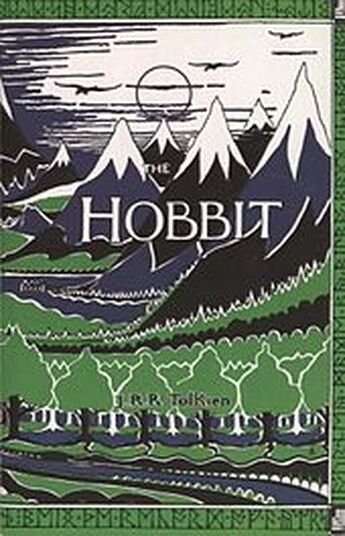
on Thror’s Map. Perhaps worst, and involving him in the most labour, was the 
dust-jacket. As originally coloured, there was a red sun and a red dragon, a red 
title, and a red flush on the great central mountain that appears on the spine or 
shelf-back. When my father sent it in in April he foresaw the objection that he 
had used too many colours (blue, green, red, and black): ‘this could be met, with 
possible improvement, by substituting white for red; and omitting the sun, or 
drawing a line round it. The presence of the sun and moon in the sky together 


refers to the magic attaching to the door.’ (See p. 56: ‘We still call it Durin’s Day 
when the last moon of Autumn and the sun are in the sky together.’) ‘We would 
suggest removing the red,’ replied Charles Furth, ‘both because the title will 
show up better in white and because the only feature about which we are not 
entirely happy in the cover is the flush on the central mountain, which makes it 
to our eyes just a trifle like a cake.’ 


J.R.R. Tolkien’s original artwork for The Hobbit jacket 


My father then re-drew the jacket design. ‘I have omitted the offending pink 
icing on the mountainous cake,’ he wrote. ‘It is now arranged in blue, black, 
green. The sun and dragon still have some red, which can be left out, in which 
case the sun will vanish or can have a thin black outline. The colours of the 
original draft were, I think, more attractive. I may say that my children (if they 
are anything to go by) much prefer the original, including the red flush on the 
central mountain - but possibly the cake-suggestion is attractive to them.’ He 
argued still for red dragon, red sun, red title on the front cover, and other details; 
but Charles Furth was firm. ‘Alas,’ he wrote, ‘the red will have to go.’ ‘The sun 
in outline is my chief sorrow,’ my father wrote when he saw the final result, ‘but 
I realize that it cannot be helped.’- The American edition had a different jacket, 
because, as the publishers said, ‘Your jacket has rather a British look which 
always seems to disconcert and depress our book trade.’ ‘I am delighted to leam 
that our jacket has a British look,’ he wrote, ‘but I would not depress or 
disconcert their book trade for anything.’ 

He drew and drew again certain subjects from The Hobbit : most especially 
Hobbiton, the Lonely Mountain, and the entrance to the Elvenking’s Halls. No. 5 
is a fine drawing of the Lonely Mountain in the possession of Mr Baird Searles 


of New York, who has most kindly allowed it to be reproduced here and 
provided a transparency. He received it as a present from Mr Paul Banham, to 
whom my father had sent it, about 1959. This shows the great meander in the 
River Running around the site of Dale; 


No. 4: Smaug flies round the Mountain 


the water-colour of Smaug flying round the Mountain (no. 4) published in 
Pictures by J.R.R. Tolkien (no. 18) shows the course of the river still to the west 
of the ruins, as on the original map. The flights of steps up to the old guard-post 
on Ravenhill can be seen at the left (see p. 240). 


No. 5: The Lonely Mountain 

No. 6 is a schematic drawing of the Lonely Mountain seen from the west, 
showing the position of the second camp and the perilous path which Bilbo with 
the dwarves Fili and Kili found (p. 206). This path brought them to a ledge 
‘narrow and breathless’, ‘with a fall of a hundred and fifty feet beside them on to 
sharp rocks below’; the ledge led into a ‘little steep-walled bay’, and ‘at its inner 
end a flat wall rose up in the lower part, close to the ground, was as smooth and 
upright as mason’s work’. This is shown in no. 7, a sketch of ‘The Back Door.’ 
Dwarves are seen pulling up goods on ropes from the second camp below, and 
above are seen two figures on the path ‘that led higher and higher on to the 
mountain’ (p. 207). 


No. 6: The Lonely Mountain from the west 


No. 7: The Back Door 


Three weeks after the publication of The Hobbit, Stanley Unwin wrote to my 
father saying that ‘a large public’ would be ‘clamouring next year to hear more 
from you about Hobbits!’ In the course of his reply (15 October 1937) he said: 

All the same I am a little perturbed. I cannot think of anything more to 
say about hobbits. Mr Baggins seems to have exhibited so fully both the 
Took and the Baggins side of their nature. But I have only too much to say, 
and much already written, about the world into which the hobbit intruded. 
You can, of course, see any of it, and say what you like about it, if and 


when you wish. I should rather like an opinion, other than that of Mr C. S. 
Lewis and my children, whether it has any value in itself, or as a marketable 
commodity, other than hobbits. But if it is true that The Hobbit has come to 
stay and more will be wanted, I will start the process of thought, and try to 
get some idea of a theme drawn from this material for treatment in a similar 
style and for a similar audience - possibly including actual hobbits. My 
daughter would like something on the Took family. One reader wants fuller 
details about Gandalf and the Necromancer. But that is too dark - much too 
dark for Richard Hughes’ snag.- I am afraid that snag appears in everything; 
though actually the presence (even if only on the borders) of the terrible is, 
I believe, what gives this world its imagined verisimilitude. A safe fairyland 
is untrue to all worlds. At the moment I am suffering like Mr Baggins from 
a touch of ‘staggerment’, and I hope I am not taking myself too seriously. 
But I must confess that your letter has aroused in me a faint hope. I mean, I 
begin to wonder whether duty and desire may not (perhaps) in future go 
more closely together. I have spent nearly all the vacation-times of 
seventeen years examining, and doing things of that sort, driven by 
immediate financial necessity (mainly medical and educational). Writing 
stories in prose or verse has been stolen, often guiltily, from time already 
mortgaged, and has been broken and ineffective. I may perhaps now do 
what I much desire to do, and not fail of financial duty. Perhaps! 

No. 8: Bag End Underhill 


The Simarillion, the long unfinished poem The Lay of Leithian (concerned with 
one of the major stories of the Elder Days), and other things went to Allen and 
Unwin in November, and were returned in the following month. In his 
accompanying letter of 15 December Stanley Unwin, urging my father To write 
another book about The Hobbit’, reported to him that The first edition is now 
sold out’, and that ‘we are expecting supplies of the reprint containing the four 
coloured illustrations- almost immediately. If any of your friends want to make 
sure of their copies of the first edition they had better buy them quickly from any 
bookseller who still has one in stock.’ 

On 16 December he replied to Stanley Unwin: 

I did not think any of the stuff I dropped on you filled the bill. .. .1 think it is 
plain that quite apart from it, a sequel or successor to The Hobbit is called 


for. I promise to give this thought and attention. But I am sure you will 
sympathize when I say that the construction of elaborate and consistent 
mythology (and two languages) rather occupies the mind, and the Silmarils 
are in my heart. So that goodness knows what will happen. Mr Baggins 
began as a comic tale among conventional and inconsistent Grimm’s fairy¬ 
tale dwarves, and got drawn into the edge of it - so that even Sauron the 
terrible peeped over the edge. And what more can hobbits do? They can be 
comic, but their comedy is suburban unless it is set against things more 
elemental. 


Three days later he wrote to Charles Furth: ‘I have written the first chapter of a 
new story about Hobbits - “A long expected party”.’ 

That was the first chapter of The Lord of the Rings. 


Christopher Tolkien 


1 When he wrote this note my father knew only of the sheet that I have 
reproduced, but two others had in fact been included in the Hobbit manuscripts 
that went to Marquette University in 1957. 

- The ‘someone’ was Elaine Griffiths, and the ‘person’ was Susan Dagnall. 
The story is told, together with the report on the book written by Rayner Unwin 
(then ten years old), in Humphrey Carpenter’s Biography, pp. 180-1. 


- A red sun and dragon, and red title and author’s name, were used on the 
cover (a truncated version of the original dust-jacket) of the reset paperback 
edition of 1975, but not on the dust-jacket of the reset hardback edition of 1978. 

- Richard Hughes had written to Stanley Unwin about The Hobbit, saying 
The only snag I can see is that many parents... may be afraid that certain parts 
of it would be too terrifying for bedtime reading.’ 

- The first impression had no pictures in colour. My father was pleased with 
the four coloured reproductions, but regretted that ‘the Eagle picture’(illustrating 
the first sentence of Chapter VI, Queer Lodgings ) had not been included - 
‘merely because I should have liked to see it reproduced.’ It was in fact included 
in the first American edition (which did not use Bilbo Comes to the Huts of the 
Raft-elves), and finally appeared in a British edition in 1978. In my note on this 
painting in Pictures (no. 9) I said that the eagle was inspired by the painting of a 
Golden Eagle by Archibald Thorburn. This has been queried on the grounds that 
the base of the eagle’s tail is white, and so must depict a White-tailed Eagle. My 
father’s eagle was a Golden Eagle, nonetheless; I remember finding the picture 
for him in T. A. Coward, The Birds of the British Isles (Vol. 1 plate 132). 
Thorburn’s painting is of a young bird, which in this species has a white base to 
the tail. 


Note on the Text 


The Hobbit was first published in September 1937. Its 1951 second edition (fifth 
impression) contains a significantly revised portion of Chapter V, “Riddles in the 
Dark,” which brings the story of The Hobbit more in line with its sequel, The 
Lord of the Rings, then in progress. Tolkien made some further revisions to the 
American edition published by Ballantine Books in February 1966, and to the 
British third edition (sixteenth impression) published by George Allen & Unwin 
later that same year. 

For the 1995 British hardcover edition, published by HarperCollins, the text of 
The Hobbit was entered into word-processing files, and a number of further 
corrections of misprints and errors were made. Since then, various editions of 
The Hobbit have been generated from that computerized text file. For the present 
text, that file has been compared again, line by line, with the earlier editions, and 
a number of further corrections have been made to present a text that, as closely 
as possible, represents Tolkien’s final intended form. 

Readers interested in details of the changes made at various times to the text 
of The Hobbit are referred to Appendix A, “Textual and Revisional Notes,” of 
The Annotated Hobbit (1988), and J.R.R. Tolkien: A Descriptive Bibliography by 
Wayne G. Hammond, with the assistance of Douglas A. Anderson (1993). 

Douglas A. Anderson 
May 2001 


H1HWIT 

F* fc. 

FMF.MF + M&FkkPXFI+ 


This is a story of long ago. At that time the languages and letters were quite 
different from ours of today. English is used to represent the languages. But two 
points may be noted. (1) In English the only correct plural of dwarf is dwarfs, 
and the adjective is dwarfish. In this story dwarves and dwarvish are used-, but 
only when speaking of the ancient people to whom Thorin Oakenshield and his 
companions belonged. (2) Ore is not an English word. It occurs in one or two 
places but is usually translated goblin (or hobgoblin for the larger kinds). Ore is 
the hobbits’ form of the name given at that time to these creatures, and it is not 
connected at all with our ore, ork, applied to sea-animals of dolphin-kind. 

Runes were old letters originally used for cutting or scratching on wood, 
stone, or metal, and so were thin and angular. At the time of this tale only the 
Dwarves made regular use of them, especially for private or secret records. Their 
runes are in this book represented by English runes, which are known now to 
few people. If the runes on Thror’s Map are compared with the transcriptions 
into modern letters (on pp. 24 and 59-60), the alphabet, adapted to modern 
English, can be discovered and the above runic title also read. On the Map all the 
normal runes are found, except for X. I and U are used for J and V. There was 
no rune for Q (use CW); nor for Z (the dwarf-rune A may be used if required). It 
will be found, however, that some single runes stand for two modern letters: th, 
ng, ee; other runes of the same kind ( 't'ea and Wst) were also sometimes used. 
The secret door was marked DM. From the side a hand pointed to this, and under 
it was written: 

fl hM Tftt MIXN FM PPrKf&RMFht FP. 

The last two runes are the initials of Thror and Thrain. The moon-runes read 
by Elrond were: 

htP+M &FS FM XRMfil-'itP+M MPFI + F M Mth *1 H KPFKKH F+ 

H-FM SMttl « -*ih+ FIF HI rFht ri>St l»r wnUl + h MFft 

pirr ■iMi+M-ncF+ fm hrifoNPri-i 

On the Map the compass points are marked in runes, with East at the top, as 


usual in dwarf-maps, and so read clockwise: E(ast), S(outh),W(est), N(orth). 
-The reason for this use is given in The Lord of the Rings, Appendix F. 


Follow this link to uncover an alternative version of this artwork 


The Hill: Hobbiton-across-the-Water 


Chapter I 

An Unexpected Party 


In a hole in the ground there lived a hobbit. Not a nasty, dirty, wet hole, filled 
with the ends of worms and an oozy smell, nor yet a dry, bare, sandy hole with 
nothing in it to sit down on or to eat: it was a hobbit-hole, and that means 
comfort. 

It had a perfectly round door like a porthole, painted green, with a shiny 
yellow brass knob in the exact middle. The door opened on to a tube-shaped hall 
like a tunnel: a very comfortable tunnel without smoke, with panelled walls, and 
floors tiled and carpeted, provided with polished chairs, and lots and lots of pegs 
for hats and coats—the hobbit was fond of visitors. The tunnel wound on and on, 
going fairly but not quite straight into the side of the hill—The Hill, as all the 
people for many miles round called it—and many little round doors opened out 
of it, first on one side and then on another. No going upstairs for the hobbit: 
bedrooms, bathrooms, cellars, pantries (lots of these), wardrobes (he had whole 
rooms devoted to clothes), kitchens, dining-rooms, all were on the same floor, 
and indeed on the same passage. The best rooms were all on the left-hand side 
(going in), for these were the only ones to have windows, deep-set round 
windows looking over his garden, and meadows beyond, sloping down to the 
river. 

This hobbit was a very well-to-do hobbit, and his name was Baggins. The 
Bagginses had lived in the neighbourhood of The Hill for time out of mind, and 
people considered them very respectable, not only because most of them were 
rich, but also because they never had any adventures or did anything unexpected: 
you could tell what a Baggins would say on any question without the bother of 
asking him. This is a story of how a Baggins had an adventure, and found 
himself doing and saying things altogether unexpected. He may have lost the 
neighbours’ respect, but he gained—well, you will see whether he gained 
anything in the end. 

The mother of our particular hobbit—what is a hobbit? I suppose hobbits need 


some description nowadays, since they have become rare and shy of the Big 
People, as they call us. They are (or were) a little people, about half our height, 
and smaller than the bearded Dwarves. Hobbits have no beards. There is little or 
no magic about them, except the ordinary everyday sort which helps them to 
disappear quietly and quickly when large stupid folk like you and me come 
blundering along, making a noise like elephants which they can hear a mile off. 
They are inclined to be fat in the stomach; they dress in bright colours (chiefly 
green and yellow); wear no shoes, because their feet grow natural leathery soles 
and thick warm brown hair like the stuff on their heads (which is curly); have 
long clever brown fingers, good-natured faces, and laugh deep fruity laughs 
(especially after dinner, which they have twice a day when they can get it). Now 
you know enough to go on with. As I was saying, the mother of this hobbit—of 
Bilbo Baggins, that is—was the famous Belladonna Took, one of the three 
remarkable daughters of the Old Took, head of the hobbits who lived across The 
Water, the small river that ran at the foot of The Hill. It was often said (in other 
families) that long ago one of the Took ancestors must have taken a fairy wife. 
That was, of course, absurd, but certainly there was still something not entirely 
hobbitlike about them, and once in a while members of the Took-clan would go 
and have adventures. They discreetly disappeared, and the family hushed it up; 
but the fact remained that the Tooks were not as respectable as the Bagginses, 
though they were undoubtedly richer. 

Not that Belladonna Took ever had any adventures after she became Mrs. 
Bungo Baggins. Bungo, that was Bilbo’s father, built the most luxurious hobbit- 
hole for her (and partly with her money) that was to be found either under The 
Hill or over The Hill or across The Water, and there they remained to the end of 
their days. Still it is probable that Bilbo, her only son, although he looked and 
behaved exactly like a second edition of his solid and comfortable father, got 
something a bit queer in his make-up from the Took side, something that only 
waited for a chance to come out. The chance never arrived, until Bilbo Baggins 
was grown up, being about fifty years old or so, and living in the beautiful 
hobbit-hole built by his father, which I have just described for you, until he had 
in fact apparently settled down immovably. 

By some curious chance one morning long ago in the quiet of the world, when 
there was less noise and more green, and the hobbits were still numerous and 
prosperous, and Bilbo Baggins was standing at his door after breakfast smoking 
an enormous long wooden pipe that reached nearly down to his woolly toes 
(neatly brushed)—Gandalf came by. Gandalf! If you had heard only a quarter of 
what I have heard about him, and I have only heard very little of all there is to 
hear, you would be prepared for any sort of remarkable tale. Tales and 


adventures sprouted up all over the place wherever he went, in the most 
extraordinary fashion. He had not been down that way under The Hill for ages 
and ages, not since his friend the Old Took died, in fact, and the hobbits had 
almost forgotten what he looked like. He had been away over The Hill and 
across The Water on businesses of his own since they were all small hobbit-boys 
and hobbit-girls. 

All that the unsuspecting Bilbo saw that morning was an old man with a staff. 
He had a tall pointed blue hat, a long grey cloak, a silver scarf over which his 
long white beard hung down below his waist, and immense black boots. 

“Good Morning!” said Bilbo, and he meant it. The sun was shining, and the 
grass was very green. But Gandalf looked at him from under long bushy 
eyebrows that stuck out further than the brim of his shady hat. 

“What do you mean?” he said. “Do you wish me a good morning, or mean 
that it is a good morning whether I want it or not; or that you feel good this 
morning; or that it is a morning to be good on?” 

“All of them at once,” said Bilbo. “And a very fine morning for a pipe of 
tobacco out of doors, into the bargain. If you have a pipe about you, sit down and 
have a fill of mine! There’s no hurry, we have all the day before us!” Then Bilbo 
sat down on a seat by his door, crossed his legs, and blew out a beautiful grey 
ring of smoke that sailed up into the air without breaking and floated away over 
The Hill. 

“Very pretty!” said Gandalf. “But I have no time to blow smoke-rings this 
morning. I am looking for someone to share in an adventure that I am arranging, 
and it’s very difficult to find anyone.” 

“I should think so—in these parts! We are plain quiet folk and have no use for 
adventures. Nasty disturbing uncomfortable things! Make you late for dinner! I 
can’t think what anybody sees in them,” said our Mr. Baggins, and stuck one 
thumb behind his braces, and blew out another even bigger smoke-ring. Then he 
took out his morning letters, and began to read, pretending to take no more 
notice of the old man. He had decided that he was not quite his sort, and wanted 
him to go away. But the old man did not move. He stood leaning on his stick and 
gazing at the hobbit without saying anything, till Bilbo got quite uncomfortable 
and even a little cross. 

“Good morning!” he said at last. “We don’t want any adventures here, thank 
you! You might try over The Hill or across The Water.” By this he meant that the 
conversation was at an end. 

“What a lot of things you do use Good morning for!” said Gandalf. “Now you 
mean that you want to get rid of me, and that it won’t be good till I move off.” 

“Not at all, not at all, my dear sir! Let me see, I don’t think I know your 


name?” 

“Yes, yes, my dear sir—and I do know your name, Mr. Bilbo Baggins. And 
you do know my name, though you don’t remember that I belong to it. I am 
Gandalf, and Gandalf means me! To think that I should have lived to be good- 
morninged by Belladonna Took’s son, as if I was selling buttons at the door!” 

“Gandalf, Gandalf! Good gracious me! Not the wandering wizard that gave 
Old Took a pair of magic diamond studs that fastened themselves and never 
came undone till ordered? Not the fellow who used to tell such wonderful tales 
at parties, about dragons and goblins and giants and the rescue of princesses and 
the unexpected luck of widows’ sons? Not the man that used to make such 
particularly excellent fireworks! I remember those! Old Took used to have them 
on Midsummer’s Eve. Splendid! They used to go up like great lilies and 
snapdragons and laburnums of fire and hang in the twilight all evening!” You 
will notice already that Mr. Baggins was not quite so prosy as he liked to 
believe, also that he was very fond of flowers. “Dear me!” he went on. “Not the 
Gandalf who was responsible for so many quiet lads and lasses going off into the 
Blue for mad adventures? Anything from climbing trees to visiting elves—or 
sailing in ships, sailing to other shores! Bless me, life used to be quite inter—I 
mean, you used to upset things badly in these parts once upon a time. I beg your 
pardon, but I had no idea you were still in business.” 

“Where else should I be?” said the wizard. “All the same I am pleased to find 
you remember something about me. You seem to remember my fireworks 
kindly, at any rate, and that is not without hope. Indeed for your old grandfather 
Took’s sake, and for the sake of poor Belladonna, I will give you what you asked 
for.” 

“I beg your pardon, I haven’t asked for anything!” 

“Yes, you have! Twice now. My pardon. I give it you. In fact I will go so far 
as to send you on this adventure. Very amusing for me, very good for you—and 
profitable too, very likely, if you ever get over it.” 

“Sorry! I don’t want any adventures, thank you. Not today. Good morning! 
But please come to tea—any time you like! Why not tomorrow? Come 
tomorrow! Good bye!” With that the hobbit turned and scuttled inside his round 
green door, and shut it as quickly as he dared, not to seem rude. Wizards after all 
are wizards. 

“What on earth did I ask him to tea for!” he said to himself, as he went to the 
pantry. He had only just had breakfast, but he thought a cake or two and a drink 
of something would do him good after his fright. 

Gandalf in the meantime was still standing outside the door, and laughing long 
but quietly. After a while he stepped up, and with the spike on his staff scratched 


a queer sign on the hobbit’s beautiful green front-door. Then he strode away, just 
about the time when Bilbo was finishing his second cake and beginning to think 
that he had escaped adventures very well. 

The next day he had almost forgotten about Gandalf. He did not remember 
things very well, unless he put them down on his Engagement Tablet: like this: 
Gandalf Tea Wednesday. Yesterday he had been too flustered to do anything of 
the kind. 

Just before tea-time there came a tremendous ring on the front-door bell, and 
then he remembered! He rushed and put on the kettle, and put out another cup 
and saucer, and an extra cake or two, and ran to the door. 

“I am so sorry to keep you waiting!” he was going to say, when he saw that it 
was not Gandalf at all. It was a dwarf with a blue beard tucked into a golden 
belt, and very bright eyes under his dark-green hood. As soon as the door was 
opened, he pushed inside, just as if he had been expected. 

He hung his hooded cloak on the nearest peg, and “Dwalin at your service!” 
he said with a low bow. 

“Bilbo Baggins at yours!” said the hobbit, too surprised to ask any questions 
for the moment. When the silence that followed had become uncomfortable, he 
added: “I am just about to take tea; pray come and have some with me.” A little 
stiff perhaps, but he meant it kindly. And what would you do, if an uninvited 
dwarf came and hung his things up in your hall without a word of explanation? 

They had not been at table long, in fact they had hardly reached the third cake, 
when there came another even louder ring at the bell. 

“Excuse me! ” said the hobbit, and off he went to the door. 

“So you have got here at last!” That was what he was going to say to Gandalf 
this time. But it was not Gandalf. Instead there was a very old-looking dwarf on 
the step with a white beard and a scarlet hood; and he too hopped inside as soon 
as the door was open, just as if he had been invited. 

“I see they have begun to arrive already,” he said when he caught sight of 
Dwalin’s green hood hanging up. He hung his red one next to it, and “Balin at 
your service!” he said with his hand on his breast. 

“Thank you!” said Bilbo with a gasp. It was not the correct thing to say, but 
they have begun to arrive had flustered him badly. He liked visitors, but he liked 
to know them before they arrived, and he preferred to ask them himself. He had 
a horrible thought that the cakes might run short, and then he—as the host: he 
knew his duty and stuck to it however painful—he might have to go without. 

“Come along in, and have some tea!” he managed to say after taking a deep 
breath. 

“A little beer would suit me better, if it is all the same to you, my good sir,” 


said Balin with the white beard. “But I don’t mind some cake—seed-cake, if you 
have any.” 

“Lots!” Bilbo found himself answering, to his own surprise; and he found 
himself scuttling off, too, to the cellar to fill a pint beer-mug, and then to a 
pantry to fetch two beautiful round seed-cakes which he had baked that 
afternoon for his after-supper morsel. 

When he got back Balin and Dwalin were talking at the table like old friends 
(as a matter of fact they were brothers). Bilbo plumped down the beer and the 
cake in front of them, when loud came a ring at the bell again, and then another 
ring. 

“Gandalf for certain this time,” he thought as he puffed along the passage. But 
it was not. It was two more dwarves, both with blue hoods, silver belts, and 
yellow beards; and each of them carried a bag of tools and a spade. In they 
hopped, as soon as the door began to open—Bilbo was hardly surprised at all. 

“What can I do for you, my dwarves?” he said. 

“Kili at your service!” said the one. “And Fili!” added the other; and they both 
swept off their blue hoods and bowed. 

“At yours and your family’s!” replied Bilbo, remembering his manners this 
time. 

“Dwalin and Balin here already, I see,” said Kili. “Let us join the throng!” 

“Throng!” thought Mr. Baggins. “I don’t like the sound of that. I really must 
sit down for a minute and collect my wits, and have a drink.” He had only just 
had a sip—in the corner, while the four dwarves sat round the table, and talked 
about mines and gold and troubles with the goblins, and the depredations of 
dragons, and lots of other things which he did not understand, and did not want 
to, for they sounded much too adventurous—when, ding-dong-a-ling-dang, his 
bell rang again, as if some naughty little hobbit-boy was trying to pull the handle 
off. 

“Someone at the door!” he said, blinking. 

“Some four, I should say by the sound,” said Fili. “Besides, we saw them 
coming along behind us in the distance.” 

The poor little hobbit sat down in the hall and put his head in his hands, and 
wondered what had happened, and what was going to happen, and whether they 
would all stay to supper. Then the bell rang again louder than ever, and he had to 
mn to the door. It was not four after all, it was five. Another dwarf had come 
along while he was wondering in the hall. He had hardly turned the knob, before 
they were all inside, bowing and saying “at your service” one after another. Dori, 
Nori, Ori, Oin, and Gloin were their names; and very soon two purple hoods, a 
grey hood, a brown hood, and a white hood were hanging on the pegs, and off 


they marched with their broad hands stuck in their gold and silver belts to join 
the others. Already it had almost become a throng. Some called for ale, and 
some for porter, and one for coffee, and all of them for cakes; so the hobbit was 
kept very busy for a while. 

A big jug of coffee had just been set in the hearth, the seed-cakes were gone, 
and the dwarves were starting on a round of buttered scones, when there came— 
a loud knock. Not a ring, but a hard rat-tat on the hobbit’s beautiful green door. 
Somebody was banging with a stick! 

Bilbo rushed along the passage, very angry, and altogether bewildered and 
bewuthered—this was the most awkward Wednesday he ever remembered. He 
pulled open the door with a jerk, and they all fell in, one on top of the other. 
More dwarves, four more! And there was Gandalf behind, leaning on his staff 
and laughing. He had made quite a dent on the beautiful door; he had also, by the 
way, knocked out the secret mark that he had put there the morning before. 

“Carefully! Carefully!” he said. “It is not like you, Bilbo, to keep friends 
waiting on the mat, and then open the door like a pop-gun! Let me introduce 
Bifur, Bofur, Bombur, and especially Thorin!” 

“At your service!” said Bifur, Bofur, and Bombur standing in a row. Then they 
hung up two yellow hoods and a pale green one; and also a sky-blue one with a 
long silver tassel. This last belonged to Thorin, an enormously important dwarf, 
in fact no other than the great Thorin Oakenshield himself, who was not at all 
pleased at falling flat on Bilbo’s mat with Bifur, Bofur, and Bombur on top of 
him. For one thing Bombur was immensely fat and heavy. Thorin indeed was 
very haughty, and said nothing about service; but poor Mr. Baggins said he was 
sorry so many times, that at last he grunted “pray don’t mention it,” and stopped 
frowning. 

“Now we are all here!” said Gandalf, looking at the row of thirteen hoods— 
the best detachable party hoods—and his own hat hanging on the pegs. “Quite a 
merry gathering! I hope there is something left for the late-comers to eat and 
drink! What’s that? Tea! No thank you! A little red wine, I think for me.” 

“And for me,” said Thorin. 

“And raspberry jam and apple-tart,” said Bifur. 

“And mince-pies and cheese,” said Bofur. 

“And pork-pie and salad,” said Bombur. 

“And more cakes—and ale—and coffee, if you don’t mind,” called the other 
dwarves through the door. 

“Put on a few eggs, there’s a good fellow!” Gandalf called after him, as the 
hobbit stumped off to the pantries. “And just bring out the cold chicken and 
pickles!” 


“Seems to know as much about the inside of my larders as I do myself!” 
thought Mr. Baggins, who was feeling positively flummoxed, and was beginning 
to wonder whether a most wretched adventure had not come right into his house. 
By the time he had got all the bottles and dishes and knives and forks and glasses 
and plates and spoons and things piled up on big trays, he was getting very hot, 
and red in the face, and annoyed. 

“Confusticate and bebother these dwarves!” he said aloud. “Why don’t they 
come and lend a hand?” Lo and behold! there stood Balin and Dwalin at the door 
of the kitchen, and Fili and Kili behind them, and before he could say knife they 
had whisked the trays and a couple of small tables into the parlour and set out 
everything afresh. 

Gandalf sat at the head of the party with the thirteen dwarves all round: and 
Bilbo sat on a stool at the fireside, nibbling at a biscuit (his appetite was quite 
taken away), and trying to look as if this was all perfectly ordinary and not in the 
least an adventure. The dwarves ate and ate, and talked and talked, and time got 
on. At last they pushed their chairs back, and Bilbo made a move to collect the 
plates and glasses. 

“I suppose you will all stay to supper?” he said in his politest unpressing 
tones. 

“Of course!” said Thorin. “And after. We shan’t get through the business till 
late, and we must have some music first. Now to clear up!” 

Thereupon the twelve dwarves—not Thorin, he was too important, and stayed 
talking to Gandalf—jumped to their feet, and made tall piles of all the things. 
Off they went, not waiting for trays, balancing columns of plates, each with a 
bottle on the top, with one hand, while the hobbit ran after them almost 
squeaking with fright: “please be careful!” and “please, don’t trouble! I can 
manage.” But the dwarves only started to sing: 


J.R.R. Tolkien sings 'Chip the glasses and crack the plates!' 


Chip the glasses and crack the plates! 
Blunt the knives and bend the forks! 
That’s what Bilbo Baggins hates- 
Smash the bottles and burn the corks! 
Cut the cloth and tread on the fat! 
Pour the milk on the pantry floor! 


Leave the bones on the bedroom mat! 

Splash the wine on every door! 

Dump the crocks in a boiling bowl; 

Pound them up with a thumping pole; 

And when you’ve finished, if any are whole, 

Send them down the hall to roll! 

That’s what Bilbo Baggins hates! 

So, carefully! carefully with the plates! 

And of course they did none of these dreadful things, and everything was 
cleaned and put away safe as quick as lightning, while the hobbit was turning 
round and round in the middle of the kitchen trying to see what they were doing. 
Then they went back, and found Thorin with his feet on the fender smoking a 
pipe. He was blowing the most enormous smoke-rings, and wherever he told one 
to go, it went—up the chimney, or behind the clock on the mantelpiece, or under 
the table, or round and round the ceiling; but wherever it went it was not quick 
enough to escape Gandalf. Pop! he sent a smaller smoke-ring from his short 
clay-pipe straight through each one of Thorin’s. Then Gandalf’s smoke-ring 
would go green and come back to hover over the wizard’s head. He had a cloud 
of them about him already, and in the dim light it made him look strange and 
sorcerous. Bilbo stood still and watched—he loved smoke-rings—and then he 
blushed to think how proud he had been yesterday morning of the smoke-rings 
he had sent up the wind over The Hill. 

“Now for some music!” said Thorin. “Bring out the instruments!” 

Kili and Fili rushed for their bags and brought back little fiddles; Dori, Nori, 
and Ori brought out flutes from somewhere inside their coats; Bombur produced 
a drum from the hall; Bifur and Bofur went out too, and came back with clarinets 
that they had left among the walking-sticks. Dwalin and Balin said: “Excuse me, 
I left mine in the porch!” “Just bring mine in with you!” said Thorin. They came 
back with viols as big as themselves, and with Thorin’s harp wrapped in a green 
cloth. It was a beautiful golden harp, and when Thorin struck it the music began 
all at once, so sudden and sweet that Bilbo forgot everything else, and was swept 
away into dark lands under strange moons, far over The Water and very far from 
his hobbit-hole under The Hill. 

The dark came into the room from the little window that opened in the side of 
The Hill; the firelight flickered—it was April—and still they played on, while 
the shadow of Gandalf’s beard wagged against the wall. 

The dark filled all the room, and the fire died down, and the shadows were 
lost, and still they played on. And suddenly first one and then another began to 
sing as they played, deep-throated singing of the dwarves in the deep places of 


their ancient homes; and this is like a fragment of their song, if it can be like 
their song without their music. 


J.R.R. Tolkien reads 'Far over the Misty Mountains cold' 


Far over the misty mountains cold 
To dungeons deep and caverns old 
We must away ere break of day 
To seek the pale enchanted gold. 

The dwarves of yore made mighty spells, 

While hammers fell like ringing bells 
In places deep, where dark things sleep, 

In hollow halls beneath the fells. 

For ancient king and elvish lord 
There many a gleaming golden hoard 
They shaped and wrought, and light they caught 
To hide in gems on hilt of sword. 

On silver necklaces they strung 

The flowering stars, on crowns they hung 

The dragon-fire, in twisted wire 

They meshed the light of moon and sun. 

Far over the misty mountains cold 
To dungeons deep and caverns old 
We must away, ere break of day, 

To claim our long-forgotten gold. 

Goblets they carved there for themselves 
And harps of gold; where no man delves 
There lay they long, and many a song 
Was sung unheard by men or elves. 

The pines were roaring on the height, 

The winds were moaning in the night. 

The fire was red, it flaming spread; 

The trees like torches blazed with light. 

The bells were ringing in the dale 
And men looked up with faces pale; 

The dragon’s ire more fierce than fire 


Laid low their towers and houses frail. 

The mountain smoked beneath the moon; 

The dwarves, they heard the tramp of doom. 

They fled their hall to dying fall 
Beneath his feet, beneath the moon. 

Far over the misty mountains grim 
To dungeons deep and caverns dim 
We must away, ere break of day, 

To win our harps and gold from him! 

As they sang the hobbit felt the love of beautiful things made by hands and by 
cunning and by magic moving through him, a fierce and a jealous love, the 
desire of the hearts of dwarves. Then something Tookish woke up inside him, 
and he wished to go and see the great mountains, and hear the pine-trees and the 
waterfalls, and explore the caves, and wear a sword instead of a walking-stick. 
He looked out of the window. The stars were out in a dark sky above the trees. 
He thought of the jewels of the dwarves shining in dark caverns. Suddenly in the 
wood beyond The Water a flame leapt up—probably somebody lighting a wood- 
fire—and he thought of plundering dragons settling on his quiet Hill and 
kindling it all to flames. He shuddered; and very quickly he was plain Mr. 
Baggins of Bag-End, Under-Hill, again. 

He got up trembling. He had less than half a mind to fetch the lamp, and more 
than half a mind to pretend to, and go and hide behind the beer-barrels in the 
cellar, and not come out again until all the dwarves had gone away. Suddenly he 
found that the music and the singing had stopped, and they were all looking at 
him with eyes shining in the dark. 

“Where are you going?” said Thorin, in a tone that seemed to show that he 
guessed both halves of the hobbit’s mind. 

“What about a little light?” said Bilbo apologetically. 

“We like the dark,” said all the dwarves. “Dark for dark business! There are 
many hours before dawn.” 

“Of course!” said Bilbo, and sat down in a hurry. He missed the stool and sat 
in the fender, knocking over the poker and shovel with a crash. 

“Hush!” said Gandalf. “Let Thorin speak!” And this is how Thorin began. 

“Gandalf, dwarves and Mr. Baggins! We are met together in the house of our 
friend and fellow conspirator, this most excellent and audacious hobbit—may 
the hair on his toes never fall out! all praise to his wine and ale!—” He paused 
for breath and for a polite remark from the hobbit, but the compliments were 
quite lost on poor Bilbo Baggins, who was wagging his mouth in protest at being 
called audacious and worst of all fellow conspirator, though no noise came out, 


he was so flummoxed. So Thorin went on: 

“We are met to discuss our plans, our ways, means, policy and devices. We 
shall soon before the break of day start on our long journey, a journey from 
which some of us, or perhaps all of us (except our friend and counsellor, the 
ingenious wizard Gandalf) may never return. It is a solemn moment. Our object 
is, I take it, well known to us all. To the estimable Mr. Baggins, and perhaps to 
one or two of the younger dwarves (I think I should be right in naming Kili and 
Fili, for instance), the exact situation at the moment may require a little brief 
explanation—” 

This was Thorin’s style. He was an important dwarf. If he had been allowed, 
he would probably have gone on like this until he was out of breath, without 
telling any one there anything that was not known already. But he was rudely 
interrupted. Poor Bilbo couldn’t bear it any longer. At may never return he began 
to feel a shriek coming up inside, and very soon it burst out like the whistle of an 
engine coming out of a tunnel. All the dwarves sprang up, knocking over the 
table. Gandalf struck a blue light on the end of his magic staff, and in its 
firework glare the poor little hobbit could be seen kneeling on the hearth-rug, 
shaking like a jelly that was melting. Then he fell flat on the floor, and kept on 
calling out “struck by lightning, struck by lightning!” over and over again; and 
that was all they could get out of him for a long time. So they took him and laid 
him out of the way on the drawing-room sofa with a drink at his elbow, and they 
went back to their dark business. 

“Excitable little fellow,” said Gandalf, as they sat down again. “Gets funny 
queer fits, but he is one of the best, one of the best—as fierce as a dragon in a 
pinch.” 

If you have ever seen a dragon in a pinch, you will realize that this was only 
poetical exaggeration applied to any hobbit, even to Old Took’s great-grand- 
uncle Bullroarer, who was so huge (for a hobbit) that he could ride a horse. He 
charged the ranks of the goblins of Mount Gram in the Battle of the Green 
Fields, and knocked their king Golfimbul’s head clean off with a wooden club. It 
sailed a hundred yards through the air and went down a rabbit-hole, and in this 
way the battle was won and the game of Golf invented at the same moment. 

In the meanwhile, however, Bullroarer’s gentler descendant was reviving in 
the drawing-room. After a while and a drink he crept nervously to the door of the 
parlour. This is what he heard, Gloin speaking: “Humph!” (or some snort more 
or less like that). “Will he do, do you think? It is all very well for Gandalf to talk 
about this hobbit being fierce, but one shriek like that in a moment of excitement 
would be enough to wake the dragon and all his relatives, and kill the lot of us. I 
think it sounded more like fright than excitement! In fact, if it had not been for 


the sign on the door, I should have been sure we had come to the wrong house. 
As soon as I clapped eyes on the little fellow bobbing and puffing on the mat, I 
had my doubts. He looks more like a grocer than a burglar!” 

Then Mr. Baggins turned the handle and went in. The Took side had won. He 
suddenly felt he would go without bed and breakfast to be thought fierce. As for 
little fellow bobbing on the mat it almost made him really fierce. Many a time 
afterwards the Baggins part regretted what he did now, and he said to himself: 
“Bilbo, you were a fool; you walked right in and put your foot in it.” 

“Pardon me,” he said, “if I have overheard words that you were saying. I don’t 
pretend to understand what you are talking about, or your reference to burglars, 
but I think I am right in believing” (this is what he called being on his dignity) 
“that you think I am no good. I will show you. I have no signs on my door—it 
was painted a week ago—, and I am quite sure you have come to the wrong 
house. As soon as I saw your funny faces on the door-step, I had my doubts. But 
treat it as the right one. Tell me what you want done, and I will try it, if I have to 
walk from here to the East of East and fight the wild Were-worms in the Last 
Desert. I had a great-great-great-grand-uncle once, Bullroarer Took, and—” 

“Yes, yes, but that was long ago,” said Gloin. “I was talking about you. And I 
assure you there is a mark on this door—the usual one in the trade, or used to be. 
Burglar wants a good job, plenty of Excitement and reasonable Reward, that’s 
how it is usually read. You can say Expert Treasure-hunter instead of Burglar if 
you like. Some of them do. It’s all the same to us. Gandalf told us that there was 
a man of the sort in these parts looking for a Job at once, and that he had 
arranged for a meeting here this Wednesday tea-time.” 

“Of course there is a mark,” said Gandalf. “I put it there myself. For very 
good reasons. You asked me to find the fourteenth man for your expedition, and 
I chose Mr. Baggins. Just let any one say I chose the wrong man or the wrong 
house, and you can stop at thirteen and have all the bad luck you like, or go back 
to digging coal.” 

He scowled so angrily at Gloin that the dwarf huddled back in his chair; and 
when Bilbo tried to open his mouth to ask a question, he turned and frowned at 
him and stuck out his bushy eyebrows, till Bilbo shut his mouth tight with a 
snap. “That’s right,” said Gandalf. “Let’s have no more argument. I have chosen 
Mr. Baggins and that ought to be enough for all of you. If I say he is a Burglar, a 
Burglar he is, or will be when the time comes. There is a lot more in him than 
you guess, and a deal more than he has any idea of himself. You may (possibly) 
all live to thank me yet. Now Bilbo, my boy, fetch the lamp, and let’s have a 
little light on this!” 

On the table in the light of a big lamp with a red shade he spread a piece of 


parchment rather like a map. 

“This was made by Thror, your grandfather, Thorin,” he said in answer to the 
dwarves’ excited questions. “It is a plan of the Mountain.” 

“I don’t see that this will help us much,” said Thorin disappointedly after a 
glance. “I remember the Mountain well enough and the lands about it. And I 
know where Mirkwood is, and the Withered Heath where the great dragons 
bred.” 

“There is a dragon marked in red on the Mountain,” said Balin, “but it will be 
easy enough to find him without that, if ever we arrive there.” 

“There is one point that you haven’t noticed,” said the wizard, “and that is the 
secret entrance. You see that rune on the West side, and the hand pointing to it 
from the other runes? That marks a hidden passage to the Lower Halls.” (Look at 
the map in this chapter, and you will see there the runes in red.) 


Thror’s Map 

Follow this link to uncover an alternative version of this artwork 

“It may have been secret once,” said Thorin, “but how do we know that it is 
secret any longer? Old Smaug has lived there long enough now to find out 
anything there is to know about those caves.” 

“He may—but he can’t have used it for years and years.” 

“Why?” 


“Because it is too small. 'Five feet high the door and three may walk abreast’ 
say the runes, but Smaug could not creep into a hole that size, not even when he 
was a young dragon, certainly not after devouring so many of the dwarves and 
men of Dale.” 

“It seems a great big hole to me,” squeaked Bilbo (who had no experience of 
dragons and only of hobbit-holes). He was getting excited and interested again, 
so that he forgot to keep his mouth shut. He loved maps, and in his hall there 
hung a large one of the Country Round with all his favourite walks marked on it 
in red ink. “How could such a large door be kept secret from everybody outside, 
apart from the dragon?” he asked. He was only a little hobbit you must 
remember. 

“In lots of ways,” said Gandalf. “But in what way this one has been hidden we 
don’t know without going to see. From what it says on the map I should guess 
there is a closed door which has been made to look exactly like the side of the 
Mountain. That is the usual dwarves’ method—I think that is right, isn’t it?” 

“Quite right,” said Thorin. 

“Also,” went on Gandalf, “I forgot to mention that with the map went a key, a 
small and curious key. Here it is!” he said, and handed to Thorin a key with a 
long barrel and intricate wards, made of silver. “Keep it safe!” 

“Indeed I will,” said Thorin, and he fastened it upon a fine chain that hung 
about his neck and under his jacket. “Now things begin to look more hopeful. 
This news alters them much for the better. So far we have had no clear idea what 
to do. We thought of going East, as quiet and careful as we could, as far as the 
Long Lake. After that the trouble would begin—.” 

“A long time before that, if I know anything about the roads East,” interrupted 
Gandalf. 

“We might go from there up along the River Running,” went on Thorin taking 
no notice, “and so to the ruins of Dale—the old town in the valley there, under 
the shadow of the Mountain. But we none of us liked the idea of the Front Gate. 
The river runs right out of it through the great cliff at the South of the Mountain, 
and out of it comes the dragon too—far too often, unless he has changed his 
habits.” 

“That would be no good,” said the wizard, “not without a mighty Warrior, 
even a Hero. I tried to find one; but warriors are busy fighting one another in 
distant lands, and in this neighbourhood heroes are scarce, or simply not to be 
found. Swords in these parts are mostly blunt, and axes are used for trees, and 
shields as cradles or dish-covers; and dragons are comfortably far-off (and 
therefore legendary). That is why I settled on burglary —especially when I 
remembered the existence of a Side-door. And here is our little Bilbo Baggins, 


the burglar, the chosen and selected burglar. So now let’s get on and make some 
plans.” 

“Very well then,” said Thorin, “supposing the burglar-expert gives us some 
ideas or suggestions.” He turned with mock-politeness to Bilbo. 

“First I should like to know a bit more about things,” said he, feeling all 
confused and a bit shaky inside, but so far still Tookishly determined to go on 
with things. “I mean about the gold and the dragon, and all that, and how it got 
there, and who it belongs to, and so on and further.” 

“Bless me!” said Thorin, “haven’t you got a map? and didn’t you hear our 
song? and haven’t we been talking about all this for hours?” 

“All the same, I should like it all plain and clear,” said he obstinately, putting 
on his business manner (usually reserved for people who tried to borrow money 
off him), and doing his best to appear wise and prudent and professional and live 
up to Gandalf’s recommendation. “Also I should like to know about risks, out- 
of-pocket expenses, time required and remuneration, and so forth”—by which he 
meant: “What am I going to get out of it? and am I going to come back alive?” 

“O very well,” said Thorin. “Long ago in my grandfather Thror’s time our 
family was driven out of the far North, and came back with all their wealth and 
their tools to this Mountain on the map. It had been discovered by my far 
ancestor, Thrain the Old, but now they mined and they tunnelled and they made 
huger halls and greater workshops—and in addition I believe they found a good 
deal of gold and a great many jewels too. Anyway they grew immensely rich and 
famous, and my grandfather was King under the Mountain again, and treated 
with great reverence by the mortal men, who lived to the South, and were 
gradually spreading up the Running River as far as the valley overshadowed by 
the Mountain. They built the merry town of Dale there in those days. Kings used 
to send for our smiths, and reward even the least skillful most richly. Fathers 
would beg us to take their sons as apprentices, and pay us handsomely, 
especially in food-supplies, which we never bothered to grow or find for 
ourselves. Altogether those were good days for us, and the poorest of us had 
money to spend and to lend, and leisure to make beautiful things just for the fun 
of it, not to speak of the most marvellous and magical toys, the like of which is 
not to be found in the world now-a-days. So my grandfather’s halls became full 
of armour and jewels and carvings and cups, and the toy market of Dale was the 
wonder of the North. 

“Undoubtedly that was what brought the dragon. Dragons steal gold and 
jewels, you know, from men and elves and dwarves, wherever they can find 
them; and they guard their plunder as long as they live (which is practically for 
ever, unless they are killed), and never enjoy a brass ring of it. Indeed they 


hardly know a good bit of work from a bad, though they usually have a good 
notion of the current market value; and they can’t make a thing for themselves, 
not even mend a little loose scale of their armour. There were lots of dragons in 
the North in those days, and gold was probably getting scarce up there, with the 
dwarves flying south or getting killed, and all the general waste and destruction 
that dragons make going from bad to worse. There was a most specially greedy, 
strong and wicked worm called Smaug. One day he flew up into the air and 
came south. The first we heard of it was a noise like a hurricane coming from the 
North, and the pine-trees on the Mountain creaking and cracking in the wind. 
Some of the dwarves who happened to be outside (I was one luckily—a fine 
adventurous lad in those days, always wandering about, and it saved my life that 
day)—well, from a good way off we saw the dragon settle on our mountain in a 
spout of flame. Then he came down the slopes and when he reached the woods 
they all went up in fire. By that time all the bells were ringing in Dale and the 
warriors were arming. The dwarves rushed out of their great gate; but there was 
the dragon waiting for them. None escaped that way. The river rushed up in 
steam and a fog fell on Dale, and in the fog the dragon came on them and 
destroyed most of the warriors—the usual unhappy story, it was only too 
common in those days. Then he went back and crept in through the Front Gate 
and routed out all the halls, and lanes, and tunnels, alleys, cellars, mansions and 
passages. After that there were no dwarves left alive inside, and he took all their 
wealth for himself. Probably, for that is the dragons’ way, he has piled it all up in 
a great heap far inside, and sleeps on it for a bed. Later he used to crawl out of 
the great gate and come by night to Dale, and carry away people, especially 
maidens, to eat, until Dale was ruined, and all the people dead or gone. What 
goes on there now I don’t know for certain, but I don’t suppose any one lives 
nearer to the Mountain than the far edge of the Long Lake now-a-days. 

“The few of us that were well outside sat and wept in hiding, and cursed 
Smaug; and there we were unexpectedly joined by my father and my grandfather 
with singed beards. They looked very grim but they said very little. When I 
asked how they had got away, they told me to hold my tongue, and said that one 
day in the proper time I should know. After that we went away, and we have had 
to earn our livings as best we could up and down the lands, often enough sinking 
as low as blacksmith-work or even coalmining. But we have never forgotten our 
stolen treasure. And even now, when I will allow we have a good bit laid by and 
are not so badly off”—here Thorin stroked the gold chain round his neck—“we 
still mean to get it back, and to bring our curses home to Smaug—if we can. 

“I have often wondered about my father’s and my grand-father’s escape. I see 
now they must have had a private Side-door which only they knew about. But 


apparently they made a map, and I should like to know how Gandalf got hold of 
it, and why it did not come down to me, the rightful heir.” 

“I did not ‘get hold of it,’ I was given it,” said the wizard. “Your grandfather 
Thror was killed, you remember, in the mines of Moria by Azog the Goblin.” 

“Curse his name, yes,” said Thorin. 

“And Thrain your father went away on the twenty-first of April, a hundred 
years ago last Thursday, and has never been seen by you since-” 

“True, true,” said Thorin. 

“Well, your father gave me this to give to you; and if I have chosen my own 
time and way for handing it over, you can hardly blame me, considering the 
trouble I had to find you. Your father could not remember his own name when he 
gave me the paper, and he never told me yours; so on the whole I think I ought to 
be praised and thanked! Here it is,” said he handing the map to Thorin. 

“I don’t understand,” said Thorin, and Bilbo felt he would have liked to say 
the same. The explanation did not seem to explain. 

“Your grandfather,” said the wizard slowly and grimly, “gave the map to his 
son for safety before he went to the mines of Moria. Your father went away to 
try his luck with the map after your grandfather was killed; and lots of 
adventures of a most unpleasant sort he had, but he never got near the Mountain. 
How he got there I don’t know, but I found him a prisoner in the dungeons of the 
Necromancer.” 

“Whatever were you doing there?” asked Thorin with a shudder, and all the 
dwarves shivered. 

“Never you mind. I was finding things out, as usual; and a nasty dangerous 
business it was. Even I, Gandalf, only just escaped. I tried to save your father, 
but it was too late. He was witless and wandering, and had forgotten almost 
everything except the map and the key.” 

“We have long ago paid the goblins of Moria,” said Thorin; “we must give a 
thought to the Necromancer.” 

“Don’t be absurd! He is an enemy far beyond the powers of all the dwarves 
put together, if they could all be collected again from the four corners of the 
world. The one thing your father wished was for his son to read the map and use 
the key. The dragon and the Mountain are more than big enough tasks for you!” 

“Hear, hear!” said Bilbo, and accidentally said it aloud. 

“Hear what?” they all said turning suddenly towards him, and he was so 
flustered that he answered “Hear what I have got to say!” 

“What’s that?” they asked. 

“Well, I should say that you ought to go East and have a look round. After all 
there is the Side-door, and dragons must sleep sometimes, I suppose. If you sit 


on the door-step long enough, I daresay you will think of something. And well, 
don’t you know, I think we have talked long enough for one night, if you see 
what I mean. What about bed, and an early start, and all that? I will give you a 
good breakfast before you go.” 

“Before we go, I suppose you mean,” said Thorin. “Aren’t you the burglar? 
And isn’t sitting on the door-step your job, not to speak of getting inside the 
door? But I agree about bed and breakfast. I like six eggs with my ham, when 
starting on a journey: fried not poached, and mind you don’t break ’em.” 

After all the others had ordered their breakfasts without so much as a please 
(which annoyed Bilbo very much), they all got up. The hobbit had to find room 
for them all, and filled all his spare-rooms and made beds on chairs and sofas, 
before he got them all stowed and went to his own little bed very tired and not 
altogether happy. One thing he did make his mind up about was not to bother to 
get up very early and cook everybody else’s wretched breakfast. The 
Tookishness was wearing off, and he was not now quite so sure that he was 
going on any journey in the morning. 

As he lay in bed he could hear Thorin still humming to himself in the best 
bedroom next to him: 

Far over the misty mountains cold 
To dungeons deep and caverns old 
We must away, ere break of day, 

To find our long-forgotten gold. 

Bilbo went to sleep with that in his ears, and it gave him very uncomfortable 
dreams. It was long after the break of day, when he woke up. 


Chapter II 
Roast Mutton 


Up jumped Bilbo, and putting on his dressing-gown went into the dining-room. 
There he saw nobody, but all the signs of a large and hurried breakfast. There 
was a fearful mess in the room, and piles of unwashed crocks in the kitchen. 
Nearly every pot and pan he possessed seemed to have been used. The washing- 
up was so dismally real that Bilbo was forced to believe the party of the night 
before had not been part of his bad dreams, as he had rather hoped. Indeed he 
was really relieved after all to think that they had all gone without him, and 
without bothering to wake him up (“but with never a thank-you” he thought); 
and yet in a way he could not help feeling just a trifle disappointed. The feeling 
surprised him. 

“Don’t be a fool, Bilbo Baggins!” he said to himself, “thinking of dragons and 
all that outlandish nonsense at your age!” So he put on an apron, lit fires, boiled 
water, and washed up. Then he had a nice little breakfast in the kitchen before 
turning out the dining-room. By that time the sun was shining; and the front door 
was open, letting in a warm spring breeze. Bilbo began to whistle loudly and to 
forget about the night before. In fact he was just sitting down to a nice little 
second breakfast in the dining-room by the open window, when in walked 
Gandalf. 

“My dear fellow,” said he, “whenever are you going to come? What about an 
early start ?—and here you are having breakfast, or whatever you call it, at half 
past ten! They left you the message, because they could not wait.” 

“What message?” said poor Mr. Baggins all in a fluster. 

“Great Elephants!” said Gandalf, “you are not at all yourself this morning— 
you have never dusted the mantelpiece!” 

“What’s that got to do with it? I have had enough to do with washing up for 
fourteen!” 

“If you had dusted the mantelpiece, you would have found this just under the 
clock,” said Gandalf, handing Bilbo a note (written, of course, on his own note- 
paper). 


This is what he read: 


“Thorin and Company to Burglar Bilbo greeting! For your hospitality our 
sincerest thanks, and for your offer of professional assistance our grateful 
acceptance. Terms: cash on delivery, up to and not exceeding one fourteenth of 
total profits (if any); all travelling expenses guaranteed in any event; funeral 
expenses to be defrayed by us or our representatives, if occasion arises and the 
matter is not otherwise arranged for. 

“Thinking it unnecessary to disturb your esteemed repose, we have proceeded 
in advance to make requisite preparations, and shall await your respected person 
at the Green Dragon Inn, Bywater, at 11 a.m. sharp. Trusting that you will be 
punctual, 

“We have the honour to remain 
“Yours deeply 
“Thorin & Co.” 

“That leaves you just ten minutes. You will have to run,” said Gandalf. 

“But—,” said Bilbo. 

“No time for it,” said the wizard. 

“But—,” said Bilbo again. 

“No time for that either! Off you go!” 

To the end of his days Bilbo could never remember how he found himself 
outside, without a hat, a walking-stick or any money, or anything that he usually 
took when he went out; leaving his second breakfast half-finished and quite 
unwashed-up, pushing his keys into Gandalf’s hands, and running as fast as his 
furry feet could carry him down the lane, past the great Mill, across The Water, 
and then on for a mile or more. 

Very puffed he was, when he got to Bywater just on the stroke of eleven, and 
found he had come without a pocket-handkerchief! 

“Bravo!” said Balin who was standing at the inn door looking out for him. 

Just then all the others came round the corner of the road from the village. 
They were on ponies, and each pony was slung about with all kinds of baggages, 
packages, parcels, and paraphernalia. There was a very small pony, apparently 
for Bilbo. 

“Up you two get, and off we go!” said Thorin. 

“I’m awfully sorry,” said Bilbo, “but I have come without my hat, and I have 
left my pocket-handkerchief behind, and I haven’t got any money. I didn’t get 
your note until after 10.45 to be precise.” 

“Don’t be precise,” said Dwalin, “and don’t worry! You will have to manage 
without pocket-handkerchiefs, and a good many other things, before you get to 


the journey’s end. As for a hat, I have got a spare hood and cloak in my 
luggage.” 

That’s how they all came to start, jogging off from the inn one fine morning 
just before May, on laden ponies; and Bilbo was wearing a dark-green hood (a 
little weather-stained) and a dark-green cloak borrowed from Dwalin. They were 
too large for him, and he looked rather comic. What his father Bungo would 
have thought of him, I daren’t think. His only comfort was he couldn’t be 
mistaken for a dwarf, as he had no beard. 

They had not been riding very long, when up came Gandalf very splendid on a 
white horse. He had brought a lot of pocket-handkerchiefs, and Bilbo’s pipe and 
tobacco. So after that the party went along very merrily, and they told stories or 
sang songs as they rode forward all day, except of course when they stopped for 
meals. These didn’t come quite as often as Bilbo would have liked them, but still 
he began to feel that adventures were not so bad after all. 

At first they had passed through hobbit-lands, a wide respectable country 
inhabited by decent folk, with good roads, an inn or two, and now and then a 
dwarf or a farmer ambling by on business. Then they came to lands where 
people spoke strangely, and sang songs Bilbo had never heard before. Now they 
had gone on far into the Lone-lands, where there were no people left, no inns, 
and the roads grew steadily worse. Not far ahead were dreary hills, rising higher 
and higher, dark with trees. On some of them were old castles with an evil look, 
as if they had been built by wicked people. Everything seemed gloomy, for the 
weather that day had taken a nasty turn. Mostly it had been as good as May can 
be, can be, even in merry tales, but now it was cold and wet. In the Lone-lands 
they had been obliged to camp when they could, but at least it had been dry. 

“To think it will soon be June!” grumbled Bilbo, as he splashed along behind 
the others in a very muddy track. It was after tea-time; it was pouring with rain, 
and had been all day; his hood was dripping into his eyes, his cloak was full of 
water; the pony was tired and stumbled on stones; the others were too grumpy to 
talk. “And I’m sure the rain has got into the dry clothes and into the food-bags,” 
thought Bilbo. “Bother burgling and everything to do with it! I wish I was at 
home in my nice hole by the fire, with the kettle just beginning to sing!” It was 
not the last time that he wished that! 

Still the dwarves jogged on, never turning round or taking any notice of the 
hobbit. Somewhere behind the grey clouds the sun must have gone down, for it 
began to get dark as they went down into a deep valley with a river at the 
bottom. Wind got up, and willows along its banks bent and sighed. Fortunately 
the road went over an ancient stone bridge, for the river, swollen with the rains, 
came rushing down from the hills and mountains in the north. 


It was nearly night when they had crossed over. The wind broke up the grey 
clouds, and a wandering moon appeared above the hills between the flying rags. 
Then they stopped, and Thorin muttered something about supper, “and where 
shall we get a dry patch to sleep on?” 

Not until then did they notice that Gandalf was missing. So far he had come 
all the way with them, never saying if he was in the adventure or merely keeping 
them company for a while. He had eaten most, talked most, and laughed most. 
But now he simply was not there at all! 

“Just when a wizard would have been most useful, too,” groaned Dori and 
Nori (who shared the hobbit’s views about regular meals, plenty and often). 

They decided in the end that they would have to camp where they were. They 
moved to a clump of trees, and though it was drier under them, the wind shook 
the rain off the leaves, and the drip, drip, was most annoying. Also the mischief 
seemed to have got into the fire. Dwarves can make a fire almost anywhere out 
of almost anything, wind or no wind; but they could not do it that night, not even 
Oin and Gloin, who were specially good at it. 

Then one of the ponies took fright at nothing and bolted. He got into the river 
before they could catch him; and before they could get him out again, Fili and 
Kili were nearly drowned, and all the baggage that he carried was washed away 
off him. Of course it was mostly food, and there was mighty little left for supper, 
and less for breakfast. 


J.R.R. Tolkien reads from 'Roast Mutton' 


There they all sat glum and wet and muttering, while Oin and Gloin went on 
trying to light the fire, and quarrelling about it. Bilbo was sadly reflecting that 
adventures are not all pony-rides in May-sunshine, when Balin, who was always 
their look-out man, said: “There’s a light over there!” There was a hill some way 
off with trees on it, pretty thick in parts. Out of the dark mass of the trees they 
could now see a light shining, a reddish comfortable-looking light, as it might be 
a fire or torches twinkling. 

When they had looked at it for some while, they fell to arguing. Some said 
“no” and some said “yes”. Some said they could but go and see, and anything 
was better than little supper, less breakfast, and wet clothes all the night. 

Others said: “These parts are none too well known, and are too near the 


mountains. Travellers seldom come this way now. The old maps are no use: 
things have changed for the worse and the road is unguarded. They have seldom 
even heard of the king round here, and the less inquisitive you are as you go 
along, the less trouble you are likely to find.” Some said: “After all there are 
fourteen of us.” Others said: “Where has Gandalf got to?” This remark was 
repeated by everybody. Then the rain began to pour down worse than ever, and 
Oin and Gloin began to fight. 

That settled it. “After all we have got a burglar with us,” they said; and so they 
made off, leading their ponies (with all due and proper caution) in the direction 
of the light. They came to the hill and were soon in the wood. Up the hill they 
went; but there was no proper path to be seen, such as might lead to a house or a 
farm; and do what they could they made a deal of rustling and crackling and 
creaking (and a good deal of grumbling and dratting), as they went through the 
trees in the pitch dark. 

Suddenly the red light shone out very bright through the tree-trunks not far 
ahead. 

“Now it is the burglar’s turn,” they said, meaning Bilbo. “You must go on and 
find out all about that light, and what it is for, and if all is perfectly safe and 
canny,” said Thorin to the hobbit. “Now scuttle off, and come back quick, if all 
is well. If not, come back if you can! If you can’t, hoot twice like a barn-owl and 
once like a screech-owl, and we will do what we can.” 

Off Bilbo had to go, before he could explain that he could not hoot even once 
like any kind of owl any more than fly like a bat. But at any rate hobbits can 
move quietly in woods, absolutely quietly. They take a pride in it, and Bilbo had 
sniffed more than once at what he called “all this dwarvish racket,” as they went 
along, though I don’t suppose you or I would have noticed anything at all on a 
windy night, not if the whole cavalcade had passed two feet off. As for Bilbo 
walking primly towards the red light, I don’t suppose even a weasel would have 
stirred a whisker at it. So, naturally, he got right up to the fire—for fire it was— 
without disturbing anyone. And this is what he saw. 

Three very large persons sitting round a very large fire of beech-logs. They 
were toasting mutton on long spits of wood, and licking the gravy off their 
fingers. There was a fine toothsome smell. Also there was a barrel of good drink 
at hand, and they were drinking out of jugs. But they were trolls. Obviously 
trolls. Even Bilbo, in spite of his sheltered life, could see that: from the great 
heavy faces of them, and their size, and the shape of their legs, not to mention 
their language, which was not drawing-room fashion at all, at all. 

“Mutton yesterday, mutton today, and blimey, if it don’t look like mutton 
again tomorrer,” said one of the trolls. 


“Never a blinking bit of manflesh have we had for long enough,” said a 
second. “What the ’ell William was a-thinkin’ of to bring us into these parts at 
all, beats me—and the drink runnin’ short, what’s more,” he said jogging the 
elbow of William, who was taking a pull at his jug. 

William choked. “Shut yer mouth!” he said as soon as he could. “Yer can’t 
expect folk to stop here for ever just to be et by you and Bert. You’ve et a village 
and a half between yer, since we come down from the mountains. How much 
more d’yer want? And time’s been up our way, when yer’d have said ’thank yer 
Bill’ for a nice bit o’ fat valley mutton like what this is.” He took a big bite off a 
sheep’s leg he was roasting, and wiped his lips on his sleeve. 

Yes, I am afraid trolls do behave like that, even those with only one head each. 
After hearing all this Bilbo ought to have done something at once. Either he 
should have gone back quietly and warned his friends that there were three fair¬ 
sized trolls at hand in a nasty mood, quite likely to try roasted dwarf, or even 
pony, for a change; or else he should have done a bit of good quick burgling. A 
really first-class and legendary burglar would at this point have picked the trolls’ 
pockets—it is nearly always worth while, if you can manage it—, pinched the 
very mutton off the spits, purloined the beer, and walked off without their 
noticing him. Others more practical but with less professional pride would 
perhaps have stuck a dagger into each of them before they observed it. Then the 
night could have been spent cheerily. 

Bilbo knew it. He had read of a good many things he had never seen or done. 
He was very much alarmed, as well as disgusted; he wished himself a hundred 
miles away, and yet—and yet somehow he could not go straight back to Thorin 
and Company emptyhanded. So he stood and hesitated in the shadows. Of the 
various burglarious proceedings he had heard of picking the trolls’ pockets 
seemed the least difficult, so at last he crept behind a tree just behind William. 

Bert and Tom went off to the barrel. William was having another drink. Then 
Bilbo plucked up courage and put his little hand in William’s enormous pocket. 
There was a purse in it, as big as a bag to Bilbo. “Ha!” thought he, warming to 
his new work as he lifted it carefully out, “this is a beginning!” 

It was! Trolls’ purses are the mischief, and this was no exception. “’Ere, ‘oo 
are you?” it squeaked, as it left the pocket; and William turned round at once and 
grabbed Bilbo by the neck, before he could duck behind the tree. 

“Blimey, Bert, look what I’ve copped!” said William. 

“What is it?” said the others coming up. 

“Lumme, if I knows! What are yer?” 

“Bilbo Baggins, a bur—a hobbit,” said poor Bilbo, shaking all over, and 
wondering how to make owl-noises before they throttled him. 


“A burrahobbit?” said they a bit startled. Trolls are slow in the uptake, and 
mighty suspicious about anything new to them. 

“What’s a burrahobbit got to do with my pocket, anyways?” said William. 

“And can yer cook ’em?” said Tom. 

“Yer can try,” said Bert, picking up a skewer. 

“He wouldn’t make above a mouthful,” said William, who had already had a 
fine supper, “not when he was skinned and boned.” 

“P’raps there are more like him round about, and we might make a pie,” said 
Bert. “Here you, are there any more of your sort a-sneakin’ in these here woods, 
yer nassty little rabbit,” said he looking at the hobbit’s furry feet; and he picked 
him up by the toes and shook him. 

“Yes, lots,” said Bilbo, before he remembered not to give his friends away. 
“No none at all, not one,” he said immediately afterwards. 

“What d’yer mean?” said Bert, holding him right way up, by the hair this time. 

“What I say,” said Bilbo gasping. “And please don’t cook me, kind sirs! I am a 
good cook myself, and cook better than I cook, if you see what I mean. I’ll cook 
beautifully for you, a perfectly beautiful breakfast for you, if only you won’t 
have me for supper.” 

“Poor little blighter,” said William. He had already had as much supper as he 
could hold; also he had had lots of beer. “Poor little blighter! Let him go!” 

“Not till he says what he means by lots and none at all,” said Bert. “I don’t 
want to have me throat cut in me sleep! Hold his toes in the fire, till he talks!” 

“I won’t have it,” said William. “I caught him anyway.” 

“You’re a fat fool, William,” said Bert, “as I’ve said afore this evening.” 

“And you’re a lout!” 

“And I won’t take that from you, Bill Huggins,” says Bert, and puts his fist in 
William’s eye. 

Then there was a gorgeous row. Bilbo had just enough wits left, when Bert 
dropped him on the ground, to scramble out of the way of their feet, before they 
were fighting like dogs, and calling one another all sorts of perfectly true and 
applicable names in very loud voices. Soon they were locked in one another’s 
arms, and rolling nearly into the fire kicking and thumping, while Tom whacked 
at them both with a branch to bring them to their senses—and that of course only 
made them madder than ever. 

That would have been the time for Bilbo to have left. But his poor little feet 
had been very squashed in Bert’s big paw, and he had no breath in his body, and 
his head was going round; so there he lay for a while panting, just outside the 
circle of firelight. 

Right in the middle of the fight up came Balin. The dwarves had heard noises 


from a distance, and after waiting for some time for Bilbo to come back, or to 
hoot like an owl, they started off one by one to creep towards the light as quietly 
as they could. No sooner did Tom see Balin come into the light than he gave an 
awful howl. Trolls simply detest the very sight of dwarves (uncooked). Bert and 
Bill stopped fighting immediately, and “a sack, Tom, quick!” they said. Before 
Balin, who was wondering where in all this commotion Bilbo was, knew what 
was happening, a sack was over his head, and he was down. 

“There’s more to come yet,” said Tom, “or I’m mighty mistook. Lots and none 
at all, it is,” said he. “No burrahobbits, but lots of these here dwarves. That’s 
about the shape of it!” 

“I reckon you’re right,” said Bert, “and we’d best get out of the light.” 

And so they did. With sacks in their hands, that they used for carrying off 
mutton and other plunder, they waited in the shadows. As each dwarf came up 
and looked at the fire, and the spilled jugs, and the gnawed mutton, in surprise, 
pop! went a nasty smelly sack over his head, and he was down. Soon Dwalin lay 
by Balin, and Fili and Kili together, and Dori and Nori and Ori all in a heap, and 
Oin and Gloin and Bifur and Bofur and Bombur— piled uncomfortably near the 
fire. 

“That’ll teach ’em,” said Tom; for Bifur and Bombur had given a lot of 
trouble, and fought like mad, as dwarves will when cornered. 

Thorin came last—and he was not caught unawares. He came expecting 
mischief, and didn’t need to see his friends’ legs sticking out of sacks to tell him 
that things were not all well. He stood outside in the shadows some way off, and 
said: “What’s ah this trouble? Who has been knocking my people about?” 

“It’s trolls!” said Bilbo from behind a tree. They had forgotten all about him. 
“They’re hiding in the bushes with sacks,” said he. 

“O! are they?” said Thorin, and he jumped forward to the fire, before they 
could leap on him. He caught up a big branch ah on fire at one end; and Bert got 
that end in his eye before he could step aside. That put him out of the battle for a 
bit. Bilbo did his best. He caught hold of Tom’s leg—as well as he could, it was 
thick as a young tree-trunk—but he was sent spinning up into the top of some 
bushes, when Tom kicked the sparks up in Thorin’s face. 


■Cke Z ro\U 

The Trolls 
Alternative Image 


Tom got the branch in his teeth for that, and lost one of the front ones. It made 
him howl, I can tell you. But just at that moment William came up behind and 
popped a sack right over Thorin’s head and down to his toes. And so the fight 
ended. A nice pickle they were all in now: all neatly tied up in sacks, with three 
angry trolls (and two with burns and bashes to remember) sitting by them, 
arguing whether they should roast them slowly, or mince them fine and boil 
them, or just sit on them one by one and squash them into jelly; and Bilbo up in 
a bush, with his clothes and his skin torn, not daring to move for fear they should 


hear him. 


It was just then that Gandalf came back. But no one saw him. The trolls had 
just decided to roast the dwarves now and eat them later—that was Bert’s idea, 
and after a lot of argument they had all agreed to it. 

“No good roasting ’em now, it’d take all night,” said a voice. Bert thought it 
was William’s. 

“Don’t start the argument all over again, Bill,” he said, “or it will take all 
night.” 

“Who’s a-arguing?” said William, who thought it was Bert that had spoken. 

“You are,” said Bert. 

“You’re a liar,” said William; and so the argument began all over again. In the 
end they decided to mince them fine and boil them. So they got a great black pot, 
and they took out their knives. 

“No good boiling ’em! We ain’t got no water, and it’s a long way to the well 
and all,” said a voice. Bert and William thought it was Tom’s. 

“Shut up!” said they, “or we’ll never have done. And yer can fetch the water 
yerself, if yer say any more.” 

“Shut up yerself!” said Tom, who thought it was William’s voice. “Who’s 
arguing but you, I’d like to know.” 

“You’re a booby,” said William. 

“Booby yerself!” said Tom. 

And so the argument began all over again, and went on hotter than ever, until 
at last they decided to sit on the sacks one by one and squash them, and boil 
them next time. 

“Who shall we sit on first?” said the voice. 

“Better sit on the last fellow first,” said Bert, whose eye had been damaged by 
Thorin. He thought Tom was talking. 

“Don’t talk to yerself!” said Tom. “But if you wants to sit on the last one, sit 
on him. Which is he?” 

“The one with the yellow stockings,” said Bert. 

“Nonsense, the one with the grey stockings,” said a voice like William’s. 

“I made sure it was yellow,” said Bert. 

“Yellow it was,” said William. 

“Then what did yer say it was grey for?” said Bert. 

“I never did. Tom said it.” 

“That I never did!” said Tom. “It was you.” 

“Two to one, so shut yer mouth!” said Bert. 

“Who are you a-talkin’ to?” said William. 


“Now stop it!” said Tom and Bert together. “The night’s gettin’ on, and dawn 
comes early. Let’s get on with it!” 

“Dawn take you all, and be stone to you!” said a voice that sounded like 
William’s. But it wasn’t. For just at that moment the light came over the hill, and 
there was a mighty twitter in the branches. William never spoke for he stood 
turned to stone as he stooped; and Bert and Tom were stuck like rocks as they 
looked at him. 


The Three Trolls are Turned to Stone 
Alternative Image 


And there they stand to this day, all alone, unless the birds perch on them; for 
trolls, as you probably know, must be underground before dawn, or they go back 
to the stuff of the mountains they are made of, and never move again. That is 
what had happened to Bert and Tom and William. 

“Excellent!” said Gandalf, as he stepped from behind a tree, and helped Bilbo 
to climb down out of a thorn-bush. Then Bilbo understood. It was the wizard’s 
voice that had kept the trolls bickering and quarrelling, until the light came and 
made an end of them. 

The next thing was to untie the sacks and let out the dwarves. They were 
nearly suffocated, and very annoyed: they had not at all enjoyed lying there 
listening to the trolls making plans for roasting them and squashing them and 


mincing them. They had to hear Bilbo’s account of what had happened to him 
twice over, before they were satisfied. 

“Silly time to go practising pinching and pocket-picking,” said Bombur, 
“when what we wanted was fire and food!” 

“And that’s just what you wouldn’t have got of those fellows without a 
struggle, in any case,” said Gandalf. “Anyhow you are wasting time now. Don’t 
you realize that the trolls must have a cave or a hole dug somewhere near to hide 
from the sun in? We must look into it!” 

They searched about, and soon found the marks of trolls’ stony boots going 
away through the trees. They followed the tracks up the hill, until hidden by 
bushes they came on a big door of stone leading to a cave. But they could not 
open it, not though they all pushed while Gandalf tried various incantations. 

“Would this be any good?” asked Bilbo, when they were getting tired and 
angry. “I found it on the ground where the trolls had their fight.” He held out a 
largish key, though no doubt William had thought it very small and secret. It 
must have fallen out of his pocket, very luckily, before he was turned to stone. 

“Why on earth didn’t you mention it before?” they cried. Gandalf grabbed it 
and fitted it into the key-hole. Then the stone door swung back with one big 
push, and they all went inside. There were bones on the floor and a nasty smell 
was in the air; but there was a good deal of food jumbled carelessly on shelves 
and on the ground, among an untidy litter of plunder, of all sorts from brass 
buttons to pots full of gold coins standing in a corner. There were lots of clothes, 
too, hanging on the walls—too small for trolls, I am afraid they belonged to 
victims—and among them were several swords of various makes, shapes, and 
sizes. Two caught their eyes particularly, because of their beautiful scabbards 
and jewelled hilts. 

Gandalf and Thorin each took one of these; and Bilbo took a knife in a leather 
sheath. It would have made only a tiny pocket-knife for a troll, but it was as 
good as a short sword for the hobbit. 

“These look like good blades,” said the wizard, half drawing them and looking 
at them curiously. “They were not made by any troll, nor by any smith among 
men in these parts and days; but when we can read the runes on them, we shall 
know more about them.” 

“Let’s get out of this horrible smell!” said Fili. So they carried out the pots of 
coins, and such food as was untouched and looked fit to eat, also one barrel of 
ale which was still full. By that time they felt like breakfast, and being very 
hungry they did not turn their noses up at what they had got from the trolls’ 
larder. Their own provisions were very scanty. Now they had bread and cheese, 
and plenty of ale, and bacon to toast in the embers of the fire. 


After that they slept, for their night had been disturbed; and they did nothing 
more till the afternoon. Then they brought up their ponies, and carried away the 
pots of gold, and buried them very secretly not far from the track by the river, 
putting a great many spells over them, just in case they ever had the chance to 
come back and recover them. When that was done, they all mounted once more, 
and jogged along again on the path towards the East. 

“Where did you go to, if I may ask?” said Thorin to Gandalf as they rode 
along. 

“To look ahead,” said he. 

“And what brought you back in the nick of time?” 

“Looking behind,” said he. 

“Exactly!” said Thorin; “but could you be more plain?” 

“I went on to spy out our road. It will soon become dangerous and difficult. 
Also I was anxious about replenishing our small stock of provisions. I had not 
gone very far, however, when I met a couple of friends of mine from Rivendell.” 

“Where’s that?” asked Bilbo. 

“Don’t interrupt!” said Gandalf. “You will get there in a few days now, if 
we’re lucky, and find out all about it. As I was saying I met two of Elrond’s 
people. They were hurrying along for fear of the trolls. It was they who told me 
that three of them had come down from the mountains and settled in the woods 
not far from the road: they had frightened everyone away from the district, and 
they waylaid strangers. 

“I immediately had a feeling that I was wanted back. Looking behind I saw a 
fire in the distance and made for it. So now you know. Please be more careful, 
next time, or we shall never get anywhere!” 

“Thank you!” said Thorin. 


Chapter III 
A Short Rest 


They did not sing or tell stories that day, even though the weather improved; nor 
the next day, nor the day after. They had begun to feel that danger was not far 
away on either side. They camped under the stars, and their horses had more to 
eat than they had; for there was plenty of grass, but there was not much in their 
bags, even with what they had got from the trolls. One morning they forded a 
river at a wide shallow place full of the noise of stones and foam. The far bank 
was steep and slippery. When they got to the top of it, leading their ponies, they 
saw that the great mountains had marched down very near to them. Already they 
seemed only a day’s easy journey from the feet of the nearest. Dark and drear it 
looked, though there were patches of sunlight on its brown sides, and behind its 
shoulders the tips of snow-peaks gleamed. 

“Is that The Mountain?” asked Bilbo in a solemn voice, looking at it with 
round eyes. He had never seen a thing that looked so big before. 

“Of course not!” said Balin. “That is only the beginning of the Misty 
Mountains, and we have got to get through, or over, or under those somehow, 
before we can come into Wilderland beyond. And it is a deal of a way even from 
the other side of them to the Lonely Mountain in the East where Smaug lies on 
our treasure.” 

“O!” said Bilbo, and just at that moment he felt more tired than he ever 
remembered feeling before. He was thinking once again of his comfortable chair 
before the fire in his favourite sitting-room in his hobbit-hole, and of the kettle 
singing. Not for the last time! 

Now Gandalf led the way. “We must not miss the road, or we shall be done 
for,” he said. “We need food, for one thing, and rest in reasonable safety—also it 
is very necessary to tackle the Misty Mountains by the proper path, or else you 
will get lost in them, and have to come back and start at the beginning again (if 
you ever get back at all).” 

They asked him where he was making for, and he answered: “You are come to 


the very edge of the Wild, as some of you may know. Hidden somewhere ahead 
of us is the fair valley of Rivendell where Elrond lives in the Last Homely 
House. I sent a message by my friends, and we are expected.” 

That sounded nice and comforting, but they had not got there yet, and it was 
not so easy as it sounds to find the Last Homely House west of the Mountains. 
There seemed to be no trees and no valleys and no hills to break the ground in 
front of them, only one vast slope going slowly up and up to meet the feet of the 
nearest mountain, a wide land the colour of heather and crumbling rock, with 
patches and slashes of grass-green and moss-green showing where water might 
be. 

Morning passed, afternoon came; but in all the silent waste there was no sign 
of any dwelling. They were growing anxious, for they saw now that the house 
might be hidden almost anywhere between them and the mountains. They came 
on unexpected valleys, narrow with steep sides, that opened suddenly at their 
feet, and they looked down surprised to see trees below them and running water 
at the bottom. There were gullies that they could almost leap over, but very deep 
with waterfalls in them. There were dark ravines that one could neither jump 
over nor climb into. There were bogs, some of them green pleasant places to 
look at, with flowers growing bright and tall; but a pony that walked there with a 
pack on its back would never have come out again. 

It was indeed a much wider land from the ford to the mountains than ever you 
would have guessed. Bilbo was astonished. The only path was marked with 
white stones, some of which were small, and others were half covered with moss 
or heather. Altogether it was a very slow business following the track, even 
guided by Gandalf, who seemed to know his way about pretty well. 

His head and beard wagged this way and that as he looked for the stones, and 
they followed his lead, but they seemed no nearer to the end of the search when 
the day began to fail. Tea-time had long gone by, and it seemed supper-time 
would soon do the same. There were moths fluttering about, and the light 
became very dim, for the moon had not risen. Bilbo’s pony began to stumble 
over roots and stones. They came to the edge of a steep fall in the ground so 
suddenly that Gandalf’s horse nearly slipped down the slope. 

“Here it is at last!” he called, and the others gathered round him and looked 
over the edge. They saw a valley far below. They could hear the voice of 
hurrying water in a rocky bed at the bottom; the scent of trees was in the air; and 
there was a light on the valley-side across the water. 


Rivendell 


Bilbo never forgot the way they slithered and slipped in the dusk down the 
steep zig-zag path into the secret valley of Rivendell. The air grew warmer as 
they got lower, and the smell of the pine-trees made him drowsy, so that every 
now and again he nodded and nearly fell off, or bumped his nose on the pony’s 
neck. Their spirits rose as they went down and down. The trees changed to beech 
and oak, and there was a comfortable feeling in the twilight. The last green had 
almost faded out of the grass, when they came at length to an open glade not far 
above the banks of the stream. 

“Hmmm! it smells like elves!” thought Bilbo, and he looked up at the stars. 
They were burning bright and blue. Just then there came a burst of song like 
laughter in the trees: 

O! What are you doing, 

And where are you going? 

Your ponies need shoeing! 

The river is flowing! 


O! tra-la-la-lally 
here down in the valley! 

O! What are you seeking, 

And where are you making ? 

The faggots are reeking, 

The bannocks are baking! 

O! tril-lil-lil-lolly 
the valley is jolly, 
ha! ha! 

O! Where are you going 
With beards all a-wagging? 

No knowing, no knowing 
What brings Mister Baggins 
And Balin and Dwalin 
down into the valley 
in June 
ha! ha! 

O! Will you be staying, 

Or will you be flying? 

Your ponies are straying! 

The daylight is dying! 

To fly would be folly, 

To stay would be jolly 
And listen and hark 
Till the end of the dark 
to our tune 
ha! ha! 

So they laughed and sang in the trees; and pretty fair nonsense I daresay you 
think it. Not that they would care; they would only laugh all the more if you told 
them so. They were elves of course. Soon Bilbo caught glimpses of them as the 
darkness deepened. He loved elves, though he seldom met them; but he was a 
little frightened of them too. Dwarves don’t get on well with them. Even decent 
enough dwarves like Thorin and his friends think them foolish (which is a very 
foolish thing to think), or get annoyed with them. For some elves tease them and 
laugh at them, and most of all at their beards. 

“Well, well!” said a voice. “Just look! Bilbo the hobbit on a pony, my dear! 
Isn’t it delicious!” 


“Most astonishing wonderful!” 

Then off they went into another song as ridiculous as the one I have written 


down in full. At last one, a tall young fellow, came out from the trees and bowed 
to Gandalf and to Thorin. 

“Welcome to the valley!” he said. 

“Thank you!” said Thorin a bit gruffly; but Gandalf was already off his horse 
and among the elves, talking merrily with them. 

“You are a little out of your way,” said the elf: “that is, if you are making for 
the only path across the water and to the house beyond. We will set you right, 
but you had best get on foot, until you are over the bridge. Are you going to stay 
a bit and sing with us, or will you go straight on? Supper is preparing over 
there,” he said. “I can smell the wood-fires for the cooking.” 

Tired as he was, Bilbo would have liked to stay a while. Elvish singing is not a 
thing to miss, in June under the stars, not if you care for such things. Also he 
would have liked to have a few private words with these people that seemed to 
know his names and all about him, although he had never seen them before. He 
thought their opinion of his adventure might be interesting. Elves know a lot and 
are wondrous folk for news, and know what is going on among the peoples of 
the land, as quick as water flows, or quicker. 

But the dwarves were all for supper as soon as possible just then, and would 
not stay. On they all went, leading their ponies, till they were brought to a good 
path and so at last to the very brink of the river. It was flowing fast and noisily, 
as mountain-streams do of a summer evening, when sun has been all day on the 
snow far up above. There was only a narrow bridge of stone without a parapet, 
as narrow as a pony could well walk on; and over that they had to go, slow and 
careful, one by one, each leading his pony by the bridle. The elves had brought 
bright lanterns to the shore, and they sang a merry song as the party went across. 

“Don’t dip your beard in the foam, father!” they cried to Thorin, who was bent 
almost on to his hands and knees. “It is long enough without watering it.” 

“Mind Bilbo doesn’t eat all the cakes!” they called. “He is too fat to get 
through key-holes yet!” 

“Hush, hush! Good People! and good night!” said Gandalf, who came last. 
“Valleys have ears, and some elves have over merry tongues. Good night!” 

And so at last they all came to the Last Homely House, and found its doors 
flung wide. 

Now it is a strange thing, but things that are good to have and days that are 
good to spend are soon told about, and not much to listen to; while things that 
are uncomfortable, palpitating, and even gruesome, may make a good tale, and 
take a deal of telling anyway. They stayed long in that good house, fourteen days 
at least, and they found it hard to leave. Bilbo would gladly have stopped there 


for ever and ever—even supposing a wish would have taken him right back to 
his hobbit-hole without trouble. Yet there is little to tell about their stay. 

The master of the house was an elf-friend—one of those people whose fathers 
came into the strange stories before the beginning of History, the wars of the evil 
goblins and the elves and the first men in the North. In those days of our tale 
there were still some people who had both elves and heroes of the North for 
ancestors, and Elrond the master of the house was their chief. 

He was as noble and as fair in face as an elf-lord, as strong as a warrior, as 
wise as a wizard, as venerable as a king of dwarves, and as kind as summer. He 
comes into many tales, but his part in the story of Bilbo’s great adventure is only 
a small one, though important, as you will see, if we ever get to the end of it. His 
house was perfect, whether you liked food, or sleep, or work, or story-telling, or 
singing, or just sitting and thinking best, or a pleasant mixture of them all. Evil 
things did not come into that valley. 

I wish I had time to tell you even a few of the tales or one or two of the songs 
that they heard in that house. All of them, the ponies as well, grew refreshed and 
strong in a few days there. Their clothes were mended as well as their bruises, 
their tempers and their hopes. Their bags were filled with food and provisions 
light to carry but strong to bring them over the mountain passes. Their plans 
were improved with the best advice. So the time came to midsummer eve, and 
they were to go on again with the early sun on midsummer morning. 

Elrond knew all about runes of every kind. That day he looked at the swords 
they had brought from the trolls’ lair, and he said: “These are not troll-make. 
They are old swords, very old swords of the High Elves of the West, my kin. 
They were made in Gondolin for the Goblin-wars. They must have come from a 
dragon’s hoard or goblin plunder, for dragons and goblins destroyed that city 
many ages ago. This, Thorin, the runes name Orcrist, the Goblin-cleaver in the 
ancient tongue of Gondolin; it was a famous blade. This, Gandalf, was 
Glamdring, Foe-hammer that the king of Gondolin once wore. Keep them well!” 

“Whence did the trolls get them, I wonder?” said Thorin looking at his sword 
with new interest. 

“I could not say,” said Elrond, “but one may guess that your trolls had 
plundered other plunderers, or come on the remnants of old robberies in some 
hold in the mountains. I have heard that there are still forgotten treasures of old 
to be found in the deserted caverns of the mines of Moria, since the dwarf and 
goblin war.” 

Thorin pondered these words. “I will keep this sword in honour,” he said. 
“May it soon cleave goblins once again!” 

“A wish that is likely to be granted soon enough in the mountains!” said 


Elrond. “But show me now your map!” 

He took it and gazed long at it, and he shook his head; for if he did not 
altogether approve of dwarves and their love of gold, he hated dragons and their 
cruel wickedness, and he grieved to remember the ruin of the town of Dale and 
its merry bells, and the burned banks of the bright River Running. The moon was 
shining in a broad silver crescent. He held up the map and the white light shone 
through it. “What is this?” he said. “There are moon-letters here, beside the plain 
runes which say ‘five feet high the door and three may walk abreast.’” 

“What are moon-letters?” asked the hobbit full of excitement. He loved maps, 
as I have told you before; and he also liked runes and letters and cunning 
handwriting, though when he wrote himself it was a bit thin and spidery. 

“Moon-letters are rune-letters, but you cannot see them,” said Elrond, “not 
when you look straight at them. They can only be seen when the moon shines 
behind them, and what is more, with the more cunning sort it must be a moon of 
the same shape and season as the day when they were written. The dwarves 
invented them and wrote them with silver pens, as your friends could tell you. 
These must have been written on a midsummer’s eve in a crescent moon, a long 
while ago.” 

“What do they say?” asked Gandalf and Thorin together, a bit vexed perhaps 
that even Elrond should have found this out first, though really there had not 
been a chance before, and there would not have been another until goodness 
knows when. 

“Stand by the grey stone when the thrush knocks,” read Elrond, “and the 
setting sun with the last light of Durin’s Day will shine upon the key-hole.” 

“Durin, Durin!” said Thorin. “He was the father of the fathers of the eldest 
race of Dwarves, the Longbeards, and my first ancestor: I am his heir.” 

“Then what is Durin’s Day?” asked Elrond. 

“The first day of the dwarves’ New Year,” said Thorin, “is as all should know 
the first day of the last moon of Autumn on the threshold of Winter. We still call 
it Durin’s Day when the last moon of Autumn and the sun are in the sky 
together. But this will not help us much, I fear, for it passes our skill in these 
days to guess when such a time will come again.” 

“That remains to be seen,” said Gandalf. “Is there any more writing?” 

“None to be seen by this moon,” said Elrond, and he gave the map back to 
Thorin; and then they went down to the water to see the elves dance and sing 
upon the midsummer’s eve. 

The next morning was a midsummer’s morning as fair and fresh as could be 
dreamed: blue sky and never a cloud, and the sun dancing on the water. Now 
they rode away amid songs of farewell and good speed, with their hearts ready 


for more adventure, and with a knowledge of the road they must follow over the 
Misty Mountains to the land beyond. 


Chapter IV 

Over Hill and under Hill 


There were many paths that led up into those mountains, and many passes over 
them. But most of the paths were cheats and deceptions and led nowhere or to 
bad ends; and most of the passes were infested by evil things and dreadful 
dangers. The dwarves and the hobbit, helped by the wise advice of Elrond and 
the knowledge and memory of Gandalf, took the right road to the right pass. 

Long days after they had climbed out of the valley and left the Last Homely 
House miles behind, they were still going up and up and up. It was a hard path 
and a dangerous path, a crooked way and a lonely and a long. Now they could 
look back over the lands they had left, laid out behind them far below. Lar, far 
away in the West, where things were blue and faint, Bilbo knew there lay his 
own country of safe and comfortable things, and his little hobbit-hole. He 
shivered. It was getting bitter cold up here, and the wind came shrill among the 
rocks. Boulders, too, at times came galloping down the mountain-sides, let loose 
by mid-day sun upon the snow, and passed among them (which was lucky), or 
over their heads (which was alarming). The nights were comfortless and chill, 
and they did not dare to sing or talk too loud, for the echoes were uncanny, and 
the silence seemed to dislike being broken—except by the noise of water and the 
wail of wind and the crack of stone. 

“The summer is getting on down below,” thought Bilbo, “and haymaking is 
going on and picnics. They will be harvesting and blackberrying, before we even 
begin to go down the other side at this rate.” And the others were thinking 
equally gloomy thoughts, although when they had said good-bye to Elrond in the 
high hope of a midsummer morning, they had spoken gaily of the passage of the 
mountains, and of riding swift across the lands beyond. They had thought of 
coming to the secret door in the Lonely Mountain, perhaps that very next last 
moon of Autumn—“and perhaps it will be Durin’s Day” they had said. Only 
Gandalf had shaken his head and said nothing. Dwarves had not passed that way 
for many years, but Gandalf had, and he knew how evil and danger had grown 
and thriven in the Wild, since the dragons had driven men from the lands, and 


the goblins had spread in secret after the battle of the Mines of Moria. Even the 
good plans of wise wizards like Gandalf and of good friends like Elrond go 
astray sometimes when you are off on dangerous adventures over the Edge of the 
Wild; and Gandalf was a wise enough wizard to know it. 

He knew that something unexpected might happen, and he hardly dared to 
hope that they would pass without fearful adventure over those great tall 
mountains with lonely peaks and valleys where no king ruled. They did not. All 
was well, until one day they met a thunderstorm—more than a thunderstorm, a 
thunder-battle. You know how terrific a really big thunderstorm can be down in 
the land and in a river-valley; especially at times when two great thunderstorms 
meet and clash. More terrible still are thunder and lightning in the mountains at 
night, when storms come up from East and West and make war. The lightning 
splinters on the peaks, and rocks shiver, and great crashes split the air and go 
rolling and tumbling into every cave and hollow; and the darkness is filled with 
overwhelming noise and sudden light. 

Bilbo had never seen or imagined anything of the kind. They were high up in 
a narrow place, with a dreadful fall into a dim valley at one side of them. There 
they were sheltering under a hanging rock for the night, and he lay beneath a 
blanket and shook from head to toe. When he peeped out in the lightning- 
flashes, he saw that across the valley the stone-giants were out, and were hurling 
rocks at one another for a game, and catching them, and tossing them down into 
the darkness where they smashed among the trees far below, or splintered into 
little bits with a bang. Then came a wind and a rain, and the wind whipped the 
rain and the hail about in every direction, so that an overhanging rock was no 
protection at all. Soon they were getting drenched and their ponies were standing 
with their heads down and their tails between their legs, and some of them were 
whinnying with fright. They could hear the giants guffawing and shouting all 
over the mountainsides. 

“This won’t do at all!” said Thorin. “If we don’t get blown off, or drowned, or 
struck by lightning, we shall be picked up by some giant and kicked sky-high for 
a football.” 


The Mountain-path 
Alternative Image 

“Well, if you know of anywhere better, take us there!” said Gandalf, who was 
feeling very grumpy, and was far from happy about the giants himself. 

The end of their argument was that they sent Fili and Kili to look for a better 
shelter. They had very sharp eyes, and being the youngest of the dwarves by 
some fifty years they usually got these sort of jobs (when everybody could see 


that it was absolutely no use sending Bilbo). There is nothing like looking, if you 
want to find something (or so Thorin said to the young dwarves). You certainly 
usually find something, if you look, but it is not always quite the something you 
were after. So it proved on this occasion. 

Soon Fili and Kili came crawling back, holding on to the rocks in the wind. 
“We have found a dry cave,” they said, “not far round the next corner; and 
ponies and all could get inside.” 

“Have you thoroughly explored it?” said the wizard, who knew that caves up 
in the mountains were seldom unoccupied. 

“Yes, yes!” they said, though everybody knew they could not have been long 
about it; they had come back too quick. “It isn’t all that big, and it does not go 
far back.” 

That, of course, is the dangerous part about caves: you don’t know how far 
they go back, sometimes, or where a passage behind may lead to, or what is 
waiting for you inside. But now Fili and Kili’s news seemed good enough. So 
they all got up and prepared to move. The wind was howling and the thunder 
still growling, and they had a business getting themselves and their ponies along. 
Still it was not very far to go, and before long they came to a big rock standing 
out into the path. If you stepped behind, you found a low arch in the side of the 
mountain. There was just room to get the ponies through with a squeeze, when 
they had been unpacked and unsaddled. As they passed under the arch, it was 
good to hear the wind and the rain outside instead of all about them, and to feel 
safe from the giants and their rocks. But the wizard was taking no risks. He lit up 
his wand—as he did that day in Bilbo’s dining-room that seemed so long ago, if 
you remember—, and by its light they explored the cave from end to end. 

It seemed quite a fair size, but not too large and mysterious. It had a dry floor 
and some comfortable nooks. At one end there was room for the ponies; and 
there they stood (mighty glad of the change) steaming, and champing in their 
nosebags. Oin and Gloin wanted to light a fire at the door to dry their clothes, 
but Gandalf would not hear of it. So they spread out their wet things on the floor, 
and got dry ones out of their bundles; then they made their blankets comfortable, 
got out their pipes and blew smoke rings, which Gandalf turned into different 
colours and set dancing up by the roof to amuse them. They talked and talked, 
and forgot about the storm, and discussed what each would do with his share of 
the treasure (when they got it, which at the moment did not seem so impossible); 
and so they dropped off to sleep one by one. And that was the last time that they 
used the ponies, packages, baggages, tools and paraphernalia that they had 
brought with them. 

It turned out a good thing that night that they had brought little Bilbo with 


them, after all. For, somehow, he could not go to sleep for a long while; and 
when he did sleep, he had very nasty dreams. He dreamed that a crack in the 
wall at the back of the cave got bigger and bigger, and opened wider and wider, 
and he was very afraid but could not call out or do anything but lie and look. 
Then he dreamed that the floor of the cave was giving way, and he was slipping 
—beginning to fall down, down, goodness knows where to. 

At that he woke up with a horrible start, and found that part of his dream was 
true. A crack had opened at the back of the cave, and was already a wide 
passage. He was just in time to see the last of the ponies’ tails disappearing into 
it. Of course he gave a very loud yell, as loud a yell as a hobbit can give, which 
is surprising for their size. 

Out jumped the goblins, big goblins, great ugly-looking goblins, lots of 
goblins, before you could say rocks and blocks. There were six to each dwarf, at 
least, and two even for Bilbo; and they were all grabbed and carried through the 
crack, before you could say tinder and flint. But not Gandalf. Bilbo’s yell had 
done that much good. It had wakened him up wide in a splintered second, and 
when goblins came to grab him, there was a terrific flash like lightning in the 
cave, a smell like gunpowder, and several of them fell dead. 

The crack closed with a snap, and Bilbo and the dwarves were on the wrong 
side of it! Where was Gandalf? Of that neither they nor the goblins had any idea, 
and the goblins did not wait to find out. They seized Bilbo and the dwarves and 
hurried them along. It was deep, deep, dark, such as only goblins that have taken 
to living in the heart of the mountains can see through. The passages there were 
crossed and tangled in all directions, but the goblins knew their way, as well as 
you do to the nearest post-office; and the way went down and down, and it was 
most horribly stuffy. The goblins were very rough, and pinched unmercifully, 
and chuckled and laughed in their horrible stony voices; and Bilbo was more 
unhappy even than when the troll had picked him up by his toes. He wished 
again and again for his nice bright hobbit-hole. Not for the last time. 

Now there came a glimmer of a red light before them. The goblins began to 
sing, or croak, keeping time with the flap of their flat feet on the stone, and 
shaking their prisoners as well. 

Clap! Snap! the black crack! 

Grip, grab! Pinch, nab! 

And down down to Goblin-town 
You go, my lad! 

Clash, crash! Crush, smash! 

Hammer and tongs! Knocker and gongs! 

Pound, pound, far underground! 


Ho, ho! my lad! 

Swish, smack! Whip crack! 

Batter and beat! Yammer and bleat! 

Work, work! Nor dare to shirk, 

While Goblins quaff, and Goblins laugh, 

Round and round far underground 
Below, my lad! 

It sounded truly terrifying. The walls echoed to the clap, snap! and the crush, 
smash ! and to the ugly laughter of their ho, ho! my lad! The general meaning of 
the song was only too plain; for now the goblins took out whips and whipped 
them with a swish, smack!, and set them running as fast as they could in front of 
them; and more than one of the dwarves were already yammering and bleating 
like anything, when they stumbled into a big cavern. 

It was lit by a great red fire in the middle, and by torches along the walls, and 
it was full of goblins. They all laughed and stamped and clapped their hands, 
when the dwarves (with poor little Bilbo at the back and nearest to the whips) 
came running in, while the goblin-drivers whooped and cracked their whips 
behind. The ponies were already there huddled in a corner; and there were all the 
baggages and packages lying broken open, and being rummaged by goblins, and 
smelt by goblins, and fingered by goblins, and quarrelled over by goblins. 

I am afraid that was the last they ever saw of those excellent little ponies, 
including a jolly sturdy little white fellow that Elrond had lent to Gandalf, since 
his horse was not suitable for the mountain-paths. For goblins eat horses and 
ponies and donkeys (and other much more dreadful things), and they are always 
hungry. Just now however the prisoners were thinking only of themselves. The 
goblins chained their hands behind their backs and linked them all together in a 
line, and dragged them to the far end of the cavern with little Bilbo tugging at 
the end of the row. 

There in the shadows on a large flat stone sat a tremendous goblin with a huge 
head, and armed goblins were standing round him carrying the axes and the bent 
swords that they use. Now goblins are cruel, wicked, and bad-hearted. They 
make no beautiful things, but they make many clever ones. They can tunnel and 
mine as well as any but the most skilled dwarves, when they take the trouble, 
though they are usually untidy and dirty. Hammers, axes, swords, daggers, 
pickaxes, tongs, and also instruments of torture, they make very well, or get 
other people to make to their design, prisoners and slaves that have to work till 
they die for want of air and light. It is not unlikely that they invented some of the 
machines that have since troubled the world, especially the ingenious devices for 
killing large numbers of people at once, for wheels and engines and explosions 


always delighted them, and also not working with their own hands more than 
they could help; but in those days and those wild parts they had not advanced (as 
it is called) so far. They did not hate dwarves especially, no more than they hated 
everybody and everything, and particularly the orderly and prosperous; in some 
parts wicked dwarves had even made alliances with them. But they had a special 
gmdge against Thorin’s people, because of the war which you have heard 
mentioned, but which does not come into this tale; and anyway goblins don’t 
care who they catch, as long as it is done smart and secret, and the prisoners are 
not able to defend themselves. 

“Who are these miserable persons?” said the Great Goblin. 

“Dwarves, and this!” said one of the drivers, pulling at Bilbo’s chain so that he 
fell forward onto his knees. “We found them sheltering in our Front Porch.” 

“What do you mean by it?” said the Great Goblin turning to Thorin. “Up to no 
good, I’ll warrant! Spying on the private business of my people, I guess! 
Thieves, I shouldn’t be surprised to learn! Murderers and friends of Elves, not 
unlikely! Come! What have you got to say?” 

“Thorin the dwarf at your service!” he replied—it was merely a polite nothing. 
“Of the things which you suspect and imagine we had no idea at all. We 
sheltered from a storm in what seemed a convenient cave and unused; nothing 
was further from our thoughts than inconveniencing goblins in any way 
whatever.” That was true enough! 

“Um!” said the Great Goblin. “So you say! Might I ask what you were doing 
up in the mountains at ah, and where you were coming from, and where you 
were going to? In fact I should like to know ah about you. Not that it will do you 
much good, Thorin Oakenshield, I know too much about your folk already; but 
let’s have the truth, or I will prepare something particularly uncomfortable for 
you!” 

“We were on a journey to visit our relatives, our nephews and nieces, and first, 
second, and third cousins, and the other descendants of our grandfathers, who 
live on the East side of these truly hospitable mountains,” said Thorin, not quite 
knowing what to say ah at once in a moment, when obviously the exact truth 
would not do at ah. 

“He is a liar, O truly tremendous one!” said one of the drivers. “Several of our 
people were struck by lightning in the cave, when we invited these creatures to 
come below; and they are as dead as stones. Also he has not explained this!” He 
held out the sword which Thorin had worn, the sword which came from the 
Trolls’ lair. 

The Great Goblin gave a truly awful howl of rage when he looked at it, and ah 
his soldiers gnashed their teeth, clashed their shields, and stamped. They knew 


the sword at once. It had killed hundreds of goblins in its time, when the fair 
elves of Gondolin hunted them in the hills or did battle before their walls. They 
had called it Orcrist, Goblin-cleaver, but the goblins called it simply Biter. They 
hated it and hated worse any one that carried it. 

“Murderers and elf-friends!” the Great Goblin shouted. “Slash them! Beat 
them! Bite them! Gnash them! Take them away to dark holes full of snakes, and 
never let them see the light again!” He was in such a rage that he jumped off his 
seat and himself rushed at Thorin with his mouth open. 

Just at that moment all the lights in the cavern went out, and the great fire 
went off poof! into a tower of blue glowing smoke, right up to the roof, that 
scattered piercing white sparks all among the goblins. 

The yells and yammering, croaking, jibbering and jabbering; howls, growls 
and curses; shrieking and skriking, that followed were beyond description. 
Several hundred wild cats and wolves being roasted slowly alive together would 
not have compared with it. The sparks were burning holes in the goblins, and the 
smoke that now fell from the roof made the air too thick for even their eyes to 
see through. Soon they were falling over one another and rolling in heaps on the 
floor, biting and kicking and fighting as if they had all gone mad. 

Suddenly a sword flashed in its own light. Bilbo saw it go right through the 
Great Goblin as he stood dumbfounded in the middle of his rage. He fell dead, 
and the goblin soldiers fled before the sword shrieking into the darkness. 

The sword went back into its sheath. “Follow me quick!” said a voice fierce 
and quiet; and before Bilbo understood what had happened he was trotting along 
again, as fast as he could trot, at the end of the line, down more dark passages 
with the yells of the goblin-hall growing fainter behind him. A pale light was 
leading them on. 

“Quicker, quicker!” said the voice. “The torches will soon be relit.” 

“Half a minute!” said Dori, who was at the back next to Bilbo, and a decent 
fellow. He made the hobbit scramble on his shoulders as best he could with his 
tied hands, and then off they all went at a run, with a clink-clink of chains, and 
many a stumble, since they had no hands to steady themselves with. Not for a 
long while did they stop, and by that time they must have been right down in the 
very mountain’s heart. 

Then Gandalf lit up his wand. Of course it was Gandalf; but just then they 
were too busy to ask how he got there. He took out his sword again, and again it 
flashed in the dark by itself. It burned with a rage that made it gleam if goblins 
were about; now it was bright as blue flame for delight in the killing of the great 
lord of the cave. It made no trouble whatever of cutting through the goblin- 
chains and setting all the prisoners free as quickly as possible. This sword’s 


name was Glamdring the Foe-hammer, if you remember. The goblins just called 
it Beater, and hated it worse than Biter if possible. Orcrist, too, had been saved; 
for Gandalf had brought it along as well, snatching it from one of the terrified 
guards. Gandalf thought of most things; and though he could not do everything, 
he could do a great deal for friends in a tight corner. 

“Are we all here?” said he, handing his sword back to Thorin with a bow. “Let 
me see: one—that’s Thorin; two, three, four, five, six, seven, eight, nine, ten, 
eleven; where are Fili and Kili? Here they are! twelve, thirteen—and here’s Mr. 
Baggins: fourteen! Well, well! it might be worse, and then again it might be a 
good deal better. No ponies, and no food, and no knowing quite where we are, 
and hordes of angry goblins just behind! On we go!” 

On they went. Gandalf was quite right: they began to hear goblin noises and 
horrible cries far behind in the passages they had come through. That sent them 
on faster than ever, and as poor Bilbo could not possibly go half as fast—for 
dwarves can roll along at a tremendous pace, I can tell you, when they have to— 
they took it in turn to carry him on their backs. 

Still goblins go faster than dwarves, and these goblins knew the way better 
(they had made the paths themselves), and were madly angry; so that do what 
they could the dwarves heard the cries and howls getting closer and closer. Soon 
they could hear even the flap of the goblin feet, many many feet which seemed 
only just round the last corner. The blink of red torches could be seen behind 
them in the tunnel they were following; and they were getting deadly tired. 

“Why, O why did I ever leave my hobbit-hole!” said poor Mr. Baggins 
bumping up and down on Bombur’s back. 

“Why, O why did I ever bring a wretched little hobbit on a treasure hunt!” said 
poor Bombur, who was fat, and staggered along with the sweat dripping down 
his nose in his heat and terror. 

At this point Gandalf fell behind, and Thorin with him. They turned a sharp 
corner. “About turn!” he shouted. “Draw your sword Thorin!” 

There was nothing else to be done; and the goblins did not like it. They came 
scurrying round the corner in full cry, and found Goblin-cleaver, and Foe- 
hammer shining cold and bright right in their astonished eyes. The ones in front 
dropped their torches and gave one yell before they were killed. The ones behind 
yelled still more, and leaped back knocking over those that were running after 
them. “Biter and Beater!” they shrieked; and soon they were all in confusion, 
and most of them were hustling back the way they had come. 

It was quite a long while before any of them dared to turn that corner. By that 
time the dwarves had gone on again, a long, long, way on into the dark tunnels 
of the goblins’ realm. When the goblins discovered that, they put out their 


torches and they slipped on soft shoes, and they chose out their very quickest 
runners with the sharpest ears and eyes. These ran forward, as swift as weasels in 
the dark, and with hardly any more noise than bats. 

That is why neither Bilbo, nor the dwarves, nor even Gandalf heard them 
coming. Nor did they see them. But they were seen by the goblins that ran 
silently up behind, for Gandalf was letting his wand give out a faint light to help 
the dwarves as they went along. 

Quite suddenly Dori, now at the back again carrying Bilbo, was grabbed from 
behind in the dark. He shouted and fell; and the hobbit rolled off his shoulders 
into the blackness, bumped his head on hard rock, and remembered nothing 
more. 


Chapter V 
Riddles in the Dark 


When Bilbo opened his eyes, he wondered if he had; for it was just as dark as 
with them shut. No one was anywhere near him. Just imagine his fright! He 
could hear nothing, see nothing, and he could feel nothing except the stone of the 
floor. 

Very slowly he got up and groped about on all fours, till he touched the wall of 
the tunnel; but neither up nor down it could he find anything: nothing at all, no 
sign of goblins, no sign of dwarves. His head was swimming, and he was far 
from certain even of the direction they had been going in when he had his fall. 
He guessed as well as he could, and crawled along for a good way, till suddenly 
his hand met what felt like a tiny ring of cold metal lying on the floor of the 
tunnel. It was a turning point in his career, but he did not know it. He put the ring 
in his pocket almost without thinking; certainly it did not seem of any particular 
use at the moment. He did not go much further, but sat down on the cold floor 
and gave himself up to complete miserableness, for a long while. He thought of 
himself frying bacon and eggs in his own kitchen at home—for he could feel 
inside that it was high time for some meal or other; but that only made him 
miserabler. 

He could not think what to do; nor could he think what had happened; or why 
he had been left behind; or why, if he had been left behind, the goblins had not 
caught him; or even why his head was so sore. The tmth was he had been lying 
quiet, out of sight and out of mind, in a very dark corner for a long while. 

After some time he felt for his pipe. It was not broken, and that was 
something. Then he felt for his pouch, and there was some tobacco in it, and that 
was something more. Then he felt for matches and he could not find any at all, 
and that shattered his hopes completely. Just as well for him, as he agreed when 
he came to his senses. Goodness knows what the striking of matches and the 
smell of tobacco would have brought on him out of dark holes in that horrible 
place. Still at the moment he felt very crushed. But in slapping all his pockets 
and feeling all round himself for matches his hand came on the hilt of his little 


sword—the little dagger that he got from the trolls, and that he had quite 
forgotten; nor fortunately had the goblins noticed it, as he wore it inside his 
breeches. 

Now he drew it out. It shone pale and dim before his eyes. “So it is an elvish 
blade, too,” he thought; “and goblins are not very near, and yet not far enough.” 

But somehow he was comforted. It was rather splendid to be wearing a blade 
made in Gondolin for the goblin-wars of which so many songs had sung; and 
also he had noticed that such weapons made a great impression on goblins that 
came upon them suddenly. 

“Go back?” he thought. “No good at all! Go sideways? Impossible! Go 
forward? Only thing to do! On we go!” So up he got, and trotted along with his 
little sword held in front of him and one hand feeling the wall, and his heart all 
of a patter and a pitter. 

Now certainly Bilbo was in what is called a tight place. But you must 
remember it was not quite so tight for him as it would have been for me or for 
you. Hobbits are not quite like ordinary people; and after all if their holes are 
nice cheery places and properly aired, quite different from the tunnels of the 
goblins, still they are more used to tunnelling than we are, and they do not easily 
lose their sense of direction underground—not when their heads have recovered 
from being bumped. Also they can move very quietly, and hide easily, and 
recover wonderfully from falls and bruises, and they have a fund of wisdom and 
wise sayings that men have mostly never heard or have forgotten long ago. 

I should not have liked to have been in Mr. Baggins’ place, all the same. The 
tunnel seemed to have no end. All he knew was that it was still going down 
pretty steadily and keeping in the same direction in spite of a twist and a turn or 
two. There were passages leading off to the side every now and then, as he knew 
by the glimmer of his sword, or could feel with his hand on the wall. Of these he 
took no notice, except to hurry past for fear of goblins or half-imagined dark 
things coming out of them. On and on he went, and down and down; and still he 
heard no sound of anything except the occasional whirr of a bat by his ears, 
which startled him at first, till it became too frequent to bother about. I do not 
know how long he kept on like this, hating to go on, not daring to stop, on, on, 
until he was tireder than tired. It seemed like all the way to tomorrow and over it 
to the days beyond. 

Suddenly without any warning he trotted splash into water! Ugh! it was icy 
cold. That pulled him up sharp and short. He did not know whether it was just a 
pool in the path, or the edge of an underground stream that crossed the passage, 
or the brink of a deep dark subterranean lake. The sword was hardly shining at 


all. He stopped, and he could hear, when he listened hard, drops drip-drip- 
dripping from an unseen roof into the water below; but there seemed no other 
sort of sound. 

“So it is a pool or a lake, and not an underground river,” he thought. Still he 
did not dare to wade out into the darkness. He could not swim; and he thought, 
too, of nasty slimy things, with big bulging blind eyes, wriggling in the water. 
There are strange things living in the pools and lakes in the hearts of mountains: 
fish whose fathers swam in, goodness only knows how many years ago, and 
never swam out again, while their eyes grew bigger and bigger and bigger from 
trying to see in the blackness; also there are other things more slimy than fish. 
Even in the tunnels and caves the goblins have made for themselves there are 
other things living unbeknown to them that have sneaked in from outside to lie 
up in the dark. Some of these caves, too, go back in their beginnings to ages 
before the goblins, who only widened them and joined them up with passages, 
and the original owners are still there in odd corners, slinking and nosing about. 


00:00/00:00 


J.R.R.Tolkien reads from 'Riddles in the Dark' 


Deep down here by the dark water lived old Gollum, a small slimy creature. I 
don’t know where he came from, nor who or what he was. He was Gollum—as 
dark as darkness, except for two big round pale eyes in his thin face. He had a 
little boat, and he rowed about quite quietly on the lake; for lake it was, wide and 
deep and deadly cold. He paddled it with large feet dangling over the side, but 
never a ripple did he make. Not he. He was looking out of his pale lamp-like 
eyes for blind fish, which he grabbed with his long fingers as quick as thinking. 
He liked meat too. Goblin he thought good, when he could get it; but he took 
care they never found him out. He just throttled them from behind, if they ever 
came down alone anywhere near the edge of the water, while he was prowling 
about. They very seldom did, for they had a feeling that something unpleasant 
was lurking down there, down at the very roots of the mountain. They had come 
on the lake, when they were tunnelling down long ago, and they found they 
could go no further; so there their road ended in that direction, and there was no 
reason to go that way—unless the Great Goblin sent them. Sometimes he took a 
fancy for fish from the lake, and sometimes neither goblin nor fish came back. 

Actually Gollum lived on a slimy island of rock in the middle of the lake. He 
was watching Bilbo now from the distance with his pale eyes like telescopes. 


Bilbo could not see him, but he was wondering a lot about Bilbo, for he could 
see that he was no goblin at all. 

Gollum got into his boat and shot off from the island, while Bilbo was sitting 
on the brink altogether flummoxed and at the end of his way and his wits. 
Suddenly up came Gollum and whispered and hissed: 

“Bless us and splash us, my precioussss! I guess it’s a choice feast; at least a 
tasty morsel it’d make us, gollum!” And when he said gollum he made a horrible 
swallowing noise in his throat. That is how he got his name, though he always 
called himself ‘my precious’. 

The hobbit jumped nearly out of his skin when the hiss came in his ears, and 
he suddenly saw the pale eyes sticking out at him. 

“Who are you?” he said, thrusting his dagger in front of him. 

“What iss he, my preciouss?” whispered Gollum (who always spoke to 
himself through never having anyone else to speak to). This is what he had come 
to find out, for he was not really very hungry at the moment, only curious; 
otherwise he would have grabbed first and whispered afterwards. 

“I am Mr. Bilbo Baggins. I have lost the dwarves and I have lost the wizard, 
and I don’t know where I am; and I don’t want to know, if only I can get away.” 

“What’s he got in his handses?” said Gollum, looking at the sword, which he 
did not quite like. 

“A sword, a blade which came out of Gondolin!” 

“Sssss” said Gollum, and became quite polite. “Praps ye sits here and chats 
with it a bitsy, my preciousss. It likes riddles, praps it does, does it?” He was 
anxious to appear friendly, at any rate for the moment, and until he found out 
more about the sword and the hobbit, whether he was quite alone really, whether 
he was good to eat, and whether Gollum was really hungry. Riddles were all he 
could think of. Asking them, and sometimes guessing them, had been the only 
game he had ever played with other funny creatures sitting in their holes in the 
long, long ago, before he lost all his friends and was driven away, alone, and 
crept down, down, into the dark under the mountains. 

“Very well,” said Bilbo, who was anxious to agree, until he found out more 
about the creature, whether he was quite alone, whether he was fierce or hungry, 
and whether he was a friend of the goblins. 

“You ask first,” he said, because he had not had time to think of a riddle. 

So Gollum hissed: 

What has roots as nobody sees, 

Is taller than trees, 

Up, up it goes, 

And yet never grows ? 


“Easy!” said Bilbo. “Mountain, I suppose.” 

“Does it guess easy? It must have a competition with us, my preciouss! If 
precious asks, and it doesn’t answer, we eats it, my preciousss. If it asks us, and 
we doesn’t answer, then we does what it wants, eh? We shows it the way out, 
yes!” 

“All right!” said Bilbo, not daring to disagree, and nearly bursting his brain to 
think of riddles that could save him from being eaten. 

Thirty white horses on a red hill, 

First they champ, 

Then they stamp, 

Then they stand still. 

That was all he could think of to ask—the idea of eating was rather on his 
mind. It was rather an old one, too, and Gollum knew the answer as well as you 
do. 

“Chestnuts, chestnuts,” he hissed. “Teeth! teeth! my preciousss; but we has 
only six!” Then he asked his second: 

Voiceless it cries, 

Wingless flutters, 

Toothless bites, 

Mouthless mutters. 

“Half a moment!” cried Bilbo, who was still thinking uncomfortably about 
eating. Fortunately he had once heard something rather like this before, and 
getting his wits back he thought of the answer. “Wind, wind of course,” he said, 
and he was so pleased that he made up one on the spot. “This’ll puzzle the nasty 
little underground creature,” he thought: 

An eye in a blue face 
Saw an eye in a green face. 

“That eye is like to this eye ” 

Said the first eye, 

“But in low place 
Not in high place. ” 

“Ss, ss, ss,” said Gollum. He had been underground a long long time, and was 
forgetting this sort of thing. But just as Bilbo was beginning to hope that the 
wretch would not be able to answer, Gollum brought up memories of ages and 
ages and ages before, when he lived with his grandmother in a hole in a bank by 
a river, “Sss, sss, my preciouss,” he said. “Sun on the daisies it means, it does.” 

But these ordinary above ground everyday sort of riddles were tiring for him. 
Also they reminded him of days when he had been less lonely and sneaky and 
nasty, and that put him out of temper. What is more they made him hungry; so 


this time he tried something a bit more difficult and more unpleasant: 

It cannot be seen, cannot be felt, 

Cannot be heard, cannot be smelt. 

It lies behind stars and under hills, 

And empty holes it fills. 

It comes first and follows after, 

Ends life, kills laughter. 

Unfortunately for Gollum Bilbo had heard that sort of thing before; and the 
answer was all round him any way. “Dark!” he said without even scratching his 
head or putting on his thinking cap. 

A box without hinges, key, or lid, 

Yet golden treasure inside is hid, 

he asked to gain time, until he could think of a really hard one. This he 
thought a dreadfully easy chestnut, though he had not asked it in the usual 
words. But it proved a nasty poser for Gollum. He hissed to himself, and still he 
did not answer; he whispered and spluttered. 

After some while Bilbo became impatient. “Well, what is it?” he said. “The 
answer’s not a kettle boiling over, as you seem to think from the noise you are 
making.” 

“Give us a chance; let it give us a chance, my preciouss—ss—ss.” 

“Well,” said Bilbo after giving him a long chance, “what about your guess?” 

But suddenly Gollum remembered thieving from nests long ago, and sitting 
under the river bank teaching his grandmother, teaching his grandmother to suck 
—“Eggses!” he hissed. “Eggses it is!” Then he asked: 

Alive without breath, 

As cold as death; 

Never thirsty, ever drinking, 

All in mail never clinking. 

He also in his turn thought this was a dreadfully easy one, because he was 
always thinking of the answer. But he could not remember anything better at the 
moment, he was so flustered by the egg-question. All the same it was a poser for 
poor Bilbo, who never had anything to do with the water if he could help it. I 
imagine you know the answer, of course, or can guess it as easy as winking, 
since you are sitting comfortably at home and have not the danger of being eaten 
to disturb your thinking. Bilbo sat and cleared his throat once or twice, but no 
answer came. 

After a while Gollum began to hiss with pleasure to himself: “Is it nice, my 
preciousss? Is it juicy? Is it scrumptiously crunchable?” He began to peer at 
Bilbo out of the darkness. 


“Half a moment,” said the hobbit shivering. “I gave you a good long chance 
just now.” 

“It must make haste, haste!” said Gollum, beginning to climb out of his boat 
on to the shore to get at Bilbo. But when he put his long webby foot in the water, 
a fish jumped out in a fright and fell on Bilbo’s toes. 

“Ugh!” he said, “it is cold and clammy!”—and so he guessed. “Fish! fish!” he 
cried. “It is fish!” 

Gollum was dreadfully disappointed; but Bilbo asked another riddle as quick 
as ever he could, so that Gollum had to get back into his boat and think. 

No-legs lay on one-leg, two-legs sat near on three-legs, four-legs got some. 

It was not really the right time for this riddle, but Bilbo was in a hurry. Gollum 
might have had some trouble guessing it, if he had asked it at another time. As it 
was, talking of fish, “no-legs” was not so very difficult, and after that the rest 
was easy. “Fish on a little table, man at table sitting on a stool, the cat has the 
bones” that of course is the answer, and Gollum soon gave it. Then he thought 
the time had come to ask something hard and horrible. This is what he said: 

This thing all things devours: 

Birds, beasts, trees, flowers; 

Gnaws iron, bites steel; 

Grinds hard stones to meal; 

Slays king, ruins town, 

And beats high mountain down. 

Poor Bilbo sat in the dark thinking of all the horrible names of all the giants 
and ogres he had ever heard told of in tales, but not one of them had done all 
these things. He had a feeling that the answer was quite different and that he 
ought to know it, but he could not think of it. He began to get frightened, and 
that is bad for thinking. Gollum began to get out of his boat. He flapped into the 
water and paddled to the bank; Bilbo could see his eyes coming towards him. 
His tongue seemed to stick in his mouth; he wanted to shout out: “Give me more 
time! Give me time!” But all that came out with a sudden squeal was: 

“Time! Time!” 

Bilbo was saved by pure luck. For that of course was the answer. 

Gollum was disappointed once more; and now he was getting angry, and also 
tired of the game. It had made him very hungry indeed. This time he did not go 
back to the boat. He sat down in the dark by Bilbo. That made the hobbit most 
dreadfully uncomfortable and scattered his wits. 

“It’s got to ask uss a quesstion, my preciouss, yes, yess, yesss. Jusst one more 
question to guess, yes, yess,” said Gollum. 

But Bilbo simply could not think of any question with that nasty wet cold 


thing sitting next to him, and pawing and poking him. He scratched himself, he 
pinched himself; still he could not think of anything. 

“Ask us! ask us!” said Gollum. 

Bilbo pinched himself and slapped himself; he gripped on his little sword; he 
even felt in his pocket with his other hand. There he found the ring he had 
picked up in the passage and forgotten about. 

“What have I got in my pocket?” he said aloud. He was talking to himself, but 
Gollum thought it was a riddle, and he was frightfully upset. 

“Not fair! not fair!” he hissed. “It isn’t fair, my precious, is it, to ask us what 
it’s got in its nassty little pocketses?” 

Bilbo seeing what had happened and having nothing better to ask stuck to his 
question, “What have I got in my pocket?” he said louder. 

“S-s-s-s-s,” hissed Gollum. “It must give us three guesseses, my preciouss, 
three guesseses.” 

“Very well! Guess away!” said Bilbo. 

“Handses!” said Gollum. 

“Wrong,” said Bilbo, who had luckily just taken his hand out again. “Guess 
again!” 

“S-s-s-s-s,” said Gollum more upset than ever. He thought of all the things he 
kept in his own pockets: fish-bones, goblins’ teeth, wet shells, a bit of bat-wing, 
a sharp stone to sharpen his fangs on, and other nasty things. He tried to think 
what other people kept in their pockets. 

“Knife! ” he said at last. 

“Wrong!” said Bilbo, who had lost his some time ago. “Last guess!” 

Now Gollum was in a much worse state than when Bilbo had asked him the 
egg-question. He hissed and spluttered and rocked himself backwards and 
forwards, and slapped his feet on the floor, and wriggled and squirmed; but still 
he did not dare to waste his last guess. 

“Come on!” said Bilbo. “I am waiting!” He tried to sound bold and cheerful, 
but he did not feel at all sure how the game was going to end, whether Gollum 
guessed right or not. 

“Time’s up!” he said. 

“String, or nothing!” shrieked Gollum, which was not quite fair—working in 
two guesses at once. 

“Both wrong,” cried Bilbo very much relieved; and he jumped at once to his 
feet, put his back to the nearest wall, and held out his little sword. He knew, of 
course, that the riddle-game was sacred and of immense antiquity, and even 
wicked creatures were afraid to cheat when they played at it. But he felt he could 
not trust this slimy thing to keep any promise at a pinch. Any excuse would do 


for him to slide out of it. And after all that last question had not been a genuine 
riddle according to the ancient laws. 

But at any rate Gollum did not at once attack him. He could see the sword in 
Bilbo’s hand. He sat still, shivering and whispering. At last Bilbo could wait no 
longer. 

“Well?” he said. “What about your promise? I want to go. You must show me 
the way.” 

“Did we say so, precious? Show the nassty little Baggins the way out, yes, 
yes. But what has it got in its pocketses, eh? Not string, precious, but not 
nothing. Oh no! gollum!” 

“Never you mind,” said Bilbo. “A promise is a promise.” 

“Cross it is, impatient, precious,” hissed Gollum. “But it must wait, yes it 
must. We can’t go up the tunnels so hasty. We must go and get some things first, 
yes, things to help us.” 

“Well, hurry up!” said Bilbo, relieved to think of Gollum going away. He 
thought he was just making an excuse and did not mean to come back. What was 
Gollum talking about? What useful thing could he keep out on the dark lake? 
But he was wrong. Gollum did mean to come back. He was angry now and 
hungry. And he was a miserable wicked creature, and already he had a plan. 

Not far away was his island, of which Bilbo knew nothing, and there in his 
hiding-place he kept a few wretched oddments, and one very beautiful thing, 
very beautiful, very wonderful. He had a ring, a golden ring, a precious ring. 

“My birthday-present!” he whispered to himself, as he had often done in the 
endless dark days. “That’s what we wants now, yes; we wants it!” 

He wanted it because it was a ring of power, and if you slipped that ring on 
your finger, you were invisible; only in the full sunlight could you be seen, and 
then only by your shadow, and that would be shaky and faint. 

“My birthday-present! It came to me on my birthday, my precious.” So he had 
always said to himself. But who knows how Gollum came by that present, ages 
ago in the old days when such rings were still at large in the world? Perhaps 
even the Master who ruled them could not have said. Gollum used to wear it at 
first, till it tired him; and then he kept it in a pouch next his skin, till it galled 
him; and now usually he hid it in a hole in the rock on his island, and was always 
going back to look at it. And still sometimes he put it on, when he could not bear 
to be parted from it any longer, or when he was very, very, hungry, and tired of 
fish. Then he would creep along dark passages looking for stray goblins. He 
might even venture into places where the torches were lit and made his eyes 
blink and smart; for he would be safe. Oh yes, quite safe. No one would see him, 
no one would notice him, till he had his fingers on their throat. Only a few hours 


ago he had worn it, and caught a small goblin-imp. How it squeaked! He still 
had a bone or two left to gnaw, but he wanted something softer. 

“Quite safe, yes,” he whispered to himself. “It won’t see us, will it, my 
precious? No. It won’t see us, and its nassty little sword will be useless, yes 
quite.” 

That is what was in his wicked little mind, as he slipped suddenly from 
Bilbo’s side, and flapped back to his boat, and went off into the dark. Bilbo 
thought he had heard the last of him. Still he waited a while; for he had no idea 
how to find his way out alone. 

Suddenly he heard a screech. It sent a shiver down his back. Gollum was 
cursing and wailing away in the gloom, not very far off by the sound of it. He 
was on his island, scrabbling here and there, searching and seeking in vain. 

“Where iss it? Where iss it?” Bilbo heard him crying. “Losst it is, my 
precious, lost, lost! Curse us and crush us, my precious is lost!” 

“What’s the matter?” Bilbo called. “What have you lost?” 

“It mustn’t ask us,” shrieked Gollum. “Not its business, no, gollum! It’s losst, 
gollum, gollum, gollum.” 

“Well, so am I,” cried Bilbo, “and I want to get unlost. And I won the game, 
and you promised. So come along! Come and let me out, and then go on with 
your looking!” Utterly miserable as Gollum sounded, Bilbo could not find much 
pity in his heart, and he had a feeling that anything Gollum wanted so much 
could hardly be something good. “Come along!” he shouted. 

“No, not yet, precious!” Gollum answered. “We must search for it, it’s lost, 
gollum.” 

“But you never guessed my last question, and you promised,” said Bilbo. 

“Never guessed!” said Gollum. Then suddenly out of the gloom came a sharp 
hiss. “What has it got in its pocketses? Tell us that. It must tell first.” 

As far as Bilbo knew, there was no particular reason why he should not tell. 
Gollum’s mind had jumped to a guess quicker than his; naturally, for Gollum had 
brooded for ages on this one thing, and he was always afraid of its being stolen. 
But Bilbo was annoyed at the delay. After all, he had won the game, pretty fairly, 
at a horrible risk. “Answers were to be guessed not given,” he said. 

“But it wasn’t a fair question,” said Gollum. “Not a riddle, precious, no.” 

“Oh well, if it’s a matter of ordinary questions,” Bilbo replied, “then I asked 
one first. What have you lost? Tell me that!” 

“What has it got in its pocketses?” The sound came hissing louder and 
sharper, and as he looked towards it, to his alarm Bilbo now saw two small 
points of light peering at him. As suspicion grew in Gollum’s mind, the light of 
his eyes burned with a pale flame. 


“What have you lost?” Bilbo persisted. 

But now the light in Gollum’s eyes had become a green fire, and it was 
coming swiftly nearer. Gollum was in his boat again, paddling wildly back to the 
dark shore; and such a rage of loss and suspicion was in his heart that no sword 
had any more terror for him. 

Bilbo could not guess what had maddened the wretched creature, but he saw 
that all was up, and that Gollum meant to murder him at any rate. Just in time he 
turned and ran blindly back up the dark passage down which he had come, 
keeping close to the wall and feeling it with his left hand. 

“What has it got in its pocketses?” he heard the hiss loud behind him, and the 
splash as Gollum leapt from his boat. “What have I, I wonder?” he said to 
himself, as he panted and stumbled along. He put his left hand in his pocket. The 
ring felt very cold as it quietly slipped on to his groping forefinger. 

The hiss was close behind him. He turned now and saw Gollum’s eyes like 
small green lamps coming up the slope. Terrified he tried to run faster, but 
suddenly he struck his toes on a snag in the floor, and fell flat with his little 
sword under him. 

In a moment Gollum was on him. But before Bilbo could do anything, recover 
his breath, pick himself up, or wave his sword, Gollum passed by, taking no 
notice of him, cursing and whispering as he ran. 

What could it mean? Gollum could see in the dark. Bilbo could see the light of 
his eyes palely shining even from behind. Painfully he got up, and sheathed his 
sword, which was now glowing faintly again, then very cautiously he followed. 
There seemed nothing else to do. It was no good crawling back down to 
Gollum’s water. Perhaps if he followed him, Gollum might lead him to some 
way of escape without meaning to. 

“Curse it! curse it! curse it!” hissed Gollum. “Curse the Baggins! It’s gone! 
What has it got in its pocketses? Oh we guess, we guess, my precious. He’s 
found it, yes he must have. My birthday-present.” 

Bilbo pricked up his ears. He was at last beginning to guess himself. He 
hurried a little, getting as close as he dared behind Gollum, who was still going 
quickly, not looking back, but turning his head from side to side, as Bilbo could 
see from the faint glimmer on the walls. 

“My birthday-present! Curse it! How did we lose it, my precious? Yes, that’s 
it. When we came this way last, when we twisted that nassty young squeaker. 
That’s it. Curse it! It slipped from us, after all these ages and ages! It’s gone, 
gollum.” 

Suddenly Gollum sat down and began to weep, a whistling and gurgling sound 
horrible to listen to. Bilbo halted and flattened himself against the tunnel-wall. 


After a while Gollum stopped weeping and began to talk. He seemed to be 
having an argument with himself. 

“It’s no good going back there to search, no. We doesn’t remember all the 
places we’ve visited. And it’s no use. The Baggins has got it in its pocketses; the 
nassty noser has found it, we says.” 

“We guesses, precious, only guesses. We can’t know till we find the nassty 
creature and squeezes it. But it doesn’t know what the present can do, does it? 
It’ll just keep it in its pocketses. It doesn’t know, and it can’t go far. It’s lost 
itself, the nassty nosey thing. It doesn’t know the way out. It said so.” 

“It said so, yes; but it’s tricksy. It doesn’t say what it means. It won’t say what 
it’s got in its pocketses. It knows. It knows a way in, it must know a way out, 
yes. It’s off to the back-door. To the back-door, that’s it.” 

“The goblinses will catch it then. It can’t get out that way, precious.” 

“Ssss, sss, gollum! Goblinses! Yes, but if it’s got the present, our precious 
present, then goblinses will get it, gollum! They’ll find it, they’ll find out what it 
does. We shan’t ever be safe again, never, gollum! One of the goblinses will put 
it on, and then no one will see him. He’ll be there but not seen. Not even our 
clever eyeses will notice him; and he’ll come creepsy and tricksy and catch us, 
gollum, gollum!” 

“Then let’s stop talking, precious, and make haste. If the Baggins has gone 
that way, we must go quick and see. Go! Not far now. Make haste!” 

With a spring Gollum got up and started shambling off at a great pace. Bilbo 
hurried after him, still cautiously, though his chief fear now was of tripping on 
another snag and falling with a noise. His head was in a whirl of hope and 
wonder. It seemed that the ring he had was a magic ring: it made you invisible! 
He had heard of such things, of course, in old old tales; but it was hard to believe 
that he really had found one, by accident. Still there it was: Gollum with his 
bright eyes had passed him by, only a yard to one side. 

On they went, Gollum flip-flapping ahead, hissing and cursing; Bilbo behind 
going as softly as a hobbit can. Soon they came to places where, as Bilbo had 
noticed on the way down, side-passages opened, this way and that. Gollum 
began at once to count them. 

“One left, yes. One right, yes. Two right, yes, yes. Two left, yes, yes.” And so 
on and on. 

As the count grew he slowed down, and he began to get shaky and weepy; for 
he was leaving the water further and further behind, and he was getting afraid. 
Goblins might be about, and he had lost his ring. At last he stopped by a low 
opening, on their left as they went up. 

“Seven right, yes. Six left, yes!” he whispered. “This is it. This is the way to 


the back-door, yes. Here’s the passage!” 

He peered in, and shrank back. “But we dursn’t go in, precious, no we dursn’t. 
Goblinses down there. Lots of goblinses. We smells them. Ssss!” 

“What shall we do? Curse them and crush them! We must wait here, precious, 
wait a bit and see.” 

So they came to a dead stop. Gollum had brought Bilbo to the way out after 
all, but Bilbo could not get in! There was Gollum sitting humped up right in the 
opening, and his eyes gleamed cold in his head, as he swayed it from side to side 
between his knees. 

Bilbo crept away from the wall more quietly than a mouse; but Gollum 
stiffened at once, and sniffed, and his eyes went green. He hissed softly but 
menacingly. He could not see the hobbit, but now he was on the alert, and he had 
other senses that the darkness had sharpened: hearing and smell. He seemed to 
be crouched right down with his flat hands splayed on the floor, and his head 
thrust out, nose almost to the stone. Though he was only a black shadow in the 
gleam of his own eyes, Bilbo could see or feel that he was tense as a bowstring, 
gathered for a spring. 

Bilbo almost stopped breathing, and went stiff himself. He was desperate. He 
must get away, out of this horrible darkness, while he had any strength left. He 
must fight. He must stab the foul thing, put its eyes out, kill it. It meant to kill 
him. No, not a fair fight. He was invisible now. Gollum had no sword. Gollum 
had not actually threatened to kill him, or tried to yet. And he was miserable, 
alone, lost. A sudden understanding, a pity mixed with horror, welled up in 
Bilbo’s heart: a glimpse of endless unmarked days without light or hope of 
betterment, hard stone, cold fish, sneaking and whispering. All these thoughts 
passed in a flash of a second. He trembled. And then quite suddenly in another 
flash, as if lifted by a new strength and resolve, he leaped. 

No great leap for a man, but a leap in the dark. Straight over Gollum’s head he 
jumped, seven feet forward and three in the air; indeed, had he known it, he only 
just missed cracking his skull on the low arch of the passage. 

Gollum threw himself backwards, and grabbed as the hobbit flew over him, 
but too late: his hands snapped on thin air, and Bilbo, falling fair on his sturdy 
feet, sped off down the new tunnel. He did not turn to see what Gollum was 
doing. There was a hissing and cursing almost at his heels at first, then it 
stopped. All at once there came a blood-curdling shriek, filled with hatred and 
despair. Gollum was defeated. He dared go no further. He had lost: lost his prey, 
and lost, too, the only thing he had ever cared for, his precious. The cry brought 
Bilbo’s heart to his mouth, but still he held on. Now faint as an echo, but 
menacing, the voice came behind: 


“Thief, thief, thief! Baggins! We hates it, we hates it, we hates it for ever!” 

Then there was a silence. But that too seemed menacing to Bilbo. “If goblins 
are so near that he smelt them,” he thought, “then theyTl have heard his 
shrieking and cursing. Careful now, or this way will lead you to worse things.” 

The passage was low and roughly made. It was not too difficult for the hobbit, 
except when, in spite of all care, he stubbed his poor toes again, several times, 
on nasty jagged stones in the floor. “A bit low for goblins, at least for the big 
ones,” thought Bilbo, not knowing that even the big ones, the ores of the 
mountains, go along at a great speed stooping low with their hands almost on the 
ground. 

Soon the passage that had been sloping down began to go up again, and after a 
while it climbed steeply. That slowed Bilbo down. But at last the slope stopped, 
the passage turned a corner and dipped down again, and there, at the bottom of a 
short incline, he saw, filtering round another corner—a glimpse of light. Not red 
light, as of fire or lantern, but a pale out-of-doors sort of light. Then Bilbo began 
to run. 

Scuttling as fast as his legs would carry him he turned the last corner and 
came suddenly right into an open space, where the light, after all that time in the 
dark, seemed dazzlingly bright. Really it was only a leak of sunshine in through 
a doorway, where a great door, a stone door, was left standing open. 

Bilbo blinked, and then suddenly he saw the goblins: goblins in full armour 
with drawn swords sitting just inside the door, and watching it with wide eyes, 
and watching the passage that led to it. They were aroused, alert, ready for 
anything. 

They saw him sooner than he saw them. Yes, they saw him. Whether it was an 
accident, or a last trick of the ring before it took a new master, it was not on his 
finger. With yells of delight the goblins rushed upon him. 

A pang of fear and loss, like an echo of Gollum’s misery, smote Bilbo, and 
forgetting even to draw his sword he struck his hands into his pockets. And there 
was the ring still, in his left pocket, and it slipped on his finger. The goblins 
stopped short. They could not see a sign of him. He had vanished. They yelled 
twice as loud as before, but not so delightedly. 

“Where is it?” they cried. 

“Go back up the passage!” some shouted. 

“This way!” some yelled. “That way!” others yelled. 

“Look out for the door,” bellowed the captain. 

Whistles blew, armour clashed, swords rattled, goblins cursed and swore and 
ran hither and thither, falling over one another and getting very angry. There was 
a terrible outcry, to-do, and disturbance. 


Bilbo was dreadfully frightened, but he had the sense to understand what had 
happened and to sneak behind a big barrel which held drink for the goblin- 
guards, and so get out of the way and avoid being bumped into, trampled to 
death, or caught by feel. 

“I must get to the door, I must get to the door!” he kept on saying to himself, 
but it was a long time before he ventured to try. Then it was like a horrible game 
of blind-man’s-buff. The place was full of goblins running about, and the poor 
little hobbit dodged this way and that, was knocked over by a goblin who could 
not make out what he had bumped into, scrambled away on all fours, slipped 
between the legs of the captain just in time, got up, and ran for the door. 

It was still ajar, but a goblin had pushed it nearly to. Bilbo struggled but he 
could not move it. He tried to squeeze through the crack. He squeezed and 
squeezed, and he stuck! It was awful. His buttons had got wedged on the edge of 
the door and the door-post. He could see outside into the open air: there were a 
few steps running down into a narrow valley between tall mountains; the sun 
came out from behind a cloud and shone bright on the outside of the door—but 
he could not get through. 

Suddenly one of the goblins inside shouted: “There is a shadow by the door. 
Something is outside!” 

Bilbo’s heart jumped into his mouth. He gave a terrific squirm. Buttons burst 
off in all directions. He was through, with a torn coat and waistcoat, leaping 
down the steps like a goat, while bewildered goblins were still picking up his 
nice brass buttons on the doorstep. 

Of course they soon came down after him, hooting and hallooing, and hunting 
among the trees. But they don’t like the sun: it makes their legs wobble and their 
heads giddy. They could not find Bilbo with the ring on, slipping in and out of 
the shadow of the trees, running quick and quiet, and keeping out of the sun; so 
soon they went back grumbling and cursing to guard the door. Bilbo had 
escaped. 


Chapter VI 

Out of the Frying-Pan into the Fire 


Bilbo had escaped the goblins, but he did not know where he was. He had lost 
hood, cloak, food, pony, his buttons and his friends. He wandered on and on, till 
the sun began to sink westwards —behind the mountains. Their shadows fell 
across Bilbo’s path, and he looked back. Then he looked forward and could see 
before him only ridges and slopes falling towards lowlands and plains glimpsed 
occasionally between the trees. 

“Good heavens!” he exclaimed. “I seem to have got right to the other side of 
the Misty Mountains, right to the edge of the Land Beyond! Where and O where 
can Gandalf and the dwarves have got to? I only hope to goodness they are not 
still back there in the power of the goblins!” 

He still wandered on, out of the little high valley, over its edge, and down the 
slopes beyond; but all the while a very uncomfortable thought was growing 
inside him. He wondered whether he ought not, now he had the magic ring, to go 
back into the horrible, horrible, tunnels and look for his friends. He had just 
made up his mind that it was his duty, that he must turn back—and very 
miserable he felt about it—when he heard voices. 

He stopped and listened. It did not sound like goblins; so he crept forward 
carefully. He was on a stony path winding downwards with a rocky wall on the 
left hand; on the other side the ground sloped away and there were dells below 
the level of the path overhung with bushes and low trees. In one of these dells 
under the bushes people were talking. 

He crept still nearer, and suddenly he saw peering between two big boulders a 
head with a red hood on: it was Balin doing look-out. He could have clapped and 
shouted for joy, but he did not. He had still got the ring on, for fear of meeting 
something unexpected and unpleasant, and he saw that Balin was looking 
straight at him without noticing him. 

“I will give them all a surprise,” he thought, as he crawled into the bushes at 
the edge of the dell. Gandalf was arguing with the dwarves. They were 
discussing all that had happened to them in the tunnels, and wondering and 


debating what they were to do now. The dwarves were grumbling, and Gandalf 
was saying that they could not possibly go on with their journey leaving Mr. 
Baggins in the hands of the goblins, without trying to find out if he was alive or 
dead, and without trying to rescue him. 

“After all he is my friend,” said the wizard, “and not a bad little chap. I feel 
responsible for him. I wish to goodness you had not lost him.” 

The dwarves wanted to know why he had ever been brought at all, why he 
could not stick to his friends and come along with them, and why the wizard had 
not chosen someone with more sense. “He has been more trouble than use so 
far,” said one. “If we have got to go back now into those abominable tunnels to 
look for him, then drat him, I say.” 

Gandalf answered angrily: “I brought him, and I don’t bring things that are of 
no use. Either you help me to look for him, or I go and leave you here to get out 
of the mess as best you can yourselves. If we can only find him again, you will 
thank me before all is over. Whatever did you want to go and drop him for, 
Dori?” 

“You would have dropped him,” said Dori, “if a goblin had suddenly grabbed 
your legs from behind in the dark, tripped up your feet, and kicked you in the 
back!” 

“Then why didn’t you pick him up again?” 

“Good heavens! Can you ask! Goblins fighting and biting in the dark, 
everybody falling over bodies and hitting one another! You nearly chopped off 
my head with Glamdring, and Thorin was stabbing here there and everywhere 
with Orcrist. All of a sudden you gave one of your blinding flashes, and we saw 
the goblins running back yelping. You shouted 'follow me everybody!’ and 
everybody ought to have followed. We thought everybody had. There was no 
time to count, as you know quite well, till we had dashed through the gate- 
guards, out of the lower door, and helter-skelter down here. And here we are— 
without the burglar, confusticate him!” 

“And here’s the burglar!” said Bilbo stepping down into the middle of them, 
and slipping off the ring. 

Bless me, how they jumped! Then they shouted with surprise and delight. 
Gandalf was as astonished as any of them, but probably more pleased than all 
the others. He called to Balin and told him what he thought of a look-out man 
who let people walk right into them like that without warning. It is a fact that 
Bilbo’s reputation went up a very great deal with the dwarves after this. If they 
had still doubted that he was really a first-class burglar, in spite of Gandalf’s 
words, they doubted no longer. Balin was the most puzzled of all; but everyone 
said it was a very clever bit of work. 


Indeed Bilbo was so pleased with their praise that he just chuckled inside and 
said nothing whatever about the ring; and when they asked him how he did it, he 
said: “Oh, just crept along, you know—very carefully and quietly.” 

“Well, it is the first time that even a mouse has crept along carefully and 
quietly under my very nose and not been spotted,” said Balin, “and I take off my 
hood to you.” Which he did. 

“Balin at your service,” said he. 

“Your servant, Mr. Baggins,” said Bilbo. 

Then they wanted to know all about his adventures after they had lost him, 
and he sat down and told them everything—except about the finding of the ring 
(“not just now” he thought). They were particularly interested in the riddle- 
competition, and shuddered most appreciatively at his description of Gollum. 

“And then I couldn’t think of any other question with him sitting beside me,” 
ended Bilbo; “so I said ‘what’s in my pocket?’ And he couldn’t guess in three 
goes. So I said: ‘what about your promise? Show me the way out!’ But he came 
at me to kill me, and I ran, and fell over, and he missed me in the dark. Then I 
followed him, because I heard him talking to himself. He thought I really knew 
the way out, and so he was making for it. And then he sat down in the entrance, 
and I could not get by. So I jumped over him and escaped, and ran down to the 
gate.” 

“What about the guards?” they asked. “Weren’t there any?” 

“O yes! lots of them; but I dodged ’em. I got stuck in the door, which was 
only open a crack, and I lost lots of buttons,” he said sadly looking at his torn 
clothes. “But I squeezed through all right—and here I am.” 

The dwarves looked at him with quite a new respect, when he talked about 
dodging guards, jumping over Gollum, and squeezing through, as if it was not 
very difficult or very alarming. 

“What did I tell you?” said Gandalf laughing. “Mr. Baggins has more about 
him than you guess.” He gave Bilbo a queer look from under his bushy 
eyebrows, as he said this, and the hobbit wondered if he guessed at the part of 
his tale that he had left out. 

Then he had questions of his own to ask, for if Gandalf had explained it all by 
now to the dwarves, Bilbo had not heard it. He wanted to know how the wizard 
had turned up again, and where they had all got to now. 

The wizard, to tell the truth, never minded explaining his cleverness more than 
once, so now he told Bilbo that both he and Elrond had been well aware of the 
presence of evil goblins in that part of the mountains. But their main gate used to 
come out on a different pass, one more easy to travel by, so that they often 
caught people benighted near their gates. Evidently people had given up going 


that way, and the goblins must have opened their new entrance at the top of the 
pass the dwarves had taken, quite recently, because it had been found quite safe 
up to now. 

“I must see if I can’t find a more or less decent giant to block it up again,” said 
Gandalf, “or soon there will be no getting over the mountains at all.” 

As soon as Gandalf had heard Bilbo’s yell he realized what had happened. In 
the flash which killed the goblins that were grabbing him he had nipped inside 
the crack, just as it snapped to. He followed after the drivers and prisoners right 
to the edge of the great hall, and there he sat down and worked up the best magic 
he could in the shadows. 

“Avery ticklish business, it was,” he said. “Touch and go!” 

But, of course, Gandalf had made a special study of bewitchments with fire 
and lights (even the hobbit had never forgotten the magic fireworks at Old 
Took’s midsummereve parties, as you remember). The rest we all know—except 
that Gandalf knew all about the back-door, as the goblins called the lower gate, 
where Bilbo lost his buttons. As a matter of fact it was well known to anybody 
who was acquainted with this part of the mountains; but it took a wizard to keep 
his head in the tunnels and guide them in the right direction. 

“They made that gate ages ago,” he said, “partly for a way of escape, if they 
needed one; partly as a way out into the lands beyond, where they still come in 
the dark and do great damage. They guard it always and no one has ever 
managed to block it up. They will guard it doubly after this,” he laughed. 

All the others laughed too. After all they had lost a good deal, but they had 
killed the Great Goblin and a great many others besides, and they had all 
escaped, so they might be said to have had the best of it so far. 

But the wizard called them to their senses. “We must be getting on at once, 
now we are a little rested,” he said. “They will be out after us in hundreds when 
night comes on; and already shadows are lengthening. They can smell our 
footsteps for hours and hours after we have passed. We must be miles on before 
dusk. There will be a bit of moon, if it keeps fine, and that is lucky. Not that they 
mind the moon much, but it will give us a little light to steer by.” 

“O yes!” he said in answer to more questions from the hobbit. “You lose track 
of time inside goblin-tunnels. Today’s Thursday, and it was Monday night or 
Tuesday morning that we were captured. We have gone miles and miles, and 
come right down through the heart of the mountains, and are now on the other 
side—quite a short cut. But we are not at the point to which our pass would have 
brought us; we are too far to the North, and have some awkward country ahead. 
And we are still pretty high up. Let’s get on!” 

“I am dreadfully hungry,” groaned Bilbo, who was suddenly aware that he had 


not had a meal since the night before the night before last. Just think of that for a 
hobbit! His stomach felt all empty and loose and his legs all wobbly, now that 
the excitement was over. 

“Can’t help it,” said Gandalf, “unless you like to go back and ask the goblins 
nicely to let you have your pony back and your luggage.” 

“No thank you!” said Bilbo. 

“Very well then, we must just tighten our belts and trudge on—or we shall be 
made into supper, and that will be much worse than having none ourselves.” 

As they went on Bilbo looked from side to side for something to eat; but the 
blackberries were still only in flower, and of course there were no nuts, not even 
hawthorn-berries. He nibbled a bit of sorrel, and he drank from a small 
mountain-stream that crossed the path, and he ate three wild strawberries that he 
found on its bank, but it was not much good. 

They still went on and on. The rough path disappeared. The bushes, and the 
long grasses between the boulders, the patches of rabbit-cropped turf, the thyme 
and the sage and the marjoram, and the yellow rockroses all vanished, and they 
found themselves at the top of a wide steep slope of fallen stones, the remains of 
a landslide. When they began to go down this, rubbish and small pebbles rolled 
away from their feet; soon larger bits of split stone went clattering down and 
started other pieces below them slithering and rolling; then lumps of rock were 
disturbed and bounded off, crashing down with a dust and a noise. Before long 
the whole slope above them and below them seemed on the move, and they were 
sliding away, huddled all together, in a fearful confusion of slipping, rattling, 
cracking slabs and stones. 

It was the trees at the bottom that saved them. They slid into the edge of a 
climbing wood of pines that here stood right up the mountain slope from the 
deeper darker forests of the valleys below. Some caught hold of the trunks and 
swung themselves into lower branches, some (like the little hobbit) got behind a 
tree to shelter from the onslaught of the rocks. Soon the danger was over, the 
slide had stopped, and the last faint crashes could be heard as the largest of the 
disturbed stones went bounding and spinning among the bracken and the pine- 
roots far below. 

“Well! that has got us on a bit,” said Gandalf; “and even goblins tracking us 
will have a job to come down here quietly.” 

“I daresay,” grumbled Bombur; “but they won’t find it difficult to send stones 
bouncing down on our heads.” The dwarves (and Bilbo) were feeling far from 
happy, and were rubbing their bruised and damaged legs and feet. 

“Nonsense! We are going to turn aside here out of the path of the slide. We 
must be quick! Look at the light!” 


The sun had long gone behind the mountains. Already the shadows were 
deepening about them, though far away through the trees and over the black tops 
of those growing lower down they could still see the evening lights on the plains 
beyond. They limped along now as fast as they were able down the gentle slopes 
of a pine forest in a slanting path leading steadily southwards. At times they 
were pushing through a sea of bracken with tall fronds rising right above the 
hobbit’s head; at times they were marching along quiet as quiet over a floor of 
pine-needles; and all the while the forest-gloom got heavier and the forest- 
silence deeper. There was no wind that evening to bring even a sea-sighing into 
the branches of the trees. 

“Must we go any further?” asked Bilbo, when it was so dark that he could 
only just see Thorin’s beard wagging beside him, and so quiet that he could hear 
the dwarves’ breathing like a loud noise. “My toes are all bruised and bent, and 
my legs ache, and my stomach is wagging like an empty sack.” 

“A bit further,” said Gandalf. 

After what seemed ages further they came suddenly to an opening where no 
trees grew. The moon was up and was shining into the clearing. Somehow it 
struck all of them as not at all a nice place, although there was nothing wrong to 
see. 

All of a sudden they heard a howl away down hill, a long shuddering howl. It 
was answered by another away to the right and a good deal nearer to them; then 
by another not far away to the left. It was wolves howling at the moon, wolves 
gathering together! 

There were no wolves living near Mr. Baggins’ hole at home, but he knew that 
noise. He had had it described to him often enough in tales. One of his elder 
cousins (on the Took side), who had been a great traveller, used to imitate it to 
frighten him. To hear it out in the forest under the moon was too much for Bilbo. 
Even magic rings are not much use against wolves—especially against the evil 
packs that lived under the shadow of the goblin-infested mountains, over the 
Edge of the Wild on the borders of the unknown. Wolves of that sort smell 
keener than goblins, and do not need to see you to catch you! 

“What shall we do, what shall we do!” he cried. “Escaping goblins to be 
caught by wolves!” he said, and it became a proverb, though we now say “out of 
the frying-pan into the fire” in the same sort of uncomfortable situations. 

“Up the trees quick!” cried Gandalf; and they ran to the trees at the edge of the 
glade, hunting for those that had branches fairly low, or were slender enough to 
swarm up. They found them as quick as ever they could, you can guess; and up 
they went as high as ever they could trust the branches. You would have laughed 


(from a safe distance), if you had seen the dwarves sitting up in the trees with 
their beards dangling down, like old gentlemen gone cracked and playing at 
being boys. Fili and Kili were at the top of a tall larch like an enormous 
Christmas tree. Dori, Nori, Ori, Oin, and Gloin were more comfortable in a huge 
pine with regular branches sticking out at intervals like the spokes of a wheel. 
Bifur, Bofur, Bombur, and Thorin were in another. Dwalin and Balin had 
swarmed up a tall slender fir with few branches and were trying to find a place to 
sit in the greenery of the topmost boughs. Gandalf, who was a good deal taller 
than the others, had found a tree into which they could not climb, a large pine 
standing at the very edge of the glade. He was quite hidden in its boughs, but 
you could see his eyes gleaming in the moon as he peeped out. 

And Bilbo? He could not get into any tree, and was scuttling about from trunk 
to trunk, like a rabbit that has lost its hole and has a dog after it. 

“You’ve left the burglar behind again!” said Nori to Dori looking down. 

“I can’t be always carrying burglars on my back,” said Dori, “down tunnels 
and up trees! What do you think I am? A porter?” 

“He’ll be eaten if we don’t do something,” said Thorin, for there were howls 
all round them now, getting nearer and nearer. “Dori!” he called, for Dori was 
lowest down in the easiest tree, “be quick, and give Mr. Baggins a hand up!” 

Dori was really a decent fellow in spite of his grumbling. Poor Bilbo could not 
reach his hand even when he climbed down to the bottom branch and hung his 
arm down as far as ever he could. So Dori actually climbed out of the tree and let 
Bilbo scramble up and stand on his back. 

Just at that moment the wolves trotted howling into the clearing. All of a 
sudden there were hundreds of eyes looking at them. Still Dori did not let Bilbo 
down. He waited till he had clambered off his shoulders into the branches, and 
then he jumped for the branches himself. Only just in time! A wolf snapped at 
his cloak as he swung up, and nearly got him. In a minute there was a whole 
pack of them yelping all round the tree and leaping up at the trunk, with eyes 
blazing and tongues hanging out. 

But even the wild Wargs (for so the evil wolves over the Edge of the Wild 
were named) cannot climb trees. For a time they were safe. Luckily it was warm 
and not windy. Trees are not very comfortable to sit in for long at any time; but 
in the cold and the wind, with wolves all round below waiting for you, they can 
be perfectly miserable places. 

This glade in the ring of trees was evidently a meeting-place of the wolves. 
More and more kept coming in. They left guards at the foot of the tree in which 
Dori and Bilbo were, and then went snuffling about till they had smelt out every 
tree that had anyone in it. These they guarded too, while all the rest (hundreds 


and hundreds it seemed) went and sat in a great circle in the glade; and in the 
middle of the circle was a great grey wolf. He spoke to them in the dreadful 
language of the Wargs. Gandalf understood it. Bilbo did not, but it sounded 
terrible to him, and as if all their talk was about cruel and wicked things, as it 
was. Every now and then all the Wargs in the circle would answer their grey 
chief all together, and their dreadful clamour almost made the hobbit fall out of 
his pine-tree. 

I will tell you what Gandalf heard, though Bilbo did not understand it. The 
Wargs and the goblins often helped one another in wicked deeds. Goblins do not 
usually venture very far from their mountains, unless they are driven out and are 
looking for new homes, or are marching to war (which I am glad to say has not 
happened for a long while). But in those days they sometimes used to go on 
raids, especially to get food or slaves to work for them. Then they often got the 
Wargs to help and shared the plunder with them. Sometimes they rode on wolves 
like men do on horses. Now it seemed that a great goblin-raid had been planned 
for that very night. The Wargs had come to meet the goblins and the goblins 
were late. The reason, no doubt, was the death of the Great Goblin, and all the 
excitement caused by the dwarves and Bilbo and the wizard, for whom they 
were probably still hunting. 

In spite of the dangers of this far land bold men had of late been making their 
way back into it from the South, cutting down trees, and building themselves 
places to live in among the more pleasant woods in the valleys and along the 
river-shores. There were many of them, and they were brave and well-armed, 
and even the Wargs dared not attack them if there were many together, or in the 
bright day. But now they had planned with the goblins’ help to come by night 
upon some of the villages nearest the mountains. If their plan had been carried 
out, there would have been none left there next day; all would have been killed 
except the few the goblins kept from the wolves and carried back as prisoners to 
their caves. 

This was dreadful talk to listen to, not only because of the brave woodmen and 
their wives and children, but also because of the danger which now threatened 
Gandalf and his friends. The Wargs were angry and puzzled at finding them here 
in their very meeting-place. They thought they were friends of the woodmen, 
and were come to spy on them, and would take news of their plans down into the 
valleys, and then the goblins and the wolves would have to fight a terrible battle 
instead of capturing prisoners and devouring people waked suddenly from their 
sleep. So the Wargs had no intention of going away and letting the people up the 
trees escape, at any rate not until morning. And long before that, they said, 
goblin soldiers would be coming down from the mountains; and goblins can 


climb trees, or cut them down. 

Now you can understand why Gandalf, listening to their growling and yelping, 
began to be dreadfully afraid, wizard though he was, and to feel that they were in 
a very bad place, and had not yet escaped at all. All the same he was not going to 
let them have it all their own way, though he could not do very much stuck up in 
a tall tree with wolves all round on the ground below. He gathered the huge pine- 
cones from the branches of the tree. Then he set one alight with bright blue fire, 
and threw it whizzing down among the circle of the wolves. It struck one on the 
back, and immediately his shaggy coat caught fire, and he was leaping to and fro 
yelping horribly. Then another came and another, one in blue flames, one in red, 
another in green. They burst on the ground in the middle of the circle and went 
off in coloured sparks and smoke. A specially large one hit the chief wolf on the 
nose, and he leaped in the air ten feet, and then rushed round and round the circle 
biting and snapping even at the other wolves in his anger and fright. 

The dwarves and Bilbo shouted and cheered. The rage of the wolves was 
terrible to see, and the commotion they made filled all the forest. Wolves are 
afraid of fire at all times, but this was a most horrible and uncanny fire. If a 
spark got in their coats it stuck and burned into them, and unless they rolled over 
quick they were soon all in flames. Very soon all about the glade wolves were 
rolling over and over to put out the sparks on their backs, while those that were 
burning were running about howling and setting others alight, till their own 
friends chased them away and they fled off down the slopes crying and 
yammering and looking for water. 

“What is all this uproar in the forest tonight?” said the Lord of the Eagles. He 
was sitting, black in the moonlight, on the top of a lonely pinnacle of rock at the 
eastern edge of the mountains. “I hear wolves’ voices! Are the goblins at 
mischief in the woods?” 

He swept up into the air, and immediately two of his guards from the rocks at 
either hand leaped up to follow him. They circled up in the sky and looked down 
upon the ring of the Wargs, a tiny spot far far below. But eagles have keen eyes 
and can see small things at a great distance. The Lord of the Eagles of the Misty 
Mountains had eyes that could look at the sun unblinking, and could see a rabbit 
moving on the ground a mile below even in the moonlight. So though he could 
not see the people in the trees, he could make out the commotion among the 
wolves and see the tiny flashes of fire, and hear the howling and yelping come 
up faint from far beneath him. Also he could see the glint of the moon on goblin 
spears and helmets, as long lines of the wicked folk crept down the hillsides 
from their gate and wound into the wood. 


Eagles are not kindly birds. Some are cowardly and cruel. But the ancient race 
of the northern mountains were the greatest of all birds; they were proud and 
strong and noble-hearted. They did not love goblins, or fear them. When they 
took any notice of them at all (which was seldom, for they did not eat such 
creatures), they swooped on them and drove them shrieking back to their caves, 
and stopped whatever wickedness they were doing. The goblins hated the eagles 
and feared them, but could not reach their lofty seats, or drive them from the 
mountains. 

Tonight the Lord of the Eagles was filled with curiosity to know what was 
afoot; so he summoned many other eagles to him, and they flew away from the 
mountains, and slowly circling ever round and round they came down, down, 
down towards the ring of the wolves and the meeting-place of the goblins. 

A very good thing too! Dreadful things had been going on down there. The 
wolves that had caught fire and fled into the forest had set it alight in several 
places. It was high summer, and on this eastern side of the mountains there had 
been little rain for some time. Yellowing bracken, fallen branches, deep-piled 
pine-needles, and here and there dead trees, were soon in flames. All round the 
clearing of the Wargs fire was leaping. But the wolf-guards did not leave the 
trees. Maddened and angry they were leaping and howling round the trunks, and 
cursing the dwarves in their horrible language, with their tongues hanging out, 
and their eyes shining as red and fierce as the flames. 

Then suddenly goblins came running up yelling. They thought a battle with 
the woodmen was going on; but they soon learned what had really happened. 
Some of them actually sat down and laughed. Others waved their spears and 
clashed the shafts against their shields. Goblins are not afraid of fire, and they 
soon had a plan which seemed to them most amusing. 

Some got all the wolves together in a pack. Some stacked fern and brushwood 
round the tree-trunks. Others rushed round and stamped and beat, and beat and 
stamped, until nearly all the flames were put out—but they did not put out the 
fire nearest to the trees where the dwarves were. That fire they fed with leaves 
and dead branches and bracken. Soon they had a ring of smoke and flame all 
round the dwarves, a ring which they kept from spreading outwards; but it closed 
slowly in, till the running fire was licking the fuel piled under the trees. Smoke 
was in Bilbo’s eyes, he could feel the heat of the flames; and through the reek he 
could see the goblins dancing round and round in a circle like people round a 
midsummer bonfire. Outside the ring of dancing warriors with spears and axes 
stood the wolves at a respectful distance, watching and waiting. 

He could hear the goblins beginning a horrible song: 

Fifteen birds in five fir-trees, 


their feathers were fanned in a fiery breeze! 

But, funny little birds, they had no wings! 

O what shall we do with the funny little things? 

Roast ’em alive, or stew them in a pot; 
fry them, boil them and eat them hot? 

Then they stopped and shouted out: “Fly away little birds! Fly away if you 
can! Come down little birds, or you will get roasted in your nests! Sing, sing 
little birds! Why don’t you sing?” 

“Go away! little boys!” shouted Gandalf in answer. “It isn’t bird-nesting time. 
Also naughty little boys that play with fire get punished.” He said it to make 
them angry, and to show them he was not frightened of them—though of course 
he was, wizard though he was. But they took no notice, and they went on 
singing. 

Burn, burn tree and fern! 

Shrivel and scorch! A fizzling torch 
To light the night for our delight, 

Ya hey! 

Bake and toast ’em, fry and roast ’em! 
till beards blaze, and eyes glaze; 
till hair smells and skins crack, 
fat melts, and bones black 
in cinders lie 
beneath the sky! 

So dwarves shall die, 
and light the night for our delight, 

Ya hey! 

Ya-harri-hey! 

Ya hoy! 

And with that Ya hoy! the flames were under Gandalf’s tree. In a moment it 
spread to the others. The bark caught fire, the lower branches cracked. 

Then Gandalf climbed to the top of his tree. The sudden splendour flashed 
from his wand like lightning, as he got ready to spring down from on high right 
among the spears of the goblins. That would have been the end of him, though 
he would probably have killed many of them as he came hurtling down like a 
thunderbolt. But he never leaped. 

Just at that moment the Lord of the Eagles swept down from above, seized 
him in his talons, and was gone. 


There was a howl of anger and surprise from the goblins. Loud cried the Lord 


of the Eagles, to whom Gandalf had now spoken. Back swept the great birds that 
were with him, and down they came like huge black shadows. The wolves 
yammered and gnashed their teeth; the goblins yelled and stamped with rage, 
and flung their heavy spears in the air in vain. Over them swooped the eagles; 
the dark rush of their beating wings smote them to the floor or drove them far 
away; their talons tore at goblin faces. Other birds flew to the tree-tops and 
seized the dwarves, who were scrambling up now as far as they ever dared to go. 

Poor little Bilbo was very nearly left behind again! He just managed to catch 
hold of Dorks legs, as Dori was borne off last of all; and up they went together 
above the tumult and the burning, Bilbo swinging in the air with his arms nearly 
breaking. 

Now far below the goblins and the wolves were scattering far and wide in the 
woods. A few eagles were still circling and sweeping above the battle-ground. 
The flames about the trees sprang suddenly up above the highest branches. They 
went up in crackling fire. There was a sudden flurry of sparks and smoke. Bilbo 
had escaped only just in time! 

Soon the light of the burning was faint below, a red twinkle on the black floor; 
and they were high up in the sky, rising all the time in strong sweeping circles. 
Bilbo never forgot that flight, clinging onto Dorks ankles. He moaned “my arms, 
my arms!”; but Dori groaned “my poor legs, my poor legs!” 

At the best of times heights made Bilbo giddy. He used to turn queer if he 
looked over the edge of quite a little cliff; and he had never liked ladders, let 
alone trees (never having had to escape from wolves before). So you can 
imagine how his head swam now, when he looked down between his dangling 
toes and saw the dark lands opening wide underneath him, touched here and 
there with the light of the moon on a hill-side rock or a stream in the plains. 

The pale peaks of the mountains were coming nearer, moonlit spikes of rock 
sticking out of black shadows. Summer or not, it seemed very cold. He shut his 
eyes and wondered if he could hold on any longer. Then he imagined what 
would happen if he did not. He felt sick. 


dX«. CDi^ty (X)tfiint<unl looH.»r»»j €rv*r\ tkc 

6yn« ttWAril QofcUa Q<vtc 

The Misty Mountains Looking West from the Eyrie towards Goblin Gate 

Alternative Image 

The flight ended only just in time for him, just before his arms gave way. He 
loosed Dori’s ankles with a gasp and fell onto the rough platform of an eagle’s 
eyrie. There he lay without speaking, and his thoughts were a mixture of surprise 
at being saved from the fire, and fear lest he fall off that narrow place into the 
deep shadows on either side. He was feeling very queer indeed in his head by 
this time after the dreadful adventures of the last three days with next to nothing 
to eat, and he found himself saying aloud: “Now I know what a piece of bacon 
feels like when it is suddenly picked out of the pan on a fork and put back on the 
shelf!” 

“No you don’t!” he heard Dori answering, “because the bacon knows that it 
will get back in the pan sooner or later; and it is to be hoped we shan’t. Also 
eagles aren’t forks!” 

“O no! Not a bit like storks—forks, I mean,” said Bilbo sitting up and looking 
anxiously at the eagle who was perched close by. He wondered what other 
nonsense he had been saying, and if the eagle would think it rude. You ought not 
to be rude to an eagle, when you are only the size of a hobbit, and are up in his 
eyrie at night! 

The eagle only sharpened his beak on a stone and trimmed his feathers and 
took no notice. 


Soon another eagle flew up. “The Lord of the Eagles bids you to bring your 
prisoners to the Great Shelf,” he cried and was off again. The other seized Dori 
in his claws and flew away with him into the night leaving Bilbo all alone. He 
had just strength to wonder what the messenger had meant by 'prisoners/ and to 
begin to think of being torn up for supper like a rabbit, when his own turn came. 

The eagle came back, seized him in his talons by the back of his coat, and 
swooped off. This time he flew only a short way. Very soon Bilbo was laid 
down, trembling with fear, on a wide shelf of rock on the mountain-side. There 
was no path down on to it save by flying; and no path down off it except by 
jumping over a precipice. There he found all the others sitting with their backs to 
the mountain wall. The Lord of the Eagles also was there and was speaking to 
Gandalf. 

It seemed that Bilbo was not going to be eaten after all. The wizard and the 
eagle-lord appeared to know one another slightly, and even to be on friendly 
terms. As a matter of fact Gandalf, who had often been in the mountains, had 
once rendered a service to the eagles and healed their lord from an arrow-wound. 
So you see ‘prisoners’ had meant ‘prisoners rescued from the goblins’ only, and 
not captives of the eagles. As Bilbo listened to the talk of Gandalf he realized 
that at last they were going to escape really and truly from the dreadful 
mountains. He was discussing plans with the Great Eagle for carrying the 
dwarves and himself and Bilbo far away and setting them down well on their 
journey across the plains below. 

The Lord of the Eagles would not take them anywhere near where men lived. 
“They would shoot at us with their great bows of yew,” he said, “for they would 
think we were after their sheep. And at other times they would be right. No! we 
are glad to cheat the goblins of their sport, and glad to repay our thanks to you, 
but we will not risk ourselves for dwarves in the southward plains.” 

“Very well,” said Gandalf. “Take us where and as far as you will! We are 
already deeply obliged to you. But in the meantime we are famished with 
hunger.” 

“I am nearly dead of it,” said Bilbo in a weak little voice that nobody heard. 

“That can perhaps be mended,” said the Lord of the Eagles. 

Later on you might have seen a bright fire on the shelf of rock and the figures 
of the dwarves round it cooking and making a fine roasting smell. The eagles 
had brought up dry boughs for fuel, and they had brought rabbits, hares, and a 
small sheep. The dwarves managed all the preparations. Bilbo was too weak to 
help, and anyway he was not much good at skinning rabbits or cutting up meat, 
being used to having it delivered by the butcher all ready to cook. Gandalf, too, 
was lying down after doing his part in setting the fire going, since Oin and Gloin 


had lost their tinder-boxes. (Dwarves have never taken to matches even yet.) 

So ended the adventures of the Misty Mountains. Soon Bilbo’s stomach was 
feeling full and comfortable again, and he felt he could sleep contentedly, though 
really he would have liked a loaf and butter better than bits of meat toasted on 
sticks. He slept curled up on the hard rock more soundly than ever he had done 
on his feather-bed in his own little hole at home. But all night he dreamed of his 
own house and wandered in his sleep into all his different rooms looking for 
something that he could not find nor remember what it looked like. 


Chapter VII 
Queer Lodgings 


The next morning Bilbo woke up with the early sun in his eyes. He jumped up to 
look at the time and to go and put his kettle on—and found he was not home at 
all. So he sat down and wished in vain for a wash and a brush. He did not get 
either, nor tea nor toast nor bacon for his breakfast, only cold mutton and rabbit. 
And after that he had to get ready for a fresh start. 

This time he was allowed to climb on to an eagle’s back and cling between his 
wings. The air rushed over him and he shut his eyes. The dwarves were crying 
farewells and promising to repay the Lord of the Eagles if ever they could, as off 
rose fifteen great birds from the mountain’s side. The sun was still close to the 
eastern edge of things. The morning was cool, and mists were in the valleys and 
hollows and twined here and there about the peaks and pinnacles of the hills. 
Bilbo opened an eye to peep and saw that the birds were already high up and the 
world was far away, and the mountains were falling back behind them into the 
distance. He shut his eyes again and held on tighter. 

“Don’t pinch!” said his eagle. “You need not be frightened like a rabbit, even 
if you look rather like one. It is a fair morning with little wind. What is finer than 
flying?” 

Bilbo would have liked to say: “A warm bath and late breakfast on the lawn 
afterwards;” but he thought it better to say nothing at all, and to let go his clutch 
just a tiny bit. 

After a good while the eagles must have seen the point they were making for, 
even from their great height, for they began to go down circling round in great 
spirals. They did this for a long while, and at last the hobbit opened his eyes 
again. The earth was much nearer, and below them were trees that looked like 
oaks and elms, and wide grass lands, and a river running through it all. But 
cropping out of the ground, right in the path of the stream which looped itself 
about it, was a great rock, almost a hill of stone, like a last outpost of the distant 
mountains, or a huge piece cast miles into the plain by some giant among giants. 

Quickly now to the top of this rock the eagles swooped one by one and set 


down their passengers. 

“Farewell!” they cried, “wherever you fare, till your eyries receive you at the 
journey’s end!” That is the polite thing to say among eagles. 

“May the wind under your wings bear you where the sun sails and the moon 
walks,” answered Gandalf, who knew the correct reply. 


B«U>o v*oIt* witk tkt e &.rlr Jun fax KlS ejrta 


Bilbo woke with the early sun in his eyes 


And so they parted. And though the Lord of the Eagles became in after days 
the King of All Birds and wore a golden crown, and his fifteen chieftains golden 


collars (made of the gold that the dwarves gave them), Bilbo never saw them 
again—except high and far off in the battle of Five Armies. But as that comes in 
at the end of this tale we will say no more about it just now. 

There was a flat space on the top of the hill of stone and a well worn path with 
many steps leading down it to the river, across which a ford of huge flat stones 
led to the grass-land beyond the stream. There was a little cave (a wholesome 
one with a pebbly floor) at the foot of the steps and near the end of the stony 
ford. Here the party gathered and discussed what was to be done. 

“I always meant to see you all safe (if possible) over the mountains,” said the 
wizard, “and now by good management and good luck I have done it. Indeed we 
are now a good deal further east than I ever meant to come with you, for after all 
this is not my adventure. I may look in on it again before it is all over, but in the 
meanwhile I have some other pressing business to attend to.” 

The dwarves groaned and looked most distressed, and Bilbo wept. They had 
begun to think Gandalf was going to come all the way and would always be 
there to help them out of difficulties. “I am not going to disappear this very 
instant,” said he. “I can give you a day or two more. Probably I can help you out 
of your present plight, and I need a little help myself. We have no food, and no 
baggage, and no ponies to ride; and you don’t know where you are. Now I can 
tell you that. You are still some miles north of the path which we should have 
been following, if we had not left the mountain pass in a hurry. Very few people 
live in these parts, unless they have come here since I was last down this way, 
which is some years ago. But there is somebody that I know of, who lives not far 
away. That Somebody made the steps on the great rock—the Carrock I believe 
he calls it. He does not come here often, certainly not in the daytime, and it is no 
good waiting for him. In fact it would be very dangerous. We must go and find 
him; and if all goes well at our meeting, I think I shall be off and wish you like 
the eagles 'farewell wherever you fare!’” 

They begged him not to leave them. They offered him dragon-gold and silver 
and jewels, but he would not change his mind. “We shall see, we shall see!” he 
said, “and I think I have earned already some of your dragon-gold—when you 
have got it.” 

After that they stopped pleading. Then they took off their clothes and bathed 
in the river, which was shallow and clear and stony at the ford. When they had 
dried in the sun, which was now strong and warm, they were refreshed, if still 
sore and a little hungry. Soon they crossed the ford (carrying the hobbit), and 
then began to march through the long green grass and down the lines of the 
wide-armed oaks and the tall elms. 


“And why is it called the Carrock?” asked Bilbo as he went along at the 
wizard’s side. 

“He called it the Carrock, because carrock is his word for it. He calls things 
like that carrocks, and this one is the Carrock because it is the only one near his 
home and he knows it well.” 

“Who calls it? Who knows it?” 

“The Somebody I spoke of—a very great person. You must all be very polite 
when I introduce you. I shall introduce you slowly, two by two, I think; and you 
must be careful not to annoy him, or heaven knows what will happen. He can be 
appalling when he is angry, though he is kind enough if humoured. Still I warn 
you he gets angry easily.” 

The dwarves all gathered round when they heard the wizard talking like this to 
Bilbo. “Is that the person you are taking us to now?” they asked. “Couldn’t you 
find someone more easy-tempered? Hadn’t you better explain it all a bit 
clearer?”—and so on. 

“Yes it certainly is! No I could not! And I was explaining very carefully,” 
answered the wizard crossly. “If you must know more, his name is Beorn. He is 
very strong, and he is a skin-changer.” 

“What! a furrier, a man that calls rabbits conies, when he doesn’t turn their 
skins into squirrels?” asked Bilbo. 

“Good gracious heavens, no, no, NO, NO!” said Gandalf. “Don’t be a fool Mr. 
Baggins if you can help it; and in the name of all wonder don’t mention the word 
furrier again as long as you are within a hundred miles of his house, nor mg, 
cape, tippet, muff, nor any other such unfortunate word! He is a skin-changer. He 
changes his skin: sometimes he is a huge black bear, sometimes he is a great 
strong black-haired man with huge arms and a great beard. I cannot tell you 
much more, though that ought to be enough. Some say that he is a bear 
descended from the great and ancient bears of the mountains that lived there 
before the giants came. Others say that he is a man descended from the first men 
who lived before Smaug or the other dragons came into this part of the world, 
and before the goblins came into the hills out of the North. I cannot say, though I 
fancy the last is the true tale. He is not the sort of person to ask questions of. 

“At any rate he is under no enchantment but his own. He lives in an oak-wood 
and has a great wooden house; and as a man he keeps cattle and horses which are 
nearly as marvellous as himself. They work for him and talk to him. He does not 
eat them; neither does he hunt or eat wild animals. He keeps hives and hives of 
great fierce bees, and lives most on cream and honey. As a bear he ranges far and 
wide. I once saw him sitting all alone on the top of the Carrock at night watching 
the moon sinking towards the Misty Mountains, and I heard him growl in the 


tongue of bears: ‘The day will come when they will perish and I shall go back!’ 
That is why I believe he once came from the mountains himself.” 

Bilbo and the dwarves had now plenty to think about, and they asked no more 
questions. They still had a long way to walk before them. Up slope and down 
dale they plodded. It grew very hot. Sometimes they rested under the trees, and 
then Bilbo felt so hungry that he would have eaten acorns, if any had been ripe 
enough yet to have fallen to the ground. 

It was the middle of the afternoon before they noticed that great patches of 
flowers had begun to spring up, all the same kinds growing together as if they 
had been planted. Especially there was clover, waving patches of cockscomb 
clover, and purple clover, and wide stretches of short white sweet honey¬ 
smelling clover. There was a buzzing and a whirring and a droning in the air. 
Bees were busy everywhere. And such bees! Bilbo had never seen anything like 
them. 

“If one was to sting me,” he thought, “I should swell up as big again as I am!” 

They were bigger than hornets. The drones were bigger than your thumb, a 
good deal, and the bands of yellow on their deep black bodies shone like fiery 
gold. 

“We are getting near,” said Gandalf. “We are on the edge of his bee-pastures.” 

After a while they came to a belt of tall and very ancient oaks, and beyond 
these to a high thorn-hedge through which you could neither see nor scramble. 

“You had better wait here,” said the wizard to the dwarves; “and when I call or 
whistle begin to come after me—you will see the way I go—but only in pairs, 
mind, about five minutes between each pair of you. Bombur is fattest and will do 
for two, he had better come alone and last. Come on Mr. Baggins! There is a 
gate somewhere round this way.” And with that he went off along the hedge 
taking the frightened hobbit with him. 

They soon came to a wooden gate, high and broad, beyond which they could 
see gardens and a cluster of low wooden buildings, some thatched and made of 
unshaped logs: barns, stables, sheds, and a long low wooden house. Inside on the 
southward side of the great hedge were rows and rows of hives with bell-shaped 
tops made of straw. The noise of the giant bees flying to and fro and crawling in 
and out filled all the air. 

The wizard and the hobbit pushed open the heavy creaking gate and went 
down a wide track towards the house. Some horses, very sleek and well- 
groomed, trotted up across the grass and looked at them intently with very 
intelligent faces; then off they galloped to the buildings. 


“They have gone to tell him of the arrival of strangers,” said Gandalf. 

Soon they reached a courtyard, three walls of which were formed by the 
wooden house and its two long wings. In the middle there was lying a great oak- 
trunk with many lopped branches beside it. Standing near was a huge man with a 
thick black beard and hair, and great bare arms and legs with knotted muscles. 
He was clothed in a tunic of wool down to his knees, and was leaning on a large 
axe. The horses were standing by him with their noses at his shoulder. 

“Ugh! here they are!” he said to the horses. “They don’t look dangerous. You 
can be off!” He laughed a great rolling laugh, put down his axe and came 
forward. 

“Who are you and what do you want?” he asked gruffly, standing in front of 
them and towering tall above Gandalf. As for Bilbo he could easily have trotted 
through his legs without ducking his head to miss the fringe of the man’s brown 
tunic. 

“I am Gandalf,” said the wizard. 

“Never heard of him,” growled the man. “And what’s this little fellow?” he 
said, stooping down to frown at the hobbit with his bushy black eyebrows. 

“That is Mr. Baggins, a hobbit of good family and unimpeachable reputation,” 
said Gandalf. Bilbo bowed. He had no hat to take off, and was painfully 
conscious of his many missing buttons. “I am a wizard,” continued Gandalf. “I 
have heard of you, if you have not heard of me; but perhaps you have heard of 
my good cousin Radagast who lives near the Southern borders of Mirkwood?” 

“Yes; not a bad fellow as wizards go, I believe. I used to see him now and 
again,” said Beorn. “Well, now I know who you are, or who you say you are. 
What do you want?” 

“To tell you the truth, we have lost our luggage and nearly lost our way, and 
are rather in need of help, or at least of advice. I may say we have had rather a 
bad time with goblins in the mountains.” 

“Goblins?” said the big man less gruffly. “O ho, so you’ve been having 
trouble with them have you? What did you go near them for?” 

“We did not mean to. They surprised us at night in a pass which we had to 
cross; we were coming out of the Lands over West into these countries—it is a 
long tale.” 

“Then you had better come inside and tell me some of it, if it won’t take all 
day,” said the man leading the way through a dark door that opened out of the 
courtyard into the house. 

Following him they found themselves in a wide hall with a fire-place in the 
middle. Though it was summer there was a wood-fire burning and the smoke 
was rising to the blackened rafters in search of the way out through an opening 


in the roof. They passed through this dim hall, lit only by the fire and the hole 
above it, and came through another smaller door into a sort of veranda propped 
on wooden posts made of single tree-trunks. It faced south and was still warm 
and filled with the light of the westering sun which slanted into it, and fell 
golden on the garden full of flowers that came right up to the steps. 


Beorn’s Hall 
Alternative Image 


Here they sat on wooden benches while Gandalf began his tale, and Bilbo 
swung his dangling legs and looked at the flowers in the garden, wondering what 
their names could be, as he had never seen half of them before. 

“I was coming over the mountains with a friend or two...” said the wizard. 

“Or two? I can only see one, and a little one at that,” said Beorn. 

“Well to tell you the truth, I did not like to bother you with a lot of us, until I 
found out if you were busy. I will give a call, if I may.” 

“Go on, call away!” 

So Gandalf gave a long shrill whistle, and presently Thorin and Dori came 
round the house by the garden path and stood bowing low before them. 

“One or three you meant, I see!” said Beorn. “But these aren’t hobbits, they 
are dwarves!” 

“Thorin Oakenshield, at your service! Dori at your service!” said the two 
dwarves bowing again. 

“I don’t need your service, thank you,” said Beorn, “but I expect you need 
mine. I am not over fond of dwarves; but if it is true you are Thorin (son of 
Thrain, son of Thror, I believe), and that your companion is respectable, and that 
you are enemies of goblins and are not up to any mischief in my lands—what are 
you up to, by the way?” 

“They are on their way to visit the land of their fathers, away east beyond 
Mirkwood,” put in Gandalf, “and it is entirely an accident that we are in your 
lands at all. We were crossing by the High Pass that should have brought us to 
the road that lies to the south of your country, when we were attacked by the evil 
goblins—as I was about to tell you.” 

“Go on telling, then!” said Beorn, who was never very polite. 

“There was a terrible storm; the stone-giants were out hurling rocks, and at the 
head of the pass we took refuge in a cave, the hobbit and I and several of our 
companions...” 

“Do you call two several?” 

“Well, no. As a matter of fact there were more than two.” 

“Where are they? Killed, eaten, gone home?” 

“Well, no. They don’t seem all to have come when I whistled. Shy, I expect. 
You see, we are very much afraid that we are rather a lot for you to entertain.” 

“Go on, whistle again! I am in for a party, it seems, and one or two more 
won’t make much difference,” growled Beorn. 

Gandalf whistled again; but Nori and Ori were there almost before he had 
stopped, for, if you remember, Gandalf had told them to come in pairs every five 


minutes. 

“Hullo!” said Beorn. “You came pretty quick—where were you hiding? Come 
on my jack-in-the-boxes!” 

“Nori at your service, Ori at...” they began; but Beorn interrupted them. 

“Thank you! When I want your help I will ask for it. Sit down, and let’s get on 
with this tale, or it will be supper-time before it is ended.” 

“As soon as we were asleep,” went on Gandalf, “a crack at the back of the 
cave opened; goblins came out and grabbed the hobbit and the dwarves and our 
troop of ponies—” 

“Troop of ponies? What were you—a travelling circus? Or were you carrying 
lots of goods? Or do you always call six a troop?” 

“O no! As a matter of fact there were more than six ponies, for there were 
more than six of us—and well, here are two more!” Just at that moment Balin 
and Dwalin appeared and bowed so low that their beards swept the stone floor. 
The big man was frowning at first, but they did their best to be frightfully polite, 
and kept on nodding and bending and bowing and waving their hoods before 
their knees (in proper dwarf-fashion), till he stopped frowning and burst into a 
chuckling laugh: they looked so comical. 

“Troop, was right,” he said. “A fine comic one. Come in my merry men, and 
what are your names? I don’t want your service just now, only your names; and 
then sit down and stop wagging!” 

“Balin and Dwalin,” they said not daring to be offended, and sat flop on the 
floor looking rather surprised. 

“Now go on again!” said Beorn to the wizard. 

“Where was I? O yes—I was not grabbed. I killed a goblin or two with a flash 

55 

“Good!” growled Beorn. “It is some good being a wizard, then.” 

“—and slipped inside the crack before it closed. I followed down into the 
main hall, which was crowded with goblins. The Great Goblin was there with 
thirty or forty armed guards. I thought to myself ‘even if they were not all 
chained together, what can a dozen do against so many?”’ 

“A dozen! That’s the first time I’ve heard eight called a dozen. Or have you 
still got some more jacks that haven’t yet come out of their boxes?” 

“Well, yes, there seem to be a couple more here now—Fili and Kili, I 
believe,” said Gandalf, as these two now appeared and stood smiling and 
bowing. 

“That’s enough!” said Beorn. “Sit down and be quiet! Now go on, Gandalf!” 

So Gandalf went on with the tale, until he came to the fight in the dark, the 
discovery of the lower gate, and their horror when they found that Mr. Baggins 


had been mislaid. “We counted ourselves and found that there was no hobbit. 
There were only fourteen of us left!” 

“Fourteen! That’s the first time I’ve heard one from ten leave fourteen. You 
mean nine, or else you haven’t told me yet all the names of your party.” 

“Well, of course you haven’t seen Oin and Gloin yet. And, bless me! here they 
are. I hope you will forgive them for bothering you.” 

“O let ’em all come! Hurry up! Come along, you two, and sit down! But look 
here, Gandalf, even now we have only got yourself and ten dwarves and the 
hobbit that was lost. That only makes eleven (plus one mislaid) and not fourteen, 
unless wizards count differently to other people. But now please get on with the 
tale.” Beorn did not show it more than he could help, but really he had begun to 
get very interested. You see, in the old days he had known the very part of the 
mountains that Gandalf was describing. He nodded and he growled, when he 
heard of the hobbit’s reappearance and of their scramble down the stone-slide 
and of the wolf-ring in the woods. 

When Gandalf came to their climbing into trees with the wolves all 
underneath, he got up and strode about and muttered: “I wish I had been there! I 
would have given them more than fireworks!” 

“Well,” said Gandalf very glad to see that his tale was making a good 
impression, “I did the best I could. There we were with the wolves going mad 
underneath us and the forest beginning to blaze in places, when the goblins came 
down from the hills and discovered us. They yelled with delight and sang songs 
making fun of us. Fifteen birds in five fir-trees...” 

“Good heavens!” growled Beorn. “Don’t pretend that goblins can’t count. 
They can. Twelve isn’t fifteen and they know it.” 

“And so do I. There were Bifur and Bofur as well. I haven’t ventured to 
introduce them before, but here they are.” 

In came Bifur and Bofur. “And me!” gasped Bombur puffing up behind. He 
was fat, and also angry at being left till last. He refused to wait five minutes, and 
followed immediately after the other two. 

“Well, now there are fifteen of you; and since goblins can count, I suppose 
that is all that there were up the trees. Now perhaps we can finish this story 
without any more interruptions.” Mr. Baggins saw then how clever Gandalf had 
been. The interruptions had really made Beorn more interested in the story, and 
the story had kept him from sending the dwarves off at once like suspicious 
beggars. He never invited people into his house, if he could help it. He had very 
few friends and they lived a good way away; and he never invited more than a 
couple of these to his house at a time. Now he had got fifteen strangers sitting in 
his porch! 


By the time the wizard had finished his tale and had told of the eagles’ rescue 
and of how they had all been brought to the Carrock, the sun had fallen behind 
the peaks of the Misty Mountains and the shadows were long in Beorn’s garden. 

“A very good tale!” said he. “The best I have heard for a long while. If all 
beggars could tell such a good one, they might find me kinder. You may be 
making it all up, of course, but you deserve a supper for the story all the same. 
Let’s have something to eat!” 

“Yes please!” they all said together. “Thank you very much!” 

Inside the hall it was now quite dark. Beorn clapped his hands, and in trotted 
four beautiful white ponies and several large long-bodied grey dogs. Beorn said 
something to them in a queer language like animal noises turned into talk. They 
went out again and soon came back carrying torches in their mouths, which they 
lit at the fire and stuck in low brackets on the pillars of the hall about the central 
hearth. The dogs could stand on their hind-legs when they wished, and carry 
things with their fore-feet. Quickly they got out boards and trestles from the side 
walls and set them up near the fire. 

Then baa—baa—baa! was heard, and in came some snow-white sheep led by 
a large coal-black ram. One bore a white cloth embroidered at the edges with 
figures of animals; others bore on their broad backs trays with bowls and platters 
and knives and wooden spoons, which the dogs took and quickly laid on the 
trestle-tables. These were very low, low enough even for Bilbo to sit at 
comfortably. Beside them a pony pushed two low-seated benches with wide 
msh-bottoms and little short thick legs for Gandalf and Thorin, while at the far 
end he put Beorn’s big black chair of the same sort (in which he sat with his 
great legs stuck far out under the table). These were all the chairs he had in his 
hall, and he probably had them low like the tables for the convenience of the 
wonderful animals that waited on him. What did the rest sit on? They were not 
forgotten. The other ponies came in rolling round drum-shaped sections of logs, 
smoothed and polished, and low enough even for Bilbo; so soon they were all 
seated at Beorn’s table, and the hall had not seen such a gathering for many a 
year. 

There they had a supper, or a dinner, such as they had not had since they left 
the Last Homely House in the West and said good-bye to Elrond. The light of the 
torches and the fire flickered about them, and on the table were two tall red 
beeswax candles. All the time they ate, Beorn in his deep rolling voice told tales 
of the wild lands on this side of the mountains, and especially of the dark and 
dangerous wood, that lay outstretched far to North and South a day’s ride before 
them, barring their way to the East, the terrible forest of Mirkwood. 


The dwarves listened and shook their beards, for they knew that they must 
soon venture into that forest and that after the mountains it was the worst of the 
perils they had to pass before they came to the dragon’s stronghold. When dinner 
was over they began to tell tales of their own, but Beorn seemed to be growing 
drowsy and paid little heed to them. They spoke most of gold and silver and 
jewels and the making of things by smith-craft, and Beorn did not appear to care 
for such things: there were no things of gold or silver in his hall, and few save 
the knives were made of metal at all. 

They sat long at the table with their wooden drinking-bowls filled with mead. 
The dark night came on outside. The fires in the middle of the hall were built 
with fresh logs and the torches were put out, and still they sat in the light of the 
dancing flames with the pillars of the house standing tall behind them, and dark 
at the top like trees of the forest. Whether it was magic or not, it seemed to Bilbo 
that he heard a sound like wind in the branches stirring in the rafters, and the 
hoot of owls. Soon he began to nod with sleep and the voices seemed to grow far 
away, until he woke with a start. 

The great door had creaked and slammed. Beorn was gone. The dwarves were 
sitting cross-legged on the floor round the fire, and presently they began to sing. 
Some of the verses were like this, but there were many more, and their singing 
went on for a long while: 

The wind was on the withered heath, 
but in the forest stirred no leaf: 
there shadows lay by night and day, 
and dark things silent crept beneath. 

The wind came down from mountains cold, 
and like a tide it roared and rolled; 
the branches groaned, the forest moaned, 
and leaves were laid upon the mould. 

The wind went on from West to East; 
all movement in the forest ceased, 
but shrill and harsh across the marsh 
its whistling voices were released. 

The grasses hissed, their tassels bent, 
the reeds were rattling—on it went 
o’er shaken pool under heavens cool 
where racing clouds were torn and rent. 

It passed the lonely Mountain bare 
and swept above the dragon’s lair: 
there black and dark lay boulders stark 


and flying smoke was in the air. 

It left the world and took its flight 
over the wide seas of the night. 

The moon set sail upon the gale, 
and stars were fanned to leaping light. 

Bilbo began to nod again. Suddenly up stood Gandalf. 

“It is time for us to sleep,” he said, “—for us, but not I think for Beorn. In this 
hall we can rest sound and safe, but I warn you all not to forget what Beorn said 
before he left us: you must not stray outside until the sun is up, on your peril.” 

Bilbo found that beds had already been laid at the side of the hall, on a sort of 
raised platform between the pillars and the outer wall. For him there was a little 
mattress of straw and woollen blankets. He snuggled into them very gladly, 
summertime though it was. The fire burned low and he fell asleep. Yet in the 
night he woke: the fire had now sunk to a few embers; the dwarves and Gandalf 
were all asleep, to judge by their breathing; a splash of white on the floor came 
from the high moon, which was peering down through the smoke-hole in the 
roof. 

There was a growling sound outside, and a noise as of some great animal 
scuffling at the door. Bilbo wondered what it was, and whether it could be Beorn 
in enchanted shape, and if he would come in as a bear and kill them. He dived 
under the blankets and hid his head, and fell asleep again at last in spite of his 
fears. 

It was full morning when he awoke. One of the dwarves had fallen over him 
in the shadows where he lay, and had rolled down with a bump from the 
platform on to the floor. It was Bofur, and he was grumbling about it, when 
Bilbo opened his eyes. 

“Get up lazybones,” he said, “or there will be no breakfast left for you.” 

Up jumped Bilbo. “Breakfast!” he cried. “Where is breakfast?” 

“Mostly inside us,” answered the other dwarves who were moving about the 
hall; “but what is left is out on the veranda. We have been about looking for 
Beorn ever since the sun got up; but there is no sign of him anywhere, though we 
found breakfast laid as soon as we went out.” 

“Where is Gandalf?” asked Bilbo, moving off to find something to eat as 
quick as he could. 

“O! out and about somewhere,” they told him. But he saw no sign of the 
wizard all that day until the evening. Just before sunset he walked into the hall, 
where the hobbit and the dwarves were having supper, waited on by Beorn’s 
wonderful animals, as they had been all day. Of Beorn they had seen and heard 


nothing since the night before, and they were getting puzzled. 

“Where is our host, and where have you been all day yourself?” they all cried. 

“One question at a time—and none till after supper! I haven’t had a bite since 
breakfast.” 

At last Gandalf pushed away his plate and jug—he had eaten two whole 
loaves (with masses of butter and honey and clotted cream) and drunk at least a 
quart of mead—and he took out his pipe. “I will answer the second question 
first,” he said, “—but bless me! this is a splendid place for smoke rings!” Indeed 
for a long time they could get nothing more out of him, he was so busy sending 
smoke rings dodging round the pillars of the hall, changing them into all sorts of 
different shapes and colours, and setting them at last chasing one another out of 
the hole in the roof. They must have looked very queer from outside, popping 
out into the air one after another, green, blue, red, silver-grey, yellow, white; big 
ones, little ones; little ones dodging through big ones and joining into figure- 
eights, and going off like a flock of birds into the distance. 

“I have been picking out bear-tracks,” he said at last. “There must have been a 
regular bears’ meeting outside here last night. I soon saw that Beorn could not 
have made them all: there were far too many of them, and they were of various 
sizes too. I should say there were little bears, large bears, ordinary bears, and 
gigantic big bears, all dancing outside from dark to nearly dawn. They came 
from almost every direction, except from the west over the river, from the 
Mountains. In that direction only one set of footprints led—none coming, only 
ones going away from here. I followed these as far as the Carrock. There they 
disappeared into the river, but the water was too deep and strong beyond the rock 
for me to cross. It is easy enough, as you remember, to get from this bank to the 
Carrock by the ford, but on the other side is a cliff standing up from a swirling 
channel. I had to walk miles before I found a place where the river was wide and 
shallow enough for me to wade and swim, and then miles back again to pick up 
the tracks again. By that time it was too late for me to follow them far. They 
went straight off in the direction of the pine-woods on the east side of the Misty 
Mountains, where we had our pleasant little party with the Wargs the night 
before last. And now I think I have answered your first question, too,” ended 
Gandalf, and he sat a long while silent. 

Bilbo thought he knew what the wizard meant. “What shall we do,” he cried, 
“if he leads all the Wargs and the goblins down here? We shall all be caught and 
killed! I thought you said he was not a friend of theirs.” 

“So I did. And don’t be silly! You had better go to bed, your wits are sleepy.” 

The hobbit felt quite crushed, and as there seemed nothing else to do he did go 
to bed; and while the dwarves were still singing songs he dropped asleep, still 


puzzling his little head about Beorn, till he dreamed a dream of hundreds of 
black bears dancing slow heavy dances round and round in the moonlight in the 
courtyard. Then he woke up when everyone else was asleep, and he heard the 
same scraping, scuffling, snuffling, and growling as before. 

Next morning they were all wakened by Beorn himself. “So here you all are 
still!” he said. He picked up the hobbit and laughed: “Not eaten up by Wargs or 
goblins or wicked bears yet I see”; and he poked Mr. Baggins’ waistcoat most 
disrespectfully. “Little bunny is getting nice and fat again on bread and honey,” 
he chuckled. “Come and have some more!” 

So they all went to breakfast with him. Beorn was most jolly for a change; 
indeed he seemed to be in a splendidly good humour and set them all laughing 
with his funny stories; nor did they have to wonder long where he had been or 
why he was so nice to them, for he told them himself. He had been over the river 
and right back up into the mountains—from which you can guess that he could 
travel quickly, in bear’s shape at any rate. From the burnt wolf-glade he had soon 
found out that part of their story was true; but he had found more than that: he 
had caught a Warg and a goblin wandering in the woods. From these he had got 
news: the goblin patrols were still hunting with Wargs for the dwarves, and they 
were fiercely angry because of the death of the Great Goblin, and also because 
of the burning of the chief wolf’s nose and the death from the wizard’s fire of 
many of his chief servants. So much they told him when he forced them, but he 
guessed there was more wickedness than this afoot, and that a great raid of the 
whole goblin army with their wolf-allies into the lands shadowed by the 
mountains might soon be made to find the dwarves, or to take vengeance on the 
men and creatures that lived there, and who they thought must be sheltering 
them. 

“It was a good story, that of yours,” said Beorn, “but I like it still better now I 
am sure it is true. You must forgive my not taking your word. If you lived near 
the edge of Mirkwood, you would take the word of no one that you did not know 
as well as your brother or better. As it is, I can only say that I have hurried home 
as fast as I could to see that you were safe, and to offer you any help that I can. I 
shall think more kindly of dwarves after this. Killed the Great Goblin, killed the 
Great Goblin!” he chuckled fiercely to himself. 

“What did you do with the goblin and the Warg?” asked Bilbo suddenly. 

“Come and see!” said Beorn, and they followed round the house. A goblin’s 
head was stuck outside the gate and a warg-skin was nailed to a tree just beyond. 
Beorn was a fierce enemy. But now he was their friend, and Gandalf thought it 
wise to tell him their whole story and the reason of their journey, so that they 
could get the most help he could offer. 


This is what he promised to do for them. He would provide ponies for each of 
them, and a horse for Gandalf, for their journey to the forest, and he would lade 
them with food to last them for weeks with care, and packed so as to be as easy 
as possible to carry—nuts, flour, sealed jars of dried fruits, and red earthenware 
pots of honey, and twice-baked cakes that would keep good a long time, and on a 
little of which they could march far. The making of these was one of his secrets; 
but honey was in them, as in most of his foods, and they were good to eat, 
though they made one thirsty. Water, he said, they would not need to carry this 
side of the forest, for there were streams and springs along the road. “But your 
way through Mirkwood is dark, dangerous and difficult,” he said. “Water is not 
easy to find there, nor food. The time is not yet come for nuts (though it may be 
past and gone indeed before you get to the other side), and nuts are about all that 
grows there fit for food; in there the wild things are dark, queer, and savage. I 
will provide you with skins for carrying water, and I will give you some bows 
and arrows. But I doubt very much whether anything you find in Mirkwood will 
be wholesome to eat or to drink. There is one stream there, I know, black and 
strong which crosses the path. That you should neither drink of, nor bathe in; for 
I have heard that it carries enchantment and a great drowsiness and forgetfulness. 
And in the dim shadows of that place I don’t think you will shoot anything, 
wholesome or unwholesome, without straying from the path. That you MUST 
NOT do, for any reason. 

“That is all the advice I can give you. Beyond the edge of the forest I cannot 
help you much; you must depend on your luck and your courage and the food I 
send with you. At the gate of the forest I must ask you to send back my horse 
and my ponies. But I wish you all speed, and my house is open to you, if ever 
you come back this way again.” 

They thanked him, of course, with many bows and sweepings of their hoods 
and with many an “at your service, O master of the wide wooden halls!” But 
their spirits sank at his grave words, and they all felt that the adventure was far 
more dangerous than they had thought, while all the time, even if they passed all 
the perils of the road, the dragon was waiting at the end. 

All that morning they were busy with preparations. Soon after midday they ate 
with Beorn for the last time, and after the meal they mounted the steeds he was 
lending them, and bidding him many farewells they rode off through his gate at a 
good pace. 

As soon as they left his high hedges at the east of his fenced lands they turned 
north and then bore to the north-west. By his advice they were no longer making 
for the main forest-road to the south of his land. Had they followed the pass, 


their path would have led them down a stream from the mountains that joined 
the great river miles south of the Carrock. At that point there was a deep ford 
which they might have passed, if they had still had their ponies, and beyond that 
a track led to the skirts of the wood and to the entrance of the old forest road. 
But Beorn had warned them that that way was now often used by the goblins, 
while the forest-road itself, he had heard, was overgrown and disused at the 
eastern end and led to impassable marshes where the paths had long been lost. 
Its eastern opening had also always been far to the south of the Lonely 
Mountain, and would have left them still with a long and difficult northward 
march when they got to the other side. North of the Carrock the edge of 
Mirkwood drew closer to the borders of the Great River, and though here the 
Mountains too drew down nearer, Beorn advised them to take this way; for at a 
place a few days’ ride due north of the Carrock was the gate of a little-known 
pathway through Mirkwood that led almost straight towards the Lonely 
Mountain. 

“The goblins,” Beorn had said, “will not dare to cross the Great River for a 
hundred miles north of the Carrock nor to come near my house—it is well 
protected at night!—but I should ride fast; for if they make their raid soon they 
will cross the river to the south and scour all the edge of the forest so as to cut 
you off, and Wargs run swifter than ponies. Still you are safer going north, even 
though you seem to be going back nearer to their strongholds; for that is what 
they will least expect, and they will have the longer ride to catch you. Be off 
now as quick as you may!” 

That is why they were now riding in silence, galloping wherever the ground 
was grassy and smooth, with the mountains dark on their left, and in the distance 
the line of the river with its trees drawing ever closer. The sun had only just 
turned west when they started, and till evening it lay golden on the land about 
them. It was difficult to think of pursuing goblins behind, and when they had put 
many miles between them and Beorn’s house they began to talk and to sing 
again and to forget the dark forest-path that lay in front. But in the evening when 
the dusk came on and the peaks of the mountains glowered against the sunset 
they made a camp and set a guard, and most of them slept uneasily with dreams 
in which there came the howl of hunting wolves and the cries of goblins. 

Still the next morning dawned bright and fair again. There was an autumn-like 
mist white upon the ground and the air was chill, but soon the sun rose red in the 
East and the mists vanished, and while the shadows were still long they were off 
again. So they rode now for two more days, and all the while they saw nothing 
save grass and flowers and birds and scattered trees, and occasionally small 
herds of red deer browsing or sitting at noon in the shade. Sometimes Bilbo saw 


the horns of the harts sticking up out of the long grass, and at first he thought 
they were the dead branches of trees. That third evening they were so eager to 
press on, for Beorn had said that they should reach the forest-gate early on the 
fourth-day, that they rode still forward after dusk and into the night beneath the 
moon. As the light faded Bilbo thought he saw away to the right, or to the left, 
the shadowy form of a great bear prowling along in the same direction. But if he 
dared to mention it to Gandalf, the wizard only said: “Hush! Take no notice!” 

Next day they started before dawn, though their night had been short. As soon 
as it was light they could see the forest coming as it were to meet them, or 
waiting for them like a black and frowning wall before them. The land began to 
slope up and up, and it seemed to the hobbit that a silence began to draw in upon 
them. Birds began to sing less. There were no more deer; not even rabbits were 
to be seen. By the afternoon they had reached the eaves of Mirkwood, and were 
resting almost beneath the great overhanging boughs of its outer trees. Their 
trunks were huge and gnarled, their branches twisted, their leaves were dark and 
long. Ivy grew on them and trailed along the ground. 

“Well, here is Mirkwood!” said Gandalf. “The greatest of the forests of the 
Northern world. I hope you like the look of it. Now you must send back these 
excellent ponies you have borrowed.” 

The dwarves were inclined to grumble at this, but the wizard told them they 
were fools. “Beorn is not as far off as you seem to think, and you had better keep 
your promises anyway, for he is a bad enemy. Mr. Baggins’ eyes are sharper than 
yours, if you have not seen each night after dark a great bear going along with us 
or sitting far off in the moon watching our camps. Not only to guard you and 
guide you, but to keep an eye on the ponies too. Beorn may be your friend, but 
he loves his animals as his children. You do not guess what kindness he has 
shown you in letting dwarves ride them so far and so fast, nor what would 
happen to you, if you tried to take them into the forest.” 

“What about the horse, then?” said Thorin. “You don’t mention sending that 
back.” 

“I don’t, because I am not sending it.” 

“What about your promise then?” 

“I will look after that. I am not sending the horse back, I am riding it!” 

Then they knew that Gandalf was going to leave them at the very edge of 
Mirkwood, and they were in despair. But nothing they could say would change 
his mind. 

“Now we had this all out before, when we landed on the Carrock,” he said. “It 
is no use arguing. I have, as I told you, some pressing business away south; and I 
am already late through bothering with you people. We may meet again before 


all is over, and then again of course we may not. That depends on your luck and 
on your courage and sense; and I am sending Mr. Baggins with you. I have told 
you before that he has more about him than you guess, and you will find that out 
before long. So cheer up Bilbo and don’t look so glum. Cheer up Thorin and 
Company! This is your expedition after all. Think of the treasure at the end, and 
forget the forest and the dragon, at any rate until tomorrow morning!” 

When tomorrow morning came he still said the same. So now there was 
nothing left to do but to fill their water-skins at a clear spring they found close to 
the forest-gate, and unpack the ponies. They distributed the packages as fairly as 
they could, though Bilbo thought his lot was wearisomely heavy, and did not at 
all like the idea of trudging for miles and miles with all that on his back. 

“Don’t you worry!” said Thorin. “It will get lighter all too soon. Before long I 
expect we shall all wish our packs heavier, when the food begins to run short.” 

Then at last they said good-bye to their ponies and turned their heads for 
home. Off they trotted gaily, seeming very glad to put their tails towards the 
shadow of Mirkwood. As they went away Bilbo could have sworn that a thing 
like a bear left the shadow of the trees and shambled off quickly after them. 

Now Gandalf too said farewell. Bilbo sat on the ground feeling very unhappy 
and wishing he was beside the wizard on his tall horse. He had gone just inside 
the forest after breakfast (a very poor one), and it had seemed as dark in there in 
the morning as at night, and very secret: “a sort of watching and waiting 
feeling,” he said to himself. 

“Good-bye!” said Gandalf to Thorin. “And good-bye to you all, good-bye! 
Straight through the forest is your way now. Don’t stray off the track!—if you 
do, it is a thousand to one you will never find it again and never get out of 
Mirkwood; and then I don’t suppose I, or any one else, will ever see you again.” 

“Do we really have to go through?” groaned the hobbit. 

“Yes, you do!” said the wizard, “if you want to get to the other side. You must 
either go through or give up your quest. And I am not going to allow you to back 
out now, Mr. Baggins. I am ashamed of you for thinking of it. You have got to 
look after all these dwarves for me,” he laughed. 

“No! no!” said Bilbo. “I didn’t mean that. I meant, is there no way round?” 

“There is, if you care to go two hundred miles or so out of your way north, 
and twice that south. But you wouldn’t get a safe path even then. There are no 
safe paths in this part of the world. Remember you are over the Edge of the Wild 
now, and in for all sorts of fun wherever you go. Before you could get round 
Mirkwood in the North you would be right among the slopes of the Grey 
Mountains, and they are simply stiff with goblins, hobgoblins, and ores of the 
worst description. Before you could get round it in the South, you would get into 


the land of the Necromancer; and even you, Bilbo, won’t need me to tell you 
tales of that black sorcerer. I don’t advise you to go anywhere near the places 
overlooked by his dark tower! Stick to the forest-track, keep your spirits up, 
hope for the best, and with a tremendous slice of luck you may come out one day 
and see the Long Marshes lying below you, and beyond them, high in the East, 
the Lonely Mountain where dear old Smaug lives, though I hope he is not 
expecting you.” 

“Very comforting you are to be sure,” growled Thorin. “Good-bye! If you 
won’t come with us, you had better get off without any more talk!” 

“Good-bye then, and really good-bye!” said Gandalf, and he turned his horse 
and rode down into the West. But he could not resist the temptation to have the 
last word. Before he had passed quite out of hearing he turned and put his hands 
to his mouth and called to them. They heard his voice come faintly: “Good-bye! 
Be good, take care of yourselves—and DON’T LEAVE THE PATH!” 


Mirkwood 

Then he galloped away and was soon lost to sight. “O good-bye and go 
away!” grunted the dwarves, all the more angry because they were really filled 
with dismay at losing him. Now began the most dangerous part of all the 
journey. They each shouldered the heavy pack and the water-skin which was 
their share, and turned from the light that lay on the lands outside and plunged 
into the forest. 


Chapter VTTT 
Flies and Spiders 


They walked in single file. The entrance to the path was like a sort of arch 
leading into a gloomy tunnel made by two great trees that leant together, too old 
and strangled with ivy and hung with lichen to bear more than a few blackened 
leaves. The path itself was narrow and wound in and out among the trunks. Soon 
the light at the gate was like a little bright hole far behind, and the quiet was so 
deep that their feet seemed to thump along while all the trees leaned over them 
and listened. 

As their eyes became used to the dimness they could see a little way to either 
side in a sort of darkened green glimmer. Occasionally a slender beam of sun 
that had the luck to slip in through some opening in the leaves far above, and 
still more luck in not being caught in the tangled boughs and matted twigs 
beneath, stabbed down thin and bright before them. But this was seldom, and it 
soon ceased altogether. 

There were black squirrels in the wood. As Bilbo’s sharp inquisitive eyes got 
used to seeing things he could catch glimpses of them whisking off the path and 
scuttling behind tree-trunks. There were queer noises too, grunts, scufflings, and 
hurryings in the undergrowth, and among the leaves that lay piled endlessly thick 
in places on the forest-floor; but what made the noises he could not see. The 
nastiest things they saw were the cobwebs: dark dense cobwebs with threads 
extraordinarily thick, often stretched from tree to tree, or tangled in the lower 
branches on either side of them. There were none stretched across the path, but 
whether because some magic kept it clear, or for what other reason they could 
not guess. 

It was not long before they grew to hate the forest as heartily as they had hated 
the tunnels of the goblins, and it seemed to offer even less hope of any ending. 
But they had to go on and on, long after they were sick for a sight of the sun and 
of the sky, and longed for the feel of wind on their faces. There was no 
movement of air down under the forest-roof, and it was everlastingly still and 
dark and stuffy. Even the dwarves felt it, who were used to tunnelling, and lived 


at times for long whiles without the light of the sun; but the hobbit, who liked 
holes to make a house in but not to spend summer days in, felt that he was being 
slowly suffocated. 

The nights were the worst. It then became pitch-dark—not what you call 
pitch-dark, but really pitch: so black that you really could see nothing. Bilbo 
tried flapping his hand in front of his nose, but he could not see it at all. Well, 
perhaps it is not true to say that they could see nothing: they could see eyes. 
They slept all closely huddled together, and took it in turns to watch; and when it 
was Bilbo’s turn he would see gleams in the darkness round them, and 
sometimes pairs of yellow or red or green eyes would stare at him from a little 
distance, and then slowly fade and disappear and slowly shine out again in 
another place. And sometimes they would gleam down from the branches just 
above him; and that was most terrifying. But the eyes that he liked the least were 
horrible pale bulbous sort of eyes. “Insect eyes,” he thought, “not animal eyes, 
only they are much too big.” 

Although it was not yet very cold, they tried lighting watch-fires at night, but 
they soon gave that up. It seemed to bring hundreds and hundreds of eyes all 
round them, though the creatures, whatever they were, were careful never to let 
their bodies show in the little flicker of the flames. Worse still it brought 
thousands of dark-grey and black moths, some nearly as big as your hand, 
flapping and whirring round their ears. They could not stand that, nor the huge 
bats, black as a top-hat, either; so they gave up fires and sat at night and dozed in 
the enormous uncanny darkness. 

All this went on for what seemed to the hobbit ages upon ages; and he was 
always hungry, for they were extremely careful with their provisions. Even so, as 
days followed days, and still the forest seemed just the same, they began to get 
anxious. The food would not last for ever: it was in fact already beginning to get 
low. They tried shooting at the squirrels, and they wasted many arrows before 
they managed to bring one down on the path. But when they roasted it, it proved 
horrible to taste, and they shot no more squirrels. 

They were thirsty too, for they had none too much water, and in all the time 
they had seen neither spring nor stream. This was their state when one day they 
found their path blocked by a running water. It flowed fast and strong but not 
very wide right across the way, and it was black, or looked it in the gloom. It was 
well that Beorn had warned them against it, or they would have drunk from it, 
whatever its colour, and filled some of their emptied skins at its bank. As it was 
they only thought of how to cross it without wetting themselves in its water. 
There had been a bridge of wood across, but it had rotted and fallen leaving only 
the broken posts near the bank. 


Bilbo kneeling on the brink and peering forward cried: “There is a boat 
against the far bank! Now why couldn’t it have been this side!” 

“How far away do you think it is?” asked Thorin, for by now they knew Bilbo 
had the sharpest eyes among them. 

“Not at all far. I shouldn’t think above twelve yards.” 

“Twelve yards! I should have thought it was thirty at least, but my eyes don’t 
see as well as they used a hundred years ago. Still twelve yards is as good as a 
mile. We can’t jump it, and we daren’t try to wade or swim.” 

“Can any of you throw a rope?” 

“What’s the good of that? The boat is sure to be tied up, even if we could hook 
it, which I doubt.” 

“I don’t believe it is tied,” said Bilbo, “though of course I can’t be sure in this 
light; but it looks to me as if it was just drawn up on the bank, which is low just 
there where the path goes down into the water.” 

“Dori is the strongest, but Fili is the youngest and still has the best sight,” said 
Thorin. “Come here Fili, and see if you can see the boat Mr. Baggins is talking 
about.” 

Fili thought he could; so when he had stared a long while to get an idea of the 
direction, the others brought him a rope. They had several with them, and on the 
end of the longest they fastened one of the large iron hooks they had used for 
catching their packs to the straps about their shoulders. Fili took this in his hand, 
balanced it for a moment, and then flung it across the stream. 

Splash it fell in the water! “Not far enough!” said Bilbo who was peering 
forward. “A couple of feet and you would have dropped it on to the boat. Try 
again. I don’t suppose the magic is strong enough to hurt you, if you just touch a 
bit of wet rope.” 

Fili picked up the hook when he had drawn it back, rather doubtfully all the 
same. This time he threw it with great strength. 

“Steady!” said Bilbo, “you have thrown it right into the wood on the other side 
now. Draw it back gently.” Fili hauled the rope back slowly, and after a while 
Bilbo said: “Carefully! It is lying on the boat; let’s hope the hook will catch.” 

It did. The rope went taut, and Fili pulled in vain. Kili came to his help, and 
then Oin and Gloin. They tugged and tugged, and suddenly they all fell over on 
their backs. Bilbo was on the look out, however, caught the rope, and with a 
piece of stick fended off the little black boat as it came rushing across the 
stream. “Help!” he shouted, and Balin was just in time to seize the boat before it 
floated off down the current. 

“It was tied after all,” said he, looking at the snapped painter that was still 
dangling from it. “That was a good pull, my lads; and a good job that our rope 


was the stronger.” 

“Who’ll cross first?” asked Bilbo. 

“I shall,” said Thorin, “and you will come with me, and Fili and Balin. That’s 
as many as the boat will hold at a time. After that Kili and Oin and Gloin and 
Dori; next Ori and Nori, Bifur and Bofur; and last Dwalin and Bombur.” 

“I’m always last and I don’t like it,” said Bombur. “It’s somebody else’s turn 
today.” 

“You should not be so fat. As you are, you must be with the last and lightest 
boatload. Don’t start grumbling against orders, or something bad will happen to 
you.” 

“There aren’t any oars. How are you going to push the boat back to the far 
bank?” asked the hobbit. 

“Give me another length of rope and another hook,” said Fili, and when they 
had got it ready, he cast it into the darkness ahead and as high as he could throw 
it. Since it did not fall down again, they saw that it must have stuck in the 
branches. “Get in now,” said Fili, “and one of you haul on the rope that is stuck 
in a tree on the other side. One of the others must keep hold of the hook we used 
at first, and when we are safe on the other side he can hook it on, and you can 
draw the boat back.” 

In this way they were all soon on the far bank safe across the enchanted 
stream. Dwalin had just scrambled out with the coiled rope on his arm, and 
Bombur (still grumbling) was getting ready to follow, when something bad did 
happen. There was a flying sound of hooves on the path ahead. Out of the gloom 
came suddenly the shape of a flying deer. It charged into the dwarves and 
bowled them over, then gathered itself for a leap. High it sprang and cleared the 
water with a mighty jump. But it did not reach the other side in safety. Thorin 
was the only one who had kept his feet and his wits. As soon as they had landed 
he had bent his bow and fitted an arrow in case any hidden guardian of the boat 
appeared. Now he sent a swift and sure shot into the leaping beast. As it reached 
the further bank it stumbled. The shadows swallowed it up, but they heard the 
sound of hooves quickly falter and then go still. 

Before they could shout in praise of the shot, however, a dreadful wail from 
Bilbo put all thoughts of venison out of their minds. “Bombur has fallen in! 
Bombur is drowning!” he cried. It was only too true. Bombur had only one foot 
on the land when the hart bore down on him, and sprang over him. He had 
stumbled, thrusting the boat away from the bank, and then toppled back into the 
dark water, his hands slipping off the slimy roots at the edge, while the boat span 
slowly off and disappeared. 

They could still see his hood above the water when they ran to the bank. 


Quickly, they flung a rope with a hook towards him. His hand caught it, and they 
pulled him to the shore. He was drenched from hair to boots, of course, but that 
was not the worst. When they laid him on the bank he was already fast asleep, 
with one hand clutching the rope so tight that they could not get it from his 
grasp; and fast asleep he remained in spite of all they could do. 

They were still standing over him, cursing their ill luck, and Bombur’s 
clumsiness, and lamenting the loss of the boat which made it impossible for 
them to go back and look for the hart, when they became aware of the dim 
blowing of horns in the wood and the sound as of dogs baying far off. Then they 
all fell silent; and as they sat it seemed they could hear the noise of a great hunt 
going by to the north of the path, though they saw no sign of it. 

There they sat for a long while and did not dare to make a move. Bombur slept 
on with a smile on his fat face, as if he no longer cared for all the troubles that 
vexed them. Suddenly on the path ahead appeared some white deer, a hind and 
fawns as snowy white as the hart had been dark. They glimmered in the 
shadows. Before Thorin could cry out three of the dwarves had leaped to their 
feet and loosed off arrows from their bows. None seemed to find their mark. The 
deer turned and vanished in the trees as silently as they had come, and in vain 
the dwarves shot their arrows after them. 

“Stop! stop!” shouted Thorin; but it was too late, the excited dwarves had 
wasted their last arrows, and now the bows that Beorn had given them were 
useless. 

They were a gloomy party that night, and the gloom gathered still deeper on 
them in the following days. They had crossed the enchanted stream; but beyond 
it the path seemed to straggle on just as before, and in the forest they could see 
no change. Yet if they had known more about it and considered the meaning of 
the hunt and the white deer that had appeared upon their path, they would have 
known that they were at last drawing towards the eastern edge, and would soon 
have come, if they could have kept up their courage and their hope, to thinner 
trees and places where the sunlight came again. 

But they did not know this, and they were burdened with the heavy body of 
Bombur, which they had to carry along with them as best they could, taking the 
wearisome task in turns of four each while the others shared their packs. If these 
had not become all too light in the last few days, they would never have 
managed it; but a slumbering and smiling Bombur was a poor exchange for 
packs filled with food however heavy. In a few days a time came when there was 
practically nothing left to eat or to drink. Nothing wholesome could they see 
growing in the wood, only funguses and herbs with pale leaves and unpleasant 
smell. 


About four days from the enchanted stream they came to a part where most of 
the trees were beeches. They were at first inclined to be cheered by the change, 
for here there was no undergrowth and the shadow was not so deep. There was a 
greenish light about them, and in places they could see some distance to either 
side of the path. Yet the light only showed them endless lines of straight grey 
trunks like the pillars of some huge twilight hall. There was a breath of air and a 
noise of wind, but it had a sad sound. A few leaves came rustling down to 
remind them that outside autumn was coming on. Their feet ruffled among the 
dead leaves of countless other autumns that drifted over the banks of the path 
from the deep red carpets of the forest. 

Still Bombur slept and they grew very weary. At times they heard disquieting 
laughter. Sometimes there was singing in the distance too. The laughter was the 
laughter of fair voices not of goblins, and the singing was beautiful, but it 
sounded eerie and strange, and they were not comforted, rather they hurried on 
from those parts with what strength they had left. 

Two days later they found their path going downwards, and before long they 
were in a valley filled almost entirely with a mighty growth of oaks. 

“Is there no end to this accursed forest?” said Thorin. “Somebody must climb 
a tree and see if he can get his head above the roof and have a look round. The 
only way is to choose the tallest tree that overhangs the path.” 

Of course “somebody” meant Bilbo. They chose him, because to be of any use 
the climber must get his head above the topmost leaves, and so he must be light 
enough for the highest and slenderest branches to bear him. Poor Mr. Baggins 
had never had much practice in climbing trees, but they hoisted him up into the 
lowest branches of an enormous oak that grew right out into the path, and up he 
had to go as best he could. He pushed his way through the tangled twigs with 
many a slap in the eye; he was greened and grimed from the old bark of the 
greater boughs; more than once he slipped and caught himself just in time; and at 
last, after a dreadful struggle in a difficult place where there seemed to be no 
convenient branches at ah, he got near the top. All the time he was wondering 
whether there were spiders in the tree, and how he was going to get down again 
(except by falling). 

In the end he poked his head above the roof of leaves, and then he found 
spiders ah right. But they were only small ones of ordinary size, and they were 
after the butterflies. Bilbo’s eyes were nearly blinded by the light. He could hear 
the dwarves shouting up at him from far below, but he could not answer, only 
hold on and blink. The sun was shining brilliantly, and it was a long while before 
he could bear it. When he could, he saw ah round him a sea of dark green, 
mffled here and there by the breeze; and there were everywhere hundreds of 


butterflies. I expect they were a kind of ‘purple emperor’, a butterfly that loves 
the tops of oak-woods, but these were not purple at all, they were a dark dark 
velvety black without any markings to be seen. 

He looked at the ‘black emperors’ for a long time, and enjoyed the feel of the 
breeze in his hair and on his face; but at length the cries of the dwarves, who 
were now simply stamping with impatience down below, reminded him of his 
real business. It was no good. Gaze as much as he might, he could see no end to 
the trees and the leaves in any direction. His heart, that had been lightened by the 
sight of the sun and the feel of the wind, sank back into his toes: there was no 
food to go back to down below. 

Actually, as I have told you, they were not far off the edge of the forest; and if 
Bilbo had had the sense to see it, the tree that he had climbed, though it was tall 
in itself, was standing near the bottom of a wide valley, so that from its top the 
trees seemed to swell up all round like the edges of a great bowl, and he could 
not expect to see how far the forest lasted. Still he did not see this, and he 
climbed down full of despair. He got to the bottom again at last, scratched, hot, 
and miserable, and he could not see anything in the gloom below when he got 
there. His report soon made the others as miserable as he was. 

“The forest goes on for ever and ever and ever in all directions! Whatever 
shall we do? And what is the use of sending a hobbit!” they cried, as if it was his 
fault. They did not care tuppence about the butterflies, and were only made more 
angry when he told them of the beautiful breeze, which they were too heavy to 
climb up and feel. 

That night they ate their very last scraps and crumbs of food; and next 
morning when they woke the first thing they noticed was that they were still 
gnawingly hungry, and the next thing was that it was raining and that here and 
there the drip of it was dropping heavily on the forest floor. That only reminded 
them that they were also parchingly thirsty, without doing anything to relieve 
them: you cannot quench a terrible thirst by standing under giant oaks and 
waiting for a chance drip to fall on your tongue. The only scrap of comfort there 
was came unexpectedly from Bombur. 

He woke up suddenly and sat up scratching his head. He could not make out 
where he was at all, nor why he felt so hungry; for he had forgotten everything 
that had happened since they started their journey that May morning long ago. 
The last thing that he remembered was the party at the hobbit’s house, and they 
had great difficulty in making him believe their tale of all the many adventures 
they had had since. 

When he heard that there was nothing to eat, he sat down and wept, for he felt 


very weak and wobbly in the legs. “Why ever did I wake up!” he cried. “I was 
having such beautiful dreams. I dreamed I was walking in a forest rather like this 
one, only lit with torches on the trees and lamps swinging from the branches and 
fires burning on the ground; and there was a great feast going on, going on for 
ever. A woodland king was there with a crown of leaves, and there was a merry 
singing, and I could not count or describe the things there were to eat and drink.” 

“You need not try,” said Thorin. “In fact if you can’t talk about something 
else, you had better be silent. We are quite annoyed enough with you as it is. If 
you hadn’t waked up, we should have left you to your idiotic dreams in the 
forest; you are no joke to carry even after weeks of short commons.” 

There was nothing now to be done but to tighten the belts round their empty 
stomachs, and hoist their empty sacks and packs, and trudge along the track 
without any great hope of ever getting to the end before they lay down and died 
of starvation. This they did all that day, going very slowly and wearily; while 
Bombur kept on wailing that his legs would not carry him and that he wanted to 
lie down and sleep. 

“No you don’t!” they said. “Let your legs take their share, we have carried you 
far enough.” 

All the same he suddenly refused to go a step further and flung himself on the 
ground. “Go on, if you must,” he said. “I’m just going to lie here and sleep and 
dream of food, if I can’t get it any other way. I hope I never wake up again.” 

At that very moment Balin, who was a little way ahead, called out: “What was 
that? I thought I saw a twinkle of light in the forest.” 

They all looked, and a longish way off, it seemed, they saw a red twinkle in 
the dark; then another and another sprang out beside it. Even Bombur got up, 
and they hurried along then, not caring if it was trolls or goblins. The light was 
in front of them and to the left of the path, and when at last they had drawn level 
with it, it seemed plain that torches and fires were burning under the trees, but a 
good way off their track. 

“It looks as if my dreams were coming true,” gasped Bombur puffing up 
behind. He wanted to rush straight off into the wood after the lights. But the 
others remembered only too well the warnings of the wizard and of Beorn. 

“A feast would be no good, if we never got back alive from it,” said Thorin. 

“But without a feast we shan’t remain alive much longer anyway,” said 
Bombur, and Bilbo heartily agreed with him. They argued about it backwards 
and forwards for a long while, until they agreed at length to send out a couple of 
spies, to creep near the lights and find out more about them. But then they could 
not agree on who was to be sent: no one seemed anxious to run the chance of 
being lost and never finding his friends again. In the end, in spite of warnings, 


hunger decided them, because Bombur kept on describing all the good things 
that were being eaten, according to his dream, in the woodland feast; so they all 
left the path and plunged into the forest together. 

After a good deal of creeping and crawling they peered round the trunks and 
looked into a clearing where some trees had been felled and the ground levelled. 
There were many people there, elvish-looking folk, all dressed in green and 
brown and sitting on sawn rings of the felled trees in a great circle. There was a 
fire in their midst and there were torches fastened to some of the trees round 
about; but most splendid sight of all: they were eating and drinking and laughing 
merrily. 

The smell of the roast meats was so enchanting that, without waiting to 
consult one another, every one of them got up and scrambled forwards into the 
ring with the one idea of begging for some food. No sooner had the first stepped 
into the clearing than all the lights went out as if by magic. Somebody kicked the 
fire and it went up in rockets of glittering sparks and vanished. They were lost in 
a completely lightless dark and they could not even find one another, not for a 
long time at any rate. After blundering frantically in the gloom, falling over logs, 
bumping crash into trees, and shouting and calling till they must have waked 
everything in the forest for miles, at last they managed to gather themselves in a 
bundle and count themselves by touch. By that time they had, of course, quite 
forgotten in what direction the path lay, and they were all hopelessly lost, at least 
till morning. 

There was nothing for it but to settle down for the night where they were; they 
did not even dare to search on the ground for scraps of food for fear of becoming 
separated again. But they had not been lying long, and Bilbo was only just 
getting drowsy, when Dori, whose turn it was to watch first, said in a loud 
whisper: 

“The lights are coming out again over there, and there are more than ever of 
them.” 

Up they all jumped. There, sure enough, not far away were scores of twinkling 
lights, and they heard the voices and the laughter quite plainly. They crept slowly 
towards them, in a single line, each touching the back of the one in front. When 
they got near Thorin said: “No rushing forward this time! No one is to stir from 
hiding till I say. I shall send Mr. Baggins alone first to talk to them. They won’t 
be frightened of him—(’What about me of them?’ thought Bilbo)—and any way 
I hope they won’t do anything nasty to him.” 

When they got to the edge of the circle of lights they pushed Bilbo suddenly 
from behind. Before he had time to slip on his ring, he stumbled forward into the 
full blaze of the fire and torches. It was no good. Out went all the lights again 


and complete darkness fell. 

If it had been difficult collecting themselves before, it was far worse this time. 
And they simply could not find the hobbit. Every time they counted themselves 
it only made thirteen. They shouted and called: “Bilbo Baggins! Hobbit! You 
dratted hobbit! Hi! hobbit, confusticate you, where are you?” and other things of 
that sort, but there was no answer. 

They were just giving up hope, when Dori stumbled across him by sheer luck. 
In the dark he fell over what he thought was a log, and he found it was the hobbit 
curled up fast asleep. It took a deal of shaking to wake him, and when he was 
awake he was not pleased at all. 

“I was having such a lovely dream,” he grumbled, “all about having a most 
gorgeous dinner.” 

“Good heavens! he has gone like Bombur,” they said. “Don’t tell us about 
dreams. Dream-dinners aren’t any good, and we can’t share them.” 

“They are the best I am likely to get in this beastly place,” he muttered, as he 
lay down beside the dwarves and tried to go back to sleep and find his dream 
again. 

But that was not the last of the lights in the forest. Later when the night must 
have been getting old, Kili who was watching then, came and roused them all 
again, saying: 

“There’s a regular blaze of light begun not far away—hundreds of torches and 
many fires must have been lit suddenly and by magic. And hark to the singing 
and the harps!” 

After lying and listening for a while, they found they could not resist the 
desire to go nearer and try once more to get help. Up they got again; and this 
time the result was disastrous. The feast that they now saw was greater and more 
magnificent than before; and at the head of a long line of feasters sat a woodland 
king with a crown of leaves upon his golden hair, very much as Bombur had 
described the figure in his dream. The elvish folk were passing bowls from hand 
to hand and across the fires, and some were harping and many were singing. 
Their gleaming hair was twined with flowers; green and white gems glinted on 
their collars and their belts; and their faces and their songs were filled with 
mirth. Loud and clear and fair were those songs, and out stepped Thorin in to 
their midst. 

Dead silence fell in the middle of a word. Out went all light. The fires leaped 
up in black smokes. Ashes and cinders were in the eyes of the dwarves, and the 
wood was filled again with their clamour and their cries. 

Bilbo found himself running round and round (as he thought) and calling and 
calling: “Dori, Nori, Ori, Oin, Gloin, Lili, Kili, Bombur, Bifur, Bofur, Dwalin, 


Balin, Thorin Oakenshield,” while people he could not see or feel were doing the 
same all round him (with an occasional “Bilbo!” thrown in). But the cries of the 
others got steadily further and fainter, and though after a while it seemed to him 
they changed to yells and cries for help in the far distance, all noise at last died 
right away, and he was left alone in complete silence and darkness. 

That was one of his most miserable moments. But he soon made up his mind 
that it was no good trying to do anything till day came with some little light, and 
quite useless to go blundering about tiring himself out with no hope of any 
breakfast to revive him. So he sat himself down with his back to a tree, and not 
for the last time fell to thinking of his far-distant hobbit-hole with its beautiful 
pantries. He was deep in thoughts of bacon and eggs and toast and butter when 
he felt something touch him. Something like a strong sticky string was against 
his left hand, and when he tried to move he found that his legs were already 
wrapped in the same stuff, so that when he got up he fell over. 

Then the great spider, who had been busy tying him up while he dozed, came 
from behind him and came at him. He could only see the thing’s eyes, but he 
could feel its hairy legs as it struggled to wind its abominable threads round and 
round him. It was lucky that he had come to his senses in time. Soon he would 
not have been able to move at all. As it was, he had a desperate fight before he 
got free. He beat the creature off with his hands—it was trying to poison him to 
keep him quiet, as small spiders do to flies—until he remembered his sword and 
drew it out. Then the spider jumped back, and he had time to cut his legs loose. 
After that it was his turn to attack. The spider evidently was not used to things 
that carried such stings at their sides, or it would have hurried away quicker. 
Bilbo came at it before it could disappear and stuck it with his sword right in the 
eyes. Then it went mad and leaped and danced and flung out its legs in horrible 
jerks, until he killed it with another stroke; and then he fell down and 
remembered nothing more for a long while. 

There was the usual dim grey light of the forest-day about him when he came 
to his senses. The spider lay dead beside him, and his sword-blade was stained 
black. Somehow the killing of the giant spider, all alone by himself in the dark 
without the help of the wizard or the dwarves or of anyone else, made a great 
difference to Mr. Baggins. He felt a different person, and much fiercer and 
bolder in spite of an empty stomach, as he wiped his sword on the grass and put 
it back into its sheath. 

“I will give you a name,” he said to it, “and I shall call you Sting.” 

After that he set out to explore. The forest was grim and silent, but obviously 
he had first of all to look for his friends, who were not likely to be very far off, 


unless they had been made prisoners by the elves (or worse things). Bilbo felt 
that it was unsafe to shout, and he stood a long while wondering in what 
direction the path lay, and in what direction he should go first to look for the 
dwarves. 

“O! why did we not remember Beorn’s advice, and Gandalf’s!” he lamented. 
“What a mess we are in now! We! I only wish it was we: it is horrible being all 
alone.” 

In the end he made as good a guess as he could at the direction from which the 
cries for help had come in the night—and by luck (he was born with a good 
share of it) he guessed more or less right, as you will see. Having made up his 
mind he crept along as cleverly as he could. Hobbits are clever at quietness, 
especially in woods, as I have already told you; also Bilbo had slipped on his 
ring before he started. That is why the spiders neither saw nor heard him coming. 

He had picked his way stealthily for some distance, when he noticed a place of 
dense black shadow ahead of him, black even for that forest, like a patch of 
midnight that had never been cleared away. As he drew nearer, he saw that it was 
made by spider-webs one behind and over and tangled with another. Suddenly he 
saw, too, that there were spiders huge and horrible sitting in the branches above 
him, and ring or no ring he trembled with fear lest they should discover him. 
Standing behind a tree he watched a group of them for some time, and then in 
the silence and stillness of the wood he realised that these loathsome creatures 
were speaking one to another. Their voices were a sort of thin creaking and 
hissing, but he could make out many of the words that they said. They were 
talking about the dwarves! 

“It was a sharp struggle, but worth it,” said one. “What nasty thick skins they 
have to be sure, but I’ll wager there is good juice inside.” 

“Aye, they’ll make fine eating, when they’ve hung a bit,” said another. 

“Don’t hang ’em too long,” said a third. “They’re not as fat as they might be. 
Been feeding none too well of late, I should guess.” 

“Kill 'em, I say,” hissed a fourth; “kill ’em now and hang 'em dead for a 
while.” 

“They’re dead now, I’ll warrant,” said the first. 

“That they are not. I saw one a-struggling just now. Just coming round again, I 
should say, after a bee-autiful sleep. I’ll show you.” 

With that one of the fat spiders ran along a rope till it came to a dozen bundles 
hanging in a row from a high branch. Bilbo was horrified, now that he noticed 
them for the first time dangling in the shadows, to see a dwarvish foot sticking 
out of the bottoms of some of the bundles, or here and there the tip of a nose, or 
a bit of beard or of a hood. 


To the fattest of these bundles the spider went—“It is poor old Bombur, I’ll 
bet,” thought Bilbo—and nipped hard at the nose that stuck out. There was a 
muffled yelp inside, and a toe shot up and kicked the spider straight and hard. 
There was life in Bombur still. There was a noise like the kicking of a flabby 
football, and the enraged spider fell off the branch, only catching itself with its 
own thread just in time. 

The others laughed. “You were quite right,” they said, “the meat’s alive and 
kicking!” 

“I’ll soon put an end to that,” hissed the angry spider climbing back onto the 
branch. 

Bilbo saw that the moment had come when he must do something. He could 
not get up at the brutes and he had nothing to shoot with; but looking about he 
saw that in this place there were many stones lying in what appeared to be a now 
dry little watercourse. Bilbo was a pretty fair shot with a stone, and it did not 
take him long to find a nice smooth egg-shaped one that fitted his hand cosily. 
As a boy he used to practise throwing stones at things, until rabbits and squirrels, 
and even birds, got out of his way as quick as lightning if they saw him stoop; 
and even grown-up he had still spent a deal of his time at quoits, dart-throwing, 
shooting at the wand, bowls, ninepins and other quiet games of the aiming and 
throwing sort—indeed he could do lots of things, besides blowing smoke-rings, 
asking riddles and cooking, that I haven’t had time to tell you about. There is no 
time now. While he was picking up stones, the spider had reached Bombur, and 
soon he would have been dead. At that moment Bilbo threw. The stone struck 
the spider plunk on the head, and it dropped senseless off the tree, flop to the 
ground, with all its legs curled up. 

The next stone went whizzing through a big web, snapping its cords, and 
taking off the spider sitting in the middle of it, whack, dead. After that there was 
a deal of commotion in the spider-colony, and they forgot the dwarves for a bit, I 
can tell you. They could not see Bilbo, but they could make a good guess at the 
direction from which the stones were coming. As quick as lightning they came 
running and swinging towards the hobbit, flinging out their long threads in all 
directions, till the air seemed full of waving snares. 

Bilbo, however, soon slipped away to a different place. The idea came to him 
to lead the furious spiders further and further away from the dwarves, if he 
could; to make them curious, excited and angry all at once. When about fifty had 
gone off to the place where he had stood before, he threw some more stones at 
these, and at others that had stopped behind; then dancing among the trees he 
began to sing a song to infuriate them and bring them all after him, and also to 


let the dwarves hear his voice. 

This is what he sang: 

Old fat spider spinning in a tree! 

Old fat spider can ’t see me! 

Attercop! Attercop! 

Won’t you stop, 

Stop your spinning and look for me? 

Old Tomnoddy, all big body, 

Old Tomnoddy can’t spy me! 

Attercop! Attercop! 

Down you drop! 

You’ll never catch me up your tree! 

Not very good perhaps, but then you must remember that he had to make it up 
himself, on the spur of a very awkward moment. It did what he wanted any way. 
As he sang he threw some more stones and stamped. Practically all the spiders in 
the place came after him: some dropped to the ground, others raced along the 
branches, swung from tree to tree, or cast new ropes across the dark spaces. 
They made for his noise far quicker than he had expected. They were frightfully 
angry. Quite apart from the stones no spider has ever liked being called Attercop, 
and Tomnoddy of course is insulting to anybody. 

Off Bilbo scuttled to a fresh place, but several of the spiders had run now to 
different points in the glade where they lived, and were busy spinning webs 
across all the spaces between the tree-stems. Very soon the hobbit would be 
caught in a thick fence of them all round him—that at least was the spiders’ idea. 
Standing now in the middle of the hunting and spinning insects Bilbo plucked up 
his courage and began a new song: 

Lazy Lob and crazy Cob 
are weaving webs to wind me. 

I am far more sweet than other meat, 
but still they cannot find me! 

Here am I, naughty little fly; 
you are fat and lazy. 

You cannot trap me, though you try, 
in your cobwebs crazy. 

With that he turned and found that the last space between two tall trees had 
been closed with a web—but luckily not a proper web, only great strands of 
double-thick spider-rope run hastily backwards and forwards from trunk to 
trunk. Out came his little sword. He slashed the threads to pieces and went off 
singing. 


The spiders saw the sword, though I don’t suppose they knew what it was, and 
at once the whole lot of them came hurrying after the hobbit along the ground 
and the branches, hairy legs waving, nippers and spinners snapping, eyes 
popping, full of froth and rage. They followed him into the forest until Bilbo had 
gone as far as he dared. Then quieter than a mouse he stole back. 

He had precious little time, he knew, before the spiders were disgusted and 
came back to their trees where the dwarves were hung. In the meanwhile he had 
to rescue them. The worst part of the job was getting up on to the long branch 
where the bundles were dangling. I don’t suppose he would have managed it, if a 
spider had not luckily left a rope hanging down; with its help, though it stuck to 
his hand and hurt him, he scrambled up—only to meet an old slow wicked fat¬ 
bodied spider who had remained behind to guard the prisoners, and had been 
busy pinching them to see which was the juiciest to eat. It had thought of starting 
the feast while the others were away, but Mr. Baggins was in a hurry, and before 
the spider knew what was happening it felt his sting and rolled off the branch 
dead. 

Bilbo’s next job was to loose a dwarf. What was he to do? If he cut the string 
which hung him up, the wretched dwarf would tumble thump to the ground a 
good way below. Wriggling along the branch (which made all the poor dwarves 
dance and dangle like ripe fruit) he reached the first bundle. 

“Fili or Kili,” he thought by the tip of a blue hood sticking out at the top. 
“Most likely Fili,” he thought by the tip of a long nose poking out of the winding 
threads. He managed by leaning over to cut most of the strong sticky threads that 
bound him round, and then, sure enough, with a kick and a struggle most of Fili 
emerged. I am afraid Bilbo actually laughed at the sight of him jerking his stiff 
arms and legs as he danced on the spider-string under his armpits, just like one 
of those funny toys bobbing on a wire. 

Somehow or other Fili was got on to the branch, and then he did his best to 
help the hobbit, although he was feeling very sick and ill from spider-poison, and 
from hanging most of the night and the next day wound round and round with 
only his nose to breathe through. It took him ages to get the beastly stuff out of 
his eyes and eyebrows, and as for his beard, he had to cut most of it off. Well, 
between them they started to haul up first one dwarf and then another and slash 
them free. None of them were better off than Fili, and some of them were worse. 
Some had hardly been able to breathe at all (long noses are sometimes useful 
you see) and some had been more poisoned. 

In this way they rescued Kili, Bifur, Bofur, Dori and Nori. Poor old Bombur 
was so exhausted—he was the fattest and had been constantly pinched and 
poked—that he just rolled off the branch and fell plop on to the ground, 


fortunately on to leaves, and lay there. But there were still five dwarves hanging 
at the end of the branch when the spiders began to come back, more full of rage 
than ever. 

Bilbo immediately went to the end of the branch nearest the tree-trunk and 
kept back those that crawled up. He had taken off his ring when he rescued Fili 
and forgotten to put it on again, so now they all began to splutter and hiss: 

“Now we see you, you nasty little creature! We will eat you and leave your 
bones and skin hanging on a tree. Ugh! he’s got a sting has he? Well, we’ll get 
him all the same, and then we’ll hang him head downwards for a day or two.” 

While this was going on, the other dwarves were working at the rest of the 
captives, and cutting at the threads with their knives. Soon all would be free, 
though it was not clear what would happen after that. The spiders had caught 
them pretty easily the night before, but that had been unawares and in the dark. 
This time there looked like being a horrible battle. 

Suddenly Bilbo noticed that some of the spiders had gathered round old 
Bombur on the floor, and had tied him up again and were dragging him away. He 
gave a shout and slashed at the spiders in front of him. They quickly gave way, 
and he scrambled and fell down the tree right into the middle of those on the 
ground. His little sword was something new in the way of stings for them. How 
it darted to and fro! It shone with delight as he stabbed at them. Half a dozen 
were killed before the rest drew off and left Bombur to Bilbo. 

“Come down! Come down!” he shouted to the dwarves on the branch. “Don’t 
stay up there and be netted!” For he saw spiders swarming up all the 
neighbouring trees, and crawling along the boughs above the heads of the 
dwarves. 

Down the dwarves scrambled or jumped or dropped, eleven all in a heap, most 
of them very shaky and little use on their legs. There they were at last, twelve of 
them counting poor old Bombur, who was being propped up on either side by his 
cousin Bifur, and his brother Bofur; and Bilbo was dancing about and waving his 
Sting; and hundreds of angry spiders were goggling at them all round and about 
and above. It looked pretty hopeless. 

Then the battle began. Some of the dwarves had knives, and some had sticks, 
and all of them could get at stones; and Bilbo had his elvish dagger. Again and 
again the spiders were beaten off, and many of them were killed. But it could not 
go on for long. Bilbo was nearly tired out; only four of the dwarves were able to 
stand firmly, and soon they would all be overpowered like weary flies. Already 
the spiders were beginning to weave their webs all round them again from tree to 
tree. 

In the end Bilbo could think of no plan except to let the dwarves into the 


secret of his ring. He was rather sorry about it, but it could not be helped. 

“I am going to disappear,” he said. “I shall draw the spiders off, if I can; and 
you must keep together and make in the opposite direction. To the left there, that 
is more or less the way towards the place where we last saw the elf-fires.” 

It was difficult to get them to understand, what with their dizzy heads, and the 
shouts, and the whacking of sticks and the throwing of stones; but at last Bilbo 
felt he could delay no longer—the spiders were drawing their circle ever closer. 
He suddenly slipped on his ring, and to the great astonishment of the dwarves he 
vanished. 

Soon there came the sound of “Lazy Lob” and “Attercop” from among the 
trees away on the right. That upset the spiders greatly. They stopped advancing, 
and some went off in the direction of the voice. “Attercop” made them so angry 
that they lost their wits. Then Balin, who had grasped Bilbo’s plan better than the 
rest, led an attack. The dwarves huddled together in a knot, and sending a 
shower of stones they drove at the spiders on the left, and burst through the ring. 
Away behind them now the shouting and singing suddenly stopped. 

Hoping desperately that Bilbo had not been caught the dwarves went on. Not 
fast enough, though. They were sick and weary, and they could not go much 
better than a hobble and a wobble, though many of the spiders were close 
behind. Every now and then they had to turn and fight the creatures that were 
overtaking them; and already some spiders were in the trees above them and 
throwing down their long clinging threads. 

Things were looking pretty bad again, when suddenly Bilbo reappeared, and 
charged into the astonished spiders unexpectedly from the side. 

“Go on! Go on!” he shouted. “I will do the stinging!” 

And he did. He darted backwards and forwards, slashing at spider-threads, 
hacking at their legs, and stabbing at their fat bodies if they came too near. The 
spiders swelled with rage, and spluttered and frothed, and hissed out horrible 
curses; but they had become mortally afraid of Sting, and dared not come very 
near, now that it had come back. So curse as they would, their prey moved 
slowly but steadily away. It was a most terrible business, and seemed to take 
hours. But at last, just when Bilbo felt that he could not lift his hand for a single 
stroke more, the spiders suddenly gave it up, and followed them no more, but 
went back disappointed to their dark colony. 

The dwarves then noticed that they had come to the edge of a ring where elf- 
fires had been. Whether it was one of those they had seen the night before, they 
could not tell. But it seemed that some good magic lingered in such spots, which 
the spiders did not like. At any rate here the light was greener, and the boughs 
less thick and threatening, and they had a chance to rest and draw breath. 


There they lay for some time, puffing and panting. But very soon they began 
to ask questions. They had to have the whole vanishing business carefully 
explained, and the finding of the ring interested them so much that for a while 
they forgot their own troubles. Balin in particular insisted on having the Gollum 
story, riddles and all, told all over again, with the ring in its proper place. But 
after a time the light began to fail, and then other questions were asked. Where 
were they, and where was their path, and where was there any food, and what 
were they going to do next? These questions they asked over and over again, and 
it was from little Bilbo that they seemed to expect to get the answers. From 
which you can see that they had changed their opinion of Mr. Baggins very 
much, and had begun to have a great respect for him (as Gandalf had said they 
would). Indeed they really expected him to think of some wonderful plan for 
helping them, and were not merely grumbling. They knew only too well that 
they would soon all have been dead, if it had not been for the hobbit; and they 
thanked him many times. Some of them even got up and bowed right to the 
ground before him, though they fell over with the effort, and could not get on 
their legs again for some time. Knowing the truth about the vanishing did not 
lessen their opinion of Bilbo at all; for they saw that he had some wits, as well as 
luck and a magic ring—and all three are very useful possessions. In fact they 
praised him so much that Bilbo began to feel there really was something of a 
bold adventurer about himself after all, though he would have felt a lot bolder 
still, if there had been anything to eat. 

But there was nothing, nothing at all; and none of them were fit to go and look 
for anything, or to search for the lost path. The lost path! No other idea would 
come into Bilbo’s tired head. He just sat staring in front of him at the endless 
trees; and after a while they all fell silent again. All except Balin. Long after the 
others had stopped talking and shut their eyes, he kept on muttering and 
chuckling to himself. 

“Gollum! Well I’m blest! So that’s how he sneaked past me, is it? Now I 
know! Just crept quietly along did you, Mr. Baggins? Buttons all over the 
doorstep! Good old Bilbo—Bilbo—Bilbo—bo—bo—bo—” And then he fell 
asleep, and there was complete silence for a long while. 

All of a sudden Dwalin opened an eye, and looked round at them. “Where is 
Thorin?” he asked. 

It was a terrible shock. Of course there were only thirteen of them, twelve 
dwarves and the hobbit. Where indeed was Thorin? They wondered what evil 
fate had befallen him, magic or dark monsters; and shuddered as they lay lost in 
the forest. There they dropped off one by one into uncomfortable sleep full of 
horrible dreams, as evening wore to black night; and there we must leave them 


for the present, too sick and weary to set guards or to take turns at watching. 

Thorin had been caught much faster than they had. You remember Bilbo 
falling like a log into sleep, as he stepped into a circle of light? The next time it 
had been Thorin who stepped forward, and as the lights went out he fell like a 
stone enchanted. All the noise of the dwarves lost in the night, their cries as the 
spiders caught them and bound them, and all the sounds of the battle next day, 
had passed over him unheard. Then the Wood-elves had come to him, and bound 
him, and carried him away. 

The feasting people were Wood-elves, of course. These are not wicked folk. If 
they have a fault it is distrust of strangers. Though their magic was strong, even 
in those days they were wary. They differed from the High Elves of the West, 
and were more dangerous and less wise. For most of them (together with their 
scattered relations in the hills and mountains) were descended from the ancient 
tribes that never went to Faerie in the West. There the Fight-elves and the Deep- 
elves and the Sea-elves went and lived for ages, and grew fairer and wiser and 
more learned, and invented their magic and their cunning craft in the making of 
beautiful and marvellous things, before some came back into the Wide World. In 
the Wide World the Wood-elves lingered in the twilight of our Sun and Moon, 
but loved best the stars; and they wandered in the great forests that grew tall in 
lands that are now lost. They dwelt most often by the edges of the woods, from 
which they could escape at times to hunt, or to ride and run over the open lands 
by moonlight or starlight; and after the coming of Men they took ever more and 
more to the gloaming and the dusk. Still elves they were and remain, and that is 
Good People. 

In a great cave some miles within the edge of Mirkwood on its eastern side 
there lived at this time their greatest king. Before his huge doors of stone a river 
ran out of the heights of the forest and flowed on and out into the marshes at the 
feet of the high wooded lands. This great cave, from which countless smaller 
ones opened out on every side, wound far underground and had many passages 
and wide halls; but it was lighter and more wholesome than any goblin-dwelling, 
and neither so deep nor so dangerous. In fact the subjects of the king mostly 
lived and hunted in the open woods, and had houses or huts on the ground and in 
the branches. The beeches were their favourite trees. The king’s cave was his 
palace, and the strong place of his treasure, and the fortress of his people against 
their enemies. 

It was also the dungeon of his prisoners. So to the cave they dragged Thorin— 
not too gently, for they did not love dwarves, and thought he was an enemy. In 
ancient days they had had wars with some of the dwarves, whom they accused of 
stealing their treasure. It is only fair to say that the dwarves gave a different 


account, and said that they only took what was their due, for the elf-king had 
bargained with them to shape his raw gold and silver, and had afterwards refused 
to give them their pay. If the elf-king had a weakness it was for treasure, 
especially for silver and white gems; and though his hoard was rich, he was ever 
eager for more, since he had not yet as great a treasure as other elf-lords of old. 
His people neither mined nor worked metals or jewels, nor did they bother much 
with trade or with tilling the earth. All this was well known to every dwarf, 
though Thorin’s family had had nothing to do with the old quarrel I have spoken 
of. Consequently Thorin was angry at their treatment of him, when they took 
their spell off him and he came to his senses; and also he was determined that no 
word of gold or jewels should be dragged out of him. 

The king looked sternly on Thorin, when he was brought before him, and 
asked him many questions. But Thorin would only say that he was starving. 

“Why did you and your folk three times try to attack my people at their 
merrymaking?” asked the king. 

“We did not attack them,” answered Thorin; “we came to beg, because we 
were starving.” 

“Where are your friends now, and what are they doing?” 

“I don’t know, but I expect starving in the forest.” 

“What were you doing in the forest?” 

“Looking for food and drink, because we were starving.” 

“But what brought you into the forest at all?” asked the king angrily. 

At that Thorin shut his mouth and would not say another word. 

“Very well!” said the king. “Take him away and keep him safe, until he feels 
inclined to tell the truth, even if he waits a hundred years.” 

Then the elves put thongs on him, and shut him in one of the inmost caves 
with strong wooden doors, and left him. They gave him food and drink, plenty of 
both, if not very fine; for Wood-elves were not goblins, and were reasonably 
well-behaved even to their worst enemies, when they captured them. The giant 
spiders were the only living things that they had no mercy upon. 

There in the king’s dungeon poor Thorin lay; and after he had got over his 
thankfulness for bread and meat and water, he began to wonder what had 
become of his unfortunate friends. It was not very long before he discovered; but 
that belongs to the next chapter and the beginning of another adventure in which 
the hobbit again showed his usefulness. 


Chapter IX 
Barrels Out of Bond 


The day after the battle with the spiders Bilbo and the dwarves made one last 
despairing effort to find a way out before they died of hunger and thirst. They 
got up and staggered on in the direction which eight out of the thirteen of them 
guessed to be the one in which the path lay; but they never found out if they 
were right. Such day as there ever was in the forest was fading once more into 
the blackness of night, when suddenly out sprang the light of many torches all 
round them, like hundreds of red stars. Out leaped Wood-elves with their bows 
and spears and called the dwarves to halt. 

There was no thought of a fight. Even if the dwarves had not been in such a 
state that they were actually glad to be captured, their small knives, the only 
weapons they had, would have been of no use against the arrows of the elves that 
could hit a bird’s eye in the dark. So they simply stopped dead and sat down and 
waited—all except Bilbo, who popped on his ring and slipped quickly to one 
side. That is why, when the elves bound the dwarves in a long line, one behind 
the other, and counted them, they never found or counted the hobbit. 

Nor did they hear or feel him trotting along well behind their torch-light as 
they led off their prisoners into the forest. Each dwarf was blindfold, but that did 
not make much difference, for even Bilbo with the use of his eyes could not see 
where they were going, and neither he nor the others knew where they had 
started from anyway. Bilbo had all he could do to keep up with the torches, for 
the elves were making the dwarves go as fast as ever they could, sick and weary 
as they were. The king had ordered them to make haste. Suddenly the torches 
stopped, and the hobbit had just time to catch them up before they began to cross 
the bridge. This was the bridge that led across the river to the king’s doors. The 
water flowed dark and swift and strong beneath; and at the far end were gates 
before the mouth of a huge cave that ran into the side of a steep slope covered 
with trees. There the great beeches came right down to the bank, till their feet 
were in the stream. 

Across the bridge the elves thrust their prisoners, but Bilbo hesitated in the 


rear. He did not at all like the look of the cavern-mouth, and he only made up his 
mind not to desert his friends just in time to scuttle over at the heels of the last 
elves, before the great gates of the king closed behind them with a clang. 

Inside the passages were lit with red torch-light, and the elf-guards sang as 
they marched along the twisting, crossing, and echoing paths. These were not 
like those of the goblin-cities; they were smaller, less deep underground, and 
filled with a cleaner air. In a great hall with pillars hewn out of the living stone 
sat the Elvenking on a chair of carven wood. On his head was a crown of berries 
and red leaves, for the autumn was come again. In the spring he wore a crown of 
woodland flowers. In his hand he held a carven staff of oak. 


The Elvenking’s Gate 
Alternative Image 


The prisoners were brought before him; and though he looked grimly at them, 
he told his men to unbind them, for they were ragged and weary. “Besides they 
need no ropes in here,” said he. “There is no escape from my magic doors for 
those who are once brought inside.” 

Long and searchingly he questioned the dwarves about their doings, and 
where they were going to, and where they were coming from; but he got little 
more news out of them than out of Thorin. They were surly and angry and did 
not even pretend to be polite. 


“What have we done, O king?” said Balin, who was the eldest left. “Is it a 
crime to be lost in the forest, to be hungry and thirsty, to be trapped by spiders? 
Are the spiders your tame beasts or your pets, if killing them makes you angry?” 

Such a question of course made the king angrier than ever, and he answered: 
“It is a crime to wander in my realm without leave. Do you forget that you were 
in my kingdom, using the road that my people made? Did you not three times 
pursue and trouble my people in the forest and rouse the spiders with your riot 
and clamour? After all the disturbance you have made I have a right to know 
what brings you here, and if you will not tell me now, I will keep you all in 
prison until you have learned sense and manners!” 

Then he ordered the dwarves each to be put in a separate cell and to be given 
food and drink, but not to be allowed to pass the doors of their little prisons, until 
one at least of them was willing to tell him all he wanted to know. But he did not 
tell them that Thorin was also a prisoner with him. It was Bilbo who found that 
out. 

Poor Mr. Baggins—it was a weary long time that he lived in that place all 
alone, and always in hiding, never daring to take off his ring, hardly daring to 
sleep, even tucked away in the darkest and remotest corners he could find. For 
something to do he took to wandering about the Elvenking’s palace. Magic shut 
the gates, but he could sometimes get out, if he was quick. Companies of the 
Wood-elves, sometimes with the king at their head, would from time to time ride 
out to hunt, or to other business in the woods and in the lands to the East. Then if 
Bilbo was very nimble, he could slip out just behind them; though it was a 
dangerous thing to do. More than once he was nearly caught in the doors, as they 
clashed together when the last elf passed; yet he did not dare to march among 
them because of his shadow (altogether thin and wobbly as it was in torchlight), 
or for fear of being bumped into and discovered. And when he did go out, which 
was not very often, he did no good. He did not wish to desert the dwarves, and 
indeed he did not know where in the world to go without them. He could not 
keep up with the hunting elves all the time they were out, so he never discovered 
the ways out of the wood, and was left to wander miserably in the forest, 
terrified of losing himself, until a chance came of returning. He was hungry too 
outside, for he was no hunter; but inside the caves he could pick up a living of 
some sort by stealing food from store or table when no one was at hand. 

“I am like a burglar that can’t get away, but must go on miserably burgling the 
same house day after day,” he thought. “This is the dreariest and dullest part of 
all this wretched, tiresome, uncomfortable adventure! I wish I was back in my 
hobbit-hole by my own warm fireside with the lamp shining!” He often wished, 


too, that he could get a message for help sent to the wizard, but that of course 
was quite impossible; and he soon realized that if anything was to be done, it 
would have to be done by Mr. Baggins, alone and unaided. 

Eventually, after a week or two of this sneaking sort of life, by watching and 
following the guards and taking what chances he could, he managed to find out 
where each dwarf was kept. He found all their twelve cells in different parts of 
the palace, and after a time he got to know his way about very well. What was 
his surprise one day to overhear some of the guards talking and to learn that 
there was another dwarf in prison too, in a specially deep dark place. He guessed 
at once, of course, that that was Thorin; and after a while he found that his guess 
was right. At last after many difficulties he managed to find the place when no 
one was about, and to have a word with the chief of the dwarves. 

Thorin was too wretched to be angry any longer at his misfortunes, and was 
even beginning to think of telling the king all about his treasure and his quest 
(which shows how low-spirited he had become), when he heard Bilbo’s little 
voice at his keyhole. He could hardly believe his ears. Soon however he made up 
his mind that he could not be mistaken, and he came to the door and had a long 
whispered talk with the hobbit on the other side. 

So it was that Bilbo was able to take secretly Thorin’s message to each of the 
other imprisoned dwarves, telling them that Thorin their chief was also in prison 
close at hand, and that no one was to reveal their errand to the king, not yet, nor 
before Thorin gave the word. For Thorin had taken heart again hearing how the 
hobbit had rescued his companions from the spiders, and was determined once 
more not to ransom himself with promises to the king of a share in the treasure, 
until all hope of escaping in any other way had disappeared; until in fact the 
remarkable Mr. Invisible Baggins (of whom he began to have a very high 
opinion indeed) had altogether failed to think of something clever. 

The other dwarves quite agreed when they got the message. They all thought 
their own shares in the treasure (which they quite regarded as theirs, in spite of 
their plight and the still unconquered dragon) would suffer seriously if the 
Wood-elves claimed part of it, and they all trusted Bilbo. Just what Gandalf had 
said would happen, you see. Perhaps that was part of his reason for going off and 
leaving them. 

Bilbo, however, did not feel nearly so hopeful as they did. He did not like 
being depended on by everyone, and he wished he had the wizard at hand. But 
that was no use: probably all the dark distance of Mirkwood lay between them. 
He sat and thought and thought, until his head nearly burst, but no bright idea 
would come. One invisible ring was a very fine thing, but it was not much good 
among fourteen. But of course, as you have guessed, he did rescue his friends in 


the end, and this is how it happened. 

One day, nosing and wandering about, Bilbo discovered a very interesting 
thing: the great gates were not the only entrance to the caves. A stream flowed 
under part of the lowest regions of the palace, and joined the Forest River some 
way further to the east, beyond the steep slope out of which the main mouth 
opened. Where this underground watercourse came forth from the hillside there 
was a water-gate. There the rocky roof came down close to the surface of the 
stream, and from it a portcullis could be dropped right to the bed of the river to 
prevent anyone coming in or out that way. But the portcullis was often open, for 
a good deal of traffic went out and in by the water-gate. If anyone had come in 
that way, he would have found himself in a dark rough tunnel leading deep into 
the heart of the hill; but at one point where it passed under the caves the roof had 
been cut away and covered with great oaken trapdoors. These opened upwards 
into the king’s cellars. There stood barrels, and barrels, and barrels; for the 
Wood-elves, and especially their king, were very fond of wine, though no vines 
grew in those parts. The wine, and other goods, were brought from far away, 
from their kinsfolk in the South, or from the vineyards of Men in distant lands. 

Hiding behind one of the largest barrels Bilbo discovered the trapdoors and 
their use, and lurking there, listening to the talk of the king’s servants, he learned 
how the wine and other goods came up the rivers, or over land, to the Long 
Lake. It seemed a town of Men still throve there, built out on bridges far into the 
water as a protection against enemies of all sorts, and especially against the 
dragon of the Mountain. From Lake-town the barrels were brought up the Forest 
River. Often they were just tied together like big rafts and poled or rowed up the 
stream; sometimes they were loaded on to flat boats. 

When the barrels were empty the elves cast them through the trapdoors, 
opened the water-gate, and out the barrels floated on the stream, bobbing along, 
until they were carried by the current to a place far down the river where the 
bank jutted out, near to the very eastern edge of Mirkwood. There they were 
collected and tied together and floated back to Lake-town, which stood close to 
the point where the Forest River flowed into the Long Lake. 

For some time Bilbo sat and thought about this water-gate, and wondered if it 
could be used for the escape of his friends, and at last he had the desperate 
beginnings of a plan. 

The evening meal had been taken to the prisoners. The guards were tramping 
away down the passages taking the torchlight with them and leaving everything 
in darkness. Then Bilbo heard the king’s butler bidding the chief of the guards 
good-night. 


“Now come with me,” he said, “and taste the new wine that has just come in. I 
shall be hard at work tonight clearing the cellars of the empty wood, so let us 
have a drink first to help the labour.” 

“Very good,” laughed the chief of the guards. “I’ll taste with you, and see if it 
is fit for the king’s table. There is a feast tonight and it would not do to send up 
poor stuff!” 

When he heard this Bilbo was all in a flutter, for he saw that luck was with 
him and he had a chance at once to try his desperate plan. He followed the two 
elves, until they entered a small cellar and sat down at a table on which two large 
flagons were set. Soon they began to drink and laugh merrily. Luck of an 
unusual kind was with Bilbo then. It must be potent wine to make a wood-elf 
drowsy; but this wine, it would seem, was the heady vintage of the great gardens 
of Dorwinion, not meant for his soldiers or his servants, but for the king’s feasts 
only, and for smaller bowls not for the butler’s great flagons. 

Very soon the chief guard nodded his head, then he laid it on the table and fell 
fast asleep. The butler went on talking and laughing to himself for a while 
without seeming to notice, but soon his head too nodded to the table, and he fell 
asleep and snored beside his friend. Then in crept the hobbit. Very soon the chief 
guard had no keys, but Bilbo was trotting as fast as he could along the passages 
towards the cells. The great bunch seemed very heavy to his arms, and his heart 
was often in his mouth, in spite of his ring, for he could not prevent the keys 
from making every now and then a loud clink and clank, which put him all in a 
tremble. 

First he unlocked Balin’s door, and locked it again carefully as soon as the 
dwarf was outside. Balin was most surprised, as you can imagine; but glad as he 
was to get out of his wearisome little stone room, he wanted to stop and ask 
questions, and know what Bilbo was going to do, and all about it. 

“No time now!” said the hobbit. “You just follow me! We must all keep 
together and not risk getting separated. All of us must escape or none, and this is 
our last chance. If this is found out, goodness knows where the king will put you 
next, with chains on your hands and feet too, I expect. Don’t argue, there’s a 
good fellow!” 

Then off he went from door to door, until his following had grown to twelve— 
none of them any too nimble, what with the dark, and what with their long 
imprisonment. Bilbo’s heart thumped every time one of them bumped into 
another, or grunted or whispered in the dark. “Drat this dwarvish racket!” he said 
to himself. But all went well, and they met no guards. As a matter of fact there 
was a great autumn feast in the woods that night, and in the halls above. Nearly 


all the king’s folk were merrymaking. 

At last after much blundering they came to Thorin’s dungeon, far down in a 
deep place and fortunately not far from the cellars. 

“Upon my word!” said Thorin, when Bilbo whispered to him to come out and 
join his friends, “Gandalf spoke true, as usual! A pretty fine burglar you make, it 
seems, when the time comes. I am sure we are all for ever at your service, 
whatever happens after this. But what comes next?” 

Bilbo saw that the time had come to explain his idea, as far as he could; but he 
did not feel at all sure how the dwarves would take it. His fears were quite 
justified, for they did not like it a bit, and started grumbling loudly in spite of 
their danger. 

“We shall be bruised and battered to pieces, and drowned too, for certain!” 
they muttered. “We thought you had got some sensible notion, when you 
managed to get hold of the keys. This is a mad idea!” 

“Very well!” said Bilbo very downcast, and also rather annoyed. “Come along 
back to your nice cells, and I will lock you all in again, and you can sit there 
comfortably and think of a better plan—but I don’t suppose I shall ever get hold 
of the keys again, even if I feel inclined to try.” 

That was too much for them, and they calmed down. In the end, of course, 
they had to do just what Bilbo suggested, because it was obviously impossible 
for them to try and find their way into the upper halls, or to fight their way out of 
gates that closed by magic; and it was no good grumbling in the passages until 
they were caught again. So following the hobbit, down into the lowest cellars 
they crept. They passed a door through which the chief guard and the butler 
could be seen still happily snoring with smiles upon their faces. The wine of 
Dorwinion brings deep and pleasant dreams. There would be a different 
expression on the face of the chief guard next day, even though Bilbo, before 
they went on, stole in and kindheartedly put the keys back on his belt. 

“That will save him some of the trouble he is in for,” said Mr. Baggins to 
himself. “He wasn’t a bad fellow, and quite decent to the prisoners. It will puzzle 
them all too. They will think we had a very strong magic to pass through all 
those locked doors and disappear. Disappear! We have got to get busy very 
quick, if that is to happen!” 

Balin was told off to watch the guard and the butler and give warning if they 
stirred. The rest went into the adjoining cellar with the trapdoors. There was 
little time to lose. Before long, as Bilbo knew, some elves were under orders to 
come down and help the butler get the empty barrels through the doors into the 
stream. These were in fact already standing in rows in the middle of the floor 


waiting to be pushed off. Some of them were wine-barrels, and these were not 
much use, as they could not easily be opened at the end without a deal of noise, 
nor could they easily be secured again. But among them were several others, 
which had been used for bringing other stuffs, butter, apples, and all sorts of 
things, to the king’s palace. 

They soon found thirteen with room enough for a dwarf in each. In fact some 
were too roomy, and as they climbed in the dwarves thought anxiously of the 
shaking and the bumping they would get inside, though Bilbo did his best to find 
straw and other stuff to pack them in as cosily as could be managed in a short 
time. At last twelve dwarves were stowed. Thorin had given a lot of trouble, and 
turned and twisted in his tub and grumbled like a large dog in a small kennel; 
while Balin, who came last, made a great fuss about his air-holes and said he was 
stifling, even before his lid was on. Bilbo had done what he could to close holes 
in the sides of the barrels, and to fix on all the lids as safely as could be 
managed, and now he was left alone again, running round putting the finishing 
touches to the packing, and hoping against hope that his plan would come off. 

It had not been done a bit too soon. Only a minute or two after Balin’s lid had 
been fitted on there came the sound of voices and the flicker of lights. A number 
of elves came laughing and talking into the cellars and singing snatches of song. 
They had left a merry feast in one of the halls and were bent on returning as soon 
as they could. 

“Where’s old Gabon, the butler?” said one. “I haven’t seen him at the tables 
tonight. He ought to be here now to show us what is to be done.” 

“I shall be angry if the old slowcoach is late,” said another. “I have no wish to 
waste time down here while the song is up!” 

“Ha, ha!” came a cry. “Here’s the old villain with his head on a jug! He’s been 
having a little feast all to himself and his friend the captain.” 

“Shake him! Wake him!” shouted the others impatiently. 

Galion was not at all pleased at being shaken or wakened, and still less at 
being laughed at. “You’re all late,” he grumbled. “Here am I waiting and waiting 
down here, while you fellows drink and make merry and forget your tasks. Small 
wonder if I fall asleep from weariness!” 

“Small wonder,” said they, “when the explanation stands close at hand in a 
jug! Come give us a taste of your sleeping-draught before we fall to! No need to 
wake the turnkey yonder. He has had his share by the looks of it.” 

Then they drank once round and became mighty merry all of a sudden. But 
they did not quite lose their wits. “Save us, Galion!” cried some, “you began 
your feasting early and muddled your wits! You have stacked some full casks 
here instead of the empty ones, if there is anything in weight.” 


“Get on with the work!” growled the butler. “There is nothing in the feeling of 
weight in an idle toss-pot’s arms. These are the ones to go and no others. Do as I 
say!” 

“Very well, very well,” they answered rolling the barrels to the opening. “On 
your head be it, if the king’s full buttertubs and his best wine is pushed into the 
river for the Lake-men to feast on for nothing!” 

Roll — roll — roll — roll, 
roll-roll-rolling down the hole! 

Heave ho! Splash plump! 

Down they go, down they bump! 

So they sang as first one barrel and then another rumbled to the dark opening 
and was pushed over into the cold water some feet below. Some were barrels 
really empty, some were tubs neatly packed with a dwarf each; but down they all 
went, one after another, with many a clash and a bump, thudding on top of ones 
below, smacking into the water, jostling against the walls of the tunnel, knocking 
into one another, and bobbing away down the current. 

It was just at this moment that Bilbo suddenly discovered the weak point in 
his plan. Most likely you saw it some time ago and have been laughing at him; 
but I don’t suppose you would have done half as well yourselves in his place. Of 
course he was not in a barrel himself, nor was there anyone to pack him in, even 
if there had been a chance! It looked as if he would certainly lose his friends this 
time (nearly all of them had already disappeared through the dark trapdoor), and 
get utterly left behind and have to stay lurking as a permanent burglar in the elf- 
caves for ever. For even if he could have escaped through the upper gates at 
once, he had precious small chance of ever finding the dwarves again. He did not 
know the way by land to the place where the barrels were collected. He 
wondered what on earth would happen to them without him; for he had not had 
time to tell the dwarves all that he had learned, or what he had meant to do, once 
they were out of the wood. 

While all these thoughts were passing through his mind, the elves being very 
merry began to sing a song round the river-door. Some had already gone to haul 
on the ropes which pulled up the portcullis at the water-gate so as to let out the 
barrels as soon as they were all afloat below. 

Down the swift dark stream you go 
Back to lands you once did know! 

Leave the halls and caverns deep, 

Leave the northern mountains steep, 

Where the forest wide and dim 
Stoops in shadow grey and grim! 


Float beyond the world of trees 
Out into the whispering breeze, 

Past the rushes, past the reeds, 

Past the marsh s waving weeds, 

Through the mist that riseth white 
Up from mere and pool at night! 

Follow, follow stars that leap 
Up the heavens cold and steep; 

Turn when dawn comes over land, 

Over rapid, over sand, 

South away! and South away! 

Seek the sunlight and the day, 

Back to pasture, back to mead, 

Where the kine and oxen feed! 

Back to gardens on the hills 
Where the berry swells and fills 
Under sunlight, under day! 

South away! and South away! 

Down the swift dark stream you go 
Back to lands you once did know! 

Now the very last barrel was being rolled to the doors! In despair and not 
knowing what else to do, poor little Bilbo caught hold of it and was pushed over 
the edge with it. Down into the water he fell, splash! into the cold dark water 
with the barrel on top of him. 

He came up again spluttering and clinging to the wood like a rat, but for all his 
efforts he could not scramble on top. Every time he tried, the barrel rolled round 
and ducked him under again. It was really empty, and floated light as a cork. 
Though his ears were full of water, he could hear the elves still singing in the 
cellar above. Then suddenly the trapdoors fell to with a boom and their voices 
faded away. He was in the dark tunnel floating in icy water, all alone—for you 
cannot count friends that are all packed up in barrels. 

Very soon a grey patch came in the darkness ahead. He heard the creak of the 
water-gate being hauled up, and he found that he was in the midst of a bobbing 
and bumping mass of casks and tubs all pressing together to pass under the arch 
and get out into the open stream. He had as much as he could do to prevent 
himself from being hustled and battered to bits; but at last the jostling crowd 
began to break up and swing off, one by one, under the stony arch and away. 
Then he saw that it would have been no good even if he had managed to get 
astride his barrel, for there was no room to spare, not even for a hobbit, between 


its top and the suddenly stooping roof where the gate was. 


Out they went under the overhanging branches of the trees on either bank. 
Bilbo wondered what the dwarves were feeling and whether a lot of water was 
getting into their tubs. Some of those that bobbed along by him in the gloom 
seemed pretty low in the water, and he guessed that these had dwarves inside. 

“I do hope I put the lids on tight enough!” he thought, but before long he was 
worrying too much about himself to remember the dwarves. He managed to keep 
his head above the water, but he was shivering with the cold, and he wondered if 
he would die of it before the luck turned, and how much longer he would be able 
to hang on, and whether he should risk the chance of letting go and trying to 
swim to the bank. 

The luck turned all right before long: the eddying current carried several 
barrels close ashore at one point and there for a while they stuck against some 
hidden root. Then Bilbo took the opportunity of scrambling up the side of his 
barrel while it was held steady against another. Up he crawled like a drowned 
rat, and lay on the top spread out to keep the balance as best he could. The 
breeze was cold but better than the water, and he hoped he would not suddenly 
roll off again when they started off once more. 

Before long the barrels broke free again and turned and twisted off down the 
stream, and out into the main current. Then he found it quite as difficult to stick 
on as he had feared; but he managed it somehow, though it was miserably 
uncomfortable. Luckily he was very light, and the barrel was a good big one and 
being rather leaky had now shipped a small amount of water. All the same it was 
like trying to ride, without bridle or stirrups, a round-bellied pony that was 
always thinking of rolling on the grass. 

In this way at last Mr. Baggins came to a place where the trees on either hand 
grew thinner. He could see the paler sky between them. The dark river opened 
suddenly wide, and there it was joined to the main water of the Forest River 
flowing down in haste from the king’s great doors. There was a dim sheet of 
water no longer overshadowed, and on its sliding surface there were dancing and 
broken reflections of clouds and of stars. Then the hurrying water of the Forest 
River swept all the company of casks and tubs away to the north bank, in which 
it had eaten out a wide bay. This had a shingly shore under hanging banks and 
was walled at the eastern end by a little jutting cape of hard rock. On the shallow 
shore most of the barrels ran aground, though a few went on to bump against the 
stony pier. 

There were people on the look-out on the banks. They quickly poled and 
pushed all the barrels together into the shallows, and when they had counted 


them they roped them together and left them till the morning. Poor dwarves! 
Bilbo was not badly off now. He slipped from his barrel and waded ashore, and 
then sneaked along to some huts that he could see near the water’s edge. He no 
longer thought twice about picking up a supper uninvited if he got the chance, he 
had been obliged to do it for so long, and he knew now only too well what it was 
to be really hungry, not merely politely interested in the dainties of a well-filled 
larder. Also he had caught a glimpse of a fire through the trees, and that appealed 
to him with his dripping and ragged clothes clinging to him cold and clammy. 

There is no need to tell you much of his adventures that night, for now we are 
drawing near the end of the eastward journey and coming to the last and greatest 
adventure, so we must hurry on. Of course helped by his magic ring he got on 
very well at first, but he was given away in the end by his wet footsteps and the 
trail of drippings that he left wherever he went or sat; and also he began to 
snivel, and wherever he tried to hide he was found out by the terrific explosions 
of his suppressed sneezes. Very soon there was a fine commotion in the village 
by the riverside; but Bilbo escaped into the woods carrying a loaf and a leather 
bottle of wine and a pie that did not belong to him. The rest of the night he had 
to pass wet as he was and far from a fire, but the bottle helped him to do that, 
and he actually dozed a little on some dry leaves, even though the year was 
getting late and the air was chilly. 

He woke again with a specially loud sneeze. It was already grey morning, and 
there was a merry racket down by the river. They were making up a raft of 
barrels, and the raft-elves would soon be steering it off down the stream to Lake- 
town. Bilbo sneezed again. He was no longer dripping but he felt cold all over. 
He scrambled down as fast as his stiff legs would take him and managed just in 
time to get on to the mass of casks without being noticed in the general bustle. 
Luckily there was no sun at the time to cast an awkward shadow, and for a mercy 
he did not sneeze again for a good while. 

There was a mighty pushing of poles. The elves that were standing in the 
shallow water heaved and shoved. The barrels now all lashed together creaked 
and fretted. 

“This is a heavy load!” some grumbled. “They float too deep—some of these 
are never empty. If they had come ashore in the daylight, we might have had a 
look inside,” they said. 

“No time now!” cried the raftman. “Shove off!” 

And off they went at last, slowly at first, until they had passed the point of 
rock where other elves stood to fend them off with poles, and then quicker and 
quicker as they caught the main stream and went sailing away down, down 


towards the Lake. 

They had escaped the dungeons of the king and were through the wood, but 
whether alive or dead still remains to be seen. 


Chapter X 
A Warm Welcome 


The day grew lighter and warmer as they floated along. After a while the river 
rounded a steep shoulder of land that came down upon their left. Under its rocky 
feet like an inland cliff the deepest stream had flowed lapping and bubbling. 
Suddenly the cliff fell away. The shores sank. The trees ended. Then Bilbo saw a 
sight: 

The lands opened wide about him, filled with the waters of the river which 
broke up and wandered in a hundred winding courses, or halted in marshes and 
pools dotted with isles on every side; but still a strong water flowed on steadily 
through the midst. And far away, its dark head in a torn cloud, there loomed the 
Mountain! Its nearest neighbours to the North-East and the tumbled land that 
joined it to them could not be seen. All alone it rose and looked across the 
marshes to the forest. The Lonely Mountain! Bilbo had come far and through 
many adventures to see it, and now he did not like the look of it in the least. 


Bilbo comes to the Huts of the Raft-elves 


As he listened to the talk of the raftmen and pieced together the scraps of 
information they let fall, he soon realized that he was very fortunate ever to have 
seen it at all, even from this distance. Dreary as had been his imprisonment and 
unpleasant as was his position (to say nothing of the poor dwarves underneath 
him) still, he had been more lucky than he had guessed. The talk was all of the 
trade that came and went on the waterways and the growth of the traffic on the 
river, as the roads out of the East towards Mirkwood vanished or fell into disuse; 
and of the bickerings of the Lake-men and the Wood-elves about the upkeep of 
the Forest River and the care of the banks. Those lands had changed much since 
the days when dwarves dwelt in the Mountain, days which most people now 
remembered only as a very shadowy tradition. They had changed even in recent 
years, and since the last news that Gandalf had had of them. Great floods and 


rains had swollen the waters that flowed east; and there had been an earthquake 
or two (which some were inclined to attribute to the dragon—alluding to him 
chiefly with a curse and an ominous nod in the direction of the Mountain). The 
marshes and bogs had spread wider and wider on either side. Paths had vanished, 
and many a rider and wanderer too, if they had tried to find the lost ways across. 
The elf-road through the wood which the dwarves had followed on the advice of 
Beorn now came to a doubtful and little used end at the eastern edge of the 
forest; only the river offered any longer a safe way from the skirts of Mirkwood 
in the North to the mountain-shadowed plains beyond, and the river was guarded 
by the Wood-elves’ king. 

So you see Bilbo had come in the end by the only road that was any good. It 
might have been some comfort to Mr. Baggins shivering on the barrels, if he had 
known that news of this had reached Gandalf far away and given him great 
anxiety, and that he was in fact finishing his other business (which does not 
come into this tale) and getting ready to come in search of Thorin’s company. 
But Bilbo did not know it. 

All he knew was that the river seemed to go on and on and on for ever, and he 
was hungry, and had a nasty cold in the nose, and did not like the way the 
Mountain seemed to frown at him and threaten him as it drew ever nearer. After 
a while, however, the river took a more southerly course and the Mountain 
receded again, and at last, late in the day the shores grew rocky, the river 
gathered all its wandering waters together into a deep and rapid flood, and they 
swept along at great speed. 

The sun had set when turning with another sweep towards the East the forest- 
river rushed into the Long Lake. There it had a wide mouth with stony clifflike 
gates at either side whose feet were piled with shingles. The Long Lake! Bilbo 
had never imagined that any water that was not the sea could look so big. It was 
so wide that the opposite shores looked small and far, but it was so long that its 
northerly end, which pointed towards the Mountain, could not be seen at all. 
Only from the map did Bilbo know that away up there, where the stars of the 
Wain were already twinkling, the Running River came down into the lake from 
Dale and with the Lorest River filled with deep waters what must once have been 
a great deep rocky valley. At the southern end the doubled waters poured out 
again over high waterfalls and ran away hurriedly to unknown lands. In the still 
evening air the noise of the falls could be heard like a distant roar. 

Not far from the mouth of the Lorest River was the strange town he heard the 
elves speak of in the king’s cellars. It was not built on the shore, though there 
were a few huts and buildings there, but right out on the surface of the lake, 
protected from the swirl of the entering river by a promontory of rock which 


formed a calm bay. A great bridge made of wood ran out to where on huge piles 
made of forest trees was built a busy wooden town, not a town of elves but of 
Men, who still dared to dwell here under the shadow of the distant dragon- 
mountain. They still throve on the trade that came up the great river from the 
South and was carted past the falls to their town; but in the great days of old, 
when Dale in the North was rich and prosperous, they had been wealthy and 
powerful, and there had been fleets of boats on the waters, and some were filled 
with gold and some with warriors in armour, and there had been wars and deeds 
which were now only a legend. The rotting piles of a greater town could still be 
seen along the shores when the waters sank in a drought. 

But men remembered little of all that, though some still sang old songs of the 
dwarf-kings of the Mountain, Thror and Thrain of the race of Durin, and of the 
coming of the Dragon, and the fall of the lords of Dale. Some sang too that Thror 
and Thrain would come back one day and gold would flow in rivers, through the 
mountain-gates, and all that land would be filled with new song and new 
laughter. But this pleasant legend did not much affect their daily business. 


Lake Town 
Alternative Image 


As soon as the raft of barrels came in sight boats rowed out from the piles of 
the town, and voices hailed the raft-steerers. Then ropes were cast and oars were 
pulled, and soon the raft was drawn out of the current of the Forest River and 
towed away round the high shoulder of rock into the little bay of Lake-town. 


There it was moored not far from the shoreward head of the great bridge. Soon 
men would come up from the South and take some of the casks away, and others 
they would fill with goods they had brought to be taken back up the stream to the 
Wood-elves’ home. In the meanwhile the barrels were left afloat while the elves 
of the raft and the boatmen went to feast in Lake-town. 

They would have been surprised, if they could have seen what happened down 
by the shore, after they had gone and the shades of night had fallen. First of all a 
barrel was cut loose by Bilbo and pushed to the shore and opened. Groans came 
from inside, and out crept a most unhappy dwarf. Wet straw was in his draggled 
beard; he was so sore and stiff, so bruised and buffeted he could hardly stand or 
stumble through the shallow water to lie groaning on the shore. He had a 
famished and a savage look like a dog that has been chained and forgotten in a 
kennel for a week. It was Thorin, but you could only have told it by his golden 
chain, and by the colour of his now dirty and tattered sky-blue hood with its 
tarnished silver tassel. It was some time before he would be even polite to the 
hobbit. 

“Well, are you alive or are you dead?” asked Bilbo quite crossly. Perhaps he 
had forgotten that he had had at least one good meal more than the dwarves, and 
also the use of his arms and legs, not to speak of a greater allowance of air. “Are 
you still in prison, or are you free? If you want food, and if you want to go on 
with this silly adventure—it’s yours after all and not mine—you had better slap 
your arms and rub your legs and try and help me get the others out while there is 
a chance!” 

Thorin of course saw the sense of this, so after a few more groans he got up 
and helped the hobbit as well as he could. In the darkness floundering in the cold 
water they had a difficult and very nasty job finding which were the right barrels. 
Knocking outside and calling only discovered about six dwarves that could 
answer. These were unpacked and helped ashore where they sat or lay muttering 
and moaning; they were so soaked and bruised and cramped that they could 
hardly yet realize their release or be properly thankful for it. 

Dwalin and Balin were two of the most unhappy, and it was no good asking 
them to help. Bifur and Bofur were less knocked about and drier, but they lay 
down and would do nothing. Fili and Kili, however, who were young (for 
dwarves) and had also been packed more neatly with plenty of straw into smaller 
casks, came out more or less smiling, with only a bruise or two and a stiffness 
that soon wore off. 

“I hope I never smell the smell of apples again!” said Fili. “My tub was full of 
it. To smell apples everlastingly when you can scarcely move and are cold and 
sick with hunger is maddening. I could eat anything in the wide world now, for 


hours on end—but not an apple!” 

With the willing help of Fili and Kili, Thorin and Bilbo at last discovered the 
remainder of the company and got them out. Poor fat Bombur was asleep or 
senseless; Dori, Nori, Ori, Oin and Gloin were waterlogged and seemed only 
half alive; they all had to be carried one by one and laid helpless on the shore. 

“Well! Here we are!” said Thorin. “And I suppose we ought to thank our stars 
and Mr. Baggins. I am sure he has a right to expect it, though I wish he could 
have arranged a more comfortable journey. Still—all very much at your service 
once more, Mr. Baggins. No doubt we shall feel properly grateful, when we are 
fed and recovered. In the meanwhile what next?” 

“I suggest Lake-town,” said Bilbo. “What else is there?” 

Nothing else could, of course, be suggested; so leaving the others Thorin and 
Fili and Kili and the hobbit went along the shore to the great bridge. There were 
guards at the head of it, but they were not keeping very careful watch, for it was 
so long since there had been any real need. Except for occasional squabbles 
about river-tolls they were friends with the Wood-elves. Other folk were far 
away; and some of the younger people in the town openly doubted the existence 
of any dragon in the mountain, and laughed at the greybeards and gammers who 
said that they had seen him flying in the sky in their young days. That being so it 
is not surprising that the guards were drinking and laughing by a fire in their hut, 
and did not hear the noise of the unpacking of the dwarves or the footsteps of the 
four scouts. Their astonishment was enormous when Thorin Oakenshield 
stepped in through the door. 

“Who are you and what do you want?” they shouted leaping to their feet and 
groping for weapons. 

“Thorin son of Thrain son of Thror King under the Mountain!” said the dwarf 
in a loud voice, and he looked it, in spite of his torn clothes and draggled hood. 
The gold gleamed on his neck and waist; his eyes were dark and deep. “I have 
come back. I wish to see the Master of your town!” 

Then there was tremendous excitement. Some of the more foolish ran out of 
the hut as if they expected the Mountain to go golden in the night and all the 
waters of the lake turn yellow right away. The captain of the guard came 
forward. 

“And who are these?” he asked, pointing to Fili and Kili and Bilbo. 

“The sons of my father’s daughter,” answered Thorin, “Fili and Kili of the 
race of Durin, and Mr. Baggins who has travelled with us out of the West.” 

“If you come in peace lay down your arms!” said the captain. 

“We have none,” said Thorin, and it was true enough: their knives had been 
taken from them by the wood-elves, and the great sword Orcrist too. Bilbo had 


his short sword, hidden as usual, but he said nothing about that. “We have no 
need of weapons, who return at last to our own as spoken of old. Nor could we 
fight against so many. Take us to your master!” 

“He is at feast,” said the captain. 

“Then all the more reason for taking us to him,” burst in Fili, who was getting 
impatient at these solemnities. “We are worn and famished after our long road 
and we have sick comrades. Now make haste and let us have no more words, or 
your master may have something to say to you.” 

“Follow me then,” said the captain, and with six men about them he led them 
over the bridge through the gates and into the market-place of the town. This 
was a wide circle of quiet water surrounded by the tall piles on which were built 
the greater houses, and by long wooden quays with many steps and ladders 
going down to the surface of the lake. From one great hall shone many lights and 
there came the sound of many voices. They passed its doors and stood blinking 
in the light looking at long tables filled with folk. 

“I am Thorin son of Thrain son of Thror King under the Mountain! I return!” 
cried Thorin in a loud voice from the door, before the captain could say 
anything. 

All leaped to their feet. The Master of the town sprang from his great chair. 
But none rose in greater surprise than the raft-men of the elves who were sitting 
at the lower end of the hall. Pressing forward before the Master’s table they 
cried: 

“These are prisoners of our king that have escaped, wandering vagabond 
dwarves that could not give any good account of themselves, sneaking through 
the woods and molesting our people!” 

“Is this true?” asked the Master. As a matter of fact he thought it far more 
likely than the return of the King under the Mountain, if any such person had 
ever existed. 

“It is true that we were wrongfully waylaid by the Elvenking and imprisoned 
without cause as we journeyed back to our own land,” answered Thorin. “But 
lock nor bar may hinder the homecoming spoken of old. Nor is this town in the 
Wood-elves’ realm. I speak to the Master of the town of the Men of the Lake, not 
to the raft-men of the king.” 

Then the Master hesitated and looked from one to the other. The Elvenking 
was very powerful in those parts and the Master wished for no enmity with him, 
nor did he think much of old songs, giving his mind to trade and tolls, to cargoes 
and gold, to which habit he owed his position. Others were of different mind, 
however, and quickly the matter was settled without him. The news had spread 
from the doors of the hall like fire through all the town. People were shouting 


inside the hall and outside it. The quays were thronged with hurrying feet. Some 
began to sing snatches of old songs concerning the return of the King under the 
Mountain; that it was Thror’s grandson not Thror himself that had come back did 
not bother them at all. Others took up the song and it rolled loud and high over 
the lake. 

The King beneath the mountains, 

The King of carven stone, 

The lord of silver fountains 
Shall come into his own! 

His crown shall be upholden, 

His harp shall be restrung, 

His halls shall echo golden 
To songs of yore re-sung. 

The woods shall wave on mountains 
And grass beneath the sun; 

His wealth shall flow in fountains 
And the rivers golden run. 

The streams shall run in gladness, 

The lakes shall shine and burn, 

All sorrow fail and sadness 

At the Mountain-king’s return! 

So they sang, or very like that, only there was a great deal more of it, and 
there was much shouting as well as the music of harps and of fiddles mixed up 
with it. Indeed such excitement had not been known in the town in the memory 
of the oldest grandfather. The Wood-elves themselves began to wonder greatly 
and even to be afraid. They did not know of course how Thorin had escaped, and 
they began to think their king might have made a serious mistake. As for the 
Master he saw there was nothing else for it but to obey the general clamour, for 
the moment at any rate, and to pretend to believe that Thorin was what he said. 
So he gave up to him his own great chair and set Fili and Kili beside him in 
places of honour. Even Bilbo was given a seat at the high table, and no 
explanation of where he came in—no songs had alluded to him even in the 
obscurest way—was asked for in the general bustle. 

Soon afterwards the other dwarves were brought into the town amid scenes of 
astonishing enthusiasm. They were all doctored and fed and housed and 
pampered in the most delightful and satisfactory fashion. A large house was 
given up to Thorin and his company; boats and rowers were put at their service; 
and crowds sat outside and sang songs all day, or cheered if any dwarf showed 
so much as his nose. 


Some of the songs were old ones; but some of them were quite new and spoke 
confidently of the sudden death of the dragon and of cargoes of rich presents 
coming down the river to Lake-town. These were inspired largely by the Master 
and they did not particularly please the dwarves, but in the meantime they were 
well contented and they quickly grew fat and strong again. Indeed within a week 
they were quite recovered, fitted out in fine cloth of their proper colours, with 
beards combed and trimmed, and proud steps. Thorin looked and walked as if 
his kingdom was already regained and Smaug chopped up into little pieces. 

Then, as he had said, the dwarves’ good feeling towards the little hobbit grew 
stronger every day. There were no more groans or grumbles. They drank his 
health, and they patted him on the back, and they made a great fuss of him; 
which was just as well, for he was not feeling particularly cheerful. He had not 
forgotten the look of the Mountain, nor the thought of the dragon, and he had 
besides a shocking cold. For three days he sneezed and coughed, and he could 
not go out, and even after that his speeches at banquets were limited to “Thag 
you very buch.” 

In the meanwhile the Wood-elves had gone back up the Forest River with their 
cargoes, and there was great excitement in the king’s palace. I have never heard 
what happened to the chief of the guards and the butler. Nothing of course was 
ever said about keys or barrels while the dwarves stayed in Lake-town, and 
Bilbo was careful never to become invisible. Still, I daresay, more was guessed 
than was known, though doubtless Mr. Baggins remained a bit of a mystery. In 
any case the king knew now the dwarves’ errand, or thought he did, and he said 
to himself: 

“Very well! We’ll see! No treasure will come back through Mirkwood without 
my having something to say in the matter. But I expect they will all come to a 
bad end, and serve them right!” He at any rate did not believe in dwarves 
fighting and killing dragons like Smaug, and he strongly suspected attempted 
burglary or something like it—which shows he was a wise elf and wiser than the 
men of the town, though not quite right, as we shall see in the end. He sent out 
his spies about the shores of the lake and as far northward towards the Mountain 
as they would go, and waited. 

At the end of a fortnight Thorin began to think of departure. While the 
enthusiasm still lasted in the town was the time to get help. It would not do to let 
everything cool down with delay. So he spoke to the Master and his councillors 
and said that soon he and his company must go on towards the Mountain. 

Then for the first time the Master was surprised and a little frightened; and he 
wondered if Thorin was after all really a descendant of the old kings. He had 


never thought that the dwarves would actually dare to approach Smaug, but 
believed they were frauds who would sooner or later be discovered and be 
turned out. He was wrong. Thorin, of course, was really the grandson of the 
King under the Mountain, and there is no knowing what a dwarf will not dare 
and do for revenge or the recovery of his own. 

But the Master was not sorry at all to let them go. They were expensive to 
keep, and their arrival had turned things into a long holiday in which business 
was at a standstill. “Let them go and bother Smaug, and see how he welcomes 
them!” he thought. “Certainly, O Thorin ThrauTs son Thror’s son!” was what he 
said. “You must claim your own. The hour is at hand, spoken of old. What help 
we can offer shall be yours, and we trust to your gratitude when your kingdom is 
regained.” 

So one day, although autumn was now getting far on, and winds were cold, 
and leaves were falling fast, three large boats left Lake-town, laden with rowers, 
dwarves, Mr. Baggins, and many provisions. Horses and ponies had been sent 
round by circuitous paths to meet them at their appointed landing-place. The 
Master and his councillors bade them farewell from the great steps of the town- 
hall that went down to the lake. People sang on the quays and out of windows. 
The white oars dipped and splashed, and off they went north up the lake on the 
last stage of their long journey. The only person thoroughly unhappy was Bilbo. 


Chapter XI 
On the Doorstep 


In two days going they rowed right up the Long Lake and passed out into the 
River Running, and now they could all see the Lonely Mountain towering grim 
and tall before them. The stream was strong and their going slow. At the end of 
the third day, some miles up the river, they drew in to the left or western bank 
and disembarked. Here they were joined by the horses with other provisions and 
necessaries and the ponies for their own use that had been sent to meet them. 
They packed what they could on the ponies and the rest was made into a store 
under a tent, but none of the men of the town would stay with them even for the 
night so near the shadow of the Mountain. 

“Not at any rate until the songs have come true!” said they. It was easier to 
believe in the Dragon and less easy to believe in Thorin in these wild parts. 
Indeed their stores had no need of any guard, for all the land was desolate and 
empty. So their escort left them, making off swiftly down the river and the 
shoreward paths, although the night was already drawing on. 

They spent a cold and lonely night and their spirits fell. The next day they set 
out again. Balin and Bilbo rode behind, each leading another pony heavily laden 
beside him; the others were some way ahead picking out a slow road, for there 
were no paths. They made north-west, slanting away from the River Running, 
and drawing ever nearer and nearer to a great spur of the Mountain that was 
flung out southwards towards them. 

It was a weary journey, and a quiet and stealthy one. There was no laughter or 
song or sound of harps, and the pride and hopes which had stirred in their hearts 
at the singing of old songs by the lake died away to a plodding gloom. They 
knew that they were drawing near to the end of their journey, and that it might be 
a very horrible end. The land about them grew bleak and barren, though once, as 
Thorin told them, it had been green and fair. There was little grass, and before 
long there was neither bush nor tree, and only broken and blackened stumps to 
speak of ones long vanished. They were come to the Desolation of the Dragon, 
and they were come at the waning of the year. 


They reached the skirts of the Mountain all the same without meeting any 
danger or any sign of the Dragon other than the wilderness he had made about 
his lair. The Mountain lay dark and silent before them and ever higher above 
them. They made their first camp on the western side of the great southern spur, 
which ended in a height called Ravenhill. On this there had been an old watch- 
post; but they dared not climb it yet, it was too exposed. 

Before setting out to search the western spurs of the Mountain for the hidden 
door, on which all their hopes rested, Thorin sent out a scouting expedition to 
spy out the land to the South where the Front Gate stood. For this purpose he 
chose Balin and Fili and Kili, and with them went Bilbo. They marched under 
the grey and silent cliffs to the feet of Ravenhill. There the river, after winding a 
wide loop over the valley of Dale, turned from the Mountain on its road to the 
Lake, flowing swift and noisily. Its bank was bare and rocky, tall and steep above 
the stream; and gazing out from it over the narrow water, foaming and splashing 
among many boulders, they could see in the wide valley shadowed by the 
Mountain’s arms the grey ruins of ancient houses, towers, and walls. 

“There lies all that is left of Dale,” said Balin. “The mountain’s sides were 
green with woods and all the sheltered valley rich and pleasant in the days when 
the bells rang in that town.” He looked both sad and grim as he said this: he had 
been one of Thorin’s companions on the day the Dragon came. 

They did not dare to follow the river much further towards the Gate; but they 
went on beyond the end of the southern spur, until lying hidden behind a rock 
they could look out and see the dark cavernous opening in a great cliff-wall 
between the arms of the Mountain. Out of it the waters of the Running River 
sprang; and out of it too there came a steam and a dark smoke. Nothing moved 
in the waste, save the vapour and the water, and every now and again a black and 
ominous crow. The only sound was the sound of the stony water, and every now 
and again the harsh croak of a bird. Balin shuddered. 

“Let us return!” he said. “We can do no good here! And I don’t like these dark 
birds, they look like spies of evil.” 

“The dragon is still alive and in the halls under the Mountain then—or I 
imagine so from the smoke,” said the hobbit. 

“That does not prove it,” said Balin, “though I don’t doubt you are right. But 
he might be gone away some time, or he might be lying out on the mountain-side 
keeping watch, and still I expect smokes and steams would come out of the 
gates: all the halls within must be filled with his foul reek.” 


The Front Gate 
Alternative Image 


With such gloomy thoughts, followed ever by croaking crows above them, 
they made their weary way back to the camp. Only in June they had been guests 
in the fair house of Elrond, and though autumn was now crawling towards winter 
that pleasant time now seemed years ago. They were alone in the perilous waste 
without hope of further help. They were at the end of their journey, but as far as 
ever, it seemed, from the end of their quest. None of them had much spirit left. 

Now strange to say Mr. Baggins had more than the others. He would often 


borrow Thorin’s map and gaze at it, pondering over the runes and the message of 
the moon-letters Elrond had read. It was he that made the dwarves begin the 
dangerous search on the western slopes for the secret door. They moved their 
camp then to a long valley, narrower than the great dale in the South where the 
Gates of the river stood, and walled with lower spurs of the Mountain. Two of 
these here thrust forward west from the main mass in long steep-sided ridges that 
fell ever downwards towards the plain. On this western side there were fewer 
signs of the dragon’s marauding feet, and there was some grass for their ponies. 
From this western camp, shadowed all day by cliff and wall until the sun began 
to sink towards the forest, day by day they toiled in parties searching for paths 
up the mountain-side. If the map was true, somewhere high above the cliff at the 
valley’s head must stand the secret door. Day by day they came back to their 
camp without success. 

But at last unexpectedly they found what they were seeking. Fili and Kili and 
the hobbit went back one day down the valley and scrambled among the tumbled 
rocks at its southern corner. About midday, creeping behind a great stone that 
stood alone like a pillar, Bilbo came on what looked like rough steps going 
upwards. Following these excitedly he and the dwarves found traces of a narrow 
track, often lost, often rediscovered, that wandered on to the top of the southern 
ridge and brought them at last to a still narrower ledge, which turned north 
across the face of the Mountain, booking down they saw that they were at the 
top of the cliff at the valley’s head and were gazing down on to their own camp 
below. Silently, clinging to the rocky wall on their right, they went in single file 
along the ledge, till the wall opened and they turned into a little steep-walled 
bay, grassy-floored, still and quiet. Its entrance which they had found could not 
be seen from below because of the overhang of the cliff, nor from further off 
because it was so small that it looked like a dark crack and no more. It was not a 
cave and was open to the sky above; but at its inner end a flat wall rose up that in 
the lower part, close to the ground, was as smooth and upright as masons’ work, 
but without a joint or crevice to be seen. No sign was there of post or lintel or 
threshold, nor any sign of bar or bolt or key-hole; yet they did not doubt that 
they had found the door at last. 

They beat on it, they thrust and pushed at it, they implored it to move, they 
spoke fragments of broken spells of opening, and nothing stirred. At last tired 
out they rested on the grass at its feet, and then at evening began their long climb 
down. 

There was excitement in the camp that night. In the morning they prepared to 
move once more. Only Bofur and Bombur were left behind to guard the ponies 


and such stores as they had brought with them from the river. The others went 
down the valley and up the newly found path, and so to the narrow ledge. Along 
this they could carry no bundles or packs, so narrow and breathless was it, with a 
fall of a hundred and fifty feet beside them on to sharp rocks below; but each of 
them took a good coil of rope wound tight about his waist, and so at last without 
mishap they reached the little grassy bay. 

There they made their third camp, hauling up what they needed from below 
with their ropes. Down the same way they were able occasionally to lower one 
of the more active dwarves, such as Kili, to exchange such news as there was, or 
to take a share in the guard below, while Bofur was hauled up to the higher 
camp. Bombur would not come up either the rope or the path. 

“I am too fat for such fly-walks,” he said. “I should turn dizzy and tread on 
my beard, and then you would be thirteen again. And the knotted ropes are too 
slender for my weight.” Luckily for him that was not true, as you will see. 

In the meanwhile some of them explored the ledge beyond the opening and 
found a path that led higher and higher on to the mountain; but they did not dare 
to venture very far that way, nor was there much use in it. Out up there a silence 
reigned, broken by no bird or sound except that of the wind in the crannies of 
stone. They spoke low and never called or sang, for danger brooded in every 
rock. The others who were busy with the secret of the door had no more success. 
They were too eager to trouble about the runes or the moon-letters, but tried 
without resting to discover where exactly in the smooth face of the rock the door 
was hidden. They had brought picks and tools of many sorts from Lake-town, 
and at first they tried to use these. But when they struck the stone the handles 
splintered and jarred their arms cruelly, and the steel heads broke or bent like 
lead. Mining work, they saw clearly, was no good against the magic that had 
shut this door; and they grew terrified, too, of the echoing noise. 

Bilbo found sitting on the doorstep lonesome and wearisome—there was not a 
doorstep, of course, really, but they used to call the little grassy space between 
the wall and the opening the “doorstep” in fun, remembering Bilbo’s words long 
ago at the unexpected party in his hobbit-hole, when he said they could sit on the 
doorstep till they thought of something. And sit and think they did, or wandered 
aimlessly about, and glummer and glummer they became. 

Their spirits had risen a little at the discovery of the path, but now they sank 
into their boots; and yet they would not give it up and go away. The hobbit was 
no longer much brighter than the dwarves. He would do nothing but sit with his 
back to the rock-face and stare away west through the opening, over the cliff, 
over the wide lands to the black wall of Mirkwood, and to the distances beyond, 


in which he sometimes thought he could catch glimpses of the Misty Mountains 
small and far. If the dwarves asked him what he was doing he answered: 

“You said sitting on the doorstep and thinking would be my job, not to 
mention getting inside, so I am sitting and thinking.” But I am afraid he was not 
thinking much of the job, but of what lay beyond the blue distance, the quiet 
Western Land and the Hill and his hobbit-hole under it. 

A large grey stone lay in the centre of the grass and he stared moodily at it or 
watched the great snails. They seemed to love the little shut-in bay with its walls 
of cool rock, and there were many of them of huge size crawling slowly and 
stickily along its sides. 

“Tomorrow begins the last week of autumn,” said Thorin one day. 

“And winter comes after autumn,” said Bifur. 

“And next year after that,” said Dwalin, “and our beards will grow till they 
hang down the cliff to the valley before anything happens here. What is our 
burglar doing for us? Since he has got an invisible ring, and ought to be a 
specially excellent performer now, I am beginning to think he might go through 
the Front Gate and spy things out a bit!” 

Bilbo heard this—the dwarves were on the rocks just above the enclosure 
where he was sitting—and “Good Gracious!” he thought, “so that is what they 
are beginning to think, is it? It is always poor me that has to get them out of their 
difficulties, at least since the wizard left. Whatever am I going to do? I might 
have known that something dreadful would happen to me in the end. I don’t 
think I could bear to see the unhappy valley of Dale again, and as for that 
steaming gate! ! !” 

That night he was very miserable and hardly slept. Next day the dwarves all 
went wandering off in various directions; some were exercising the ponies down 
below, some were roving about the mountain-side. All day Bilbo sat gloomily in 
the grassy bay gazing at the stone, or out west through the narrow opening. He 
had a queer feeling that he was waiting for something. “Perhaps the wizard will 
suddenly come back today,” he thought. 

If he lifted his head he could see a glimpse of the distant forest. As the sun 
turned west there was a gleam of yellow upon its far roof, as if the light caught 
the last pale leaves. Soon he saw the orange ball of the sun sinking towards the 
level of his eyes. He went to the opening and there pale and faint was a thin new 
moon above the rim of Earth. 

At that very moment he heard a sharp crack behind him. There on the grey 
stone in the grass was an enormous thrush, nearly coal black, its pale yellow 
breast freckled with dark spots. Crack! It had caught a snail and was knocking it 


on the stone. Crack! Crack! 

Suddenly Bilbo understood. Forgetting all danger he stood on the ledge and 
hailed the dwarves, shouting and waving. Those that were nearest came 
tumbling over the rocks and as fast as they could along the ledge to him, 
wondering what on earth was the matter; the others shouted to be hauled up the 
ropes (except Bombur, of course: he was asleep). 

Quickly Bilbo explained. They all fell silent: the hobbit standing by the grey 
stone, and the dwarves with wagging beards watching impatiently. The sun sank 
lower and lower, and their hopes fell. It sank into a belt of reddened cloud and 
disappeared. The dwarves groaned, but still Bilbo stood almost without moving. 
The little moon was dipping to the horizon. Evening was coming on. Then 
suddenly when their hope was lowest a red ray of the sun escaped like a finger 
through a rent in the cloud. A gleam of light came straight through the opening 
into the bay and fell on the smooth rock-face. The old thrush, who had been 
watching from a high perch with beady eyes and head cocked on one side, gave 
a sudden trill. There was a loud crack. A flake of rock split from the wall and 
fell. A hole appeared suddenly about three feet from the ground. 

Quickly, trembling lest the chance should fade, the dwarves rushed to the rock 
and pushed—in vain. 

“The key! The key!” cried Bilbo. “Where is Thorin?” 

Thorin hurried up. 

“The key!” shouted Bilbo. “The key that went with the map! Try it now while 
there is still time!” 

Then Thorin stepped up and drew the key on its chain from round his neck. 
He put it to the hole. It fitted and it turned! Snap! The gleam went out, the sun 
sank, the moon was gone, and evening sprang into the sky. 

Now they all pushed together, and slowly a part of the rock-wall gave way. 
Long straight cracks appeared and widened. A door five feet high and three 
broad was outlined, and slowly without a sound swung inwards. It seemed as if 
darkness flowed out like a vapour from the hole in the mountain-side, and deep 
darkness in which nothing could be seen lay before their eyes, a yawning mouth 
leading in and down. 


Chapter XII 
Inside Information 


For a long time the dwarves stood in the dark before the door and debated, until 
at last Thorin spoke: 

“Now is the time for our esteemed Mr. Baggins, who has proved himself a 
good companion on our long road, and a hobbit full of courage and resource far 
exceeding his size, and if I may say so possessed of good luck far exceeding the 
usual allowance—now is the time for him to perform the service for which he 
was included in our Company; now is the time for him to earn his Reward.” 

You are familiar with Thorin’s style on important occasions, so I will not give 
you any more of it, though he went on a good deal longer than this. It certainly 
was an important occasion, but Bilbo felt impatient. By now he was quite 
familiar with Thorin too, and he knew what he was driving at. 

“If you mean you think it is my job to go into the secret passage first, O 
Thorin Thrain’s son Oakenshield, may your beard grow ever longer,” he said 
crossly, “say so at once and have done! I might refuse. I have got you out of two 
messes already, which were hardly in the original bargain, so that I am, I think, 
already owed some reward. But ‘third time pays for all’ as my father used to say, 
and somehow I don’t think I shall refuse. Perhaps I have begun to trust my luck 
more than I used to in the old days”—he meant last spring before he left his own 
house, but it seemed centuries ago—“but anyway I think I will go and have a 
peep at once and get it over. Now who is coming with me?” 

He did not expect a chorus of volunteers, so he was not disappointed. Fili and 
Kili looked uncomfortable and stood on one leg, but the others made no pretence 
of offering—except old Balin, the look-out man, who was rather fond of the 
hobbit. He said he would come inside at least and perhaps a bit of the way too, 
ready to call for help if necessary. 

The most that can be said for the dwarves is this: they intended to pay Bilbo 
really handsomely for his services; they had brought him to do a nasty job for 
them, and they did not mind the poor little fellow doing it if he would; but they 
would all have done their best to get him out of trouble, if he got into it, as they 


did in the case of the trolls at the beginning of their adventures before they had 
any particular reasons for being grateful to him. There it is: dwarves are not 
heroes, but calculating folk with a great idea of the value of money; some are 
tricky and treacherous and pretty bad lots; some are not, but are decent enough 
people like Thorin and Company, if you don’t expect too much. 

The stars were coming out behind him in a pale sky barred with black when 
the hobbit crept through the enchanted door and stole into the Mountain. It was 
far easier going than he expected. This was no goblin entrance, or rough wood- 
elves’ cave. It was a passage made by dwarves, at the height of their wealth and 
skill: straight as a ruler, smooth-floored and smooth-sided, going with a gentle 
never-varying slope direct—to some distant end in the blackness below. 

After a while Balin bade Bilbo “Good luck!” and stopped where he could still 
see the faint outline of the door, and by a trick of the echoes of the tunnel hear 
the rustle of the whispering voices of the others just outside. Then the hobbit 
slipped on his ring, and warned by the echoes to take more than hobbit’s care to 
make no sound, he crept noiselessly down, down, down into the dark. He was 
trembling with fear, but his little face was set and grim. Already he was a very 
different hobbit from the one that had run out without a pocket-handkerchief 
from Bag-End long ago. He had not had a pocket-handkerchief for ages. He 
loosened his dagger in its sheath, tightened his belt, and went on. 

“Now you are in for it at last, Bilbo Baggins,” he said to himself. “You went 
and put your foot right in it that night of the party, and now you have got to pull 
it out and pay for it! Dear me, what a fool I was and am!” said the least Tookish 
part of him. “I have absolutely no use for dragon-guarded treasures, and the 
whole lot could stay here for ever, if only I could wake up and find this beastly 
tunnel was my own front-hall at home!” 

He did not wake up of course, but went still on and on, till all sign of the door 
behind had faded away. He was altogether alone. Soon he thought it was 
beginning to feel warm. “Is that a kind of a glow I seem to see coming right 
ahead down there?” he thought. 

It was. As he went forward it grew and grew, till there was no doubt about it. 
It was a red light steadily getting redder and redder. Also it was now 
undoubtedly hot in the tunnel. Wisps of vapour floated up and past him and he 
began to sweat. A sound, too, began to throb in his ears, a sort of bubbling like 
the noise of a large pot galloping on the fire, mixed with a rumble as of a 
gigantic tom-cat purring. This grew to the unmistakable gurgling noise of some 
vast animal snoring in its sleep down there in the red glow in front of him. 


It was at this point that Bilbo stopped. Going on from there was the bravest 
thing he ever did. The tremendous things that happened afterwards were as 
nothing compared to it. He fought the real battle in the tunnel alone, before he 
ever saw the vast danger that lay in wait. At any rate after a short halt go on he 
did; and you can picture him coming to the end of the tunnel, an opening of 
much the same size and shape as the door above. Through it peeps the hobbit’s 
little head. Before him lies the great bottommost cellar or dungeon-hall of the 
ancient dwarves right at the Mountain’s root. It is almost dark so that its vastness 
can only be dimly guessed, but rising from the near side of the rocky floor there 
is a great glow. The glow of Smaug! 

There he lay, a vast red-golden dragon, fast asleep; a thrumming came from 
his jaws and nostrils, and wisps of smoke, but his fires were low in slumber. 
Beneath him, under all his limbs and his huge coiled tail, and about him on all 
sides stretching away across the unseen floors, lay countless piles of precious 
things, gold wrought and unwrought, gems and jewels, and silver red-stained in 
the ruddy light. 

Smaug lay, with wings folded like an immeasurable bat, turned partly on one 
side, so that the hobbit could see his underparts and his long pale belly crusted 
with gems and fragments of gold from his long lying on his costly bed. Behind 
him where the walls were nearest could dimly be seen coats of mail, helms and 
axes, swords and spears hanging; and there in rows stood great jars and vessels 
filled with a wealth that could not be guessed. 

To say that Bilbo’s breath was taken away is no description at all. There are no 
words left to express his staggerment, since Men changed the language that they 
learned of elves in the days when all the world was wonderful. Bilbo had heard 
tell and sing of dragon-hoards before, but the splendour, the lust, the glory of 
such treasure had never yet come home to him. His heart was filled and pierced 
with enchantment and with the desire of dwarves; and he gazed motionless, 
almost forgetting the frightful guardian, at the gold beyond price and count. 

He gazed for what seemed an age, before drawn almost against his will, he 
stole from the shadow of the doorway, across the floor to the nearest edge of the 
mounds of treasure. Above him the sleeping dragon lay, a dire menace even in 
his sleep. He grasped a great two-handled cup, as heavy as he could carry, and 
cast one fearful eye upwards. Smaug stirred a wing, opened a claw, the rumble of 
his snoring changed its note. 

Then Bilbo fled. But the dragon did not wake—not yet—but shifted into other 
dreams of greed and violence, lying there in his stolen hall while the little hobbit 


toiled back up the long tunnel. His heart was beating and a more fevered shaking 
was in his legs than when he was going down, but still he clutched the cup, and 
his chief thought was: “I’ve done it! This will show them. ‘More like a grocer 
than a burglar’ indeed! Well, we’ll hear no more of that.” 

Nor did he. Balin was overjoyed to see the hobbit again, and as delighted as he 
was surprised. He picked Bilbo up and carried him out into the open air. It was 
midnight and clouds had covered the stars, but Bilbo lay with his eyes shut, 
gasping and taking pleasure in the feel of the fresh air again, and hardly noticing 
the excitement of the dwarves, or how they praised him and patted him on the 
back and put themselves and all their families for generations to come at his 
service. 

The dwarves were still passing the cup from hand to hand and talking 
delightedly of the recovery of their treasure, when suddenly a vast rumbling 
woke in the mountain underneath as if it was an old volcano that had made up its 
mind to start eruptions once again. The door behind them was pulled nearly to, 
and blocked from closing with a stone, but up the long tunnel came the dreadful 
echoes, from far down in the depths, of a bellowing and a trampling that made 
the ground beneath them tremble. 

Then the dwarves forgot their joy and their confident boasts of a moment 
before and cowered down in fright. Smaug was still to be reckoned with. It does 
not do to leave a live dragon out of your calculations, if you live near him. 
Dragons may not have much real use for all their wealth, but they know it to an 
ounce as a rule, especially after long possession; and Smaug was no exception. 
He had passed from an uneasy dream (in which a warrior, altogether 
insignificant in size but provided with a bitter sword and great courage, figured 
most unpleasantly) to a doze, and from a doze to wide waking. There was a 
breath of strange air in his cave. Could there be a draught from that little hole? 
He had never felt quite happy about it, though it was so small, and now he glared 
at it in suspicion and wondered why he had never blocked it up. Of late he had 
half fancied he had caught the dim echoes of a knocking sound from far above 
that came down through it to his lair. He stirred and stretched forth his neck to 
sniff. Then he missed the cup! 

Thieves! Fire! Murder! Such a thing had not happened since first he came to 
the Mountain! His rage passes description—the sort of rage that is only seen 
when rich folk that have more than they can enjoy suddenly lose something that 
they have long had but have never before used or wanted. His fire belched forth, 
the hall smoked, he shook the mountain-roots. He thrust his head in vain at the 
little hole, and then coiling his length together, roaring like thunder underground, 


he sped from his deep lair through its great door, out into the huge passages of 
the mountain-palace and up towards the Front Gate. 

To hunt the whole mountain till he had caught the thief and had torn and 
trampled him was his one thought. He issued from the Gate, the waters rose in 
fierce whistling steam, and up he soared blazing into the air and settled on the 
mountain-top in a spout of green and scarlet flame. The dwarves heard the awful 
rumour of his flight, and they crouched against the walls of the grassy terrace 
cringing under boulders, hoping somehow to escape the frightful eyes of the 
hunting dragon. 

There they would have all been killed, if it had not been for Bilbo once again. 
“Quick! Quick!” he gasped. “The door! The tunnel! It’s no good here.” 

Roused by these words they were just about to creep inside the tunnel when 
Bifur gave a cry: “My cousins! Bombur and Bofur—we have forgotten them, 
they are down in the valley!” 

“They will be slain, and all our ponies too, and all our stores lost,” moaned the 
others. “We can do nothing.” 

“Nonsense!” said Thorin, recovering his dignity. “We cannot leave them. Get 
inside Mr. Baggins and Balin, and you two Fili and Kili—the dragon shan’t have 
all of us. Now you others, where are the ropes? Be quick!” 

Those were perhaps the worst moments they had been through yet. The 
horrible sounds of Smaug’s anger were echoing in the stony hollows far above; 
at any moment he might come blazing down or fly whirling round and find them 
there, near the perilous cliff’s edge hauling madly on the ropes. Up came Bofur, 
and still all was safe. Up came Bombur, puffing and blowing while the ropes 
creaked, and still all was safe. Up came some tools and bundles of stores, and 
then danger was upon them. 

A whirring noise was heard. A red light touched the points of standing rocks. 
The dragon came. 

They had barely time to fly back to the tunnel, pulling and dragging in their 
bundles, when Smaug came hurtling from the North, licking the mountain-sides 
with flame, beating his great wings with a noise like a roaring wind. His hot 
breath shrivelled the grass before the door, and drove in through the crack they 
had left and scorched them as they lay hid. Flickering fires leaped up and black 
rock-shadows danced. Then darkness fell as he passed again. The ponies 
screamed with terror, burst their ropes and galloped wildly off. The dragon 
swooped and turned to pursue them, and was gone. 

“That’ll be the end of our poor beasts!” said Thorin. “Nothing can escape 
Smaug once he sees it. Here we are and here we shall have to stay, unless any 
one fancies tramping the long open miles back to the river with Smaug on the 


watch!” 

It was not a pleasant thought! They crept further down the tunnel, and there 
they lay and shivered though it was warm and stuffy, until dawn came pale 
through the crack of the door. Every now and again through the night they could 
hear the roar of the flying dragon grow and then pass and fade, as he hunted 
round and round the mountain-sides. 

He guessed from the ponies, and from the traces of the camps he had 
discovered, that men had come up from the river and the lake and had scaled the 
mountain-side from the valley where the ponies had been standing; but the door 
withstood his searching eye, and the little high-walled bay had kept out his 
fiercest flames. Long he had hunted in vain till the dawn chilled his wrath and he 
went back to his golden couch to sleep—and to gather new strength. He would 
not forget or forgive the theft, not if a thousand years turned him to smouldering 
stone, but he could afford to wait. Slow and silent he crept back to his lair and 
half closed his eyes. 

When morning came the terror of the dwarves grew less. They realized that 
dangers of this kind were inevitable in dealing with such a guardian, and that it 
was no good giving up their quest yet. Nor could they get away just now, as 
Thorin had pointed out. Their ponies were lost or killed, and they would have to 
wait some time before Smaug relaxed his watch sufficiently for them to dare the 
long way on foot. Luckily they had saved enough of their stores to last them still 
for some time. 

They debated long on what was to be done, but they could think of no way of 
getting rid of Smaug—which had always been a weak point in their plans, as 
Bilbo felt inclined to point out. Then as is the nature of folk that are thoroughly 
perplexed, they began to grumble at the hobbit, blaming him for what had at first 
so pleased them: for bringing away a cup and stirring up Smaug’s wrath so soon. 

“What else do you suppose a burglar is to do?” asked Bilbo angrily. “I was not 
engaged to kill dragons, that is warrior’s work, but to steal treasure. I made the 
best beginning I could. Did you expect me to trot back with the whole hoard of 
Thror on my back? If there is any grumbling to be done, I think I might have a 
say. You ought to have brought five hundred burglars not one. I am sure it 
reflects great credit on your grandfather, but you cannot pretend that you ever 
made the vast extent of his wealth clear to me. I should want hundreds of years 
to bring it all up, if I was fifty times as big, and Smaug as tame as a rabbit.” 

After that of course the dwarves begged his pardon. “What then do you 
propose we should do, Mr. Baggins?” asked Thorin politely. 

“I have no idea at the moment—if you mean about removing the treasure. 
That obviously depends entirely on some new turn of luck and the getting rid of 


Smaug. Getting rid of dragons is not at all in my line, but I will do my best to 
think about it. Personally I have no hopes at all, and wish I was safe back at 
home.” 

“Never mind that for the moment! What are we to do now, to-day?” 

“Well, if you really want my advice, I should say we can do nothing but stay 
where we are. By day we can no doubt creep out safely enough to take the air. 
Perhaps before long one or two could be chosen to go back to the store by the 
river and replenish our supplies. But in the meanwhile everyone ought to be well 
inside the tunnel by night. 

“Now I will make you an offer. I have got my ring and will creep down this 
very noon—then if ever Smaug ought to be napping—and see what he is up to. 
Perhaps something will turn up. 'Every worm has his weak spot,’ as my father 
used to say, though I am sure it was not from personal experience.” 

Naturally the dwarves accepted the offer eagerly. Already they had come to 
respect little Bilbo. Now he had become the real leader in their adventure. He 
had begun to have ideas and plans of his own. When midday came he got ready 
for another journey down into the Mountain. He did not like it of course, but it 
was not so bad now he knew, more or less, what was in front of him. Had he 
known more about dragons and their wily ways, he might have been more 
frightened and less hopeful of catching this one napping. 

The sun was shining when he started, but it was as dark as night in the tunnel. 
The light from the door, almost closed, soon faded as he went down. So silent 
was his going that smoke on a gentle wind could hardly have surpassed it, and he 
was inclined to feel a bit proud of himself as he drew near the lower door. There 
was only the very faintest glow to be seen. 

“Old Smaug is weary and asleep,” he thought. “He can’t see me and he won’t 
hear me. Cheer up Bilbo!” He had forgotten or had never heard about dragons’ 
sense of smell. It is also an awkward fact that they can keep half an eye open 
watching while they sleep, if they are suspicious. 

Smaug certainly looked fast asleep, almost dead and dark, with scarcely a 
snore more than a whiff of unseen steam, when Bilbo peeped once more from 
the entrance. He was just about to step out on to the floor when he caught a 
sudden thin and piercing ray of red from under the drooping lid of Smaug’s left 
eye. He was only pretending to sleep! He was watching the tunnel entrance! 
Hurriedly Bilbo stepped back and blessed the luck of his ring. Then Smaug 
spoke. 

“Well, thief! I smell you and I feel your air. I hear your breath. Come along! 
Help yourself again, there is plenty and to spare!” 


But Bilbo was not quite so unlearned in dragon-lore as all that, and if Smaug 
hoped to get him to come nearer so easily he was disappointed. “No thank you, 
O Smaug the Tremendous!” he replied. “I did not come for presents. I only 
wished to have a look at you and see if you were truly as great as tales say. I did 
not believe them.” 

“Do you now?” said the dragon somewhat flattered, even though he did not 
believe a word of it. 

“Truly songs and tales fall utterly short of the reality, O Smaug the Chiefest 
and Greatest of Calamities,” replied Bilbo. 

“You have nice manners for a thief and a liar,” said the dragon. “You seem 
familiar with my name, but I don’t seem to remember smelling you before. Who 
are you and where do you come from, may I ask?” 

“You may indeed! I come from under the hill, and under the hills and over the 
hills my paths led. And through the air. I am he that walks unseen.” 

“So I can well believe,” said Smaug, “but that is hardly your usual name.” 

“I am the clue-finder, the web-cutter, the stinging fly. I was chosen for the 
lucky number.” 

“Lovely titles!” sneered the dragon. “But lucky numbers don’t always come 
off.” 

“I am he that buries his friends alive and drowns them and draws them alive 
again from the water. I came from the end of a bag, but no bag went over me.” 

“These don’t sound so creditable,” scoffed Smaug. 

“I am the friend of bears and the guest of eagles. I am Ringwinner and 
Luckwearer; and I am Barrel-rider,” went on Bilbo beginning to be pleased with 
his riddling. 

“That’s better!” said Smaug. “But don’t let your imagination run away with 
you!” 


Conversation with Smaug 


This of course is the way to talk to dragons, if you don’t want to reveal your 
proper name (which is wise), and don’t want to infuriate them by a flat refusal 
(which is also very wise). No dragon can resist the fascination of riddling talk 
and of wasting time trying to understand it. There was a lot here which Smaug 
did not understand at all (though I expect you do, since you know all about 
Bilbo’s adventures to which he was referring), but he thought he understood 
enough, and he chuckled in his wicked inside. 

“I thought so last night,” he smiled to himself. “Lake-men, some nasty scheme 


of those miserable tub-trading Lake-men, or I’m a lizard. I haven’t been down 
that way for an age and an age; but I will soon alter that!” 

“Very well, O Barrel-rider!” he said aloud. “Maybe Barrel was your pony’s 
name; and maybe not, though it was fat enough. You may walk unseen, but you 
did not walk all the way. Let me tell you I ate six ponies last night and I shall 
catch and eat all the others before long. In return for the excellent meal I will 
give you one piece of advice for your good: don’t have more to do with dwarves 
than you can help!” 

“Dwarves!” said Bilbo in pretended surprise. 

“Don’t talk to me!” said Smaug. “I know the smell (and taste) of dwarf—no 
one better. Don’t tell me that I can eat a dwarf-ridden pony and not know it! 
You’ll come to a bad end, if you go with such friends, Thief Barrel-rider. I don’t 
mind if you go back and tell them so from me.” But he did not tell Bilbo that 
there was one smell he could not make out at all, hobbit-smell; it was quite 
outside his experience and puzzled him mightily. 

“I suppose you got a fair price for that cup last night?” he went on. “Come 
now, did you? Nothing at all! Well, that’s just like them. And I suppose they are 
skulking outside, and your job is to do all the dangerous work and get what you 
can when I’m not looking—for them? And you will get a fair share? Don’t you 
believe it! If you get off alive, you will be lucky.” 

Bilbo was now beginning to feel really uncomfortable. Whenever Smaug’s 
roving eye, seeking for him in the shadows, flashed across him, he trembled, and 
an unaccountable desire seized hold of him to rush out and reveal himself and 
tell all the truth to Smaug. In fact he was in grievous danger of coming under the 
dragon-spell. But plucking up courage he spoke again. 

“You don’t know everything, O Smaug the Mighty,” said he. “Not gold alone 
brought us hither.” 

“Ha! Ha! You admit the ‘us’” laughed Smaug. “Why not say ‘us fourteen’ and 
be done with it, Mr. Lucky Number? I am pleased to hear that you had other 
business in these parts besides my gold. In that case you may, perhaps, not 
altogether waste your time. 

“I don’t know if it has occurred to you that, even if you could steal the gold bit 
by bit—a matter of a hundred years or so—you could not get it very far? Not 
much use on the mountain-side? Not much use in the forest? Bless me! Had you 
never thought of the catch? A fourteenth share, I suppose, or something like it, 
those were the terms, eh? But what about delivery? What about cartage? What 
about armed guards and tolls?” And Smaug laughed aloud. He had a wicked and 
a wily heart, and he knew his guesses were not far out, though he suspected that 


the Lake-men were at the back of the plans, and that most of the plunder was 
meant to stop there in the town by the shore that in his young days had been 
called Esgaroth. 

You will hardly believe it, but poor Bilbo was really very taken aback. So far 
all his thoughts and energies had been concentrated on getting to the Mountain 
and finding the entrance. He had never bothered to wonder how the treasure was 
to be removed, certainly never how any part of it that might fall to his share was 
to be brought back all the way to Bag-End Under-Hill. 

Now a nasty suspicion began to grow in his mind—had the dwarves forgotten 
this important point too, or were they laughing in their sleeves at him all the 
time? That is the effect that dragon-talk has on the inexperienced. Bilbo of 
course ought to have been on his guard; but Smaug had rather an overwhelming 
personality. 

“I tell you,” he said, in an effort to remain loyal to his friends and to keep his 
end up, “that gold was only an afterthought with us. We came over hill and under 
hill, by wave and wind, for Revenge. Surely, O Smaug the unassessably wealthy, 
you must realize that your success has made you some bitter enemies?” 

Then Smaug really did laugh—a devastating sound which shook Bilbo to the 
floor, while far up in the tunnel the dwarves huddled together and imagined that 
the hobbit had come to a sudden and a nasty end. 

“Revenge!” he snorted, and the light of his eyes lit the hall from floor to 
ceiling like scarlet lightning. “Revenge! The King under the Mountain is dead 
and where are his kin that dare seek revenge? Girion Lord of Dale is dead, and I 
have eaten his people like a wolf among sheep, and where are his sons’ sons that 
dare approach me? I kill where I wish and none dare resist. I laid low the 
warriors of old and their like is not in the world today. Then I was but young and 
tender. Now I am old and strong, strong, strong, Thief in the Shadows!” he 
gloated. “My armour is like tenfold shields, my teeth are swords, my claws 
spears, the shock of my tail a thunderbolt, my wings a hurricane, and my breath 
death!” 

“I have always understood,” said Bilbo in a frightened squeak, “that dragons 
were softer underneath, especially in the region of the—er—chest; but doubtless 
one so fortified has thought of that.” 

The dragon stopped short in his boasting. “Your information is antiquated,” he 
snapped. “I am armoured above and below with iron scales and hard gems. No 
blade can pierce me.” 

“I might have guessed it,” said Bilbo. “Truly there can no-where be found the 
equal of Lord Smaug the Impenetrable. What magnificence to possess a 
waistcoat of fine diamonds!” 


“Yes, it is rare and wonderful, indeed,” said Smaug absurdly pleased. He did 
not know that the hobbit had already caught a glimpse of his peculiar under¬ 
covering on his previous visit, and was itching for a closer view for reasons of 
his own. The dragon rolled over. “Look!” he said. “What do you say to that?” 

“Dazzlingly marvellous! Perfect! Flawless! Staggering!” exclaimed Bilbo 
aloud, but what he thought inside was: “Old fool! Why, there is a large patch in 
the hollow of his left breast as bare as a snail out of its shell!” 

After he had seen that Mr. Baggins’ one idea was to get away. “Well, I really 
must not detain Your Magnificence any longer,” he said, “or keep you from 
much needed rest. Ponies take some catching, I believe, after a long start. And so 
do burglars,” he added as a parting shot, as he darted back and fled up the tunnel. 

It was an unfortunate remark, for the dragon spouted terrific flames after him, 
and fast though he sped up the slope, he had not gone nearly far enough to be 
comfortable before the ghastly head of Smaug was thrust against the opening 
behind. Luckily the whole head and jaws could not squeeze in, but the nostrils 
sent forth fire and vapour to pursue him, and he was nearly overcome, and 
stumbled blindly on in great pain and fear. He had been feeling rather pleased 
with the cleverness of his conversation with Smaug, but his mistake at the end 
shook him into better sense. 

“Never laugh at live dragons, Bilbo you fool!” he said to himself, and it 
became a favourite saying of his later, and passed into a proverb. “You aren’t 
nearly through this adventure yet,” he added, and that was pretty true as well. 

The afternoon was turning into evening when he came out again and stumbled 
and fell in a faint on the ‘doorstep’. The dwarves revived him, and doctored his 
scorches as well as they could; but it was a long time before the hair on the back 
of his head and his heels grew properly again: it had all been singed and frizzled 
right down to the skin. In the meanwhile his friends did their best to cheer him 
up; and they were eager for his story, especially wanting to know why the dragon 
had made such an awful noise, and how Bilbo had escaped. 

But the hobbit was worried and uncomfortable, and they had difficulty in 
getting anything out of him. On thinking things over he was now regretting some 
of the things he had said to the dragon, and was not eager to repeat them. The 
old thrush was sitting on a rock near by with his head cocked on one side, 
listening to all that was said. It shows what an ill temper Bilbo was in: he picked 
up a stone and threw it at the thrush, which merely fluttered aside and came 
back. 

“Drat the bird!” said Bilbo crossly. “I believe he is listening, and I don’t like 
the look of him.” 


“Leave him alone!” said Thorin. “The thrushes are good and friendly—this is 
a very old bird indeed, and is maybe the last left of the ancient breed that used to 
live about here, tame to the hands of my father and grandfather. They were a 
long-lived and magical race, and this might even be one of those that were alive 
then, a couple of hundreds of years or more ago. The Men of Dale used to have 
the trick of understanding their language, and used them for messengers to fly to 
the Men of the Lake and elsewhere.” 

“Well, he’ll have news to take to Lake-town all right, if that is what he is 
after,” said Bilbo; “though I don’t suppose there are any people left there that 
trouble with thrush-language.” 

“Why what has happened?” cried the dwarves. “Do get on with your tale!” 

So Bilbo told them all he could remember, and he confessed that he had a 
nasty feeling that the dragon guessed too much from his riddles added to the 
camps and the ponies. “I am sure he knows we came from Lake-town and had 
help from there; and I have a horrible feeling that his next move may be in that 
direction. I wish to goodness I had never said that about Barrel-rider; it would 
make even a blind rabbit in these parts think of the Lake-men.” 

“Well, well! It cannot be helped, and it is difficult not to slip in talking to a 
dragon, or so I have always heard,” said Balin anxious to comfort him. “I think 
you did very well, if you ask me—you found out one very useful thing at any 
rate, and got home alive, and that is more than most can say who have had words 
with the likes of Smaug. It may be a mercy and a blessing yet to know of the 
bare patch in the old Worm’s diamond waistcoat.” 

That turned the conversation, and they all began discussing dragon-slayings 
historical, dubious, and mythical, and the various sorts of stabs and jabs and 
undercuts, and the different arts devices and stratagems by which they had been 
accomplished. The general opinion was that catching a dragon napping was not 
as easy as it sounded, and the attempt to stick one or prod one asleep was more 
likely to end in disaster than a bold frontal attack. All the while they talked the 
thrush listened, till at last when the stars began to peep forth, it silently spread its 
wings and flew away. And all the while they talked and the shadows lengthened 
Bilbo became more and more unhappy and his foreboding grew. 

At last he interrupted them. “I am sure we are very unsafe here,” he said, “and 
I don’t see the point of sitting here. The dragon has withered all the pleasant 
green, and anyway the night has come and it is cold. But I feel it in my bones 
that this place will be attacked again. Smaug knows now how I came down to his 
hall, and you can trust him to guess where the other end of the tunnel is. He will 
break all this side of the Mountain to bits, if necessary, to stop up our entrance, 
and if we are smashed with it the better he will like it.” 


“You are very gloomy, Mr. Baggins!” said Thorin. “Why has not Smaug 
blocked the lower end, then, if he is so eager to keep us out? He has not, or we 
should have heard him.” 

“I don’t know, I don’t know—because at first he wanted to try and lure me in 
again, I suppose, and now perhaps because he is waiting till after tonight’s hunt, 
or because he does not want to damage his bedroom if he can help it—but I wish 
you would not argue. Smaug will be coming out at any minute now, and our only 
hope is to get well in the tunnel and shut the door.” 

He seemed so much in earnest that the dwarves at last did as he said, though 
they delayed shutting the door—it seemed a desperate plan, for no one knew 
whether or how they could get it open again from the inside, and the thought of 
being shut in a place from which the only way out led through the dragon’s lair 
was not one they liked. Also everything seemed quite quiet, both outside and 
down the tunnel. So for a longish while they sat inside not far down from the 
half-open door and went on talking. 

The talk turned to the dragon’s wicked words about the dwarves. Bilbo wished 
he had never heard them, or at least that he could feel quite certain that the 
dwarves now were absolutely honest when they declared that they had never 
thought at all about what would happen after the treasure had been won. “We 
knew it would be a desperate venture,” said Thorin, “and we know that still; and 
I still think that when we have won it will be time enough to think what to do 
about it. As for your share, Mr. Baggins, I assure you we are more than grateful 
and you shall choose your own fourteenth, as soon as we have anything to 
divide. I am sorry if you are worried about transport, and I admit the difficulties 
are great—the lands have not become less wild with the passing of time, rather 
the reverse—but we will do whatever we can for you, and take our share of the 
cost when the time comes. Believe me or not as you like!” 

From that the talk turned to the great hoard itself and to the things that Thorin 
and Balin remembered. They wondered if they were still lying there unharmed in 
the hall below: the spears that were made for the armies of the great King 
Bladorthin (long since dead), each had a thrice-forged head and their shafts were 
inlaid with cunning gold, but they were never delivered or paid for; shields made 
for warriors long dead; the great golden cup of Thror, two-handed, hammered 
and carven with birds and flowers whose eyes and petals were of jewels; coats of 
mail gilded and silvered and impenetrable; the necklace of Girion, Lord of Dale, 
made of five hundred emeralds green as grass, which he gave for the arming of 
his eldest son in a coat of dwarf-linked rings the like of which had never been 
made before, for it was wrought of pure silver to the power and strength of triple 
steel. But fairest of all was the great white gem, which the dwarves had found 


beneath the roots of the Mountain, the Heart of the Mountain, the Arkenstone of 
Thrain. 

“The Arkenstone! The Arkenstone!” murmured Thorin in the dark, half 
dreaming with his chin upon his knees. “It was like a globe with a thousand 
facets; it shone like silver in the firelight, like water in the sun, like snow under 
the stars, like rain upon the Moon!” 

But the enchanted desire of the hoard had fallen from Bilbo. All through their 
talk he was only half listening to them. He sat nearest to the door with one ear 
cocked for any beginnings of a sound without, his other was alert for echoes 
beyond the murmurs of the dwarves, for any whisper of a movement from far 
below. 

Darkness grew deeper and he grew ever more uneasy. “Shut the door!” he 
begged them, “I fear that dragon in my marrow. I like this silence far less than 
the uproar of last night. Shut the door before it is too late!” 

Something in his voice gave the dwarves an uncomfortable feeling. Slowly 
Thorin shook off his dreams and getting up he kicked away the stone that 
wedged the door. Then they thrust upon it, and it closed with a snap and a clang. 
No trace of a keyhole was there left on the inside. They were shut in the 
Mountain! 

And not a moment too soon. They had hardly gone any distance down the 
tunnel when a blow smote the side of the Mountain like the crash of battering- 
rams made of forest oaks and swung by giants. The rock boomed, the walls 
cracked and stones fell from the roof on their heads. What would have happened 
if the door had still been open I don’t like to think. They fled further down the 
tunnel glad to be still alive, while behind them outside they heard the roar and 
rumble of Smaug’s fury. He was breaking rocks to pieces, smashing wall and 
cliff with the lashings of his huge tail, till their little lofty camping ground, the 
scorched grass, the thrush’s stone, the snail-covered walls, the narrow ledge, and 
all disappeared in a jumble of smithereens, and an avalanche of splintered stones 
fell over the cliff into the valley below. 

Smaug had left his lair in silent stealth, quietly soared into the air, and then 
floated heavy and slow in the dark like a monstrous crow, down the wind 
towards the west of the Mountain, in the hopes of catching unawares something 
or somebody there, and of spying the outlet to the passage which the thief had 
used. This was the outburst of his wrath when he could find nobody and see 
nothing, even where he guessed the outlet must actually be. 

After he had let off his rage in this way he felt better and he thought in his 
heart that he would not be troubled again from that direction. In the meanwhile 
he had further vengeance to take. “Barrel-rider!” he snorted. “Your feet came 


from the waterside and up the water you came without a doubt. I don’t know 
your smell, but if you are not one of those men of the Lake, you had their help. 
They shall see me and remember who is the real King under the Mountain!” 

He rose in fire and went away south towards the Running River. 


Chapter XTTT 

Not at Home 


In the meanwhile, the dwarves sat in darkness, and utter silence fell about them. 
Little they ate and little they spoke. They could not count the passing of time; 
and they scarcely dared to move, for the whisper of their voices echoed and 
mstled in the tunnel. If they dozed, they woke still to darkness and to silence 
going on unbroken. At last after days and days of waiting, as it seemed, when 
they were becoming choked and dazed for want of air, they could bear it no 
longer. They would almost have welcomed sounds from below of the dragon’s 
return. In the silence they feared some cunning devilry of his, but they could not 
sit there for ever. 

Thorin spoke: “Let us try the door!” he said. “I must feel the wind on my face 
soon or die. I think I would rather be smashed by Smaug in the open than 
suffocate in here!” So several of the dwarves got up and groped back to where 
the door had been. But they found that the upper end of the tunnel had been 
shattered and blocked with broken rock. Neither key nor the magic it had once 
obeyed would ever open that door again. 

“We are trapped!” they groaned. “This is the end. We shall die here.” 

But somehow, just when the dwarves were most despairing, Bilbo felt a 
strange lightening of the heart, as if a heavy weight had gone from under his 
waistcoat. 

“Come, come!” he said. “’While there’s life there’s hope!’ as my father used 
to say, and ‘Third time pays for all.’ I am going down the tunnel once again. I 
have been that way twice, when I knew there was a dragon at the other end, so I 
will risk a third visit when I am no longer sure. Anyway the only way out is 
down. And I think this time you had better all come with me.” 

In desperation they agreed, and Thorin was the first to go forward by Bilbo’s 
side. 

“Now do be careful!” whispered the hobbit, “and as quiet as you can be! 
There may be no Smaug at the bottom, but then again there may be. Don’t let us 
take any unnecessary risks!” 


Down, down they went. The dwarves could not, of course, compare with the 
hobbit in real stealth, and they made a deal of puffing and shuffling which 
echoes magnified alarmingly; but though every now and again Bilbo in fear 
stopped and listened, not a sound stirred below. Near the bottom, as well as he 
could judge, Bilbo slipped on his ring and went ahead. But he did not need it: the 
darkness was complete, and they were all invisible, ring or no ring. In fact so 
black was it that the hobbit came to the opening unexpectedly, put his hand on 
air, stumbled forward, and rolled headlong into the hall! 

There he lay face downwards on the floor and did not dare to get up, or hardly 
even to breathe. But nothing moved. There was not a gleam of light—unless, as 
it seemed to him, when at last he slowly raised his head, there was a pale white 
glint, above him and far off in the gloom. But certainly it was not a spark of 
dragon-fire, though the worm-stench was heavy in the place, and the taste of 
vapour was on his tongue. 

At length Mr. Baggins could bear it no longer. “Confound you, Smaug, you 
worm!” he squeaked aloud. “Stop playing hide-and-seek! Give me a light, and 
then eat me, if you can catch me!” 

Faint echoes ran round the unseen hall, but there was no answer. 

Bilbo got up, and found that he did not know in what direction to turn. 

“Now I wonder what on earth Smaug is playing at,” he said. “He is not at 
home today (or tonight, or whatever it is), I do believe. If Oin and Gloin have 
not lost their tinder-boxes, perhaps we can make a little light, and have a look 
round before the luck turns.” 

“Light!” he cried. “Can anybody make a light?” 

The dwarves, of course, were very alarmed when Bilbo fell forward down the 
step with a bump into the hall, and they sat huddled just where he had left them 
at the end of the tunnel. 

“Sh! sh!” they hissed, when they heard his voice; and though that helped the 
hobbit to find out where they were, it was some time before he could get 
anything else out of them. But in the end, when Bilbo actually began to stamp on 
the floor, and screamed out “light!” at the top of his shrill voice, Thorin gave 
way, and Oin and Gloin were sent back to their bundles at the top of the tunnel. 

After a while a twinkling gleam showed them returning, Oin with a small 
pine-torch alight in his hand, and Gloin with a bundle of others under his arm. 
Quickly Bilbo trotted to the door and took the torch; but he could not persuade 
the dwarves to light the others or to come and join him yet. As Thorin carefully 
explained, Mr. Baggins was still officially their expert burglar and investigator. If 
he liked to risk a light, that was his affair. They would wait in the tunnel for his 


report. So they sat near the door and watched. 

They saw the little dark shape of the hobbit start across the floor holding his 
tiny light aloft. Every now and again, while he was still near enough, they caught 
a glint and a tinkle as he stumbled on some golden thing. The light grew smaller 
as he wandered away into the vast hall; then it began to rise dancing into the air. 
Bilbo was climbing the great mound of treasure. Soon he stood upon the top, and 
still went on. Then they saw him halt and stoop for a moment; but they did not 
know the reason. 

It was the Arkenstone, the Heart of the Mountain. So Bilbo guessed from 
Thorin’s description; but indeed there could not be two such gems, even in so 
marvellous a hoard, even in all the world. Ever as he climbed, the same white 
gleam had shone before him and drawn his feet towards it. Slowly it grew to a 
little globe of pallid light. Now as he came near, it was tinged with a flickering 
sparkle of many colours at the surface, reflected and splintered from the 
wavering light of his torch. At last he looked down upon it, and he caught his 
breath. The great jewel shone before his feet of its own inner light, and yet, cut 
and fashioned by the dwarves, who had dug it from the heart of the mountain 
long ago, it took all light that fell upon it and changed it into ten thousand sparks 
of white radiance shot with glints of the rainbow. 

Suddenly Bilbo’s arm went towards it drawn by its enchantment. His small 
hand would not close about it, for it was a large and heavy gem; but he lifted it, 
shut his eyes, and put it in his deepest pocket. 

“Now I am a burglar indeed!” thought he. “But I suppose I must tell the 
dwarves about it—some time. They did say I could pick and choose my own 
share; and I think I would choose this, if they took all the rest!” All the same he 
had an uncomfortable feeling that the picking and choosing had not really been 
meant to include this marvellous gem, and that trouble would yet come of it. 

Now he went on again. Down the other side of the great mound he climbed, 
and the spark of his torch vanished from the sight of the watching dwarves. But 
soon they saw it far away in the distance again. Bilbo was crossing the floor of 
the hall. 

He went on, until he came to the great doors at the further side, and there a 
draught of air refreshed him, but it almost puffed out his light. He peeped timidly 
through, and caught a glimpse of great passages and of the dim beginnings of 
wide stairs going up into the gloom. And still there was no sight nor sound of 
Smaug. He was just going to turn and go back, when a black shape swooped at 
him, and brushed his face. He squeaked and started, stumbled backwards and 
fell. His torch dropped head downwards and went out! 

“Only a bat, I suppose and hope!” he said miserably. “But now what am I to 


do? Which is East, South, North, or West?” 

“Thorin! Balin! Oin! Gloin! Fili! Kili!” he cried as loud as he could—it 
seemed a thin little noise in the wide blackness. 

“The light’s gone out! Someone come and find me and help me!” For the 
moment his courage had failed altogether. 

Faintly the dwarves heard his small cries, though the only word they could 
catch was “help!” 

“Now what on earth or under it has happened?” said Thorin. “Certainly not 
the dragon, or he would not go on squeaking.” 

They waited a moment or two, and still there were no dragon-noises, no sound 
at all in fact but Bilbo’s distant voice. “Come, one of you, get another light or 
two!” Thorin ordered. “It seems we have got to go and help our burglar.” 

“It is about our turn to help,” said Balin, “and I am quite willing to go. 
Anyway I expect it is safe for the moment.” 

Gloin lit several more torches, and then they all crept out, one by one, and 
went along the wall as hurriedly as they could. It was not long before they met 
Bilbo himself coming back towards them. His wits had quickly returned as soon 
as he saw the twinkle of their lights. 

“Only a bat and a dropped torch, nothing worse!” he said in answer to their 
questions. Though they were much relieved, they were inclined to be grumpy at 
being frightened for nothing; but what they would have said, if he had told them 
at that moment about the Arkenstone, I don’t know. The mere fleeting glimpses 
of treasure which they had caught as they went along had rekindled all the fire of 
their dwarvish hearts; and when the heart of a dwarf, even the most respectable, 
is wakened by gold and by jewels, he grows suddenly bold, and he may become 
fierce. 

The dwarves indeed no longer needed any urging. All were now eager to 
explore the hall while they had the chance, and willing to believe that, for the 
present, Smaug was away from home. Each now gripped a lighted torch; and as 
they gazed, first on one side and then on another, they forgot fear and even 
caution. They spoke aloud, and cried out to one another, as they lifted old 
treasures from the mound or from the wall and held them in the light, caressing 
and fingering them. 

Fili and Kili were almost in merry mood, and finding still hanging there many 
golden harps strung with silver they took them and struck them; and being 
magical (and also untouched by the dragon, who had small interest in music) 
they were still in tune. The dark hall was filled with a melody that had long been 
silent. But most of the dwarves were more practical: they gathered gems and 
stuffed their pockets, and let what they could not carry fall back through their 


fingers with a sigh. Thorin was not least among these; but always he searched 
from side to side for something which he could not find. It was the Arkenstone; 
but he spoke of it yet to no one. 

Now the dwarves took down mail and weapons from the walls, and armed 
themselves. Royal indeed did Thorin look, clad in a coat of gold-plated rings, 
with a silver-hafted axe in a belt crusted with scarlet stones. 

“Mr. Baggins!” he cried. “Here is the first payment of your reward! Cast off 
your old coat and put on this!” 

With that he put on Bilbo a small coat of mail, wrought for some young elf- 
prince long ago. It was of silver-steel, which the elves call mithril, and with it 
went a belt of pearls and crystals. A light helm of figured leather, strengthened 
beneath with hoops of steel, and studded about the brim with white gems, was 
set upon the hobbit’s head. 

“I feel magnificent,” he thought; “but I expect I look rather absurd. How they 
would laugh on the Hill at home! Still I wish there was a looking-glass handy!” 

All the same Mr. Baggins kept his head more clear of the bewitchment of the 
hoard than the dwarves did. Long before the dwarves were tired of examining 
the treasures, he became weary of it and sat down on the floor; and he began to 
wonder nervously what the end of it all would be. “I would give a good many of 
these precious goblets,” he thought, “for a drink of something cheering out of 
one of Beorn’s wooden bowls!” 

“Thorin!” he cried aloud. “What next? We are armed, but what good has any 
armour ever been before against Smaug the Dreadful? This treasure is not yet 
won back. We are not looking for gold yet, but for a way of escape; and we have 
tempted luck too long!” 

“You speak the truth!” answered Thorin, recovering his wits. “Let us go! I will 
guide you. Not in a thousand years should I forget the ways of this palace.” Then 
he hailed the others, and they gathered together, and holding their torches above 
their heads they passed through the gaping doors, not without many a backward 
glance of longing. 

Their glittering mail they had covered again with their old cloaks and their 
bright helms with their tattered hoods, and one by one they walked behind 
Thorin, a line of little lights in the darkness that halted often, listening in fear 
once more for any rumour of the dragon’s coming. 

Though all the old adornments were long mouldered or destroyed, and though 
all was befouled and blasted with the comings and goings of the monster, Thorin 
knew every passage and every turn. They climbed long stairs, and turned and 
went down wide echoing ways, and turned again and climbed yet more stairs, 
and yet more stairs again. These were smooth, cut out of the living rock broad 


and fair; and up, up, the dwarves went, and they met no sign of any living thing, 
only furtive shadows that fled from the approach of their torches fluttering in the 
draughts. 

The steps were not made, all the same, for hobbit-legs, and Bilbo was just 
feeling that he could go on no longer, when suddenly the roof sprang high and 
far beyond the reach of their torch-light. A white glimmer could be seen coming 
through some opening far above, and the air smelt sweeter. Before them light 
came dimly through great doors, that hung twisted on their hinges and half burnt. 

“This is the great chamber of Thror,” said Thorin; “the hall of feasting and of 
council. Not far off now is the Front Gate.” 

They passed through the ruined chamber. Tables were rotting there; chairs and 
benches were lying there overturned, charred and decaying. Skulls and bones 
were upon the floor among flagons and bowls and broken drinking-horns and 
dust. As they came through yet more doors at the further end, a sound of water 
fell upon their ears, and the grey light grew suddenly more full. 

“There is the birth of the Running River,” said Thorin. “From here it hastens 
to the Gate. Let us follow it!” 

Out of a dark opening in a wall of rock there issued a boiling water, and it 
flowed swirling in a narrow channel, carved and made straight and deep by the 
cunning of ancient hands. Beside it ran a stone-paved road, wide enough for 
many men abreast. Swiftly along this they ran, and round a wide-sweeping turn 
—and behold! before them stood the broad light of day. In front there rose a tall 
arch, still showing the fragments of old carven work within, worn and splintered 
and blackened though it was. A misty sun sent its pale light between the arms of 
the Mountain, and beams of gold fell on the pavement at the threshold. 

A whirl of bats frightened from slumber by their smoking torches flurried over 
them; as they sprang forward their feet slithered on stones rubbed smooth and 
slimed by the passing of the dragon. Now before them the water fell noisily 
outward and foamed down towards the valley. They flung their pale torches to 
the ground, and stood gazing out with dazzled eyes. They were come to the 
Front Gate, and were looking out upon Dale. 

“Well!” said Bilbo, “I never expected to be looking out of this door. And I 
never expected to be so pleased to see the sun again, and to feel the wind on my 
face. But, ow! this wind is cold!” 

It was. A bitter easterly breeze blew with a threat of oncoming winter. It 
swirled over and round the arms of the Mountain into the valley, and sighed 
among the rocks. After their long time in the stewing depths of the dragon- 
haunted caverns, they shivered in the sun. 

Suddenly Bilbo realized that he was not only tired but also very hungry 


indeed. “It seems to be late morning,” he said, “and so I suppose it is more or 
less breakfast-time—if there is any breakfast to have. But I don’t feel that 
Smaug’s front doorstep is the safest place for a meal. Do let’s go somewhere 
where we can sit quiet for a bit!” 

“Quite right!” said Balin. “And I think I know which way we should go: we 
ought to make for the old look-out post at the South-West corner of the 
Mountain.” 

“How far is that?” asked the hobbit. 

“Five hours march, I should think. It will be rough going. The road from the 
Gate along the left edge of the stream seems all broken up. But look down there! 
The river loops suddenly east across Dale in front of the ruined town. At that 
point there was once a bridge, leading to steep stairs that climbed up the right 
bank, and so to a road running towards Ravenhill. There is (or was) a path that 
left the road and climbed up to the post. A hard climb, too, even if the old steps 
are still there.” 

“Dear me!” grumbled the hobbit. “More walking and more climbing without 
breakfast! I wonder how many breakfasts, and other meals, we have missed 
inside that nasty clockless, timeless hole?” 

As a matter of fact two nights and the day between had gone by (and not 
altogether without food) since the dragon smashed the magic door, but Bilbo had 
quite lost count, and it might have been one night or a week of nights for all he 
could tell. 

“Come, come!” said Thorin laughing—his spirits had begun to rise again, and 
he rattled the precious stones in his pockets. “Don’t call my palace a nasty hole! 
You wait till it has been cleaned and redecorated!” 

“That won’t be till Smaug’s dead,” said Bilbo glumly. “In the meanwhile 
where is he? I would give a good breakfast to know. I hope he is not up on the 
Mountain looking down at us!” 

That idea disturbed the dwarves mightily, and they quickly decided that Bilbo 
and Balin were right. 

“We must move away from here,” said Dori. “I feel as if his eyes were on the 
back of my head.” 

“It’s a cold lonesome place,” said Bombur. “There may be drink, but I see no 
sign of food. A dragon would always be hungry in such parts.” 

“Come on! Come on!” cried the others. “Let us follow Balin’s path!” 

Under the rocky wall to the right there was no path, so on they trudged among 
the stones on the left side of the river, and the emptiness and desolation soon 
sobered even Thorin again. The bridge that Balin had spoken of they found long 


fallen, and most of its stones were now only boulders in the shallow noisy 
stream; but they forded the water without much difficulty, and found the ancient 
steps, and climbed the high bank. After going a short way they struck the old 
road, and before long came to a deep dell sheltered among the rocks; there they 
rested for a while and had such a breakfast as they could, chiefly cram and 
water. (If you want to know what cram is, I can only say that I don’t know the 
recipe; but it is biscuitish, keeps good indefinitely, is supposed to be sustaining, 
and is certainly not entertaining, being in fact very uninteresting except as a 
chewing exercise. It was made by the Lake-men for long journeys.) 

After that they went on again; and now the road struck westwards and left the 
river, and the great shoulder of the south-pointing mountain-spur drew ever 
nearer. At length they reached the hill path. It scrambled steeply up, and they 
plodded slowly one behind the other, till at last in the late afternoon they came to 
the top of the ridge and saw the wintry sun going downwards to the West. 

Here they found a flat place without a wall on three sides, but backed to the 
North by a rocky face in which there was an opening like a door. From that door 
there was a wide view East and South and West. 

“Here,” said Balin, “in the old days we used always to keep watchmen, and 
that door behind leads into a rockhewn chamber that was made here as a 
guardroom. There were several places like it round the Mountain. But there 
seemed small need for watching in the days of our prosperity, and the guards 
were made over comfortable, perhaps—otherwise we might have had longer 
warning of the coming of the dragon, and things might have been different. Still, 
here we can now lie hid and sheltered for a while, and can see much without 
being seen.” 

“Not much use, if we have been seen coming here,” said Dori, who was 
always looking up towards the Mountain’s peak, as if he expected to see Smaug 
perched there like a bird on a steeple. 

“We must take our chance of that,” said Thorin. “We can go no further to¬ 
day.” 

“Hear, hear!” cried Bilbo, and flung himself on the ground. 

In the rock-chamber there would have been room for a hundred, and there was 
a small chamber further in, more removed from the cold outside. It was quite 
deserted; not even wild animals seemed to have used it in all the days of 
Smaug’s dominion. There they laid their burdens; and some threw themselves 
down at once and slept, but the others sat near the outer door and discussed their 
plans. In all their talk they came perpetually back to one thing: where was 
Smaug? They looked West and there was nothing, and East there was nothing, 
and in the South there was no sign of the dragon, but there was a gathering of 


very many birds. At that they gazed and wondered; but they were no nearer 
understanding it, when the first cold stars came out. 


Chapter XTV 
Fire and Water 


Now if you wish, like the dwarves, to hear news of Smaug, you must go back 
again to the evening when he smashed the door and flew off in rage, two days 
before. 

The men of the lake-town Esgaroth were mostly indoors, for the breeze was 
from the black East and chill, but a few were walking on the quays, and 
watching, as they were fond of doing, the stars shine out from the smooth 
patches of the lake as they opened in the sky. From their town the Lonely 
Mountain was mostly screened by the low hills at the far end of the lake, through 
a gap in which the Running River came down from the North. Only its high peak 
could they see in clear weather, and they looked seldom at it, for it was ominous 
and drear even in the light of morning. Now it was lost and gone, blotted in the 
dark. 

Suddenly it flickered back to view; a brief glow touched it and faded. 

“Look!” said one. “The lights again! Last night the watchmen saw them start 
and fade from midnight until dawn. Something is happening up there.” 

“Perhaps the King under the Mountain is forging gold,” said another. “It is 
long since he went North. It is time the songs began to prove themselves again.” 

“Which king?” said another with a grim voice. “As like as not it is the 
marauding fire of the Dragon, the only king under the Mountain we have ever 
known.” 

“You are always foreboding gloomy things!” said the others. “Anything from 
floods to poisoned fish. Think of something cheerful!” 

Then suddenly a great light appeared in the low place in the hills and the 
northern end of the lake turned golden. “The King beneath the Mountain!” they 
shouted. “His wealth is like the Sun, his silver like a fountain, his rivers golden 
mn! The river is running gold from the Mountain!” they cried, and everywhere 
windows were opening and feet were hurrying. 

There was once more a tremendous excitement and enthusiasm. But the grim¬ 
voiced fellow ran hotfoot to the Master. “The dragon is coming or I am a fool!” 


he cried. “Cut the bridges! To arms! To arms!” 

Then warning trumpets were suddenly sounded, and echoed along the rocky 
shores. The cheering stopped and the joy was turned to dread. So it was that the 
dragon did not find them quite unprepared. 

Before long, so great was his speed, they could see him as a spark of fire 
rushing towards them and growing ever huger and more bright, and not the most 
foolish doubted that the prophecies had gone rather wrong. Still they had a little 
time. Every vessel in the town was filled with water, every warrior was armed, 
every arrow and dart was ready, and the bridge to the land was thrown down and 
destroyed, before the roar of Smaug’s terrible approach grew loud, and the lake 
rippled red as fire beneath the awful beating of his wings. 

Amid shrieks and wailing and the shouts of men he came over them, swept 
towards the bridges and was foiled! The bridge was gone, and his enemies were 
on an island in deep water—too deep and dark and cool for his liking. If he 
plunged into it, a vapour and a steam would arise enough to cover all the land 
with a mist for days; but the lake was mightier than he, it would quench him 
before he could pass through. 

Roaring he swept back over the town. A hail of dark arrows leaped up and 
snapped and rattled on his scales and jewels, and their shafts fell back kindled by 
his breath burning and hissing into the lake. No fireworks you ever imagined 
equalled the sights that night. At the twanging of the bows and the shrilling of 
the trumpets the dragon’s wrath blazed to its height, till he was blind and mad 
with it. No one had dared to give battle to him for many an age; nor would they 
have dared now, if it had not been for the grim-voiced man (Bard was his name), 
who ran to and fro cheering on the archers and urging the Master to order them 
to fight to the last arrow. 

Fire leaped from the dragon’s jaws. He circled for a while high in the air 
above them lighting all the lake; the trees by the shores shone like copper and 
like blood with leaping shadows of dense black at their feet. Then down he 
swooped straight through the arrow-storm, reckless in his rage, taking no heed to 
turn his scaly sides towards his foes, seeking only to set their town ablaze. 

Fire leaped from thatched roofs and wooden beam-ends as he hurtled down 
and past and round again, though all had been drenched with water before he 
came. Once more water was flung by a hundred hands wherever a spark 
appeared. Back swirled the dragon. A sweep of his tail and the roof of the Great 
House crumbled and smashed down. Flames unquenchable sprang high into the 
night. Another swoop and another, and another house and then another sprang 
afire and fell; and still no arrow hindered Smaug or hurt him more than a fly 
from the marshes. 


Already men were jumping into the water on every side. Women and children 
were being huddled into laden boats in the market-pool. Weapons were flung 
down. There was mourning and weeping, where but a little time ago the old 
songs of mirth to come had been sung about the dwarves. Now men cursed their 
names. The Master himself was turning to his great gilded boat, hoping to row 
away in the confusion and save himself. Soon all the town would be deserted 
and burned down to the surface of the lake. 

That was the dragon’s hope. They could all get into boats for all he cared. 
There he could have fine sport hunting them, or they could stop till they starved. 
Let them try to get to land and he would be ready. Soon he would set all the 
shoreland woods ablaze and wither every field and pasture. Just now he was 
enjoying the sport of town-baiting more than he had enjoyed anything for years. 

But there was still a company of archers that held their ground among the 
burning houses. Their captain was Bard, grim-voiced and grim-faced, whose 
friends had accused him of prophesying floods and poisoned fish, though they 
knew his worth and courage. He was a descendant in long line of Girion, Lord of 
Dale, whose wife and child had escaped down the Running River from the ruin 
long ago. Now he shot with a great yew bow, till all his arrows but one were 
spent. The flames were near him. His companions were leaving him. He bent his 
bow for the last time. 

Suddenly out of the dark something fluttered to his shoulder. He started—but 
it was only an old thrush. Unafraid it perched by his ear and it brought him news. 
Marvelling he found he could understand its tongue, for he was of the race of 
Dale. 

“Wait! Wait!” it said to him. “The moon is rising. Look for the hollow of the 
left breast as he flies and turns above you!” And while Bard paused in wonder it 
told him of tidings up in the Mountain and of all that it had heard. 

Then Bard drew his bow-string to his ear. The dragon was circling back, 
flying low, and as he came the moon rose above the eastern shore and silvered 
his great wings. 

“Arrow!” said the bowman. “Black arrow! I have saved you to the last. You 
have never failed me and always I have recovered you. I had you from my father 
and he from of old. If ever you came from the forges of the true king under the 
Mountain, go now and speed well!” 

The dragon swooped once more lower than ever, and as he turned and dived 
down his belly glittered white with sparkling fires of gems in the moon—but not 
in one place. The great bow twanged. The black arrow sped straight from the 
string, straight for the hollow by the left breast where the foreleg was flung wide. 
In it smote and vanished, barb, shaft and feather, so fierce was its flight. With a 


shriek that deafened men, felled trees and split stone, Smaug shot spouting into 
the air, turned over and crashed down from on high in ruin. 

Full on the town he fell. His last throes splintered it to sparks and gledes. The 
lake roared in. A vast steam leaped up, white in the sudden dark under the moon. 
There was a hiss, a gushing whirl, and then silence. And that was the end of 
Smaug and Esgaroth, but not of Bard. 

The waxing moon rose higher and higher and the wind grew loud and cold. It 
twisted the white fog into bending pillars and hurrying clouds and drove it off to 
the West to scatter in tattered shreds over the marshes before Mirkwood. Then 
the many boats could be seen dotted dark on the surface of the lake, and down 
the wind came the voices of the people of Esgaroth lamenting their lost town and 
goods and ruined houses. But they had really much to be thankful for, had they 
thought of it, though it could hardly be expected that they should just then: three 
quarters of the people of the town had at least escaped alive; their woods and 
fields and pastures and cattle and most of their boats remained undamaged; and 
the dragon was dead. What that meant they had not yet realized. 

They gathered in mournful crowds upon the western shores, shivering in the 
cold wind, and their first complaints and anger were against the Master, who had 
left the town so soon, while some were still willing to defend it. 

“He may have a good head for business—especially his own business,” some 
murmured, “but he is no good when anything serious happens!” And they 
praised the courage of Bard and his last mighty shot. “If only he had not been 
killed,” they all said, “we would make him a king. Bard the Dragon-shooter of 
the line of Girion! Alas that he is lost!” 

And in the very midst of their talk a tall figure stepped from the shadows. He 
was drenched with water, his black hair hung wet over his face and shoulders, 
and a fierce light was in his eyes. 

“Bard is not lost!” he cried. “He dived from Esgaroth, when the enemy was 
slain. I am Bard, of the line of Girion; I am the slayer of the dragon!” 

“King Bard! King Bard!” they shouted; but the Master ground his chattering 
teeth. 

“Girion was lord of Dale, not king of Esgaroth,” he said. “In the Lake-town 
we have always elected masters from among the old and wise, and have not 
endured the rule of mere fighting men. Let 'King Bard’ go back to his own 
kingdom—Dale is now freed by his valour, and nothing hinders his return. And 
any that wish can go with him, if they prefer the cold stones under the shadow of 
the Mountain to the green shores of the lake. The wise will stay here and hope to 
rebuild our town, and enjoy again in time its peace and riches.” 


“We will have King Bard!” the people near at hand shouted in reply. “We have 
had enough of the old men and the money-counters!” And people further off 
took up the cry: “Up the Bowman, and down with Moneybags,” till the clamour 
echoed along the shore. 

“I am the last man to undervalue Bard the Bowman,” said the Master warily 
(for Bard now stood close beside him). “He has tonight earned an eminent place 
in the roll of the benefactors of our town; and he is worthy of many imperishable 
songs. But, why O People?”—and here the Master rose to his feet and spoke 
very loud and clear—“Why do I get all your blame? For what fault am I to be 
deposed? Who aroused the dragon from his slumber, I might ask? Who obtained 
of us rich gifts and ample help, and led us to believe that old songs could come 
true? Who played on our soft hearts and our pleasant fancies? What sort of gold 
have they sent down the river to reward us? Dragon-fire and ruin! From whom 
should we claim the recompense of our damage, and aid for our widows and 
orphans?” 

As you see, the Master had not got his position for nothing. The result of his 
words was that for the moment the people quite forgot their idea of a new king, 
and turned their angry thoughts towards Thorin and his company. Wild and bitter 
words were shouted from many sides; and some of those who had before sung 
the old songs loudest, were now heard as loudly crying that the dwarves had 
stirred the dragon up against them deliberately! 

“Fools!” said Bard. “Why waste words and wrath on those unhappy creatures? 
Doubtless they perished first in fire, before Smaug came to us.” Then even as he 
was speaking, the thought came into his heart of the fabled treasure of the 
Mountain lying without guard or owner, and he fell suddenly silent. He thought 
of the Master’s words, and of Dale rebuilt, and filled with golden bells, if he 
could but find the men. 

At length he spoke again: “This is no time for angry words, Master, or for 
considering weighty plans of change. There is work to do. I serve you still— 
though after a while I may think again of your words and go North with any that 
will follow me.” 

Then he strode off to help in the ordering of the camps and in the care of the 
sick and the wounded. But the Master scowled at his back as he went, and 
remained sitting on the ground. He thought much but said little, unless it was to 
call loudly for men to bring him fire and food. 

Now everywhere Bard went he found talk running like fire among the people 
concerning the vast treasure that was now unguarded. Men spoke of the 
recompense for all their harm that they would soon get from it, and wealth over 
and to spare with which to buy rich things from the South; and it cheered them 


greatly in their plight. That was as well, for the night was bitter and miserable. 
Shelters could be contrived for few (the Master had one) and there was little 
food (even the Master went short). Many took ill of wet and cold and sorrow that 
night, and afterwards died, who had escaped uninjured from the ruin of the town; 
and in the days that followed there was much sickness and great hunger. 

Meanwhile Bard took the lead, and ordered things as he wished, though 
always in the Master’s name, and he had a hard task to govern the people and 
direct the preparations for their protection and housing. Probably most of them 
would have perished in the winter that now hurried after autumn, if help had not 
been to hand. But help came swiftly; for Bard at once had speedy messengers 
sent up the river to the Forest to ask the aid of the King of the Elves of the 
Wood, and these messengers had found a host already on the move, although it 
was then only the third day after the fall of Smaug. 

The Elvenking had received news from his own messengers and from the 
birds that loved his folk, and already knew much of what had happened. Very 
great indeed was the commotion among all things with wings that dwelt on the 
borders of the Desolation of the Dragon. The air was filled with circling flocks, 
and their swift-flying messengers flew here and there across the sky. Above the 
borders of the Forest there was whistling, crying and piping. Far over Mirkwood 
tidings spread: “Smaug is dead!” Leaves rustled and startled ears were lifted. 
Even before the Elvenking rode forth the news had passed west right to the 
pinewoods of the Misty Mountains; Beorn had heard it in his wooden house, and 
the goblins were at council in their caves. 

“That will be the last we shall hear of Thorin Oakenshield, I fear,” said the 
king. “He would have done better to have remained my guest. It is an ill wind, 
all the same,” he added, “that blows no one any good.” For he too had not 
forgotten the legend of the wealth of Thror. So it was that Bard’s messengers 
found him now marching with many spearmen and bowmen; and crows were 
gathered thick above him, for they thought that war was awakening again, such 
as had not been in those parts for a long age. 

But the king, when he received the prayers of Bard, had pity, for he was the 
lord of a good and kindly people; so turning his march, which had at first been 
direct towards the Mountain, he hastened now down the river to the Long Lake. 
He had not boats or rafts enough for his host, and they were forced to go the 
slower way by foot; but great store of goods he sent ahead by water. Still elves 
are lightfooted, and though they were not in these days much used to the 
marches and the treacherous lands between the Forest and the Lake, their going 
was swift. Only five days after the death of the dragon— they came upon the 
shores and looked on the ruins of the town. Their welcome was good, as may be 


expected, and the men and their Master were ready to make any bargain for the 
future in return for the Elvenking’s aid. 

Their plans were soon made. With the women and the children, the old and the 
unfit, the Master remained behind; and with him were some men of crafts and 
many skilled elves; and they busied themselves felling trees, and collecting the 
timber sent down from the Forest. Then they set about raising many huts by the 
shore against the oncoming winter; and also under the Master’s direction they 
began the planning of a new town, designed more fair and large even than 
before, but not in the same place. They removed northward higher up the shore; 
for ever after they had a dread of the water where the dragon lay. He would 
never again return to his golden bed, but was stretched cold as stone, twisted 
upon the floor of the shallows. There for ages his huge bones could be seen in 
calm weather amid the ruined piles of the old town. But few dared to cross the 
cursed spot, and none dared to dive into the shivering water or recover the 
precious stones that fell from his rotting carcase. 

But all the men of arms who were still able, and the most of the Elvenking’s 
array, got ready to march north to the Mountain. It was thus that in eleven days 
from the ruin of the town the head of their host passed the rock-gates at the end 
of the lake and came into the desolate lands. 


Chapter XV 

The Gathering of the Clouds 


Now we will return to Bilbo and the dwarves. All night one of them had 
watched, but when morning came they had not heard or seen any sign of danger. 
But ever more thickly the birds were gathering. Their companies came flying 
from the South; and the crows that still lived about the Mountain were wheeling 
and crying unceasingly above. 

“Something strange is happening,” said Thorin. “The time has gone for the 
autumn wanderings; and these are birds that dwell always in the land; there are 
starlings and flocks of finches; and far off there are many carrion birds as if a 
battle were afoot!” 

Suddenly Bilbo pointed: “There is that old thrush again!” he cried. “He seems 
to have escaped, when Smaug smashed the mountain-side, but I don’t suppose 
the snails have!” 

Sure enough the old thrush was there, and as Bilbo pointed, he flew towards 
them and perched on a stone near by. Then he fluttered his wings and sang; then 
he cocked his head on one side, as if to listen; and again he sang, and again he 
listened. 

“I believe he is trying to tell us something,” said Balin; “but I cannot follow 
the speech of such birds, it is very quick and difficult. Can you make it out 
Baggins?” 

“Not very well,” said Bilbo (as a matter of fact, he could make nothing of it at 
all); “but the old fellow seems very excited.” 

“I only wish he was a raven!” said Balin. 

“I thought you did not like them! You seemed very shy of them, when we 
came this way before.” 

“Those were crows! And nasty suspicious-looking creatures at that, and rude 
as well. You must have heard the ugly names they were calling after us. But the 
ravens are different. There used to be great friendship between them and the 
people of Thror; and they often brought us secret news, and were rewarded with 
such bright things as they coveted to hide in their dwellings. 


“They live many a year, and their memories are long, and they hand on their 
wisdom to their children. I knew many among the ravens of the rocks when I 
was a dwarf-lad. This very height was once named Ravenhill, because there was 
a wise and famous pair, old Care and his wife, that lived here above the guard- 
chamber. But I don’t suppose that any of that ancient breed linger here now.” 

No sooner had he finished speaking than the old thrush gave a loud call, and 
immediately flew away. 

“We may not understand him, but that old bird understands us, I am sure,” 
said Balin. “Keep watch now, and see what happens!” 

Before long there was a fluttering of wings, and back came the thrush; and 
with him came a most decrepit old bird. He was getting blind, he could hardly 
fly, and the top of his head was bald. He was an aged raven of great size. He 
alighted stiffly on the ground before them, slowly flapped his wings, and bobbed 
towards Thorin. 

“O Thorin son of Thrain, and Balin son of Fundin,” he croaked (and Bilbo 
could understand what he said, for he used ordinary language and not bird- 
speech). “I am Roac son of Care. Care is dead, but he was well known to you 
once. It is a hundred years and three and fifty since I came out of the egg, but I 
do not forget what my father told me. Now I am the chief of the great ravens of 
the Mountain. We are few, but we remember still the king that was of old. Most 
of my people are abroad, for there are great tidings in the South—some are 
tidings of joy to you, and some you will not think so good. 

“Behold! the birds are gathering back again to the Mountain and to Dale from 
South and East and West, for word has gone out that Smaug is dead!” 

“Dead! Dead?” shouted the dwarves. “Dead! Then we have been in needless 
fear—and the treasure is ours!” They all sprang up and began to caper about for 

joy- 

“Yes, dead,” said Roac. “The thrush, may his feathers never fall, saw him die, 
and we may trust his words. He saw him fall in battle with the men of Esgaroth 
the third night back from now at the rising of the moon.” 

It was some time before Thorin could bring the dwarves to be silent and listen 
to the raven’s news. At length when he had told all the tale of the battle he went 
on: 

“So much for joy, Thorin Oakenshield. You may go back to your halls in 
safety; all the treasure is yours—for the moment. But many are gathering hither 
beside the birds. The news of the death of the guardian has already gone far and 
wide, and the legend of the wealth of Thror has not lost in the telling during 
many years; many are eager for a share of the spoil. Already a host of the elves 
is on the way, and carrion birds are with them hoping for battle and slaughter. By 


the lake men murmur that their sorrows are due to the dwarves; for they are 
homeless and many have died, and Smaug has destroyed their town. They too 
think to find amends from your treasure, whether you are alive or dead. 

“Your own wisdom must decide your course; but thirteen is small remnant of 
the great folk of Durin that once dwelt here, and now are scattered far. If you 
will listen to my counsel, you will not trust the Master of the Lake-men, but 
rather him that shot the dragon with his bow. Bard is he, of the race of Dale, of 
the line of Girion; he is a grim man but true. We would see peace once more 
among dwarves and men and elves after the long desolation; but it may cost you 
dear in gold. I have spoken.” 

Then Thorin burst forth in anger: “Our thanks, Roac Care’s son. You and your 
people shall not be forgotten. But none of our gold shall thieves take or the 
violent carry off while we are alive. If you would earn our thanks still more, 
bring us news of any that draw near. Also I would beg of you, if any of you are 
still young and strong of wing, that you would send messengers to our kin in the 
mountains of the North, both west from here and east, and tell them of our 
plight. But go specially to my cousin Dain in the Iron Hills, for he has many 
people well-armed, and dwells nearest to this place. Bid him hasten!” 

“I will not say if this counsel be good or bad,” croaked Roac, “but I will do 
what can be done.” Then off he slowly flew. 

“Back now to the Mountain!” cried Thorin. “We have little time to lose.” 

“And little food to use!” cried Bilbo, always practical on such points. In any 
case he felt that the adventure was, properly speaking, over with the death of the 
dragon-in which he was much mistaken—and he would have given most of his 
share of the profits for the peaceful winding up of these affairs. 

“Back to the Mountain!” cried the dwarves as if they had not heard him; so 
back he had to go with them. 

As you have heard some of the events already, you will see that the dwarves 
still had some days before them. They explored the caverns once more, and 
found, as they expected, that only the Front Gate remained open; all the other 
gates (except, of course, the small secret door) had long ago been broken and 
blocked by Smaug, and no sign of them remained. So now they began to labour 
hard in fortifying the main entrance, and in making a new path that led from it. 
Tools were to be found in plenty that the miners and quarriers and builders of old 
had used; and at such work the dwarves were still very skilled. 

As they worked the ravens brought them constant tidings. In this way they 
learned that the Elvenking had turned aside to the Lake, and they still had a 
breathing space. Better still, they heard that three of their ponies had escaped and 


were wandering wild far down the banks of the Running River, not far from 
where the rest of their stores had been left. So while the others went on with 
their work, Fili and Kili were sent, guided by a raven, to find the ponies and 
bring back all they could. 

They were four days gone, and by that time they knew that the joined armies 
of the Lake-men and the Elves were hurrying toward the Mountain. But now 
their hopes were higher; for they had food for some weeks with care—chiefly 
cram, of course, and they were very tired of it; but cram is much better than 
nothing—and already the gate was blocked with a wall of squared stones laid 
dry, but very thick and high, across the opening. There were holes in the wall 
through which they could see (or shoot), but no entrance. They climbed in or out 
with ladders, and hauled stuff up with ropes. For the issuing of the stream they 
had contrived a small low arch under the new wall; but near the entrance they 
had so altered the narrow bed that a wide pool stretched from the mountain-wall 
to the head of the fall over which the stream went towards Dale. Approach to the 
Gate was now only possible, without swimming, along a narrow ledge of the 
cliff, to the right as one looked outwards from the wall. The ponies they had 
brought only to the head of the steps above the old bridge, and unloading them 
there had bidden them return to their masters and sent them back riderless to the 
South. 

There came a night when suddenly there were many lights as of fires and 
torches away south in Dale before them. 

“They have come!” called Balin. “And their camp is very great. They must 
have come into the valley under the cover of dusk along both banks of the river.” 

That night the dwarves slept little. The morning was still pale when they saw a 
company approaching. From behind their wall they watched them come up to 
the valley’s head and climb slowly up. Before long they could see that both men 
of the lake armed as if for war and elvish bowmen were among them. At length 
the foremost of these climbed the tumbled rocks and appeared at the top of the 
falls; and very great was their surprise to see the pool before them and the Gate 
blocked with a wall of new-hewn stone. 

As they stood pointing and speaking to one another Thorin hailed them: “Who 
are you,” he called in a very loud voice, “that come as if in war to the gates of 
Thorin son of Thrain, King under the Mountain, and what do you desire?” 

But they answered nothing. Some turned swiftly back, and the others after 
gazing for a while at the Gate and its defences soon followed them. That day the 
camp was moved to the east of the river, right between the arms of the Mountain. 
The rocks echoed then with voices and with song, as they had not done for many 


a day. There was the sound, too, of elven-harps and of sweet music; and as it 
echoed up towards them it seemed that the chill of the air was warmed, and they 
caught faintly the fragrance of woodland flowers blossoming in spring. 

Then Bilbo longed to escape from the dark fortress and to go down and join in 
the mirth and feasting by the fires. Some of the younger dwarves were moved in 
their hearts, too, and they muttered that they wished things had fallen out 
otherwise and that they might welcome such folk as friends; but Thorin scowled. 

Then the dwarves themselves brought forth harps and instruments regained 
from the hoard, and made music to soften his mood; but their song was not as 
elvish song, and was much like the song they had sung long before in Bilbo’s 
little hobbit-hole. 

Under the Mountain dark and tall 
The King has come unto his hall! 

His foe is dead, the Worm of Dread, 

And ever so his foes shall fall. 

The sword is sharp, the spear is long, 

The arrow swift, the Gate is strong; 

The heart is bold that looks on gold; 

The dwarves no more shall suffer wrong. 

The dwarves of yore made mighty spells, 

While hammers fell like ringing bells 
In places deep, where dark things sleep, 

In hollow halls beneath the fells. 

On silver necklaces they strung 
The light of stars, on crowns they hung 
The dragon-fire, from twisted wire 
The melody of harps they wrung. 

The mountain throne once more is freed! 

O! wandering folk, the summons heed! 

Come haste! Come haste! across the waste! 

The king of friend and kin has need. 

Now call we over mountains cold, 

‘Come back unto the caverns old’! 

Here at the Gates the king awaits, 

His hands are rich with gems and gold. 

The king is come unto his hall 
Under the Mountain dark and tall. 

The Worm of Dread is slain and dead, 

And ever so our foes shall fall! 


This song appeared to please Thorin, and he smiled again and grew merry; 
and he began reckoning the distance to the Iron Hills and how long it would be 
before Dain could reach the Lonely Mountain, if he had set out as soon as the 
message reached him. But Bilbo’s heart fell, both at the song and the talk: they 
sounded much too warlike. 

The next morning early a company of spearmen was seen crossing the river, 
and marching up the valley. They bore with them the green banner of the 
Elvenking and the blue banner of the Lake, and they advanced until they stood 
right before the wall at the Gate. 

Again Thorin hailed them in a loud voice: “Who are you that come armed for 
war to the gates of Thorin son of Thrain, King under the Mountain?” This time 
he was answered. 

A tall man stood forward, dark of hair and grim of face, and he cried: “Hail 
Thorin! Why do you fence yourself like a robber in his hold? We are not yet 
foes, and we rejoice that you are alive beyond our hope. We came expecting to 
find none living here; yet now that we are met there is matter for a parley and a 
council.” 

“Who are you, and of what would you parley?” 

“I am Bard, and by my hand was the dragon slain and your treasure delivered. 
Is that not a matter that concerns you? Moreover I am by right descent the heir of 
Girion of Dale, and in your hoard is mingled much of the wealth of his halls and 
towns, which of old Smaug stole. Is not that a matter of which we may speak? 
Further in his last battle Smaug destroyed the dwellings of the men of Esgaroth, 
and I am yet the servant of their Master. I would speak for him and ask whether 
you have no thought for the sorrow and misery of his people. They aided you in 
your distress, and in recompense you have thus far brought ruin only, though 
doubtless undesigned.” 

Now these were fair words and true, if proudly and grimly spoken; and Bilbo 
thought that Thorin would at once admit what justice was in them. He did not, of 
course, expect that any one would remember that it was he who discovered all 
by himself the dragon’s weak spot; and that was just as well, for no one ever did. 
But also he did not reckon with the power that gold has upon which a dragon has 
long brooded, nor with dwarvish hearts. Long hours in the past days Thorin had 
spent in the treasury, and the lust of it was heavy on him. Though he had hunted 
chiefly for the Arkenstone, yet he had an eye for many another wonderful thing 
that was lying there, about which were wound old memories of the labours and 
the sorrows of his race. 

“You put your worst cause last and in the chief place,” Thorin answered. “To 
the treasure of my people no man has a claim, because Smaug who stole it from 


us also robbed him of life or home. The treasure was not his that his evil deeds 
should be amended with a share of it. The price of the goods and the assistance 
that we received of the Lake-men we will fairly pay—in due time. But nothing 
will we give, not even a loaf’s worth, under threat of force. While an armed host 
lies before our doors, we look on you as foes and thieves. 

“It is in my mind to ask what share of their inheritance you would have paid to 
our kindred, had you found the hoard unguarded and us slain.” 

“A just question,” replied Bard. “But you are not dead, and we are not robbers. 
Moreover the wealthy may have pity beyond right on the needy that befriended 
them when they were in want. And still my other claims remain unanswered.” 

“I will not parley, as I have said, with armed men at my gate. Nor at all with 
the people of the Elvenking, whom I remember with small kindness. In this 
debate they have no place. Begone now ere our arrows fly! And if you would 
speak with me again, first dismiss the elvish host to the woods where it belongs, 
and then return, laying down your arms before you approach the threshold.” 

“The Elvenking is my friend, and he has succoured the people of the Lake in 
their need, though they had no claim but friendship on him,” answered Bard. 
“We will give you time to repent your words. Gather your wisdom ere we 
return!” Then he departed and went back to the camp. 

Ere many hours were past, the banner-bearers returned, and trumpeters stood 
forth and blew a blast: 

“In the name of Esgaroth and the Forest,” one cried, “we speak unto Thorin 
Thrain’s son Oakenshield, calling himself the King under the Mountain, and we 
bid him consider well the claims that have been urged, or be declared our foe. At 
the least he shall deliver one twelfth portion of the treasure unto Bard, as the 
dragon-slayer, and as the heir of Girion. From that portion Bard will himself 
contribute to the aid of Esgaroth; but if Thorin would have the friendship and 
honour of the lands about, as his sires had of old, then he will give also 
somewhat of his own for the comfort of the men of the Lake.” 

Then Thorin seized a bow of horn and shot an arrow at the speaker. It smote 
into his shield and stuck there quivering. 

“Since such is your answer,” he called in return, “I declare the Mountain 
besieged. You shall not depart from it, until you call on your side for a truce and 
a parley. We will bear no weapons against you, but we leave you to your gold. 
You may eat that, if you will!” 

With that the messengers departed swiftly, and the dwarves were left to 
consider their case. So grim had Thorin become, that even if they had wished, 
the others would not have dared to find fault with him; but indeed most of them 
seemed to share his mind—except perhaps old fat Bombur and Fili and Kili. 


Bilbo, of course, disapproved of the whole turn of affairs. He had by now had 
more than enough of the Mountain, and being besieged inside it was not at all to 
his taste. 

“The whole place still stinks of dragon,” he grumbled to himself, “and it 
makes me sick. And cram is beginning simply to stick in my throat.” 


Chapter XVT 
A Thief in the Night 


Now the days passed slowly and wearily. Many of the dwarves spent their time 
piling and ordering the treasure; and now Thorin spoke of the Arkenstone of 
Thrain, and bade them eagerly to look for it in every corner. 

“For the Arkenstone of my father,” he said, “is worth more than a river of gold 
in itself, and to me it is beyond price. That stone of all the treasure I name unto 
myself, and I will be avenged on anyone who finds it and withholds it.” 

Bilbo heard these words and he grew afraid, wondering what would happen, if 
the stone was found—wrapped in an old bundle of tattered oddments that he 
used as a pillow. All the same he did not speak of it, for as the weariness of the 
days grew heavier, the beginnings of a plan had come into his little head. 

Things had gone on like this for some time, when the ravens brought news 
that Dain and more than five hundred dwarves, hurrying from the Iron Hills, 
were now within about two days’ march of Dale, coming from the North-East. 

“But they cannot reach the Mountain unmarked,” said Roac, “and I fear lest 
there be battle in the valley. I do not call this counsel good. Though they are a 
grim folk, they are not likely to overcome the host that besets you; and even if 
they did so, what will you gain? Winter and snow is hastening behind them. How 
shall you be fed without the friendship and goodwill of the lands about you? The 
treasure is likely to be your death, though the dragon is no more! ” 

But Thorin was not moved. “Winter and snow will bite both men and elves,” 
he said, “and they may find their dwelling in the waste grievous to bear. With my 
friends behind them and winter upon them, they will perhaps be in softer mood 
to parley with.” 

That night Bilbo made up his mind. The sky was black and moonless. As soon 
as it was full dark, he went to a corner of an inner chamber just within the gate 
and drew from his bundle a rope, and also the Arkenstone wrapped in a rag. 
Then he climbed to the top of the wall. Only Bombur was there, for it was his 
turn to watch, and the dwarves kept only one watchman at a time. 

“It is mighty cold!” said Bombur. “I wish we could have a fire up here as they 


have in the camp!” 

“It is warm enough inside,” said Bilbo. 

“I daresay; but I am bound here till midnight,” grumbled the fat dwarf. “A 
sorry business altogether. Not that I venture to disagree with Thorin, may his 
beard grow ever longer; yet he was ever a dwarf with a stiff neck.” 

“Not as stiff as my legs,” said Bilbo. “I am tired of stairs and stone passages. I 
would give a good deal for the feel of grass at my toes.” 

“I would give a good deal for the feel of a strong drink in my throat, and for a 
soft bed after a good supper!” 

“I can’t give you those, while the siege is going on. But it is long since I 
watched, and I will take your turn for you, if you like. There is no sleep in me 
tonight.” 

“You are a good fellow, Mr. Baggins, and I will take your offer kindly. If there 
should be anything to note, rouse me first, mind you! I will lie in the inner 
chamber to the left, not far away.” 

“Off you go!” said Bilbo. “I will wake you at midnight, and you can wake the 
next watchman.” 

As soon as Bombur had gone, Bilbo put on his ring, fastened his rope, slipped 
down over the wall, and was gone. He had about five hours before him. Bombur 
would sleep (he could sleep at any time, and ever since the adventure in the 
forest he was always trying to recapture the beautiful dreams he had then); and 
all the others were busy with Thorin. It was unlikely that any, even Fili or Kili, 
would come out on the wall until it was their turn. 

It was very dark, and the road after a while, when he left the newly made path 
and climbed down towards the lower course of the stream, was strange to him. 
At last he came to the bend where he had to cross the water, if he was to make 
for the camp, as he wished. The bed of the stream was there shallow but already 
broad, and fording it in the dark was not easy for the little hobbit. He was nearly 
across when he missed his footing on a round stone and fell into the cold water 
with a splash. He had barely scrambled out on the far bank, shivering and 
spluttering, when up came elves in the gloom with bright lanterns and searched 
for the cause of the noise. 

“That was no fish!” one said. “There is a spy about. Hide your lights! They 
will help him more than us, if it is that queer little creature that is said to be their 
servant.” 

“Servant, indeed!” snorted Bilbo; and in the middle of his snort he sneezed 
loudly, and the elves immediately gathered towards the sound. 

“Let’s have a light!” he said. “I am here, if you want me!” and he slipped off 
his ring, and popped from behind a rock. 


They seized him quickly, in spite of their surprise. “Who are you? Are you the 
dwarves’ hobbit? What are you doing? How did you get so far past our 
sentinels?” they asked one after another. 

“I am Mr. Bilbo Baggins,” he answered, “companion of Thorin, if you want to 
know. I know your king well by sight, though perhaps he doesn’t know me to 
look at. But Bard will remember me, and it is Bard I particularly want to see.” 

“Indeed!” said they, “and what may be your business?” 

“Whatever it is, it’s my own, my good elves. But if you wish ever to get back 
to your own woods from this cold cheerless place,” he answered shivering, “you 
will take me along quick to a fire, where I can dry—and then you will let me 
speak to your chiefs as quick as may be. I have only an hour or two to spare.” 

That is how it came about that some two hours after his escape from the Gate, 
Bilbo was sitting beside a warm fire in front of a large tent, and there sat too, 
gazing curiously at him, both the Elvenking and Bard. A hobbit in elvish armour, 
partly wrapped in an old blanket, was something new to them. 

“Really you know,” Bilbo was saying in his best business manner, “things are 
impossible. Personally I am tired of the whole affair. I wish I was back in the 
West in my own home, where folk are more reasonable. But I have an interest in 
this matter—one fourteenth share, to be precise, according to a letter, which 
fortunately I believe I have kept.” He drew from a pocket in his old jacket 
(which he still wore over his mail), crumpled and much folded, Thorin’s letter 
that had been put under the clock on his mantelpiece in May! 

“A share in the profits, mind you,” he went on. “I am aware of that. Personally 
I am only too ready to consider all your claims carefully, and deduct what is 
right from the total before putting in my own claim. However you don’t know 
Thorin Oakenshield as well as I do now. I assure you, he is quite ready to sit on a 
heap of gold and starve, as long as you sit here.” 

“Well, let him!” said Bard. “Such a fool deserves to starve.” 

“Quite so,” said Bilbo. “I see your point of view. At the same time winter is 
coming on fast. Before long you will be having snow and what not, and supplies 
will be difficult—even for elves I imagine. Also there will be other difficulties. 
You have not heard of Dain and the dwarves of the Iron Hills?” 

“We have, a long time ago; but what has he got to do with us?” asked the king. 

“I thought as much. I see I have some information you have not got. Dain, I 
may tell you, is now less than two days’ march off, and has at least five hundred 
grim dwarves with him—a good many of them have had experience in the 
dreadful dwarf and goblin wars, of which you have no doubt heard. When they 
arrive there may be serious trouble.” 


“Why do you tell us this? Are you betraying your friends, or are you 
threatening us?” asked Bard grimly. 

“My dear Bard!” squeaked Bilbo. “Don’t be so hasty! I never met such 
suspicious folk! I am merely trying to avoid trouble for all concerned. Now I 
will make you an offer! !” 

“Let us hear it!” they said. 

“You may see it!” said he. “It is this!” and he drew forth the Arkenstone, and 
threw away the wrapping. 

The Elvenking himself, whose eyes were used to things of wonder and beauty, 
stood up in amazement. Even Bard gazed marvelling at it in silence. It was as if 
a globe had been filled with moonlight and hung before them in a net woven of 
the glint of frosty stars. 

“This is the Arkenstone of Thrain,” said Bilbo, “the Heart of the Mountain; 
and it is also the heart of Thorin. He values it above a river of gold. I give it to 
you. It will aid you in your bargaining.” Then Bilbo, not without a shudder, not 
without a glance of longing, handed the marvellous stone to Bard, and he held it 
in his hand, as though dazed. 

“But how is it yours to give?” he asked at last with an effort. 

“O well!” said the hobbit uncomfortably. “It isn’t exactly; but, well, I am 
willing to let it stand against all my claim, don’t you know. I may be a burglar— 
or so they say: personally I never really felt like one—but I am an honest one, I 
hope, more or less. Anyway I am going back now, and the dwarves can do what 
they like to me. I hope you will find it useful.” 

The Elvenking looked at Bilbo with a new wonder. “Bilbo Baggins!” he said. 
“You are more worthy to wear the armour of elf-princes than many that have 
looked more comely in it. But I wonder if Thorin Oakenshield will see it so. I 
have more knowledge of dwarves in general than you have perhaps. I advise you 
to remain with us, and here you shall be honoured and thrice welcome.” 

“Thank you very much I am sure,” said Bilbo with a bow. “But I don’t think I 
ought to leave my friends like this, after all we have gone through together. And 
I promised to wake old Bombur at midnight, too! Really I must be going, and 
quickly.” 

Nothing they could say would stop him; so an escort was provided for him, 
and as he went both the king and Bard saluted him with honour. As they passed 
through the camp an old man, wrapped in a dark cloak, rose from a tent door 
where he was sitting and came towards them. 

“Well done! Mr. Baggins!” he said, clapping Bilbo on the back. “There is 
always more about you than anyone expects!” It was Gandalf. 

For the first time for many a day Bilbo was really delighted. But there was no 


time for all the questions that he immediately wished to ask. 

“All in good time!” said Gandalf. “Things are drawing towards the end now, 
unless I am mistaken. There is an unpleasant time just in front of you; but keep 
your heart up! You may come through all right. There is news brewing that even 
the ravens have not heard. Good night!” 

Puzzled but cheered, Bilbo hurried on. He was guided to a safe ford and set 
across dry, and then he said farewell to the elves and climbed carefully back 
towards the Gate. Great weariness began to come over him; but it was well 
before midnight when he clambered up the rope again—it was still where he had 
left it. He untied it and hid it, and then he sat down on the wall and wondered 
anxiously what would happen next. 

At midnight he woke up Bombur; and then in turn rolled himself up in his 
corner, without listening to the old dwarf’s thanks (which he felt he had hardly 
earned). He was soon fast asleep forgetting all his worries till the morning. As a 
matter of fact he was dreaming of eggs and bacon. 


Chapter XVTT 
The Clouds Burst 


Next day the trumpets rang early in the camp. Soon a single runner was seen 
hurrying along the narrow path. At a distance he stood and hailed them, asking 
whether Thorin would now listen to another embassy, since new tidings had 
come to hand, and matters were changed. 

“That will be Dain!” said Thorin when he heard. “They will have got wind of 
his coming. I thought that would alter their mood! Bid them come few in number 
and weaponless, and I will hear,” he called to the messenger. 

About midday the banners of the Forest and the Lake were seen to be borne 
forth again. A company of twenty was approaching. At the beginning of the 
narrow way they laid aside sword and spear, and came on towards the Gate. 
Wondering, the dwarves saw that among them were both Bard and the 
Elvenking, before whom an old man wrapped in cloak and hood bore a strong 
casket of iron-bound wood. 

“Hail Thorin!” said Bard. “Are you still of the same mind?” 

“My mind does not change with the rising and setting of a few suns,” 
answered Thorin. “Did you come to ask me idle questions? Still the elf-host has 
not departed as I bade! Till then you come in vain to bargain with me.” 

“Is there then nothing for which you would yield any of your gold?” 

“Nothing that you or your friends have to offer.” 

“What of the Arkenstone of Thrain?” said he, and at the same moment the old 
man opened the casket and held aloft the jewel. The light leapt from his hand, 
bright and white in the morning. 

Then Thorin was stricken dumb with amazement and confusion. No one spoke 
for a long while. 

Thorin at length broke the silence, and his voice was thick with wrath. “That 
stone was my father’s, and is mine,” he said. “Why should I purchase my own?” 
But wonder overcame him and he added: “But how came you by the heirloom of 
my house—if there is need to ask such a question of thieves?” 

“We are not thieves,” Bard answered. “Your own we will give back in return 


for our own.” 

“How came you by it?” shouted Thorin in gathering rage. 

“I gave it to them!” squeaked Bilbo, who was peering over the wall, by now in 
a dreadful fright. 

“You! You!” cried Thorin, turning upon him and grasping him with both 
hands. “You miserable hobbit! You undersized—burglar!” he shouted at a loss 
for words, and he shook poor Bilbo like a rabbit. 

“By the beard of Durin! I wish I had Gandalf here! Curse him for his choice of 
you! May his beard wither! As for you I will throw you to the rocks!” he cried 
and lifted Bilbo in his arms. 

“Stay! Your wish is granted!” said a voice. The old man with the casket threw 
aside his hood and cloak. “Here is Gandalf! And none too soon it seems. If you 
don’t like my Burglar, please don’t damage him. Put him down, and listen first to 
what he has to say!” 

“You all seem in league!” said Thorin dropping Bilbo on the top of the wall. 
“Never again will I have dealings with any wizard or his friends. What have you 
to say, you descendant of rats?” 

“Dear me! Dear me!” said Bilbo. “I am sure this is all very uncomfortable. 
You may remember saying that I might choose my own fourteenth share? 
Perhaps I took it too literally—I have been told that dwarves are sometimes 
politer in word than in deed. The time was, all the same, when you seemed to 
think that I had been of some service. Descendant of rats, indeed! Is this all the 
service of you and your family that I was promised, Thorin? Take it that I have 
disposed of my share as I wished, and let it go at that!” 

“I will,” said Thorin grimly. “And I will let you go at that—and may we never 
meet again!” Then he turned and spoke over the wall. “I am betrayed,” he said. 
“It was rightly guessed that I could not forbear to redeem the Arkenstone, the 
treasure of my house. For it I will give one fourteenth share of the hoard in silver 
and gold, setting aside the gems; but that shall be accounted the promised share 
of this traitor, and with that reward he shall depart, and you can divide it as you 
will. He will get little enough, I doubt not. Take him, if you wish him to live; and 
no friendship of mine goes with him. 

“Get down now to your friends!” he said to Bilbo, “or I will throw you down.” 

“What about the gold and silver?” asked Bilbo. 

“That shall follow after, as can be arranged,” said he. “Get down!” 

“Until then we keep the stone,” cried Bard. 

“You are not making a very splendid figure as King under the Mountain,” said 
Gandalf. “But things may change yet.” 

“They may indeed,” said Thorin. And already, so strong was the bewilderment 


of the treasure upon him, he was pondering whether by the help of Dain he 
might not recapture the Arkenstone and withhold the share of the reward. 

And so Bilbo was swung down from the wall, and departed with nothing for 
all his trouble, except the armour which Thorin had given him already. More 
than one of the dwarves in their hearts felt shame and pity at his going. 

“Farewell!” he cried to them. “We may meet again as friends.” 

“Be off!” called Thorin. “You have mail upon you, which was made by my 
folk, and is too good for you. It cannot be pierced by arrows; but if you do not 
hasten, I will sting your miserable feet. So be swift!” 

“Not so hasty!” said Bard. “We will give you until tomorrow. At noon we will 
return, and see if you have brought from the hoard the portion that is to be set 
against the stone. If that is done without deceit, then we will depart, and the elf- 
host will go back to the Forest. In the meanwhile farewell!” 

With that they went back to the camp; but Thorin sent messengers by Roac 
telling Dain of what had passed, and bidding him come with wary speed. 

That day passed and the night. The next day the wind shifted west, and the air 
was dark and gloomy. The morning was still early when a cry was heard in the 
camp. Runners came in to report that a host of dwarves had appeared round the 
eastern spur of the Mountain and was now hastening to Dale. Dain had come. He 
had hurried on through the night, and so had come upon them sooner than they 
had expected. Each one of his folk was clad in a hauberk of steel mail that hung 
to his knees, and his legs were covered with hose of a fine and flexible metal 
mesh, the secret of whose making was possessed by Dain’s people. The dwarves 
are exceedingly strong for their height, but most of these were strong even for 
dwarves. In battle they wielded heavy two-handed mattocks; but each of them 
had also a short broad sword at his side and a roundshield slung at his back. 
Their beards were forked and plaited and thrust into their belts. Their caps were 
of iron and they were shod with iron, and their faces were grim. 

Trumpets called men and elves to arms. Before long the dwarves could be 
seen coming up the valley at a great pace. They halted between the river and the 
eastern spur; but a few held on their way, and crossing the river drew near the 
camp; and there they laid down their weapons and held up their hands in sign of 
peace. Bard went out to meet them, and with him went Bilbo. 

“We are sent from Dain son of Nain,” they said when questioned. “We are 
hastening to our kinsmen in the Mountain, since we learn that the kingdom of 
old is renewed. But who are you that sit in the plain as foes before defended 
walls?” This, of course, in the polite and rather old-fashioned language of such 
occasions, meant simply: “You have no business here. We are going on, so make 


way or we shall fight you!” They meant to push on between the Mountain and 
the loop of the river; for the narrow land there did not seem to be strongly 
guarded. 

Bard, of course, refused to allow the dwarves to go straight on to the 
Mountain. He was determined to wait until the gold and silver had been brought 
out in exchange for the Arkenstone; for he did not believe that this would be 
done, if once the fortress was manned with so large and warlike a company. 
They had brought with them a great store of supplies; for the dwarves can carry 
very heavy burdens, and nearly all of Dain’s folk, in spite of their rapid march, 
bore huge packs on their backs in addition to their weapons. They would stand a 
siege for weeks, and by that time yet more dwarves might come, and yet more, 
for Thorin had many relatives. Also they would be able to reopen and guard 
some other gate, so that the besiegers would have to encircle the whole 
mountain; and for that they had not sufficient numbers. 

These were, in fact, precisely their plans (for the raven-messengers had been 
busy between Thorin and Dain); but for the moment the way was barred, so after 
angry words the dwarf-messengers retired muttering in their beards. Bard then 
sent messengers at once to the Gate; but they found no gold or payment. Arrows 
came forth as soon as they were within shot, and they hastened back in dismay. 
In the camp all was now astir, as if for battle; for the dwarves of Dain were 
advancing along the eastern bank. 

“Fools!” laughed Bard, “to come thus beneath the Mountain’s arm! They do 
not understand war above ground, whatever they may know of battle in the 
mines. There are many of our archers and spearmen now hidden in the rocks 
upon their right flank. Dwarf-mail may be good, but they will soon be hard put 
to it. Let us set on them now from both sides, before they are fully rested!” 

But the Elvenking said: “Long will I tarry, ere I begin this war for gold. The 
dwarves cannot pass us, unless we will, or do anything that we cannot mark. Let 
us hope still for something that will bring reconciliation. Our advantage in 
numbers will be enough, if in the end it must come to unhappy blows.” 

But he reckoned without the dwarves. The knowledge that the Arkenstone was 
in the hands of the besiegers burned in their thoughts; also they guessed the 
hesitation of Bard and his friends, and resolved to strike while they debated. 

Suddenly without a signal they sprang silently forward to attack. Bows 
twanged and arrows whistled; battle was about to be joined. 

Still more suddenly a darkness came on with dreadful swiftness! A black 
cloud hurried over the sky. Winter thunder on a wild wind rolled roaring up and 
rumbled in the Mountain, and lightning lit its peak. And beneath the thunder 
another blackness could be seen whirling forward; but it did not come with the 


wind, it came from the North, like a vast cloud of birds, so dense that no light 
could be seen between their wings. 

“Halt!” cried Gandalf, who appeared suddenly, and stood alone, with arms 
uplifted, between the advancing dwarves and the ranks awaiting them. “Halt!” 
he called in a voice like thunder, and his staff blazed forth with a flash like the 
lightning. “Dread has come upon you all! Alas! it has come more swiftly than I 
guessed. The Goblins are upon you! Bolg- of the North is coming, O Dain! 
whose father you slew in Moria. Behold! the bats are above his army like a sea 
of locusts. They ride upon wolves and Wargs are in their train!” 

Amazement and confusion fell upon them all. Even as Gandalf had been 
speaking the darkness grew. The dwarves halted and gazed at the sky. The elves 
cried out with many voices. 

“Come!” called Gandalf. “There is yet time for council. Let Dain son of Nain 
come swiftly to us!” 

So began a battle that none had expected; and it was called the Battle of Five 
Armies, and it was very terrible. Upon one side were the Goblins and the Wild 
Wolves, and upon the other were Elves and Men and Dwarves. This is how it fell 
out. Ever since the fall of the Great Goblin of the Misty Mountains the hatred of 
their race for the dwarves had been rekindled to fury. Messengers had passed to 
and fro between all their cities, colonies and strongholds; for they resolved now 
to win the dominion of the North. Tidings they had gathered in secret ways; and 
in all the mountains there was a forging and an arming. Then they marched and 
gathered by hill and valley, going ever by tunnel or under dark, until around and 
beneath the great mountain Gundabad of the North, where was their capital, a 
vast host was assembled ready to sweep down in time of storm unawares upon 
the South. Then they learned of the death of Smaug, and joy was in their hearts; 
and they hastened night after night through the mountains, and came thus at last 
on a sudden from the North hard on the heels of Dain. Not even the ravens knew 
of their coming until they came out in the broken lands which divided the Lonely 
Mountain from the hills behind. How much Gandalf knew cannot be said, but it 
is plain that he had not expected this sudden assault. 

This is the plan that he made in council with the Elvenking and with Bard; and 
with Dain, for the dwarf-lord now joined them: the Goblins were the foes of all, 
and at their coming all other quarrels were forgotten. Their only hope was to lure 
the goblins into the valley between the arms of the Mountain; and themselves to 
man the great spurs that struck south and east. Yet this would be perilous, if the 
goblins were in sufficient numbers to overrun the Mountain itself, and so attack 
them also from behind and above; but there was no time to make any other plan, 
or to summon any help. 


Soon the thunder passed, rolling away to the South-East; but the bat-cloud 
came, flying lower, over the shoulder of the Mountain, and whirled above them 
shutting out the light and filling them with dread. 

“To the Mountain!” called Bard. “To the Mountain! Let us take our places 
while there is yet time!” 

On the Southern spur, in its lower slopes and in the rocks at its feet, the Elves 
were set; on the Eastern spur were men and dwarves. But Bard and some of the 
nimblest of men and elves climbed to the height of the Eastern shoulder to gain a 
view to the North. Soon they could see the lands before the Mountain’s feet 
black with a hurrying multitude. Ere long the vanguard swirled round the spur’s 
end and came rushing into Dale. These were the swiftest wolf-riders, and already 
their cries and howls rent the air afar. A few brave men were strung before them 
to make a feint of resistance, and many there fell before the rest drew back and 
fled to either side. As Gandalf had hoped, the goblin army had gathered behind 
the resisted vanguard, and poured now in rage into the valley, driving wildly up 
between the arms of the Mountain, seeking for the foe. Their banners were 
countless, black and red, and they came on like a tide in fury and disorder. 

It was a terrible battle. The most dreadful of all Bilbo’s experiences, and the 
one which at the time he hated most—which is to say it was the one he was most 
proud of, and most fond of recalling long afterwards, although he was quite 
unimportant in it. Actually I may say he put on his ring early in the business, and 
vanished from sight, if not from all danger. A magic ring of that sort is not a 
complete protection in a goblin charge, nor does it stop flying arrows and wild 
spears; but it does help in getting out of the way, and it prevents your head from 
being specially chosen for a sweeping stroke by a goblin swordsman. 

The elves were the first to charge. Their hatred for the goblins is cold and 
bitter. Their spears and swords shone in the gloom with a gleam of chill flame, 
so deadly was the wrath of the hands that held them. As soon as the host of their 
enemies was dense in the valley, they sent against it a shower of arrows, and 
each flickered as it fled as if with stinging fire. Behind the arrows a thousand of 
their spearmen leapt down and charged. The yells were deafening. The rocks 
were stained black with goblin blood. 

Just as the goblins were recovering from the onslaught and the elf-charge was 
halted, there rose from across the valley a deep-throated roar. With cries of 
“Moria!” and “Dain, Dain!” the dwarves of the Iron Hills plunged in, wielding 
their mattocks, upon the other side; and beside them came the men of the Lake 
with long swords. 

Panic came upon the Goblins; and even as they turned to meet this new attack, 
the elves charged again with renewed numbers. Already many of the goblins 


were flying back down the river to escape from the trap; and many of their own 
wolves were turning upon them and rending the dead and the wounded. Victory 
seemed at hand, when a cry rang out on the heights above. 

Goblins had scaled the Mountain from the other side and already many were 
on the slopes above the Gate, and others were streaming down recklessly, 
heedless of those that fell screaming from cliff and precipice, to attack the spurs 
from above. Each of these could be reached by paths that ran down from the 
main mass of the Mountain in the centre; and the defenders had too few to bar 
the way for long. Victory now vanished from hope. They had only stemmed the 
first onslaught of the black tide. 

Day drew on. The goblins gathered again in the valley. There a host of Wargs 
came ravening and with them came the bodyguard of Bolg, goblins of huge size 
with scimitars of steel. Soon actual darkness was coming into a stormy sky; 
while still the great bats swirled about the heads and ears of elves and men, or 
fastened vampire-like on the stricken. Now Bard was fighting to defend the 
Eastern spur, and yet giving slowly back; and the elf-lords were at bay about 
their king upon the southern arm, near to the watch-post on Ravenhill. 

Suddenly there was a great shout, and from the Gate came a trumpet call. 
They had forgotten Thorin! Part of the wall, moved by levers, fell outward with 
a crash into the pool. Out leapt the King under the Mountain, and his 
companions followed him. Hood and cloak were gone; they were in shining 
armour, and red light leapt from their eyes. In the gloom the great dwarf gleamed 
like gold in a dying fire. 

Rocks were hurled down from on high by the goblins above; but they held on, 
leapt down to the falls’ foot, and rushed forward to battle. Wolf and rider fell or 
fled before them. Thorin wielded his axe with mighty strokes, and nothing 
seemed to harm him. 

“To me! To me! Elves and Men! To me! O my kinsfolk!” he cried, and his 
voice shook like a horn in the valley. 

Down, heedless of order, rushed all the dwarves of Dain to his help. Down too 
came many of the Lake-men, for Bard could not restrain them; and out upon the 
other side came many of the spearmen of the elves. Once again the goblins were 
stricken in the valley; and they were piled in heaps till Dale was dark and 
hideous with their corpses. The Wargs were scattered and Thorin drove right 
against the bodyguard of Bolg. But he could not pierce their ranks. 

Already behind him among the goblin dead lay many men and many dwarves, 
and many a fair elf that should have lived yet long ages merrily in the wood. 
And as the valley widened his onset grew ever slower. His numbers were too 
few. His flanks were unguarded. Soon the attackers were attacked, and they were 


forced into a great ring, facing every way, hemmed all about with goblins and 
wolves returning to the assault. The bodyguard of Bolg came howling against 
them, and drove in upon their ranks like waves upon cliffs of sand. Their friends 
could not help them, for the assault from the Mountain was renewed with 
redoubled force, and upon either side men and elves were being slowly beaten 
down. 

On all this Bilbo looked with misery. He had taken his stand on Ravenhill 
among the Elves—partly because there was more chance of escape from that 
point, and partly (with the more Tookish part of his mind) because if he was 
going to be in a last desperate stand, he preferred on the whole to defend the 
Elvenking. Gandalf, too, I may say, was there, sitting on the ground as if in deep 
thought, preparing, I suppose, some last blast of magic before the end. 

That did not seem far off. “It will not be long now,” thought Bilbo, “before the 
goblins win the Gate, and we are all slaughtered or driven down and captured. 
Really it is enough to make one weep, after all one has gone through. I would 
rather old Smaug had been left with all the wretched treasure, than that these vile 
creatures should get it, and poor old Bombur, and Balin and Fili and Kili and all 
the rest come to a bad end; and Bard too, and the Lake-men and the merry elves. 
Misery me! I have heard songs of many battles, and I have always understood 
that defeat may be glorious. It seems very uncomfortable, not to say distressing. 
I wish I was well out of it.” 

The clouds were torn by the wind, and a red sunset slashed the West. Seeing 
the sudden gleam in the gloom Bilbo looked round. He gave a great cry: he had 
seen a sight that made his heart leap, dark shapes small yet majestic against the 
distant glow. 

“The Eagles! The Eagles!” he shouted. “The Eagles are coming!” 

Bilbo’s eyes were seldom wrong. The eagles were coming down the wind, line 
after line, in such a host as must have gathered from all the eyries of the North. 

“The Eagles! the Eagles!” Bilbo cried, dancing and waving his arms. If the 
elves could not see him they could hear him. Soon they too took up the cry, and 
it echoed across the valley. Many wondering eyes looked up, though as yet 
nothing could be seen except from the southern shoulders of the Mountain. 

“The Eagles!” cried Bilbo once more, but at that moment a stone hurtling 
from above smote heavily on his helm, and he fell with a crash and knew no 
more. 

- Son of Azog. See p.24 


Chapter XVTTT 
The Return .Tourney 


When Bilbo came to himself, he was literally by himself. He was lying on the 
flat stones of Ravenhill, and no one was near. A cloudless day, but cold, was 
broad above him. He was shaking, and as chilled as stone, but his head burned 
with fire. 

“Now I wonder what has happened?” he said to himself. “At any rate I am not 
yet one of the fallen heroes; but I suppose there is still time enough for that!” 

He sat up painfully. Looking into the valley he could see no living goblins. 
After a while as his head cleared a little, he thought he could see elves moving in 
the rocks below. He rubbed his eyes. Surely there was a camp still in the plain 
some distance off; and there was a coming and going about the Gate? Dwarves 
seemed to be busy removing the wall. But all was deadly still. There was no call 
and no echo of a song. Sorrow seemed to be in the air. 

“Victory after all, I suppose!” he said, feeling his aching head. “Well, it seems 
a very gloomy business.” 

Suddenly he was aware of a man climbing up and coming towards him. 

“Hullo there!” he called with a shaky voice. “Hullo there! What news?” 

“What voice is it that speaks among the stones?” said the man halting and 
peering about him not far from where Bilbo sat. 

Then Bilbo remembered his ring! “Well I’m blessed!” said he. “This 
invisibility has its drawbacks after all. Otherwise I suppose I might have spent a 
warm and comfortable night in bed!” 

“It’s me, Bilbo Baggins, companion of Thorin!” he cried, hurriedly taking off 
the ring. 

“It is well that I have found you!” said the man striding forward. “You are 
needed and we have looked for you long. You would have been numbered 
among the dead, who are many, if Gandalf the wizard had not said that your 
voice was last heard in this place. I have been sent to look here for the last time. 
Are you much hurt?” 

“A nasty knock on the head, I think,” said Bilbo. “But I have a helm and a 


hard skull. All the same I feel sick and my legs are like straws.” 

“I will carry you down to the camp in the valley,” said the man, and picked 
him lightly up. 

The man was swift and sure-footed. It was not long before Bilbo was set down 
before a tent in Dale; and there stood Gandalf, with his arm in a sling. Even the 
wizard had not escaped without a wound; and there were few unharmed in all the 
host. 

When Gandalf saw Bilbo, he was delighted. “Baggins!” he exclaimed. “Well I 
never! Alive after all—I am glad! I began to wonder if even your luck would see 
you through! A terrible business, and it nearly was disastrous. But other news 
can wait. Come!” he said more gravely. “You are called for;” and leading the 
hobbit he took him within the tent. 

“Hail! Thorin,” he said as he entered. “I have brought him.” 

There indeed lay Thorin Oakenshield, wounded with many wounds, and his 
rent armour and notched axe were cast upon the floor. He looked up as Bilbo 
came beside him. 

“Farewell, good thief,” he said. “I go now to the halls of waiting to sit beside 
my fathers, until the world is renewed. Since I leave now all gold and silver, and 
go where it is of little worth, I wish to part in friendship from you, and I would 
take back my words and deeds at the Gate.” 

Bilbo knelt on one knee filled with sorrow. “Farewell, King under the 
Mountain!” he said. “This is a bitter adventure, if it must end so; and not a 
mountain of gold can amend it. Yet I am glad that I have shared in your perils— 
that has been more than any Baggins deserves.” 

“No!” said Thorin. “There is more in you of good than you know, child of the 
kindly West. Some courage and some wisdom, blended in measure. If more of us 
valued food and cheer and song above hoarded gold, it would be a merrier 
world. But sad or merry, I must leave it now. Farewell!” 

Then Bilbo turned away, and he went by himself, and sat alone wrapped in a 
blanket, and, whether you believe it or not, he wept until his eyes were red and 
his voice was hoarse. He was a kindly little soul. Indeed it was long before he 
had the heart to make a joke again. “A mercy it is,” he said at last to himself, 
“that I woke up when I did. I wish Thorin were living, but I am glad that we 
parted in kindness. You are a fool, Bilbo Baggins, and you made a great mess of 
that business with the stone; and there was a battle, in spite of all your efforts to 
buy peace and quiet, but I suppose you can hardly be blamed for that.” 

All that had happened after he was stunned, Bilbo learned later; but it gave 
him more sorrow than joy, and he was now weary of his adventure. He was 


aching in his bones for the homeward journey. That, however, was a little 
delayed, so in the meantime I will tell something of events. The Eagles had long 
had suspicion of the goblins’ mustering; from their watchfulness the movements 
in the mountains could not be altogether hid. So they too had gathered in great 
numbers, under the great Eagle of the Misty Mountains; and at length smelling 
battle from afar they had come speeding down the gale in the nick of time. They 
it was who dislodged the goblins from the mountain-slopes, casting them over 
precipices, or driving them down shrieking and bewildered among their foes. It 
was not long before they had freed the Lonely Mountain, and elves and men on 
either side of the valley could come at last to the help of the battle below. 

But even with the Eagles they were still outnumbered. In that last hour Beorn 
himself had appeared—no one knew how or from where. He came alone, and in 
bear’s shape; and he seemed to have grown almost to giant-size in his wrath. 

The roar of his voice was like drums and guns; and he tossed wolves and 
goblins from his path like straws and feathers. He fell upon their rear, and broke 
like a clap of thunder through the ring. The dwarves were making a stand still 
about their lords upon a low rounded hill. Then Beorn stooped and lifted Thorin, 
who had fallen pierced with spears, and bore him out of the fray. 

Swiftly he returned and his wrath was redoubled, so that nothing could 
withstand him, and no weapon seemed to bite upon him. He scattered the 
bodyguard, and pulled down Bolg himself and crushed him. Then dismay fell on 
the Goblins and they fled in all directions. But weariness left their enemies with 
the coming of new hope, and they pursued them closely, and prevented most of 
them from escaping where they could. They drove many of them into the 
Running River, and such as fled south or west they hunted into the marshes 
about the Forest River; and there the greater part of the last fugitives perished, 
while those that came hardly to the Wood-elves’ realm were there slain, or drawn 
in to die deep in the trackless dark of Mirkwood. Songs have said that three parts 
of the goblin warriors of the North perished on that day, and the mountains had 
peace for many a year. 

Victory had been assured before the fall of night; but the pursuit was still on 
foot, when Bilbo returned to the camp; and not many were in the valley save the 
more grievously wounded. 

“Where are the Eagles?” he asked Gandalf that evening, as he lay wrapped in 
many warm blankets. 

“Some are in the hunt,” said the wizard, “but most have gone back to their 
eyries. They would not stay here, and departed with the first light of morning. 
Dain has crowned their chief with gold, and sworn friendship with them 
forever.” 


“I am sorry. I mean, I should have liked to see them again,” said Bilbo 
sleepily; “perhaps I shall see them on the way home. I suppose I shall be going 
home soon?” 

“As soon as you like,” said the wizard. 

Actually it was some days before Bilbo really set out. They buried Thorin 
deep beneath the Mountain, and Bard laid the Arkenstone upon his breast. 

“There let it lie till the Mountain falls!” he said. “May it bring good fortune to 
all his folk that dwell here after!” 

Upon his tomb the Elvenking then laid Orcrist, the elvish sword that had been 
taken from Thorin in captivity. It is said in songs that it gleamed ever in the dark 
if foes approached, and the fortress of the dwarves could not be taken by 
surprise. There now Dain son of Nain took up his abode, and he became King 
under the Mountain, and in time many other dwarves gathered to his throne in 
the ancient halls. Of the twelve companions of Thorin, ten remained. Fili and 
Kili had fallen defending him with shield and body, for he was their mother’s 
elder brother. The others remained with Dain; for Dain dealt his treasure well. 

There was, of course, no longer any question of dividing the hoard in such 
shares as had been planned, to Balin and Dwalin, and Dori and Nori and Ori, and 
Oin and Gloin, and Bifur and Bofur and Bombur—or to Bilbo. Yet a fourteenth 
share of all the silver and gold, wrought and unwrought, was given up to Bard; 
for Dain said: “We will honour the agreement of the dead, and he has now the 
Arkenstone in his keeping.” 

Even a fourteenth share was wealth exceedingly great, greater than that of 
many mortal kings. From that treasure Bard sent much gold to the Master of 
Lake-town; and he rewarded his followers and friends freely. To the Elvenking 
he gave the emeralds of Girion, such jewels as he most loved, which Dain had 
restored to him. 

To Bilbo he said: “This treasure is as much yours as it is mine; though old 
agreements cannot stand, since so many have a claim in its winning and defence. 
Yet even though you were willing to lay aside all your claim, I should wish that 
the words of Thorin, of which he repented, should not prove true: that we should 
give you little. I would reward you most richly of all.” 

“Very kind of you,” said Bilbo. “But really it is a relief to me. How on earth 
should I have got all that treasure home without war and murder all along the 
way, I don’t know. And I don’t know what I should have done with it when I got 
home. I am sure it is better in your hands.” 

In the end he would only take two small chests, one filled with silver, and the 
other with gold, such as one strong pony could carry. “That will be quite as 
much as I can manage,” said he. 


At last the time came for him to say good-bye to his friends. “Farewell, 
Balin!” he said; “and farewell, Dwalin; and farewell Dori, Nori, Ori, Oin, Gloin, 
Bifur, Bofur, and Bombur! May your beards never grow thin!” And turning 
towards the Mountain he added: “Farewell Thorin Oakenshield! And Fili and 
Kili! May your memory never fade!” 

Then the dwarves bowed low before their Gate, but words stuck in their 
throats. “Good-bye and good luck, wherever you fare!” said Balin at last. “If 
ever you visit us again, when our halls are made fair once more, then the feast 
shall indeed be splendid!” 

“If ever you are passing my way,” said Bilbo, “don’t wait to knock! Tea is at 
four; but any of you are welcome at any time!” 

Then he turned away. 

The elf-host was on the march; and if it was sadly lessened, yet many were 
glad, for now the northern world would be merrier for many a long day. The 
dragon was dead, and the goblins overthrown, and their hearts looked forward 
after winter to a spring of joy. 

Gandalf and Bilbo rode behind the Elvenking, and beside them strode Beorn, 
once again in man’s shape, and he laughed and sang in a loud voice upon the 
road. So they went on until they drew near to the borders of Mirkwood, to the 
north of the place where the Forest River ran out. Then they halted, for the 
wizard and Bilbo would not enter the wood, even though the king bade them 
stay a while in his halls. They intended to go along the edge of the forest, and 
round its northern end in the waste that lay between it and the beginning of the 
Grey Mountains. It was a long and cheerless road, but now that the goblins were 
crushed, it seemed safer to them than the dreadful pathways under the trees. 
Moreover Beorn was going that way too. 

“Farewell! O Elvenking!” said Gandalf. “Merry be the greenwood, while the 
world is yet young! And merry be all your folk!” 

“Farewell! O Gandalf!” said the king. “May you ever appear where you are 
most needed and least expected! The oftener you appear in my halls the better 
shall I be pleased!” 

“I beg of you,” said Bilbo stammering and standing on one foot, “to accept 
this gift!” and he brought out a necklace of silver and pearls that Dain had given 
him at their parting. 

“In what way have I earned such a gift, O hobbit?” said the king. 

“Well, er, I thought, don’t you know,” said Bilbo rather confused, “that, er, 
some little return should be made for your, er, hospitality. I mean even a burglar 
has his feelings. I have drunk much of your wine and eaten much of your bread.” 


“I will take your gift, O Bilbo the Magnificent!” said the king gravely. “And I 
name you elf-friend and blessed. May your shadow never grow less (or stealing 
would be too easy)! Farewell!” 

Then the elves turned towards the Forest, and Bilbo started on his long road 
home. 

He had many hardships and adventures before he got back. The Wild was still 
the Wild, and there were many other things in it in those days beside goblins; but 
he was well guided and well guarded—the wizard was with him, and Beorn for 
much of the way—and he was never in great danger again. Anyway by mid¬ 
winter Gandalf and Bilbo had come all the way back, along both edges of the 
Forest, to the doors of Beorn’s house; and there for a while they both stayed. 
Yule-tide was warm and merry there; and men came from far and wide to feast at 
Beorn’s bidding. The goblins of the Misty Mountains were now few and 
terrified, and hidden in the deepest holes they could find; and the Wargs had 
vanished from the woods, so that men went abroad without fear. Beorn indeed 
became a great chief afterwards in those regions and ruled a wide land between 
the mountains and the wood; and it is said that for many generations the men of 
his line had the power of taking bear’s shape, and some were grim men and bad, 
but most were in heart like Beorn, if less in size and strength. In their day the last 
goblins were hunted from the Misty Mountains and a new peace came over the 
edge of the Wild. 

It was spring, and a fair one with mild weathers and a bright sun, before Bilbo 
and Gandalf took their leave at last of Beorn, and though he longed for home, 
Bilbo left with regret, for the flowers of the gardens of Beorn were in springtime 
no less marvellous than in high summer. 

At last they came up the long road, and reached the very pass where the 
goblins had captured them before. But they came to that high point at morning, 
and looking backward they saw a white sun shining over the outstretched lands. 
There behind lay Mirkwood, blue in the distance, and darkly green at the nearer 
edge even in the spring. There far away was the Lonely Mountain on the edge of 
eyesight. On its highest peak snow yet unmelted was gleaming pale. 

“So comes snow after fire, and even dragons have their ending!” said Bilbo, 
and he turned his back on his adventure. The Tookish part was getting very tired, 
and the Baggins was daily getting stronger. “I wish now only to be in my own 
arm-chair!” he said. 


Chapter XTX 
The T.ast Stage 


It was on May the First that the two came back at last to the brink of the valley 
of Rivendell, where stood the Last (or the First) Homely House. Again it was 
evening, their ponies were tired, especially the one that carried the baggage; and 
they all felt in need of rest. As they rode down the steep path, Bilbo heard the 
elves still singing in the trees, as if they had not stopped since he left; and as 
soon as the riders came down into the lower glades of the wood they burst into a 
song of much the same kind as before. This is something like it: 

The dragon is withered, 

His bones are now crumbled; 

His armour is shivered, 

His splendour is humbled! 

Though sword shall be rusted, 

And throne and crown perish 
With strength that men trusted 
And wealth that they cherish, 

Here grass is still growing, 

And leaves are yet swinging, 

The white water flowing, 

And elves are yet singing 
Come! Tra-la-la-lally! 

Come back to the valley! 

The stars are far brighter 
Than gems without measure, 

The moon is far whiter 
Than silver in treasure; 

The fire is more shining 
On hearth in the gloaming 
Than gold won by mining, 

So why go a-roaming? 


O! Tra-Ia-la-lally 
Come back to the Valley. 

O! Where are you going, 

So late in returning? 

The river is flowing, 

The stars are all burning! 

O! Whither so laden, 

So sad and so dreary? 

Here elf and elf-maiden 
Now welcome the weary 
With Tra-la-la-lally 
Come back to the Valley, 

Tra-la-la-lally 

Fa-la-la-lally 

Fa-la! 

Then the elves of the valley came out and greeted them and led them across 
the water to the house of Elrond. There a warm welcome was made them, and 
there were many eager ears that evening to hear the tale of their adventures. 
Gandalf it was who spoke, for Bilbo was fallen quiet and drowsy. Most of the 
tale he knew, for he had been in it, and had himself told much of it to the wizard 
on their homeward way or in the house of Beorn; but every now and again he 
would open one eye, and listen, when a part of the story which he did not yet 
know came in. 

It was in this way that he learned where Gandalf had been to; for he overheard 
the words of the wizard to Elrond. It appeared that Gandalf had been to a great 
council of the white wizards, masters of lore and good magic; and that they had 
at last driven the Necromancer from his dark hold in the south of Mirkwood. 

“Ere long now,” Gandalf was saying, “the Forest will grow somewhat more 
wholesome. The North will be freed from that horror for many long years, I 
hope. Yet I wish he were banished from the world!” 

“It would be well indeed,” said Elrond; “but I fear that will not come about in 
this age of the world, or for many after.” 

When the tale of their journeyings was told, there were other tales, and yet 
more tales, tales of long ago, and tales of new things, and tales of no time at all, 
till Bilbo’s head fell forward on his chest, and he snored comfortably in a corner. 

He woke to find himself in a white bed, and the moon shining through an open 
window. Below it many elves were singing loud and clear on the banks of the 
stream. 

Sing all ye joyful, now sing all together! 


The wind’s in the tree-top, the wind’s in the heather; 

The stars are in blossom, the moon is in flower, 

And bright are the windows of Night in her tower. 

Dance all ye joyful, now dance all together! 

Soft is the grass, and let foot be like feather! 

The river is silver, the shadows are fleeting; 

Merry is May-time, and merry our meeting. 

Sing we now softly, and dreams let us weave him! 

Wind him in slumber and there let us leave him! 

The wanderer sleepeth. Now soft be his pillow! 

Lullaby! Lullaby! Alder and Willow! 

Sigh no more Pine, till the wind of the morn! 

Fall Moon! Dark be the land! 

Hush! Hush! Oak, Ash, and Thorn! 

Hushed be all water, till dawn is at hand! 

“Well, Merry People!” said Bilbo looking out. “What time by the moon is 
this? Your lullaby would waken a drunken goblin! Yet I thank you.” 

“And your snores would waken a stone dragon—yet we thank you,” they 
answered with laughter. “It is drawing towards dawn, and you have slept now 
since the night’s beginning. Tomorrow, perhaps, you will be cured of weariness.” 

“A little sleep does a great cure in the house of Elrond,” said he; “but I will 
take all the cure I can get. A second good night, fair friends!” And with that he 
went back to bed and slept till late morning. 

Weariness fell from him soon in that house, and he had many a merry jest and 
dance, early and late, with the elves of the valley. Yet even that place could not 
long delay him now, and he thought always of his own home. After a week, 
therefore, he said farewell to Elrond, and giving him such small gifts as he 
would accept, he rode away with Gandalf. 

Even as they left the valley the sky darkened in the West before them, and 
wind and rain came up to meet them. 

“Merry is May-time!” said Bilbo, as the rain beat into his face. “But our back 
is to legends and we are coming home. I suppose this is the first taste of it.” 

“There is a long road yet,” said Gandalf. 

“But it is the last road,” said Bilbo. 

They came to the river that marked the very edge of the borderland of the 
Wild, and to the ford beneath the steep bank, which you may remember. The 
water was swollen both with the melting of the snows at the approach of 
summer, and with the daylong rain; but they crossed with some difficulty, and 
pressed forward, as evening fell, on the last stage of their journey. 


This was much as it had been before, except that the company was smaller, 
and more silent; also this time there were no trolls. At each point on the road 
Bilbo recalled the happenings and the words of a year ago—it seemed to him 
more like ten—so that, of course, he quickly noted the place where the pony had 
fallen in the river, and they had turned aside for their nasty adventure with Tom 
and Bert and Bill. 

Not far from the road they found the gold of the trolls, which they had buried, 
still hidden and untouched. “I have enough to last me my time,” said Bilbo, 
when they had dug it up. “You had better take this, Gandalf. I daresay you can 
find a use for it.” 

“Indeed I can!” said the wizard. “But share and share alike! You may find you 
have more needs than you expect.” 

So they put the gold in bags and slung them on the ponies, who were not at all 
pleased about it. After that their going was slower, for most of the time they 
walked. But the land was green and there was much grass through which the 
hobbit strolled along contentedly. He mopped his face with a red silk 
handkerchief—no! not a single one of his own had survived, he had borrowed 
this one from Elrond—for now June had brought summer, and the weather was 
bright and hot again. 

As all things come to an end, even this story, a day came at last when they 
were in sight of the country where Bilbo had been born and bred, where the 
shapes of the land and of the trees were as well known to him as his hands and 
toes. Coming to a rise he could see his own Hill in the distance, and he stopped 
suddenly and said: 

Roads go ever ever on, 

Over rock and under tree, 

By caves where never sun has shone, 

By streams that never find the sea; 

Over snow by winter sown, 

And through the merry flowers of June, 

Over grass and over stone, 

And under mountains in the moon. 

Roads go ever ever on 

Under cloud and under star, 

Yet feet that wandering have gone 
Turn at last to home afar. 

Eyes that fire and sword have seen 
And horror in the halls of stone 
Look at last on meadows green 


And trees and hills they long have known. 

Gandalf looked at him. “My dear Bilbo!” he said. “Something is the matter 
with you! You are not the hobbit that you were.” 

And so they crossed the bridge and passed the mill by the river and came right 
back to Bilbo’s own door. 

“Bless me! What’s going on?” he cried. There was a great commotion, and 
people of all sorts, respectable and unrespectable, were thick round the door, and 
many were going in and out—not even wiping their feet on the mat, as Bilbo 
noticed with annoyance. 

If he was surprised, they were more surprised still. He had arrived back in the 
middle of an auction! There was a large notice in black and red hung on the gate, 
stating that on June the Twenty-second Messrs Grubb, Grubb, and Burrowes 
would sell by auction the effects of the late Bilbo Baggins Esquire, of Bag-End, 
Underhill, Hobbiton. Sale to commence at ten o’clock sharp. It was now nearly 
lunchtime, and most of the things had already been sold, for various prices from 
next to nothing to old songs (as is not unusual at auctions). Bilbo’s cousins the 
Sackville-Bagginses were, in fact, busy measuring his rooms to see if their own 
furniture would fit. In short Bilbo was “Presumed Dead”, and not everybody that 
said so was sorry to find the presumption wrong. 

The return of Mr. Bilbo Baggins created quite a disturbance, both under the 
Hill and over the Hill, and across the Water; it was a great deal more than a nine 
days’ wonder. The legal bother, indeed, lasted for years. It was quite a long time 
before Mr. Baggins was in fact admitted to be alive again. The people who had 
got specially good bargains at the Sale took a deal of convincing; and in the end 
to save time Bilbo had to buy back quite a lot of his own furniture. Many of his 
silver spoons mysteriously disappeared and were never accounted for. Personally 
he suspected the Sackville-Bagginses. On their side they never admitted that the 
returned Baggins was genuine, and they were not on friendly terms with Bilbo 
ever after. They really had wanted to live in his nice hobbit-hole so very much. 

Indeed Bilbo found he had lost more than spoons—he had lost his reputation. 
It is true that for ever after he remained an elf-friend, and had the honour of 
dwarves, wizards, and all such folk as ever passed that way; but he was no 
longer quite respectable. He was in fact held by all the hobbits of the 
neighbourhood to be ‘queer’—except by his nephews and nieces on the Took 
side, but even they were not encouraged in their friendship by their elders. 

I am sorry to say he did not mind. He was quite content; and the sound of the 
kettle on his hearth was ever after more musical than it had been even in the 
quiet days before the Unexpected Party. His sword he hung over the 
mantelpiece. His coat of mail was arranged on a stand in the hall (until he lent it 


to a Museum). His gold and silver was largely spent in presents, both useful and 
extravagant—which to a certain extent accounts for the affection of his nephews 
and his nieces. His magic ring he kept a great secret, for he chiefly used it when 
unpleasant callers came. 

He took to writing poetry and visiting the elves; and though many shook their 
heads and touched their foreheads and said “Poor old Baggins!” and though few 
believed any of his tales, he remained very happy to the end of his days, and 
those were extraordinarily long. 

One autumn evening some years afterwards Bilbo was sitting in his study 
writing his memoirs—he thought of calling them “There and Back Again, a 
Hobbit’s Holiday”—when there was a ring at the door. It was Gandalf and a 
dwarf; and the dwarf was actually Balin. 

“Come in! Come in!” said Bilbo, and soon they were settled in chairs by the 
fire. If Balin noticed that Mr. Baggins’ waistcoat was more extensive (and had 
real gold buttons), Bilbo also noticed that Balin’s beard was several inches 
longer, and his jewelled belt was of great magnificence. 

They fell to talking of their times together, of course, and Bilbo asked how 
things were going in the lands of the Mountain. It seemed they were going very 
well. Bard had rebuilt the town in Dale and men had gathered to him from the 
Lake and from South and West, and all the valley had become tilled again and 
rich, and the desolation was now filled with birds and blossoms in spring and 
fruit and feasting in autumn. And Lake-town was refounded and was more 
prosperous than ever, and much wealth went up and down the Running River; 
and there was friendship in those parts between elves and dwarves and men. 

The old Master had come to a bad end. Bard had given him much gold for the 
help of the Lake-people, but being of the kind that easily catches such disease he 
fell under the dragon-sickness, and took most of the gold and fled with it, and 
died of starvation in the Waste, deserted by his companions. 

“The new Master is of wiser kind,” said Balin, “and very popular, for, of 
course, he gets most of the credit for the present prosperity. They are making 
songs which say that in his day the rivers run with gold.” 

“Then the prophecies of the old songs have turned out to be true, after a 
fashion!” said Bilbo. 

“Of course!” said Gandalf. “And why should not they prove true? Surely you 
don’t disbelieve the prophecies, because you had a hand in bringing them about 
yourself? You don’t really suppose, do you, that all your adventures and escapes 
were managed by mere luck, just for your sole benefit? You are a very fine 
person, Mr. Baggins, and I am very fond of you; but you are only quite a little 


fellow in a wide world after all!” 

“Thank goodness!” said Bilbo laughing, and handed him the tobacco-jar. 


The Hall at Bag-End 
Alternative Image 


If you are interested in Hobbits you will learn a lot more 
about them in The Lord of the Rings: 

THE FELLOWSHIP OF THE RING 
THE TWO TOWERS 
THE RETURN OF THE KING 


THE LORD 
OF THE RINGS 


J.R.R. TOLKIEN 


Houghton Mifflin Harcourt 


Chapter 1 


ALONG-EXPECTED PARTY 


When Mr. Bilbo Baggins of Bag End announced that he would shortly be 
celebrating his eleventy-first birthday with a party of special magnificence, there 
was much talk and excitement in Hobbiton. 

Bilbo was very rich and very peculiar, and had been the wonder of the Shire 
for sixty years, ever since his remarkable disappearance and unexpected return. 
The riches he had brought back from his travels had now become a local legend, 
and it was popularly believed, whatever the old folk might say, that the Hill at 
Bag End was full of tunnels stuffed with treasure. And if that was not enough for 
fame, there was also his prolonged vigour to marvel at. Time wore on, but it 
seemed to have little effect on Mr. Baggins. At ninety he was much the same as 
at fifty. At ninety-nine they began to call him well-preserved; but unchanged 
would have been nearer the mark. There were some that shook their heads and 
thought this was too much of a good thing; it seemed unfair that anyone should 
possess (apparently) perpetual youth as well as (reputedly) inexhaustible wealth. 

Tt will have to be paid for,’ they said. ‘It isn’t natural, and trouble will come 
of it!’ 


But so far trouble had not come; and as Mr. Baggins was generous with his 
money, most people were willing to forgive him his oddities and his good 
fortune. He remained on visiting terms with his relatives (except, of course, the 
Sackville-Bagginses), and he had many devoted admirers among the hobbits of 
poor and unimportant families. But he had no close friends, until some of his 
younger cousins began to grow up. 

The eldest of these, and Bilbo’s favourite, was young Frodo Baggins. When 
Bilbo was ninety-nine he adopted Frodo as his heir, and brought him to live at 


Bag End; and the hopes of the Sackville-Bagginses were finally dashed. Bilbo 
and Frodo happened to have the same birthday, September 22nd. 'You had better 
come and live here, Frodo my lad,’ said Bilbo one day; ‘and then we can 
celebrate our birthday-parties comfortably together.’ At that time Frodo was still 
in his tweens, as the hobbits called the irresponsible twenties between childhood 
and coming of age at thirty-three. 


Twelve more years passed. Each year the Bagginses had given very lively 
combined birthday-parties at Bag End; but now it was understood that something 
quite exceptional was being planned for that autumn. Bilbo was going to be 
eleventy-one, 111, a rather curious number, and a very respectable age for a 
hobbit (the Old Took himself had only reached 130); and Frodo was going to be 
thirty-three, 33, an important number: the date of his ‘coming of age’. 

Tongues began to wag in Hobbiton and Bywater; and rumour of the coming 
event travelled all over the Shire. The history and character of Mr. Bilbo Baggins 
became once again the chief topic of conversation; and the older folk suddenly 
found their reminiscences in welcome demand. 

No one had a more attentive audience than old Ham Gamgee, commonly 
known as the Gaffer. He held forth at The Ivy Bush, a small inn on the Bywater 
road; and he spoke with some authority, for he had tended the garden at Bag End 
for forty years, and had helped old Holman in the same job before that. Now that 
he was himself growing old and stiff in the joints, the job was mainly carried on 
by his youngest son, Sam Gamgee. Both father and son were on very friendly 
terms with Bilbo and Frodo. They lived on the Hill itself, in Number 3 Bagshot 
Row just below Bag End. 

‘Avery nice well-spoken gentlehobbit is Mr. Bilbo, as I’ve always said,’ the 
Gaffer declared. With perfect truth: for Bilbo was very polite to him, calling him 
‘Master Hamfast’, and consulting him constantly upon the growing of vegetables 
- in the matter of ‘roots’, especially potatoes, the Gaffer was recognized as the 
leading authority by all in the neighbourhood (including himself). 

‘But what about this Frodo that lives with him?’ asked Old Noakes of 
Bywater. ‘Baggins is his name, but he’s more than half a Brandybuck, they say. 
It beats me why any Baggins of Hobbiton should go looking for a wife away 
there in Buckland, where folks are so queer.’ 

‘And no wonder they’re queer,’ put in Daddy Twofoot (the Gaffer’s next-door 
neighbour), ‘if they live on the wrong side of the Brandywine River, and right 
agin the Old Forest. That’s a dark bad place, if half the tales be true.’ 

‘You’re right, Dad!’ said the Gaffer. ‘Not that the Brandybucks of Buckland 


live in the Old Forest; but they’re a queer breed, seemingly. They fool about with 
boats on that big river - and that isn’t natural. Small wonder that trouble came of 
it, I say. But be that as it may, Mr. Frodo is as nice a young hobbit as you could 
wish to meet. Very much like Mr. Bilbo, and in more than looks. After all his 
father was a Baggins. A decent respectable hobbit was Mr. Drogo Baggins; there 
was never much to tell of him, till he was drownded.’ 

‘Drownded?’ said several voices. They had heard this and other darker 
mmours before, of course; but hobbits have a passion for family history, and 
they were ready to hear it again. 

‘Well, so they say,’ said the Gaffer. ‘You see: Mr. Drogo, he married poor 
Miss Primula Brandybuck. She was our Mr. Bilbo’s first cousin on the mother’s 
side (her mother being the youngest of the Old Took’s daughters); and Mr. 
Drogo was his second cousin. So Mr. Frodo is his first and second cousin, once 
removed either way, as the saying is, if you follow me. And Mr. Drogo was 
staying at Brandy Hall with his father-in-law, old Master Gorbadoc, as he often 
did after his marriage (him being partial to his vittles, and old Gorbadoc keeping 
a mighty generous table); and he went out boating on the Brandywine River; and 
he and his wife were drownded, and poor Mr. Frodo only a child and all.’ 

‘I’ve heard they went on the water after dinner in the moonlight,’ said Old 
Noakes; ‘and it was Drogo’s weight as sunk the boat.’ 

‘And / heard she pushed him in, and he pulled her in after him,’ said 
Sandyman, the Hobbiton miller. 

‘You shouldn’t listen to all you hear, Sandyman,’ said the Gaffer, who did not 
much like the miller. ‘There isn’t no call to go talking of pushing and pulling. 
Boats are quite tricky enough for those that sit still without looking further for 
the cause of trouble. Anyway: there was this Mr. Frodo left an orphan and 
stranded, as you might say, among those queer Bucklanders, being brought up 
anyhow in Brandy Hall. A regular warren, by all accounts. Old Master Gorbadoc 
never had fewer than a couple of hundred relations in the place. Mr. Bilbo never 
did a kinder deed than when he brought the lad back to live among decent folk. 

‘But I reckon it was a nasty knock for those Sackville-Bagginses. They 
thought they were going to get Bag End, that time when he went off and was 
thought to be dead. And then he comes back and orders them off; and he goes on 
living and living, and never looking a day older, bless him! And suddenly he 
produces an heir, and has all the papers made out proper. The Sackville- 
Bagginses won’t never see the inside of Bag End now, or it is to be hoped not.’ 

‘There’s a tidy bit of money tucked away up there, I hear tell,’ said a stranger, 
a visitor on business from Michel Delving in the Westfarthing. ‘All the top of 
your hill is full of tunnels packed with chests of gold and silver, and jools, by 


what I’ve heard.’ 

Then you’ve heard more than I can speak to,’ answered the Gaffer. ‘I know 
nothing about jools. Mr. Bilbo is free with his money, and there seems no lack of 
it; but I know of no tunnel-making. I saw Mr. Bilbo when he came back, a matter 
of sixty years ago, when I was a lad. I’d not long come prentice to old Holman 
(him being my dad’s cousin), but he had me up at Bag End helping him to keep 
folks from trampling and trapessing all over the garden while the sale was on. 
And in the middle of it all Mr. Bilbo comes up the Hill with a pony and some 
mighty big bags and a couple of chests. I don’t doubt they were mostly full of 
treasure he had picked up in foreign parts, where there be mountains of gold, 
they say; but there wasn’t enough to fill tunnels. But my lad Sam will know 
more about that. He’s in and out of Bag End. Crazy about stories of the old days, 
he is, and he listens to all Mr. Bilbo’s tales. Mr. Bilbo has learned him his letters 
- meaning no harm, mark you, and I hope no harm will come of it. 

‘Elves and Dragons! I says to him. Cabbages and potatoes are better for me 
and you. Don’t go getting mixed up in the business of your betters, or you’ll land 
in trouble too big for you, I says to him. And I might say it to others,’ he added 
with a look at the stranger and the miller. 

But the Gaffer did not convince his audience. The legend of Bilbo’s wealth 
was now too firmly fixed in the minds of the younger generation of hobbits. 

‘Ah, but he has likely enough been adding to what he brought at first,’ argued 
the miller, voicing common opinion. ‘He’s often away from home. And look at 
the outlandish folk that visit him: dwarves coming at night, and that old 
wandering conjuror, Gandalf, and all. You can say what you like, Gaffer, but Bag 
End’s a queer place, and its folk are queerer.’ 

‘And you can say what you like, about what you know no more of than you 
do of boating, Mr. Sandyman,’ retorted the Gaffer, disliking the miller even more 
than usual. ‘If that’s being queer, then we could do with a bit more queerness in 
these parts. There’s some not far away that wouldn’t offer a pint of beer to a 
friend, if they lived in a hole with golden walls. But they do things proper at Bag 
End. Our Sam says that everyone’s going to be invited to the party, and there’s 
going to be presents, mark you, presents for all - this very month as is.’ 


That very month was September, and as fine as you could ask. A day or two 
later a rumour (probably started by the knowledgeable Sam) was spread about 
that there were going to be fireworks - fireworks, what is more, such as had not 
been seen in the Shire for nigh on a century, not indeed since the Old Took died. 

Days passed and The Day drew nearer. An odd-looking waggon laden with 


odd-looking packages rolled into Hobbiton one evening and toiled up the Hill to 
Bag End. The startled hobbits peered out of lamplit doors to gape at it. It was 
driven by outlandish folk, singing strange songs: dwarves with long beards and 
deep hoods. A few of them remained at Bag End. At the end of the second week 
in September a cart came in through Bywater from the direction of Brandywine 
Bridge in broad daylight. An old man was driving it all alone. He wore a tall 
pointed blue hat, a long grey cloak, and a silver scarf. He had a long white beard 
and bushy eyebrows that stuck out beyond the brim of his hat. Small hobbit- 
children ran after the cart all through Hobbiton and right up the hill. It had a 
cargo of fireworks, as they rightly guessed. At Bilbo’s front door the old man 
began to unload: there were great bundles of fireworks of all sorts and shapes, 
each labelled with a large red G 1 * and the elf-rune, v. 

That was Gandalf’s mark, of course, and the old man was Gandalf the 
Wizard, whose fame in the Shire was due mainly to his skill with fires, smokes, 
and lights. His real business was far more difficult and dangerous, but the Shire- 
folk knew nothing about it. To them he was just one of the ‘attractions’ at the 
Party. Hence the excitement of the hobbit-children. ‘G for Grand!’ they shouted, 
and the old man smiled. They knew him by sight, though he only appeared in 
Hobbiton occasionally and never stopped long; but neither they nor any but the 
oldest of their elders had seen one of his firework displays - they now belonged 
to a legendary past. 

When the old man, helped by Bilbo and some dwarves, had finished 
unloading, Bilbo gave a few pennies away; but not a single squib or cracker was 
forthcoming, to the disappointment of the onlookers. 

‘Run away now!’ said Gandalf. ‘You will get plenty when the time comes.’ 
Then he disappeared inside with Bilbo, and the door was shut. The young 
hobbits stared at the door in vain for a while, and then made off, feeling that the 
day of the party would never come. 


Inside Bag End, Bilbo and Gandalf were sitting at the open window of a 
small room looking out west on to the garden. The late afternoon was bright and 
peaceful. The flowers glowed red and golden: snapdragons and sunflowers, and 
nasturtians trailing all over the turf walls and peeping in at the round windows. 

‘How bright your garden looks!’ said Gandalf. 

‘Yes,’ said Bilbo. ‘I am very fond indeed of it, and of all the dear old Shire; 
but I think I need a holiday.’ 

‘You mean to go on with your plan then?’ 

‘I do. I made up my mind months ago, and I haven’t changed it.’ 


'Very well. It is no good saying any more. Stick to your plan - your whole 
plan, mind - and I hope it will turn out for the best, for you, and for all of us.’ 

‘I hope so. Anyway I mean to enjoy myself on Thursday, and have my little 
joke.’ 

'Who will laugh, I wonder?’ said Gandalf, shaking his head. 

‘We shall see,’ said Bilbo. 


The next day more carts rolled up the Hill, and still more carts. There might 
have been some grumbling about ‘dealing locally’, but that very week orders 
began to pour out of Bag End for every kind of provision, commodity, or luxury 
that could be obtained in Hobbiton or Bywater or anywhere in the 
neighbourhood. People became enthusiastic; and they began to tick off the days 
on the calendar; and they watched eagerly for the postman, hoping for 
invitations. 

Before long the invitations began pouring out, and the Hobbiton post-office 
was blocked, and the Bywater post-office was snowed under, and voluntary 
assistant postmen were called for. There was a constant stream of them going up 
the Hill, carrying hundreds of polite variations on Thank you, I shall certainly 
come. 

A notice appeared on the gate at Bag End: no admittance except on party 
business. Even those who had, or pretended to have Party Business were seldom 
allowed inside. Bilbo was busy: writing invitations, ticking off answers, packing 
up presents, and making some private preparations of his own. From the time of 
Gandalf’s arrival he remained hidden from view. 

One morning the hobbits woke to find the large field, south of Bilbo’s front 
door, covered with ropes and poles for tents and pavilions. A special entrance 
was cut into the bank leading to the road, and wide steps and a large white gate 
were built there. The three hobbit-families of Bagshot Row, adjoining the field, 
were intensely interested and generally envied. Old Gaffer Gamgee stopped even 
pretending to work in his garden. 

The tents began to go up. There was a specially large pavilion, so big that the 
tree that grew in the field was right inside it, and stood proudly near one end, at 
the head of the chief table. Lanterns were hung on all its branches. More 
promising still (to the hobbits’ mind): an enormous open-air kitchen was erected 
in the north corner of the field. A draught of cooks, from every inn and eating- 
house for miles around, arrived to supplement the dwarves and other odd folk 
that were quartered at Bag End. Excitement rose to its height. 

Then the weather clouded over. That was on Wednesday the eve of the Party. 


Anxiety was intense. Then Thursday, September the 22nd, actually dawned. The 
sun got up, the clouds vanished, flags were unfurled and the fun began. 

Bilbo Baggins called it a party, but it was really a variety of entertainments 
rolled into one. Practically everybody living near was invited. A very few were 
overlooked by accident, but as they turned up all the same, that did not matter. 
Many people from other parts of the Shire were also asked; and there were even 
a few from outside the borders. Bilbo met the guests (and additions) at the new 
white gate in person. He gave away presents to all and sundry - the latter were 
those who went out again by a back way and came in again by the gate. Hobbits 
give presents to other people on their own birthdays. Not very expensive ones, as 
a rule, and not so lavishly as on this occasion; but it was not a bad system. 
Actually in Hobbiton and Bywater every day in the year was somebody’s 
birthday, so that every hobbit in those parts had a fair chance of at least one 
present at least once a week. But they never got tired of them. 

On this occasion the presents were unusually good. The hobbit-children were 
so excited that for a while they almost forgot about eating. There were toys the 
like of which they had never seen before, all beautiful and some obviously 
magical. Many of them had indeed been ordered a year before, and had come all 
the way from the Mountain and from Dale, and were of real dwarf-make. 

When every guest had been welcomed and was finally inside the gate, there 
were songs, dances, music, games, and, of course, food and drink. There were 
three official meals: lunch, tea, and dinner (or supper). But lunch and tea were 
marked chiefly by the fact that at those times all the guests were sitting down 
and eating together. At other times there were merely lots of people eating and 
drinking - continuously from elevenses until six-thirty, when the fireworks 
started. 

The fireworks were by Gandalf: they were not only brought by him, but 
designed and made by him; and the special effects, set pieces, and flights of 
rockets were let off by him. But there was also a generous distribution of squibs, 
crackers, backarappers, sparklers, torches, dwarf-candles, elf-fountains, goblin- 
barkers and thunderclaps. They were all superb. The art of Gandalf improved 
with age. 

There were rockets like a flight of scintillating birds singing with sweet 
voices. There were green trees with trunks of dark smoke: their leaves opened 
like a whole spring unfolding in a moment, and their shining branches dropped 
glowing flowers down upon the astonished hobbits, disappearing with a sweet 
scent just before they touched their upturned faces. There were fountains of 
butterflies that flew glittering into the trees; there were pillars of coloured fires 
that rose and turned into eagles, or sailing ships, or a phalanx of flying swans; 


there was a red thunderstorm and a shower of yellow rain; there was a forest of 
silver spears that sprang suddenly into the air with a yell like an embattled army, 
and came down again into the Water with a hiss like a hundred hot snakes. And 
there was also one last surprise, in honour of Bilbo, and it startled the hobbits 
exceedingly, as Gandalf intended. The lights went out. A great smoke went up. It 
shaped itself like a mountain seen in the distance, and began to glow at the 
summit. It spouted green and scarlet flames. Out flew a red-golden dragon - not 
life-size, but terribly life-like: fire came from his jaws, his eyes glared down; 
there was a roar, and he whizzed three times over the heads of the crowd. They 
all ducked, and many fell flat on their faces. The dragon passed like an express 
train, turned a somersault, and burst over Bywater with a deafening explosion. 

That is the signal for supper!’ said Bilbo. The pain and alarm vanished at 
once, and the prostrate hobbits leaped to their feet. There was a splendid supper 
for everyone; for everyone, that is, except those invited to the special family 
dinner-party. This was held in the great pavilion with the tree. The invitations 
were limited to twelve dozen (a number also called by the hobbits one Gross, 
though the word was not considered proper to use of people); and the guests 
were selected from all the families to which Bilbo and Frodo were related, with 
the addition of a few special unrelated friends (such as Gandalf). Many young 
hobbits were included, and present by parental permission; for hobbits were 
easy-going with their children in the matter of sitting up late, especially when 
there was a chance of getting them a free meal. Bringing up young hobbits took 
a lot of provender. 

There were many Bagginses and Boffins, and also many Tooks and 
Brandybucks; there were various Grubbs (relations of Bilbo Baggins’ 
grandmother), and various Chubbs (connexions of his Took grandfather); and a 
selection of Burrowses, Bolgers, Bracegirdles, Brockhouses, Goodbodies, 
Hornblowers and Proudfoots. Some of these were only very distantly connected 
with Bilbo, and some had hardly ever been in Hobbiton before, as they lived in 
remote corners of the Shire. The Sackville-Bagginses were not forgotten. Otho 
and his wife Lobelia were present. They disliked Bilbo and detested Frodo, but 
so magnificent was the invitation card, written in golden ink, that they had felt it 
was impossible to refuse. Besides, their cousin, Bilbo, had been specializing in 
food for many years and his table had a high reputation. 

All the one hundred and forty-four guests expected a pleasant feast; though 
they rather dreaded the after-dinner speech of their host (an inevitable item). He 
was liable to drag in bits of what he called poetry; and sometimes, after a glass 
or two, would allude to the absurd adventures of his mysterious journey. The 
guests were not disappointed: they had a very pleasant feast, in fact an 


engrossing entertainment: rich, abundant, varied, and prolonged. The purchase 
of provisions fell almost to nothing throughout the district in the ensuing weeks; 
but as Bilbo’s catering had depleted the stocks of most of the stores, cellars and 
warehouses for miles around, that did not matter much. 

After the feast (more or less) came the Speech. Most of the company were, 
however, now in a tolerant mood, at that delightful stage which they called 
Tilling up the corners’. They were sipping their favourite drinks, and nibbling at 
their favourite dainties, and their fears were forgotten. They were prepared to 
listen to anything, and to cheer at every full stop. 

My dear People, began Bilbo, rising in his place. ‘Hear! Hear! Hear!’ they 
shouted, and kept on repeating it in chorus, seeming reluctant to follow their 
own advice. Bilbo left his place and went and stood on a chair under the 
illuminated tree. The light of the lanterns fell on his beaming face; the golden 
buttons shone on his embroidered silk waistcoat. They could all see him 
standing, waving one hand in the air, the other was in his trouser-pocket. 

My dear Bagginses and Boffins, he began again; and my dear Tooks and 
Brandybucks, and Grubbs, and Chubbs, and Burrowses, and Hornblowers, and 
Bolgers, Bracegirdles, Goodbodies, Brockhouses and Proudfoots. ‘ProudFEET!’ 
shouted an elderly hobbit from the back of the pavilion. His name, of course, 
was Proudfoot, and well merited; his feet were large, exceptionally furry, and 
both were on the table. 

Proudfoots, repeated Bilbo. Also my good Sackville-Bagginses that I welcome 
back at last to Bag End. Today is my one hundred and eleventh birthday: I am 
eleventy-one today! ‘Hurray! Hurray! Many Happy Returns!’ they shouted, and 
they hammered joyously on the tables. Bilbo was doing splendidly. This was the 
sort of stuff they liked: short and obvious. 

I hope you are all enjoying yourselves as much as I am. Deafening cheers. 
Cries of Yes (and No). Noises of trumpets and horns, pipes and flutes, and other 
musical instruments. There were, as has been said, many young hobbits present. 
Hundreds of musical crackers had been pulled. Most of them bore the mark dale 
on them; which did not convey much to most of the hobbits, but they all agreed 
they were marvellous crackers. They contained instruments, small, but of perfect 
make and enchanting tones. Indeed, in one corner some of the young Tooks and 
Brandybucks, supposing Uncle Bilbo to have finished (since he had plainly said 
all that was necessary), now got up an impromptu orchestra, and began a merry 
dance-tune. Master Everard Took and Miss Melilot Brandybuck got on a table 
and with bells in their hands began to dance the Springle-ring: a pretty dance, 
but rather vigorous. 

But Bilbo had not finished. Seizing a horn from a youngster nearby, he blew 


three loud hoots. The noise subsided. I shall not keep you long, he cried. Cheers 
from all the assembly. I have called you all together for a Purpose. Something in 
the way that he said this made an impression. There was almost silence, and one 
or two of the Tooks pricked up their ears. 

Indeed, for Three Purposes! First of all, to tell you that I am immensely fond 
of you all, and that eleventy-one years is too short a time to live among such 
excellent and admirable hobbits. Tremendous outburst of approval. 

I don’t know half of you half as well as I should like; and I like less than half 
of you half as well as you deserve. This was unexpected and rather difficult. 
There was some scattered clapping, but most of them were trying to work it out 
and see if it came to a compliment. 

Secondly, to celebrate my birthday. Cheers again. I should say: our birthday. 
For it is, of course, also the birthday of my heir and nephew, Frodo. He comes of 
age and into his inheritance today. Some perfunctory clapping by the elders; and 
some loud shouts of ‘Frodo! Frodo! Jolly old Frodo/ from the juniors. The 
Sackville-Bagginses scowled, and wondered what was meant by ‘coming into 
his inheritance’. 

Together we score one hundred and forty-four. Your numbers were chosen to 
fit this remarkable total: One Gross, if I may use the expression. No cheers. This 
was ridiculous. Many of the guests, and especially the Sackville-Bagginses, were 
insulted, feeling sure they had only been asked to fill up the required number, 
like goods in a package. ‘One Gross, indeed! Vulgar expression/ 

It is also, if I may be allowed to refer to ancient history, the anniversary of 
my arrival by barrel at Esgaroth on the Long Lake; though the fact that it was 
my birthday slipped my memory on that occasion. I was only fifty-one then, and 
birthdays did not seem so important. The banquet was very splendid, however, 
though I had a bad cold at the time, I remember, and could only say ‘thag you 
very buch \ I now repeat it more correctly: Thank you very much for coming to 
my little party. Obstinate silence. They all feared that a song or some poetry was 
now imminent; and they were getting bored. Why couldn’t he stop talking and 
let them drink his health? But Bilbo did not sing or recite. He paused for a 
moment. 

Thirdly and finally, he said, I wish to make an announcement. He spoke this 
last word so loudly and suddenly that everyone sat up who still could. I regret to 
announce that - though, as I said, eleventy-one years is far too short a time to 
spend among you - this is the end. I am going. I am leaving now. good-bye: 


He stepped down and vanished. There was a blinding flash of light, and the 


guests all blinked. When they opened their eyes Bilbo was nowhere to be seen. 
One hundred and forty-four flabbergasted hobbits sat back speechless. Old Odo 
Proudfoot removed his feet from the table and stamped. Then there was a dead 
silence, until suddenly, after several deep breaths, every Baggins, Boffin, Took, 
Brandybuck, Grubb, Chubb, Burrows, Bolger, Bracegirdle, Brockhouse, 
Goodbody, Hornblower, and Proudfoot began to talk at once. 

It was generally agreed that the joke was in very bad taste, and more food and 
drink were needed to cure the guests of shock and annoyance. 'He’s mad. I 
always said so,’was probably the most popular comment. Even the Tooks (with a 
few exceptions) thought Bilbo’s behaviour was absurd. For the moment most of 
them took it for granted that his disappearance was nothing more than a 
ridiculous prank. 

But old Rory Brandybuck was not so sure. Neither age nor an enormous 
dinner had clouded his wits, and he said to his daughter-in-law, Esmeralda: 
‘There’s something fishy in this, my dear! I believe that mad Baggins is off 
again. Silly old fool. But why worry? He hasn’t taken the vittles with him.’ He 
called loudly to Frodo to send the wine round again. 

Frodo was the only one present who had said nothing. For some time he had 
sat silent beside Bilbo’s empty chair, and ignored all remarks and questions. He 
had enjoyed the joke, of course, even though he had been in the know. He had 
difficulty in keeping from laughter at the indignant surprise of the guests. But at 
the same time he felt deeply troubled: he realized suddenly that he loved the old 
hobbit dearly. Most of the guests went on eating and drinking and discussing 
Bilbo Baggins’ oddities, past and present; but the Sackville-Bagginses had 
already departed in wrath. Frodo did not want to have any more to do with the 
party. He gave orders for more wine to be served; then he got up and drained his 
own glass silently to the health of Bilbo, and slipped out of the pavilion. 


As for Bilbo Baggins, even while he was making his speech, he had been 
fingering the golden ring in his pocket: his magic ring that he had kept secret for 
so many years. As he stepped down he slipped it on his finger, and he was never 
seen by any hobbit in Hobbiton again. 

He walked briskly back to his hole, and stood for a moment listening with a 
smile to the din in the pavilion, and to the sounds of merrymaking in other parts 
of the field. Then he went in. He took off his party clothes, folded up and 
wrapped in tissue-paper his embroidered silk waistcoat, and put it away. Then he 
put on quickly some old untidy garments, and fastened round his waist a worn 
leather belt. On it he hung a short sword in a battered black-leather scabbard. 


From a locked drawer, smelling of moth-balls, he took out an old cloak and 
hood. They had been locked up as if they were very precious, but they were so 
patched and weatherstained that their original colour could hardly be guessed: it 
might have been dark green. They were rather too large for him. He then went 
into his study, and from a large strong-box took out a bundle wrapped in old 
cloths, and a leather-bound manuscript; and also a large bulky envelope. The 
book and bundle he stuffed into the top of a heavy bag that was standing there, 
already nearly full. Into the envelope he slipped his golden ring, and its fine 
chain, and then sealed it, and addressed it to Frodo. At first he put it on the 
mantelpiece, but suddenly he removed it and stuck it in his pocket. At that 
moment the door opened and Gandalf came quickly in. 

‘Hullo!’ said Bilbo. ‘I wondered if you would turn up.’ 

‘I am glad to find you visible,’ replied the wizard, sitting down in a chair, ‘I 
wanted to catch you and have a few final words. I suppose you feel that 
everything has gone off splendidly and according to plan?’ 

‘Yes, I do,’ said Bilbo. ‘Though that flash was surprising: it quite startled me, 
let alone the others. A little addition of your own, I suppose?’ 

‘It was. You have wisely kept that ring secret all these years, and it seemed to 
me necessary to give your guests something else that would seem to explain 
your sudden vanishment.’ 

‘And would spoil my joke. You are an interfering old busybody,’ laughed 
Bilbo, ‘but I expect you know best, as usual.’ 

‘I do - when I know anything. But I don’t feel too sure about this whole 
affair. It has now come to the final point. You have had your joke, and alarmed 
or offended most of your relations, and given the whole Shire something to talk 
about for nine days, or ninety-nine more likely. Are you going any further?’ 

‘Yes, I am. I feel I need a holiday, a very long holiday, as I have told you 
before. Probably a permanent holiday: I don’t expect I shall return. In fact, I 
don’t mean to, and I have made all arrangements. 

‘I am old, Gandalf. I don’t look it, but I am beginning to feel it in my heart of 
hearts. Well-preserved indeed!’ he snorted. ‘Why, I feel all thin, sort of stretched, 
if you know what I mean: like butter that has been scraped over too much bread. 
That can’t be right. I need a change, or something.’ 

Gandalf looked curiously and closely at him. ‘No, it does not seem right,’ he 
said thoughtfully. ‘No, after all I believe your plan is probably the best.’ 

‘Well, I’ve made up my mind, anyway. I want to see mountains again, 
Gandalf - mountains; and then find somewhere where I can rest. In peace and 
quiet, without a lot of relatives prying around, and a string of confounded 
visitors hanging on the bell. I might find somewhere where I can finish my book. 


I have thought of a nice ending for it: and he lived happily ever after to the end 
of his days.’ 

Gandalf laughed. ‘I hope he will. But nobody will read the book, however it 
ends.’ 

‘Oh, they may, in years to come. Frodo has read some already, as far as it has 
gone. You’ll keep an eye on Frodo, won’t you?’ 

‘Yes, I will - two eyes, as often as I can spare them.’ 

‘He would come with me, of course, if I asked him. In fact he offered to 
once, just before the party. But he does not really want to, yet. I want to see the 
wild country again before I die, and the Mountains; but he is still in love with the 
Shire, with woods and fields and little rivers. He ought to be comfortable here. I 
am leaving everything to him, of course, except a few oddments. I hope he will 
be happy, when he gets used to being on his own. It’s time he was his own 
master now.’ 

‘Everything?’ said Gandalf. ‘The ring as well? You agreed to that, you 
remember.’ 

‘Well, er, yes, I suppose so,’ stammered Bilbo. 

‘Where is it?’ 

‘In an envelope, if you must know,’ said Bilbo impatiently. ‘There on the 
mantelpiece. Well, no! Here it is in my pocket!’ He hesitated. ‘Isn’t that odd 
now?’ he said softly to himself. ‘Yet after all, why not? Why shouldn’t it stay 
there?’ 

Gandalf looked again very hard at Bilbo, and there was a gleam in his eyes. ‘I 
think, Bilbo,’ he said quietly, ‘I should leave it behind. Don’t you want to?’ 

‘Well yes - and no. Now it comes to it, I don’t like parting with it at all, I 
may say. And I don’t really see why I should. Why do you want me to?’ he 
asked, and a curious change came over his voice. It was sharp with suspicion and 
annoyance. ‘You are always badgering me about my ring; but you have never 
bothered me about the other things that I got on my journey.’ 

‘No, but I had to badger you,’ said Gandalf. ‘I wanted the truth. It was 
important. Magic rings are - well, magical; and they are rare and curious. I was 
professionally interested in your ring, you may say; and I still am. I should like 
to know where it is, if you go wandering again. Also I think you have had it 
quite long enough. You won’t need it any more, Bilbo, unless I am quite 
mistaken.’ 

Bilbo flushed, and there was an angry light in his eyes. His kindly face grew 
hard. ‘Why not?’ he cried. ‘And what business is it of yours, anyway, to know 
what I do with my own things? It is my own. I found it. It came to me.’ 

‘Yes, yes,’ said Gandalf. ‘But there is no need to get angry.’ 


‘If I am it is your fault/ said Bilbo. ‘It is mine, I tell you. My own. My 
Precious. Yes, my Precious/ 

The wizard’s face remained grave and attentive, and only a flicker in his deep 
eyes showed that he was startled and indeed alarmed. ‘It has been called that 
before/ he said, ‘but not by you/ 

‘But I say it now. And why not? Even if Gollum said the same once. It’s not 
his now, but mine. And I shall keep it, I say/ 

Gandalf stood up. He spoke sternly. ‘You will be a fool if you do, Bilbo/ he 
said. ‘You make that clearer with every word you say. It has got far too much 
hold on you. Let it go! And then you can go yourself, and be free/ 

Til do as I choose and go as I please/ said Bilbo obstinately. 

‘Now, now, my dear hobbit!’ said Gandalf. ‘All your long life we have been 
friends, and you owe me something. Come! Do as you promised: give it up!’ 

‘Well, if you want my ring yourself, say so!’ cried Bilbo. ‘But you won’t get 
it. I won’t give my Precious away, I tell you.’ His hand strayed to the hilt of his 
small sword. 

Gandalf’s eyes flashed. ‘It will be my turn to get angry soon,’ he said. ‘If you 
say that again, I shall. Then you will see Gandalf the Grey uncloaked.’ He took a 
step towards the hobbit, and he seemed to grow tall and menacing; his shadow 
filled the little room. 

Bilbo backed away to the wall, breathing hard, his hand clutching at his 
pocket. They stood for a while facing one another, and the air of the room 
tingled. Gandalf’s eyes remained bent on the hobbit. Slowly his hands relaxed, 
and he began to tremble. 

‘I don’t know what has come over you, Gandalf,’ he said. ‘You have never 
been like this before. What is it all about? It is mine isn’t it? I found it, and 
Gollum would have killed me, if I hadn’t kept it. I’m not a thief, whatever he 
said.’ 

‘I have never called you one,’ Gandalf answered. ‘And I am not one either. I 
am not trying to rob you, but to help you. I wish you would trust me, as you 
used.’ He turned away, and the shadow passed. He seemed to dwindle again to 
an old grey man, bent and troubled. 

Bilbo drew his hand over his eyes. ‘I am sorry,’ he said. ‘But I felt so queer. 
And yet it would be a relief in a way not to be bothered with it any more. It has 
been so growing on my mind lately. Sometimes I have felt it was like an eye 
looking at me. And I am always wanting to put it on and disappear, don’t you 
know; or wondering if it is safe, and pulling it out to make sure. I tried locking it 
up, but I found I couldn’t rest without it in my pocket. I don’t know why. And I 
don’t seem able to make up my mind.’ 


Then trust mine/ said Gandalf. ‘It is quite made up. Go away and leave it 
behind. Stop possessing it. Give it to Frodo, and I will look after him/ 

Bilbo stood for a moment tense and undecided. Presently he sighed. ‘All 
right/ he said with an effort. ‘I will/ Then he shrugged his shoulders, and smiled 
rather ruefully. ‘After all that’s what this party business was all about, really: to 
give away lots of birthday-presents, and somehow make it easier to give it away 
at the same time. It hasn’t made it any easier in the end, but it would be a pity to 
waste all my preparations. It would quite spoil the joke.’ 

‘Indeed it would take away the only point I ever saw in the affair,’ said 
Gandalf. 

‘Very well,’ said Bilbo, ‘it goes to Frodo with all the rest.’ He drew a deep 
breath. ‘And now I really must be starting, or somebody else will catch me. I 
have said good-bye, and I couldn’t bear to do it all over again.’ He picked up his 
bag and moved to the door. 

‘You have still got the ring in your pocket,’ said the wizard. 

‘Well, so I have!’ cried Bilbo. ‘And my will and all the other documents too. 
You had better take it and deliver it for me. That will be safest.’ 

‘No, don’t give the ring to me,’ said Gandalf. ‘Put it on the mantelpiece. It 
will be safe enough there, till Frodo comes. I shall wait for him.’ 

Bilbo took out the envelope, but just as he was about to set it by the clock, his 
hand jerked back, and the packet fell on the floor. Before he could pick it up, the 
wizard stooped and seized it and set it in its place. A spasm of anger passed 
swiftly over the hobbit’s face again. Suddenly it gave way to a look of relief and 
a laugh. 

‘Well, that’s that,’ he said. ‘Now I’m off!’ 

They went out into the hall. Bilbo chose his favourite stick from the stand; 
then he whistled. Three dwarves came out of different rooms where they had 
been busy. 

‘Is everything ready?’ asked Bilbo. ‘Everything packed and labelled?’ 

‘Everything,’ they answered. 

‘Well, let’s start then!’ He stepped out of the front-door. 

It was a fine night, and the black sky was dotted with stars. He looked up, 
sniffing the air. ‘What fun! What fun to be off again, off on the Road with 
dwarves! This is what I have really been longing for, for years! Good-bye!’ he 
said, looking at his old home and bowing to the door. ‘Good-bye, Gandalf!’ 

‘Good-bye, for the present, Bilbo. Take care of yourself! You are old enough, 
and perhaps wise enough.’ 

‘Take care! I don’t care. Don’t you worry about me! I am as happy now as I 
have ever been, and that is saying a great deal. But the time has come. I am 


being swept off my feet at last/ he added, and then in a low voice, as if to 
himself, he sang softly in the dark: 


The Road goes ever on and on 
Down from the door where it began. 
Now far ahead the Road has gone, 
And I must follow, if I can, 

Pursuing it with eager feet, 

Until it joins some larger way 
Where many paths and errands meet. 
And whither then? I cannot say. 


He paused, silent for a moment. Then without another word he turned away from 
the lights and voices in the field and tents, and followed by his three companions 
went round into his garden, and trotted down the long sloping path. He jumped 
over a low place in the hedge at the bottom, and took to the meadows, passing 
into the night like a rustle of wind in the grass. 

Gandalf remained for a while staring after him into the darkness. 'Good-bye, 
my dear Bilbo - until our next meeting!’ he said softly and went back indoors. 


Frodo came in soon afterwards, and found him sitting in the dark, deep in 
thought. ‘Has he gone?’ he asked. 

‘Yes,’ answered Gandalf, ‘he has gone at last.’ 

‘I wish - I mean, I hoped until this evening that it was only a joke,’ said 
Frodo. ‘But I knew in my heart that he really meant to go. He always used to 
joke about serious things. I wish I had come back sooner, just to see him off.’ 

‘I think really he preferred slipping off quietly in the end,’ said Gandalf. 
‘Don’t be too troubled. He’ll be all right - now. He left a packet for you. There it 
is!’ 

Frodo took the envelope from the mantelpiece, and glanced at it, but did not 
open it. 

‘You’ll find his will and all the other documents in there, I think,’ said the 
wizard. ‘You are the master of Bag End now. And also, I fancy, you’ll find a 
golden ring.’ 

‘The ring!’ exclaimed Frodo. ‘Has he left me that? I wonder why. Still, it may 
be useful.’ 


‘It may, and it may not,’ said Gandalf. ‘I should not make use of it, if I were 
you. But keep it secret, and keep it safe! Now I am going to bed.’ 


As master of Bag End Frodo felt it his painful duty to say good-bye to the 
guests. Rumours of strange events had by now spread all over the field, but 
Frodo would only say no doubt everything will be cleared up in the morning. 
About midnight carriages came for the important folk. One by one they rolled 
away, filled with full but very unsatisfied hobbits. Gardeners came by 
arrangement, and removed in wheelbarrows those that had inadvertently 
remained behind. 

Night slowly passed. The sun rose. The hobbits rose rather later. Morning 
went on. People came and began (by orders) to clear away the pavilions and the 
tables and the chairs, and the spoons and knives and bottles and plates, and the 
lanterns, and the flowering shrubs in boxes, and the crumbs and cracker-paper, 
the forgotten bags and gloves and handkerchiefs, and the uneaten food (a very 
small item). Then a number of other people came (without orders): Bagginses, 
and Boffins, and Bolgers, and Tooks, and other guests that lived or were staying 
near. By mid-day, when even the best-fed were out and about again, there was a 
large crowd at Bag End, uninvited but not unexpected. 

Frodo was waiting on the step, smiling, but looking rather tired and worried. 
He welcomed all the callers, but he had not much more to say than before. His 
reply to all inquiries was simply this: ‘Mr. Bilbo Baggins has gone away; as far 
as I know, for good.’ Some of the visitors he invited to come inside, as Bilbo had 
left ‘messages’ for them. 

Inside in the hall there was piled a large assortment of packages and parcels 
and small articles of furniture. On every item there was a label tied. There were 
several labels of this sort: 

For adelard took, for his very own, from Bilbo; on an umbrella. Adelard had 
carried off many unlabelled ones. 

For dora baggins in memory of a long correspondence, with love from Bilbo; 
on a large waste-paper basket. Dora was Drogo’s sister and the eldest surviving 
female relative of Bilbo and Frodo; she was ninety-nine, and had written reams 
of good advice for more than half a century. 

For milo burrows, hoping it will be useful, from B.B.; on a gold pen and ink- 
bottle. Milo never answered letters. 

For angelica’s use, from Uncle Bilbo; on a round convex mirror. She was a 
young Baggins, and too obviously considered her face shapely. 

For the collection of hugo Bracegirdle, from a contributor; on an (empty) 


book-case. Hugo was a great borrower of books, and worse than usual at 
returning them. 

For lobelia sackville-baggins, as a present; on a case of silver spoons. Bilbo 
believed that she had acquired a good many of his spoons, while he was away on 
his former journey. Lobelia knew that quite well. When she arrived later in the 
day, she took the point at once, but she also took the spoons. 


This is only a small selection of the assembled presents. Bilbo’s residence 
had got rather cluttered up with things in the course of his long life. It was a 
tendency of hobbit-holes to get cluttered up: for which the custom of giving so 
many birthday-presents was largely responsible. Not, of course, that the 
birthday-presents were always new; there were one or two old mathoms of 
forgotten uses that had circulated all around the district; but Bilbo had usually 
given new presents, and kept those that he received. The old hole was now being 
cleared a little. 

Every one of the various parting gifts had labels, written out personally by 
Bilbo, and several had some point, or some joke. But, of course, most of the 
things were given where they would be wanted and welcome. The poorer 
hobbits, and especially those of Bagshot Row, did very well. Old Gaffer Gamgee 
got two sacks of potatoes, a new spade, a woollen waistcoat, and a bottle of 
ointment for creaking joints. Old Rory Brandybuck, in return for much 
hospitality, got a dozen bottles of Old Winyards: a strong red wine from the 
Southfarthing, and now quite mature, as it had been laid down by Bilbo’s father. 
Rory quite forgave Bilbo, and voted him a capital fellow after the first bottle. 

There was plenty of everything left for Frodo. And, of course, all the chief 
treasures, as well as the books, pictures, and more than enough furniture, were 
left in his possession. There was, however, no sign nor mention of money or 
jewellery: not a penny-piece or a glass bead was given away. 


Frodo had a very trying time that afternoon. A false rumour that the whole 
household was being distributed free spread like wildfire; and before long the 
place was packed with people who had no business there, but could not be kept 
out. Labels got torn off and mixed, and quarrels broke out. Some people tried to 
do swaps and deals in the hall; and others tried to make off with minor items not 
addressed to them, or with anything that seemed unwanted or unwatched. The 
road to the gate was blocked with barrows and handcarts. 

In the middle of the commotion the Sackville-Bagginses arrived. Frodo had 


retired for a while and left his friend Merry Brandybuck to keep an eye on 
things. When Otho loudly demanded to see Frodo, Merry bowed politely. 

‘He is indisposed/ he said. ‘He is resting/ 

‘Hiding, you mean/ said Lobelia. ‘Anyway we want to see him and we mean 
to see him. Just go and tell him so!’ 

Merry left them a long while in the hall, and they had time to discover their 
parting gift of spoons. It did not improve their tempers. Eventually they were 
shown into the study. Frodo was sitting at a table with a lot of papers in front of 
him. He looked indisposed - to see Sackville-Bagginses at any rate; and he stood 
up, fidgeting with something in his pocket. But he spoke quite politely. 

The Sackville-Bagginses were rather offensive. They began by offering him 
bad bargain-prices (as between friends) for various valuable and unlabelled 
things. When Frodo replied that only the things specially directed by Bilbo were 
being given away, they said the whole affair was very fishy. 

‘Only one thing is clear to me/ said Otho, ‘and that is that you are doing 
exceedingly well out of it. I insist on seeing the will/ 

Otho would have been Bilbo’s heir, but for the adoption of Frodo. He read 
the will carefully and snorted. It was, unfortunately, very clear and correct 
(according to the legal customs of hobbits, which demand among other things 
seven signatures of witnesses in red ink). 

‘Foiled again!’ he said to his wife. ‘And after waiting sixty years. Spoons? 
Fiddlesticks!’ He snapped his fingers under Frodo’s nose and stumped off. But 
Lobelia was not so easily got rid of. A little later Frodo came out of the study to 
see how things were going on, and found her still about the place, investigating 
nooks and corners, and tapping the floors. He escorted her firmly off the 
premises, after he had relieved her of several small (but rather valuable) articles 
that had somehow fallen inside her umbrella. Her face looked as if she was in the 
throes of thinking out a really crushing parting remark; but all she found to say, 
turning round on the step, was: 

‘You’ll live to regret it, young fellow! Why didn’t you go too? You don’t 
belong here; you’re no Baggins - you - you’re a Brandybuck!’ 

‘Did you hear that, Merry? That was an insult, if you like,’ said Frodo as he 
shut the door on her. 

‘It was a compliment,’ said Merry Brandybuck, ‘and so, of course, not true.’ 


Then they went round the hole, and evicted three young hobbits (two 
Boffins and a Bolger) who were knocking holes in the walls of one of the cellars. 
Frodo also had a tussle with young Sancho Proudfoot (old Odo Proudfoot’s 


grandson), who had begun an excavation in the larger pantry, where he thought 
there was an echo. The legend of Bilbo’s gold excited both curiosity and hope; 
for legendary gold (mysteriously obtained, if not positively ill-gotten), is, as 
everyone knows, anyone’s for the finding - unless the search is interrupted. 

When he had overcome Sancho and pushed him out, Frodo collapsed on a 
chair in the hall. ‘It’s time to close the shop, Merry,’ he said. ‘Lock the door, and 
don’t open it to anyone today, not even if they bring a battering ram.’ Then he 
went to revive himself with a belated cup of tea. 

He had hardly sat down, when there came a soft knock at the front-door. 
‘Lobelia again most likely,’ he thought. ‘She must have thought of something 
really nasty, and have come back again to say it. It can wait.’ 

He went on with his tea. The knock was repeated, much louder, but he took 
no notice. Suddenly the wizard’s head appeared at the window. 

‘If you don’t let me in, Frodo, I shall blow your door right down your hole 
and out through the hill,’ he said. 

‘My dear Gandalf! Half a minute!’ cried Frodo, running out of the room to 
the door. ‘Come in! Come in! I thought it was Lobelia.’ 

‘Then I forgive you. But I saw her some time ago, driving a pony-trap 
towards Bywater with a face that would have curdled new milk.’ 

‘She had already nearly curdled me. Honestly, I nearly tried on Bilbo’s ring. I 
longed to disappear.’ 

‘Don’t do that!’ said Gandalf, sitting down. ‘Do be careful of that ring, 
Frodo! In fact, it is partly about that that I have come to say a last word.’ 

‘Well, what about it?’ 

‘What do you know already?’ 

‘Only what Bilbo told me. I have heard his story: how he found it, and how 
he used it: on his journey, I mean.’ 

‘Which story, I wonder,’ said Gandalf. 

‘Oh, not what he told the dwarves and put in his book,’ said Frodo. ‘He told 
me the true story soon after I came to live here. He said you had pestered him till 
he told you, so I had better know too. “No secrets between us, Frodo,” he said; 
“but they are not to go any further. It’s mine anyway.” ’ 

‘That’s interesting,’ said Gandalf. ‘Well, what did you think of it all?’ 

‘If you mean, inventing all that about a “present”, well, I thought the true 
story much more likely, and I couldn’t see the point of altering it at all. It was 
very unlike Bilbo to do so, anyway; and I thought it rather odd.’ 

‘So did I. But odd things may happen to people that have such treasures - if 
they use them. Let it be a warning to you to be very careful with it. It may have 
other powers than just making you vanish when you wish to.’ 


‘I don’t understand/ said Frodo. 

‘Neither do 1/ answered the wizard. ‘I have merely begun to wonder about 
the ring, especially since last night. No need to worry. But if you take my advice 
you will use it very seldom, or not at all. At least I beg you not to use it in any 
way that will cause talk or rouse suspicion. I say again: keep it safe, and keep it 
secret!’ 

‘You are very mysterious! What are you afraid of?’ 

‘I am not certain, so I will say no more. I may be able to tell you something 
when I come back. I am going off at once: so this is good-bye for the present.’ 
He got up. 

‘At once!’ cried Frodo. ‘Why, I thought you were staying on for at least a 
week. I was looking forward to your help.’ 

‘I did mean to - but I have had to change my mind. I may be away for a good 
while; but I’ll come and see you again, as soon as I can. Expect me when you 
see me! I shall slip in quietly. I shan’t often be visiting the Shire openly again. I 
find that I have become rather unpopular. They say I am a nuisance and a 
disturber of the peace. Some people are actually accusing me of spiriting Bilbo 
away, or worse. If you want to know, there is supposed to be a plot between you 
and me to get hold of his wealth.’ 

‘Some people!’ exclaimed Frodo. ‘You mean Otho and Lobelia. How 
abominable! I would give them Bag End and everything else, if I could get Bilbo 
back and go off tramping in the country with him. I love the Shire. But I begin to 
wish, somehow, that I had gone too. I wonder if I shall ever see him again.’ 

‘So do I,’ said Gandalf. ‘And I wonder many other things. Good-bye now! 
Take care of yourself! Look out for me, especially at unlikely times! Good-bye!’ 

Frodo saw him to the door. He gave a final wave of his hand, and walked off 
at a surprising pace; but Frodo thought the old wizard looked unusually bent, 
almost as if he was carrying a great weight. The evening was closing in, and his 
cloaked figure quickly vanished into the twilight. Frodo did not see him again 
for a long time. 


Works by J.R.R. Tolkien 


The Hobbit 
Leaf by Niggle 
On Fairy-Stories 
Farmer Giles of Ham 
The Homecoming of Beorhtnoth 
The Lord of the Rings 
The Adventures of Tom Bombadil 
The Road Goes Ever On (with Donald Swann) 
Smith of Wootton Major 


WORKS PUBLISHED POSTHUMOUSLY 
Sir Gawain and the Green Knight, Pearl and Sir Orfeo 
The Father Christmas Letters 
The Silmarillion 
Pictures by J.R.R. Tolkien 
Unfinished Tales 
The Letters of J.R.R. Tolkien 
Finn and Hengest 
Mr Bliss 

The Monsters and the Critics & Other Essays 
Roverandom 
The Children of Hurin 
The Legend of Sigurd and Gudrun 


THE HISTORY OF MIDDLE-EARTH - BY CHRISTOPHER TOLKIEN 

I The Book of Lost Tales, Part One 

II The Book of Lost Tales, Part Two 

III The Lays of Beleriand 
IV The Shaping of Middle-earth 
V The Lost Road and Other Writings 

VI The Return of the Shadow 

VII The Treason of Isengard 
VIII The War of the Ring 

IX Sauron Defeated 
X Morgoth’s Ring 
XI The War of the Jewels 
XII The Peoples of Middle-earth 


0 Comments

7/25/2021 0 Comments

Bloodchild -book club analysis

Book Club Analysis Before Check-Out;

INVASION OF THE INCUBATORS Butler’s “Bloodchild” protagonist, Gan, is born on a planet colonized by humans and home to a species of giant, sentient centipedes. When the humans first arrived neither race recognized the other as intelligent, but by the time the story begins a tense truce has been negotiated. Humans live on special preserves, and each family “voluntarily” commits one male child per generation to incubating the centipedes’ offspring. Usually the grubs which hatch from eggs laid in these men’s bodies are removed before they devour them from the inside out. Unfortunately, young Gan encounters a man whose centipede is absent, and who is therefore experiencing the horror of a hatching without her surgical intervention or the tailored pain relief drugs only she can provide. Humans are the aliens in this scenario. And challenging the popular science fiction narrative which reenacts white imperialism by mapping the subjugation of non-European lands onto the conquest of extraterrestrial space, it is the foreign humans, rather than the natives, who are reduced to the status of a commodity. SLAVES TO THE RHYTHM METHOD That the commodity humans represent is a highly valued one doesn’t really matter. That the long-term success of the centipedes’ reproduction cycle is dependent on them means that they’re coveted and protected, not that they have much choice as to whether or not they’re impregnated. Despite the many parallels to slavery that critics pointed out to her in her story, Butler was always adamant that the real inspiration for “Bloodchild” lay in the politics of sex. Consent and bodily boundaries are often troublous in Butler’s work. In this story as in many others, constraint is a factor in supposedly consensual agreements. Like women in patriarchal societies coupling with men, the human families must come to accept their selection by centipedes endowed with power and privilege. Then they carefully decide which family member will render services; it’s almost always a male, in order to ensure that human reproduction is less impacted by the incubation process. Relationships between unequals can never be purely consensual; they’re built on imbalance. The humans in “Bloodchild” risk annihilation. A scenario in which psychoactive chemicals and imprisonment accomplish the centipedes’ goals sans human agency lies in the story’s very recent past. Suicide is another option Gan seriously considers. Love such as he feels for the centipede who has befriended his family can function as weapon, or a cage, circumscribing movement away from its problematic focus. But as “Bloodchild” ends we know that Gan, at least, is willing to keep dancing this awkward dance. AIN’T I A WOMAN? The pressure to classify this story as an allegory of slavery comes on multiple fronts. That Butler resisted doing so shows how stubborn she could be when it came to sticking to her aesthetic principles. Framing the proposition as either/or, though, is a failure of understanding. People can claim multiple identities and multiple oppressions, and these often inform our creative work. Butler was black and a woman and tall and shy and nearsighted and a vegetarian and an atheist and a high blood pressure patient. Three of these identities divided her from this culture’s default settings in ways the culture calls important: race, gender, and religion. Viewing “Bloodchildren” through at least two identity lenses—race and gender—produces binocular vision. Depth. Room to wander around in the world the author made. IF YOU LIVED HERE YOU’D BE HOME BY NOW Per its proponent Darko Suvin, cognitive estrangement is science fiction’s tool for getting readers to recognize truths they’d otherwise be averse to. By locating her story on a distant planet, in the future, Butler made the unpalatable so fresh, so unfamiliar, that it could be swallowed whole and mentally digested later. Not a “spoonful of sugar,” but a place setting of utensils wrought of finest unobtainium. The terrifying, choice-poor path lying before Gan is one many marginalized readers know well, while this society’s giant centipedes may find it so mundane as to be beneath their ordinary notice. BUY IT NOW IMMORTAL LACKS Butler urged students to write about what they feared. What did she fear? Parasitic insects appear repeatedly in her work—though only in “Bloodchild” do they argue their own case. Loss of autonomy features frequently as well—as in her breakout novel Kindred and her made-for-sequels last book, Fledgling. The beauty of her treatment of these themes is how she transforms such horrors into achingly involving, deeply compelling calls for autonomy, freedom, and bodily integrity. BECAUSE THEY CAN Beyond the coercion implicit in his people’s situation, Gan’s motivation for allowing himself to be impregnated is twofold: he loves and wishes to protect his sister Hoa, the family’s other candidate for hosting the natives’ living larvae; and he loves and wishes to please his family’s giant centipede, T’Gatoi. For centuries women have weighed the dangers of childbirth against its rewards. With her story of a man dealing in similar complexities, Butler strikes a rich and reverberating chord, one that echoes through multiple identities, multiple dynamics, multiple contingencies. “Bloodchild” is a glorious accomplishment—an elegant, urgent tale that changes all who read it. Perhaps that’s because it’s also a lasting and faithful depiction of what we can and will do to survive.

0 Comments

7/25/2021 0 Comments

Ursula le guin - book club review

The Day Before the Revolution 

Ursula K. Le Guin 

In memoriam Paul Goodman, 1911–1972 My novel The Dispossessed is about a small worldful of people who call themselves Odonians. The name is taken from the founder of their society, Odo, who lived several generations before the time of the novel, and who therefore doesn’t get into the action — except implicitly, in that all the action started with her. 

Odonianism is anarchism. Not the bomb-in-the-pocket stuff, which is terrorism, whatever name it tries to dignify itself with; not the social-Darwinist economic “libertarianism” of the far right; but anarchism. asprefiguredinearlyTaoist thought, and expounded by Shelleyand Kropotkin,Goldman and Goodman. Anarchism’s principal target is the authoritarian State (capitalist or socialist); its principal moral-practical theme is cooperation (solidarity, mutual aid). It is the most idealistic, and to me the most interesting, of all political theories. 

To embody it in a novel, which had not been done before, was a long and hard job for me, and absorbed me totally for many months. When it was done I felt lost exiled — a displaced person. I was very grateful, therefore, when Odo came out of the shadows and across the gulf of Probability, and wanted a story written, not about the world she made, but about herself. This story is about one of the ones who walked away from Omelas. 

The speaker’s voice was as loud as empty beer-trucks in a stone street, and the people at the meeting were jammed up close, cobblestones, that great voice booming over them. Taviri was somewhere on the other side of the hall. She had to get to him. She wormed and pushed her way among the dark-clothed, close-packed people. She did not hear the words, nor see the faces: only the booming, and the bodies pressed one behind the other. She could not see Taviri, she was too short. A broad black-vested belly and chest loomed up, blocking her way. She must get through to Taviri. Sweating, she jabbed fiercely with her fist. It was like hitting stone, he did not move at all, but the huge lungs let out right over her head a prodigious noise, a bellow.. She cowered. Then she understood that the bellow had not been at her. Others were shouting. The speaker had said something, something fine about taxes or shadows. Thrilled, she joined the shouting — “Yes! Yes!” — and shoving on, came out easily into the open expanse of the Regimental Drill Field in Parheo. Overhead the evening sky lay deep and colorless, and all around her nodded the tall weeds with dry, white, close-floreted heads. She had never known what they were called. The flowers nodded above her head, swaying in the wind that always blew across the fields in 

the dusk. She ran among them, and they whipped lithe aside and stood up again swaying, silent. Taviri stood among the tall weeds in his good suit, the dark grey one that made him look like a professor or a play-actor, harshly elegant. He did not look happy, but he was laughing, and saying something to her. The sound of his voice made her cry, and she reached out to catch hold of his hand, but she did not stop, quite. She could not stop. “Oh, Taviri,” she said, It’s just on there!” The queer sweet smell of the white weeds was heavy as she went on. There were thorns. tangles underfoot, there were slopes, pits. She feared to fall, to fall, she stopped. 

Sun, bright morning-glare, straight in the eyes, relentless. She had forgotten to pull the blind last night. She turned her back on the sun, but the right side wasn’t comfortable. No use. Day. She sighed twice, sat up, got her legs over the edge of the bed, and sat hunched in her nightdress looking down at her feet. 

The toes, compressed by a lifetime of cheap shoes, were almost square where they touched each other, and bulged out above in corns; the nails were discolored and shapeless. Between the knob-like anklebones ran fine, dry wrinkles. The brief little plain at the base of the toes had kept its delicacy, but the skin was the color of mud, and knotted veins crossed the instep. Disgusting. Sad, depressing. Mean. Pitiful. She tried on all the words, and they all fit, like hideous little hats. Hideous: yes, that one too. To look at oneself and find it hideous, what a job! But then, when she hadn’t been hideous, had she sat around and stared at herself like this? Not much! A proper body’s not an object, not an implement, not a belonging to be admired, it’s just you, yourself. Only when it’s no longer you. but yours, a thing owned, do you worry about it — Is it in good shape? Will it do? Will it last? 

“Who cares” said Laia fiercely, and stood up. It made her giddy to stand up suddenly. She had to put out her hand to the bed-table, for she dreaded falling. At that she thought of reaching out to Taviri in the dream. 

What had he said? She could not remember. She was not sure if she had even touched his hand. She frowned, trying to force memory. It had been so long since she had dreamed about Taviri; and now not even to remember what he had said! 

It was gone, it was gone. She stood there hunched in her nightdress, frowning, one hand on the bed-table. How long was it since she had thought of him — let alone dreamed of him — even thought of him, as “Taviri?” How long since she had said his name? 

Asieo said. When Asieo and I were in prison in the North. Before I met Asieo. Asieo’s theory of reciprocity. Oh yes, she talked about him, talked about him too much no doubt, maundered, dragged him in. But as “Asieo,” the last name, the public man. The private man was gone, utterly gone. There were so few left who had even known him. They had all used to be in jail. One laughed about it in those days, all the friends in all the jails. But they weren’t even there, these days. They were in the prison cemeteries. Or in the common graves. 

“Oh, oh my dear,” Laia said out loud, and she sank down onto the bed again because she could not stand up under the remembrance of those first weeks in the Fort, in the cell, those first weeks of the nine years in the Fort in Drio, in the cell, those first weeks after they told her that Asieo had been killed in the fighting in Capitol Square and had been buried with the Fourteen Hundred in the lime-ditches behind Oring Gate. In the cell. Her hands fell into the old position on her lap, the left clenched and locked inside the grip of the right, the right thumb working back and forth a little pressing and rubbing on the knuckle of the left first finger. Hours, days, nights. She had thought ofthemall,eachone,each one ofthe FourteenHundred,howtheylay,howthequicklime 

2 

worked on the flesh, how the bones touched in the burning dark. Who touched him? How did the slender bones of the hand lie now? Hours, years. 

“Taviri, I have never forgotten you!” she whispered, and the stupidity of it brought her back to morning light and the rumpled bed. Of course she hadn’t forgotten him. These things go without saying between husband and wife. There were her ugly old feet fiat on the floor again, just as before. She had got nowhere at all, she had gone in a circle. She stood up with a grunt of effort and disapproval, and went to the closet for her dressing gown. 

The young people went about the halls of the House in becoming immodesty, but she was too old for that. She didn’t want to spoil some young man’s breakfast with the sight of her. Besides, they had grown up in the principle of freedom of dress and sex and all the rest, and she hadn’t. All she had done was invent it. It’s not the same. 

Like speaking of Asieo as “my husband.” They winced. The word she should use as a good Odonian, of course, was “partner.” But why the hell did she have to be good Odonian? 

She shuffled down the hall to the bathrooms. Mairo was there, washing her hair in a lavatory. Laia looked at the long, sleek, wet hank with admiration. She got out of the House so seldom now that she didn’t know when she had last seen a respectably shaven scalp, but still the sight of a full head of hair gave her pleasure, vigorous pleasure. How many times had she been jeered at, Longhair, Longhair, had her hair pulled by policemen or young toughs, had her hair shaved off down to the scalp by a grinning soldier at each new prison? And then had grown it all over again, through the fuzz,to the frizz, to the curls, to the mane... In the old days. For God’s love, couldn’t she think of anything today but the old days? 

Dressed, her bed made, she went down to commons. It was a good breakfast, but she had never got her appetite back since the damned stroke. She drank two cups of herb tea, but couldn’t finish the piece of fruit she had taken. How she had craved fruit as a child badly enough to steal it; and in the Fort — oh, for God’s love stop it! She smiled and replied to the greetings and friendly inquiries of the other breakfasters and big Aevi who was serving the counter this morning. It was he who had tempted her with the peach, “Look at this, I’ve been saving it for you,” and how could she refuse? Anyway she had always loved fruit, and never got enough; once when she was six or seven she had stolen a piece off a vendor’s cart in River Street. But it was hard to eat when everyone was talking so excitedly. There was news from Thu, real news. She was inclined to discount it at first, being wary of enthusiasms, but after she had read the between the lines of it, she thought, with a strange kind of certainty, deep but cold. Why, this is it: it has come. And in Thu, not here. Thu will break before this country does; the Revolution will first prevail there. As if that mattered! There will be no more nations. And yet it did matter somehow, it made her a little cold and sad-envious, in fact. Of all the infinite stupidities. She did not join in the talk much, and soon got up to go back to her room, feeling sorry for herself. She could not share their excitement. She was out of it, really out of it. It’s not easy, she said to herself in justification, laboriously climbing the stairs, to accept being out of it when you’ve been in it, in the center of it, for fifty years. Oh, for God’s love. Whining! 

She got the stairs and the self-pity behind her, entering her room. It was a good room, and it was good to be by herself. It was a great relief. Even if it wasn’t strictly fair. Some of the kids in the attics were living five to a room no bigger than this. There were always more people wanting to live in an Odonian House than could be properly accommodated. She had this big room all to herself only because she was an old woman who had had a stroke. And maybe because she was Odo. If she hadn’t been Odo, but merely the old woman with a stroke, would she have had 

3 

it? Very likely. After all, who the hell wanted to room with a drooling old woman? But it was hard to be sure. Favoritism, elitism, leader-worship, they crept back and cropped out everywhere. But she had never hoped to see them eradicated in her lifetime, in one generation. Only Time works the great changes. Meanwhile this was a nice, large, sunny room, proper for a drooling old woman who had started a world revolution. 

Her secretary would be coming in an hour to help her despatch the day’s work. She shuffled over to the desk, a beautiful, big piece, a present from the Noi Cabinetmakers’ Syndicate be- cause somebody had heard her remark once that the only piece of furniture she had ever really longed for was a desk with drawers and enough room on top ... damn, the top was practically covered with papers with notes clipped to them, mostly in Noi’s small clear handwriting: Urgent. — Northern Provinces. — Consult w/R. T.? 

Her own handwriting had never been the same since Asieo’s death. It was odd, when you thought about it. After all, within five years after his death she had written the whole Analogy. Andthere were those letters,which the tall guardwith thewatery grew’eyes, what washisname, nevermind, had smuggled out of the fort for her for twoyears. The PrisonLetters they called them now, there were a dozen different editions of them. All that stuff, the letters which people kept telling her were so full of “spiritual strength” — which probably meant she had been lying herself blue in the face when she wrote them, trying to keep her spirits up — and the Analogy which was certainly the solidest intellectual work she had ever done, all of that had been written in the Fort in Drio, in the cell, after Asieo’s death. One had to do something, and in the Fort they let one have paper and pens... But it had all been written in the hasty, scribbling hand which she had never felt was hers, not her own like the round, black scrolling of the manuscript of Society Without Government, forty-five years old. Taviri had taken not only her body’s and her heart’s desire to the quicklime with him, but even her good clear hand-writing. 

But he had left her the Revolution. How brave of you to go on, to work, to write, in prison, after such a defeat for the Movement, after your partner’s death, people had used to say. Damn fools. What else had there been to do? Bravery, courage — what was courage? She had never figured it out. Not fearing, some said. Fearing yet going on, others said. But what could one do but go on? Had one any real choice, ever?To die was merely to go on in another direction. 

If you wanted to come home you had to keep going on, that was what she meant when she wrote “True journey is return,” but it had never been more than an intuition, and she was farther than ever now from being able to rationalize it. She bent down, too suddenly so that she grunted a little at the creak in her bones, and began to root in a bottom drawer of the desk. Her hand came on an age-softened folder and drew it out, recognizing it by touch before sight confirmed: the manuscript of Syndical Organization in Revolutionary Transition. He had printed the title on the folder and written his name under it, Taviri Odo Asieo, IX 741. There was an elegant hand- writing, every letter well-formed, bold, and fluent. But he had preferred to use a voiceprinter. The manuscript was all in voiceprint, and high quality too, hesitancies adjusted and idiosyncrasies of speech normalized. You couldn’t see there how he had said “o” deep in his throat as they did on the North Coast. There was nothing of him there but his mind. She had nothing of him at all except his name written on the folder. She hadn’t kept his letters, it was sentimental to keep letters. Besides, she never kept anything. She couldn’t think of anything that she had ever owned 

4 

for more than a few years, except this ramshackle old body, of course, and she was stuck with that...Dualizing again. “She” and “it.” Age and illness made one dualist, made one escapist; the mind insisted, It’s not me, it’s not me. But it was. Maybe the mystics could detach mind from body, she had always rather wistfully envied them the chance, without hope of emulating them. Escape had never been her game. She had sought for freedom here, now, body and soul. 

First self-pity, then self-praise, and here she still sat, for God’s love, holding Asieo’s name in her hand, why? Didn’t she know his name without looking it up? What was wrong with her? She raised the folder to her lips and kissed the handwritten name firmly and squarely, replaced the folder in the back of the bottom drawer, shut the drawer, and straightened up in the chair. Her right hand tingled. She scratched it, and then shook it in the air, spitefully. It had never quite got over the stroke. Neither had her right leg or right eye, or the right corner of her mouth. They were sluggish, inept, they tingled. They made her feel like a robot with a short circuit. 

And time was getting on, Noi would be coming, what had she been doing ever since breakfast? She got up so hastily that she lurched, and grabbed at the chairback to make sure she did not fall. She went down the hall to the bathroom and looked in the big mirror there. Her grey knot was loose and droopy, she hadn’t done it up well before breakfast. She struggled with it a while. It was hard to keep her arms up in the air. Amai, running in to piss, stopped and said, “Let me do it!” and knotted it up tight and neat in no time, with her round, strong, pretty fingers, smiling and silent.Amai wastwenty, lessthana third ofLaia’sage.Herparentshadboth beenmembersof the Movement, one killed in the insurrection of ‘60, the other still recruiting in the South Provinces. Amai had grown up in Odonian Houses, born to the Revolution, a true daughter of anarchy. And so quiet and free and beautiful a child, enough to make you cry when you thought: this is what we worked for, this is what we meant, this is it, here she is, alive, the kindly, lovely future. 

Laia Asieo Odo’s right eye wept several little tears, as she stood between the lavatories and the latrines having her hair done up by the daughter she had not borne; but her left eye, the strong one, did not weep, nor did it know what the right eye did. 

She thanked Amai and hurried back to her room. She had noticed, in the mirror, a stain on her collar. Peach juice, probably. Damned old dribbler. She didn’t want Noi to come in and find her with drool on her collar. 

As the clean shirt went on over her head, she thought, What’s so special about Noi? She fastened the collar-frogs with her left hand, slowly. Noi was thirty or so, a slight, muscular fellow, with a soft voice and alert dark eyes. That’s what was special about Noi. It was that simple. Good old sex. She had never been drawn to a fair man or a fat one, or the tall fellows with big biceps,never,not evenwhenshewasfourteenandfellinlovewithevery passingfart.Dark, spare, and fiery, that was the recipe. Taviri, of course. This boy wasn’t a patch on Taviri for brains, nor even for looks, but there it was: she didn’t want him to see her with dribble on her collar and her hair coming undone. 

Her thin, grey hair. Noi came in, just pausing in the open doorway — my God, she hadn’t even shut the door while changing her shirt! She looked at him and saw herself. The old woman. 

You could brush your hair and change your shirt, or you could wear last week’s shirt and last night’s braids, or you could put on cloth of gold and dust your shaven scalp with diamond powder. None of it would make the slightest difference. The old woman would look a little less, or a little more, grotesque. 

5 

One keeps oneself neat out of mere decency mere sanity, awareness of other people. And finally even that goes, and one dribbles unashamed. “Good morning,” the young man said in his gentle voice. “Hello, Noi.” No, by God, it was not out of mere decency. Decency be damned. Because the man she had loved, and to whom her age would not have mattered — because he was dead, must she pretend she had no sex? Must she suppress the truth, like a damned puritan authoritarian? Even six months ago, before the stroke, she had made men look at her and like to look at her; and now, though she could give no pleasure, by God she could please herself. 

When she was six years old, and Papa’s friend Gadeo used to come by to talk politics with Papa after dinner, she would put on the gold-colored necklace that Mama had found on a trash heap and brought home for her. It was so short that it always got hidden under her collar where nobody could see it. She liked it that way. She knew she had it on. She sat on the doorstep and listened to them talk, and knew that she looked nice for Gadeo. He was dark, with white teeth that flashed. Sometimes he called her “pretty Laia.” “There’s my pretty Laia!” Sixty-six years ago. 

“What? My head’s dull. I had a terrible night.” It was true. She had slept even less than usual. “I was asking if you’d seen the papers this morning.” She nodded. “Pleased about Soinehe?” Soinehe was the province in Thu which had declared its secession from the Thuvian State last night. 

He was pleased about it. His white teeth flashed in his dark, alert face. Pretty Laia. “Yes. And apprehensive.” “I know. But it’s the real thing, this time. It’s the beginning of the end of the Government in Thu. They haven’t even tried to order troops into Soinehe, you know. It would merely provoke the soldiers into rebellion sooner, and they know it.” 

She agreed with him. She herself had felt that certainty. But she could not share his delight. After alifetime of livingon hope because there is nothing but hope,one loses the taste for victory. A real sense of triumph must be preceded by real despair. She had unlearned despair a long time ago. There were no more triumphs. One went on. 

“Shall we do those letters today?” “All right. Which letters?” “To the people in the North,” he said without impatience. “In the North?” “Parheo, Oaidun.” She had been born in Parheo, the dirty city on the dirty river. She had not come here to the capital till she was twenty-two and ready to bring the Revolution, though in those days, before sheandthe othershad thoughtitthrough, it hadbeenaverygreenand puerile revolution.Strikes for better wages, representation for women. Votes and wages — Power and Money, for the love of God! Well, one does learn a little, after all, in fifty years. 

But then one must forget it all. “Start with Oaidun,” she said, sitting down in the armchair. Noi was at the desk ready to work. He read out excerpts from the lettersshe was to answer. She tried to pay attention, andsucceeded well enough that she dictated one whole letter and started on another. “Remember that at this 

6 

stage your brotherhood is vulnerable to the threat of... no, to the danger... to...” She groped till Noi suggested, “The danger of leader-worship?” 

“All right. And that nothing is so soon corrupted by power-seeking as altruism. No. And that nothing corrupts altruism-no. O for God’s love you know what I’m trying to say, Noi, you write it. They know it too, it’s just the same old stuff, why can’t they read my books!” “Touch,” Noi said gently, smiling, citing one of the central Odonian themes. “All right, but I’m tired of being touched. If you’ll write the letter I’ll sign it but I can’t be bothered with it this morning.” He was looking at her with a little question or concern. She said, irritable, “There is something else I have to do!” 

When Noi had gone she sat down at the desk and moved the papers about, pretending to be doing something, because she had been startled, frightened, by the words she had said. She had nothing else to do. She never had had anything else to do. This was her work: her lifework. The speaking tours and the meetings and the streets were out of reach for her now, but she could still write, and that was her work. And anyhow if she had had anything else to do, Noi would have known it; he kept her schedule, and tactfully reminded her of things, like the visit from the foreign students this afternoon. Oh, damn. She liked the young, and there was always something to learn from a foreigner, but she was tired of new faces, and tired of being on view. She learned from them, but they didn’t learn from her; they had learnt all she had to teach long ago, from her books, from the Movement. They just came to look, as if she were the Great Tower in Rodarred, or the Canyon of the Tulaevea. A phenomenon, a monument. They were awed, adoring. She snarled at them: Think your own thoughts! — That’s not anarchism, that’s mere obscurantism. — You don’t think liberty and discipline are incompatible, do you? — They accepted their tongue- lashing meekly as children, gratefully, as if she were some kind of All-Mother, the idol of the Big Sheltering Womb. She! She who had mined the shipyards at Seissero, and had cursed Premier Inoilte to his face in front of a crowd of seven thousand, telling him he would have cut off his own balls and had them bronzed and sold as souvenirs, if he thought there was any profit in it — she who had screeched, and sworn and kicked policemen, and spat at priests, and pissed inpublic on the big brass plaque in Capitol Square that said HERE WAS FOUNDED THE SOVEREIGN NATION OF A-IO ETC ETC, pssssssssss to all that! And now she was everybody’s grandmama, the dear old lady, the sweet old monument, come worship at the womb. The fire’s out, boys, it’s safe to come up close. 

“No, I won ‘t,” Laia said out loud. “I will not.” She was not selfconscious about talking to herself, because she always had talked to herself. “Laia’s invisible audience,” Tavari had used to say, as she went through the room muttering. “You needn’t come, I won’t be here,” she told the invisible audience now. She had just decided that it was she had to do. She had to go out. To go into the streets. 

It was inconsiderate to disappoint the foreign students. It was erratic, typically senile. It was unOdonian. Psssssss to all that. What was the good working for freedom all your life and ending up without any freedom at all? She would go out for a walk. 

“What is an anarchist? One who, choosing, accepts the responsibility of choice.” On the way downstairs she decided, scowling, to stay and see the foreign students. But then she would go out. 

7 

They were very young students, very earnest: doe-eyed, shaggy, charming creatures from the Western Hemisphere. Benbili and the kingdom of Mand, the girls in white trousers, the boys in long kilts, warlike and archaic. They spoke of their hopes. “We in Mand are so very far from the Revolution that maybe we are near it,” said one of the girls, wistful and smiling: “The Circle of Life!” and she showed the extremes meeting, in the circle of her slender, dark-skinned fingers. Amai and Aevi served them white wine and brown bread, the hospitality of the House. But the visitors, unpresumptuous, all rose to take their leave after barely half an hour. “No, no, no,” Laia said. “stay’ here, talk with Aevi and Amai. It’s just that I get stiff sitting down, you see, I have to change about. It has been so good to meet you, will you come back to see me, my little brothers and sisters, soon?” For her heart went out to them, and theirs to her, and she exchanged kisses all round, laughing, delighted by the dark young cheeks, the affectionate eyes, the scented hair, before she shuffled off. She was really a little tired, but to go up and take a nap would be a defeat. She had wanted to go out. She would go out. She had not been alone outdoors since-when? Since winter! before the stroke. No wonder she was getting morbid. It had been a regular jail sentence. Outside, the streets, that’s where she lived. 

She went quietly out the side door of the House, past the vegetable patch, to the street. The narrow strip of sour city dirt had been beautifully gardened and was producing a fine crop of beans and ceea, but Laia’s eye for farming was unenlightened. Of course it had been clear that anarchist communities, even in the time of transition, must work towards optimal self-support, but how that was to be managed in the way of actual dirt and plants wasn’t her business. There were farmers and agronomists for that. Her job was the streets, the noisy, stinking streets of stone, where she had grown up and lived all her life, except for the fifteen years in prison. 

She looked up fondly at the facade of the House. That it had been built as a bank gave peculiar satisfaction to its present occupants. They kept their sacks of meal in the bomb-proof money- vault, and aged their cider in kegs in safe deposit boxes. Over the fussy columns that faced the street carved letters still read, “National Investors and Grain Factors Banking Association.” The Movement was not strong on names. They had no flag. Slogans came and went as the need did. There was always the Circle of Life to scratch on walls and pavements where Authority would have to see it. But when it came to names they were indifferent, accepting and ignoring whatever they got called, unafraid of being pinned down and penned in, unafraid of being absurd. So this best known and second oldest of all the cooperative Houses had no name except The Bank. 

It faced on a wide and quiet street, but only a block away began the Temeba, an open market, once famous as a center for blackmarket psychogenics and teratogenics, now reduced to vegeta- bles, secondhand clothes, and miserable sideshows. Its crapulous vitality was gone, leaving only half-paralyzed alcoholics. addicts, cripples, hucksters, and fifth rate whores, pawnshops, gam- bling dens fortune-tellers, body-sculptors, and cheap hotels. Laia turned to the Temeba as water seeks its level. 

She had never feared or despised the city. It was her country. There would not be slums like this, if the Revolution prevailed. But there would be misery. There would alwaysbe misery,waste, cruelty. She hadneverpretended tobe changingthe humancondition, tobe Mamatakingtragedy away from the children so they won’t hurt themselves. Anything but. So long as people were free to choose, if they chose to drink flybane and live in sewers, it was their business. Just so long as it wasn’t the business of Business, the source of profit and the means of power for other people. She had felt all that before she knew anything; before she wrote the first pamphlet, before she left Parheo, before she knew what “capital” meant, before she’d been farther than River Street 

8 

where she played rolltaggie kneeling on scabby knees on the pavement with the other six-year- olds, she had known it: that she, and the other kids, and her parents, and their parents, and the drunksandwhoresandallofRiverStreet,werealthebottomofsomething—werethefoundation, the reality,the source.But will youdragcivilizationdownintothe mud?cried theshocked decent people, later on, and she had tried for years to explain to them that if all you had was mud, then if you were God you made it into human beings, and if you were human you tried to make it into houses where human beings could live. But nobody who thought he was better than mud could understand. Now, water seekingits level, mud to mud, Laia shuffled through the foul, noisy street, and all the ugly weakness of her old age was at home. The sleepy whores, their lacquered hair-arrangements dilapidated and askew, the one-eyed woman wearily yelling her vegetables to sell, the half-wit beggar slapping flies, these were her countrywomen. They looked like her, they were all sad, disgusting, mean, pitiful, hideous. They were her sisters her own people. 

She did not feel too well. It had been along time since she had walked so far, four or five blocks by herself, in the noise and push and striking summer heat of the streets. She had wanted to get to Koly Park, the triangle of scruffy grass at the end of the Temeba and sit there for a while with the other old men and women who always sat there, to see what it was like to sit there and be old; but it was too far. If she didn’t turn back now, she might get a dizzy spell, and she had a dread of falling down, falling down and having to lie there and look up at the people come to stare at the old woman in a fit. She turned and started home, frowning with effort and self-disgust. She could feel her face very red, and a swimming feeling came and went in her ears. It got a bit much, she was really afraid she might keel over. She saw a doorstep in the shade and made for it, let herself down cautiously, sat, sighed. 

Nearby was a fruit-seller, sitting silent behind his dusty, withered stock. People went by. No- body bought from him. Nobody looked at her. Odo, who was Odo? Famous revolutionary, author of Community, The Analogy, etc. etc. She, who was she? An old woman with grey hair and a red face sitting on a dirty doorstep in a slum, muttering to herself. 

True? Was that she? Certainly it was what anybody passing her saw. But was it she, herself, any more than the famous revolutionary, etc., was? No. It was not. But who was she, then? 

The one who loved Taviri. Yes. True enough. But not enough. That was gone; he had been dead so long. “Who am I?” Laia muttered to her invisible audience, and they knew the answer and told it to her with one voice. She was the little girl with scabby knees, sitting on the doorstep staring down through the dirty golden haze of River Street in the heat of late summer, the six-year- old, the sixteen-year-old, the fierce, cross, dream-ridden girl, untouched, untouchable. She was herself. Indeed she had been the tireless worker and thinker, but a blood clot in a vein had taken that woman away from her. Indeed she had been the lover, the swimmer in the midst of life, but Taviri, dying, had taken that woman away with him. There was nothing left, really, but the foundation. She had come home; she had never left home. “True voyage is return.” Dust and mud and a doorstep in the slums. And beyond, at the far end of the street, the field full of tall dry weeds blowing in the wind as the night came. 

“Laia! What are you doing here? Are you all right?” One of the people from the House, of course, a nice woman, a bit fanatical and always talking. Laia could not remember her name though she had known her for years. She let herself be taken home, the woman talking all the way. ln the big cool common room (once occupied by tellers counting money behind polished counters supervised by armed guards) Laia sat down in a chair. 

9 

She was unable just as yet to face climbing the stairs, though she would have liked to be alone. The woman kept on talking, and other excited people came in. It appeared that a demonstration was being planned. Events in Thu were moving so fast that the mood here had caught fire, and something must be done. Day after tomorrow, no, tomorrow, there was to be a march, a big one, from Old Town to Capitol Square the old route. “Another Ninth Month Uprising,” said a young man, fiery and laughing, glancing at Laia. He had not even been born at the time of the Ninth Month Uprising, it was all history to him. Now he wanted to make some history of his own. The room had filled up. A general meeting would be held here, tomorrow, at eight in the morning. “You must talk, Laia.” 

“Tomorrow?Oh, Iwon’tbe here tomorrow,”she saidbrusquely. Whoeverhad askedhersmiled, another one laughed, though Amai glanced round at her with a puzzled look. They went on talking and shouting. The Revolution. What on earth had made her say that? What a thing to say on the eve of the Revolution, even if it was true. 

She waited her time, managed to get up and, for all her clumsiness, to slip away unnoticed among the people busy with their planning and excitement. She got to the hall, to the stairs, and began to climb them one by one. “The general strike,” a voice, two voices, ten voices were saying in the room below, behind her. “The general strike “ Laia muttered, resting for a moment on the landing. Above, ahead, inher room, what awaited her? The private stroke. That was mildly funny. She started up the second flight of stairs, one by one, one leg at a time, like a small child. She was dizzy but she was no longer afraid to fall. On ahead, on there, the dry white flowers nodded and whispered in the open fields of evening. Seventy-two years and she had never had time to learn what they were called. 

10 

The Anarchist Library Anti-Copyright 

Ursula K. Le Guin The Day Before

0 Comments

7/25/2021 0 Comments

Book Club Discussion Thread : Anne Birstein

Image result for ann birstein biography"


Birstein grew up in Hell’s Kitchen, down the street from the Actor’s Temple. She describes the congregation as filled with actors, comedians, Vaudevillians, radio stars and prizefighters. On Yom Kippur, she, her mother and three sisters (and the mother of Milton Berle) would look down from the “Ladies Balcony” to see Berle, Eddie Cantor, Jack Benny, Red Buttons and once a young Frank Sinatra, who had been invited along.

Birstein graduated from Queens College (where her papers are housed) and studied at the Sorbonne on a Fulbright. She published her first novel, “Star of Glass,” at 23. She was a novelist of manners, with wry humor, who understood the many layers of human interactions; her memoirs were written with a novelist’s eye for character and complexity.

Image result for ann birstein biography"


Biography Ann Birstein was born to immigrant Jewish parents in New York City on May 27th, 1927. Her father, Bernard Birstein was an orthodox rabbi who opened a small synagogue on West 47th Street in Manhattan to Broadway actors. The small synagogue was transformed into what became widely known as “The Actors Temple”, including Milton Berle and Jack Benny among its members. Growing up with the influence of The Actors Temple, Ann Birstein developed many personal contacts with notable Jewish celebrities such as Eddie Cantor and Sophie Tucker. After graduating from high school Birstein majored in English at Queens College, receiving a B.A., magna cum laude, in 1948. While in attendance at Queens College, Birstein was encouraged by one of her advisors to enter a literary competition sponsored by a publishing house. On the basis of a novel manuscript for which she had written one chapter per week, Birstein was awarded the Dodd Mead Intercollegiate Literary Fellowship. Included in this award was the publishing of her first novel, Star of Glass in 1950. After her graduation from Queens College, Birstein pursued graduate work at Kenyon School of English (1950), in Sorbonne, Paris (1951-1952). Following the release of her first novel, Birstein’s editor introduced her to New York writer and literary critic, Alfred Kazin, with whom she developed a romantic relationship. With this introduction, Birstein found herself thrust into the height of New York’s literary and intellectual circles with literary giants such as Saul Bellow and Ralph Ellison as their most intimate friends. Birstein married Alfred Kazin in 1952. From the early 1950s through 1970s Birstein and Kazin took various residences in New York, New England and California to pursue Kazin’s university appointments. During this time Birstein was awarded MacDowell Colony fellowships to further work on her writing. Birstein divorced Kazin in 1982, and did not remarry. Birstein taught creative writing and lectured at Barnard, City College, Columbia University, Hofstra University, SUNY at Albany, The Writers Workshop at University of Iowa, The New School, Queens College and various schools and community centers in the US and abroad. Birstein’s honors include a National Endowment for the Arts grant, Honorary Alumni Member Phi Beta Kappa, Fulbright Fellowship, and Queens College Scholar. Birstein is the author of nine books including seven works of fiction: Star of Glass (1950), The Troublemaker (1955), The Sweet Birds of Gorham (1966), Summer Situations (1972), Dickie’s List (1973), American Children (1980), The Rabbi on 47th Street (1982), The Last of the True Believers (1988) and What I Saw at the Fair (2003). Her short stories, essays, and reviews have appeared in the New Yo

Birstein is a fine novelist (American Children)--so it's not surprising that she has turned her family history into a novel-like tale, one that bubbles with domestic furies reminiscent of I. B. Singer and ripe dialogue worthy of Odets. Her father, Rabbi Bernard Birstein, starts out as Beril Bernstein in pogrom-prone Slobodka, Poland, a rabbinical student who agrees to an arranged marriage with skinny, bespectacled Basha Friedlander. . . whose family will help finance their escape to the US. First stop (after Ellis Island): Atlanta--where, amid oppressive relatives and anti-Semitism, Beril has to make a living somehow (""Butcher? What was going on in this country, anyway?""). But then--after the Leo Frank lynching--Beril drags Basha and babies off to Chicago. . . and there Basha dies of the influenza. So the kids are deposited with slovenly cousin Lily (who silently yearns for Beril), while Beril becomes a sanitarium fund-raiser, ""a cuff-shooter, well-dressed and dapper,"" and, missing Lily's signals, instead acquires a new wife in Norfolk: blond, plump, born-hausfrau Clara. Finally, then, with family re-assembled, it's off to a rabbi position at last--in Canarsic, Brooklyn. But nervous, un-modern, non-English-speaking Clara is a hopeless rebbetzin; Beril's Canarsie days are numbered; he begins to have nightmares about ""toilet deodorants on commission""--the salesman's life. ""If only there were some shul where he could be independent. . . without the need of a helpmeet."" And there is such a shull! The rabbi-less West Side Hebrew Relief Association on 47th St. near Broadway--where Beril makes Jewish actors welcome (even if they're not orthodox), mounts great all-star benefit shows (after winning over the tough Sophie Tucker, reducing her to Yiddishe tears), and presides over a stormy family: Clara's jealousy of dead wife #1 and the daughters' (including Ann, Clara's own girl) unsuitable beaux. Roughly funny as well as nostalgically tender--a small delight. Pub Date: April 9th, 1982 ISBN: 0595089100 Publisher: Dial
0 Comments

7/25/2021 0 Comments

A quick look back at Frank Frazetta

-

Books by Frank Frazetta


The Fantastic Art of Frank Frazetta

The Fantastic Art of Frank Frazetta

Frank Frazetta

Out of Stock

Icon

Icon

Frank Frazetta

Out of Stock

Frank Frazetta, Book 2

Frank Frazetta, Book 2

Frank Frazetta

Out of Stock

Legacy: Selected Paintings and Drawings by the Grand Master of Fantastic Art, Frank Frazetta

Legacy: Selected Paintings and Drawings by the Grand Master of Fantastic Art, Frank Frazetta

Frank Frazetta

$27.59 - $84.09

Frank Frazetta - Book Four

Frank Frazetta - Book Four

Frank Frazetta

Out of Stock

Frazetta: Illustrations Arcanum (Illustrators Artbook Series)

Frazetta: Illustrations Arcanum (Illustrators Artbook Series)

Frank Frazetta

Out of Stock

Frank Frazetta: Rough Work (Spectrum Presents)

Frank Frazetta: Rough Work (Spectrum Presents)

Frank Frazetta

Out of Stock

Frank Frazetta, Book 3

Frank Frazetta, Book 3

Frank Frazetta

Out of Stock

RGK: The Art of Roy G. Krenkel

RGK: The Art of Roy G. Krenkel

Frank Frazetta

Out of Stock

Frank Frazetta's Adventures of the Snow Man

Frank Frazetta's Adventures of the Snow Man

Frank Frazetta

Out of Stock

Frank Frazetta: Master Of Fantasy Art

Frank Frazetta: Master Of Fantasy Art

Frank Frazetta

Out of Stock

Frank Frazetta - Book Five

Frank Frazetta - Book Five

Frank Frazetta

Out of Stock

Frazetta Sketchbook (Vol I)

Frazetta Sketchbook (Vol I)

Frank Frazetta

Out of Stock

Golden Treasury of Krazy Kool Klassic Kids' Komics

Golden Treasury of Krazy Kool Klassic Kids' Komics

Frank Frazetta

Out of Stock

The Sensuous Frazetta

The Sensuous Frazetta

Frank Frazetta

$33.43

Al Capp's Li'l Abner: The Frazetta Years Volume 4 (1960-1961)

Al Capp's Li'l Abner: The Frazetta Years Volume 4 (1960-1961)

Frank Frazetta

Out of Stock

Classic Comics Illustrators: The Comics Journal Library (Burne Hogarth, Frank Frazetta, Mark Schultz, Russ Heath and Russ Manning)

Classic Comics Illustrators: The Comics Journal Library (Burne Hogarth, Frank Frazetta, Mark Schultz, Russ Heath and Russ Manning)

Frank Frazetta

Out of Stock

Al Capp's Li'l Abner: The Frazetta Sundays, Vol. 2: 1956-57

Al Capp's Li'l Abner: The Frazetta Sundays, Vol. 2: 1956-57

Frank Frazetta

$19.59

Frank Frazetta's Death Dealer Deluxe HC

Frank Frazetta's Death Dealer Deluxe HC

Frank Frazetta

Out of Stock

Frazetta Funny Stuff

Frazetta Funny Stuff

Frank Frazetta

Out of Stock

Thun'da, King Of The Congo Archive

Thun'da, King Of The Congo Archive

Frank Frazetta

Out of Stock

Frazetta Pillow Book

Frazetta Pillow Book

Frank Frazetta

$30.09

Johnny Comet

Johnny Comet

Frank Frazetta

$9.59

Haunted Horror Pre-Code Cover Coloring Book, Volume 1

Haunted Horror Pre-Code Cover Coloring Book, Volume 1

Frank Frazetta

Out of Stock

witzend

witzend

Frank Frazetta

Out of Stock

The Complete Frazetta Johnny Comet

The Complete Frazetta Johnny Comet

Frank Frazetta

$21.85

Frazetta Johnny Comet Deluxe

Frazetta Johnny Comet Deluxe

Frank Frazetta

Out of Stock

Small Wonders: The Funny Animal Art of Frank Frazetta

Small Wonders: The Funny Animal Art of Frank Frazetta

Frank Frazetta

$12.29

White Indian

White Indian

Frank Frazetta

$21.80

Cripta Volume 4

Cripta Volume 4

Frank Frazetta

Out of Stock

More by Frank Frazetta

Bibliography of Frank  Frazetta

-

Frank Frazetta (February 9, 1928 - May 10, 2010)
Frazetta was born and raised in Brooklyn, New York. At the age of eight, at the insistence of his school teachers, Frazetta's parents enrolled him in the Brooklyn Academy of Fine Arts. He attended the academy for eight years under the tutelage of Michele Falanga, an award-winning Italian fine artist. Falanga was struck by Frazetta's significant talent. Frazetta's abilities flourished under Falanga, who dreamed of sending Frazetta to Europe, at his own expense, to further his studies. Unfortunately, Falanga died suddenly in 1944 and with him, his dream. As the school closed about a year after Falanga's passing, Frazetta was forced to find work to earn a living.

At 16, Frazetta started drawing for comic books that varied in themes: westerns, fantasy, mysteries, histories and other contemporary themes. Some of his earliest work was in funny animal comics, which he signed as "Fritz". During this period he turned down job offers from comic giants such as Walt Disney. In the early 1950s, he worked for EC Comics, National Comics (including the superhero feature "Shining Knight"), Avon and several other comic book companies. Much of his work in comic books was done in collaboration with friends Al Williamson and Roy Krenkel.
Frank Frazetta Studio 1
Through the work on the Buck Rogers covers for Famous Funnies, Frazetta started working with Al Capp on his Li'l Abner comic strip. Frazetta was also producing his own strip, Johnny Comet at this time, as well as assisting Dan Barry on the Flash Gordon daily strip. In 1961, after nine years with Capp, Frazetta returned to regular comics. Having emulated Capp's style for so long, Frazetta's own work during this period looked a bit awkward as his own style struggled to reemerge. Work in comics for Frazetta was hard to find, however. Comics had changed during his period with Capp and his style was deemed antiquated. Eventually he joined Harvey Kurtzman doing the parody strip Little Annie Fanny in Playboy magazine.
Frank Frazetta Studio 2
By 1964, one of Frazetta's magazine ads caught the eye of United Artists studios. He was approached to do the movie poster for What's New Pussycat and earned his yearly salary in one afternoon. He did several other movie posters (see notable works). Frazetta also started producing paintings for paperback editions of adventure books. His cover for the sword-and-sorcery collection Conan the Adventurer by Robert E. Howard and L. Sprague de Camp (Lancer 1966) caused a sensation-numerous people bought the book for its cover alone. From this point on, Frazetta's work was in great demand. During this period he also did covers for other paperback editions of classic Edgar Rice Burroughs books, such as those from the Tarzan and Barsoom (John Carter of Mars) series. He also did several pen and ink illustrations for many of these books.
Since this time, most of Frazetta's work has been commercial in nature, providing paintings and illustrations from things such as movie posters to book jackets to calendars. Many of his paintings are uncommissioned but have nonetheless become highly sought after commercially.

Frazetta's work has long been admired by many Hollywood personalities. Clint Eastwood and George Lucas-fans and friends of Frazetta's-have commissioned works from him for some of their movie projects.
Frank Frazetta Home 1
Once he secured a reputation, movie studios started trying to lure him to work on animated movies. Most, however, would give him participation in name only-most of the creative control would be held by others. Finally in the early 1980s a movie deal was offered which would give him most creative control. Frazetta worked with animated movie producer Ralph Bakshi on the feature Fire and Ice released in 1983.

Many of the characters and most of the story were Frazetta's creations. The movie proved to be a commercial disappointment, however, as Frazetta's fantastic imagery could not be sufficiently reproduced via then-current animation technology and methods. Frazetta soon returned to his roots in painting and pen and ink illustrations.
Today, Frazetta's work is so highly regarded that even incomplete sketches of his sell for thousands of dollars. Frazetta's primary commercial works are in oil, but he also works with watercolor, ink and pencil alone. In his later life, Frazetta has been plagued by a variety of health problems, including a thyroid condition that went untreated for many years. Recently, a series of strokes has impaired Frazetta's manual dexterity to a degree that he has switched to drawing and painting with his left hand. He still continues to find an outlet through sculpture and other means.
Frank Frazetta Studio 4
The cover of Wolfmother's debut album features Frazetta's "The Sea Witch"Frazetta's paintings have been used by a number of recording artists as cover art for their albums. Molly Hatchet's first 2 albums feature "The Death Dealer" and "Dark Kingdom" respectively. Dust's second album, Hard Attack, features "Snow Giants". Nazareth used "The Brain" for their 1977 album Expect No Mercy. Recently, Wolfmother used "The Sea Witch" as the cover for their self-titled debut. Wolfmother has also used other Frazetta paintings for the covers of their singles.

In 2003, a feature film documenting the life and career of Frazetta was released entitled,
Frazetta: Painting With Fire.

Mr. Frazetta died of a stroke on May 10, 2010, in a hospital near his residence in Florida.
0 Comments

7/17/2021 0 Comments

Planet Stories  The Black Amazon of Mars

0 Comments

7/11/2021 0 Comments

Aelita princess of mars

Picture


1

LIBRARY OF SOVIET LITERATURE


A E L I T A


by


Alexei Tolstoi


TRANSLATED FROM THE RUSSIAN

BY LUCY FLAXMAN


FOREIGN LANGUAGES PUBLISHING HOUSE Moscow


2

TRANSLATED FROM THE RUSSIAN

BY LUCY FLAXMAN


EDITED

BY V. SHNEERSON


DESIGNED

BY A. VASIN


Printed in the Union of Soviet Socialist Republics

CONTENTS


A Strange Notice

The Workshop


  • Fellow-Traveller A Sleepless Night The Same Night The Take-off Black Sky

The Descent

Mars

The Deserted House

The Sunset

Los Looks at the Earth

The Martians

Beyond the Mountains

Soatsera

In the Azure Copse

Rest

The Ball of Mist

On the Stairs

Aelita's First Story

A Chance Discovery

Aelita's Morning

Aelita's Second Story


Gusev Observes the City

Los Is Alone

The Spell

The Song of Long Ago

Los Flies to Gusev's Aid

Gusev's Activities

Events Take a New Turn

The Counter-Attack

Queen Magr's Labyrinth

Khao

Escape

Oblivion

The Earth


The Voice of Love


4

A STRANGE NOTICE


A strange notice appeared in Krasniye Zori Street. It was written on a small sheet of grey paper, and nailed to the peeling wall of a deserted building. Walking past the house, Archibald Skiles, the American newspaper correspondent, saw a barefoot young woman in a neat cotton-print frock standing before the notice and reading it with her lips. Her tired, sweet face showed no surprise; her blue eyes, with a little fleck of madness in them, were unmoved. She tucked a lock of wavy hair behind her ear, lifted her basket of vegetables and crossed the street.


As it happened, the notice merited greater attention. His curiosity aroused, Skiles read it, moved closer, rubbed his eyes, and read it again.


"Twenty-three," he muttered at last, which was his way of saying, "I'll be damned!"

The notice read as follows:


"Engineer M. S. Los invites all who wish to fly with him to the planet of Mars on August 18, to call on him between 6 and 8 p.m. at 11, Zhdanovskayia Embankment."

It was written as simply as that, in indelible pencil.

Skiles felt his pulse. It was normal. He glanced at his watch. The time was ten past four of August 17, 192. . . .


Skiles had been prepared for anything in that crazy city, but not for this, not the notice on the peeling wall. It unnerved him.


The wind swept down the empty street. The big houses with their broken and boarded windows, seemed untenanted. Not a single head showed in them. The young woman across the street put down her basket and stared at Skiles. Her sweet face was calm but weary.


Skiles bit his lip. He pulled out an old envelope and jotted down Los's address. While he was thus engaged, a tall, broad-shouldered man, a soldier, to judge by his clothes—a beltless tunic and puttees—stopped by the notice. He had no cap on,


5

and his hands were thrust idly into his pockets. The back of his strong neck tensed as he read.


"Here's a man—taking a swing at Mars!" he muttered with unconcealed admiration, turning his tanned, cheerful face to Skiles. There was a scar across his temple. His eyes were a grey-brown, with little flecks in them, like those of the barefoot woman. (Skiles had long since noted these curious flecks in Russian eyes, had even mentioned the fact in one of his articles, to wit: "... the absence of stability in their eyes, now mocking, now fanatically resolute, and lastly, that baffling expression of superiority—is highly painful to the European.")


"I've a good mind to fly with him—as simple as that," he said, looking Skiles up and down with a good-natured smile.


Then he narrowed his eyes. His smile vanished. He had noticed the woman standing across the street beside her basket. Jerking up his chin, he called to her:


"What are you doing there, Masha?" (She blinked her eyes rapidly.) "Get along home." (She shifted her small dusty feet, sighed, hung her head.) "Get along, I say, I'll be home soon."

The woman picked up her basket and walked away.

"I've been demobbed, you know—shell-shocked and wounded. Spend my time reading notices—bored stiff," the soldier said.

"Are you going to see this man?" Skiles inquired.

"Certainly."


"But it's preposterous—flying fifty million kilometres through space...." "Yes. It is pretty far."

"The man's a fraud—or a raving lunatic."

"You never can tell."

It was Skiles who narrowed his eyes now as he studied the soldier. There it was, that mocking expression, that baffling look of superiority. He flushed with anger and stalked off in the direction of the Neva River. He strode along confidently, with long swinging steps. In the park he sat on a bench, shoved his hand into his pocket where, like the inveterate smoker and man


6

of business that he was, he kept his tobacco shreds, filled his pipe with a jab of his thumb, lit up, and stretched out his legs.


The full-grown lime-trees sighed overhead. The air was warm and damp. A little boy, naked except for a dirty polka-dot shirt, was sitting on a sand-pile. He looked as though he had been there for hours. The wind ruffled his soft flaxen hair. He was holding a string to which the leg of an ancient, draggle-tailed crow was tied. The crow looked sullen and cross, and, like the boy, glared at Skiles.


Suddenly—for the fraction of \a second—he felt dizzy. His head whirled. Was he dreaming? Was all this—the boy, the crow, the empty houses, deserted streets, strange glances, and that little notice inviting him to Mars—was it alt a dream?


Skiles took a long draw at his strong tobacco, unfolded his map of Petrograd and traced the way to Zhdanovskaya Embankment with the stem of his pipe.


THE WORKSHOP


Skiles walked into a yard littered with rusty iron scrap and empty cement I barrels. Sickly blades of grass grew on the piles of rubbish, between tangled coils of wire and broken machine parts. The dusty windows of a tall shed at the far end of the yard reflected the setting sun. In its low doorway a worker sat mixing red lead in a bucket. Sidles asked for Engineer Los. The man jerked his head towards the shed. Skiles entered.


The shed was dimly lit. An electric bulb covered with a tin cone hung over a table piled with technical drawings and books. A tangle of scaffolding rose ceiling-high at the back of the shed. There was a blazing forge, fanned by another worker. Skiles saw the studded metal surface of a spheric body gleaming through the scaffolding. The crimson rays of the


7

setting sun and the dark clouds rising from the sea were framed in the open gate outside.

"Someone here to see you," said the worker at the forge.


A broad-shouldered man of medium height emerged from behind the scaffolding. His thick crop of hair was white, his face young and clean-shaven, with a large handsome mouth and piercing, light-grey, unblinking eyes. He wore a soiled homespun shirt open at the throat, and patched trousers held up by a piece of twine. There was a stained drawing in his hand. As he approached Skiles he fumbled at his throat in a vain attempt to button his shirt.


"Is it about the notice? D'you want to fly?" he asked in a husky voice. He offered Skiles a chair under the electric bulb, sat down facing him, laid his drawing on thu table, and filled his pipe. It was Engineer Mstislav Sergeyevich Los.


Lowering his eyes, he struck a match. Its flame Illumined his keen face, the two bitter lines near his mouth, the broad sweep of his nostrils and his long dark eyelashes. Skiles liked that face. He said he had no intention of flying to Mars but that he had read the notice in Krasniye Zori Street, and deemed it his duty to inform his readers of so extraordinary and sensational a project as Los's interplanetary trip.


Los heard him out, his unblinking eyes fixed on his face. "Pity you won't fly with me. A great pity!" He shook his


head. "People shy away from me the moment I mention the subject. I expect to take off in four days and haven't found a companion yet." He struck another match, and blew out a cloud of smoke.

"What d'you want to know?"

"The story of your life."


"It can be of no interest to anybody," said Los. "There's nothing remarkable about it. I went to school on a pittance and shifted for myself since I was twelve. My youth, my studies, and my work—there's nothing in them to interest your readers, nothing—except ..." Los frowned and set his mouth, "this contraption." He jabbed his pipe at the scaffolding. "I've been


8

working on it a long time. Started building two years ago. That's all."


"How many months d'you expect it to take you to reach Mars?" Skiles asked, studying the point of his pencil.


"Nine or ten hours, I think. Not more." "Oh!" Skiles reddened. His mouth twitched.


"I would be very much obliged," he began with studied politeness, "if you were to trust me more, and treat our interview seriously."


Los put his elbows on the table and enveloped himself in a cloud of smoke. His eyes gleamed through the haze.


"On August 18, Mars will be forty million kilometres away from the Earth. This is the distance I shall have to fly. First, I shall have to get through the layer of the Earth's atmosphere, which is 75 kilometres. Second, the space between the planets, which is 40 million kilometres. Third, the layer of the Martian atmosphere—65 kilometres. It is only those 140 kilometres of atmosphere that matter."


He rose and dug his hands into his trouser pockets. His head was in the shadow. All Skiles saw was his exposed chest and hairy arms with the rolled up shirtsleeves.


"Flight is usually associated with a bird, a falling leaf, or a plane. But these do not really fly. They float. In the strict sense of the word, flight is the drop of a body propelled by the force of gravity. Take a rocket. In space, where there is no resistance, where there is nothing to obstruct its flight, a rocket travels with increasing velocity. I am likely to approach the velocity of light if no magnetic influences interfere. My machine is built on the rocket principle. I shall have to pierce 140 kilometres of terrestrian and Martian atmosphere. This will take an hour and a half, including the take-off and landing. Add another hour for climbing out of the Earth's gravitational field. Once I am in space, I shall be able to fly at any speed I like. There are just two dangers. One is that my blood vessels might burst from excessive acceleration, and the other, that the machine might hit the Martian atmosphere at too great a speed. It would be like


9

striking sand. The machine and everything in it would turn into gas. Particles of planets, of unborn or perished worlds, hurtle through interstellar space. Whenever they enter the atmosphere they burn up. Air is an almost impenetrable shield, although apparently it was pierced at one time on our planet."


Los pulled his hand out of his pocket, laid it on the table under the light and clenched his fist.


"In Siberia, amid the eternal ice, I dug up mammoths that had perished in the cracks of the earth. I found grass in their teeth— they had once grazed in regions now bound by ice. I ate their meat. They had not decomposed, frozen as they were and buried in snow. The Earth's axis had apparently deflected very abruptly. The Earth either collided with some celestial body, or we had a second satellite revolving round us, smaller than the moon. The Earth must have attracted it, and it collided with the Earth and shifted its axis. It could very well have been this impact that destroyed the continent in the Atlantic Ocean lying west of Africa. To avoid disintegrating when I rocket into the Martian atmosphere, I shall have to keep down my speed. This is why I allow six or seven hours for the flight in outer space. In a few years travelling to Mars will be as simple as flying, say, from Moscow to New York."


Los stepped away from the table and threw an electric switch. Arc lights went on, hissing overhead under the ceiling. Skiles saw drawings, diagrams and maps pinned on the board walls, shelves loaded with optical and measuring instruments, space-suits, stacks of tinned food, fur clothes and a telescope on a dais in the corner.


Los and Skiles walked over to the scaffolding built round the metal egg. Skiles estimated that it was roughly 8 1/2 metres high and 6 metres in diameter. A flat steel belt ran round its middle, projecting over its lower part like an umbrella. This was the parachute brake to increase the machine's resistance during its drop through the atmosphere. There were three portholes under the parachute. The bottom of this egg-like machine terminated in a narrow neck girdled by a double spiral


10

of massive steel—the buffer to absorb the shock during the landing.


Tapping his pencil on the riveted shell, Los embarked on a detailed description of his interplanetary ship. It was built of pliable refractory steel, fortified from within with ribs - and lightweight framework. So much for the outer casing. Inside it was a second casing made of six layers of rubber, felt and leather, which contained observation instruments and various appliances, such as oxygen tanks, carbonic acid absorbers, and shock-absorbent containers for instruments and provisions. Special "peepholes" made of short metal tubes and prismatic glasses projected beyond the outer casing.


The propulsion mechanism was installed in the spiral-choked neck made of a steel harder than astronomical bronze. Vertical canals were drilled in it, each of which broadened at the top to issue into a detonation chamber. The chambers were equipped with spark plugs and feeders. Just as gasoline is fed to a motor, ultralyddite, a fine powder of unusual explosive force, was fed to the detonation chambers. Discovered by a Petrograd factory, ultralyddite was more powerful than any other known explosive. The jet produced by the explosive was cone-shaped and had an exceedingly narrow base. To ensure that the axis of the jet coincided with the axis of the vertical canals of the neck, the ultralyddite fed to the detonation chambers was first passed through a magnetic field.


This was the general principle of the propulsion mechanism. It was a rocket. Its supply of ultralyddite would last for 100 hours. The velocity of the machine was regulated by decreasing or increasing the number of detonations per second. Its lower part was much heavier than the upper, which would cause it to turn neck foremost towards the field of gravitation.

"Who financed your project?" asked Skiles.

Los looked surprised.


"Why, the Republic...."


11

The two went back to the table. After a moment's silence,

Skiles asked somewhat uncertainly:

"D'you think you'll find any living beings on Mars?"


"I'll have an answer to that on Friday morning, August 19." "I offer you ten dollars per line of your travel notes. You can have the money in advance for six articles of 200 lines

each, the check to be cashed in Stockholm. How about it?"

Los laughed and nodded. Skiles perched on a corner of the table to write out the check.


"Pity you won't come with me. It's really a short trip. Shorter, in fact, than hiking from here to Stockholm," said Los, puffing on his pipe.


12

A FELLOW-TRAVELLER


Los stood leaning against the gatepost. His pipe was cold. Beyond the gate, an empty lot stretched all the way to the bank of the Zhdanovka. On the other side of the river loomed the blurred outlines of trees on Petrovsky Island, tinged by the melancholy sunset. Wisps of clouds, touched by the sun's glow, were scattered like islands in the expanse of greenish sky, studded with a few twinkling stars. All was quiet on old Mother Earth.


Kuzmin, the worker who had been mixing red lead, strolled up to the gate. He flicked his burning cigarette into the darkness.


"It isn't easy, parting with the Earth," he said softly. "It's hard enough leaving home. You keep looking back as you pack off to the railway station. My house may have a thatch roof, but it's mine, and there's no place like home. As for leaving the Earth—"


"The kettle's boiling," said Khokhlov, the other worker. "Come, Kuzmin, and have your tea."


Kuzmin sighed. "Yes, that's that," he said, retracing his steps to the forge. Sullen Khokhlov and Kuzmin sat on a couple of crates. They carefully broke their bread, picked the bones out of the sun-cured fish and chewed it unhurriedly. Jerking his beard, Kuzmin said in an undertone:


"I'm sorry for the old man. There aren't many like him in the world."

"He isn't dead yet, is he?"


"A flyer told me he climbed close to eight versts—it was summer, mind you—and his oil froze. Can you imagine what it is like higher up? Must be ice-cold, and pitch dark."


"What I say is, he isn't dead yet," Khokhlov repeated sullenly.


13

"There isn't a soul who wants to fly with him. Nobody believes him. The notice has been up on the wall for over a week."

"I believe him."

"You think he'll get there?"


"He will. And they'll sit up and take notice in Europe then."

"Who'll sit up?"


"They'll sit up, I'm telling you. And they'll have to like it or lump it. Who'll Mars belong to, eh?—the Soviets."

"Why, that'd be great!"


Kuzmin made room on his crate for Los. The engineer sat down and took up a tin mug of steaming tea.

"Won't you fly with me, Khokhlov?"

"No," Khokhlov said. "I'm scared."

Los smiled, took a sip of his tea and turned to Kuzmin. "What about you, my friend?"


"I'd be glad to, but my wife is a sick woman, and then there are the children. Cant very well leave them, can I?"


"Yes, it seems I'll have to fly alone," said Los, setting down the empty mug and wiping his lips with his hand. "Volunteers are scarce." He smiled again and shook his head. "A girl came to see me about it yesterday. I’ll come with you,' she said. Tm nineteen; I can sing, dance and play the guitar, and I want to leave the Earth—I'm sick of all these revolutions. Will I need an exit visa?' After our little talk she sat down and cried. 'You cheated me,' she wailed, 'I thought it was much nearer.' Then there was a young man. He spoke in a deep bass voice and had moist hands. 'D'you take me for an idiot?' he boomed. 'You can't fly to Mars. How dare you hang up such notices?' It was all I could do to pacify him."


Los rested his elbows on his knees and gazed at the coals. His face looked tired and drawn. He seemed to be relaxing after a long strain. Kuzmin went to get some tobacco. Khokhlov coughed.

"Aren't you scared at all?"


Los turned on him his eyes warmed by the flaming coals.


14

"No, I'm not. I'm sure I'll make it. And if I don't, the end will be too swift to be painful. There's something else that worries me. Suppose I miscalculate and miss the Martian field of gravitation. My supplies of fuel, oxygen and food will last for a long time. And there I'll be flying in the dark, with a star shining somewhere ahead. A thousand years from now my frozen corpse will plunge into its fiery oceans. Just think of my corpse flying through obscurity for a thousand years! And the long days of anguish when I'll still breathe—I'll live for days and days in that box, all alone in the universe! It isn't dying that scares me, but the solitude, the hopeless solitude in eternal obscurity. That's the thing I'm afraid of. I'd hate to fly by myself."


Los stared at the coals with narrowed eyes, his mouth set obstinately.

Kuzmin appeared in the door and called softly:

"Someone to see you."

"Who is it?" Los rose to his feet.

"A Red Army man."


Kuzmin came in, followed by the man in the beltless tunic who had read the notice in Krasniye Zori Street. He nodded to Los, glanced at the scaffolding, and approached the table.

"Need a travelling companion?"

Los offered him a chair and sat down facing him. "Yes, I'm looking for someone to come with me to Mars."


"I know—I read the notice. I had a man show me the star in the sky. It's a long way. What are the terms—the pay and keep?"

"Are you a family man?"

"I've got a wife, but no children." He drummed on the table with his fingers and inspected the shed curiously. Los told him briefly about the flight, and warned him about the risk. He promised to provide for his wife, and said he would give him his wages in advance, in cash and provisions. The Red Army man nodded absently.


"Do you know what we'll find there? Men or monsters?"


15

Los scratched the back of his head and laughed.

"There ought to be people—something like us. We'll see when we get there. It's like this—for some years now, the big radio stations in Europe and America have been receiving :strange undecipherable signals. They were first thought to be caused by magnetic storms. But they were too much like alphabetic signals. Someone is trying to contact us. Who can it be? As far as we know, there's no life on any of the planets, outside Mars. That's the only place the signals can come from. Look at its map—it's covered with a network of canals (he pointed to a drawing of Marls nailed to the wall). They seem to have a very powerful radio station. Mars is calling the Earth. So far, we have been unable to reply. But we can fly there. It is scarcely possible that the radio stations on Mars were built by monsters or creatures unlike us. Mars and the Earth are two tiny globes revolving in close proximity. The laws are the same for both of us. The dust of life flies about the universe. The same spores settle on Mars and the Earth, and all the myriad frozen stars. Life appears everywhere, and it is governed everywhere by man-like creatures. There is no animal more perfect than man."


"I'm coming with you," said the Red Army man resolutely. "When do I bring my things?"

"Tomorrow. I must show you round the ship. Your name?"

"Alexei Ivanovich Gusev."

"Occupation?"


Gusev glanced at Los absent-mindedly, then lowered his eyes to his fingers tapping the table.


"I've been to school," he said, "I know something about motor-cars, flew a plane as an observer, fought in the war since I was eighteen. That's my story in a nutshell. I was wounded several times, and am now in the reserve." Suddenly he rubbed the crown of his head savagely and laughed. "The things I've been through in the last seven years! To tell the truth, I ought to have had the command of a regiment by now—but I'm too hot-headed. As soon as the fighting died down I'd grow restless--


16

couldn't wait till we were in the fray again. I'd go off my rocket —ask to be sent on an assignment, or simply run away." (He rubbed his head again and grinned.) "I founded four republics


— can't recall the cities now, and one time I rallied something like three hundred chaps to go and liberate India. But we got lost in the hills on the way, were caught in a storm and a landslide. Our horses were all done for. Few of us got back. Then I spent two months with Makhno—felt like going on a spree. But the bandits were a bit too thick for me—I joined the Red Army. Chased the Poles out of Kiev all the way to Warsaw with Budyonny's cavalry. Got wounded the last time, when we stormed Perekop, and was laid up for about a year. When I left hospital I didn't know what to do with myself. Then I met this girl of mine, and married her. She's a good soul. I've a soft spot for her, but I can't stay at home. And there's no point in going back to the village—my folks are all dead and the land's gone to seed. Nothing to do in town either. The war is over, and it's not likely we'll have another one soon. Take me on, Mstislav Sergeyevich. I might come in handy out there, on Mars."


"Good," said Los. He shook Gusev's hand. "See you tomorrow."


A SLEEPLESS NIGHT


Everything was ready for the takeoff. But the two men scarcely slept the next two days, stowing away countless trifles in the spaceship's containers.


They tested the instruments, tore down the scaffolding, and pulled part of the roof out in the shed.


Los introduced Gusev to the propulsion mechanism and the key instruments. His travelling companion, he saw, was both intelligent and shrewd.


17

They fixed the hour of their departure for 6 p.m. the following day.


Late at night, Los sent Gusev and the workers away. He put out all the lights but one and lay down fully dressed on the iron cot behind the telescope in the corner.


It was a quiet, starry night. Los did not sleep. He clasped his hands behind his head and stared into the dark. He had had no chance to relax for days and days. But this last night on Earth he'd let himself go: weep, man, weep and torment yourself.


Painful memories came flooding in, memories of a semi-dark room, a candle shaded by a book. The air heavy with the smell of medicine. A basin on the rug by the bed. Every time he got up and stepped past it, blurred shadows danced on the dreary wallpaper. His heart gave a twist. There, on the bed, lay Katya, the dearest thing in his life, his wife—her breath coming in quiet, short gasps. Her thick, tangled hair spread over the pillow, and her knees were raised under the quilt. Katya was leaving him. Her gentle face had changed. It was flushed and restless. She pulled out her hand from under the quilt and plucked at its edge with her fingers. Los kept taking her hand in his and tucking it under the quilt again., "Open your eyes, dear, look at me." She murmured plaintively, barely above a whisper, "Op win, op win." Her childish, barely audible, plaintive voice was trying to say, "Open the window." His feeling of pity was more terrible than fear. "Katya, Katya, look at me." He kissed her cheek, her forehead, her closed eyes. Her throat trembled, her chest rose convulsively, her fingers clutched the edge of the quilt. "Katya, Katya, what is it, my love?" No answer. She was going. ... She lifted herself on her elbows, arched her chest, as though pushed by someone, tormented. Her head fell back. She slipped down, deep into the bed. Her jaw fell. Los, shaken, took her in his arms, clung to her. No, no, no—he could not reconcile himself with Death.


Los rose from the cot, took a pack of cigarettes off the table, lit up and paced the dark shed. Then he climbed the steps


18

to the telescope dais and trained the lens on Mars high over Petrograd. He gazed long at the bright, glowing little ball. It shimmered in the lens.


He lay down again. A new vision rose in his memory— Katya sitting in the grass on a mound. Away beyond the undulating fields shone the golden domes of Zvenigorod. Kites were gliding in the summer heat over the corn and buckwheat. Katya felt lazy, it was very hot. Sitting beside her, chewing a stalk of grass, Los gazed at her fair hair, her suntanned shoulders, and the strip of white between the tan of her skin and her dress. Her grey eyes were untroubled and beautiful. There were kites gliding in them too. She was eighteen. She sat there saying nothing. Los thought to himself, "Oh no, my dear, I have more important things to do than sit here and fall in love with you. I'm not going to get hooked. I shan't come out to the country to see you again."


Lord! How stupid he had been to have let those sultry summer days go to waste. If time could only have stopped in its pace then! But it was gone, never to return!...


Los got up, struck a match, lit a cigarette and began to pace the floor again. But striding up and down by the wall like a caged beast was worse still.


He opened the door and searched the sky for Mars, which had risen to its zenith.


"It'll be just as bad up there. I shan't escape from myself even beyond the Earth's limits and outside the bounds of Death. Why did I have to poison myself with love? Much better to have lived unaroused. Aren't the frozen seeds of life, the icy crystals floating in the ether, deep in slumber? But I, I had to fall and sprout—to learn the meaning of the awful thirst of love, of merging, of losing myself, of ceasing to be a solitary seed. And all this brief dream only to re-encounter death, and separation, and to float again, a frozen crystal."


Los lingered at the gate. High over sleeping Petrograd Mars glittered, now blood-red, now blue. "A new and fascinating world," Los thought, "a world long dead, perhaps, or


19

fantastically lush and perfect. I'll stand there one night, just as I am standing here now, looking up at my native planet among the other stars. And I'll think of the mound, and the kites, and of Katya's grave. And my grief will no longer weigh me down."


In the early hours of the morning Los dug his head into his pillow and fell asleep. He was roused by the clatter of carts on the embankment. He rubbed his cheek. His eyes, sleep-laden, stared blankly at the maps on the walls and at the contours of the spaceship. He sighed, and fully awake now, went over to the wash-basin and doused his head in the icy water. Then he put on his coat and strode across the empty lot to his flat, where Katya had died six months before.


Here he washed and shaved, put on clean underwear and clothes, and checked the windows. They were fastened. The flat was not lived in. A layer of dust had settled on the furniture. He opened the door into the bedroom where he had not slept since Katya died. The shades were pulled down, and it was almost dark. Only the mirror on Katya's wardrobe door glimmered dimly. The door was half-open. Los frowned. He tiptoed over to it, closed it, then locked the bedroom door, walked out of the flat, locked the front door and put the key in his waistcoat pocket.


Now he was ready to leave.


THE SAME NIGHT


That same night Masha waited a long time for her husband. She heated the tea kettle on the primus stove over and over again, but the ominous silence outside the tall oaken door remained unbroken.


Gusev and Masha occupied a room in what was once a lavish mansion. Its owners had abandoned it during the


20

Revolution. In the four years since, the rain and the blizzards had done a good deal of damage to it.


The room was big. On the ceiling, among the gilded ornaments and clouds, floated a plump smiling woman, with winged cherubs capering about her.


"See her, Masha?" Gusev was wont to say, pointing at the ceiling, "See that jolly lass? Plump she is, and has six babies. That's what I call a woman!"


Over the gilded bed with lion's paws hung a portrait of an old tight-lipped man in a powdered wig with a star on his coat. Gusev nicknamed him "General Boots."


"He's the kind that never lets you off," he'd say. "Get on the wrong side of him, and he'll give you a taste of his boot." Masha was afraid to look at the portrait. A smoky pipe stretched across the room from a little iron stove, staining the walls with soot. The shelves and the table on Which Masha cooked their frugal meals were very tidy.


The carved oaken door opened into a hall with a double row of windows. The broken panes were boarded up, and the ceiling had cracked in places. On gusty nights, the wind roamed in it freely, and mice scuttled across the floor.


Masha sat at the table. The primus stove sputtered. From afar the wind carried the mournful chimes of a clock. It struck two. There was no sign of Gusev.


"What does he want? What more does he need?" Masha thought. "Never satisfied, my restless darling. Alyosha, Alyosha, if you'd just shut your eyes and rest your head on my shoulder, sweetheart; no need to search, you'll never find anything like the love I have for you."


Tears glistened on her eyelashes. She wiped them unhurriedly and cupped her cheek in her hand. Overhead floated the jolly woman with her frolicking cherubs. Masha thought, "If I were like her, he'd never leave me."


Gusev had told her he was going away on a long trip, but had not said where, and she had been afraid to ask. She was aware that he could not go on living with her in the queer room,


21

in that graveyard stillness, deprived of his former freedom. It was more than he could stand. He had nightmares—he would suddenly gnash his teeth, mutter, sit up, breathing hard, his face and chest dripping with sweat. Then he would go back to sleep, waking up next morning depressed and restless.


Masha was gentle with him—wiser than a mother. He loved her for it, but when morning came he would be anxious to foe gone again.


Masha had a job, and brought home food rations. They often went without a kopek. Gusev picked up various jobs, but never kept them for long. "Old folks say there's a land of gold in China," he used to remark. "There's no such land there, of course, but I've never been out that way. I'll go there, Masha, and see what it's like."


Masha dreaded the moment when Gusev would leave her worse than death itself. She had nobody else in the world. She had been a sales-girl in the shops, and a cashier on the little Neva boats ever since she was fifteen. It had been a joyless and solitary existence.


A year ago, on a holiday, she had met Gusev in a park. He had said, "I see you're all alone. Mightn't we pass the time together? I hate being alone." She had looked at him closely. He had a nice face, kind eyes and a cheerful grin—and he was sober. "I don't mind," she had said, and they strolled in the park until night-fall, Gusev telling her about the war, raids and upheavals—things you would never find in books. He walked her home, and called on her often after that night. Masha gave herself to him simply, without fuss. And then she fell in love with him, suddenly, with every fibre of her being, feeling that he was very dear to her. That was when her anguish began.


The kettle boiled over. Masha took it off the stove and resumed her vigil. She had thought she heard a shuffling noise in the empty hall before, but had felt too forlorn and lonely to take notice of it. Now she heard it again. Someone was out there. She could hear his footsteps.


22

Masha flung the door open and looked into the hall. A number of low columns were faintly visible in the lamplight seeping in through one of the windows. Between them she saw a grey-haired old man, hatless, and wearing a long coat. He stood there glowering at her from under his knitted eyebrows, and craning his neck forward. Her knees buckled under her.

"What are you doing here?" she whispered.

The old man stared at her, his neck still craned forward. He raised a threatening forefinger. Masha slammed the door shut, her heart beating wildly, and listened intently to his receding steps. The old man was obviously leaving by way of the front stairs.


Soon she heard her husband's swift, vigorous stride approaching from the other end of the house. Gusev was cheerful and smudged with soot.


"Help me wash up," he said, unbuttoning his collar. "I'm leaving tomorrow! Is the kettle hot? That's fine." He washed his face, his muscular neck and his arms up to the elbows, looking at his wife out of the tail-end of his eye as he wiped himself. "Come, nothing's going to happen to me. I'll come back. If seven years of bullets and bayonets didn't get me down, my hour just isn't due—don't fret. And if I must give up the ghost, then it's in the books. Anything could finish me then, even a fly's tickle."


He sat down at the table, peeled a boiled potato, broke it in two and dipped it in salt. "Get out some clean clothes—a couple of shirts, some underwear and foot-rags. Don't forget the soap. And a needle and thread. Been crying again?"


"I was frightened," said Masha, averting her face. "There's an old man snooping about in the house. He shook his finger at me. Please don't go away, Alyosha."


"D'you mean, because an old man's been shaking his finger at you?"


"It's an ill omen."


23

"Too bad I must go—I'd have it out with the old buzzard. It's probably one of the people who lived here, stealing about nights, trying to scare the living daylights out of us."

"Alyosha, will you come back to me?"

"Didn't I say so? When I say a thing, I mean it."

"Are you going very far?"


Gusev whistled and winked at the ceiling. His eyes danced as he poured hot tea into his saucer.


"Beyond the clouds, Masha, like the lassie up there." Masha hung her head. Gusev yawned and began to undress.


Masha cleared away the dishes noiselessly, and sat down to darn socks, scarcely daring to raise her eyes. When she took her things off and went to bed, Gusev was sound asleep, his hand resting on his chest. Masha lay down beside him and gazed at her husband. Tears coursed down her cheeks: she loved him so and yearned so for his restless heart. Where was he going? What was he after?


She rose at daybreak, brushed her husband's clothes and laid out the clean underwear. Gusev got out of bed. He drank his tea, joking and patting Masha's cheek. Then he put a big wad of money on the table, hoisted his sack over his shoulder, stood a moment in the doorway, kissed Masha, and was gone.


She never did find out from him where he was going.


THE TAKE-OFF


A little knot of gapers gathered on the lot outside Los's workshop. They I straggled in from the embankment and the Petrovsky Island, jostling and looking up every now and then at the low-hanging sun pushing its broad rays through the clouds.


"What's up? Anybody murdered?" somebody asked. "They're flying to Mars."


"Good Lord, what are we coming to?"


24

"What are you talking about? Who's flying?"

"They're going to seal a couple of convicts in a steel ball and shoot it off to Mars. It's an experiment."

"You're pulling my leg."

"The beasts—a man's nothing to them."

"Who do you mean by 'them,' may I ask?"

"None of your damned business."

"Inhuman, I call it."

"My God, what a pack of idiots you are."

"Who's an idiot?"

"They ought to send you up."

"Drop it, comrades. You're about to witness a signal event. Cut out your nonsense."

"But what's the idea of flying to Mars?"


"Well, somebody said they're taking up 400 kilograms of propaganda leaflets."

"It's an expedition."

"What for?"

"For gold."

"That's right—to replenish our gold reserves."

"How much do they expect to bring back?"

"Any amount."

"Citizens, how much longer do we have to wait here?"

"They're taking off at sundown."

The talk rippled back and forth until dusk. The people argued and quarrelled, but did not leave.


The setting sun shed a ruddy glow over half the sky. Presently a large car of the Gubernia Executive Committee nosed its way slowly through the crowd. Lights went on in the windows of the workshop. The people fell silent and pushed forward.


Open on all sides, its rows of rivets glinting, the egg-shaped spaceship stood on a slightly inclined cement platform in the middle of the shed. Its brightly-lit interior of rhomb-stitched yellow leather was visible through the open porthole.


25

Los and Gusev were clad in sheepskin jackets, felt boots and leather helmets. The members of the Executive Committee, academicians, engineers, and newspapermen surrounded the spaceship. The speechmaking was over. The photographers had taken countless shots. Los said a few words of thanks. He was pale and glassy-eyed. He embraced Khokhlov and Kuzmin. Glancing at his watch, he said:

"Time we took off."


A hush fell over the crowd. Gusev frowned and crawled through the porthole. Inside, he sat on a leather seat, adjusted his helmet and straightened his jacket.


"Don't forget to see my wife!" he called out to Khokhlov, scowling hard.


Los tarried at the porthole, looking down at his feet. Suddenly he raised his head, and said in a hollow, tremulous voice:


"I think I shall make it. I'm certain that in a few years hundreds of spaceships will ply the cosmos. We shall always— always be driven by the spirit of quest. But I should not be the first to fly. I should not be the first to probe the secrets of the firmament. What will I find there? Oblivion. It is this that troubles me most as I take my leave of you. No, comrades, I'm not a genius, not a brave man, not a dreamer. I'm a coward—a fugitive."


Los broke off abruptly, and looked oddly at the people around him. They were bewildered. He pulled his helmet down over his eyes.


"But that's beside the point. My personal affairs—I'm leaving them behind, on that lonely cot in the shed. Good-bye, comrades. Stand away from the spaceship, please."

Now Gusev called out from inside the cabin:

"Comrades, I'll pass the Soviet Republic's warmest regards to those whatever-they are on Mars. Right?"

The crowd cheered.


Los turned, crawled through the porthole and slammed the lid shut behind him. Jostling and buzzing excitedly, the people


26

pushed their way out of the shed and mixed with the crowd on the vacant lot. A voice called out warningly:

"Move back and lie down."


Thousands of people stared at the lighted squares of the workshop windows. All was quiet inside, and out in the open. Several minutes elapsed. Many lay down on the ground. A horse neighed in the distance. Somebody snarled:

"Silence!"


That instant the shed was shaken by an ear-splitting roar followed by a series of violent detonations. The earth shook. Out of the opening in the roof, in a cloud of smoke and dust, rose the blunt metallic nose of the spaceship. The roar grew as the craft bobbed up into the air, and hung there, as though taking aim. Then, with a thunderous din, the eight-metre sphere rocketed westward over the crowd and streaked into the reddish clouds in the distance.


The crowd came to life, shouting, throwing caps into the air, and swarming round the shed.


BLACK SKY


Los screwed the lid over the porthole, sat down, and looked into Gusev's eyes, which were as sharp and clawing as a captured bird's. "Well, Alexei Ivanovich?"

"Let her go."

Los grasped the lever of the rheostat, and gave it a gentle tug. There was a dull detonation—the first crash that had startled the crowd on the lot. Then he pulled a second rheostat. A dull thudding started underfoot and the spaceship vibrated so violently that Gusev clutched at his seat and rolled his eyes wildly. Los switched on both rheostats. The spaceship shot up, the vibration subsided. Los yelled:


"We're up!"


27

Gusev mopped his face. It was getting hot. The speedometer indicated 50 metres per second. Its hand kept rising.


The spaceship was speeding at a tangent in a direction opposite to the rotation of the Earth. The centrifugal force was pulling it eastwards. According to Los's calculation, the ship would straighten out at an altitude of 100 kilometres and then move along a diagonal line.


The motor worked smoothly. Los and Gusev unbuttoned their fur-lined jackets and pushed back their helmets. They turned off the electric light and sat in the pale dusk filtering in through the peep-holes.


Fighting against a sensation of weakness and dizziness, Los got down on his knees and put his eye to the peep-hole. The Earth spread out below like a huge concave bowl of blue-grey. Here and there over it, like islands, lay cloudy ridges. He was looking at the Atlantic Ocean.


Gradually the bowl grew smaller and began to drop. Its right-hand edge took on a silvery sheen, and the other edge was lost in shadows. Now it looked like a ball hurtling into an abyss.

Gusev, whose eyes were glued to another peep-hole, said:

"So long, old thing. We've had a long spell together—time

to part."

He tried to get up, lurched, and fell back into his seat.


"I'm choking, Mstislav Sergeyevich," he wheezed, tugging at his collar. "Can't breathe."


Los felt his heart beating faster and faster until it was pounding like mad. His head throbbed. Everything grew dark.


He crawled over to the speedometer. Its hand was moving rapidly, indicating an incredible velocity. The air was thinning. The gravitational pull declined. The compass showed that the Earth was directly beneath them. The ship was still picking up speed with each passing second, rocketing madly into icy space.


28

Los broke his finger-nails unbuttoning his collar. Then his heart stopped.


He had known that the ship's velocity would cause a pronounced change in the activity of the heart, in the blood circulation and the entire rhythm of the body. Knowing this, he had wired the speedometer of a gyroscope (of which there were two) to a tank which would eject a substantial dose of oxygen and ammonia at the crucial moment.


Los was the first to regain consciousness. His chest ached, his head reeled, and his heart hummed like a top. Thoughts came and went—unusual thoughts, quick and clear. His movements were light and precise.


He turned off the emergency oxygen taps and glanced at the speedometer. The spaceship was doing nearly 500 kilometres per second. A dazzling sunbeam came through one of the peep-holes and fell upon Gusev lying on his back, his teeth set in a horrible grin and his glassy eyes popping out of their sockets.


Los brought a pinch of smelling salts to his nose. Gusev took a deep breath. His eyelids fluttered. The engineer gripped him under the arm-pits and lifted him, but Gusev's body hung suspended in the air like a soap bubble. He released him, and Gusev sank slowly back to the floor. He landed with his legs outstretched and his elbows raised as if he were sitting in water. He looked about him in bewilderment.

"Am I drunk?" he gasped.


Los ordered him to climb to the top peephole and look out. Gusev struggled to his feet, staggered, then crawled like a fly up the sheer wall of the cabin, clutching at its stitched leather lining. He put his eye to the peep-hole.

"It's pitch dark," he reported. "I can't see a thing."


Los put a smoked eye-piece over the lens facing the sun. The sun hung suspended in space, a huge shaggy ball boldly outlined against the dark void around it. Two luminous veils of mist drifted on both sides of it like a pair of wings. A fountain spouted from the compact mass and shaped itself into a


29

mushroom. It was a period of sun spots. A little apart from the radiant ball were iridescent oceans of fire. Cast off by the sun and revolving round it, they were paler than the zodiacal wings.


Los tore himself away from the fascinating spectacle—the life-giving fire of the universe. He replaced the lid on the eyepiece. It was dark again. Then he moved to the peep-hole on the other side of the cabin. He adjusted the focus. The greenish ray of a star pricked his eye, Presently a lucid blue beam replaced it. It was Sirius, the celestial diamond, the first star of the Northern sky.


Los crawled over to the third peep-hole. He adjusted it, put his eye to it, then wiped it with his handkerchief and put his eye to it again. His heart contracted. He felt the roots of his hair twitching.


Blurred, misty spots were floating past them in the dark. "Something's out there next to us," cried Gusev in alarm. The spots drifted downward, growing distinct and bright as


they receded. Los glimpsed broken silver lines and threads, and then the boldly-etched jagged edges of a rocky ridge. The spaceship had evidently come near a celestial body, entered its gravitational field, and now begun to rotate round it like a satellite.


Los groped for the rheostat levers with a trembling hand, and pulled them as far as they would go at the risk of blowing up the ship. The engine under them shook and roared. The spots and shining jagged cliffs swiftly receded. The gleaming surface loomed larger, approaching them, and they could clearly discern sharp long shadows cast by the cliffs stretching blackly across a bare, lifeless plain.


The spaceship was heading for the rocks. Sun-bathed on one side, they seemed to be a stone's throw away. Los thought (his mind was clear and collected), "The ship will crash in a moment, before it has time to turn neck foremost to the pull of gravity. This is the end."


But just then he glimpsed the ruins of stepped towers on the dead plain between the cliffs. The ship slid over the toothy


30

crags. Beyond lay an abyss, a black void, obscurity. Metal-bearing veins glinted on the jagged side of a steep cliff. Then the fragment of the smashed, unknown planet remained far behind, continuing its journey to eternity. The spaceship was again speeding through the deserted expanse of black sky. Suddenly Gusev started: "Is that the moon ahead of us?" He turned, parted from the wall, and hung in mid- air, arms and legs spread frogwise, cursing tinder his breath, and straining to swim back to the wall. Los lost his hold on the floor, and felt himself drifting. He hung on to the ocular tube, and gazed at the glittering silvery disc of Mars.


THE DESCENT


The silvery disc of Mars, shrouded here I and there in clouds, was growing perceptibly larger. The spot of ice at the South Pole sparkled dazzlingly. Beneath it spread a curve of mist, stretching to the equator in the east, ascending in the vicinity of the prime meridian, skirting a lighter surface, and bifurcating to form a second cape at the western edge of the disc.


Five clearly visible dark dots were distributed about the equator, joined by straight lines which formed two equilateral triangles and a third elongated one. At the foot of the eastern triangle was an arc. A second semicircle ran from the middle of this arc to its extremity. Several lines, dots and semi-circles were scattered to east and west of this equatorial group. The North Pole was immersed in darkness.


Los gazed avidly at this network of lines. Here it was—the thing that drove astronomers to distraction—the ever-changing rectilinear baffling Martian canals. Los now discerned a second, barely perceptible, blurred network of lines within the bold pattern of the first.


31

He sketched the lines in his notebook. Suddenly the Martian disc pitched violently, and floated past the lens. Los leaped to the rheostats.


"We're in, Alexei Ivanovich! We're being pulled in! We're falling!"


The ship turned neck foremost to the planet. Los out down the motor, then switched it off. The change of velocity was not as painful now, but the silence that set in was so harrowing that Gusev clutched his head and pressed his hands over his ears.


Los lay on the floor watching the silvery disc grow larger and rounder. It seemed to be shooting towards them out of the void.


He switched on the rheostats. The spaceship vibrated, battling against the pull of the Martian field of gravitation. The velocity of their fall diminished. Mars shut out the sky, grew dimmer, its edges curving up like those of a bowl.


These last few moments were terrifying. They were dropping at a dizzy speed. Mars blotted out the sky. The lenses grew dim with moisture. The machine hurtled through a cloud-drift over a misty plain. Shuddering and roaring, it slowed down its descent.


"We're landing!" Los shouted, and switched off the motor. The next moment he was catapulted head over heels against the wall. The spaceship hit the ground heavily, and toppled on its side.


* * * * * * * * * *


Their knees trembled, their hands shook, and their hearts leaped wildly. Hastily and silently, Los and Gusev put the cabin in order, and stuck the half-dead mouse they had brought from the Earth out of one of the peep-holes. The mouse revived. It lifted its nose, twitched its whiskers, and washed itself. The air outside was fit for living beings.


32

They unscrewed the lid over the porthole. Los ran his tongue over his lips and said hollowly:

"We've made it, Alexei Ivanovich! Out we go!"


They pulled off their felt boots and fur-lined jackets. Gusev fastened his revolver to his belt (just in case), chuckled, and swung open the lid.


MARS


The first thing they saw as they crawled out of the spaceship was the dazzling bottomless sky, deep blue as the ocean in a storm.


The sun, a great fiery ball, stood high over Mars. The stream of crystal-blue light was cool and transparent—from the startlingly vivid horizon to the zenith.


"They've a jolly sun out here," said Gusev, and sneezed, so dazzlingly bright were the deep-blue heights. There was a tightening sensation in their chests and the blood throbbed in their temples, but breathing came easy. The air was thin and dry.


The spaceship lay in an orange-coloured flat plain. The horizon was very close—almost within reach. There were large cracks in the ground. The land was overgrown with tall cactuses shaped like pronged candlesticks, which cast vivid purple shadows on the ground. A dry wind was blowing.


Los and Gusev stood looking around for a while, then set off across the plain. They found walking unusually easy, although their feet sank ankle-deep in the crumbling soil. As they skirted a tall fleshy cactus, Los touched it. It quivered, as though swayed by a gust of wind, and its brown meaty tentacles stretched towards Los's hand. Gusev kicked at its roots. The loathsome thing toppled over, driving its thorns into the sand.


33

They walked for about thirty minutes. Before them spread the same orange-coloured plain—the cactuses, the purple shadows, and the cracks in the soil. When they turned south, leaving the sun at right angles to them, Los's attention was drawn to the soil. Suddenly he stopped short, squatted on his haunches, and slapped his knee.

"Alexei Ivanovich, the soil's been ploughed."

"What?"


On looking closer they saw wide, crumbling grooves and straight rows of cactuses. Some steps away Gusev stumbled over a stone slab with a large bronze ring. A shred of rope was tied to the ring. Los scratched his chin. His eyes shone.

"Do you know where we are?" he asked.

"Yes—in a field."

"And what's the ring for?"

"The devil knows why they had to fix a ring in the stone." "It's to fasten a buoy. See these cockleshells? We're on the

bottom of a dry canal."


"Bait," said Gusev, "they don't seem to have much water here."


They turned west and strode across the grooves. A large bird with a drooping asp-like body flew over the field, flapping its wings convulsively. Gusev stopped dead and reached for his revolver, but the bird soared, rose into the intense blue of the sky, and disappeared beyond the near horizon.


The cactuses were now taller, thicker and meatier. The men had to pick their way carefully through the quivering, thorny thicket. Animals very much like lizards, bright-orange, with scaly backs, scuttled underfoot. Strange prickly-looking balls scudded aside and leapt into the tentacled undergrowth. Los and Gusev proceeded with great care.


The cactuses terminated at the edge of a steep chalk-white bank. It was paved, apparently, with ancient hewn flagstones. Dry moss hung from the cracks and crevices. A ring like the one in the field was screwed into one of the slabs. Crested lizards lay dozing peacefully in the sun.


34

The space-travellers climbed the bank. On top, an undulating plain opened to their eyes. It was the same orange colour, but of a dimmer shade. There was a scattering of dwarfed trees, somewhat like mountain pines and white mounds of stones, and ruins. Away in the north-west rose a mountain range, as sharp and jagged as frozen tongues of flame. The summits sparkled with snow.


"We'd better get back," said Gusev. "Have a bite to eat and rest up. We'll soon fag ourselves out this way. There's not a soul around."


They lingered on the bank for a while. The plain was heart-breakingly desolate and forlorn.

"What a place to come to," Gusev sighed.


They descended the bank and made for the spaceship. It took some time to find it among the cactuses.

Suddenly Gusev whispered:

"There it is!"

He whipped his revolver out with a trained hand.


"Hey!" he shouted. "Who's meddling with our ship, you blankety-blank? I'll shoot!"

"Who are you shouting at?"

"See the ship over there?"

"Yes, I can see it now."

"There's someone on its right."


They ran, stumbling, towards the spaceship. The creature near it moved away, hopped among the cactuses, leapt high, spread its long webby wings, shot into the air with a crackling noise, and, describing, a circle over their heads, soared into the blue. It was the creature they had taken for a bird. Gusev aimed his revolver at it, but Los knocked the gun out of his hand.


"You're mad!" he cried. "Can't you see it's a Martian?" Gusev stared open-mouthed at the strange creature circling


above them in the deep-blue sky. Los pulled out his handkerchief and waved.

"Take care," said Gusev. "He may plug us from up there."


"Put your revolver away, I tell you."


35

The large bird descended. Now they saw that it was a man-like, being seated in the saddle of a flying-machine. Two curved mobile wings flapped on either side, at the level of his shoulders. A disc whirred a little below the wings—a propeller apparently. Behind the saddle hung a tail with levers protruding from it. The machine was as mobile and pliant as a living being.


It dived and glided over the field with one wing up and the other down. Finally, they saw the Martian's head in an egg-shaped helmet with a tall peak. He wore goggles, and his long face was brick-red, wizened and sharp-nosed. He opened his mouth and squeaked. Then he flapped his wings rapidly, landed, ran a few steps and jumped out of his saddle some thirty paces away from the travellers.


The Martian resembled a man of medium height. He was clad in a loose yellow jacket, and his spindle legs were bound tightly above the knees. He pointed angrily at the fallen cactuses, but when Los and Gusev made a step in his direction, he jumped back into his saddle, shook his long finger at them, took off almost without a run, then landed again, shouting in a thin, squeaking voice and pointing at the broken plants.


"The block's sore at us," said Gusev. "Hey!" he cried to the Martian, "stop squeaking, you old freak! Come on over here— we don't bite!"


"Don't shout at him, Alexei Ivanovich. He doesn't know Russian. Let's sit down, or he'll never come near us."


They squatted on the sun-baked ground. Los gestured that he wanted to eat and drink. Gusev lit a cigarette and spat. The Martian regarded them for a while, ceased his chatter but still shook his long, pencil-like finger at them. Then he unfastened a bag from the saddle and threw it to them. Next he re-mounted his machine, climbed in circles to a high altitude and flew off north, where he was soon lost behind the horizon. The bag contained two metal boxes and a flat vessel filled with liquid. Gusev opened the boxes. There was a strong-smelling jelly in


36

one and a few jellied lumps, much like Turkish Delight, in the other. Gusev sniffed them.


"Ugh, so that's what they eat!" He fetched a basket of food from the spaceship, gathered a few dry cactus sticks and held a match to them. A thin wisp of smoke rose from the fire. The cactuses smouldered, but gave a great deal of heat. They warmed a tin of corned beef and laid their meal out on a clean napkin. They had not realized how ravenously hungry they were, and pitched in solidly.


The sun stood high. The wind had abated. It was hot. A small myriapod crawled up to them over the orange mounds. Gusev threw it a piece of crisped bread. Raising its triangular horny head, it froze into stony immobility.


Los asked for a cigarette and lay down, propping his cheek on his hand. He smoked and smiled.


"D'you know how long we've gone without food, Alexei Ivanovich?"


"Since yesterday, Mstislav Sergeyevich. I filled up with potatoes just before the takeoff."

"No, my dear friend, we haven't eaten for 23 or 24 days."

"What?!"

"It was August 18 in Petrograd yesterday. Today it is September 11. Surprised?"

"Surprised is not the word for it."


"I find it hard to understand myself. We took off at 7 p.m. It is 2 p.m. now. By my watch we left the Earth 19 hours ago. But if we take the clock in my ^workshop, it is almost a month. Did you ever notice how queer you feel if you wake up in a train when it stops or what an odd sensation you have if you sleep through the stop? Your body loses speed when the train stops moving. In a running train, your heart and watch both go faster than in a stationary train. True, you can hardly tell the difference, because the train's velocity is so insignificant. But our flight is another matter. We flew half the way almost at the velocity of light—and felt it only too well. As long as we were flying, our heart activity and every other motion were related,


37

and were, so to speak, part and parcel of the ship's progress. Everything moved in the same rhythm. The ship's speed was 500,000 times the normal speed of a body in motion on Earth. Hence, the speed of my heart-beats—a beat per second by the ship's watch—increased 500,000 times. This means that by the Petrograd clock my heart beat 500,000 times a second during the flight. According to my heart-beats and the ship's watch, and the way I feel, we were en route 19 hours. And so we really were— just 19 hours. But if we take the heart-beats of, someone in Petrograd, and the Petropavlovsky Church clock, more than three weeks have passed since we left the Earth. Perhaps, some day, we'll build a large spaceship, stock it with a six-month supply of food, oxygen and ultralyddite, and invite a few cranks to go up in it. 'Tired of living in our century? Want to live a hundred years from now? Get into this box and rally your patience to stay in it for six months. You will be well recompensed—considering what you'll find on your return! You'll have been gone a hundred years.' We'll shoot them into space at the speed of light. For six months they'll languish there, grow beards, then come back to Earth to find a Golden Age. That's what it'll be like."


Gusev said "oh," and "ah," and clicked his tongue in amazement.


"What d'you think of this stuff?" he asked. "Will it do us any harm?"


He pulled the stopper in the Martian flask with his teeth, tasted the liquid and spat. It was drinkable. He took a few gulps and smacked his lips.

"It's something like our Madeira."


Los took a sip. The liquid was sirupy and sweet, and held the fragrance of flowers. Before they knew it half the flask was gone. A pleasant sense of ease and warmth coursed through their veins, but their minds were unclouded.


Los got to his feet and stretched himself. He felt marvellously and strangely at ease under this alien sky, as in a


38

dream. It was as though he were cast ashore by the surf of the stellar ocean—reborn to explore an unknown, new life.


Gusev stowed away the food basket in the ship, screwed the lid down on the porthole and pushed his cap back.


"I'm not a bit sorry I came, Mstislav Sergeyevich. I feel wonderful."


They decided to return to the bank and scour the hilly plain until dark.


In the highest of spirits they made their way among the cactuses, clearing them now and then with long, bouncy leaps. Soon they glimpsed the flagstones gleaming white through the thickets.


Suddenly Los stopped. His skin crept with loathing. Staring up at him from behind meaty cactus leaves some three paces away was a. pair of eyes, as large as those of a horse, with drooping red eyelids. There was intense, deadly hatred in their piercing glare.


"What's the matter?" Gusev asked. Then he saw them too. He fired his revolver at once. There was a spurt of dust, and the eyes disappeared. "There's another!" Gusev turned and fired at a striped brown fat body moving swiftly on long, spidery legs. It was the kind of giant spider that is to be found on Earth on the bottom of deep oceans. It escaped into the thickets.


THE DESERTED HOUSE


From the canal bank to the nearest copse Los and Gusev walked in brown-baked dust, clearing dry ditches, and shirting ponds. Here and there, the rusty skeletons of what used to be barges jutted out of the sand of the abandoned canal beds. Convex discs a metre in diameter gleamed in the dead, dismal plain. They stretched in a line of glimmering dots from the craggy mountains down to the thickets and ruins below.


39

A clump of stunted brown trees with spreading flat crowns and gnarled branches nestled between two hills. Their foliage was moss-like, their trunks knotted and veined. Shreds of barbed netting were stretched between the outermost trees.


They entered the copse. Gusev stooped and kicked something in the dust. A fractured human skull rolled out. Metal gleamed in its teeth. It was hot there. The mossy branches offered meagre shelter from the blazing rays of the sun. A few steps away they stumbled upon one of the convex discs; it was attached to the edge of a round metal well. Then, at the back of the copse, they came upon the ruins of a thick brick wall. Mounds of rubble and twisted metal beams lay around it.


"These houses were blown up," Gusev observed. "They've been fighting. I've seen plenty of this sort of thing before."


A giant spider appeared from behind a heap of rubble and ran along the jagged edge of a wall. Gusev fired. The spider leaped high and toppled over. Another came running out of the ruins and made for the trees, raising little clouds of brown dust. It ran into the barbed netting and struggled vainly to extricate itself.


Gusev and Los came to a hill-top and descended in the direction of another little copse, in which they glimpsed a few brick structures around a tall flat-roofed stone building. There were several discs between the hill and the buildings. Pointing at them, Los said:


"They're probably the wells of a water main, complete with pneumatic piping and electric wiring. Seems they've been out of use for years."


They cleared the barbed netting, crossed' the copse, and approached a sprawling-flagged courtyard. At its far end stood a house of unique) sombre architecture. Its smooth walls tapered towards a massive cornice of black and red stone. The windows, set deep in the walls, were long and narrow as crevices. Two corrugated tapering pillars supported a portal with a bronze bas-relief depicting a reclining figure with closed


40

eyes. Flat steps running the length of the facade led up to a low massive door. Wilted fibres of creeping plants hung between the dark slabs of the wall. The building resembled a huge tomb.


Gusev put his shoulder to the metal door and heaved. It gave way with a creak. They passed a dark vestibule and entered a large hall. Light filtered in through a glass dome. The hall was almost empty. There were a few upturned stools and a low table covered-with a dusty black cloth. The stone floor was littered with broken crockery, and a strange kind of machine or instrument made of discs, globes and metal netting stood near the door. Everything was coated with dust.


Dusty shafts of light fell on the yellowish-gold-specked walls, which were fringed with a wide strip of mosaic, depicting, apparently historical episodes—battles between yellow-skinned and red-skinned creatures; a manlike figure immersed up to the waist in the sea; the same figure flying amid the stars; battle scenes and scenes of combat with beasts of prey; herds of strange-looking animals driven by shepherds; scenes of domestic life; hunting scenes; dances; birth and death rituals. The dismal mosaic terminated over the doorway in a picture of a giant circular reservoir.


"Most interesting," said Los, stepping on to a couch for a closer look at the mosaic. "A strange human head keeps recurring in all the scenes. What can it mean?"


In the meantime, Gusev discovered a door which opened on to an inner stairway. It led to a broad arched passage flooded with dust-laden light.


All along the walls and in the niches stood stone and bronze figures, busts, heads, masks, fragments of vases. Marble and bronze doorways led to private chambers.


Gusev decided to investigate the low-ceilinged, musty and dimly-lit rooms. In one of them he found an empty swimming pool, on the bottom of which lay a dead spider. In another a smashed mirror ran the length and breadth of one of the walls. On the floor lay a pile of rotting rags and upturned furniture; in the closets hung decayed remnants of various garments.


41

In the third room a wide couch stood upon a dais under a skylight. The skeleton of a Martian hung from the couch to the floor. The place bore traces of fierce fighting. A second skeleton lay huddled in a corner.


Amid the rubbish Gusev found several coined metal objects, much like women's ornaments, and little vessels of coloured stone. From among the rotting tatters that were once the garments of one of the skeletons, he picked up two large dark-gold stones joined by a miniature chain. The stones glowed warmly.


"They'll come in handy," Gusev muttered to himself. "I'll give them to Masha."


Los stopped to examine the sculptures in the passage. Among the sharp-nosed Martian heads, statues of sea monsters, painted masks, and vases, whose shapes and ornaments were curiously like those of the Etruscan anaphoras, his eye picked out a large statue of a naked woman with tousled hair and a savage assymetrical face. Her breasts were pointed and far apart. She wore a golden tiara of stars, which formed a thin parabola on her forehead. It was inlaid with two little balls— one ruby-red, and the other brick-red. The sensuous haughty face was strangely familiar.


Beside the statue was a dark niche fenced off with a netted screen. Los dug his fingers through the netting, but it would not give way. He lit a match and peered in. A golden mask lay on the remnants of a cushion. It was the mask of a human face with high cheek-bones and serenely closed eyes. The crescent-shaped mouth was smiling. The nose was pointed, like a bird's beak. A swelling between the eyebrows had the shape of a large dragon-fly's eye. It was the head he had seen on the mosaic strip in the first hall. Los burned half his matches examining the curious mask. Shortly before his departure from the Earth, he had seen photographs of similar masks, discovered among ruins of giant cities on the Niger, in the part of Africa where signs of an extinct culture suggested a race mysteriously vanished.


42

One of the side doors in the passage was ajar. Los entered a long high-ceilinged room with a gallery and latticed balustrade. Below the gallery, and on it, were bookcases and shelves with fat volumes. Their backs, stamped in gold, lined the grey walls. There were small metal cylinders in some of the bookcases, and leather- or wood-bound volumes. From the bookcases, shelves, and the dark corners blindly stared busts of wizened, bald-headed Martian scientists. Several deep seats and cabinets on spindle legs with round screens attached to their sides stood about the room.


Los surveyed this mildewed treasure-house with bated breath. Its books contained the wisdom of centuries. He approached a shelf and carefully pulled out a book. Its pages were greenish, and the letters shaped like geometric figures coloured a light-brown hue. He put one of the books with technical drawings into his pocket, to study it closer at his leisure. The metal receptacles contained yellow cylinders resembling phonograph records of old. At the scratch of a finger-nail they sounded like bone, but their surface was as smooth as glass. He saw one of them on the top of a screened cabinet. Someone had apparently been about to use it when the house was attacked.


He next opened a black bookcase, pulled out one of the leather-bound worm-eaten books, and brushed off the dust carefully with his sleeve. Its yellowed time-worn pages formed a long vertical sheet that folded like a fan. The pages, merging one into the other, were covered with coloured triangles the size of a finger-nail, running from left to right and back again, dropping and intermingling in irregular lines. They varied in pattern and colour. A few pages lower the triangles were interspersed with coloured circles of different forms and hues, combining to form diverse patterns. The interwoven opalescent changing forms of these triangles, circles, squares and figures ran on from page to page. Presently Los heard a barely audible, exquisite melody.


43

He closed the book and leaned against the book-shelves dreamily, shaken and thrilled by this new sensation. It was a singing book.


"Mstislav Sergeyevich!" Gusev called to him, his voice rumbling hollowly through the empty building. "Come here, quick!"


Los went out into the passage. He saw Gusev in a doorway at its far end, with E frightened smile on his lips.

"See what they have here."


He led Los into a narrow semi-dark room. A large square milky mirror was mounted on the far wall, with a few stools and armchairs before it.


"See this little knob hanging on the cord? 1 thought it was gold and tried to tear it off. Look what happened."


Gusev pulled the knob. The mirror lit up and on its surface appeared the stepped contours of big buildings, window -panes sparkling in the setting sun, and flapping banners. The muted roar of a crowd filled the room. A winged shadow slipped across the mirror, blotting out the city. Suddenly the screen flashed brightly. There followed a crackling under the flooring, and the mirror faded.


"That was a short circuit," said Gusev. "We'd better push on. It's getting late."


THE SUNSET


Spreading its narrow wings of mist, the flaming sun sank lower and lower. The two men hastened back across the plain which now, in the waning light, looked even more desolate and wild than ever. The sun set rapidly behind the near edge of the fields, and disappeared, leaving a brilliant red halo in its wake. Its pointed rays lit up half the horizon, then turned ashen-grey, and died. The sky acquired an opaque quality.


44

A large red star loomed low over Mars in the glow of the ashen sunset. It gleamed like an angry eye. For a moment it filled the darkness with its smouldering rays.


Presently the lofty celestial dome came alight with stars— glittering constellations whose icy rays hurt the eye. The glowering red star burned brighter as it climbed.


When they came to the canal bank, Los stopped and said, pointing at it: "That's the Earth."


Gusev pulled off his cap and wiped the sweat from his brow. Throwing his head far back, he gazed at his native planet afloat among the constellations. His face was sad and drawn.

"The Earth," he echoed.

They stood for some time on the bank of the ancient canal overlooking the plain and the blurred contours of the cactuses in the starlight.


Now a silver crescent, smaller than the moon's, appeared above the stark line of the horizon and rose over the cactus field. The palmated plants cast long shadows on the ground.


Gusev prodded Los with his elbow. "See what's behind us." Overhead, above the undulating plain, the thickets and ruins, shone Mars's second satellite. Its round yellowish globe, also  smaller  than  the  moon's,  sank  beyond  the  craggy mountain-tops.  The  metal  discs  on  the  mountain  slopes

shimmered in its light.

"What a night!" whispered Gusev. "Like a dream."

They made: their way cautiously down the bank to the cactus field. A shadow scurried underfoot. A shaggy ball rolled along the reflections cast on the ground by the two moons. They heard something rattle. Then something squealed. It was a thin, piercing, blood-curdling sound. The glimmering cactus leaves stirred. Cobwebs, as resilient as nets, stuck to their faces.


Suddenly, the night was rent by an eerie howl. It broke off abruptly, emphasizing the deep silence. Shuddering with horror and loathing, Gusev and Los dashed across the plain, leaping high over the quivering plants.


45

At last they saw the steel casing of their spaceship gleaming in the light of the rising crescent. They ran up to it and sank to the ground by its side, panting heavily.


"You won't find me out in these spidery places after dark," said Gusev. He unscrewed the lid over the porthole and climbed into the ship.


Los tarried a little, listening and peering into the darkness. Suddenly he saw the fantastic, winged outline of an airship sailing among the stars.


LOS LOOKS AT THE EARTH


The shadow cast by the airship disappeared. Los climbed on to the wet casing of the machine, lit his pipe and gazed up at the stars. He shivered a little in the chilly air. Inside, Gusev fussed about, muttering under his breath as he examined and stowed away his finds. Then he stuck his head through the porthole.


"Say what you like, Mstislav Sergeyevich, these things are made of gold. The stones are priceless. I can just see my fool of a girl dance for joy when I show them to her."


He withdrew his head, and was soon still, the lucky chap. As for Los, sleep did not come to him. He blinked at the


stars and sucked the stem of his pipe musingly. How the deuce had those gold masks with the third dragon-fly eye found their way to Mars? And the mosaic? The giants drowning in the sea and darting among the stars? The sign of the parabola? Did the ruby ball symbolize the Earth? And was the brick ball Mars? Were they badges of power over the two worlds? It was unfathomable. The singing book, too, and the strange city that had appeared in the milky mirror? And why—why was the land so desolate and deserted?


46

Los knocked his pipe out against his heel. Would day never come? The Martian flyer they had met earlier in the day must have notified some populated place of their arrival. Perhaps the Martians were looking for them, and the recent airship had been sent to find them?


Los scanned the sky. The light of the reddish star—the Earth—was growing dim as it approached the zenith. Its ray struck at his heart.


He recalled the sleepless night when he had stood in the door of his shed on Earth and gazed up at rising Mars with the same chill grief. That was just two nights ago. No more than a day lay between this hour and that—on Earth.


Ah, Earth, so green, now immersed in clouds and now emerging luxuriant, rich in water, cruel to its children, yet loved by them....


His brain chilled. That reddish globe of the Earth was so much like a flaming heart. And man, an ephemerid, coming to life for a moment; he—Los—all alone had, with his mad will, cut himself adrift from it, and was now sitting like some forlorn demon on this wretched patch of desert land. So this was solitude. Was it what he had wanted? Had he succeeded in escaping from himself? ...


Los shivered violently from the cold. He shoved his pipe in his pocket, climbed into the ship, and lay down beside the snoring Gusev. That simple soul had not betrayed his land.


Having flown across space and landed in ninth heaven, he was as much at home in it as he had been on Earth. He slept like a babe. His conscience was clear.


The warmth and fatigue lulled Los to sleep. Consolation finally came to him. He dreamt of the bank of a terrestrial river, birches rustling in the wind, clouds and sparkling sunbeams playing in the water, and a radiant white figure waving and calling to him from across the river.


Los and Gusev were roused by the loud whirr of propellers.


47

THE MARTIANS


Dazzling pink clouds drifted over the morning sky like skeins of yarn. Bathed in sunshine, a flying-ship was descending, now appearing in the deep-blue rents in the clouds, now vanishing behind the pink ridges. Its triple-mast frame with three tapering wings on each side looked like a giant beetle.


The silvery ship, moist and gleaming, pierced the clouds and hung over the cactuses. Vertical screws whirred at the tips of its short masts at either end, keeping the ship some distance above the ground. Step-ladders were-lowered over its sides, and the flying-machine perched on them. Down the step-ladders filed the thin little figures of Martians. They were clad in egg-shaped helmets and loose silver jackets. Thick collars covered their necks and chins. Each was armed with a short automatic rifle, with a disc half-way up the barrel.


Gusev stood frowning near the spaceship. Clutching his Mauser, he watched the Martians line up in double file. The muzzles of their rifles lay across their bent arms.


"They hold their guns like women, the blighters," Gusev growled.


Los stood by, arms folded across his chest, smiling. The last Martian to leave the ship wore a black robe that fell in folds from his shoulders. His bare head was bald and knobby. The colour of his beardless long face was almost blue.


He plodded through the loamy soil past the double row of soldiers. His protuberant light-coloured eyes fixed upon Gusev in an icy stare. Then he turned his eyes upon Los. He approached the two men, raised his small hand in its broad sleeve and chirped in a thin, glassy voice:


"Taltsetl."


48

His eyes opened wider still and flashed with frigid excitement. He repeated the bird-like word and pointed imperiously to the sky. Los said:

"The Earth."

"The Earth," the Martian repeated with difficulty, knitting his brow. The lumps on his head turned purple. Gusev thrust forward a foot and coughed.


"We're from Soviet Russia—Russians," he rasped. "Come on a visit, see?" He touched his cap. "We won't hurt you." Then he turned to Los, "He doesn't understand a word I say."


The Martian's intelligent blue face was immobile, except for a red spot—a sign of mental strain—that spread between his eyebrows. Pointing gracefully at the sun, he enunciated a strange word:

"Soatsre."


Then he pointed at the soil and spread his arms as though embracing a globe:

"Tuma."


Next he pointed at one of the soldiers, who stood in a semi-circle behind him, then at Gusev, himself and Los, and said:

"Shokho."


He named a number of objects and heard them named in the language of the Earth. Approaching Los, he solemnly touched the engineer's forehead between the eyebrows with his fourth finger. Los nodded in greeting. When the Martian touched Gusev the same way, the latter pulled his cap over his eyes. "They treat us like savages."


The Martian approached the spaceship and gazed at it with suppressed amazement. Then, having apparently grasped its principle, he examined the huge soot-covered steel egg with great interest. Suddenly he raised his arms, turned to the soldiers, and spoke to them rapidly.

"Aieeoo," the soldiers wailed.


He placed his palm on his forehead, sighed, conquered his agitation, and turned to Los without a trace of his former reserve. His eyes, now dark and moist, fixed on the engineer.


49

"Aieeoo," he said, "aieeoo utara shokho, datsia Tuma ragheoh Taltsetl."


Covering his eye with his hand, he bowed, called a soldier, took a narrow blade from him, and scratched on the spaceship the outlines of an egg, a lid over it, and the figure of a soldier at its side. Glancing over the Martian's shoulder, Gusev said:


"He wants to put a tent up over the ship and station guards around it. But they might pinch our things. The lid has no lock on it."

"Nonsense, Alexei Ivanovich. Don't be a fool."

"But all our instruments and clothes are in it. By the look of that soldier over there—I wouldn't trust him within a mile of my house."


The Martian listened respectfully to their conversation. Los signalled his agreement. The Martian put a whistle to his thin-lipped mouth, and a shrill whistle replied from the flying-ship. The Martian followed this up with a series of signals. Thin wire antennas rose from the top of the ship's tall middle mast and emitted sparks.


The Martian invited Los and Gusev to board the flying-ship. The soldiers came nearer and surrounded them. Gusev glanced at them over his shoulder with a smirk, climbed into the spaceship, brought out two sacks of clothes, screwed down the porthole, pointed at it and tapped his Mauser. Then he shook his finger at the soldiers and scowled fiercely. They followed his movements with amazement.


"Well, Alexei Ivanovich, guests or prisoners, we've got no choice," Los said with a smile.


He swung his sack over his shoulder and the two of them approached the ship.


The vertical screws on the masts broke into a loud whirr. The wings went down, and the propellers roared. Guests or prisoners, Gusev and Los climbed the flimsy step-ladder.


50

BEYOND THE MOUNTAINS


The flying-ship headed north-east, flying low over Mars. Los and the bald-headed Martian remained on deck. Gusev joined the soldiers below.


He entered a brightly-lit straw-coloured cabin, dropped into a wicker arm-chair and contemplated the sharp-nosed short soldiers, who blinked their reddish eyes like birds. Then he pulled out his precious tin cigarette-case (he had never parted with it in all his seven years of fighting), tapped its lid, so much as if to say, "How about a smoke, comrades," and offered the soldiers cigarettes.


The Martians shook their heads in fright. One of them risked taking a cigarette. He examined it, sniffed it and put it away in his trouser pocket. When Gusev lit his, they backed away from him, whispering timidly:

"Sbokho tao tavra, shokho-om."


Horror was written over their pointed reddish faces as they watched the "shokho" swallow smoke. But soon they clustered round him again.


Unabashed by his ignorance of the Martian tongue, Gusev told his new friends about Russia, the war, the Revolution and his own exploits.


"Gusev—that's me. It's from goose—a kind of big bird that we have on Earth. You've never seen anything like them, I suppose. My name is Alexei. I was in command of more than a regiment—a complete cavalry squadron, as a matter of fact. A hero, I am—one hell of a brave chap. What I do is pull out my sabre—machine-gun or no machine-gun — and chop 'em to bits. 'Hands up and surrender, you bastards!' is what I say. I'm chopped up a bit myself, but never give it a thought. Our military academy has a special course called 'Gusev's Sabre Tactics.' Believe it or not! I was offered command of a corps," Gusev tilted his cap back and scratched his head, "but I refused.


51

Fed up. Seven years of fighting is enough to make any man sick. Well, then Mstislav Sergeyevich here came along and begged me to fly with him. 'Alexei Ivanovich,' he says, 'please come with me—I can't possibly fly without you.' So here I am."


The Martians listened to him in amazement. One of them produced a flask with a brown liquid smelling of musk. Gusev dug into his sack and pulled out a pint of vodka. The Martians drank it and broke into an excited chatter. Gusev slapped them on the back and made a great deal of noise. Then he emptied his pockets of all sorts of odds and ends and offered to exchange them. Delighted, the Martians gave him articles of gold for his penknife, his pencil stub and curious cigarette-lighter made out of a blank cartridge.


Meanwhile, Los was leaning over the net railing of the flying-ship and gazing down at the desolate undulating plain receding below.


He recognized the house they had explored the day before. Wherever he turned his eyes were ruins, copses and the ribbons of dry canals.


Pointing to the desert below, Los conveyed his surprise at so much barren land. The Martian's bulging eyes suddenly grew angry. At a sign from him the flying-ship climbed higher, described an arc, and headed for the summits of the craggy mountains.


The sun rose high and the clouds disappeared. The propellers roared, the pliant wings creaked and shifted as the machine turned and climbed, and the vertical screws whirred. Los observed that there were no other sounds besides the whirring of the propellers and the whistling of the wind. The motors operated noiselessly. For that matter, there were no motors in sight. All Los could see were round boxes, resembling dynamo cases, revolving on the hub of each propeller, and two sparkling elliptical baskets of silvery wire topping the front and rear masts.


Los asked the Martian to name various Objects, and wrote them down. Then he produced the book of technical drawings


52

and asked his companion to pronounce the geometrical letters. The Martian looked at the book with surprise. His eyes froze again and his thin lips curled disdainfully. Deliberately, he took the book from Los's hands and dropped it overboard.


The rarefied air made breathing hard. Los's eyes watered. Noticing this, the Martian gave a sign to descend to a lower altitude. The ship was now flying over the blood-red crags. Their broad ridge zigzagged from south-east to north-west. The ship's shadow skimmed over the rocky precipices glittering with veins of ores and metals, the steep inclines overgrown with lichen, the misty abysses, and icy peaks and glaciers. The land was wild and desolate.


"Liziazira," said the Martian, indicating the mountains. He showed his small teeth, glinting with metal.


As he gazed down at the cliffs, which reminded him of the funereal landscape he had seen on the piece of dead planet, Los espied the overturned skeleton of a ship marooned on the rocks at the bottom of an abyss, and silvery metal debris scattered round it. Farther beyond the rocky ridge jutted the broken wing of another ship. On the right was a third wreck, speared by a granite peak. Everywhere were the remains of large wings, broken frames and jutting blades. It was obviously a battle-field; the demons themselves, it seemed, had been vanquished on these barren rocks.


Los stole a glance at his neighbour. The Martian was sitting beside him, clutching at his collar, and calmly surveying the sky. Flying towards them in formation were long-winged birds. They suddenly soared high, flashed their yellow wings in the deep blue of the sky and turned back. Following their descent, Los saw the black surface of a round lake cradled deep amid the rocks. Leafy bushes grew on its shores. The yellow birds alighted at the water's edge.


The lake suddenly began to ripple and boil, a fountain of water spurted up from its centre and dropped.


"Soam," said the Martian solemnly. They were nearing the end of the mountain range. A canary-yellow plain with large


53

sparkling lakes loomed in the north-west through the eddying translucent heat waves. The Martian pointed to the enchanting misty distance and said with a dreamy smile: "Azora."


The flying-ship climbed again. The moist air caressed Los's face and hummed in his ears. Azora stretched in a broad shining plain below. Criss-crossed by rippling canals and carpeted with orange-coloured copses and jolly canary meadows, Azora, or Joy, was like the little spring meadows one dreams of as a child.


Wide metal barges plied up and down the canals. Little white houses with pretty garden paths were ranged along the banks. Los saw innumerable tiny figures of Martians. Some were taking off from their flat roofs and darting like bats across the canal to the copses beyond. Pools and sparkling streams glistened among the meadows. Azora was a lovely land indeed.


At the far end of the plain shimmered a vast expanse of water, into which emptied the winding canals. The air-ship flew in its direction, and at last Los made out a broad and straight canal. Its far bank was lost in mist, and its muddy yellow waters flowed indolently past a rocky incline.


They flew on for a long time. Finally, the end of the canal hove in sight. The smooth side of a wall rose out of the water, stretching both ways to the horizon. The wall loomed larger. Los could now discern huge slabs of stone, with shrubs and trees sprouting from their crevices. They were approaching a giant reservoir brimming with water. Here and there little foam-capped fountains played on its surface.

"Ro," said the Martian, raising his finger significantly.


Los pulled his notebook out of his pocket and found the sketch of lines and dots on the Martian disc he had made the day before. He showed the drawing to his neighbour and pointed to the reservoir below. The Martian scrutinized the drawing with a frown, then nodded excitedly and indicated one of the dots with the nail of his little finger.


Leaning over the rail, Los saw one curved and two straight canals stemming from the reservoir. So that was the secret: the


54

round spots on the Martian disc were reservoirs, and the triangles and semi-circles were canals. But who had built these cyclopic walls? Los glanced at his companion. The Martian stuck out his iunderlip and raised his hands to the sky:

"Tao hatskha ro khamagatsitl."


The ship was now passing over a scorched plain. A fourth, very broad dry canal cut a pink-red gash in it; its bed was planted with neat rows of vegetation. This was obviously one of the lines in the second network of canals that showed in a blurred pattern on the Martian disc.


The plain gradually terminated in undulating hills beyond which rose the bluish outlines of latticed towers. Wire antennas sprouted over their central mast again and began to spark. More and more latticed towers and buildings appeared behind the hills. A gigaintic city emerged at last out of the sunny haze in a pattern of silvery shadows.

The Martian said:

"Soatsera."


55


SOATSERA


The light-blue contours of Soatsera, its stepped line of flat roofs, latticed walls covered with green vines, the oval mirrors of its ponds, and the transparent towers rising beyond the hills spread over a large area all the way to the misty horizon. A multitude of black dots came swarming across the city to meet the flying-ship. The planted canal bed receded to the north. East of the city lay an empty gutted field strewn with mounds of rubble. At one end of this desert towered a giant statue, cracked and overgrown with lichen, casting a long dark shadow upon the ground.


It was the statue of a man standing with his feet planted together, and his arms pressed to his narrow hips. A stitched belt supported his mighty chest, and an ear-lapped helmet topped by a fish-tail comb glimmered on his head. The crescent mouth in his broad face was smiling, and his eyes were closed.

"Magatsitl," said the Martian, pointing to the sky.

In the distance behind the statue were the ruins of a big reservoir and the remains of an aqueduct. Looking down at them, Los realized that the mounds of rubble on the plain— the pits and hills—were all remains of an ancient town. The new city of Soatsera began beyond the sparkling lake, to the west of these ruins.


The black dots in the sky grew larger as they neared the ship. They were hundreds of Martians hurrying to meet the ship in their winged boats and saddles, canvas birds and parachute baskets.


The first to reach them was a shiny gold cigar of a ship with four dragon-fly wings. It swerved and hung over them.


56

Flowers and coloured strips of paper came floating down to their deck, and excited faces hung over the rails above.


Los stood up. Holding on to a rope, he doffed his helmet. The wind ruffled his white hair. Gusev climbed out of the cabin and took his place at his side. Flowers showered down upon them in bunches from the boats above. The bluish faces, some swarthier, others a brick-red hue, registered excitement, delight and awe.


The slowly-moving flying-ship was now surrounded on all sides by hundreds of aircraft. A fat man in a striped cap waved his arms to them as his parachute basket swooped down in front. A knobby face peering into a telescope flashed by. A worried-looking sharp-nosed Martian with flying hair circled their ship in his winged saddle, aiming a revolving case at Los. Then a flower-bedecked basket flew past, carrying three pale large-eyed women in blue bonnets, flapping blue sleeves and gold-embroidered scarves.


The whirr of propellers and hum of the wind in the wings, the thin whistles, the glitter of gold, and the bright costumes in the blue air, the foliage in the parks below—purple, silver and canary-yellow—and the sparkling window-panes of the buildings were all like a dream. Los and Gusev were stunned. Gusev kept looking round dazedly, and whispering:


"Look at that, will you! Did you ever see anything like it!" The ship sailed over hanging gardens, and landed smoothly


on a large round square. The next moment hundreds of little boats, baskets and winged saddles poured from the sky, plopping on to the white flagstones of the square. The streets radiating from it were filled with milling crowds of Martians who were running, scattering flowers and bits of paper, and waving handkerchiefs.


The ship had landed beside a tall forbidding building of red-black stone, as massive as a pyramid. On its broad steps, between square tapering pillars that rose to two-thirds of the height of the building, stood a group of Martians. They were clad in black robes and round caps. As Los learned afterwards,


57

they were the Council of Engineers—the supreme governing body of all the Martian countries.


Los's companion motioned to him to stay on board the flying-ship. The soldiers filed down the step-ladders and surrounded the ship, holding back the pressing crowds. Gusev gazed with delight at the eddying square, bright with gaily-coloured clothes, at the swarms of wings above, the piles of grey and black-red buildings, the transparent outlines of towers behind the roofs.


"What a city! Ah, what a city!" he kept repeating, stamping his feet in excitement.


The black-robed Martians on the steps made way for a tall, stoop-shouldered Martian, also dressed in black, with an elongated morose face, and a long narrow black beard. A gold comb, like the tail of a fish, trembled on the top of his round cap.


Half-way down the staircase he leaned on his stick and fixed his dark, sunken eyes on the newcomers from the Earth. Los also studied him appraisingly and guardedly.

"What's he staring at us for, the devil," Gusev whispered.

He turned to the crowd and called out to them cheerfully:


"Hallo, Comrades Martians! We bring you greetings from the Soviet Republics. We've come to make friends with you!"


The crowd gasped in amazement, buzzed excitedly, and pressed forward. The grim-looking Martian clutched his beard and turned his lack-lustre eyes on the crowd milling in the square. The tumultuous ocean of heads gradually grew still under his gaze. He turned to his companions on the steps, said a few words to them, and pointed his staff at the flying-ship.


One of the Martians ran down to the ship and whispered a few rapid words to the bald-headed Martian leaning over the ship's side. The next moment whistles resounded in the ship, two soldiers climbed aboard, the propellers roared, and the flying-ship took off ponderously. Rising above the city, it set its course northward.


58


IN THE AZURE COPSE


Soatsera disappeared behind the hills. The ship was flying over a plain dotted here and there with monotonous lines of buildings, the pylons and wires of elevated roads, gaping mines, and loaded wherries moving up and down the canals.


Soon rocky pinnacles appeared among the patches of forest. The ship descended, crossed over a gorge and landed on a meadow sloping down towards a luxuriant dark copse.


Los and Gusev picked up their sacks and followed their bald-headed companion down the slope towards the copse.


A spray of water beating up from behind a tree sparkled iridescently above the glistening, moist curly grass. A herd of short-legged, long-haired, black and white animals was grazing on the slope. It was an idyllic scene. The water gurgled. A soft breeze blew.


The long-haired animals rose lazily to make way for the men, and then padded off clumsily on their bear-like paws, turning their flat, gentle muzzles to look at the newcomers. Yellow birds alighted on the meadow and preened their feathers under the iridescent fountain.


The travellers entered the copse. Its weeping trees were azure-blue. Their resinous leafage rustled on dry drooping branches. Away beyond the spotted trunks shimmered the waters of a lake. The spicy aromatic heat in the wood went to the men's heads.


The copse was cut by many pathways strewn with orange gravel. In the circular clearings, where the paths intersected, stood large statues, some broken and overgrown with lichen. Here and there, stumps of pillars and remnants of cyclopic walls reared above the vegetation.


The path they followed wound towards the lake, and soon they saw its dark-blue surface, and in it the reflections of the


59

summit of a distant crag, and the gently stirring weeping trees. The gorgeous sun shone brightly. In a curve of the bank, on both sides of a moss-grown staircase leading down to the water's edge, were two great sitting statues, cracked and festooned with creeping vines.


A young woman in a yellow pointed cap appeared on the steps. She looked slim and youthful, blue-white against the massive background of the moss-grown sitting Magatsitl smiling eternally in his sleep. She slipped, caught hold of a rocky ledge and raised her head.


"Aelita," the Martian whispered, covering his eyes with his sleeve, and dragged Los and Gusev off the path into the copse. Soon they came to a broad clearing. In its grassy recesses stood a gloomy grey house with slanting walls. Arrow-straight pathways led from the star-shaped gravel ground in front of it across the meadow and down to a grove in which some squat stone buildings were scattered among the trees.


The bald-headed Martian whistled. A short chubby Martian in a striped robe came round the corner of the house. His dark-red face looked as though it were smeared with beet-juice. Squinting in the sun, he came towards them, but when he heard who the newcomers were, he made a move to flee. The bald-headed Martian spoke to him in a commanding voice, and he led them into the house, shaking with fright, looking at them over his shoulder, and showing his single yellow tooth.


60


REST


The terrestrian visitors were led to small, bright, almost bare rooms, whose narrow windows overlooked the garden. The walls of the dining-room and bedrooms were covered with white matting. Flowering bushes stood in pots in the corners. Gusev found the place comfortable: "Like a basket—very nice."


The fat man in the striped robe—the house steward— fussed and chattered, waddling from one door to another and mopping his head with a brown handkerchief. Every now and again he suddenly froze into immobility, stared at the guests with his sclerotic eyes and mumbled a few rapid words—a charm, most likely.


He filled the baths and took Los and Gusev each to his own bath, from whose bottom rose thick clouds of steam. The hot, bubbling, light water almost lulled Los to sleep. The steward pulled him out by the hand.


Weak from his bath, Los stumbled into the dining-room where the table was laden with vegetables, chopped meats, tiny eggs and fruit. The little crisp balls of bread, no bigger than nuts, melted in their mouths. There were no knives or forks, just miniature spoons stuck into each dish. The steward was struck dumb by the way the men from the Earth devoured his delicate food. Gusev was enjoying himself enormously. He found the wine with its bouquet of damp flowers especially good. It seemed to evaporate in his mouth and coursed warm and invigorating through his veins.


After showing the guests to their bedrooms, the house steward bustled about for some time, propping the pillows and tucking in the quilts. The "white giants" were soon fast asleep.


61

Their snoring made the glass panes shake, the plants tremble in their pots, and the beds creak heavily under their un-Martian powerful bodies.


Los opened his eyes. Blue artificial light poured down from the skylight. It was warm and pleasant in bed. "Where am I?" he asked himself, but closed his eyes again ecstatically before furnishing the answer.


Radiant spots floated past—like dewdrops glistening on the azure foliage. A presentiment of joys to come—that the next instant something very wonderful would filter through those spots into his dream—filled him with a sweet unrest.


He smiled in his sleep, and frowned, trying to penetrate the thin haze of rippling sunbeams. But an even deeper slumber overtook him.


* * * * * * * * * *


Los sat up in bed. He sat still for some time, then got out of bed and pulled the curtains. Huge stars of an unfamiliar and strange pattern shone icily through the narrow window.


"Yes, yes," he murmured, "I'm not on Earth. An ice-bound desert and boundless space has brought me to a new world. Yes, of course, I'm dead. I left life behind."

He dug his nails into the skin over his heart.

"This is not life, nor death either. My brain, my body are alive, but I've left life behind."


He could not understand why for two nights now he had been yearning so much for the Earth, for himself Who lived out there, beyond the stars. It was as though a living thread had been broken, and his spirit was choking in an icy, black void. He fell back on his pillow.


* * * * * * * * * *


62

"Who is it?"

Los jumped out of bed. The morning light poured in through the window. The little straw room was spotless. Outside the window, the leaves rustled and the birds chirped. Los passed his hand over his eyes and sighed.


Someone tapped gently on the door again. Los opened it. It was the striped fat man hugging to his stomach a large bunch of blue flowers sparkling with dewdrops.


"Aieeoo utara Aelita," he whispered, holding out the flowers.


THE BALL OF MIST


During their morning meal Gusev said: "This won't do. It wasn't worth flying all that way to land ourselves in this hole. Lolling about in a bath isn't what we came here for. They won't have us in the city—remember how that old beard glared at us? Beware of him, Mstislav Sergeyevich. They've kept us comfortable so far, but what'll they do next?"


'Don't rush to conclusions, Alexei Ivanovich," said Los, glancing at the bitter-sweet smelling azure flowers. "Let's bide our time. They'll see we're not dangerous, and will let us go to town."


"I don't know about you, but I didn't come here to waste time," Gusev declared. "What do you think we should do?"

"I'm surprised at you. You aren't doped, by any chance?"

"Do you want to quarrel?"

"No, but we could have smelled all the flowers we wanted back on Earth. My idea is— since we're the first men to come here, Mars is ours—a Soviet planet. We've got to make that official."


"You're a funny fellow, Alexei Ivanovich."


63

"We'll see who's funny." Gusev tightened his leather belt, shrugged his shoulders and narrowed his eyes cunningly. "It's no easy job, of course, since we're all alone. But we've got to get a signed document from them stating they're willing to join the Russian Federative Republic. They won't give it to us without a fight, naturally—you saw for yourself that things are not so quiet here on Mars. I've a nose for this sort of thing."

"Do you intend to start a revolution?"


"Can't say. We'll see about it. What'll we go back to Petrograd with? A dry spider, eh? Nothing doing! When we get back we'll show 'em the slip of paper: here you are—Mars has joined the Federative Republics! Europe'll sit up and take notice! There's plenty of gold here for one thing—shiploads of it."


Los looked at Gusev thoughtfully. Was the man joking? His cunning guileless eyes were twinkling, but there was a little dare-devil glint in them.


Los shook his head. Touching the translucent waxen petals of the large flowers, he said thoughtfully:


"I never bothered to wonder why I was flying to Mars. I just flew to come here. There was a time when conquistadores set out in search of new lands. They steered their ships into the mouths of rivers, their captains doffed their wide-brimmed hats and named the land after themselves. Then they plundered it. Yes, I suppose you're right. It is not enough just to land—one must load the ships with treasures! We are to discover a new world, with its untold treasures! Wisdom—wisdom is what we must take back on our ship, Alexei Ivanovich."


"You and I don't see eye to eye," said Gusev. "You're a pretty difficult sort."

Los laughed. I


"No, I'm difficult only for myself. You and I will manage quite well, my friend."


Somebody scratched at the door. His knees bent with fear and awe, the house steward motioned the men to follow him. Los rose hastily and smoothed his white hair. Gusev gave the


64

ends of his moustache an energetic twist. The guests went along a passage, then down a flight of stairs, and came to the other end of the house.


The manager tapped at a low door. A hasty, childish voice called from inside. Los and Gusev entered a long white chamber. Dust-specks danced in the shafts of light streaming down from the skylight to the mosaic floor, which reflected neat rows of books, bronze statues between flat bookcases, little tables on pointed legs, and the milky surfaces of screens.


A little way from the door stood a young ashen-haired woman in a black long-sleeved robe. Specks of dust shimmered in the ray slanting over her tall hairdress, and fell upon the golden book-backs on the shelves. It was the woman they had seen near the lake, the woman whom the Martian had called Aelita.


Los bowed low before her. Aelita fixed the enormous pupils of her ashen eyes upon him. Her white-blue elongated face quivered. The little nose and generous mouth were as tender as a child's. Her breast under the black, soft folds of her gown heaved as though she had been climbing a steep hill.


"Ellio utara gheoh," she murmured in a mellifluous, gentle voice, and bent her head so low that they glimpsed the nape of her neck.


Los could only snap his fingers in reply. With an effort he said in a strangely pompous tone:

"The travellers from the Earth greet you, Aelita."

He blushed. Gusev announced with dignity:

"Glad to meet you—Regimental Commander Gusev and Engineer Los. We've come to thank you for your hospitality."


On hearing human speech, Aelita raised her head. Her face was now composed. The pupils of her eyes contracted. She held out her hand palm upwards. Los and Gusev fancied they saw a little pale-green ball appear in it. Suddenly Aelita turned her


65

hand and went past the book-shelves to the far end of the library. Her guests followed her.


Los observed that Aelita was no higher than his shoulder, that she was as gentle and ethereal as the bitter-sweet flowers she had sent him that morning. The hem of her loose robe brushed the smooth surface of the mosaic floor. She turned and smiled, but her eyes were still disturbed.


She pointed to a broad bench standing in a semi-circular niche. Los and Gusev sat down. Aelita took a seat opposite them at a reading table, placed her elbows on it and gave her guests an appraising glance.


They sat in silence a little while. A sense of calm and acute pleasure pervaded Los as he watched the lovely stranger. Gusev sighed and murmured:

"Nice girl—awfully nice, in fact."

Then Aelita spoke. It was as though she had touched the strings of a musical instrument. Her voice was beautiful. She repeated several words over and over, barely moving her lips. Her ashen eyelashes dropped and rose.


She stretched her hand out again. Los and Gusev saw the same little pale-green ball of mist, no bigger than an apple, nestling in her palm. It was all movement and opalescence inside.


Now both the guests and Aelita gazed intently at the cloudy, opalescent apple. Suddenly the movement in it ceased, and a number of dark spots appeared on its surface. Then, as he examined the spots, Los gasped: it was the Earth that was lying in Aelita's palm!

"Taltsetl," she said, pointing to it.


The ball revolved slowly. The outlines of America and the Pacific coast of Asia drifted past. Gusev grew excited.


"That's us—Russians," he said, pointing his finger at Siberia.


The ridges of the Urals and the ribbon of the Lower Volga floated past like a veil, and they made out the contours of the coast of the White Sea.


66

"Here," said Los, pointing to the Gulf of Finland.

Aelita raised her eyes in surprise. The ball came to a stop. Los tried to concentrate, and in his mind's eye he saw a section of a geographical map. Almost at once, as though it were a reflection of his imagination, there appeared on the surface of the little misty ball a black stain with threads of railway lines spreading from it in all directions, and the inscription "Petrograd."


Aelita studied the ball and then covered it with her hand— it now shone through her ringers. She glanced at Los and nodded.

"Oheo, kho suah," she said, and he understood:

"Concentrate and try to remember."


He recalled the outlines of Petersburg—the granite embankment, the cold blue waters of the Neva, a boat diving in its waves, the arches of the Nikolayevsky Bridge in the fog, the thick smoke rising from the factory chimneys, the mists and clouds of sunset, a wet street, a sign over a small shop, an old droshky standing on the corner.


Aelita rested her chin on her hand and contemplated the ball. It reflected Los's memories, producing pictures which were now distinct, and now blurred. The dim gleaming dome of St. Isaac's Cathedral appeared, to be replaced by stone steps leading down to the water's edge, a semi-circular bench, and a fair-haired girl sitting on it in melancholy solitude—her face trembled and disappeared— and above it two sphinxes in tiaras. Columns of figures flashed by—a technical drawing, a spluttering forge, and sullen old Khokhlov fanning the coals.


Aelita gazed for a long time at the strange life passing before her in the misty ball. Presently the images became confused: pictures of a completely different nature invaded the ball—clouds of smoke, a fire, galloping horsemen running and falling. Then a bearded face dripping with blood blotted out everything else. Gusev heaved a long sigh. Aelita looked at him in alarm and turned her head. The ball disappeared.


67

Aelita sat for a few moments in silence, leaning her elbows on the table, shielding her eyes with her hand. Then she stood up, took a container from one of the shelves, pulled out a cylinder of bone and inserted it in a reading table equipped with a screen. She pulled a cord, drawing blue curtains over the top windows of the library, moved the table closer to the bench and turned a knob.


The screen lit up, and the figures of Martians, animals, houses, trees and various domestic utensils appeared on it.


Aelita named each object. The figures moved and converged, and she named verbs. Occasionally, coloured signs, like those in the singing book, appeared alongside the images, and there sounded an elusive musical phrase. Aelita then named a conception.


She spoke in a low voice. Unhurriedly, the objects of this strange primer drifted across the screen. In the still powder-blue darkness of the library, Aelita's ashen eyes gazed at Los and her voice cast a commanding, but gentle, spell over him. He was in a daze.


Soon he felt that his brain was clearing, as though a misty veil had been lifted, and new words and conceptions were impressed on his memory. This continued for a long time. At last, Aelita touched her forehead, sighed, and switched off the screen. Los and Gusev were in a trance.


"You had better rest now," said Aelita in words whose sounds were still strange, but whose meaning reached the recesses of their mind.


ON THE STAIRS


Seven days elapsed.


68

Recalling them later, Los visualized them as a blue twilight, a wonderful calm in which he lived through a succession of glorious daydreams.


Each morning, Los and Gusev rose early. After a bath and a light breakfast they went to the library where they were greeted by Aelita's serious, gentle glance. The meaning of her words was almost clear to them now. There was a sense of ineffable peace in the twilight stillness of that chamber, and in Aelita's soft-spoken speech. Her moist eyes shone. They seemed to draw the two of them into a land of dreams. Shadows crept across the screen, and words effortlessly sank into their consciousness.


These words—only sounds at first, and then conceptions looming in a fog—gradually acquired meaning. When Los uttered the word Aelita, it stirred him in two ways; the first two letters AE, or "seen for the last time." made him feel sad, and the letters LITA, or "starlight," diffused a silvery radiance. In this way, the language of the new world fused itself as the finest matter with his consciousness.


The lessons went on for seven days. They took place in the morning, and after sundown until midnight. Finally, Aelita grew weary. On the eighth day they were not awakened, and slept until evening.


When Los rose from his bed he saw the long shadows cast by the trees outside his window. A bird chirped on a crystal-clear monotonous note. Los dressed quickly and went to the library, without waking Gusev. He knocked on its door, but received no reply.


Then he went outdoors—for the first time in seven days. The clearing sloped down to the low buildings on the


fringe of the copse. A herd of ungainly, long-haired khashi— something like a cross between a bear and cow—moved in that direction, lowing dismally. The setting sun shed its golden rays over the curly grass. The meadow gleamed like wet gold. Emerald cranes flapped over the lake. A snowy pinnacle washed by the glow of sunset loomed in the distance. It was a


69

peaceful scene, tinged with the sadness of a day departing in golden tranquillity.


Los followed the path leading to the lake. He passed the same weeping azure trees on both sides, the same ruins beyond the spotted tree-trunks; he breathed the same cool air. But he felt he was seeing this lovely place for the first time. A shroud had fallen off his eyes and ears, for he now knew the names of things. The lake glowed in flaming shreds through the foliage. But when Los approached the water's edge the sun had set and the fiery feathers of the sunset, its tongues of flame, spread midway across the sky in a golden conflagration. The fire died rapidly, the sky cleared, grew dark, and soon was spangled with stars.


The strange stellar pattern was reflected in the water. In the curve of the lake, on the two sides of the stairway, loomed the black silhouettes of the stone giants—watchmen of the centuries, sitting with their faces uplifted to the stars.


Los groped his way to the steps, blinded by the swift descent of twilight. He leaned against the foot of one of the statues and filled his lungs with the damp air and the acrid aroma of marsh plants. The reflections of the stars were blurred. A thin mist had risen over the water. But up in the sky the constellations shone ever brighter, and as his eyes grew accustomed to the dusk he soon discerned the sleeping branches, the glinting pebbles and the smiling face of the seated Magatsitl.


Los stood gazing into the night until his hand, which rested on the stone, grew numb. Then, as he moved away from the statue, he saw Aelita on the steps below. She was sitting there motionless, looking at the stars reflected in the black water.


"Aieeoo tu ira khaskhe, Aelita," said Los, listening with surprise to the strange sounds his lips were shaping. He spoke them with difficulty, as though his lips were frozen. His desire —may I’ll be with you, Aelita?—had shaped itself of its own accord in these alien words.


She turned her head slowly and said:


70

"Yes."

Los sank on to the step beside her. Aelita's hair was gathered up under the black hood of her cape. He saw her face in the starlight, but not her eyes—only the deep shadows under them.

In a voice somewhat distant and contained she asked:

"Were you happy there—on Earth?"


Los took his time to reply. He scanned her face. It was motionless. Her mouth was set in a sad line.


"Yes." he replied. "Yes—I was happy." "What is happiness like on your Earth?" Los peered into her face again.


"Happiness on our Earth, I believe, is in escaping from one's self. He is happy who is imbued with fullness and accord, and with the desire to live for those who provide this fullness, accord and joy."


Aelita turned to look at him. He saw her large eyes gazing in surprise at him, the white-haired giant.

"It comes from loving a woman," he added.


Aelita turned away. The pointed hood on her head trembled. Was she laughing? No. Crying then? No. Los fidgeted on the mossy step. Aelita asked with a catch in her voice:

"Why did you leave the Earth?"


"The woman I loved had died," said Los. "I did not have the courage to stay with my despair. Life was torture. I'm a runaway—a coward."


Aelita's hand crept out of her cape, touched Los's, and slipped back under the cape.


"I knew this would happen to me," she said pensively. "I had strange dreams when I was a little girl. I dreamed of tall green mountains. And radiant rivers unlike ours. And clouds— large white clouds—and rain, downpours of rain. And giant men. I thought I was going mad. Later, my teacher told me I had ashkheh—second vision. We, the descendants of the Magatsitls, retain the memory of another life—within us there


71

is ashkheh, lying dormant like the seed that has failed to sprout. Ashkheh is a terrible force; it is wisdom incarnate. But I do not know what happiness is."


Aelita thrust both hands out of her cape and clapped them together like a child. Her hood trembled again.


"For many years now I have been coming to these steps to look at the stars. I know a great deal. I know things of which you must never know, nor need to know. But I was happy only as a child, when I dreamed of the clouds, the pouring rain, the green mountains, and the giants. My teacher told me I should perish." She turned again and smiled.


Aelita was so beautiful, so dangerous was the bitter-sweet aroma emanating from her cape and hood, her hands, face and breath, that Los was awed.


"My teacher said, 'Khao will destroy you! Khao is descent." Aelita turned away and pulled her hood over her eyes. After a moment's silence, Los said: "Aelita, tell me what you know."


"It is a secret," she said solemnly, "but you are a man, and I shall have to tell you a great deal."


She lifted her face. The constellations on both sides of the Milky Way glittered with frightening brightness, as if burnished by the wind of eternity. Aelita sighed.


"Listen," she said, "listen to me with calm and attention,"


AELITA'S FIRST STORY


Twenty thousand years ago Tuma, or Mars, was populated by the Aols—the Orange Race. The wild Aol tribes— hunters and eaters of the giant spiders-dwelled in the equatorial forests and marshes. Only a few words have come down to us from those tribes. Other Aol tribes dwelled along the southern gulfs of the large continent where there are volcanic caves and salt-


72

and fresh-water lakes. They were fishermen, and stored their catch underground, in the salt lakes. They took shelter from the winter's cold in the deep caves. There are still mounds of fish bones in them.


"A third group of Aols settled near the equator, in the foothills, near the geysers of drinking water. These knew the art of housebuilding. They bred long-haired khashi, warred against the spider-eaters, and worshipped the blood-red star of Tal-tsetl.


"An unusual shokho appeared among the tribes inhabiting the blessed land of Azora. He was the son of a shepherd and had grown up in the Liziazira Mountains. When he reached the age of seventeen he descended to the Azora foothills and went from town to town, speaking thus:


  • 'I had a dream. The sky opened and a star fell to the ground. I drove my khashi to where the star had fallen and I saw the Son of the Sky lying in the grass. He was very tall, and his face was as white as the snow on the mountain peaks. He raised his head and I saw light and madness flashing in his eyes. Struck by fear, I fell to the ground and lay prostrate for a long time. I heard the Son of the Sky take my staff and drive my khashi away. The ground shook under his feet. And I heard him say in a thunderous voice: "You shall die, for that is my wish." But I followed him, because I was loath to part with my khashi. I was afraid to go near him, for his eyes flashed with evil fire, and each time I prostrated myself on the ground to remain alive. Thus we walked for several days, leaving the mountains behind and driving deeper and deeper into the desert.


  • 'The Son of the Sky struck his staff against a stone, and water spurted from it. The khashi and I drank. Then the Son of the Sky said to me, "Be my slave." And I tended his khashi, and he threw me the remains of his food.'


"This was what the shepherd told the town-dwellers. And he also said:

"The gentle birds and peaceful animals never know their dying hour. But the predatory ikhi spreads its wings over the


73

crane, and the spider spins its web, and the eyes of the awful cha glow in the blue thickets. Beware! You have not swords sharp enough to slay Evil. You have not walls strong enough to shelter you from it. You have not legs long enough to flee from it. I see a sign blazing in the sky, and the evil Son of the Sky swooping, down upon your dwellings. His eyes are like the red fire of Taltsetl.'


"The dwellers of peaceful Azora lifted their hands in horror as they heard the shepherd's words. And the shepherd said:


  • 'When the bloodthirsty cha glares at you from the thickets, become a shadow, and the nose of the cha will not smell your blood. When the ikhi swoops down from the pink clouds, become a shadow, and the eyes of the ikhi will search for you in the grass in vain. When, in the light of the two moons—olio and litkha—the evil spider tsitli spins its web around your dwelling, become a shadow, and the tsitli will not catch you. Become a shadow, poor son of Tuma. Evil alone draws Evil. Avoid everything akin to Evil. Hide your imperfections under the thresholds of your dwellings. Go to the great geyser of So-am and bathe in its waters. And you will become invisible to the evil Son of the Sky—his bloodshot eye will pierce your shadow in vain.'


"The dwellers of Azora hearkened to the shepherd. Many followed him to the round lake, to the great geyser of Soam.

"But some demanded, 'How can we hide Evil under the thresholds of our dwellings?' Others grew angry and shouted, 'You are fooling us. The poor have sent you to put us off our guard and take possession of our dwellings.' Still others said, 'Let us throw the mad shepherd from the cliff into the hot lake; let him be a shadow himself.'


"Hearing this, the shepherd picked up his ulla, a wooden pipe with strings stretched across a triangle at its tip, and seated himself among the infuriated and perplexed, and played and sang for them. He played and sang so well that the birds ceased to chirp, the wind ceased to blow, the herds lay down on the ground, and the sun stopped in the sky. The listeners felt that


74

they—all of them—had hidden their imperfections under the threshold of their dwellings.


"The shepherd taught his disciples for three years. In the summer of the fourth year, the spider-eaters came from their marshes and fell upon the dwellers of Azora. The shepherd went from town to town and said, 'Do not cross your thresholds. Beware of the Evil in yourselves. Beware of tainting your purity.' The town-dwellers listened to him. But there were some who did not wish to oppose the spider-eaters, and the savages slew them on the thresholds of their dwellings. Then the town elders got together, caught the shepherd, dragged him to the cliff and cast him into the lake.


"The shepherd's teachings had meanwhile spread far beyond Azora. Even the dwellers of the sea-caves carved his image in the cliffs. But it happened, too, that one or another tribal chieftain executed those who worshipped the shepherd, because his teachings were deemed insane and dangerous. The hour, however, arrived when his prophecy came true. In the chronicles of that day it is written:


  • 'For forty days and forty nights the Sons of the Sky dropped upon Tuma. The star of Taltsetl rose after dusk and glowed unusually bright, like an Evil Eye. Many of the Sons of the Sky dropped dead, many were shattered against the rocks and drowned in the southern ocean, but many reached the surface of Tuma and remained alive.'


"That is what the chronicles say about the great migration of Magatsitls—one of the tribes of the terrestrial race which perished in the flood twenty thousand years ago.


"The Magatsitls came in bronze egg-like machines that were propelled by the power released in the process of disintegration of matter. They kept leaving the Earth for forty days. "Many of the giant eggs were lost in stellar space. Many crashed when landing on Mars. Some landed safely on the plains of the equatorial continent. "The chronicles say:


  • 'The Sons of the Sky climbed out of their eggs, tall and black-haired. They had flat yellow faces. Their bodies and


75

knees were clad in bronze armour. They wore pointed combs on their helmets, and the helmets protruded over their faces. They held short swords in their left hand, and in the right a scroll with formulas which brought about the end of the poor ignorant people of Tuma.'


"Such was the fierce and mighty tribe of Magatsitls. Their domain on Earth had been the City of One Hundred Golden Gates on the continent which sank to the bottom of the ocean.


"They climbed out of their (bronze eggs, entered the towns of the Aols and took what they wished, killing all who dared to oppose them. They drove the herds of khashi to the plains and dug wells. They tilled the fields and sowed them to barley. But there was little water in the wells, and the barley-corn withered in the dry and barren soil. Then they bade the Aols to go to the plains and dig irrigation canals and build large water reservoirs.


"Some of the tribes obeyed them. Others said, 'We shall not obey them. Let us kill the newcomers.' Aol troops marched to the plain and spread over it like a storm-cloud.


"The newcomers were few in number, but they were strong as rocks, mighty as the ocean waves, fierce as the tempest. They crushed the troops of the Aols. The Aol towns were razed and the herds scattered. The fierce cha loft their marshes and tore the children and women to pieces. The spiders spun their webs round the deserted dwellings. The corpse-eaters—the ikhi —battened to such an extent that they could fly no longer. It was the end of the world.


"Then the Aols remembered the prophecy: 'Become a shadow to Evil, poor son of Tuma, and the bloody eye of the Son of the Sky will pierce your shadow in vain.' Many Aols went to the great geyser of Soam. Many left for the hills, hoping to hear the purifying song of the ulla in the mist-laden gorges. They shared their belongings. They sought the Good in themselves and in others, and welcomed the Good with songs and tears of joy. Those who believed in the shepherd built a Holy Threshold in the Liziazira Mountains, and Evil lay hidden under it. Three rings of undying fire guarded the Threshold.


76

"The Aol troops perished. The spider-eaters were all slain in the forests. The fishermen became slaves. But the Magatsitls did not molest those who believed in the shepherd; they did not touch the Holy Threshold; they did not go near the Soam Geyser; they did not enter the mountain gorges where the mysterious song of the ulla was wafted by the wind at midday.

"Many bloody and sad years passed in this way.

"There were no women among the newcomers—the conquerors were fated to die without leaving any descendants. And so a herald appeared in the hills where the Aols were in hiding. He was a Magatsitl of handsome visage. He wore no helmet and carried no sword. He had nought but a staff to which was tied a skein of wool. He approached the fires round the Holy Threshold and' addressed the Aols who gathered thither from all the gorges.


  • 'My head is bare, my breast is unshielded. Slay me if I speak an untruth. We are very mighty. We possessed the star of Taltsetl. We flew across the way of the stars called the Milky Way. We vanquished Tuma and destroyed the tribes who opposed us. We have built water reservoirs and great canals to collect water and irrigate the barren plains of Tuma. We shall build the great city of Soatsera, the City of the Sun, and we shall grant life to all who wish to live. But we have no women, and must die without fulfilling our predestination. Give us your virgins, and we shall father a mighty tribe which will populate the continents of Tuma. Come to us and help us build.'


"The herald put down his staff with the skein of wool beside the fire and sat facing the Threshold. His eyes were closed. And everybody saw that there was a third eye on his brow, with a film on it, as though it were inflamed.


"The Aols conferred and spoke among themselves, 'In the hills there is not enough food for the cattle, and little water, too. In winter we freeze in our caves. The gales blow our huts into the bottomless gorges. Let us do as the herald says and return to our former dwellings.'


77

"The Aols left the mountain gorges and returned to the plain of Azora, driving their herds of khashi before them. The Magatsitls took the virgins of the Aols and fathered the blue Mountain Tribe. And they began to build the sixteen giant reservoirs of Ro to collect the water that flowed down from the polar summits during the thaw. The barren plains were cut up by canals and irrigated.

"The new towns of the Aols rose upon the ashes of the old.

The fields yielded rich harvests.


"Then the walls of Soatsera were built. The Magatsitls employed giant cranes which were operated by means of amazing mechanisms. Their knowledge enabled them to shift large stones and stimulate the growth of plants. They wrote their knowledge down in books with coloured spots and star-shaped figures.


"When the last man from the Earth died, Knowledge died with him. Only twenty thousand years later did we, the descendants of the Mountain Tribe, learned to decipher the mysterious books of the Atlantians."


A CHANCE DISCOVERY


At dusk, Gusev, who had nothing better to do, made a tour of the rooms. The big house was built to withstand the winter frosts. It had many passages, stairways, halls and a gallery—all immersed in an untenanted silence. Gusev wandered through the house, looked into all the corners, and yawned:

"They're well off, the devils, but it's a dull life."


He heard voices and the clatter of kitchen knives and crockery in the back regions of the house. The house steward was scolding someone in a stream of chirpy words. Gusev made his way to the kitchen. It was a low-vaulted chamber, in the back of which an oily flame could be seen dancing over


78

some pots and pans. He stood in the doorway and sniffed. The steward and the cook fell silent, and backed away from him.


"It's smoky in here—smoky, understand?" Gusev said in Russian. "You ought to put a cowl over your stove. Barbarians —that's what you are, and you call yourselves Martians!"


Shrugging his shoulder, he went out on the back porch, sat down on the stone steps, pulled out his cigarette-case, and lit a fag.


At the far end of the meadow, where the copse began, a shepherd boy was running and shouting as he drove his lowing khashi into a brick shed. A woman with two pails of milk came up the grass-grown path leading from the shed. The wind ruffled her yellow blouse and the little tassle hanging from the funny cap on her bright-red hair. Midway up the path she put her pails down and waved away an insect, shielding her face with her elbow. The wind blew her skirt up. She squatted, laughing, then snatched up her pails and came running to the house. When she saw Gusev, she grinned, showing her small white teeth.


Gusev called her Ikhoshka, although she was really called Ikha. She was the steward's niece—a bouncing smoky-blue mischievous girl.


Dashing past Gusev, she crinkled her nose. He wanted to give her a playful spank, but restrained himself, puffed at his cigarette and waited.


He did not wait in vain, for Ikhoshka soon came back with a basket and a little knife. She sat down a little way from the Son of the Sky and pared her vegetables, blinking her thick eyelashes. He could see that she was a jolly girl.


"Why are you Martian girls blue?" he asked her in Russian. "Silly Ikhoshka, you don't know life at all, do you?"


Ikha replied, and, strangely enough, he understood what she said.


"At school we studied Sacred History and it said that the Sons of the Sky were very fierce. It looks like the books were wrong. You are not fierce at all."


79

"That's right, we're gentle as lambs," said Gusev, winking. Ikha spluttered with laughter, and the peelings flew from

under her knife.


"My uncle says you Sons of the Sky can slay a person with a glance. I haven't noticed it."

"Really? And what have you noticed?"


"Look here, answer me in our language," said Ikhoshka. "I don't understand yours."

"But I sound something awful when I speak yours."


"What was that?" Ikha put down her knife. She was convulsed with laughter. "I think you people on the Red Star are the same as us."


Gusev coughed and moved a little closer to her. Ikha picked up her basket and edged away. Gusev coughed and moved closer again.


"You'll wear your trousers thin if you keep sliding on the step."


Perhaps Ikha had put it some other way, but that was how Gusev understood it.


He was now sitting very close to her. Ikhoshka heaved a little sigh. She inclined her head and sighed again a little more deeply. Gusev looked round furtively and put his arm on her shoulders. She threw back her head and stared at him with wide-open eyes. Before she knew it, he had kissed her hard on the mouth. Ikha hugged her basket and knife to herself.


"So there, Ikhoshka!" said Gusev. She jumped to her feet and ran away.


Gusev plucked at his moustache and grinned. The sun had set and the stars were twinkling in the sky. A shaggy little animal crept up to the steps and gazed at Gusev with luminescent eyes. Gusev stirred— the animal hissed and disappeared like a shadow.


"We'll have to drop this nonsense," Gusev muttered. He pulled at his belt and entered the house. In the passage, Ikha suddenly appeared in front of him. He beckoned to her. Frowning from the effort, he told her in Martian:


80

"I'll marry you if needs be. You do what I tell you." Ikha turned away and pouted at the wall. He gripped her hand.) "Here, don't start pouting now—I haven't married you yet. I, the Son of the Sky, haven't come here for nothing. I have important business to do on your planet. But I'm new here and don't know your ways. You've got to help me. Only don't you dare lie to me. Tell me, who is your master?"


"Our master?" Ikha said, trying hard to understand what Gusev was saying. "He's the ruler of all the countries of Tuma."


"You don't say!" Gusev stood still. "You're not lying, are you?" (He scratched behind his ear.) "What's his title? Is he a king, eh? What's his job?"


"His name is Tuseoob. He's Aelita's father. He's the head of the Supreme Council."

"Oh, I see."


Gusev took a few steps in silence. "I saw a screen in that room over there. I'd like to have another look at it. Show me how it works."


They entered a narrow, semi-dark room furnished with low armchairs. A filmy mirror gleamed white on the wall. Gusev sank into an armchair near the screen. Ikha said: "What would the Son of the Sky like to see?"

"Show me the city."


"It's too late. The factories and shops are closed, and there's nobody in the squares. Perhaps you would like to see our entertainments?"


"Let's have the entertainments." Ikha inserted a plug into a socket in the switchboard, and, holding the end of a long cord, moved back to where the Son of the Sky was lolling in the chair, his legs outstretched.

"Here's a festival," she said, pulling the cord.


The hubbub of a thousand voices filled the room. The screen lit up and a view of arched glass roofs appeared on its surface. Great shafts of light were focussed on large banners, posters and clouds of fume of every colour. Below seethed an ocean of heads. Here and there, above and below, darted bat-


81

like winged figures. Then the glass arches, the intersecting shafts of light and the milling crowds receded and were lost in a dusty haze.


"What are they doing?" Gusev shouted above the din. "They are inhaling the precious fumes. Those clouds of


smoke—they are the fumes of the Miavra; they are very precious fumes —fumes of immortality, we call them. The khavra-smoker has wonderful dreams— dreams of living for ever. He sees and understands marvellous things. Many even hear the sounds of the ulla. Smoking khavra at home is punished by death. Permission to smoke it is issued by the Supreme Council.


In this house we are allowed to smoke tohavra just twelve times a year."

"And what are the others doing?"


"They are guessing numbers at the lottery drums. Today everybody can guess a number, and the one who guesses the right one will never have to work again. The Supreme Council will give him a fine house, a field, ten khashi and a winged boat. It's wonderful to guess the right number."


Explaining all this to Gusev, Ikha sat down on the arm-rest of his chair. He put his hand round her waist. Ikha tried to wriggle out of his embrace, then gave up and sat still. Gusev exclaimed with surprise at the things he saw on the screen. "Well, did you ever! Now look at that!" Finally he asked Ikha to show him something else.


Ikha jumped off the armchair and fumbled with the switchboard. She could not get the plugs to fit the holes. When she returned to Gusev and settled back on the arm-rest, playing with the button on her cord, her face was a little dazed. Gusev looked up at her and grinned. Ikha was terrified.


"It's high time you married, my girl." Ikhoshka looked away and sighed. Gusev stroked her back, as sensitive as a cat's.


"My sweet little girl, my pretty blue lass."


82

"Look at this, it's very interesting," she murmured weakly, pulling the cord.


A man's back blotted out half the screen. A frigid voice was heard speaking slowly. The back moved aside and Gusev saw part of a tall arch supported at the far end of the chamber by a square pillar. A section of the wall was covered with golden inscriptions and geometric figures. Below, sitting round a table with their heads bent low, were the Martians whom he had seen on his arrival on the steps of the gloomy building.


Aelita's father Tuscoob stood at the head of the brocade-covered table. As his thin lips moved his beard gently brushed the golden embroidery of his robe. He was otherwise rigid, as though wrought out of stone. His lack-lustre, sombre eyes were fixed straight in front of him, at the screen. Tuscoob was speaking, and though incomprehensible, his sharp words were terrifying. He repeated the word Taltsetl several times and struck the table with a scroll. A Martian sitting opposite him, with a broad pale face, suddenly sprang up. Flashing this white eyes at Tuscoob, he cried:

"Not they, but you!"


Ikhoshka started. She was facing the screen, but had neither seen nor heard anything while the large hand of the Son of the Sky had been stroking her back. But the shout of the Martian on the screen, and Gusev's repeated question: "What is it, what are they saying?" startled her and she stared open-mouthed at the screen. She gave a little gasp and pulled the cord.

The screen faded.

"I made a mistake. I connected the wrong.... No one dares


to listen to the secrets of the Supreme Council." Ikhoshka's teeth were chattering. She clutched at her red hair and whispered in despair, "I made a mistake. It's not my fault. They'll send me to the caves—to the eternal snows."


"Now, now Ikhoshka, I won't tell anybody." Gusev drew her close and stroked her warm hair, as silken as an Angora cat's. Ikhoshka grew quiet and closed her eyes.


83

"Foolish little girl. What are you, a kitten? Silly little blue thing."


He scratched her gently behind the ear, certain that she was enjoying the sensation. Ikhoshka drew in her legs. Her eyes glowed like those of the animal he had seen at the back porch. Gusev felt a little frightened.


At that moment they heard Los and Aelita coming up the hall. Ikhoshka slid off the armchair and stumbled towards the door.

That night Gusev went to Los's bedroom.

"Something's brewing against us," he said. "I got a girl here to switch on the screen, and we listened in by accident to a session of the Supreme Council. I understood enough to know that we've got to be careful. They'll kill us, as sure as I stand here. It'll end badly for us."


Los did not hear him. He gazed dreamily at his companion, his arms folded behind his head.


"Witchcraft, Alexei Ivanovich. It's all witchcraft. Turn off the light." Gusev stood still for a moment. "All right," he muttered gloomily. Then he went to bed.


AELITA'S MORNING


Aelita woke up early and lay in bed leaning on her elbow. Her broad couch, open on all sides, stood, as was the custom, on a dais in the middle of the bedroom. The dome-like ceiling terminated high up in a marble-framed skylight through which the morning light filtered into the room. The pale mosaic pattern on the wall was hidden in shadows. The shaft of light picked out only the snow -white sheets, the pillows and Aelita's ashen head resting on her hand.


She had spent the "night badly. Confused snatches of strange and alarming dreams had passed before her closed eyes.


84

Her sleep had been light. All night she had had the sensation of being asleep and dreaming of tiresome things, and wondering drowsily why she was dreaming at all.


When the morning sun shone down through the skylight, Aelita sighed, woke up altogether, and lay motionless. Her thoughts were clear, but there was still a sense of longing in her blood. This was deplorable, very deplorable.


"Longing in the blood, confusion in the mind—a futile return to the experiences of the past. Longing of the blood—a return to the caves,, the herds, the camp-fires. The spring breeze, longing, and birth. To give birth, rear creatures that they should die, then bury them, and again—the longing and the anguish of motherhood. Futile, blind reproduction."


Thus Aelita mused. Her reflections were wise, but her sense of longing would not allay itself. She got out of bed, slipped her feet into her straw slippers, pulled on her robe and went to her bathroom. There she undressed, tied her hair in a tight knot, and stepped into the marble pool.


She halted on the lowest step. It was pleasant to stand there in the sunlight pouring through the window. Sunbeams played on the wall. Aelita saw her reflection in the bluish water; a shaft of light fell on her stomach. Her top lip trembled with aversion. She dipped herself in the cool waters of the pool.


The bath refreshed her, and her thoughts returned to the cares of the day. Every morning she spoke to her father. There was a little screen in her room for the purpose.


Aelita sat down at her mirror, combed her hair, and smeared aromatic cream and a floral essence over her face, neck and arms. Then, frowning at herself, she pulled up the little table with the screen and plugged in the cipher-board.


Her father's familiar study appeared in the misty screen, with its bookcases, maps and drawings on revolving prisms. Tuscoob entered the room, sat down at his desk, pushed some manuscripts aside with his elbow and fixed his eyes on Aelita's. Smiling with the corners of his long thin lips, he said:


"How did you sleep, Aelita?"


85

"I slept well. Everything is well in the house."

"How are the Sons of the Sky?"

"They are calm and contented—still asleep."

"Are you still giving them lessons?"


"No. The engineer speaks fluently. His companion knows enough."

"Are they anxious to leave the house?"

"No—oh, no."

Aelita had answered too hastily. Tuscoob's lack-lustre eyes widened in surprise. Under his gaze Aelita began to edge back in her chair until she could move no farther. Her father said:

"I do not understand."

"What don't you understand? Father, tell me everything. What do you want to do with them? I beg you...."


Aelita did not finish. Tuscoob's face was a mask of fury. The screen faded, but Aelita still scanned its dim surface, still saw her father's face which she, as all living things, dreaded.


She was disturbed more than ever, and studied her reflection in the mirror with dilated pupils. A vague sense of longing coursed through her blood. "This is very bad, and so futile."


The visage of the Son of the Sky appeared before her just as she saw it in the dream she had had that night—big, with snow-white hair, agitated, inexplicably changeable, with eyes now sad, now tender, saturated with the Earth's sun, the Earth's moisture—eyes as dangerous as the misty abysses, eyes that were stirring and tempestuous.


Aelita shook her head. Her heart beat painfully. Bending over the switchboard, she inserted the plugs. The misty screen revealed the wizened figure of an old man dozing in a chair among a great number of cushions. The light from a small window fell on his withered hands lying on a fluffy rug. The old man started, adjusted his glasses, peered over them at the screen and smiled toothlessly.


"What is it, my child?"


86

"Teacher, I am disturbed," said Aelita. "I cannot think clearly. I do not wish it. I am afraid. But I cannot help it."

"Are you disturbed by the Son of the Sky?"


"Yes. I am disturbed by what I cannot understand in him. Teacher, I have just spoken with Father. He was troubled. I feel there is conflict in the Supreme Council. I am afraid they will make a terrible decision. Help me."


"You have just said that the Son of the Sky disturbed you. Would not it be better if he were to disappear altogether?"


"Oh, no!" Aelita said this hastily, abruptly, in great perturbation.


The old man frowned. He champed his shrivelled mouth. "I find it hard to follow your way of thinking, Aelita. There

is both reality and contradiction in it."

"Yes, I feel that."

"That is the best proof of guilt. Supreme thought is clear, dispassionate and direct. I shall do as you wish. I shall speak to your father. He is also a passionate man, and that may cause him to act in a way that is neither wise nor just."

"I shall hope."


"Calm yourself, Aelita, and concentrate. Look into yourself. What is your disturbance? It is ancient silt—the red dusk—rising from the bottom of your blood—it is the thirst to prolong life. Your blood is revolting."

"Teacher, he disturbs me in another way."


"No matter what lofty feelings he may rouse in you, the woman will awaken in you, and you will perish. The frigidity of wisdom alone, Aelita, calm contemplation of inevitable death—the death of matter steeped in sweat and lust'—and the anticipation of the time when your spirit, perfect, no more in need of the paltry experience of life, quits the boundaries of your consciousness and is no more—that, and that alone, is happiness. You are anxious to return. Beware of the temptation, my child. It is easy to fall, but the climb is slow and hard. Be wise."


Aelita's head drooped.


87

"Teacher," she said suddenly, her lips trembling and her eyes full of yearning, "the Son of the Sky said that on Earth they know that which is higher than reason, than knowledge, than wisdom. But what it was I did not understand. It is this that disturbs me. Yesterday, we were on the lake. When the Red Star rose, he pointed to it and said, 'It is surrounded by a mist of love. Men who have known love do not die. My heart was rent with longing, teacher."


The old man frowned and said nothing. The fingers of his withered hand twitched.


"Good," he said. "Let the Son of the Sky impart his knowledge to you. Do not disturb me until you know all. But be careful."


The screen faded. It was quiet in the room. Aelita wiped her face with a handkerchief. Then she looked at herself— carefully, appraisingly. Her brows lifted. She opened a small casket and leaned over it as she fingered the objects within. She found and put on her neck a tiny dry paw of the wonderful animal indri, set in a frame of precious metal. It was believed to help women in trouble.


Aelita sighed and went to the library. Los rose from his seat at the window where he had been reading a book. Aelita looked at him—he was big, kind and worried. A great-warmth surged up in her heart. She placed her hand on her breast, on the paw of the wonderful little animal, and said:


"Yesterday I promised to tell you about the end of the Atlantians. Sit down and listen."


AELITA'S SECOND STORY


This is what we read in the coloured books," Aelita began. "At that distant time the hub of the Earth was the City of a Hundred Golden Gates, which now lies at the bottom of the


88

ocean. Knowledge and the enticements of luxury spread from it far and wide. It attracted the earthly tribes and fired them with primeval greed. But a time came when a younger generation fell upon the rulers and captured the city. The light of civilization waned. Then it flared up again, brighter than ever, enriched by the fresh blood of the conquerors. Centuries passed, and again hordes of nomads hovered like a cloud over the eternal city. "The original founders of the City of a Hundred Golden Gates were African Negroes of the Zemze tribe. They deemed themselves to be the junior branch of a black race which in the dimmest antiquity populated the gigantic continent of Gwandan, now lying at the bottom of the Pacific Ocean. Its survivors had broken up into numerous tribes. Many of them had become savages. But the memory of their great past was treasured by the Negroes.


"The Zemze people were powerful and tall. They had an extraordinary quality: they sensed the nature and form of things at a distance, just as a magnet senses the presence of another magnet. This special sense of theirs developed when they lived in the dark caves of tropical forests.


"The poisonous gokh fly drove the Zemes out of the forests. They moved west until they found suitable land and finally settled on a hilly plateau washed on two sides by feig rivers. There was much fruit and game there, and gold, tin and copper in the mountains. The forests, hills and quiet rivers were beautiful, and there were no ravishing fevers.


"The men built a wall to protect themselves from wild beasts, and erected a tall stone pyramid to show that they had come to stay.


"On the top of the pyramid they mounted a pillar crowned with a bunch of feathers of the Mitli, the patron bird of the tribe which had saved them from the gokh fly during their migration to the west. The Zemze chieftains decorated their heads with feathers and gave themselves the names of birds.


"West of this plateau lived nomadic red-skinned tribes. The Zemze people fell upon these tribes, captured them, and made


89

them till the soil, build houses and mine ore and gold. Word of the city spread far and wide, and the red-skinned tribes were terrified, for the Zemzes were strong and clever, and knew how to kill their enemies from afar with the aid of bent pieces of wood. They plied the wide rivers in their canoes and gathered tribute from the red-skins.


"The descendants of the Zemzes decorated their city with round stone buildings roofed with reeds. They wove excellent cloths of wool and recorded their thoughts with the help of drawings—an art that had been stored in their memories since ancient times.


"Many centuries passed, and now a great chieftain appeared among the red-skins. He was called Uru. Born in the city, he left it in his youth to join the nomads and hunters of the steppe. He gathered warriors round him in great numbers and set out to storm the city.


"The descendants of the Zemzes employed all the knowledge at their disposal to defend their town. They made use of fire, let mad buffaloes loose on the enemy, shot their boomerangs at them. But the red-skins were numerically stronger. And they were driven on by greed. They captured the city and laid it waste. Uru proclaimed himself ruler of the world. He bade the red warriors to take the Zemze virgins. The remnants of the vanquished tribe, who had taken refuge in the forests, returned to the city to serve the conquerors.


"The red-skins now mastered the knowledge, customs and arts of the Zemzes. They produced a long line of statesmen and conquerors, and the mysterious aptitude of sensing the nature of things from a distance was passed down from generation to generation.


"The generals of the Uru dynasty enlarged their domains, exterminated the nomads in the west and built pyramids of earth and stone on the coast of the Pacific Ocean. They pushed the Negroes far back to the east, and erected formidable fortresses along the banks of the Niger and Congo, and on the rocky coast of the Mediterranean which once spread to where


90

the Sahara Desert now lies. It was an era of war and construction. The land of the Zemzes was called Hamagan.


"A new wall was put up round the city. It had a hundred gates adorned with gold foil. The peoples of the whole world flocked thither, drawn by greed and curiosity. Among the numerous tribes wandering through its bazaars and pitching their tents under its walls there appeared a new race of men. Their skin was dark-olive, their eyes narrow and smouldering, and their noses hooked like beaks. They were clever and cunning. Nobody knew how they had entered the city. But by the time a new generation had grown up the science and trade of the City of a Hundred Golden Gates had passed into the hands of this small tribe. They called themselves Sons of Aam.


"The wise-sit of the Sons of Aam deciphered the ancient inscriptions of the Zemzes and trained themselves to perceive the nature of things. They built a subterranean temple dedicated to the Sleeping Negro's Head and gathered about themselves followers, healing the isiok, telling fortunes and showing the Believers the shadows of the dead.


"Their wealth and knowledge helped the Sons of Aam to worm their way into the government of the country. They won many tribes over to their side and incited them to rise both within and far beyond the limits of the city in the name of the new faith. The Uru dynasty was overthrown. The Sons of Aam now ruled the city.


"This was the time of the first great earthquake. Flames broke out here and there in the mountains and veiled the heavens with ashes. Large areas in the south of the Atlantis continent were swallowed up by the ocean. In the north, rocky islands rose from the sea bottom and merged with the mainland to form the European plain.


"The Sons of Aam brought culture to the numerous tribes vanquished and banished by the Uru dynasty. They had no use for warfare, however. Instead, they fitted out ships bearing the emblem of the Sleeping Negro's Head, and loaded them with spices, fabrics, gold and ivory. Those initiated in the cult sailed


91

the ships to distant lands in the guise of merchants and doctors. They traded, and healed the sick and the lame by means of charms and invocations. To protect their wares, they built large pyramidal buildings in each land and mounted their Sleeping Negro's Head upon them. Thus they propagated their cult. If the people protested against their invasions, troops of red-skins clad in bronze armour and tall helmets, and armed with shields decorated with feathers swarmed down from the ships and struck terror into the hearts of the natives.


"Thus the ancient Zemze country was extended and fortified. But now it was called Atlantis. A second great city— Ptitligua— was built in the far west, in the land of the red-skins. Atlantian merchants sailed east to India, where the black race still reigned. They came to the east coast of Asia, where giants with flat yellow faces hurled stones at their ships.


"The cult of the Sleeping Head was open to all—it was the chief instrument of power, but its idea and inner essence were kept a secret. The Atlantians cultivated the Zemze grain of wisdom, and were no more than at the source of the road that led the whole race to destruction.

"This is what they said:


"The true world cannot be seen, sensed or heard; it has neither taste nor smell. It is the movement of reason. The initial and final purpose of this movement is indefinable. Reason is matter harder than stone and swifter than light. In pursuit of peace, like all matter, reason falls into a state of torpor; its movement becomes sluggish. The effect is called reincarnation of reason in substance. At a certain stage of its torpor, reason turns into fire, air, water and earth. It is from these four elements that the perceptible world is formed. Substance is a temporary condensation of reason. It is a nucleus of the sphere of condensed reason, even as a ball of lightning, which is a concentration of storm-laden air.


  • 'In a crystal, reason is at a consummate standstill. In interstellar space it is in consummate movement. Man is the bridge spanning these two states of reason. It is through man


92

that reason flows into the perceptible world. The feet of man stem from crystal. His stomach is the sun, his eyes—the stars, and his head—the bowl whose edges spread into the universe.


  • 'Man is the world's ruler. The elements and all movement are subordinate to him. He rules them by the force that emanates from his reason, just as a sunbeam emanates from a crack in a clay vessel.'


"This is what the Atlantians said. The simple people did not grasp their teachings. Some worshipped animals; others—the shadows of the dead; still others worshipped idols, or the night's whispers, or thunder and lightning, or just a hole in the ground. It was impossible and dangerous to combat these numerous superstitions.


"Then the priests, the highest caste of Atlantfans, realized the need of a single cult, a clear and comprehensible cult for all. They built huge gold-embellished temples and dedicated them to the Sim—the father and ruler of all life, the wrathful life-giver who dies and comes to life again.


"The cult of the Sun soon spread throughout the Earth. The Believers shed much human blood. Among the red-skins in the far west the sun was represented as a snake covered with feathers. In the far east the sun-king of the shadows of the dead —was depicted as a human being with the head of a bird.


"In the heart of the world—the City of a Hundred Golden Gates—a pyramid was built to the very clouds, and the Sleeping Head was mounted on its pinnacle. A golden winged bull with a human face and a lion's paws was erected in the square at its foot, and an undying flame lit under it.


"During the equinox, the high priest—the Son of the Sun and Great Potentate—sacrificed the handsomest youth in the city and cremated his body in the bull's belly in the presence of the people, to the accompaniment of egg-shaped drums and the dancing of nude women.


"The Son of the Sun was the supreme sovereign of the city and all its dominions. He built dams and irrigated the land. He distributed clothes and food, and determined the amount of


93

land and cattle to be given each man. An army of functionaries carried out his commands. Nobody could say, 'This is mine,' because everything belonged to the Sun. Labour was deemed sacred. The idle were put to death. In the spring the Son of the Sun went to the fields with his bulls and ploughed the first groove and planted the first grain of maize.


"The temples were stocked with grain, fabrics and spices. The Atlantian ships with their purple sails blazing the image of a snake holding the Sun in its teeth, sailed the seas and rivers of the world. Lasting peace was established on Earth. Men were forgetting the use of the sword.

"Then a cloud swept over Atlantis from the east.


"A yellow-faced, slant-eyed powerful tribe of Uchkurs dwelled upon the eastern plateaus of Asia. It obeyed a woman who was possessed. She was called Su Khutam Lu, which meant 'She who Speaketh to the Moon.' "Su Khutam Lu told the Uchkurs: " 'I shall take you to a land where the sun sets in a gorge between the hills. The sheep that graze there are as numerous as the stars; rivers of mare's milk flow there, and the tents are so big that a herd of camels can find shelter in them. Your steeds have not trodden their soil and you have not dipped your helmets in their rivers.'


"The Uchkurs swarmed down from the plateaus and fell upon the numerous nomad yellow-faced tribes. They subjugated them and became their war chiefs. They said to them, 'Follow us to the Land of the Sun of which Su Khutam Lu has spoken.'


"The nomads who worshipped the stars were fearless dreamers. They broke camp and drove their herds westward. Their march was slow, dragging on for years. In their van rode the Uchkur horsemen who attacked, fought, and destroyed the cities in their way. Their herds, and the carts of women and children, moved in their wake. The nomads by-passed India and poured into the eastern part of the European plain.


"Many settled on the banks of its lakes. The strongest, however, proceeded westward. On the Mediterranean coast


94

they ravaged the first colony of Atlantians, and learned from their prisoners the lay of the Land of the Sun. In the meantime Su Khutam Lu died. They nailed her scalp to a tall pole and moved with this banner down the coast to the end of Europe where, from a mountain top, they beheld the Promised Land. A hundred years had elapsed since the Uchkurs left their native plateaus.


"The nomads felled trees in the forests and made rafts to cross the warm salt river. They set foot on the Promised Land of Atlantis, and fell upon the holy city of Tuleh. But when they climbed its high walls, they heard bells ringing in the city, and the chimes were so sweet that the yellow-skins would not destroy the city, nor touch its inhabitants, nor plunder its temples. They just replenished their stores and took clothes, and proceeded south-west. The dust raised by their carts and herds shut out the sun.


"Finally, the nomads were blocked by an army of red-skins. The delicate Atlantians were clad in gold and feathers of many shades, and were beautiful to behold. But they were no match for the nomad horsemen, who slew a great many and scattered the rest. When the yellow-skinned nomads tasted the blood of the Atlantians they were mo longer merciful.


"Messengers were dispatched from the City of a Hundred Golden Gates to the redskins in the west, the Negroes in the south, the A am tribes in the east, and to the cycloips in the north. Human sacrifices were made. Flames burned night and day on the temple tops. The city dwellers flocked thither to witness the sacrifices, to take part in the frenzied dances and orgies. They drank wine and squandered their treasures.


"The priests prepared themselves for the trials to come. They took the books of Great Knowledge to the mountain caves and buried them there.


"The outcome of the war was a foregone conclusion. The sated Atlantians put up a halfhearted defence of their wealth. The nomads, on the other hand, were fired with primeval greed and faith in their preordained success. Still, the struggle was


95

prolonged and bloody. The country was laid waste. Hunger and the plague stalked the land. The armies overran and pillaged the country. The City of a Hundred Golden Gates was taken by storm and its walls were torn down. The Son of the Sun leapt to his death from the top of the pyramid. The fires burning on the temple tops were extinguished. The surviving handful of learned men fled to the mountain caves. It was the downfall of civilization.


"Sheep now grazed in grass -grown squares between the ruined palaces of the great city, and yellow-faced shepherds sang sadly about the Promised Land, where the earth was blue and the sky was golden, so like the mirages they had seen in the steppes.


"The nomads asked their chiefs, 'Where shall we go now?' and the chiefs told them, 'We have brought you to the Promised Land. Settle here, and live in peace.' 'But many of the nomad tribes would not stay, and marched on westward, to the land of the Feathered Snake. There they were defeated by the sovereign Ptitligua. Other tribes made their way to the equator, and were wiped out by the Negroes, the herds of elephants, and the marsh fevers.


"The yellow-faced Uchkur chieftains elected the wisest among them to be the ruler of the conquered land. His name was Tubal. He had the walls repaired, the gardens cleared, the fields ploughed and the houses rebuilt. And he issued many wise and simple laws. He summoned the priests and sages who had fled to the caves, and told them, 'My eyes and ears are open to wisdom.' He appointed them as his advisers, permitted them to reopen their temples, and dispatched messengers to announce his desire for peace.


"Such was the beginning of the third and highest phase of Atlantian civilization. The blood of the numerous Atlantian tribes-black, red, olive and white—mingled with that of the dreamy hot-headed Asian nomads, the star-worshipping descendants of the possessed Su Khutam Lu.


96

"The nomads were soon assimilated by the other tribes. Nothing remained of their tents, herds and savage customs but songs and legends. A new tribe appeared, strong of build, with black hair and dark-yellow skin. The Uchkurs, descendants of the horsemen and war chiefs, were the aristocracy. They were fond of science, art and luxury. They put up a new wall with heptagonal towers round their city, coated the twenty-one ledges of their gigantic pyramid with gold, built aqueducts, and were the first in the history of architecture to erect columns.


"In protracted wars they re-conquered countries and cities that had split away. In the north they fought the cyclops—the wild descendants of the Zemze tribes who had not mixed with other races. Rama, the great conqueror, went all the way to India. He united the junior Arian tribes into the Kingdom of Ra. Thus, the boundaries of Atlantis were unprecedentedly extended and fortified, stretching from the lands of the Feathered Snake to the Asiatic coast of the Pacific Ocean, where the yellow-faced giants had once hurled stones at the Atlantian ships.


"The restless questing spirit of the conquerors yearned for knowledge. They read the ancient books of the Zemzes and the wise books of the Sons of Aam. One cycle closed, and a new one opened. Decayed remains of the 'Seven Paipyruses of the Sleeper' were found in the caves. This discovery led to the rapid development of knowledge. The Sons of Aam had lacked creative zest. The Zetmzes had lacked the ability of clear and keen reasoning. The restless and passionate Uchkurs possessed both these qualities in plenty.

"The fundamentals of the new knowledge were as follows:

  • 'Man possesses the mightiest of forces, the matter of pure reason. But it is dormant within him. Just as an arrow released from a bow by a skilled hand strikes its target, so can the matter of dormant reason be released from the bow of will by the hand of knowledge. The power o-f directed knowledge is unlimited.'


"The science of knowledge was divided into two parts: the preliminary, which comprised the development of the body,


97

will and mind, and the basic, which embraced knowledge o-f nature, the world, and the formulas by means of which the matter of directed knowledge harnessed nature.


"This consummation of knowledge and progress of a culture never again equalled on Earth continued for a century, from the 450th to the 350th year before the Flood, that is, before the end of Atlantis.


"Peace reigned on Earth. The powers of the Earth, called to life by knowledge, served man generously. The gardens and fields yielded bumper harvests. The herds multiplied. Labour was light. The people recalled their old customs and holidays, and there was nothing to hinder them from living, loving, giving birth and enjoying life. The chronicals called this era the Golden Age.


"A sphinx depicting the four elements in a single body— symbol of the mystery of dormant reason—was erected on the eastern boundaries of the Earth. Then man built the seven wonders of the world—a labyrinth, a colossus in the Mediterranean Sea, the pillars west of the Gibraltar, the stargazers' tower in Poseidon, the sitting statue of Tubal, and the city of the Lemutes on a Pacific Ocean island.


"The light of knowledge reached the black tribes that had been pushed back into the tropical marshes. The Negroes, civilized, built giant cities in Central Africa.


"The seed of Zemze wisdom produced wonderful fruit. But now the wisest of the wise realized that the original sin lay in the roots of civilization. Any further development of knowledge would lead to destruction. Mankind would slay itself even as the snake stings its own tail.


"The original sin lay in perceiving existence—the life of the Earth and its creatures —as something conceived by man's reason. In studying the world, man studied only himself. Reason was his only reality. The world was of his own conception, merely a dream of his. This concept of existence was bound to lead in each man's mind to the notion that he was the only being in existence, and the rest of the world nothing


98

but the figment of his imagination. It was logical that a struggle for the single personality, a struggle of all against all, the extermination of mankind as of a dream that had turned against the man who dreamt it, would follow. Contempt and a loathing of existence as of a bad dream, a nightmare, were a natural sequel.


"This was the original fault of Zemze wisdom. "Knowledge split in two. Some saw no way of extracting


the seed of evil and said that evil was the sole power engendering existence. They called themselves the Black, since their knowledge stemmed from the black-skinned.


"Others, who thought evil was outside Nature, was but the deflection of reason from the natural, searched for a counteragent to combat it.


"They said, The Sun's ray falls on the Earth, perishes and is reborn in the fruits of the Earth. That is the fundamental law of life.' They likened reason to the ray. Its movement was descent, death in sacrifice and resurrection in flesh. The original sin, the solitude of reason, could, they said, be destroyed by the sin of the flesh. Reason must fall through flesh and pass the living gates of death. These gates were sex. Reason is destroyed by sexual craving, or Eros.


"Those who propounded this theory called themselves the White, for they wore linen tiaras, symbols of Eros. They instituted a spring holiday and played the mystery of sin in the luxuriant garden of the ancient Temple of the Sun. A virgin youth represented reason, a woman—the gate to carnal matter; and a snake represented Eros: People flocked from distant lands to see the play.


"The gap between the two schools of knowledge' was great. A struggle ensued.. An astounding discovery was made at the time. Man learned to release the vital force dormant in the seeds of plants. This fulminating, flame-cold- material force, when released, soared, up into space. The Black employed it as a_ weapon of' destruction. They built huge flying-boats which


99

struck terror into the hearts of their enemies. Savage tribes came to worship these flying dragons.


"The White realized that the end of the world was near, and prepared for it. They selected the purest and strongest from among the simple people and led them north and east. They gave them highland pastures, where they could live as primitives.


"The forebodings of the White came true. The Golden Age was on the decline; satiety came to the cities of Atlantis. Unbridled fancy, perversion, and depravity went unrestrained. The powers which man had mastered turned against him. Men became grim, vindictive and ruthless in face of inevitable perdition.


"Then came the last days. They were marked by a great calamity: the central region of the City of a Hundred Golden Gates was shaken by an earthquake. A large area of land sank below the surface of the ocean, and the waves of the Atlantic cut off the country of the Feathered Snake for all time.


"The Black blamed the White for having released the spirits of earth and fire with their invocations. The people were infuriated. Incited by the Black, they slaughtered more than half the populace wearing the linen tiara. Those who- survived fled from the land of the Atlantians.


"The wealthiest citizens of the Black Order, called Magatsitls or the Ruthless, seized power in the City of a Hundred Golden Gates. They said:


  • 'We shall destroy mankind because it is a nightmare of reason.'

"To enjoy the spectacle of death to the full, they announced festivals and games, opened the state treasury funds and shops to all, brought white maidens from the north and handed them over to the mob, threw open the doors of temples to all who thirsted for perverse pleasures, filled the fountains with wine, and roasted meat in the squares. A madness gripped the people. It was the time of the grape harvest.


100

"At night the Magatsitls came to the squares where the frenzied populace was gorging itself on food and drink, women and dances in the light of bonfires. They wore tall helmets with pointed combs and armoured belts, but carried no shields. With their right hands they hurled bronze bombs which burst into cold, destructive flames, and with their left they plunged their swords into the drunk and crazed.


"The bloody orgy was interrupted by a terrible earthquake. The statue of Tubal fell, the walls cracked, the pillars supporting the aqueduct tumbled over, and flames broke forth from deep cracks in the ground, shrouding the siky with ashes.


"Next morning the lurid disc of the sun shed its lustreless light over the ruins, the smouldering gardens, the crowds of maddened, life-weary, overgorged people, and piles of corpses. The Magatsitls climbed into their egg-shaped flying-ships and soared away through star-spangled space to the land of abstract reason.


"Many thousands of ships had left thus when a fourth shattering subterranean jolt shook the earth. A huge wave rose out of the ashen darkness in the north and rolled over the earth, swallowing up all living things in its path.


"Then a storm broke out and bolts of lightning struck the dwellings and the grounds around them. The rain came down in torrents and volcanic rocks hurtled through the air.


"Sheltered by the walls of the great city, swarms of Magatsitls were still taking off from the top of the gold-layered pyramid. They swept through sheets of rain, smoke and ashes up into the starry skies. Three consecutive earthquakes rent the land of Atlantic asunder, and the City of a Hundred Golden Gates sank into the turbulent waves."


GUSEV OBSERVES THE CITY


101

Ikha was badly smitten. She obeyed Gusev's slightest command and gazed at him with love-dimmed eyes. It was both amusing and pathetic. Gusev was strict with her, but always just. When Ikhoshka languished under the stress of her pent-up emotions, he took her on his knee and stroked her head, scratched her behind the ear, and told her funny stories. She listened in a trance.


Gusev had made up his mind to escape to the city. The house was like a mousetrap to him. There was no chance to defend himself if the need arose, nor to get away. Yet Gusev was certain that Los and he were in grave danger. Los would not listen to him. He just frowned. The world was eclipsed for him by the skirt of the Tuscoob girl. ' "


"No need to be so restless," he said. "What if they kill us? We're not afraid of death, are we? We could have stayed in' Petrograd— much safer there."


Gusev had Ikhoshka bring him the keys to the hangar housing the flying-boats. He went there with a torch after dark, and spent the night tinkering with a little double-winged speed-boat. Its engine was simple enough. The tiny motor worked on grains of white metal which disintegrated with incredible force under the effects of an electric spark. The machine received its electric charge from the air. Mars, Aelita had told them, was covered with high-tension electricity supplied by stations at both the poles.


Gusev dragged the boat to the hangar doors and returned the keys to Ikha. In case of need, he could wrench the padlock off.


Next he decided to take control of the city of Soatsera. Ikha showed him how to work the misty screen. It could be switched on one way, so that he could see and hear without being seen or heard.


Gusev explored the entire city—its squares, the shopping district, the factories, and the workers' blocks. A strange kind of life passed before him on the misty screen.


102

The brick factory shops were low, dimly illumined by the light from the dusty windows. The wizened faces of the workers were despondent and sunken-eyed. Always, always the moving lathes, machines, bent figures, precise movements—it was a dismal, hopeless, ant-like existence.


Gusev saw the monotonous lines of workers' streets, and the same dismal figures trudging along them with drooping heads. Thousands of years of boredom wafted from those clean-swept brick passages, as alike as two drops of water. Clearly, hope had abandoned the people living in them.


Then the central squares appeared on the screen—buildings that rose like stepped pyramids, bright-green creepers, window-panes sparkling in the sun, well-dressed women, little tables and slim vases with flowers in the middle of the streets, eddying crowds of richly-attired people, men in black robes, the facades of houses—all reflected in the greenish parquet of the street. Golden flying-boats floated low over the city, casting fleeting shadows, and Gusev glimpsed upturned laughing faces and bright gossamer scarves.


The city led a double life. Gusev made a careful note of it. His experience told him that there must still be another, third, underground side to it. A great many carelessly-dressed young Martians loafed in the fashionable streets. They slouched about with their hands in their pockets and kept their eyes open. Gusev thought to himself, "Aha, I've seen the likes of you before."


Ikhoshka offered detailed explanations. But she refused point-blank to connect the screen with the building of the Supreme Council of Engineers.


She shook her red locks and clasped her hands in fear. "Don't ask me to do it, Son of the Sky. Better kill me,

precious Son of the Sky."


In the morning of their fourteenth day on Mars, Gusev took his seat in the armchair as usual, placed the switchboard on his knees, and pulled the cord.


103

A strange scene materialized on the screen. He saw clusters of alarmed, whispering Martians in the central square. The tables, flowers and bright parasols had all disappeared, A company of soldiers marched up in triangle formation like sinister stone-faced puppets. Then a crowd ran down a street of shops; a Martian spiralled up out of a scuffle in a winged machine. Similar groups of alarmed, whispering people clustered in the park. A crowd of workers at a factory stood scowling fiercely, their faces flushed with excitement.


Extraordinary things were afoot in the city. That was obvious. Gusev shook Ikhoshka by the shoulder: "What's going on?" She said nothing, her love-sick, dimmed eyes fixed on his face.


TUSCOOB


The city was in a state of unrest. The screen telephones hummed and flickered. Groups of Martians stood whispering in the streets, squares and parks. They were obviously waiting for something to happen, and kept looking up at the sky. There was a rumour that the storehouses of dry cactus were aflame. The water taps were opened in the city at noon, and the supply ran out — but not for long. There was an explosion south-west of the city. People pasted strips of paper crosswise on their windows.


The unrest spread from the centre of the city, the building of the Supreme Council of Engineers.


People spoke about the impending fall of Tuscoob's power, and the approaching changes.

"The lights will go off tonight."


The excitement was fanned by rumours. "They'll shut off the polar stations." "The magnetic field will disappear."


104

"They're holding suspects in the cellars of the Supreme Council building."


The rumours had a different effect in the city outskirts, the factories, the workers' settlements and public stores. The people there seemed to know more about what was going on. With a mixed feeling of malicious pleasure and worry they said that the huge Eleventh Reservoir had been blown up by the subterranean workers, that government agents were searching for illicit caches of arms, and that Tuseoob was concentrating his troops in Soatsera.


By noon all work had stopped. Large crowds gathered in the streets waiting for things to happen. They cast wary glances at the conspicuous carelessly-dressed young Martians who popped up from nowhere and hung around with their hands in their pockets.


Early in the afternoon government boats circled over the city and a shower of white leaflets floated down to the streets.


The government called on the people to disregard the malefic rumours spread by their enemies, and added that its hold on the country and resolution to carry on had never been stronger.


The unrest subsided somewhat, but soon new rumours spread, one more terrifying than the other. One thing was known for certain. There was to be a head-on clash that evening in the Supreme Council between Tuscoob and Engineer Gar, the leader of Soatsera's workers.


After dusk, large crowds filled the vast square before the Supreme Council building. Soldiers guarded its stairs, entrances and roof. The cold wind had brought a fog, and the street lamps rocked in its moist clouds, diffusing a bleak red glimmer. The sombre walls of the building towered upwards into the darkness. All its windows were alight.


105

Seated under ponderous vaults on the benches of the amphitheatre in the round hall were the members of the Supreme Council. Their faces were alert and guarded. On a screen mounted high up on the wall they saw scenes snatched out of the teeming city— the interior of factories, street crossings with figures running to and fro in the fog, the contours of the reservoirs, the electro-magnetic towers, and the desolate rows of heavily-guarded storehouses. One by one, the screen contacted all the control mirrors in the city. The last to appear was the square outside the Supreme Council building— an ocean of heads shrouded in clouds of fog and the diffused light of the lanterns. The hall filled with the ominous rumbling noise of the crowd.


A shrill whistle called the council to order. The screen faded. Tuscoob stepped on the platform draped in black and gold brocade. He was pale, calm and resolute.


"There are disturbances in the city," he said. "They are aroused by the rumour that I shall be opposed today. This rumour was enough to shake the state. In my opinion this state of affairs is both cankerous and ominous. We must nip in the bud the reasons for all this excitement. I know that some of you will relay my words throughout the city tonight. I speak openly. The city is in the grip of anarchy. My agents say there are not enough muscles in the country to oppose it. We are approaching the end of the world."


The amphitheatre buzzed its protest. Tuscoob smiled scornfully.


'"Anarchy, the force which is destroying the world order, stems from the city. Spiritual calm, the natural will to live, and man's powers of emotion are frittered away in the city on questionable entertainments and vain pleasures. The fumes of khavra are the soul of the city. Bright streets, noise, luxurious golden boats are the envy of those who see them from below. Women who bare their backs and bellies and wear tantalizing perfume; gaudy lights flashing across the fronts of brothels; boat-restaurants sailing above the streets—that's what the city


106

is! Peace of mind goes up in smoke. The dissipated have just one wish—a thirst—a thirst for intoxication. But blood is the only thing that can intoxicate them."


Tuscoob jabbed the air before him with his finger. The men in the hall stirred again warily. He continued:


"The city is paving the way for the anarchist personality, whose sole aim and purpose in life will be destruction. People think anarchy is freedom. They are wrong. Anarchy thirsts for anarchy alone. It is the duty of the state to fight the disturbers of order—that is the law! We must oppose anarchy with our will for order. We must rally the sound elements of the country and send them out against anarchy with a minimum loss. We shall declare war on anarchy. The security measures taken so far are of a temporary nature, but the hour will come when the police reveals its most vulnerable spot. As we double the number of our police agents, the anarchists multiply fourfold. We must be the first to attack, and resort to a harsh but imperative measure: We must demolish the city."


Half the men in the amphitheatre howled and jumped to their feet. Their eyes burned. Their faces were pale. Tuscoob restored order with a single glance.


"The city will be destroyed—it is inevitable, one way or another. And it is best that we do it ourselves. I shall subsequently propose a plan of resettling the sound section of the city population in the countryside. We must use the rich land beyond the Liziazira Mountains, deserted since the civil war. Much will have to be done. But the cause is noble. We shall not manage to save civilization by destroying the city. We shall not even thereby postpone its end. But we shall help the Martian world to die with dignity and in peace."

"What does he say?" shouted the frightened men shrilly.

"Why must we die?"

"He's insane!"

"Down with Tuscoob!"

Tuscoob again restored order in the amphitheatre with a twitch of his brow.


107

"The history of Mars is drawing to a close. Life is waning on our planet. You know the birth and death rates. In a few more centuries the last of the Martians will watch the sun set for the last time. We are powerless to arrest the process of extinction. We must be wise and take firm action to grace the world's last days with luxury and joy. Our initial task is to destroy the city. It has done its duty to civilization. Now it is corrupting civilization and must perish."


Gor, the young broad-visaged young Martian Gusev had seen on the screen, rose from his place in the centre of the amphitheatre.


He had a low, rasping voice. His finger pointed at Tuscoob. "He lies! He wants to destroy the city to keep his power. He condemns us to death to retain power. Pie knows that the only way he can retain power is to destroy millions of people. He knows how much he is hated by those who do not fly in golden boats, who live and die in the subterranean factory cities, who roam the dusty passages on holidays, yawning from despair, and who seek oblivion frenziedly in the accursed khavra. Tuscoob has made our deathbed. Let him lie on it himself. We do not wish to die. We were born to live. We know that Mars is doomed to extinction. But there is salvation—it will come from the Earth, the people of the Earth—a sound, fresh race with hot blood. He fears them. Tuscoob, you have hidden two men from the Earth in your home. You are afraid of them, the Sons of the Sky. You are strong only among the weak and khavra-doped. When strong hot-blooded men come, you will become a mere shadow—a nightmare. You will vanish like a phantom. That is what you fear most. Your theory of anarchy is a deliberate invention. You concocted your shocking plan for destroying the city on the spur of the moment. You thirst for blood yourself. You want to divert general attention so that you can do away with the two daring men who have come to save us. I know that

you have issued an order to...."

Gor stopped short. His face turned purple from exertion.

Tuscoob fixed him with his frowning eyes.


108

"I shan't stop—you can't make me!" Gor screamed. "I know —you practise ancient sorcery— But I'm not scared of your eyes."


With an effort he wiped the sweat from his brow with his large palm. He took a deep breath, and staggered. The amphitheatre watched with bated breath as he dropped into his seat. His head fell on his arms. They heard him gnashing his teeth.

Tuscoob lifted his eyebrows and went on unperturbed:


"You say, depend on the immigrants from the Earth? Too late for that. Infuse new blood into our veins? Too late—too late and too cruel. We shall only prolong the agony of our planet. We shall only add to our suffering, for we shall inevitably become the slaves of our conquerors. Instead of meeting our end with dignity, we shall again enter the weary cycle of centuries. What for? Why should we, a frail and wise race, work for the conquerors? So that the life-hungry savages chase us out of our palaces and gardens, make us build new reservoirs, and dig for ore? So that the Martian plains resound again to battle-cries and our cities again breed perverts and madmen? No. We must die peacefully in our dwellings. Let Taltsetl shed its red rays from afar. We shall not admit foreigners. We shall build new stations at the poles and surround our planet with impenetrable armour. We shall destroy Soatsera—the nest of anarchy and delirious dreams. It was here, in Soatsera, that the criminal plan to contact the Earth was born. We shall run our ploughs across the squares. We shall leave nothing standing but the institutions we need to sustain life. And we shall make criminals, drunkards, madmen and day-dreamers work in them. We shall shackle them. They shall be offered the gift of life, for which they crave. Those who obey us shall get country holdings, means of livelihood, and comfort. Twenty millenniums of hard labour have given us the right to live in leisure, quiet and meditation. The end of civilization will be crowned by the Golden Age. We shall proclaim public holidays and organize wonderful


109

entertainments. Perhaps we shall thus prolong our term for a few more centuries, since we shall live in peace."


The amphitheatre listened in silence, spellbound. Tuscoob's face had come out in spots. He closed his eyes as though to see into the future.


The low rumble of the thousands outside reached the vaulted hall. Gor rose. His face was contorted. He tore off his cap and hurled it aside. Holding his arms before him, he rushed down the aisle towards Tuscoob, seized him by the neck and pushed him off the brocaded platform. Then he turned his face to the amphitheatre, spread his hands out and shouted in a choking voice:


"Very well! If you want death, let it be death—but for you! We'll go on . . . ."


The men on the benches jumped to their feet noisily. A few of them rushed to the prostrate Tuscoob.


Gor leapt to the door. He pushed aside the guard with his elbow. The hem of his black robe flashed in the door leading to the square. His voice resounded in the distance, echoed by the howling crowd.


LOS IS ALONE


A revolution's started! The city's in an uproar! How d'you like that?"


Gusev was in the library. Merry sparks danced in his eyes. He had lost his sleepy look. His nose crinkled, and his moustache bristled belligerently. He thrust his hands deep under his leather belt.


"I've stowed away everything we need in the boat—food and hand-grenades. Even got one of their guns. Come on— chuck those books and let's go."


110

Los was huddled in the corner of his divan, looking at Gusev with unseeing eyes. He had waited for more than two hours for Aelita to appear, had been to her door and listened, but heard no sound. He had then returned to his seat and waited impatiently for the sound of her footsteps in the hall. He knew her light tread would thrill him to the core. She would enter, more beautiful and desirable than he imagined, and pass under the high sunlit windows, her black gown trailing over the mirror-like floor. And he would shiver. His whole soul would shudder and grow taut as before a storm.


"What's the matter with you? Feeling ill? I say let's go— everything is ready. I'll proclaim you Commissar of Mars. It's a clean job."


Los dropped his head to avoid Gusev's probing gaze. In a low voice he asked:

"What's happening in the city?"


"The devil knows. There's crowds of people in the streets. Hell of a noise. They're breaking windows."


"Go by yourself, Alexei Ivanovich. But come back tonight without fail. I promise you all my support. Make a revolution— make me Commissar. Shoot me, if you like, but leave me alone just now. Please."


"All right," said Gusev. "They're troublemakers, they are, damn them. Fancy our coming all the way to seventh heaven to find a female waiting for us there. Baih! I'll be back at midnight. Ikhoshka will see to it that nobody gives one away."

Gusev left, and Los took up his book again.


"What's going to come of it?" he mused. "Will the storm sweep past? No, never. Did he welcome this feeling of waiting in agony for a super-light to smite him? No—there was no joy in his heart, nor sorrow; no dreams, no thirst, no satisfaction. But he felt life flowing into the cold loneliness of his body whenever Aelita was by his side. Life floated in, treading lightly on the mirror-like floor under the shining windows. But that too was no more than a dream. He wanted the consummation of his desire. Then life would flow into her too.


111

Aelita would attain completion. And he—he would be left again to yearn in solitude."


Never had Los felt so strongly the futility of ardent love. Never had he understood so well love's delusion—that terrible sacrifice of self to woman—the bane of man. You flung open your arms, spread your hands from star to star, waiting for woman. And she came and took—and lived. As for you—lover and father—you were left suspended like an empty shell, your arms spread from star to star.


Aelita was right. He should not have learned so much—he knew too much. He, Son of the Earth, still had hot blood racing through his veins; he was still filled with the disturbing seeds of life. But his mind was a thousand years away, in another land. He knew what he need not have known. His mind was a yawning abyss. What had his reason discovered? An abyss, and new mysteries beyond it.


Make a singing bird basking in the glorious rays of the sun shut its eyes and try to fathom the merest particle of human wisdom, and it will drop dead.

The whistle of the departing flying-boat reached his ears.

Ikha's head bobbed in through the library doorway.

"Son of the Sky, dinner is ready."


Los hastened to the dining-room—a white circular chamber where he was accustomed to dine with Aelita. It was hot there. The flowers in the tall vases under the columns exuded a warm aroma. Looking away so that Los would not see her tear-stained eyes, Ikha said:

"You dine alone, Son of the Sky."

She covered Aelita's plate with white flowers.

Los's eyes clouded. He sat down to table gloomily. He did not touch his food—just fingered his bread, and drank several glasses of wine. A faint sound of music issued from the mirror-inlaid cupola over the table. Lo-s clenched his teeth.


Two voices—those of a string and a brass instrument— poured from the cupola, merging, interweaving and singing of dreams that would never come true. They parted on the highest,


112

dying notes, and were back instantly in the low registers, calling yearningly from the tomb, beckoning, singing of reunion, blending, whirling—much like an old, old waltz.


Los gripped his slim wine-glass. Ikha hid behind a column, covering her face with the edge of her dress. Her shoulders were shaking. Los threw down his napkin and rose from the table. The haunting melody, the stuffy flowers, and the wine— all of it was so futile.

He asked Ikha:

"Can I see Aelita?"

Ikha shook her red locks, still hiding her face. Los gripped her shoulder.

"What's happened? Is she ill? I must see her."


Ikha slipped out of Los's grip and fled, dropping a photograph. Los picked it up. It was a picture of Gusev in full military dress— cloth helmet, shoulder belt, one hand on the hilt of his sabre and the other holding a revolver. Behind him were exploding grenades. The card was signed: "To little Ikhoshka with everlasting love."


Los dropped the photograph, walked out of the house and strode across the meadow to the copse. He was advancing in leaps quite unconsciously, and muttering:


"She needn't see me if she doesn't want to. To think I travelled to another world—an unparalleled effort—just to sit on a couch and wait for a woman to come out and smile at me. Preposterous! Mad! Gusev's right—I'm sick. Doped, waiting for a tender glance. To blazes with it."


His thoughts stabbed painfully. He groaned as though he had a toothache. Unwittingly, he leapt high in the air and barely kept his feet. His white hair streamed in the wind. He loathed himself thoroughly.


He ran towards the lake; it lay as smooth as a mirror. Sheaves of sunlight gleamed on its blue-black surface. It was hot. Los gripped his head and sat on a stone.


113

Purple globular fish rose indolently from the translucent depths of the lake, twitching their long needles and staring indifferently at Los with watery eyes.


"D'you hear me, little fish—pop-eyed, silly fish?" Los murmured. "I am calm—and I say it in full command of my senses. I am tormented by curiosity—I yearn to take her in my arms when she enters in her black robe. I want to hear her heart beat. She'll come close to me, so shyly. I'll see her eyes grow wild. You see, little fish—I've stopped. I'm not going on. I'm not thinking. I don't want to. That's enough. The thread is torn —it is the end. Tomorrow I shall go to the city. Fight? Splendid. Death? Excellent. But no music, please—no flowers, no temptations. I cannot stand the hothouse atmosphere. That magic ball in her hand—to blazes with it! It is all deceit, phantoms."


Los rose, picked up a large stone and hurled it into a shoal of fish. His head was splitting. The light hurt his eyes. Beyond the copse jutted the peak of a glittering snow-capped mountain. "What I need is some cold air." Los screwed up his eyes at the diamond peak and set out for it through the blue grove.


The trees receded and he came out on to a desolate hilly plateau. The ice-coated pinnacle was far beyond its edge. He strode on, kicking at heaps of slag and rubble. All around gaped mine shafts. Los resolved doggedly to bite into that snow glittering in the distance.


A cloud of brown dust rose in a distant dell. The sultry wind carried the sound of many voices. From a hilltop Los saw a large group of Martians trudging along a dry canal bed. They were carrying picks and hammers, and knives fastened to the ends of long sticks. They stumbled as they walked, shaking their weapons and bellowing fiercely. Circling high over the clouds of dust in their wake were large birds of prey.


Los remembered what Gusev had told him about the disturbances in the city. He thought, "Live, struggle, conquer, perish—but keep your heart on a leash, the mad unhappy thing."


114

The Martians disappeared behind the hills.

Los hurried on, agitated by his thoughts. Suddenly he stopped short and jerked his head back. A flying-boat was descending from the blue sky. It circled, glittering above him, lower and lower, then slid over his head and landed.


Someone wrapped in snow-white fur stood up in the boat. He recognized Aelita's worried eyes peering out from under the fur trimmings of her helmet. Los's heart pounded, sending currents of heat through his body. As he approached the boat, Aelita pushed the moist fur away from her face. Los fixed his yearning eyes on her.


"I have come for you. I was in the city. We must flee. I have been longing for you so much...."


Los gripped the side of the boat and heaved a sigh.


115

THE SPELL


Los eat behind Aelita. The pilot, a red-faced youth, sent the flying-boat up smoothly into the air. The cold wind tore at them. Aelita's white fur coat smelled of mountain gales and snow.

She turned to look at Los, her cheeks glowing.


"I saw Father. He ordered me to poison you and your companion." Her teeth gleamed. She unclenched her fist. A tiny stone flask dangled from a ring on her finger. "Father said, 'Let them die in peace. They deserve a tranquil death.' "


Aelita's grey eyes filled with tears. But she laughed and pulled the ring off her finger. Los grasped her hand.


"Don't throw it away," he said, taking the flask from her and putting it in his pocket. "It is your gift, Aelita; a dark drop —sleep, peace. Now you are both life and death to me." He put his face close to hers. "When the terrible hour of solitude comes, I shall feel you again in this drop."


Aelita closed her eyes and rested her back against him in her effort to understand. But it was no good—she could not understand. The roaring wind, Los's hot chest against her back, his hand resting on her shoulder under the fur—it seemed their blood was coursing through a single artery. And they experienced a single sense of delight, flying as a single body towards some sparkling primeval recollection. But no, it was no good—she could not understand.


A minute or more passed. The boat was approaching the Tuscoob estate. The pilot glanced over his shoulder: Aelita and the Son of the Sky looked so strange. Tiny sun-sparks glittered in the pupils of their eyes. The wind ruffled the snowy fur of Aelita's coat. Her eyes gazed ecstatically at the ocean of sky all round.


116

The young pilot poked his sharp nose into his collar and chuckled noiselessly. Banking the boat on her left wing and diving, he set her down beside the house.


Aelita came out of her spell. Her fingers fumbled with the bird-head buttons of her coat as she tried to get it unfastened. Los lifted her out of the boat, set her down on the grass and stood leaning over her. Aelita said to the boy-pilot:

"Bring out the closed boat."


She did not see Ikhoshka's red eyes or the scared pumpkin-yellow face of the house steward. Smiling and turning to Los absent-mindedly on the way, she led him to her rooms at the back of the house.


It was his first visit to Aelita's quarters. The chambers were vaulted, had golden arches, and their walls were covered with shadow pictures like the silhouettes on a Chinese parasol. The warm spicy air went to his head.

Aelita said softly:

"Sit down."


Los obeyed. She sank to the floor at his feet, put her head on his knees and sat very still.


He looked down at the ashen hair combed high on her head, and placed his hand over hers. Her throat trembled. Los bent over her. She said:


"Are you bored with me? Forgive me. I do not know how to love yet. It is all so vague. I told Ikha, 'Put more flowers in the dining room when he is alone, and let the ulla play for him.'"


Aelita rested her elbows on his knees. She had a dreamy look.


"Did you hear me? Did you understand? Did you think of me?"


"You must surely know," he said, "that when I do not see you I go mad with alarm. And when I do see you I am even more alarmed. It seems to me that it was my yearning for you that drove me across the stars."


Aelita sighed. She looked happy.


117

"Father told me to poison you, but I could see that he did not trust me. He said, 'I shall kill both of you.' We have not long to live, but don't you feel the minutes opening endlessly, blissfully?"


She relapsed into silence as she saw Los's eyes gleam with cold resolution, his mouth set in an obstinate line.

"All right," he said, "I shall flight."

Aelita moved closer and whispered:

"You are the giant of my youthful dreams. You are handsome. You are strong. You are brave and kind. Your hands are iron. Your knees are stone. Your glance is deadly. It makes women feel heavy under the heart."


Aelita's head rested lightly on his shoulder. Her murmuring became indistinct, barely audible. Los brushed the hair from her face.

"What is it?"

Impetuously, she wound her hands round his neck, like a child. Large tears welled up in her eyes and streamed down (her little pointed face.


"I do not know how to love," she said. "I have never known. Pity me. Do not shun me. I shall tell you stories. I shall tell you about the terrible comets, and the battle of the airships, and the end of the beautiful land beyond the mountains. You will never be bored. Nobody ever caressed me. When I saw you the first time, I thought, 'He is the giant of my childhood dreams.' I wanted you to lift me in your arms and take me away. It is gloomy here, hopeless. Like death itself. The sun gives little warmth. The snows on the pole do not thaw any longer. The seas are drying up. There is nothing but endless desert land. Tuma is covered with copper sands. The Earth, the Earth —dear giant, take me to the Earth. I want to see the green hills, the waterfalls, the clouds, the big animals and the giants. I do not want to die."


Aelita burst into tears. She was like a little girl—amusing and delightful when she clapped her hands as she spoke of the giants.


118

Los kissed her wet eyes. She grew quiet. She pouted her small mouth. She gazed up at the Son of the Sky with loving eyes, beholding her fairy giant.


Suddenly a low whistle pierced the semi-darkness of the room and the oval screen on Aelita's dressing table lit up softly. Tuscoob's head was peering at her.

"Are you there?" he asked.

Aelita jumped like a cat on to the carpet and ran to the screen.

"I am here, Father."

"Are the Sons of the Sky still alive?"

"No, Father. I gave them poison. They are dead."


Aelita spoke in a cold, sharp voice. She stood with her back to Los, hiding him from her father.

"What else do you want me to do, Father?"


Tuscoob did not reply. Aelita's shoulders heaved and her head rolled back. Her father snarled viciously:


"You lie! The Son of the Sky is in the city. He's leading the uprising!"


Aelita swayed. Her father's head disappeared.


119

THE SONG OF LONG AGO


Aelita, Lkhoshka and Los took off in a four-winged boat for the Liziazira Mountains.


The electro-magnetic wave receiver—the mast with the wires—operated unceasingly. Aelita, bent over a tiny screen, listened and watched.


She found it difficult to make anything out in the medley of frantic telephone messages, calls, shouts, and worried inquiries that whirled in the magnetic fields of Mars. Still, Tuscoob's steely voice managed to cut through and dominate the chaos. The shapes of a disturbed world flitted across the mirror.


On several occasions Aelita heard a strange voice bellowing:


"Comrades, don't listen to the whisperers. We want no concessions. To arms, comrades, the hour has struck—all power to the Sov—Sov—Sov. . . ."

Aelita turned around to face Ikhoshka.

"Your friend is bold; he is a true Son of the Sky. Have no fears about him."


Ikhoshka stamped her feet like a goat and shook her red head. Aelita saw that their flight had remained undiscovered. She took the earphones off and wiped the misted pane of the porthole with the palm of her hand.

"Look," she said to Los, "the ikhi are following us."


The boat was flying high over Mars. Two animals with scabrous coats of brown hair and webbed wings flew in the glaring light on each side of the boat Their flat horny beaks faced the portholes. Catching sight of Los, one of them dived and struck its beak against the pane. Los jerked his head back. Aelita laughed.


They soon left Azora behind. Below were the sharp cliffs of the Liziazira Mountains. The boat lost height, flew over Lake Soam and landed on a broad ledge hanging over an abyss.


120

Los and the pilot dragged the boat into a cave, hoisted the luggage baskets on to their backs and followed the women down a barely perceptible time-worn stairway leading to the gorge. Aelita tripped along lightly in front. Holding on to projections in the rocks, she looked at him intently. Stones flew from under his large feet, echoing hollowly in the gorge. "This is where Magatsitl carried his staff with the skein of wool," said Aelita. "You'll now see the sacred ring of fire."


Midway down the precipice the steps turned into a narrow tunnel in the cliff. Its dark recesses had a dank smell. Scraping the rock with his shoulders and bending double, Los advanced laboriously between the polished walls. He groped for, and found Aelita's shoulder, and at once felt her breath on his lips. He whispered in Russian, "Sweetheart." The tunnel issued into a dimly-lit cave. Basalt columns glittered all around. Thin clouds of vapour ascended at its far end. Water gurgled somewhere, and there was the monotonous sound of drops falling from the dark vaults.


Aelita led the way. Her black cape and pointed hood floated over a lake, and kept disappearing behind the clouds of vapour. Her voice reached Los from the darkness. "Careful," she called, and then appeared on the narrow steep arch of an ancient bridge. Los felt the arch shake under his feet, but saw nothing but the cape floating through the semi-darkness.


It grew lighter. The crystals overhead glimmered faintly. The cave ended in a colonnade of low stone pillars beyond which opened a view of the rocky pinnacles and mountain reservoirs of Liziazira bathed in the rays of the evening sun.


The columns faced a broad terrace overgrown with rusty moss. Its edge hung over an abyss. Almost invisible steps and pathways led up to a town of caves. In the centre of the terrace stood the Holy Threshold, half submerged in soil and overgrown with moss. It was a large sarcophagus built of blocks of gold. Crude images of birds and beasts ornamented it on all sides, and on top of it lay the Sleeping Martian—one


121

hand under his head, the other pressing an ulla to his breast.

The ruins of a colonnade encircled this curious sculpture.

Aelita sank to her knees before the Threshold and kissed the place over the Sleeping Martian's heart. When she rose to her feet, her face was pensive and gentle. Ikha also squatted at the feet of the Sleeping Martian, embracing and pressing here face to them.


On their left there was a golden triangular door wedged in between a rocky wall covered with half-obliterated inscriptions. Los pulled out the clumps of moss covering it and opened the door with difficulty. Inside was the ancient abode of the custodian of the Threshold —a dark cave with stone benches, a hearth and a couch carved of granite. They put their baskets in the cave. Ikha covered the floor with a mat, made Aelita's bed, poured some oil into a lamp hanging under the ceiling, and lit it. The young pilot went off to guard his winged boat.


Aelita and Los sat on the edge of the abyss. The sun was setting behind the craggy summits. Long black shadows stretched along the hills, broken by yawning clefts. It was a dismal place, barren and wild, these mountains where the ancient Aols once sought refuge from men.


"Long ago the mountains were covered with vegetation," said Aelita. "Herds of khashi used to graze here and waterfalls rumbled in the gorges. Tuma is dying. The cycle of the millenniums is closing. Perhaps we are the last Martians— when we're gone, Tuma will be lifeless."


Aelita fell silent. The sun disappeared behind the neighbouring dragon-backed cliffs. Its glowing crimson poured into the heavens, merging with the purple dusk.


"But my heart tells me otherwise." Aelita rose and walked along the edge of the precipice, picking up dry moss and sticks. Having gathered a pile in her cape, she returned to Los and built a fire. Then she fetched a lamp from the cave, got down on her knees, and lit the moss with its flame. Soon the fire was crackling merrily.


122

Now Aelita sat down, took a little ulla from under her cape, and propping her elbows on her raised knees, began to pluck at its strings. The instrument emitted a gentle droning sound. Aelita lifted her head to the stars twinkling in the nocturnal sky and sang in a low, sad voice:

Gather the dry grass, the dung of beasts

and the broken branches. Pile them up neatly, Strike stone against stone--woman,

leader of two souls. Strike a spark, and the fire will burn.

Sit at the fire, hold thy hands to the warmth.

Thy husband sits across the dancing flames.

Through the smoke rising to the stars


The eyes of thy man gaze into the darkness of thy being, the depths of thy


soul. His eyes are brighter than the stars, hotter than the fire, bolder than the


luminous eyes of Cha. Know thee--the sun will be a cold ember,

the stars will Roll off the Sky, and wicked Taltsetl will


no longer burn over the world-- But thee, woman, will sit at the fire of

immortality, thy hands close to its

flames, And listen to the voice of those yet to

come to life, The voice in the darkness of thy womb.


The fire was dying. Dropping the ulla on her knees, Aelita gazed at the coals—they illumined her face with their warm glow.


"It is our ancient custom," she said sternly, "for a woman who sings the song of the ulla to a man, to become his wife."


LOS FLIES TO GUSEV'S AID


123

At midnight Los climbed out of the flying-boat into the courtyard of the Tuscoob estate. The windows in the house were dark. Gusev had obviously not returned yet. The slanting wall was bathed in starlight. The bluish reflections of the constellations glittered in the black window-panes. Behind the merlons of the roof loomed an angular shadow. Los peered at it —what could it be?

The young pilot leaned over anxiously and whispered:

"Don't go there."


Los pulled his Mauser out of its holster. His nostrils quivered as he inhaled the chilly air. His memory pictured the fire at the edge of the abyss, the smell of burning moss, and Aelita's glowing eyes.


"Will you come back?" she had asked, standing by the fire. "Do your duty—fight, conquer. But do not forget—it is all no more than a dream—shadows. Here, by the fire, you live, and will not die. Be sure to come back." She had moved close. Her eyes next to his seemed to open into the bottomless night filled with stardust. "Come back—come back to me, Son of the Sky."


The memory singed him, and flickered out —it had lasted no more than a second while he had unbuttoned the holster. Peering at the strange shadow looming over the roof on the other side of the (house, Los felt his muscles tighten, his hot blood pounding—fight, fight! He ran lightly towards the house, stopped to listen for a moment, then crept along the side wall and peeped round the corner. A smashed airship was lying on its side near the entrance to the house. One of its wings projected over the roof. Los made out several sack-like objects on the grass. They were corpses. The house was dark and mute. Was Gusev among them? Los examined the corpses.


No, they were Martians. One of them sprawled face down on the steps. Another lay among the debris of the ship. They had evidently been shot down by guns fired from the house.


Los ran up the steps. The door was slightly ajar. He went inside.


124

"Alexei Ivanovich!" he called.

There was no answer. He switched on the lights. The whole house came ablaze. Then he thought, "That's asking for trouble," but dismissed the thought the next moment. Under one of the arches he slipped over a sticky pool.

"Alexei Ivanovich!" he called again.


No answer. He entered the narrow room with the misty screen, sat down in an armchair and dug his finger-nails into his chin. Should he wait for Gusev there? Or fly to his aid? But where to fly? Whose ship had been shot down outside? The dead did not look like soldiers. They were more like workers. What had the fighting been about? Had Gusev been there? Or Tuscoob's men? Yes, he must hurry.


He picked up the switchboard and plugged in the "Square of the Supreme Council Building." He pulled the cord, and was thrown back by the roar that invaded the room. There were clouds of smoke, tongues of flame and sparks in the reddish gleam of the lanterns.


Somebody's body suddenly shot up with flapping arms and a blood-smeared face.

Los pulled the cord and turned away from the screen.


"He should at least let me know where to look for him in this mess."


Los clasped his hands behind his back and paced the low-ceilinged room. Suddenly he halted, swung round, and whipped out his Mauser. A head was showing in the door just above the floor—a red-haired, copper-skinned, wizened head.


Los leaped to the door. A Martian lay in a pool of blood in the passage. Los picked him up and put him in a chair. His stomach was ripped open.


Licking his lips, the Martian muttered: "Hurry, we are perishing, Son of the Sky, save us. Open my hand...."


Los pulled a note out of the dying Martian's fist. It was scarcely legible.


125

"Sending a ship and seven workers for you. Reliable chaps. Am storming the Supreme Council building. Land your ship on the square by the tower. Gusev."


Los bent over the wounded Martian. He asked him what had happened, but the Martian only wheezed and jerked.


Los took his head in his hands. The wretch stopped wheezing. His eyes bulged. An expression of horror in them gave place to one of bliss. "Help—" His eyes glazed over, and his mouth set in a grin.


Los buttoned his coat and wrapped his scarf round his neck. He went to the front door and opened it. Jets of blue flame hissed from behind the carcass of the wrecked ship. A bullet sent Los's helmet flying.


Gnashing his teeth, Los dashed towards the ship, and putting the weight of his body behind the heave, upset it on the men hiding behind it.


The mangled heap of metal crashed to the ground, and the Martians behind it squealed in terror. The huge wing swayed dangerously, then fell on top of the men crawling from under the debris. Bent figures scurried in zigzags across the misty green. Los took a leap forward and fired. The report was deafening. The nearest Martian dived into the grass. Another flung away Ms gun, squatted and covered his face with his hands.


Los gripped him by the collar of his silver coat and lifted him like a puppy. He was a soldier. Los said:

"Did Tuscoob send you?"

"Yes, Son of the Sky."

"I shall kill you."

"Do as you wish, Son of the Sky."

"Where is your ship?"

Dangling in front of Son of the Sky's terrible face, the Martian motioned with dilated . eyes in the direction of the trees; a small fighter stood in their shade.


"Did you see the Son of the Sky in town? Can you find him?"


126

"Yes,"

"Off we go."

Los jumped into the ship. The Martian took his seat behind the controls. The propeller whirred and the nocturnal wind lashed at their faces. The huge wild stars swayed in their black heights.


GUSEV'S ACTIVITIES


Having taken off from Tuscoob's estate equipped with an air map, a gun, some provisions and six hand-grenades, which he had brought with him from Petrograd unknown to Los, Gusev sighted Soatsera at noon. The central streets were empty. Military ships and troops were placed in three concentric semi-circles in the enormous star-shaped square fronting the Council of Engineers building.


As Gusev began his descent, he was noticed, and a shiny six- winged Ship took off from the square and zoomed into the air, flashing gaily in the sunshine. Silvery figures were ranged on its decks. Gusev described a circle over the ship and pulled a grenade carefully out of his sack.


Below him, the ship's coloured wheels were revolving and its mast-wires bristling.


Gusev bent over the side of his boat and shook his fist at the ship. There was a faint answering wail. The little silver figures aimed their short guns at him, and out of little yellow puffs came bullets ripping at the side of Gusev's boat. Gusev cursed lustily. He pulled a lever and swooped down on the ship. As he sped over them he threw his grenade. There was a deafening explosion. Straightening out his boat, he turned round to look. The ship, somersaulting giddily, was falling to pieces in mid-air. It crashed on to the roofs below.


That was when things began to happen.


127

Flying over the city, Gusev recognized the squares, the government buildings, the arsenal and the workers' quarters he had seen on the screen. Thousands of Martians seethed like a disturbed ant-hill in the vicinity of a factory wall. As Gusev landed, the crowd scattered in all directions. He touched ground on a cleared spot, and grinned.


The Martians recognized him. Thousands of hands were raised in greeting. The crowd chanted, "Magatsitl! Magatsitl!" They edged closer to him warily. He saw their trembling faces, their pleading eyes, their radish-red bald heads. These were the workers, the rabble, the poverty-stricken.


Gusev climbed out of his boat, swung his sack on his shoulder and waved his hand.


"Greetings, comrades!" The stillness that ensued seemed unreal. Gusev towered like a giant among the frail shapes of the Martians. "What did you come here for, comrades? To talk, or to fight? If it's talking you're after, I'm off. So long."


A sigh rose from the crowd. A few Martians yelled in despair and the Test chimed in:

"Help—help us, Son of the Sky!"


"You're going to fight, then?" Gusev asked, and added in a hoarse voice: "The fight's on.


A warship attacked me just now. I blew it to bits. To arms, men, follow me!"


Gor (Gusev recognized him at once) elbowed his way through the crowd. He was grey with agitation. His lips were trembling. He clawed at Gusev's chest.


"What are you talking about? Where do you want us to go? They will wipe us out. We have no arms. We must resort to other measures—"

Gusev tore Gor's hands from his chest.

"The chief measure's to act. The one who acts will seize power. I haven't come here all the way from the Earth to talk to you. I came to teach you to act. You're moss-grown, Comrades Martians. Those who aren't afraid to die—follow me! Where's your arsenal? To arms! Follow me to the arsenal!"


128

"Ai-yai!" shrieked the Martians.

The Martians pressed forward, jostling and crushing each other. Gor spread his hands in despair.


The uprising had begun. A leader had been found. Heads were whirling. The impossible seemed possible. Gor, who had been preparing the uprising slowly and methodically, but who had hesitated before making a decision even after the events of the day before, now suddenly came to life. He made twelve burning speeches, transmitted to the workers' quarters over the misty screens. Forty thousand Martians flocked to the arsenal. Gusev divided the rebels into small groups and stationed them under cover of the buildings, monuments and trees. He arranged for the women and children to be placed before all the control screens registering the events in town for the government's benefit, and told them to curse Tuscoob in a half-hearted manner. This Asiatic ruse fooled the government for a while.


Gusev feared an attack from the air. To divert attention and gain time, he sent five thousand unarmed Martians to the centre of the city to yell for warm clothes, bread and khavra. He told them:


"None of you will return alive. Remember that. And now, off you go."


Five thousand Martians wailed, "Ai-yai!" opened enormous umbrellas inscribed with slogans, and marched off to die, whining an old, forbidden song:


Under the glazed roofs,

Beneath the iron arches,

In a lug of stone

Rise the fumes of khavra.

We are very merry, oh!

Hand us the jug of stone!

Ai-yai! We shall not return

To the mines and quarries,

We shall not return


129

To the ghastly tomb-like passages,

To the machines, the machines.

We want to live! Ai-yai! To live!


Hand us the jug of stone!


Whirling their enormous umbrellas and wailing, they disappeared in the narrow streets.


The arsenal, a low square building in the old section of the city, was guarded by a small military detachment. The soldiers stood in a semi-circle on the square in front of a bronze gate. Behind them were two curious machines made of wire spirals, discs and spheres (Gusev had seen one like them in the deserted building). The rebels approached and surrounded the arsenal by way of crooked little by-streets. It sheer walls were strong.


Running from tree to tree and peering round corners, Gusev studied the location and found that the best way to attack the arsenal was from the gate in front. He had his men wrench one of the bronze entrance doors out and bind it with ropes. Then he told the rebels to swarm down to the building and scream "ai-yai" at the top of their voices.


The soldiers guarding the gate had been calmly watching the crowds milling in the by-streets, but now they pushed their machines a little forward. A purple light flickered from the spirals. Pointing to them, the Martians screwed up their eyes and piped, "Beware of them, Son of the Sky!" There was no time to lose. Planting his feet apart, Gusev gripped the ropes and lifted the bronze door. It was heavy, but he could carry it. He made his way under cover of the wall to the edge of the square. The gate was just a few dozen steps away. Whispering the command: "Make ready," he mopped his face with his sleeve, thinking, "If I could only get real angry," and held the door before him like a shield.


"Come on, laddies!" he yelled hoarsely, panting as he advanced across the square.


130

Several bullets struck his makeshift shield. Gusev staggered. Now he grew angry in earnest and increased his pace, cursing as he went. All around the Martians screamed and wailed as they came pouring from behind the corners, gateways and trees. A deafening explosion rent the air. But the avalanche of Martians passed on, crushing the soldiers and the dreaded machines.


Cursing vehemently, Gusev dashed up to the gate and rammed at the lock with the corner of his bronze door. The gate gave way. Gusev rushed into the square courtyard where four-winged ships were standing in rows.


The arsenal was captured. Forty thousand Martians received arms. Gusev contacted the Council of Engineers building by the screen telephone and demanded the surrender of Tuscoob.


The government dispatched a flight of airships to attack the arsenal. Gusev flew out to meet it with his fleet. The government airships turned back. Gusev and his fleet gave chase and shot them down over the ruins of ancient Soatsera. The ships crashed at the feet of the gigantic statue of Magatsitl smiling with closed eyes. The rays of the setting sun gleamed on his scaly helmet.


The sky was now controlled by the insurrectionists. The government centred its police force round the Council building. Machines which ejected round lightning were installed on its roof, and soon part of the insurrectionists' fleet was shot down by them. Towards nightfall, Gusev stormed the square of the Supreme Council and put up barricades in the streets radiating starwise from the square. "I'll teach you to make a revolution, you brick-red devils," he muttered, showing the Martians how to wrench stone blocks out of the pavements, fell trees, tear doors off their hinges and fill their shirts with sand.


They turned the two arsenal lightning machines round to face the Supreme Council building and pelted the government troops with flaming shells. The government charged the square with electricity by means of an electric magnet.


131

Then Gusev made his last speech of the day—very brief and expressive—from the top of a barricade, and hurled three hand-grenades in succession. The force of their explosion was terrifying: three shafts of flame shot up. The square was enveloped in clouds of dust and acrid smoke. Howling, the Martians rushed forward. (This was the scene Los had glimpsed on the screen in Tuscoob's house.)


The government removed the magnetic field, and now fiery round shells soared over the square, bursting into flashes of bluish flame. The dark pyramidal houses were shaken by the thunderous detonations.


The battle did not last long. Gusev dashed across the corpse-strewn square at the head of a picked detachment and burst into the Supreme Council building. It was empty. Tuseoob and the engineers had escaped.


EVENTS TAKE A NEW TURN


The mutineers seized all the important points in the city indicated by Gor. It was a cool night and the Martians froze at their posts. Gusev ordered bonfires to be lit. This was unheard of—no fires had been burned in the city for a thousand years, and the Martians knew of the dancing flames only from the songs of old.


Gusev lit the first fire, using broken furniture for firewood, in front of the Supreme Council building. "Ulla, ulla," the Martians whimpered, clustering round the fire. One after the other bonfires blazed up in all the squares. Their ruddy glow cast flickering shadows on the inclined walls of the buildings, and glimmered in the window-panes.


132

Bluish faces appeared at the windows. They peered out in alarm and agony at the strange fires and the dismal ragged figures of the rebels. Many houses were deserted that night.


It was quiet in the city. There was no other sound but the crackling of the fires and the clanking of weapons, as though the millenniums had retraced their march and had begun their wearisome advance all over again. Even the shaggy stars over the streets and fires were different—the men sitting round the fires involuntarily raised their heads to gaze at their forgotten pattern. Gusev surveyed his troops from his winged saddle. He dropped from the starry heights on to the square and cast a great shadow as he crossed it. He was a true Son of the Sky, a titan stepped down from a stone socle. "Magatsitl, Magatsitl," the Martians whispered in superstitious awe. Many were seeing him for the first time, and crawled up to touch him. Others sobbed like children, saying, "Now we won't die. We shall be happy. Son of the Sky has brought us life."


The emaciated bodies covered with dusty overalls, the wizened, sharp-nosed, haggard faces, the sad eyes trained for centuries to see nothing but whirling wheels and dark mine shafts; the skinny hands, unskilled in movements of joy and daring—the hands, faces and eyes reflecting the sparks of the fires—they were all reaching out to the Son of the Sky.


"Splendid, chaps. Keep your chins up," he told them. "There's no law to make you suffer till doomsday. Never you fear. When we win out, things will be fine."


Late that night, Gusev returned to the Council building. He was cold and hungry. Some two-score heavily-armed Martians were sleeping on the floor under the low golden arches of the vaulted hall. The mirror-smooth surface of the floor was spattered with chewed khavra. Gor was sitting on a stack of cartridge tins in the centre of the hall, writing in the light of his searchlight. The table was littered with open tins, flasks and breadcrumbs.


133

Gusev perched on a corner of the table and began to devour the food ravenously. Then he wiped his hands on his trousers, drank from a flask, grunted, and said in a hoarse voice:

"Where's the enemy? That's what I want to know...."

Gor raised his inflamed eyes and glanced at the blood-stained rag tied around Gusev's head, at his broad, strong-champing jaws, his bristling moustache, his distended nostrils.


"Nobody tells me where the hell the goverment troops have gone," Gusev continued. "There's about three hundred of 'em scattered out there in the square, but they had about fifteen thousand soldiers all told. Vanished. They're not needles, you know, to vanish in a haystack. If they'd have disappeared, I'd know about it. We're in a tight hole. Any moment the enemy can turn up behind our back."


"Tuscoob, the government, the remnants of the troops and part of the population have gone down into the labyrinth of Queen Magr beneath the city," said Gor.

Gusev jumped to his feet.

"Why in blazes didn't you say so at once?"


"It's useless to attempt to follow Tuscoob. Sit down and eat, Son of the Sky." He frowned as he produced a pepper-red packet of dry khavra from his robe, put some in his mouth and chewed slowly. His eyes grew misty and dark, and the wrinkles smoothened on his face. "Several thousands of years ago we did not build big houses, because we could not heat them—we had not as yet discovered electricity. In winter, the people descended deep under the ground. The huge halls we built in the natural caverns—the columns, tunnels and passages—were all warmed by the subterranean heat of the planet. The heat in the craters was so intense that we used it to produce steam. We still have a few primitive steam engines of those days on some of our islands. The tunnels joining the subterranean cities stretch throughout the planet. It is no use looking for Tuscoob in that labyrinth. He is the only one who knows the plan and secret passages of the labyrinth of Queen Magr, the ruler of two worlds who reigned over the whole of Mars. The network of


134

tunnels under Soatsera leads to 500 populated cities and more than a thousand dead ones. There are stores of arms and airship hangars everywhere. Our forces are scattered and we are poorly armed. Tuscoob has an army and he is backed by the landowners, khavra planters and all those who, after the devastating war of thirty years ago, became proprietors o>f city houses. Tuscoob is clever and treacherous. He provoked these events in order to stamp out all vestiges of resistance. The Golden Age—the Golden Age!"


Gor shook his dazed head. Purple spots spread over his cheeks. The khavra was beginning to take effect.


"Tuseoob dreams of the Golden Age. He wishes to open the last era of Mars—the Golden Age. Only the elect, only those deserving of bliss would have access to it. Equality is unattainable; there is no such thing as equality. Universal happiness is the pipedream of khavra-doped madmen. Tuscoob said, 'The thirst for equality and universal justice destroys the greatest achievements of civilization.' " A pink foam appeared on Gor's lips. "Back to inequality, to injustice! Let the past centuries swarm down upon us like flies. Shackle the slaves, chain them to the machines, the lathes, drive them down the mine-shafts—to wallow in grief. And the blessed will wallow in joy. The Golden Age! Grit and gloom. Damn my father and mother. Why was I ever born, may I be damned!" Gusev looked at him, chewing his cigarette savagely. "Bah. You've certainly made a mess of things!"


Gor said nothing for a long time. He sat huddled over the cartridge tins like a very old man.


"You're right, Son of the Sky. We of ancient Tuma have not solved the riddle. Today I saw you fighting. You're full o>f fire! You are vigorous and reckless. It is for you, Sons of the Earth, to solve the riddle. But not for us. We are too old. We are filled with ashes. We have let time slip through our fingers."

Gusev tightened his belt.

"All right, say it's ashes. What do you propose to do tomorrow?"


135

"Tomorrow morning we must locate Tuscoob over the screen telephone and approach him on the question of mutual concessions."


"Look here, comrade, you've been talking nonsense for a whole hour," Gusev out in. "Here's the layout for tomorrow: you'll announce to Mars that power is in the hands of the workers. Demand unconditional subordination. I'll pick out a few good lads and go straight to the poles with my fleet. I'll capture the electromagnetic stations and wire at once to the Earth—to Moscow—for reinforcements. They'll have apparatuses ready in six months, and it'll take them only—"


Gusev lurched and gripped the table for support. The whole building was shaking. Pieces of carved ornaments dropped from the dark shadows of the ceiling. The Martiaris Oil the floor leapt to their feet and looked around in bewilderment. Another jolt shook the building. It was stronger than the first. The window-panes crashed on to the floor and the doors flew open. A low rumble rolled through the hall. From the square came the sounds of shooting and screaming.


The Martians clustering in the doorways suddenly fell back. The Son of the Sky— Los strode into the hall. He was almost unrecognizable. His large eyes were dark and sunken, and they emitted a strange light. The Martians backed away and squatted on their haunches. His white hair was standing on end.


"The city's surrounded," he said in a loud firm voice, "The sky is teeming with ships. Tuscoob is blowing up the workers' districts."


THE COUNTER-ATTACK


Los and Gor had just rushed out on to the front steps under the columns of the building when a second explosion rent the air. A blue fan of flame burst in the northern section of the city,


136

followed by clouds of smoke and ashes. Before the thunderous reverberations had died away a storm swept down upon them. A dark-red glow seeped over the sky.


Not a single shout came from the star-shaped square filled with troops. The Martians watched the fire in silence. Their houses and families were burning to ashes. Their last hopes went up in black smoke.


After a short conference with Los and Gor, Gusev made arrangements to get his air fleet in readiness. All the ships were in the arsenal. There were only five giant dragon-flies on the square. Gusev sent them up on a reconnaissance flight. The ships mounted into the sky, their wings glowing red in the light of the conflagration.


He received word from the arsenal that the troops were embarking on their ships. Meanwhile, the fires were spreading. It was ominously still in the city. Gusev sent his messengers to the screen telephone to hasten the embarkation, and ran back and forth across the square like a huge shadow, yelling hoarsely and forming the scattered troops into columns. Returning to the steps, he scowled and twitched his moustache.


"Will you tell those"—a strange expression followed which Gor could not understand—"at the arsenal to hurry up."


Gor returned to the telephone. Finally a telephone message came through that the embarkation had been completed and the ships were taking off. A few moments later the dragon-flies glided low over the city through the thick smoke. Standing with his feet planted apart and his head thrown back, Gusev viewed the V formations of the ships with pleasure. And then the city was shaken by a third explosion.


Tongues of blue flame licked through the lines of the ships. The dragon-flies shot up, spun and vanished, leaving nothing but a rain of ashes and clouds of smoke.


Gor came out on to the steps. His head had sunk into his shoulders and his face was twitching. When the noise died down, he said:


"The arsenal's blown up. The fleet's wiped out."


137

Gusev grunted and chewed his moustache. Los leaned against a column and stared at the conflagration. Gor stood up on his toes to peer into Los's glassy eyes.


"This is going to end badly for those who remain alive." Los said nothing. Gusev shook his head obstinately and


stalked down to the square. He gave a command, and soon column after column marched away along the streets towards the barricades.


In another moment Gusev's winged shadow was flying over the square and shouting from above, "Hustle, you half-baked devils, get a move on with you!"


The square was soon empty. The conflagration which had spread over a large section of the city now illumined formations of dragon-flies flying over the city from the opposite direction. These were Tuscoob's ships. Gor said:

"Run, Son of the Sky, you can still save yourself."


Los shrugged his shoulders. The ships were approaching and losing height. One fiery ball after another shot up out of the dark of the streets to intercept them. These were the round balls of lightning fired by the mutineers' machines. The lines of winged galleys described a circle over the square and split up to sail in different directions over the streets and roofs. The incessant bursts of fire illumined their sides. One galley turned over, dropped and caught its wings between the roofs of two buildings. Others landed on the square and spewed forth soldiers in silver jackets. The soldiers ran down the streets. They were fired at from the windows and from behind corners, and pelted with stones. More and more ships kept coming over, casting an unending line of fiery shadows on the square. Los saw Gusev's broad-shouldered figure climbing up on to the terrace of a house. Five or six ships immediately swerved towards him. He lifted a large stone over his head and hurled it at the nearest galley. Then the flashing wings covered him on all sides.


Los was shaken out of his torpor. He dashed across the square to the house. The ships circled above, spitting fire and


138

roaring. Los gritted his teeth, noting everything round him with a sharp eye.


He cleared the square in a few leaps and espied Gusev up on the terrace, crawling all over with Martians, heaving like a bear under their scrambling legs and arms, shaking them off and hammering at them with his fists. He wrenched one off his throat and threw him into the air, dragging the others with him as he moved along the terrace. Then he fell down.


Los cried out in alarm. Clinging to the ledges of the building he climbed on to the terrace. Gusev's bleeding mouth and bulging eyes appeared again from under the squealing writhing mass. Several soldiers sprang upon Los. He shook them off with loathing, and then began to pick the soldiers off Gusev and hurl them like so many sticks over the railing. The terrace soon emptied. Gusev tried to rise, but only rolled his head from side to side. Los picked him up, jumped into the open door and put him down on the carpet of the little room illumined by the red glow outside.


Gusev was breathing hoarsely. Los looked out of the door. The ships were gliding past the terrace—he saw the sharp-nosed faces peering out of them. He was certain they would attack again.


"Mstislav Sergeyevich," Gusev called. He was sitting up, feeling his head and spitting blood. "Our men have been wiped out—the whole lot of 'em.... Can you imagine it— swarming

down on us and killing us like flies.... If anybody's alive, he's in

hiding. Left me all alone. Oh, damn it!" He got to his feet, staggered across, the room and stood before a bronze statue of some eminent Martian. "You just wait!" He picked it up and made for the door.

"What on earth are you doing?"


"I can't stand it, see? Let me go!" He ran out on to the terrace. Spurts of fire jetted from under the wing of a ship floating past. Then there was a thud and a crash. "Aha!" shouted Gusev. Los dragged him back into the room and slammed the door shut.


139

"Alexei Ivanovich, can't you understand— we're beaten— it's all over. We must save Aelita."

"All you think about is your damned wench."


Gusev sat down abruptly, clutched his head, snorted and stamped his foot.


"All right," he snarled, bursting with impotent fury, "let them skin me! Nothing's right in the world. Nothing's right on this planet! 'Save us,' they said, 'please save us....' Hung on for

dear life, they did.... 'We want to live,' they said. To live! But

what could I do? I shed my blood, but they crushed us all the same. Damn it, I can't stand the sight of it. I'll tear those despots of theirs to pieces."


He snorted again and stamped to the door. Los gripped his shoulders, shook him and fixed him with a stern eye.


"This is a nightmare. Come. We may be able to get back. Home—back to Earth."

Gusev smeared the blood and dirt over his face.

"Let's go."

The room opened on to a circular landing hanging over a deep shaft. A spiral staircase wound to the bottom. The dim light of the conflagration outside filtered through the skylight down into the dizzy depths of the shaft.


Los started down the narrow stairs. It was quiet below. But above them the firing had grown louder and they heard the bottoms of the ships scraping against the roof of the building. It looked as though the Martians were attacking this last refuge of the Sons of the Sky.


Los and Gusev ran down the endless spiral stairs. It grew darker. Suddenly they saw a small figure below. It was crawling towards them laboriously. Then it stopped and cried weakly:


"They'll break in at any moment. Hurry. The entrance to the labyrinth is at the bottom."

It was Gor, wounded in the head. Licking his lips, he said:


"Keep to the big tunnels. Watch the signs on the walls. Good-bye. If you return to Earth, tell them about us. Perhaps you will be happy on Earth. But for us, there is nothing but ice


140

deserts, death and agony. Aye, we've let our chance slip by. We should have loved life furiously and ardently—ardently. . . ."


There was a noise above. Gusev rushed down the stairs. Los wanted to take Gor along, but the Martian clenched his teeth and gripped the bannister. "Go. I want to die."


Los hurried down after Gusev. At last they reached the circular landing (from which the steps led steeply to the bottom of the shaft. Here they found a large flagstone with a ring screwed into it. They lifted it with difficulty: a stream of dry air wafted up from the dark gap - Gusev slipped into it first. As he replaced the block of stone over his head, Los saw figures of soldiers appearing far above in the reddish dusk of the circular landing. They came running down the steps. Gor stretched his hands out to them and fell under their blows.


141


QUEEN MAGR'S LABYRINTH


Los and Gusev groped their way through the musty darkness.

"There's a turn here, Mstislav Sergeyevich."

"Is it a narrow tunnel?"

"No, it's wide."


"Here are some more columns. Hold on, there! Where are we?"


They had been in the labyrinth for no less than three hours. Their matches had run out. Gusev had dropped his searchlight in the fighting. They crept along in utter darkness.


The tunnels branched out endlessly, crossing and receding away into the depths. There was the clear and monotonous sound of dripping water. Their dilated eyes discerned some vague greyish outlines in the distance, but these hazy spots were only a hallucination.

"Stop!"

"What's the matter?"

"There's no bottom here."


They stood still and listened. A fragrant, dry breeze fanned their faces. There was the sound of breathing coming from somewhere very far, very deep below. They sensed, with vague alarm, that there was nothing before them Gusev groped for a pebble and threw it into the darkness. A few seconds later they heard the faint thud of the pebble as it struck the bottom.

"It's a well."

"But what's breathing down there?"

"Can't tell."


They turned and came up against a wall. Both to the right and left their hands fumbled at crumbling cracks and arches.


142

The edge of the invisible well was very close to the wall —to the right, to the left, and again to the right. They soon realized they were turning round and round and could not find the tunnel by which they had come to the narrow cornice.


They stood close to each other, shoulder to shoulder, their backs against the rough surface of the wall, listening to the hypnotizing sighs issuing from the depths of the well.

"Is this the end, Alexei Ivanovich?"

"Looks like it."


After a moment's silence Los asked in a strange voice, very softly:

"Look—do you see anything?"

"No."

"To the left, in the distance."

"No, no."


Los whispered something to himself and shifted from one foot to the other.

"Love life furiously and ardently—that's the way...."

"What are you talking about?"

"About them. And about us."


Now Gusev shifted his feet and sighed. "There it is, breathing. Do you hear it?" "What—death?"


"Who the devil knows what it is? I've thought a lot about it," Gusev went on, as though discoursing with himself. "When you're lying prone in a field with your gun, and it's dark and raining—no matter what you think about it always comes down to one thing— death. You picture yourself lying at the wayside like a dead horse, frozen, and grinning in death. I don't know what'll happen after I die—I just don't know. But I've got to know while I'm still alive: am I a man or a piece of rotting horseflesh? Or is it all the same? When the time comes to die and I roll my eyes up, shudder and give up the ghost, will the whole world—at that moment—everything I've seen with my eyes, turn upside down, eh? Will the thing lying dead and grinning be me—me, so alive and remembering all the way


143

back to when I was three years old— while the whole world goes rolling on just the same as before? That's what I'm afraid of. I can't understand it. We got so used to killing ever since nineteen fourteen that a man meant nothing to us—you put a bullet through him—and there he was. No, it's not as simple as all that. Once I lay wounded on a cart, looking up at the stars. I felt sick at heart. What's the difference, I wondered, whether I was a louse or a man? A louse has to eat and drink the same as me. It's just as hard for a louse to die as for me. The end's the same for both of us. But then I saw the stars twinkling like diamonds up there in the sky—it was the month of August. And my innards shuddered. I felt as though all those stars were Inside of me. No, I wasn't a louse. No. And I cried like a baby. Why was the world made like that? A man isn't a louse. It's a terrible thing to do, a great sin, to crack a man's skull. And people have invented poison gases too. I want to live, Mstislav Sergeyevich, I can't stand this damned darkness. What are we waiting for anyway?..."

"It is here," said Los in the same strange voice.

At that moment the endless tunnels reverberated with the sound of a crash in the distance. The cornice underfoot and the wall behind them shook. Stones came falling through the darkness. The rumble rolled on in waves and died in the distance. It was the seventh explosion. Tuscoob had kept his word. Judging from the remoteness of the detonation, they had left Soatsera far behind.


Stones kept tumbling around them for some time. Then it grew quiet. Gusev was the first to notice that the breathing in the depths had ceased. Now new strange noises were issuing from the bottom of the well—a kind of hissing and bubbling, as though a soft liquid were coming to a boil. Gusev could stand it no longer—spreading his arms along the wall, he moved away, shouting, cursing and kicking at the stones.


"The cornice goes around. Do you hear? There must be an exit here. Ooph, bumped my head against something!" For a while he groped in silence, then his agitated voice came from


144

somewhere ahead of Los who was still standing motionless against the wall: "Mstislav Sergeyevich—there's a handle here. It's a knife-switch—hurrah!—a knife-switch!"


There was a screeching sound, and a dusty light went on under the low brick cupola. The ribs of its flat vault were supported by the narrow ledge of the cornice hanging over a circular shaft some 10 metres in diameter.


Gusev was still clutching the handle of the knife-switch. Los hugged the wall on the other side of the shaft, under the arch of the cupola. He shielded his eyes from the glare with his hand, then removed it and peered down into the shaft. He bent low to see to its bottom. Gusev saw his hand shake, as though he were trying to throw something off his fingers. When he raised his head, his hair was standing on end and his eyes were dilated with horror.

Gusev shouted:


"What is it?" He looked down into the depths of the brick-walled shaft. There was a dark brown skin writhing at the bottom. It was making that hissing noise, a bubbling that was growing ever more ominous. The skin swelled and bulged. It was dotted all over with large horse eyes focussed on the light, and shaggy paws. . . .

"It's death!" screamed Los.

It was a crawling mass of spiders. They had probably been breeding in the warm recesses of the shaft, and the explosion had disturbed them and caused them to swarm up the shaft. They were making that hissing, rustling sound. One of the spiders came crawling out on to the cornice.

Los was standing near by. Gusev shouted:


"Run!" He jumped over the shaft, grazing his head against the vault of the cupola, landed on his haunches near Los, grabbed his hand and pulled him towards the tunnel entrance. They ran as fast as their legs would carry them.


There were dusty lamps burning under the ceiling of the tunnel at rare intervals. A thick layer of dust covered the floor. There were remnants of columns and statues, and narrow


145

doorways leading to other tunnels. Gusev and Los reached the end of the passage which brought them out to a hall with a flat vault and low columns. In its centre stood a broken statue of a woman with a fleshy, fiercely scowling face. Beyond were a number of dark niches. Dust lay everywhere, on the statue of Queen Magr and the shattered fragments of domestic utensils.

Los stood still with glassy, dilated eyes.

"There are millions of them there," he said, looking over his shoulder. "They are waiting —biding their time until the day comes for them to overrun and govern life on Mars...."


Gusev drew him away into the largest tunnel leading from the hall. Here the lamps also burned dimly at rare intervals. They moved along it for a long time, passing an arched bridge over a broad well, at the bottom of which lay the carcasses of gigantic machines. The dusty grey walls led on and on. They were gripped with despair, ready to drop with fatigue. Los kept repeating in a low voice:

"Let me go, I want to lie down."


His heart was pounding. He stumbled after Gusev in the dust, racked with anguish. Drops of cold sweat streamed down his face. Los had seen the yawning fangs of Death, and yet a greater force was making him hold on to life, and he staggered on through the endless empty passages.


Suddenly the tunnel swerved sharply and Gusev gasped. The indigo-blue, dazzling sky and the glittering ice-capped mountain peak which Los remembered so well opened before them, framed in the arch of the tunnel. They emerged from the labyrinth in the vicinity of Tuscoob's estate.


KHAO


Son of the Sky," called a high-pitched voice.


146

As Gusev and Los approached the estate from the side of the copse, a little sharp-nosed face popped out from behind the blue foliage. It was Aelita's pilot, the little lad in the grey coat. He clapped his hands and danced, wrinkling his face until it looked like a tapir's. Pushing aside the branches, he pointed to a winged boat hidden among the ruins of the reservoir.


He told them that the night had passed quietly, that he had heard a distant explosion at daybreak, and had seen the smoke of a big fire. Thin-king the Sons of the Sky had perished, he had climbed back into his boat and flown to Aelita's retreat. She had also heard the explosion and watched the fire from the height of her cliff. She told him to go back to the estate and wait for the Son of the Sky. "If Tuscoob's servants seize you," she had said, "die in silence; if the Son of the Sky is dead, find his corpse, search his clothes for a little stone flask, and bring it to me."


Los listened to the youth's tale with clenched teeth. Then he went with Gusev to the lake to wash off the bloodstains and dust. Gusev carved a club almost the size of a horse's leg out of a branch of hard wood, after which they all got into the boat and climbed into the luminous blue.


Gusev and the pilot dragged the boat into the cave, lay down near its entrance and unfolded a map. At that moment Ikha came tripping down from the cliff above. She clapped her hands as she glimpsed Gusev, and tears welled up in her loving eyes. Gusev laughed happily.


Los hurried down the precipice leading to the Holy Threshold. He felt as if the wind were blowing him down the steep steps, through the narrow passages and across the little bridges. What was in store for Aelita and him? Would they escape with their lives or not? He could not think—his thoughts died before they had time to take shape. What was most important now was that he would again behold her, "born


147

of the light of the stars." His only wish was to gaze at the thin little blue face and forget himself in a flood-tide of joy. As he ran through the clouds of steam rising over the bridge spanning the lake in the cavern, Los glimpsed again the moonlit view of the mountains beyond the low columns. Cautiously he made his way to the broad ledge overhanging the abyss. The golden Holy Threshold glimmered dully. The air was hot and still. A wave of tenderness suffused his whole being—he wanted to kiss the copper moss, the footprints on this last retreat of love.


Deep below jutted the barren edges of the hills. The ice shone against the dark blue of the sky. His heart was gripped with yearning. Here were the ashes of the fire, the crushed grass where Aelita had sung the Song of the Ulla. A crested lizard scuttled by, hissing over the stones. It stopped and turned its head to look at him.


Los opened the triangular door in the rock and entered, stooping low.


Aelita was asleep among her white pillows in the light of the lamp hanging from the ceiling. She lay on her back, her bent arm above her head. Her thin little face was sad and sweet, and her closed eyelids trembled, disturbed by a dream.


Los went down on his knees at the head of her couch and gazed rapturously at the mate of his joy and sorrow. What torments would he not go through now to keep sadness away from this dear face, to save this young sweetness from destruction. As she breathed, a lock of as hen hair on her cheek rose and fell gently.


Los thought of the blood-curdling sight of those breathing, rustling, hissing creatures in the deep well of the labyrinth, biding their time. A groan of anguish burst from his lips. Aelita sighed and woke up. She stared blankly at Los for a moment, then her eyebrows lifted in amazement. Supporting herself with both hands, she sat up.


"Son of the Sky," she said tenderly and softly. "My son, my love."


148

She did not hide her nakedness; only a blush of girlish self-consciousness tinged her cheeks. Her bluish shoulders, budding breasts, and narrow hips seemed born of the light of the stars. Los remained on his knees before her, looking mutely at his love, filled with an overwhelming joy. Her bitter-sweet perfume wrapped him in a tempestuous haze.


"I dreamt of you," said Aelita. "You were carrying me in your arms up some glass steps, higher and higher. I heard your heart beating as the blood surged in and out. I was filled with languor. I waited for you to stop, for my yearning to cease. I want to learn to love. I know only the stress and anguish of languor. You have aroused me." Her eyebrows lifted still higher. "You look so strange. Oh, my giant!"


She moved back to the far corner of her couch. Her lips opened like those of a little animal at bay. Los said hoarsely:

"Come to me."

She shook her head.

"You look like the terrible Cha."


He covered his face with his hand, trembling from the fierce effort to restrain himself. The next moment he was all aflame. He took his hand away, and Aelita asked softly:

"What is it?"

"Don't be afraid."

She moved closer to him and whispered again:

"I am afraid of Khao. I shall die."

"Don't be afraid. Khao is fire—it is life. Don't be afraid of Khao. Come to me, my love!"


He reached his arms out to her. Aelita sighed inaudibly. Her eyelashes fell and her strained little face became drawn. Then she suddenly rose and blew out the lamp.

Her fingers buried themselves in Los's snowy hair.

There was a noise outside the cave, as of a swarm of bees droning. Neither Los nor Aelita heard it. The droning grew louder. Then a warship rose like a giant wasp from the abyss and grazed the rock with its prow.


149

The ship hung in the air level with the ledge. A step-ladder fell over its side. Tuscoob and a company of soldiers clad in armour and corrugated helmets disembarked.


The soldiers stationed themselves in a semicircle in front of the cave. Tuscoob went up to the triangular door and struck it with the end of his staff.


Los and Aelita were fast asleep. Tuscoob turned round and pointed to the cave with his staff. "Take them," he snapped.


150

ESCAPE


The warship circled over the cliffs of the Holy Threshold for some time, then flew off towards Azora, and landed somewhere. Only now were Ikha and Gusev able to rush down to the Threshold. They found Los lying prone in a pool of blood near the cave entrance.


Gusev lifted him—Los was not breathing. His eyes were shut and his chest and head were caked with blood. Aelita was gone. Ikha wailed as she gathered up her mistress's things. She found everything but the hooded cape—the kidnappers had apparently wrapped Aelita, dead or living, in it and borne her away to the ship.


Ikha made a bundle of what remained of the one who was "born of the light of the stars." Gusev heaved Los over his shoulder and they retraced their steps across the bridges over the bubbling dark waters, down the steps of the precipice wrapped in mist—the path trodden by Magatsitl carrying a spinning-wheel and the striped apron of an Aol maiden, the sign of peace and life.


Gusev dragged the boat out of the cave above, and put Los in it. He tightened his belt, pulled his helmet down over his eyes and said sternly:


"They won't catch me alive. And if I ever get back to Earth —we'll return...." (Three incomprehensible words followed.)


He climbed into the boat and gripped the controls. "You go home, you two. And remember me kindly." He leaned over the side and shook hands with the pilot and Ikha. "I'm not asking you to come with me, Ikhoshka; don't know whether I'll come out of this alive. Thanks, dear girl, for your love. We Sons of the Earth never forget such things. Believe me.

Good-bye."

He screwed his eyes up at the sun, nodded, and took off. Ikha and the lad in the grey fur coat stood watching the Son of


151

the Sky flying away. They did not notice the winged dot mounting from beyond the lunar cliffs in the west to intercept him. When Gusev disappeared in the rays of the sun, Ikha flung herself on the mossy rocks in such despair that the lad was frightened—had she too departed from sad Tuma?

"Ikha, Ikha," he sobbed, "kho tuah mirra tuah murra...."


Gusev did not see the warship flying to intercept him. He checked his map and fixed his eyes on the cliffs of the Liziazira floating past, holding his course due east, where the spaceship lay hidden in the cactus grove.


Behind him reclined Los's body, wrapped in a sheet which flapped in the wind. It was motionless as if he were asleep. At least it did not have the frightening limpness of a corpse. Gusev suddenly realized how much he cared for his comrade.


What had happened was this: Gusev, Ikhoshka and the pilot had been sitting in the cave near the boat, enjoying a bit of fun, when suddenly they heard the sounds of shots below. Then a scream. Next moment a warship veered up like a hawk from the abyss, leaving Los's lifeless body behind on the ledge. It circled above the cliff, watching.


Gusev spat overboard—he was fed up to the gills with Mars. If he could only get to the spaceship and pour some vodka down Los's throat. He touched Los's body—it was still warm. "Maybe he'll come round yet." Gusev knew from experience the impotence of Martian bullets against the human body. "But he ought to have come out of his faint by now." Alarmed, he looked over his shoulder at the sun. That was when he saw the ship swooping down on him from above.


Gusev veered north to avoid it. The ship turned in the same direction. Yellow puffs darted from it. Gusev began to climb, intending to double his speed when losing height, and make his getaway.


The icy wind whined in his ears and tears filmed his eyes and froze on his eyelashes. A flock of loathsome ikhi, flapping their wings haphazardly, made for the boat, but missed it and fell behind. Gusev had lost his orientation long ago. The blood


152

pounded in his temples and the rarefied air whipped him with icy thongs. Gusev dived. The warship fell far behind, and was soon swallowed up by the horizon.


There was nothing but copper-red desert-land below as far as the eye could see. Not a single tree, nor any signs of life anywhere, nothing but the shadow of the boat sliding over the flat hills, the sandy waves, the cracks in the glittering stony soil. The ruins of houses cast their gloomy shadows here and there on the hills. And everywhere the land was cleft by the ribbons of dry canals.


The sun was setting behind the smooth edge of the sandy plain; its copper rays shone dismally, and still there was nothing in sight but the waves of sand, the hills, and the crumbling ruins of dying Tuma.


Night fell swiftly. Gusev descended and landed on a sandy plain. He climbed out of the boat, uncovered Los's face, raised his eyelids, pressed his ear to his heart. Los was neither dead nor alive. Gusev noticed an open flask dangling on the chain from a ring on Los's little finger.


"Damn this desert," said Gusev, walking away from the boat. The icy stars blinked in the limitless black skies. The sand was grey in their light. It was so quiet that he heard the sand running into the depressions made by his footsteps. His throat was parched and he felt terribly homesick. "Damn this desert!" He went back to the boat and took his seat behind the controls. What course should he take? The pattern of the stars was so strange and unfamiliar.


Gusev switched on the motor, but after a few revolutions, the propeller whirred to a stop. The explosive powder fuel had run out.


"Oh, all right," Gusev muttered. He got out of the boat, thrust his club under his belt and pulled Los out of the cockpit. "Let's go, man," he said, hoisting Los on to his back. He set out, sinking ankle-deep in the sand. At long last he came to a hill. He put Los down on the steps of a staircase. Glancing up at the hill, he saw a solitary column bathed in starlight looming high


153

on the hilltop. He flung himself on the ground. His blood throbbed with an overpowering weariness.


He lost all sense of time. The sand chilled him, froze his blood. Finally he sat up and lifted his head in anguish. Low over the desert hung a grim reddish star. It was like the eye of a large bird. Gusev stared at it open-mouthed.


"The Earth." He lifted Los and ran towards the star. He now knew where the spaceship lay.


Breathing hard and sweating profusely, Gusev jumped across the ditches, yelling wildly as he stumbled over the stones, and kept on running doggedly. The dark horizon so close ahead receded as he ran towards it. Now and then he would lie down and press his face to the cool sand to moisten his parched lips with its vapours. Then he would pick up his comrade again and plod on, glancing from time to time at the reddish rays of the Earth. His huge shadow moved in solitude over the cemetery of the world.


The crescent Oil a pushed its edge over the horizon. Then, at midnight, the round Likhta floated up, shedding a mild silvery light. The sand dunes now cast a double shadow. The two strange moons sailed over the sky—one upwards, the other down. Taltsetl faded in their light. The ice-bound summits of Liziazira loomed in the distance.


At last Gusev came to the end of the desert. It was almost daybreak. He entered the cactus grove. Kicking down a plant, he greedily devoured its jelly-like watery meat. The stars faded. Rose-edged clouds appeared in the violet sky. He suddenly became aware of a monotonous hammering of metal against metal resounding clearly in the morning stillness.


Gusev soon realized its meaning. He caught sight of three netted masts—they belonged to the warship which had pursued him. That was where the sounds were coming from. The Martians were destroying the spaceship.


Gusev broke into a run under cover of the cactuses. He saw the warship alongside the large rusty hump of the spaceship. Two dozen Martians were pounding at its studded coat with big


154

hammers. It looked as though they had just begun. Gusev put Los on the ground and pulled out his club.


"Hey, you so-and-so!" he yelled. He rushed up to the warship and smashed its metal wing with a single blow of his club, struck off its mast and hammered against the hull like mad. Soldiers came jumping out of its interior. Throwing away their weapons, they dropped overboard like peas and scattered in all directions. Whining and squealing, the soldiers crawled away into the thickets. The grove was deserted in a flash—so great was their terror of the invulnerable omnipresent Son of the Sky.


Gusev unscrewed the lid over the porthole, dragged Los in, and the two Sons of the Sky disappeared into the egg. The lid slammed shut. Then the Martians hiding behind the cactuses witnessed a singularly remarkable sight.


The huge rusty egg broke into a roar and billows of brown dust and smoke spurted from under it. Tuma quaked from the thunderous detonations. Roaring and screeching, the gigantic egg leapt over the cactus grove, hung for a moment in a cloud of dust, then shot into the sky like a meteor, bearing the fierce Magatsitls back to their native land.


OBLIVION


Well, Mstislav Sergeyevich, are we still alive?" Something scalded Los's mouth. He felt a liquid fire pouring through his body—his veins and bones. He opened his eyes. A little dusty star was twinkling above—just within reach. The sky had a strange look about it. It was yellow and padded. Something was beating rhythmically, and the dusty star trembled above.

"What time is it?"

"Worse luck — the watch's stopped," a voice replied. "Have we been flying long?"


155

"We have, Mstislav Sergeyevich."

"Where are we flying?"

"The devil knows. I can't make out a thing. There's nothing but the darkness and the stars. We're rocketing through: space."


Los closed his eyes, trying to probe the emptiness of his memory, but found nothing there and fell back into an impenetrable coma.


Gusev tucked the blankets round him and turned back to the observation tubes. Mars was already smaller than a saucer. Its dry sea bottoms and the dead deserts formed lunar spots on its surface. The disc of sand-swept Tuma diminished; the spaceship was flying farther and farther away from it into the pitch-black void. Now and then the ray of a star pricked Gusev's eye. But try as he did, he could see no red star anywhere.


Gusev yawned and snapped his jaws — he was tired of all this cosmic void. He checked the supplies of water, food and oxygen, wrapped himself in a blanket, and lay down on the vibrating floor next to Los.


When he woke up from a pressing feeling of hunger, he had no idea how much time had elapsed. Los was lying next to him with open eyes—his face haggard, sallow and old. He asked quietly:

"Where are we?"

"Same place as before—space."

"Alexei Ivanovich, have we been on Mars?"

"Seems your mind's gone blank."


"Yes, something's the matter with me. Just when things start coming back to me, my memory breaks off in the strangest way. I don't know what's happened—it's all like a dream. Give me a drink." Los shut his eyes and asked tremulously: "Was she —also a dream?"

"Who?"


Los did not reply. His head sank back and he closed his eyes.


156

Gusev looked through all the peep-holes in turn. There was nothing but darkness. Drawing the blanket over Ws shoulders, he sat hunched under it. He had no wish to think, remember, or dream. What was the use? The metal egg droned and vibrated drowsily as it sped through the bottomless void.


Time, infinite, not of the Earth, lagged interminably. Gusev sat hunched in a torpor. Los was asleep. The chill of eternity settled like invisible dust on his heart and mind.


Suddenly a blood-curdling scream rent the air. Gusev jumped to his feet, his eyes popping from his head. Los was standing among his scattered blankets, his gauze bandage hanging over his face, and shouting madly:

"She's alive!"


He lifted his bony hands and began to pound and claw at the leather-bound wall.


"She's alive! Let me out—I'm choking— she was, she was!"


He thrashed about and shouted for a long time, then fell back limply, spent, in Gusev's arms. Gradually he calmed down and dozed off again.


Gusev huddled under the blanket again. Every desire he had had turned into ashes; he felt numb. His ears had grown accustomed to the metallic pulsation of the spaceship and unconscious of any other sounds. Los muttered and moaned in his sleep; every now and then his face lit up with joy.


Gusev looked down at his sleeping companion and thought:


"You're doing the right thing, dear man. Don't bother to wake up, just go on sleeping. When you wake up, you'll sit hunched under your blanket like me, shivering like a crow on a frozen stump. Is this the end?"


157

He did not even bother to close his eyes. He just sat and looked at a gleaming nail in front of him. He was completely indifferent, sinking into oblivion.


More time, vast quantities of it, elapsed in this manner. Suddenly he heard strange sounds of something knocking

and scraping against the iron shell.


Gusev opened his eyes. He was coming out of his coma. He listened. It sounded as though they were driving through mounds of pebble and debris. Something fell on the ship and slipped down its side. There was more scrapping and scratching. Now something struck the other side, and the ship shook. Gusev roused Los. They crawled to the observation tubes and gasped.


All around them in the dark were fields of chipped fragments that glittered like diamonds. Stones, rocks and crystals sparkled with long pointed rays. And a long way off, the shaggy sun hung in the black night.


"We are passing through the head of a comet, I think," whispered Los. "Switch on the rheostats. We must get out of this field, or the comet will draw us to the sun."


Gusev climbed to the top peep-hole and Los stood by the rheostats. The scratching and grating increased. Gusev shouted from above:


"Easy now, there's a rock on our right. Put her on as far as she'll go. A mountain— there's a mountain coming at us. That'll do. We've passed it. Let her go, man, let her go!"


THE EARTH


The diamond fields were the trail of a comet speeding through space. For I a long time the ship, drawn into its gravitational field, pushed through the meteoritic cloud. Its speed increased and the absolute laws of mathematics followed


158

their course—gradually the paths of the ship and the meteorites changed direction, fanning out at am ever-widening angle. The golden haze —the head of the unknown comet—and its tail— the streams of meteorites—were shooting along a hyperbola, a hopeless curve, to skirt the sun and disappear for ever in space. The ship's curve of flight now approached an ellipsis.


The wild hope of returning to Earth resuscitated the two men. They kept their eyes glued to the peep-holes. The ship's side facing the sun was hot. They threw off their clothes.


The diamond fields were far beneath them now. A glittering mass at first, they soon faded into a grey-white veil and vanished. Then the opalescent Saturn appeared away in the distance, ringed by its satellites.


The egg, attracted by the comet, was returning to the solar system.


A little later the obscurity was pierced by a shining line, which soon dimmed and disappeared. It was a swarm of asteroids— little planets—spinning round the sun. The force of their gravity increased the curve of the egg's flight. Then Los saw a strange shiny narrow sickle through the top peep-hole. It was Venus. Almost simultaneously Gusev, at the other peep-hole, gasped and turned a perspiring red face to Los.

"It's her, honestly, it's her!..."


A silvery-blue globe was shining warmly in the murky blackness. On one side of it a tiny ball, no bigger than a currant, gleamed brightly. The ship was speeding somewhat off course, and Los decided upon a dangerous measure—turning the neck of the ship around to deflect the combustion axis from the trajectory of the flight. He was successful. The direction changed. The warm little ball gradually climbed to the zenith.


Space and time fled on and on. Los and Gusev clung to the observation tubes and reeled back on to their scattered fur rugs and blankets again and again. Their strength was giving out. They were dying of thirst, but the water supply had run out.


Suddenly, in a semi-coma, Los saw the furs, blankets and bags floating along the walls. Gusev's half-naked body hung in


159

the air. It was like a nightmare. Gusev was now lying next to a peep-pole. He picked himself up, mumbling to himself, clutching at his breast and shaking his curly head. Tears coursed down his face and drooping moustache.

"Our own, our very own dear Earth!"


Through the mist of his consciousness Los realized that the ship had turned neck fore-most, attracted by the Earth. He crawled to the rheostats and pulled at them—the egg began to vibrate and roar. He bent to look through a peep-hole.


There, hanging in the darkness, was the huge watery globe, bathed in sunshine. Its oceans were blue, and the contours of its islands green. Clouds spread over one of its continents. The moist globe was turning slowly. The tears welling up in their eyes prevented the men from seeing it. Singing with love, their hearts flew out to meet the bluish moist shaft of light. The land of humanity! The flesh of life! The heart of the world!


The globe of the Earth now covered half the sky. Los pulled the rheostats as far as they would go. The ship was still flying too fast— the casing was hot, the rubber lining inside and the leather upholstery were smouldering. Summoning all his remaining strength Gusev shifted the lid over the porthole. An icy gust swept in through the aperture. The Earth opened its arms to receive its prodigal sons.

The impact was shattering. The spaceship's shell cracked.

The egg dived deep into a grassy mound.


It was noon of Sunday, June third. On the shore of Lake Michigan, a great distance from where the spaceship finally dropped, people who were out boating, lounging in open-air restaurants and cafes, playing tennis, golf and football, and flying kites in the cloudless sky—all these crowds of holiday-makers who had come to the lovely green lake shore to enjoy their weekend amid the rustling June foliage, heard a strange whining sound that lasted a full five minutes.


World war veterans scanned the sky and remarked that heavy shells made that sort of Whining sound. Then many saw an egg-shaped shadow flit rapidly over the ground.


160

Within an hour a great crowd had gathered round the damaged spaceship. People came flocking from all directions, climbing over fences, riding in cars, plying the blue lake in row boats. The egg, smeared with soot and grease, dented and cracked, stood listing to one side on a mound. Many conjectures were formed, one more absurd than the other. The people grew especially excited when they noticed the inscription on the half-open lid over the porthole, which read: "RSFSR. Took off from Petrograd, August 18, 192.. ." It was all the more surprising since it was now June 3, 19... In a word, the inscription had been made three and a half years before.


Suddenly the crowd heard faint moans issuing from the interior of the mysterious apparatus. They backed away in silence and consternation. A squad of policemen, a doctor and twelve newspapermen with cameras appeared on the scene. They opened the porthole and carefully lifted out two half-naked human bodies. One was emaciated, thin as a skeleton, old and white-haired—and unconscious. The other, with a bleeding face and broken arms, was moaning pitifully. Exclamations of sympathy and concern burst from the crowd. The celestial travellers were deposited in a car and driven to a hospital.


A bird outside the window was singing in a voice crystal with joy. It sang of sunbeams, and of the blue sky. Los lay back on his pillows listening. Tears streamed down his haggard face. He had heard that crystal voice somewhere. But where?


Beyond the curtains flapping gently in the morning breeze, sparkled dew-bedecked blades of grass. The wet leaves cast playful shadows on the curtains. The bird chirruped.


In the distance, a white cloud was rising from behind the forest.


Someone's heart was pining for this earth, for the clouds, the pattering rains and sparkling dew, the giants wandering


161

over the green hills. He remembered—it was a bird which had sung like this of Aelita's dreams on a sunny morning, far away from the Earth. Aelita.... But had she existed at all? Or was she


only a dream? No. The bird was singing in its chirping language of the time when a woman, blue as dusk, with a thin little sad face, sat at a fire and sang an old old song of love.


That was why the tears were streaming down Los's sunken cheeks. The bird was singing of the one who had remained beyond the stars, and of the grey wizened old dreamer who had traversed the skies.


The curtain flapped gently in the wind. The aroma of honey, earth and moisture crept into the room.


On one such morning Skiles turned up at the hospital. He shook Los's hand vigorously—"Congratulations, old man"— then sat down on a stool beside the bed and pushed his hat to the back of his head.


"Doesn't look as though the trip's agreed with you, old man," he said. "I've just seen Gusev. He's a brick: arms in plaster casts, jaw broken, and cheerful as the day. Tickled pink to be back. I sent his wife a wire and five thousand dollars. I've also wired my newspaper about you—you've got a pot of money waiting for you for your Travel Notes.'


But you'll have to improve your machine—you made a bum landing! To think that almost four years have passed since that crazy evening in Petrograd! How about a glass of brandy, my boy —it'll pep you up."


Skiles went on chattering, casting cheerful and solicitous glances at the patient. His face was sun-tanned and genial and his eyes were full of avid curiosity. Los held out his hand.


"I'm glad to see you, Skiles."


162


THE VOICE OF LOVE


Snowflakes danced over Zhdanov Embankment, swept over the sidewalks, whirled round the swinging street-lamps. They blanketed the doorways and window ledges, and, borne toy the blizzard, moaned and raged in the park beyond the river. Los strode down the embankment holding his collar up against the wind. His warm scarf fluttered behind his back, the snow pricked his face and his feet slipped over the ice on the road. He was returning to his solitary flat after his day's work at the factory. The people in the district were accustomed to the sight of his broad-brimmed hat, his scarf wound round his chin, his stooped shoulders, and even, when he bowed in greeting, letting the wind ruffle his white hair, to the strange look in his eyes which had seen what no other man had witnessed before him.


At another time, perhaps, some young poet would have been inspired by his odd figure with the fluttering scarf, wandering through the snowstorm. But times were different: poets were no longer captivated by snowstorms, or stars, or lands beyond the clouds. They were fired by the pounding of the hammers throughout the country, the humming of saws, the rustling of sickles, the wheezing of scythes—the buoyant songs of the Earth.


It was six months since Los had returned to Earth. The interest which the first telegram had evoked in the world, announcing the arrival of two men from Mars; had subsided. Los and Gusev had eaten the required number of dishes at one hundred and fifty banquets, suppers and scientific gatherings. Gusev had wired Masha to come to him from Petrograd, dressed her up like a doll, had given several hundred


163

interviews, bought himself a motorcycle, wore round goggles and spent six months touring America and Europe, telling all and sundry about his battle with the Martians, about the spiders and the comets, and the way he and Los had almost landed on the Big Dipper. Then, returning to Soviet Russia, he founded a "society for dispatching military detachments to the planet of Mars for the purpose of saving the remnants of its toiling population."


Los was building a universal motor of the Martian type at one of the engineering plants in Leningrad.


At six p.m. he usually went home, ate in solitude, and before going to bed took up a book—but the poet's lines and the fantasies of the novelist seemed like childish prattle to him. Turning off the light, he would lie gazing into the darkness, and his lonely thoughts would flow on and on....


Los made his way along the embankment at the usual hour. Clouds of snow swirled up into the heights, into the raging blizzard.


Snowflakes drifted off the cornices and roofs of the buildings. The street lamps rocked. Los found it hard to breathe.


He stopped in his tracks and raised his head. The wind had torn the stormy clouds. A star twinkled in the bottomless pit of the black sky. Los gazed at it with wild yearning—its ray had pierced his heart. "Tuma, Tuma, star of sorrow." The ragged edges of the clouds veiled the abyss again, shutting out the star. In that brief moment a vision which had always eluded him now flashed through his mind with terrible clarity.


... He had heard a noise—like the angry buzzing of bees— in his sleep. Then there was a loud rapping at the door. Aelita had started, sighed, and begun to shiver. He could not see her in the dark of the cave, only felt her heart beating wildly. The knocks were repeated. Then came Tuscoob's voice: "Take them." Los had drawn Aelita to him. She said, in a barely audible voice:


"Farewell, my husband, Son of the Sky."


164

Her fingers had slipped over his face. Then Los fumbled for her hand and took the flask with the poison. Very quickly, in a single breath, she murmured into his ear:


"I have been dedicated to Queen Magr. According to our ancient custom, the awful Law of Magr, a virgin who has broken her vow is thrown into the well of the labyrinth. You have seen it. But I could not deny myself the love of the Son of the Sky. I am happy. I thank you for having given me life. You have returned me to the millennium of Khao. Thank you, my husband."


Aelita kissed him, and he smelled the bitter odour of the poison on her lips. Then he drank the rest of the dark liquid— there was still enough of it in the flask. Aelita had just touched it with her lips. The rapping on the door made Los get up, but he felt faint, and his hands and legs would not obey him. He returned to the couch, fell over Aelita's body and embraced her. He did not stir when the Martians entered the cave. They tore him from his wife, wrapped her up and bore her away. With a last effort, he had staggered after the skirt of her black cape. There were sparks of fire, and something struck him in the chest and sent him reeling hack towards the little golden door of the cave....


Bent against the wind, Los hurried on down the embankment. Then he stopped again, caught in a whirling snow cloud and shouted, as he had that time in the black void of the universe:

"She's alive, alive—Aelita, Aelita!"


The wind snatched up this name, uttered for the first time on Earth, and scattered it amid the whirling snowflakes. Los dug his chin deeper into his muffler, thrust his hands into his pockets and stumped on to his house.


A car was standing at the front door. Little white flies darted in the foggy shafts of its lights. A man in a shaggy fur


165

coat stood stamping the frozen soles of his boots against the sidewalk.


"I've come for you, Mstislav Sergeyevich," he called in a cheerful voice. "Climb in and let's go."


It was Gusev. Hurriedly he explained that at seven in the evening the radio-telephone station was expecting to receive some strange signals of very great force. Nobody could decipher the code. For a week the newspapers in all parts of the world had wondered what the signals meant—it was thought that they came from Mars. The radio station had invited Los to listen in that evening to the mysterious message.


Los got into the car without a word. The white flakes in the cones of light danced frenziedly. The cold wind lashed at. his face. The violet lights of the city, the shining lamps along the embankments—lights and more lights—glowed over the snowy desert of the Neva River. In the distance an ice-breaker wailed.


The car drove up to a little round-roofed house standing on a snowy lot at the end of Krasniye Zori Street. The towers and wire nets rising into the snowy clouds hummed desolately. Los opened the snow-coated door, stamped into the warm little house and flung off his scarf and hat. A plump rosy-cheeked man explained something to him, holding his cold red hand in his own warm chubby palms. The hands of the clock were approaching the figure seven.


Los sat down at the wireless and clapped on the earphones. The hand of the clock crawled on. Oh time, the feverish beats of the heart, the icy space of the universe!...


A slow whisper sounded in his ears. Los closed his eyes at once. Again came the distant alarming slow whispering. A strange word was repeated over and over. Los strained his ears. Like a muted bolt of lightning smiting his heart came the distant voice, repeating sorrowfully in an unearthly tone:


"Where are you, where are you,-where are you, Son of the Sky?"


The voice died away. Los stared before him with dilated stricken eyes. Aelita's voice, the voice of love and eternity, the


166

voice of yearning, reached him across the universe— calling, begging, imploring: "Where are you, where are you, my love?"


1923-1937


167


168

0 Comments

7/11/2021 0 Comments

July 11th, 2021

0 Comments

7/11/2021 0 Comments

time travelers wife

Picture
When Henry meets Clare, he is twenty-eight and she is twenty. He is a hip librarian; she is a beautiful art student. Henry has never met Clare before; Clare has known Henry since she was six... “A powerfully original love story. BOTTOM LINE: Amazing trip.” —PEOPLE “To those who say there are no new love stories, I heartily recommend The Time Traveler’s Wife, an enchanting novel, which is beautifully crafted and as dazzlingly imaginative as it is dizzyingly romantic.” —SCOTT TUROW AUDREY NIFFENEGGER’S innovative debut, The Time Traveler’s Wife, is the story, of Clare, a beautiful art student, and Henry, an adventuresome librarian, who have known each other since Clare was six and Henry was thirty-six, and were married when Clare was twenty-three and Henry thirty-one. Impossible but true, because Henry is one of the first people diagnosed with Chrono-Displacement Disorder: periodically his genetic clock resets and he finds himself misplaced in time, pulled to moments of emotional gravity from his life, past and future. His disappearances are spontaneous, his experiences unpredictable, alternately harrowing and amusing. The Time Traveler’s Wife depicts the effects of time travel on Henry and Clare’s marriage and their passionate love for each other, as the story unfolds from both points of view. Clare and Henry attempt to live normal lives, pursuing familiar goals— steady jobs, good friends, children of their own. All of this is threatened by something they can neither prevent nor control, making their story intensely moving and entirely unforgettable. THE TIME TRAVELER’S WIFE a novel by Audrey Niffenegger Clock time is our bank manager, tax collector, police inspector; this inner time is our wife. —J. B. Priestley, Man and Time LOVE AFTER LOVE The time will come when, with elation, you will greet yourself arriving at your own door, in your own mirror, and each will smile at the other’s welcome, and say, sit here. Eat. You will love again the stranger who was your self. Give wine. Give bread. Give back your heart to itself, to the stranger who has loved you all your life, whom you ignored for another, who knows you by heart. Take down the love letters from the bookshelf, the photographs, the desperate notes, peel your own image from the mirror. Sit. Feast on your life. —Derek Walcott For ELIZABETH HILLMAN TAMANDL May 20, 1915—December 18, 1986 and NORBERT CHARLES TAMANDL February 11, 1915—May 23, 1957 PROLOGUE CLARE: It’s hard being left behind. I wait for Henry, not knowing where he is, wondering if he’s okay. It’s hard to be the one who stays. I keep myself busy. Time goes faster that way. I go to sleep alone, and wake up alone. I take walks. I work until I’m tired. I watch the wind play with the trash that’s been under the snow all winter. Everything seems simple until you think about it. Why is love intensified by absence? Long ago, men went to sea, and women waited for them, standing on the edge of the water, scanning the horizon for the tiny ship. Now I wait for Henry. He vanishes unwillingly, without warning. I wait for him. Each moment that I wait feels like a year, an eternity. Each moment is as slow and transparent as glass. Through each moment I can see infinite moments lined up, waiting. Why has he gone where I cannot follow? HENRY: How does it feel? How does it feel? Sometimes it feels as though your attention has wandered for just an instant. Then, with a start, you realize that the book you were holding, the red plaid cotton shirt with white buttons, the favorite black jeans and the maroon socks with an almost-hole in one heel, the living room, the about-to-whistle tea kettle in the kitchen: all of these have vanished. You are standing, naked as a jaybird, up to your ankles in ice water in a ditch along an unidentified rural route. You wait a minute to see if maybe you will just snap right back to your book, your apartment, et cetera. After about five minutes of swearing and shivering and hoping to hell you can just disappear, you start walking in any direction, which will eventually yield a farmhouse, where you have the option of stealing or explaining. Stealing will sometimes land you in jail, but explaining is more tedious and time-consuming and involves lying anyway, and also sometimes results in being hauled off to jail, so what the hell. Sometimes you feel as though you have stood up too quickly even if you are lying in bed half asleep. You hear blood rushing in your head, feel vertiginous falling sensations. Your hands and feet are tingling and then they aren’t there at all. You’ve mislocated yourself again. It only takes an instant, you have just enough time to try to hold on, to flail around (possibly damaging yourself or valuable possessions) and then you are skidding across the forest-green-carpeted hallway of a Motel 6 in Athens, Ohio, at 4:16 a.m., Monday, August 6, 1981, and you hit your head on someone’s door, causing this person, a Ms. Tina Schulman from Philadelphia, to open this door and start screaming because there’s a naked, carpet-burned man passed out at her feet. You wake up in the County Hospital concussed with a policeman sitting outside your door listening to the Phillies game on a crackly transistor radio. Mercifully, you lapse back into unconsciousness and wake up again hours later in your own bed with your wife leaning over you looking very worried. Sometimes you feel euphoric. Everything is sublime and has an aura, and suddenly you are intensely nauseated and then you are gone. You are throwing up on some suburban geraniums, or your father’s tennis shoes, or your very own bathroom floor three days ago, or a wooden sidewalk in Oak Park, Illinois, circa 1903, or a tennis court on a fine autumn day in the 1950s, or your own naked feet in a wide variety of times and places. How does it feel? It feels exactly like one of those dreams in which you suddenly realize that you have to take a test you haven’t studied for and you aren’t wearing any clothes. And you’ve left your wallet at home. When I am out there, in time, I am inverted, changed into a desperate version of myself. I become a thief, a vagrant, an animal who runs and hides. I startle old women and amaze children. I am a trick, an illusion of the highest order, so incredible that I am actually true. Is there a logic, a rule to all this coming and going, all this dislocation? Is there a way to stay put, to embrace the present with every cell? I don’t know. There are clues; as with any disease there are patterns, possibilities. Exhaustion, loud noises, stresses, standing up suddenly, flashing light—any of these can trigger an episode. But: I can be reading the Sunday Times, coffee in hand and Clare dozing beside me on our bed and suddenly I’m in 1976 watching my thirteen-year-old self mow my grandparents’ lawn. Some of these episodes last only moments; it’s like listening to a car radio that’s having trouble holding on to a station. I find myself in crowds, audiences, mobs. Just as often I am alone, in a field, house, car, on a beach, in a grammar school in the middle of the night. I fear finding myself in a prison cell, an elevator full of people, the middle of a highway. I appear from nowhere, naked. How can I explain? I have never been able to carry anything with me. No clothes, no money, no ID. I spend most of my sojourns acquiring clothing and trying to hide. Fortunately I don’t wear glasses. It’s ironic, really. All my pleasures are homey ones: armchair splendor, the sedate excitements of domesticity. All I ask for are humble delights. A mystery novel in bed, the smell of Clare’s long red-gold hair damp from washing, a postcard from a friend on vacation, cream dispersing into coffee, the softness of the skin under Clare’s breasts, the symmetry of grocery bags sitting on the kitchen counter waiting to be unpacked. I love meandering through the stacks at the library after the patrons have gone home, lightly touching the spines of the books. These are the things that can pierce me with longing when I am displaced from them by Time’s whim. And Clare, always Clare. Clare in the morning, sleepy and crumple-faced. Clare with her arms plunging into the papermaking vat, pulling up the mold and shaking it so, and so, to meld the fibers. Clare reading, with her hair hanging over the back of the chair, massaging balm into her cracked red hands before bed. Clare’s low voice is in my ear often. I hate to be where she is not, when she is not. And yet, I am always going, and she cannot follow. I THE MAN OUT OF TIME Oh not because happiness exists, that too-hasty profit snatched from approaching loss. But because truly being here is so much; because everything here apparently needs us, this fleeting world, which in some strange way keeps calling to us. Us, the most fleeting of all. ...Ah, but what can we take along into that other realm? Not the art of looking, which is learned so slowly, and nothing that happened here. Nothing. The sufferings, then. And, above all, the heaviness, and the long experience of love,—just what is wholly unsayable. — from The Ninth Duino Elegy, Rainer Maria Rilke, translated by Stephen Mitchell FIRST DATE, ONE Saturday, October 26, 1991 (Henry is 28, Clare is 20) CLARE: The library is cool and smells like carpet cleaner, although all I can see is marble. I sign the Visitors’ Log: Clare Abshire, 11:15 10-26-91 Special Collections. I have never been in the Newberry Library before, and now that I’ve gotten past the dark, foreboding entrance I am excited. I have a sort of Christmas-morning sense of the library as a big box full of beautiful books. The elevator is dimly lit, almost silent. I stop on the third floor and fill out an application for a Reader’s Card, then I go upstairs to Special Collections. My boot heels rap the wooden floor. The room is quiet and crowded, full of solid, heavy tables piled with books and surrounded by readers. Chicago autumn morning light shines through the tall windows. I approach the desk and collect a stack of call slips. I’m writing a paper for an art history class. My research topic is the Kelmscott Press Chaucer. I look up the book itself and fill out a call slip for it. But I also want to read about papermaking at Kelmscott. The catalog is confusing. I go back to the desk to ask for help. As I explain to the woman what I am trying to find, she glances over my shoulder at someone passing behind me. “Perhaps Mr. DeTamble can help you,” she says. I turn, prepared to start explaining again, and find myself face to face with Henry. I am speechless. Here is Henry, calm, clothed, younger than I have ever seen him. Henry is working at the Newberry Library, standing in front of me, in the present. Here and now. I am jubilant. Henry is looking at me patiently, uncertain but polite. “Is there something I can help you with?” he asks. “Henry!” I can barely refrain from throwing my arms around him. It is obvious that he has never seen me before in his life. “Have we met? I’m sorry, I don’t...” Henry is glancing around us, worrying that readers, co-workers are noticing us, searching his memory and realizing that some future self of his has met this radiantly happy girl standing in front of him. The last time I saw him he was sucking my toes in the Meadow. I try to explain. “I’m Clare Abshire. I knew you when I was a little girl.,.” I’m at a loss because I am in love with a man who is standing before me with no memories of me at all. Everything is in the future for him. I want to laugh at the weirdness of the whole thing. I’m flooded with years of knowledge of Henry, while he’s looking at me perplexed and fearful. Henry wearing my dad’s old fishing trousers, patiently quizzing me on multiplication tables, French verbs, all the state capitals; Henry laughing at some peculiar lunch my seven-year-old self has brought to the Meadow; Henry wearing a tuxedo, undoing the studs of his shirt with shaking hands on my eighteenth birthday. Here! Now! “Come and have coffee with me, or dinner or something...” Surely he has to say yes, this Henry who loves me in the past and the future must love me now in some bat-squeak echo of other time. To my immense relief he does say yes. We plan to meet tonight at a nearby Thai restaurant, all the while under the amazed gaze of the woman behind the desk, and I leave, forgetting about Kelmscott and Chaucer and floating down the marble stairs, through the lobby and out into the October Chicago sun, running across the park scattering small dogs and squirrels, whooping and rejoicing. HENRY: It’s a routine day in October, sunny and crisp. I’m at work in a small windowless humidity-controlled room on the fourth floor of the Newberry, cataloging a collection of marbled papers that has recently been donated, The papers are beautiful, but cataloging is dull, and I am feeling bored and sorry for myself. In fact, I am feeling old, in the way only a twenty-eight-year-old can after staying up half the night drinking overpriced vodka and trying, without success, to win himself back into the good graces of Ingrid Carmichel. We spent the entire evening fighting, and now I can’t even remember what we were fighting about. My head is throbbing. I need coffee. Leaving the marbled papers in a state of controlled chaos, I walk through the office and past the page’s desk in the Reading Room. I am halted by Isabelle’s voice saying, “Perhaps Mr. DeTamble can help you,” by which she means “Henry, you weasel, where are you slinking off to?” And this astoundingly beautiful amber-haired tall slim girl turns around and looks at me as though I am her personal Jesus. My stomach lurches. Obviously she knows me, and I don’t know her. Lord only knows what I have said, done, or promised to this luminous creature, so I am forced to say in my best librarianese, “Is there something I can help you with?” The girl sort of breathes “Henry!” in this very evocative way that convinces me that at some point in time we have a really amazing thing together. This makes it worse that I don’t know anything about her, not even her name. I say “Have we met?” and Isabelle gives me a look that says You asshole. But the girl says, “I’m Clare Abshire. I knew you when I was a little girl,” and invites me out to dinner. I accept, stunned. She is glowing at me, although I am unshaven and hung over and just not at my best. We are going to meet for dinner this very evening, at the Beau Thai, and Clare, having secured me for later, wafts out of the Reading Room. As I stand in the elevator, dazed, I realize that a massive winning lottery ticket chunk of my future has somehow found me here in the present, and I start to laugh. I cross the lobby, and as I run down the stairs to the street I see Clare running across Washington Square, jumping and whooping, and I am near tears and I don’t know why. Later that evening: HENRY: At 6:00 p.m. I race home from work and attempt to make myself attractive. Home these days is a tiny but insanely expensive studio apartment on North Dearborn; I am constantly banging parts of myself on inconvenient walls, countertops and furniture. Step One: unlock seventeen locks on apartment door, fling myself into the living room-which-is-also-my-bedroom and begin stripping off clothing. Step Two: shower and shave. Step Three: stare hopelessly into the depths of my closet, gradually becoming aware that nothing is exactly clean. I discover one white shirt still in its dry cleaning bag. I decide to wear the black suit, wing tips, and pale blue tie. Step Four: don all of this and realize I look like an FBI agent. Step Five: look around and realize that the apartment is a mess. I resolve to avoid bringing Clare to my apartment tonight even if such a thing is possible. Step Six: look in full-length bathroom mirror and behold angular, wild-eyed 6’1“ ten-year-old Egon Schiele look-alike in clean shirt and funeral director suit. I wonder what sorts of outfits this woman has seen me wearing, since I am obviously not arriving from my future into her past wearing clothes of my own. She said she was a little girl? A plethora of unanswerables runs through my head. I stop and breathe for a minute. Okay. I grab my wallet and my keys, and away I go: lock the thirty-seven locks, descend in the cranky little elevator, buy roses for Clare in the shop in the lobby, walk two blocks to the restaurant in record time but still five minutes late. Clare is already seated in a booth and she looks relieved when she sees me. She waves at me like she’s in a parade. “Hello,” I say. Clare is wearing a wine-colored velvet dress and pearls. She looks like a Botticelli by way of John Graham: huge gray eyes, long nose, tiny delicate mouth like a geisha. She has long red hair that covers her shoulders and falls to the middle of her back. Clare is so pale she looks like a waxwork in the candlelight. I thrust the roses at her. “For you.” “Thank you,” says Clare, absurdly pleased. She looks at me and realizes that I am confused by her response. “You’ve never given me flowers before.” I slide into the booth opposite her. I’m fascinated. This woman knows me; this isn’t some passing acquaintance of my future hejiras. The waitress appears and hands us menus. “Tell me,” I demand. “What?” “Everything. I mean, do you understand why I don’t know you? I’m terribly sorry about that—” “Oh, no, you shouldn’t be. I mean, I know.. .why that is.” Clare lowers her voice. “It’s because for you none of it has happened yet, but for me, well, I’ve known you for a long time.” “How long?” “About fourteen years. I first saw you when I was six.” “Jesus. Have you seen me very often? Or just a few times?” “The last time I saw you, you told me to bring this to dinner when we met again,” Clare shows me a pale blue child’s diary, “so here,”—she hands it to me—“you can have this.” I open it to the place marked with a piece of newspaper. The page, which has two cocker spaniel puppies lurking in the upper right-hand corner, is a list of dates. It begins with September 23, 1977, and ends sixteen small, blue, puppied pages later on May 24, 1989. I count. There are 152 dates, written with great care in the large open Palmer Method blue ball point pen of a six-year-old. “You made the list? These are all accurate?” “Actually, you dictated this to me. You told me a few years ago that you memorized the dates from this list. So I don’t know how exactly this exists; I mean, it seems sort of like a Mobius strip. But they are accurate. I used them to know when to go down to the Meadow to meet you.” The waitress reappears and we order: Tom Kha Kai for me and Gang Mussaman for Clare. A waiter brings tea and I pour us each a cup. “What is the Meadow?” I am practically hopping with excitement. I have never met anyone from my future before, much less a Botticelli who has encountered me 152 times. “The Meadow is a part of my parents’ place up in Michigan. There’s woods at one edge of it, and the house on the opposite end. More or less in the middle is a clearing about ten feet in diameter with a big rock in it, and if you’re in the clearing no one at the house can see you because the land swells up and then dips in the clearing. I used to play there because I liked to play by myself and I thought no one knew I was there. One day when I was in first grade I came home from school and went out to the clearing and there you were.” “Stark naked and probably throwing up.” “Actually, you seemed pretty self-possessed. I remember you knew my name, and I remember you vanishing quite spectacularly. In retrospect, it’s obvious that you had been there before. I think the first time for you was in 1981; I was ten. You kept saying ‘Oh my god,’ and staring at me. Also, you seemed pretty freaked out about the nudity, and by then I just kind of took it for granted that this old nude guy was going to magically appear from the future and demand clothing.” Clare smiles. “And food.” “What’s funny?” “I made you some pretty weird meals over the years. Peanut butter and anchovy sandwiches. Pate and beets on Ritz crackers. I think partly I wanted to see if there was anything you wouldn’t eat and partly I was trying to impress you with my culinary wizardry.” “How old was I?” “I think the oldest I have seen you was forty-something. I’m not sure about youngest; maybe about thirty? How old are you now?” “Twenty-eight.” “You look very young to me now. The last few years you were mostly in your early forties, and you seemed to be having kind of a rough life... It’s hard to say. When you’re little all adults seem big, and old.” “So what did we do? In the Meadow? That’s a lot of time, there.” Clare smiles. “We did lots of things. It changed depending on my age, and the weather. You spent a lot of time helping me do my homework. We played games. Mostly we just talked about stuff. When I was really young I thought you were an angel; I asked you a lot of questions about God. When I was a teenager I tried to get you to make love to me, and you never would, which of course made me much more determined about it. I think you thought you were going to warp me sexually, somehow. In some ways you were very parental.” “Oh. That’s probably good news but somehow at the moment I don’t seem to want to be thought of as parental.” Our eyes meet. We both smile and we are conspirators. “What about winter? Michigan winters are pretty extreme.” “I used to smuggle you into our basement; the house has a huge basement with several rooms, and one of them is a storage room and the furnace is on the other side of the wall. We call it the Reading Room because all the useless old books and magazines are stored there. One time you were down there and we had a blizzard and nobody went to school or to work and I thought I was going to go crazy trying to get food for you because there wasn’t all that much food in the house. Etta was supposed to go grocery shopping when the storm hit. So you were stuck reading old Reader’s Digests for three days, living on sardines and ramen noodles.” “Sounds salty. I’ll look forward to it.” Our meal arrives. “Did you ever learn to cook?” “No, I don’t think I would claim to know how to cook. Nell and Etta always got mad when I did anything in their kitchen beyond getting myself a Coke, and since I’ve moved to Chicago I don’t have anybody to cook for, so I haven’t been motivated to work on it. Mostly I’m too busy with school and all, sol just eat there.” Clare takes a bite of her curry. “This is really good.” “Nell and Etta?” “Nell is our cook.” Clare smiles. “Nell is like cordon bleu meets Detroit; she’s how Aretha Franklin would be if she was Julia Child. Etta is our housekeeper and all-around everything. She’s really more almost our mom; I mean, my mother is...well, Etta’s just always there, and she’s German and strict, but she’s very comforting, and my mother is kind of off in the clouds, you know?” I nod, my mouth full of soup. “Oh, and there’s Peter,” Clare adds. “Peter is the gardener.” “Wow. Your family has servants. This sounds a little out of my league. Have I ever, uh, met any of your family?” “You met my Grandma Meagram right before she died. She was the only person I ever told about you. She was pretty much blind by then. She knew we were going to get married and she wanted to meet you.” I stop eating and look at Clare. She looks back at me, serene, angelic, perfectly at ease. “Are we going to get married?” “I assume so,” she replies. “You’ve been telling me for years that whenever it is you’re coming from, you’re married to me.” Too much. This is too much. I close my eyes and will myself to think of nothing; the last thing I want is to lose my grip on the here and now. “Henry? Henry, are you okay?” I feel Clare sliding onto the seat beside me. I open my eyes and she grips my hands strongly in hers. I look at her hands and see that they are the hands of a laborer, rough and chapped. “Henry, I’m sorry, I just can’t get used to this. It’s so opposite. I mean, all my life you’ve been the one who knew everything and I sort of forgot that tonight maybe I should go slow.” She smiles. “Actually, almost the last thing you said to me before you left was ‘Have mercy, Clare.’ You said it in your quoting voice, and I guess now that I think of it you must have been quoting me.” She continues to hold my hands. She looks at me with eagerness; with love. I feel profoundly humble. “Clare?” “Yes?” “Could we back up? Could we pretend that this is a normal first date between two normal people?” “Okay.” Clare gets up and goes back to her side of the table. She sits up straight and tries not to smile. “Um, right. Gee, ah, Clare, ah, tell me about yourself. Hobbies? Pets? Unusual sexual proclivities?” “Find out for yourself.” “Right. Let’s see.. .where do you go to school? What are you studying?” “I’m at the School of the Art Institute; I’ve been doing sculpture, and I’ve just started to study papermaking.” “Cool. What’s your work like?” For the first time, Clare seems uncomfortable. “It’s kind of...big, and it’s about.. .birds.” She looks at the table, then takes a sip of tea. “Birds?” “Well, really it’s about, um, longing.” She is still not looking at me, so I change the subject. “Tell more about your family.” “Okay.” Clare relaxes, smiles. “Well...my family lives in Michigan, by a small town on the lake called South Haven. Our house is in an unincorporated area outside the town, actually. It originally belonged to my mother’s parents, my Grandpa and Grandma Meagram. He died before I was born, and she lived with us until she died. I was seventeen. My grandpa was a lawyer, and my dad is a lawyer; my dad met my mom when he came to work for Grandpa.” “So he married the boss’s daughter.” “Yeah. Actually, I sometimes wonder if he really married the boss’s house. My mom is an only child, and the house is sort of amazing; it’s in a lot of books on the Arts and Crafts movement.” “Does it have a name? Who built it?” “It’s called Meadowlark House, and it was built in 1896 by Peter Wyns.” “Wow. I’ve seen pictures of it. It was built for one of the Henderson family, right?” “Yes. It was a wedding present for Mary Henderson and Dieter Bascombe. They divorced two years after they moved in and sold the house.” “Posh house.” “My family is posh. They’re very weird about it, too.” “Brothers and sisters?” “Mark is twenty-two and finishing pre-law at Harvard. Alicia is seventeen and a senior in high school. She’s a cellist.” I detect affection for the sister and a certain flatness for the brother. “You aren’t too fond of your brother?” “Mark is just like Dad. They both like to win, talk you down until you submit.” “You know, I always envy people with siblings, even if they don’t like them all that much,” “You’re an only child?” “Yep. I thought you knew everything about me?” “Actually I know everything and nothing. I know how you look without clothes, but until this afternoon I didn’t know your last name. I knew you lived in Chicago, but I know nothing about your family except that your mom died in a car crash when you were six. I know you know a lot about art and speak fluent French and German; I had no idea you were a librarian. You made it impossible for me to find you in the present; you said it would just happen when it was supposed to happen, and here we are.” “Here we are,” I agree. “Well, my family isn’t posh; they’re musicians. My father is Richard DeTamble and my mother was Annette Lyn Robinson.” “Oh—the singer!” “Right. And he’s a violinist. He plays for the Chicago Symphony Orchestra. But he never really made it the way she did. It’s a shame because my father is a marvelous violin player. After Mom died he was just treading water.” The check arrives. Neither of us has eaten very much, but I at least am not interested in food right now. Clare picks up her purse and I shake my head at her. I pay; we leave the restaurant and stand on Clark Street in the fine autumn night. Clare is wearing an elaborate blue knitted thing and a fur scarf; I have forgotten to bring an overcoat so I’m shivering. “Where do you live?” Clare asks. Uh oh. “I live about two blocks from here, but my place is tiny and really messy right now. You?” “Roscoe Village, on Hoyne. But I have a roommate.” “If you come up to my place you have to close your eyes and count to one thousand. Perhaps you have a very uninquisitive deaf roommate?” “No such luck. I never bring anyone over; Charisse would pounce on you and stick bamboo slivers under your fingernails until you told all.” “I long to be tortured by someone named Charisse, but I can see that you do not share my taste. Come up to my parlor.” We walk north along Clark. I veer into Clark Street Liquors for a bottle of wine. Back on the street Clare is puzzled. “I thought you aren’t supposed to drink?” I m not? “Dr. Kendrick was very strict about it.” “Who’s he?” We are walking slowly because Clare is wearing impractical shoes. “He’s your doctor; he’s a big expert on Chrono-Impairment.” “Explain.” “I don’t know very much. Dr. David Kendrick is a molecular geneticist who discovered—will discover why people are chrono-impaired. It’s a genetic thing; he figures it out in 2006.” She sighs. “I guess it’s just way too early. You told me once that there are a lot more chrono-impaired people about ten years from now.” “I’ve never heard of anyone else who has this—impairment.” “I guess even if you went out right now and found Dr. Kendrick he wouldn’t be able to help you. And we would never have met, if he could.” “Let’s not think about that.” We are in my lobby. Clare precedes me into the tiny elevator. I close the door and push eleven. She smells like old cloth, soap, sweat, and fur. I breathe deeply. The elevator clangs into place on my floor and we extricate ourselves from it and walk down the narrow hallway. I wield my fistful of keys on all 107 locks and crack the door slightly. “It’s gotten much worse during dinner. I’m going to have to blindfold you.” Clare giggles as I set down the wine and remove my tie. I pass it over her eyes and tie it firmly at the back of her head. I open the door and guide her into the apartment and settle her in the armchair. “Okay, start counting.” Clare counts. I race around picking underwear and socks from the floor, collecting spoons and coffee cups from various horizontal surfaces and chucking them into the kitchen sink. As she says “Nine hundred and sixty-seven,” I remove the tie from her eyes. I have turned the sleeper-sofa into its daytime, sofa self, and I sit down on it. “Wine? Music? Candlelight?” “Yes, please.” I get up and light candles. When I’m finished I turn off the overhead light and the room is dancing with little lights and everything looks better. I put the roses in water, locate my corkscrew, extract the cork, and pour us each a glass of wine. After a moment’s thought I put on the EMI CD of my mother singing Schubert lieder and turn the volume low. My apartment is basically a couch, an armchair, and about four thousand books. “How lovely,” says Clare. She gets up and reseats herself on the sofa. I sit down next to her. There is a comfortable moment when we just sit there and look at each other. The candlelight flickers on Clare’s hair. She reaches over and touches my cheek. “It’s so good to see you. I was getting lonely.” I draw her to me. We kiss. It’s a very.. .compatible kiss, a kiss born of long association, and I wonder just exactly what we’ve been doing in this meadow of Clare’s, but I push the thought away. Our lips part; usually at this point I would be considering how to work my way past various fortresses of clothing, but instead I lean back and stretch out on the sofa, bringing Clare along with me by gripping her under the arms and pulling; the velvet dress makes her slippery and she slithers into the space between my body and the back of the sofa like a velvet eel. She is facing me and I am propped up by the arm of the sofa. I can feel the length of her body pressing against mine through the thin fabric. Part of me is dying to go leaping and licking and diving in, but I’m exhausted and overwhelmed. “Poor Henry.” “Why ‘Poor Henry?’ I’m overcome with happiness.” And it’s true. “Oh, I’ve been dropping all these surprises on you like big rocks.” Clare swings a leg over me so she’s sitting exactly on top of my cock. It concentrates my attention wonderfully. “Don’t move,” I say. “Okay. I’m finding this evening highly entertaining. I mean, Knowledge is Power, and all that. Also I’ve always been hugely curious to find out where you live and what you wear and what you do for a living.” “ Voila!” I slide my hands under her dress and up her thighs. She’s bearing stockings and garters. My kind of girl. “Clare?” “Oui.” “It seems like a shame to just gobble everything up all at once. I mean, a little anticipation wouldn’t hurt anything.” Clare is abashed. “I’m sorry! But, you know, in my case, I’ve been anticipating for years. And, it’s not like cake.. .you eat it and it’s gone.” “Have your cake and eat it too.” “That’s my motto.” She smiles a tiny wicked smile and thrusts her hips back and forth a couple times. I now have an erection that is probably tall enough to ride some of the scarier rides at Great America without a parent. “You get your way a lot, don’t you?” “Always. I’m horrible. Except you have been mostly impervious to my wheedling ways. I’ve suffered dreadfully under your regime of French verbs and checkers.” “I guess I should take consolation in the fact that my future self will at least have some weapons of subjugation. Do you do this to all the boys?” Clare is offended; I can’t tell how genuinely. “I wouldn’t dream of doing this with boys. What nasty ideas you have!” She is unbuttoning my shirt. “God, you’re so...young.” She pinches my nipples, hard. The hell with virtue. I’ve figured out the mechanics of her dress. The next morning: CLARE: I wake up and I don’t know where I am. An unfamiliar ceiling. Distant traffic noises. Bookshelves. A blue armchair with my velvet dress slung across it and a man’s tie draped over the dress. Then I remember. I turn my head and there’s Henry. So simple, as though I’ve been doing it all my life. He is sleeping with abandon, torqued into an unlikely shape as though he’s washed up on some beach, one arm over his eyes to shut out the morning, his long black hair splayed over the pillow. So simple. Here we are. Here and now, finally now. I get out of bed carefully. Henry’s bed is also his sofa. The springs squeak as I stand up. There’s not much space between the bed and the bookshelves, so I edge along until I make it into the hallway. The bathroom is tiny. I feel like Alice in Wonderland, grown huge and having to stick my arm out the window just so I can turn around. The ornate little radiator is clanking out heat. I pee and wash my hands and my face. And then I notice that there are two toothbrushes in the white porcelain toothbrush holder. I open the medicine cabinet. Razors, shaving cream, Listerine, Tylenol, aftershave, a blue marble, a toothpick, deodorant on the top shelf. Hand lotion, tampons, a diaphragm case, deodorant, lipstick, a bottle of multivitamins, a tube of spermicide on the bottom shelf. The lipstick is a very dark red. I stand there, holding the lipstick. I feel a little sick. I wonder what she looks like, what her name is. I wonder how long they’ve been going out. Long enough, I guess. I put the lipstick back, close the medicine cabinet. In the mirror I see myself, white-faced, hair flying in all directions. Well, whoever you are, I’m here now. You may be Henry’s past, but I’m his future. I smile at myself. My reflection grimaces back at me. I borrow Henry’s white terrycloth bathrobe from the back of the bathroom door. Underneath it on the hook is a pale blue silk robe. For no reason at all wearing his bathrobe makes me feel better. Back in the living room, Henry is still sleeping. I retrieve my watch from the windowsill and see that it’s only 6:30. I’m too restless to get back into bed. I walk into the kitchenette in search of coffee. All the counters and the stove are covered with stacks of dishes, magazines, and other reading material. There’s even a sock in the sink. I realize that Henry must have simply heaved everything into the kitchen last night, regardless. I always had this idea that Henry was very tidy. Now it becomes clear that he’s one of those people who is fastidious about his personal appearance but secretly slovenly about everything else. I find coffee in the fridge, and find the coffee maker, and start the coffee. While I wait for it to brew, I peruse Henry’s bookshelves. Here is the Henry I know. Donne’s Elegies and Songs and Sonnets. Doctor Faustus, by Christopher Marlowe. Naked Lunch. Anne Bradstreet, Immanuel Kant. Barthes, Foucault, Derrida. Blake’s Songs of Innocence and Experience. Winnie the Pooh. The Annotated Alice. Heidegger. Rilke. Tristram Shandy. Wisconsin Death Trip. Aristotle. Bishop Berkeley. Andrew Marvell. Hypothermia, Frostbite and Other Cold Injuries. The bed squeaks and I jump. Henry is sitting up, squinting at me in the morning light. He’s so young, so before—. He doesn’t know me, yet. I have a sudden fear that he’s forgotten who I am. “You look cold” he says. “Come back to bed, Clare.” “I made coffee,” I offer. “Mmm, I can smell it. But first come and say good morning.” I climb into bed still wearing his bathrobe. As he slides his hand under it he stops for just a moment, and I see that he has made the connection, and is mentally reviewing his bathroom vis-à-vis me. “Does it bother you?” he asks. I hesitate. “Yes, it does. It does bother you. Of course.” Henry sits up, and I do, too. He turns his head toward me, looks at me. “It was almost over, anyway.” “Almost?” “I was about to break up with her. It’s just bad timing. Or good timing, I don’t know.” He’s trying to read my face, for what? Forgiveness? It’s not his fault. How could he know? “We’ve sort of been torturing each other for a long time—” He’s talking faster and faster and then he stops. “Do you want to know?” No. “Thank you.” Henry passes his hands over his face. “I’m sorry. I didn’t know you were coming or I’d have cleaned up a little more. My life, I mean, not just the apartment.” There’s a lipstick smear under Henry’s ear, and I reach up and rub it out. He takes my hand, and holds it. “Am I very different? Than you expected?” he asks apprehensively. “Yes...you’re more...” selfish, I think, but I say, “...younger.” He considers it. “Is that good or bad?” “Different.” I run both hands over Henry’s shoulders and across his back, massaging muscles, exploring indentations. “Have you seen yourself, in your forties?” “Yes. I look like I’ve been spindled and mutilated.” “Yeah. But you’re less—I mean you are sort of—more. I mean, you know me, so....” “So right now you’re telling me that I’m somewhat gauche.” I shake my head, although that is exactly what I mean. “It’s just that I’ve had all these experiences, and you...I’m not used to being with you when you don’t remember anything that happened.” Henry is somber. “I’m sorry. But the person you know doesn’t exist yet. Stick with me, and sooner or later, he’s bound to appear. That’s the best I can do, though.” “That’s fair,” I say. “But in the meantime...” He turns to meet my gaze. “In the meantime?” “I want...” “You want?” I’m blushing. Henry smiles, and pushes me backward gently onto the pillows. “You know.” “I don’t know much, but I can guess a thing or two.” Later, we’re dozing warm covered with midmorning October pale sun, skin to skin and Henry says something into the back of my neck that I don’t catch. “What?” “I was thinking; it’s very peaceful, here with you. It’s nice to just lie here and know that the future is sort of taken care of.” “Henry?” “Hmm?” “How come you never told yourself about me?” “Oh. I don’t do that.” “Do what?” “I don’t usually tell myself stuff ahead of time unless it’s huge, life-threatening, you know? I’m trying to live like a normal person. I don’t even like having myself around, so I try not to drop in on myself unless there’s no choice.” I ponder this for a while. “I would tell myself everything.” “No, you wouldn’t. It makes a lot of trouble.” “I was always trying to get you to tell me things.” I roll over onto my back and Henry props his head on his hand and looks down at me. Our faces are about six inches apart. It’s so strange to be talking, almost like we always did, but the physical proximity makes it hard for me to concentrate. “Did I tell you things?” he asks. “Sometimes. When you felt like it, or had to.” “Like what?” “See? You do want to know. But I’m not telling.” Henry laughs. “Serves me right. Hey, I’m hungry. Let’s go get breakfast.” Outside it’s chilly. Cars and cyclists cruise along Dearborn while couples stroll down the sidewalks and there we are with them, in the morning sunlight, hand in hand, finally together for anyone to see. I feel a tiny pang of regret, as though I’ve lost a secret, and then a rush of exaltation: now everything begins. A FIRST TIME FOR EVERYTHING Sunday, June 16, 1968 HENRY: The first time was magical. How could I have known what it meant? It was my fifth birthday, and we went to the Field Museum of Natural History. I don’t think I had ever been to the Field Museum before. My parents had been telling me all week about the wonders to be seen there, the stuffed elephants in the great hall, the dinosaur skeletons, the caveman dioramas. Mom had just gotten back from Sydney, and she had brought me an immense, surpassingly blue butterfly, Papilio ulysses, mounted in a frame filled with cotton. I would hold it close to my face, so close I couldn’t see anything but that blue. It would fill me with a feeling, a feeling I later tried to duplicate with alcohol and finally found again with Clare, a feeling of unity, oblivion, mindlessness in the best sense of the word. My parents described the cases and cases of butterflies, hummingbirds, beetles. I was so excited that I woke up before dawn. I put on my gym shoes and took my Papilio ulysses and went into the backyard and down the steps to the river in my pajamas. I sat on the landing and hatched the light come up. A family of ducks came swimming by, and a raccoon appeared on the landing across the river and looked at me curiously before washing its breakfast and eating it. I may have fallen asleep. I heard Mom calling and I ran back up the stairs, which were slippery with dew, careful not to drop the butterfly. She was annoyed with me for going down to the landing by myself, but she didn’t make a big deal about it, it being my birthday and all. Neither of them were working that night, so they took their time getting dressed and out the door. I was ready long before either of them. I sat on their bed and pretended to read a score. This was around the time my musician parents recognized that their one and only offspring was not musically gifted. It wasn’t that I wasn’t trying; I just could not hear whatever it was they heard in a piece of music. I enjoyed music, but I could hardly carry a tune. And though I could read a newspaper when I was four, scores were only pretty black squiggles. But my parents were still hoping I might have some hidden musical aptitude, so when I picked up the score Mom sat down next to me and tried to help me with it. Pretty soon Mom was singing and I was chiming in with horrible yowling noises and snapping my fingers and we were giggling and she was tickling me. Dad came out of the bathroom with a towel around his waist and joined in and for a few glorious minutes they were singing together and Dad picked me up and they were dancing around the bedroom with me pressed between them. Then the phone rang, and the scene dissolved. Mom went to answer it, and Dad set me on the bed and got dressed. Finally, they were ready. My mom wore a red sleeveless dress and sandals; she had painted her toenails and fingernails so they matched her dress. Dad was resplendent in dark blue pants and a white short-sleeved shirt, providing a quiet background for Mom’s flamboyance. We all piled into the car. As always, I had the whole backseat to myself, so I lay down and watched the tall buildings along Lake Shore Drive flicking past the window. “Sit up, Henry” said Mom. “We’re here.” I sat up and looked at the museum. I had spent my childhood thus far being carted around the capital cities of Europe, so the Field Museum satisfied my idea of “Museum,” but its domed stone facade was nothing exceptional. Because it was Sunday, we had a little trouble finding parking, but eventually we parked and walked along the lake, past boats and statues and other excited children. We passed between the heavy columns and into the museum. And then I was a boy enchanted. Here all of nature was captured, labeled, arranged according to a logic that seemed as timeless as if ordered by God, perhaps a God who had mislaid the original paperwork on the Creation and had requested the Field Museum staff to help Him out and keep track of it all. For my five-year-old self, who could derive rapture from a single butterfly, to walk through the Field Museum was to walk through Eden and see all that passed there. We saw so much that day: the butterflies, to be sure, cases and cases of them, from Brazil, from Madagascar, even a brother of my blue butterfly from Down Under. The museum was dark, cold, and old, and this heightened the sense of suspension, of time and death brought to a halt inside its walls. We saw crystals and cougars, muskrats and mummies, fossils and more fossils. We ate our picnic lunch on the lawn of the museum, and then plunged in again for birds and alligators and Neanderthals. Toward the end I was so tired I could hardly stand, but I couldn’t bear to leave. The guards came and gently herded us all to the doors; I struggled not to cry, but began to anyway, out of exhaustion and desire. Dad picked me up, and we walked back to the car. I fell asleep in the backseat, and when I awoke We were home, and it was time for dinner. We ate downstairs in Mr. and Mrs. Kim’s apartment. They were our landlords. Mr. Kim was a gruff, compact man who seemed to like me but never said much, and Mrs. Kim (Kimy, my nickname for her) was my buddy, my crazy Korean card-playing babysitter. I spent most of my waking hours with Kimy. My mom was never much of a cook, and Kimy could produce anything from a soufflé to bi him bop with panache. Tonight, for my birthday, she had made pizza and chocolate cake. We ate. Everyone sang Happy Birthday and I blew out the candles. I don’t remember what I wished for. I was allowed to stay up later than usual, because I was still excited by all the things we’d seen, and because I had slept so late in the afternoon. I sat on the back porch in my pajamas with Mom and Dad and Mrs. and Mr. Kim, drinking lemonade and watching the blueness of the evening sky, listening to the cicadas and the TV noises from other apartments. Eventually Dad said, “Bedtime, Henry.” I brushed my teeth and said prayers and got into bed. I was exhausted but wide awake. Dad read to me for a while, and then, seeing that I still couldn’t sleep, he and Mom turned out the lights, propped open my bedroom door, and went into the living room. The deal was: they would play for me as long as I wanted, but I had to stay in bed to listen. So Mom sat at the piano, and Dad got out his violin, and they played and sang for a long time. Lullabies, lieder, nocturnes; sleepy music to soothe the savage boy in the bedroom. Finally Mom came in to see if I was asleep. I must have looked small and wary in my little bed, a nocturnal animal in pajamas. “Oh, baby. Still awake?” I nodded. “Dad and I are going to bed. Are you okay?” I said Yes and she gave me a hug. “It was pretty exciting today at the museum, huh?” “Can we go back tomorrow?” “Not tomorrow, but we’ll go back real soon, okay?” Okay. “G’night.” She left the door open and flipped off the hall light. “Sleep tight. Don’t let the bedbugs bite.” I could hear little noises, water running, toilet flushing. Then all was quiet. I got out of bed and knelt in front of my window. I could see lights in the house next door, and somewhere a car drove by with its radio blaring. I stayed there for a while, trying to feel sleepy, and then I stood up and everything changed. Saturday, January 2, 1988, 4:03 a.m. /Sunday, June 16, 1968, 10:46 p.m. (Henry is 24, and 5) HENRY: It’s 4:03 a.m. on a supremely cold January morning and I’m just getting home. I’ve been out dancing and I’m only half drunk but utterly exhausted. As I fumble with my keys in the bright foyer I fall to my knees, dizzy and nauseated, and then I am in the dark, vomiting on a tile floor. I raise my head and see a red illuminated EXIT sign and as my eyes adjust I see tigers, cavemen with long spears, cavewomen wearing strategically modest skins, wolfish dogs. My heart is racing and for a long liquor-addled moment I think Holy shit, I’ve gone all the way back to the Stone Age until I realize that EXIT signs tend to congregate in the twentieth century. I get up, shaking, and venture toward the doorway, tile icy under my bare feet, gooseflesh and all my hairs standing up. It’s absolutely silent. The air is clammy with air conditioning. I reach the entrance and look into the next room. It’s full of glass cases; the white streetlight glow through the high windows shows me thousands of beetles. I’m in the Field Museum, praise the Lord. I stand still and breathe deeply, trying to clear my head. Something about this rings a bell in my fettered brain and I try to dredge it up. I’m supposed to do something. Yes. My fifth birthday... someone was there, and I’m about to be that someone...I need clothes. Yes. Indeed. I sprint through beetle mania into the long hallway that bisects the second floor, down the west staircase to the first floor, grateful to be in the pre-motion-detector era. The great elephants loom menacingly over me in the moonlight and I wave to them on my way to the little gift shop to the right of the main entrance. I circle the wares and find a few promising items: an ornamental letter opener, a metal bookmark with the Field’s insignia, and two T-shirts that feature dinosaurs. The locks on the cases are a joke; I pop them with a bobby pin I find next to the cash register, and help myself. Okay. Back up the stairs, to the third floor. This is the Field’s “attic,” where the labs are; the staff have their offices up here. I scan the names on the doors, but none of them suggests anything to me; finally I select at random and slide my bookmark along the lock until the catch pushes back and I’m in. The occupant of this office is one V. M. Williamson, and he’s a very untidy guy. The room is dense with papers, and coffee cups and cigarettes overflow from ashtrays; there’s a partially articulated snake skeleton on his desk. I quickly case the joint for clothes and come up with nothing. The next office belongs to a woman, J. F. Bettley. On the third try I get lucky. D. W. Fitch has an entire suit hung neatly on his coat rack, and it pretty much fits me, though it’s a bit short in the arms and legs and wide in the lapels. I wear one of the dinosaur T-shirts under the jacket. No shoes, but I’m decent. D. W. also keeps an unopened package of Oreo cookies in his desk, bless him. I appropriate them and leave, closing the door carefully behind me. Where was I, when I saw me? I close my eyes and fatigue takes me bodily, caressing me with her sleepy fingers. I am almost out on my feet, but I catch myself and it comes to me: a man in silhouette walking toward me backlit by the museum’s front doors. I need to get back to the Great Hall. When I get there all is quiet and still. I walk across the middle of the floor, trying to replicate the view of the doors, and then I seat myself near the coat room, so as to enter stage left. I can hear blood rushing in my head, the air conditioning system humming, cars whooshing by on Lake Shore Drive. I eat ten Oreos, slowly, gently prying each one apart, scraping the filling out with my front teeth, nibbling the chocolate halves to make them last. I have no idea what time it is, or how long I have to wait. I’m mostly sober now, and reasonably alert. Time passes, nothing happens. At last: I hear a soft thud, a gasp. Silence. I wait. I stand up, silently, and pad into the Hall, walking slowly through the light that slants across the marble floor. I stand in the center of the doors and call out, not loud: “Henry.” Nothing. Good boy, wary and silent. I try again. “It’s okay, Henry. I’m your guide, I’m here to show you around. It’s a special tour. Don’t be afraid, Henry.” I hear a slight, oh-so-faint noise. “I brought you a T-shirt, Henry. So you won’t get cold while we look at the exhibits.” I can make him out now, standing at the edge of the darkness. “Here. Catch.” I throw it to him, and the shirt disappears, and then he steps into the light. The T-shirt comes down to his knees. Me at five, dark spiky hair, moon pale with brown almost Slavic eyes, wiry, coltish. At five I am happy, cushioned in normality and the arms of my parents. Everything changed, starting now. I walk forward slowly, bend toward him, and speak softly. “Hello. I’m glad to see you, Henry. Thank you for coming tonight.” “Where am I? Who are you?” His voice is small and high, and echoes a little off the cold stone. “You’re in the Field Museum. I have been sent here to show you some things you can’t see during the day. My name is also Henry. Isn’t that funny?” He nods. “Would you like some cookies? I always like to eat cookies while I look around museums. It makes it more multi-sensory.” I offer him the package of Oreos. He hesitates, unsure if it’s all right, hungry but unsure how many he can take without being rude. “Take as many as you want. I’ve already eaten ten, so you have some catching up to do.” He takes three. “Is there anything you’d like to see first?” He shakes his head. “Tell you what. Let’s go up to the third floor; that’s where they keep all the stuff that isn’t on display. Okay?” “Okay.” We walk through darkness, up the stairs. He isn’t moving very fast, so I climb slowly with him. “Where’s Mom?” “She’s at home, sleeping. This is a special tour, only for you, because it’s your birthday. Besides, grown-ups don’t do this sort of thing.” “Aren’t you a grown-up?” “I’m an extremely unusual grown-up. My job is to have adventures. So naturally when I heard that you wanted to come back to the Field Museum right away, I jumped at the chance to show you around.” “But how did I get here?” He stops at the top of the stairs and looks at me with total confusion. “Well, that’s a secret. If I tell you, you have to swear not to say anything to anyone.” “Why?” “Because they wouldn’t believe you. You can tell Mom, or Kimy if you want, but that’s it. Okay?” “Okay....” I kneel in front of him, my innocent self, look him in the eyes. “Cross your heart and hope to die?” “Uh-huh....” “Okay. Here’s how it is: you time traveled. You were in your bedroom, and all of a sudden, poof! you are here, and it’s a little earlier in the evening, so we have plenty of time to look at everything before you have to go home.” He is silent and quizzical. “Does that make sense?” “But...why?” “Well, I haven’t figured that out yet. I’ll let you know when I do. In the meantime, we should be moving along. Cookie?” He takes one and we walk slowly down the corridor. I decide to experiment. “Let’s try this one.” I slide the bookmark along a door marked 306 and open it. When I flick on the lights there are pumpkin-sized rocks all over the floor, whole and halved, craggy on the outside and streaked with veins of metal inside. “Ooh, look, Henry. Meteorites.” “What’s meteorites?” “Rocks that fall from outer space.” He looks at me as though I’m from outer space. “Shall we try another door?” He nods. I close the meteorite room and try the door across the corridor. This room is full of birds. Birds in simulated flight, birds perched eternally on branches, bird heads, bird skins. I open one of the hundreds of drawers; it contains a dozen glass tubes, each holding a tiny gold and black bird with its name wrapped around a foot. Henry’s eyes are the size of saucers. “Do you want to touch one?” “Uh-huh.” I remove the cotton wadding from the mouth of a tube and shake a goldfinch onto my palm. It remains tube-shaped. Henry strokes its small head, lovingly. “It’s sleeping?” “More or less.” He looks at me sharply, distrusting my equivocation. I insert the finch gently back into the tube, replace the cotton, replace the tube, shut the drawer. I am so tired. Even the word sleep is a lure, a seduction. I lead the way out into the hall, and suddenly I recollect what it was I loved about this night when I was little. “Hey, Henry. Let’s go to the library.” He shrugs. I walk, quickly now, and he runs to keep up. The library is on the third floor, at the east end of the building. When we get there, I stand for a minute, contemplating the locks. Henry looks at me, as though to say, Well, that’s that. I feel in my pockets, and find the letter opener. I wiggle the wooden handle off, and lo, there’s a nice long thin metal prong in there. I stick one half of it into the lock and feel around. I can hear the tumblers springing, and when I’m all the way back I stick in the other half, use my bookmark on the other lock and presto, Open Sesame! At last, my companion is suitably impressed. “How’d you do that?” “It’s not that hard. I’ll teach you another time. Entrez!” I hold open the door and he walks in. I flip on the lights and the Reading Room springs into being; heavy wooden tables and chairs, maroon carpet, forbidding enormous Reference Desk. The Field Museum’s Library is not designed to appeal to five-year-olds. It’s a closed-stacks library, used by scientists and scholars. There are bookcases lining the room, but they hold mostly leather-bound Victorian science periodicals. The book I’m after is in a huge glass and oak case by itself in the center of the room. I spring the lock with my bobby pin and open the glass door. Really, the Field ought to get more serious about security. I don’t feel too terrible about doing this; after all, I’m a bona fide librarian, I do Show and Tells at the Newberry all the time. I walk behind the Reference Desk and find a piece of felt and some support pads, and lay them out on the nearest table. Then I close and carefully lift the book out of its case and onto the felt. I pull out a chair. “Here, stand on this so you can see better.” He climbs up, and I open the book. It’s Audubon’s Birds of America, the deluxe, wonderful double-elephant folio that’s almost as tall as my young self. This copy is the finest in existence, and I have spent many rainy afternoons admiring it. I open it to the first plate, and Henry smiles, and looks at me. “ ‘Common Loon’” he reads. “It looks like a duck.” “Yeah, it does. I bet I can guess your favorite bird.” He shakes his head and smiles. “What’ll you bet?” He looks down at himself in the T-Rex T-shirt and shrugs. I know the feeling. “How about this: if I guess you get to eat a cookie, and if I can’t guess you get to eat a cookie?” He thinks it over and decides this would be a safe bet. I open the book to Flamingo. Henry laughs. “Am I right?” “Yes!” It’s easy to be omniscient when you’ve done it all before. “Okay, here’s your cookie. And I get one for being right. But we have to save them ‘til we’re done looking at the book; we wouldn’t want to get crumbs all over the bluebirds, right?” “Right!” He sets the Oreo on the arm of the chair and we begin again at the beginning and page slowly through the birds, so much more alive than the real thing in glass tubes down the hall. “Here’s a Great Blue Heron. He’s really big, bigger than a flamingo. Have you ever seen a hummingbird? I saw some today!” “Here in the museum?” “Uh-huh.” “Wait ‘til you see one outside—they’re like tiny helicopters, their wings go so fast you just see a blur....” Turning each page is like making a bed, an enormous expanse of paper slowly rises up and over. Henry stands attentively, waits each time for the new wonder, emits small noises of pleasure for each Sandhill Crane, American Coot, Great Auk, Pileated Woodpecker. When we come to the last plate, Snow Bunting, he leans down and touches the page, delicately stroking the engraving. I look at him, look at the book, remember, this book, this moment, the first book I loved, remember wanting to crawl into it and sleep. “You tired?” “Uh-huh.” “Should we go?” Okay. I close Birds of America, return it to its glass home, open it to Flamingo, shut the case, lock it. Henry jumps off the chair and eats his Oreo. I return the felt to the desk and push the chair in. Henry turns out the light, and we leave the library. We wander, chattering amiably of things that fly and things that slither, and eating our Oreos. Henry tells me about Mom and Dad and Mrs. Kim, who is teaching him to make lasagna, and Brenda, whom I had forgotten about, my best pal when I was little until her family moved to Tampa, Florida, about three months from now. We are standing in front of Bushman, the legendary silverback gorilla, whose stuffed magnificence glowers at us from his little marble stand in a first floor hallway, when Henry cries out, and staggers forward, reaching urgently for me, and I grab him, and he’s gone. The T-shirt is warm empty cloth in my hands. I sigh, and walk upstairs to ponder the mummies for a while by myself. My young self will be home now, climbing into bed. I remember, I remember. I woke up in the morning and it was all a wonderful dream. Mom laughed and said that time travel sounded fun, and she wanted to try it, too. That was the first time. FIRST DATE, TWO Friday, September 23, 1977 (Henry is 36, Clare is 6) HENRY: I’m in the Meadow, waiting. I wait slightly outside the clearing, naked, because the clothes Clare keeps for me in a box under a stone are not there; the box isn’t there either, so I am thankful that the afternoon is fine, early September, perhaps, in some unidentified year. I hunker down in the tall grass. I consider. The fact that there is no box full of clothes means that I have arrived in a time before Clare and I have met. Perhaps Clare isn’t even born yet. This has happened before, and it’s a pain; I miss Clare and I spend the time hiding naked in the Meadow, not daring to show myself in the neighborhood of Clare’s family. I think longingly of the apple trees at the western edge of the Meadow. At this time of year there ought to be apples, small and sour and munched by deer, but edible. I hear the screen door slam and I peer above the grass. A child is running, pell mell, and as it comes down the path through the waving grass my heart twists and Clare bursts into the clearing. She is very young. She is oblivious; she is alone. She is still wearing her school uniform, a hunter green jumper with a white blouse and knee socks with penny loafers, and she is carrying a Marshall Field’s shopping bag and a beach towel. Clare spreads the towel on the ground and dumps out the contents of the bag: every imaginable kind of writing implement. Old ballpoint pens, little stubby pencils from the library, crayons, smelly Magic Markers, a fountain pen. She also has a bunch of her dad’s office stationery. She arranges the implements and gives the stack of paper a smart shake, and then proceeds to try each pen and pencil in turn, making careful lines and swirls, humming to herself. After listening carefully for a while I identify her humming as the theme song of “The Dick Van Dyke Show.” I hesitate. Clare is content, absorbed. She must be about six; if it’s September she has probably just entered first grade. She’s obviously not waiting for me, I’m a stranger, and I’m sure that the first thing you learn in first grade is not to have any truck with strangers who show up naked in your favorite secret spot and know your name and tell you not to tell your mom and dad. I wonder if today is the day we are supposed to meet for the first time or if it’s some other day. Maybe I should be very silent and either Clare will go away and I can go munch up those apples and steal some laundry or I will revert to my regularly scheduled programming, I snap from my reverie to find Clare staring straight at me. I realize, too late, that I have been humming along with her. “Who’s there?” Clare hisses. She looks like a really pissed off goose, all neck and legs. I am thinking fast, “Greetings, Earthling,” I intone, kindly. “Mark! You nimrod!” Clare is casting around for something to throw, and decides on her shoes, which have heavy, sharp heels. She whips them off and does throw them. I don’t think she can see me very well, but she lucks out and one of them catches me in the mouth. My lip starts to bleed. “Please don’t do that.” I don’t have anything to staunch the blood, so I press my hand to my mouth and my voice comes out muffled. My jaw hurts. “Who is it?” Now Clare is frightened, and so am I. “Henry. It’s Henry, Clare. I won’t hurt you, and I wish you wouldn’t throw anything else at me.” “Give me back my shoes. I don’t know you. Why are you hiding?” Clare is glowering at me. I toss her shoes back into the clearing. She picks them up and stands holding them like pistols. “I’m hiding because I lost my clothes and I’m embarrassed. I came a long way and I’m hungry and I don’t know anybody and now I’m bleeding.” “Where did you come from? Why do you know my name?” The whole truth and nothing but the truth. “I came from the future. I am a time traveler. In the future we are friends.” “People only time travel in movies.” “That’s what we want you to believe.” “Why?” “If everybody time traveled it would get too crowded. Like when you went to see your Grandma Abshire last Christmas and you had to go through O’Hare Airport and it was very, very crowded? We time travelers don’t want to mess things up for ourselves, so we keep it quiet.” Clare chews on this for a minute. “Come out.” “Loan me your beach towel.” She picks it up and all the pens and pencils and papers go flying. She throws it at me, overhand, and I grab it and turn my back as I stand and wrap it around my waist. It is bright pink and orange with a loud geometric pattern. Exactly the sort of thing you’d want to be wearing when you meet your future wife for the first time. I turn around and walk into the clearing; I sit on the rock with as much dignity as possible. Clare stands as far away from me as she can get and remain in the clearing. She is still clutching her shoes. “You’re bleeding.” “Well, yeah. You threw a shoe at me.” “Oh.” Silence. I am trying to look harmless, and nice. Nice looms large in Clare’s childhood, because so many people aren’t. “You’re making fun of me.” “I would never make fun of you. Why do you think I’m making fun of you?” Clare is nothing if not stubborn. “Nobody time travels. You’re lying.” “Santa time travels.” “What?” “Sure. How do you think he gets all those presents delivered in one night? He just keeps turning back the clock a few hours until he gets down every one of those chimneys.” “Santa is magic. You’re not Santa.” “Meaning I’m not magic? Geez, Louise, you’re a tough customer.” “I’m not Louise,” “I know. You’re Clare. Clare Anne Abshire, born May 24, 1971. Your parents are Philip and Lucille Abshire, and you live with them and your grandma and your brother, Mark, and your sister, Alicia, in that big house up there.” “Just because you know things doesn’t mean you’re from the future.” “If you hang around a while you can watch me disappear” I feel I can count on this because Clare once told me it was the thing she found most impressive about our first meeting. Silence. Clare shifts her weight from foot to foot and waves away a mosquito. “Do you know Santa?” “Personally? Um, no.” I have stopped bleeding, but I must look awful. “Hey, Clare, do you happen to have a Band-Aid? Or some food? Time traveling makes me pretty hungry.” She thinks about this. She digs into her jumper pocket and produces a Hershey bar with one bite out of it. She throws it at me. “Thank you. I love these.” I eat it neatly but very quickly. My blood sugar is low. I put the wrapper in her shopping bag. Clare is delighted. “You eat like a dog.” “I do not!” I am deeply offended. “I have opposable thumbs, thank you very much.” “What are posable thumbs?” “Do this.” I make the “okay” sign. Clare makes the “okay” sign. “Opposable thumbs means you can do that. It means you can open jars and tie your shoes and other things animals can’t do.” Clare is not happy with this. “Sister Carmelita says animals don’t have souls.” “Of course animals have souls. Where did she get that idea?” “She said the Pope says.” “The Pope’s an old meanie. Animals have much nicer souls than we do. They never tell lies or blow anybody up.” “They eat each other.” “Well, they have to eat each other; they can’t go to Dairy Queen and get a large vanilla cone with sprinkles, can they?” This is Clare’s favorite thing to eat in the whole wide world (as a child. As an adult Clare’s favorite food is sushi, particularly sushi from Katsu on Peterson Avenue). “They could eat grass.” “So could we, but we don’t. We eat hamburgers.” Clare sits down at the edge of the clearing. “Etta says I shouldn’t talk to strangers.” “That’s good advice.” Silence. “When are you going to disappear?” “When I’m good and ready to. Are you bored with me?” Clare rolls her eyes. “What are you working on?” “Penmanship.” “May I see?” Clare gets up carefully and collects a few pieces of stationery while fixing me with her baleful stare. I lean forward slowly and extend my hand as though she is a Rottweiler, and she quickly shoves the papers at me and retreats. I look at them intently, as though she has just handed me a bunch of Bruce Rogers’ original drawings for Centaur or the Book of Kells or something. She has printed, over and over, large and larger, “Clare Anne Abshire.” All the ascenders and descenders have swirling curlicues and all the counters have smiley faces in them. It’s quite beautiful. “This is lovely.” Clare is pleased, as always when she receives homage for her work. “I could make one for you.” “I would like that. But I’m not allowed to take anything with me when I time travel, so maybe you could keep it for me and I could just enjoy it while I’m here.” “Why can’t you take anything?” “Well, think about it. If we time travelers started to move things around in time, pretty soon the world would be a big mess. Let’s say I brought some money with me into the past. I could look up all the winning lottery numbers and football teams and make a ton of money. That doesn’t seem very fair, does it? Or if I was really dishonest, I could steal things and bring them to the future where nobody could find me.” “You could be a pirate!” Clare seems so pleased with the idea of me as a pirate that she forgets that I am Stranger Danger. “You could bury the money and make a treasure map and dig it up in the future.” This is in fact more or less how Clare and I fund our rock-and-roll lifestyle. As an adult Clare finds this mildly immoral, although it does give us an edge in the stock market. “That’s a great idea. But what I really need isn’t money, it’s clothing.” Clare looks at me doubtfully. “Does your dad have any clothes he doesn’t need? Even a pair of pants would be great. I mean, I like this towel, don’t get me wrong, it’s just that where I come from, I usually like to wear pants.” Philip Abshire is a tad shorter than me and about thirty pounds heavier. His pants are comical but comfortable on me. “I don’t know....” “That’s okay, you don’t need to get them right now. But if you bring some next time I come, it would be very nice.” “Next time?” I find an unused piece of stationery and a pencil. I print in block letters: THURSDAY, SEPTEMBER 29,1977 AFTER SUPPER. I hand Clare the paper, and she receives it cautiously. My vision is blurring. I can hear Etta calling Clare. “It’s a secret, Clare, okay?” “Why?” “Can’t tell. I have to go, now. It was nice to meet you. Don’t take any wooden nickels.” I hold out my hand and Clare takes it, bravely. As we shake hands, I disappear. Wednesday, February 9, 2000 (Clare is 28, Henry is 36) CLARE: It’s early, about six in the morning and I’m sleeping the thin dreamy sleep of six in the morning when Henry slams me awake and I realize he’s been elsewhen. He materializes practically on top of me and I yell, and we scare the shit out of each other and then he starts laughing and rolls over and I roll over and look at him and realize that his mouth is bleeding profusely. I jump up to get a washcloth and Henry is still smiling when I get back and start daubing at his lip. “How’d that happen?” “You threw a shoe at me.” I don’t remember ever throwing anything at Henry. “Did not.” “Did too. We just met for the very first time, and as soon as you laid eyes on me you said, ‘That’s the man I’m going to marry,’ and you pasted me one. I always said you were an excellent judge of character.” Thursday, September 29, 1977 (Clare is 6, Henry is 35) CLARE: The calendar on Daddy’s desk this morning said the same as the paper the man wrote. Nell was making a soft egg for Alicia and Etta was yelling at Mark cause he didn’t do his homework and played Frisbee with Steve. I said Etta can I have some clothes from the trunks? meaning the trunks in the attic where we play dress up, and Etta said What for? and I said I want to play dress up with Megan and Etta got mad and said It was time to go to school and I could worry about playing when I got home. So I went to school and we did adding and mealworms and language arts and after lunch French and music and religion. I worried all day about pants for the man cause he seemed like he really wanted pants. So when I got home I went to ask Etta again but she was in town but Nell let me lick both the beaters of cake batter which Etta won’t let us because you get salmon. And Mama was writing and I was gonna go away without asking but she said What is it, Baby? so I asked and she said I could go look in the Goodwill bags and have anything I wanted. So I went to the laundry room and looked in the Goodwill bags and found three pairs of Daddy’s pants but one had a big cigarette hole. So I took two and I found a white shirt like Daddy wears to work and a tie with fishes on it and a red sweater. And the yellow bathrobe that Daddy had when I was little and it smelled like Daddy. I put the clothes in a bag and put the bag in the mud-room closet. When I was coming out of the mud room Mark saw me and he said What are you doing, asshole? And I said Nothing, asshole and he pulled my hair and I stepped on his foot really hard and then he started to cry and went to tell. So I went up to my room and played Television with Mr. Bear and Jane where Jane is the movie star and Mr. Bear asks her about how it is being a movie star and she says she really wants to be a veterinarian but she is so incredibly pretty she has to be a movie star and Mr. Bear says maybe she could be a veterinarian when she’s old. And Etta knocked and said Why are you stepping on Mark? and I said Because Mark pulled my hair for no reason and Etta said You two are getting on my nerves and went away so that was okay. We ate dinner with just Etta because Daddy and Mama went to a party. It was fried chicken with little peas and chocolate cake and Mark got the biggest piece but I didn’t say anything because I licked the beaters. So after dinner I asked Etta if I could go outside and she said did I have homework and I said Spelling and bring leaves for art class, and she said Okay as long as you come in by dark. So I went and got my blue sweater with the zebras and I got the bag and I went out and went to the clearing. But the man wasn’t there and I sat on the rock for a while and then I thought I better get some leaves. So I went back to the garden and found some leaves from Mama’s little tree that she told me later was Ginkgo, and some leaves from the Maple and the Oak. So then I went back to the clearing he still wasn’t there and I thought Well, I guess he just made up that he was coming and he didn’t want pants so bad after all. And I thought maybe Ruth was right cause I told her about the man and she said I was making it up because people don’t disappear in real life only on TV. Or maybe it was a dream like when Buster died and I dreamed he was okay and he was in his cage but I woke up and no Buster and Mama said Dreams are different than real life but important too. And it was getting cold and I thought maybe I should just leave the bag and if the man came he could have his pants. So I was walking back up the path and there was this noise and somebody said Ouch. Dang, that hurt. And then I was scared. HENRY: I kind of slam into the rock when I appear and scrape my knees. I am in the clearing and the sun is setting beautifully in a spectacular J. M. W. Turner blowout orange and red over the trees. The clearing is empty except for a shopping bag full of clothes and I rapidly deduce that Clare has left these and this is probably a day shortly after our first meeting. Clare is nowhere in sight and I call her name softly. No response. I dig through the bag of clothes. There’s the pair of chinos and the beautiful pair of brown wool trousers, a hideous tie with trout all over it, the Harvard sweater, the oxford-cloth white shirt with ring around the collar and sweat stains under the arms, and the exquisite silk bathrobe with Philip’s monogram and a big tear over the pocket. All these clothes are old friends, except for the tie, and I’m happy to see them. I don the chinos and the sweater and bless Clare’s apparently hereditary good taste and sense. I feel great; except for the lack of shoes I’m well equipped for my current location in spacetime. “Thanks, Clare, you did a great job ” I call softly. I am surprised when she appears at the entrance to the clearing. It’s getting dark quickly and Clare looks tiny and scared in the half light. “Hi.” “Hi, Clare. Thanks for the clothes. They’re perfect, and they’ll keep me nice and warm tonight.” “I have to go in soon.” “That’s okay, it’s almost dark. Is it a school night?” “Uh-huh.” “What’s the date?” “Thursday, September 29,1977.” “That’s very helpful. Thanks.” “How come you don’t know that?” “Well, I just got here. A few minutes ago it was Monday, March 27, 2000. It was a rainy morning and I was making toast.” “But you wrote it down for me.” She takes out a piece of Philip’s law office letterhead and holds it out for me. I walk to her and take it, and am interested to see the date written on it in my careful block lettering. I pause and grope for the best way to explain the vagaries of time travel to the small child who is Clare at the moment. “It’s like this. You know how to use a tape recorder?” “Mmhmm.” “Okay. So you put in a tape and you play it from the beginning to the end, right?” “Yeah....” “That’s how your life is. You get up in the morning and you eat breakfast and you brush your teeth and you go to school, right? You don’t get up and suddenly find yourself at school eating lunch with Helen and Ruth and then all of a sudden you’re at home getting dressed, right?” Clare giggles. “Right.” “Now for me, it’s different. Because I am a time traveler, I jump around a lot from one time to another. So it’s like if you started the tape and played it for a while but then you said Oh I want to hear that song again, so you played that song and then you went back to where you left off but you wound the tape too far ahead so you rewound it again but you still got it too far ahead. You see?” “Sort of.” “Well, it’s not the greatest analogy in the world. Basically, sometimes I get lost in time and I don’t know when I am.” “ What’s analogy?” “It’s when you try to explain something by saying it’s like another thing. For example, at the moment I am as snug as a bug in a rug in this nice sweater, and you are as pretty as a picture, and Etta is going to be as mad as a hatter if you don’t go in pretty soon.” “Are you going to sleep here? You could come to our house, we have a guest room.” “Gosh, that’s very nice of you. Unfortunately, I am not allowed to meet your family until 1991.” Clare is utterly perplexed. I think part of the problem is that she can’t imagine dates beyond the 70s. I remember having the same problem with the ‘60s when I was her age. “Why not?” “It’s part of the rules. People who time travel aren’t supposed to go around talking to regular people while they visit their times, because we might mess things up.” Actually, I don’t believe this; things happen the way they happened, once and only once. I’m not a proponent of splitting universes. “But you talk to me.” “You’re special. You’re brave and smart and good at keeping secrets.” Clare is embarrassed. “I told Ruth, but she didn’t believe me.” “Oh. Well, don’t worry about it. Very few people ever believe me, either. Especially doctors. Doctors don’t believe anything unless you can prove it to them.” “I believe you.” Clare is standing about five feet away from me. Her small pale face catches the last orange light from the west. Her hair is pulled back tightly into a ponytail and she is wearing blue jeans and a dark sweater with zebras running across the chest. Her hands are clenched and she looks fierce and determined. Our daughter, I think sadly, would have looked like this. “Thank you, Clare.” “I have to go in now.” “Good idea.” “Are you coming back?” I consult the List, from memory. “I’ll be back October 16. It’s a Friday. Come here, right after school. Bring that little blue diary Megan gave you for your birthday and a blue ballpoint pen” I repeat the date, looking at Clare to make sure she is remembering. “Au revoir, Clare.” “Aurevoir....” “Henry.” “ Au revoir, Henri.” Already her accent is better than mine. Clare turns and runs up the path, into the arms of her lighted and welcoming house, and I turn to the dark and begin to walk across the meadow. Later in the evening I chuck the tie in the dumpster behind Dina’s Fish ‘n Fry. LESSONS IN SURVIVAL Thursday, June 7, 1973 (Henry is 27, and 9) HENRY: I am standing across the street from the Art Institute of Chicago on a sunny June day in 1973 in the company of my nine-year-old self. He is traveling from next Wednesday; I have come from 1990. We have a long afternoon and evening to frivol as we will, and so we have come to one of the great art museums of the world for a little lesson in pick-pocketing. “Can’t we just look at the art?” pleads Henry. He’s nervous. He’s never done this before. “Nope. You need to know this. How are you going to survive if you can’t steal anything?” “Begging.” “Begging is a drag, and you keep getting carted off by the police. Now, listen: when we get in there, I want you to stay away from me and pretend we don’t know each other. But be close enough to watch what I’m doing. If I hand you anything, don’t drop it, and put it in your pocket as fast as you can. Okay?” “I guess. Can we go see St. George?” “Sure.” We cross Michigan Avenue and walk between students and housewives sunning themselves on the museum steps. Henry pats one of the bronze lions as we go by. I feel moderately bad about this whole thing. On the one hand, I am providing myself with urgently required survival skills. Other lessons in this series include Shoplifting, Beating People Up, Picking Locks, Climbing Trees, Driving, Housebreaking, Dumpster Diving, and How to Use Oddball Things like Venetian Blinds and Garbage Can Lids as Weapons. On the other hand, I’m corrupting my poor innocent little self. I sigh. Somebody’s got to do it. It’s Free Day, so the place is swarming with people. We stand in line, move through the entry, and slowly climb the grandiose central staircase. We enter the European Galleries and make our way backward from the seventeenth-century Netherlands to fifteenth-century Spain. St. George stands poised, as always, ready to transfix his dragon with his delicate spear while the pink and green princess waits demurely in the middleground. My self and I love the yellow-bellied dragon wholeheartedly, and we are always relieved to find that his moment of doom has still not arrived. Henry and I stand before Bernardo Martorell’s painting for five minutes, and then he turns to me. We have the gallery to ourselves at the moment. “It’s not so hard,” I say. “Pay attention. Look for someone who is distracted. Figure out where the wallet is. Most men use either their back pocket or the inside pocket of their suit jacket. With women you want the purse behind their back. If you’re on the street you can just grab the whole purse, but then you have to be sure you can outrun anybody who might decide to chase you. It’s much quieter if you can take it without them noticing.” “I saw a movie where they practiced with a suit of clothes with little bells and if the guy moved the suit while he took the wallet the bells rang.” “Yeah, I remember that movie. You can try that at home. Now follow me.” I lead Henry from the fifteenth century to the nineteenth; we arrive suddenly in the midst of French Impressionism. The Art Institute is famous for its Impressionist collection. I can take it or leave it, but as usual these rooms are jam-packed with people craning for a glimpse of La Grande Jatte or a Monet Haystack. Henry can’t see over the heads of the adults, so the paintings are lost on him, but he’s too nervous to look at them anyway. I scan the room. A woman is bending over her toddler as it twists and screams. Must be nap time. I nod at Henry and move toward her. Her purse has a simple clasp and is slung over her shoulder, across her back. She’s totally focused on getting her child to stop screeching. She’s in front of Toulouse-Lautrec’s At the Moulin Rouge. I pretend to be looking at it as I walk, bump into her, sending her pitching forward, I catch her arm, “I’m so sorry, forgive me, I wasn’t looking, are you all right? It’s so crowded in here....” My hand is in her purse, she’s flustered, she has dark eyes and long hair, large breasts, she’s still trying to lose the weight she gained having the kid. I catch her eye as I find her wallet, still apologizing, the wallet goes up my jacket sleeve, I look her up and down and smile, back away, turn, walk, look over my shoulder. She has picked up her boy and is staring back at me, slightly forlorn. I smile and walk, walk. Henry is following me as I take the stairs down to the Junior Museum. We rendezvous by the men’s toilets. “That was weird,” says Henry. “Why’d she look at you like that?” “She’s lonely,” I euphemize. “Maybe her husband isn’t around very much.” We cram ourselves into a stall and I open her wallet. Her name is Denise Radke. She lives in Villa Park, Illinois. She is a member of the museum and an alumna of Roosevelt University. She is carrying twenty-two dollars in cash, plus change. I show all this to Henry, silently, put the wallet back as it was, and hand it to him. We walk out of the stall, out of the men’s room, back toward the entrance to the museum. “Give this to the guard. Say you found it on the floor.” “Why?” “We don’t need it; I was just demonstrating.” Henry runs to the guard, an elderly black woman who smiles and gives Henry a sort of half-hug. He conies back slowly, and we walk ten feet apart, with me leading, down the long dark corridor which will someday house Decorative Arts and lead to the as-yet-unthought-of Rice Wing, but which at the moment is full of posters. I’m looking for easy marks, and just ahead of me is a perfect illustration of the pickpocket’s dream. Short, portly, sun burnt, he looks as though he’s made a wrong turn from Wrigley Field in his baseball cap and polyester trousers with light blue short-sleeved button-down shirt. He’s lecturing his mousy girlfriend on Vincent van Gogh. “So he cuts his ear off and gives it to his girl—hey, how’d you like that for a present, huh? An ear! Huh. So they put him in the loony bin...” I have no qualms about this one. He strolls on, braying, blissfully unaware, with his wallet in his left back pocket. He has a large gut but almost no backside, and his wallet is pretty much aching for me to take it. I amble along behind them. Henry has a clear view as I deftly insert my thumb and forefinger into the mark’s pocket and liberate the wallet. I drop back, they walk on, I pass the wallet to Henry and he shoves it into his pants as I walk ahead. I show Henry some other techniques: how to take a wallet from the inside breast pocket of a suit, how to shield your hand from view while it’s inside a woman’s purse, six different ways to distract someone while you take their wallet, how to take a wallet out of a backpack, and how to get someone to inadvertently show you where their money is. He’s more relaxed now, he’s even starting to enjoy this. Finally, I say, “Okay, now you try.” He’s instantly petrified. “I can’t.” “Sure you can. Look around. Find someone.” We are standing in the Japanese Print Room. It’s full of old ladies. “Not here.” “Okay, where?” He thinks for a minute. “The restaurant?” We walk quietly to the restaurant. I remember this all vividly. I was totally terrified. I look over at my self and sure enough, his face is white with fear. I’m smiling, because I know what comes next. We stand at the end of the line for the garden restaurant. Henry looks around, thinking. In front of us in line is a very tall middle-aged man wearing a beautifully cut brown lightweight suit; it’s impossible to see where the wallet is. Henry approaches him, with one of the wallets I’ve lifted earlier proffered on his outstretched hand. “Sir? Is this yours?” says Henry softly. “It was on the floor.” “Uh? Oh, hmm, no,” the man checks his right back pants pocket, finds his wallet safe, leans over Henry to hear him better, takes the wallet from Henry and opens it. “Hmm, my, you should take this to the security guards, hmm, there’s quite a bit of cash in here, yes,” the man wears thick glasses and peers at Henry through them as he speaks and Henry reaches around under the man’s jacket and steals his wallet. Since Henry is wearing a short-sleeved T-shirt I walk behind him and he passes the wallet to me. The tall thin brown-suited man points at the stairs, explaining to Henry how to turn in the wallet. Henry toddles off in the direction the man has indicated, and I follow, overtake Henry and lead him right through the museum to the entrance and out, past the guards, onto Michigan Avenue and south, until we end up, grinning like fiends, at the Artists Cafe, where we treat ourselves to milkshakes and french fries with some of our ill-gotten gains. Afterwards we throw all the wallets in a mailbox, sans cash, and I get us a room at the Palmer House. “So?” I ask, sitting on the side of the bathtub watching Henry brush his teeth. “ ot?” returns Henry with a mouth full of toothpaste. “What do you think?” He spits. “About what?” “Pick-pocketing.” He looks at me in the mirror. “It’s okay.” He turns and looks directly at me. “I did it!” He grins, largely. “You were brilliant!” “Yeah!” The grin fades. “Henry, I don’t like to time travel by myself. It’s better with you. Can’t you always come with me?” He is standing with his back to me, and we look at each other in the mirror. Poor small self: at this age my back is thin and my shoulder blades stick out like incipient wings. He turns, waiting for an answer, and I know what I have to tell him— me. I reach out and gently turn him and bring him to stand by me, so we are side by side, heads level, facing the mirror. “Look.” We study our reflections, twinned in the ornate gilt Palmer House bathroom splendor. Our hair is the same brown-black, our eyes slant dark and fatigue-ringed identically, we sport exact replicas of each other’s ears. I’m taller and more muscular and shave. He’s slender and ungainly and is all knees and elbows. I reach up and pull my hair back from my face, show him the scar from the accident. Unconsciously, he mimics my gesture, touches the same scar on his own forehead. “It’s just like mine,” says my self, amazed. “How did you get it?” “The same as you. It is the same. We are the same.” A translucent moment. I didn’t understand, and then I did, just like that. I watch it happen. I want to be both of us at once, feel again the feeling of losing the edges of my self, of seeing the admixture of future and present for the first time. But I’m too accustomed, too comfortable with it, and so I am left on the outside, remembering the wonder of being nine and suddenly seeing, knowing, that my friend, guide, brother was me. Me, only me. The loneliness of it. “You’re me.” “When you are older.” “But...what about the others?” “Other time travelers?” He nods. “I don’t think there are any. I mean, I’ve never met any others.” A tear gathers at the edge of his left eye. When I was little, I imagined a whole society of time travelers, of which Henry, my teacher, was an emissary, sent to train me for eventual inclusion in this vast camaraderie. I still feel like a castaway, the last member of a once numerous species. It was as though Robinson Crusoe discovered the telltale footprint on the beach and then realized that it was his own. My self, small as a leaf, thin as water, begins to cry. I hold him, hold me, for a long time. Later, we order hot chocolate from room service, and watch Johnny Carson. Henry falls asleep with the light on. As the show ends I look over at him and he’s gone, vanished back to my old room in my dad’s apartment, standing sleep-addled beside my old bed, falling into it, gratefully. I turn off the TV and the bedside lamp. 1973 street noises drift in the open window. I want to go home. I lie on the hard hotel bed, desolate, alone. I still don’t understand. Sunday, December 10, 1978 (Henry is 15, and 15) HENRY: I’m in my bedroom with my self. He’s here from next March. We are doing what we often do when we have a little privacy, when it’s cold out, when both of us are past puberty and haven’t quite gotten around to actual girls yet. I think most people would do this, if they had the sort of opportunities I have. I mean, I’m not gay or anything. It’s late Sunday morning. I can hear the bells ringing at St. Joe’s. Dad came home late last night; I think he must have stopped at the Exchequer after the concert; he was so drunk he fell down on the stairs and I had to haul him into the apartment and put him to bed. He coughs and I hear him messing around in the kitchen. My other self seems distracted; he keeps looking at the door. “What?” I ask him. “Nothing,” he says. I get up and check the lock. “ No,” he says. He seems to be making a huge effort to speak. “Come on,” I say. I hear Dad’s heavy step right outside my door. “Henry?” he says, and the knob of the door slowly turns and I abruptly realize that I have inadvertently unlocked the door and Henry leaps for it but it’s too late: Dad sticks his head in and there we are, in flagrante delicto. “Oh,” he says. His eyes are wide and he looks completely disgusted. “Jesus, Henry.” He shuts the door and I hear him walking back to his room. I throw my self a reproachful glare as I pull on a pair of jeans and a T-shirt. I walk down the hall to Dad’s bedroom. His door is shut. I knock. No answer. I wait. “Dad?” Silence. I open the door, stand in the doorway. “Dad?” He’s sitting with his back to me, on his bed. He continues to sit, and I stand there for a while, but I can’t bring myself to walk into the room. Finally I shut the door, walk back to my own room. “That was completely and totally your fault,” I tell my self severely. He is wearing jeans, sitting on the chair with his head in his hands. “You knew, you knew that was going to happen and you didn’t say a word. Where is your sense of self preservation? What the hell is wrong with you? What use is it knowing the future if you can’t at least protect us from humiliating little scenes—” “Shut up ” Henry croaks. “Just shut up.” “I will not shut up,” I say, my voice rising. “I mean, all you had to do was say—” “Listen.” He looks up at me with resignation. “It was like.. .it was like that day at the ice-skating rink.” “Oh. Shit.” A couple years ago, I saw a little girl get hit in the head with a hockey puck at Indian Head Park. It was horrible. I found out later that she died in the hospital. And then I started to time travel back to that day, over and over, and I wanted to warn her mother, and I couldn’t. It was like being in the audience at a movie. It was like being a ghost. I would scream, No, take her home, don’t let her near the ice, take her away, she’s going to get hurt, she’s going to die, and I would realize that the words were only in my head, and everything would go on as before. Henry says, “You talk about changing the future, but for me this is the past, and as far as I can tell there’s nothing I can do about it. I mean, I tried, and it was the trying that made it happen. If I hadn’t said something, you wouldn’t have gotten up....” “Then why did you say anything?” “Because I did. You will, just wait.” He shrugs. “It’s like with Mom. The accident. Immer wieder.” Always again, always the same. “Free will?” He gets up, walks to the window, stands looking out over the Tatingers’ backyard. “I was just talking about that with a self from 1992. He said something interesting: he said that he thinks there is only free will when you are in time, in the present. He says in the past we can only do what we did, and we can only be there if we were there.” “But whenever I am, that’s my present. Shouldn’t I be able to decide—” “No. Apparently not.” “What did he say about the future?” “Well, think. You go to the future, you do something, you come back to the present. Then the thing that you did is part of your past. So that’s probably inevitable, too.” I feel a weird combination of freedom and despair. I’m sweating; he opens the window and cold air floods into the room. “But then I’m not responsible for anything I do while I’m not in the present.” He smiles. “Thank God.” “And everything has already happened.” “Sure looks that way.” He runs his hand over his face, and I see that he could use a shave. “But he said that you have to behave as though you have free will, as though you are responsible for what you do.” “Why? What does it matter?” “Apparently, if you don’t, things are bad. Depressing.” “Did he know that personally?” “Yes.” “So what happens next?” “Dad ignores you for three weeks. And this”—he waves his hand at the bed—“we’ve got to stop meeting like this.” I sigh. “Right, no problem. Anything else?” “Vivian Teska.” Vivian is this girl in Geometry whom I lust after. I’ve never said a word to her. “After class tomorrow, go up to her and ask her out.” “I don’t even know her.” “Trust me.” He’s smirking at me in a way that makes me wonder why on earth I would ever trust him but I want to believe. “Okay.” “I should get going. Money, please.” I dole out twenty dollars. “More.” I hand him another twenty. “That’s all I’ve got.” “Okay.” He’s dressing, pulling clothes from the stash of things I don’t mind never seeing again. “How about a coat?” I hand him a Peruvian skiing sweater that I’ve always hated. He makes a face and puts it on. We walk to the back door of the apartment. The church bells are tolling noon. “Bye,” says my self. “Good luck,” I say, oddly moved by the sight of me embarking into the unknown, into a cold Chicago Sunday morning he doesn’t belong in. He thumps down the wooden stairs, and I turn to the silent apartment. Wednesday, November 17/Tuesday, September 28, 1982 (Henry is 19) HENRY: I’m in the back of a police car in Zion, Illinois. I am wearing handcuffs and not much else. The interior of this particular police car smells like cigarettes, leather, sweat, and another odor I can’t identify that seems endemic to police cars. The odor of freak-outedness, perhaps. My left eye is swelling shut and the front of my body is covered with bruises and cuts and dirt from being tackled by the larger of the two policemen in an empty lot full of broken glass. The policemen are standing outside the car talking to the neighbors, at least one of whom evidently saw me trying to break into the yellow and white Victorian house we are parked in front of. I don’t know where I am in time. I’ve been here for about an hour, and I have fucked up completely. I’m very hungry. I’m very tired. I’m supposed to be in Dr. Quarrie’s Shakespeare seminar, but I’m sure I’ve managed to miss it. Too bad. We’re doing Midsummer Night’s Dream. The upside of this police car is: it’s warm and I’m not in Chicago. Chicago’s Finest hate me because I keep disappearing while I’m in custody, and they can’t figure it out. Also I refuse to talk to them, so they still don’t know who I am, or where I live. The day they find out, I’m toast because there are several outstanding warrants for my arrest: breaking and entering, shoplifting, resisting arrest, breaking arrest, trespassing, indecent exposure, robbery, und so weiter. From this one might deduce that I am a very inept criminal, but really the main problem is that it’s so hard to be inconspicuous when you’re naked. Stealth and speed are my main assets and so, when I try to burgle houses in broad daylight stark naked, sometimes it doesn’t work out. I’ve been arrested seven times, and so far I’ve always vanished before they can fingerprint me or take a photo. The neighbors keep peering in the windows of the police car at me. I don’t care. I don’t care. This is taking a long time. Fuck, I hate this. I lean back and close my eyes. A car door opens. Cold air—my eyes fly open—for an instant I see the metal grid that separates the front of the car from the back, the cracked vinyl seats, my hands in the cuffs, my gooseflesh legs, the flat sky through the windshield, the black visored hat on the dashboard, the clipboard in the officer’s hand, his red face, tufted graying eyebrows and jowls like drapes—everything shimmers, iridescent, butter fly-wing colors and the policeman says, “Hey, he’s having some kinda fit—” and my teeth are chattering hard and before my eyes the police car vanishes and I am lying on my back in my own backyard. Yes. Yes! I fill my lungs with the sweet September night air. I sit up and rub my wrists, still marked where the handcuffs were. I laugh and laugh. I have escaped again! Houdini, Prospero, behold me! for I am a magician, too. Nausea overcomes me, and I heave bile onto Kimy’s mums. Saturday, May 14, 1983 (Clare is 11 almost 12) CLARE: It’s Mary Christina Heppworth’s birthday and all the fifth-grade girls from St. Basil’s are sleeping over at her house. We have pizza and Cokes and fruit salad for dinner, and Mrs. Heppworth made a big cake shaped like a unicorn’s head with Happy Birthday Mary Christina! in red icing and we sing and Mary Christina blows out all twelve candles in one blow. I think I know what she wished for; I think she wished not to get any taller. That’s what I would wish if I were her, anyway. Mary Christina is the tallest person in our class. She’s 5’9“. Her mom is a little shorter than her, but her dad is really, really tall. Helen asked Mary Christina once and she said he’s 67”. She’s the only girl in her family. and her brothers are all older and shave and they’re really tall, too. They make a point of ignoring us and eating a lot of cake and Patty and Ruth especially giggle a lot whenever they come where we are. It’s so embarrassing. Mary Christina opens her presents. I got her a green sweater just like my blue one that she liked with the crocheted collar from Laura Ashley. After dinner we watch The Parent Trap on video and the Heppworth family kind of hangs around watching us until we all take turns putting on our pajamas in the second floor bathroom and we crowd into Mary Christina’s room that is decorated totally in pink, even the wall-to-wall carpet. You get the feeling Mary Christina’s parents were really glad to finally have a girl after all those brothers. We have all brought our sleeping bags, but we pile them against one wall and sit on Mary Christina’s bed and on the floor. Nancy has a bottle of Peppermint Schnapps and we all drink some. It tastes awful, and it feels like Vicks VapoRub in my chest. We play Truth or Dare. Ruth dares Wendy to run down the hall without her top on. Wendy asks Francie what size bra Lexi, Francie’s seventeen-year-old sister, wears. (Answer: 38D.) Francie asks Gayle what she was doing with Michael Planner at the Dairy Queen last Saturday. (Answer: eating ice cream. Well, duh.) After a while we all get bored with Truth or Dare, mainly because it’s hard to think of good dares that any of us will actually do, and because we all pretty much know whatever there is to know about each other, because we’ve been going to school together since kindergarten. Mary Christina says, “Let’s do Ouija board,” and we all agree, because it’s her party and cause Ouija board is cool. She gets it out of her closet. The box is all mashed, and the little plastic thing that shows the letters is missing its plastic window. Henry told me once that he went to a séance and the medium had her appendix burst in the middle of it and they had to call an ambulance. The board is only really big enough for two people to do it at once, so Mary Christina and Helen go first. The rule is you have to ask what you want to know out loud or it won’t work. They each put their fingers on the plastic thing. Helen looks at Mary Christina, who hesitates and Nancy says, “Ask about Bobby,” so Mary Christina asks, “Does Bobby Duxler like me?” Everybody giggles. The answer is no, but the Ouija says yes, with a little pushing by Helen. Mary Christina smiles so hugely I can see her braces, top and bottom. Helen asks if any boys like her. The Ouija circles around for a while, and then stops on D, A, V. “David Hanley?” says Patty, and everybody laughs. Dave is the only black kid in our class. He’s real shy and small and he’s good at math. “Maybe he’ll help you with long division” says Laura, who is also very shy. Helen laughs. She’s terrible at math. “Here, Clare. You and Ruth try.” We take Helen and Mary Christina’s places. Ruth looks at me and I shrug. “I don’t know what to ask,” I say. Everybody snickers; how many possible questions are there? But there are so many things I want to know. Is Mama going to be okay? Why was Daddy yelling at Etta this morning? Is Henry a real person? Where did Mark hide my French homework? Ruth says, “What boys like Clare?” I give her a mean look, but she just smiles. “Don’t you want to know?” “No,” I say, but I put my fingers on the white plastic anyway. Ruth puts her fingers on too and nothing moves. We are both touching the thing very lightly, we are trying to do it right and not push. Then it starts to move, slow. It goes in circles, and then stops on H. Then it speeds up. E, N, R, Y. “Henry,” says Mary Christina, “who’s Henry?” Helen says, “I don’t know, but you’re blushing, Clare. Who is Henry?” I just shake my head, like it’s a mystery to me, too. “You ask, Ruth.” She asks (big surprise) who likes her; the Ouija spells out R, I, C, K. I can feel her pushing. Rick is Mr. Malone, our Science teacher, who has a crush on Miss Engle, the English teacher. Everybody except Patty laughs; Patty has a crush on Mr. Malone, too. Ruth and I get up and Laura and Nancy sit down. Nancy has her back to me, so I can’t see her face when she asks, “Who is Henry?” Everybody looks at me and gets real quiet. I watch the board. Nothing. Just as I’m thinking I’m safe, the plastic thing starts to move. H, it says. I think maybe it will just spell Henry again; after all, Nancy and Laura don’t know anything about Henry. I don’t even know that much about Henry. Then it goes on: U, S, B, A, N, D. They all look at me. “Well, I’m not married; I’m only eleven.” “But who’s Henry?” wonders Laura. “I don’t know. Maybe he’s somebody I haven’t met yet.” She nods. Everyone is weirded out. I’m very weirded out. Husband? Husband? Thursday, April 12, 1984 (Henry is 36, Clare is 12) HENRY: Clare and I are playing chess in the fire circle in the woods. It’s a beautiful spring day, and the woods are alive with birds courting and birds nesting. We are keeping ourselves out of the way of Clare’s family, who are out and about this afternoon. Clare has been stuck on her move for a while; I took her Queen Three moves ago and now she is doomed but determined to go down fighting. She looks up, “Henry, who’s your favorite Beatle?” “John. Of course.” “Why ‘of course’?” “Well, Ringo is okay but kind of a sad sack, you know? And George is a little too New Age for my taste.” “What’s ‘New Age’?” “Oddball religions. Sappy boring music. Pathetic attempts to convince oneself of the superiority of anything connected with Indians. Non-Western medicine.” “But you don’t like regular medicine ” “That’s because doctors are always trying to tell me I’m crazy. If I had a broken arm I would be a big fan of Western medicine.” “What about Paul?” “Paul is for girls.” Clare smiles, shyly. “I like Paul best.” “Well, you’re a girl.” “Why is Paul for girls?” Tread carefully, I tell myself. “Uh, gee. Paul is, like, the Nice Beatle, you know?” “Is that bad?” “No, not at all. But guys are more interested in being cool, and John is the Cool Beatle.” “Oh. But he’s dead.” I laugh. “You can still be cool when you’re dead. In fact, it’s much easier, because you aren’t getting old and fat and losing your hair.” Clare hums the beginning of “When I’m 64.” She moves her rook forward five spaces. I can checkmate her now, and I point this out to her and she hastily takes back the move. “So why do you like Paul?” I ask her. I look up in time to see her blushing fervently. “He’s so... beautiful,” Clare says. There’s something about the way she says it that makes me feel strange. I study the board, and it occurs to me that Clare could checkmate me if she took my bishop with her knight. I wonder if I should tell her this. If she was a little younger, I would. Twelve is old enough to fend for yourself. Clare is staring dreamily at the board. It dawns on me that I am jealous. Jesus. I can’t believe I’m feeling jealous of a multimillionaire rock star geezer old enough to be Clare’s dad. “Hmpf,” I say. Clare looks up, smiling mischievously. “Who do you like?” You, I think but don’t say. “You mean when I was your age?” “Um, yeah. When were you my age?” I weigh the value and potential of this nugget before I dole it out. “I was your age in 1975. I’m eight years older than you.” “So you’re twenty?” “Well, no, I’m thirty-six.” Old enough to be your dad. Clare furrows her brow. Math is not her strongest subject. “But if you were twelve in 1975....” “Oh, sorry. You’re right. I mean, I myself am thirty-six, but somewhere out there”—I wave my hand toward the south— “I’m twenty. In real time.” Clare strives to digest this. “So there are two of you?” “Not exactly. There’s always only one me, but when I’m time traveling sometimes I go somewhere I already am, and yeah, then you could say there are two. Or more.” “How come I never see more than one?” “You will. When you and I meet in my present that will happen fairly frequently.” More often than I’d like, Clare. “So who did you like in 1975?” “Nobody, really. At twelve I had other stuff to think about. But when I was thirteen I had this huge crush on Patty Hearst.” Clare looks annoyed. “A girl you knew at school?” I laugh. “No. She was a rich Californian college girl who got kidnapped by these awful left-wing political terrorists, and they made her rob banks. She was on the news every night for months.” “What happened to her? Why did you like her?” “They eventually let her go, and she got married and had kids and now she’s a rich lady in California. Why did I like her? Ah, I don’t know. It’s irrational, you know? I guess I kind of knew how she felt, being taken away and forced to do stuff she didn’t want to do, and then it seemed like she was kind of enjoying it.” “Do you do things you don’t want to do?” “Yeah. All the time.” My leg has fallen asleep and I stand up and shake it until it tingles. “I don’t always end up safe and sound with you, Clare. A lot of times I go places where I have to get clothes and food by stealing.” “Oh.” Her face clouds, and then she sees her move, and makes it, and looks up at me triumphantly. “Checkmate!” “Hey! Bravo!” I salaam her. “You are the chess queen dujour.” “Yes, I am,” Clare says, pink with pride. She starts to set the pieces back in their starting positions. “Again?” I pretend to consult my nonexistent watch. “Sure.” I sit down again. “You hungry?” We’ve been out here for hours and supplies have run low; all we have left is the dregs of a bag of Doritos. “Mmhmm.” Clare holds the pawns behind her back; I tap her right elbow and she shows me the white pawn. I make my standard opening move, Queen’s Pawn to Q4. She makes her standard response to my standard opening move, Queen’s Pawn to Q4. We play out the next ten moves fairly rapidly, with only moderate bloodshed, and then Clare sits for a while, pondering the board. She is always experimenting, always attempting the coup d’eclat. “Who do you like now?” she asks without looking up. “You mean at twenty? Or at thirty-six?” “Both.” I try to remember being twenty. It’s just a blur of women, breasts, legs, skin, hair. All their stories have jumbled together, and their faces no longer attach themselves to names. I was busy but miserable at twenty. “Twenty was nothing special. Nobody springs to mind.” “And thirty-six?” I scrutinize Clare. Is twelve too young? I’m sure twelve is really too young. Better to fantasize about beautiful, unattainable, safe Paul McCartney than to have to contend with Henry the Time Traveling Geezer. Why is she asking this anyway? “Henry?” “Yeah?” “Are you married?” “Yes,” I admit reluctantly. “To who?” “A very beautiful, patient, talented, smart woman.” Her faces falls. “Oh.” She picks up one of my white bishops, which she captured two moves ago, and spins it on the ground like a top. “Well, that’s nice.” She seems kind of put out by this news. “What’s wrong?” “Nothing.” Clare moves her queen from Q2 to KN5. “Check.” I move my knight to protect my king. “Am I married?” Clare inquires. I meet her eyes. “You’re pushing your luck today.” “Why not? You never tell me anything anyway. Come on, Henry, tell me if I’m gonna be an old maid.” “You’re a nun,” I tease her. Clare shudders. “Boy, I hope not.” She takes one of my pawns with her rook. “How did you meet your wife?” “Sorry. Top secret information.” I take her rook with my queen. Clare makes a face. “Ouch. Were you time traveling? When you met her?” “ I was minding my own business.” Clare sighs. She takes another pawn with her other rook. I’m starting to run low on pawns. I move Queen’s Bishop to KB4. “It’s not fair that you know everything about me but you never tell me anything about you.” “True. It’s not fair.” I try to look regretful, and obliging. “I mean, Ruth and Helen and Megan and Laura tell me everything and I tell them everything.” “Everything?” “Yeah. Well, I don’t tell them about you.” “Oh? Why’s that?” Clare looks a bit defensive. “You’re a secret. They wouldn’t believe me, anyway.” She traps my bishop with her knight, flashes me a sly smile. I contemplate the board, trying to find a way to take her knight or move my bishop. Things are looking grim for White. “Henry, are you really a person?” I am a bit taken aback. “Yes. What else would I be?” “I don’t know. A spirit?” “I’m really a person, Clare.” “Prove it.” “How?” “I don’t know.” “I mean, I don’t think you could prove that you’re a person, Clare.” “Sure I can.” “How?” “I’m just like a person.” “Well, I’m just like a person, too.” It’s funny that Clare is bringing this up; back in 1999 Dr. Kendrick and I are engaged in philosophical trench warfare over this very issue. Kendrick is convinced that I am a harbinger of a new species of human, as different from everyday folks as Cro-Magnon Man was from his Neanderthal neighbors. I contend that I’m just a piece of messed-up code, and our inability to have kids proves that I’m not going to be the Missing Link. We’ve taken to quoting Kierkegaard and Heidegger at each other and glowering. Meanwhile, Clare regards me doubtfully. “ People don’t appear and disappear the way you do. You’re like the Cheshire Cat.” “Are you implying that I’m a fictional character?” I spot my move, finally: King’s Rook to QR3. Now she can take my bishop but she’ll lose her queen in the process. It takes Clare a moment to realize this and when she does she sticks out her tongue at me. Her tongue is a worrisome shade of orange from all the Doritos she’s eaten. “It makes me kind of wonder about fairy tales. I mean, if you’re real, then why shouldn’t fairy tales be real, too?” Clare stands up, still pondering the board, and does a little dance, hopping around like her pants are on fire. “I think the ground is getting harder. My butt’s asleep.” “Maybe they are real. Or some little thing in them is real and then people just added to it, you know?” “Like maybe Snow White was in a coma?” “And Sleeping Beauty, too.” “And Jack the beanstalk guy was just a real terrific gardener.” “And Noah was a weird old man with a houseboat and a lot of cats.” Clare stares at me. “Noah is in the Bible. He’s not a fairy tale.” “Oh. Right. Sorry.” I’m getting very hungry. Any minute now Nell will ring the dinner bell and Clare will have to go in. She sits back down on her side of the board. I can tell she’s lost interest in the game when she starts building a little pyramid out of all the conquered pieces. “You still haven’t proved you’re real” Clare says. “Neither have you.” “Do you ever wonder if I’m real?” she asks me, surprised. “Maybe I’m dreaming you. Maybe you’re dreaming me; maybe we only exist in each other’s dreams and every morning when we wake up we forget all about each other.” Clare frowns, and makes a motion with her hand as though to bat away this odd idea. “Pinch me,” she requests. I lean over and pinch her lightly on the arm. “Harder!” I do it again, hard enough to leave a white and red mark that lingers for some seconds and then vanishes. “Don’t you think I would wake up, if I was asleep? Anyway, I don’t feel asleep.” “Well, I don’t feel like a spirit. Or a fictional character.” “How do you know? I mean, if I was making you up, and I didn’t want you to know you were made up, I just wouldn’t tell you, right?” I wiggle my eyebrows at her. “Maybe God just made us up and He’s not telling us.” “You shouldn’t say things like that,” Clare exclaims. “Besides, you don’t even believe in God. Do you?” I shrug, and change the subject. “I’m more real than Paul McCartney.” Clare looks worried. She starts to put all the pieces back in their box, carefully dividing white and black. “Lots of people know about Paul McCartney—I’m the only one who knows about you.” “But you’ve actually met me, and you’ve never met him.” “My mom went to a Beatles concert.” She closes the lid of the chess set and stretches out on the ground, staring up at the canopy of new leaves. “It was at Comiskey Park, in Chicago, August 8,1965.” I poke her in the stomach and she curls up like a hedgehog, giggling. After an interval of tickling and thrashing around, we lie on the ground with our hands clasped across our middles and Clare asks, “Is your wife a time traveler too?” “Nope. Thank God.” “Why ‘thank God’? I think that would be fun. You could go places together.” “One time traveler per family is more than enough. It’s dangerous, Clare.” “Does she worry about you?” “Yes,” I say softly. “She does.” I wonder what Clare is doing now, in 1999. Maybe she’s still asleep. Maybe she won’t know I’m gone. “Do you love her?” “Very much,” I whisper. We He silently side by side, watching the swaying trees, the birds, the sky. I hear a muffled sniffling noise and glancing at Clare I am astonished to see that tears are streaming across her face toward her ears. I sit up and lean over her. “What’s wrong, Clare?” She just shakes her head back and forth and presses her lips together. I smooth her hair, and pull her into a sitting position, wrap my arms around her. She’s a child, and then again she isn’t. “What’s wrong?” It comes out so quietly that I have to ask her to repeat it: “It’s just that I thought maybe you were married to me.” Wednesday, June 27, 1984 (Clare is 13) CLARE: I am standing in the Meadow. It’s late June, late afternoon; in a few minutes it will be time to wash up for supper. The temperature is dropping. Ten minutes ago the sky was coppery blue and there was a heavy heat over the Meadow, everything felt curved, like being under a vast glass dome, all near noises swallowed up in the heat while an overwhelming chorus of insects droned. I have been sitting on the tiny footbridge watching waterbugs skating on the still small pool, thinking about Henry. Today isn’t a Henry day; the next one is twenty-two days away. It is now much cooler. Henry is puzzling to me. All my life I have pretty much just accepted Henry as no big deal; that is, although Henry is a secret and therefore automatically fascinating, Henry is also some kind of miracle and just recently it’s started to dawn on me that most girls don’t have a Henry or if they do they’ve all been pretty quiet about it. There’s a wind coming; the tall grass is rippling and I close my eyes so it sounds like the sea (which I have never seen except on TV). When I open them the sky is yellow and then green. Henry says he comes from the future. When I was little I didn’t see any problem with that; I didn’t have any idea what it might mean. Now I wonder if it means that the future is a place, or like a place, that I could go to; that is go to in some way other than just getting older. I wonder if Henry could take me to the future. The woods are black and the trees bend over and whip to the side and bow down. The insect hum is gone and the wind is smoothing everything, the grass is flat and the trees are creaking and groaning. I am afraid of the future; it seems to be a big box waiting for me. Henry says he knows me in the future. Huge black clouds are moving up from behind the trees, they come up so suddenly that I laugh, they are like puppets, and everything is swirling toward me and there is a long low peal of thunder. I am suddenly aware of myself standing thin and upright in a Meadow where everything has flattened itself down and so I lie down hoping to be unnoticed by the storm which rolls up and I am flat on my back looking up when water begins to pour down from the sky. My clothes are soaked in an instant and I suddenly feel that Henry is there, an incredible need for Henry to be there and to put his hands on me even while it seems to me that Henry is the rain and I am alone and wanting him. Sunday, September 23, 1984 (Henry is 35, Clare is 13) HENRY: I am in the clearing, in the Meadow. It’s very early in the morning, just before dawn. It’s late summer, all the flowers and grasses are up to my chest. It’s chilly. I am alone. I wade through the plants and locate the clothes box, open it up, and find blue jeans and a white oxford shirt and flip-flops. I’ve never seen these clothes before, so I have no idea where I am in time. Clare has also left me a snack: there’s a peanut butter and jelly sandwich carefully wrapped in aluminum foil, with an apple and a bag of lay’s potato chips. Maybe this is one of Clare’s school lunches. My expectations veer in the direction of the late seventies or early eighties. I sit down on the rock and eat the food, and then I feel much better. The sun is rising. The whole Meadow is blue, and then orange, and pink, the shadows are elongated, and then it is day. There’s no sign of Clare. I crawl a few feet into the vegetation, curl up on the ground even though it is wet with dew, and sleep. When I wake up the sun is higher and Clare is sitting next to me reading a book. She smiles at me and says, “Daylight in the swamp. The birds are singing and the frogs are croaking and it’s time to get up!” I groan and rub my eyes. “Hi, Clare. What’s the date?” “Sunday, September 23, 1984.” Clare is thirteen. A strange and difficult age, but not as difficult as what we are going through in my present. I sit up, and yawn. “Clare, if I asked very nicely, would you go into your house and smuggle out a cup of coffee for me?” “Coffee?” Clare says this as though she has never heard of the substance. As an adult she is as much of an addict as I am. She considers the logistics. “Pretty please?” “Okay, I’ll try.” She stands up, slowly. This is the year Clare got tall, quickly. In the past year she has grown five inches, and she has not yet become accustomed to her new body. Breasts and legs and hips, all newly minted. I try not to think about it as I watch her walk up the path to the house. I glance at the book she was reading. It’s a Dorothy Sayers, one I haven’t read. I’m on page thirty-three by the time she gets back. She has brought a Thermos, cups, a blanket, and some doughnuts. A summer’s worth of sun has freckled Clare’s nose, and I have to resist the urge to run my hands through her bleached hair, which falls over her arms as she spreads out the blanket. “Bless you.” I receive the Thermos as though it contains a sacrament. We settle ourselves on the blanket. I kick off the flip-flops, pour out a cup of coffee, and take a sip. It’s incredibly strong and bitter. “Yowza! This is rocket fuel, Clare.” “Too strong?” She looks a little depressed, and I hasten to compliment her. “Well, there’s probably no such thing as too strong, but it’s pretty strong. I like it, though. Did you make it?” “Uh-huh. I never made coffee before, and Mark came in and was kind of bugging me, so maybe I did it wrong.” “No, it’s fine.” I blow on the coffee, and gulp it down. I feel better immediately. I pour another cup. Clare takes the Thermos from me. She pours herself half an inch of coffee and takes a cautious sip. “Ugh,” she says. “This is disgusting. Is it supposed to taste like this?” “Well, it’s usually a little less ferocious. You like yours with lots of cream and sugar.” Clare pours the rest of her coffee into the Meadow and takes a doughnut. Then she says, “You’re making me into a freak.” I don’t have a ready reply for this, since the idea has never occurred to me. “Uh, no I’m not.” “You are so.” “Am not.” I pause. “What do you mean, I’m making you into a freak? I’m not making you into anything.” “You know, like telling me that I like coffee with cream and sugar before I hardly even taste it. I mean, how am I going to figure out if that’s what I like or if I just like it because you tell me I like it?” “But Clare, it’s just personal taste. You should be able to figure out how you like coffee whether I say anything or not. Besides, you’re the one who’s always bugging me to tell you about the future.” “Knowing the future is different from being told what I like,” Clare says. “Why? It’s all got to do with free will.” Clare takes off her shoes and socks. She pushes the socks into the shoes and places them neatly at the edge of the blanket. Then she takes my cast-off flip-flops and aligns them with her shoes, as though the blanket is a tatami mat. “I thought free will had to do with sin.” I think about this. “No, ” I say, “why should free will be limited to right and wrong? I mean, you just decided, of your own free will, to take off your shoes. It doesn’t matter, nobody cares if you wear shoes or not, and it’s not sinful, or virtuous, and it doesn’t affect the future, but you’ve exercised your free will” Clare shrugs. “But sometimes you tell me something and I feel like the future is already there, you know? Like my future has happened in the past and I can’t do anything about it.” “That’s called determinism,” I tell her. “It haunts my dreams.” Clare is intrigued. “Why?” “Well, if you are feeling boxed in by the idea that your future is unalterable, imagine how I feel. I’m constantly running up against the fact that I can’t change anything, even though I am right there, watching it.” “But Henry, you do change things! I mean, you wrote down that stuff that I’m supposed to give you in 1991 about the baby with Down Syndrome, And the List, if I didn’t have the List I would never know when to come meet you. You change things all the time.” I smile. “I can only do things that work toward what has already happened. I can’t, for example, undo the fact that you just took off your shoes.” Clare laughs. “Why would you care if I take them off or not?” “I don’t. But even if I did, it’s now an unalterable part of the history of the universe and I can’t do a thing about it.” I help myself to a doughnut. It’s a Bismarck, my favorite. The frosting is melting in the sun a little, and it sticks to my fingers. Clare finishes her doughnut, rolls up the cuffs of her jeans and sits cross-legged. She scratches her neck and looks at me with annoyance. “Now you’re making me self-conscious. I feel like every time I blow my nose it’s a historic event.” “Well, it is.” She rolls her eyes. “What’s the opposite of determinism?” “Chaos.” “Oh. I don’t think I like that. Do you like that?” I take a big bite out of the Bismarck and consider chaos. “Well, I do and I don’t. Chaos is more freedom; in fact, total freedom. But no meaning. I want to be free to act, and I also want my actions to mean something.” “But, Henry, you’re forgetting about God—why can’t there be a God who makes it mean something?” Clare frowns earnestly, and looks away across the Meadow as she speaks. I pop the last of the Bismarck into my mouth and chew slowly to gain time. Whenever Clare mentions God my palms start to sweat and I have an urge to hide or run or vanish. “I don’t know, Clare. I mean, to me things seem too random and meaningless for there to be a God.” Clare clasps her arms around her knees. “But you just said before that everything seems like it’s all planned out beforehand.” “Hpmf,” I say. I grab Clare’s ankles, pull her feet onto my lap, and hold on. Clare laughs, and leans back on her elbows. Clare’s feet are cold in my hands; they are very pink and very clean. “Okay,” I say, “let’s see. The choices we’re working with here are a block universe, where past, present and future all coexist simultaneously and everything has already happened; chaos, where anything can happen and nothing can be predicted because we can’t know all the variables; and a Christian universe in which God made everything and it’s all here for a purpose but we have free will anyway. Right?” Clare wiggles her toes at me. “I guess.” “And what do you vote for?” Clare is silent. Her pragmatism and her romantic feelings about Jesus and Mary are, at thirteen, almost equally balanced. A year ago she would have said God without hesitation. In ten years she will vote for determinism, and ten years after that Clare will believe that the universe is arbitrary, that if God exists he does not hear our prayers, that cause and effect are inescapable and brutal, but meaningless. And after that? I don’t know. But right now Clare sits on the threshold of adolescence with her faith in one hand and her growing skepticism in the other, and all she can do is try to juggle them, or squeeze them together until they fuse. She shakes her head. “I don’t know. I want God. Is that okay?” I feel like an asshole. “Of course it’s okay. That’s what you believe.” “But I don’t want to just believe it, I want it to be true.” I run my thumbs across Clare’s arches, and she closes her eyes. “You and St. Thomas Aquinas both,” I say. “I’ve heard of him,” Clare says, as though she’s speaking of a long-lost favorite uncle, or the host of a TV show she used to watch when she was little. “He wanted order and reason, and God, too. He lived in the thirteenth century and taught at the University of Paris. Aquinas believed in both Aristotle and angels.” “I love angels,” says Clare. “They’re so beautiful. I wish I could have wings and fly around and sit on clouds.” “Ein jeder Engel ist schrecklich.‘” Clare sighs, a little soft sigh that means I don’t speak German, remember? “Huh?” “‘Every angel is terrifying.’ It’s part of a series of poems called The Duino Elegies, by a poet named Rilke. He’s one of our favorite poets.” Clare laughs. “You’re doing it again!” “What?” “Telling me what I like.” Clare burrows into my lap with her feet. Without thinking I put her feet on my shoulders, but then that seems too sexual, somehow, and I quickly take Clare’s feet in my hands again and hold them together with one hand in the air as she lies on her back, innocent and angelic with her hair spread nimbus-like around her on the blanket. I tickle her feet. Clare giggles and twists out of my hands like a fish, jumps up and does a cartwheel across the clearing, grinning at me as if to dare me to come and get her. I just grin back, and she returns to the blanket and sits down next to me. “Henry?” “Yeah?” “You are making me different.” “I know” I turn to look at Clare and just for a moment I forget that she is young, and that this is long ago; I see Clare, my wife, superimposed on the face of this young girl, and I don’t know what to say to this Clare who is old and young and different from other girls, who knows that different might be hard. But Clare doesn’t seem to expect an answer. She leans against my arm, and I put my arm around her shoulders. “ Clare!” Across the quiet of the Meadow Clare’s dad is bellowing her name. Clare jumps up and grabs her shoes and socks. “It’s time for church ” she says, suddenly nervous. “Okay,” I say. “Um, bye.” I wave at her, and she smiles and mumbles goodbye and is running up the path, and is gone. I lie in the sun for a while, wondering about God, reading Dorothy Sayers. After an hour or so has passed I too am gone and there is only a blanket and a book, coffee cups, and clothing, to show that we were there at all. AFTER THE END Saturday, October 27, 1984 (Clare is 13, Henry is 43) CLARE: I wake up suddenly. There was a noise: someone called my name. It sounded like Henry. I sit up in bed, listening. I hear the wind, and crows calling. But what if it was Henry? I jump out of bed and I run, with no shoes I run downstairs, out the back door, into the Meadow. It’s cold, the wind cuts right through my nightgown. Where is he? I stop and look and there, by the orchard, there’s Daddy and Mark, in their bright orange hunting clothes, and there’s a man with them, they are all standing and looking at something but then they hear me and they turn and I see that the man is Henry. What is Henry doing with Daddy and Mark? I run to them, my feet cut by the dead grasses, and Daddy walks to meet me. “Sweetheart,” he says, “what are you doing out here so early?” “I heard my name” I say. He smiles at me. Silly girl, his smile says, and I look at Henry, to see if he will explain. Why did you call me, Henry? but he shakes his head and puts his finger to his lips, Shhh, don’t tell, Clare. He walks into the orchard and I want to see what they were looking at but there’s nothing there and Daddy says, “Go back to bed, Clare, it was just a dream.” He puts his arm around me and begins to walk back toward the house with me and I look back at Henry and he waves, he’s smiling, It’s okay, Clare, I’ll explain later (although knowing Henry he probably won’t explain, he’ll make me figure it out or it will explain itself one of these days). I wave back at him, and then I check to see if Mark saw that but Mark has his back to us, he’s irritated and is waiting for me to go away so he and Daddy can go back to hunting, but what is Henry doing here, what did they say to each other? I look back again but I don’t see Henry and Daddy says, “Go on, now, Clare, go back to bed,” and he kisses my forehead. He seems upset and so I run, run back to the house, and then softly up the stairs and then I am sitting on my bed, shivering, and I still don’t know what just happened, but I know it was bad, it was very, very bad. Monday, February 2, 1987 (Clare is 15, Henry is 38) CLARE: When I get home from school Henry is waiting for me in the Reading Room. I have fixed a little room for him next to the furnace room; it’s on the opposite side from where all the bicycles are. I have allowed it to be known in my household that I like to spend time in the basement reading, and I do in fact spend a lot of time in here, so that it doesn’t seem unusual. Henry has a chair wedged under the doorknob. I knock four knocks and he lets me in. He has made a sort of nest out of pillows and chair cushions and blankets, he has been reading old magazines under my desk lamp. He is wearing Dad’s old jeans and a plaid flannel shirt, and he looks tired and unshaven. I left the back door unlocked for him this morning and here he is. I set the tray of food I have brought on the floor. “I could bring down some books.” “Actually, these are great.” He’s been reading Mad magazines from the ‘60s. “And this is indispensable for time travelers who need to know all sorts of factoids at a moment’s notice,” he says, holding up the 1968 World Almanac. I sit down next to him on the blankets, and look over at him to see if he’s going to make me move. I can see he’s thinking about it, so I hold up my hands for him to see and then I sit on them. He smiles. “Make yourself at home,” he says. “When are you coming from?” “2001. October” “You look tired.” I can see that he’s debating about telling me why he’s tired, and decides against it. “What are we up to in 2001?” “Big things. Exhausting things.” Henry starts to eat the roast beef sandwich I have brought him. “Hey, this is good.” “Nell made it.” He laughs. “I’ll never understand why it is that you can build huge sculptures that withstand gale force winds, deal with dye recipes, cook kozo, and all that, and you can’t do anything whatsoever with food. It’s amazing.” “It’s a mental block. A phobia.” “It’s weird.” “I walk into the kitchen and I hear this little voice saying, ‘Go away.’ So I do.” “Are you eating enough? You look thin.” I feel fat. “I’m eating.” I have a dismal thought. “Am I very fat in 2001? Maybe that’s why you think I’m too thin.” Henry smiles at some joke I don’t get. “Well, you’re kind of plump at the moment, in my present, but it will pass.” “Ugh.” “Plump is good. It will look very good on you.” “No thanks.” Henry looks at me, worrying. “You know, I’m not anorexic or anything. I mean, you don’t have to worry about it.” “Well, it’s just that your mom was always bugging you about it.” “‘Was’?” “Is.” “Why did you say was?” “No reason. Lucille is fine. Don’t worry.” He’s lying. My stomach tightens and I wrap my arms around my knees and put my head down. HENRY: I cannot believe that I have made a slip of the tongue of this magnitude. I stroke Clare’s hair, and I wish fervently that I could go back to my present for just a minute, long enough to consult Clare, to find out what I should say to her, at fifteen, about her mother’s death. It’s because I’m not getting any sleep. If I was getting some sleep I would have been thinking faster, or at least covering better for my lapse. But Clare, who is the most truthful person I know, is acutely sensitive to even small lies, and now the only alternatives are to refuse to say anything, which will make her frantic, or to lie, which she won’t accept, or to tell the truth, which will upset her and do strange things to her relationship with her mother. Clare looks at me. “Tell me,” she says. CLARE: Henry looks miserable. “I can’t, Clare.” “Why not?” “It’s not good to know things ahead. It screws up your life.” “Yes. But you can’t half tell me.” “There’s nothing to tell.” I’m really beginning to panic. “She killed herself.” I am flooded with certainty. It is the thing I have always feared most. “ No. No. Absolutely not.” I stare at him. Henry just looks very unhappy. I cannot tell if he is telling the truth. If I could only read his mind, how much easier life would be. Mama. Oh, Mama. HENRY: This is dreadful. I can’t leave Clare with this. “Ovarian cancer,” I say, very quietly. “Thank God,” she says, and begins to cry. Friday, June 5, 1987 (Clare is 16, Henry is 32) CLARE: I’ve been waiting all day for Henry. I’m so excited. I got my driver’s license yesterday, and Daddy said I could take the Fiat to Ruth’s party tonight. Mama doesn’t like this at all, but since Daddy has already said yes she can’t do much about it. I can hear them arguing in the library after dinner. “You could have asked me—” “It seemed harmless, Lucy....” I take my book and walk out to the Meadow. I lie down in the grass. The sun is beginning to set. It’s cool out here, and the grass is full of little white moths. The sky is pink and orange over the trees in the west, and an arc of deepening blue over me. I am thinking about going back to the house and getting a sweater when I hear someone walking through the grass. Sure enough, it’s Henry. He enters the clearing and sits down on the rock. I spy on him from the grass. He looks fairly young, early thirties maybe. He’s wearing the plain black T-shirt and jeans and hi-tops. He’s just sitting quietly, waiting. I can’t wait a minute longer, myself, and I jump up and startle him. “Jesus, Clare, don’t give the geezer a heart attack.” “You’re not a geezer.” Henry smiles. He’s funny about being old. “Kiss,” I demand, and he kisses me. “What was that for?” he asks. “I got my driver’s license!” Henry looks alarmed. “Oh, no. I mean, congratulations.” I smile at him; nothing he says can ruin my mood. “You’re just jealous.” “I am, in fact. I love to drive, and I never do.” “How come?” “Too dangerous.” “Chicken.” “I mean for other people. Imagine what would happen if I was driving and I disappeared? The car would still be moving and kaboom! lots of dead people and blood. Not pretty.” I sit down on the rock next to Henry. He moves away. I ignore this. “I’m going to a party at Ruth’s tonight. Want to come?” He raises one eyebrow. This usually means he’s going to quote from a book I’ve never heard of or lecture me about something. Instead he only says, “But Clare, that would involve meeting a whole bunch of your friends.” “Why not? I’m tired of being all secretive about this.” “Let’s see. You’re sixteen. I’m thirty-two right now, only twice your age. I’m sure no one would even notice, and your parents would never hear about it.” I sigh. “Well, I have to go to this party. Come with and sit in the car and I won’t stay in very long and then we can go somewhere.” HENRY: We park about a block away from Ruth’s house. I can hear the music all the way down here; it’s Talking Heads’ Once In A Lifetime. I actually kind of wish I could go with Clare, but it would be unwise. She hops out of the car and says, “Stay!” as though I am a large, disobedient dog, and totters off in her heels and short skirt toward Ruth’s. I slump down and wait. CLARE: AS soon as I walk in the door I know this party is a mistake. Ruth’s parents are in San Francisco for a week, so at least she will have some time to repair, clean, and explain, but I’m glad it’s not my house all the same. Ruth’s older brother, Jake, has also invited his friends, and altogether there are about a hundred people here and all of them are drunk. There are more guys than girls and I wish I had worn pants and flats, but it’s too late to do anything about it. As I walk into the kitchen to get a drink someone behind me says, “Check out Miss Look-But-Don’t-Touch!” and makes an obscene slurping sound. I spin around and see the guy we call Lizardface (because of his acne) leering at me. “Nice dress, Clare.” “Thanks, but it’s not for your benefit, Lizardface.” He follows me into the kitchen. “Now, that’s not a very nice thing to say, young lady. After all, I’m just trying to express my appreciation of your extremely comely attire, and all you can do is insult me...”He won’t shut up. I finally escape by grabbing Helen and using her as a human shield to get out of the kitchen. “This sucks,” says Helen. “Where’s Ruth?” Ruth is hiding upstairs in her bedroom with Laura. They are smoking a joint in the dark and watching out the window as a bunch of Jake’s friends skinny dip in the pool. Soon we are all sitting in the window seat gawking. “Mmm,” says Helen. “I’d like some of that.” “Which one?” Ruth asks. “The guy on the diving board.” “Ooh.” “Look at Ron,” says Laura. “That’s Ron?” Ruth giggles. “Wow. Well, I guess anyone would look better without the Metallica T-shirt and the skanky leather vest,” Helen says. “Hey, Clare, you’re awfully quiet.” “Um? Yeah, I guess,” I say weakly. “Look at you,” says Helen. “You are, like, cross-eyed with lust. I am ashamed of you. How could you let yourself get into such a state?” She laughs. “Seriously, Clare, why don’t you just get it over with?” “I can’t,” I say miserably. “Sure you can. Just walk downstairs and yell ‘Fuck me!’ and about fifty guys would be yelling ‘Me! Me!’” “You don’t understand. I don’t want—it’s not that—” “She wants somebody in particular,” Ruth says, without taking her eyes off the pool. “Who?” Helen asks. I shrug my shoulders. “Come on, Clare, spit it out.” “Leave her alone,” Laura says. “If Clare doesn’t want to say, she doesn’t have to.” I am sitting next to Laura, and I lean my head on her shoulder. Helen bounces up. “I’ll be right back.” “Where you going?” “I brought some champagne and pear juice to make Bellinis, but I left it in the car.” She dashes out the door. A tall guy with shoulder-length hair does a backwards somersault off the diving board. “Ooh la la,” say Ruth and Laura in unison. HENRY: A long time has passed, maybe an hour or so. I eat half the potato chips and drink the warm Coke Clare has brought along. I nap a bit. She’s gone for so long that I’m starting to consider going for a walk. Also I need to take a leak. I hear heels tapping toward me. I look out the window, but it’s not Clare, it’s this bombshell blond girl in a tight red dress. I blink, and realize that this is Clare’s friend Helen Powell. Uh oh. She clicks over to my side of the car, leans over and peers at me. I can see right down her dress to Tokyo. I feel slightly woozy, “Hi, Clare’s boyfriend. I’m Helen.” “Wrong number, Helen. But pleased to meet you.” Her breath is highly alcoholic. “Aren’t you going to get out of the car and be properly introduced?” “Oh, I’m pretty comfortable where I am, thanks.” “Well, I’ll just join you in there, then.” She moves uncertainly around the front of the car, opens the door, and plops herself into the driver’s seat. “I’ve been wanting to meet you for the longest time,” Helen confides. “You have? Why?” I desperately wish Clare would come and rescue me, but then that would give the game away, wouldn’t it? Helen leans toward me and says, sotto voce, “I deduced your existence. My vast powers of observation have led me to the conclusion that whatever remains when you have eliminated the impossible, is the truth, no matter how impossible. Hence,” Helen pauses to burp. “How unladylike. Excuse me. Hence, I have concluded that Clare must have a boyfriend, because otherwise, she would not be refusing to fuck all these very nice boys who are very much distressed about it. And here you are. Ta da!” I’ve always liked Helen, and I am sad to have to mislead her. This does explain something she said to me at our wedding, though. I love it when little puzzle pieces drop into place like this. “That’s very compelling reasoning, Helen, but I’m not Clare’s boyfriend.” “Then why are you sitting in her car?” I have a brainstorm. Clare is going to kill me for this. “I’m a friend of Clare’s parents. They were worried about her taking the car to a party where there might be alcohol, so they asked me to go along and play chauffeur in case she got too pickled to drive.” Helen pouts. “That’s extremely not necessary. Our little Clare hardly drinks enough to fill a tiny, tiny thimble—” “I never said she did. Her parents were just being paranoid.” High heels click down the sidewalk. This time it is Clare. She freezes when she sees that I have company. Helen jumps out of the car and says, “Clare! This naughty man says he is not your boyfriend.” Clare and I exchange glances. “Well, he’s not,” says Clare curtly. “Oh,” says Helen. “Are you leaving?” “It’s almost midnight. I’m about to turn into a pumpkin.” Clare walks around the car and opens her door. “Come on, Henry, let’s go.” She starts the car and flips on the lights. Helen stands stock still in the headlights. Then she walks over to my side of the car. “Not her boyfriend, huh, Henry? You had me going there for a minute, yes you did. Bye bye, Clare.” She laughs, and Clare pulls out of the parking space awkwardly and drives away. Ruth lives on Conger. As we turn onto Broadway, I see that all the street lights are off. Broadway is a two-lane highway. It’s ruler-straight, but without the streetlights it’s like driving into an inkwell. “Better turn on your brights, Clare,” I say. She reaches forward and turns the headlights off completely. “Clare—!” “Don’t tell me what to do!” I shut up. All I can see are the illuminated numbers of the clock radio. It’s 11:36.I hear the air rushing past the car, the engine of the car; I feel the wheels passing over the asphalt, but somehow we seem to be motionless, and the world moves around us at forty-five miles per hour. I close my eyes. It makes no difference. I open them. My heart is pounding. Headlights appear in the distance. Clare turns her lights on and we are rushing along again, perfectly aligned between the yellow stripes in the middle of the road and the edge of the highway. It’s 11:38. Clare is expressionless in the reflected dashboard lights. “Why did you do that?” I ask her, my voice shaking. “Why not?” Clare’s voice is calm as a summer pond. “Because we could have both died in a fiery wreck?” Clare slows and turns onto Blue Star Highway. “But that’s not what happens” she says. “I grow up and meet you and we get married and here you are.” “For all you know you crashed the car just then and we both spent a year in traction.” “But then you would have warned me not to do it,” says Clare. “I tried, but you yelled at me—” “I mean, an older you would have told a younger me not to crash the car.” “Well, by then it would have already happened.” We have reached Meagram Lane, and Clare turns onto it. This is the private road that leads to her house. “Pull over, Clare, okay? Please?” Clare drives onto the grass, stops, cuts the engine and the lights. It’s completely dark again, and I can hear a million cicadas singing. I reach over and pull Clare close to me, put my arm around her. She is tense and unpliant. “Promise me something.” “What?” Clare asks. “Promise you won’t do anything like that again. I mean not just with the car, but anything dangerous. Because you don’t know. The future is weird, and you can’t go around behaving like you’re invincible—” “But if you’ve seen me in the future—” “Trust me. Just trust me.” Clare laughs. “Why would I want to do that?” “I dunno. Because I love you?” Clare turns her head so quickly that she hits me in the jaw, “Ouch.” “Sorry.” I can barely see the outline of her profile. “You love me?” she asks. “Yes.” “Right now?” “Yes.” “But you’re not my boyfriend.” Oh. That’s what’s bugging her. “Well, technically speaking, I’m your husband. Since you haven’t actually gotten married yet, I suppose we would have to say that you are my girlfriend.” Clare puts her hand someplace it probably shouldn’t be. “I’d rather be your mistress.” “You’re sixteen, Clare.” I gently remove her hand, and stroke her face. “That’s old enough. Ugh, your hands are all wet.” Clare turns on the overhead light and I am startled to see that her face and dress are streaked with blood. I look at my palms and they are sticky and red. “Henry! What’s wrong?” “I don’t know.” I lick my right palm and four deep crescent-shaped cuts appear in a row. I laugh. “It’s from my fingernails. When you were driving without the headlights.” Clare snaps off the overhead light and we are sitting in the dark again. The cicadas sing with all their might. “I didn’t mean to scare you.” “Yeah, you did. But usually I feel safe when you’re driving. It’s just—” “What?” “I was in a car accident when I was a kid, and I don’t like to ride in cars.” “Oh—I’m sorry.” “‘S okay. Hey, what time is it?” “Oh my God.” Clare flips the light on. 12:12. “I’m late. And how can I walk in all bloody like this?” She looks so distraught that I want to laugh. “Here.” I rub my left palm across her upper lip and under her nose. “You have a nosebleed.” “Okay.” She starts the car, flips on the headlights, and eases back onto the road. “Etta’s going to freak when she sees me.” “Etta? What about your parents?” “Mama’s probably asleep by now, and it’s Daddy’s poker night.” Clare opens the gate and we pass through. “If my kid was out with the car the day after she got her license I would be sitting next to the front door with a stopwatch.” Clare stops the car out of sight of the house. “Do we have kids?” “Sorry, that’s classified.” “I’m gonna apply for that one under the Freedom of Information Act.” “Be my guest.” I kiss her carefully, so as not to disturb the faux nosebleed. “Let me know what you find out.” I open the car door. “Good luck with Etta.” “Good night.” “Night.” I get out and close the door as quietly as possible. The car glides down the drive, around the bend and into the night. I walk after it toward a bed in the Meadow under the stars. Sunday, September 27, 1987 (Henry is 32, Clare is 16) HENRY: I materialize in the Meadow, about fifteen feet west of the clearing. I feel dreadful, dizzy and nauseated, so I sit for a few minutes to pull myself together. It’s chilly and gray, and I am submerged in the tall brown grass, which cuts into my skin. After a while I feel a little better, and it’s quiet, so I stand up and walk into the clearing. Clare is sitting on the ground, next to the rock, leaning against it. She doesn’t say anything, just looks at me with what I can only describe as anger. Uh oh, I think. What have I done? She’s in her Grace Kelly phase; she’s wearing her blue wool coat and a red skirt. I’m shivering, and I hunt for the clothes box. I find it, and don black jeans, a black sweater, black wool socks, a black overcoat, black boots, and black leather gloves, I look like I’m about to star in a Wim Wenders film. I sit down next to Clare. “Hi, Clare. Are you okay?” “Hi, Henry. Here.” She hands me a Thermos and two sandwiches. “Thanks. I feel kind of sick, so I’ll wait a little.” I set the food on the rock. The Thermos contains coffee; I inhale deeply. Just the smell makes me feel better. “Are you all right?” She’s not looking at me. As I scrutinize Clare, I realize that she’s been crying. “Henry. Would you beat someone up for me?” “What?” “I want to hurt someone, and I’m not big enough, and I don’t know how to fight. Will you do it for me?” “Whoa. What are you talking about? Who? Why?” Clare stares at her lap. “I don’t want to talk about it. Couldn’t you just take my word that he totally deserves it?” I think I know what’s going on; I think I’ve heard this story before. I sigh, and move closer to Clare, and put my arm around her. She leans her head on my shoulder. “This is about some guy you went on a date with, right?” “Yeah.” “And he was a jerk, and now you want me to pulverize him?” “Yeah.” “Clare, lots of guys are jerks. I used to be a jerk—” Clare laughs. “I bet you weren’t as big of a jerk as Jason Everleigh.” “He’s a football player or something, right?” “Yes.” “Clare, what makes you think I can take on some huge jock half my age? Why were you even going out with someone like that?” She shrugs. “At school, everybody’s been bugging me ‘cause I never date anyone. Ruth and Meg and Nancy—I mean, there are all these rumors going around that I’m a lesbian. Even Mama is asking me why I don’t go out with boys. Guys ask me out, and I turn them down. And then Beatrice Dilford, who is a dyke, asked me if I was, and I told her no, and she said that she wasn’t surprised, but that’s what everybody was saying, so then I thought, well, maybe I’d better go out with a few guys. So the next one who asked was Jason. He’s, like, this jock, and he’s really good looking, and I knew that if I went out with him everyone would know, and I thought maybe they would shut up.” “So this was the first time you went out on a date?” “Yeah. We went to this Italian restaurant and Laura and Mike were there, and a bunch of people from Theater class, and I offered to go Dutch but he said no, he never did that, and it was okay, I mean, we talked about school and stuff, football. Then we went to see Friday the 13th, Part VII, which was really stupid, in case you were thinking of seeing it,” “I’ve seen it.” “Oh. Why? It doesn’t seem like your kind of thing.” “Same reason you did; my date wanted to see it.” “Who was your date?” “A woman named Alex.” “What was she like?” “A bank teller with big tits who liked to be spanked.” The second this pops out of my mouth I realize that I am talking to Clare the teenager, not Clare my wife, and I mentally smack myself in the head. “Spanked?” Clare looks at me, smiling, her eyebrows halfway to her hairline. “Never mind. So you went to a movie, and...?” “Oh. Well, then he wanted to go to Traver’s.” “What is Traver’s?” “It’s a farm on the north side.” Clare’s voice drops, I can hardly hear her. “It’s where people go to...make out.” I don’t say anything. “So I told him I was tired, and wanted to go home, and then he got kind of, urn, mad.” Clare stops talking; for a while we sit, listening to birds, airplanes, wind. Suddenly Clare says, “He was really mad.” “What happened then?” “He wouldn’t take me home. I wasn’t sure where we were; somewhere out on Route 12, he was just driving around, down little lanes, God, I don’t know. He drove down this dirt road, and there was this little cottage. There was a lake nearby, I could hear it. And he had the key to this place.” I’m getting nervous. Clare never told me any of this; just that she once went on a really horrible date with some guy named Jason, who was a football player. Clare has fallen silent again. “Clare. Did he rape you?” “No. He said I wasn’t.. .good enough. He said—no, he didn’t rape me. He just—hurt me. He made me..” She can’t say it. I wait. Clare unbuttons her coat, and removes it. She peels her shirt off, and I see that her back is covered with bruises. They are dark and purple against her white skin. Clare turns and there is a cigarette burn on her right breast, blistered and ugly. I asked her once what that scar was, and she wouldn’t say. I am going to kill this guy. I am going to cripple him. Clare sits before me, shoulders back, gooseflesh, waiting. I hand her her shirt, and she puts it on. “All right,” I tell her quietly. “Where do I find this guy?” “I’ll drive you,” she says. Clare picks me up in the Fiat at the end of the driveway, out of sight of the house. She’s wearing sunglasses even though it’s a dim afternoon, and lipstick, and her hair is coiled at the back of her head. She looks a lot older than sixteen. She looks like she just walked out of Rear Window, though the resemblance would be more perfect if she was blond. We speed through the fall trees, but I don’t think either of us notices much color. A tape loop of what happened to Clare in that little cottage has begun to play repeatedly in my head. “How big is he?” Clare considers. “A couple inches taller than you. A lot heavier. Fifty pounds?” “Christ.” “I brought this.” Clare digs in her purse and produces a handgun. “Clare!” “It’s Daddy’s.” I think fast. “Clare, that’s a bad idea. I mean, I’m mad enough to actually use it, and that would be stupid. Ah, wait.” I take it from her, open the chamber, and remove the bullets and put them in her purse. “There. That’s better. Brilliant idea, Clare.” Clare looks at me, questioning. I stick the gun in my overcoat pocket. “Do you want me to do this anonymously, or do you want him to know it’s from you?” “I want to be there.” “Oh.” She pulls into a private lane and stops. “I want to take him somewhere and I want you to hurt him very badly and I want to watch. I want him scared shitless.” I sigh. “Clare, I don’t usually do this kind of thing. I usually fight in self-defense, for one thing.” “Please.” It comes out of her mouth absolutely flat. “Of course.” We continue down the drive, and stop in front of a large, new faux Colonial house. There are no cars visible. Van Halen emanates from an open second-floor window. We walk to the front door and I stand to the side while Clare rings the bell. After a moment the music abruptly stops and heavy footsteps clump down stairs. The door opens, and after a pause a deep voice says, “What? You come back for more?” That’s all I need to hear. I draw the gun and step to Clare’s side. I point it at the guy’s chest. “Hi, Jason,” Clare says. “I thought you might like to come out with us.” He does the same thing I would do, drops and rolls out of range, but he doesn’t do it fast enough. I’m in the door and I take a flying leap onto his chest and knock the wind out of him. I stand up, put my boot on his chest, point the gun at his head. C’est magnifique mais ce n’estpas la guerre. He looks kind of like Tom Cruise, very pretty, all-American. “What position does he play?” I ask Clare. “Halfback.” “Hmm. Never would of guessed. Get up, hands up where I can see them,” I tell him cheerfully. He complies, and I walk him out the door. We are all standing in the driveway. I have an idea. I send Clare back into the house for rope; she comes out a few minutes later with scissors and duct tape. “Where do you want to do this?” “The woods.” Jason is panting as we march him into the woods. We walk for about five minutes, and then I see a little clearing with a handy young elm at the edge of it. “How about this, Clare?” “Yeah.” I look at her. She is completely impassive, cool as a Raymond Chandler murderess. “Call it, Clare.” “Tie him to the tree.” I hand her the gun, jerk Jason’s hands into position behind the tree, and duct tape them together. There’s almost a full roll of duct tape, and I intend to use all of it. Jason is breathing strenuously, wheezing. I step around him and look at Clare. She looks at Jason as though he is a bad piece of conceptual art. “Are you asthmatic?” He nods. His pupils are contracted into tiny points of black. “I’ll get his inhaler,” says Clare. She hands the gun back to me and ambles off through the woods along the path we came down. Jason is trying to breathe slowly and carefully. He is trying to talk. “Who...are you?” he asks, hoarsely. “I’m Clare’s boyfriend. I’m here to teach you manners, since you have none.” I drop my mocking tone, and walk close to him, and say softly, “How could you do that to her? She’s so young. She doesn’t know anything, and now you’ve completely fucked up everything...” “She’s a.. .cock.. .tease.” “She has no idea. It’s like torturing a kitten because it bit you.” Jason doesn’t answer. His breath comes in long, shivering whinnies. Just as I am becoming concerned, Clare arrives. She holds up the inhaler, looks at me. “Darling, do you know how to use this thing?” “I think you shake it and then put it in his mouth and press down on the top.” She does this, asks him if he wants more. He nods. After four inhalations, we stand and watch him gradually subside into more normal breathing. “Ready?” I ask Clare. She holds up the scissors, makes a few cuts in the air. Jason flinches. Clare walks over to him, kneels, and begins to cut off his clothes. “Hey,” says Jason. “Please be quiet,” I say. “No one is hurting you. At the moment.” Clare finishes cutting off his jeans and starts on his T-shirt. I start to duct tape him to the tree. I begin at his ankles, and wind very neatly up his calves and thighs. “Stop there,” Clare says, indicating a point just below Jason’s crotch. She snips off his underwear. I start to tape his waist. His skin is clammy and he’s very tan everywhere except inside a crisp outline of a Speedo-type bathing suit. He’s sweating heavily. I wind all the way up to his shoulders, and stop, because I want him to be able to breathe. We step back and admire our work. Jason is now a duct-tape mummy with a large erection. Clare begins to laugh. Her laugh sounds spooky, echoing through the woods. I look at her sharply. There’s something knowing and cruel in Clare’s laugh, and it seems to me that this moment is the demarcation, a sort of no-man’s-land between Clare’s childhood and her life as a woman. “What next?” I inquire. Part of me wants to turn him into hamburger and part of me doesn’t want to beat up somebody who’s taped to a tree. Jason is bright red. It contrasts nicely with the gray duct tape. “Oh,” says Clare. “You know, I think that’s enough.” I am relieved. So of course I say, “You sure? I mean there are all sorts of things I could do. Break his eardrums? Nose? Oh, wait, he’s already broken it once himself. We could cut his Achilles’ tendons. He wouldn’t be playing football in the near future.” “No!” Jason strains against the tape. “Apologize, then,” I tell him. Jason hesitates. “Sorry.” “That’s pretty pathetic—” “I know,” Clare says. She fishes around in her purse and finds a Magic Marker. She walks up to Jason as though he is a dangerous zoo animal, and begins to write on his duct-taped chest. When she’s done, she stands back and caps her marker. She’s written an account of their date. She sticks the marker back in her purse and says, “Let’s go.” “You know, we can’t just leave him. He might have another asthma attack.” “Hmm. Okay, I know. I’ll call some people.” “Wait a minute,” says Jason. “What?” says Clare. “Who are you calling? Call Rob.” Clare laughs. “Uh-uh. I’m going to call every girl I know.” I walk over to Jason and place the muzzle of the gun under his chin. “If you mention my existence to one human and I find out about it I will come back and I will devastate you. You won’t be able to walk, talk, eat, or fuck when I’m done. As far as you know, Clare is a nice girl who for some inexplicable reason doesn’t date. Right?” Jason looks at me with hatred. “Right.” “We’ve dealt with you very leniently, here. If you hassle Clare again in any way you will be sorry.” “Okay.” “Good.” I place the gun back in my pocket. “It’s been fun.” “Listen, dickface—” Oh, what the hell. I step back and put my whole weight into a side kick to the groin. Jason screams. I turn and look at Clare, who is white under her makeup. Tears are running down Jason’s face. I wonder if he’s going to pass out. “Let’s go,” I say. Clare nods. We walk back to the car, subdued. I can hear Jason yelling at us. We climb in, Clare starts the car, turns, and rockets down the driveway and onto the street. I watch her drive. It’s beginning to rain. There’s a satisfied smile playing around the edges of her mouth. “Is that what you wanted?” I ask. “Yes,” says Clare. “That was perfect. Thank you.” “My pleasure.” I’m getting dizzy. “I think I’m almost gone.” Clare pulls onto a sidestreet. The rain is drumming on the car. It’s like riding through a car wash. “Kiss me,” she demands. I do, and then I’m gone. Monday, September 28, 1987 (Clare is 16) CLARE: At school on Monday, everybody looks at me but no one will speak to me. I feel like Harriet the Spy after her classmates found her spy notebook. Walking down the hall is like parting the Red Sea. When I walk into English, first period, everyone stops talking. I sit down next to Ruth. She smiles and looks worried. I don’t say anything either but then I feel her hand on mine under the table, hot and small. Ruth holds my hand for a moment and then Mr. Partaki walks in and she takes her hand away and Mr. Partaki notices that everyone is uncharacteristically silent. He says mildly, “Did you all have a nice weekend?” and Sue Wong says, “Oh, yes” and there’s a shimmer of nervous laughter around the room. Partaki is puzzled, and there’s an awful pause. Then he says, “Well, great, then let s embark on Billy Budd. In 1851, Herman Melville published Moby-Dick, or, The Whale, which was greeted with resounding indifference by the American public...” It’s all lost on me. Even with a cotton undershirt on, my sweater feels abrasive, and my ribs hurt. My classmates arduously fumble their way through a discussion of Billy Budd. Finally the bell rings, and they escape. I follow, slowly, and Ruth walks with me. “Are you okay?” she asks. “Mostly.” “I did what you said.” “What time?” “Around six. I was afraid his parents would come home and find him. It was hard to cut him out. The tape ripped off all his chest hair.” “Good. Did a lot of people see him?” “Yeah, everybody. Well, all the girls. No guys, as far as I know.” The halls are almost empty. I’m standing in front of my French classroom. “Clare, I understand why you did it, but what I don’t get is how you did it.” “I had some help.” The passing bell rings and Ruth jumps. “Oh my god. I’ve been late to gym five times in a row!” She moves away as though repelled by a strong magnetic field. “Tell me at lunch,” Ruth calls as I turn and walk into Madame Simone’s room. “ Ah, Mademoiselle Abshire, asseyez-vous, s’il vous plait.” I sit between Laura and Helen. Helen writes me a note: Good for you. The class is translating Montaigne. We work quietly, and Madame walks around the room, correcting. I’m having trouble concentrating. The look on Henry’s face after he kicked Jason: utterly indifferent, as though he had just shaken his hand, as though he was thinking about nothing in particular, and then he was worried because he didn’t know how I would react, and I realized that Henry enjoyed hurting Jason, and is that the same as Jason enjoying hurting me? But Henry is good. Does that make it okay? Is it okay that I wanted him to do it? “ Clare, attendez” Madame says, at my elbow. After the bell once again everyone bolts out. I walk with Helen. Laura hugs me apologetically and runs off to her music class at the other end of the building. Helen and I both have third-period gym. Helen laughs. “Well, dang, girl. I couldn’t believe my eyes. How’d you get him taped to that tree?” I can tell I’m going to get tired of that question. “I have a friend who does things like that. He helped me out.” “Who is ‘he’?” “A client of my dad’s,” I lie. Helen shakes her head. “You’re such a bad liar.” I smile, and say nothing. “It’s Henry, right?” I shake my head, and put my finger to my lips. We have arrived at the girls’ gym. We walk into the locker room and abracadabra! all the girls stop talking. Then there’s a low ripple of talk that fills the silence. Helen and I have our lockers in the same bay. I open mine and take out my gym suit and shoes. I have thought about what I am going to do. I take off my shoes and stockings, strip down to my undershirt and panties. I’m not wearing a bra because it hurt too much. “Hey, Helen,” I say. I peel off my shirt, and Helen turns. “Jesus Christ, Clare!” The bruises look even worse than they did yesterday. Some of them are greenish. There are welts on my thighs from Jason’s belt. “Oh, Clare.” Helen walks to me, and puts her arms around me, carefully. The room is silent, and I look over Helen’s shoulder and see that all the girls have gathered around us, and they are all looking. Helen straightens up, and looks back at them, and says, “Well?” and someone in the back starts to clap, and they are all clapping, and laughing, and talking, and cheering, and I feel light, light as air. Wednesday, July 12, 1995 (Clare is 24, Henry is 32) CLARE: I’m lying in bed, almost asleep, when I feel Henry’s hand brushing over my stomach and realize he’s back. I open my eyes and he bends down and kisses the little cigarette burn scar, and in the dim night light I touch his face. “Thank you,” I say, and he says, “It was my pleasure,” and that is the only time we ever speak of it. Sunday, September 11, 1988 (Henry is 36, Clare is 17) HENRY: Clare and I are in the Orchard on a warm September afternoon. Insects drone in the Meadow under golden sun. Everything is still, and as I look across the dry grasses the air shimmers with warmth. We are under an apple tree. Clare leans against its trunk with a pillow under her to cushion the tree roots. I am lying stretched out with my head in her lap. We have eaten, and the remains of our lunch lie scattered around us, with fallen apples interspersed. I am sleepy and content. It is January in my present, and Clare and I are struggling. This summer interlude is idyllic. Clare says, “I’d like to draw you, just like that.” “Upside down and asleep?” “Relaxed. You look so peaceful.” Why not? “Go ahead.” We are out here in the first place because Clare is supposed to be drawing trees for her art class. She picks up her sketchbook and retrieves the charcoal. She balances the book on her knee. “Do you want me to move?” I ask her. “No, that would change it too much. As you were, please.” I resume staring idly at the patterns the branches make against the sky. Stillness is a discipline. I can hold quite still for long stretches of time when I’m reading, but sitting for Clare is always surprisingly difficult. Even a pose that seems very comfortable at first becomes torture after fifteen minutes or so. Without moving anything but my eyes, I look at Clare. She is deep in her drawing. When Clare draws she looks as though the world has fallen away, leaving only her and the object of her scrutiny. This is why I love to be drawn by Clare: when she looks at me with that kind of attention, I feel that I am everything to her. It’s the same look she gives me when we’re making love. Just at this moment she looks into my eyes and smiles. “I forgot to ask you: when are you coming from?” “January, 2000.” Her face falls. “Really? I thought maybe a little later.” “Why? Do I look so old?” Clare strokes my nose. Her fingers travel across the bridge and over my brows. “No, you don’t. But you seem happy and calm, and usually when you come from 1998, or ‘99 or 2000, you’re upset, or freaked out, and you won’t tell me why. And then in 2001 you’re okay again.” I laugh. “You sound like a fortune teller. I never realized you were tracking my moods so closely.” “What else have I got to go on?” “Remember, it’s stress that usually sends me in your direction, here. So you shouldn’t get the idea that those years are unremittingly horrible. There are lots of nice things in those years, too.” Clare goes back to her drawing. She has given up asking me about our future. Instead she asks, “Henry, what are you afraid of?” The question surprises me and I have to think about it. “Cold,” I say. “I am afraid of winter. I am afraid of police. I am afraid of traveling to the wrong place and time and getting hit by a car or beat up. Or getting stranded in time, and not being able to come back. I am afraid of losing you.” Clare smiles. “How could you lose me? I’m not going anywhere.” “I worry that you will get tired of putting up with my undependableness and you will leave me.” Clare puts her sketchbook aside. I sit up. “I won’t ever leave you,” she says. “Even though you’re always leaving me.” “But I never want to leave you.” Clare shows me the drawing. I’ve seen it before; it hangs next to Clare’s drawing table in her studio at home. In the drawing I do look peaceful. Clare signs it and begins to write the date. “Don’t,” I say. “It’s not dated.” “It’s not?” “I’ve seen it before. There’s no date on it.” “Okay.” Clare erases the date and writes Meadowlark on it instead. “Done.” She looks at me, puzzled. “Do you ever find that you go back to your present and something has changed? I mean, what if I wrote the date on this drawing right now? What would happen?” “I don’t know. Try it,” I say, curious. Clare erases the word Meadowlark and writes September 11, 1988. “There,” she says, “that was easy.” We look at each other, bemused. Clare laughs. “If I’ve violated the space-time continuum it isn’t very obvious.” “I’ll let you know if you’ve just caused World War III.” I’m starting to feel shaky. “I think I’m going, Clare.” She kisses me, and I’m gone. Thursday, January 13, 2000 (Henry is 36, Clare is 28) HENRY: After dinner I’m still thinking about Clare’s drawing, so I walk out to her studio to look at it. Clare is making a huge sculpture out of tiny wisps of purple paper; it looks like a cross between a Muppet and a bird’s nest. I walk around it carefully and stand in front of her table. The drawing is not there. Clare comes in carrying an armful of abaca fiber. “Hey.” She throws it on the floor and walks over to me. “What’s up?” “Where’s that drawing that used to hang right there? The one of me?” “Huh? Oh, I don’t know. Maybe it fell down.” Clare dives under the table and says, “I don’t see it. Oh, wait here it is.” She emerges holding the drawing between two fingers. “Ugh, it’s all cobwebby.” She brushes it off and hands it to me. I look it over. There’s still no date on it. “What happened to the date?” “What date?” “You wrote the date at the bottom, here. Under your name. It looks like it’s been trimmed off.” Clare laughs. “Okay. I confess. I trimmed it.” “Why?” “I got all freaked by your World War III comment. I started thinking, what if we never meet in the future because I insisted on testing this out?” “I’m glad you did.” “Why?” “I don’t know. I just am.” We stare at each other, and then Clare smiles, and I shrug, and that’s that. But why does it seem as though something impossible almost happened? Why do I feel so relieved? CHRISTMAS EVE, ONE ALWAYS CRASHING IN THE SAME CAR Saturday, December 24, 1988 (Henry is 40, Clare is 17) HENRY: It’s a dark winter afternoon. I’m in the basement in Meadowlark House in the Reading Room. Clare has left me some food: roast beef and cheese on whole wheat with mustard, an apple, a quart of milk, and an entire plastic tub of Christmas cookies, snowballs, cinnamon-nut diamonds, and peanut cookies with Hershey’s Kisses stuck into them. I am wearing my favorite jeans and a Sex Pistols T-shirt. I ought to be a happy camper, but I’m not: Clare has also left me today’s South Haven Daily; it’s dated December 24, 1988. Christmas Eve. This evening, in the Get Me High Lounge, in Chicago, my twenty-five-year-old self will drink until I quietly slide off the bar stool and onto the floor and end up having my stomach pumped at Mercy Hospital. It’s the nineteenth anniversary of my mother’s death. I sit quietly and think about my mom. It’s funny how memory erodes. If all I had to work from were my childhood memories, my knowledge of my mother would be faded and soft, with a few sharp moments standing out. When I was five I heard her sing Lulu at the Lyric Opera. I remember Dad, sitting next to me, smiling up at Mom at the end of the first act with utter exhilaration. I remember sitting with Mom at Orchestra Hall, watching Dad play Beethoven under Boulez. I remember being allowed to come into the living room during a party my parents were giving and reciting Blake’s Tyger, Tyger burning bright to the guests, complete with growling noises; I was four, and when I was done my mother swept me up and kissed me and everyone applauded. She was wearing dark lipstick and I insisted on going to bed with her lip prints on my cheek. I remember her sitting on a bench in Warren Park while my dad pushed me on a swing, and she bobbed close and far, close and far. One of the best and most painful things about time traveling has been the opportunity to see my mother alive. I have even spoken to her a few times; little things like “Lousy weather today, isn’t it?” I give her my seat on the El, follow her in the supermarket, and watch her sing. I hang around outside the apartment my father still lives in, and watch the two of them, sometimes with my infant self, take walks, eat in restaurants, go to the movies. It’s the ‘60s, and they are elegant, young, brilliant musicians with the entire world before them. They are happy as larks, they shine with their luck, their joy. When we run across each other they wave; they think I am someone who lives in the neighborhood, someone who takes a lot of walks, someone who gets his hair cut oddly and seems to mysteriously ebb and flow in age. I once heard my father wonder if I was a cancer patient. It still amazes me that Dad has never realized that this man lurking around the early years of their marriage was his son. I see how my mother is with me. Now she is pregnant, now they bring me home from the hospital, now she takes me to the park in a baby carriage and sits memorizing scores, singing softly with small hand gestures to me, making faces and shaking toys at me. Now we walk hand in hand and admire the squirrels, the cars, the pigeons, anything that moves. She wears cloth coats and loafers with Capri pants. She is dark-haired with a dramatic face, a full mouth, wide eyes, short hair; she looks Italian but actually she’s Jewish. My mom wears lipstick, eye liner, mascara, blush, and eyebrow pencil to go to the dry cleaner’s. Dad is much as he always is, tall, spare, a quiet dresser, a wearer of hats. The difference is his face. He is deeply content. They touch each other often, hold hands, walk in unison. At the beach the three of us wear matching sunglasses and I have a ridiculous blue hat. We all lie in the sun slathered in baby oil. We drink Rum and Coke, and Hawaiian Punch. My mother’s star is rising. She studies with Jehan Meek, with Mary Delacroix, and they carefully guide her along the paths of fame; she sings a number of small but gemlike roles, attracting the ears of Louis Behaire at the Lyric. She understudies Linea Waverleigh’s Aida. Then she is chosen to sing Carmen. Other companies take notice, and soon we are traveling around the world. She records Schubert for Decca, Verdi and Weill for EMI, and we go to London, to Paris, to Berlin, to New York. I remember only an endless series of hotel rooms and airplanes. Her performance at Lincoln Center is on television; I watch it with Gram and Gramps in Muncie. I am six years old and I hardly believe that it’s my mom, there in black and white on the small screen. She is singing Madama Butterfly. They make plans to move to Vienna after the end of the Lyric’s ‘69 -’70 season. Dad auditions at the Philharmonic. Whenever the phone rings it’s Uncle Ish, Mom’s manager, or someone from a record label. I hear the door at the top of the stairs open and clap shut and then slowly descending footsteps. Clare knocks quietly four times and I remove the straight-backed chair from under the doorknob. There’s still snow in her hair and her cheeks are red. She is seventeen years old. Clare throws her arms around me and hugs me excitedly. “Merry Christmas, Henry!” she says. “It’s so great you’re here!” I kiss her on the cheek; her cheer and bustle have scattered my thoughts but my sense of sadness and loss remains. I run my hands over her hair and come away with a small handful of snow that melts immediately. “What’s wrong?” Clare takes in the untouched food, my uncheerful demeanor. “You’re sulking because there’s no mayo?” “Hey. Hush.” I sit down on the broken old La-Z-Boy and Clare squeezes in beside me. I put my arm around her shoulders. She puts her hand on my inner thigh. I remove it, and hold it. Her hand is cold. “Have I ever told you about my mom?” “No.” Clare is all ears; she’s always eager for any bits of autobiography I let drop. As the dates on the List grow few and our two years of separation loom large, Clare is secretly convinced she can find me in real time if I would only dole out a few facts. Of course, she can’t, because I won’t, and she doesn’t. We each eat a cookie. “Okay. Once upon a time, I had a mom. I had a dad, too, and they were very deeply in love. And they had me. And we were all pretty happy. And both of them were really terrific at their jobs, and my mother, especially, was great at what she did, and we used to travel all over, seeing the hotel rooms of the world. So it was almost Christmas—” “What year?” “The year I was six. It was the morning of Christmas Eve, and my dad was in Vienna because we were going to move there soon and he was finding us an apartment. So the idea was that Dad would fly into the airport and Mom and I would drive out and pick him up and we would all continue on to Grandma’s house for the holidays. “It was a gray, snowy morning and the streets were covered in sheets of ice that hadn’t been salted yet. Mom was a nervous driver. She hated expressways, hated driving to the airport, and had only agreed to do this because it made a lot of sense. We got up early, and she packed the car. I was wearing a winter coat, a knit hat, boots, jeans, a pullover sweater, underwear, wool socks that were kind of tight, and mittens. She was dressed entirely in black, which was more unusual then than it is now.” Clare drinks some of the milk directly from the carton. She leaves a cinnamon-colored lipstick print. “What kind of car?” “It was a white ‘62 Ford Fairlane.” “What’s that?” “Look it up. It was built like a tank. It had fins. My parents loved it— it had a lot of history for them. “So we got in the car. I sat in the front passenger seat, we both wore our seatbelts. And we drove. The weather was absolutely awful. It was hard to see, and the defrost in that car wasn’t the greatest. We went through this maze of residential streets, and then we got on the expressway. It was after rush hour, but traffic was a mess because of the weather and the holiday So we were moving maybe fifteen, twenty miles an hour. My mother stayed in the right-hand lane, probably because she didn’t want to change lanes without being able to see very well and because we weren’t going to be on the expressway very long before we exited for the airport. “We were behind a truck, well behind it, giving it plenty of room up there. As we passed an entrance a small car, a red Corvette, actually, got on behind us. The Corvette, which was being driven by a dentist who was only slightly inebriated, at 10:30 a.m., got on just a bit too quickly, and was unable to slow down soon enough because of the ice on the road, and hit our car. And in ordinary weather conditions, the Corvette would have been mangled and the indestructible Ford Fairlane would have had a bent fender and it wouldn’t have been that big of a deal. “But the weather was bad, the roads were slick, so the shove from the Corvette sent our car accelerating forward just as traffic slowed down. The truck ahead of us was barely moving. My mother was pumping the brakes but nothing was happening. “We hit the truck practically in slow motion, or so it seemed to me. In actuality we were going about forty. The truck was an open pickup truck full of scrap metal. When we hit it, a large sheet of steel flew off the back of the truck, came through our windshield, and decapitated my mother.” Clare has her eyes closed. “No.” “It’s true.” “But you were right there—you were too short!” “No, that wasn’t it, the steel embedded in my seat right where my forehead should have been. I have a scar where it started to cut my forehead.” I show Clare. “It got my hat. The police couldn’t figure it out. All my clothes were in the car, on the seat and the floor, and I was found stark naked by the side of the road.” “You time traveled.” “Yes. I time traveled.” We are silent for a moment. “It was only the second time it ever happened to me. I had no idea what was going on. I was watching us plow into this truck, and then I was in the hospital. In fact, I was pretty much unhurt, just in shock.” “How.. .why do you think it happened?” “Stress—pure fear. I think my body did the only trick it could.” Clare turns her face to mine, sad and excited. “So...” “So. Mom died, and I didn’t. The front end of the Ford crumpled up, the steering column went through Mom’s chest, her head went through the now empty windshield and into the back of the truck, there was an unbelievable amount of blood. The guy in the Corvette was unscathed. The truck driver got out of his truck to see what hit him, saw Mom, fainted on the road and was run over by a school bus driver who didn’t see him and was gawking at the accident. The truck driver had two broken legs. Meanwhile, I was completely absent from the scene for ten minutes and forty-seven seconds. I don’t remember where I went; maybe it was only a second or two for me. Traffic came to a complete halt. Ambulances were trying to come from three different directions and couldn’t get near us for half an hour. Paramedics came running on foot. I appeared on the shoulder. The only person who saw me appear was a little girl; she was in the back seat of a green Chevrolet station wagon. Her mouth opened, and she just stared and stared.” “But—Henry, you were—you said you don’t remember. And how could you know this anyway? Ten minutes and forty-seven seconds? Exactly?” I am quiet for a while, searching for the best way to explain. “You know about gravity, right? The larger something is, the more mass it has, the more gravitational pull it exerts? It pulls smaller things to it, and they orbit around and around?” “Yes....” “My mother dying...it’s the pivotal thing...everything else goes around and around it...I dream about it, and I also—time travel to it. Over and over. If you could be there, and could hover over the scene of the accident, and you could see every detail of it, all the people, cars, trees, snowdrifts—if you had enough time to really look at everything, you would see me. I am in cars, behind bushes, on the bridge, in a tree. I have seen it from every angle, I am even a participant in the aftermath: I called the airport from a nearby gas station to page my father with the message to come immediately to the hospital. I sat in the hospital waiting room and watched my father walk through on his way to find me. He looks gray and ravaged. I walked along the shoulder of the road, waiting for my young self to appear, and I put a blanket around my thin child’s shoulders. I looked into my small uncomprehending face, and I thought...I thought....”I am weeping now. Clare wraps her arms around me and I cry soundlessly into her mohair-sweatered breasts. “What? What, Henry?” “I thought, I should have died, too!” We hold each other. I gradually get hold of myself. I have made a mess of Clare’s sweater. She goes to the laundry room and comes back wearing one of Alicia’s white polyester chamber music playing shirts. Alicia is only fourteen, but she’s already taller and bigger than Clare. I stare at Clare, standing before me, and I am sorry to be here, sorry to ruin her Christmas. “I’m sorry, Clare. I didn’t mean to put all this sadness on you. I just find Christmas.. .difficult.” “Oh, Henry! I’m so glad you’re here, and, you know, I’d rather know—I mean, you just come out of nowhere, and disappear, and if I know things, about your life, you seem more...real. Even terrible things.. .I need to know as much as you can say.” Alicia is calling down the stairs for Clare. It is time for Clare to join her family, to celebrate Christmas. I stand, and we kiss, cautiously, and Clare says “Coming!” and gives me a smile and then she’s running up the stairs. I prop the chair under the door again and settle in for a long night. CHRISTMAS EVE, TWO Saturday, December 24, 1988 (Henry is 25) HENRY: I call Dad and ask if he wants me to come over for dinner after the Christmas matinee concert. He makes a half-hearted attempt at inviting me but I back out, to his relief. The Official DeTamble Day of Mourning will be conducted in multiple locations this year. Mrs. Kim has gone to Korea to visit her sisters; I’ve been watering her plants and taking in her mail. I call Ingrid Carmichel and ask her to come out with me and she reminds me, crisply, that it’s Christmas Eve and some people have families to kowtow to. I run through my address book. Everyone is out of town, or in town with their visiting relatives. I should have gone to see Gram and Gramps. Then I remember they’re in Florida. It’s 2:53 in the afternoon and stores are closing down. I buy a bottle of schnapps at Al’s and stow it in my overcoat pocket. Then I hop on the El at Belmont and ride downtown. It’s a gray day, and cold. The train is half full, mostly people with their kids going down to see Marshall Field’s Christmas windows and do last minute shopping at Water Tower Place. I get off at Randolph and Walk east to Grant Park. I stand on the IC overpass for a while, drinking, and then I walk down to the skating rink. A few couples and little kids are skating. The kids chase each other and skate backward and do figure eights. I rent a pair of more-or-less my size skates, lace them on, and walk onto the ice. I skate the perimeter of the rink, smoothly and without thinking too much. Repetition, movement, balance, cold air. It’s nice. The sun is setting. I skate for an hour or so, then return the skates, pull on my boots, and walk. I walk west on Randolph, and south on Michigan Avenue, past the Art Institute. The lions are decked out in Christmas wreathes. I walk down Columbus Drive. Grant Park is empty, except for the crows, which strut and circle over the evening-blue snow. The streetlights tint the sky orange above me; it’s a deep cerulean blue over the lake. At Buckingham Fountain I stand until the cold becomes unbearable watching seagulls wheeling and diving, fighting over a loaf of bread somebody has left for them. A mounted policeman rides slowly around the fountain once and then sedately continues south. I walk. My boots are not quite waterproof, and despite my several sweaters my overcoat is a bit thin for the dropping temperature. Not enough body fat; I’m always cold from November to April. I walk along Harrison, over to State Street. I pass the Pacific Garden Mission, where the homeless have gathered for shelter and dinner. I wonder what they’re having; I wonder if there’s any festivity, there, in the shelter. There are few cars. I don’t have a watch, but I guess that it’s about seven. I’ve noticed lately that my sense of time passing is different; it seems to run slower than other people’s. An afternoon can be like a day to me; an El ride can be an epic journey. Today is interminable. I have managed to get through most of the day without thinking, too much, about Mom, about the accident, about all of it...but now, in the evening, walking, it is catching up with me. I realize I’m hungry. The alcohol has worn off. I’m almost at Adams, and I mentally review the amount of cash I have on me and decide to splurge on dinner at the Berghoff a venerable German restaurant famous for its brewery. The Berghoff is warm, and noisy. There are quite a few people, eating and standing around. The legendary Berghoff waiters are bustling importantly from kitchen to table. I stand in line, thawing out, amidst chattering families and couples. Eventually I am led to a small table in the main dining room, toward the back. I order a dark beer and a plate of duck wursts with spaetzle. When the food comes, I eat slowly. I polish off all the bread, too, and realize that I can’t remember eating lunch. This is good, I’m taking care of myself, I’m not being an idiot, I’m remembering to eat dinner. I lean back in my chair and survey the room. Under the high ceilings, dark paneling, and murals of boats, middle-aged couples eat their dinners. They have spent the afternoon shopping, or at the symphony, and they talk pleasantly of the presents they have bought, their grandchildren, plane tickets and arrival times, Mozart. I have an urge to go to the symphony, now, but there’s no evening program. Dad is probably on his way home from Orchestra Hall. I would sit in the upper reaches of the uppermost balcony (the best place to sit, acoustically) and listen to Das Lied von der Erde, or Beethoven, or something similarly un-Christmasy. Oh well. Maybe next year. I have a sudden glimpse of all the Christmases of my life lined up one after another, waiting to be gotten through, and despair floods me. No. I wish for a moment that Time would lift me out of this day, and into some more benign one. But then I feel guilty for wanting to avoid the sadness; dead people need us to remember them, even if it eats us, even if all we can do is say I’m sorry until it is as meaningless as air. I don’t want to burden this warm festive restaurant with grief that I would have to recall the next time I’m here with Gram and Gramps, so I pay and leave. Back on the street, I stand pondering. I don’t want to go home. I want to be with people, I want to be distracted. I suddenly think of the Get Me High Lounge, a place where anything can happen, a haven for eccentricity. Perfect. I walk over to Water Tower Place and catch the #66 Chicago Avenue bus, get off at Damen, and take the #50 bus north. The bus smells of vomit, and I’m the only passenger. The driver is singing Silent Night in a smooth church tenor, and I wish him a Merry Christmas as I step off the bus at Wabansia. As I walk past the Fix-It shop snow begins to fall, and I catch the big wet flakes on the tips of my fingers. I can hear music leaking out of the bar. The abandoned ghost train track looms over the street in the sodium vapor glare and as I open the door someone starts to blow a trumpet and hot jazz smacks me in the chest. I walk into it like a drowning man, which is what I have come here to be. There are about ten people in the place, counting Mia, the bartender. Three musicians, trumpet, standing bass, and clarinet, occupy the tiny stage, and the customers are all sitting at the bar. The musicians are playing furiously, swinging at maximum volume like sonic dervishes and as I sit and listen I make out the melody line of White Christmas. Mia comes over and stares at me and I shout “Whiskey and water!” at the top of my voice and she bawls “House?” and I yell “Okay!” and she turns to mix it. There is an abrupt halt to the music. The phone rings, and Mia snatches it up and says, “Get Me Hiiiiiiiiigh!” She sets my drink in front of me and I lay a twenty on the bar. “No,” she says into the phone. “Well, daaaang. Well, fuck you, too.” She whomps the receiver back into its cradle like she’s dunking a basketball. Mia stands looking pissed off for a few moments, then lights a Pall Mall and blows a huge cloud of smoke at me. “Oh, sorry.” The musicians troop over to the bar and she serves them beers. The rest-room door is on the stage, so I take advantage of the break between sets to take a leak. When I get back to the bar Mia has set another drink in front of my bar stool. “You’re psychic,” I say. “You’re easy.” She plunks her ashtray down and leans against the inside of the bar, pondering. “What are you doing, later?” I review my options. I’ve been known to go home with Mia a time or two, and she’s good fun and all that, but I’m really not in the mood for casual frivolity at the moment. On the other hand, a warm body is not a bad thing when you’re down. “I’m planning to get extremely drunk. What did you have in mind?” “Well, if you’re not too drunk you could come over, and if you’re not dead when you wake up you could do me a huge favor and come to Christmas dinner at my parents’ place in Glencoe and answer to the name Rafe.” “Oh, God, Mia. I’m suicidal just thinking about it. Sorry.” She leans over the bar and speaks emphatically. “C’mon, Henry. Help me out. You’re a presentable young person of the male gender. Hell, you’re a librarian. You won’t freak when my parents start asking who your parents are and what college you went to.” “Actually, I will. I will run straight to the powder room and slit my throat. Anyway, what’s the point? Even if they love me it just means they’ll torture you for years with ‘What ever happened to that nice young librarian you were dating?’ And what happens when they meet the real Rafe?” “I don’t think I’ll have to worry about that. C’mon. I’ll perform Triple X sex acts on you that you’ve never even heard of.” I have been refusing to meet Ingrid’s parents for months. I have refused to go to Christmas dinner at their house tomorrow. There’s no way I’m going to do this for Mia, whom I hardly know. “Mia. Any other night of the year—look, my goal tonight is to achieve a level of inebriation at which I can barely stand up, much less get it up. Just call your parents and tell them Rafe is having a tonsillectomy or something.” She goes to the other end of the bar to take care of three suspiciously young male college types. Then she messes around with bottles for a while, making something elaborate. She sets the tall glass in front of me. “Here. It’s on the house.” The drink is the color of strawberry Kool-Aid. “What is it?” I take a sip. It tastes like 7-Up. Mia smiles an evil little smile. “It’s something I invented. You want to get smashed, this is the express train.” “Oh. Well, thank you.” I toast her, and drink up. A sensation of heat and total well-being floods me. “Heavens. Mia, you ought to patent this. You could have little lemonade stands all over Chicago and sell it in Dixie cups. You’d be a millionaire.” “Another?” “Sure.” As a promising junior partner in DeTamble & DeTamble, Alcoholics at Large, I have not yet found the outer limit in my ability to consume liquor. A few drinks later, Mia is peering at me across the bar with concern. “Henry?” “Yeah?” “I’m cutting you off.” This is probably a good idea. I try to nod my agreement with Mia, but it’s too much effort. Instead, I slide slowly, almost gracefully, to the floor. I wake up much later at Mercy Hospital. Mia is sitting next to my bed. Her mascara has run all over her face. I’m hooked up to an IV and I feel bad. Very bad. In fact, every kind of bad. I turn my head and retch into a basin. Mia reaches over and wipes my mouth. “Henry—” Mia is whispering. “Hey. What the hell.” “Henry, I’m so sorry—” “Not your fault. What happened?” “You passed out and I did the math—how much do you weigh?” “175.” “Jesus. Did you eat dinner?” I think about it. “Yeah.” “Well, anyway, the stuff you were drinking was about forty proof. And you had two whiskeys.. .but you seemed perfectly fine and then all of a sudden you looked awful, and then you passed out, and I thought about it and realized you had a lot of booze in you. So I called 911 and here you are.” “Thanks. I think” “Henry, do you have some kind of death wish?” I consider. “Yes.” I turn to the wall, and pretend to sleep. Saturday, April 8, 1989 (Clare is 17, Henry is 40) CLARE: I’m sitting in Grandma Meagram’s room, doing the New York Times crossword puzzle with her. It’s a bright cool April morning and I can see red tulips whipping in the wind in the garden. Mama is down there planting something small and white over by the forsythia. Her hat is almost blowing off and she keeps clapping her hand to her head and finally takes the hat off and sets her work basket on it. I haven’t seen Henry in almost two months; the next date on the List is three weeks away. We are approaching the time when I won’t see him for more than two years. I used to be so casual about Henry, when I was little; seeing Henry wasn’t anything too unusual. But now every time he’s here is one less time he’s going to be here. And things are different with us. I want something...I want Henry to say something, do something that proves this hasn’t all been some kind of elaborate joke. I want. That’s all. I am wanting. Grandma Meagram is sitting in her blue wing chair by the window. I sit in the window seat, with the newspaper in my lap. We are about halfway through the crossword. My attention has drifted. “Read that one again, child,” says Grandma. “Twenty down. ‘Monkish monkey.’ Eight letters, second letter ‘a’, last letter ‘n’.” “ Capuchin.” She smiles, her unseeing eyes turn in my direction. To Grandma I am a dark shadow against a somewhat lighter background. “That’s pretty good, eh?” “Yeah, that’s great. Geez, try this one: nineteen across, ‘Don’t stick your elbow out so far. Ten letters, second letter ’u‘.” “ Burma Shave. Before your time.” “Arrgh. I’ll never get this.” I stand up and stretch. I desperately need to go for a walk. My grandmother’s room is comforting but claustrophobic. The ceiling is low, the wallpaper is dainty blue flowers, the bedspread is blue chintz, the carpet is white, and it smells of powder and dentures and old skin. Grandma Meagram sits trim and straight. Her hair is beautiful, white but still slightly tinged with the red I have inherited from her, and perfectly coiled and pinned into a chignon. Grandma’s eyes are like blue clouds. She has been blind for nine years, and she has adapted well; as long as she is in the house she can get around. She’s been trying to teach me the art of crossword solving, but I have trouble caring enough to see one through by myself. Grandma used to do them in ink. Henry loves crossword puzzles. “It’s a beautiful day, isn’t it,” says Grandma, leaning back in her chair and rubbing her knuckles. I nod, and then say, “Yes, but it’s kind of windy. Mama’s down there gardening, and everything keeps blowing away on her.” “How typical of Lucille,” says her mother. “Do you know, child, I’d like to go for a walk.” “I was just thinking that same thing,” I say. She smiles, and holds out her hands, and I gently pull her out of her chair. I fetch our coats, and tie a scarf around Grandma’s hair to stop it from getting messed up by the wind. Then we make our way slowly down the stairs and out the front door. We stand on the drive, and I turn to Grandma and say, “Where do you want to go?” “Let’s go to the Orchard,” she says. “That’s pretty far. Oh, Mama’s waving; wave back.” We wave at Mama, who is all the way down by the fountain now. Peter, our gardener, is with her. He has stopped talking to her and is looking at us, waiting for us to go on so he and Mama can finish the argument they are having, probably about daffodils, or peonies. Peter loves to argue with Mama, but she always gets her way in the end. “It’s almost a mile to the Orchard, Grandma.” “Well, Clare, there’s nothing wrong with my legs.” “Okay, then, we’ll go to the Orchard.” I take her arm, and away we go. When we get to the edge of the Meadow I say, “Shade or sun?” and she answers, “Oh, sun, to be sure,” and so we take the path that cuts through the middle of the Meadow, that leads to the clearing. As we walk, I describe. “We’re passing the bonfire pile. There’s a bunch of birds in it—oh, there they go!” “Crows. Starlings. Doves, too,” she says. “Yes...we’re at the gate, now. Watch out, the path is a little muddy. I can see dog tracks, a pretty big dog, maybe Joey from Allinghams‘. Everything is greening up pretty good. Here is that wild rose.” “How high is the Meadow?” asks Grandma. “Only about a foot. It’s a real pale green. Here are the little oaks.” She turns her face toward me, smiling. “Let’s go and say hello.” I lead her to the oaks that grow just a few feet from the path. My grandfather planted these three oak trees in the forties as a memorial to my Great Uncle Teddy, Grandma’s brother who was killed in the Second World War. The oak trees still aren’t very big, only about fifteen feet tall. Grandma puts her hand on the trunk of the middle one and says, “Hello.” I don’t know if she’s addressing the tree or her brother. We walk on. As we walk over the rise I see the Meadow laid out before us, and Henry is standing in the clearing. I halt. “What is it?” Grandma asks. “Nothing,” I tell her. I lead her along the path. “What do you see?” she asks me. “There’s a hawk circling over the woods,” I say. “What time is it?” I look at my watch. “Almost noon.” We enter the clearing. Henry stands very still. He smiles at me. He looks tired. His hair is graying. He is wearing his black overcoat, he stands out dark against the bright Meadow. “Where is the rock?” Grandma says. “I want to sit down ” I guide her to the rock, help her to sit. She turns her face in Henry’s direction and stiffens. “Who’s there?” she asks me, urgency in her voice. “No one ” I lie. “There’s a man, there,” she says, nodding toward Henry. He looks at me with an expression that seems to mean Go ahead. Tell her. A dog is barking in the woods. I hesitate. “Clare,” Grandma says. She sounds scared. “Introduce us,” Henry says, quietly. Grandma is still, waiting. I put my arm around her shoulders. “It’s okay, Grandma,” I say. “This is my friend Henry. He’s the one I told you about.” Henry walks over to us and holds out his hand. I place Grandma’s hand in his. “Elizabeth Meagram,” I say to Henry. “So you’re the one,” Grandma says. “Yes,” Henry replies, and this Yes falls into my ears like balm. Yes. “May I?” She gestures with her hands toward Henry. “Shall I sit next to you?” Henry sits on the rock. I guide Grandma’s hand to his face. He watches my face as she touches his. “That tickles,” Henry says to Grandma. “Sandpaper,” she says as she runs her fingertips across his unshaven chin. “You’re not a boy,” she says. “No.” “How old are you?” “I’m eight years older than Clare.” She looks puzzled. “Twenty-five?” I look at Henry’s salt and pepper hair, at the creases around his eyes. He looks about forty, maybe older. “Twenty-five,” he says firmly. Somewhere out there, it’s true. “Clare tells me she’s going to marry you,” my grandmother says to Henry. He smiles at me. “Yes, we’re going to get married. In a few years, when Clare is out of school.” “In my day, gentlemen came to dinner and met the family.” “Our situation is...unorthodox. That hasn’t been possible.” “I don’t see why not. If you’re going to cavort around in meadows with my granddaughter you can certainly come up to the house and be inspected by her parents.” “I’d be delighted to,” Henry says, standing up, “but I’m afraid right now I have a train to catch.” “Just a moment, young man—” Grandma begins, as Henry says, “Goodbye, Mrs. Meagram. It was great to finally meet you. Clare, I’m sorry I can’t stay longer—” I reach out to Henry but there’s the noise like all the sound is being sucked out of the world and he’s already gone. I turn to Grandma. She’s sitting on the rock with her hands stretched out, an expression of utter bewilderment on her face. “What happened?” she asks me, and I begin to explain. When I am finished she sits with her head bowed, twisting her arthritic fingers into strange shapes. Finally she raises her face toward me. “But Clare,” says my grandmother, “he must be a demon.” She says it matter-of-factly, as though she’s telling me that my coat’s buttoned up wrong, or that it’s time for lunch. What can I say? “I’ve thought of that,” I tell her. I take her hands to stop her from rubbing them red. “But Henry is good. He doesn’t feel like a demon.” Grandma smiles. “You talk as though you’ve met a peck of them.” “Don’t you think a real demon would be sort of—demonic?” “I think he would be nice as pie if he wanted to be.” I choose my words carefully. “Henry told me once that his doctor thinks he’s a new kind of human. You know, sort of the next step in evolution,” Grandma shakes her head. “That is just as bad as being a demon. Goodness, Clare, why in the world would you want to marry such a person? Think of the children you would have! Popping into next week and back before breakfast!” I laugh. “But it will be exciting! Like Mary Poppins, or Peter Pan.” She squeezes my hands just a little. “Think for a minute, darling: in fairy tales it’s always the children who have the fine adventures. The mothers have to stay at home and wait for the children to fly in the window.” I look at the pile of clothes lying crumpled on the ground where Henry has left them. I pick them up and fold them. “Just a minute,” I say, and I find the clothes box and put Henry’s clothes in it. “Let’s go back to the house. It’s past lunchtime.” I help her off the rock. The wind is roaring in the grass, and we bend into it and make our way toward the house. When we come to the rise I turn and look back over the clearing. It’s empty. A few nights later, I am sitting by Grandma’s bed, reading Mrs. Dalloway to her. It’s evening. I look up; Grandma seems to be asleep. I stop reading, and close the book. Her eyes open. “Hello,” I say. “Do you ever miss him?” she asks me. “Every day. Every minute.” “Every minute,” she says. “Yes. It’s that way, isn’t it?” She turns on her side and burrows into the pillow. “Good night,” I say, turning out the lamp. As I stand in the dark looking down at Grandma in her bed, self-pity floods me as though I have been injected with it. It’s that way, isn’t it? Isn’t it. EAT OR BE EATEN Saturday, November 30, 1991 (Henry is 28, Clare is 20) HENRY: Clare has invited me to dinner at her apartment. Charisse, Clare’s roommate, and Gomez, Charisse’s boyfriend, will also be dining. At 6:59 p.m. Central Standard Time, I stand in my Sunday best in Clare’s vestibule with my finger on her buzzer, fragrant yellow freesia and an Australian Cabernet in my other arm, and my heart in my mouth. I have not been to Clare’s before, nor have I met any of her friends. I have no idea what to expect. The buzzer makes a horrible sound and I open the door. “All the way up!” hollers a deep male voice. I plod up four flights of stairs. The person attached to the voice is tall and blond, sports the world’s most immaculate pompadour and a cigarette and is wearing a Solidarnosc T-shirt. He seems familiar, but I can’t place him. For a person named Gomez he looks very...Polish. I find out later that his real name is Jan Gomolinski. “Welcome, Library Boy!” Gomez booms. “Comrade!” I reply, and hand him the flowers and the wine. We eyeball each other, achieve detente, and with a flourish Gomez ushers me into the apartment. It’s one of those wonderful endless railroad apartments from the twenties—a long hallway with rooms attached almost as afterthoughts. There are two aesthetics at work here, funky and Victorian. This plays out in the spectacle of antique petit point chairs with heavy carved legs next to velvet Elvis paintings. I can hear Duke Ellington’s I Got It Bad and That Ain’t Good playing at the end of the hall, and Gomez leads me in that direction. Clare and Charisse are in the kitchen. “My kittens, I have brought you a new toy,” Gomez intones. “It answers to the name of Henry, but you can call it Library Boy” I meet Clare’s eyes. She shrugs her shoulders and holds her face out to be kissed; I oblige with a chaste peck and turn to shake hands with Charisse, who is short and round in a very pleasing way, all curves and long black hair. She has such a kind face that I have an urge to confide something, anything, to her, just to see her reaction. She’s a small Filipino Madonna. In a sweet, Don’t Fuck With Me voice she says, “Oh, Gomez, do shut up. Hello, Henry. I’m Charisse Bonavant. Please ignore Gomez, I just keep him around to lift heavy objects.” “And sex. Don’t forget the sex,” Gomez reminds her. He looks at me. “Beer?” “Sure.” He delves into the fridge and hands me a Blatz. I pry off the cap and take a long pull. The kitchen looks as though a Pillsbury dough factory has exploded in it. Clare sees the direction of my gaze. I suddenly recollect that she doesn’t know how to cook. “It’s a work in progress,” says Clare. “It’s an installation piece,” says Charisse. “Are we going to eat it?” asks Gomez. I look from one to the other, and we all burst out laughing. “Do any of you know how to cook?” “No.” “Gomez can make rice.” “Only Rice-A-Roni.” “Clare knows how to order pizza.” “And Thai—I can order Thai, too.” “Charisse knows how to eat.” “ Shut up, Gomez,” say Charisse and Clare in unison. “Well, uh.. .what was that going to be?” I inquire, nodding at the disaster on the counter. Clare hands me a magazine clipping. It’s a recipe for Chicken and Shiitake Risotto with Winter Squash and Pine Nut Dressing. It’s from Gourmand, and there are about twenty ingredients. “Do you have all this stuff?” Clare nods. “The shopping part I can do. It’s the assembly that perplexes.” I examine the chaos more closely. “I could make something out of this.” “You can cook?” I nod. “It cooks! Dinner is saved! Have another beer!” Gomez exclaims. Charisse looks relieved, and smiles warmly at me. Clare, who has been hanging back almost fearfully, sidles over to me and whispers, “You’re not mad?” I kiss her, just a tad longer than is really polite in front of other people. I straighten up, take off my jacket, and roll up my sleeves. “Give me an apron,” I demand. “You, Gomez—open that wine. Clare, clean up all that spilled stuff, it’s turning to cement. Charisse, would you set the table?” One hour and forty-three minutes later we are sitting around the dining room table eating Chicken Risotto Stew with Pureed Squash. Everything has lots of butter in it. We are all drunk as skunks. CLARE: The whole time Henry is making dinner Gomez is standing around the kitchen making jokes and smoking and drinking beer and whenever no one is looking he makes awful faces at me. Finally Charisse catches him and draws her finger across her throat and he stops. We are talking about the most banal stuff: our jobs, and school, and where we grew up, and all the usual things that people talk about when they meet each other for the first time. Gomez tells Henry about his job being a lawyer, representing abused and neglected children who are wards of the state. Charisse regales us with tales of her exploits at Lusus Naturae, a tiny software company that is trying to make computers understand when people talk to them, and her art, which is making pictures that you look at on a computer. Henry tells stories about the Newberry Library and the odd people who come to study the books. “Does the Newberry really have a book made out of human skin?” Charisse asks Henry. “Yep. The Chronicles of Nawat Wuzeer Hydembed. It was found in the palace of the King of Delhi in 1857. Come by some time and I’ll pull it out for you.” Charisse shudders and grins. Henry is stirring the stew. When he says “Chow time,” we all flock to the table. All this time Gomez and Henry have been drinking beer and Charisse and I have been sipping wine and Gomez has been topping up our glasses and we have not been eating much but I do not realize how drunk we all are until I almost miss sitting down on the chair Henry holds for me and Gomez almost sets his own hair on fire while lighting the candles. Gomez holds up his glass. “The Revolution!” Charisse and I raise our glasses, and Henry does, too. “The Revolution!” We begin eating, with enthusiasm. The risotto is slippery and mild, the squash is sweet, the chicken is swimming in butter. It makes me want to cry, it’s so good. Henry takes a bite, then points his fork at Gomez. “Which revolution?” “Pardon?” “Which revolution are we toasting?” Charisse and I look at each other in alarm, but it is too late. Gomez smiles and my heart sinks. “The next one.” “The one where the proletariat rises up and the rich get eaten and capitalism is vanquished in favor of a classless society?” “That very one.” Henry winks at me. “That seems rather hard on Clare. And what are you planning to do with the intelligentsia?” “Oh,” Gomez says, “we will probably eat them, too. But we’ll keep you around, as a cook. This is outstanding grub.” Charisse touches Henry’s arm, confidentially. “We aren’t really going to eat anybody,” she says. “We are just going to redistribute their assets.” “That’s a relief,” Henry replies. “I wasn’t looking forward to cooking Clare.” Gomez says, “It’s a shame, though. I’m sure Clare would be very tasty.” “I wonder what cannibal cuisine is like?” I say. “Is there a cannibal cookbook?” “ The Cooked and The Raw,” says Charisse. Henry objects. “That’s not really a how-to. I don’t think Levi-Strauss gives any recipes.” “We could just adapt a recipe,” says Gomez, taking another helping of the chicken. “You know, Clare with Porcini Mushrooms and Marinara Sauce over Linguini. Or Breast of Clare a la Orange. Or—” “Hey,” I say. “What if I don’t want to be eaten?” “Sorry, Clare,” Gomez says gravely. “I’m afraid you have to be eaten for the greater good.” Henry catches my eye, and smiles. “Don’t worry, Clare; come the Revolution ‘I’ll hide you at the Newberry. You can live in the stacks and I’ll feed you Snickers and Doritos from the Staff Lunchroom. They’ll never find you.” I shake my head. “What about ‘First, we kill all the lawyers’?” “No,” Gomez says. “You can’t do anything without lawyers. The Revolution would get all balled up in ten minutes if lawyers weren’t there to keep it in line.” “But my dad’s a lawyer,” I tell him, “so you can’t eat us after all.” “He’s the wrong kind of lawyer” Gomez says. “He does estates for rich people. I, on the other hand, represent the poor oppressed children—” “Oh, shut up, Gomez,” says Charisse. “You’re hurting Clare’s feelings.” “I’m not! Clare wants to be eaten for the Revolution, don’t you, Clare?” “No.” “Oh.” “What about the Categorical Imperative?” asks Henry. “Say what?” “You know, the Golden Rule. Don’t eat other people unless you are willing to be eaten.” Gomez is cleaning his nails with the tines of his fork. “Don’t you think it’s really Eat or Be Eaten that makes the world go round?” “Yeah, mostly. But aren’t you yourself a case in point for altruism?” Henry asks. “Sure, but I am widely considered to be a dangerous nutcase.” Gomez says this with feigned indifference, but I can see that he is puzzled by Henry. “Clare,” he says, “what about dessert?” “Ohmigod, I almost forgot,” I say, standing up too fast and grabbing the table for support. “I’ll get it.” “I’ll help you” says Gomez, following me into the kitchen. I’m wearing heels and as I walk into the kitchen I catch the door sill and stagger forward and Gomez grabs me. For a moment we stand pressed together and I feel his hands on my waist, but he lets me go. “You’re drunk, Clare,” Gomez tells me. “I know. So are you.” I press the button on the coffee maker and coffee begins to drip into the pot. I lean against the counter and carefully take the cellophane off the plate of brownies. Gomez is standing close behind me, and he says very quietly, leaning so that his breath tickles my ear, “He’s the same guy.” “What do you mean?” “That guy I warned you about. Henry, he’s the guy—” Charisse walks into the kitchen and Gomez jumps away from me and opens the fridge. “Hey,” she says. “Can I help?” “Here, take the coffee cups...” We all juggle cups and saucers and plates and brownies and make it safely back to the table. Henry is waiting as though he’s at the dentist, with a look of patient dread. I laugh, it’s so exactly the look he used to have when I brought him food in the Meadow...but he doesn’t remember, he hasn’t been there yet. “Relax,” I say. “It’s only brownies. Even I can do brownies.” Everyone laughs and sits down. The brownies turn out to be kind of undercooked. “Brownies tartare,” says Charisse. “Salmonella fudge,” says Gomez. Henry says, “I’ve always liked dough,” and licks his fingers. Gomez rolls a cigarette, lights it, and takes a deep drag. HENRY: Gomez lights a cigarette and leans back in his chair. There’s something about this guy that bugs me. Maybe it’s the casual possessiveness toward Clare, or the garden variety Marxism? I’m sure I’ve seen him before. Past or future? Let’s find out. “You look very familiar,” I say to him. “Mmm? Yeah, I think we’ve seen each other around.” I’ve got it. “Iggy Pop at the Riviera Theater?” He looks startled. “Yeah. You were with that blond girl, Ingrid Carmichel, I always used to see you with.” Gomez and I both look at Clare. She is staring intently at Gomez, and he smiles at her. She looks away, but not at me. Charisse comes to the rescue. “You saw Iggy without me?” Gomez says, “You were out of town.” Charisse pouts. “I miss everything,” she says to me. “I missed Patti Smith and now she’s retired. I missed Talking Heads the last time they toured.” “Patti Smith will tour again” I say. “She will? How do you know?” asks Charisse. Clare and I exchange glances. “I’m just guessing” I tell her. We begin exploring each other’s musical tastes and discover that we are all devoted to punk. Gomez tells us about seeing the New York Dolls in Florida just before Johnny Thunders left the band. I describe a Lene Lovich concert I managed to catch on one of my time travels. Charisse and Clare are excited because the Violent Femmes are playing the Aragon Ballroom in a few weeks and Charisse has scored free tickets. The evening winds down without further ado. Clare walks me downstairs. We stand in the foyer between the outer door and the inner door. “I’m sorry,” she says. “Oh, not at all. It was fun, I didn’t mind cooking.” “No,” Clare says, looking at her shoes, “about Gomez.” It’s cold in the foyer. I wrap my arms around Clare and she leans against me. “What about Gomez?” I ask her. Something’s on her mind. But then she shrugs. “It’ll be okay,” she says, and I take her word for it. We kiss. I open the outer door, and Clare opens the inner door; I walk down the sidewalk and look back. Clare is still standing there in the half-open doorway watching me. I stand, wanting to go back and hold her, wanting to go back upstairs with her. She turns and begins to walk upstairs, and I watch until she is out of sight. Saturday, December 14, 1991 Tuesday, May 9, 2000 (Henry is 36) HENRY: I’m stomping the living shit out of a large drunk suburban guy who had the effrontery to call me a faggot and then tried to beat me up to prove his point. We are in the alley next to the Vic Theater. I can hear the Smoking Popes’ bass leaking out of the theater’s side exits as I systematically smash this idiot’s nose and go to work on his ribs. I’m having a rotten evening, and this fool is taking the brunt of my frustration. “Hey, Library Boy.” I turn from my groaning homophobic yuppie to find Gomez leaning against a dumpster, looking grim. “Comrade.” I step back from the guy I’ve been bashing, who slides gratefully to the pavement, doubled up. “How goes it?” I’m very relieved to see Gomez: delighted, actually. But he doesn’t seem to share my pleasure. “Gee, ah, I don’t want to disturb you or anything, but that’s a friend of mine you’re dismembering, there.” Oh, surely not. “Well, he requested it. Just walked right up to me and said, ‘Sir, I urgently need to be firmly macerated.’” “Oh. Well, hey, well done. Fucking artistic, actually.” “Thank you.” “Do you mind if I just scoop up ol‘ Nick here and take him to the hospital?” “Be my guest.” Damn. I was planning to appropriate Nick’s clothing, especially his shoes, brand new Doc Martens, deep red, barely worn. “Gomez.” “Yeah?” He stoops to lift his friend, who spits a tooth into his own lap. “What’s the date?” “December 14.” “What year?” He looks up at me like a man who has better things to do than humor lunatics and lifts Nick in a fireman’s carry that must be excruciating. Nick begins to whimper. “1991. You must be drunker than you look.” He walks up the alley and disappears in the direction of the theater entrance. I calculate rapidly. Today is not that long after Clare and I started dating, therefore Gomez and I hardly know each other. No wonder he was giving me the hairy eyeball. He reappears unencumbered. “I made Trent deal with it. Nick’s his brother. He wasn’t best pleased.” We start walking east, down the alley. “Forgive me for asking, dear Library Boy, but why on earth are you dressed like that?” I’m wearing blue jeans, a baby blue sweater with little yellow ducks all over it, and a neon red down vest with pink tennis shoes. Really, it’s not surprising that someone would feel they needed to hit me. “It was the best I could do at the time.” I hope the guy I took these off of was close to home. It’s about twenty degrees out here. “Why are you consorting with frat boys?” “Oh, we went to law school together.” We are walking by the back door of the Army-Navy surplus store and I experience a deep desire to be wearing normal clothing. I decide to risk appalling Gomez; I know he’ll get over it. I stop. “Comrade. This will only take a moment; I just need to take care of something. Could you wait at the end of the alley?” “What are you doing?” “Nothing. Breaking and entering. Pay no attention to the man behind the curtain.” “Mind if I come along?” “Yes.” He looks crestfallen. “All right. If you must.” I step into the niche which shelters the back door. This is the third time I’ve broken into this place, although the other two occasions are both in the future at the moment. I’ve got it down to a science. First I open the insignificant combination lock that secures the security grate, slide the grate back, pick the Yale lock with the inside of an old pen and a safety pin found earlier on Belmont Avenue, and use a piece of aluminum between the double doors to lift the inside bolt. Voila! Altogether, it takes about three minutes. Gomez regards me with almost religious awe. “ Where did you learn to do that?” “It’s a knack,” I reply modestly. We step inside. There is a panel of blinking red lights trying to look like a burglar alarm system, but I know better. It’s very dark in here. I mentally review the layout and the merchandise. “Don’t touch anything, Gomez.” I want to be warm, and inconspicuous. I step carefully through the aisles, and my eyes adjust to the dark. I start with pants: black Levi’s. I select a dark blue flannel shirt, a heavy black wool overcoat with an industrial-strength lining, wool socks, boxers, heavy mountain-climb ing gloves, and a hat with ear flaps. In the shoe department I find, to my great satisfaction, Docs exactly like the ones my buddy Nick was wearing. I am ready for action. Gomez, meanwhile, is poking around behind the counter. “Don’t bother,” I tell him. “This place doesn’t leave cash in the register at night. Let’s go.” We leave the way we came. I close the door gently and pull the grate across. I have my previous set of clothing in a shopping bag. Later I will try to find a Salvation Army collection bin. Gomez looks at me expectantly, like a large dog who’s waiting to see if I have any more lunch meat. Which reminds me. “I’m ravenous. Let’s go to Ann Sather’s.” “Ann Sather’s? I was expecting you to propose bank robbery, or manslaughter, at the very least. You’re on a roll, man, don’t stop now!” “I must pause in my labors to refuel. Come on.” We cross from the alley to Ann Sather’s Swedish Restaurant’s parking lot. The attendant mutely regards us as we traverse his kingdom. We cut over to Belmont. It’s only nine o’clock, and the street is teeming with its usual mix of runaways, homeless mental cases, clubbers, and suburban thrill seekers. Ann Sather’s stands out as an island of normalcy amid the tattoo parlors and condom boutiques. We enter, and wait by the bakery to be seated. My stomach gurgles. The Swedish decor is comforting, all wood paneling and swirling red marbling. We are seated in the smoking section, right in front of the fireplace. Things are looking up. We remove our coats, settle in, read the menus, even though, as lifelong Chicagoans, we could probably sing them from memory in two-part harmony. Gomez lays all his smoking paraphernalia next to his silverware. “Do you mind?” “Yes. But go ahead.” The price of Gomez’s company is marinating in the constant stream of cigarette smoke that flows from his nostrils. His fingers are a deep ochre color; they flutter delicately over the thin papers as he rolls Drum tobacco into a thick cylinder, licks the paper, twists it, sticks it between his lips, and lights it. “Ahh.” For Gomez, a half hour without a smoke is an anomaly. I always enjoy watching people satisfy their appetites, even if I don’t happen to share them. “You don’t smoke? Anything?” “I run.” “Oh. Yeah, shit, you’re in great shape. I thought you had about killed Nick, and you weren’t even winded.” “He was too drunk to fight. Just a big sodden punching bag.” “Why’d you lay into him like that?” “It was just stupidity.” The waiter arrives, tells us his name is Lance and the specials are salmon and creamed peas. He takes our drink orders and speeds away. I toy with the cream dispenser. “He saw how I was dressed, concluded that I was easy meat, got obnoxious, wanted to beat me up, wouldn’t take no for an answer, and got a surprise. I was minding my own business, really I was.” Gomez looks thoughtful. “Which is what, exactly?” “Pardon?” “Henry. I may look like a chump, but in fact your old Uncle Gomez is not completely sans clues. I have been paying attention to you for some time: before our little Clare brought you home, as a matter of fact. I mean, I don’t know if you are aware of it, but you are moderately notorious in certain circles. I know a lot of people who know you. People; well, women. Women who know you ” He squints at me through the haze of his smoke. “They say some pretty strange things.” Lance arrives with my coffee and Gomez’s milk. We order: a cheeseburger and fries for Gomez, split pea soup, the salmon, sweet potatoes, and mixed fruit for me. I feel like I’m going to keel over right this minute if I don’t get a lot of calories fast. Lance departs swiftly. I’m having trouble caring very much about the misdeeds of my earlier self, much less justifying them to Gomez. None of his business, anyway. But he’s waiting for my answer. I stir cream into my coffee, watching the slight white scum on the top dissipate in swirls. I throw caution to the winds. It doesn’t matter, after all. “What would you like to know, comrade?” “Everything. I want to know why a seemingly mild-mannered librarian beats a guy into a coma over nothing while wearing kindergarten-teacher clothing. I want to know why Ingrid Carmichel tried to kill herself eight days ago. I want to know why you look ten years older right now than you did the last time I saw you. Your hair’s going gray. I want to know why you can pick a Yale lock. I want to know why Clare had a photograph of you before she actually met you.” Clare had a photo of me before 1991 ? I didn’t know that. Oops. “What did the photo look like?” Gomez regards me. “More like you look at the moment, not like you looked a couple weeks ago when you came over for dinner.” That was two weeks ago? Lord, this is only the second time Gomez and I have met. “It was taken outdoors. You’re smiling. The date on the back is June, 1988.” The food arrives, and we pause to arrange it on our little table. I start eating as though there’s no tomorrow. Gomez sits, watching me eating, his food untouched. I’ve seen Gomez do his thing in court with hostile witnesses, just like this. He simply wills them to spill the beans. I don’t mind telling all, I just want to eat first. In fact, I need Gomez to know the truth, because he’s going to save my ass repeatedly in the years to come. I’m halfway through the salmon and he’s still sitting. “Eat, eat,” I say in my best imitation of Mrs. Kim. He dips a fry in ketchup and munches it. “Don’t worry, I’ll confess. Just let me have my last meal in peace.” He capitulates, and starts to eat his burger. Neither of us says a word until I’ve finished consuming my fruit. Lance brings me more coffee. I doctor it, stir it. Gomez is looking at me as though he wants to shake me. I resolve to amuse myself at his expense. “Okay. Here it is: time travel.” Gomez rolls his eyes and grimaces, but says nothing. “I am a time traveler. At the moment I am thirty-six years old. This afternoon was May 9, 2000. It was a Tuesday. I was at work, I had just finished a Show and Tell for a bunch of Caxton Club members and I had gone back to the stacks to reshelve the books when I suddenly found myself on School Street, in 1991.1 had the usual problem of getting something to wear. I hid under somebody’s porch for a while. I was cold, and nobody was coming along, and finally this young guy, dressed—well, you saw how I was dressed. I mugged him, took his cash and everything he was wearing except his underwear. Scared him silly; I think he thought I was going to rape him or something. Anyway, I had clothes. Okay. But in this neighborhood you can’t dress like that without having certain misunderstandings arise. So I’ve been taking shit all evening from various people, and your friend just happened to be the last straw. I’m sorry if he’s very damaged. I very much wanted his clothes, especially his shoes.” Gomez glances under the table at my feet. “I find myself in situations like that all the time. No pun intended. There’s something wrong with me. I get dislocated in time, for no reason. I can’t control it, I never know when it’s going to happen, or where and when I’ll end up. So in order to cope, I pick locks, shoplift, pick pockets, mug people, panhandle, break and enter, steal cars, lie, fold, spindle, and mutilate. You name it, I’ve done it.” “Murder.” “Well, not that I know of. I’ve never raped anybody, either.” I look at him as I speak. He’s poker-faced. “Ingrid. Do you actually know Ingrid?” “I know Celia Attley.” “Dear me. You do keep strange company. How did Ingrid try to kill herself?” “An overdose of Valium.” “1991? Yeah, okay. That would be Ingrid’s fourth suicide attempt.” “What?” “Ah, you didn’t know that? Celia is only selectively informative. Ingrid actually succeeded in doing herself in on January 2, 1994. She shot herself in the chest.” “Henry—” “You know, it happened six years ago, and I’m still angry at her. What a waste. But she was severely depressed, for a long time, and she just sunk down into it. I couldn’t do anything for her. It was one of the things we used to fight about.” “This is a pretty sick joke, Library Boy.” “You want proof.” He just smiles. “How about that photo? The one you said Clare has?” The smile vanishes. “Okay. I admit that I am a wee bit befuddled by that.” “I met Clare for the first time in October, 1991. She met me for the first time in September, 1977; she was six, I will be thirty-eight. She’s known me all her life. In 1991 I’m just getting to know her. By the way, you should ask Clare all this stuff. She’ll tell you ” “I already did. She told me.” “Well, hell, Gomez. You’re taking up valuable time, here, making me tell you all over again. You didn’t believe her?” “No. Would you?” “Sure. Clare is very truthful. It’s that Catholic upbringing that does it.” Lance comes by with more coffee. I’m already highly caffeinated, but more can’t hurt. “So? What kind of proof are you looking for?” “Clare said you disappear.” “Yeah, it’s one of my more dramatic parlor tricks. Stick to me like glue, and sooner or later, I vanish. It may take minutes, hours, or days, but I’m very reliable that way.” “Do we know each other in 2000?” “Yeah.” I grin at him. “We’re good friends.” “Tell me my future.” Oh, no. Bad idea. “Nope.” “Why not?” “Gomez. Things happen. Knowing about them in advance makes everything.. .weird. You can’t change anything, anyway.” “Why?” “Causation only runs forward. Things happen once, only once. If you know things...1 feel trapped, most of the time. If you are in time, not knowing...you’re free. Trust me.” He looks frustrated. “You’ll be the best man at our wedding. I’ll be yours. You have a great life, Gomez. But I’m not going to tell you the particulars.” “Stock tips?” Yeah, why not. In 2000 the stock market is insane, but there are amazing fortunes to be made, and Gomez will be one of the lucky ones. “Ever heard of the Internet?” No. “It’s a computer thing. A vast, worldwide network with regular people all plugged in, communicating by phone lines with computers. You want to buy technology stocks. Netscape, America Online, Sun Microsystems, Yahoo!, Microsoft, Amazon.com.” He’s taking notes. “Dotcom?” “Don’t worry about it. lust buy it at the IPO.” I smile. “Clap your hands if you believe in fairies.” “I thought you were pole-axing anyone who insinuated anything about fairies this evening?” “It’s from Peter Pan, you illiterate.” I suddenly feel nauseous. I don’t want to cause a scene here, now. I jump up. “Follow me ” I say, running for the men’s room, Gomez close behind me. I burst into the miraculously empty John. Sweat is streaming down my face. I throw up into the sink. “Jesus H. Christ,” says Gomez. “Damn it, Library—” but I lose the rest of whatever he’s about to say, because I’m lying on my side, naked, on a cold linoleum floor, in pitch blackness. I’m dizzy, so I lie there for a while. I reach out my hand and touch the spines of books. I’m in the stacks, at the Newberry. I get up and stagger to the end of the aisle and flip the switch; light floods the row I’m standing in, blinding me. My clothes, and the cart of books I was shelving, are in the next aisle over. I get dressed, shelve the books, and gingerly open the security door to the stacks. I don’t know what time it is; the alarms could be on. But no, everything is as it was. Isabelle is instructing a new patron in the ways of the Reading Room; Matt walks by and waves. The sun pours in the windows, and the hands of the Reading Room clock point to 4:15. I’ve been gone less than fifteen minutes. Amelia sees me and points to the door. “I’m going out to Starbucks. You want Java?” “Um, no, I don’t think so. But thanks.” I have a horrible headache. I stick my face into Roberto’s office and tell him I don’t feel well. He nods sympathetically, gestures at the phone, which is spewing lightspeed Italian into his ear. I grab my stuff and leave. Just another routine day at the office for Library Boy. Sunday, December 15, 1991 (Clare is 20) CLARE: It’s a beautiful sunny Sunday morning, and I’m on my way home from Henry’s apartment. The streets are icy and there’s a couple inches of fresh snow. Everything is blindingly white and clean. I am singing along with Aretha Franklin, “R-E-S-P-E-C-T!” as I turn off Addison onto Hoyne, and lo and behold, there’s a parking space right in front. It’s my lucky day. I park and negotiate the slick sidewalk, let myself into the vestibule, still humming. I have that dreamy rubber spine feeling that I’m beginning to associate with sex, with waking up in Henry’s bed, with getting home at all hours of the morning. I float up the stairs. Charisse will be at church. I’m looking forward to a long bath and the New York Times. As soon as I open our door, I know I’m not alone. Gomez is sitting in the living room in a cloud of smoke with the blinds closed. What with the red flocked wallpaper and the red velvet furniture and all the smoke, he looks like a blond Polish Elvis Satan. He just sits there, so I start walking back to my room without speaking. I’m still mad at him. “Clare.” I turn. “What?” “I’m sorry. I was wrong.” I’ve never heard Gomez admit to anything less than papal infallibility. His voice is a deep croak. I walk into the living room and open the blinds. The sunlight is having trouble getting through the smoke, so I crack a window. “I don’t see how you can smoke this much without setting off the smoke detector.” Gomez holds up a nine-volt battery. “I’ll put it back before I leave.” I sit down on the Chesterfield. I wait for Gomez to tell me why he’s changed his mind. He’s rolling another cigarette. Finally he lights it, and looks at me. “I spent last night with your friend Henry.” “So did I.” “Yeah. What did you do?” “Went to Facets, saw a Peter Greenaway film, ate Moroccan, went to his place.” “And you just left.” “That’s right.” “Well. My evening was less cultural, but more eventful. I came upon your beamish boy in the alley by the Vic, smashing Nick to a pulp. Trent told me this morning that Nick has a broken nose, three broken ribs, five broken bones in his hand, soft-tissue damage, and forty-six stitches. And he’s gonna need a new front tooth.” I am unmoved. Nick is a big bully. “You should have seen it, Clare. Your boyfriend dealt with Nick like he was an inanimate object. Like Nick was a sculpture he was carving. Real scientific-like. Just considered where to land it for maximum effect, wham. I would have totally admired it, if it hadn’t been Nick.” “Why was Henry beating up Nick?” Gomez looks uncomfortable. “It sounded like it might have been Nick’s fault. He likes to pick on.. .gays, and Henry was dressed like Little Miss Muffet.” I can imagine. Poor Henry. “And then?” “Then we burglarized the Army-Navy surplus store.” So far so good. “And?” “And then we went to Ann Sather’s for dinner.” I burst out laughing. Gomez smiles. “And he told me the same whacko story that you told me.” “So why did you believe him?” “Well, he’s so fucking nonchalant. I could tell that he absolutely knew me, through and through. He had my number, and he didn’t care. And then he—vanished, and I was standing there, and I just.. .had to. Believe.” I nod, sympathetically. “The disappearing is pretty impressive. I remember that from the very first time I saw him, when I was little. He was shaking my hand, and poof! he was gone. Hey, when was he coming from?” “2000. He looked a lot older.” “He goes through a lot.” It’s kind of nice to sit here and talk about Henry with someone who knows. I feel a surge of gratitude toward Gomez which evaporates as he leans forward and says, quite gravely, “Don’t marry him, Clare.” “He hasn’t asked me, yet.” “You know what I mean.” I sit very still, looking at my hands quietly clasped in my lap. I’m cold and furious. I look up. Gomez regards me anxiously. “I love him. He’s my life. I’ve been waiting for him, my whole life, and now, he’s here.” I don’t know how to explain. “With Henry, I can see everything laid out, like a map, past and future, everything at once, like an angel....”I shake my head. I can’t put it into words. “I can reach into him and touch time.. .he loves me. We’re married because.. .we’re part of each other....”I falter. “It’s happened already. All at once.” I peer at Gomez to see if I’ve made any sense. “Clare. I like him, very much. He’s fascinating. But he’s dangerous. All the women he’s been with fall apart. I just don’t want you blithely waltzing into the arms of this charming sociopath..” “Don’t you see that you’re too late? You’re talking about somebody I’ve known since I was six. I know him. You’ve met him twice and you’re trying to tell me to jump off the train. Well, I can’t. I’ve seen my future; I can’t change it, and I wouldn’t if I could.” Gomez looks thoughtful. “He wouldn’t tell me anything about my future.” “Henry cares about you; he wouldn’t do that to you.” “He did it to you.” “It couldn’t be helped; our lives are all tangled together. My whole childhood was different because of him, and there was nothing he could do. He did the best he could.” I hear Charisse’s key turning in the lock. “Clare, don’t be mad—I’m just trying to help you.” I smile at him. “You can help us. You’ll see.” Charisse comes in coughing. “Oh, sweetie. You’ve been waiting a long time.” “I’ve been chatting with Clare. About Henry.” “I’m sure you’ve been telling her how much you adore him,” Charisse says with a note of warning in her voice. “I’ve been telling her to run as fast as possible in the opposite direction.” “Oh, Gomez. Clare, don’t listen to him. He has terrible taste in men.” Charisse sits down primly a foot away from Gomez and he reaches over and pulls her onto his lap. She gives him a look. “She’s always like this after church.” “I want breakfast.” “Of course you do, my dove.” They get up and scamper down the hall to the kitchen. Soon Charisse is emitting high-pitched giggles and Gomez is trying to spank her with the Times Magazine. I sigh and go to my room. The sun is still shining. In the bathroom I run hot hot water into the huge old tub and strip off last night’s clothes. As I climb in I catch sight of myself in the mirror. I look almost plump. This cheers me no end, and I sink down into the water feeling like an Ingres odalisque. Henry loves me. Henry is here, finally, now, finally. And I love him. I run my hands over my breasts and a thin film of saliva is reaquified by the water and disperses. Why does everything have to be complicated? Isn’t the complicated part behind us now? I submerge my hair, watch it float around me, dark and net-like. I never chose Henry, and he never chose me. So how could it be a mistake? Again I am faced with the fact that we can’t know. I lie in the tub, staring at the tile above my feet, until the water is almost cool. Charisse knocks on the door, asking if I’ve died in here and can she please brush her teeth? As I wrap my hair in a towel I see myself blurred in the mirror by steam and time seems to fold over onto itself and I see myself as a layering of all my previous days and years and all the time that is coming and suddenly I feel as though I’ve become invisible. But then the feeling is gone as fast as it came and I stand still for a minute and then I pull on my bathrobe and open the door and go on. Saturday, December 22, 1991 (Henry is 28, and 33) HENRY: At 5:25 a.m. the doorbell rings, always an evil omen. I stagger to the intercom and push the button. “Yeah?” “Hey. Let me in.” I press the button again and the horrible buzzing noise that signifies Welcome to My Hearth and Home is transmitted over the line. Forty-five seconds later the elevator clunks and starts to ratchet its way up. I pull on my robe, I go out and stand in the hall and watch the elevator cables moving through the little safety-glass window. The cage hovers into sight and stops, and sure enough, it’s me. He slides open the cage door and steps into the corridor, naked, unshaven, and sporting really short hair. We quickly cross the empty hall and duck into the apartment. I close the door and we stand for a moment looking ourselves over. “Well,” I say, just for something to say. “How goes it?” “So-so. What’s the date?” “December 22, 1991. Saturday” “Oh—Violent Femmes at the Aragon tonight?” “Yep.” He laughs. “Shit. What an abysmal evening that was.” He walks over to the bed— my bed—and climbs in, pulls the covers over his head. I plop down beside him. “Hey.” No response. “When are you from?” “November 13, 1996. I was on my way to bed. So let me get some sleep, or you will be sincerely sorry in five years.” This seems reasonable enough. I take off my robe and get back into bed. Now I’m on the wrong side of the bed, Clare’s side, as I think of it these days, because my doppelganger has commandeered my side. Everything is subtly different on this side of the bed. It’s like when you close one eye and look at something close up for a while, and then look at it from the other eye. I lie there doing this, looking at the armchair with my clothes scattered over it, a peach pit at the bottom of a wine glass on the windowsill, the back of my right hand. My nails need cutting and the apartment could probably qualify for Federal Disaster Relief funds. Maybe my extra self will be willing to pitch in, help out around the house a little, earn his keep. I run my mind over the contents of the refrigerator and pantry and conclude that we are well provisioned. I am planning to bring Clare home with me tonight and I’m not sure what to do with my superfluous body. It occurs to me that Clare might prefer to be with this later edition of me, since after all they do know each other better. For some reason this plunges me into a funk. I try to remember that anything subtracted now will be added later, but I still feel fretful and wish that one of us would just go away. I ponder my double. He’s curled up, hedgehog style, facing away from me, evidently asleep. I envy him. He is me, but I’m not him, yet. He has been through five years of a life that’s still mysterious to me, still coiled tightly waiting to spring out and bite. Of course, whatever pleasures are to be had, he’s had them; for me they wait like a box of unpoked chocolates. I try to consider him with Clare’s eyes. Why the short hair? I’ve always been fond of my black, wavy, shoulder-length hair; I’ve been wearing it this way since high school. But sooner or later, I’m going to chop it off. It occurs to me that the hair is one of many things that must remind Clare I’m not exactly the man she’s known from earliest childhood. I’m a close approximation she is guiding surreptitiously toward a me that exists in her mind’s eye. What would I be without her? Not the man who breathes, slowly, deeply, across the bed from me. His neck and back undulate with vertebrae, ribs. His skin is smooth, hardly haired, tightly tacked onto muscles and bones. He is exhausted, and yet sleeps as though at any moment he may jump up and run. Do I radiate this much tension? I guess so. Clare complains that I don’t relax until I’m dead tired, but actually I am often relaxed when I’m with her. This older self seems leaner and more weary, more solid and secure. But with me he can afford to show off: he’s got my number so completely that I can only acquiesce to him, in my own best interests. It’s 7:14 and it’s obvious that I’m not going back to sleep. I get out of bed and turn on the coffee. I pull on underwear and sweatpants and stretch out. Lately my knees have been sore, so I wrap supports onto them. I pull on socks and lace up my beater running shoes, probably the cause of the funky knees, and vow to go buy new shoes tomorrow. I should have asked my guest what the weather was like out there. Oh, well, December in Chicago: dreadful weather is de rigueur. I don my ancient Chicago Film Festival T-shirt, a black sweatshirt, and a heavy orange sweatshirt with a hood that has big Xs on the front and back made of reflective tape. I grab my gloves and keys and out I go, into the day. It’s not a bad day, as early winter days go. There’s very little snow on the ground, and the wind is toying with it, pushing it here and there. Traffic is backed up on Dearborn, making a concert of engine noises, and the sky is gray, slowly lightening into gray. I lace my keys onto my shoe and decide to run along the lake. I run slowly east on Delaware to Michigan Avenue, cross the overpass, and begin jogging beside the bike path, heading north along Oak Street Beach. Only hard-core runners and cyclists are out today. Lake Michigan is a deep slate color and the tide is out, revealing a dark brown strip of sand. Seagulls wheel above my head and far out over the water. I am moving stiffly; cold is unkind to joints, and I’m slowly realizing that it is pretty cold out here by the lake, probably in the low twenties. So I run a little slower than usual, warming up, reminding my poor knees and ankles that their life’s work is to carry me far and fast on demand. I can feel the cold dry air in my lungs, feel my heart serenely pounding, and as I reach North Avenue I am feeling good and I start to speed up. Running is many things to me: survival, calmness, euphoria, solitude. It is proof of my corporeal existence, my ability to control my movement through space if not time, and the obedience, however temporary, of my body to my will. As I run I displace air, and things come and go around me, and the path moves like a filmstrip beneath my feet. I remember, as a child, long before video games and the Web, threading filmstrips into the dinky projector in the school library and peering into them, turning the knob that advanced the frame at the sound of a beep. I don’t remember anymore what they looked like, what they were about, but I remember the smell of the library, and the way the beep made me jump every time. I’m flying now, that golden feeling, as if I could run right into the air, and I’m invincible, nothing can stop me, nothing can stop me, nothing, nothing, nothing, nothing—. Evening, the same day: (Henry is 28 and 33, Clare is 20) CLARE: We’re on our way to the Violent Femmes concert at the Aragon Ballroom. After some reluctance on Henry’s part, which I don’t understand because he loves les Femmes, we are cruising Uptown in search of parking. I loop around and around, past the Green Mill, the bars, the dimly lit apartment buildings and the laundromats that look like stage sets. I finally park on Argyle and we walk shivering down the glassy broken sidewalks. Henry walks fast and I am always a little out of breath when we walk together. I’ve noticed that he makes an effort to match my pace, now. I pull off my glove and put my hand in his coat pocket, and he puts his arm around my shoulder. I’m excited because Henry and I have never gone dancing before, and I love the Aragon, in all its decaying faux Spanish splendor. My Grandma Meagram used to tell me about dancing to the big bands here in the thirties, when everything was new and lovely and there weren’t people shooting up in the balconies and lakes of piss in the men’s room. But c’est la vie, times change, and we are here. We stand in line for a few minutes. Henry seems tense, on guard. He holds my hand, but stares out over the crowd. I take the opportunity to look at him. Henry is beautiful. His hair is shoulder-length, combed back, black and sleek. He’s cat-like, thin, exuding restlessness and physicality. He looks like he might bite. Henry is wearing a black overcoat and a white cotton shirt with French cuffs which dangle undone below his coat sleeves, a lovely acid-green silk tie which he has loosened just enough so that I can see the muscles in his neck, black jeans and black high-top sneakers. Henry gathers my hair together and wraps it around his wrist. For a moment I am his prisoner, and then the line moves forward and he lets me go. We are ticketed and flow with masses of people into the building. The Aragon has numerous long hallways and alcoves and balconies that wrap around the main hall and are ideal for getting lost and for hiding, Henry and I go up to a balcony close to the stage and sit at a tiny table. We take off our coats. Henry is staring at me. “You look lovely. That’s a great dress; I can’t believe you can dance in it.” My dress is skin-tight lilac blue silk, but it stretches enough to move in. I tried it out this afternoon in front of a mirror and it was fine. The thing that worries me is my hair; because of the dry winter air there seems to be twice as much of it as usual. I start to braid it and Henry stops me. “Don’t, please—I want to look at you with it down.” The opening act begins its set. We listen patiently. Everyone is milling around, talking, smoking. There are no seats on the main floor. The noise is phenomenal. Henry leans over and yells in my ear. “Do you want something to drink?” “Just a Coke.” He goes off to the bar. I rest my arms on the railing of the balcony and watch the crowd. Girls in vintage dresses, girls in combat gear, boys with Mohawks, boys in flannel shirts. People of both sexes in T-shirts and jeans. College kids and twenty-somethings, with a few old folks scattered in. Henry is gone for a long time. The warm-up band finishes, to scattered applause, and roadies begin removing the band’s equipment and bringing on a more or less identical bunch of instruments. Eventually I get tired of waiting, and, abandoning our table and coats, I force my way through the dense pack of people on the balcony down the stairs and into the long dim hallway where the bar is. Henry’s not there. I move slowly through the halls and alcoves, looking but trying not to look like I’m looking. I spot him at the end of a hallway. He is standing so close to the woman that at first I think they are embracing; she has her back to the wall and Henry leans over her with his hand braced against the wall above her shoulder. The intimacy of their pose takes my breath. She is blond, and beautiful in a very German way, tall and dramatic. As I get closer, I realize that they aren’t kissing; they are fighting. Henry is using his free hand to emphasize whatever it is he is yelling at this woman. Suddenly her impassive face breaks into anger, almost tears. She screams something back at him. Henry steps back and throws up his hands. I hear the last of it as he walks away: “I can’t, Ingrid, I just can’t! I’m sorry—” “Henry!” She is running after him when they both see me, standing quite still in the middle of the corridor. Henry is grim as he takes my arm and we walk quickly to the stairs. Three steps up I turn and see her standing, watching us, her arms at her sides, helpless and intense. Henry glances back, and we turn and continue up the stairs. We find our table, which miraculously is still free and still boasts our coats. The lights arc going down and Henry raises his voice over the noise of the crowd. “I’m sorry. I never made it as far as the bar, and I ran into Ingrid—” Who is Ingrid? I think of myself standing in Henry’s bathroom with a lipstick in my hand and I need to know but blackness descends and the Violent Femmes take the stage. Gordon Gano stands at the microphone glaring at us all and menacing chords ring out and he leans forward and intones the opening lines of Blister in the Sun and we’re off and running. Henry and I sit and listen and then he leans over to me and shouts, “Do you want to leave?” The dance floor is a roiling mass of slamming humanity. “I want to dance!” Henry looks relieved. “Great! Yes! Come on!” He strips off his tie and shoves it in his overcoat pocket. We wend our way back downstairs and enter the main hall. I see Charisse and Gomez dancing more or less together. Charisse is oblivious and frenzied, Gomez is barely moving, a cigarette absolutely level between his lips. He sees me and gives me a little wave. Moving into the crowd is like wading in Lake Michigan; we are taken in and buoyed along, floating toward the stage. The crowd is roaring Add it up! Add it up! and the Femmes respond by attacking their instruments with insane vigor, Henry is moving, vibrating with the bass line. We are just outside the mosh pit, dancers slamming against each other at high velocity on one side and on the other side dancers shaking their hips, flailing their arms, stepping to the music. We dance. The music runs through me, waves of sound that grab me by the spine, that move my feet my hips my shoulders without consulting my brain. (Beautiful girl, love your dress, high school smile, oh yes, where she is now, I can only guess.) I open my eyes and see Henry watching me while he dances. When I raise my arms he grasps me around the waist and I leap up. I have a panoramic view of the dance floor for a mighty eternity. Someone waves at me but before I can see who it is Henry sets me down again. We dance touching, we dance apart. (How can I explain personal pain?) Sweat is streaming down me. Henry shakes his head and his hair makes a black blur and his sweat is all over me. The music is goading, mocking (I ain’t had much to live for I ain’t had much to live for I ain’t had much to live for). We throw ourselves at it. My body is elastic, my legs are numb, and a sensation of white heat travels from my crotch to the top of my head. My hair is damp ropes that cling to my arms and neck and face and back. The music crashes into a wall and stops. My heart is pounding. I place my hand on Henry’s chest and am surprised that his seems only slightly quickened. Slightly later, I walk into the ladies’ room and see Ingrid sitting on a sink, crying. A small black woman with beautiful long dreads is standing in front of her speaking softly and stroking her hair. The sound of Ingrid’s sobs echoes off the dank yellow tile. I start to back out of the room and my movement attracts their attention. They look at me. Ingrid is a mess. All her Teutonic cool is gone, her face is red and puffy, her makeup is in streaks. She stares at me, bleak and drained. The black woman walks over to me. She is fine and delicate and dark and sad. She stands close and speaks quietly. “Sister,” she says, “what’s your name?” I hesitate. “Clare,” I finally say. She looks back at Ingrid. “Clare. A word to the wise. You are mixing in where you’re not wanted. Henry, he’s bad news, but he’s Ingrid’s bad news, and you be a fool to mess with him. You hear what I’m saying?” I don’t want to know but I can’t help myself. “What are you talking about?” “They were going to get married. Then Henry, he breaks it off, tells Ingrid he’s sorry, never mind, just forget it. I say she’s better off without him, but she don’t listen. He treats her bad, drinks like they ain’t making it no more, disappears for days and then comes around like nothing happened, sleeps with anything that stands still long enough. That’s Henry. When he makes you moan and cry, don’t say nobody never told you.” She turns abruptly and walks back to Ingrid, who is still staring at me, who is looking at me with unconditional despair. I must be gaping at them. “I’m sorry,” I say, and I flee. I wander the halls and finally find an alcove that’s empty except for a young Goth girl passed out on a vinyl couch with a burning cigarette between her fingers. I take it from her and stub it out on the filthy tile. I sit on the arm of the couch and the music vibrates through my tailbone up my spine. I can feel it in my teeth. I still need to pee and my head hurts. I want to cry. I don’t understand what just happened. That is, I understand but I don’t know what I should do about it. I don’t know if I should just forget it, or get upset at Henry and demand an explanation, or what. What did I expect? I wish I could send a postcard into the past, to this cad Henry who I don’t know: Do nothing, Wait for me. Wish you were here. Henry sticks his head around the corner. “There you are. I thought I’d lost you.” Short hair. Henry has either gotten his hair cut in the last half hour or I’m looking at my favorite chrono-displaced person. I jump up and fling myself at him. “Oompf—hey, glad to see you, too...” “I’ve missed you—” now I am crying. “You’ve been with me almost nonstop for weeks.” “I know but—you’re not you, yet—I mean, you’re different. Damn.” I lean against the wall and Henry presses against me. We kiss, and then Henry starts licking my face like a mama cat. I try to purr and start laughing. “You asshole. You’re trying to distract me from your infamous behavior—” “What behavior? I didn’t know you existed. I was unhappily dating Ingrid. I met you. I broke up with Ingrid less than twenty-four hours later. I mean, infidelity isn’t retroactive, you know?” “She said—” “Who said?” “The black woman.” I mime long hair. “Short, big eyes, dreads—” “Oh Lord. That’s Celia Attley. She despises me. She’s in love with Ingrid.” “She said you were going to marry Ingrid. That you drink all the time, fuck around, and are basically a bad person and I should run. That’s what she said.” Henry is torn between mirth and incredulity. “Well, some of that is actually true. I did fuck around, a lot, and I certainly have been known to drink rather prodigiously. But we weren’t engaged. I would never have been insane enough to marry Ingrid. We were royally miserable together.” “But then why—” “Clare, very few people meet their soulmates at age six. So you gotta pass the time somehow. And Ingrid was very— patient. Overly patient. Willing to put up with odd behavior, in the hope that someday I would shape up and marry her martyred ass. And when somebody is that patient, you have to feel grateful, and then you want to hurt them. Does that make any sense?” “I guess. I mean, no, not to me, but I don’t think that way.” Henry sighs. “It’s very charming of you to be ignorant of the twisted logic of most relationships. Trust me. When we met I was wrecked, blasted, and damned, and I am slowly pulling myself together because I can see that you are a human being and I would like to be one, too. And I have been trying to do it without you noticing, because I still haven’t figured out that all pretense is useless between us. But it’s a long way from the me you’re dealing with in 1991 to me, talking to you right now from 1996. You have to work at me; I can’t get there alone.” “Yes, but it’s hard. I’m not used to being the teacher.” “Well, whenever you feel discouraged, think of all the hours I spent, am spending, with your tiny self. New math and botany, spelling and American history. I mean, you can say nasty things to me in French because I sat there and drilled you on them.” “Too true. Il a les defauts de ses qualites. But I bet it’s easier to teach all that than to teach how to be—happy.” “But you make me happy. It’s living up to being happy that’s the difficult part.” Henry is playing with my hair, twirling it into little knots. “Listen, Clare, I’m going to return you to the poor imbecile you came in with. I’m sitting upstairs feeling depressed and wondering where you are.” I realize that I have forgotten my present Henry in my joy at seeing my once and future Henry, and I am ashamed. I feel an almost maternal longing to go solace the strange boy who is becoming the man before me, the one who kisses me and leaves me with an admonition to be nice. As I walk up the stairs I see the Henry of my future fling himself into the midst of the slam dancers, and I move as in a dream to find the Henry who is my here and now. CHRISTMAS EVE, THREE Tuesday, Wednesday, Thursday, December 24, 25, 26, 1991 (Clare is 20, Henry is 28) CLARE: It’s 8:32 a.m. on the twenty-fourth of December and Henry and I are on our way to Meadowlark House for Christmas. It’s a beautiful clear day, no snow here in Chicago, but six inches on the ground in South Haven. Before we left, Henry spent time repacking the car, checking the tires, looking under the hood. I don’t think he had the slightest idea what he was looking at. My car is a very cute 1990 white Honda Civic, and I love it, but Henry really hates riding in cars, especially small cars. He’s a horrible passenger, holding onto the armrest and braking the whole time we’re in transit. He would probably be less afraid if he could be the driver, but for obvious reasons Henry doesn’t have a driver’s license. So we are sailing along the Indiana Toll Road on this fine winter day; I’m calm and looking forward to seeing my family and Henry is a basket case. It doesn’t help that he didn’t run this morning; I’ve noticed that Henry needs an incredible amount of physical activity all the time in order to be happy. It’s like hanging out with a greyhound. It’s different being with Henry in real time. When I was growing up Henry came and went, and our encounters were concentrated and dramatic and unsettling. Henry had a lot of stuff he wasn’t going to tell me, and most of the time he wouldn’t let me get anywhere near him, so I always had this intense, unsatisfied feeling. When I finally found him in the present, I thought it would be like that. But in fact it’s so much better, in many ways. First and foremost, instead of refusing to touch me at all, Henry is constantly touching me, kissing me, making love to me. I feel as though I have become a different person, one who is bathed in a warm pool of desire. And he tells me things! Anything I ask him about himself, his life, his family—he tells me, with names, places, dates. Things that seemed utterly mysterious to me as a child are revealed as perfectly logical. But the best thing of all is that I see him for long stretches of time—hours, days. I know where to find him. He goes to work, he comes home. Sometimes I open my address book just to look at the entry: Henry DeTamble, 714 Dearborn, lie, Chicago, IL 60610, 312-431-8313. A last name, an address, a phone number. lean call him on the phone. It’s a miracle. I feel like Dorothy, when her house crash-landed in Oz and the world turned from black and white to color. We’re not in Kansas anymore. In fact, we’re about to cross into Michigan, and there’s a rest stop. I pull into the parking lot, and we get out and stretch our legs. We head into the building, and there’s the maps and brochures for the tourists, and the huge bank of vending machines. “Wow,” Henry says. He goes over and inspects all the junk food, and then starts reading the brochures. “Hey, let’s go to Frankenmuth! ‘Christmas 365 Days a Year!’ God, I’d commit hara-kiri after about an hour of that. Do you have any change?” I find a fistful of change in the bottom of my purse and we gleefully spend it on two Cokes, a box of Good & Plenty, and a Hershey bar. We walk back out into the dry cold air, arm in arm. In the car, we open our Cokes and consume sugar. Henry looks at my watch. “Such decadence. It’s only 9:15.” “Well, in a couple minutes, it’ll be 10:15.” “Oh, right, Michigan’s an hour ahead. How surreal.” I look over at him. “Everything is surreal. I can’t believe you’re actually going to meet my family. I’ve spent so much time hiding you from my family.” “Only because I adore you beyond reason am I doing this. I have spent a lot of time avoiding road trips, meeting girls’ families, and Christmas. The fact that I am enduring all three at once proves that I love you.” “Henry—” I turn to him; we kiss. The kiss starts to evolve into something more when out of the corner of my eye I see three prepubescent boys and a large dog standing a few feet away from us, watching with interest. Henry turns to see what I am looking at and the boys all grin and give us the thumbs up. They amble off to their parents’ van. “By the way—what are the sleeping arrangements at your house?” “Oh, dear. Etta called me yesterday about that. I’m in my own room and you are in the blue room. We’re down the hall from each other, with my parents and Alicia in between.” “And how committed are we to maintaining this?” I start the car and we get back on the highway. “I don’t know because I’ve never done this before. Mark just brings his girlfriends downstairs to the rec room and boffs them on the couch in the wee hours, and we all pretend not to notice. If things are difficult we can always go down to the Reading Room; I used to hide you down there.” “Hmm. Oh, well.” Henry looks out the window for a while. “You know, this isn’t too bad.” “What?” “Riding. In a car. On the highway.” “Golly. Next you’ll be getting on planes.” “Never.” “Paris. Cairo. London. Kyoto.” “No way. I am convinced that I would time travel and Lord knows if I would be able to get back to something flying 350 miles an hour. I’d end up falling out of the sky a la Icarus.” “Seriously?” “I’m not planning to find out for sure.” “Could you get there by time travel?” “Well. Here’s my theory. Now, this is only a Special Theory of Time Travel as Performed by Henry DeTamble, and not a General Theory of Time Travel.” “Okay.” “First of all, I think it’s a brain thing. I think it’s a lot like epilepsy, because it tends to happen when I’m stressed, and there are physical cues, like flashing light, that can prompt it. And because things like running, and sex, and meditation tend to help me stay put in the present. Secondly, I have absolutely no conscious control over when or where I go, how long I stay, or when I come back. So time travel tours of the Riviera are very unlikely. Having said that, my subconscious seems to exert tremendous control, because I spend a lot of time in my own past, visiting events that are interesting or important, and evidently I will be spending enormous amounts of time visiting you, which I am looking forward to immensely. I tend to go to places I’ve already been in real time, although I do find myself in other, more random times and places. I tend to go to the past, rather than the future.” “You’ve been to the future? I didn’t know you could do that.” Henry is looking pleased with himself. “So far, my range is about fifty years in each direction. But I very rarely go to the future, and I don’t think I’ve ever seen much of anything there that I found useful. It’s always quite brief. And maybe I just don’t know what I’m looking at. It’s the past that exerts a lot of pull. In the past I feel much more solid. Maybe the future itself is less substantial? I don’t know. I always feel like I’m breathing thin air, out there in the future. That’s one of the ways I can tell it is the future: it feels different. It’s harder to run, there.” Henry says this thoughtfully, and I suddenly have a glimpse of the terror of being in a foreign time and place, without clothes, without friends... “That’s why your feet—” “Are like leather.” The soles of Henry’s feet have thick calluses, as though they are trying to become shoes. “I am a beast of the hoof. If anything ever happens to my feet you might as well shoot me.” We ride on in silence for a while. The road rises and dips, dead fields of cornstalks flash by. Farmhouses stand washed in the winter sun, each with their vans and horse trailers and American cars lined up in the long driveways. I sigh. Going home is such a mixed experience. I’m dying to see Alicia and Etta, and I’m worried about my mother, and I don’t especially feel like dealing with my father and Mark. But I’m curious to see how they deal with Henry, and he with them. I’m proud of the fact that I kept Henry a secret for so long. Fourteen years. When you’re a kid fourteen years is forever. We pass a Wal-Mart, a Dairy Queen, a McDonald’s. More cornfields. An orchard. U-Pick-M Strawberries, Blueberries. In the summer this road is a long corridor of fruit, grain, and capitalism. But now the fields are dead and dry and the cars speed along the sunny cold highway ignoring the beckoning parking lots. I never thought much about South Haven until I moved to Chicago. Our house always seemed like an island, sitting in the unincorporated area to the south, surrounded by the Meadow, orchards, woods, farms, and South Haven was just Town, as in Let’s go to Town and get an ice cream. Town was groceries and hardware and Mackenzie’s Bakery and the sheet music and records at the Music Emporium, Alicia’s favorite store. We used to stand in front of Appleyard’s Photography Studio making up stories about the brides and toddlers and families smiling their hideous smiles in the window. We didn’t think the library was funny-looking in its faux Greek splendor, nor did we find the cuisine limited and bland, or the movies at the Michigan Theater relentlessly American and mindless. These were opinions I came to later, after I became a denizen of a City, an expatriate anxious to distance herself from the bumpkin ways of her youth. I am suddenly consumed by nostalgia for the little girl who was me, who loved the fields and believed in God, who spent winter days home sick from school reading Nancy Drew and sucking menthol cough drops, who could keep a secret. I glance over at Henry and see that he has fallen asleep. South Haven, fifty miles. Twenty-six, twelve, three, one. Phoenix Road. Blue Star Highway. And then: Meagram Lane. I reach over to wake Henry but he’s already awake. He smiles nervously and looks out the window at the endless tunnel of bare winter trees as we hurtle along, and as the gate comes into view I fumble in the glove compartment for the opener and the gates swing apart and we pass through. The house appears like a pop-up in a book. Henry gasps, and starts to laugh. “What?” I say defensively. “I didn’t realize it was so huge. How many rooms does this monster have?” “Twenty-four,” I tell him. Etta is waving at us from the hall window as I pull around the drive and stop near the front door. Her hair is grayer than last time I was here, but her face is pink with pleasure. As we climb out of the car she’s gingerly picking her way down the icy front steps in no coat and her good navy blue dress with the lace collar, carefully balancing her stout figure over her sensible shoes, and I run over to her to take her arm but she bats me away until she’s at the bottom and then she gives me a hug and a kiss (I breathe in Etta’s smell of Noxzema and powder so gladly) as Henry stands by, waiting. “And what have we here?” she says as though Henry is a small child I have brought along unannounced. “Etta Milbauer, Henry DeTamble,” I introduce. I see a little ‘Oh’ on Henry’s face and I wonder who he thought she was. Etta beams at Henry as we climb the steps. She opens the front door. Henry lowers his voice and asks me, “What about our stuff?” and I tell him that Peter will deal with it. “Where is everyone?” I ask, and Etta says that lunch is in fifteen minutes and we can take off our coats and wash and go right in. She leaves us standing in the hall and retreats to the kitchen. I turn, take off my coat and hang it in the hall closet. When I turn back to Henry he is waving at someone. I peer around him and see Nell sticking her broad, snub-nosed face out of the dining room door, grinning, and I run down the hall and give her a big sloppy kiss and she chuckles at me and says, “Pretty man, monkey girl,” and ducks back into the other room before Henry can reach us. “Nell?” he guesses and I nod. “She’s not shy, just busy,” I explain. I lead him up the back stairs to the second floor. “You’re in here,” I tell him, opening the door to the blue bedroom. He glances in and follows me down the hall. “This is my room,” I say apprehensively and Henry slips around me and stands in the middle of the rug just looking and when he turns to me I see that he doesn’t recognize anything; nothing in the room means a thing to him, and the knife of realization sinks in deeper: all the little tokens and souvenirs in this museum of our past are as love letters to an illiterate. Henry picks up a wren’s nest (it happens to be the first of all the many bird’s nests he gave me over the years) and says, “Nice.” I nod, and open my mouth to tell him and he puts it back on the shelf and says, “Does that door lock?” and I flip the lock and we’re late for lunch. HENRY: I’m almost calm as I follow Clare down the stairs, through the dark cold hall and into the dining room. Everyone is already eating. The room is low ceilinged and comfortable in a William Morrisy sort of way; the air is warm from the fire crackling in the small fireplace and the windows are so frosted over that I can’t see out. Clare goes over to a thin woman with pale red hair who must be her mother, who tilts her head to receive Clare’s kiss, who half rises to shake my hand. Clare introduces her to me as “my mother” and I call her “Mrs. Abshire” and she immediately says “Oh, but you must call me Lucille, everyone does,” and smiles in an exhausted but warm sort of way, as though she is a brilliant sun in some other galaxy. We take our seats across the table from each other. Clare is sitting between Mark and an elderly woman who turns out to be her Great Aunt Dulcie; I am sitting between Alicia and a plump pretty blond girl who is introduced as Sharon and who seems to be with Mark. Clare’s father sits at the head of the table and my first impression is that he is deeply disturbed by me. Handsome, truculent Mark seems equally unnerved. They’ve seen me before. I wonder what I was doing that caused them to notice me, remember me, recoil ever so slightly in aversion when Clare introduces me. But Philip Abshire is a lawyer, and master of his features, and within a minute he is affable and smiling, the host, my girlfriend’s dad, a balding middle-aged man with aviator glasses and an athletic body gone soft and paunchy but strong hands, tennis-playing hands, gray eyes that continue to regard me warily despite the confidential grin. Mark has a harder time concealing his distress, and every time I catch his eye he looks at his plate. Alicia is not what I expected; she is matter-of-fact and kind, but a little odd, absent. She has Philip’s dark hair, like Mark, and Lucille’s features, sort of; Alicia looks as though someone had tried to combine Clare and Mark but had given up and thrown in some Eleanor Roosevelt to fill in the gaps. Philip says something and Alicia laughs, and suddenly she is lovely and I turn to her in surprise as she rises from the table. “I’ve got to go to St. Basil’s,” she informs me. “I’ve got a rehearsal. Are you coming to church?” I dart a look at Clare, who nods slightly, and I tell Alicia “Of course,” and as everyone sighs with—what? relief? I remember that Christmas is, after all, a Christian holiday in addition to being my own personal day of atonement. Alicia leaves. I imagine my mother laughing at me, her well-plucked eyebrows raised high at the sight of her half-Jewish son marooned in the midst of Christmas in Goyland, and I mentally shake my finger at her. You should talk, I tell her. You married an Episcopalian. I look at my plate and it’s ham, with peas and an effete little salad. I don’t eat pork and I hate peas. “Clare tells us you’re a librarian,” Philip assays, and I admit that this is so. We have a chipper little discussion about the Newberry and people who are Newberry trustees and also clients of Philip’s firm, which apparently is based in Chicago, in which case I am not clear about why Clare’s family lives way up here in Michigan. “Summer homes,” he tells me, and I remember Clare explaining that her father specializes in wills and trusts. I picture elderly rich people reclining on their private beaches, slathering on sunblock and deciding to cut Junior out of the will, reaching for their cell phones to call Philip. I recollect that Avi, who is first chair to my father’s second at the CSO, has a house around here somewhere. I mention this and everyone’s ears perk. “Do you know him?” Lucille asks. “Sure. He and my dad sit right next to each other.” “Sit next to each other?” “Well, you know. First and second violin.” “Your father is a violinist?” “Yeah.” I look at Clare, who is staring at her mother with a don’t embarrass me expression on her face. “And he plays for the Chicago Symphony Orchestra?” “Yes.” Lucille s face is suffused with pink; now I know where Clare gets her blushes. “Do you think he would listen to Alicia play? If we gave him a tape?” I grimly hope that Alicia is very, very good. People are constantly bestowing tapes on Dad. Then I have a better idea. “Alicia is a cellist, isn’t she?” “Yes.” “Is she looking for a teacher?” Philip interjects: “She studies with Frank Wainwright in Kalamazoo.” “Because I could give the tape to Yoshi Akawa. One of his students just left to take a job in Paris.” Yoshi is a great guy and first chair cello. I know he’ll at least listen to the tape; my dad, who doesn’t teach, will simply pitch it out. Lucille is effusive; even Philip seems pleased. Clare looks relieved. Mark eats. Great Aunt Dulcie, pink-haired and tiny, is oblivious to this whole exchange. Perhaps she’s deaf? I glance at Sharon, who is sitting on my left and who hasn’t said a word. She looks miserable. Philip and Lucille are discussing which tape they should give me, or perhaps Alicia should make a new one? I ask Sharon if this is her first time up here and she nods. Just as I’m about to ask her another question Philip asks me what my mother does and I blink; I give Clare a look that says Didn’t you tell them anything? “My mother was a singer. She’s dead.” Clare says, quietly, “Henry’s mother was Annette Lyn Robinson.” She might as well have told them my mom was the Virgin Mary; Philip’s face lights up. Lucille makes a little fluttering motion with her hands. “Unbelievable—fantastic! We have all her recordings—” und so wiete. But then Lucille says, “I met her when I was young. My father took me to hear Madama Butterfly, and he knew someone who took us backstage afterward, and we went to her dressing room, and she was there, and all these flowers! and she had her little boy—why, that was you!” I nod, trying to find my voice. Clare says, “What did she look like?” Mark says, “Are we going skiing this afternoon?” Philip nods. Lucille smiles, lost in memory. “She was so beautiful— she still had the wig on, that long black hair, and she was teasing the little boy with it, tickling him, and he was dancing around. She had such lovely hands, and she was just my height, so slender, and she was Jewish, you know, but I thought she looked more Italian—” Lucille breaks off and her hand flies to her mouth, and her eyes dart to my plate, which is clean except for a few peas. “Are you Jewish?” Mark asks, pleasantly. “I suppose I could be, if I wanted, but nobody ever made a point of it. She died when I was six, and my dad’s a lapsed Episcopalian.” “You look just like her” Lucille volunteers, and I thank her. Our plates are removed by Etta, who asks Sharon and me if we drink coffee. We both say Yes at the same time, so emphatically that Clare’s whole family laughs. Etta gives us a motherly smile and minutes later she sets steaming cups of coffee in front of us and I think That wasn’t so bad after all. Everyone talks about skiing, and the weather, and we all stand up and Philip and Mark walk into the hall together; I ask Clare if she’s going skiing and she shrugs and asks me if I want to and I explain that I don’t ski and have no interest in learning. She decides to go anyway after Lucille says that she needs someone to help with her bindings. As we walk up the stairs I hear Mark say,“— incredible resemblance—” and I smile to myself. Later, after everyone has left and the house is quiet, I venture down from my chilly room in search of warmth and more coffee. I walk through the dining room and into the kitchen and am confronted by an amazing array of glassware, silver, cakes, peeled vegetables, and roasting pans in a kitchen that looks like something you’d see in a four-star restaurant. In the midst of it all stands Nell with her back to me, singing Rudolph the Red Nosed Reindeer and waggling her large hips, waving a baster at a young black girl who points at me mutely. Nell turns around and smiles a huge gap-toothed smile and then says, “What are you doin‘ in my kitchen, Mister Boyfriend?” “I was wondering if you have any coffee left?” “Left? What do you think, I let coffee sit around all day gettin‘ vile? Shoo, son, get out of here and go sit in the living room and pull on the bell and I will make you some fresh coffee. Didn’t your mama teach you about coffee?” “Actually, my mother wasn’t much of a cook” I tell her, venturing closer to the center of the vortex. Something smells wonderful. “What are you making?” “What you’re smellin‘ is a Thompson’s Turkey,” Nell says. She opens the oven to show me a monstrous turkey that looks like something that’s been in the Great Chicago Fire. It’s completely black. “Don’t look so dubious, boy. Underneath that crust is the best eatin’ turkey on Planet Earth.” I am willing to believe her; the smell is perfect. “What is a Thompson’s Turkey?” I ask, and Nell discourses on the miraculous properties of the Thompson’s Turkey, invented by Morton Thompson, a newspaperman, in the 1930s. Apparently the production of this marvelous beast involves a great deal of stuffing, basting, and turning. Nell allows me to stay in her kitchen while she makes me coffee and wrangles the turkey out of the oven and wrestles it onto its back and then artfully drools cider gravy all over it before shoving it back into the chamber. There are twelve lobsters crawling around in a large plastic tub of water by the sink. “Pets?” I tease her, and she replies, “That’s your Christmas dinner, son; you want to pick one out? You’re not a vegetarian, are you?” I assure her that I am not, that I am a good boy who eats whatever is put in front of him. “You’d never know it, you so thin,” Nell says. “I’m gonna feed you up.” “That’s why Clare brought me.” “Hmm,” Nell says, pleased. “Awright, then. Now scat so I can get on, here.” I take my large mug of fragrant coffee and wend my way to the living room, where there is a huge Christmas tree and a fire. It looks like an ad for Pottery Barn. I settle myself in an orange wing chair by the fire and am riffing through the pile of newspapers when someone says, “Where’d you get the coffee?” and I look up and see Sharon sitting across from me in a blue armchair that exactly matches her sweater. “Hi” I say. “I’m sorry—” “That’s okay,” Sharon says. “I went to the kitchen, but I guess we’re supposed to use the bell, wherever that is.” We scan the room and sure enough, there’s a bell pull in the corner. “This is so weird,” Sharon says. “We’ve been here since yesterday and I’ve been just kind of creeping around, you know, afraid to use the wrong fork or something...” “Where are you from?” “Florida.” She laughs. “I never had a white Christmas ‘til I got to Harvard. My dad owns a gas station in Jacksonville. I figured after school I’d go back there, you know, ’cause I don’t like the cold, but now I guess I’m stuck.” “How come?” Sharon looks surprised. “Didn’t they tell you? Mark and I are getting married.” I wonder if Clare knows this; it seems like something she would have mentioned. Then I notice the diamond on Sharon’s finger. “Congratulations.” “I guess. I mean, thank you.” “Um, aren’t you sure? About getting married?” Sharon actually looks like she’s been crying; she’s all puffy around the eyes. “Well, I’m pregnant. So...” “Well, it doesn’t necessarily follow—” “Yeah it does. If you’re Catholic.” Sharon sighs, and slouches into the chair. I actually know several Catholic girls who have had abortions and weren’t struck down by lightning, but apparently Sharon’s is a less accommodating faith. “Well, congratulations. Uh, when...?” “January eleventh.” She sees my surprise and says, “Oh, the baby? April.” She makes a face. “I hope it’s over spring break, because otherwise I don’t see how I’ll manage—not that it matters so much now....” “What’s your major?” “Premed. My parents are furious. They’re leaning on me to give it up for adoption.” “Don’t they like Mark?” “They’ve never even met Mark, it’s not that, they’re just afraid I won’t go to medical school and it will all be a big waste.” The front door opens and the skiers have returned. A gust of cold air makes it all the way across the living room and blows over us. It feels good, and I realize that I am being roasted like Nell’s turkey by the fire here. “What time is dinner?” I ask Sharon. “Seven, but last night we had drinks in here first. Mark had just told his mom and dad, and they weren’t exactly throwing their arms around me. I mean, they were nice, you know, how people can be nice but be mean at the same time? I mean, you’d think I got pregnant all by myself and Mark had nothing to do with it—” I’m glad when Clare comes in. She’s wearing a funny peaked green cap with a big tassel hanging off it and an ugly yellow skiing sweater over blue jeans. She’s flushed from the cold and smiling. Her hair is wet and I see as she walks ebulliently across the enormous Persian carpet in her stocking feet toward me that she does belong here, she’s not an aberration, she has simply chosen another kind of life, and I’m glad. I stand up and she throws her arms around me and then just as quickly she turns to Sharon and says, “I just heard! Congratulations!” and Clare embraces Sharon, who looks at me over Clare’s shoulder, startled but smiling. Later Sharon tells me, “I think you’ve got the only nice one.” I shake my head but I know what she means. CLARE: There’s an hour before dinner and no one will notice if we’re gone. “Come on,” I tell Henry. “Let’s go outside.” He groans. “Must we?” “I want to show you something.” We put on our coats and boots and hats and gloves and tromp through the house and out the back door. The sky is clear ultramarine blue and the snow over the meadow reflects it back lighter and the two blues meet in the dark line of trees that is the beginning of the woods. It’s too early for stars but there’s an airplane blinking its way across space. I imagine our house as a tiny dot of light seen from the plane, like a star. “This way.” The path to the clearing is under six inches of snow. I think of all the times I have stomped over bare footprints so no one would see them running down the path toward the house. Now there are deer tracks, and the prints of a large dog. The stubble of dead plants under snow, wind, the sound of our boots. The clearing is a smooth bowl of blue snow; the rock is an island with a mushroom top. “This is it.” Henry stands with his hands in his coat pockets. He swivels around, looking. “So this is it,” he says. I search his face for a trace of recognition. Nothing. “Do you ever have deja vu?” I ask him. Henry sighs. “My whole life is one long deja vu.” We turn and walk over our own tracks, back to the house. Later: I have warned Henry that we dress for dinner on Christmas Eve and so when I meet him in the hall he is resplendent in a black suit, white shirt, maroon tie with a mother-of-pearl tie clasp. “Goodness,” I say. “You’ve shined your shoes!” “I have ,” he admits. “Pathetic, isn’t it?” “You look perfect; a Nice Young Man.” “When in fact, I am the Punk Librarian Deluxe. Parents, beware.” “They’ll adore you.” “I adore you. Come here.” Henry and I stand before the full-length mirror at the top of the stairs, admiring ourselves. I am wearing a pale green silk strapless dress which belonged to my grandmother. I have a photograph of her wearing it on New Year’s Eve, 1941. She’s laughing. Her lips are dark with lipstick and she’s holding a cigarette. The man in the photograph is her brother Teddy, who was killed in France six months later. He’s laughing, too. Henry puts his hands on my waist and expresses surprise at all the boning and corsetry under the silk. I tell him about Grandma. “She was smaller than me. It only hurts when I sit down; the ends of the steel thingies poke into my hips.” Henry is kissing my neck when someone coughs and we spring apart. Mark and Sharon stand in the door of Mark’s room, which Mama and Daddy have reluctantly agreed there is no point in their not sharing. “None of that, now,” Mark says in his annoyed schoolmarm voice. “Haven’t you learned anything from the painful example of your elders, boys and girls?” “Yes,” replies Henry. “Be prepared.” He pats his pants pocket (which is actually empty) with a smile and we sail down the stairs as Sharon giggles. Everyone’s already had a few drinks when we arrive in the living room. Alicia makes our private hand signal: Watch out for Mama, she’s messed up. Mama is sitting on the couch looking harmless, her hair all piled up into a chignon, wearing her pearls and her peach velvet dress with the lace sleeves. She looks pleased when Mark goes over and sits down next to her, laughs when he makes some little joke for her, and I wonder for a moment if Alicia is mistaken. But then I see how Daddy is watching Mama and I realize that she must have said something awful just before we came in. Daddy is standing by the drinks cart and he turns to me, relieved, and pours me a Coke and hands Mark a beer and a glass. He asks Sharon and Henry what they’ll have. Sharon asks for La Croix. Henry, after pondering for a moment, asks for Scotch and water. My father mixes drinks with a heavy hand, and his eyes bug out a little when Henry knocks back the Scotch effortlessly. “Another?” “No, thank you.” I know by now that Henry would like to simply take the bottle and a glass and curl up in bed with a book, and that he is refusing seconds because he would then feel no compunction about thirds and fourths. Sharon hovers at Henry’s elbow and I abandon them, crossing the room to sit by Aunt Dulcie in the window seat. “Oh, child, how lovely—I haven’t seen that dress since Elizabeth wore it to the party the Lichts had at the Planetarium. ”Alicia joins us; she is wearing a navy blue turtleneck with a tiny hole where the sleeve is separating from the bodice and an old bedraggled kilt with wool stockings that bag around her ankles like an old lady’s. I know she’s doing it to bug Daddy, but still. “What’s wrong with Mama?” I ask her. Alicia shrugs. “She’s pissed off about Sharon.” “What’s wrong with Sharon?” inquires Dulcie, reading our lips. “She seems very nice. Nicer than Mark, if you ask me.” “She’s pregnant,” I tell Dulcie. “They’re getting married. Mama thinks she’s white trash because she’s the first person in her family to go to college.” Dulcie looks at me sharply, and sees that I know what she knows. “Lucille, of all people, ought to be a little understanding of that young girl.” Alicia is about to ask Dulcie what she means when the dinner bell rings and we rise, Pavlovian, and file toward the dining room. I whisper to Alicia, “Is she drunk?” and Alicia whispers back, “I think she was drinking in her room before dinner.” I squeeze Alicia’s hand and Henry hangs back and we go into the dining room and find our places, Daddy and Mama at the head and foot of the table, Dulcie and Sharon and Mark on one side with Mark next to Mama, and Alicia and Henry and me, with Alicia next to Daddy. The room is full of candles, and little flowers floating in cut-glass bowls, and Etta has laid out all the silver and china on Grandma’s embroidered tablecloth from the nuns in Provence. In short, it is Christmas Eve, exactly like every Christmas Eve I can remember, except that Henry is at my side sheepishly bowing his head as my father says grace. “Heavenly Father, we give thanks on this holy night for your mercy and for your benevolence, for another year of health and happiness, for the comfort of family, and for new friends. We thank you for sending your Son to guide us and redeem us in the form of a helpless infant, and we thank you for the baby Mark and Sharon will be bringing into our family. We beg to be more perfect in our love and patience with each other. Amen.” Uh-oh, I think. Now he’s done it. I dart a glance at Mama and she is seething. You would never know it if you didn’t know Mama: she is very still, and she stares at her plate. The kitchen door opens and Etta comes in with the soup and sets a small bowl in front of each of us. I catch Mark’s eye and he inclines his head slightly toward Mama and raises his eyebrows and I just nod a tiny nod. He asks her a question about this year’s apple harvest, and she answers. Alicia and I relax a little bit. Sharon is watching me and I wink at her. The soup is chestnut and parsnip, which seems like a bad idea until you taste Nell’s. “Wow,” Henry says, and we all laugh, and eat up our soup. Etta clears away the soup bowls and Nell brings in the turkey. It is golden and steaming and huge, and we all applaud enthusiastically, as we do every year. Nell beams and says, “Well, now” as she does every year. “Oh, Nell, it’s perfect,” my mother says with tears in her eyes. Nell looks at her sharply and then at Daddy, and says, “Thank you, Miz Lucille.” Etta serves us stuffing, glazed carrots, mashed potatoes, and lemon curd, and we pass our plates to Daddy, who heaps them with turkey. I watch Henry as he takes his first bite of Nell’s turkey: surprise, then bliss. “I have seen my future,” he announces, and I stiffen. “I am going to give up librarianing and come and live in your kitchen and worship at Nell’s feet. Or perhaps I will just marry her.” “You’re too late,” says Mark. “Nell is already married.” “Oh, well. It will have to be her feet, then. Why don’t all of you weigh 300 pounds?” “I’m working on it,” my father says, patting his paunch. “I’m going to weigh 300 pounds when I’m old and I don’t have to drag my cello around anymore,” Alicia tells Henry. “I’m going to live in Paris and eat nothing but chocolate and I’m going to smoke cigars and shoot heroin and listen to nothing but Jimi Hendrix and the Doors. Right, Mama?” “I’ll join you,” Mama says grandly. “But I would rather listen to Johnny Mathis.” “If you shoot heroin you won’t want to eat much of anything,” Henry informs Alicia, who regards him speculatively. “Try marijuana instead.” Daddy frowns. Mark changes the subject: “I heard on the radio that it’s supposed to snow eight inches tonight.” “Eight!” we chorus. “I’m dreaming of a white Christmas...,” Sharon ventures without conviction. “I hope it doesn’t all dump on us while we’re in church,” Alicia says grumpily. “I get so sleepy after Mass.” We chatter on about snowstorms we have known. Dulcie tells about being caught in the Big Blizzard of 1967, in Chicago. “I had to leave my car on Lake Shore Drive and walk all the way from Adams to Belmont.” “I got stuck in that one,” says Henry. “I almost froze; I ended up in the rectory of the Fourth Presbyterian Church on Michigan Avenue.” “How old were you?” asks Daddy, and Henry hesitates and replies, “Three.” He glances at me and I realize he’s talking about an experience he had while time traveling and he adds, “I was with my father.” It seems transparently obvious to me that he’s lying but no one seems to notice. Etta comes in and clears our dishes and sets out dessert plates. After a slight delay Nell comes in with the flaming plum pudding. “Oompa!” says Henry. She sets the pudding down in front of Mama, and the flames turn Mama’s pale hair copper red, like mine, for a moment before they die out. Daddy opens the champagne (under a dish towel, so the cork won’t put out anybody’s eyeball). We all pass our glasses to him and he fills them and we pass them back. Mama cuts thin slices of plum pudding and Etta serves everyone. There are two extra glasses, one for Etta and one for Nell, and we all stand up for the toasts. My father begins: “To family.” “To Nell and Etta, who are like family, who work so hard and make our home and have so many talents,” my mother says, breathless and soft. “To peace and justice,” says Dulcie. “To family,” says Etta. “To beginnings ” says Mark, toasting Sharon. “To chance” she replies. It’s my turn. I look at Henry. “To happiness. To here and now.” Henry gravely replies, “To world enough and time,” and my heart skips and I wonder how he knows, but then I realize that Marvell’s one of his favorite poets and he’s not referring to anything but the future. “To snow and Jesus and Mama and Daddy and catgut and sugar and my new red Converse High Tops,” says Alicia, and we all laugh. “To love,” says Nell, looking right at me, smiling her vast smile. “And to Morton Thompson, inventor of the best eatin‘ turkey on the Planet Earth.” HENRY: All through dinner Lucille has been careening wildly from sadness to elation to despair. Her entire family has been carefully navigating her mood, driving her into neutral territory again and again, buffering her, protecting her. But as we sit down and begin to eat dessert, she breaks down and sobs silently, her shoulders shaking, her head turned away as though she’s going to tuck it under her wing like a sleeping bird. At first I am the only person who notices this, and I sit, horrified, unsure what to do. Then Philip sees her, and then the whole table falls quiet. He’s on his feet, by her side. “Lucy?” he whispers. “Lucy, what is it?” Clare hurries to her, saying “Come on, Mama, it’s okay, Mama...” Lucille is shaking her head, No, no, no, and wringing her hands. Philip backs off; Clare says, “Hush,” and Lucille is speaking urgently but not very clearly: I hear a rush of unintelligableness, then “All wrong,” and then “Ruin his chances,” and finally “I am just utterly disregarded in this family,” and “Hypocritical,” and then sobs. To my surprise it’s Great Aunt Dulcie who breaks the stunned stillness. “Child, if anybody’s a hypocrite here it’s you. You did the exact same thing and I don’t see that it ruined Philip’s chances one bit. Improved them, if you ask me.” Lucille stops crying and looks at her aunt, shocked into silence. Mark looks at his father, who nods, once, and then at Sharon, who is smiling as though she’s won at bingo. I look at Clare, who doesn’t seem particularly astonished, and I wonder how she knew if Mark didn’t, and I wonder what else she knows that she hasn’t mentioned, and then it is borne in on me that Clare knows everything, our future, our past, everything, and I shiver in the warm room. Etta brings coffee. We don’t linger over it. CLARE: Etta and I have put Mama to bed. She kept apologizing, the way she always does, and trying to convince us that she was well enough to go to Mass, but we finally got her to lie down and almost immediately she was asleep. Etta says that she will stay home in case Mama wakes up, and I tell her not to be silly, I’ll stay, but Etta is obstinate and so I leave her sitting by the bed, reading St. Matthew. I walk down the hall and peek into Henry’s room, but it’s dark. When I open my door I find Henry supine on my bed reading A Wrinkle in Time. I lock the door and join him on the bed. “What’s wrong with your mom?” he asks as I carefully arrange myself next to him, trying not to get stabbed by my dress. “She’s manic-depressive.” “Has she always been?” “She was better when I was little. She had a baby that died, when I was seven, and that was bad. She tried to kill herself. I found her.” I remember the blood, everywhere, the bathtub full of bloody water, the towels soaked with it. Screaming for help and nobody was home. Henry doesn’t say anything, and I crane my neck and he is staring at the ceiling. “Clare,” he finally says. “What?” “How come you didn’t tell me? I mean, there’s kind of a lot of stuff going on with your family that it would have been good to know ahead of time.” “But you knew....” I trail off. He didn’t know. How could he know? “I’m sorry. It’s just—I told you when it happened, and I forget that now is before then, and so I think you know all about it...” Henry pauses, and then says, “Well, I’ve sort of emptied the bag, as far as my family is concerned; all the closets and skeletons have been displayed for your inspection, and I was just surprised...I don’t know.” “But you haven’t introduced me to him.” I’m dying to meet Henry’s dad, but I’ve been afraid to bring it up. “No. I haven’t.” “Are you going to?” “Eventually.” “When?” I expect Henry to tell me I’m pushing my luck, like he always used to when I asked too many questions, but instead he sits up and swings his legs off the side of the bed. The back of his shirt is all wrinkled. “I don’t know, Clare. When I can stand it, I guess.” I hear footsteps outside the door that stop, and the doorknob jiggles back and forth. “Clare?” my father says. “Why is the door locked?” I get up and open the door. Daddy opens his mouth and then sees Henry and beckons me into the hall. “Clare, you know your mother and I don’t approve of you inviting your friend into your bedroom,” he says quietly. “There are plenty of rooms in this house—” “We were just talking—” “You can talk in the living room.” “I was telling him about Mama and I didn’t want to talk about it in the living room, okay?” “Honey, I really don’t think it’s necessary to tell him about your mother—” “After the performance she just gave what am I supposed to do? Henry can see for himself that she’s wacko, he isn’t stupid—” my voice is rising and Alicia opens her door and puts her finger to her lips. “Your mother is not ‘wacko’,” my father says sternly. “Yeah, she is,” Alicia affirms, joining the fray. “Now stay out of this—” “The hell I will—” “Alicia!” Daddy’s face is dark red and his eyes are protruding and his voice is very loud. Etta opens Mama’s door and looks at the three of us with exasperation. “Go downstairs, if you want to yell,” she hisses, and closes the door. We look at each other, abashed. “Later,” I tell Daddy. “Give me a hard time later.” Henry has been sitting on my bed this whole time, trying to pretend he’s not here. “Come on, Henry. Let’s go sit in some other room.” Henry, docile as a small rebuked boy, stands and follows me downstairs. Alicia galumphs after us. At the bottom of the stairs I look up and see Daddy looking down at us helplessly. He turns and walks over to Mama’s door and knocks. “Hey, let’s watch It’s a Wonderful Life” Alicia says, looking at her watch. “It’s on Channel 60 in five minutes.” “Again? Haven’t you seen it, like, two hundred times already?” Alicia has a thing for Jimmy Stewart. “I’ve never seen it,” says Henry. Alicia affects shock. “Never? How come?” “I don’t have a television.” Now Alicia really is shocked. “Did yours break or something?” Henry laughs. “No. I just hate them. They give me headaches.” They make him time travel. It’s the flickering quality of the picture. Alicia is disappointed. “So you don’t want to watch?” Henry glances at me; I don’t mind. “Sure,” I say. “For a while. We won’t see the end, though; we have to get ready for Mass.” We troop into the TV room, which is off the living room. Alicia turns on the set. A choir is singing It Came Upon the Midnight Clear. “Ugh,” she sneers. “Look at those bad yellow plastic robes. They look like rain ponchos.” She plops down on the floor and Henry sits on the couch. I sit down next to him. Ever since we arrived I have been worrying constantly about how to behave in front of my various family members in terms of Henry. How close should I sit? If Alicia weren’t here I would lie down on the couch, put my head on Henry’s lap. Henry solves my problem by scooting closer and putting his arm around me. It’s kind of a self-conscious arm: we would never sit this way in any other context. Of course, we never watch TV together. Maybe this is how we would sit if we ever watched TV. The choir disappears and a slew of commercials comes on. McDonald’s, a local Buick dealership, Pillsbury, Red Lobster: they all wish us a Merry Christmas. I look at Henry, who has an expression of blank amazement on his face. “What?” I ask him softly. “The speed. They jump cut every couple seconds; I’m going to be ill.” Henry rubs his eyes with his fingers. “I think I’ll just go read for a while.” He gets up and walks out of the room, and in a minute I hear his feet on the stairs. I offer up a quick prayer: Please, God, let Henry not time travel, especially not when we’re about to go to church and I won’t be able to explain. Alicia scrambles onto the couch as the opening credits appear on the screen. “He didn’t last long,” she observes. “He gets these really bad headaches. The kind where you have to lie in the dark and not move and if anybody says boo your brain explodes.” “Oh.” James Stewart is flashing a bunch of travel brochures, but his departure is cut short by the necessity of attending a dance. “He’s really cute.” “Jimmy Stewart?” “Him too. I meant your guy. Henry.” I grin. I am as proud as if I had made Henry myself. “Yeah.” Donna Reed is smiling radiantly at Jimmy Stewart across a crowded room. Now they are dancing, and Jimmy Stewart’s rival has turned the switch that causes the dance floor to open over a swimming pool. “Mama really likes him.” “Hallelujah.” Donna and Jimmy dance backwards into the pool; soon people in evening clothes are diving in after them as the band continues playing. “Nell and Etta approve, also.” “Great. Now we just have to get through the next thirty-six hours without ruining the good first impression.” “How hard can that be? Unless—no, you wouldn’t be that dumb...” Alicia looks over at me dubiously. “Would you?” “Of course not.” “Of course not,” she echoes. “God, I can’t believe Mark. What a stupid fuck.” Jimmy and Donna are singing Buffalo Girls, won’t you come out tonight while walking down the streets of Bedford Falls resplendent in football uniform and bathrobe, respectively. “You should have been here yesterday. I thought Daddy was going to have a coronary right in front of the Christmas tree. I was imagining him crashing into it and the tree falling on him and the paramedics having to heave all the ornaments and presents off him before they could do CPR...” Jimmy offers Donna the moon, and Donna accepts. “I thought you learned CPR in school.” “I would be too busy trying to revive Mama. It was bad, Clare. There was a lot of yelling.” “Was Sharon there?” Alicia laughs grimly. “Are you kidding? Sharon and I were in here trying to chat politely, you know, and Mark and the parentals were in the living room screaming at each other. After a while we just sat here and listened.” Alicia and I exchange a look that just means So what else is new? We have spent our lives listening to our parents yelling, at each other, at us. Sometimes I feel like if I have to watch Mama cry one more time I’m going to leave forever and never come back. Right now I want to grab Henry and drive back to Chicago, where no one can yell, no one can pretend everything is okay and nothing happened. An irate, paunchy man in an undershirt yells at James Stewart to stop talking Donna Reed to death and just kiss her. I couldn’t agree more, but he doesn’t. Instead he steps on her robe and she walks obliviously out of it, and the next thing you know she’s hiding naked in a large hydrangea bush. A commercial for Pizza Hut comes on and Alicia turns off the sound. “Um, Clare?” “Yeah?” “Has Henry ever been here before?” Uh-oh. “No, I don’t think so, why?” She shifts uneasily and looks away for a second. “You’re gonna think I’m nuts.” “What?” “See, I had this weird thing happen. A long time ago...I was, like, about twelve, and I was supposed to be practicing, but then I remembered that I didn’t have a clean shirt for this audition or something, and Etta and everybody were out someplace and Mark was supposed to be baby-sitting but he was in his room doing bongs or whatever.... Anyway, so I went downstairs, to the laundry room, and I was looking for my shirt, and I heard this noise, you know, like the door at the south end of the basement, the one that goes into the room with all the bicycles, that sort of whoosh noise? So I thought it was Peter, right? So I was standing in the door of the laundry room, sort of listening, and the door to the bicycle room opens and Clare, you won’t believe this, it was this totally naked guy who looked just like Henry.” When I start laughing it sounds fake. “Oh, come on.” Alicia grins. “See, I knew you would think it was nuts. But I swear, it really happened. So this guy just looks a little surprised, you know, I mean I’m standing there with my mouth hanging open and wondering if this naked guy is going to, you know, rape me or kill me or something, and he just looks at me and goes, ‘Oh, hi, Alicia,’ and walks into the Reading Room and shuts the door.” “Huh?” “So I run upstairs, and I’m banging on Mark’s door and he’s telling me to buzz off, and so finally I get him to open the door and he’s so stoned that it takes a while before he gets what I’m talking about and then, of course, he doesn’t believe me but finally I get him to come downstairs and he knocks on the Reading Room door and we are both really scared, it’s like Nancy Drew, you know, where you’re thinking, ‘Those girls are really dumb, they should just call the police,’ but nothing happens, and then Mark opens the door and there’s nobody there, and he is mad at me, for, like, making it up, but then we think the man went upstairs, so we both go and sit in the kitchen next to the phone with Nell’s big carving knife on the counter.” “How come you never told me about this?” “Well, by the time you all got home I felt kind of stupid, and I knew that Daddy especially would think it was a big deal, and nothing really happened.. .but it wasn’t funny, either, and I didn’t feel like talking about it.” Alicia laughs. “I asked Grandma once if there were any ghosts in the house, but she said there weren’t any she knew of.” “And this guy, or ghost, looked like Henry?” “Yeah! I swear, Clare, I almost died when you guys came in and I saw him, I mean, he’s the guy! Even his voice is the same. Well, the one I saw in the basement had shorter hair, and he was older, maybe around forty...” “But if that guy was forty, and it was five years ago—Henry is only twenty-eight, so he would have been twenty-three then, Alicia.” “Oh. Huh. But Clare, it’s too weird—does he have a brother?” “No. His dad doesn’t look much like him.” “Maybe it was, you know, astral projection or something.” “Time travel,” I offer, smiling. “Oh, yeah, right. God, how bizarre.” The TV screen is dark for a moment, then we are back with Donna in her hydrangea bush and Jimmy Stewart walking around it with her bathrobe draped over one arm. He’s teasing her, telling her he’s going to sell tickets to see her. The cad, I think, even as I blush remembering worse things I’ve said and done to Henry vis a vis the issue of clothing/nakedness. But then a car rolls up and Jimmy Stewart throws Donna her bathrobe. “Your father’s had a stroke!” says someone in the car, and off he goes with hardly a backward glance, as Donna Reed stands bereft in her foliage. My eyes tear up. “Jeez, Clare, it’s okay, he’ll be back,” Alicia reminds me. I smile, and we settle in to watch Mr. Potter taunting poor Jimmy Stewart into giving up college and running a doomed savings and loan. “Bastard,” Alicia says. “Bastard,” I agree. HENRY: As we walk out of the cold night air into the warmth and light of the church my guts are churning. I’ve never been to a Catholic Mass. The last time I attended any sort of religious service was my mom’s funeral. I am holding on to Clare’s arm like a blind man as she leads us up the central aisle, and we file into an empty pew. Clare and her family kneel on the cushioned kneelers and I sit, as Clare has told me to. We are early. Alicia has disappeared, and Nell is sitting behind us with her husband and their son, who is on leave from the Navy. Dulcie sits with a contemporary of hers. Clare, Mark, Sharon, and Philip kneel side by side in varying attitudes: Clare is self-conscious, Mark perfunctory, Sharon calm and absorbed, Philip exhausted. The church is full of poinsettias. It smells like wax and wet coats. There’s an elaborate stable scene with Mary and Joseph and their entourage to the right of the altar. People are filing in, choosing seats, greeting each other. Clare slides onto the seat next to me, and Mark and Philip follow suit; Sharon remains on her knees for a few more minutes and then we are all sitting quietly in a row, waiting. A man in a suit walks onto the stage—altar, whatever— and tests the microphones that are attached to the little reading stands, then disappears into the back again. There are many more people now, it’s crowded. Alicia and two other women and a man appear stage left, carrying their instruments. The blond woman is a violinist and the mousy brown-haired woman is the viola player; the man, who is so elderly that he stoops and shuffles, is another violinist. They are all wearing black. They sit in their folding chairs, turn on the lights over their music stands, rattle their sheet music, plink at various strings, and look at each other, for consensus. People are suddenly quiet and into this quiet comes a long, slow, low note that fills the space, that connects to no known piece of music but simply exists, sustains. Alicia is bowing as slowly as it is possible for a human to bow, and the sound she is producing seems to emerge from nowhere, seems to originate between my ears, resonates through my skull like fingers stroking my brain. Then she stops. The silence that follows is brief but absolute. Then all four musicians surge into action. After the simplicity of that single note their music is dissonant, modern and jarring and I think Bartok? but then I resolve what I am hearing and realize that they are playing Silent Night. I can’t figure out why it sounds so weird until I see the blond violinist kick Alicia’s chair and after a beat the piece comes into focus. Clare glances over at me and smiles. Everyone in the church relaxes. Silent Night gives way to a hymn I don’t recognize. Everyone stands. They turn toward the back of the church, and the priest walks up the central aisle with a large retinue of small boys and a few men in suits. They solemnly march to the front of the church and take up their positions. The music abruptly stops. Oh, no, I think, what now? Clare takes my hand, and we stand together, in the crowd, and if there is a God, then God, let me just stand here quietly and inconspicuously, here and now, here and now. CLARE: Henry looks as though he’s about to pass out. Dear God, please don’t let him disappear now. Father Compton is welcoming us in his radio announcer voice. I reach into Henry’s coat pocket, push my fingers through the hole at the bottom, find his cock, and squeeze. He jumps as though I’ve administered an electric shock. “The Lord be with you,” says Father Compton. “And also with you,” we all reply serenely. The same, everything the same. And yet, here we are, at last, for anyone to see. I can feel Helen’s eyes boring into my back. Ruth is sitting five rows behind us, with her brother and parents. Nancy, Laura, Mary Christina, Patty, Dave, and Chris, and even Jason Everleigh; it seems like everyone I went to school with is here tonight. I look over at Henry, who is oblivious to all this. He is sweating. He glances at me, raises one eyebrow. The Mass proceeds. The readings, the Kyrie, Peace be with you: and also with you. We all stand for the gospel, Luke, Chapter 2. Everyone in the Roman Empire, traveling to their home towns, to be taxed, Joseph and Mary, great with child, the birth, miraculous, humble. The swaddling clothes, the manger. The logic of it has always escaped me, but the beauty of the thing is undeniable. The shepherds, abiding in the field. The angel: Fear not: for, behold, I bring you good tidings of great joy...Henry is jiggling his leg in a very distracting way. He has his eyes closed and he is biting his lip. Multitudes of angels. Father Compton intones, “ But Mary kept all these things, and pondered them in her heart” “Amen,” we say, and sit down for the sermon. Henry leans over and whispers, “Where is the restroom?” “Through that door,” I tell him, pointing at the door Alicia and Frank and the others came in through. “How do I get there?” “Walk to the back of the church and then down the side aisle.” “If I don’t come back—” “You have to come back.” As Father Compton says, “On this most joyous of nights...” Henry stands and walks quickly away. Father’s eyes follow him as he walks back and over and up to the door. I watch as he slips out the door and it swings shut behind him. HENRY: I’m standing in what appears to be the hallway of an elementary school. Don’t panic, I repeat to myself. No one can see you. Hide somewhere. I look around, wildly, and there’s a door: BOYS. I open it, and I’m in a miniature men’s room, brown tile, all the fixtures tiny and low to the ground, radiator blasting, intensifying the smell of institutional soap. I open the window a few inches and stick my face above the crack. There are evergreen trees blocking any view there might have been, and so the cold air I am sucking in tastes of pine. After a few minutes I feel less tenuous. I lie down on the tile, curled up, knees to chin. Here I am. Solid. Now. Here on this brown tile floor. It seems like such a small thing to ask. Continuity. Surely, if there is a God, he wants us to be good, and it would be unreasonable to expect anyone to be good without incentives, and Clare is very, very good, and she even believes in God, and why would he decide to embarrass her in front of all those people—I open my eyes. All the tiny porcelain fixtures have iridescent auras, sky blue and green and purple, and I resign myself to going, there’s no stopping now, and I am shaking, “No!” but I’m gone. CLARE: Father finishes his sermon, which is about world peace, and Daddy leans across Sharon and Mark and whispers, “Is your friend sick?” “Yes,” I whisper back, “he has a headache, and sometimes they make him nauseous.” “Should I go see if I can help?” “No! He’ll be okay.” Daddy doesn’t seem convinced, but he stays in his seat. Father is blessing the host. I try to suppress my urge to run out and find Henry myself. The first pews stand for communion. Alicia is playing Bach’s cello suite no. 2. It is sad and lovely. Come back, Henry. Come back. HENRY: I’m in my apartment in Chicago. It’s dark, and I’m on my knees in the living room. I stagger up, and whack my elbow on the bookshelves. “Fuck!” I can’t believe this. I can’t even get through one day with Clare’s family and I’ve been sucked up and spit out into my own fucking apartment like a fucking pinball— “Hey.” I turn and there I am, sleepily sitting up, on the sofa bed. “What’s the date?” I demand. “December 28, 1991.” Four days from now. I sit down on the bed. “I can’t stand it.” “Relax. You’ll be back in a few minutes. Nobody will notice. You’ll be perfectly okay for the rest of the visit.” “Yeah?” “Yeah. Stop whining,” my self says, imitating Dad perfectly. I want to deck him, but what would be the point? There’s music playing softly in the background. “Is that Bach?” “Huh? Oh, yeah, it’s in your head. It’s Alicia.” “That’s odd. Oh!” I run for the bathroom, and almost make it. CLARE: The last few people are receiving communion when Henry walks in the door, a little pale, but walking. He walks back and up the aisle and squeezes in next to me. “The Mass is ended, go in peace,” says Father Compton. “Amen,” we respond. The altar boys assemble together like a school of fish around Father, and they proceed jauntily up the aisle and we all file out after them. I hear Sharon ask Henry if he’s okay, but I don’t catch his reply because Helen and Ruth have intercepted us and I am introducing Henry. Helen simpers. “But we’ve met before!” Henry looks at me, alarmed. I shake my head at Helen, who smirks. “Well, maybe not,” she says. “Nice to meet you— Henry.” Ruth shyly offers Henry her hand. To my surprise he holds it for a moment and then says, “Hello, Ruth,” before I have introduced her, but as far as I can tell she doesn’t recognize him. Laura joins us just as Alicia comes up bumping her cello case through the crowd. “Come to my house tomorrow,” Laura invites. “My parents are leaving for the Bahamas at four.” We all agree enthusiastically; every year Laura’s parents go someplace tropical the minute all the presents have been opened, and every year we flock over there as soon as their car disappears around the driveway. We part with a chorus of “Merry Christmas!” and as we emerge through the side door of the church into the parking lot Alicia says, “Ugh, I knew it!” There’s deep new snow everywhere, the world has been remade white. I stand still and look at the trees and cars and across the street toward the lake, which is crashing, invisible, on the beach far below the church on the bluff. Henry stands with me, waiting. Mark says, “Come on, Clare,” and I do. HENRY: It’s about 1:30 in the morning when we walk in the door of Meadowlark House. All the way home Philip scolded Alicia for her ‘mistake’ at the beginning of Silent Night, and she sat quietly, looking out the window at the dark houses and trees. Now everyone goes upstairs to their rooms after saying ‘Merry Christmas’ about fifty more times except Alicia and Clare, who disappear into a room at the end of the first floor hall. I wonder what to do with myself, and on an impulse I follow them. “—a total prick,” Alicia is saying as I stick my head in the door. The room is dominated by an enormous pool table which is bathed in the brilliant glare of the lamp suspended over it. Clare is racking up the balls as Alicia paces back and forth in the shadows at the edge of the pool of light. “Well, if you deliberately try to piss him off and he gets pissed off, I don’t see why you’re upset,” Clare says. “He’s just so smug,” Alicia says, punching the air with her fists. I cough. They both jump and then Clare says, “Oh, Henry, thank God, I thought you were Daddy.” “Wanna play?” Alicia asks me. “No, I’ll just watch.” There is a tall stool by the table, and I sit on it. Clare hands Alicia a cue. Alicia chalks it and then breaks, sharply. Two stripes fall into corner pockets. Alicia sinks two more before missing, just barely, a combo bank shot. “Uh-oh,” says Clare. “I’m in trouble.” Clare drops an easy solid, the 2 ball, which was poised on the edge of a corner pocket. On her next shot she sends the cue ball into the hole after the 3, and Alicia fishes out both balls and lines up her shot. She runs the stripes without further ado. “Eight ball, side pocket,” Alicia calls, and that is that. “Ouch,” sighs Clare. “Sure you don’t want to play?” She offers me her cue. “Come on, Henry,” say Alicia. “Hey, do either of you want anything to drink?” “No,” Clare says. “What have you got?” I ask. Alicia snaps on a light and a beautiful old bar appears at the far end of the room. Alicia and I huddle behind it and lo, there is just about everything I can imagine in the way of alcohol. Alicia mixes herself a rum and Coke. I hesitate before such riches, but finally pour myself a stiff whiskey. Clare decides to have something after all, and as she’s cracking the miniature tray of ice cubes into a glass for her Kahlua the door opens and we all freeze. It’s Mark. “Where’s Sharon?” Clare asks him. “Lock that,” commands Alicia. He turns the lock and walks behind the bar. “Sharon is sleeping,” he says, pulling a Heineken out of the tiny fridge. He uncaps it and saunters over to the table. “Who’s playing?” “Alicia and Henry,” says Clare. “Hmm. Has he been warned?” “Shut up, Mark,” Alicia says. “She’s Jackie Gleason in disguise,” Mark assures me. I turn to Alicia. “Let the games begin.” Clare racks again. Alicia gets the break. The whiskey has coated all my synapses, and everything is sharp and clear. The balls explode like fireworks and blossom into a new pattern. The 13 teeters on the edge of a corner pocket and then falls. “Stripes again,” Alicia says. She sinks the 15, the 12, and the 9 before a bad leave forces her to try an unmakable two-rail shot. Clare is standing just at the edge of the light, so that her face is in shadow but her body floats out of the blackness, her arms folded across her chest. I turn my attention to the table. It’s been a while. I sink the 2, 3, and 6 easily, and then look for something else to work with. The 1 is smack in front of the corner pocket at the opposite end of the table, and I send the cue ball into the 7 which drops the 1.1 send the 4 into a side pocket with a bank shot and get the 5 in the back corner with a lucky carom. It’s just slop, but Alicia whistles anyway. The 7 goes down without mishap. “Eight in the corner” I indicate with my cue, and in it goes. A sigh escapes around the table. “Oh, that was beautiful,” says Alicia. “Do it again.” Clare is smiling in the dark. “Not your usual,” Mark says to Alicia. “I’m too tired to concentrate. And too pissed off.” “Because of Dad?” “Yeah.” “Well, if you poke him, he’s going to poke back.” Alicia pouts. “Anybody can make an honest mistake.” “It sounded like Terry Riley for a minute there,” I tell Alicia. She smiles. “It was Terry Riley. It was from Salome Dances for Peace!” Clare laughs. “How did Salome get into Silent Night?” “Well, you know, John the Baptist, I figured that was enough of a connection, and if you transpose that first violin part down an octave, it sounds pretty good, you know, la la la, LA...” “But you can’t blame him for getting mad,” says Mark. “I mean, he knows that you wouldn’t play something that sounded like that by accident.” I pour myself a second drink. “What did Frank say?” Clare asks. “Oh, he dug it. He was, like, trying to figure out how to make a whole new piece out of it, you know, like Silent Night meets Stravinsky. I mean, Frank is eighty-seven, he doesn’t care if I fuck around as long as he’s amused. Arabella and Ashley were pretty snitty about it, though.” “Well, it isn’t very professional,” says Mark. “Who cares? This is just St. Basil’s, you know?” Alicia looks at me. “What do you think?” I hesitate. “I don’t really care,” I say finally. “But if my dad heard you do that, he’d be very angry.” “Really? Why?” “He has this idea that every piece of music should be treated with respect, even if it isn’t something he likes much. I mean, he doesn’t like Tchaikovsky, or Strauss, but he will play them very seriously. That’s why he’s great; he plays everything as though he’s in love with it.” “Oh.” Alicia walks behind the bar, mixes herself another drink, thinks this over. “Well, you’re lucky to have a great dad who loves something besides money.” I’m standing behind Clare, running my fingers up her spine in the dark. She puts her hand behind her back and I clasp it. “I don’t think you would say that if you knew my family at all. Besides, your dad seems to care about you very much.” “No ” she shakes her head. “He just wants me to be perfect in front of his friends. He doesn’t care at all.” Alicia racks the balls and swivels them into position. “Who wants to play?” “I’ll play,” Mark says. “Henry?” “Sure.” Mark and I chalk our cues and face each other across the table. I break. The 4 and the 15 go down. “Solids,” I call, seeing the 2 near the corner. I sink it, and then miss the 3 altogether. I’m getting tired, and my coordination is softening from the whiskies. Mark plays with determination but no flair, and sinks the 10 and the 11. We soldier on, and soon I have sunk all the solids. Mark’s 13 is parked on the lip of a corner pocket. “8 ball,” I say pointing at it. “You know, you can’t drop Mark’s ball or you’ll lose,” says Alicia. “‘S okay,” I tell her. I launch the cue ball gently across the table, and it kisses the 8 ball lovingly and sends it smooth and easy toward the 13, and it seems to almost detour around the 13 as though on rails, and plops decorously into the hole, and Clare laughs, but then the 13 teeters, and falls. “Oh, well,” I say. “Easy come, easy go.” “Good game,” says Mark. “God, where’d you learn to play like that?” Alicia asks. “It was one of the things I learned in college.” Along with drinking, English and German poetry, and drugs. We put away the cues and pick up the glasses and bottles. “What was your major?” Mark unlocks the door and we all walk together down the hall toward the kitchen. “English lit.” “How come not music?” Alicia balances her glass and Clare’s in one hand as she pushes open the dining room door. I laugh. “You wouldn’t believe how unmusical I am. My parents were sure they’d brought home the wrong kid from the hospital.” “That must have been a drag,” says Mark. “At least Dad’s not pushing you to be a lawyer” he says to Alicia. We enter the kitchen and Clare flips on the light. “He’s not pushing you either” she retorts. “You love it.” “Well, that’s what I mean. He’s not making any of us do something we don’t want to do.” “Was it a drag?” Alicia asks me. “I would have been lapping it up.” “Well, before my mom died, everything was great. After that, everything was terrible. If I had been a violin prodigy, maybe.. .I dunno.” I look at Clare, and shrug. “Anyway, Dad and I don’t get along. At all.” “How come?” Clare says, “Bedtime.” She means, Enough already. Alicia is waiting for an answer. I turn my face to her. “Have you ever seen a picture of my mom?” She nods. “I look like her.” “So?” Alicia washes the glasses under the tap. Clare dries. “So, he can’t stand to look at me. I mean, that’s just one reason among many.” But— “Alicia—” Clare is trying, but Alicia is unstoppable. “But he’s your dad.” I smile. “The things you do to annoy your dad are small beer compared with the things my dad and I have done to each other.” “Like what?” “Like the numerous times he has locked me out of our apartment, in all kinds of weather. Like the time I threw his car keys into the river. That kind of thing.” “Why’dja do that?” “I didn’t want him to smash up the car, and he was drunk.” Alicia, Mark, and Clare all look at me and nod. They understand perfectly. “Bedtime,” says Alicia, and we all leave the kitchen and go to our rooms without another word, except, “Good night.” CLARE: It’s 3:14 a.m. according to my alarm clock and I am just getting warm in my cold bed when the door opens and Henry comes in very quietly. I pull back the covers and he hops in. The bed squeaks as we arrange ourselves. “Hi” I whisper. “Hi” Henry whispers back. “This isn’t a good idea.” “It was very cold in my room.” “Oh.” Henry touches my cheek, and I have to stifle a shriek. His fingers are icy. I rub them between my palms. Henry burrows deeper into the covers. I press against him, trying to get warm again. “Are you wearing socks?” he asks softly. “Yes.” He reaches down and pulls them off my feet. After a few minutes and a lot of squeaking and Shhh! we are both naked. “Where did you go, when you left church?” “My apartment. For about five minutes, four days from now.” “Why?” “Tired. Tense, I guess” “No, why there?” “Dunno. Sort of a default mechanism. The time travel air traffic controllers thought I would look good there, maybe.” Henry buries his hand in my hair. It’s getting lighter outside. “Merry Christmas,” I whisper. Henry doesn’t answer, and I lie awake in his arms thinking about multitudes of angels, listening to his measured breath, and pondering in my heart. HENRY: In the early hours of the morning I get up to take a leak and as I stand in Clare’s bathroom sleepily urinating by the illumination of the Tinkerbell nightlight I hear a girl’s voice say “Clare?” and before I can figure out where this voice is coming from a door that I thought was a closet opens and I find myself standing stark naked in front of Alicia. “Oh,” she whispers as I belatedly grab a towel and cover myself. “Oh, hi, Alicia,” I whisper, and we both grin. She disappears back into her room as abruptly as she came in. CLARE: I’m dozing, listening to the house waking up. Nell is down in the kitchen singing and rattling the pans. Someone walks down the hall, past my door. I look over and Henry is still deep in sleep, and I suddenly realize that I have got to get him out of here without anyone seeing. I extricate myself from Henry and the blankets and climb out of bed carefully. I pick my nightgown up off the floor and I’m just pulling it on over my head when Etta says, “Clare! Rise and shine, it’s Christmas!” and sticks her head in the door. I hear Alicia calling Etta and as I poke my head out of the nightgown I see Etta turn away to answer Alicia and I turn to the bed and Henry is not there. His pajama bottoms are lying on the rug and I kick them under the bed. Etta walks into my room in her yellow bathrobe with her braids trailing over her shoulders. I say “Merry Christmas!” and she is telling me something about Mama, but I’m having trouble listening because I’m imagining Henry materializing in front of Etta. “Clare?” Etta is peering at me with concern. “Huh? Oh, sorry. I’m still asleep, I guess.” “There’s coffee downstairs.” Etta is making the bed. She looks puzzled. “I’ll do that, Etta. You go on down.” Etta walks to the other side of the bed. Mama sticks her head in the door. She looks beautiful, serene after last night’s storm. “Merry Christmas, honey.” I walk to her, kiss her cheek lightly. “Merry Christmas, Mama.” It’s so hard to stay mad at her when she is my familiar, lovely Mama. “Etta, will you come down with me?” Mama asks. Etta thwaps the pillows with her hands and the twin impressions of our heads vanish. She glances at me, raises her eyebrows, but doesn’t say anything. “Etta?” “Coming...” Etta bustles out after Mama. I shut the door after them and lean against it, just in time to see Henry roll out from under the bed. He gets up and starts to put his pajamas on. I lock the door. “Where were you?” I whisper. “Under the bed,” Henry whispers back, as though this should be obvious. “All the time?” “Yeah.” For some reason this strikes me as hilarious, and I start to giggle. Henry puts his hand over my mouth, and soon we are both shaking with laughter, silently. HENRY: Christmas Day is strangely calm after the high seas of yesterday. We gather around the tree, self-conscious in our bathrobes and slippers, and presents are opened, and exclaimed over. After effusive thanks on all sides, we eat breakfast. There is a lull and then we eat Christmas dinner, with great praise for Nell and the lobsters. Everyone is smiling, well-mannered, and good-looking. We are a model happy family, an advertisement for the bourgeoisie. We are everything I always longed for when I sat in the Lucky Wok restaurant with Dad and Mrs. and Mr. Kim every Christmas Day and tried to pretend I was enjoying myself while the adults all watched anxiously. But even as we lounge, well-fed, in the living room after dinner, watching football on television and reading the books we have given each other and attempting to operate the presents which require batteries and/or assembly, there is a noticeable strain. It is as though somewhere, in one of the more remote rooms of the house, a cease-fire has been signed, and now all the parties are endeavoring to honor it, at least until tomorrow, at least until a new consignment of ammunition comes in. We are all acting, pretending to be relaxed, impersonating the ideal mother, father, sisters, brother, boyfriend, fiancée. And so it is a relief when Clare looks at her watch, gets up off the couch, and says, “Come on, it’s time to go over to Laura’s.” CLARE: Laura’s party is in full swing by the time we arrive. Henry is tense and pale and heads for the liquor as soon as we get our coats off. I still feel sleepy from the wine we drank at dinner, so I shake my head when he asks me what I want, and he brings me a Coke. He’s holding on to his beer as though it’s ballast. “Do not, under any circumstances, leave me to fend for myself,” Henry demands, looking over my shoulder, and before I can even turn my head Helen is upon us. There is a momentary, embarrassed silence. “So, Henry” Helen says, “we hear that you are a librarian. But you don’t look like a librarian.” “Actually, I am a Calvin Klein underwear model. The librarian thing is just a front.” I’ve never seen Helen nonplussed before. I wish I had a camera. She recovers quickly, though, looks Henry up and down, and smiles. “Okay, Clare, you can keep him,” she says. “That’s a relief,” I tell her. “I’ve lost the receipt.” Laura, Ruth, and Nancy converge on us, looking determined, and interrogate us: how did we meet, what does Henry do for a living, where did he go to college, blah, blah, blah. I never expected that when Henry and I finally appeared in public together it would be simultaneously so nerve-racking and so boring. I tune in again just as Nancy says, “It’s so weird that your name is Henry.” “Oh?” says Henry, “Why’s that?” Nancy tells him about the slumber party at Mary Christina’s, the one where the Ouija board said that I was going to marry someone named Henry. Henry looks impressed. “Really?” he asks me. “Um, yeah.” I suddenly have an urgent need to pee. “Excuse me,” I say, detaching myself from the group and ignoring Henry’s pleading expression. Helen is hot on my heels as I run upstairs. I have to shut the bathroom door in her face to stop her from following me in. “Open up, Clare,” she says, jiggling the door knob. I take my time, pee, wash my hands, put on fresh lipstick. “Clare,” Helen grumbles, “I’m gonna go downstairs and tell your boyfriend every single hideous thing you’ve ever done in your life if you don’t open this door immed—” I swing the door open and Helen almost falls into the room. “All right, Clare Abshire,” Helen says menacingly. She closes the door. I sit down on the side of the bathtub and she leans against the sink, looming over me in her pumps. “Fess up. What is really going on with you and this Henry person? I mean, you just stood there and told a big fat stack of lies. You didn’t meet this guy three months ago, you’ve known him for years! What’s the big secret?” I don’t really know how to begin. Should I tell Helen the truth? No. Why not? As far as I know, Helen has only seen Henry once, and he didn’t look that different from how he looks right now. I love Helen. She’s strong, she’s crazy, she’s hard to fool. But I know she wouldn’t believe me if I said, time travel, Helen. You have to see it to believe it. “Okay,” I say, gathering my wits. “Yeah, IVe known him for a long time.” “How long?” “Since I was six.” Helen’s eyes bug out like a cartoon character’s. I laugh. “Why.. .how come.. .well, how long have you been dating him?” “I dunno. I mean, there was a period of time when things were sort of on the verge, but nothing was exactly going on, you know; that is, Henry was pretty adamant that he wasn’t going to mess around with a little kid, so I was just kind of hopelessly nuts about him...” “But—how come we never knew about him? I don’t see why it all had to be such a hush hush. You could have told me.” “Well, you kind of knew.” This is lame, and I know it. Helen looks hurt. “That’s not the same thing as you telling me.” “I know. I’m sorry.” “Hmpf. So what was the deal?” “Well, he’s eight years older than me.” “So what?” “So when I was twelve and he was twenty, that was a problem.” Not to mention when I was six and he was forty. “I still don’t get it. I mean, I can see you not wanting your parents to know you were playing Lolita to his Humbert Humbert, but I don’t get why you couldn’t tell us. We would have been totally into it. I mean, we spent all this time feeling sorry for you, and worrying about you, and wondering why you were such a nun—” Helen shakes her head. “And there you were, screwing Mario the Librarian the whole time—” I can’t help it, I’m blushing. “I was not screwing him the whole time.” “Oh, come, on.” “Really! We waited till I was eighteen. We did it on my birthday.” “Even so, Clare,” Helen begins, but there’s a heavy knock on the bathroom door, and a deep male voice asks, “Are you girls about done in there?” “To be continued,” Helen hisses at me as we exit the bathroom to the applause of the five guys standing in line in the hallway. I find Henry in the kitchen, listening patiently as one of Laura’s inexplicable jock friends babbles on about football. I catch the eye of his blond, button-nosed girlfriend, and she hauls him off to get another drink. Henry says, “Look, Clare—Baby Punks!” I look and he’s pointing at Jodie, Laura’s fourteen-year-old sister, and her boyfriend, Bobby Hardgrove. Bobby has a green Mohawk and the full ripped T-shirt/safety pin getup, and Jodie is trying to look like Lydia Lunch but instead just looks like a raccoon having a bad hair day. Somehow they seem like they’re at a Halloween party instead of a Christmas party. They look stranded and defensive. But Henry is enthusiastic. “Wow. How old are they, about twelve?” “Fourteen.” “Let’s see, fourteen, from ninety-one, that makes them...oh my god, they were born in 1977. I feel old. I need another drink.” Laura passes through the kitchen holding a tray of Jell-O shots. Henry takes two and downs them both in rapid succession, then makes a face. “Ugh. How revolting.” I laugh. “What do you think they listen to?” Henry says. “Dunno. Why don’t you go over and ask them?” Henry looks alarmed. “Oh, I couldn’t. I’d scare them.” “I think you’re scared of them.” “Well, you may be right. They look so tender and young and green, like baby peas or something.” “Did you ever dress like that?” Henry snorts derisively. “What do you think? Of course not. Those children are emulating British punk. I am an American punk. No, I used to be into more of a Richard Hell kind of look.” “Why don’t you go talk to them? They seem lonely” “You have to come and introduce us and hold my hand.” We venture across the kitchen with caution, like Levi-Strauss approaching a pair of cannibals. Jodie and Bobby have that fight or flight look you see on deer on the Nature Channel. “Um, hi, Jodie, Bobby.” “Hi, Clare,” says Jodie. I’ve known Jodie her whole life, but she seems shy all of a sudden, and I decide that the neo-punk apparel must be Bobby’s idea. “You guys looked kind of, um, bored, so I brought Henry over to meet you. He likes your, um, outfits.” “Hi,” says Henry, acutely embarrassed. “I was just curious—that is, I was wondering, what do you listen to?” “Listen to?” Bobby repeats. “You know—music. What music are you into?” Bobby lights up. “Well, the Sex Pistols,” he says, and pauses. “Of course,” says Henry, nodding. “And the Clash?” “Yeah. And, um, Nirvana...” “Nirvana’s good,” says Henry. “Blondie?” says Jodie, as though her answer might be wrong. “I like Blondie,” I say. “And Henry likes Deborah Harry.” “Ramones?” says Henry. They nod in unison. “How about Patti Smith?” Jodie and Bobby look blank. “Iggy Pop?” Bobby shakes his head. “Pearl Jam,” he offers. I intercede. “We don’t have much of a radio station up here,” I tell Henry. “There’s no way for them to find out about this stuff.” “Oh,” Henry says. He pauses. “Look, do you want me to write some things down for you? To listen to?” Jodie shrugs. Bobby nods, looking serious, and excited. I forage for paper and pen in my purse. Henry sits down at the kitchen table, and Bobby sits across from him. “Okay,” says Henry. “You have to go back to the sixties, right? You start with the Velvet Underground, in New York. And then, right over here in Detroit, you’ve got the MC5, and Iggy Pop and the Stooges. And then back in New York, there were The New York Dolls, and The Heartbreakers—” “Tom Petty?” says Jodie. “We’ve heard of him.” “Um, no, this was a totally different band,” says Henry. “Most of them died in the eighties.” “Plane crash?” asks Bobby. “Heroin,” Henry corrects. “Anyway, there was Television, and Richard Hell and the Voidoids, and Patti Smith.” “Talking Heads,” I add. “Huh. I dunno. Would you really consider them punk?” “They were there.” “Okay,” Henry adds them to his list, “Talking Heads. So then, things move over to England—” “I thought punk started in London,” says Bobby. “No. Of course,” says Henry, pushing back his chair, “some people, me included, believe that punk is just the most recent manifestation of this, this spirit, this feeling, you know, that things aren’t right and that in fact things are so wrong that the only thing we can do is to say Fuck It, over and over again, really loud, until someone stops us.” “ Yes,” Bobby says quietly, his face glowing with an almost religious fervor under his spiked hair. “Yes.” “You’re corrupting a minor,” I tell Henry. “Oh, he would get there anyway, without me. Wouldn’t you?” “I’ve been trying, but it ain’t easy, here.” “I can appreciate that” says Henry. He’s adding to the list. I look over his shoulder. Sex Pistols, The Clash, Gang of Four, Buzzcocks, Dead Kennedys, X, The Mekons, The Raincoats, The Dead Boys, New Order, The Smiths, Lora Logic, The Au Pairs, Big Black, PiL, The Pixies, The Breeders, Sonic Youth... “Henry, they’re not going to be able to get any of that up here.” He nods, and jots the phone number and address for Vintage Vinyl at the bottom of the sheet. “You do have a record player, right?” “My parents have one,” Bobby says. Henry winces. “What do you really like?” I ask Jodie. I feel as though she’s fallen out of the conversation during the male bonding ritual Henry and Bobby are conducting. “Prince,” she admits. Henry and I let out a big Whoo! and I start singing 1999 as loud as I can, and Henry jumps up and we’re doing a bump and grind across the kitchen. Laura hears us and runs off to put the actual record on and just like that, it’s a dance party. HENRY: We’re driving back to Clare’s parents’ house from Laura’s party. Clare says, “You’re awfully quiet.” “I was thinking about those kids. The Baby Punks.” “Oh, yeah. What about them?” “I was trying to figure out what would cause that kid—” “Bobby.” “—Bobby, to revert, to latch on to music that was made the year he was born...” “Well, I was really into the Beatles,” Clare points out. “They broke up the year before I was born.” “Yeah, well, what is that about? I mean, you should have been swooning over Depeche Mode, or Sting or somebody. Bobby and his girlfriend ought to be listening to The Cure if they want to dress up. But instead they’ve stumbled into this thing, punk, that they don’t know anything about—” “I’m sure it’s mostly to annoy their parents. Laura was telling me that her dad won’t let Jodie leave the house dressed like that. She puts everything in her backpack and changes in the ladies’ room at school,” says Clare. “But that’s what everybody did, back when. I mean, it’s about asserting your individualism, I understand that, but why are they asserting the individualism of 1977? They ought to be wearing plaid flannel.” “Why do you care?” Clare says. “It depresses me. It’s a reminder that the moment I belonged to is dead, and not just dead, but forgotten. None of this stuff ever gets played on the radio, I can’t figure out why. It’s like it never happened. That’s why I get excited when I see little kids pretending to be punks, because I don’t want it all to just disappear.” “Well,” says Clare, “you can always go back. Most people are glued to the present; you get to be there again and again.” I think about this. “It’s just sad, Clare. Even when I get to do something cool, like, say, go to see a concert I missed the first time around, maybe a band that’s broken up or somebody that died, it’s sad watching them because I know what’s going to happen.” “But how is that different from the rest of your life?” “It isn’t.” We have reached the private road that leads to Clare’s house. She turns in. “Henry?” “Yeah?” “If you could stop, now... if you could not time travel any more, and there would be no consequences, would you?” “If I could stop now and still meet you?” “You’ve already met me.” “Yes. I would stop.” I glance at Clare, dim in the dark car. “It would be funny” she says, “I would have all these memories that you would never get to have. It would be like— well, it is like being with somebody who has amnesia. I’ve been feeling that way ever since we got here.” I laugh. “So in the future you can watch me lurch along into each memory, until I’ve got the complete set. Collect ‘em all.” She smiles. “I guess so.” Clare pulls into the circular driveway in front of the house. “Home sweet home.” Later, after we have crept upstairs into our separate rooms and I have put on pajamas and brushed my teeth and sneaked into Clare’s room and remembered to lock the door this time and we are warm in her narrow bed, she whispers, “I wouldn’t want you to miss it.” “Miss what?” “All the things that happened. When I was a kid. I mean, so far they have only halfway happened, because you aren’t there yet. So when they happen to you, then it’s real.” “I’m on my way.” I run my hand over her belly, and down between her legs. Clare squeals. “Shhh.” “Your hand is icy.” “Sorry.” We fuck carefully, silently. When I finally come it’s so intense that I get a horrible headache, and for a minute I’m afraid I’m going to disappear, but I don’t. Instead I lie in Clare’s arms, cross-eyed with pain. Clare snores, quiet animal snores that feel like bulldozers running through my head. I want my own bed, in my own apartment. Home sweet home. No place like home. Take me home, country roads. Home is where the heart is. But my heart is here. So I must be home. Clare sighs, turns her head, and is quiet. Hi, honey, I’m home. I’m home. CLARE: It’s a clear, cold morning. Breakfast has been eaten. The car is packed. Mark and Sharon have already left with Daddy for the airport in Kalamazoo. Henry is in the hall saying goodbye to Alicia; I run upstairs to Mama’s room. “Oh, is it so late?” she asks when she sees me wearing my coat and boots. “I thought you were staying to lunch.” Mama is sitting at her desk, which as always is covered with pieces of paper which are covered with her extravagant handwriting. “What are you working on?” Whatever it is, it’s full of scratched-out words and doodles. Mama turns the page face down. She’s very secretive about her writing. “Nothing. It’s a poem about the garden under the snow. It isn’t coming out well at all.” Mama stands up, walks to the window. “Funny how poems are never as nice as the real garden. My poems, anyway.” I can’t really comment on this because Mama has never let me read one of her poems, so I say, “Well, the garden is beautiful,” and she waves the compliment away. Praise means nothing to Mama, she doesn’t believe it. Only criticism can flush her cheeks and catch her attention. If I were to say something disparaging she would remember it always. There is an awkward pause. I realize that she is waiting for me to leave so she can go back to her writing. “Bye, Mama,” I say. I kiss her cool face, and escape. HENRY: We’ve been on the road for about an hour. For miles the highway was bordered by pine trees; now we are in flat land full of barbed-wire fences. Neither of us has spoken in a while. As soon as I notice it the silence is strange, and so I say something. “That wasn’t so bad.” My voice is too cheerful, too loud in the small car. Clare doesn’t answer, and I look over at her. She’s crying; tears are running down her cheeks as she drives, pretending that she’s not crying. I’ve never seen Clare cry before, and something about her silent stoic tears unnerves me. “Clare. Clare, maybe—could you maybe pull over for a minute?” Without looking at me, she slows down and drives onto the shoulder, stops. We are somewhere in Indiana. The sky is blue and there are many crows in the field at the side of the road. Clare leans her forehead against the steering wheel and takes a long ragged breath. “Clare.” I’m talking to the back of her head. “Clare, I’m sorry. Was it— did I fuck up somehow? What happened? I—” “It’s not you,” she says under her veil of hair. We sit like this for minutes. “What’s wrong, then?” Clare shakes her head, and I sit and stare at her. Finally I gather enough courage to touch her. I stroke her hair, feeling the bones of her neck and spine through the thick shimmering waves. She turns and I’m holding her awkwardly across the divided seats and now Clare is crying hard, shuddering. Then she’s quiet. Then she says, “God damn Mama.” Later we are sitting in a traffic jam on the Dan Ryan Expressway, listening to Irma Thomas. “Henry? Was it—did you mind very much?” “Mind what?” I ask, thinking about Clare crying. But she says, “My family? Are they—did they seem—?” “They were fine, Clare. I really liked them. Especially Alicia.” “Sometimes I just want to push them all into Lake Michigan and watch them sink.” “Um, I know the feeling. Hey, I think your dad and your brother have seen me before. And Alicia said something really strange just as we were leaving.” “I saw you with Dad and Mark once. And Alicia definitely saw you in the basement one day when she was twelve.” “Is that going to be a problem?” “No, because the explanation is too weird to be believed.” We both laugh, and the tension that has ridden with us all the way to Chicago dissipates. Traffic begins to accelerate. Soon Clare stops in front of my apartment building. I take my bag from the trunk, and I watch as Clare pulls away and glides down Dearborn, and my throat closes up. Hours later I identify what I am feeling as loneliness, and Christmas is officially over for another year. HOME IS ANYWHERE YOU HANG YOUR HEAD Saturday, May 9, 1992 (Henry is 28) HENRY: I’ve decided that the best strategy is to just ask straight out; either he says yes or no. I take the Ravenswood El to Dad’s apartment, the home of my youth. I haven’t been here much lately; Dad seldom invites me over and I’m not given to showing up unannounced, the way I’m about to do. But if he won’t answer his phone, what does he expect? I get off at Western and walk west on Lawrence. The two-flat is on Virginia; the back porch looks over the Chicago River. As I stand in the foyer fumbling for my key Mrs. Kim peeps out of her door and furtively gestures for me to step in. I am alarmed; Kimy is usually very hearty and loud and affectionate, and although she knows everything there is to know about us she never interferes. Well, almost never. Actually, she gets pretty involved in our lives, but we like it. I sense that she is really upset. “You like a Coke?” She’s already marching toward her kitchen. “Sure.” I set my backpack by the front door and follow her. In the kitchen she cracks the metal lever of an old-fashioned ice cube tray. I always marvel at Kimy’s strength. She must be seventy and to me she seems exactly the same as when I was little. I spent a lot of time down here, helping her make dinner for Mr. Kim (who died five years ago), reading, doing homework, and watching TV. I sit at the kitchen table and she sets a glass of Coke brimming with ice before me. She has a half-consumed cup of instant coffee in one of the bone china cups with hummingbirds painted around the rim. I remember the first time she allowed me to drink coffee out of one of those cups; I was thirteen. I felt like a grown-up. “Long time no see, buddy.” Ouch. “I know. I’m sorry.. .time has been moving kind of fast, lately.” She appraises me. Kimy has piercing black eyes, which seem to see the very back of my brain. Her flat Korean face conceals all emotion unless she wants you to see it. She is a fantastic bridge player. “You been time traveling?” “No. In fact, I haven’t been anywhere for months. It’s been great.” “You got a girlfriend?” I grin. “Ho ho. Okay, I know all about it. What’s her name? How come you don’t bring her around?” “Her name is Clare. I have offered to bring her around several times and he always turns me down.” “You don’t offer to me. You come here, Richard will come, too. We’ll have duck almondine.” As usual I am impressed with my own obtusity. Mrs. Kim knows the perfect way to dissolve all social difficulties. My dad feels no compunction about being a jerk to me, but he will always make an effort for Mrs. Kim, as well he should, since she pretty much raised his child and probably isn’t charging him market rent. “You’re a genius.” “Yes, I am. How come I don’t get a MacArthur grant? I ask you?” “Dunno. Maybe you’re not getting out of the house enough. I don’t think the MacArthur people are hanging out at Bingo World.” “No, they already got enough money. So when you getting married?” Coke comes up my nose, I’m laughing so hard. Kimy lurches up and starts thumping me on the back. I subside, and she sits back down, grumpily. “What’s so funny? I’m just asking. I get to ask, huh?” “No, that’s not it—I mean, I’m not laughing because it’s ludicrous, I’m laughing because you are reading my mind. I came over to ask Dad to let me have Mom’s rings.” “Ohhhhh. Boy, I don’t know. Wow, you’re getting married. Hey! That’s great! She gonna say yes?” “I think so. I’m ninety-nine percent sure.” “Well, that’s pretty good, I don’t know about your mom’s rings, though. See, what I want to tell you—” her eyes glance at the ceiling “your dad, he’s not doing too good. He’s yelling a lot, and throwing stuff, and he’s not practicing.” “Oh. Well, that’s not totally surprising. But it’s not good. You been up there, lately?” Kimy is ordinarily in Dad’s apartment a lot. I think she surreptitiously cleans it. I’ve seen her defiantly ironing Dad’s tux shirts, daring me to comment. “He won’t let me in!” She’s on the verge of tears. This is very bad. My dad certainly has his problems, but it is monstrous of him to let them affect Kimy. “But when he’s not there?” Usually I pretend not to know that Kimy is in and out of Dad’s apartment without his knowledge; she pretends that she would never do such a thing. But actually I’m appreciative, now that I no longer live here. Someone has to keep an eye on him. She looks guilty, and crafty, and slightly alarmed that I am mentioning this. “Okay. Yeah, I go in once, ‘cause I worry about him. He’s got trash everywhere; we’re gonna get bugs if he keep this up. He’s got nothing in that fridge but beer and lemons. He’s got so much clothes on the bed I don’t think he sleeps in it. I don’t know what he’s doing. I never seen him this bad since when your mom died.” “Oh boy. What do you think?” There’s a big crash above our heads, which means Dad has dropped something on the kitchen floor. He’s probably just getting up. “I guess I’d better go up there ” “Yeah.” Kimy is wistful. “He’s such a nice guy, your dad; I don’t know why he lets it get like this.” “He’s an alcoholic. That’s what alcoholics do. It’s in their job description: Fall apart, and then keep falling apart.” She levels her devastating gaze at me. “Speaking of jobs...” “Yes?” Oh shit. “I don’t think he’s been working.” “Well, it’s the off-season. He doesn’t work in May.” “They are touring Europe and he’s here. Also, he don’t pay rent last two months.” Damn damn damn. “Kimy, why didn’t you call me? That’s awful. Geez.” I am on my feet and down the hall; I grab my backpack and return to the kitchen. I delve around in it and find my checkbook. “How much does he owe you?” Mrs. Kim is deeply embarrassed. “No, Henry, don’t—he’ll pay it.” “He can pay me back. C’mon, buddy, it’s okay. Cough it out, now, how much?” She’s not looking at me. “$1,200.00,” she says in a small voice. “That’s all? What are you doing, buddy, running the Philanthropic Society for the Support of Wayward DeTambles?” I write the check and stick it under her saucer. “You better cash that or I’ll come looking for you.” “Well, then I won’t cash it and you will have to visit me.” “I’ll visit you anyway.” I am utterly guilt stricken. “I will bring Clare.” Kimy beams at me. “I hope so. I’m gonna be your maid of honor, right?” “If Dad doesn’t shape up you can give me away. Actually, that’s a great idea: you can walk me down the aisle, and Clare will be waiting in her tux, and the organist will be playing Lohengrin....” “I better buy a dress.” “Yow. Don’t buy any dresses until I tell you it’s a done deal.” I sigh. “I guess I better go up there and talk to him.” I stand up. In Mrs. Kim’s kitchen I feel enormous, suddenly, as though I’m visiting my old grammar school and marveling over the size of the desks. She stands slowly and follows me to the front door. I hug her. For a moment she seems fragile and lost, and I wonder about her life, the telescoping days of cleaning and gardening and bridge playing, but then my own concerns crash back in again. I will come back soon; I can’t spend my entire life hiding in bed with Clare. Kimy watches as I open Dad’s door. “Hey, Dad? You home?” There’s a pause, and then, “GO AWAY.” I walk up the stairs and Mrs. Kim shuts her door. The first thing that hits me is the smell: something is rotting in here. The living room is devastated. Where are all the books? My parents had tons of books, on music, on history, novels, in French, in German, in Italian: where are they? Even the record and CD collection seems smaller. There are papers all over, junk mail, newspapers, scores, covering the floor. My mother’s piano is coated with dust and there is a vase of long-dead gladiolas mummifying on the windowsill. I walk down the hall, glancing in the bedrooms. Utter chaos; clothes, garbage, more newspapers. In the bathroom a bottle of Michelob lies under the sink and a glossy dry layer of beer varnishes the tile. In the kitchen my father sits at the table with his back to me, looking out the window at the river. He doesn’t turn around as I enter. He doesn’t look at me when I sit down. But he doesn’t get up and leave, either, so I take it as a sign that conversation may proceed. “Hi, Dad.” Silence. “I saw Mrs. Kim, just now. She says you’re not doing too good.” Silence. “I hear you’re not working.” “It’s May.” “How come you’re not on tour?” He finally looks at me. Under the stubbornness there is fright. “I’m on sick leave.” “Since when?” “March.” “Paid sick leave?” Silence. “Are you sick? What’s wrong?” I think he’s going to ignore me, but then he answers by holding out his hands. They are shaking as though they are in their own tiny earthquake. He’s done it, finally. Twenty-three years of determined drinking and he’s destroyed his ability to play the violin. “Oh, Dad. Oh, God. What does Stan say?” “He says that’s it. The nerves are shot, and they aren’t coming back.” “Jesus.” We look at each other for an unendurable minute. His face is anguished, and I’m beginning to understand: he has nothing. There is nothing left to hold him, to keep him, to be his life. First Mom, then his music, gone, gone. I never mattered much to begin with, so my belated efforts will be inconsequential. “What happens now?” Silence. Nothing happens now. “You can’t just stay up here and drink for the next twenty years.” He looks at the table. “What about your pension? Workers’ comp? Medicare? AA?” He’s done nothing, let everything slide. Where have I been? “I paid your rent.” “Oh.” He’s confused. “Didn’t I pay it?” “No. You owed for two months. Mrs. Kim was very embarrassed. She didn’t want to tell me, and she didn’t want me giving her money, but there’s no sense making your problems her problems.” “Poor Mrs. Kim.” Tears are coursing down my father’s cheeks. He is old. There’s no other word for it. He’s fifty-seven, and he’s an old man. I am not angry, now. I’m sorry, and frightened for him. “Dad.” He is looking at me again. “Look. You have to let me do some things for you, okay?” He looks away, out the window again at the infinitely more interesting trees on the other side of the water. “You need to let me see your pension documents and bank statements and all that. You need to let Mrs. Kim and me clean this place. And you need to stop drinking.” “No.” “No, what? Everything or just some of it?” Silence. I’m starting to lose my patience, so I decide to change the subject. “Dad. I’m going to get married.” Now I have his attention. “To who? Who would marry you?” He says this, I think, without malice. He’s genuinely curious. I take out my wallet and remove a picture of Clare from its plastic pocket. In the picture Clare is looking out serenely over Lighthouse Beach. Her hair floats like a banner in the breeze and in the early morning light she seems to glow against a background of dark trees. Dad takes the picture and studies it carefully. “Her name is Clare Abshire. She’s an artist” “Well. She’s pretty,” he says grudgingly. This is as close as I’m going to get to a paternal blessing. “I would like...1 would really like to give her Mom’s wedding and engagement rings. I think Mom would have liked that.” “How would you know? You probably hardly remember her.” I don’t want to discuss it, but I feel suddenly determined to have my way. “I see her on a regular basis. I’ve seen her hundreds of times since she died. I see her walking around the neighborhood, with you, with me. She goes to the park and learns scores, she shops, she has coffee with Mara at Tia’s. I see her with Uncle Ish. I see her at Juilliard. I hear her sing!” Dad is gaping at me. I’m destroying him, but I can’t seem to stop. “I have spoken to her. Once I stood next to her on a crowded train, touching her.” Dad is crying. “It’s not always a curse, okay? Sometimes time travel is a great thing. I needed to see her, and sometimes I get to see her. She would have loved Clare, she would have wanted me to be happy, and she would deplore the way you’ve fucked everything up just because she died.” He sits at the kitchen table and weeps. He cries, not covering his face, but simply lowering his head and letting the tears stream from him. I watch him for a while, the price of losing my temper. Then I go to the bathroom and return with the roll of toilet paper. He takes some, blindly, and blows his nose. Then we sit there for a few minutes. “Why didn’t you tell me?” “What do you mean?” “Why didn’t you tell me you could see her? I would’ve liked.. .to know that.” Why didn’t I tell him? Because any normal father would have figured out by now that the stranger haunting their early married life was really his abnormal, time-traveling son. Because I was scared to: because he hated me for surviving. Because I could secretly feel superior to him for something he saw as a defect. Ugly reasons like that. “Because I thought it would hurt you.” “Oh. No. It doesn’t... hurt me; I...it’s good to know she’s there, somewhere. I mean...the worst thing is that she’s gone. So it’s good that she’s out there. Even if I can’t see her.” “She seems happy, usually.” “Yes, she was very happy.. .we were happy.” “Yeah. You were like a different person. I always wondered what it would have been like to grow up with you the way you were, then.” He stands up, slowly. I remain seated, and he walks unsteadily down the hall and into his bedroom. I hear him rummaging around, and then he comes slowly back with a small satin pouch. He reaches into it, and withdraws a dark blue jeweler’s box. He opens it, and takes out the two delicate rings. They rest like seeds in his long, shaking hand. Dad puts his left hand over the right hand that holds the rings, and sits like that for a bit, as though the rings are lightning bugs trapped in his two hands. His eyes are closed. Then he opens his eyes, and reaches out his right hand: I cup my hands together, and he turns the rings onto my waiting palms. The engagement ring is an emerald, and the dim light from the window is refracted green and white in it. The rings are silver, and they need cleaning. They need wearing, and I know just the girl to wear them. BIRTHDAY Sunday, May 24, 1992 (Clare is 21, Henry is 28) CLARE: It’s my twenty-first birthday. It’s a perfect summer evening. I’m at Henry’s apartment, in Henry’s bed, reading The Moonstone. Henry is in the tiny kitchenette making dinner. As I don his bathrobe and head for the bathroom I hear him swearing at the blender. I take my time, wash my hair, steam up the mirrors. I think about cutting my hair. How nice it would be to wash it, run a quick comb through it, and presto! all set, ready to rock and roll. I sigh. Henry loves my hair almost as though it is a creature unto itself, as though it has a soul to call its own, as though it could love him back. I know he loves it as part of me, but I also know that he would be deeply upset if I cut it off. And I would miss it, too.. .it’s just so much effort, sometimes I want to take it off like a wig and set it aside while I go out and play. I comb it carefully, working out the tangles. My hair is heavy when it’s wet. It pulls on my scalp. I prop the bathroom door open to dissipate the steam. Henry is singing something from Carmina Burana; it sounds weird and off key. I emerge from the bathroom and he is setting the table. “Perfect timing; dinner is served ” “Just a minute, let me get dressed.” “You’re fine as you are. Really.” Henry walks around the table, opens the bathrobe, and runs his hands lightly over my breasts. “Mmm. Dinner will get cold.” “Dinner is cold. I mean, it’s supposed to be cold.” “Oh....Well, let’s eat.” I’m suddenly exhausted, and cranky. “Okay.” Henry releases me without comment. He returns to setting out silverware. I watch him for a minute, then pick up my clothes from their various places on the floor and put them on. I sit down at the table; Henry brings out two bowls of soup, pale and thick. “Vichyssoise. This is my grandmother’s recipe.” I take a sip. It’s perfect, buttery and cool. The next course is salmon, with long pieces of asparagus in an olive oil and rosemary marinade. I open my mouth to say something nice about the food and instead say, “Henry—do other people have sex as much as we do?” Henry considers. “Most people.. .no, I imagine not. Only people who haven’t known each other very long and still can’t believe their luck, I would think. Is it too much?” “I don’t know. Maybe.” I say this looking at my plate. I can’t believe I’m saying this; I spent my entire adolescence begging Henry to fuck me and now I’m telling him it’s too much. Henry sits very still. “Clare, I’m so sorry. I didn’t realize; I wasn’t thinking.” I look up; Henry looks stricken. I burst out laughing. Henry smiles, a little guilty, but his eyes are twinkling. “It’s just—you know, there are days when I can’t sit down.” “Well.. .you just have to say. Say’Not tonight, dear, we’ve already done it twenty-three times today and I would rather read Bleak House.‘” “And you will meekly cease and desist?” “I did, just then, didn’t I? That was pretty meek.” “Yeah. But then I felt guilty.” Henry laughs. “You can’t expect me to help you out there. It may be my only hope: day after day, week after week, I will languish, starving for a kiss, withering away for want of a blow job, and after a while you will look up from your book and realize that I’m actually going to die at your feet if you don’t fuck me immediately but I won’t say a word. Maybe a few little whimpering noises.” “But—I don’t know, I mean, I’m exhausted, and you seem...fine. Am I abnormal, or something?” Henry leans across the table and holds out his hands. I place mine in his. “Clare.” “Yes?” “It may be indelicate to mention this, but if you will excuse me for saying so, your sex drive far outstrips that of almost all the women I’ve dated. Most women would have cried Uncle and turned on their answering machines months ago. But I should have thought.. .you always seemed into it. But if it’s too much, or you don’t feel like it, you have to say so, because otherwise I’ll be tiptoeing around, wondering if I’m burdening you with my hideous demands.” “But how much sex is enough?” “For me? Oh, God. My idea of the perfect life would be if we just stayed in bed all the time. We could make love more or less continuously, and only get up to bring in supplies, you know, fresh water and fruit to prevent scurvy, and make occasional trips to the bathroom to shave before diving back into bed. And once in a while we could change the sheets. And go to the movies to prevent bedsores. And running. I would still have to run every morning.” Running is a religion with Henry. “How come running? Since you’d be getting so much exercise anyway?” He is suddenly serious. “Because quite frequently my life depends on running faster than whoever’s chasing me.” “Oh.” Now it’s my turn to be abashed, because I already knew that. “But—how do I put this?—you never seem to go anywhere—that is, since I met you here in the present you’ve hardly time traveled at all. Have you?” “Well, at Christmas, you saw that. And around Thanksgiving. You were in Michigan, and I didn’t mention it because it was depressing.” “You were watching the accident?” Henry stares at me. “Actually, I was. How did you know?” “A few years ago you showed up at Meadowlark on Christmas Eve and told me about it. You were really upset.” “Yeah. I remember being unhappy just seeing that date on the List, thinking, gee, an extra Christmas to get through. Plus that was a bad one in regular time; I ended up with alcohol poisoning and had to have my stomach pumped. I hope I didn’t ruin yours.” “No.. .I was happy to see you. And you were telling me something that was important, personal, even though you were careful not to tell any names or places. It was still your real life, and I was desperate for anything that helped me believe you were real and not some psychosis of mine. That’s also why I was always touching you.” I laugh. “I never realized how difficult I was making things for you. I mean, I did everything I could think of, and you were just cool as could be. You must have been dying” “For example?” “What’s for dessert?” Henry dutifully gets up and brings dessert. It’s mango ice cream with raspberries. It has one little candle sticking out of it at an angle; Henry sings Happy Birthday and I giggle because he’s so off-key; I make a wish and blow out the candle. The ice cream tastes superb; I am very cheerful, and I scan my memory for an especially egregious episode of Henry baiting. “Okay. This was the worst. When I was sixteen, I was waiting for you late one night. It was about eleven o’clock, and there was a new moon, so it was pretty dark in the clearing. And I was kind of annoyed with you, because you were resolutely treating me like—a child, or a pal, or whatever—and I was just crazy to lose my virginity. I suddenly got the idea that I would hide your clothes....” “Oh, no.” “Yes. So I moved the clothes to a different spot...” I’m a little ashamed of this story, but it’s too late now. “And?” “And you appeared, and I basically teased you until you couldn’t take it.” “And?” “And you jumped me and pinned me, and for about thirty seconds we both thought ‘This is it.’ I mean, it wasn’t like you would’ve been raping me, because I was absolutely asking for it. But you got this look on your face, and you said ‘No,’ and you got up and walked away. You walked right through the Meadow into the trees and I didn’t see you again for three weeks.” “Wow. That’s a better man than I.” “I was so chastened by the whole thing that I made a huge effort to behave myself for the next two years.” “Thank goodness. I can’t imagine having to exercise that much willpower on a regular basis.” “Ah, but you will, that’s the amazing part. For a long time I actually thought you were not attracted to me. Of course, if we are going to spend our whole lives in bed, I suppose you can exercise a little restraint on your jaunts into my past.” “Well, you know, I’m not kidding about wanting that much sex. I mean, I realize that it’s not practical. But I’ve been wanting to tell you: I feel so different. I just.. .feel so connected to you. And I think that it holds me here, in the present. Being physically connected the way that we are, it’s kind of rewiring my brain.” Henry is stroking my hand with his fingertips. He looks up. “I have something for you. Come and sit over here.” I get up and follow him into the living room. He’s turned the bed into the couch and I sit down. The sun is setting and the room is washed in rose and tangerine light. Henry opens his desk, reaches into a pigeonhole, and produces a little satin bag. He sits slightly apart from me; our knees are touching. He must be able to hear my heart beating, I think. It’s come to this, I think. Henry takes my hands and looks at me gravely. I’ve waited for this so long and here it is and I’m frightened. “Clare?” “Yes?” My voice is small and scared. “You know that I love you. Will you marry me?” “Yes...Henry.” I have an overwhelming sense of deja vu. “But you know, really.. .1 already have.” Sunday, May 31, 1992 (Clare is 21, Henry is 28) CLARE: Henry and I are standing in the vestibule of the apartment building he grew up in. We’re a little late already, but we are just standing here; Henry is leaning against the mailboxes and breathing slowly with his eyes closed. “Don’t worry,” I say. “It can’t be any worse than you meeting Mama.” “Your parents were very nice to me.” “But Mama is.. .unpredictable.” “So’s Dad.” Henry inserts his key into the front door lock and we walk up one flight of stairs and Henry knocks on the door of an apartment. Immediately it is opened by a tiny old Korean woman: Kimy. She’s wearing a blue silk dress and bright red lipstick, and her eyebrows have been drawn on a little lopsided. Her hair is salt-and-pepper gray; it’s braided and coiled into two buns at her ears. For some reason she reminds me of Ruth Gordon. She comes up to my shoulder, and she tilts her head back and says, “Ohhh, Henry, she’s bee-yoo-tiful!” I can feel myself turn red. Henry says, “Kimy, where are your manners?” and Kimy laughs and says, “Hello, Miss Clare Abshire!” and I say “Hello, Mrs. Kim.” We smile at each other, and she says, “Oh, you got to call me Kimy, everybody call me Kimy.” I nod and follow her into the living room and there’s Henry’s dad, sitting in an armchair. He doesn’t say anything, just looks at me. Henry’s dad is thin, tall, angular, and tired. He doesn’t look much like Henry. He has short gray hair, dark eyes, a long nose, and a thin mouth whose corners turn down a little. He’s sitting all bunched up in his chair, and I notice his hands, long elegant hands that lie in his lap like a cat napping. Henry coughs and says, “Dad, this is Clare Abshire. Clare, this is my father, Richard DeTamble.” Mr. DeTamble slowly extends one of his hands, and I step forward and shake it. It’s ice cold. “Hello, Mr. DeTamble. It’s nice to meet you,” I say. “Is it? Henry must not have told you very much about me, then.” His voice is hoarse and amused. “I will have to capitalize on your optimism. Come and sit down by me. Kimy, may we have something to drink?” “I was just going to ask everyone—Clare, what would you like? I made sangria, you like that? Henry, how ‘bout you? Sangria? Okay. Richard, you like a beer?” Everyone seems to pause for a moment. Then Mr. DeTamble says, “No, Kimy, I think I’ll just have tea, if you don’t mind making it.” Kimy smiles and disappears into the kitchen, and Mr. DeTamble turns to me and says, “I have a bit of a cold. I’ve taken some of that cold medicine, but I’m afraid it just makes me drowsy.” Henry is sitting on the couch, watching us. All the furniture is white and looks as though it was bought at a JCPenney around 1945. The upholstery is protected with clear plastic, and there are vinyl runners over the white carpet. There’s a fireplace that looks as though it’s never used; above it is a beautiful ink painting of bamboo in wind. “That’s a wonderful painting,” I say, because no one is saying anything. Mr. DeTamble seems pleased. “Do you like it? Annette and I brought it back from Japan in 1962. We bought it in Kyoto, but the original is from China. We thought Kimy and Dong would like it. It is a seventeenth-century copy of a much older painting.” “Tell Clare about the poem ” Henry says. “Yes; the poem goes something like this: ‘Bamboo without mind, yet sends thoughts soaring among clouds. Standing on the lone mountain, quiet, dignified, it typifies the will of a gentleman. —Painted and written with a light heart, Wu Chen.’” “That’s lovely,” I say. Kimy comes in with drinks on a tray, and Henry and I each take a glass of sangria while Mr. DeTamble carefully grasps his tea with both hands; the cup rattles against the saucer as he sets it on the table beside him. Kimy sits in a small armchair by the fireplace and sips her sangria. I taste mine and realize that it’s really strong. Henry glances at me and raises his eyebrows. Kimy says, “Do you like gardens, Clare?” “Um, yes,” I say. “My mother is a gardener.” “You got to come out before dinner and see the backyard. All my peonies are blooming, and we got to show you the river.” “That sounds nice.” We all troop out to the yard. I admire the Chicago River, placidly flowing at the foot of a precarious stairway; I admire the peonies. Kimy asks, “What kind of garden does your mom have? Does she grow roses?” Kimy has a tiny but well-ordered rose garden, all hybrid teas as far as I can tell. “She does have a rose garden. Actually, Mama’s real passion is irises.” “Oh. I got irises. They’re over there.” Kimy points to a clump of iris. “I need to divide them, you think your mom would like some?” “I don’t know. I could ask.” Mama has more than two hundred varieties of iris. I catch Henry smiling behind Kimy’s back and I frown at him. “I could ask her if she wants to trade you some of hers; she has some that she bred herself, and she likes to give them to friends.” “Your mother breeds iris?” Mr. DeTamble asks. “Uh-huh. She also breeds tulips, but the irises are her favorites.” “She is a professional gardener?” “No,” I say. “Just an amateur. She has a gardener who does most of the work and there’s a bunch of people who come in and mow and weed and all that.” “Must be a big yard,” Kimy says. She leads the way back into the apartment. In the kitchen a timer goes off. “Okay,” says Kimy. “It’s time to eat.” I ask if I can help but Kimy waves me into a chair. I sit across from Henry. His dad is on my right and Kimy’s empty chair is on my left. I notice that Mr. DeTamble is wearing a sweater, even though it’s pretty warm in here. Kimy has very pretty china; there are hummingbirds painted on it. Each of us has a sweating cold glass of water. Kimy pours us white wine. She hesitates at Henry’s dad’s glass but passes him over when he shakes his head. She brings out salads and sits down. Mr. DeTamble raises his water glass. “To the happy couple,” he says. “Happy couple,” says Kimy, and we all touch glasses and drink. Kimy says, “So, Clare, Henry say you are an artist. What kind of artist?” “I make paper. Paper sculptures.” “Ohh. You have to show me sometime ‘cause I don’t know about that. Like origami?” “Uh, no.” Henry intercedes. “They’re like that German artist we saw down at the Art Institute, you know, Anselm Kiefer. Big dark scary paper sculptures.” Kimy looks puzzled. “Why would a pretty girl like you make ugly things like that?” Henry laughs. “It’s art, Kimy. Besides, they’re beautiful.” “I use a lot of flowers,” I tell Kimy. “If you give me your dead roses I’ll put them in the piece I’m working on now.” “Okay,” she says. “What is it?” “A giant crow made out of roses, hair, and daylily fiber.” “Huh. How come a crow? Crows are bad luck.” “They are? I think they’re gorgeous.” Mr. DeTamble raises one eyebrow and for just a second he does look like Henry; he says, “You have peculiar ideas about beauty.” Kimy gets up and clears our salad plates and brings in a bowl of green beans and a steaming plate of “Roast Duck with Raspberry Pink Peppercorn Sauce.” It’s heavenly. I realize where Henry learned to cook. “What you think?” Kimy demands. “It’s delicious, Kimy,” says Mr. DeTamble, and I echo his praise. “Maybe cut down on the sugar?” Henry asks. “Yeah, I think so, too,” says Kimy. “It’s really tender though,” Henry says, and Kimy grins. I stretch out my hand to pick up my wine glass. Mr. DeTamble nods at me and says, “Annette’s ring looks well on you.” “It’s very beautiful. Thank you for letting me have it.” “There’s a lot of history in that ring, and the wedding band that goes with it. It was made in Paris in 1823 for my great-great-great-grandmother, whose name was Jeanne. It came to America in 1920 with my grandmother, Yvette, and it’s been sitting in a drawer since 1969, when Annette died. It’s good to see it back out in the light of day.” I look at the ring, and think, Henry’s mom was wearing this when she died. I glance at Henry, who seems to be thinking the same thing, and at Mr. DeTamble, who is eating his duck. “Tell me about Annette,” I ask Mr. DeTamble. He puts down his fork and leans his elbows on the table, puts his hands against his forehead. He peers at me from behind his hands. “Well, I’m sure Henry must have told you something.” “Yes. A little. I grew up listening to her records; my parents are fans of hers.” Mr. DeTamble smiles. “Ah. Well then, you know that Annette had the most marvelous voice...rich, and pure, such a voice, and such range...she could express her soul with that voice, whenever I listened to her I felt my life meant more than mere biology... she could really hear, she understood structure and she could analyze exactly what it was about a piece of music that had to be rendered just so...she was a very emotional person, Annette. She brought that out in other people. After she died I don’t think I ever really felt anything again.” He pauses. I can’t look at Mr. DeTamble so I look at Henry. He’s staring at his father with an expression of such sadness that I look at my plate. Mr. DeTamble says, “But you asked about Annette, not about me. She was kind, and she was a great artist; you don’t often find that those go together. Annette made people happy; she was happy herself. She enjoyed life. I only saw her cry twice: once when I gave her that ring and the other time when she had Henry.” Another pause. Finally I say, “You were very lucky.” He smiles, still shielding his face in his hands. “Well, we were and we weren’t. One minute we had everything we could dream of, and the next minute she was in pieces on the expressway.” Henry winces. “But don’t you think,” I persist, “that it’s better to be extremely happy for a short while, even if you lose it, than to be just okay for your whole life?” Mr. DeTamble regards me. He takes his hands away from his face and stares. Then he says, “I’ve often wondered about that. Do you believe that?” I think about my childhood, all the waiting, and wondering, and the joy of seeing Henry walking through the Meadow after not seeing him for weeks, months, and I think about what it was like not to see him for two years and then to find him standing in the Reading Room at the Newberry Library: the joy of being able to touch him, the luxury of knowing where he is, of knowing he loves me. “Yes,” I say. “I do.” I meet Henry’s eyes and smile. Mr. DeTamble nods. “Henry has chosen well.” Kimy gets up to bring coffee and while she’s in the kitchen Mr. DeTamble continues, “He isn’t calibrated to bring peace to anyone’s life. In fact, he is in many ways the opposite of his mother: unreliable, volatile, and not even especially concerned with anyone but himself. Tell me, Clare: why on earth would a lovely girl like you want to marry Henry?” Everything in the room seems to hold its breath. Henry stiffens but doesn’t say anything. I lean forward and smile at Mr. DeTamble and say, with enthusiasm, as though he has asked me what flavor of ice cream I like best: “Because he’s really, really good in bed.” In the kitchen there’s a howl of laughter. Mr. DeTamble glances at Henry, who raises his eyebrows and grins, and finally even Mr. DeTamble smiles, and says, “ Touché, my dear.” Later, after we have drunk our coffee and eaten Kimy’s perfect almond torte, after Kimy has shown me photographs of Henry as a baby, a toddler, a high school senior (to his extreme embarrassment); after Kimy has extracted more information about my family (“How many rooms? That many! Hey, buddy, how come you don’t tell me she beautiful and rich?”), we all stand at the front door and I thank Kimy for dinner and say good night to Mr. DeTamble. “It was a pleasure, Clare,” he says. “But you must call me Richard.” “Thank you.. .Richard.” He takes my hand for a moment and for just that moment I see him as Annette must have seen him, years ago—and then it’s gone and he nods awkwardly at Henry, who kisses Kimy, and we walk downstairs and into the summer evening. It seems like years have passed since we went inside. “Whoosh,” says Henry. “I died a thousand deaths, just watching that.” “Was I okay?” “Okay? You were brilliant! He loved you!” We are walking down the street, holding hands. There’s a playground at the end of the block and I run to the swings and climb on, and Henry takes the one next to me, facing the opposite direction, and we swing higher and higher, passing each other, sometimes in synch and sometimes streaming past each other so fast it seems like we’re going to collide, and we laugh, and laugh, and nothing can ever be sad, no one can be lost, or dead, or far away: right now we are here, and nothing can mar our perfection, or steal the joy of this perfect moment. Wednesday, June 10, 1992 (Clare is 21) CLARE: I’m sitting by myself at a tiny table in the front window of Cafe Peregolisi, a venerable little rat hole with excellent coffee. I’m supposed to be working on a paper on Alice in Wonderland for the History of the Grotesque class I’m taking this summer; instead I’m daydreaming, staring idly at the natives, who are bustling and hustling in the early evening of Halsted Street. I don’t often come to Boy’s Town. I figure I will get more work done if I’m somewhere that no one I know will think to look for me. Henry has disappeared. He’s not home and he wasn’t at work today. I am trying not to worry about it. I am trying to cultivate a nonchalant and carefree attitude. Henry can take care of himself. Just because I have no idea where he might be doesn’t mean anything is wrong. Who knows? Maybe he’s with me. Someone is standing on the other side of the street, waving. I squint, focus, and realize that it’s the short black woman who was with Ingrid that night at the Aragon. Celia. I wave back, and she crosses the street. Suddenly she’s standing in front of me. She is so small that her face is level with mine, although I am sitting and she is standing. “Hi, Clare,” Celia says. Her voice is like butter. I want to wrap myself in her voice and go to sleep. “Hello, Celia. Have a seat.” She sits, opposite me, and I realize that all of her shortness is in her legs; sitting down she is much more normal looking. “I hear tell you got engaged,” she says. I hold up my left hand, show her the ring. The waiter slouches over to us and Celia orders Turkish coffee. She looks at me, and gives me a sly smile. Her teeth are white and long and crooked. Her eyes are large and her eyelids hover halfway closed as though she’s falling asleep. Her dreadlocks are piled high and decorated with pink chopsticks that match her shiny pink dress. “You’re either brave or crazy,” she says. “So people tell me.” “Well, by now you ought to know.” I smile, shrug, sip my coffee, which is room temperature and too sweet. Celia says, “Do you know where Henry is right now?” “No. Do you know where Ingrid is right now?” “Uh-huh,” Celia says. “She’s sitting on a bar stool in Berlin, waiting on me.” She checks her watch. “I’m late.” The light from the street turns her burnt-umber skin blue and then purple. She looks like a glamorous Martian. She smiles at me. “Henry is running down Broadway in his birthday suit with a pack of skinheads on his tail” Oh, no. The waiter brings Celia’s coffee and I point at my cup. He refills it and I carefully measure a teaspoon of sugar in and stir. Celia stands a demi-tasse spoon straight up in the tiny cup of Turkish coffee. It is black and dense as molasses. Once upon a time there were three little sisters. ..and they lived at the bottom of a well... Why did they live at the bottom of a well?...It was a treacle well. Celia is waiting for me to say something. Curtsy while you’re thinking what to say. It saves time. “Really?” I say. Oh, brilliant, Clare. “You don’t seem too worried. My man were running around in his altogether like that I would wonder a little bit, myself.” “Yeah, well, Henry’s not exactly the most average person.” Celia laughs. “You can say that again, sister.” How much does she know? Does Ingrid know? Celia leans toward me, sips her coffee, opens her eyes wide, raises her eyebrows and purses her lips. “You really gonna marry him?” A mad impulse makes me say, “If you don’t believe me you can watch me do it. Come to the wedding.” Celia shakes her head. “Me? You know, Henry don’t like me at all. Not one bit.” “Well, you don’t seem to be a big fan of his, either.” Celia grins. “I am now. He dumped Miss Ingrid Carmichel hard, and I’m picking up the pieces.” She glances at her watch again. “Speaking of whom, I am late for my date.” Celia stands up, and says, “Why don’t you come along?” “Oh, no thanks.” “Come on, girl. You and Ingrid ought to get to know each other. You have so much in common. We’ll have a little bachelorette party.” “In Berlin?” Celia laughs. “Not the city. The bar.” Her laugh is caramel; it seems to emanate from the body of someone much larger. I don’t want her to go, but.... “No, I don’t think that would be such a good idea.” I look Celia in the eye. “It seems mean.” Her gaze holds me, and I think of snakes, of cats. Do cats eat bats?.. .Do bats eat cats? “Besides, I have to finish this.” Celia flashes a look at my notebook. “What, is that homework? Ohh, it’s a school night! Now just listen to your big sister Celia, who knows what’s best for little schoolgirls—hey, you old enough to drink?” “Yes ” I tell her proudly. “As of three weeks ago.” Celia leans close to me. She smells like cinnamon. “Come on come on come on. You got to live it up a little before you settle down with Mr. Librarian Man. Come oooooonnnn, Clare. Before you know it you be up to your ears in Librarian babies shitting their Pampers full of that Dewey decimal system.” “I really don’t think—” “Then don’t say nothin‘, just come on.” Celia is packing up my books and manages to knock over the little pitcher of milk. I start to mop it up but Celia just marches out of the cafe holding my books. I rush after her. “Celia, don’t, I need those—” For someone with short legs and five-inch heels she’s moving fast. “Uh-uh, I’m not giving ‘em back till you promise you’re coming with me.” “Ingrid won’t like it.” We are walking in step, heading south on Halstead toward Belmont. I don’t want to see Ingrid. The first and last time I saw her was the Violent Femmes concert and that’s fine with me. “‘Course she will. Ingrid’s been very curious about you.” We turn onto Belmont, walk past tattoo parlors, Indian restaurants, leather shops and storefront churches. We walk under the El and there’s Berlin. It doesn’t look too enticing on the outside; the windows are painted black and I can hear disco pulsating from the darkness behind the skinny freckled guy who cards me but not Celia, stamps our hands and suffers us to enter the abyss. As my eyes adjust I realize that the entire place is full of women. Women are crowded around the tiny stage watching a female stripper strutting in a red sequined G-string and pasties. Women are laughing and flirting at the bar. It’s Ladies’ Night. Celia is pulling me toward a table. Ingrid is sitting there by herself with a tall glass of sky blue liquid in front of her. She looks up and I can tell that she’s not too pleased to see me. Celia kisses Ingrid and waves me to a chair. I remain standing. “Hey, baby,” Celia says to Ingrid. “You’ve got to be kidding,” says Ingrid. “What did you bring her for?” They both ignore me. Celia still has her arms wrapped around my books. “It’s cool, Ingrid, she’s all right. I thought y’all might want to become better acquainted, that’s all.” Celia seems almost apologetic, but even I can see that she’s enjoying Ingrid’s discomfort. Ingrid glares at me. “Why did you come? To gloat?” She leans back in her chair and tilts her chin up. Ingrid looks like a blond vampire, black velvet jacket and blood red lips. She is ravishing. I feel like a small-town school girl. I hold out my hands to Celia and she gives me my books. “I was coerced. I’m leaving now.” I begin to turn away but Ingrid shoots out a hand and grabs my arm. “Wait a minute—” She wrenches my left hand toward her, and I stumble and my books go flying. I pull my hand back and Ingrid says,“— you’re engaged?” and I realize that she’s looking at Henry’s ring. I say nothing. Ingrid turns to Celia. “You knew, didn’t you?” Celia looks down at the table, says nothing. “You brought her here to rub it in, you bitch.” Her voice is quiet. I can hardly hear her over the pulsing music. “No, Ing, I just—” “Fuck you, Celia.” Ingrid stands up. For a moment her face is close to mine and I imagine Henry kissing those red lips. Ingrid stares at me. She says, “You tell Henry he can go to hell. And tell him I’ll see him there.” She stalks out. Celia is sitting with her face in her hands. I begin to gather up my books. As I turn to go Celia says, “Wait.” I wait. Celia says, “I’m sorry, Clare.” I shrug. I walk to the door, and when I turn back I see that Celia is sitting alone at the table, sipping Ingrid’s blue drink and leaning her face against her hand. She is not looking at me. Out on the street I walk faster and faster until I am at my car, and then I drive home and I go to my room and I lie on my bed and I dial Henry’s number but he’s not home and I turn out the light but I don’t sleep. BETTER LIVING THROUGH CHEMISTRY Sunday, September 5, 1993 (Clare is 22, Henry is 30) CLARE: Henry is perusing his dog-eared copy of the Physicians’ Desk Reference. Not a good sign. “I never realized you were such a drug fiend.” “I’m not a drug fiend. I’m an alcoholic.” “You’re not an alcoholic” “Sure I am.” I lie down on his couch and put my legs across his lap. Henry puts the book on top of my shins and continues to page through it. “You don’t drink all that much.” “I used to. I slowed down somewhat after I almost killed myself. Also my dad is a sad cautionary tale.” “What are you looking for?” “Something I can take for the wedding. I don’t want to leave you standing at the altar in front of four hundred people.” “Yeah. Good idea.” I ponder this scenario and shudder. “Let’s elope.” He meets my eyes. “Let’s. I’m all for it.” “My parents would disown me.” “Surely not.” “You haven’t been paying attention. This is a major Broadway production. We are just an excuse for my dad to entertain lavishly and impress all his lawyer buddies. If we bowed out my parents would have to hire actors to impersonate us.” “Let’s go down to City Hall and get married beforehand. Then if anything happens, at least we’ll be married.” “Oh, but.. .1 wouldn’t like that. It would be lying.. .1 would feel weird. How about we do that after, if the real wedding gets messed up?” “Okay. Plan B.” He holds out his hand, and I shake it. “So are you finding anything?” “Well, ideally I would like a neuroleptic called Risperdal, but it won’t be marketed until 1994. The next best thing would be Clozaril, and a possible third choice would be Haldol.” “They all sound like high-tech cough medicine.” “They’re antipsychotics.” “Seriously?” “Yes.” “You’re not psychotic.” Henry looks at me and makes a horrible face and claws at the air like a silent movie werewolf. Then he says, quite seriously, “On an EEG, I have the brain of a schizophrenic. More than one doctor has insisted that this little time-travel delusion of mine is due to schizophrenia. These drugs block dopamine receptors.” “Side effects?” “Well.. .dystonia, akathisia, pseudo-Parkinsonism. That is, involuntary muscle contractions, restlessness, rocking, pacing, insomnia, immobility, lack of facial expression. And then there’s tardive dyskinsia, chronic uncontrollable facial muscles, and agranulocytosis, the destruction of the body’s ability to make white blood cells. And then there’s the loss of sexual function. And the fact that all the drugs that are currently available are somewhat sedative.” “You’re not seriously thinking of taking any of these, are you?” “Well, I’ve taken Haldol in the past. And Thorazine.” “And..,?” “Really horrible. I was totally zombified. It felt like my brain was full of Elmer’s Glue.” “Isn’t there anything else?” “Valium. Librium. Xanax.” “Mama takes those. Xanax and Valium.” “Yeah, that would make sense.” He makes a face and sets the Physicians’ Desk Reference aside and says, “Move over.” We adjust our positions on the couch until we are lying side by side. It’s very cozy. “Don’t take anything.” “Why not?” “You’re not sick.” Henry laughs. “That’s what I love you for: your inability to perceive all my hideous flaws.” He’s unbuttoning my shirt and I wrap my hand around his. He looks at me, waiting. I am a little angry. “I don’t understand why you talk like that. You’re always saying horrible things about yourself. You aren’t like that. You’re good.” Henry looks at my hand and disengages his, and draws me closer. “I’m not good,” he says softly, in my ear. “But maybe I will be, hmmm?” “You better be.” “I’m good to you.” Too true. “Clare?” “Hmmm?” “Do you ever lie awake wondering if I’m some kind of joke God is playing on you?” “No. I lie awake worrying that you might disappear and never come back. I lie awake brooding about some of the stuff I sort of half know about in the future. But I have total faith in the idea that we are supposed to be together.” “Total faith.” “Don’t you?” Henry kisses me. ‘ “Nor Time, nor Place, nor Chance, nor Death can bow/my least desires unto the least remove.’” “Come again?” “I don’t mind if I do.” “Braggart.” “Now who’s saying horrible things about me?” Monday, September 6, 1993 (Henry is 30) HENRY: I’m sitting on the stoop of a dingy white aluminum-sided house in Humboldt Park. It’s Monday morning, around ten. I’m waiting for Ben to get back from wherever he is. I don’t like this neighborhood very much; I feel kind of exposed sitting here at Ben’s door, but he’s an extremely punctual guy, so I continue to wait with confidence. I watch two young Hispanic women push baby strollers along the pitched and broken sidewalk. As I meditate on the inequity of city services, I hear someone yell “Library Boy!” in the distance. I look in the direction of the voice and sure enough, it’s Gomez. I groan inwardly; Gomez has an amazing talent for running into me when I’m up to something particularly nefarious. I will have to get rid of him before Ben shows up. Gomez comes sailing toward me happily. He’s wearing his lawyer outfit, and carrying his briefcase. I sigh. “ Qa va, comrade.” “ Qa va. What are you doing here?” Good question. “Waiting on a friend. What time is it?” “Quarter after ten. September 6,1993,” he adds helpfully. “I know, Gomez. But thanks anyway. You visiting a client?” “Yeah. Ten-year-old girl. Mom’s boyfriend made her drink Drano. I do get tired of humans.” “Yeah. Too many maniacs, not enough Michelangelos.” “You had lunch? Or breakfast, I guess it would be?” “Yeah. I kind of need to stay here, wait for my friend.” “I didn’t know any of your friends lived out this way. All the people I know over here are sadly in need of legal counsel.” “Friend from library school.” And here he is. Ben drives up in his ‘62 silver Mercedes. The inside is a wreck, but from the outside it’s a sweet-looking car. Gomez whistles softly. “Sorry I’m late,” Ben says, hurrying up the walk. “Housecall.” Gomez looks at me inquisitively. I ignore him. Ben looks at Gomez, and at me. “Gomez, Ben. Ben, Gomez. So sorry you have to leave, comrade.” “Actually, I’ve got a couple hours free—” Ben takes the situation in hand. “Gomez. Great meeting you. Some other time, yes?” Ben is quite nearsighted, and he peers kindly at Gomez through his thick glasses that magnify his eyes to twice their normal size. Ben’s jingling his keys in his hand. It’s making me nervous. We both stand quietly, waiting for Gomez to leave. “Okay. Yeah. Well, bye,” says Gomez. “I’ll call you this afternoon” I tell him. He turns without looking at me and walks away. I feel bad, but there are things I don’t want Gomez to know, and this is one of them. Ben and I turn to each other, share a look that acknowledges the fact that we know things about each other that are problematic. He opens his front door. I have always itched to try my hand at breaking into Ben’s place, because he has a large number and variety of locks and security devices. We enter the dark narrow hall. It always smells like cabbage in here, even though I know for a fact that Ben never cooks much in the way of food, let alone cabbage. We walk to the back stairway, up and into another hallway, through one bedroom and into another, which Ben has set up as a lab. He sets down his bag and hangs up his jacket. I half expect him to put on some tennis shoes, a la Mr. Rogers, but instead he putters around with his coffee maker. I sit down on a folding chair and wait for Ben to finish. More than anyone else I know, Ben looks like a librarian. And I did in fact meet him at Rosary, but he quit before finishing his MLS. He has gotten thinner since I saw him last, and lost a little more hair. Ben has AIDS, and every time I see him I pay attention, because I never know how it will go, with him. “You’re looking good ” I tell him. “Massive doses of AZT. And vitamins, and yoga, and visual imaging. Speaking of which. What can I do for you?” “I’m getting married.” Ben is surprised, and then delighted. “Congratulations. To whom?” “Clare. You met her. The girl with very long red hair.” “Oh—yes.” Ben looks grave. “She knows?” “Yes.” “Well, great.” He gives me a look that says that this is all very nice, but what of it? “So her parents have planned this huge wedding, up in Michigan. Church, bridesmaids, rice, the whole nine yards. And a lavish reception at the Yacht Club, afterward. White tie, no less.” Ben pours out coffee and hands me a mug with Winnie the Pooh on it. I stir powdered creamer into it. It’s cold up here, and the coffee smells bitter but kind of good. “I need to be there. I need to get through about eight hours of huge, mind-boggling stress, without disappearing.” “Ah.” Ben has a way of taking in a problem, just accepting it, which I find very soothing. “I need something that’s going to K.O. every dopamine receptor I’ve got.” “Navane, Haldol, Thorazine, Serentil, Mellaril, Stelazine...” Ben polishes his glasses on his sweater. He looks like a large hairless mouse without them. “I was hoping you could make this for me.” I fish around in my jeans for the paper, find it and hand it over. Ben squints at it, reads. “3-[2-[4-96-fluoro-l,2-benizisoxazol-3-yl)...colloidal silicon dioxide, hydroxypropyl methylcellulose.. .propylene glycol—” He looks up at me, bewildered. “What is this?” “It’s a new antipsychotic called risperidone, marketed as Risperdal. It will be commercially available in 1998, but I would like to try it now. It belongs to a new class of drugs called benzisoxazole derivatives.” “Where did you get this?” “PDR. The 2000 edition.” “Who makes it?” “Janssen.” “Henry, you know you don’t tolerate antipsycotics very well. Unless this works in some radically different way?” “They don’t know how it works. ‘Selective monoaminergic antagonist with high affinity for serotonin type 2, dopamine type 2, blah blah blah.” “Well, same old same old. What makes you think this is going to be any better than Haldol?” I smile patiently. “It’s an educated guess. I don’t know for sure. Can you make that?” Ben hesitates. “I can, yes” “How soon? It takes a while to build up in the system.” “I’ll let you know. When’s the wedding?” “October 23 ” “Mmm. What’s the dosage?” “Start with 1 milligram and build from there.” Ben stands up, stretches. In the dim light of this cold room he seems old, jaundiced, paper-skinned. Part of Ben likes the challenge (hey, let’s replicate this avant-garde drug that nobody’s even invented yet) and part of him doesn’t like the risk. “Henry, you don’t even know for sure that dopamine’s your problem.” “You’ve seen the scans.” “Yeah, yeah. Why not just live with it? The cure might be worse than the problem.” “Ben. What if I snapped my fingers right now—” I stand up, lean close to him, snap my fingers: “and right now you suddenly found yourself standing in Allen’s bedroom, in 1986—” “—I’d kill the fucker.” “But you can’t, because you didn’t.” Ben closes his eyes, shakes his head. “And you can’t change anything: he will still get sick, you will still get sick, und so wiete. What if you had to watch him die over and over?” Ben sits in the folding chair. He’s not looking at me. “That’s what it’s like, Ben. I mean, yeah, sometimes it’s fun. But mostly it’s getting lost and stealing and trying to just....” “Cope.” Ben sighs. “God, I don’t know why I put up with you.” “Novelty? My boyish good looks?” “Dream on. Hey, am I invited to this wedding?” I am startled. It never occurred to me that Ben would want to come. “Yeah! Really? You would come?” “Beats funerals.” “Great! My side of the church is filling up rapidly. You’ll be my eighth guest.” Ben laughs. “Invite all your ex-girlfriends. That’ll swell the ranks.” “I’d never survive it. Most of them want my head on a stick.” “Mmm .” Ben gets up and rummages in one of his desk drawers. He pulls out an empty pill bottle and opens another drawer, takes out a huge bottle of capsules, opens it and places three pills in the small bottle. He tosses it to me. “What is it?” I ask, opening the bottle and shaking a pill onto my palm. “It’s an endorphin stabilizer combined with an antidepressant. It’s— hey, don’t—” I have popped the pill into my mouth and swallowed. “It’s morphine-based.” Ben sighs. “You have the most casually arrogant attitude toward drugs.” “I like opiates.” “I bet. Don’t think I’m going to let you have a ton of those, either. Let me know if you think that would do the job for the wedding. In case this other thing doesn’t pan out. They last about four hours, so you would need two.” Ben nods at the two remaining pills. “Don’t gobble those up just for fun, okay?” “Scout’s honor.” Ben snorts. I pay him for the pills and leave. As I walk downstairs I feel the rush grab me and I stop at the bottom of the stairs to luxuriate in it. It’s been a while. Whatever Ben has mixed in here, it’s fantastic. It’s like an orgasm times ten plus cocaine, and it seems to be getting stronger. As I walk out the front door I practically trip over Gomez. He’s been waiting for me. “Care for a ride?” “Sure.” I am deeply moved by his concern. Or his curiosity. Or whatever. We walk to his car, a Chevy Nova with two bashed headlights. I climb into the passenger seat. Gomez gets in and slams his door. He coaxes the little car into starting and we set off. The city is gray and dingy and it’s starting to rain. Fat drops smack the windshield as crack houses and empty lots flow by us. Gomez turns on NPR and they’re playing Charles Mingus who sounds a little slow to me but then again why not? it’s a free country. Ashland Avenue is full of brain-jarring potholes but otherwise things are fine, quite fine actually, my head is fluid and mobile, like liquid mercury escaped from a broken thermometer, and it’s all I can do to keep myself from moaning with pleasure as the drug laps all my nerve endings with its tiny chemical tongues. We pass ESP Psychic Card Reader, Pedro’s Tire Outlet, Burger King, Pizza Hut, and I am a Passenger runs through my head weaving its way into the Mingus. Gomez says something which I don’t catch and then again, “Henry!” “Yes?” “What are you on?” “I’m not quite sure. A science experiment, of sorts.” “Why?” “Stellar question. I’ll get back to you on that.” We don’t say anything else until the car stops in front of Clare and Charisse’s apartment. I look at Gomez in confusion. “You need company,” he tells me gently. I don’t disagree. Gomez lets us in the front door and we walk upstairs. Clare opens the door and when she sees me she looks upset, relieved, and amused, all at once. CLARE: I have talked Henry into getting into my bed, and Gomez and I are sitting in the living room drinking tea and eating peanut butter and kiwi jelly sandwiches. “Learn to cook, woman,” intones Gomez. He sounds like Charleton Heston handing down the Ten Commandments. “One of these days.” I stir sugar into my tea. “Thank you for going and getting him.” “Anything for you, kitten.” He starts to roll a cigarette. Gomez is the only person I know who smokes during a meal. I refrain from commenting. He lights up. He looks at me, and I brace myself. “So, what was that little episode all about, hmm? Most of the people who go to Compassionate Pharmacopoeia are AIDS victims or cancer patients.” “You know Ben?” I don’t know why I’m surprised. Gomez knows everybody. “I know of Ben. My mom used to go to Ben when she was having chemo.” “Oh.” I review the situation, searching for things I can safely mention. “Whatever Ben gave him really put him in the Slow Zone.” “We’re trying to find something that will help Henry stay in the present.” “He seems a little too inanimate for daily use.” “Yeah.” Maybe a lower dosage? “Why are you doing this?” “Doing what?” “Aiding and abetting Mr. Mayhem. Marrying him, no less.” Henry calls my name. I get up. Gomez reaches out and grabs my hand. “Clare. Please—” “Gomez. Let go.” I stare him down. After a long, awful moment he drops his eyes and lets me go. I hurry down the hall into my room and shut the door. Henry is stretched out like a cat, diagonally across the bed face down. I take off my shoes and stretch out beside him. “How’s it going?” I ask him. Henry rolls over and smiles. “Heaven.” He strokes my face. “Care to join me?” No. Henry sighs. “You are so good. I shouldn’t be trying to corrupt you.” “I’m not good. I’m afraid.” We lie together in silence for a long time. The sun is shining now, and it shows me my bedroom in early afternoon: the curve of the walnut bed frame, the gold and violet Oriental rug, the hairbrush and lipstick and bottle of hand lotion on the bureau. A copy of Art in America with Leon Golub on the cover lies on the seat of my old garage-sale armchair partially obscured by A Rebours. Henry is wearing black socks. His long bony feet hang off the edge of the bed. He seems thin to me. Henry’s eyes are closed; perhaps he can feel me staring at him, because he opens his eyes and smiles at me. His hair is falling into his face and I brush it back. Henry takes my hand and kisses the palm. I unbutton his jeans and slide my hand over his cock, but Henry shakes his head and takes my hand and holds it. “Sorry, Clare,” he says softly. “There’s something in this stuff that seems to have short-circuited the equipment. Later, maybe.” “That’ll be fun on our wedding night.” Henry shakes his head. “I can’t take this for the wedding. It’s too much fun. I mean, Ben’s a genius, but he’s used to working with people who are terminally ill. Whatever he’s got in here, it plays like a near-death experience.” He sighs and sets the pill bottle on my nightstand. “I should mail those to Ingrid. This is her perfect drug.” I hear the front door open and then it slams shut; Gomez leaving. “You want something to eat?” I ask. “No thanks.” “Is Ben going to make that other drug for you?” “He’s going to try,” Henry says. “What if it’s not right?” “You mean if Ben fucks up?” “Yeah.” Henry says, “Whatever happens, we both know that I live to be at least forty-three. So don’t worry about it.” Forty-three? “What happens after forty-three?” “I don’t know, Clare. Maybe I figure out how to stay in the present.” He gathers me in and we are quiet. When I wake up later it is dark and Henry is sleeping beside me. The little bottle of pills shines red in the light °f the LED display of the alarm clock. Forty-three? Monday, September 27, 1993 (Clare is 22, Henry is 30) CLARE: I let myself into Henry’s apartment and turn on the lights. We’re going to the opera tonight; it’s The Ghosts of Versailles. The Lyric Opera won’t seat latecomers, so I’m flustered and at first I don’t realize that no lights means Henry isn’t here. Then I do realize it, and I’m annoyed because he’s going to make us late. Then I wonder if he’s gone. Then I hear someone breathing. I stand still. The breathing is coming from the kitchen, I run into the kitchen and turn on the light and Henry is lying on the floor, fully clothed, in a strange, rigid pose, staring straight ahead. As I stand there he makes a low sound, not like a human sound, a groan that clatters in his throat, that tears through his clenched teeth. “Oh, God, oh, God.” I call 911. The operator assures me they’ll be here in minutes. And as I sit on the kitchen floor staring at Henry I feel a wave of anger and I find Henry’s Rolodex in his desk and I dial the number. “Hello?” The voice is tiny and distant. “Is this Ben Matteson?” “Yes. Who is this?” “Clare Abshire. Listen, Ben, Henry is lying on the floor totally rigid and can’t talk. What the fuck?” “What? Shit! Call 911!” “I did—” “The drug is mimicking Parkinson’s, he needs dopamine! Tell them— shit, call me from the hospital—” “They’re here—” “Okay! Call me—” I hang up, and face the paramedics. Later, after the ambulance ride to Mercy Hospital, after Henry has been admitted, injected, and intubated and is lying in a hospital bed attached to a monitor, relaxed and sleeping, I look up and see a tall gaunt man in the doorway of Henry’s room, and I remember that I have forgotten to call Ben. He walks in and stands across from me on the other side of the bed. The room is dark and the light from the hallway silhouettes Ben as he bows his head and says, “I’m so sorry. So sorry.” I reach across the bed, take his hands. “It’s okay. He’s going to be fine. Really” Ben shakes his head. “It’s completely my fault. I should never have made it for him.” “What happened?” Ben sighs and sits down in the chair. I sit on the bed. “It could be several things,” he says. “It could be just a side effect, could happen to anybody. But it could be that Henry didn’t have the recipe quite right. I mean, it’s a lot to memorize. And I couldn’t check it.” We are both silent. Henry’s monitor drips fluid into his arm. An orderly walks by with a cart. Finally I say, “Ben?” “Yes, Clare?” “Do something for me?” “Anything.” “Cut him off. No more drugs. Drugs aren’t going to work.” Ben grins at me, relieved. “Just say no.” “Exactly.” We laugh. Ben sits with me for a while. When he gets up to leave, he takes my hand and says, “Thank you for being kind about it. He could easily have died.” “But he didn’t.” “No, he didn’t.” “See you at the wedding.” “Yes.” We are standing in the hall. In the glaring fluorescent light Ben looks tired and ill. He ducks his head and turns, and walks down the hall, and I turn back to the dim room where Henry lies sleeping. TURNING POINT Friday, October 22, 1993 (Henry is 30) HENRY: I am strolling down Linden Street, in South Haven, at large for an hour while Clare and her mother do something at the florist’s. The wedding is tomorrow, but as the groom I don’t seem to have too many responsibilities. Be there; that’s the main item on my To Do list. Clare is constantly being whisked away to fittings, consultations, bridal showers. When I do see her she always looks rather wistful. It’s a clear cold day, and I dawdle. I wish South Haven had a decent bookstore. Even the library consists mainly of Barbara Cartland and John Grisham. I have the Penguin edition of Kleist with me, but I’m not in the mood. I pass an antiques shop, a bakery, a bank, another antiques shop. As I walk by the barber shop I peer in; there’s an old man being shaved by a dapper little balding barber, and I know at once what I’m going to do. Little bells clang against the door as I walk into the shop. It smells of soap, steam, hair lotion, and elderly flesh. Everything is pale green. The chair is old and ornate with chrome, and there are elaborate bottles lining dark wooden shelves, and trays of scissors, combs, and razors. It’s almost medical; it’s very Norman Rockwell. The barber glances up at me. “Haircut?” I ask. He nods at the row of empty straight-backed chairs with magazines neatly stacked on a rack at one end of the row. Sinatra is playing on the radio. I sit down and leaf through a copy of Reader’s Digest. The barber wipes traces of lather from the old man’s chin, and applies aftershave. The old man climbs gingerly from the chair and pays up. The barber helps him into his coat and hands him his cane. “See you, George,” says the old man as he creeps out. ‘“Bye, Ed,” replies the barber. He turns his attention to me. “What’ll it be?” I hop into the chair and he steps me up a few inches and swivels me around to face the mirror. I take a long last look at my hair. I hold my thumb and forefinger about an inch apart. “Cut it all off.” He nods his approval and ties a plastic cape around my neck. Soon his scissors are flashing little metal on metal noises around my head, and my hair is falling to the floor. When he is done he brushes me off and removes the cape and voila, I’ve become the me of my future. GET ME TO THE CHURCH ON TIME Saturday, October 23, 1993 (Henry is 30, Clare is 22) (6:00 a.m.) HENRY: I wake up at 6:00 a.m. and it’s raining. I am in a snug little green room under the eaves in a cozy little bed-and-breakfast called Blake’s, which is right on the south beach in South Haven. Clare’s parents have chosen this place; my dad is sleeping in an equally cozy pink room downstairs, next to Mrs. Kim in a lovely yellow room; Grandpa and Grams are in the uber-cozy blue master bedroom. I lie in the extra-soft bed under Laura Ashley sheets, and I can hear the wind flinging itself against the house. The rain is pouring down in sheets. I wonder if I can run in this monsoon. I hear it coursing through the gutters and drumming on the roof, which is about two feet above my face. This room is like a garret. It has a delicate little writing desk, in case I need to pen any ladylike missives on my wedding day. There’s a china ewer and basin on the bureau; if I actually wanted to use them I’d probably have to break the ice on the water first, because it’s quite cold up here. I feel like a pink worm in the core of this green room, as though I have eaten my way in and should be working on becoming a butterfly, or something. I’m not real awake, here, at the moment. I hear somebody coughing. I hear my heart beating and the high-pitched sound which is my nervous system doing its thing. Oh, God, let today be a normal day. Let me be normally befuddled, normally nervous; get me to the church on time, in time. Let me not startle anyone, especially myself. Let me get through our wedding day as best I can, with no special effects. Deliver Clare from unpleasant scenes. Amen. (7:00 a.m.) CLARE: I wake up in my bed, the bed of my childhood. As I float on the surface of waking I can’t find myself in time; is it Christmas, Thanksgiving? Is it third grade, again? Am I sick? Why is it raining? Outside the yellow curtains the sky is dead and the big elm tree is being stripped of its yellow leaves by the wind. I have been dreaming all night. The dreams merge, now. In one part of this dream I was swimming in the ocean, I was a mermaid. I was sort of new at being a mermaid and one of the other mermaids was trying to teach me; she was giving me mermaid lessons. I was afraid to breathe under water. The water got into my lungs and I couldn’t figure out how it was supposed to work, it felt terrible and I kept having to rise up to the surface and breathe and the other mermaid kept saying, No, Clare, like this.. .until finally I realized that she had gills in her neck, and I did too, and then it was better. Swimming was like flying, all the fish were birds...There was a boat on the surface of the ocean, and we all swam up to see the boat. It was just a little sailboat, and my mother was on it, all by herself. I swam up to her and she was surprised to see me there, she said Why Clare, I thought you were getting married today, and I suddenly realized, the way you do in dreams, that I couldn’t get married to Henry if I was a mermaid, and I started to cry, and then I woke up and it was the middle of the night. So I lay there for a while in the dark and I made up that I became a regular woman, like the Little Mermaid except I didn’t have any of that nonsense about hideous pain in my feet or getting my tongue cut out. Hans Christian Andersen must have been a very strange and sad person. Then I went back to sleep and now I am in bed and Henry and I are getting married today. (7:16 a.m.) HENRY: The ceremony is at 2:00 p.m. and it will take me about half an hour to dress and twenty minutes for us to drive over to St. Basil’s. It is now 7:16 a.m., which leaves five hours and forty-four minutes to kill. I throw on jeans and a skanky old flannel shirt and high-tops and creep as quietly as possible downstairs seeking coffee. Dad has beat me to it; he’s sitting in the breakfast room with his hands wrapped around a dainty cup of steaming black joe. I pour one for myself and sit across from him. Through the lace-curtained windows the weak light gives Dad a ghostly look; he’s a colorized version of a black and white movie of himself this morning. His hair is standing up every which way and without thinking I smooth mine down, as though he were a mirror. He does the same, and we smile. (8:17 a.m.) CLARE: Alicia is sitting on my bed, poking me. “Come on, Clare,” she pokes. “Daylight in the swamp. The birds are singing,” (quite untrue) “and the frogs are jumping and it’s time to get up!” Alicia is tickling me. She throws off the covers and we are wrestling and just as I pin her Etta sticks her head in the door and hisses “Girls! What is all this bumping? Your father, he thinks a tree fell on the house, but no, it is you sillies trying to kill each other. Breakfast is almost ready.” With that Etta abruptly withdraws her head and we hear her barging down the stairs as we dissolve into laughter. (8:32 a.m.) HENRY: It’s still blowing gales out there but I am going running anyway. I study the map of South Haven (“A shining jewel on the Sunset Coast of Lake Michigan!”) which Clare has provided me with. Yesterday I ran along the beach, which was pleasant but not something to do this morning. I can see six-foot-tall waves throwing themselves at the shore. I measure out a mile of streets and figure I will run laps; if it’s too awful out there I can cut it short. I stretch out. Every joint pops. I can almost hear tension crackling in my nerves like static in a phone line. I get dressed, and out into the world I go. The rain is a slap in the face. I am drenched immediately. I soldier slowly down Maple Street. It’s just going to be a slog; I am fighting the wind and there’s no way to get up any speed. I pass a woman standing at the curb with her bulldog and she looks at me with amazement. This isn’t mere exercise, I tell her silently. This is desperation. (8:54 a.m.) CLARE: We’re gathered around the breakfast table. Cold leaks in from all the windows, and I can barely see outside, it’s raining so hard. How is Henry going to run in this? “Perfect weather for a wedding,” Mark jokes. I shrug. “ I didn’t pick it.” “You didn’t?” “ Daddy picked it.” “Well, I’m paying for it,” Daddy says petulantly. “True.” I munch my toast. My mother eyes my plate critically. “Honey, why don’t you have some nice bacon? And some of these eggs?” The very thought turns my stomach. “I can’t. Really. Please.” “Well, at least put some peanut butter on that toast. You need protein.” I make eye contact with Etta, who strides into the kitchen and comes back a minute later with a tiny crystal dish full of peanut butter. I thank her and spread some on the toast. I ask my mother, “Do I have any time before Janice shows up?” Janice is going to do something hideous to my face and hair. “She’s coming at eleven. Why?” “I need to run into Town, to get something.” “I can get it for you, sweetie.” She looks relieved at the thought of getting out of the house. “I would like to go, myself.” “We can both go.” “By myself.” I mutely plead with her. She’s puzzled but relents. “Well, okay. Goodness.” “Great. I’ll be right back.” I get up to leave. Daddy clears his throat. “May I be excused?” “Certainly.” “Thank you.” I flee. (9:35 a.m.) HENRY: I’m standing in the immense, empty bathtub struggling out of my cold, soaked clothes. My brand new running shoes have acquired an entirely new shape, reminiscent of marine life. I have left a trail of water from the front door to the tub, which I hope Mrs. Blake won’t mind too much. Someone knocks on my door. “Just a minute,” I call. I squoosh over to the door and crack it open. To my complete surprise, it’s Clare. “What’s the password?” I say softly. “Fuck me,” replies Clare. I swing the door wide. Clare walks in, sits on the bed, and starts taking off her shoes. “You’re not joking?” “Come on, O almost-husband mine. I’ve got to be back by eleven.” She looks me up and down. “You went running! I didn’t think you’d run in this rain.” “Desperate times call for desperate measures.” I peel off my T-shirt and throw it into the tub. It lands with a splat. “Isn’t it supposed to be bad luck for the groom to see the bride before the wedding?” “So close your eyes.” Clare trots into the bathroom and grabs a towel. I lean over and she dries my hair. It feels wonderful. I could do with a lifetime of this. Yes, indeed. “It’s really cold up here,” says Clare. “Come and be bedded, almost-wife. It’s the only warm spot in the whole place.” We climb in. “We do everything out of order, don’t we?” “You have a problem with that?” “No. I like it.” “Good. You’ve come to the right man for all your extra-chronological needs.” (11:15 a.m.) CLARE: I walk in the back door and leave my umbrella in the mud room. In the hall I almost bump into Alicia. “Where have you been? Janice is here.” “What time is it?” “Eleven-fifteen. Hey, you’ve got your shirt on backward and inside out.” “I think that’s good luck, isn’t it?” “Maybe, but you’d better change it before you go upstairs.” I duck back into the mud room and reverse my shirt. Then I run upstairs. Mama and Janice are standing in the hall outside my room. Janice is carrying a huge bag of cosmetics and other implements of torture. “There you are. I was getting worried.” Mama shepherds me into my room and Janice brings up the rear. “I have to go talk to the caterers.” She is almost wringing her hands as she departs. I turn to Janice, who examines me critically. “Your hair’s all wet and tangled. Why don’t you comb it out while I set up?” She starts to take a million tubes and bottles from her bag and sets them on my dresser. “Janice.” I hand her the postcard from the Uffizi. “Can you do this?” I have always loved the little Medici princess whose hair is not unlike mine; hers has many tiny braids and pearls all swooped together in a beautiful fall of amber hair. The anonymous artist must have loved her, too. How could he not love her? Janice considers. “This isn’t what your mom thinks we’re doing.” “Uh-huh. But it’s my wedding. And my hair. And I’ll give you a very large tip if you do it my way.” “I won’t have time to do your face if we do this; it’ll take too long to do all these braids.” Hallelujah. “It’s okay. I’ll put on my own makeup.” “Well, all right. Just comb it for me and we’ll get started.” I begin to pick out the tangles. I’m starting to enjoy this. As I surrender to Janice’s slender brown hands I wonder what Henry is up to. (11:36 a.m.) HENRY: The tux and all its attendant miseries are laid out on the bed. I’m freezing my undernourished ass off in this cold room. I throw all my cold wet clothing out of the tub and into the sink. This bathroom is amazingly as big as the bedroom. It’s carpeted, and relentlessly pseudo- Victorian. The tub is an immense claw-footed thing amid various ferns and stacks of towels and a commode and a large framed reproduction of Hunt’s The Awakened Conscience. The windowsill is six inches from the floor and the curtains are filmy white muslin, so I can see Maple Street in all its dead leafy glory. A beige Lincoln Continental cruises lazily up the street. I run hot water into the tub, which is so large that I get tired of waiting for it to fill and climb in. I amuse myself playing with the European-style shower attachment and taking the caps off the ten or so shampoos, shower gels, and conditioners and sniffing them all; by the fifth one I have a headache. I sing Yellow Submarine. Everything within a four-foot radius gets wet. (12:35p.m.) CLARE: Janice releases me, and Mama and Etta converge. Etta says, “Oh, Clare, you look beautiful!” Mama says, “That’s not the hairstyle we agreed on, Clare.” Mama gives Janice a hard time and then pays her and I give Janice her tip when Mama’s not looking. I’m supposed to get dressed at the church, so they pack me into the car and we drive over to St. Basil’s. (12:55p.m.) (Henry is 38) HENRY: I’m walking along Highway 12, about two miles south of South Haven. It’s an unbelievably awful day, weather-wise. It’s fall, rain is gusting and pouring down in sheets, and it’s cold and windy. I’m wearing nothing but jeans, I’m barefoot, and I am soaked to the skin. I have no idea where I am in time. I’m headed for Meadowlark House, hoping to dry out in the Reading Room and maybe eat something. I have no money, but when I see the pink neon light of the Cut-Rate Gas for Less sign I veer toward it. I enter the gas station and stand for a moment, streaming water onto the linoleum and catching my breath. “Quite a day to be out in ” says the thin elderly gent behind the counter. “Yep ” I reply. “Car break down?” “Huh? Um, no.” He’s taking a good look at me, noting the bare feet, the unseasonable clothing. I pause, feign embarrassment. “Girlfriend threw me out of the house.” He says something but I don’t hear it because I am looking at the South Haven Daily. Today is Saturday, October 23,1993. Our wedding day. The clock above the cigarette rack says 1:10. “Gotta run,” I say to the old man, and I do. (1:42 p.m.) CLARE: I’m standing in my fourth grade classroom wearing my wedding dress. It’s ivory watered silk with lots of lace and seed pearls. The dress is tightly fitted in the bodice and arms but the skirt is huge, floor-length with a train and twenty yards of fabric. I could hide ten midgets under it. I feel like a parade float, but Mama is making much of me; she’s fussing and taking pictures and trying to get me to put on more makeup. Alicia and Charisse and Helen and Ruth are all fluttering around in their matching sage green velvet bridesmaids’ outfits. Since Charisse and Ruth are both short and Alicia and Helen are both tall they look like some oddly assorted Girl Scouts but we’ve all agreed to be cool about it when Mama’s around. They are comparing the dye jobs on their shoes and arguing about who should get to catch the bouquet. Helen says, “Charisse, you’re already engaged, you shouldn’t even be trying to catch it,” and Charisse shrugs and says, “Insurance. With Gomez you never know.” (1:48 p.m.) HENRY: I’m sitting on a radiator in a musty room full of boxes of prayer books. Gomez is pacing back and forth, smoking. He looks terrific in his tux. I feel like I’m impersonating a game show host. Gomez paces and flicks his ashes into a teacup. He’s making me even more nervous than I already am. “You’ve got the ring?” I ask for the gazillionth time. “Yeah. I’ve got the ring.” He stops pacing for a moment and looks at me. “Want a drink?” “Yeah.” Gomez produces a flask and hands it to me. I uncap it and take a swallow. It’s very smooth Scotch. I take another mouthful and hand it back. I can hear people laughing and talking out in the vestibule. I’m sweating, and my head aches. The room is very warm. I stand up and open the window, hang my head out, breathe. It’s still raining. There’s a noise in the shrubbery. I open the window farther and look down. There I am, sitting in the dirt, under the window, soaking wet, panting. He grins at me and gives me the thumbs up. (1:55 p.m.) CLARE: We’re all standing in the vestibule of the church. Daddy says, “Let’s get this show on the road,” and knocks on the door of the room Henry is dressing in. Gomez sticks his head out and says, “Give us a minute.” He throws me a look that makes my stomach clench and pulls his head in and shuts the door. I am walking toward the door when Gomez opens it again, and Henry appears, doing up his cuff links. He’s wet, dirty, and unshaven. He looks about forty. But he’s here, and he gives me a triumphant smile as he walks through the doors of the church and down the aisle. Sunday, June 13, 1976 (Henry is 30) HENRY: I am lying on the floor in my old bedroom. I’m alone, and it’s a perfect summer night in an unknown year. I lie there swearing and feeling like an idiot for a while. Then I get up and go into the kitchen and help myself to several of Dad’s beers. Saturday, October 23, 1993 (Henry is 38, and 30, Clare is 22) (2:37p.m.) CLARE: We are standing at the altar. Henry turns to me and says, “I, Henry, take you, Clare, to be my wife. I promise to be true to you in good times and in bad, in sickness and in health. I will love you and honor you all the days of my life.” I think: remember this. I repeat the promise to him. Father Compton smiles at us and says,“.. .What God has joined, men must not divide.” I think: that’s not really the problem. Henry slides the thin silver ring over my finger into place above the engagement ring. I place his plain gold band on his finger, the only time he will ever wear it. The Mass proceeds, and I think this is all that matters: he’s here, I’m here, it doesn’t matter how, as long as he’s with me. Father Compton blesses us, and says, “The Mass is ended, go in peace.” We walk down the aisle, arm in arm, together. (6:26p.m.) HENRY: The reception is just getting underway. The caterers are rushing back and forth with steel carts and covered trays. People are arriving and checking their coats. The rain has finally stopped. The South Haven Yacht Club is on North Beach, a 1920s building done up in paneling and leather, red carpet, and paintings of ships. It’s dark out now, but the light- house is blinking away out on the pier. I’m standing at a window, drinking Glenlivet, waiting for Clare, who has been whisked away by her mother for some reason I’m not privy to. I see Gomez and Ben’s reflections, heading toward me, and I turn. Ben looks worried. “How are you?” “I’m okay. Can you guys do me a favor?” They nod. “Gomez, go back to the church. I’m there, waiting in the vestibule. Pick me up, and bring me here. Smuggle me into the downstairs men’s John and leave me there. Ben, keep an eye on me,” (I point at my chest) “and when I tell you to, grab my tux and bring it to me in the men’s room. Okay?” Gomez asks, “How much time do we have?” “Not much.” He nods, and walks away. Charisse approaches, and Gomez kisses her on the forehead and continues on. I turn to Ben, who looks tired. “How are you?” I ask him. Ben sighs. “Kind of fatigued. Um, Henry?” “Hmm?” “When are you coming from?” “2002.” “Can you.. .Look, I know you don’t like this, but...” “What? It’s okay, Ben. Whatever you want. It’s a special occasion.” “Tell me: am I still alive?” Ben isn’t looking at me; he stares at the band, tuning up in the ballroom. “Yes. You’re doing fine. I just saw you a few days ago; we played pool.” Ben lets his breath out in a rush. “Thank you.” “No problem.” Tears are welling up in Ben’s eyes. I offer him my handkerchief, and he takes it, but then hands it back unused and goes off in search of the men’s room. (7:04 p.m.) CLARE: Everyone is sitting down to dinner and no one can find Henry. I ask Gomez if he’s seen him, and Gomez just gives me one of his Gomez looks and says that he’s sure Henry will be here any minute. Kimy comes up to us, looking very fragile and worried in her rose silk dress. “Where is Henry?” she asks me. “I don’t know, Kimy.” She pulls me toward her and whispers in my ear, “I saw his young friend Ben carrying a pile of clothing out of the Lounge.” Oh, no. If Henry has snapped back to his present it will be hard to explain. Maybe I could say that there was an emergency? Some kind of library emergency that required Henry’s immediate attention. But all his co-workers are here. Maybe I could say Henry has amnesia, has wandered away.... “There he is,” Kimy says. She squeezes my hand. Henry is standing in the doorway scanning the crowd, and sees us. He comes running over. I kiss him. “Howdy, stranger.” He is back in the present, my younger Henry, the one who belongs here. Henry takes my arm, and Kimy’s arm, and leads us in to dinner. Kimy chuckles, and says something to Henry that I don’t catch. “What’d she say?” I ask as we sit down. “She asked me if we were planning a ménage a trois for the wedding night.” I turn lobster red. Kimy winks at me. (7:16 p.m.) HENRY: I’m hanging out in the club Library, eating canapés and reading a sumptuously bound and probably never opened first edition of Heart of Darkness. Out of the corner of my eye I see the manager of the club speeding toward me. I close the book and replace it on the shelf. “I’m sorry, sir, I’m afraid I’ll have to ask you to leave.” No shirt, no shoes, no service. “Okay.” I stand up, and as the manager turns his back blood rushes to my head and I vanish. I come to on our kitchen floor on March 2, 2002, laughing. I’ve always wanted to do that. (7:21 p.m.) CLARE: Gomez is making a speech: “Dear Clare, and Henry, family and friends, members of the jury... wait, scratch that. Dearly beloved, we have gathered here this evening on the shores of the Land of Singledom to wave our handkerchiefs at Clare and Henry as they embark together on their voyage on the Good Ship Matrimony. And while we are sad to watch them bid farewell to the joys of single life, we are confident that the much-ballyhooed state of Wedded Bliss will be a more than adequate new address. Some of us may even join them there shortly unless we can think of a way to avoid it. And so, let us have a toast: to Clare Abshire DeTamble, a beautiful artbabe who deserves every happiness that may befall her in her new world. And to Henry DeTamble, a damn fine fellow and a lucky son of a bitch: may the Sea of Life stretch before you like glass, and may you always have the wind at your backs. To the happy couple!” Gomez leans over and kisses me on the mouth, and I catch his eyes for a moment, and then the moment is gone. (8:48 p.m.) HENRY: We have cut and eaten the wedding cake. Clare has thrown her bouquet (Charisse caught it) and I have thrown Clare’s garter (Ben, of all people, caught that). The band is playing Take the A Train, and people are dancing. I have danced with Clare, and Kimy, Alicia, and Charisse; now I am dancing with Helen, who is pretty hot stuff, and Clare is dancing with Gomez. As I casually twirl Helen I see Celia Attley cut in on Gomez, who in turn cuts in on me. As he whirls Helen away I join the crowd by the bar and watch Clare dancing with Celia. Ben joins me. He’s drinking seltzer. I order vodka and tonic. Ben is wearing Clare’s garter around his arm like he’s in mourning. “Who’s that?” he asks me. “Celia Attley. Ingrid’s girlfriend.” “That’s weird.” “Yep.” “What’s with that guy Gomez?” “What do you mean?” Ben stares at me and then turns his head. “Never mind.” (10:23 p.m.) CLARE: It’s over. We have kissed and hugged our way out of the club, have driven off in our shaving-cream-and-tin-can-covered car. I pull up in front of the Dew Drop Inn, a tiny, tacky motel on Silver Lake. Henry is asleep. I get out, check in, get the desk guy to help me walk Henry into our room and dump him on the bed. The guy brings in the luggage, eyeballs my wedding dress and Henry’s inert state, and smirks at me. I tip him. He leaves. I remove Henry’s shoes, loosen his tie. I take off my dress and lay it over the armchair. I’m standing in the bathroom, shivering in my slip and brushing my teeth. In the mirror I can see Henry lying on the bed. He’s snoring. I spit out the toothpaste and rinse my mouth. Suddenly it comes over me: happiness. And the realization: we’re married. Well, I’m married, anyway. When I turn out the light I kiss Henry goodnight. He smells of alcohol sweat and Helen’s perfume. Goodnight, goodnight, don’t let the bedbugs bite. And I fall asleep, dreamless and happy. Monday, October 25, 1993 (Henry is 30, Clare is 22) HENRY: The Monday after the wedding Clare and I are at Chicago City Hall, being married by a judge. Gomez and Charisse are the witnesses. Afterward we all go out for dinner at Charlie Trotter’s, a restaurant so expensive that the decor resembles the first-class section of an airplane or a minimalist sculpture. Fortunately, although the food looks like art, it tastes great. Charisse takes photographs of each course as it appears in front of us. “How’s it feel, being married?” asks Charisse. “I feel very married,” Clare says. “You could keep going,” says Gomez. “Try out all the different ceremonies, Buddhist, nudist...” “I wonder if I’m a bigamist?” Clare is eating something pistachio-colored that has several large shrimp poised over it as though they are nearsighted old men reading a newspaper. “I think you’re allowed to marry the same person as many times as you want,” Charisse says. “Are you the same person?” Gomez asks me. The thing I’m eating is covered with thin slices of raw tuna that melt on my tongue. I take a moment to appreciate them before I answer: “Yes, but more so.” Gomez is disgruntled and mutters something about Zen koans, but Clare smiles at me and raises her glass. I tap hers with mine: a delicate crystal note rings out and falls away in the hum of the restaurant. And so, we are married. II A DROP OF BLOOD IN A BOWL OF MILK “What is it? My dear?” “Ah, how can we bear it?” “Bear what?” “This. For so short a time. How can we sleep this time away?” “We can be quiet together, and pretend—since it is only the beginning—that we have all the time in the world.” “And every day we shall have less. And then none.” “Would you rather, therefore, have had nothing at all?” “No. This is where I have always been coming to. Since my time began. And when I go away from here, this will be the mid-point, to which everything ran, before, and from which everything will run. But now, my love, we are here, we are now, and those other times are running elsewhere.” —A. S. Byatt, Possession MARRIED LIFE March, 1994 (Clare is 22, Henry is 30) CLARE: And so we are married. At first we live in a two-bedroom apartment in a two-flat in Ravenswood. It’s sunny, with butter-colored hardwood floors and a kitchen full of antique cabinets and antiquated appliances. We buy things, spend Sunday afternoons in Crate & Barrel exchanging wedding presents, order a sofa that can’t fit through the doors of the apartment and has to be sent back. The apartment is a laboratory in which we conduct experiments, perform research on each other. We discover that Henry hates it when I absentmindedly click my spoon against my teeth while reading the paper at breakfast. We agree that it is okay for me to listen to Joni Mitchell and it is okay for Henry to listen to The Shags as long as the other person isn’t around. We figure out that Henry should do all the cooking and I should be in charge of laundry and neither of us is willing to vacuum so We hire a cleaning service. We fall into a routine. Henry works Tuesdays through Saturdays at the Newberry. He gets up at 7:30 and starts the coffee, then throws on his running clothes and goes for a run. When he gets back he showers and dresses, and I stagger out of bed and chat with him while he fixes breakfast. After we eat, he brushes his teeth and speeds out the door to catch the El, and I go back to bed and doze for an hour or so. When I get up again the apartment is quiet. I take a bath and comb my hair and put on my work clothes. I pour myself another cup of coffee, and I walk into the back bedroom which is my studio, and I close the door. I am having a hard time, in my tiny back bedroom studio, in the beginning of my married life. The space that I can call mine, that isn’t full of Henry, is so small that my ideas have become small. I am like a caterpillar in a cocoon of paper; all around me are sketches for sculptures, small drawings that seem like moths fluttering against the windows, beating their wings to escape from this tiny space. I make maquettes, tiny sculptures that are rehearsals for huge sculptures. Every day the ideas come more reluctantly, as though they know I will starve them and stunt their growth. At night I dream about color, about submerging my arms into vats of paper fiber. I dream about miniature gardens I can’t set foot in because I am a giantess. The compelling thing about making art—or making anything, I suppose—is the moment when the vaporous, insubstantial idea becomes a solid there, a thing, a substance in a world of substances. Circe, Nimbue, Artemis, Athena, all the old sorceresses: they must have known the feeling as they transformed mere men into fabulous creatures, stole the secrets of the magicians, disposed armies: ah, look, there it is, the new thing. Call it a swine, a war, a laurel tree. Call it art. The magic I can make is small magic now, deferred magic. Every day I work, but nothing ever materializes. I feel like Penelope, weaving and unweaving. And what of Henry, my Odysseus? Henry is an artist of another sort, a disappearing artist. Our life together in this too-small apartment is punctuated by Henry’s small absences. Sometimes he disappears unobtrusively; I might be walking from the kitchen into the hall and find a pile of clothing on the floor. I might get out of bed in the morning and find the shower running and no one in it. Sometimes it’s frightening. I am working in my studio one afternoon when I hear someone moaning outside my door; when I open it I find Henry on his hands and knees, naked, in the hall, bleeding heavily from his head. He opens his eyes, sees me, and vanishes. Sometimes I wake up in the night and Henry is gone. In the morning he will tell me where he’s been, the way other husbands might tell their wives a dream they had: “I was in the Selzer Library in the dark, in 1989.” Or: “I was chased by a German sheperd across somebody’s backyard and had to climb a tree.” Or: “I was standing in the rain near my parents’ apartment, listening to my mother sing.” I am waiting for Henry to tell me that he has seen me as a child, but so far this hasn’t happened. When I was a child I looked forward to seeing Henry. Every visit was an event. Now every absence is a nonevent, a subtraction, an adventure I will hear about when my adventurer materializes at my feet, bleeding or whistling, smiling or shaking. Now I am afraid when he is gone. HENRY: When you live with a woman you learn something every day. So far I have learned that long hair will clog up the shower drain before you can say “Liquid-Plumr”; that it is not advisable to clip something out of the newspaper before your wife has read it, even if the newspaper in question is a week old; that I am the only person in our two-person household who can eat the same thing for dinner three nights in a row without pouting; and that headphones were invented to preserve spouses from each other’s musical excesses. (How can Clare listen to Cheap Trick? Why does she like The Eagles? I’ll never know, because she gets all defensive when I ask her. How can it be that the woman I love doesn’t want to listen to Musique du Garrot et de la Farraille?) The hardest lesson is Clare’s solitude. Sometimes I come home and Clare seems kind of irritated; I’ve interrupted some train of thought, broken into the dreamy silence of her day. Sometimes I see an expression on Clare’s face that is like a closed door. She has gone inside the room of her mind and is sitting there knitting or something. I’ve discovered that Clare likes to be alone. But when I return from time traveling she is always relieved to see me. When the woman you live with is an artist, every day is a surprise. Clare has turned the second bedroom into a wonder cabinet, full of small sculptures and drawings pinned up on every inch of wall space. There are coils of wire and rolls of paper tucked into shelves and drawers. The sculptures remind me of kites, or model airplanes. I say this to Clare one evening, standing in the doorway of her studio in my suit and tie, home from work, about to begin making dinner, and she throws one at me; it flies surprisingly well, and soon we are standing at opposite ends of the hall, tossing tiny sculptures at each other, testing their aerodynamics. The next day I come home to find that Clare has created a flock of paper and wire birds, which are hanging from the ceiling in the living room. A week later our bedroom windows are full of abstract blue translucent shapes that the sun throws across the room onto the walls, making a sky for the bird shapes Clare has painted there. It’s beautiful. The next evening I’m standing in the doorway of Clare’s studio, watching her finish drawing a thicket of black lines around a little red bird. Suddenly I see Clare, in her small room, closed in by all her stuff, and I realize that she’s trying to say something, and I know what I have to do. Wednesday, April 13, 1994 (Clare is 22, Henry is 30) CLARE: I hear Henry’s key in the front door and I come out of the studio as he walks in. To my surprise he’s carrying a television set. We don’t own a TV because Henry can’t watch it and I can’t be bothered to watch by myself. The TV is an old, small, dusty black and white set with a broken antennae. “Hi, honey, I’m home,” says Henry, setting the TV on the dining room table. “Ugh, it’s filthy” I say. “Did you find it in the alley?” Henry looks offended. “I bought it at the Unique. Ten bucks.” “Why?” “There’s a program on tonight that I thought we should watch.” “But—” I can’t imagine what show would make Henry risk time traveling. “It’s okay, I won’t sit and stare at it. I want you to see this.” “Oh. What?” I’m so out of touch with what’s on television. “It’s a surprise. It’s on at eight.” The TV sits on the floor of the dining room while we eat dinner. Henry refuses to answer any questions about it, and makes a point of teasing me by asking what I would do if I had a huge studio. “What does it matter? I have a closet. Maybe I’ll take up origami.” “Come on, seriously” “I don’t know.” I twirl linguine onto my fork. “I would make every maquette one hundred times bigger. I’d draw on ten-foot-by-ten-foot pieces of cotton rag paper. I would wear roller skates to get from one end of the studio to the other. I’d set up huge vats, and a Japanese drying system, and a ten-pound Reina beater....” I’m captivated by my mental image of this imaginary studio, but then I remember my real studio, and I shrug. “Oh well. Maybe someday.” We get by okay on Henry’s salary and the interest on my trust fund, but to afford a real studio I would have to get a job, and then I wouldn’t have any time to spend in the studio. It’s a Catch-22. All my artist friends are starving for money or time or both. Charisse is designing computer software by day and making art at night. She and Gomez are getting married next month. “What should we get the Gomezes for a wedding present?” “Huh? Oh, I dunno. Can’t we just give them all those espresso machines we got?” “We traded those in for the microwave and the bread-making machine.” “Oh, yeah. Hey, it’s almost eight. Grab your coffee, let’s go sit in the living room.” Henry pushes back his chair and hoists the television, and I carry both our cups of coffee into the living room. He sets the set on the coffee table and after messing around with an extension cord and fussing with the knobs we sit on the couch watching a waterbed commercial on Channel 9. It looks like it’s snowing in the waterbed showroom. “Damn,” says Henry, peeking at the screen. “It worked better in the Unique.” The logo for the Illinois Lottery flashes on the screen. Henry digs in his pants pocket and hands me a small white piece of paper. “Hold this.” It’s a lottery ticket. “My god. You didn’t—” “Shh. Watch.” With great fanfare, the Lottery officials, serious men in suits, announce the numbers on the randomly chosen ping pong balls that pop one by one into position on the screen. 43,2, 26,51,10,11. Of course they match the numbers on the ticket in my hand. The Lottery men congratulate us. We have just won eight million dollars. Henry clicks off the TV. He smiles. “Neat trick, huh?” “I don’t know what to say.” Henry realizes that I am not jumping for joy. “Say, ‘Thank you, darling, for providing the bucks we need to buy a house.’ That would work for me.” “But—Henry—it’s not real.” “Sure it is. That’s a real lottery ticket. If you take it to Katz’s Deli, Minnie will give you a big hug and the State of Illinois will write you a real check.” “But you knew.” “Sure. Of course. It was just a matter of looking it up in tomorrow’s Tribune.” “We can’t...it’s cheating.” Henry smacks himself dramatically on the forehead. “How silly of me. I completely forgot that you’re supposed to buy tickets without having the slightest idea what the numbers will be. Well, we can fix it.” He disappears down the hall into the kitchen and returns with a box of matches. He lights a match and holds the ticket up to it. “No!” Henry blows out the match. “It doesn’t matter, Clare. We could win the lottery every week for the next year if we felt like it. So if you have a problem with it, it’s no big deal.” The ticket is a little singed on one corner. Henry sits next to me on the couch. “Tell you what. Why don’t you just hang on to this, and if you feel like cashing it we will, and if you decide to give it to the first homeless person you meet you could do that—” “No fair.” “What’s no fair?” “You can’t just leave me with this huge responsibility.” “Well, I’m perfectly happy either way. So if you think we’re cheating the State of Illinois out of the money they’ve scammed from hard-working suckers, then let’s just forget about it. I’m sure we can think of some other way to get you a bigger studio.” Oh. A bigger studio. It dawns on me, stupid me, that Henry could win the lottery anytime at all; that he has never bothered to do so because it’s not normal; that he has decided to set aside his fanatical dedication to living like a normal person so I can have a studio big enough to roller-skate across; that I am being an ingrate. “Clare? Earth to Clare....” “Thank you,” I say, too abruptly. Henry raises his eyebrows. “Does that mean we’re going to cash in that ticket?” “I don’t know. It means ‘Thank you.’” “You’re welcome.” There is an uncomfortable silence. “Hey, I wonder what’s on TV?” “Snow.” Henry laughs, stands up, and pulls me off the couch. “Come on, let’s go spend our ill-gotten gains.” “Where are we going?” “I dunno.” Henry opens the hall closet, hands me my jacket. “Hey, let’s buy Gomez and Charisse a car for their wedding.” “I think they gave us wine glasses.” We are galumphing down the stairs. Outside it’s a perfect spring night. We stand on the sidewalk in front of our apartment building, and Henry takes my hand, and I look at him, and I raise our joined hands and Henry twirls me around and soon we’re dancing down Belle Plaine Avenue, no music but the sound of cars whooshing by and our own laughter, and the smell of cherry blossoms that fall like snow on the sidewalk as we dance underneath the trees. Wednesday, May 18, 1994 (Clare is 22, Henry is 30) CLARE: We are attempting to buy a house. Shopping for houses is amazing. People who would never invite you into their homes under any other circumstances open their doors wide, allow you to peer into their closets, pass judgment on their wallpaper, ask pointed questions about their gutters. Henry and I have very different ways of looking at houses. I walk through slowly, consider the woodwork, the appliances, ask questions about the furnace, check for water damage in the basement. Henry just walks directly to the back of the house, peers out the back window, and shakes his head at me. Our realtor, Carol, thinks he is a lunatic. I tell her he is a gardening fanatic. After a whole day of this, we are driving home from Carol’s office and I decide to inquire about the method in Henry’s madness. “What the hell,” I ask, politely, “are you doing?” Henry looks sheepish. “Well, I wasn’t sure if you wanted to know this, but I’ve been in our home-to-be. I don’t know when, but I was—will be— there on a beautiful autumn day, late afternoon. I stood at a window at the back of the house, next to that little marble topped table you got from your grandmother, and looked out over the backyard into the window of a brick building which seemed to be your studio. You were pulling sheets of paper back there. They were blue. You wore a yellow bandanna to keep your hair back, and a green sweater and your usual rubber apron and all that. There’s a grape arbor in the yard. I was there for about two minutes. So I’m just trying to duplicate that view, and when I do I figure that’s our house.” “Jeez. Why didn’t you mention it? Now I feel silly.” “Oh, no. Don’t. I just thought you would enjoy doing it the regular way. I mean, you seemed so thorough, and you read all those books about how to do it, and I thought you wanted to, you know, shop, and not have it be inevitable.” “ Somebody has to ask about termites, and asbestos, and dry rot, and sump pumps...” “Exactly. So let us continue as we are, and surely we will arrive separately at our mutual conclusion.” This does eventually happen, although there are a couple tense moments before then. I find myself entranced with a white elephant in East Roger’s Park, a dreadful neighborhood at the northern perimeter of the city. It’s a mansion, a Victorian monster big enough for a family of twelve and their servants. I know even before I ask that it’s not our house; Henry is appalled by it even before we get in the front door. The backyard is a parking lot for a huge drug store. The inside has the bones of a truly beautiful house; high ceilings, fireplaces with marble mantels, ornate woodwork— “Please,” I wheedle. “It’s so incredible.” “Yeah, incredible is the word. We’d be raped and pillaged once a week m this thing. Plus it needs total rehab, wiring, plumbing, new furnace, probably a new roof.... It’s just not it.” His voice is final, the voice of one who has seen the future, and has no plans to mess with it. I sulk for a couple days after that. Henry takes me out for sushi. “Tchotchka. Amorta. Heart of my heart. Speak to me.” “I’m not not speaking to you.” “I know. But you’re sulking. And I would rather not be sulked at, especially for speaking common sense.” The waitress arrives, and we hurriedly consult our menus. I don’t want to bicker in Katsu, my favorite sushi restaurant, a place we eat at a lot. I reflect that Henry is counting on this, in addition to the intrinsic happiness of sushi, to placate me. We order goma-ae, hijiki, futomaki, kappamaki, and an impressive array of raw things on rice rectangles. Kiko, the waitress, disappears with our order. “I’m not mad at you.” This is only sort of true. Henry raises one eyebrow. “Okay. Good. What’s wrong, then?” “Are you absolutely sure this place you were in is our house? What if you’re wrong and we turn down something really great just because it doesn’t have the right view of the backyard?” “It had an awful lot of our stuff in it to be anything but our house. I grant you that it might not be our first house—I wasn’t close enough to you to see how old you were. I thought you were pretty young, but maybe you were just well-preserved. But I swear to you that it’s really nice, and won’t it be great to have a studio in the back like that?” I sigh. “Yeah. It will. God. I wish you could videotape some of your excursions. I would love to see this place. Couldn’t you have looked at the address, while you were at it?” “Sorry. It was just a quickie.” Sometimes I would give anything to open up Henry’s brain and look at his memory like a movie. I remember when I first learned to use a computer; I was fourteen and Mark was trying to teach me to draw on his Macintosh. After about ten minutes I wanted to push my hands through the screen and get at the real thing in there, whatever it was. I like to do things directly, touch the textures, see the colors. House shopping with Henry is making me crazy. It’s like driving one of those awful toy remote control cars. I always drive them into walls. On purpose. “Henry. Would you mind if I went house hunting by myself for a while?” “No, I guess not.” He seems a little hurt. “If you really want to.” “Well, we’re going to end up in this place anyway, right? I mean, it won’t change anything.” “True. Yeah, don’t mind me. But try not to fall for any more hellholes, okay?” I finally find it about a month and twenty or so houses later. It’s on Ainslie, in Lincoln Square, a red brick bungalow built in 1926. Carol pops open the key box and wrestles with the lock, and as the door opens I have an overwhelming sensation of something fitting... I walk right through to the back window, peer out at the backyard, and there’s my future studio, and there’s the grape arbor and as I turn around Carol looks at me inquisitively and I say, “We’ll buy it.” She is more than a bit surprised. “Don’t you want to see the rest of the house? What about your husband?” “Oh, he’s already seen it. But yeah, sure, let’s see the house.” Saturday, July 9, 1994 (Henry is 31, Clare is 23) HENRY: Today was Moving Day. All day it was hot; the movers’ shirts stuck to them as they walked up the stairs of our apartment this morning, smiling because they figured a two-bedroom apartment would be no big deal and they’d be done before lunch time. Their smiles fell when they stood in our living room and saw Clare’s heavy Victorian furniture and my seventy-eight boxes of books. Now it’s dark and Clare and I are wandering through the house, touching the walls, running our hands over the cherry windowsills. Our bare feet slap the wood floors. We run water into the claw-footed bathtub, turn the burners of the heavy Universal stove on and off. The windows are naked; we leave the lights off and street light pours over the empty fireplace through dusty glass. Clare moves from room to room, caressing her house, our house. I follow her, watching as she opens closets, windows, cabinets. She stands on tiptoe in the dining room, touches the etched-glass light fixture with a fingertip. Then she takes off her shirt. I run my tongue over her breasts. The house envelops us, watches us, contemplates us as we make love in it for the first time, the first of many times, and afterward, as we lie spent on the bare floor surrounded by boxes, I feel that we have found our home. Sunday, August 28, 1994 (Clare is 23, Henry is 31) CLARE: It’s a humid sticky hot Sunday afternoon, and Henry, Gomez, and I are at large in Evanston. We spent the morning at Lighthouse Beach, playing in Lake Michigan and roasting ourselves. Gomez wanted to be buried in the sand, so Henry and I obliged. We ate our picnic, and napped. Now we are walking down the shady side of Church Street, licking Orangsicles, groggy with sun. “Clare, your hair is full of sand,” says Henry. I stop and lean over and beat my hair like a carpet with my hand. A whole beach falls out of it. “My ears are full of sand. And my unmentionables ” Gomez says. “I’ll be glad to whack you in the head, but you will have to do the rest yourself,” I say. A small breeze blows up and we hold our bodies out to it. I coil my hair onto the top of my head and immediately feel better. “What shall we do next?” Gomez inquires. Henry and I exchange glances. “Bookman’s Alley” we chant in unison. Gomez groans. “Oh, God. Not a bookstore. Lord, Lady, have mercy on your humble servant—” “Bookman’s Alley it is, then ” Henry says blithely. “Just promise me we won’t spend more than, oh, say, three hours...” “I think they close at five” I tell him, “and it’s already 2:30.” “You could go have a beer,” says Henry. “I thought Evanston was dry.” “No, I think they changed it. If you can prove you’re not a member of the YMCA you can have a beer.” “I’ll come with you. All for one and one for all.” We turn onto Sherman, walk past what used to be Marshall Field’s and is now a sneaker outlet store, past what used to be the Varsity Theater and is now a Gap. We turn into the alley that runs between the florist’s and the shoe repair shop and lo and behold, it’s Bookman’s Alley. I push the door open and we troop into the dim cool shop as though we are tumbling into the past. Roger is sitting behind his little untidy desk chatting with a ruddy white-haired gentleman about something to do with chamber music. He smiles when he sees us. “Clare, I’ve got something you will like,” he says. Henry makes a beeline for the back of the store where all the printing and bibliophilic stuff is. Gomez meanders around looking at the weird little objects that are tucked into the various sections: a saddle in Westerns, a deerstalker’s cap in Mysteries. He takes a gumdrop from the immense bowl in the Children’s section, not realizing that those gumdrops have been there for years and you can hurt yourself on them. The book Roger has for me is a Dutch catalog of decorative papers with real sample papers tipped in. I can see immediately that it’s a find, so I lay it on the table by the desk, to start the pile of things I want. Then I begin to peruse the shelves dreamily, inhaling the deep dusty smell of paper, glue, old carpets and wood. I see Henry sitting on the floor in the Art section with something open on his lap. He’s sunburned, and his hair stands up every which way. I’m glad he cut it. He looks more like himself to me now, with the short hair. As I watch him he puts his hand up to twirl a piece of it around his finger, realizes it’s too short to do that, and scratches his ear. I want to touch him, run my hands through his funny sticking-up hair, but I turn and burrow into the Travel section instead. HENRY: Clare is standing in the main room by a huge stack of new arrivals. Roger doesn’t really like people fiddling with unpriced stuff, but I’ve noticed that he’ll let Clare do pretty much whatever she wants in his store. She has her head bent over a small red book. Her hair is trying to escape from the coil on her head, and one strap of her sundress is hanging off her shoulder, exposing a bit of her bathing suit. This is so poignant, so powerful, that I urgently need to walk over to her, touch her, possibly, if no one is looking, bite her, but at the same time I don’t want this moment to end, and suddenly I notice Gomez, who is standing in the Mystery section looking at Clare with an expression that so exactly mirrors my own feelings that I am forced to see—. At this moment, Clare looks up at me and says, “Henry, look, it’s Pompeii.” She holds out the tiny book of picture postcards, and something in her voice says, See, I have chosen you. I walk to her, put my arm around her shoulders, straighten the fallen strap. When I look up a second later, Gomez has turned his back on us and is intently surveying the Agatha Christies. Sunday, January 15, 1995 (Clare is 23, Henry is 31) CLARE: I am washing dishes and Henry is dicing green peppers. The sun is setting very pinkly over the January snow in our backyard on this early Sunday evening, and we are making chili and singing Yellow Submarine: In the town where I was born Lived a man who sailed to sea... Onions hiss in the pan on the stove. As we sing And our friends are all on board I suddenly hear my voice floating alone and I turn and Henry’s clothes lie in a heap, the knife is on the kitchen floor. Half of a pepper sways slightly on the cutting board. I turn off the heat and cover the onions. I sit down next to the pile of clothes and scoop them up, still warm from Henry’s body, and sit until all their warmth is from my body, holding them. Then I get up and go into our bedroom, fold the clothes neatly and place them on our bed. Then I continue making dinner as best I can, and eat by myself, waiting and wondering. Friday, February 3, 1995 (Clare is 23, Henry is 31, and 39) CLARE: Gomez and Charisse and Henry and I are sitting around our dining room table playing Modern Capitalist Mind-Fuck. It’s a game Gomez and Charisse have invented. We play it with a Monopoly set. It involves answering questions, getting points, accumulating money, and exploiting your fellow players. It’s Gomez’s turn. He shakes the dice, gets a six, and lands on Community Chest. He draws a card. “Okay, everybody. What modern technological invention would you deep-six for the good of society?” “Television,” I say. “Fabric softener,” says Charisse. “Motion detectors,” says Henry vehemently. “And I say gunpowder.” “That’s hardly modern ” I object. “Okay. The assembly line.” “You don’t get two answers,” says Henry. “Sure I do. What kind of a lame-ass answer is ‘motion detectors,’ anyway?” “I keep getting ratted on by the motion detectors in the stacks at the Newberry. Twice this week I’ve ended up in the stacks after hours, and as soon as I show up the guard is upstairs checking it out. It’s driving me nuts.” “I don’t think the proletariat would be affected much by the de-invention of motion sensors. Clare and I each get ten points for correct answers, Charisse gets five points for creativity, and Henry gets to go backward three spaces for valuing the needs of the individual over the collective good.” “That puts me back on Go. Give me $200.00, Banker.” Charisse gives Henry his money. “Oops,” says Gomez. I smile at him. It’s my turn. I roll a four. “Park Place. I’ll buy it.” In order to buy anything I must correctly answer a question. Henry draws from the Chance pile. “Whom would you prefer to have dinner with and why: Adam Smith, Karl Marx, Rosa Luxembourg, Alan Greenspan?” “Rosa.” “Why?” “Most interesting death.” Henry, Charisse, and Gomez confer and agree that I can buy Park Place. I give Charisse my money and she hands me the deed. Henry shakes and lands on Income Tax. Income Tax has its own special cards. We all tense, in apprehension. He reads the card. “Great Leap Forward.” “Damn ” We all hand Charisse all our real estate, and she puts it back in the Bank’s holdings, along with her own. “Well, so much for Park Place.” “Sorry.” Henry moves halfway across the board, which puts him on St. James. “I’ll buy it.” “My poor little St. James,” laments Charisse. I draw a card from the Free Parking pile. “What is the exchange rate of the Japanese yen against the dollar today?” “I have no idea. Where did that question come from?” “Me.” Charisse smiles. “What’s the answer?” “99.8 yen to the dollar.” “Okay. No St. James. Your turn.” Henry hands Charisse the dice. She rolls a four and ends up going to Jail. She picks a card that tells her what her crime is: Insider Trading. We laugh. “That sounds more like you guys,” says Gomez. Henry and I smile modestly. We are making a killing in the stock market these days. To get out of Jail Charisse has to answer three questions. Gomez picks from the Chance pile. “Question the First: name two famous artists Trotsky knew in Mexico.” “Diego Rivera and Frieda Kahlo.” “Good. Question the Second: How much does Nike pay its Vietnamese workers per diem to make those ridiculously expensive sneakers?” “Oh, God. I don’t know...$3.00? Ten cents?” “What’s your answer?” There is an immense crash in the kitchen. We all jump up, and Henry says, “Sit down!” so emphatically that we do. He runs into the kitchen. Charisse and Gomez look at me, startled. I shake my head. “I don’t know.” But I do. There is a low murmur of voices and a moan. Charisse and Gomez are frozen, listening. I stand up and softly follow Henry. He is kneeling on the floor, holding a dish cloth against the head of the naked man lying on the linoleum, who is of course Henry. The wooden cabinet that holds our dishes is on its side; the glass is broken and all the dishes have spilled out and shattered. Henry is lying in the midst of the mess, bleeding and covered with glass. Both Henrys look at me, one piteously, the other urgently. I kneel opposite Henry, over Henry. “Where’s all this blood coming from?” I whisper. “I think it’s all from the scalp,” Henry whispers back. “Let’s call an ambulance,” I say. I start to pick the glass out of Henry’s chest. He closes his eyes and says, “Don’t.” I stop. “Holy cats.” Gomez stands in the doorway. I see Charisse standing behind him on tiptoe, trying to see over his shoulder. “Wow,” she says, pushing past Gomez. Henry throws a dish cloth over his prone duplicate’s genitalia. “Oh, Henry, don’t worry about it, I’ve drawn a gazillion models—” “I try to retain a modicum of privacy,” Henry snaps. Charisse recoils as though he’s slapped her. “Listen, Henry-—” Gomez rumbles. I can’t think with all this going on. “Everyone please shut up,” I demand, exasperated. To my surprise they do. “What happens?” I ask Henry, who has been lying on the floor grimacing and trying not to move. He opens his eyes and stares up at me for a moment before answering. “I’ll be gone in a few minutes,” he finally says, softly. He looks at Henry. “I want a drink.” Henry bounds up and comes back with a juice glass full of lack Daniels. I support Henry’s head and he manages to down about a third of it. “Is that wise?” Gomez asks. “Don’t know. Don’t care,” Henry assures him from the floor. “This hurts like hell.” He gasps. “Stand back! Close your eyes—” “Why?—” Gomez begins. Henry is convulsing on the floor as though he is being electrified. His head is nodding violently and he yells “Clare!” and I close my eyes. There is a noise like a bed sheet being snapped but much louder and then there is a cascade of glass and china everywhere and Henry has vanished. “Oh my God,” says Charisse. Henry and I stare at each other. That was different, Henry. That was violent and ugly. What is happening to you? His white face tells me that he doesn’t know either. He inspects the whiskey for glass fragments and then drinks it down. “What’s with all the glass?” Gomez demands, gingerly brushing himself off. Henry stands up, offers me his hand. He’s covered with a fine mist of blood and bits of crockery and crystal. I stand up and look at Charisse. She has a big cut on her face; blood is running down her cheek like a tear. “Anything that’s not part of my body gets left behind,” Henry explains. He shows them the gap where he had a tooth pulled because he kept losing the filling. “So whenever I went back to, at least all the glass is gone, they won’t have to sit there and pick it out with tweezers,” “No, but we will,” Gomez says, gently removing glass from Charisse’s hair. He has a point. LIBRARY SCIENCE FICTION Wednesday, March 8, 1995 (Henry is 31) HENRY: Matt and I are playing Hide and Seek in the stacks in Special Collections. He’s looking for me because we are supposed to be giving a calligraphy Show and Tell to a Newberry Trustee and her Ladies’ Lettering Club. I’m hiding from him because I’m trying to get all of my clothes on my body before he finds me. “Come on, Henry, they’re waiting,” Matt calls from somewhere in Early American Broadsides. I’m pulling on my pants in Twentieth-Century French livres d’artistes. “lust a second, I just want to find this one thing,” I call. I make a mental note to learn ventriloquism for moments like this. Matt’s voice is coming closer as he says, “You know Mrs. Connelly is going to have kittens, just forget it, let’s get out there—” He sticks his head into my row as I’m buttoning my shirt. “What are you doing?” “Sorry?” “You’ve been running around naked in the stacks again, haven’t you?” “Um, maybe.” I try to sound nonchalant. “Jesus, Henry. Give me the cart.” Matt grabs the book-laden cart and starts to wheel it off toward the Reading Room. The heavy metal door opens and closes. I put on my socks and shoes, knot my tie, dust off my jacket and put it on. Then I walk out into the Reading Room, face Matt over the long classroom table surrounded by middle-aged rich ladies, and begin to discourse on the various book hands of lettering genius Rudolf Koch. Matt lays out felts and opens portfolios and interjects intelligent things about Koch and by the end of the hour he seems like maybe he’s not going to kill me this time. The happy ladies toddle off to lunch. Matt and I move around the table, putting books back into their boxes and onto the cart. “I’m sorry about being late,” I say. “If you weren’t brilliant,” Matt replies, “we would have tanned you and used you to rebind Das Manifest der Nacktkultur by now.” “There’s no such book.” “Wanna bet?” “No.” We wheel the cart back to the stacks and begin reshelving the portfolios and books. I buy Matt lunch at the Beau Thai, and all is forgiven, if not forgotten. Tuesday, April 11, 1995 (Henry is 31) HENRY: There is a stairwell in the Newberry Library that I am afraid of. It is located toward the east end of the long hallway that runs through each of the four floors, bisecting the Reading Rooms from the stacks. It is not grand, like the main staircase with its marble treads and carved balustrades. It has no windows. It has fluorescent lights, cinderblock walls, concrete stairs with yellow safety strips. There are metal doors with no windows on each floor. But these are not the things that frighten me. The thing about this stairwell that I don’t like one bit is the Cage. The Cage is four stories tall and runs up the center of the stairwell. At first glance it looks like an elevator cage, but there is no elevator and never was. No one at the Newberry seems to know what the Cage is for, or why it was installed. I assume it’s there to stop people from throwing themselves from the stairs and landing in a broken heap. The Cage is painted beige. It is made of steel. When I first came to work at the Newberry, Catherine gave me a tour of all the nooks and crannies. She proudly showed me the stacks, the artifact room, the unused room in the east link where Matt practices his singing, McAllister’s amazingly untidy cubicle, the Fellows’ carrels, the staff lunch room. As Catherine opened the door to the stairwell, on our way up to Conservation, I had a moment of panic. I glimpsed the crisscrossed wire of the Cage and balked, like a skittish horse. “What’s that?” I asked Catherine. “Oh, that’s the Cage,” she replied, casually. “Is it an elevator?” “No, it’s just a cage. I don’t think it does anything.” “Oh.” I walked up to it, looked in. “Is there a door down there?” “No. You can’t get into it.” “Oh.” We walked up the stairs and continued on with our tour. Since then, I have avoided using that stairway. I try not to think about the Cage; I don’t want to make a big deal out of it. But if I ever end up inside it, I won’t be able to get out. Friday, June 9, 1995 (Henry is 31) HENRY: I materialize on the floor of the Staff Men’s Room on the fourth floor of the Newberry. I’ve been gone for days, lost in 1973, rural Indiana, and I’m tired, hungry, and unshaven; worst of all, I’ve got a black eye and I can’t find my clothes. I get up and lock myself in a stall, sit down and think. While I’m thinking someone comes in, unzips, and stands in front of the urinal pissing. When he’s done he zips and then stands for a moment and right then I happen to sneeze. “Who’s there?” says Roberto. I sit silently. Through the space between the door and the stall I see Roberto slowly bend down and look under the door at my feet. “Henry?” he says. “I will have Matt bring your clothes. Please get dressed and come to my office.” I slink into Roberto’s office and sit down across from him. He’s on the phone, so I sneak a look at his calendar. It’s Friday. The clock above the desk says 2:17. I’ve been gone for a little more than twenty-two hours. Roberto places the phone gently in its cradle and turns to look at me. “Shut the door,” he says. This is a mere formality because the walls of our offices don’t actually go all the way up to the ceiling, but I do as he says. Roberto Calle is an eminent scholar of the Italian Renaissance and the Head of Special Collections. He is ordinarily the most sanguine of men, golden, bearded, and encouraging; now he gazes at me sadly over his bifocals and says, “We really can’t have this, you know.” “Yes,” I say. “I know.” “May I ask how you acquired that rather impressive black eye?” Roberto’s voice is grim. “I think I walked into a tree.” “Of course. How silly of me not to think of that.” We sit and look at each other. Roberto says, “Yesterday I happened to notice Matt walking into your office carrying a pile of clothing. Since it was not the first time I had seen Matt walking around with clothing I asked him where he had gotten this particular pile, and he said that he had found it in the Men’s Room. And so I asked him why he felt compelled to transport this pile of clothing to your office and he said that it looked like what you were wearing, which it did. And since no one could find you, we simply left the clothing on your desk.” He pauses as though I’m supposed to say something, but I can’t think of anything appropriate. He goes on, “This morning Clare called and told Isabelle you had the flu and wouldn’t be in.” I lean my head against my hand. My eye is throbbing. “Explain yourself,” Roberto demands. It’s tempting to say, Roberto, I got stuck in 1973 and I couldn’t get out and I was in Muncie, Indiana, for days living in a barn and I got decked by the guy who owned the barn because he thought I was trying to mess with his sheep. But of course I can’t say that. I say, “I don’t really remember, Roberto. I’m sorry.” “Ah. Well, I guess Matt wins the pool.” “What pool?” Roberto smiles, and I think that maybe he’s not going to fire me. “Matt bet that you wouldn’t even attempt to explain. Amelia put her money on abduction by aliens. Isabelle bet that you were involved in an international drug-running cartel and had been kidnapped and killed by the Mafia.” “What about Catherine?” “Oh, Catherine and I are convinced that this is all due to an unspeakably bizarre sexual kink involving nudity and books.” I take a deep breath. “It’s more like epilepsy,” I say. Roberto looks skeptical. “Epilepsy? You disappeared yesterday afternoon. You have a black eye and scratches all over your face and hands. I had Security searching the building top to bottom for you yesterday; they tell me you are in the habit of taking off your clothing in the stacks.” I stare at my fingernails. When I look up, Roberto is staring out the window. “I don’t know what to do with you, Henry. I would hate to lose you; when you are here and fully clothed you can be quite...competent. But this just will not do!” We sit and look at each other for minutes. Finally Roberto says, “Tell me it won’t happen again ” “I can’t. I wish I could.” Roberto sighs, and waves his hand at the door. “Go. Go catalogue the Quigley Collection, that’ll keep you out of trouble for a while.” (The Quigley Collection, recently donated, is over two thousand pieces of Victorian ephemera, mostly having to do with soap.) I nod my obedience and stand up. As I open the door Roberto says, “Henry. Is it so bad that you can’t tell me?” I hesitate. “Yes ” I say. Roberto is silent. I close the door behind me and walk to my office. Matt is sitting behind my desk, transferring stuff from his calendar into mine. He looks up as I come in. “Did he fire you?” Matt asks. “No,” I reply. “Why not?” “Dunno.” “Odd. By the way, I did your lecture for the Chicago Hand Bookbinders.” “Thanks. Buy you lunch tomorrow?” “Sure.” Matt checks the calendar in front of him. “We’ve got a Show and Tell for a History of Typography class from Columbia in forty-five minutes.” I nod and start rummaging in my desk for the list of items we’re about to show. “Henry?” “Yeah?” “Where were you?” “Muncie, Indiana. 1973.” “Yeah, right.” Matt rolls his eyes and grins sarcastically. “Never mind.” Sunday, December 17, 1995 (Clare is 24, Henry is 8) CLARE: I’m visiting Kimy. It’s a snowy Sunday afternoon in December. I’ve been Christmas shopping, and I’m sitting in Kimy’s kitchen drinking hot chocolate, warming my feet by the baseboard radiator, regaling her with stories of bargains and decorations. Kimy plays solitaire while we talk; I admire her practiced shuffle, her efficient slap of red card on black card. A pot of stew simmers on the stove. There’s a noise in the dining room; a chair falls over. Kimy looks up, turns. “Kimy” I whisper. “There’s a little boy under the dining room table.” Someone giggles. “Henry?” Kimy calls. No answer. She gets up and stands in the doorway. “Hey, buddy. Stop that. Put some clothes on, mister.” Kimy disappears into the dining room. Whispering. More giggles. Silence. Suddenly a small naked boy is staring at me from the doorway, and just as suddenly he vanishes. Kimy comes back in, sits down at the table, and resumes her game. “Wow,” I say. Kimy smiles. “That don’t happen so much these days. Now he’s a grown-up, when he comes. But he don’t come as much as he used to.” “I’ve never seen him go forward like that, into the future.” “Well, you don’t have so much future with him, yet.” It takes me a second to figure out what she means. When I do, I wonder what kind of future it will be, and then I think about the future expanding, gradually opening enough for Henry to come to me from the past. I drink my chocolate and stare out into Kimy’s frozen yard. “Do you miss him?” I ask her. “Yeah, I miss him. But he’s grown-up now. When he comes like a little boy, it’s like a ghost, you know?” I nod. Kimy finishes her game, gathers up the cards. She looks at me, smiles. “When you guys gonna have a baby, huh?” “I don’t know, Kimy. I’m not sure we can.” She stands up, walks over to the stove and stirs the stew. “Well, you never know.” “True.” You never know. Later, Henry and I are lying in bed. Snow is still falling; the radiators make faint clucking noises. I turn to him and he looks at me and I say, “Let’s make a baby.” Monday, March 11, 1996 (Henry is 32) HENRY: I have tracked down Dr. Kendrick; he is affiliated with the University of Chicago Hospital. It is a vile wet cold day in March. March in Chicago seems like it ought to be an improvement over February, but sometimes it isn’t. I get on the IC and sit facing backwards. Chicago streams out behind us and soon enough we are at 59th Street. I disembark and struggle through the sleety rain. It’s 9:00 a.m., it’s Monday. Everyone is drawn into themselves, resisting being back in the workweek. I like Hyde Park. It makes me feel as though I’ve fallen out of Chicago and into some other city, Cambridge, perhaps. The gray stone buildings are dark with rain and the trees drip fat icy drops on passersby. I feel the blank serenity of the fait accompli; I will be able to convince Kendrick, though I have failed to convince so many doctors, because I do convince him. He will be my doctor because in the future he is my doctor. I enter a small faux Mies building next to the hospital. I take the elevator to Three, open the glass door that bears the golden legend Drs. C. P. Shane and D. L Kendrick, announce myself to the receptionist and sit in one of the deep lavender upholstered chairs. The waiting room is pink and violet, I suppose to soothe the patients. Dr. Kendrick is a geneticist, and not incidentally, a philosopher; the latter, I think, must be of some use in coping with the harsh practical realities of the former. Today there is no one here but me. I’m ten minutes early. The wallpaper is broad stripes the exact color of Pepto-Bismol. It clashes with the painting of a watermill opposite me, mostly browns and greens. The furniture is pseudocolonial, but there’s a pretty nice rug, some kind of soft Persian carpet, and I feel kind of sorry for it, stuck here in this ghastly waiting room. The receptionist is a kind-looking middle-aged woman with very deep wrinkles from years of tanning; she is deeply tanned now, in March in Chicago. At 9:35 I hear voices in the corridor and a blond woman enters the waiting room with a little boy in a small wheelchair. The boy appears to have cerebral palsy or something like it. The woman smiles at me; I smile back. As she turns I see that she is pregnant. The receptionist says, “You may go in, Mr. DeTamble,” and I smile at the boy as I pass him. His enormous eyes take me in, but he doesn’t smile back. As I enter Dr. Kendrick’s office, he is making notes in a file. I sit down and he continues to write. He is younger than I thought he would be; late thirties. I always expect doctors to be old men. I can’t help it, it’s left over from my childhood of endless medical men. Kendrick is red-haired, thin-faced, bearded, with thick wire-rimmed glasses. He looks a little bit like D. H. Lawrence. He’s wearing a nice charcoal-gray suit and a narrow dark green tie with a rainbow trout tie clip. An ashtray overflows at his elbow; the room is suffused with cigarette smoke, although he isn’t smoking right now. Everything is very modern: tubular steel, beige twill, blond wood. He looks up at me and smiles. “Good morning, Mr. DeTamble. What can I do for you?” He is looking at his calendar. “I don’t seem to have any information about you, here? What seems to be the problem?” “Dasein.” Kendrick is taken aback. “ Dasein? Being? How so?” “I have a condition which I’m told will become known as Chrono-Impairment. I have difficulty staying in the present.” “I’m sorry?” “I time travel. Involuntarily.” Kendrick is flustered, but subdues it. I like him. He is attempting to deal with me in a manner befitting a sane person, although I’m sure he is considering which of his psychiatrist friends to refer me to. “But why do you need a geneticist? Or are you consulting me as a philosopher?” “It’s a genetic disease. Although it will be pleasant to have someone to chat with about the larger implications of the problem.” “Mr. DeTamble. You are obviously an intelligent man...I’ve never heard of this disease. I can’t do anything for you.” “You don’t believe me.” “Right. I don’t.” Now I am smiling, ruefully. I feel horrible about this, but it has to be done. “Well. I’ve been to quite a few doctors in my life, but this is the first time I’ve ever had anything to offer in the way of proof. Of course no one ever believes me. You and your wife are expecting a child next month?” He is wary. “Yes. How do you know?” “In a few years I look up your child’s birth certificate. I travel to my wife’s past, I write down the information in this envelope. She gives it to me when we meet in the present. I give it to you, now. Open it after your son is born.” “We’re having a daughter.” “No, you’re not, actually,” I say gently. “But let’s not quibble about it. Save that, open it after the child is born. Don’t throw it out. After you read it, call me, if you want to.” I get up to leave. “Good luck,” I say, although I do not believe in luck, these days. I am deeply sorry for him, but there’s no other way to do this. “Goodbye, Mr. DeTamble,” Dr. Kendrick says coldly. I leave. As I get into the elevator I think to myself that he must be opening the envelope right now. Inside is a sheet of typing paper. It says: Colin Joseph Kendrick April 6, 1996 1:18 a.m. 6 lbs. 8 oz Caucasian male Down Syndrome Saturday, April 6, 1996, 5:32 a.m. (Henry is 32, Clare is 24) HENRY: We are sleeping all tangled together; all night we have been waking, turning, getting up, coming back to bed. The Kendricks’ baby was born in the early hours of today. Soon the phone will ring. It does ring. The phone is on Clare’s side of the bed, and she picks it up and says “Hello?” very quietly, and hands it to me. “How did you know? How did you know?” Kendrick is almost whispering. “I’m sorry. I’m so sorry.” Neither of us says anything for a minute. I think Kendrick is crying. “Come to my office.” “When?” “Tomorrow,” he says, and hangs up the phone. Sunday, April 7, 1996 (Henry is 32 and 8, Clare is 24) HENRY: Clare and I are driving to Hyde Park. We’ve been silent for most of the ride. It’s raining, and the wipers provide the rhythm section for the water streaming off the car and the wind. As though continuing a conversation we haven’t exactly been having. Clare says, “It doesn’t seem fair.” “What? Kendrick?” “Yeah.” “Nature isn’t fair.” “Oh—no. I mean, yeah, it’s sad about the baby, but actually I meant us. It seems not fair that we’re exploiting this.” “Unsporting, you mean?” “Uh-huh.” I sigh. The 57th Street exit sign appears and Clare changes lanes and pulls off the drive. “I agree with you, but it’s too late. And I tried...” “Well, it’s too late, anyway.” “Right.” We lapse into silence again. I direct Clare through the maze of one-way streets, and soon we are sitting in front of Kendrick’s office building. “Good luck.” “Thanks.” I am nervous. “Be nice.” Clare kisses me. We look at each other, all our hopes submerged in feeling guilty about Kendrick. Clare smiles, and looks away. I get out of the car and watch as Clare drives off slowly down 59th Street and crosses the Midway. She has an errand to do at the Smart Gallery. The main door is unlocked and I take the elevator up to Three. There’s no one in Kendrick’s waiting room, and I walk through it and down the hall. Kendrick’s door is open. The lights are off. Kendrick stands behind his desk with his back to me, looking out the window at the rainy street below. I stand silently in the doorway for a long moment. Finally I walk into the office. Kendrick turns and I am shocked at the difference in his face. Ravaged is not the word. He is emptied; something has gone that was there before. Security; trust; confidence. I am so accustomed to living on a metaphysical trapeze that I forget that other people tend to enjoy more solid ground. “Henry DeTamble,” says Kendrick. “Hello.” “Why did you come to me?” “Because I had come to you. It wasn’t a matter of choice.” Fate? “Call it whatever you want. Things get kind of circular, when you’re me. Cause and effect get muddled.” Kendrick sits down at his desk. The chair squeaks. The only other sound is the rain. He reaches in his pocket for his cigarettes, finds them, looks at me. I shrug. He lights one, and smokes for a little while. I regard him. “How did you know?” he says. “I told you before. I saw the birth certificate.” “When?” “1999.” “Impossible.” “Explain it, then.” Kendrick shakes his head. “I can’t. I’ve been trying to work it out, and I can’t. Everything—was correct. The hour, the day, the weight, the.. .abnormality.” He looks at me desperately. “What if we had decided to name him something else— Alex, or Fred, or Sam...?” I shake my head, and stop when I realize I’m mimicking him. “But you didn’t. I won’t go so far as to say you couldn’t, but you did not. All I was doing was reporting. I’m not a psychic.” “Do you have any children?” “No.” I don’t want to discuss it, although eventually I will have to. “I’m sorry about Colin. But you know, he’s really a wonderful boy.” Kendrick stares at me. “I tracked down the mistake. Our test results were accidentally switched with those of a couple named Kenwick.” “What would you have done if you had known?” He looks away. “I don’t know. My wife and I are Catholic, so I imagine the end result would be the same. It’s ironic..” “Yes.” Kendrick stubs out his cigarette and lights another. I resign myself to a smoke-induced headache. “How does it work?” “What?” “This supposed time travel thing that you supposedly do.” He sounds angry. “You say some magic words? Climb in a machine?” I try to explain plausibly. “No. I don’t do anything. It just happens. I can’t control it, I just—one minute everything is fine, the next I’m somewhere else, some other time. Like changing channels. I just suddenly find myself in another time and place.” “Well, what do you want me to do about it?” I lean forward, for emphasis. “I want you to find out why, and stop it.” Kendrick smiles. It’s not a friendly smile. “Why would you want to do that? It seems like it would be quite handy for you. Knowing all these things that other people don’t know.” “It’s dangerous. Sooner or later it’s going to kill me.” “I can’t say that I would mind that.” There’s no point in continuing. I stand up, and walk to the door. “Goodbye, Dr. Kendrick.” I walk slowly down the hall, giving him a chance to call me back, but he doesn’t. As I stand in the elevator I reflect miserably that whatever went wrong, it just had to go that way, and sooner or later it will right itself. As I open the door I see Clare waiting for me across the street in the car. She turns her head and there is such an expression of hope, such anticipation in her face that I am overwhelmed by sadness, I am dreading telling her, and as I walk across the street to her my ears are buzzing and I lose my balance and I am falling but instead of pavement I hit carpeting and I lie where I fall until I hear a familiar child’s voice saying “Henry, are you okay?” and I look up to see myself, age eight, sitting up in bed, looking at me. “I’m fine, Henry.” He looks dubious. “Really, I’m okay.” “You want some Ovaltine?” “Sure.” He gets out of bed, toddles across the bedroom and down the hall. It’s the middle of the night. He fusses around in the kitchen for a while, and eventually returns with two mugs of hot chocolate. We drink them slowly, in silence. When we’re done Henry takes the mugs back to the kitchen and washes them. No sense in leaving the evidence around, When he comes back I ask, “What’s up?” “Not much. We went to see another doctor today.” “Hey, me too. Which one?” “I forget the name. An old guy with a lot of hair in his ears.” “How was it?” Henry shrugs. “He didn’t believe me.” “Uh-huh. You should just give up. None of them ever will believe you. Well, the one I saw today believed me, I think, but he didn’t want to help.” “How come?” “He just didn’t like me, I guess.” “Oh. Hey, do you want some blankets?” “Um, maybe just one.” I strip the bedspread off Henry’s bed and curl up on the floor. “Good night. Sleep tight.” I see the flash of my small self’s white teeth in the blueness of the bedroom, and then he turns away into a tight ball of sleeping boy and I am left staring at my old ceiling, willing myself back to Clare. CLARE: Henry walks out of the building looking unhappy, and suddenly he cries out and he’s gone. I jump out of the car and run over to the spot where Henry was, just an instant ago, but of course there’s just a pile of clothing there, now. I gather everything up and stand for a few heartbeats in the middle of the street, and as I stand there I see a man’s face looking down at me from a window on the third floor. Then he disappears. I walk back to the car and get in, and sit staring at Henry’s light blue shirt and black pants, wondering if there’s any point in staying here. I’ve got Brideshead Revisited in my purse, so I decide to hang around for a while in case Henry reappears soon. As I turn to find the book I see a red-haired man running toward the car. He stops at the passenger door and peers in at me. This must be Kendrick. I flip the lock and he climbs into the car, and then he doesn’t know what to say. “Hello,” I say. “You must be David Kendrick. I’m Clare DeTamble.” “Yes—” he’s completely flustered, “yes, yes. Your husband—” “Just vanished in broad daylight.” “Yes!” “You seem surprised.” “Well—” “Didn’t he tell you? He does that.” So far I’m not very impressed with this guy, but I persevere. “I’m so sorry about your baby. But Henry says he’s a darling kid, and that he draws really well and has a lot of imagination. And your daughter’s very gifted, and it will all be fine. You’ll see.” He’s gaping at me. “We don’t have a daughter. Just—Colin.” “But you will. Her name is Nadia.” “It’s been a shock. My wife is very upset...” “But it will be okay. Really.” To my surprise this stranger begins to cry, his shoulders shaking, his face buried in his hands. After a few minutes he stops, and raises his head. I hand him a Kleenex, and he blows his nose. “I’m so sorry,” he begins. “Never mind. What happened in there, with you and Henry? It went badly.” “How do you know?” “He was all stressed out, so he lost his grip on now.” “Where is he?” Kendrick looks around as though I might be hiding Henry in the back seat. “I don’t know. Not here. We were hoping you could help, but I guess not.” “Well, I don’t see how—” At this instant Henry appears in exactly the same spot he disappeared from. There’s a car about twenty feet away, and the driver slams his brakes as Henry throws himself across the hood of our car. The man rolls down his window and Henry sits up and makes a little how, and the man yells something and drives off. My blood is singing in rny ears. I look over at Kendrick, who is speechless. I jump out of the car, and Henry eases himself off the hood. “Hi, Clare. That was close, huh?” I wrap my arms around him; he’s shaking. “Have you got my clothes?” “Yeah, right here—oh hey, Kendrick is here.” “What? Where?” “In the car.” “Why?” “He saw you disappear and it seems to have affected his brain.” Henry sticks his head in the driver’s side door. “Hello.” He grabs his clothing and starts to get dressed. Kendrick gets out of the car and trots around to us. “Where were you?” “1971. I was drinking Ovaltine with myself, as an eight-year-old, in my old bedroom, at one in the morning. I was there for about an hour. Why do you ask?” Henry regards Kendrick coldly as he knots his tie. “Unbelievable.” “You can go on saying that as long as you want, but unfortunately it’s true.” “You mean you became eight years old?” “No. I mean I was sitting in my old bedroom in my dad’s apartment, in 1971, just as I am, thirty-two years old, in the company of myself, at eight. Drinking Ovaltine. We were chatting about the incredulity of the medical profession.” Henry walks around to the side of the car and opens the door. “Clare, let’s vamoose. This is pointless.” I walk to the driver’s side. “Goodbye, Dr. Kendrick. Good luck with Colin.” “Wait—” Kendrick pauses, collects himself. “This is a genetic disease?” “Yes,” says Henry. “It’s a genetic disease, and we’re trying to have a child ” Kendrick smiles, sadly. “A chancy thing to do.” I smile back at him. “We’re used to taking chances. Goodbye.” Henry and I get into the car, and drive away. As I pull onto Lake Shore Drive I glance at Henry, who to my surprise is grinning broadly. “What are you so pleased about?” “Kendrick. He is totally hooked.” “You think?” “Oh, yeah.” “Well, great. But he seemed kind of dense.” “He’s not.” “Okay.” We drive home in silence, an entirely different quality of silence than we arrived with. Kendrick calls Henry that evening, and they make an appointment to begin the work of figuring out how to keep Henry in the here and now. Friday, April 12, 1996 (Henry is 32) HENRY: Kendrick sits with his head bowed. His thumbs move around the perimeter of his palms as though they want to escape from his hands. As the afternoon has passed the office has been illuminated with golden light; Kendrick has sat immobile except for those twitching thumbs, listening to me talk. The red Indian carpet, the beige twill armchairs’ steel legs have flared bright; Kendrick’s cigarettes, a pack of Camels, have sat untouched while he listened. The gold rims of his round glasses have been picked out by the sunlight; the edge of Kendrick’s right ear has glowed red, his foxish hair and pink skin have been as burnished by the light as the yellow chrysanthemums in the brass bowl on the table between us. All afternoon, Kendrick has sat there in his chair, listening. And I have told him everything. The beginning, the learning, the rush of surviving and the pleasure of knowing ahead, the terror of know-‘ng things that can’t be averted, the anguish of loss. Now we sit in silence and finally he raises his head and looks at me. In Kendrick’s light eyes is a sadness that I want to undo; after laying everything before him I want to take it all back and leave, excuse him from the burden of having to think about any of this. He reaches for his cigarettes, selects one, lights it, inhales and then exhales a blue cloud that turns white as it crosses the path of the light along with its shadow. “Do you have difficulty sleeping?” he asks me, his voice rasping from disuse. “Yes.” “Is there any particular time of day that you tend to.. .vanish?” “No.. .well, early morning maybe more than other times.” “Do you get headaches?” “Yes.” “Migraines?” “No. Pressure headaches. With vision distortion, auras.” “Hmm.” Kendrick stands up. His knees crack. He paces around the office, smoking, following the edge of the rug. It’s beginning to bug me when he stops and sits down again. “Listen,” he says, frowning, “there are these things called clock genes. They govern circadian rhythms, keep you in sync with the sun, that sort of thing. We’ve found them in many different types of cells, all over the body, but they are especially tied to vision, and you seem to experience many of your symptoms visually. The suprachiasmatic nucleus of the hypothalamus, which is located right above your optic chiasm, serves as the reset button, as it were, of your sense of time—so that’s what I want to begin with.” “Um, sure,” I say, since he’s looking at me as though he expects a reply. Kendrick gets up again and strides over to a door I haven’t noticed before, opens it and disappears for a minute. When he returns he’s holding latex gloves and a syringe. “Roll up your sleeve,” Kendrick demands. “What are you doing?” I ask, rolling my sleeve above my elbow. He doesn’t answer, unwraps the syringe, swabs my arm and ties it off, sticks me expertly. I look away. The sun has passed, leaving the office in gloom. “Do you have health insurance?” he asks me, removing the needle and untying my arm. He puts cotton and a Band-Aid over the puncture. “No. I’ll pay for everything myself.” I press my fingers against the sore spot, bend my elbow. Kendrick smiles. “No, no. You can be my little science experiment, hitchhike on my NIH grant for this.” “For what?” “We’re not going to mess around, here.” Kendrick pauses, stands holding the used gloves and the little vial of my blood that he’s just drawn. “We’re going to have your DNA sequenced.” “I thought that took years.” “It does, if you’re doing the whole genome. We are going to begin by looking at the most likely sites; Chromosome 17, for example.” Kendrick throws the latex and needle in a can labeled Biohazard and writes something on the little red vial of blood. He sits back down across from me and places the vial on the table next to the Camels. “But the human genome won’t be sequenced until 2000. What will you compare it to?” “2000? So soon? You’re sure? I guess you are. But to answer your question, a disease that is as—disruptive—as yours often appears as a kind of stutter, a repeated bit of code that says, in essence, Bad News. Huntington’s disease, for instance, is just a bunch of extra CAG triplets on Chromosome 4.” I sit up and stretch. I could use some coffee. “So that’s it? Can I run away and play now?” “Well, I want to have your head scanned, but not today. I’ll make an appointment for you at the hospital. MRI, CAT scan, and X-rays. I’m also going to send you to a friend of mine, Alan Larson; he has a sleep lab here on campus.” “Fun ” I say, standing up slowly so the blood doesn’t all rush to my head. Kendrick tilts his face up at me. I can’t see his eyes, his glasses are shiny opaque disks at this angle. “It is fun,” he says. “It’s such a great puzzle, and we finally have the tools to find out—” “To find out what?” “Whatever it is. Whatever you are.” Kendrick smiles and I notice that his teeth are uneven and yellowed. He stands, extends his hand, and I shake it, thank him; there’s an awkward pause: we are strangers again after the intimacies of the afternoon, and then I walk out of his office, down stairs, into the street, where the sun has been waiting for me. Whatever I am. What am I? What am I? A VERY SMALL SHOE Spring, 1996 (Clare is 24, Henry is 32) CLARE: When Henry and I had been married for about two years we decided, without talking about it very much, to see if we could have a baby. I knew that Henry was not at all optimistic about our chances of having a baby and I was not asking him or myself why this might be because I was afraid that he had seen us in the future without any baby and I just didn’t want to know about that. And I didn’t want to think about the possibility that Henry’s difficulties with time travel might be hereditary or somehow mess up the whole baby thing, as it were. So I was simply not thinking about a lot of important stuff because I was completely drunk with the notion of a baby: a baby that looked sort of like Henry, black hair and those intense eyes and maybe very pale like me and smelled like milk and talcum powder and skin, a sort of dumpling baby, gurgling and laughing at everyday stuff, a monkey baby, a small cooing sort of baby. I would dream about babies. In my dreams I would climb a tree and find a very small shoe. In a nest; I would suddenly discover that the cat/book/sandwich I thought I Was holding was really a baby; I would be swimming in the lake and find a colony of babies growing at the bottom. I suddenly began to see babies everywhere; a sneezing red-haired girl in a sunbonnet at the A&P; a tiny staring Chinese boy, son of the owners, in the Golden Wok (home of wonderful vegetarian eggrolls); a sleeping almost bald baby at a Batman movie. In a fitting room in a JCPenney a very trusting woman actually let me hold her three-month-old daughter; it was all I could do to continue sitting in that pink-beige vinyl chair and not spring up and run madly away hugging that tiny soft being to my breasts. My body wanted a baby. I felt empty and I wanted to be full. I wanted someone to love who would stay: stay and be there, always. And I wanted Henry to be in this child, so that when he was gone he wouldn’t be entirely gone, there would be a bit of him with me.. .insurance, in case of fire, flood, act of God. Sunday, October 2, 1966 (Henry is 33) HENRY: I am sitting, very comfortable and content, in a tree in Appleton, Wisconsin, in 1966, eating a tuna fish sandwich and wearing a white T-shirt and chinos stolen from someone’s beautiful sun-dried laundry. Somewhere in Chicago, I am three; my mother is still alive and none of this chrono-fuckupedness has started. I salute my small former self, and thinking about me as a child naturally gets me thinking about Clare, and our efforts to conceive. On one hand, I am all eagerness; I want to give Clare a baby, see Clare ripen like a flesh melon, Demeter in glory. I want a normal baby who will do the things normal babies do: suck, grasp, shit, sleep, laugh; roll over, sit up, walk, talk in nonsense mumblings. I want to see my father awkwardly cradling a tiny grandchild; I have given my father so little happiness—this would be a large redress, a balm. And a balm to Clare, too; when I am snatched away from her, a part of me would remain. But: but. I know, without knowing, that this is very unlikely. I know that a child of mine is almost certainly going to be The One Most Likely to Spontaneously Vanish, a magical disappearing baby who will evaporate as though carried off by fairies. And even as I pray, panting and gasping over Clare in extremities of desire, for the miracle of sex to somehow yield us a baby, a part of me is praying just as vehemently for us to be spared. I am reminded of the story of the monkey’s paw, and the three wishes that followed so naturally and horribly from each other. I wonder if our wish is of a similar order. I am a coward. A better man would take Clare by the shoulders and say, Love, this is all a mistake, let us accept it and go on, and be happy. But I know that Clare would never accept, would always be sad. And so I hope, against hope, against reason and I make love to Clare as though anything good might come of it. ONE Monday, June 3, 1996 (Clare is 25) CLARE: The first time it happens Henry is away. It’s the eighth week of the pregnancy. The baby is the size of a plum, has a face and hands and a beating heart. It is early evening, early summer, and I can see magenta and orange clouds in the west as I wash the dishes. Henry disappeared almost two hours ago. He went out to water the lawn and after half an hour, when I realized that the sprinkler still wasn’t on, I stood at the back door and saw the telltale pile of clothing sitting by the grape arbor. I went out and gathered up Henry’s jeans and underwear and his ratty Kill Your Television T-shirt, folded them and put them on the bed. I thought about turning on the sprinkler but decided not to, reasoning that Henry won’t like it if he appears in the backyard and gets drenched. I have prepared and eaten macaroni and cheese and a small salad, have taken my vitamins, have consumed a large glass of skim milk. I hum as I do the dishes, imagine the little being inside me hearing the humming, filing the humming away for future reference at some subtle, cellular level and as I stand there, conscientiously washing my salad bowl I feel a slight twinge somewhere deep inside, somewhere in my pelvis. Ten minutes later I am sitting in the living room minding my own business and reading Louis DeBernieres and there it is again, a brief twang on my internal strings. I ignore it. Everything is fine. Henry’s been gone for more than two hours. I worry about him for a second, then resolutely ignore that, too. I do not start to really worry for another half hour or so, because now the weird little sensations are resembling menstrual cramps, and I am even feeling that sticky blood feeling between my legs and I get up and walk into the bathroom and pull down my underpants there’s a lot of blood oh my god. I call Charisse. Gomez answers the phone. I try to sound okay, ask for Charisse, who gets on the phone and immediately says, “What’s wrong?” “I’m bleeding.” “Where’s Henry?” “I don’t know.” “What kind of bleeding?” “Like a period.” The pain is becoming intense and I sit down on the floor. “Can you take me to Illinois Masonic?” “I’ll be right there, Clare.” She hangs up, and I replace the receiver gently, as though I might hurt its feelings by handling it too roughly. I get to rny feet with care, find my purse. I want to write Henry a note, but I don’t know what to say. I write: “Went to IL Masonic. (Cramps.) Charisse drove me there. 7:20 p.m. C.” I unlock the back door for Henry. I leave the note by the phone. A few minutes later Charisse is at the front door. When we get to the car, Gomez is driving. We don’t talk much. I sit in the front seat, look out the window. Western to Belmont to Sheffield to Wellington. Everything is unusually sharp and emphatic, as though I need to remember as though there will be a test. Gomez turns into the Unloading Zone Or the Emergency Room. Charisse and I get out. I look back at Gomez, smiles briefly and roars off to park the car. We walk through doors that open automatically as our feet press the ground, as in a fairy tale, as though we are expected. The pain has receded like an ebbing tide, and now it moves toward the shore again, fresh and fierce. There are a few people sitting abject and small in the brightly lit room, waiting their turn, encircling their pain with bowed heads and crossed arms, and I sink down among them. Charisse walks over to the man sitting behind the triage desk. I can’t hear what she says, but when he says “Miscarriage?” it dawns on me that this is what is going on, this is what it is called, and the word expands in my head until it fills all crevices of my mind, until it has crowded out every other thought. I start to cry. After they’ve done everything they could, it happens anyway. I find out later that Henry arrived just before the end, but they wouldn’t let him come in. I have been sleeping, and when I wake up it’s late at night and Henry is there. He is pale and hollow-eyed and he doesn’t say a word. “Oh,” I mumble, “where were you?” and Henry leans over and carefully embraces me. I feel his stubble against my cheek and I am rubbed raw, not on my skin but deep in me, a wound opens and Henry’s face is wet but with whose tears? Thursday, June 13 and Friday, June 14, 1996 (Henry is 32) HENRY: I arrive at the sleep lab exhausted, as Dr. Kendrick has asked me to. This is the fifth night I’ve spent here, and by now I know the routine. I sit on the bed in the odd, fake, home-like bedroom wearing pajama bottoms while Dr. Larson’s lab technician, Karen, puts cream on my head and chest and tapes wires in place. Karen is young and blond and Vietnamese. She’s wearing long fake fingernails and says, ‘Oops, sorry,’ when she rakes my cheek with one of them. The lights are dim, the room is cool. There are no windows except a piece of one-way glass that looks like a mirror, behind which sits Dr. Larson, or whoever’s watching the machines this evening. Karen finishes the wiring, bids me good night, leaves the room. I settle into the bed carefully, close my eyes, imagine the spider-legged tracings on long streams of graph paper gracefully recording my eye movements, respiration, brain waves on the other side of the glass. I’m asleep within minutes. I dream of running. I’m running through woods, dense brush, trees, but somehow I am running through all of it, passing through like a ghost. I burst into a clearing, there’s been a fire— I dream I am having sex with Ingrid. I know it’s Ingrid, even though I can’t see her face, it is Ingrid body, Ingrid’s long smooth legs. We are fucking in her parents’ house, in their living room on the couch, the TV is on, tuned to a nature documentary in which a herd of antelope is running, and then there’s a parade. Clare is sitting on a tiny float in the parade, looking sad while people are cheering all around her and suddenly Ing jumps up and pulls a bow and arrow from behind the couch and she shoots Clare. The arrow goes right into the TV and Clare claps her hands to her breast like Wendy in a silent version of Peter Pan and I leap up and I’m choking Ingrid, my hands around her throat, screaming at her— I wake up. I’m cold with sweat and my heart is pounding. I’m in the sleep lab. I wonder for a moment if there’s something they’re not telling me, if they can somehow watch my dreams, see my thoughts. I turn onto my side and close my eyes. I dream that Clare and I are walking through a museum. The museum is an old palace, all the paintings are in rococo gold frames, all the other visitors are wearing tall powdered wigs and immense dresses, frock coats, and breeches. They don’t seem to notice us as we pass. We look at the paintings, but they aren’t really paintings, they’re poems, poems somehow given physical manifestation. “Look,” I say to Clare, “there’s an Emily Dickinson.” The heart asks pleasure first; And then excuse from pain...She stands in front of the bright yellow poem and seems to warm herself by it. We see Dante, Donne, Blake, Neruda, Bishop; linger in a room full of Rilke, pass quickly through the Beats and pause before Verlaine and Baudelaire. I suddenly realize that I’ve lost Clare, I am walking, then running, back through the galleries and then I abruptly find her: she is standing before a poem, a tiny white poem tucked into a corner. She is weeping. As I come up behind her I see the poem: Now I lay me down to sleep, I pray the Lord my soul to keep, If I should die before I wake, I pray the Lord my soul to take. I’m thrashing in grass, it’s cold, wind rushes over me, I’m naked and cold in darkness, there’s snow on the ground, I am on my knees in the snow, blood drips onto the snow and I reach out— “My god, he’s bleeding—” “How the hell did that happen?” “Shit, he’s ripped off all the electrodes, help me get him back on the bed—” I open my eyes. Kendrick and Dr. Larson are crouched over me. Dr. Larson looks upset and worried, but Kendrick has a jubilant smile on his face. “Did you get it?” I ask, and he replies, “It was perfect.” I say, “Great,” and then I pass out. TWO Sunday, October 12, 1997 (Henry is 34, Clare is 26) HENRY: I wake up and smell iron and it’s blood. Blood is everywhere and Clare is curled up in the middle of it like a kitten. I shake her and she says, “No.” “ComeonClarewakeupyou’rebleeding.” “I was dreaming...” “Clare, please...” She sits up. Her hands, her face, her hair are drenched in blood. Clare holds out her hand and on it reclines a tiny monster. She says, simply, “He died,” and bursts into tears. We sit together on the edge of the blood-soaked bed, holding each other, and crying. Monday, February 16, 1998 (Clare is 26, Henry is 34) CLARE: Henry and I are just about to go out. It’s a snowy afternoon, and I’m pulling on my boots when the phone rings. Henry walks down the hall and into the living room to answer it. I hear him say, “Hello?” and then “Really?” and then “Well, hot damn!” Then he says, “Wait, let me get some paper—” and there’s a long silence, punctuated once in a while with “Wait, explain that” and I take off my boots and my coat and pad into the living room in my socks. Henry is sitting on the couch with the phone cradled in his lap like a pet, furiously taking notes, I sit down next to him and he grins at me. I look at the pad; the top of the page starts off: 4 genes: pert, timeless!, Clock, new gene-time traveler?? Chrom-17 x 2, 4, 25, 200+ repeats TAG, sex linked? no, +too many dopamine recpts, what proteins???... and I realize: Kendrick has done it! He’s figured it out! I can’t believe it. He’s done it. Now what? Henry puts down the phone, turns to me. He looks as stunned as I feel. “What happens next?” I ask him. “He’s going to clone the genes and put them into mice.” “What?” “He’s going to make time-traveling mice. Then he’s going to cure them.” We both start to laugh at the same time, and then we are dancing, flinging each other around the room, laughing and dancing until we fall back onto the couch, panting. I look over at Henry, and I wonder that on a cellular level he is so different, so other, when he’s just a man in a white button-down shirt and a pea jacket whose hand feels like skin and bone in mine, a man who smiles just like a human. I always knew he was different, what does it matter? a few letters of code? but somehow it must matter, and somehow we must change it, and somewhere on the other side of the city Dr. Kendrick is sitting in his office figuring out how to make mice that defy the rules of time. I laugh, but it’s life and death, and I stop laughing and put my hand over my mouth. INTERMEZZO Wednesday, August 12, 1998 (Clare is 27) CLARE: Mama is asleep, finally. She sleeps in her own bed, in her own room; she has escaped from the hospital, at last, only to find her room, her refuge, transformed into a hospital room. But now she is past knowing. All night she talked, wept, laughed, yelled, called out “Philip!” and “Mama!” and “No, no, no...” All night the cicadas and the tree frogs of my childhood pulsed their electric curtain of sound and the night light made her skin look like beeswax, her bone hands flailing in supplication, clutching at the glass of water I held to her crusted lips. Now it is dawn. Mama’s window looks out over the east. I sit in the white chair, by the window, facing the bed, but not looking, not looking at Mama so effaced in her big bed, not looking at the pill bottles and the spoons and the glasses and the IV pole with the bag hanging obese with fluid and the blinking red LED display and the bed pan and the little kidney-shaped receptacle for vornit and the box of latex gloves and the trash can with the BIOHAZARD warning label full of bloody syringes. I am looking out the window, toward the east. A few birds are singing. I can hear the doves that live in the wisteria waking up. The world is gray. Slowly color leaks into it, not rosy-fingered but like a slowly spreading stain of blood orange, one moment lingering at the horizon and then flooding the garden and then golden light, and then a blue sky, and then all the colors vibrant in their assigned places, the trumpet vines, the roses, the white salvia, the marigolds, all shimmering in the new morning dew like glass. The silver birches at the edges of the woods dangle like white strings suspended from the sky. A crow flies across the grass. Its shadow flies under it, and meets it as it lands under the window and caws, once. Light finds the window, and creates my hands, my body heavy in Mama’s white chair. The sun is up. I close my eyes. The air conditioner purrs. I’m cold, and I get up and walk to the other window, and turn it off. Now the room is silent. I walk to the bed. Mama is still. The laborious breathing that has haunted my dreams has stopped. Her mouth is open slightly and her eyebrows are raised as though in surprise, although her eyes are closed; she could be singing. I kneel by the bed, I pull back the covers and lay my ear against her heart. Her skin is warm. Nothing. No heart beats, no blood moves, no breath inflates the sails of her lungs. Silence. I gather up her reeking, wasted body into my arms, and she is perfect, she is my own perfect beautiful Mama again, for just a moment, even as her bones jut against my breasts and her head lolls, even as her cancer-laden belly mimics fecundity she rises up in memory shining, laughing, released: free. Footsteps in the hall. The door opens and Etta’s voice. “Clare? Oh—!” I lower Mama back to the pillows, smooth her nightgown, her hair. “She’s gone.” Saturday, September 12, 1998 (Henry is 35, Clare is 27) HENRY: Lucille was the one who loved the garden. When we came to visit, Clare would walk through the front door of the Meadowlark House and straight out the back door to find Lucille, who was almost always in the garden, rain or shine. When she was well we would find her kneeling in the beds, weeding or moving plants or feeding the roses. When she was ill Etta and Philip would bring her downstairs wrapped in quilts and seat her in her wicker chair, sometimes by the fountain, sometimes under the pear tree where she could see Peter working, digging and pruning and grafting. When Lucille was well she would regale us with the doings of the garden: the red-headed finches who had finally discovered the new feeder, the dahlias that had done better than expected over by the sundial, the new rose that turned out to be a horrible shade of lavender but was so vigorous that she was loathe to get rid of it. One summer Lucille and Alicia conducted an experiment: Alicia spent several hours each day practicing the cello in the garden, to see if the plants would respond to the music. Lucille swore that her tomatoes had never been so plentiful, and she showed us a zucchini that was the size of my thigh. So the experiment was deemed a success, but was never repeated because it was the last summer Lucille was well enough to garden. Lucille waxed and waned with the seasons, like a plant. In the summer, when we all showed up, Lucille would rally and the house rang with the happy shouts and pounding of Mark and Sharon’s children, who tumbled like puppies in the fountain and cavorted sticky and ebullient on the lawn. Lucille was often grimy but always elegant. She would rise to greet us, her white and copper hair in a thick coil with fat strands straggling into her face, white kidskin gardening gloves and Smith & Hawken tools thrown down as she received our hugs. Lucille and I always kissed very formally, on both cheeks, as though we were very old French countesses who hadn’t seen each other in a while. She was never less than kind to me, although she could devastate her daughter with a glance. I miss her. Clare.. .well, ‘miss’ is inadequate. Clare is bereft. Clare walks into rooms and forgets why she is there. Clare sits staring at a book without turning a page for an hour. But she doesn’t cry. Clare smiles if I make a joke. Clare eats what I put in front of her. If I try to make love to her Clare will try to go along with it...and soon I leave her alone, afraid of the docile, tearless face that seems to be miles away. I miss Lucille, but it is Clare I am bereft of, Clare who has gone away and left me with this stranger who only looks like Clare. Wednesday, November 26, 1998 (Clare is 27, Henry is 35) CLARE: Mama’s room is white and bare. All the medical paraphernalia is gone. The bed is stripped down to the mattress, which is stained and ugly in the clean room. I’m standing in front of Mama’s desk. It’s a heavy white Formica desk, modern and strange in an otherwise feminine and delicate room full of antique French furniture. Mama’s desk stands in a little bay, windows embrace it, morning light washes across its empty surface. The desk is locked. I have spent an hour looking for the key, with no luck. I lean my elbows on the back of Mama’s swivel chair, and stare at the desk. Finally, I go downstairs. The living room and dining room are empty. I hear laughter in the kitchen, so I push the door open. Henry and Nell are huddled over a cluster of bowls and a pastry cloth and a rolling pin. “Easy, boy, easy! You gonna toughen ‘em up, you go at ’em like that. You need a light touch, Henry, or they gonna have a texture like bubble gum.” “Sorry sorry sorry. I will be light, just don’t whack me like that. Hey, Clare.” Henry turns around smiling and I see that he is covered with flour. “What are you making?” “Croissants. I have sworn to master the art of folding pastry dough or perish in the attempt.” “Rest in peace, son,” says Nell, grinning. “What’s up?” Henry asks as Nell efficiently rolls out a ball of dough and folds it and cuts it and wraps it in waxed paper. “I need to borrow Henry for a couple of minutes, Nell.” Nell nods and points her rolling pin at Henry. “Come back in fifteen minutes and we’ll start the marinade.” “Yes’m.” Henry follows me upstairs. We stand in front of Mama’s desk. “I want to open it and I can’t find the keys.” “Ah.” He darts a look at me, so quick I can’t read it. “Well, that’s easy.” Henry leaves the room and is back in minutes. He sits on the floor in front of Mama’s desk, straightening out two large paper clips. He starts with the bottom left drawer, carefully probing and turning one paper clip, and then sticks the other one in after it. “ Voila” he says, pulling on the drawer. It’s bursting with paper. Henry opens the other four drawers without any fuss. Soon they are all gaping, their contents exposed: notebooks, loose-leaf papers, gardening catalogs, seed packets, pens and short pencils, a checkbook, a Hershey’s candy bar, a tape measure, and a number of other small items that now seem forlorn and shy in the daylight. Henry hasn’t touched anything in the drawers. He looks at me; I glance at the door almost involuntarily and Henry takes the hint. I turn to Mama’s desk. The papers are in no order at all. I sit on the floor and pile the contents of a drawer in front of me. Everything with her handwriting on it I smooth and pile on my left. Some of it is lists, and notes to herself: Do not ask P about S. Or: Remind Etta dinner B’s Friday. There are pages and pages of doodles, spirals and squiggles, black circles, marks like the feet of birds. Some of these have a sentence or a phrase embedded in them. To part her hair with a knife. And: couldn’t couldn’t do it. And: 7/7 am quiet it will pass me by. Some sheets are poems so heavily marked and crossed out those very little remains, like fragments of Sappho: Like old meat, relaxed and tender no air XXXXXXX she said yes she said XXXXXXXXXXXXXX Or: his hand XXXXXXXXXXXXXX XXXXXXXXXXXXXX in extreme XXXXXXXXXX Some poems have been typed: At the moment all hope is weak and small. Music and beauty are salt in my sadness; a white void rips through my ice. Who could have said that the angel of sex was so sad? or known desire would melt this vast winter night into a flood of darkness. 1/23/79 The spring garden: a ship of summer swimming through my winter vision. 4/6/79 1979 was the year Mama lost the baby and tried to kill herself. My stomach aches and my eyes blur. I know now how it was with her then. I take all of those papers and put them aside without reading any more. In another drawer I find more recent poems. And then I find a poem addressed to me: The Garden Under Snow for clare now the garden is under snow a blank page our footprints write on clare who was never mine but always belonged to herself Sleeping Beauty a crystalline blanket she waits this is her spring this is her sleeping/awakening she is waiting everything is waiting for a kiss the improbable shapes of tubers roots I-never thought my baby her almost face a garden, waiting HENRY: It’s almost dinner time and I’m in Nell’s way, so when she says, “Shouldn’t you go see what your woman is up to?” it seems like a good idea to go and find out. Clare is sitting on the floor in front of her mother’s desk surrounded by white and yellow papers. The desk lamp throws a pool of light around her, but her face is in shadow; her hair a flaming copper aura. She looks up at me, holds out a piece of paper, and says, “Look, Henry, she wrote me a poem.” As I sit beside Clare and read the poem I forgive Lucille, a little, for her colossal selfishness and her monstrous dying, and I look up at Clare. “It’s beautiful,” I say, and she nods, satisfied, for a moment, that her mother really did love her. I think about my mother singing lieder after lunch on a summer afternoon, smiling at our reflection in a shop window, twirling in a blue dress across the floor of her dressing room. She loved me. I never questioned her love. Lucille was changeable as wind. The poem Clare holds is evidence, immutable, undeniable, a snapshot of an emotion. I look around at the pools of paper on the floor and I am relieved that something in this mess has risen to the surface to be Clare’s lifeboat. “She wrote me a poem,” Clare says, again, in wonder. Tears are streaking down her cheeks. I put my arms around her, and she’s back, my wife, Clare, safe and sound, on the shore at last after the shipwreck, weeping like a little girl whose mother is waving to her from the deck of the foundering boat. NEW YEAR’S EVE, ONE Friday, December 31, 1999, 11:55p.m. (Henry is 36, Clare is 28) HENRY: Clare and I are standing on a rooftop in Wicker Park with a multitude of other hardy souls, awaiting the turn of the so-called millennium. It’s a clear night, and not that cold; I can see my breath, and my ears and nose are a bit numb. Clare is all muffled up in her big black scarf and her face is startlingly white in the moon/street light. The rooftop belongs to a couple of Clare’s artist friends. Gomez and Charisse are nearby, slow-dancing in parkas and mittens to music only they can hear. Everyone around us is drunkenly bantering about the canned goods they nave stockpiled, the heroic measures they have taken to protect their computers from meltdown. I smile to myself, knowing that all this millennial nonsense will be completely forgotten by the time the Christmas trees are Picked up off the curbs by Streets and San. We are waiting for the fireworks to begin. Clare and I lean against the waist-high false front of the building and survey the City of Chicago. We are facing east, looking toward Lake Michigan. “Hello, everybody” Clare says, waving her mitten at the lake, at South Haven, Michigan. “It’s funny,” she says to me. “It’s already the new year there. I’m sure they’re all in bed.” We are six stories up, and I am surprised by how much I can see from here. Our house, in Lincoln Square, is somewhere to the north and west of here; our neighborhood is quiet and dark. Downtown, to the southeast, is sparkling. Some of the huge buildings are decorated for Christmas, sporting green and red lights in their windows. The Sears and The Hancock stare at each other like giant robots over the heads of lesser skyscrapers. I can almost see the building I lived in when I met Clare, on North Dearborn, but it’s obscured by the taller, uglier building they put up a few years ago next to it. Chicago has so much excellent architecture that they feel obliged to tear some of it down now and then and erect terrible buildings just to help us all appreciate the good stuff. There isn’t much traffic; everyone wants to be somewhere at midnight, not on the road. I can hear bursts of firecrackers here and there, punctuated occasionally with gunfire from the morons who seem to forget that guns do more than make loud noises. Clare says, “I’m freezing” and looks at her watch. “Two more minutes.” Bursts of celebration around the neighborhood indicate that some people’s watches are fast. I think about Chicago in the next century. More people, many more. Ridiculous traffic, but fewer potholes. There will be a hideous building that looks like an exploding Coke can in Grant Park; the West Side will slowly rise out of poverty and the South Side will continue to decay. They will finally tear down Wrigley Field and build an ugly megastadium, but for now it stands blazing with light in the Northeast. Gomez begins the countdown: “Ten, nine, eight...” and we all take it up: “seven, six, five, four, THREE! TWO! ONE! Happy New Year!” Champagne corks pop, fireworks ignite and streak across the sky, and Clare and I dive into each other’s arms. Time stands still, and I hope for better things to come. THREE Saturday, March 13, 1999 (Henry is 35, Clare is 27) HENRY: Charisse and Gomez have just had their third child, Rosa Evangeline Gomolinski. We allow a week to pass, then descend on them with presents and food. Gomez answers the door. Maximilian, three years old, is clinging to his leg, and hides his face behind Gomez’s knee when we say “Hi Max!” Joseph, more extroverted at one, races up to Clare babbling “Ba ba ba” and burps loudly as she picks him up. Gomez rolls his eyes, and Clare laughs, and Joe laughs, and even I have to laugh at the complete chaos. Their house looks as though a glacier with a Toys “R” Us store inside it has moved through, leaving pools of Legos and abandoned stuffed bears. “Don’t look,” says Gomez. “None of this is real. We’re just testing one of Charisse’s virtual reality games. We call it ‘Parenthood.’” “Gomez?” Charisse’s voice floats out of the bedroom. “Is that Clare and Henry?” We all tromp down the hall and into the bedroom. I catch a glimpse of the kitchen as we pass. A middle-aged woman is standing at the sink, washing dishes. Charisse is lying in bed with the baby in her arms. The baby is asleep. She is tiny and has black hair and a sort of Aztec look about her. Max and Joe are light-haired. Charisse looks awful (to me. Clare insists later that she looked “wonderful”). She has gained a lot of weight and looks exhausted and ill. She has had a Caesarean. I sit down on the chair. Clare and Gomez sit on the bed. Max clambers over to his mother and snuggles under her free arm. He stares at me and puts his thumb in his mouth. Joe is sitting on Gomez’s lap. “She’s beautiful,” says Clare. Charisse smiles. “And you look great.” “I feel like shit” says Charisse. “But I’m done. We got our girl.” She strokes the baby’s face, and Rosa yawns and raises one tiny hand. Her eyes are dark slits. “Rosa Evangeline,” Clare coos to the baby. “That’s so pretty.” “Gomez wanted to name her Wednesday, but I put my foot down,” says Charisse. “Well, she was born on a Thursday, anyway” explains Gomez. “Wanna hold her?” Clare nods, and Charisse carefully hands her daughter into Clare’s arms. Seeing Clare with a baby in her arms, the reality of our miscarriages grabs me and for a moment I feel nauseous. I hope I’m not about to time travel. The feeling retreats and I am left with the actuality of what we’ve been doing: we have been losing children. Where are they, these lost children, wandering, hovering around confused? “Henry, would you like to hold Rosa?” Clare asks me. I panic. “No,” I say, too emphatically. “I’m not feeling so hot,” I explain. I get up and walk out of the bedroom, through the kitchen and out the back door. I stand in the backyard. It is raining lightly. I stand and breathe. The back door slams. Gomez comes out and stands beside me. “You okay?” he asks. “I think so. I was getting claustrophobic in there.” “Yeah, I know what you mean.” We stand silently for minutes. I am trying to remember my father holding me when I was little. All I can remember is playing games with him, running, laughing, riding around on his shoulders. I realize that Gomez is looking at me, and that tears are coursing down my cheeks. I wipe my sleeve across my face. Somebody has to say something. “Don’t mind me,” I say. Gomez makes an awkward gesture. “I’ll be right back,” he says, and disappears into the house. I think he’s gone for good, but he reappears with a lit cigarette in hand. I sit down on the decrepit picnic table, which is damp with rain and covered with pine needles. It’s cold out here. “You guys still trying to have a kid?” I am startled by this until I realize that Clare probably tells Charisse everything, and Charisse probably tells Gomez nothing. “Yeah.” “Is Clare still upset about that miscarriage?” “Miscarriages. Plural. We’ve had three.” “‘To lose one child, Mr. DeTamble, may be regarded as a misfortune; to lose three looks like carelessness.” “That’s not really all that funny, Gomez.” “Sorry.” Gomez does look abashed, for once. I don’t want to talk about this. I have no words to talk about it, and I can barely talk about it with Clare, with Kendrick and the other doctors at whose feet we’ve laid our sad case. “Sorry,” Gomez repeats. I stand up. “We’d better go in.” “Ah, they don’t want us, they want to talk about girl stuff.” “Mmm. Well, then. How about those Cubs?” I sit down again. “Shut up.” Neither of us follows baseball. Gomez is pacing back and forth. I wish he would stop, or, better yet, go inside. “So what’s the problem?” he asks, casually. “With what? The Cubs? No pitching, I’d say.” “No, dear Library Boy, not the Cubs. What is the problem that is causing you and Clare to be sans infants?” “That is really not any of your business, Gomez.” He plunges on, unfazed. “Do they even know what the problem is?” “Fuck off, Gomez” “Tut, tut. Language. Because I know this great doctor....” “Gomez—” “Who specializes in fetal chromosomal disorders.” “Why on earth would you know—” “Expert witness.” “Oh.” “Her name is Amit Montague ” he continues, “she’s a genius. She’s been on TV and won all these awards. Juries adore her.” “Oh, well, if juries love her—” I begin, sarcastically. “Just go and see her. Jesus, I’m trying to be helpful.” I sigh. “Okay. Um, thanks.” “Is that ‘Thanks, we will run right out and do as you suggest, dear Comrade,’ or ‘Thanks, now go screw yourself?” I stand up, brush damp pine needles off the seat of my pants. “Let’s go in,” I say, and we do. FOUR Wednesday, July 21, 1999/September 8, 1998 (Henry is 36, Clare is 28) HENRY: We are lying in bed. Clare is curled on her side, her back to me, and I am curled around her, facing her back. It’s about two in the morning, and we have just turned out the light after a long and pointless discussion of our reproductive misadventures. Now I lie pressed against Clare, my hand cupping her right breast, and I try to discern if we are in this together or if I have been somehow left behind. “Clare,” I say softly, into her neck. “Mmm?” “Let’s adopt.” I’ve been thinking about this for weeks, months. It Ferris like a brilliant escape route: we will have a baby. It will be healthy. Clare will be healthy. We will be happy. It is the obvious answer. Clare says, “But that would be fake. It would be pretending.” She sits UP» faces me, and I do the same. It would be a real baby, and it would be ours. “What’s pretend about that? I’m sick of pretending. We pretend all the time. I want to really do this.” “We don’t pretend all the time. What are you talking about?” “We pretend to be normal people, having normal lives! I pretend it’s perfectly okay with me that you’re always disappearing God knows where. You pretend everything is okay even when you almost get killed and Kendrick doesn’t know what the hell to do about it! I pretend I don’t care when our babies die...” She is sobbing, bent double, her face covered by her hair, a curtain of silk sheltering her face. I’m tired of crying. I’m tired of watching Clare cry. I am helpless before her tears, there is nothing I can do that will change anything. “Clare...”I reach out to touch her, to comfort her, to comfort myself, and she pushes me away. I get out of bed, and grab my clothes. I dress in the bathroom. I take Clare’s keys from her purse, and I put on my shoes. Clare appears in the hall. “Where are you going?” “I don’t know.” “Henry—” I walk out the door, and slam it. It feels good to be outside. I can’t remember where the car is. Then I see it across the street. I walk over to it and get in. My first idea was to sleep in the car, but once I am sitting in it I decide to drive somewhere. The beach: I will drive to the beach. I know that this is a terrible idea. I’m tired, I’m upset, it would be madness to drive...but I just feel like driving. The streets are empty. I start the car. It roars to life. It takes me a minute to get out of the parking space. I see Clare’s face in the front window. Let her worry. For once I don’t care. I drive down Ainslie to Lincoln, cut over to Western, and drive north. It’s been a while since I’ve been out alone in the middle of the night in the present, and I can’t even remember the last time I drove a car when I didn’t absolutely have to. This is nice. I speed past Rosehill Cemetery and down the long corridor of car dealerships. I turn on the radio, punch through the presets to WLUW; they’re playing Coltrane so I crank up the volume and wind the window down. The noise, the wind, the soothing repetition of stoplights and streetlights make me calm, anesthetize me, and after a while I kind of forget why I’m out here in the first place. At the Evanston border I cut over to Ridge, and then take Dempster to the lake. I park near the lagoon, leave the keys in the ignition, get out, and walk. It’s cool and very quiet. I walk out onto the pier and stand at the end of it, looking down the shoreline at Chicago, flickering under its orange and purple sky. I’m so tired. I’m tired of thinking about death. I’m tired of sex as a means to an end. And I’m frightened of where it all might end. I don’t know how much pressure I can take from Clare. What are these fetuses, these embryos, these clusters of cells we keep making and losing? What is it about them that is important enough to risk Clare’s life, to tinge every day with despair? Nature is telling us to give up, Nature is saying: Henry, you’re a very fucked-up organism and we don’t want to make any more of you. And I am ready to acquiesce. I have never seen myself in the future with a child. Even though I have spent quite a bit of time with my young self, even though I spend a lot of time with Clare as a child, I don’t feel like my life is incomplete without one of my very own. No future self has ever encouraged me to keep plugging away at this. I actually broke down and asked, a few weeks ago; I ran into my self in the stacks at the Newberry, a self from 2004. Are we ever going to have a baby? I asked. My self only smiled and shrugged. You just have to live it, sorry, he replied, smug and sympathetic. Oh, Jesus, just tell me I cried, raising my voice as he raised his hand and disappeared. Asshole, I said loudly, and Isabelle stuck her head in the security door and asked me why I was yelling in the stacks and did I realize that they could hear me in the Reading Room? I just don’t see any way out of this. Clare is obsessed. Amit Montague encourages her, tells her stories about miracle babies, gives her vitamin drinks that remind me of Rosemary s Baby. Maybe I could go on strike. Sure, that’s it; a sex strike. I laugh to myself. The sound is swallowed by the waves gently lapping the pier. Fat chance. I’d be groveling on my knees within days. My head hurts. I try to ignore it; I know it’s because I’m tired. I wonder if I could sleep on the beach without anyone bothering me. It’s a beautiful night. Just at this moment I am startled by an intense beam of light that pans across the pier and into my face and suddenly I’m in Kimy’s kitchen, lying on my back under her kitchen table, surrounded by the legs of chairs. Kimy is seated in one of the chairs and is peering at me under the table. My left hip is pressing against her shoes. “Hi, buddy,” I say weakly. I feel like I’m about to pass out. “You gonna give me a heart attack one of these days, buddy,” Kimy says. She prods me with her foot. “Get out from under there and put on some clothes.” I flop over and back out from under the table on my knees. Then I curl up on the linoleum and rest for a moment, gathering my wits and trying not to gag. “Henry.. .you okay?” She leans over me. “You want something to eat? You want some soup? I got minestrone soup...Coffee?” I shake my head. “You want to lie on the couch? You sick?” “No, Kimy, it’s okay, I’ll be okay.” I manage to get to my knees and then to my feet. I stagger into the bedroom and open Mr. Kim’s closet, which is almost empty except for a few pairs of neatly pressed jeans in various sizes ranging from small boy to grown-up, and several crisp white shirts, my little clothing stash, ready and waiting. Dressed, I walk back to the kitchen, lean over Kimy, and give her a peck on the cheek. “What’s the date?” “September 8, 1998. Where you from?” “Next July.” We sit down at the table. Kimy is doing the New York Times crossword puzzle. “What’s going on, next July?” “It’s been a very cool summer, your garden’s looking good. All the tech stocks are up. You should buy some Apple stock in January.” She makes a note on a piece of brown paper bag. “Okay. And you? How are you doing? How’s Clare? You guys got a baby yet?” “Actually, I am hungry. How about some of that soup you were mentioning?” Kimy lumbers out of her chair and opens the fridge. She gets out a saucepan and starts to heat up some soup. “You didn’t answer my question.” “No news, Kimy. No baby. Clare and I fight about it just about every waking moment. Please don’t start on me.” Kimy has her back to me. She stirs the soup vigorously. Her back radiates chagrin. “I’m not ‘starting on you,’ I just ask, okay? I just wondering. Sheesh.” We are silent for a few minutes. The noise of the spoon scraping the bottom of the saucepan is getting to me. I think about Clare, looking out the window at me as I drove away. “Hey, Kimy.” “Hey, Henry.” “How come you and Mr. Kim never had kids?” Long silence. Then: “We did have child.” “You did?” She pours the steaming soup into one of the Mickey Mouse bowls I loved when I was a kid. She sits down and runs her hands over her hair, smoothes the white straggling hairs into the little bun at the back. Kimy looks at me. “Eat your soup. I be right back.” She gets up and walks out of the kitchen, and I hear her shuffling down the plastic runner that covers the carpeting in the hall. I eat the soup. It’s almost gone when she comes back. “Here. This is Min. She is my baby.” The photograph is black and white, blurry. In it a young girl, perhaps five or six years old, stands in front of Mrs. Kim’s building, this building, the building I grew up in. She is wearing a Catholic school uniform, smiling, and holding an umbrella. “It’s her first day school. She is so happy, so scared.” I study the photo. I am afraid to ask. I look up. Kimy is staring out the window, over the river. “What happened?” “Oh. She died. Before you were born. She had leukemia, she die.” I suddenly remember. “Did she used to sit out in a rocker in the backyard? In a red dress?” Mrs. Kim stares at me, startled. “You see her?” “Yes, I think so. A long time ago. When I was about seven. I was standing on the steps to the river, buck naked, and she told me I better not come into her yard, and I told her it was my yard and she didn’t believe me. I couldn’t figure it out.” I laugh. “She told me her mom was gonna spank me if I didn’t go away.” Kimy laughs shakily. “Well, she right, huh?” “Yeah, she was just off by a few years.” Kimy smiles. “Yeah, Min, she a little firecracker. Her dad call her Miss Big Mouth. He loved her very much.” Kimy turns her head, surreptitiously touches her hand to her eyes. I remember Mr. Kim as a taciturn man who spent most of his time sitting in his armchair watching sports on TV. “What year was Min born?” “1949. She died 1956. Funny, she would be middle-aged lady with kids now, herself. She would be forty-nine years old. Kids would be maybe in college, maybe a little older.” Kimy looks at me, and I look back at her. “We’re trying, Kimy. We’re trying everything we can think of.” “I didn’t say nothing.” “Uh-huh.” Kimy bats her eyelashes at me like she’s Louise Brooks or somebody. “Hey, buddy, I am stuck on this crossword. Nine down, starts with K—” CLARE: I watch the police divers swim out into Lake Michigan. It’s an overcast morning, already very hot. I am standing on the Dempster Street pier. There are five fire engines, three ambulances, and seven squad cars standing on Sheridan Road with their lights blinking and flashing. There are seventeen firemen and six paramedics. There are fourteen policemen and one policewoman, a short fat white woman whose head seems squashed by her cap, who keeps saying stupid platitudes intended to comfort me until I want to push her off the pier. I’m holding Henry’s clothes. It’s five o’clock in the morning. There are twenty-one reporters, some of whom are TV reporters with trucks and microphones and video people, and some of whom are print reporters with photographers. There is an elderly couple hanging around the edges of the action, discreet but curious. I try not to think about the policeman’s description of Henry jumping off the end of the pier, caught in the beam of the police car searchlight. I try not to think. Two new policemen come walking down the pier. They confer with some of the police who are already here, and then one of them, the older one, detaches and walks to me. He has a handlebar mustache, the old-fashioned kind that ends in little points. He introduces himself as Captain Michels, and asks me if I can think of any reason my husband might have wanted to take his own life. “Well, I really don’t think he did, Captain. I mean, he’s a very good swimmer, he’s probably just swimming to, urn, Wilmette or someplace”— I wave my hand vaguely to the north—“and he’ll be back any time now....” The Captain looks dubious. “Does he make a habit of swimming in toe middle of the night?” He’s an insomniac. “Had you been arguing? Was he upset?” “No,” I lie. “Of course not.” I look out over the water. I am sure I don’t sound very convincing. “I was sleeping and he must have decided to go swimming and he didn’t want to wake me up.” “Did he leave a note?” “No.” As I rack my brains for a more realistic explanation I hear a splash near the shore. Hallelujah. Not a moment too soon. “There he is!” Henry starts to stand up in the water, hears me yell, and ducks down again and swims to the pier. “Clare. What’s going on?” I kneel on the pier. Henry looks tired, and cold. I speak quietly. “They thought you drowned. One of them saw you throw yourself off the pier. They’ve been searching for your body for two hours.” Henry looks worried, but also amused. Anything to annoy the police. All the police have clustered around me and they are peering down at Henry silently. “Are you Henry DeTamble?” asks the captain. “Yes. Would you mind if I got out of the water?” We all follow Henry to the shore, Henry swimming and the rest of us walking along beside him on the pier. He climbs out of the water and stands dripping on the beach like a wet rat. I hand him his shirt, which he uses to dry himself off. He puts on the rest of his clothes, and stands calmly, waiting for the police to figure out what they want to do with him. I want to kiss him and then kill him. Or vice versa. Henry puts his arm around me. He is clammy and damp. I lean close to him, for his coolness, and he leans into me, for warmth. The police ask him questions. He answers them very politely. These are the Evanston police, with a few Morton Grove and Skokie police who have come by just for the heck of it. If they were Chicago police they would know Henry, and they would arrest him. “Why didn’t you respond when the officer told you to get out of the water?” “I was wearing earplugs, Captain.” “Earplugs?” “To keep the water out of my ears.” Henry makes a show of digging in his pockets. “I don’t know where they got to. I always wear earplugs when I swim.” “Why were you swimming at three o’clock in the morning?” “I couldn’t sleep ” And so on. Henry lies seamlessly, marshaling the facts to support his thesis. In the end, grudgingly, the police issue him a citation, for swimming when the beach is officially closed. It’s a $500 fine. When the police let us go, the reporters and photographers and TV cameras converge on us as we walk to the car. No comment. Just out for a swim. Please, we would really rather not have our picture taken. Click. We finally make it to the car, which is sitting all by itself with the keys in it on Sheridan Road. I start the ignition and roll down my window. The police and the reporters and the elderly couple are all standing on the grass, watching us. We are not looking at each other. “Clare.” “Henry.” “I’m sorry.” “Me too.” He looks over at me, touches my hand on the steering wheel. We drive home in silence. Friday, January 14, 2000 (Clare is 28, Henry is 36) CLARE: Kendrick leads us through a maze of carpeted, drywalled, acoustical-tiled hallways and into a conference room. There are no windows, only blue carpet and a long, polished black table surrounded by padded swivel chairs. There’s a whiteboard and a few Magic Markers, a clock over the door, and a coffee urn with cups, cream, and sugar ready beside it. Kendrick and I sit at the table, but Henry paces around the room. Kendrick takes off his glasses and massages the sides of his small nose with his fingers. The door opens and a young Hispanic man in surgical scrubs wheels a cart into the room. On the cart is a cage covered with a cloth. “Where d’ya want it?” the young man asks, and Kendrick says, “Just leave the whole cart, if you don’t mind,” and the man shrugs and leaves. Kendrick walks to the door and turns a knob and the lights dim to twilight. I can barely see Henry standing next to the cage. Kendrick walks to him and silently removes the cloth. The smell of cedar wafts from the cage. I stand and stare into it. I don’t see anything but the core of a roll of toilet paper, some food bowls, a water bottle, an exercise wheel, fluffy cedar chips. Kendrick opens the top of the cage and reaches in, scoops out something small and white. Henry and I crowd around, staring at the tiny mouse that sits blinking on Kendrick’s palm. Kendrick takes a tiny penlight out of his pocket, turns it on and rapidly flashes it over the mouse. The mouse tenses, and then it is gone. “Wow,” I say. Kendrick places the cloth back over the cage and turns the lights up. “It’s being published in next week’s issue of Nature,” he says, smiling. “It’s the lead article.” “Congratulations,” Henry says. He glances at the clock. “How long are they usually gone? And where do they go?” Kendrick gestures at the urn and we both nod. “They tend to be gone about ten minutes or so,” he says, pouring three cups of coffee as he speaks and handing us each one. “They go to the Animal Lab in the basement, where they were born. They don’t seem to be able to go more than a few minutes either way.” Henry nods. “They’ll go longer as they get older.” “Yes, that’s been true so far.” “How did you do it?” I ask Kendrick. I still can’t quite believe that he has done it. Kendrick blows on his coffee and takes a sip, makes a face. The coffee is bitter, and I add sugar to mine. “Well,” he says, “it helped a lot that Celera has been sequencing the whole mouse genome. It told us where to look for the four genes we were targeting. But we could have done it without that. “We started by cloning your genes and then used enzymes to snip out the damaged portions of DNA. Then we took those pieces and snuck them into mouse embryos at the four-cell-division stage. That was the easy part.” Henry raises his eyebrows. “Sure, of course. Clare and I do that all the time in our kitchen. So what was the hard part?” He sits on the table and sets his coffee beside him. In the cage I can hear the squeaking of the exercise wheel. Kendrick glances at me. “The hard part was getting the dams, the mother mice, to carry the altered mice to term. They kept dying, hemorrhaging to death.” Henry looks very alarmed. “The mothers died?” Kendricks nods. “The mothers died, and the babies died. We couldn’t figure it out, so we started watching them around the clock, and then we saw what was going on. The embryos were traveling out of their dam’s womb, and then in again, and the mothers bled to death internally. Or they would just abort the fetus at the ten-day mark. It was very frustrating.” Henry and I exchange looks and then look away. “We can relate to that,” I tell Kendrick. “Ye-ess,” he says. “But we solved the problem.” “How?” Henry asks. “We decided that it might be an immune reaction. Something about the fetal mice was so foreign that the dams’ immune systems were trying to fight them as though they were a virus or something. So we suppressed the dams’ immune systems, and then it all worked like magic.” My heart is beating in my ears. Like magic. Kendrick suddenly stoops and grabs for something on the floor. “Gotcha,” he says, displaying the mouse in his cupped hands. “Bravo!” Henry says. “What’s next?” “Gene therapy,” Kendrick tells him. “Drugs.” He shrugs. “Even though we can make it happen, we still don’t know why it happens. Or how it happens. So we try to understand that.” He offers Henry the mouse. Henry cups his hands and Kendrick tips the mouse into them. Henry inspects it curiously. “It has a tattoo,” he says. “It’s the only way we can keep track of them,” Kendrick tells him. “They drive the Animal Lab technicians nuts, they’re always escaping.” Henry laughs. “That’s our Darwinian advantage,” he says. “We escape.” He strokes the mouse, and it shits on his palm. “Zero tolerance for stress,” says Kendrick, and puts the mouse back in its cage, where it flees into the toilet-paper core. As soon as we get home I am on the phone to Dr. Montague, babbling about immuno-suppressants and internal bleeding. She listens carefully and then tells me to come in next week, and in the meantime she will do some research. I put down the phone and Henry regards me nervously over the Times business section. “It’s worth a try,” I tell him. “Lots of dead mouse moms before they figured it out,” Henry says. “But it worked! Kendrick made it work!” Henry just says, “Yeah ” and goes back to reading. I open my mouth and then change my mind and walk out to the studio, too excited to argue. It worked like magic. Like magic. FIVE Thursday, May 11, 2000 (Henry is 39, Clare is 28) HENRY: I’m walking down Clark Street in late spring, 2000. There’s nothing too remarkable about this. It’s a lovely warm evening in Andersonville, and all the fashionable youth are sitting at little tables drinking fancy cold coffee at Kopi’s, or sitting at medium-sized tables eating couscous at Reza’s, or just strolling, ignoring the Swedish knickknacks stores and exclaiming over each other’s dogs. I should be at work, in 2002, but oh, well. Matt will have to cover for my afternoon Show and Tell, I guess. I make a mental note to take him out to dinner. As I idle along, I unexpectedly see Clare across the street. She is standing in front of George’s, the vintage clothing store, looking at a display of baby clothes. Even her back is wistful, even her shoulders sigh with longing. As I watch her, she leans her forehead against the shop window and stands there, dejected. I cross the street, dodging a UPS van and a Volvo, and stand behind her. Clare looks up, startled, and sees my reflection in the glass. “Oh, it’s you,” she says, and turns. “I thought you were at the movies with Gomez.” Clare seems a little defensive, a little guilty, as though I have caught her doing something illicit. “I probably am. I’m supposed to be at work, actually. In 2002.” Clare smiles. She looks tired, and I do the dates in my head and realize that our fifth miscarriage was three weeks ago. I hesitate, and then I put my arms around her, and to my relief she relaxes against me, leans her head on my shoulder. “How are you?” I ask. “Terrible,” she says softly. “Tired.” I remember. She stayed in bed for weeks. “Henry, I quit.” She watches me, trying to gauge my reaction to this, weighing her intention against my knowledge. “I give up. It isn’t going to happen.” Is there anything to stop me from giving her what she needs? I can’t think of a single reason not to tell her. I stand and rack my brain for anything that would preclude Clare knowing. All I remember is her certainty, which I am about to create. “Persevere, Clare.” “What?” “Hang in there. In my present we have a baby.” Clare closes her eyes, whispers, “Thank you.” I don’t know if she’s talking to me or to God. It doesn’t matter. “Thank you,” she says, again, looking at me, talking to me, and I feel as though I am an angel in some demented version of the Annunciation. I lean over and kiss her; I can feel resolve, joy, purpose coursing through Clare. I remember the tiny head full of black hair crowning between Clare’s legs and I marvel at how this moment creates that miracle, and vice versa. Thank you. Thank you. “Did you know?” Clare asks me. “No.” She looks disappointed. “Not only did I not know, I did everything I could think of to prevent you from getting pregnant again.” “Great.” Clare laughs. “So whatever happens, I just have to be quiet and let it rip?” “Yep.” Clare grins at me, and I grin back. Let it rip. SIX Saturday, June 3, 2000 (Clare is 29, Henry is 36) CLARE: I’m sitting at the kitchen table idly flipping through the Chicago Tribune and watching Henry unpack the groceries. The brown paper bags stand evenly lined up on the counter and Henry produces ketchup, chicken, gouda cheese from them like a magician. I keep waiting for the rabbit and the silk scarves. Instead it’s mushrooms, black beans, fettucine, lettuce, a pineapple, skim milk, coffee, radishes, turnips, a rutabaga, oatmeal, butter, cottage cheese, rye bread, mayonnaise, eggs, razors, deodorant, Granny Smith apples, half-and-half, bagels, shrimp, cream cheese, Frosted MiniWheats, marinara sauce, frozen orange juice, carrots, condoms, sweet potatoes...condoms? I get up and walk to the counter, pick up the blue box and shake it at Henry. “What, are you having an affair?” He looks up at me defiantly as he rummages in the freezer. “No, actually, I had an epiphany. I was standing in the toothpaste aisle when it happened. Want to hear it?” “No.” Henry stands up and turns to me. His expression is like a sigh. “Well here it is anyway: we can’t keep trying to have a baby.” Traitor. “We agreed..” “...to keep trying. I think five miscarriages is enough. I think we have tried.” “No. I mean—why not, try again?” I try to keep the pleading out of my voice, to keep the anger that rises up in my throat from spilling into my words. Henry walks around the counter, stands in front of me, but doesn’t touch me, knows that he can’t touch me. “Clare. The next time you miscarry it’s going to kill you, and I am not going to keep doing something that’s going to end up with you dead. Five pregnancies.. .I know you want to try again, but I can’t. I can’t take it anymore, Clare. I’m sorry.” I walk out the back door and stand in the sun, by the raspberry bushes. Our children, dead and wrapped in silky gampi tissue paper, cradled in tiny wooden boxes, are in shade now, in the late afternoon, by the roses. I feel the heat of the sun on my skin and shiver for them, deep in the garden, cool on this mild June day. Help, I say in my head, to our future child. He doesn’t know, so I can’t tell him. Come soon. Friday, June 9, 2000/November 19, 1986 (Henry is 36, Clare is 15) HENRY: It’s 8:45 a.m. on a Friday morning and I’m sitting in the waiting room of a certain Dr. Robert Gonsalez. Clare doesn’t know I’m here. I’ve decided to get a vasectomy. Dr. Gonsalez’s office is on Sheridan Road, near Diversey, in a posh medical center just up the way from the Lincoln Park Conservatory. This waiting room is decorated in browns and hunter green, lots of paneling and framed prints of Derby winners from the 1880s. Very manly. I feel as though I should be wearing a smoking jacket and clenching a large cigar between my jaws. I need a drink. The nice woman at Planned Parenthood assured me in her soothing, practiced voice that this would hardly hurt a bit. There are five other guys sitting here with me. I wonder if they’ve got the clap, or maybe their prostates are acting up. Maybe some of them are like me, sitting here waiting to end their careers as potential dads. I feel a certain solidarity with these unknown men, all of us sitting here together in this brown wooden leather room on this gray morning waiting to walk into the examining room and take off our pants. There’s a very old man who sits leaning forward with his hands clasped around his cane, his eyes closed behind thick glasses that magnify his eyelids. He’s probably not here to get snipped. The teenage boy who sits leafing through an ancient copy of Esquire is feigning indifference. I close my eyes and imagine that I am in a bar and the bartender has her back to me now as she mixes a good single-malt Scotch with just a small amount of tepid water. Perhaps it’s an English pub. Yes, that would account for the decor. The man on my left coughs, a deep lung-shaking sort of cough, and when I open my eyes I’m still sitting in a doctor’s waiting room. I sneak a look at the watch of the guy on my right. He’s got one of those immense sports watches that you can use to time sprints or call the mothership. It’s 9:58. My appointment is in two minutes. The doctor seems to be running late, though. The receptionist calls, “Mr. Liston,” and the teenager stands up abruptly and walks through the heavy paneled door into the office. The rest of us look at each other, furtively, as though we are on the subway and someone is trying to sell us Streetwise. I am rigid with tension and I remind myself that this is a necessary and good thing that I am about to do. I am not a traitor. I am not a traitor. I am saving Clare from horror and pain. She will never know. It will not hurt. Maybe it will hurt a little. Someday I will tell her and she will realize I had to do it. We tried. I have no choice. I am not a traitor. Even if I hurts it will be worth it. I am doing it because I love her. I think of Clare sitting on our bed, covered in blood, weeping, and I feel sick. “Mr. DeTamble.” I rise, and now I really feel sick. My knees buckle. My head swims, and I’m bent over, retching, I’m on my hands and knees, the ground is cold and covered with the stubble of dead grass. There’s nothing in my stomach, I’m spitting up mucous. It’s cold. I look up. I’m in the clearing, in the Meadow. The trees are bare, the sky is flat clouds with early darkness approaching. I’m alone. I get up and find the clothes box. Soon I am wearing a Gang of Four T-shirt and a sweater and jeans, heavy socks and black military boots, a black wool overcoat and large baby blue mittens. Something has chewed its way into the box and made a nest. The clothes indicate the mid-eighties. Clare is about fifteen or sixteen. I wonder whether to hang around and wait for her or just go. I don’t know if I can face Clare’s youthful exuberance right now. I turn and walk toward the orchard. It looks like late November. The Meadow is brown, and makes a rattling noise in the wind. Crows are fighting over windfall apples at the edge of the orchard. Just as I reach them I hear someone panting, running behind me. I turn, and it’s Clare. “Henry—” she’s out of breath, she sounds like she has a cold. I let her stand, rasping, for a minute. I can’t talk to her. She stands, breathing, her breath steaming in front of her in white clouds, her hair vivid red in the gray and brown, her skin pink and pale. I turn and walk into the orchard. “Henry—” Clare follows me, catches my arm. “What? What did I do? Why won’t you talk to me?” Oh God. “I tried to do something for you, something important, and it didn’t work. I got nervous, and ended up here.” “What was it?” “I can’t tell you. I wasn’t even going to tell you about it in the present. You wouldn’t like it.” “Then why did you want to do it?” Clare shivers in the wind. “It was the only way. I couldn’t get you to listen to me. I thought we could stop fighting if I did it.” I sigh. I will try again, and, if necessary, again. “Why are we fighting?” Clare is looking up at me, tense and anxious. Her nose is running. “Have you got a cold?” “Yes. What are we fighting about?” “It all began when the wife of your ambassador slapped the mistress of my prime minister at a soiree being held at the embassy. This affected the tariff on oatmeal, which led to high unemployment and rioting—” “Henry.” “Yes?” “Just once, just once, would you stop making fun of me and tell me something I am asking you?” “I can’t.” Without apparent premeditation, Clare slaps me, hard. I step back, surprised, glad. “Hit me again.” She is confused, shakes her head. “Please, Clare.” “No. Why do you want me to hit you? I wanted to hurt you.” “I want you to hurt me. Please.” I hang my head. “What is the matter with you?” “Everything is terrible and I can’t seem to feel it.” “ What is terrible? What is going on?” “Don’t ask me.” Clare comes up, very close to me, and takes my hand, one pulls off the ridiculous blue mitten, brings my palm to her mouth, and bites. The pain is excruciating. She stops, and I look at my hand, Blood comes slowly, in tiny drops, around the bite mark. I will probably get blood poisoning, but at the moment I don’t care. “Tell me.” Her face is inches from mine. I kiss her, very roughly. She is resistant. I release her, and she turns her back on me. “That wasn’t very nice,” she says in a small voice. What is wrong with me? Clare, at fifteen, is not the same person who’s been torturing me for months, refusing to give up on having a baby, risking death and despair, turning lovemaking into a battlefield strewn with the corpses of children. I put my hands on her shoulders. “I’m sorry. I’m very sorry, Clare, it’s not you. Please.” She turns. She’s crying, and she’s a mess. Miraculously, there’s a Kleenex in my coat pocket. I dab at her face, and she takes the tissue from me and blows her nose. “You never kissed me before.” Oh, no. My face must be funny, because Clare laughs. I can’t believe it. What an idiot I am. “Oh, Clare, Just—forget that, okay? Just erase it. It never happened. Come here. Take two, yes? Clare?” She tentatively steps toward me. I put my arms around her, look at her. Her eyes are rimmed red, her nose is swollen, and she definitely has a bad cold. I place my hands over her ears and tip her head back, and kiss her, and try to put my heart into hers, for safekeeping, in case I lose it again. Friday, June 9, 2000 (Clare is 29, Henry is 36) CLARE: Henry has been terribly quiet, distracted, and pensive all evening. All through dinner he seemed to be mentally searching imaginary stacks for a book he’d read in 1942 or something. Plus his right hand is all bandaged up. After dinner he went into the bedroom and lay face down on the bed with his head hanging over the foot of the bed and his feet on my pillow. I went to the studio and scrubbed molds and deckles and drank my coffee, but I wasn’t enjoying myself because I couldn’t figure out what Henry’s problem was. Finally I go back into the house. He is still lying in the same position. In the dark. I lie down on the floor. My back makes loud cracking sounds as I stretch out. “Clare?” “Mmmm?” “Do you remember the first time I kissed you?” “Vividly.” “I’m sorry.” Henry rolls over. I’m burning up with curiosity. “What were you so upset about? You were trying to do something, and it didn’t work, and you said I wouldn’t like it. What was it?” “How do you manage to remember all that?” “I am the original elephant child. Are you going to tell me now?” “No.” “If I guess will you tell me if I’m right?” “Probably not.” “Why not?” “Because I am exhausted, and I don’t want to fight tonight.” I don’t want to fight either. I like lying here on the floor. It’s kind of cold but very solid. “You went to get a vasectomy.” Henry is silent. He is so silent for so long that I want to put a mirror in front of his mouth to see if he’s breathing. Finally: “How did you know?” “I didn’t exactly know. I was afraid that might be it. And I saw the note you made for the appointment with the doctor this morning.” “I burned that note.” “I saw the impression on the sheet below the one you wrote on.” Henry groans. “Okay, Sherlock. You got me.” We continue to lie peaceably in the dark. “Go ahead.” “What?” “Get a vasectomy. If you have to.” Henry rolls over again and looks at me. All I see is his dark head against the dark ceiling. “You’re not yelling at me.” “No. I can’t do this anymore, either. I give up. You win, we’ll stop trying to have a baby.” “I wouldn’t exactly describe that as winning. It just seems—necessary.” “Whatever.” Henry climbs off the bed and sits on the floor with me. “Thank you.” “You’re welcome.” He kisses me. I imagine the bleak November day in 1986 that Henry has just come from, the wind, the warmth of his body in the cold orchard. Soon, for the first time in many months, we are making love without worrying about the consequences. Henry has caught the cold I had sixteen years ago. Four weeks later, Henry has had his vasectomy and I discover that I am pregnant for the sixth time. BABY DREAMS September, 2000 (Clare is 29) CLARE: I dream I’m walking down stairs into my grandmother Abshire’s basement. The long soot mark from the time the crow flew down the chimney is still there on the left-hand wall; the steps are dusty and the handrail leaves gray marks on my hand as I steady myself; I descend and walk into the room that always scared me when I was little. In this room are deep shelves with rows and rows of canned goods, tomatoes and pickles, corn relish and beets. They look embalmed. In one of the jars is the small fetus of a duck. I carefully open the jar and pour the ducking and the fluid into my hand. It gasps and retches. “Why did you leave me?” it asks, when it can speak. “I’ve been waiting for you.” I dream that my mother and I are walking together down a quiet residential street in South Haven. I am carrying a baby. As we walk, the baby becomes heavier and heavier, until I can barely lift it. I turn to Mama and tell her that I can’t carry this baby any farther; she takes it from me easily and we continue on. We come to a house and walk down the small walkway to its backyard. In the yard there are two screens and a slide projector. People are seated in lawn chairs, watching slides of trees. Half of a tree is on each screen. One half is summer and the other winter; they are the same tree, different seasons. The baby laughs and cries out in delight, I dream I am standing on the Sedgewick El platform, waiting for the Brown Line train. I am carrying two shopping bags, which upon inspection turn out to contain boxes of saltine crackers and a very small, stillborn baby with red hair, wrapped in Saran Wrap. I dream I am at home, in my old room. It’s late at night, the room is dimly illuminated by the aquarium light. I suddenly realize, with horror, that there is a small animal swimming round and round the tank; I hastily remove the lid and net the animal, which turns out to be a gerbil with gills. “I’m so sorry” I say. “I forgot about you.” The gerbil just stares at me reproachfully. I dream I am walking up stairs in Meadowlark House. All the furniture is gone, the rooms are empty, dust floats in the sunlight which makes golden pools on the polished oak floors. I walk down the long hall, glancing in the bedrooms, and come to my room, in which a small wooden cradle sits alone. There is no sound. I am afraid to look into the cradle. In Mama’s room white sheets are spread over the floor. At my feet is a tiny drop of blood, which touches the tip of a sheet and spreads as I watch until the entire floor is covered in blood. Saturday, September 23, 2000 (Clare is 29, Henry is 37) CLARE: I’m living under water. Everything seems slow and far away. I know there’s a world up there, a sunlit quick world where time runs like dry sand through an hourglass, but down here, where I am, air and sound and time and feeling are thick and dense. I’m in a diving bell with this baby, just the two of us trying to survive in this alien atmosphere, but I feel very alone. Hello? Are you there? No answer comes back. He’s dead, I tell Amit. No, she says, smiling anxiously, no, Clare, see, there’s his heartbeat. T can’t explain. Henry hovers around trying to feed me, massage me, cheer me up, until I snap at him. I walk across the yard, into my studio. It’s like a museum, a mausoleum, so still, nothing living or breathing, no ideas here, just things, things that stare at me accusingly. I’m sorry, I tell my blank, empty drawing table, my dry vats and molds, the half-made sculptures. Stillborn, I think, looking at the blue iris paper-wrapped armature that seemed so hopeful in June. My hands are clean and soft and pink. I hate them. I hate this emptiness. I hate this baby. No. No, I don’t hate him. I just can’t find him. I sit at my drawing board with a pencil in my hand and a sheet of white paper before me. Nothing comes. I close my eyes and all I can think of is red. So I get a tube of watercolor, cadmium red dark, and I get a big mop of a brush, and I fill a jar with water, and I begin to cover the paper with red. It glistens. The paper is limp with moisture, and darkens as it dries. I watch it drying. It smells of gum arabic. In the center of the paper, very small, in black ink, I draw a heart, not a silly Valentine but an anatomically correct heart, tiny, doll-like, and then veins, delicate road maps of veins, that reach all the way to the edges of the paper, that hold the small heart enmeshed like a fly in a spiderweb. See, there’s his heartbeat. It has become evening. I empty the water jar and wash the brush. I lock the studio door, cross the yard, and let myself in the back door. Henry is making spaghetti sauce. He looks up as I come in. “Better?” he asks. “Better,” I reassure him, and myself. Wednesday, September 27, 2000 (Clare is 29) CLARE: It’s lying on the bed. There’s some blood, but not so much. It’s lying on its back, trying to breathe, its tiny ribcage quivering, but it’s too soon, it’s convulsing, and blood is gushing from the cord in time with the beating of its heart. I kneel beside the bed and pick it up, pick him up, my tiny boy, jerking like a small freshly caught fish, drowning in air. I hold him, so gently, but he doesn’t know I’m here, holding him, he is slippery and his skin is almost imaginary, his eyes are closed and I think wildly of mouth-to-mouth resuscitation, of 911 and Henry, oh, don t go before Henry can see you! but his breath is bubbling with fluid, small sea creature breathing water and then he opens his mouth wide and I can see right through him and my hands are empty and he’s gone, gone. I don’t know how long, time passes. I am kneeling. Kneeling, I pray. Dear God. Dear God. Dear God. The baby stirs in my womb. Hush. Hide. I wake up in the hospital. Henry is there. The baby is dead. SEVEN Thursday, December 28, 2000 (Henry is 33, and 37, Clare is 29) HENRY: I am standing in our bedroom, in the future. It’s night, but moonlight gives the room a surreal, monochromatic distinctness. My ears are ringing, as they often do, in the future. I look down on Clare and myself, sleeping. It feels like death. I am sleeping tightly balled up, knees to chest, wound up in blankets, mouth slightly open. I want to touch me. I want to hold me in my arms, look into my eyes. But it won’t happen that way; I stand for long minutes staring intently at my sleeping future self. Eventually I walk softly to Clare’s side of the bed, kneel. It feels immensely like the present. I will myself to forget the other body in the bed, to concentrate on Clare. She stirs, her eyes open. She isn’t sure where we are. Neither am I. I am overwhelmed by desire, by a longing to be connected to Clare as strongly as possible, to be here, now. I kiss her very lightly, lingering, linking about nothing. She is drunk with sleep, moves her hand to my face and wakes more as she feels the solidity of me. Now she is present; she runs her hand down my arm, a caress. I carefully peel the sheet from her, so as not to disturb the other me, of whom Clare is still not aware. I wonder if this other self is somehow impervious to waking, but decide not to find out. I am lying on top of Clare, covering her completely with my body. I wish I could stop her from turning her head, but she will turn her head any minute now. As I penetrate Clare she looks at me and I think I don’t exist and a second later she turns her head and sees me. She cries out, not loudly, and looks back at me, above her, in her. Then she remembers, accepts it, this is pretty strange but it’s okay, and in this moment I love her more than life. Monday, February 12, 2001 (Henry is 37, Clare is 29) HENRY: Clare has been in a strange mood all week. She’s distracted. It is as though something only Clare can hear has riveted her attention, as though she’s receiving revelations from God through her fillings, or trying to decode satellite transmissions of Russian cryptology in her head. When I ask her about it, she just smiles and shrugs. This is so unlike Clare that I am alarmed, and immediately desist. I come home from work one evening and I can see just by looking at Clare that something awful has happened. Her expression is scared and pleading. She comes close to me and stops, and doesn’t say anything. Someone has died, I think. Who has died? Dad? Kimy? Philip? “Say something,” I ask. “What’s happened?” “I’m pregnant.” “How can you—” Even as I say it I know exactly how. “Never mind, I remember.” For me, that night was years ago, but for Clare it is only weeks in the past. I was coming from 1996, when we were trying desperately to conceive, and Clare was barely awake. I curse myself for a careless fool. Clare is waiting for me to say something. I force myself to smile. “Big surprise.” “Yeah.” She looks a little teary. I take her into my arms, and she holds me tightly. “Scared?” I murmur into Clare’s hair. “Uh-huh.” “You were never scared, before.” “I was crazy, before. Now I know....” “What it is.” “What can happen.” We stand and think about what can happen. I hesitate. “We could....” I let it hang. “No. I can’t.” It’s true. Clare can’t. Once a Catholic, always a Catholic. I say, “Maybe it will be good. A happy accident.” Clare smiles, and I realize that she wants this, that she actually hopes that seven will be our lucky number. My throat contracts, and I have to turn away. Tuesday, February 20, 2001 (Clare is 29, Henry is 37) CLARE: The clock radio clicks on at 7:46 a.m. and National Public Radio sadly tells me that there has been a plane crash somewhere and eighty-six people are dead. I’m pretty sure I am one of them. Henry’s side of the bed is empty. I close my eyes and I am in a little berth in a cabin on an ocean-liner, pitching over rough seas. I sigh and gingerly creep out of bed and into the bathroom. I’m still throwing up ten minutes later when Henry sticks his head in the door and asks me if I’m okay. “Great. Never better.” He perches on the edge of the tub. I would just as soon not have an audience for this. “Should I be worried? You never threw up at all before.” “Amit says this is good; I’m supposed to throw up.” It’s something about my body recognizing the baby as part of me, instead of a foreign body. Amit has been giving me this drug they give people who have organ transplants. “Maybe I should bank some more blood for you today.” Henry and I are both type O. I nod, and throw up. We are avid blood bankers; he has needed transfusions twice, and I have had three, one of them requiring a huge amount. I sit for a minute and then stagger to my feet. Henry steadies me. I wipe my mouth and brush my teeth. Henry goes downstairs to make breakfast. I suddenly have an overpowering desire for oatmeal. “Oatmeal!” I yell down the stairs. “Okay!” I begin to brush out my hair. My reflection in the mirror shows me pink and puffy. I thought pregnant women were supposed to glow. I am not glowing. Oh, well. I’m still pregnant, and that’s all that counts. Thursday, April 19, 2001 (Henry is 37, Clare is 29) HENRY: We are at Amit Montague’s office for the ultrasound. Clare and I have been both eager and reluctant to have an ultrasound. We have refused amniocentesis because we are sure we will lose the baby if we poke a huge long needle at it. Clare is eighteen weeks pregnant. Halfway there; if we could fold time in half right now like a Rorschach test, this would be the crease down the middle. We live in a state of holding breath, afraid to exhale for fear of breathing out the baby too soon. We sit in the waiting room with other expectant couples and mothers with strollers and toddlers who run around bumping into things. Dr. Montague’s office always depresses me, because we have spent so much time here being anxious and hearing bad news. But today is different. Today everything will be okay. A nurse calls our names. We repair to an examining room. Clare gets undressed, and gets on the table, and is greased and scanned. The technician watches the monitor. Amit Montague, who is tall and regal and French Moroccan, watches the monitor. Clare and I hold hands. We watch the monitor, too. Slowly the image builds itself, bit by bit. On the screen is a weather map of the world. Or a galaxy, a swirl of stars. Or a baby. “ Bien joue, une fille,” Dr. Montague says. “She is sucking her thumb. She is very pretty. And very big.” Clare and I exhale. On the screen a pretty galaxy is sucking her thumb. As we watch she takes her hand away from her mouth. Dr. Montague says, “She smiles.” And so do we. Monday, August 20, 2001 (Clare is 30, Henry is 38) CLARE: The baby is due in two weeks and we still haven’t settled on a name for her. In fact, we’ve barely discussed it; we’ve been avoiding the whole subject superstitiously, as though naming the baby will cause the Furies to notice her and torment her. Finally Henry brings home a book called Dictionary of Given Names. We are in bed. It’s only 8:30 p.m. and I’m wiped out. I lie on my side, my belly a peninsula, facing Henry, who lies on his side facing me with his head propped on his arm, the book on the bed between us. We look at each other, smile nervously. “Any thoughts?” he says, leafing through the book. “Jane,” I reply. He makes a face. “Jane?” “I used to name all my dolls and stuffed animals Jane. Every one of them.” Henry looks it up. “It means ‘ Gift of God.’” “That works for me.” “Let’s have something a little unusual. How about Irette? Or Jodotha?” He s through the pages. “Here’s a good one: Loololuluah. It’s Arabic for pearl.” “How about Pearl?” I picture the baby as a smooth iridescent white ball. Henry runs his finger downs the columns. “Okay: ‘ (Latin) A probable variant of perula, in reference to the most valued form of this product of disease.’” “Ugh. What’s wrong with this book?” I take it from Henry and, for kicks, look up “ ‘Henry (Teutonic) Ruler of the home: chief of the dwelling.’” He laughs. “Look up Clare.” “It’s just another form of ‘ Clara (Latin) Illustrious, bright.’” “That’s good,” he says. I flip through the book randomly. “Philomele?” “I like that,” says Henry. “But what of the horrible nickname issue? Philly? Mel?” “Pyrene (Greek) Red-haired.” “But what if she isn’t?” Henry reaches over the book and picks up a handful of my hair, and puts the ends in his mouth. I pull it away from him and push all my hair behind me. “I thought we knew everything there was to know about this kid. Surely Kendrick tested for red hair?” I say. Henry retrieves the book from me. “Yseult? Zoe? I like Zoe. Zoe has possibilities.” “What’s it mean?” “Life.” “Yeah, that’s very good. Bookmark that.” “Eliza,” Henry offers. “Elizabeth.” Henry looks at me, hesitates. “Annette.” “Lucy.” “No ” Henry says firmly. “No,” I agree. “What we need” Henry says, “is a fresh start. A blank slate. Let’s call her Tabula Rasa.” “Let’s call her Titanium White.” “Blanche, Blanca, Bianca...” “Alba,” I say. “ As in Duchess of?” “Alba DeTamble.” It rolls around in my mouth as I say it. “That’s nice, all the little iambs, tripping along...” He’s flipping through the book. “ ‘Alba (Latin) White. (Provencal) Dawn of day.’ Hmm.” He laboriously clambers off the bed. I can hear him rummaging around in the living room; he returns after a few minutes with Volume I of the OED, the big Random House dictionary, and my decrepit old Encyclopedia Americana Book I, A to Annuals. ‘“A dawn song of the Provencal poets.. .in honor of their mistresses. Reveilles, a Vaurore, par le cri du guet-teur, deux amants qui viennent de passer la nuit ensemble se separent en maudissant le jour qui vient trop tat; tel est le theme, non moins invariable que celui de la pastourelle, d’un genre dontle nom est emprunte au mot alba, qui figure parfois au debut de la piece. Et regulierement a la fin de chaque couplet, ou il forme refrain.’ How sad. Let’s try Random House. This is better. ‘A white city on a hill. A fortress.’” He jettisons Random House off the bed and opens the encyclopedia. “AEsop, Age of Reason, Alaska...okay, here, Alba.” He scans the entry. “A bunch of now wiped-out towns in ancient Italy. And the Duke of Alba.” I sigh and turn onto my back. The baby stirs. She must have been sleeping. Henry is back to perusing the bed. “Amour. Amourous. Armadillo. Bazooms. Goodness, the things they print these days in works reference.” He slides his hand under my nightgown, runs it slowly over her taut stomach. The baby kicks, hard, just where his hand is, and he arts, and looks at me, amazed. His hands are roaming, finding their way toss familiar and unfamiliar terrain. “How many DeTambles can you fit in there?” “Uh, there’s always room for one more.” “Alba,” he says, softly. “A white city. An impregnable fortress on a white hill.” “She’ll like it.” Henry is pulling my underwear down my legs and over my ankles. He tosses it off the bed and looks at me. “Careful...,” I tell him. “Very careful,” he agrees, as he strips off his clothes. I feel immense, like a continent in a sea of pillows and blankets. Henry bends over me from behind, moves over me, an explorer mapping my skin with his tongue. “Slowly, slowly....” I am afraid. “A song sung by the troubadours at dawn...” he is whispering to me as he enters me. “...To their mistresses,” I reply. My eyes are closed and I hear Henry as though from the next room: “Just.. .so.” And then: “Yes. Yes!” ALBA, AN INTRODUCTION Wednesday, November 16, 2011 (Henry is 38, Clare is 40) HENRY: I’m in the Surrealist Galleries at the Art Institute of Chicago, in the future. I am not perfectly dressed; the best I could do was a long black winter coat from the coat check room and pants from a guard’s locker. I did manage to find shoes, which are always the most difficult thing to get. So I figure I’ll lift a wallet, buy a T-shirt in the museum store, have lunch, see some art, and then launch myself out of the building and into the world of shops and hotel rooms. I have no idea where I am in time. Not too far out there; the clothing and haircuts are not too different from 2001. I’m simultaneously excited about this little sojourn and disturbed, because in my present Clare is about to have Alba at any moment, and I absolutely want to be there, but on the other hand this is an unusually high-quality slice of forward time travel. I feel strong and really present, really good. So I stand quietly in a dark room full of spot-lit Joseph Cornell boxes, watching a school group following a docent, carrying little stools which they obediently sit on when she tells them to park themselves. I observe the group. The docent is the usual: a well-groomed woman in her fifties with impossibly blond hair and taut face. The teacher, a good-humored young woman wearing light blue lipstick, stands at the back of the flock of students, ready to contain any who get boisterous. It’s the students who interest me. They are all about ten or so, fifth grade, I guess that would be. It’s a Catholic school, so they all wear identical clothes, green plaid for the girls and navy blue for the boys. They are attentive and polite, but not excited. Too bad; I would think Cornell would be perfect for kids. The docent seems to think they are younger than they are; she talks to them as though they are little children. There’s a girl in the back row who seems more engaged than the rest. I can’t see her face. She has long curly black hair and a peacock-blue dress, which sets her apart from her peers. Every time the docent asks a question, this girl’s hand goes up, but the docent never calls on her. I can see that the girl is getting fed up. The docent is talking about Cornell’s Aviary boxes. Each box is bleak, and many have white, painted interiors with perches and the kind of holes that a birdhouse would have, and some have pictures of birds. They are the starkest and most austere of his pieces, without the whimsy of the Soap Bubble Sets or the romance of the Hotel boxes. “Why do you think Mr. Cornell made these boxes?” The docent brightly scans the children for a reply, ignoring the peacock-blue girl, who is waving her hand like she has Saint Vitus’ Dance. A boy in the front says shyly that the artist must have liked birds. This is too much for the girl She stands up with her hand in the air. The docent reluctantly says, “Yes?” “He made the boxes because he was lonely. He didn’t have anyone to love, and he made the boxes so he could love them, and so people would know that he existed, and because birds are free and the boxes are hiding places for the birds so they will feel safe, and he wanted to be free and be safe. The boxes are for him so he can be a bird.” The girl sits down. I am blown away by her answer. This is a ten-year-old who can empathize with Joseph Cornell. Neither the docent nor the class exactly knows what to make of this, but the teacher, who is obviously used to her, says, “Thank you, Alba, that’s very perceptive.” She turns and smiles gratefully at the teacher, and I see her face, and I am looking at my daughter. I have been standing in the next gallery, and I take a few steps forward, to look at her, to see her, and she sees me, and her face lights up, and she jumps up, knocks over her little folding chair, and almost before I know it I am holding Alba in my arms, holding her tight, kneeling before her with my arms around her as she says “Daddy” over and over. Everyone is gaping at us. The teacher hurries over. She says, “Alba, who is this? Sir, who are you?” “I’m Henry DeTamble, Alba’s father.” “He’s my daddy!” The teacher is almost wringing her hands. “Sir, Alba’s father is dead.” I am speechless. But Alba, daughter mine, has a grip on the situation. “He’s dead,” she tells her teacher. “But he’s not continuously dead.” I find my wits. “It’s kind of hard to explain—” “He’s a CDP,” says Alba. “Like me.” This seems to make perfect sense to the teacher although it means nothing to me. The teacher is a bit pale under her makeup but she looks sympathetic. Alba squeezes my hand. Say something, is what she means. “Ah, Ms.—” “Cooper.” “Ms. Cooper, is there any possibility that Alba and I could have a few minutes, here, to talk? We don’t see each other much.” “Well...I just...we’re on a field trip...the group...I can’t let you just take the child away from the group, and I don’t really know that you are Mr. DeTamble, you see....” “Let’s call Mama,” says Alba. She runs over to her school bag and whips out a cell phone. She presses a key and I hear the phone ringing and I’m rapidly realizing that there are possibilities here: someone picks up on the other end, and Alba says “Mama?...I’m at the Art Institute...No, I’m okay...Mama, Daddy’s here! Tell Mrs. Cooper it’s really Daddy, okay?... Yeah, ‘k, bye!” She hands me the phone. I hesitate, pull my head together. “Clare?” There’s a sharp intake of breath. “Clare?” “ Henry! Oh, God, I can’t believe it! Come home!” “I’ll try....” “When are you from?” “2001. Just before Alba was born.” I smile at Alba. She is leaning against me, holding my hand. “Maybe I should come down there?” “That would be faster. Listen, could you tell this teacher that I’m really me?” “Sure—where will you be?” “At the lions. Come as fast as you can, Clare. It won’t be much longer.” “I love you.” “I love you, Clare.” I hesitate, and then hand the phone to Mrs. Cooper. She and Clare have a short conversation, in which Clare somehow convinces her to let me take Alba to the museum entrance, where Clare will meet us. I thank Mrs. Cooper, who has been pretty graceful in a weird situation, and Alba and I walk hand in hand out of the Morton Wing, down the spiral staircase and into Chinese ceramics. My mind is racing-What to ask first? Alba says, “Thank you for the videos. Mama gave them to me for my birthday.” What videos? “I can do the Yale and the Master, and I’m working on the Walters.” Locks. She’s learning to pick locks. “Great. Keep at it. Listen, Alba?” “Daddy?” “What’s a CDP?” “Chrono-Displaced Person.” We sit down on a bench in front of a Tang Dynasty porcelain dragon. Alba sits facing me, with her hands in her lap. She looks exactly like me at ten. I can hardly believe any of this. Alba isn’t even born yet and here she is, Athena sprung full blown. I level with her. “You know, this is the first time I’ve met you.” Alba smiles. “How do you do?” She is the most self-possessed child I’ve ever met. I scrutinize her: where is Clare in this child? “Do we see each other much?” She considers. “Not much. It’s been about a year. I saw you a few times when I was eight.” “How old were you when I died?” I hold my breath. “Five.” Jesus. I can’t deal with this. “I’m sorry! Should I not have said that?” Alba is contrite. I hug her to me. “It’s okay. I asked, didn’t I?” I take a deep breath. “How is Clare?” “Okay. Sad.” This pierces me. I realize I don’t want to know anything more. “What about you? How’s school? What are you learning?” Alba grins. “I’m not learning much in school, but I’m reading all about early instruments, and Egypt, and Mama and I are reading Lord of the Rings, and I’m learning a tango by Astor Piazzolla.” At ten? Heavens. “Violin? Who’s your teacher?” “Gramps.” For a moment I think she means my grandfather, and then I realize she means Dad. This is great. If Dad is spending time with Alba, she must actually be good. “Are you good?” What a rude question. “Yes. I’m very good.” “Thank God. I was never any good at music.” That’s what Gramps says.“ She giggles. ”But you like music.“ I love music. I just can’t play it, myself.” I heard Grandma Annette sing! She was so beautiful.“ “Which recording?” I saw her for real. At the Lyric. She was singing Aida.“ He’s a CDP, like me. Oh, shit. “You time travel.” “Sure.” Alba smiles happily. “Mama always says you and I are exactly alike. Dr. Kendrick says I am a prodigy” “How so?” “Sometimes I can go when and where I want.” Alba looks pleased with herself; I’m so envious. “Can you not go at all if you don’t want to?” “Well, no,” She looks embarrassed. “But I like it. I mean, sometimes it’s not convenient, but...it’s interesting, you know?” Yes. I know. “Come and visit me, if you can be anytime you want.” “I tried. I saw you once on the street; you were with a blond woman. You seemed like you maybe were busy, though.” Alba blushes and all of a sudden Clare peeks out at me, for just a tiny fraction of a second. “That was Ingrid. I dated her before I met your mom.” I wonder what we were doing, Ing and I, back then, that Alba is so discomfited by; I feel a pang of regret, that I made a poor impression on this sober and lovely girl. “Speaking of your mom, we should go out front and wait for her.” The high-pitched whining noise has set in, and I just hope Clare will get here before I’m gone. Alba and I get up and quickly make our way to the front steps. It’s late fall, and Alba doesn’t have a coat, so I wrap mine around both of us. I am leaning against the granite slab that supports one of the lions, facing south, and Alba leans against me, encased in my coat, pressed against my bare torso with just her face sticking out at the level of my chest. It’s a rainy day. Traffic swims along on Michigan Avenue. I am drunk with the overwhelming love I feel for this amazing child, who presses against me as though she belongs to me, as though we will never be separated, as though we have all the time in the world. I am clinging to this moment, fighting fatigue and the pulling of my own time. Let me stay, I implore my body, God, Father Time, Santa, anybody who might be listening. Just let me see Clare, and I’ll come along peacefully. “There’s Mama ,” says Alba. A white car, unfamiliar to me, is speeding toward us. It pulls up to the intersection and Clare jumps out, leaving it where it is, blocking traffic. “Henry!” I try to run to her, she is running, and I collapse onto the steps, and I stretch out my arms toward Clare: Alba is holding me and yelling something and Clare is only a few feet from me and I use my last reserves of will to look at Clare who seems so far away and I say as clearly as I can “I love you,” and I’m gone. Damn. Damn. 7:20p.m. Friday, August 24, 2001 (Clare is 30, Henry is 38) CLARE: I am lying on the battered chaise lounge in the backyard with books and magazines cast adrift all around me and a half-drunk glass of lemonade now diluted with melted ice cubes at my elbow. It’s beginning to cool off a bit. It was eighty-five degrees earlier; now there’s a breeze and the cicadas are singing their late summer song. Fifteen jets have passed over me on their way to O’Hare from distances unknown. My belly looms before me, anchoring me to this spot. Henry has been gone since eight o’clock yesterday morning and I am beginning to be afraid. What if I go into labor and he’s not here? What if I have the baby and he still isn’t back? What if he’s hurt? What if he’s dead? What if I die? These thoughts chase each other like those weird fur pieces old ladies used to wear around their necks with the tail in the mouth, circling around until I can’t stand one more minute of it. Usually I like to fret in a whirl of activity; I worry about Henry while I scrub down the studio or do nine loads of wash or pull three posts of paper. But now I lie here, beached by my belly in the early evening sun of our backyard while Henry is out there.. .doing what-ever it is that he is doing. Oh, God. Bring him back. Now. But nothing happens. Mr. Panetta drives down the alley and his garage door screeches open and then closed. A Good Humor truck comes and goes. The fireflies begin their evening revels. But no Henry. I am getting hungry. I am going to starve to death in the backyard because Henry is not here to make dinner. Alba is squirming around and I consider getting up and going into the kitchen and fixing some food and eating it. But then I decide to do the same thing I always do when Henry isn’t around to feed me. I get up, slowly, in increments, and walk sedately into the house. I find my purse, and I turn on a few lights, and I let myself out the front door and lock it. It feels good to be moving. Once again I am surprised, and am surprised to be surprised, that I am so huge in one part of my body only, like someone whose plastic surgery has gone wrong, like one of those women in an African tribe whose idea of beauty requires extremely elongated necks or lips or earlobes. I balance my weight against Alba’s, and in this Siamese twin dancing manner we walk to the Opart Thai Restaurant. The restaurant is cool and full of people. I am ushered to a table in the front window. I order spring rolls and Pad Thai with tofu, bland and safe. I drink a whole glass of water. Alba presses against my bladder; I go to the restroom and when I come back food is on the table. I eat. I imagine the conversation Henry and I would be having if he were here. I wonder where he might be. I mentally comb through my memory, trying to fit the Henry who vanished while putting on his pants yesterday with any Henry I have seen in my childhood. This is a waste of time; I’ll just have to wait for the story from Himself. Maybe he’s back. I have to stop myself from bolting out of the restaurant to go check. The entree arrives. I squeeze lime over the noodles and scoop them into my mouth. I picture Alba, tiny and pink, curled inside me, eating Pad Thai with tiny delicate chopsticks. I picture her with long black hair and green eyes. She smiles and says, “Thanks, Mama.” I smile and tell her, “You’re welcome, so very welcome.” She has a tiny stuffed animal in there with her named Alfonzo. Alba gives Alfonzo some tofu. I finish eating. I sit for a few minutes, resting. Someone at the next table lights up a cigarette. I pay, and leave. I toddle down Western Avenue. A car full of Puerto Rican teenagers yells something at me, but I don’t catch it. Back at the ranch I fumble for my keys and Henry swings the door open and says, “Thank God,” and flings his arms around me. We kiss. I am so relieved to see him that it takes me a few minutes to realize that he is also extremely relieved to see me. “Where have you been?” Henry demands. “Opart. Where have you been?” “You didn’t leave a note, and I came home, and you weren’t here, and I thought you were at the hospital. So I called, but they said you weren’t—” I start laughing, and it’s hard to stop. Henry looks perplexed. When I can say something I tell him, “Now you know how it feels.” He smiles. “Sorry. But I just—I didn’t know where you were, and I sort of panicked. I thought I’d missed Alba.” “But where were you?” Henry grins. “Wait till you hear this. Just a minute. Let’s sit down.” “Let’s lie down. I’m beat.” “Whadja do all day?” “Laid around.” “Poor Clare, no wonder you’re tired.” I go into the bedroom and turn on the air conditioner and pull the shades. Henry veers into the kitchen and appears after a few minutes with drinks. I arrange myself on the bed and receive ginger ale; Henry kicks off his shoes and joins me with a beer in hand. “Tell all.” “Well.” He raises one eyebrow and opens his mouth and closes it. “I don’t know how to begin.” “Spit it out.” “I have to start by saying that this is by far the weirdest thing that has ever happened to me.” “Weirder than you and me?” “Yeah. I mean, that felt reasonably natural, boy meets girl...” “Weirder than watching your mom die over and over?” “Well, that’s just a horrible routine, by now. It’s a bad dream I have every so often. No, this was just surreal.” He runs his hand over my belly. “I went forward, and I was really there, you know, coming in strong, and I ran into our little girl, here.” “Oh, my god. I’m so jealous. But wow.” “Yeah. She was about ten. Clare, she is so amazing—she’s smart and musical and just...really confident and nothing fazed her....” “What does she look like?” “Me. A girl version of me. I mean, she’s beautiful, she’s got your eyes, but basically she looks a lot like me: black hair, pale, with a few freckles, and her mouth is smaller than mine was, and her ears don’t stick out. She had long curly hair, and my hands with the long fingers, and she’s tall.... She was like a young cat.” Perfect. Perfect. “I’m afraid my genes have had their way with her.... She was like you in personality, though. She had the most amazing presence...I saw her in a group of schoolchildren at the Art Institute and she was talking about Joseph Cornell’s Aviary boxes, and she said something heartrending about him.. .and somehow I knew who she was. And she recognized me.” “Well, I would hope so.” I have to ask. “Does she—is she—?” Henry hesitates. “Yes,” he finally says. “She does.” We are both silent. He strokes my face. “I know.” I want to cry. “Clare, she seemed happy. I asked her—she said she likes it.” He smiles. “She said it was interesting!” We both laugh, a little ruefully at first, and then, it hits me, and we laugh in earnest, until our faces hurt, until tears are streaming down our cheeks. Because, of course, it is interesting. Very interesting. BIRTHDAY Wednesday, September 5-Thursday September 6, 2001 (Henry is 38, Clare is 30) HENRY: Clare has been pacing around the house all day like a tiger. The contractions come every twenty minutes or so. “Try to get some sleep,” I tell her, and she lies on the bed for a few minutes and then gets up again. At two in the morning she finally goes to sleep. I lie next to her, wakeful, watching her breathe, listening to the little fretful sounds she makes, playing with her hair. I am worried, even though I know, even though I have seen with my own eyes that she will be okay, and Alba will be okay. Clare wakes up at 3:30. “I want to go to the hospital,” she tells me. “Maybe we should call a cab,” I say. “It’s awfully late.” “Gomez said to call no matter what time it was.” “Okay.” I dial Gomez and Charisse. The phone rings sixteen times, and then Gomez picks up, sounding like a man on the bottom of the sea. “Muh?” says Gomez. “Hey, Comrade. It’s time.” He mutters something that sounds like “mustard eggs.” Then Charisse sets on the phone and tells me that they are on their way. I hang up and call Dr. Montague, and leave a message with her answering service. Clare is crouched on all fours, rocking back and forth. I get down on the floor with her. “Clare?” She looks up at me, still rocking. “Henry...why did we decide to do this again?” “Supposedly when it’s over they hand you a baby and let you keep it.” “Oh, yeah.” Fifteen minutes later we are climbing into Gomez’s Volvo. Gomez yawns as he helps me maneuver Clare into the back seat. “Do not even think of drenching my car in amniotic fluid,” he says to Clare amiably. Charisse runs into the house for garbage bags and covers the seats. We hop in and away we go. Clare leans against me and clenches my hands in hers. “Don’t leave me,” she says. “I won’t” I tell her. I meet Gomez’s eyes in the rearview mirror. “It hurts,” Clare says. “Oh, God, it hurts.” “Think of something else. Something nice,” I say. We are racing down Western Avenue, headed south. There’s hardly any traffic. “Tell me...” I cast about and come up with my most recent sojourn into Clare’s childhood. “Remember the day we went to the lake, when you were twelve? And we went swimming, and you were telling me about getting your period?” Clare is gripping my hands with bone-shattering strength. “Did I?” “Yeah, you were sort of embarrassed but also real proud of your-Setf- ?.. You were wearing a pink and green bikini, and these yellow sunglasses with hearts molded into the frames.” “I remember—ah!—oh, Henry, it hurts, it hurts!” Charisse turns around and says, “Come on, Clare, it’s just the baby leaning on your spine, you’ve got to turn, okay?” Clare tries to change her position. “Here we are,” Gomez says, turning into Mercy Hospital’s Emergency Unloading Zone. “I’m leaking,” Clare says. Gomez stops the car, jumps out, and we gently remove Clare from the car. She takes two steps and her water breaks. “Good timing, kitten,” Gomez says. Charisse runs ahead with our paperwork, and Gomez and I walk Clare slowly through ER and down long corridors to the OB wing. She stands leaning against the nurses’ station while they nonchalantly prepare a room for her. “Don’t leave me,” Clare whispers. “I won’t” I tell her again. I wish I could be sure about this. I am feeling cold and a little nauseous. Clare turns and leans into me. I wrap my arms around her. The baby is a hard roundness between us. Come out, come out wherever you are. Clare is panting. A fat blond nurse comes and tells us the room is ready. We all troop in. Clare immediately gets down on the floor on her hands and knees. Charisse starts putting things away, clothes in the closet, toiletries in the bathroom. Gomez and I stand watching Clare helplessly. She is moaning. We look at each other. Gomez shrugs. Charisse says, “Hey Clare, how about a bath? You’ll feel better in warm water.” Clare nods. Charisse makes a motion with her hands at Gomez that means shoo. Gomez says, “I think I’ll go have a smoke,” and leaves. “Should I stay?” I ask Clare. “Yes! Don’t go—stay where I can see you.” “Okay.” I walk into the bathroom to run the bathwater. Hospital bathrooms creep me out. They always smell like cheap soap and diseased flesh. I turn on the tap, wait for the water to get warm. “Henry! Are you there?” Clare calls out. I stick my head back into the room. “I’m here.” “Stay in here,” Clare commands, and Charisse takes my place in the bathroom. Clare makes a sound that I have never heard a human being make before, a deep despairing groan of agony. What have I done to her? I think of twelve-year-old Clare laughing and covered with wet sand on a blanket, in her first bikini, at the beach. Oh, Clare, I’m sorry, I’m sorry. An older black nurse comes in and checks Clare’s cervix. “Good girl,” she coos to Clare. “Six centimeters.” Clare nods, smiles, and then grimaces. She clutches her belly and doubles over, moaning louder. The nurse and I hold her. Clare gasps for breath, and then starts to scream. Amit Montague walks in and rushes to her. “Baby baby baby, hush—” The nurse is giving Dr. Montague a bunch of information that means nothing to me. Clare is sobbing. I clear my throat. My voice comes out in a croak. “How about an epidural?” “Clare?” Clare nods. People crowd into the room with tubes and needles and machines. I sit holding Clare’s hand, watching her face. She is lying on her side, whimpering, her face wet with sweat and tears as the anesthesiologist hooks up an IV and inserts a needle into her spine. Dr. Montague is examining her, and frowning at the fetal monitor. “What’s wrong?” Clare asks her. “Something’s wrong.” “The heartbeat is very fast. She is scared, your little girl. You have to be calm, Clare, so the baby can be calm, yes?” “It hurts so much.” “That is because she is big.” Amit Montague’s voice is quiet, soothing. The burly walrus-mustachioed anesthesiologist looks at me, bored, over Claire’s body. “But now we are giving you a little cocktail, eh, some narcotics sonic analgesic, soon you will relax, and the baby will relax, yes?” Clare nods, yes. Dr. Montague smiles. “And Henry, how are you?” “Not very relaxed.” I try to smile. I could use some of whatever it is they are giving Clare. I am experiencing slight double vision; I breathe deeply and it goes away. “Things are improving: see?” says Dr. Montague. “It is like a cloud that passes over, the pain goes away, we take it somewhere and leave it by the side of the road, all by itself, and you and the little one are still here, yes? It is pleasant here, we will take our time, there is no hurry....” The tension has left Clare’s face. Her eyes are fixed on Dr. Montague. The machines beep. The room is dim. Outside the sun is rising. Dr. Montague is watching the fetal monitor. “Tell her you are fine, and she is fine. Sing her a song, yes?” “Alba, it’s okay,” Clare says softly. She looks at me. “Say the poem about the lovers on the carpet.” I blank, and then I remember. I feel self-conscious reciting Rilke in front of all these people, and so I begin: “ Engell: Es ware ein Platz, den wir nicht wissen—” “Say it in English,” Clare interrupts. “Sorry.” I change my position, so that I am sitting by Clare’s belly with my back to Charisse and the nurse and the doctor, I slide my hand under Clare’s button-strained shirt. I can feel the outline of Alba through Clare’s hot skin. “Angel!” I say to Clare, as though we are in our own bed, as though we have been up all night on less momentous errands, Angel!: If there were a place that we didn’t know of and there, on some unsayable carpet, lovers displayed what they could never bring to mastery here— the bold exploits of their high-flying hearts, their towers of pleasure, their ladders that have long since been standing where there was no ground, leaning just on each other, trembling,— and could master all this, before the surrounding spectators, the innumerable soundless dead: Would these, then, throw down their final, forever saved-up, forever hidden, unknown to us, eternally valid coins of happiness before the at last genuinely smiling pair on the gratified carpet? “There,” says Dr. Montague, clicking off the monitor. “Everyone is serene.” She beams at us all, and glides out the door, followed by the nurse. I accidentally catch the eye of the anesthesiologist, whose expression plainly says What kind of a pussy are you, anyway? CLARE: The sun is coming up and I am lying numb on this strange bed in this pink room and somewhere in the foreign country that is my uterus Alba is crawling toward home, or away from home. The pain has left but I know that it has not gone far, that it is sulking somewhere in a corner or under the bed and it will jump out when I least expect it. The contractions come and go, remote, muffled like the peal of bells through fog. Henry lies down next to me. People come and go. I feel like throwing up, but I don’t. Charisse gives me shaved ice out of a paper cup; it tastes like stale snow. I watch the tubes and the red blinking lights and I think about Mama. I breathe. Henry watches me. He looks so tense and unhappy. I start to worry again that he will vanish. “It’s okay,” I say. He nods. He strokes my belly. I’m sweating. It’s so hot in here. The nurse comes in and checks on me. Amit checks on me. I am somehow alone with Alba in the midst of everyone. It’s okay, I tell her. You’re doing fine, you’re not hurting me. Henry gets up and paces back and forth until I ask him to stop. I feel as though all my organs are becoming creatures, each with its own agenda, its own train to catch. Alba is tunneling headfirst into me, a bone and flesh excavator of my flesh and bone, a deepener of my depths. I imagine her swimming through me, I imagine her falling into the stillness of a morning pond, water parting at her velocity. I imagine her face, I want to see her face. I tell the anesthesiologist I want to feel something. Gradually the numbness recedes and the pain comes back, but it’s different pain now. It’s okay pain. Time passes. Time passes and the pain begins to roll in and out as though it’s a woman standing at an ironing board, passing the iron back and forth, back and forth across a white tablecloth. Amit comes in and says it’s time, time to go to the delivery room. I am shaved and scrubbed and moved onto a gurney and rolled through hallways. I watch the ceilings of the hallways roll by, and Alba and I are rolling toward meeting each other, and Henry is walking beside us. In the delivery room everything is green and white. I smell detergent, it reminds me of Etta, and I want Etta but she is at Meadowlark, and I look up at Henry who is wearing surgical scrubs and I think why are we here we should be at home and then I feel as though Alba is surging, rushing and I push without thinking and we do this again and again like a game, like a song. Someone says Hey, where’d the Dad go? I look around but Henry is gone, he is nowhere not here and I think God damn him, but no, I don’t mean it God, but Alba is coming, she is coming and then I see Henry, he stumbles into my vision, disoriented and naked but here, he’s here! and Amit says Sucre Dieu! and then Ah, she has crowned, and I push and Alba’s head comes out and I put my hand down to touch her head, her delicate slippery wet velvet head and I push and push and Alba tumbles into Henry’s waiting hands and someone says Oh! and I am empty and released and I hear a sound like an old vinyl record when you put the needle in the wrong groove and then Alba yells out and suddenly she is here, someone places her on my belly and I look down and her face, Alba’s face, is so pink and creased and her hair is so black and her eyes blindly search and her hands reach out and Alba pulls herself up to my breasts and she pauses, exhausted by the effort, by the sheer fact of everything. Henry leans over me and touches her forehead, and says, “Alba.” Later: CLARE: It’s the evening of Alba’s first day on earth. I’m lying in bed in the hospital room surrounded by balloons and teddy bears and flowers with Alba in my arms. Henry is sitting cross-legged on the foot of the bed taking pictures of us. Alba has just finished nursing and she blows colostrum bubbles from her tiny lips and then falls asleep, a soft warm bag of skin and fluid against my nightgown. Henry finishes the roll of film and unloads the camera. “Hey,” I say, suddenly remembering. “Where did you go? In the delivery room?” Henry laughs. “You know, I was hoping you hadn’t noticed that. I thought maybe you were so preoccupied—” “Where were you?” “I was wandering around my old elementary school in the middle of the night.” “For how long?” I ask. “Oh, god. Hours. It was beginning to get light when I left. It was winter and they had the heat turned way down. How long was I gone?” “I’m not sure. Maybe five minutes?” Henry shakes his head. “I was frantic. I mean, I had just abandoned you, and there I was just drifting around uselessly through the hallways of Francis Parker.... It was so...I felt so..” Henry smiles. “But it turned out okay, hmm?” I laugh. “‘All’s well that ends well.” “‘Thou speakest wiser than thou art ware of.’” There is a quiet knock on the door; Henry says, “Come in!” and Richard steps into the room and then stops, hesitant. Henry turns and says, “Dad—” and then stops, and then jumps off the bed and says, “Come in, have a seat.” Richard is carrying flowers and a small teddy bear which Henry adds to the pile on the windowsill. “Clare,” says Richard. “I—congratulations.” He sinks slowly into the chair beside the bed. “Um, would you like to hold her?” Henry asks softly. Richard nods, looking at me to see if I agree. Richard looks as though he hasn’t slept for days. His shirt needs ironing and he stinks of sweat and the iodine reek of old beer. I smile at him although I am wondering if this is such a hot idea. I hand Alba over to Henry who carefully transfers her into Richard’s awkward arms. Alba turns her pink round face up to Richard’s long unshaven one, turns toward his chest and searches for a nipple. After a moment she gives up and yawns, then goes back to sleep. He smiles. I had forgotten how Richard’s smile can transform his face. “She’s beautiful,” he tells me. And, to Henry, “She looks like your mother.” Henry nods. “There’s your violinist, Dad.” He smiles. “It skipped a generation.” “A violinist?” Richard looks down at the sleeping baby, black hair and tiny hands, fast asleep. No one ever looked less like a concert violinist than Alba does right now. “A violinist.” He shakes his head. “But how do you— No, never mind. So you are a violinist, are you now, little girl?” Alba sticks out her tongue a tiny bit and we all laugh. “She’ll need a teacher, once she’s old enough,” I suggest. “A teacher? Yes...You’re not going to hand her over to those Suzuki idiots, are you?” Richard demands. Henry coughs. “Er, actually we were hoping that if you had nothing better to do...” Richard gets it. It’s a pleasure to see him comprehend, to see him realize that someone needs him, that only he can give his only granddaughter the training she will need. “I’d be delighted,” he says, and Alba’s future unrolls in front of her like a red carpet as far as the eye can see. Tuesday, September 11, 2001 (Clare is 30, Henry is 38) CLARE: I wake up at 6:43 and Henry is not in bed. Alba isn’t in her crib, either. My breasts hurt. My cunt hurts. Everything hurts. I get out of bed very carefully, go to the bathroom. I walk through the hall, the dining room, slowly. In the living room Henry is sitting on the couch with Alba cradled in his arms, not watching the little black and white television with the sound turned low. Alba is asleep. I sit down next to Henry. He puts his arm around me. “How come you’re up?” I ask him. “I thought you said it wasn’t for a couple of hours yet?” On the TV a weatherman is smiling and pointing at a satellite picture of the Midwest. “I couldn’t sleep,” Henry says. “I wanted to listen to the world being normal for a little while longer.” “Oh.” I lean my head on Henry’s shoulder and close my eyes. When I open them again a commercial for a cell phone company is ending and a commercial for bottled water comes on. Henry hands Alba to me and gets up. In a minute I hear him making breakfast. Alba wakes up and I undo my nightgown and feed her. My nipples hurt. I watch the television. A blond anchorperson tells me something, smiling. He and the other anchorperson, an Asian woman, laugh and smile at me. At City Hall, Mayor Daley is answering questions. I doze. Alba sucks at me. Henry brings in a tray of eggs, toast, and orange juice. I want coffee. Henry has tactfully drunk his in the kitchen, but I can smell it on his breath. He sets the tray on the coffee table and puts my plate on my lap. I eat my eggs as Alba nurses. Henry mops up yolk with his toast. On TV a bunch of kids are skidding across grass, to demonstrate the effectiveness of some laundry detergent. We finish eating; Alba finishes, too. I burp her and Henry takes all the dishes to the kitchen. When he comes back I pass her to him and head to the bathroom. I take a shower. The water is so hot I almost can’t stand it, but it feels heavenly on my sore body. I breathe the steamy air, dry my skin gingerly, rub balm on my lips, breasts, stomach. The mirror is all steamed up, so I don’t have to see myself. I comb my hair. I pull on sweatpants and a sweater. I feel deformed, deflated. In the living room Henry is sitting with his eyes closed, and Alba is sucking her thumb. As I sit down again Alba opens her eyes and makes a mewing sound. Her thumb slips out of her mouth and she looks confused. A Jeep is driving through a desert landscape. Henry has turned off the sound. He massages his eyes with his fingers. I fall asleep again. Henry says, “Wake up, Clare.” I open my eyes. The television picture swerves around. A city street. A sky. A white skyscraper on fire. An airplane, toylike, slowly flies into the second white tower. Silent flames shoot up. Henry turns up the sound. “Oh my god,” says the voice of the television. “Oh my god.” Tuesday, June 11, 2002 (Clare is 31) CLARE: I’m making a drawing of Alba. At this moment Alba is nine months and five days old. She is sleeping on her back, on a small light blue flannel blanket, on the yellow ochre and magenta Chinese rug on the living room floor. She has just finished nursing. My breasts are light, almost empty. Alba is so very asleep that I feel perfectly okay about walking out the back door and across the yard into my studio. For a minute I stand in the doorway inhaling the slightly musty unused studio odor. Then I rummage around in my flat file, find some persimmon-tanned paper that looks like cowhide, grab a few pastels and other implements and a drawing board and walk (with only a small pang of regret) out the door and back into the house. The house is very quiet. Henry is at work (I hope) and I can hear the washing machine churning away in the basement. The air conditioner whines. There’s a faint rumble of traffic on Lincoln Avenue. I sit down on the rug next to Alba. A trapezoid of sunlight is inches away from her small pudgy feet. In half an hour it will cover her. I clip my paper to the drawing board and arrange my pastels next to me on the rug. Pencil in hand, I consider my daughter. Alba is sleeping deeply. Her ribcage rises and falls slowly and I can hear the soft grunt she makes with each exhalation. I wonder if she’s getting a cold. It’s warm in here, on this June late afternoon, and Alba’s wearing a diaper and nothing else. She’s a little flushed. Her left hand is clenching and unclenching rhythmically. Maybe she’s dreaming music. I begin to rough in Alba’s head, which is turned toward me. I am not thinking about this, really. My hand is moving across the paper like the needle of a seismograph, recording Alba’s form as I absorb it with my eyes. I note the way her neck disappears in the folds of baby fat under her chin, how the soft indentations above her knees alter slightly as she kicks, once, and is still again. My pencil describes the convexity of Alba’s full belly which submerges into the top of her diaper, an abrupt and angular line cutting across her roundness. I study the paper, adjust the angle of Alba’s legs, redraw the crease where her right arm joins her torso. I begin to lay in pastel. I start by sketching in highlights in white— down her tiny nose, along her left side, across her knuckles, her diaper, the edge of her left foot. Then I rough in shadows, in dark green and ultramarine. A deep shadow clings to Alba’s right side where her body meets the blanket. It’s like a pool of water, and I put it in solidly. Now the Alba in the drawing suddenly becomes three-dimensional, leaps off the page. I use two pink pastels, a light pink the hue of the inside of a shell and a dark pink that reminds me of raw tuna. With rapid strokes I make Alba’s skin. It is as though Alba’s skin was hidden in the paper, and I am removing some invisible substance that concealed it. Over this pastel skin I use a cool violet to make Alba’s ears and nose and mouth (her mouth is slightly open in a tiny O). Her black and abundant hair becomes a mixture of dark blue and black and red on the paper. I take care with her eyebrows, which seem so much like furry caterpillars that have found a home on Alba’s face. The sunlight covers Alba now. She stirs, brings her small hand over her eyes, and sighs. I write her name, and my name, and the date at the bottom of the paper. The drawing is finished. It will serve as a record—I loved you, I made you, and I made this for you—long after I am gone, and Henry is gone, and even Alba is gone. It will say, we made you, and here you are, here and now. Alba opens her eyes and smiles. SECRET Sunday, October 12, 2003 (Clare is 32, Henry is 40) CLARE: This is a secret: sometimes I am glad when Henry is gone. Sometimes I enjoy being alone. Sometimes I walk through the house late at night and I shiver with the pleasure of not talking, not touching, just walking, or sitting, or taking a bath. Sometimes I lie on the living room floor and listen to Fleetwood Mac, the Bangles, the B-52’s, the Eagles, bands Henry can’t stand. Sometimes I go for long walks with Alba and I don’t leave a note saying where I am. Sometimes I meet Celia for coffee, and we talk about Henry, and Ingrid, and whoever Celia’s seeing that week. Sometimes I hang out with Charisse and Gomez, and we don’t talk about Henry, and we manage to enjoy ourselves. Once I went to Michigan and when I came back Henry was still gone and I never told him I had been anywhere. Sometimes I get a baby-sitter and I go to the movies or I ride my bicycle after dark along the bike path by Montrose beach with no lights; it’s like flying. Sometimes I am glad when Henry’s gone, but I’m always glad when he comes back. EXPERIENCING TECHNICAL DIFFICULTIES Friday, May 7, 2004 (Henry is 40, Clare is 32) HENRY: We are at the opening of Clare’s exhibit at the Chicago Cultural Center. She has been working nonstop for a year, building huge, ethereal bird skeletons out of wire, wrapping them in translucent strips of paper, coating them with shellac until they transmit light. Now the sculptures hang from the high ceiling, and squat on the floor. Some of them are kinetic, motorized: a few beat their wings, and there are two cock skeletons slowly demolishing each other in a corner. An eight-foot-tall pigeon dominates the entrance. Clare is exhausted, and ecstatic. She’s wearing a simple black silk dress, her hair is piled high on her head. People have brought her flowers; she has a bouquet of white roses in her arms, there’s a heap of plastic-wrapped bouquets next to the guest book. It’s very crowded. People circle around, exclaim over each piece, crane their heads back to look at the flying birds. Everyone congratulates Clare. There was a glowing review in this morning’s Tribune. All our friends are here, and Clare’s family has driven in from Michigan. They surround Clare now, Philip, Alicia, Mark and Sharon and their kids, Nell, Etta. Charisse takes pictures of them, and they all smile for her. When she gives us copies of the pictures, a few weeks from now, I will be struck by the dark circles under Clare’s eyes, and by how thin she looks. I am holding Alba’s hand. We stand by the back wall, out of the crowd. Alba can’t see anything, because everyone is tall, and so I lift her on to my shoulders. She bounces. Clare’s family has dispersed and she is being introduced to a very well-dressed elderly couple by Leah Jacobs, her dealer. Alba says, “I want Mama.” “Mama’s busy, Alba,” I say. I am feeling queasy. I bend over and set Alba on the floor. She puts her arms up. “ No. I want Mama.” I sit on the floor and put my head between my knees. I need to find a place where no one can see me. Alba is pulling my ear. “Don’t, Alba,” I say. I look up. My father is making his way to us through the crowd. “Go,” I tell Alba. I give her a little push. “Go see Grandpa.” She starts to whimper. “I don’t see Grandpa. I want Mama.” I am crawling toward Dad. I bump into someone’s legs. I hear Alba screaming, “Mama!” as I vanish. CLARE: There are masses of people. Everyone presses at me, smiling. I smile at them. The show looks great, and it’s done, it’s up! I’m so happy, and so tired. My face hurts from smiling. Everyone I know is here. I’m talking to Celia when I hear a commotion at the back of the gallery, and then I hear Alba screaming, “Mama!” Where is Henry? I try to get through the crowd to Alba. Then I see her: Richard has lifted her up. People part to let me through. Richard hands Alba to me. She locks her legs around my waist, buries her face in my shoulder, wraps her arms around my neck, “Where’s Daddy?” I ask her softly. “Gone,” says Alba. NATURE MORTE Sunday, July 11, 2004 (Clare is 33, Henry is 41) CLARE: Henry is sleeping, bruised and caked with blood, on the kitchen floor. I don’t want to move him or wake him. I sit with him on the cool linoleum for a while. Eventually I get up and make coffee. As the coffee streams into the pot and the grounds make little exploding puffs, Henry whimpers and puts his hands over his eyes. It’s obvious that he has been beaten. One eye is swollen shut. The blood seems to have come from his nose. I don’t see any wounds, just radiant purple fist-sized bruises all over his body. He is very thin; I can see all his vertebrae and ribs. His pelvis juts, his cheeks are hollow. His hair has grown down almost to his shoulders, there is gray shot through it. There are cuts on his hands and feet, and insect bites everywhere on his body. He is very tanned, and filthy, grime under nails, dirt sweated into creases of his skin. He smells of grass, blood, and salt. After watching him and sitting with him for a while, I decide to wake him. “Henry,” I say very softly, “wake up, now, you’re home...I stroke his face, carefully, and he opens his eye. I can tell he’s not quite awake. ”Clare,“ he mumbles. ”Clare.“ Tears begin to stream from his good eye, he is shaking with sobbing, and I pull him into my lap. I am crying. Henry is curled in my lap, there on the floor, we shake tightly together, rocking, rocking, crying our relief and our anguish together. Thursday, December 23, 2004 (Clare is 33, Henry is 41) CLARE: It’s the day before Christmas Eve. Henry is at Water Tower Place, taking Alba to see Santa at Marshall Field’s while I finish the shopping. Now I’m sitting in the cafe at Border’s Bookstore, drinking cappuccino at a table by the front window and resting my feet with a pile of bulging shopping bags leaning against my chair. Outside the window the day is fading and tiny white lights describe every tree. Shoppers hurry up and down Michigan Avenue, and I can hear the muted clang of the Salvation Army Santa’s bell below me. I turn back to the store, scanning for Henry and Alba, and someone calls my name. Kendrick is coming toward me with his wife, Nancy, and Colin and Nadia in tow. I can see at a glance that they’ve just come from FAO Schwarz; they have the shell-shocked look of parents freshly escaped from toy-store hell. Nadia comes running up to me squealing “Aunt Clare, Aunt Clare! Where’s Alba?” Colin smiles shyly and holds out his hand to show me that he has a tiny yellow tow truck. I congratulate him and tell Nadia that Alba’s visiting Santa, and Nadia replies that she already saw Santa last week. “What did you ask for?” I query. “A boyfriend,” says Nadia. She’s three years old. I grin at Kendrick and Nancy. Kendrick says something, sotto voce, to Nancy, and she says, “Come on, troops, we have to find a book for Aunt Silvie,” and the three of them go pelting off to the bargain tables. Kendrick gestures at the empty chair across from me. “May I?” Sure. He sits down, sighing deeply. “I hate Christmas.” “You and Henry both.” “Does he? I didn’t know that.” Kendrick leans against the window and closes his eyes. Just as I think that he’s actually asleep he opens them and says, “Is Henry following his drug regimen?” “Um, I guess. I mean, as closely as he can, considering that he’s been time traveling a lot lately.” Kendrick drums his fingers on the table. “How much is a lot?” “Every couple days.” Kendrick looks furious. “Why doesn’t he tell me these things?” “I think he’s afraid you’ll get upset with him and quit.” “He’s the only test subject I have who can talk and he never tells me anything!” I laugh. “Join the club.” Kendrick says, “I’m trying to do science. I need him to tell me when something doesn’t work. Otherwise we’re all just spinning our wheels.” I nod. Outside it has started to snow. “Clare?” “Hmm?” “Why won’t you let me look at Alba’s DNA?” I’ve had this conversation a hundred times with Henry. “Because first you’d just want to locate all the markers in her genes, and that would be okay. But then you and Henry would start to badger me to let you try out drugs on her, and that is not okay. That’s why.” “But she’s still very young; she has a better chance of responding positively to the medication.” “I said no. When Alba is eighteen she can decide for herself. So far, everything you’ve given Henry has been a nightmare.” I can’t look at Kendrick. I say this to my hands, tightly folded on the table. “But we might be able to develop gene therapy for her—” “People have died from gene therapy.” Kendrick is silent. The noise level in the store is overwhelming. Then from the babble I hear Alba calling, “Mama!” I look up and see her riding on Henry’s shoulders, clutching his head with her hands. Both of them are wearing coonskin caps. Henry sees Kendrick and for a brief moment he looks apprehensive and I wonder what secrets these two men are keeping from me. Then Henry smiles and comes striding toward us, Alba bobbing happily above the crowd. Kendrick rises to greet him, and I push the thought away. BIRTHDAY Wednesday, May 24, 1989 (Henry is 41, Clare is 18) HENRY: I come to with a thud and skid across the painful stubble of the Meadow on my side, ending up dirty and bloody at Clare’s feet. She is sitting on the rock, coolly immaculate in a white silk dress, white stockings and shoes, and short white gloves. “Hello, Henry,” she says, as though I have just dropped in for tea. “What’s up?” I ask. “You look like you’re on your way to your first communion.” Clare sits up very straight and says, “Today is May 24, 1989.” I think fast. “Happy birthday. Do you happen to have a Bee Gees outfit squirreled away somewhere around here for me?” Without deigning to reply Clare glides off the rock and, reaching behind it, produces a garment bag. With a flourish she unzips it to reveal a tuxedo, pants, and one of those infernal formal shirts that require studs. She produces a suitcase containing underwear, a cummerbund, a bow tie, studs, and a gardenia. I am seriously alarmed, and not forewarned. I ponder the available data. “Clare. We’re not getting married today or anything insane like that, are we? Because I know for a fact that our anniversary is in the fall. October. Late October.” Clare turns away while I am dressing. “You mean you can’t remember our anniversary? How male.” I sigh. “Darling, you know I know, I just can’t get at it right now. But anyway. Happy Birthday.” “I’m eighteen.” “Heavens, so you are. It seems like only yesterday that you were six.” Clare is intrigued, as always, with the notion that I have recently visited some other Clare, older or younger. “Have you seen me when I was six lately?” “Well, just now I was lying in bed with you reading Emma. You were thirty-three. I am forty-one at the moment, and feeling every minute.” I comb through my hair with my fingers and run my hand over my stubble, “I’m sorry, Clare. I’m afraid I’m not at my best for your birthday.” I fasten the gardenia through the buttonhole of the tuxedo and start to do up the studs. “I saw you at six about two weeks ago. You drew me a picture of a duck.” Clare blushes. The blush spreads like drops of blood in a bowl of milk. “Are you hungry? I made us a feast!” “Of course I’m hungry. I’m famished, gaunt, and considering cannibalism.” “That won’t be necessary just yet.” There is something in her tone that pulls me up. Something is going on that I don’t know about, and Clare expects me to know it. She is practically humming with excitement. I contemplate the relative merits of a simple confession of ignorance versus continuing to fake it. I decide to let it go for a while. Clare is spreading out a blanket which will later end up on our bed. I carefully sit down on it and am comforted by its pale green familiarity. Clare unpacks sandwiches, little paper cups, silverware, crackers, a tiny black jar of supermarket caviar, Thin Mint Girl Scout cookies, strawberries, a bottle of Cabernet with a fancy label, Brie cheese which looks a bit melted, and paper plates. “Clare. Wine! Caviar!” I am impressed, and somehow not amused. She hands me the Cabernet and the corkscrew. “Um, I don’t think I’ve ever mentioned this, but I’m not supposed to drink. Doctor’s orders.” Clare looks crestfallen. “But I can certainly eat.. .I can pretend to be drinking. I mean, if that would be helpful.” I can’t shake the feeling that we are playing house. “I didn’t know you drank. Alcohol. I mean, I’ve hardly ever seen you drink any.” “Well, I don’t really like it, but since this is a momentous occasion I thought it would be nice to have wine. Champagne probably would have been better, but this was in the pantry, so I brought it along.” I open the wine and pour us each a small cup. We toast each other silently. I pretend to sip mine. Clare takes a mouthful, swallows it in a businesslike fashion, and says, “Well, that’s not so bad.” “That’s a twenty-something-dollar bottle of wine.” “Oh. Well, that was marvelous.” “Clare.” She is unwrapping dark rye sandwiches which seem to be overflowing with cucumbers. “I hate to be obtuse...I mean, obviously it’s your birthday....” “My eighteenth birthday” she agrees. “Um, well, to begin with, I’m really upset that I don’t have a present for you...” Clare looks up, surprised, and I realize that I’m warm, I’m on to something here, “but you know I never know when I’m coming, and I can’t bring anything with me...” “I know all that. But don’t you remember, we worked it all out last time you were here; because on the List today is the last day left and also my birthday. You don’t remember?” Clare is looking at me very intently, as though concentration can move memory from her mind to mine. “Oh. I haven’t been there yet. I mean, that conversation is still in my future. I wonder why I didn’t tell you then? I still have lots of dates on the list left to go. Is today really the last day? You know, we’ll be meeting each other in the present in a couple years. We’ll see each other then.” “But that’s a long time. For me.” There is an awkward pause. It’s strange to think that right now I am in Chicago, twenty-five years old, going about my business, completely unaware of Clare’s existence, and for that matter, oblivious to my own presence here in this lovely Michigan meadow on a gorgeous spring day which is the eighteenth anniversary of her birth. We are using plastic knives to apply caviar to Ritz crackers. For a while there is much crunching and furious consumption of sandwiches. The conversation seems to have foundered. And then I wonder, for the first time, if perhaps Clare is being entirely truthful with me here, knowing as she does that I am on slippery terms with statements that begin “I never,” since I never have a complete inventory of my past handy at any given moment, since my past is inconveniently compounded with my future. We move on to the strawberries. “Clare.” She smiles, innocently. “What exactly did we decide, the last time you saw me? What were we planning to do for your birthday?” She’s blushing again. “Well, this ” she says, gesturing at our picnic. “Anything else? I mean, this is wonderful.” “Well. Yes.” I’m all ears, because I think I know what’s coming. “Yes?” Clare is quite pink but manages to look otherwise dignified as she says, “We decided to make love.” “Ah.” I have, actually, always wondered about Clare’s sexual experiences prior to October 26, 1991, when we met for the first time in the present. Despite some pretty amazing provocation on Clare’s part I have refused to make love to her and have spent many amusing hours chatting with her about this and that while trying to ignore painful hard-ons. But today, Clare is legally, if perhaps not emotionally, an adult, and surely I can’t warp her life too much.. .that is to say, I’ve already given her a pretty weird childhood just by being in her childhood at all. How many girls have their very own eventual husband appearing at regular intervals buck naked before their eyes? Clare is watching me think this through. I am thinking about the first time I made love to Clare and wondering if it was the first time she made love to me. I decide to ask her about this when I get back to my present. Meanwhile, Clare is tidying things back into the picnic basket. “So?” What the hell. “Yes.” Clare is excited and also scared. “Henry. You’ve made love to me lots of times....” “Many, many times.” She’s having trouble saying it. “It’s always beautiful,” I tell her. “It’s the most beautiful thing in my life. I will be very gentle.” Having said this I am suddenly nervous. I’m feeling responsible and Humbert Humbertish and also as though I am being watched by many people, and all of those people are Clare. I have never felt less sexual in my life. Okay. Deep breath. “I love you.” We both stand up, lurching a bit on the uneven surface of the blanket. I open my arms and Clare moves into them. We stand, still, embracing there in the Meadow like the bride and groom on top of a wedding cake. And after all, this is Clare, come to my forty-one-year-old self almost as she was when we first met. No fear. She leans her head back. I lean forward and kiss her. “Clare.” “Mmmm?” “You’re absolutely sure we’re alone?” “Everyone except Etta and Nell is in Kalamazoo.” “Because I feel like I’m on Candid Camera, here.” “Paranoid. Very sad” “Never mind.” “We could go to my room.” “Too dangerous. God, it’s like being in high school.” “What?” “Never mind.” Clare steps back from me and unzips her dress. She pulls it over her head and drops it on the blanket with admirable unconcern. She steps out of her shoes and peels off her stockings. She unhooks her bra, discards it, and steps out of her panties. She is standing before me completely naked. It is a sort of miracle: all the little marks I have become fond of have vanished; her stomach is flat, no trace of the pregnancies that will bring us such grief, such happiness. This Clare is a little thinner, and a lot more buoyant than the Clare I love in the present. I realize again how much sadness has overtaken us. But today all of that is magically removed; today the possibility of joy is close to us. I kneel, and Clare comes over and stands in front of me. I press my face to her stomach for a moment, and then look up; Clare is towering over me, her hands in my hair, with the cloudless blue sky around her. I shrug off my jacket and undo the tie. Clare kneels and we remove the studs deftly and with the concentration of a bomb squad. I take off the pants and underwear. There’s no way to do this gracefully. I wonder how male strippers deal with this problem. Or do they just hop around on stage, one leg in, one out? Clare laughs. “I’ve never seen you get undressed. Not a pretty sight.” “You wound me. Come here and let me wipe that smirk off your face.” “Uh-oh.” In the next fifteen minutes I’m proud to say that I have indeed removed all traces of superiority from Clare’s face. Unfortunately she’s getting more and more tense, more.. .defended. In fourteen years and heaven only knows how many hours and days spent happily, anxiously, urgently, languorously making love with Clare, this is utterly new to me. I want, if at all possible, for her to feel the sense of wonder I felt when I met her and we made love for what I thought (silly me) was the first time. I sit up, panting. Clare sits up as well, and circles her arms around her knees, protectively. “You okay?” “I’m afraid.” “That’s okay.” I’m thinking. “I swear to you that the next time we meet you’re going to practically rape me. I mean, you are really exceptionally talented at this.” I am? “You are incandescent,” I am rummaging through the picnic basket: cups, wine, condoms, towels. “Clever girl.” I pour us each a cup of wine. “To virginity. ‘ Had we but world enough, and time’ Drink up.” She does, obediently, like a small child taking medicine. I refill her cup, and down my own. “But you aren’t supposed to drink.” “It’s a momentous occasion. Bottoms up.” Clare weighs about 120 pounds, but these are Dixie cups. “One more.” “More? I’ll get sleepy.” “You’ll relax.” She gulps it down. We squash up the cups and throw them in the picnic basket. I lie down on my back with my arms stretched out like a sunbather, or a crucifixion. Clare stretches out beside me. I gather her in so that we are side by side, facing each other. Her hair falls across her shoulders and breasts in a very beautiful and touching way and I wish for the zillionth time that I was a painter. “Clare?” “Hmmm?” “Imagine yourself as open; empty. Someone’s come along and taken out all your innards, and left only nerve endings.” I’ve got the tip of my index finger on her clit. “Poor little Clare. No innards.” “Ah, but it’s a good thing, you see, because there’s all this extra room in there. Think of all the stuff you could put inside you if you didn’t have all those silly kidneys and stomachs and pancreases and what not.” “Like what?” She’s very wet. I remove my hand and carefully rip open the condom packet with my teeth, a maneuver I haven’t performed in years. “Kangaroos. Toaster ovens. Penises.” Clare takes the condom from me with fascinated distaste. She’s lying on her back and she unfurls it and sniffs it. “Ugh. Must we?” Although I often refuse to tell Clare things, I seldom actually lie to her. I feel a twinge of guilt as I say, ‘“Fraid so.” I retrieve it from her, but instead of putting it on I decide that what we really need here is cunnilingus. Clare, in her future, is addicted to oral sex and will leap tall buildings in a single bound and wash the dishes when it’s not her turn in order to get it. If cunnilingus were an Olympic event I would medal, no doubt about it. I spread her out and apply my tongue to her clit. “Oh God,” Clare says in a low voice. “Sweet Jesus.” “No yelling,” I warn. Even Etta and Nell will come down to the Meadow to see what’s wrong if Clare really gets going. In the next fifteen minutes I take Clare several steps down the evolutionary ladder until she’s pretty much a limbic core with a few cerebral cortex peripherals. I roll on the condom and slowly, carefully slide into Clare, imagining things breaking and blood cascading around me. She has her eyes closed and at first I think she’s not even aware that I’m actually inside her even though I’m directly over her but then she opens her eyes and smiles, triumphant, beatific. I manage to come fairly quickly; Clare is watching me, concentrating, and as I come I see her face turn to surprise. How strange things are. What odd things we animals do. I collapse onto her. We are bathed in sweat. I can feel her heart beating. Or perhaps it’s mine. I pull out carefully and dispose of the condom. We lie, side by side, looking at the very blue sky. The wind is making a sea sound with the grass. I look over at Clare. She looks a bit stunned. “Hey. Clare.” “Hey” she says weakly. “Did it hurt?” “Yes.” “Did you like it?” “Oh, yes!” she says, and starts to cry. We sit up, and I hold her for a while. She is shaking. “Clare. Clare. What’s wrong?” I can’t make out her reply at first, then: “You’re going away. Now I won’t see you for years and years.” “Only two years. Two years and a few months.” She is quiet. “Oh, Clare. I’m sorry. I can’t help it. It’s funny, too, because I was just lying here thinking what a blessing today was. To be here with you making love instead of being chased by thugs or freezing to death in some barn or some of the other stupid shit I get to deal with. And when I go back, I’m with you. And today was wonderful.” She is smiling, a little. I kiss her. “How come I always have to wait?” “Because you have perfect DNA and you aren’t being thrown around in time like a hot potato. Besides, patience is a virtue.” Clare is pummel-ing my chest with her fists, lightly. “Also, you’ve known me your whole life, whereas I only meet you when I’m twenty-eight. So I spend all those years before we meet—” “Fucking other women.” “Well, yeah. But, unbeknownst to me, it’s all just practice for when I meet you. And it’s very lonely and weird. If you don’t believe me, try it yourself. I’ll never know. It’s different when you don’t care.” “I don’t want anybody else.” “Good.” “Henry just give me a hint. Where do you live? Where do we meet? What day?” “One hint. Chicago” “More.” “Have faith. It’s all there, in front of you.” “Are we happy?” “We are often insane with happiness. We are also very unhappy for reasons neither of us can do anything about. Like being separated.” “So all the time you’re here now you’re not with me then?” “Well, not exactly. I may end up missing only ten minutes. Or ten days. There’s no rule about it. That’s what makes it hard, for you. Also, I sometimes end up in dangerous situations, and I come back to you broken and messed up, and you worry about me when I’m gone. It’s like marrying a policeman.” I’m exhausted. I wonder how old I actually am, in real time. In calendar time I’m forty-one, but with all this coming and going perhaps I’m really forty-five or -six. Or maybe I’m thirty-nine. Who knows? There’s something I have to tell her; what was it? “Clare?” “Henry.” “When you see me again, remember that I won’t know you; don’t be upset when you see me and I treat you like a total stranger, because to me you will be brand new. And please don’t blow my mind with everything all at once. Have mercy, Clare.” “I will! Oh, Henry stay!” “Shh. I’ll be with you.” We lie down again. The exhaustion permeates me and I will be gone in a minute. “I love you, Henry. Thank you for.. .my birthday present.” “I love you, Clare. Be good.” I’m gone. SECRET Thursday, February 10, 2005 (Clare is 33, Henry is 41) CLARE: It’s Thursday afternoon and I’m in the studio making pale yellow kozo paper. Henry’s been gone for almost twenty-four hours now, and as usual I’m torn between thinking obsessively about when and where he might be and being pissed at him for not being here and worrying about when he’ll be back. It’s not helping my concentration and I’m ruining a lot of sheets; I plop them off the su and back into the vat. Finally I take a break and pour myself a cup of coffee. It’s cold in the studio, and the water in the vat is supposed to be cold although I have warmed it a little to save my hands from cracking. I wrap my hands around the ceramic mug. Steam wafts up. I put my face over it, inhale the moisture and coffee smell. And then, oh thank you, God, I hear Henry whistling as he comes up the path through the garden, into the studio. He stomps the snow off his boots and shrugs off his coat. He’s looking marvelous, really happy. My heart is racing and I take a wild guess: “May 24, 1989?” “ Yes, oh, yes!” Henry scoops me up, wet apron and Wellingtons and all, and swings me around. Now I’m laughing, we’re both laughing. Henry exudes delight. “Why didn’t you tell me? I’ve been needlessly wondering all these years. Vixen! Minx!” He’s biting my neck and tickling me. “But you didn’t know, so I couldn’t tell you.” “Oh. Right. My God, you’re amazing.” We sit on the grungy old studio couch. “Can we turn up the heat in here?” “Sure.” Henry jumps up and turns the thermostat higher. The furnace kicks in. “How long was I gone?” “Almost a whole day.” Henry sighs. “Was it worth it? A day of anxiety in exchange for a few really beautiful hours?” “Yes. That was one of the best days of my life.” I am quiet, remembering. I often invoke the memory of Henry’s face above me, surrounded by blue sky, and the feeling of being permeated by him. I think about it when he’s gone and I’m having trouble sleeping. “Tell me....” “Mmmm?” We are wrapped around each other, for warmth, for reassurance. “What happened after I left?” “I picked everything up and made myself more or less presentable and went back up to the house. I got upstairs without running into anyone and I took a bath. After a while Etta started hammering on the door wanting to know why I was in the tub in the middle of the day and I had to pretend I was sick. And I was, in a way...I spent the summer lounging around, sleeping a lot. Reading. I just kind of rolled up into myself. I spent some time down in the Meadow, sort of hoping you might show up. I wrote you letters. I burned them. I stopped eating for a while and Mom dragged me to her therapist and I started eating again. At the end of August my parents informed me that if I didn’t ‘perk up’ I wouldn’t be going to school that fall, so I immediately perked up because my whole goal in life was to get out of the house and go to Chicago. And school was a good thing; it was new, I had an apartment, I loved the city. I had something to think about besides the fact that I had no idea where you were or how to find you. By the time I finally did run into you I was doing pretty well; I was into my work, I had friends, I got asked out quite a bit—” “Oh?” “Sure.” “Did you go? Out?” “Well, yeah. I did. In the spirit of research.. .and because I occasionally got mad that somewhere out there you were obliviously dating other women. But it was all a sort of black comedy. I would go out with some perfectly nice pretty young art boy, and spend the whole evening thinking about how boring and futile it was and checking my watch. I stopped after five of them because I could see that I was really pissing these guys off. Someone put the word out at school that I was a dyke and then I got a wave of girls asking me out.” “I could see you as a lesbian.” “Yeah; behave yourself or I’ll convert.” “I’ve always wanted to be a lesbian.” Henry is looking dreamy and heavy-lidded; not fair when I am wound up and ready to jump on him. He yawns. “Oh, well, not in this lifetime. Too much surgery.” In my head I hear the voice of Father Compton behind the grille of the confessional, softly asking me if there’s anything else I want to confess. No, I tell him firmly. No, there isn’t. That was a mistake. I was drunk, and it doesn’t count. The good Father sighs, and pushes the curtain across. End of confession. My penance is to lie to Henry, by omission, as long as we both shall live. I look at him, happily postprandial, sated with the charms of my younger self, and the image of Gomez sleeping, Gomez’s bedroom in morning light flashes across my mental theater. It was a mistake, Henry, I tell him silently. I was waiting, and I got sideswiped, just once. Tell him, says Father Compton, or somebody, in my head. I can’t, I retort. He’ll hate me. “Hey,” Henry says gently. “Where are you?” “Thinking.” “You look so sad.” “Do you worry sometimes that all the really great stuff has already happened?” “No. Well, sort of, but in a different way than you mean. I’m still moving through the time you’re reminiscing about, so it’s not really gone, for me. I worry that we aren’t paying close attention here and now. That is, time travel is sort of an altered state, so I’m more...aware when I’m out there, and it seems important, somehow, and sometimes I think that if I could just be that aware here and now, that things would be perfect. But there’s been some great things, lately.” He smiles, that beautiful crooked radiant smile, all innocence, and I allow my guilt to subside, back to the little box where I keep it crammed in like a parachute. “Alba.” “Alba is perfect. And you are perfect. I mean, as much as I love you, back there, it’s the shared life, the knowing each other....” “Through thick and thin....” “The fact that there are bad times makes it more real. It’s the reality that I want.” Tell him, tell him. “Even reality can be pretty unreal...” If I’m ever going to say it, now’s the time. He waits. I just. Can’t. “Clare?” I regard him miserably, like a child caught in a complicated fib, and then I say it, almost inaudibly. “I slept with someone.” Henry’s face is frozen, disbelieving. “Who?” he asks, without looking at me, “Gomez.” “Why?” Henry is still, waiting for the blow. “I was drunk. We were at a party, and Charisse was in Boston—” “Wait a minute. When was this?” “1990.” He starts to laugh. “Oh, God. Clare, don’t do that to me, shit. 1990. Jesus, I thought you were telling me something that happened, like, last week.” I smile, weakly. He says, “I mean, it’s not like I’m overjoyed about it, but since I just got through telling you to go out and experiment I can’t really...I dunno.” He’s getting restless. He gets up and starts pacing around the studio. I am incredulous. For fifteen years I’ve been paralyzed with fear, fear that Gomez would say something, do something in his big lumbering Gomez callousness, and Henry doesn’t mind. Or does he? “How was it?” he asks, quite casually, with his back to me as he messes with the coffeemaker. I pick my words with care. “Different. I mean, without getting real critical of Gomez—” “Oh, go ahead.” “It was sort of like being a china shop, and trying to get off with a bull.” “He’s bigger than me.” Henry states this as fact. “I wouldn’t know about now, but back then he had no finesse at all. He actually smoked a cigarette while he was fucking me.” Henry winces. I get up, walk over to him. “I’m sorry. It was a mistake.” He pulls me to him, and I say, softly, into his collar, “I was waiting very patiently...” but then I can’t go on. Henry is stroking my hair. “It’s okay, Clare,” he says. “It’s not so bad.” I wonder if he is comparing the Clare he has just seen, in 1989, with the duplicitous me in his arms, and, as if reading my mind he says, “Any other surprises?” “That was it.” “God, you can really keep a secret.” I look at Henry, and he stares back at me, and I can tell that I have altered for him somehow. “It made me understand, better...it made me appreciate...” “You’re trying to tell me that I did not suffer by comparison?” “Yes.” I kiss him, tentatively, and after a moment of hesitation Henry begins to kiss me back, and before too long we are on our way to being all right again. Better than all right. I told him, and it was okay, and he still loves me. My whole body feels lighter, and I sigh with the goodness of confessing, finally, and not even having a penance, not one Hail Mary or Our Father. I feel like I’ve walked away scot free from a totaled car. Out there, somewhere, Henry and I are making love on a green blanket in a meadow, and Gomez is looking at me sleepily and reaching for me with his enormous hands, and everything, everything is happening now, but it’s too late, as usual, to change any of it, and Henry and I unwrap each other on the studio couch like brand new never before boxes of chocolate and it’s not too late, not yet, anyway. Saturday, April 14, 1990 (Clare is 18) (6:43 a.m.) CLARE: I open my eyes and I don’t know where I am. Cigarette smell. Venetian blind shadow across cracked yellow wall. I turn my head and beside me, sleeping, in his bed, is Gomez. Suddenly I remember, and I panic. Henry. Henry will kill me. Charisse will hate me. I sit up. Gomez’s bedroom is a wreck of overfilled ashtrays, clothes, law textbooks, newspapers, dirty dishes. My clothes lie in a small, accusing pile on the floor beside me. Gomez sleeps beautifully. He looks serene, not like a guy who’s just cheated on his girlfriend with his girlfriend’s best friend. His blond hair is wild, not in its usual perfect controlled state. He looks like an overgrown boy, exhausted from too many boyish games. My head is pounding. My insides feel like they’ve been beaten. I get up, shakily, and walk down the hall to the bathroom, which is dank and mold-infested and filled with shaving paraphernalia and damp towels. Once I’m in the bathroom I’m not sure what I wanted; I pee and I wash my face with the hard soap sliver, and I look at myself in the mirror to see if I look any different, to see if Henry will be able to tell just by looking at me.. .I look kind of nauseous, but otherwise I just look the way I look at seven in the morning. The house is quiet. There’s a clock ticking somewhere nearby. Gomez shares this house with two other guys, friends who are also at Northwestern’s Law School. I don’t want to run into anyone. I go back to Gomez’s room and sit on the bed. “Good morning.” Gomez smiles at me, reaches out to me. I recoil, and burst into tears. “Whoa. Kitten! Clare, baby, hey, hey...” He scrambles up and soon I am weeping in his arms. I think of all the times I have cried on Henry’s shoulder. Where are you? I wonder desperately. I need you, here and now. Gomez is saying rny name, over and over. What am I doing here, without any clothes on, crying in the embrace of an equally naked Gomez? He reaches over and hands me a box of tissue, and I blow my nose, and wipe my eyes, and then I look at him with a look of unconditional despair, and he looks back at me in confusion. “Okay now?” No. How can I be okay? “Yeah.” “What’s wrong?” I shrug. Gomez shifts into cross-examining fragile witness mode. “Clare, have you ever had sex before?” I nod. “Is it Charisse? You feel bad about it ‘cause of Charisse?” I nod. “Did I do something wrong?” I shake my head. “Clare, who is Henry?” I gape at him incredulously. “How do you know?...” Now I’ve done it. Shit. Son of a bitch. Gomez leans over and grabs his cigarettes from the bedside table, and lights one. He waves out the match and takes a deep drag. With a cigarette in his hand, Gomez seems more...dressed, somehow, even though he’s not. He silently offers me one, and I take it, even though I don’t smoke. It just seems like the thing to do, and it buys me time to think about what to say. He lights it for me, gets up, rummages around in his closet, finds a blue bathrobe that doesn’t look all that clean, and hands it to me. I put it on; it’s huge. I sit on the bed, smoking and watching Gomez put on a pair of jeans. Even in my wretchedness I observe that Gomez is beautiful, tall and broad and...large, an entirely different sort of beauty from Henry’s lithe panther wildness. I immediately feel horrible for comparing. Gomez sets an ashtray next to me, and sits down on the bed, and looks at me. “You were talking in your sleep to someone named Henry.” Damn. Damn. “What did I say?” “Mostly just ‘Henry’ over and over, like you were calling someone to come to you. And ‘I’m sorry.’ And once you said ‘Well, you weren’t here,’ like you were really angry. Who is Henry?” “Henry is my lover.” “Clare, you don’t have a lover. Charisse and I have seen you almost every day for six months, and you never date anyone, and no one ever calls you.” “Henry is my lover. He’s been gone for a while, and he’ll be back in the fall of 1991.” “Where is he?” Somewhere nearby. “I don’t know.” Gomez thinks I am making this up. For no reason I am determined to make him believe me. I grab my purse, open my wallet, and show Gomez the photo of Henry. He studies it carefully. “I’ve seen this guy. Well, no: someone a lot like him. This guy is too old to be the same person. But that guy’s name was Henry.” My heart is beating like a mad thing. I try to be casual as I ask, “Where did you see him?” “At clubs. Mostly Exit, and Smart Bar. But I can’t imagine that he’s your guy; he’s a maniac. Chaos attends his every move. He’s an alcoholic, and he’s just... I don’t know, he’s really rough on women. Or so I hear.” “Violent?” I can’t imagine Henry hitting a woman. “No. I don’t know.” “What’s his last name?” “I don’t know. Listen, kitten, this guy would chew you up and spit you out.. .he’s not at all what you need.” I smile. He’s exactly what I need, but I know that it is futile to go chasing through clubland trying to find him. “What do I need?” “Me. Except you don’t seem to think so.” “You have Charisse. What do you want me for?” “I just want you. I don’t know why.” “You a Mormon or something?” Gomez says very seriously, “Clare, I.. .look, Clare—” “Don’t say it.” “Really, I—” “No. I don’t want to know.” I get up, stub out my cigarette, and start to put my clothes on. Gomez sits very still and watches me dress. I feel stale and dirty and creepy putting on last night’s party dress in front of Gomez, but I try not to let it show. I can’t do the long zipper in the back of the dress and Gomez gravely helps me with it. “Clare, don’t be mad.” “I’m not mad at you. I’m mad at myself.” “This guy must be really something if he can walk away from a girl like you and expect you to be around two years later.” I smile at Gomez. “He is amazing.” I can see that I have hurt Gomez’s feelings. “Gomez, I’m sorry. If I was free, and you were free...” Gomez shakes his head, and before I know it, he’s kissing me. I kiss back, and there’s just a moment when I wonder.... “I’ve got to go now, Gomez.” He nods. I leave. Friday, April 27, 1990 (Henry is 26) HENRY: Ingrid and I are at the Riviera Theater, dancing our tiny brains out to the dulcet tones of Iggy Pop. Ingrid and I are always happiest together when we are dancing or fucking or anything else that involves physical activity and no talking. Right now we are in heaven. We’re way up front and Mr. Pop is whipping us all into a compact ball of manic energy. I told Ing once that she dances like a German and she didn’t like it, but it’s true: she dances seriously, like lives are hanging in the balance, like precision dancing can save the starving children in India. It’s great. The Iggster is crooning “ Calling Sister Midnight: well, I’m an idiot for you...” and I know exactly how he feels. It’s moments like this that I see the point of me and Ingrid. We slash and burn our way through Lust for Life, China Doll, Funtime. Ingrid and I have taken enough speed to launch a mission to Pluto, and I have that weird high-pitched feeling and a deep conviction that I could do this, be here, for the rest of my life and be perfectly content. Ingrid is sweating. Her white T-shirt has glued itself to her body in an interesting and aesthetically pleasing way and I consider peeling it off of her but refrain, because she’s not wearing a bra and I’ll never hear the end of it. We dance, Iggy Pop sings, and sadly, inevitably, after three encores, the concert finally ends. I feel great. As we file out with our fellow elated and pumped-up concertgoers, I wonder what we should do next, Ingrid takes off to go and stand in the long line for the ladies’ room, and I wait for her out on Broadway. I’m watching a yuppie in a BMW argue with a valet-parking kid over an illegal space when this huge blond guy walks up to me. “Henry?” he asks. I wonder if I’m about to be served with a court summons or something. “Yeah?” “Clare says hello.” Who the hell is Clare? “Sorry, wrong number.” Ingrid walks up, looking once again like her usual Bond Girl self. She sizes up this guy, who’s a pretty fine specimen of guyhood. I put my arm around her. The guy smiles. “Sorry. You must have a double out there.” My heart contracts; something’s going on that I don’t get, a little of my future seeping into now, but now is not the moment to investigate. He seems pleased about something, and excuses himself, and walks away. “What was that all about?” says Ingrid. “I think he thought I was someone else.” I shrug. Ingrid looks worried. Just about everything about me seems to worry Ingrid, so I ignore it. “Hey, Ing, what shall we do next?” I feel like leaping tall buildings in a single bound. “My place?” “Brilliant.” We stop at Margie’s Candies for ice cream, and soon we’re in the car chanting “I scream, you scream, we all scream for ice cream” and laughing like deranged children. Later, in bed with Ingrid, I wonder who Clare is, but then I figure there’s probably no answer to that, so I forget about it. Friday, February 18, 2005 (Henry is 41, Clare is 33) HENRY: I’m taking Charisse to the opera. It’s Tristan und Isolde. The reason I am here with Charisse and not Clare has to do with Clare’s extreme aversion to Wagner. I’m not a huge Wagnerite either, but we have season tickets and I’d just as soon go as not. We were discussing this one evening at Charisse and Gomez’s place, and Charisse wistfully said that she’d never been to the opera. The upshot of it all is that Charisse and I are getting out of a taxi in front of the Lyric Opera House and Clare is at home minding Alba and playing Scrabble with Alicia, who’s visiting us this week. I’m not really in the mood for this. When I stopped at their house to collect Charisse, Gomez winked at me and said “Don’t keep her out too late, son!” in his best clueless-parent voice. I can’t remember the last time Charisse and I did anything by ourselves. I like Charisse, very much, but I don’t have much of anything to say to her. I shepherd Charisse through the crowd. She moves slowly, taking in the splendid lobby, marble and sweeping high galleries full of elegantly understated rich people and students with faux fur and pierced noses. Charisse smiles at the libretto vendors, two tuxedoed gents who stand at the entrance to the lobby singing “Libretto! Libretto! Buy yourself a libretto!” in two-part harmony. No one I know is here. Wagnerites are the Green Berets of opera fans; they’re made of sterner stuff, and they all know each other. There’s a lot of air kissing going on as Charisse and I walk upstairs to the mezzanine. Clare and I have a private box; it’s one of our indulgences. I pull back the curtain and Charisse steps in and says, “Oh!” I take her coat and drape it over a chair, and do the same with mine. We settle ourselves. Charisse crosses her ankles and folds her small hands in her lap. Her black hair gleams in the low soft light, and with her dark lipstick and dramatic eyes Charisse is like an exquisite, wicked child, all dressed up, allowed to stay up late with the grown-ups. She sits and drinks in the beauty of the Lyric, the ornate gold and green screen that shields the stage, the ripples of cascading plaster that rim every arch and dome, the excited murmur of the crowd. The lights go down and Charisse flashes me a grin. The screen rises, and we are on a boat, and Isolde is singing. I lean back in my chair and lose myself in the current of her voice. Four hours, one love potion, and a standing ovation later, I turn to Charisse. “Well, how did you like it?” She smiles. “It was silly, wasn’t it? But the singing made it not silly.” I hold out her coat and she feels around for the arm hole; finds it and shrugs on the coat. “Silly? I guess. But I’m willing to pretend that Jane Egland is young and beautiful instead of a three-hundred-pound cow because she has the voice of Euterpe.” “Euterpe?” “The muse of music.” We join the stream of exiting, satiated listeners. Downstairs we flow out into the cold. I march us up Wacker Drive a bit and manage to snare a cab after only a few minutes. I’m about to give the cabbie Charisse’s address when she says, “Henry, let’s go have coffee. I don’t want to go home yet.” I tell the cabbie to take us to Don’s Coffee Club, which is on Jarvis, at the northern edge of the city. Charisse chats about the singing, which was sublime; about the sets, which we both agree were not inspired; about the moral difficulties of enjoying Wagner when you know he was an anti-Semitic asshole whose biggest fan was Hitler. When we get to Don’s, the joint is jumping; Don is holding court in an orange Hawaiian shirt and I wave to him. We find a small table in the back. Charisse orders cherry pie a la mode and coffee, and I order my usual peanut butter and jelly sandwich and coffee. Perry Como is crooning from the stereo and there’s a haze of cigarette smoke drifting over the dinette sets and garage sale paintings. Charisse leans her head on her hand and sighs. “This is so great. I feel like sometimes I forget what it was like to be a grown-up.” “You guys don’t go out much?” Charisse mushes her ice cream around with her fork, laughs. “Joe does this. He says it tastes better if it’s mushy. God, I’m picking up their bad habits instead of them learning my good ones.” She eats a bite of pie. “To answer your question, we do go out, but it’s almost always to political stuff. Gomez is thinking about running for alderman.” I swallow my coffee the wrong way and start to cough. When I can talk again I say, “You’re joking. Isn’t that going over to the dark side? Gomez is always slamming the city administration.” Charisse gives me a wry look. “He’s decided to change the system from within. He’s burned out on horrible child abuse cases. I think he’s convinced himself that he could actually improve things if he had some clout.” “Maybe he’s right.” Charisse shakes her head. “I liked it better when we were young anarchist revolutionaries. I’d rather blow things up than kiss ass.” I smile. “I never realized that you were more radical than Gomez.” “Oh, yeah. Actually, it’s just that I’m not as patient as Gomez. I want action.” “Gomez is patient?” “Oh, sure. I mean, look at the whole thing with Clare—” Charisse abruptly stops, looks at me. “What whole thing?” I realize as I ask the question that this is why we are here, that Charisse has been waiting to talk about this. I wonder what she knows that I don’t know. I wonder if I want to know what Charisse knows. I don’t think I want to know anything. Charisse looks away, and then back at me. She looks down at her coffee, puts her hands around the cup. “Well, I thought you knew, but, like— Gomez is in love with Clare.” “Yes.” I’m not helping her out with this. Charisse is tracing the grain of the table’s veneer with her finger. “So.. .Clare has been telling him to take a hike, and he thinks that if he just hangs in there long enough, something will happen, and he’ll end up with her.” “Something will happen...?” “To you.” Charisse meets my eyes. I feel ill. “Excuse me” I say to her. I get up and make my way to the tiny Marilyn Monroe-plastered bathroom. I splash my face with cold water. I lean against the wall with my eyes closed. When it becomes obvious that I’m not going anywhere I walk back into the cafe and sit down. “Sorry. You were saying?” Charisse looks scared and small. “Henry,” she says quietly. “Tell me.” “Tell you what, Charisse?” “Tell me you aren’t going anywhere. Tell me Clare doesn’t want Gomez. Tell me everything’s going to work out. Or tell me it’s all shit, I don’t know—just tell me what happens!” Her voice shakes. She puts her hand on my arm, and I force myself not to pull away. “You’ll be fine, Charisse. It’ll be okay.” She stares at me, not believing and wanting to believe. I lean back in my chair. “He won’t leave you.” She sighs. “And you?” I am silent. Charisse stares at me, and then she bows her head. “Let’s go home,” she says, finally, and we do. Sunday, June 12, 2005 (Clare is 34, Henry is 41) CLARE: It’s a sunny Sunday afternoon, and I walk into the kitchen to find Henry standing by the window staring out at the backyard. He beckons me over. I stand beside him and look out. Alba is playing in the yard with an older girl. The girl is about seven. She has long dark hair and she is barefoot. She wears a dirty T-shirt with the Cubs’ logo on it. They are both sitting on the ground, facing each other. The girl has her back to us. Alba is smiling at her and gesturing with her hands as though she is flying. The girl shakes her head and laughs. I look at Henry. “Who is that?” “That’s Alba.” “Yes, but who’s with her?” Henry smiles, but his eyebrows pull together so that the smile seems worried. “Clare, that’s Alba when she’s older. She’s time traveling.” “My God.” I stare at the girl. She swivels and points at the house, and I see a quick profile and then she turns away again. “Should we go out there?” “No, she’s fine. If they want to come in here they will.” “I’d love to meet her....” “Better not—” Henry begins, but as he speaks the two Albas jump up and come racing toward the back door, hand in hand. They burst into the kitchen laughing. “Mama, Mama,” says my Alba, three-year-old Alba, pointing, “look! A big girl Alba!” The other Alba grins and says, “Hi, Mama ” and I am smiling and I say, “Hello, Alba,” when she turns and sees Henry and cries out, “Daddy!” and runs to him, throws her arms around him, and starts to cry. Henry glances at me, bends over Alba, rocking her, and whispers something in her ear. HENRY: Clare is white-faced; she stands watching us, holding small Alba’s hand, Alba who stands watching open-mouthed as her older self clings to me, weeping. I lean down to Alba, whisper in her ear: “ Don’t tell Mama I died, okay?” She looks up at me, tears clinging to her long lashes, lips quivering, and nods. Clare is holding a tissue, telling Alba to blow her nose, hugging her. Alba allows herself to be led off to wash her face. Small Alba, present Alba, wraps herself around my leg. “Why, Daddy? Why is she sad?” Fortunately I don’t have to answer because Clare and Alba have returned; Alba is wearing one of Clare’s T-shirts and a pair of my cutoffs. Clare says, “Hey, everybody. Why don’t we go get an ice cream?” Both Albas smile; small Alba dances around us yelling “I scream, you scream, I scream, you scream...” We pile into the car, Clare driving, three-year-old Alba in the front seat and seven-year-old Alba in the backseat with me. She leans against me; I put my arm around her. Nobody says a word except little Alba, who says, “Look, Alba, a doggie! Look, Alba, look, Alba...” until her older self says, “Yeah, Alba, I see.” Clare drives us to Zephyr; we settle into a blue glitter vinyl booth and order two banana splits, a chocolate malt, and a soft-serve vanilla cone with sprinkles, The girls suck down their banana splits like vacuum cleaners; Clare and I toy with our ice cream, not looking at each other. Clare says, “Alba, what’s going on, in your present?” Alba darts a look at me. “Not much,” she says. “Gramps is teaching me Saint-Saens’ second violin concerto.” “You’re in a play, at school,” I prompt. “I am?” she says. “Not yet, I guess.” “Oh, sorry,” I say. “I guess that’s not till next year.” It goes on like this. We make halting conversation, working around what we know, what we must protect Clare and small Alba from knowing. After a while older Alba puts her head in her arms on the table. “Tired?” Clare asks her. She nods. “We’d better go,” I tell Clare. We pay, and I pick Alba up; she’s limp, almost asleep in my arms. Clare scoops up little Alba, who’s hyper from all the sugar. Back in the car, as we’re cruising up Lincoln Avenue, Alba vanishes. “She’s gone back ” I say to Clare. She holds my eyes in the rearview mirror for a few moments. “Back where, Daddy?” asks Alba. “Back where?” Later: CLARE: I’ve finally managed to get Alba to take a nap. Henry is sitting on our bed, drinking Scotch and staring out the window at some squirrels chasing each other around the grape arbor. I walk over and sit down next to him. “Hey” I say. Henry looks at me, puts his arm around me, pulls me to him. “Hey” he says. “Are you going to tell me what that was all about?” I ask him. Henry puts down his drink and starts to undo the buttons on my shirt. “Can I get away with not telling you?” “No.” I unbuckle his belt and open the button of his jeans. “Are you sure?” He’s kissing my neck. “Yes.” I slide his zipper down, run my hand under his shirt, over his stomach. “Because you don’t really want to know.” Henry breathes into my ear and runs his tongue around the rim. I shiver. He takes off my shirt, undoes the clasp of my bra. My breasts fall loose and I lie back, watching Henry stripping off his jeans and underwear and shirt. He climbs onto the bed and I say, “Socks.” “Oh, yeah.” He takes off his socks. We look at each other. “You’re just trying to distract me ” I say. Henry caresses my stomach. “I’m trying to distract myself. If I also manage to distract you, that’s a bonus.” “You have to tell me.” “No, I don’t.” He cups my breasts in his hands, runs his thumbs over my nipples. “I’ll imagine the worst.” “Go ahead.” I raise my hips and Henry pulls off my jeans and my underwear. He straddles me, leans over me, kisses me. Oh, God, I think, what can it be? What is the worst? I close my eyes. A memory: the Meadow, a cold day in my childhood, running over dead grass, there was a noise, he called my name— “Clare?” Henry is biting my lips, gently. “Where are you?” “1984.” Henry pauses and says, “Why?” “I think that’s where it happens.” “Where what happens?” “Whatever it is you’re afraid to tell me.” Henry rolls off of me and we are lying side by side. “Tell me about it,” he says. “It was early. A day in the fall. Daddy and Mark were out deer hunting. I woke up; I thought I heard you calling me, and I ran out into the meadow, and you were there, and you and Daddy and Mark were all looking at something, but Daddy made me go back to the house, so I never saw what you were looking at.” “Oh?” “I went back there later in the day. There was a place in the grass all soaked in blood.” Henry says nothing. He presses his lips together. I wrap my arms around him, hold him tightly. I say, “The worst—” “Hush, Clare.” “But—” “Shh.” Outside it is still a golden afternoon. Inside we are cold, and we cling together for warmth. Alba, in her bed, sleeps, and dreams of ice cream, dreams the small contented dreams of three, while another Alba, somewhere in the future, dreams of wrapping her arms around her father, and wakes up to find.. .what? THE EPISODE OF THE MONROE STREET PARKING GARAGE Monday, January 7, 2006 (Clare is 34, Henry is 42) CLARE: We are sleeping deep early morning winter sleep when the phone rings. I snap into wakefulness, my heart surging and realize Henry is there beside me. He reaches over me and picks up the phone. I glance at the clock; it’s 4:32 a.m. ‘“Lo” says Henry. He listens for a long minute. I am wide awake now. Henry is expressionless. “Okay. Stay there. We’ll leave right now.” He leans over and replaces the receiver. “Who was it?” “Me. It was me. I’m down in the Monroe Street Parking Garage, no clothes, fifteen degrees below zero. God, I hope the car starts.” We jump out of bed and throw on yesterday’s clothes. Henry is booted and has his coat on before I’m in my jeans and he runs out to start the car. I stuff Henry’s shirt and long underwear and jeans and socks and boots and extra coat and mittens and a blanket into a shopping bag, wake Alba and stuff her into her coat and boots, fly into my coat and out the door. I pull out of the garage before the car is warmed up and it dies. I restart it, we sit for a minute and I try again. It snowed six inches yesterday and Ainslie is rutted with ice. Alba is whining in her car seat and Henry shushes her. When we get to Lawrence I speed up and in ten minutes we are on the Drive; there’s no one out at this hour. The Honda’s heater purrs. Over the lake the sky is becoming lighter. Everything is blue and orange, brittle in the extreme cold. As we sail down Lake Shore Drive I have a strong deja vu: the cold, the lake in dreamy silence, the sodium glow of the streetlights: I’ve been here before, been here before. I’m deeply enmeshed in this moment and it stretches on, carrying me away from the strangeness of the thing into awareness of the duplicity of now; although we are speeding through this winter cityscape time stands immobile. We pass Irving, Belmont, Fullerton, LaSalle: I exit at Michigan. We fly down the deserted corridor of expensive shops, Oak Street, Chicago, Randolph, Monroe, and now we are diving down into the subterranean concrete world of the parking garage. I take the ticket the ghostly female machine voice offers me. “Drive to the northwest end,” says Henry. “The pay phone by the security station.” I follow his instructions. The deja vu is gone. I feel as though I’ve been abandoned by a protective angel. The garage is virtually empty. I speed across acres of yellow lines to the pay phone: the receiver dangles from its cord. No Henry. “Maybe you got back to the present?” “But maybe not...” Henry is confused, and so am I. We get out of the car. It’s cold down here. My breath condenses and vanishes. I don’t feel as though we should leave, but I don’t have any idea what might have happened. I walk over to the security station and peer in the window. No guard. The video monitors show empty concrete. “Shit. Where would I go? Let’s drive around.” We get back into the car and cruise slowly through the vast pillared chambers of vacant space, past signs directing us to Go Slow, More Parking, Remember Your Car’s Location. No Henry anywhere. We look at each other in defeat. “When were you coming from?” “I didn’t say” We drive home in silence. Alba is sleeping. Henry stares out the window. The sky is cloudless and pink in the east, and there are more cars out now, early commuters. As we wait for the stoplight at Ohio Street I hear seagulls squawking. The streets are dark with salt and water. The city is soft, white, obscured by snow. Everything is beautiful. I am detached, I am a movie. We are seemingly unscathed, but sooner or later there will be hell to pay. BIRTHDAY Thursday, June 15, 2006 (Clare is 35) CLARE: Tomorrow is Henry’s birthday. I’m in Vintage Vinyl, trying to find an album he will love that he doesn’t already have. I was kind of counting on asking Vaughn, the owner of the shop, for help, because Henry’s been coming here for years. But there’s a high school kid behind the counter. He’s wearing a Seven Dead Arson T-shirt and probably wasn’t even born when most of the stuff in the shop was being recorded. I flip through the bins. Sex Pistols, Patti Smith, Supertramp, Matthew Sweet. Phish, Pixies, Pogues, Pretenders. B-52’s, Kate Bush, Buzzcocks. Echo and the Bunnymen. The Art of Noise. The Nails. The Clash, The Cramps, The Cure. Television. I pause over an obscure Velvet Underground retread, trying to remember if I’ve seen it lying around the house, but on closer scrutiny I realize it’s just a mishmash of stuff Henry has on other albums. Dazzling Killmen, Dead Kennedys. Vaughn comes in carrying a huge box, heaves it behind the counter, and goes back out. He does this a few more times, and then he and the kid start to unpack the boxes, piling LPs onto the counter, exclaiming over various things I’ve never heard of. I walk over to Vaughn and mutely fan three LPs before him. “Hi, Clare,” he says, grinning hugely. “How’s it going?” “Hi, Vaughn. Tomorrow’s Henry’s birthday. Help.” He eyeballs my selections. “He’s already got those two,” he says nodding at Lilliput and the Breeders, “and that’s really awful,” indicating the Plasmatics. “Great cover, though, huh?” “Yeah. Do you have anything in that box he might like?” “Nah, this is all fifties. Some old lady died. You might like this, I just got this yesterday.” He pulls a Golden Palominos compilation out of the New Arrivals bin. There’s a couple new things on it, so I take it. Suddenly Vaughn grins at me. “I’ve got something really oddball for you—I’ve been saving it for Henry.” He steps behind the counter and fishes around in the depths for a minute. “Here.” Vaughn hands me an LP in a blank white jacket. I slide the record out and read the label: “ Annette Lyn Robinson, Paris Opera, May 13, 1968, Lulu.” I look at Vaughn, questioningly. “Yeah, not his usual thing, huh? It’s a bootleg of a concert; it doesn’t officially exist. He asked me to keep an eye out for her stuff a while back, but it’s not my usual thing, either, so I found it and then I kept forgetting to tell him. I listened to it; it’s really nice. Good sound quality.” “Thank you,” I whisper. “You’re welcome. Hey, what’s the big deal?” “She’s Henry’s mother.” Vaughn raises his eyebrows and his forehead scrunches up comically. “No kidding? Yeah...he looks like her. Huh, that’s interesting. You’d think he would have mentioned it.” “He doesn’t talk about her much. She died when he was little. In a car accident.” “Oh. That’s right, I sort of remember that. Well, can I find anything else for you?” “No, that’s it.” I pay Vaughn and leave, hugging the voice of Henry’s mother to me as I walk down Davis Street in an ecstasy of anticipation. Friday, June 16, 2006 (Henry is 43, Clare is 35) HENRY: It’s my forty-third birthday. My eyes pop open at 6:46 a.m. even though I have the day off from work, and I can’t get back to sleep. I look over at Clare and she’s utterly abandoned to slumber, arms cast apart and hair fanned over her pillow willy-nilly. She looks beautiful, even with creases from the pillowcase across her cheeks. I get out of bed carefully, go to the kitchen, and start the coffee. In the bathroom I run the water for a while, waiting for it to get hot. We should get a plumber in here, but we never get around to it. Back in the kitchen I pour a cup of coffee, carry it to the bathroom, and balance it on the sink. I lather my face, and start to shave. Ordinarily, I am expert at shaving without actually looking at myself, but today, in honor of my birthday, I take inventory. My hair has gone almost white; there’s a bit of black left at the temples and my eyebrows are still completely black. I’ve grown it out some, not as long as I used to wear it before I met Clare, but not short, either. My skin is wind-roughened and there are creases at the edges of my eyes and across my forehead and lines that run from my nostrils to the corners of my mouth. My face is too thin. All of me is too thin. Not Auschwitz thin, but not normal thin, either. Early stages of cancer thin, perhaps. Heroin addict thin. I don’t want to think about it, so I continue shaving. I rinse off my face, apply aftershave, step back, and survey the results. At the library yesterday someone remembered that it’s my birthday and so Roberto, Isabelle, Matt, Catherine, and Amelia gathered me up and took me to Beau Thai for lunch. I know there’s been some talk at work about my health, about why I have suddenly lost so much weight and the fact that I have recently aged rapidly. Everyone was extra nice, the way people are to AIDS victims and chemotherapy patients. I almost long for someone to just ask me, so I can lie to them and get it over with. But instead we joked around and ate Pad Thai and Prik King, Cashew Chicken and Pad Seeuw. Amelia gave me a pound of killer Colombian coffee beans. Catherine, Matt, Roberto and Isabelle splurged and got me the Getty facsimile of the Mira Calligraphiae Monumenta, which I have been lusting after in the Newberry bookstore for ages. I looked up at them, heartstruck, and I realized that my co-workers think I am dying. “You guys...” I said, and I couldn’t think how to go on, so I didn’t. It’s not often that words fail me. Clare gets up, Alba wakes up. We all get dressed, and pack the car. We’re going to Brookfield Zoo with Gomez and Charisse and their kids. We spend the day ambling around, looking at monkeys and flamingoes, polar bears and otters. Alba likes the big cats best. Rosa holds Alba’s hand and tells her about dinosaurs. Gomez does a great impression of a chimp, and Max and Joe rampage around, pretending to be elephants and playing hand-held video games. Charisse and Clare and I stroll aimlessly, talking about nothing, soaking in the sunlight. At four o’clock the kids are all tired and cranky and we pack them back in the cars, promise to do it again soon, and go home. The baby-sitter arrives promptly at seven. Clare bribes and threatens Alba to be good, and we escape. We are dressed to the nines, at Clare’s insistence, and as we sail south on Lake Shore Drive I realize that I don’t know where we’re going. “You’ll see,” says Clare. “It’s not a surprise party, is it?” I ask apprehensively. “No,” she assures me. Clare exits the Drive at Roosevelt and threads her way through Pilsen, a Hispanic neighborhood just south of downtown. Groups of kids are playing in the streets, and we weave around them and finally park near 20th and Racine. Clare leads me to a run-down two-flat and rings the bell at the gate. We are buzzed in, and we make our way through the trash-littered yard and up precarious stairs. Clare knocks on one of the doors and it is opened by Lourdes, a friend of Clare’s from art school. Lourdes smiles and beckons us inside, and as we step in I see that the apartment has been transformed into a restaurant with only one table. Beautiful smells are wafting around, and the table is laid with white damask, china, candles. A record player stands on a heavy carved sideboard. In the living room are cages full of birds: parrots, canaries, tiny lovebirds. Lourdes kisses my cheek and says, “Happy birthday, Henry,” and a familiar voice says, “Yeah, happy birthday!” I stick my head into the kitchen and there’s Nell. She’s stirring something in a saucepan and she doesn’t stop even when I wrap my arms around her and lift her slightly off the ground. “Whooee!” she says. “You been eatin‘ your Wheaties!” Clare hugs Nell and they smile at each other. “He looks pretty surprised,” Nell says, and Clare just smiles even more broadly. “Go on and sit down ” Nell commands. “Dinner is ready.” We sit facing each other at the table. Lourdes brings small plates of exquisitely arranged antipasti: transparent prociutto with pale yellow melon, mussels that are mild and smoky, slender strips of carrot and beet that taste of fennel and olive oil. In the candlelight Clare’s skin is warm and her eyes are shadowed. The pearls she’s wearing delineate her collar bones and the pale smooth area above her breasts; they rise and fall with her breath. Clare catches me staring at her and smiles and looks away. I look down and realize that I have finished eating my mussels and am sitting there holding a tiny fork in the air like an idiot. I put it down and Lourdes removes our plates and brings the next course. We eat Nell’s beautiful rare tuna, braised with a sauce of tomatoes, apples, and basil. We eat small salads full of radicchio and orange peppers and we eat little brown olives that remind me of a meal I ate with my mother in a hotel in Athens when I was very young. We drink Sauvignon Blanc, toasting each other repeatedly. (“To olives!” “To baby-sitters!” “To Nell!”) Nell emerges from the kitchen carrying a small flat white cake that blazes with candles. Clare, Nell, and Lourdes sing “Happy Birthday” to me. I make a wish and blow out the candles in one breath. “That means you’ll get your wish,” says Nell, but mine is not a wish that can be granted. The birds talk to each other in strange voices as we all eat cake and then Lourdes and Nell vanish back into the kitchen. Clare says, “I got you a present. Close your eyes.” I close my eyes. I hear Clare push her chair back from the table. She walks across the room. Then there is the noise of a needle hitting vinyl...a hiss...violins...a pure soprano piercing like sharp rain through the clamor of the orchestra...my mother’s voice, singing Lulu. I open my eyes. Clare sits across the table from me, smiling. I stand up and pull her from her chair, embrace her. “Amazing,” I say, and then I can’t continue so I kiss her. Much later, after we have said goodbye to Nell and Lourdes with many teary expressions of gratitude, after we have made our way home and paid the baby-sitter, after we have made love in a daze of exhausted pleasure, we lie in bed on the verge of sleep, and Clare says, “Was it a good birthday?” “Perfect,” I say. “The best.” “Do you ever wish you could stop time?” Clare asks. “I wouldn’t mind staying here forever.” “Mmm,” I say, rolling onto my stomach. As I slide into sleep Clare says, “I feel like we’re at the top of a roller coaster,” but then I am asleep and I forget to ask her, in the morning, what she means. AN UNPLEASANT SCENE Wednesday, June 28, 2006 (Henry is 43, and 43) HENRY: I come to in the dark, on a cold concrete floor. I try to sit up, but I get dizzy and I lie down again. My head is aching. I explore with my hands; there’s a big swollen area just behind my left ear. As my eyes adjust, I see the faint outlines of stairs, and Exit signs, and far above me a lone fluorescent bulb emitting cold light. All around me is the criss-crossed steel pattern of the Cage. I’m at the Newberry, after hours, inside the Cage. “Don’t panic” I say to myself out loud. “It’s okay. It’s okay. It’s okay.” I stop when I realize that I’m not listening to myself. I manage to get to my feet. I’m shivering. I wonder how long I have to wait. I wonder what my co-workers will say when they see me. Because this is it. I’m about to be revealed as the tenuous freak of nature that I really am. I have not been looking forward to this, to say the least. I try pacing back and forth to keep warm, but this makes my head throb. I give it up, sit down in the middle of the floor of the Cage and make myself as compact as possible. Hours go by. I replay this whole incident in my head, rehearsing my lines, considering all the ways it could have gone better, or worse. Finally I get tired of that and play records for myself in my head. That’s Entertainment by the Jam, Pills and Soap by Elvis Costello, Perfect Day by Lou Reed. I’m trying to remember all the words to the Gang of Four’s I Love a Man in a Uniform when the lights blink on. Of course it’s Kevin the Security Nazi, opening the library. Kevin is the last person on the entire planet I would want to encounter while naked and trapped in the Cage, so naturally he spots me as soon as he walks in. I am curled up on the floor, playing possum. “Who’s there?” Kevin says, louder than necessary. I imagine Kevin standing there, pasty and hung over in the dank light of the stairwell. His voice bounces around, echoing off the concrete. Kevin walks down the stairs and stands at the bottom, about ten feet away from me. “How’d you get in there?” He walks around the Cage. I continue to pretend to be unconscious. Since I can’t explain, I might as well not be bothered. “My God, it’s DeTamble,” I can feel him standing there, gaping. Finally he remembers his radio. “Ah, ten-four, hey, Roy.” Unintelligible static. “Ah, yeah, Roy it’s Kevin, ah, could you come on down to A46? Yeah, at the bottom.” Squawks. “Just come on down here.” He turns the radio off. “Lord, DeTamble, I don’t know what you think you’re trying to prove, but you sure have done it now.” I hear him moving around. His shoes squeak and he makes a soft grunting noise. I imagine he must be sitting on the stairs. After a few minutes a door opens upstairs and Roy comes down. Roy is my favorite security guy. He’s a huge African-American gentleman who always has a beautiful smile on his face. He’s the King of the Main Desk, and I’m always glad to arrive at work and bask in his magnificent good cheer. “Whoa,” Roy says. “What have we here?” “It’s DeTamble. I can’t figure out how he got in there.” “DeTamble? My my. That boy sure has a thing for airing out his john-son. I ever tell you ‘bout the time I found him running around the third-floor Link in his altogether?” “Yeah, you did.” “Well, I guess we got to get him out of there.” “He’s not moving.” “Well, he’s breathing. You think he’s hurt? Maybe we should call an ambulance.” “We’re gonna need the fire department, cut him out with those Jaws of Life things they use on wrecks.” Kevin sounds excited. I don’t want the fire department or paramedics. I groan and sit up. “Good morning, Mr. DeTamble,” Roy croons. “You’re here a bit early, aren’t you?” “Just a bit,” I agree, pulling my knees to my chin. I’m so cold my teeth hurt from being clenched. I contemplate Kevin and Roy, and they return my gaze. “I don’t suppose I could bribe you gentlemen?” They exchange glances. “Depends,” Kevin says, “on what you have in mind. We can’t keep our mouths shut about this because we can’t get you out by ourselves.” “No, no, I wouldn’t expect that.” They look relieved, “Listen. I will give each of you one hundred dollars if you will do two things for me. The first thing is, I would like one of you to go out and get me a cup of coffee.” Roy’s face breaks into his patented King of the Main Desk smile. “Hell, Mr. DeTamble, I’ll do that for free. ‘Course, I don’t know how you’re gonna drink it,” “Bring a straw. And don’t get it from the machines in the lounge. Go out and get real coffee. Cream, no sugar.” “Will do,” says Roy. “What’s the second thing?” asks Kevin. “I want you to go up to Special Collections and grab some clothes out of my desk, lower right-hand drawer. Bonus points if you can do it without anyone noticing what you’re up to.” “No sweat,” Kevin says, and I wonder why I ever disliked the man. “Better lock off this stairwell,” Roy says to Kevin, who nods and walks off to do it. Roy stands at the side of the Cage and looks at me with pity. “So, how’d you get yourself in there?” I shrug. “I don’t have a really good answer for that.” Roy smiles, shakes his head. “Well, think about it and I’ll go get you that cup of coffee.” About twenty minutes pass. Finally, I hear a door being unlocked and Kevin comes down the stairs, followed by Matt and Roberto. Kevin catches my eye and shrugs as though to say, I tried. He feeds my shirt through the mesh of the Cage, and I put it on while Roberto stands regarding me coldly with his arms crossed. The pants are a little bulky and it takes some effort to get them into the Cage. Matt is sitting on the stairs with a doubtful expression. I hear the door opening again. It’s Roy, bringing coffee and a sweet roll. He places a straw in my coffee and sets it on the floor next to the roll. I have to drag my eyes away from it to look at Roberto, who turns to Roy and Kevin and asks, “May we have some privacy?” “Certainly, Dr. Calle.” The security guards walk upstairs and out the first-floor door. Now I am alone, trapped, and bereft of an explanation, before Roberto, whom I revere and whom I have lied to repeatedly. Now there is only the truth, which is more outrageous than any of my lies. “All right, Henry,” says Roberto. “Let’s have it.” HENRY: It’s a perfect September morning. I’m a little late to work because of Alba (she refused to get dressed) and the El (it refused to come) but not terribly late, by my standards, anyway. When I sign in at the Main Desk there’s no Roy, it’s Marsha. I say, “Hey Marsha, where’s Roy?” and she says, “Oh, he’s attending to some business.” I say, “Oh ” and take the elevator to the fourth floor. When I walk into Special Collections Isabelle says, “You’re late,” and I say, “But not very.” I walk into my office and Matt is standing at my window, looking out over the park. “Hi, Matt,” I say, and Matt jumps a mile. “Henry!” he says, going white. “How did you get out of the Cage?” I set my knapsack on my desk and stare at him. “The Cage?” “You—I just came from downstairs—you were trapped in the Cage, and Roberto is down there—you told me to come up here and wait, but you didn’t say for what—” “My god.” I sit down on the desk. “Oh, my god.” Matt sits down in my chair and looks up at me. “Look, I can explain... ” I begin. “You can?” “Sure.” I think about it. “I—you see—oh, fuck,” “It’s something really weird, isn’t it, Henry?” “Yeah. Yeah, it is.” We stare at each other. “Look, Matt.. .let’s go downstairs and see what’s going on, and I’ll explain to you and Roberto together, okay?” “Okay.” We stand up, and we go downstairs. As we walk down the east corridor I see Roy loitering near the entrance to the stairs. He starts when he sees me, and just as he’s about to ask me the obvious, I hear Catherine say, “Hi, boys, what’s up?” as she breezes past us and tries to open the door to the stairs. “Hey, Roy, how come no can open?” “Hum, well, Ms. Mead,” Roy glances at me, “we’ve been having a problem with, uh...” “It’s okay, Roy,” I say. “Come on, Catherine. Roy, would you mind staying up here?” He nods, and lets us into the stairwell. As we step inside I hear Roberto say, “Listen, I do not appreciate you sitting in there telling me science fiction. If I wanted science fiction I would borrow some from Amelia.” He’s sitting on the bottom stairs and as we come down behind him he turns to see who it is. “Hi, Roberto,” I say softly. Catherine says, “Oh my god. Oh my god.” Roberto stands up and loses his balance and Matt reaches over and steadies him. I look over at the Cage, and there I am. I’m sitting on the floor, wearing my white shirt and khakis and hugging my knees to my chest, obviously freezing and hungry. There’s a cup of coffee sitting outside the Cage. Roberto and Matt and Catherine watch us silently. “When are you from?” I ask. “August, 2006.” I pick up the coffee, hold it at chin level, poke the straw through the side of the Cage. He sucks it down. “You want this sweet roll?” He does. I break it into three parts and push it in. I feel like I’m at the zoo. “You’re hurt,” I say. “I hit my head on something,” he says. “How much longer are you going to be here?” “Another half hour or so.” He gestures to Roberto. “You see?” “What is going on?” Catherine asks. I consult my self. “You want to explain?” “I’m tired. Go ahead.” So I explain. I explain about being a time traveler, the practical and genetic aspects of it. I explain about how the whole thing is really a sort of disease, and I can’t control it. I explain about Kendrick, and about how Clare and I met, and met again. I explain about causal loops, and quantum mechanics and photons and the speed of light. I explain about how it feels to be living outside of the time constraints most humans are subject to. I explain about the lying, and the stealing, and the fear. I explain about trying to have a normal life. “And part of having a normal life is having a normal job,” I conclude. “I wouldn’t really call this a normal job,” Catherine says. “I wouldn’t call this a normal life,” says my self, sitting inside the Cage. I look at Roberto, who is sitting on the stairs, leaning his head against the wall. He looks exhausted, and wistful. “So,” I ask him. “Are you going to fire me?” Roberto sighs. “No. No, Henry, I’m not going to fire you.” He stands up carefully, and brushes off the back of his coat with his hand. “But I don’t understand why you didn’t tell me all this a long time ago.” “You wouldn’t have believed me,” says my self. “You didn’t believe me just now, until you saw.” “Well, yes—” Roberto begins, but his next words are lost in the odd noise vacuum that sometimes accompanies my comings and goings. I turn and see a pile of clothes lying on the floor of the Cage. I will come back later this afternoon and fish them out with a clothes hanger. I turn back to Matt, Roberto, and Catherine. They look stunned. “Gosh,” says Catherine. “It’s like working with Clark Kent.” “I feel like Jimmy Olsen,” says Matt. “Ugh.” “That makes you Lois Lane,” Roberto teases Catherine. “No, no, Clare is Lois Lane,” she replies. Matt says, “But Lois Lane was oblivious to the Clark Kent/Superman connection, whereas Clare. “Without Clare I would have given up a long time ago,” I say. “I never understood why Clark Kent was so hell bent on keeping Lois Lane in the dark.” “It makes a better story,” says Matt. “Does it? I don’t know,” I reply. Friday, July 7, 2006 (Henry is 43) HENRY: I’m sitting in Kendrick’s office, listening to him explain why it’s not going to work. Outside the heat is stifling, blazing hot wet wool mummification. In here it’s air-conditioned enough that I’m hunched gooseflesh in this chair. We are sitting across from each other in the same chairs we always sit in. On the table is an ashtray full of cigarette filters. Kendrick has been lighting each cigarette off the end of the previous one. We’re sitting with the lights off, and the air is heavy with smoke and cold. I want a drink. I want to scream. I want Kendrick to stop talking so I can ask him a question. I want to stand up and walk out. But I sit, listening. When Kendrick stops talking the background noises of the building are suddenly apparent. “Henry? Did you hear me?” I sit up and look at him like a schoolchild caught daydreaming. “Um, no.” “I asked you if you understood. Why it won’t work.” “Um, yeah.” I try to pull my head together. “It won’t work because my immune system is all fucked up. And because I’m old. And because there are too many genes involved.” “Right.” Kendrick sighs and stubs out his cigarette in the mound of stubs. Tendrils of smoke escape and die. “I’m sorry.” He leans back in his chair and clasps his soft pink hands together in his lap. I think about the first time I saw him, here in this office, eight years ago. Both of us were younger and cockier, confident in the bounty of molecular genetics, ready to use science to confound nature. I think about holding Kendrick’s time-traveling mouse in my hands, about the surge of hope I felt then, looking at my tiny white proxy. I think about the look on Clare’s face when I tell her it’s not going to work. She never thought it would work, though. I clear my throat. “What about Alba?” Kendrick crosses his ankles and fidgets. “What about Alba?” “Would it work for her?” “We’ll never know, will we? Unless Clare changes her mind about letting me work with Alba’s DNA. And we both know perfectly well that Clare’s terrified of gene therapy. She looks at me like I’m Josef Mengele every time I try to discuss it with her.” “But if you had Alba’s DNA” I say, “you could make some mice and work on stuff for her and when she turns eighteen if she wants she can try it.” “Yes.” “So even if I’m fucked at least Alba might benefit someday.” “Yes.” “Okay, then.” I stand and rub my hands together, pluck my cotton shirt away from my body where it has been adhered by now-cold sweat. “That’s what we’ll do.” Friday, July 14, 2006 (Clare is 35, Henry is 43) CLARE: I’m in the studio making gampi tissue. It’s a paper so thin and transparent you can see through it; I plunge the su-ketta into the vat and bring it up, rolling the delicate slurry around until it is perfectly distributed. I set it on the corner of the vat to drain, and I hear Alba laughing, Alba running through the garden, Alba yelling, “Mama! Look what Daddy got me!” She bursts through the door and clatters toward me, Henry following more sedately. I look down to see why she is clattering and I see: ruby slippers. “They’re just like Dorothy’s!” Alba says, doing a little tap dance on the wooden floor. She taps her heels together three times, but she doesn’t vanish. Of course, she’s already home. I laugh. Henry looks pleased with himself. “Did you make it to the post office?” I ask him. His face falls. “Shit. No, I forgot. Sorry. I’ll go tomorrow, first thing.” Alba is twirling around, and Henry reaches out and stops her. “Don’t, Alba. You’ll get dizzy.” “I like being dizzy.” “It’s not a good idea.” Alba is wearing a T-shirt and shorts. She has a Band-Aid over the skin in the crook of her elbow. “What happened to your arm?” I ask her. Instead of answering she looks at Henry, so I do, too. “It’s nothing,” he says. “She was sucking on her skin and she gave herself a hickey.” “What’s a hickey?” Alba asks. Henry starts to explain but I say, “Why does a hickey need a Band-Aid?” “I dunno ” he says. “She just wanted one.” I have a premonition. Call it the sixth sense of mothers. I walk over to Alba. “Let’s see.” She hugs her arm close to her, clutching it tight with her other arm. “Don’t take off the Band-Aid. It’ll hurt.” “I’ll be careful.” I grip her arm firmly. She makes a whimpering noise, but I am determined. Slowly I unbend her arm, peel off the bandage gently. There’s a small red puncture wound in the center of a purple bruise. Alba says, “It’s sore, don’t” and I release her. She sticks the Band-Aid back down, and watches me, waiting. “Alba, why don’t you go call Kimy and see if she wants to come over for dinner?” Alba smiles and races out of the studio. In a minute the back door of the house bangs. Henry is sitting at my drawing table, swiveling slightly back and forth in my chair. He watches me. He waits for me to say something. “I don’t believe it,” I finally say. “How could you?” “I had to” Henry says. His voice is quiet. “She—I couldn’t leave her without at least—I wanted to give her a head start. So Kendrick can be working on it, working for her, just in case.” I walk over to him, squeaking in my galoshes and rubber apron, and lean against the table. Henry tilts his head, and the light rakes his face and I see the lines that run across his forehead, around the edges of his mouth, his eyes. He has lost more weight. His eyes are huge in his face. “Clare, I didn’t tell her what it was for. You can tell her, when... it’s time.” I shake my head, no. “Call Kendrick and tell him to stop.” “No.” “Then I will.” “Clare, don’t—” “You can do whatever you want with your own body, Henry, but—” “Clare!” Henry squeezes my name out through clenched teeth. “What?” “It’s over, okay? I’m done. Kendrick says he can’t do anything more.” “But—” I pause to absorb what he’s just said. “But then...what happens?” Henry shakes his head. “I don’t know. Probably what we thought might happen...happens. But if that’s what happens, then...I can’t just leave Alba without trying to help her...oh, Clare, just let me do this for her! It may not work, she may never use it—she may love time traveling, she may never be lost, or hungry, she may never get arrested or chased or raped or beat up, but what if she doesn’t love it? What if she wants to just be a regular girl? Clare? Oh, Clare, don’t cry...” But I can’t stop, I stand weeping in my yellow rubber apron, and finally Henry stands up and puts his arms around me. “It’s not like we ever were exempt, Clare,” he says softly. “I’m just trying to make her a safety net.” I can feel his ribs through his T-shirt. “Will you let me at least leave her that?” I nod, and Henry kisses my forehead. “Thank you,” he says, and I start to cry again. Saturday, October 27, 1984 (Henry is 43, Clare is 13) HENRY: I know the end, now. It goes like this: I will be sitting in the Meadow, in the early morning, in autumn. It will be overcast, and chilly, and I will be wearing a black wool overcoat and boots and gloves. It will be a date that is not on the List. Clare will be asleep, in her warm twin bed. She will be thirteen years old. In the distance, a shot will crack across the dry cold air. It is deer-hunting season. Somewhere out there, men in bright orange garments will be sitting, waiting, shooting. Later they will drink beer, and eat the sandwiches their wives have packed for them. The wind will pick up, will ripple through the orchard, stripping the useless leaves from the apple trees. The back door of Meadowlark House will slam, and two tiny figures in fluorescent orange will emerge, carrying matchstick rifles. They will walk toward me, into the Meadow, Philip and Mark. They will not see me, because I will be huddled in the high grass, a dark, unmoving spot in a field of beige and dead green. About twenty yards from me Philip and Mark will turn off the path and walk towards the woods. They will stop and listen. They will hear it before I do: a rustling, thrashing, something moving through the grass, something large and clumsy, a flash of white, a tail perhaps? and it will come toward me, toward the clearing, and Mark will raise his rifle, aim carefully, squeeze the trigger, and: There will be a shot, and then a scream, a human scream. And then a pause. And then: “ Clare! Clare!” And then nothing. I will sit for a moment, not thinking, not breathing. Philip will be running, and then I will be running, and Mark, and we will converge on the place: But there will be nothing. Blood on the earth, shiny and thick. Bent dead grass. We will stare at each other without recognition, over the empty dirt. In her bed, Clare will hear the scream. She will hear someone calling her name, and she will sit up, her heart jumping in her ribcage. She will run downstairs, out the door, into the Meadow in her nightgown. When she sees the three of us she will stop, confused. Behind the backs of her father and brother I will put my finger to my lips. As Philip walks to her I will turn away, will stand in the shelter of the orchard and watch her shivering in her father’s embrace, while Mark stands by, impatient and perplexed, his fifteen-year-old’s stubble gracing his chin and he will look at me, as though he is trying to remember. And Clare will look at me, and I will wave to her, and she will walk back to her house with her dad, and she will wave back, slender, her nightgown blowing around her like an angel’s, and she will get smaller and smaller, will recede into the distance and disappear into the house, and I will stand over a small trampled bloody patch of soil and I will know: somewhere out there I am dying. THE EPISODE OF THE MONROE STREET PARKING GARAGE Monday, January 7, 2006 (Henry is 43) HENRY: It’s cold. It’s very, very cold and I am lying on the ground in snow. Where am I? I try to sit up. My feet are numb, I can’t feel my feet. I’m in an open space with no buildings or trees. How long have I been here? It’s night. I hear traffic. I get to my hands and knees. I look up. I’m in Grant Park. The Art Institute stands dark and closed across hundreds of feet of blank snow. The beautiful buildings of Michigan Avenue are silent. Cars stream along Lake Shore Drive, headlights cutting through night. Over the lake is a faint line of light; dawn is coming. I have to get out of here. I have to get warm. I stand up. My feet are white and stiff. I can’t feel them or move them, but I begin to walk, I stagger forward through the snow, sometimes falling, getting back up and walking, it goes on and on, finally I am crawling. I crawl across a street. I crawl down concrete stairs backwards, clinging to the handrail. Salt gets into the raw places on my hands and knees. I crawl to a pay phone. Seven rings. Eight. Nine. ‘“Lo,” says my self. “Help me,” I say. “I’m in the Monroe Street Parking Garage. It’s unbelievably fucking cold down here. I’m near the guard station. Come and get me.” “Okay. Stay there. We’ll leave right now.” I try to hang up the phone but miss. My teeth are chattering uncontrollably. I crawl to the guard station and hammer on the door. No one is there. Inside I see video monitors, a space heater, a jacket, a desk, a chair. I try the knob. It’s locked. I have nothing to open it with. The window is wire reinforced. I am shivering hard. There are no cars down here. “Help me!” I yell. No one comes. I curl into a ball in front of the door, bring my knees to my chin, wrap my hands around my feet. No one comes, and then, at last, at last, I am gone. FRAGMENTS Monday, Tuesday, Wednesday, September 25, 26, and 27, 2006 (Clare is 35, Henry is 43) CLARE: Henry has been gone all day. Alba and I went to McDonald’s for dinner. We played Go Fish and Crazy Eights; Alba drew a picture of a girl with long hair flying a dog. We picked out her dress for school tomorrow. Now she is in bed. I am sitting on the front porch trying to read Proust; reading in French is making me drowsy and I am almost asleep when there is a crash in the living room and Henry is on the floor shivering, white and cold—“Help me,” he says through chattering teeth and I run for the phone. Later: The Emergency Room: a scene of fluorescent limbo: old people full of ailments, mothers with feverish small children, teenagers whose friends are having bullets removed from various limbs, who will brag about this later to admiring girls but who are now subdued and tired. Later: In a small white room: nurses lift Henry onto a bed and remove his blanket. His eyes open, register me, and close. A blond intern looks him over. A nurse takes his temperature, pulse. Henry is shivering, shivering so intensely it makes the bed shake, makes the nurse’s arm vibrate like the Magic Fingers beds in 1970s motels. The resident looks at Henry’s pupils, ears, nose, fingers, toes, genitals. They begin to wrap him in blankets and something metallic and aluminum foil-like. They pack his feet in cold packs. The small room is very warm. Henry’s eyes flicker open again. He is trying to say something. It sounds like my name. I reach under the blankets and hold his icy hands in mine. I look at the nurse. “We need to warm him up, get his core temperature up,” she says. “Then we’ll see.” Later: “How on earth did he get hypothermia in September?” the resident asks me. “I don’t know,” I say. “Ask him.” Later: It’s morning. Charisse and I are in the hospital cafeteria. She’s eating chocolate pudding. Upstairs in his room Henry is sleeping. Kimy is watching him. I have two pieces of toast on my plate; they are soggy with butter and untouched. Someone sits down next to Charisse; it’s Kendrick. “Good news,” he says, “his core temp’s up to ninety-seven point six. There doesn’t seem to be any brain damage.” I can’t say anything. Thank you God, is all I think. “Okay, um, I’ll check back later when I’m finished at Rush St. Luke’s,” says Kendrick, standing up. “Thank you, David,” I say as he’s about to walk away, and Kendrick smiles and leaves. Later: Dr. Murray comes in with an Indian nurse whose name tag says Sue. Sue is carrying a large basin and a thermometer and a bucket. Whatever is about to happen, it will be low-tech. “Good morning, Mr. DeTamble, Mrs. DeTamble. We’re going to rewarm your feet.” Sue sets the basin on the floor and silently disappears into the bathroom. Water runs. Dr. Murray is very large and has a wonderful beehive hairdo that only certain very imposing and beautiful black women can get away with. Her bulk tapers down from the hem of her white coat into two perfect feet in alligator-skin pumps. She produces a syringe and an ampoule from her pocket, and proceeds to draw the contents of the ampoule into the syringe. “What is that?” I ask. “Morphine. This is going to hurt. His feet are pretty far gone.” She gently takes Henry’s arm, which he mutely holds out to her as though she has won it from him in a poker game. She has a delicate touch. The needle slides in and she depresses the plunger; after a moment Henry makes a little moan of gratitude. Dr. Murray is removing the cold packs from Henry’s feet as Sue emerges with hot water. She sets it on the floor by the bed. Dr. Murray lowers the bed, and the two of them manipulate him into a sitting position. Sue measures the temperature of the water. She pours the water into the basin and immerses Henry’s feet. He gasps. “Any tissue that’s gonna make it will turn bright red. If it doesn’t look like a lobster, it’s a problem.” I watch Henry’s feet floating in the yellow plastic basin. They are white as snow, white as marble, white as titanium, white as paper, white as bread, white as sheets, white as white can be. Sue changes the water as Henry’s ice feet cool it down. The thermometer shows one hundred and six degrees. In five minutes it is ninety degrees and Sue changes it again. Henry’s feet bob like dead fish. Tears run down his cheeks and disappear under his chin. I wipe his face. I stroke his head. I watch to see his feet turn bright red. It’s like waiting for a photograph to develop, watching for the image slowly graying into black in the tray of chemicals. A flush of red appears at the ankles of both feet. The red spreads in splotches over the left heel, finally some of the toes hesitantly blush. The right foot remains stubbornly blanched. Pink appears reluctantly as far as the ball of the foot, and then goes no farther. After an hour, Dr. Murray and Sue carefully dry Henry’s feet and Sue places bits of cotton between his toes. They put him back in bed and arrange a frame over his feet so nothing touches them. The following night: It’s very late at night and I am sitting by Henry’s bed in Mercy Hospital, watching him sleep. Gomez is sitting in a chair on the other side of the bed, and he is also asleep. Gomez sleeps with his head back and his mouth open, and every now and then he makes a little snorting noise and then turns his head. Henry is still and silent. The IV machine beeps. At the foot of the bed a tent-like contraption raises the blankets away from the place where his feet should be, but Henry’s feet are not there now. The frostbite ruined them. Both feet were amputated above the ankles this morning. I cannot imagine, I am trying not to imagine, what is below the blankets. Henry’s bandaged hands are lying above the blankets and I take his hand, feeling how cool and dry it is, how the pulse beats in the wrist, how tangible Henry’s hand is in my hand. After the surgery Dr. Murray asked me what I wanted her to do with Henry’s feet. Reattach them seemed like the correct answer, but I just shrugged and looked away. A nurse comes in, smiles at me, and gives Henry his injection. In a few minutes he sighs, as the drug envelopes his brain, and turns his face toward me. His eyes open so slightly, and then he is asleep again. I want to pray, but I can’t remember any prayers, all that runs through my head is Eeny-meeny miney moe, catch a tiger by the toe, if he hollers, let him go, eeny meeny miney moe. Oh, God, please don’t, please don’t do this to me. But the Snark was a boojum. No. Nothing comes. Envoyez chercher le medecin. Qu’avez-vous? Ilfaudra aller a Chapital. Je me suis coupe assez fortement. Otez le bandage et laissez-moi voir. Out, c’est une coupure profunde. I don’t know what time it is. Outside it is getting light. I place Henry’s hand back on the blanket. He draws it to his chest, protectively. Gomez yawns, and stretches his arms out, cracking his knuckles. “Morning, kitten,” he says, and gets up and lumbers into the bathroom. I can hear him peeing as Henry opens his eyes. “Where am I?” “Mercy. September 27, 2006 ” Henry stares up at the ceiling. Then, slowly, he pushes himself up against the pillows and stares at the foot of the bed. He leans forward, reaching with his hands under the blanket. I close my eyes. Henry begins to scream. Tuesday, October 17, 2006 (Clare is 35, Henry is 43) CLARE: Henry has been home from the hospital for a week. He spends the days in bed, curled up, facing the window, drifting in and out of morphine-laced sleep. I try to feed him soup, and toast, and macaroni and cheese, but he doesn’t eat very much. He doesn’t say much, either. Alba hovers around, silent and anxious to please, to bring Daddy an orange, a newspaper, her Teddy; but Henry only smiles absently and the small pile of offerings sits unused on his nightstand. A brisk nurse named Sonia Browne comes once a day to change the dressings and to give advice, but as soon as she vanishes into her red Volkswagen Beetle Henry subsides into his vacant-lot persona. I help him to use the bedpan. I make him change one pair of pajamas for another. I ask him how he feels, what he needs, and he answers vaguely or not at all. Although Henry is right here in front of me, he has disappeared. I’m walking down the hall past the bedroom with a basket of laundry in my arms and I see Alba through the slightly open door, standing next to Henry, who is curled up in bed. I stop and watch her. She stands still, her arms hanging at her side, her black braids dangling down her back, her blue turtleneck distorted from being pulled on. Morning light floods the room, washes everything yellow. “Daddy?” Alba says, softly. Henry doesn’t respond. She tries again, louder. Henry turns toward her, rolls over. Alba sits down on the bed. Henry has his eyes closed. “Daddy?” “Hmm?” “Are you dying?” Henry opens his eyes and focuses on Alba. “No.” “Alba said you died.” “That’s in the future, Alba. Not yet. Tell Alba she shouldn’t tell you those kinds of things.” Henry runs his hand over the beard that’s been growing since we left the hospital. Alba sits with her hands folded in her lap and her knees together. “Are you going to stay in bed all the time now?” Henry pulls himself up so he is leaning against the headboard. “Maybe.” He is rummaging in the drawer of the nightstand, but the painkillers are in the bathroom. “Why?” “Because I feel like shit, okay?” Alba shrinks away from Henry, gets up off the bed. “Okay!” she says, and she is opening the door and almost collides with me and is startled and then she silently flings her arms around my waist and I pick her up, so heavy in my arms now. I carry her into her room and we sit in the rocker, rocking together, Alba’s hot face against my neck. What can I tell you, Alba? What can I say? Wednesday and Thursday October 18 and 19, and Thursday, October 26, 2006 (Clare is 35, Henry is 43) CLARE: I’m standing in my studio with a roll of armature wire and a bunch of drawings. I’ve cleared off the big work table, and the drawings are neatly pinned up on the wall. Now I stand and try to summon up the piece in my mind’s eye. I try to imagine it 3-D. Life size. I snip off a length of wire and it springs away from the huge roll; I begin to shape a torso. I weave the wire into shoulders, ribcage, and then a pelvis. I pause. Maybe the arms and legs should be articulated? Should I make feet or not? I start to make a head and then realize that I don’t want any of this. I push it all under the table and begin again with more wire. Like an angel. Every angel is terrifying. And yet, alas, I invoke you, almost deadly birds of the soul... It is only the wings that I want to give him. I draw in the air with the thin metal, looping and weaving; I measure with my arms to make a wingspan, I repeat the process, mirror-reversed, for the second wing, comparing symmetry as though I’m giving Alba a haircut, measuring by eye, feeling out the weight, the shapes. I hinge the wings together, and then I get up on the ladder and hang them from the ceiling. They float, air encompassed by lines, at the level of my breasts, eight feet across, graceful, ornamental, useless. At first I imagined white, but I realize now that that’s not it. I open the cabinet of pigments and dyes. Ultramarine, Yellow Ochre, Raw Umber, Viridian, Madder Lake. No. Here it is: Red Iron Oxide. The color of dried blood. A terrible angel wouldn’t be white, or would be whiter than any white I can make. I set the jar on the counter, along with Bone Black. I walk to the bundles of fiber that stand, fragrant, in the far corner of the studio. Kozo and linen; transparency and pliancy, a fiber that rattles like chattering teeth combined with one that is soft as lips. I weigh out two pounds of kozo, tough and resilient bark that must be cooked and beaten, broken and pounded. I heat water in the huge pot that covers two burners on the stove. When it is boiling I feed the kozo into it, watching it darken and slowly take in water. I measure in soda ash and cover the pot, turn on the exhaust hood. I chop a pound of white linen into small pieces, fill the beater with water, and start it rending and tearing up the linen into a fine white pulp. Then I make myself coffee and sit staring out the window across the yard at the house. At that moment: HENRY: My mother is sitting on the foot of my bed. I don’t want her to know about my feet. I close my eyes and pretend to be asleep. “Henry?” she says. “I know you’re awake. C’mon, buddy, rise and shine.” I open my eyes. It’s Kimy. “Mmm. Morning.” “It’s 2:30 in the afternoon. You should get out of bed.” “I can’t get out of bed, Kimy. I don’t have any feet.” “You got wheelchair,” she says. “Come on, you need a bath, you need a shave, pee-yoo, you smell like an old man.” Kimy stands up, looking very grim. She peels the covers off of me and I lie there like a shelled shrimp, cold and flaccid in the afternoon sunlight. Kimy browbeats me into sitting in the wheelchair, and she wheels me to the door of the bathroom, which is too narrow for the chair to pass. “Okay,” Kimy says, standing in front of me with her hands on her hips. “How we gonna do this? Huh?” “I don’t know, Kimy. I’m just the gimp; I don’t actually work here.” “What kind of word is that, gimp?” “It’s a highly pejorative slang word used to describe cripples.” Kimy looks at me as though I am eight and have used the word fuck in her presence (I didn’t know what it meant, I only knew it was forbidden). “I think it’s ‘sposed to be disabled, Henry.” She leans over and unbuttons my pajama top. “I’ve got hands” I say, and finish the unbuttoning myself. Kimy turns around, brusque and grumpy, and turns on the tap, adjusts the temperature, places the plug in the drain. She rummages in the medicine cabinet, brings out my razor, shaving soap, the beaver-hair shaving brush. I can’t figure out how to get out of the wheelchair. I decide to try sliding off the seat; I push my ass forward, arch my back, and slither toward the floor. I wrench my left shoulder and bang my butt as I go down, but it’s not too bad. In the hospital the physical therapist, an encouraging young person named Penny Featherwight, had several techniques for getting in and out of the chair, but they all had to do with chair/bed and chair/chair situations. Now I’m sitting on the floor and the bathtub looms like the white cliffs of Dover above me. I look up at Kimy, eighty-two years old, and realize that I’m on my own, here. She looks at me and it’s all pity, that look. I think fuck it, I have to do this somehow, I can’t let Kimy look at me like that. I shrug out of my pajama bottoms, and begin to unwrap the bandages that cover the dressings on my legs. Kimy looks at her teeth in the mirror. I stick my arm over the side of the tub and test the bath water. “If you throw some herbs in there you can have stewed gimp for supper.” “Too hot?” Kimy asks. “Yeah.” Kimy adjusts the faucets and then leaves the bathroom, pushing the wheelchair out of the doorway. I gingerly remove the dressing from my right leg. Under the wrappings the skin is pale and cold. I put my hand at the folded-over part, the flesh that cushions the bone. I just took a Vicodin a little while ago. I wonder if I could take another one without Clare noticing. The bottle is probably up there in the medicine cabinet. Kimy comes back carrying one of the kitchen chairs. She plops it down next to me. I remove the dressing from the other leg. “She did a nice job,” Kimy says. “Dr. Murray? Yeah, it’s a big improvement, much more aerodynamic.” Kimy laughs. I send her to the kitchen for phone books. When she puts them next to the chair I raise myself so I’m sitting on them. Then I scramble onto the chair, and sort of fall/roll into the bathtub. A huge wave of water sloshes out of the tub onto the tile. I’m in the bathtub. Hallelujah. Kimy turns off the water, and dries her legs with a towel. I submerge. Later: CLARE: After hours of cooking I strain the kozo and it, too, goes into the beater. The longer it stays in the beater, the finer and more bone-like it will be. After four hours, I add retention aid, clay, pigment. The beige pulp suddenly turns a deep dark earth red. I drain it into buckets and pour it into the waiting vat. When I walk back to the house Kimy is in the kitchen making the kind of tuna fish casserole that has potato chips crumbled over it. “How’d it go?” I ask her. “Real good. He’s in the living room.” There is a trail of water between the bathroom and the living room in Kimy-sized footprints. Henry is sleeping on the sofa with a book spread open on his chest. Borges“ Ficciones. He is shaved and I lean over him and breathe; he smells fresh, his damp gray hair sticking up all ways. Alba is chattering to Teddy in her room. For a moment I feel as though I’ve time traveled, as though this is some stray moment from before, but then I let my eyes travel down Henry’s body to the flatnesses at the end of the blanket, and I know that I am only here and now. The next morning it’s raining. I open the door of the studio and the wire wings await me, floating in the morning gray light. I turn on the radio; it’s Chopin, rolling etudes like waves over sand. I don rubber boots, a bandanna to keep my hair out of the pulp, a rubber apron. I hose down my favorite teak and brass mold and deckle, uncover the vat, set up a felt to couch the paper onto. I reach down into the vat and agitate the slurry of dark red to mix the fiber and water. Everything drips. I plunge the mold and deckle into the vat, and carefully bring it up, level, streaming water. I set it on the corner of the vat and the water drains from it and leaves a layer of fiber on the surface; I remove the deckle and press the mold onto the felt, rocking it gently and as I remove it the paper remains on the felt, delicate and shiny. I cover it with another felt, wet it, and again: I plunge the mold and deckle down, bring it up, drain it, couch it. I lose myself in the repetition, the piano music floating over the water sloshing and dripping and raining. When I have a post of paper and felt, I press it in the hydraulic paper press. Then I go back to the house and eat a ham sandwich. Henry is reading. Alba is at school. After lunch, I stand in front of the wings with my post of freshly made paper. I am going to cover the armature with a paper membrane. The paper is damp and dark and wants to tear but it drapes over the wire forms like skin. I twist the paper into sinews, into cords that twist and connect. The wings are bat wings now, the tracing of the wire is evident below the gaunt paper surface. I dry the paper I haven’t used yet, heating it on sheets of steel. Then I begin to tear it into strips, into feathers. When the wings are dry I will sew these on, one by one. I begin to paint the strips, black and gray and red. Plumage, for the terrible angel, the deadly bird. A week later, in the evening: HENRY: Clare has cajoled me into getting dressed and has enlisted Gomez to carry me out the back door, across the yard, and into her studio. The studio is lit with candles; there are probably a hundred of them, more, on tables and on the floor, and on the windowsills. Gomez sets me down on the studio couch, and retreats to the house. In the middle of the studio a white sheet is suspended from the ceiling, and I turn around to see if there’s a projector, but there isn’t. Clare is wearing a dark dress, and as she moves around the room her face and hands float white and disembodied. “Want some coffee?” she asks me. I haven’t had any since before the hospital. “Sure,” I reply. She pours two cups, adds cream, and brings me one. The hot cup feels familiar and good in my hand. “I made you something,” Clare says. “Feet? I could use some feet.” “Wings,” she says, dropping the white sheet to the floor. The wings are huge and they float in the air, wavering in the candlelight. They are darker than the darkness, threatening but also redolent of longing, of freedom, of rushing through space. The feeling of standing solidly, on my own two feet, of running, running like flying. The dreams of hovering, of flying as though gravity has been rescinded and now is allowing me to be removed from the earth a safe distance, these dreams come back to me in the twilit studio. Clare sits down next to me. I feel her looking at me. The wings are silent, their edges ragged. I cannot speak. Siehe, ich lebe. Woraus? Weder Kindheit noch Zukunft! werden weniger... Uberzahliges Dasein! entspringt reir Herzen. (Look, I am living. On what? Neither childhood nor future/ grows any smaller.. .Superabundant being/ wells up in my heart.) “Kiss me,” Clare says, and I turn to her, white face and dark lips floating in the dark, and I submerge, I fly, I am released: being wells up in my heart. FEET DREAMS October/November, 2006 (Henry is 43) HENRY: I dream that I am at the Newberry, giving a Show and Tell to some graduate students from Columbia College. I’m showing them incunabula, early printed books. I show them the Gutenberg Fragment, Caxton’s Game and Play of Chess, the Jensen Eusebius. It’s going well, they are asking good questions. I rummage around on the cart, looking for this special book I just found in the stacks, something I never knew we had. It’s in a heavy red box. There’s no title, just the call number, CASE WING f ZX 983.D 453, stamped in gold under the Newberry insignia. I place the box on the table and set out the pads. I open the box, and there, pink and perfect, are my feet. They are surprisingly heavy. As I set them on the pads the toes all wiggle, to say Hi, to show me they can still do it. I begin to speak about them, explaining the relevance of my feet to fifteenth century Venetian printing. The students are taking notes. One of them, a pretty blonde in a shiny sequined tank top, points at my feet, and says, “Look, they’re all white!” And it’s true, the skin has gone dead white, the feet are lifeless and putrid. I sadly make a note to myself to send them up to Conservation first thing tomorrow. In my dream I am running. Everything is fine. I run along the lake, from Oak Street Beach, heading north. I feel my heart pumping, my lungs smoothly rising and falling. I am moving right along. What a relief, I think. I was afraid I’d never run again, but here I am, running. It’s great. But things begin to go wrong. Parts of my body are falling off. First my left arm goes. I stop and pick it up off the sand and brush it off and put it back on, but it isn’t very securely attached and it comes off again after only half a mile. So I carry it in my other arm, thinking maybe when I get it back home I can attach it more tightly. But then the other arm goes, and I have no arms at all to even pick up the arms I’ve lost. So I continue running. It’s not too bad; it doesn’t hurt. Soon I realize that my cock has dislodged and fallen into the right leg of my sweatpants, where it is banging around in an annoying manner, trapped by the elastic at the bottom. But I can’t do anything about it, so I ignore it. And then I can feel that my feet are all broken up like pavement inside my shoes, and then both of my feet break off at the ankles and I fall face-first onto the path. I know that if I stay there I will be trampled by other runners, so I begin to roll. I roll and roll until I roll into the lake, and the waves roll me under, and I wake up gasping. I dream that I am in a ballet. I am the star ballerina, I am in my dressing room being swathed in pink tulle by Barbara, who was my mom’s dresser. Barbara is a tough cookie, so even though my feet hurt like hell I don’t complain as she tenderly encases the stumps in long pink satin toe shoes. When she finishes I stagger up from my chair and cry out. “Don’t be a sissy,” says Barbara, but then she relents and gives me a shot of morphine. Uncle Ish appears at the door of the dressing room and we hurry down endless backstage hallways. I know that my feet hurt even though I cannot see them or feel them. We rush on, and suddenly I am in the wings and looking onto the stage I realize that the ballet is The Nutcracker, and I am the Sugar Plum Fairy. For some reason this really bugs me. This isn’t what I was expecting. But someone gives me a little shove, and I totter on stage. And I dance. I am blinded by the lights, I dance without thinking, without knowing the steps, in an ecstasy of pain. Finally I fall to my knees, sobbing, and the audience rises to their feet, and applauds. Friday, November 3, 2006 (Clare is 35, Henry is 43) CLARE: Henry holds up an onion and looks at me gravely and says, “This...is an onion.” I nod. “Yes. I’ve read about them.” He raises one eyebrow. “Very good. Now, to peel an onion, you take a sharp knife, lay the aforementioned onion sideways on a cutting board, and remove each end, like so. Then you can peel the onion, like so. Okay. Now, slice it into cross-sections. If you’re making onion rings, you just pull apart each slice, but if you’re making soup or spaghetti sauce or something you dice it, like this..” Henry has decided to teach me to cook. All the kitchen counters and cabinets are too high for him in his wheelchair. We sit at the kitchen table, surrounded by bowls and knives and cans of tomato sauce. Henry pushes the cutting board and knife across the table to me, and I stand up and awkwardly dice the onion. Henry watches patiently. “Okay, great. Now, green peppers: you run the knife around here, then pull out the stem...” We make marinara sauce, pesto, lasagna. Another day it’s chocolate chip cookies, brownies, creme brulee. Alba is in heaven. “More dessert,” she begs. We poach eggs and salmon, make pizza from scratch. I have to admit that it’s kind of fun. But I’m terrified the first night I cook dinner by myself. I’m standing in the kitchen surrounded by pots and pans, the asparagus is overcooked and I burn myself taking the monkfish out of the oven. I put everything on plates and bring it into the dining room where Henry and Alba are sitting at their places. Henry smiles, encouragingly. I sit down; Henry raises his glass of milk in the air: “To the new cook!” Alba clinks her cup against his, and we begin to eat. I sneak glances at Henry, eating. And as I’m eating, I realize that everything tastes fine. “It’s good, Mama!” Alba says, and Henry nods. “It’s terrific, Clare,” Henry says, and we stare at each other and I think, Don’t leave me. WHAT GOES AROUND COMES AROUND Monday, December 18, 2006/Sunday, January 2, 1994 (Henry is 43) HENRY: I wake up in the middle of the night with a thousand razor-toothed insects gnawing on my legs and before I can even shake a Vicodin out of the bottle I am falling. I double up, I am on the floor but it’s not our floor, it’s some other floor, some other night. Where am I? Pain makes everything seem shimmery, but it’s dark and there’s something about the smell, what does it remind me of? Bleach. Sweat. Perfume, so familiar—but it couldn’t be— Footsteps walking up stairs, voices, a key unlocking several locks (where can I hide?) the door opens, I’m crawling across the floor as the light snaps on and explodes in my head like a flashbulb and a woman whispers, “Oh my god.” I’m thinking No, this just can’t be happening, and the door shuts and I hear Ingrid say, “Celia, you’ve got to go” and Celia protests, and as they stand on the other side of the door arguing about it I look around desperately but there’s no way out. This must be Ingrid’s apartment on Clark Street where I have never been but here is all her stuff, overwhelming me, the Eames chair, the kidney-shaped marble coffee table loaded with fashion magazines, the ugly orange couch we used to—I cast around wildly for something to wear, but the only textile in this minimal room is a purple and yellow afghan that’s clashing with the couch, so I grab it and wind it around myself, hoist myself onto the couch and Ingrid opens the door again. She stands quietly for a long moment and looks at me and I look at her and all I can think is oh, Ing, why did you do this to yourself? The Ingrid who lives in my memory is the incandescent blond angel of cool I met at Jimbo’s Fourth of July party in 1988; Ingrid Carmichel was devastating and untouchable, encased in gleaming armor made of wealth, beauty, and ennui. The Ingrid who stands looking at me now is gaunt and hard and tired; she stands with her head tilted to one side and looks at me with wonder and contempt. Neither of us seems to know what to say. Finally she takes off her coat, tosses it on the chair, and perches at the other end of the couch. She’s wearing leather pants. They squeak a little as she sits down. “Henry.” “Ingrid.” “What are you doing here?” “I don’t know. I’m sorry. I just—well, you know.” I shrug. My legs hurt so much that I almost don’t care where I am. “You look like shit.” “I’m in a lot of pain,” “That’s funny. So am I.” “I mean physical pain.” “Why?” For all Ingrid cares I could be spontaneously combusting right in front of her. I pull back the afghan and reveal my stumps. She doesn’t recoil and she doesn’t gasp. She doesn’t look away, and when she does she looks me in the eyes and I see that Ingrid, of all people, understands perfectly. By entirely separate processes we have arrived at the same condition. She gets up and goes into another room, and when she comes back she has her old sewing kit in her hand. I feel a surge of hope, and my hope is justified: Ingrid sits down and opens the lid and it’s just like the good old days, there’s a complete pharmacy in there with the pin cushions and thimbles. “What do you want?” Ingrid asks. “Opiates.” She picks through a baggie full of pills and offers me an assortment; I spot Ultram and take two. After I swallow them dry she gets me a glass of water and I drink it down. “Well.” Ingrid runs her long red fingernails through her long blond hair. “When are you coming from?” “December, 2006. What’s the date here?” Ingrid looks at her watch. “It was New Year’s Day, but now it’s January 2. 1994.” Oh, no. Please no. “What’s wrong?” Ingrid says. “Nothing.” Today is the day Ingrid will commit suicide. What can I say to her? Can I stop her? What if I call someone? “Listen, Ing, I just want to say....” I hesitate. What can I tell her without spooking her? Does it matter now? Now that she’s dead? Even though she’s sitting right here? “What?” I’m sweating. “Just...be nice to yourself. Don’t...I mean, I know you aren’t very happy—” “Well, whose fault is that?” Her bright red lipsticked mouth is set in a frown. I don’t answer. Is it my fault? I don’t really know. Ingrid is staring at me as though she expects an answer. I look away from her. I look at the Maholy-Nagy poster on the opposite wall. “Henry?” Ingrid says. “Why were you so mean to me?” I drag my eyes back to her. “Was I? I didn’t want to be.” Ingrid shakes her head. “You didn’t care if I lived or died.” Oh, Ingrid. “I do care. I don’t want you to die.” “You didn’t care. You left me, and you never came to the hospital.” Ingrid speaks as though the words choke her. “Your family didn’t want me to come. Your mom told me to stay away.” “You should have come.” I sigh. “Ingrid, your doctor told me I couldn’t visit you.” “I asked and they said you never called.” “I called. I was told you didn’t want to talk to me, and not to call anymore.” The painkiller is kicking in. The prickling pain in my legs dulls. I slide my hands under the afghan and place my palms against the skin of my left stump, and then my right. “I almost died and you never spoke to me again.” “I thought you didn’t want to talk to me. How was I supposed to know?” “You got married and you never called me and you invited Celia to the wedding to spite me.” I laugh, I can’t help it. “Ingrid, Clare invited Celia. They’re friends; I’ve never figured out why. Opposites attract, I guess. But anyway, it had nothing to do with you.” Ingrid says nothing. She’s pale under her makeup. She digs in her coat pocket and brings out a pack of English Ovals and a lighter. “Since when do you smoke?” I ask her. Ingrid hated smoking. Ingrid liked coke and crystal meth and drinks with poetic names. She extracts a cigarette from the pack between two long nails, and lights it. Her hands are shaking. She drags on the cigarette and smoke curls from her lips. “So how’s life without feet?” Ingrid asks me. “How’d that happen, anyway?” “Frostbite. I passed out in Grant Park in January.” “So how do you get around?” “Wheelchair, mostly.” “Oh. That sucks.” “Yeah,” I say. “It does.” We sit in silence for a moment. Ingrid asks, “Are you still married?” “Yeah.” “Kids?” “One. A girl.” “Oh.” Ingrid leans back, drags on her cigarette, blows a thin stream of smoke from her nostrils. “I wish I had kids.” “You never wanted kids, Ing.” She looks at me, but I can’t read the look. “I always wanted kids. I didn’t think you wanted kids, so I never said anything.” “You could still have kids.” Ingrid laughs. “Could I? Do I have kids, Henry? In 2006 do I have a husband and a house in Winnetka and 2.5 kids?” “Not exactly.” I shift my position on the couch. The pain has receded but what’s left is the shell of the pain, an empty space where there should be pain but instead there is the expectation of pain. “Not exactly,‘” Ingrid mimics. “How not exactly? Like, as in, ’Not exactly, Ingrid, really you’re a bag lady?‘” “You’re not a bag lady.” “So I’m not a bag lady. Okay, great.” Ingrid stubs out her cigarette and crosses her legs. I always loved Ingrid’s legs. She’s wearing boots with high heels. She and Celia must have been to a party. Ingrid says, “We’ve eliminated the extremes: I’m not a suburban matron and I’m not homeless. Come on, Henry, give me some more hints.” I am silent. I don’t want to play this game. “Okay, let’s make it multiple choice. Let’s see... A) I’m a stripper in a real sleazy club on Rush Street. Um, B) I’m in prison for ax-murdering Celia and feeding her to Malcolm. Heh. Yeah, ah, C) I’m living on the Rio del Sol with an investment banker. How ‘bout it Henry? Do any of those sound good to you?” “Who’s Malcolm?” “Celia’s Doberman.” Figures. Ingrid plays with her lighter, flicking it on and off. “How about D) I’m dead?” I flinch. “Does that appeal to you at all?” “No. It doesn’t.” “Really? I like that one best.” Ingrid smiles. It’s not a pretty smile. It’s more like a grimace. “I like that one so much that it’s given me an idea.” She gets up and strides across the room and down the hall. I can hear her opening and shutting a drawer. When she reappears she has one hand behind her back. Ingrid stands in front of me, and says, “Surprise!” and she’s pointing a gun at me. It’s not a very big gun. It’s slim and black and shiny. Ingrid holds it close to her waist, casually, as though she’s at a cocktail party. I stare at the gun. Ingrid says, “I could shoot you.” “Yes. You could,” I say. “Then I could shoot myself,” she says. “That could also happen.” “But does it?” “I don’t know, Ingrid. You get to decide.” “Bullshit, Henry. Tell me,” Ingrid commands. “All right. No. It doesn’t happen that way.” I try to sound confident. Ingrid smirks. “But what if I want it to happen that way?” “Ingrid, give me the gun.” “Come over here and get it.” “Are you going to shoot me?” Ingrid shakes her head, smiling. I climb off the couch, onto the floor, crawl toward Ingrid, trailing the afghan, slowed by the painkiller. She backs away, holding the gun trained on me. I stop. “Come on, Henry. Nice doggie. Trusting doggie.” Ingrid flicks off the safety catch and takes two steps toward me. I tense. She is aiming point blank at my head. But then Ingrid laughs, and places the muzzle of the gun against her temple. “How about this, Henry? Does it happen like this?” “No.” No! She frowns. “Are you sure, Henry?” Ingrid moves the gun to her chest. “Is this better? Head or heart, Henry?” Ingrid steps forward. I could touch her. I could grab her—Ingrid kicks me in the chest and I fall backward, I am sprawled on the floor looking up at her and Ingrid leans over and spits in my face. “Did you love me?” Ingrid asks, looking down at me. “Yes,” I tell her. “Liar,” Ingrid says, and she pulls the trigger. Monday, December 18, 2006 (Clare is 35, Henry is 43) CLARE: I wake up in the middle of the night and Henry is gone. I panic. I sit up in bed. The possibilities crowd into my mind. He could be run over by cars, stuck in abandoned buildings, out in the cold—I hear a sound, someone is crying. I think it is Alba, maybe Henry went to see what was wrong with Alba, so I get up and go into Albas room, but Alba is asleep, curled around Teddy, her blankets thrown off the bed. I follow the sound down the hall and there, sitting on the living room floor, there is Henry, with his head in his hands. I kneel beside him. “What’s wrong?” I ask him. Henry raises his face and I can see the shine of tears on his cheeks in the streetlight that comes in the windows. “Ingrid’s dead,” Henry says. I put my arms around him. “Ingrid’s been dead for a long time,” I say softly. Henry shakes his head. “Years, minutes...same thing,” he says. We sit on the floor in silence. Finally Henry says, “Do you think it’s morning yet?” “Sure.” The sky is still dark. No birds are singing. “Let’s get up,” he says. I bring the wheelchair, help him into it, and wheel him into the kitchen. I bring his bathrobe and Henry struggles into it. He sits at the kitchen table staring out the window into the snow-covered backyard. Somewhere in the distance a snowplow scrapes along a street. I turn on the light. I measure coffee into a filter, measure water into the coffee maker, turn it on. I get out cups. I open the fridge, but when I ask Henry what he wants to eat he just shakes his head. I sit down at the kitchen table opposite Henry and he looks at me. His eyes are red and his hair is sticking out in many directions. His hands are thin and his face is bleak. “It was my fault,” Henry says. “If I hadn’t been there...” “Could you have stopped her?” I ask. “No. I tried.” “Well, then.” The coffee maker makes little exploding noises. Henry runs his hands over his face. He says, “I always wondered why she didn’t leave a note.” I am about to ask him what he means when I realize that Alba is standing in the kitchen doorway. She’s wearing a pink nightgown and green mouse slippers. Alba squints and yawns in the harsh light of the kitchen. “Hi, kiddo,” Henry says. Alba comes over to him and drapes herself over the side of his wheelchair. “Mmmmorning,” Alba says. “It’s not really morning,” I tell her. “It’s really still nighttime.” “How come you guys are up if it’s nighttime?” Alba sniffs. “You’re making coffee, so it’s morning.” “Oh, it’s the old coffee-equals-morning fallacy,” Henry says. “There’s a hole in your logic, buddy.” “What?” Alba asks. She hates to be wrong about anything. “You are basing your conclusion on faulty data; that is, you are forgetting that your parents are coffee fiends of the first order, and that we just might have gotten out of bed in the middle of the night in order to drink MORE COFFEE.” He’s roaring like a monster, maybe a Coffee Fiend. “I want coffee,” says Alba. “I am a Coffee Fiend.” She roars back at Henry. But he scoops her off of him and plops her down on her feet. Alba runs around the table to me and throws her arms around my shoulders. “Roar!” she yells in my ear. I get up and pick Alba up. She’s so heavy now. “Roar, yourself.” I carry her down the hall and throw her onto her bed, and she shrieks with laughter. The clock on her nightstand says 4:16 a.m. “See?” I show her. “It’s too early for you to get up.” After the obligatory amount of fuss Alba settles back into bed, and I walk back to the kitchen. Henry has managed to pour us both coffee. I sit down again. It’s cold in here. “Clare.” “Mmm?” “When I’m dead—” Henry stops, looks away, takes a breath, begins again. “I’ve been getting everything organized, all the documents, you know, my will, and letters to people, and stuff for Alba, it’s all in my desk.” I can’t say anything. Henry looks at me. “When?” I ask. Henry shakes his head. “Months? Weeks? Days?” “I don’t know, Clare.” He does know, I know he knows. “You looked up the obituary, didn’t you?” I say. Henry hesitates, and then nods. I open my mouth to ask again, and then I am afraid. HOURS, IF NOT DAYS Friday, December 24, 2006 (Henry is 43, Clare is 35) HENRY: I wake up early, so early that the bedroom is blue in the almost-dawn light. I lie in bed, listening to Clare’s deep breathing, listening to the sporadic noise of traffic on Lincoln Avenue, crows calling to each other, the furnace shutting off. My legs ache. I prop myself up on my pillows and find the bottle of Vicodin on my bedside table. I take two, wash them down with flat Coke. I slide back into the blankets and turn onto my side. Clare is sleeping face down, with her arms wrapped protectively around her head. Her hair is hidden under the covers. Clare seems smaller without her ambiance of hair. She reminds me of herself as a child, sleeping with the simplicity she had when she was little. I try to remember if I have ever seen Clare as a child, sleeping. I realize that I never have. It’s Alba that I am thinking of. The light is changing. Clare stirs, turns toward me, onto her side. I study her face. There are a few faint lines, at the corners of her eyes and mouth, that are the merest suggestion of the beginnings of Clare’s face in middle age. I will never see that face of hers, and I regret it bitterly, the face with which Clare will go on without me, which will never be kissed by me, which will belong to a world that I won’t know, except as a memory of Clare’s, relegated finally to a definite past. Today is the thirty-seventh anniversary of my mother’s death. I have thought of her, longed for her, every day of those thirty-seven years, and my father has, I think, thought of her almost without stopping. If fervent memory could raise the dead, she would be our Eurydice, she would rise like Lady Lazarus from her stubborn death to solace us. But all of our laments could not add a single second to her life, not one additional beat of the heart, nor a breath. The only thing my need could do was bring me to her. What will Clare have when I am gone? How can I leave her? I hear Alba talking in her bed. “Hey,” says Alba. “Hey, Teddy! Shh, go to sleep now.” Silence. “Daddy?” I watch Clare, to see if she will wake up. She is still, asleep. “Daddy!” I gingerly turn, carefully extricate myself from the blankets, maneuver myself to the floor. I crawl out of our bedroom, down the hall and into Alba’s room. She giggles when she sees me. I make a growling noise, and Alba pats my head as though I am a dog. She is sitting up in bed, in the midst of every stuffed animal she has. “Move over, Red Riding Hood.” Alba scoots aside and I lift myself onto the bed. She fussily arranges some of the toys around me. I put my arm around her and lean back and she holds out Blue Teddy to me. “He wants to eat marshmallows.” “It’s a little early for marshmallows, Blue Teddy. How about some poached eggs and toast?” Alba makes a face. She does it by squinching together her mouth and eyebrows and nose. “Teddy doesn’t like eggs,” she announces. “Shhhh. Mama’s sleeping.” “Okay” Alba whispers, loudly. “Teddy wants blue Jell-O.” I hear Clare groan and start to get up in the other room. “Cream of Wheat?” I cajole. Alba considers. “With brown sugar?” Okay. “You want to make it?” I slide off the bed. “Yeah. Can I have a ride?” I hesitate. My legs really hurt, and Alba has gotten a little too big to do this painlessly, but I can deny her nothing now. “Sure. Hop on.” I am on my hands and knees. Alba climbs onto my back, and we make our way into the kitchen. Clare is standing sleepily by the sink, watching coffee drip into the pot. I clamber up to her and butt my head against her knees and she grabs Alba’s arms and hoists her up, Alba giggling madly all the while. I crawl into my chair. Clare smiles and says, “What’s for breakfast, cooks?” “Jell-O!” Alba shrieks. “Mmm. What kind of Jell-O? Cornflake Jell-O?” “Nooooo!” “Bacon Jell-O?” “Ick!” Alba wraps herself around Clare, pulls on her hair. “Ouch. Don’t, sweetie. Well, it must be oatmeal Jell-O, then.” “Cream of Wheat!” “Cream of Wheat Jell-O, yum.” Clare gets out the brown sugar and the milk and the Cream of Wheat package. She sets them on the counter and looks at me inquiringly. “How ‘bout you? Omelet Jell-O?” “If you’re making it, yeah.” I marvel at Clare’s efficiency, moving around the kitchen as though she’s Betty Crocker, as though she’s been doing this for years. She’ll be okay without me, I think as I watch her, but I know that she will not. I watch Alba mix the water and the wheat together, and I think of Alba at ten, at fifteen, at twenty. It is not nearly enough, yet. I am not done, yet. I want to be here. I want to see them, I want to gather them in my arms, I want to live— “Daddy’s crying” Alba whispers to Clare. “That’s because he has to eat my cooking” Clare tells her, and winks at me, and I have to laugh. NEW YEAR’S EVE, TWO Sunday, December 31, 2006 (Clare is 35, Henry is 43) (7:25p.m.) CLARE: We’re having a party! Henry was kind of reluctant at first but he seems perfectly content now. He’s sitting at the kitchen table showing Alba how to cut flowers out of carrots and radishes. I admit that I didn’t exactly play fair: I brought it up in front of Alba and she got all excited and then he couldn’t bear to disappoint her. “It’ll be great, Henry. We’ll ask everyone we know.” “Everyone?” he queried, smiling. “Everyone we like ,” I amended. And so for days I’ve been cleaning, and Henry and Alba have been baking cookies (although half the dough goes into Alba’s mouth if we don’t watch her). Yesterday Charisse and I went to the grocery store and bought dips, chips, spreads, every possible kind of vegetable, and beer, and wine, and champagne, little colored hors d’ouvres toothpicks, and napkins with Happy New Year printed in gold, and matching paper plates and Lord knows what else. Now the whole house smells like meatballs and the rapidly dying Christmas tree in the living room. Alicia is here washing our wineglasses. Henry looks up at me and says, “Hey, Clare, it’s almost showtime. Go take your shower.” I glance at my watch and realize that yes, it’s time. Into the shower and wash hair and dry hair and into underwear and bra, stockings and black silk party dress, heels and a tiny dab of perfume and lipstick and one last look in the mirror (I look startled) and back into the kitchen where Alba, oddly enough, is still pristine in her blue velvet dress and Henry is still wearing his holey red flannel shirt and ripped-up blue jeans. “Aren’t you going to change?” “Oh—yeah. Sure. Help me, huh?” I wheel him into our bedroom. “What do you want to wear?” I’m hunting through his drawers for underwear and socks. “Whatever. You choose.” Henry reaches over and shuts the bedroom door. “Come here.” I stop riffing through the closet and look at Henry. He puts the brake on the wheelchair and maneuvers his body onto the bed. “There’s no time” I say. “Right, exactly. So let’s not waste time talking.” His voice is quiet and compelling. I flip the lock on the door. “You know, I just got dressed—” “Shhh.” He holds out his arms to me, and I relent, and sit beside him, and the phrase one last time pops into my mind unbidden. (8:05p.m.) HENRY: The doorbell rings just as I am knotting my tie. Clare says nervously, “Do I look all right?” She does, she is pink and lovely, and I tell her so. We emerge from the bedroom as Alba runs to answer the door and starts yelling “Grandpa! Grandpa! Kimy!” My father stomps his snowy boots and leans to hug her. Clare kisses him on both cheeks. Dad rewards her with his coat. Alba commandeers Kimy and takes her to see the Christmas tree before she even gets her coat off. “Hello, Henry,” says Dad, smiling, leaning over me and suddenly it hits me: tonight my life will flash before my eyes. We’ve invited everyone who matters to us: Dad, Kimy, Alicia, Gomez, Charisse, Philip, Mark and Sharon and their kids, Gram, Ben, Helen, Ruth, Kendrick and Nancy and their‘ kids, Roberto, Catherine, Isabelle, Matt, Amelia, artist friends of Clare’s, library school friends of mine, parents of Alba’s friends, Clare’s dealer, even Celia Attley, at Clare’s insistence...The only people missing have been unavoidably detained: my mother, Lucille, Ingrid...Oh, God. Help me. (8:20 p.m.) CLARE: Gomez and Charisse come breezing in like kamikaze jet fighters. “Hey Library Boy, you lazy coot, don’t you ever shovel your sidewalks?” Henry smacks his forehead. “I knew I forgot something.” Gomez dumps a shopping bag full of CDs in Henry’s lap and goes out to clean the walks. Charisse laughs and follows me into the kitchen. She takes out a huge bottle of Russian vodka and sticks it in the freezer. We can hear Gomez singing “Let It Snow” as he makes his way down the side of the house with the shovel. “Where are the kids?” I ask Charisse. “We parked them at my mom’s. It’s New Year’s; we figured they’d have more fun with Grandma. Plus we decided to have our hangovers in privacy, you know?” I’ve never given it much thought, actually; I haven’t been drunk since before Alba was conceived. Alba comes running into the kitchen and Charisse gives her an enthusiastic hug. “Hey, Baby Girl! We brought you a Christmas present!” Alba looks at me. “Go ahead and open it.” It’s a tiny manicure set, complete with nail polish. Alba is open-mouthed with awe. I nudge her, and she remembers. “ Thank you, Aunt Charisse.” “You’re welcome, Alba.” “Go show Daddy,” I tell her, and she runs off in the direction of the living room. I stick my head into the hall and I can see Alba gesturing excitedly at Henry, who holds out his fmgers for her as though contemplating a fingernailectomy. “Big hit,” I tell Charisse. She smiles. “That was my trip when I was little. I wanted to be a beautician when I grew up.” I laugh. “But you couldn’t hack it, so you became an artist.” “I met Gomez and realized that nobody ever overthrew the bourgeois capitalist misogynist corporate operating system by perming its hair.” “Of course, we haven’t exactly been beating it to its knees by selling it art, either.” “Speak for yourself, babe. You’re just addicted to beauty, that’s all.” “Guilty, guilty, guilty.” We wander into the dining room and Charisse begins to load up her plate. “So what are you working on?” I ask her. “Computer viruses as art.” “Oooh.” Oh, no. “Isn’t that kind of illegal?” “Well; no. I just design them, then I paint the html onto canvas, then I have a show. I don’t actually put them into circulation.” “But someone could.” “Sure.” Charisse smiles wickedly. “I hope they do. Gomez scoffs, but some of these little paintings could seriously inconvenience the World Bank and Bill Gates and those bastards who make ATM machines.” “Well, good luck. When’s the show?” “May. I’ll send you a card.” “Yeah, when I get it I’ll convert our assets into gold and lay in bottled water” Charisse laughs. Catherine and Amelia arrive, and we cease to speak of World Anarchy Through Art and move on to admiring each other’s party dresses. (8:50 p.m.) HENRY: The house is packed with our nearest and dearest, some of whom I haven’t seen since before the surgery. Leah Jacobs, Clare’s dealer, is tactful and kind, but I find it difficult to withstand the pity in her gaze. Celia surprises me by walking right up to me and offering her hand. I take it, and she says, “I’m sorry to see you like this.” “Well, you look great,” I say, and she does. Her hair is done up really high and she’s dressed all in shimmery blue. “Uh-huh,” says Celia in her fabulous toffee voice. “I liked it better when you were bad and I could just hate your skinny white self.” I laugh. “Ah, the good old days.” She delves into her purse. “I found this a long time ago in Ingrid’s stuff. I thought Clare might want it.” Celia hands me a photograph. It’s a photo of me, probably from around 1990. My hair is long and I’m laughing, standing on Oak Street Beach, no shirt. It’s a great photograph. I don’t remember Ingrid taking it, but then again, so much of my time with Ing is kind of a blank now. “Yeah, I bet she would like it. Memento mori.” I hand the picture back to her. Celia glances at me sharply. “You’re not dead, Henry DeTamble.” “I’m not far from it, Celia.” Celia laughs. “Well, if you get to Hell before I do, save me a place next to Ingrid.” She turns abruptly and walks off in search of Clare. (9:45 p.m.) CLARE: The children have run around and eaten too much party food and now they are sleepy but cranky. I pass Colin Kendrick in the hall and ask if he wants to take a nap; he tells me very solemnly that he’d like to stay up with the grown-ups. I am touched by his politeness and his fourteen-year-old’s beauty, his shyness with me even though he’s known me all his life. Alba and Nadia Kendrick are not so restrained. “Mamaaa,” Alba bleats, “you said we could stay up!” “Sure you don’t want to sleep for a while? I’ll wake you up right before midnight.” “ Nooooo.” Kendrick is listening to this exchange and I shrug my shoulders and he laughs. “The Indomitable Duo. Okay, girls, why don’t you go play quietly in Alba’s room for a while.” They shuffle off, grumbling. We know that within minutes they’ll be playing happily. “It’s good to see you, Clare,” Kendrick says as Alicia ambles over. “Hey, Clare. Get a load of Daddy.” I follow Alicia’s gaze and realize that our father is flirting with Isabelle. “Who is that?” “Oh, my god.” I’m laughing. “That’s Isabelle Berk.” I start to outline Isabelle’s draconian sexual proclivities for Alicia. We are laughing so hard we can hardly breathe. “Perfect, perfect. Oh. Stop,” Alicia says. Richard comes over to us, drawn by our hysterics. “What’s so funny, bella donnas?” We shake our heads, still giggling. “They’re mocking the mating rituals of their paternal authority figure,” says Kendrick. Richard nods, bemused, and asks Alicia about her spring concert schedule. They wander off in the direction of the kitchen, talking Bucharest and Bartok. Kendrick is still standing next to me, waiting to say something I don’t want to hear. I begin to excuse myself, and he puts his hand on my arm. “Wait, Clare—” I wait. “I’m sorry,” he says. “It’s okay, David.” We stare at each other for a moment. Kendrick shakes his head, rumbles for his cigarettes. “If you ever want to come by the lab I could show you what I’ve been doing for Alba...”I cast my eyes around the party, looking for Henry. Gomez is showing Sharon how to rumba in the living room. Everyone seems to be having a good time, but Henry is nowhere in sight. I haven’t seen him for at least forty-five minutes, and I feel a strong urge to find him, make sure he’s okay, make sure he’s here. “Excuse me,” I tell Kendrick, who looks like he wants to continue the conversation. “Another time. When it’s quieter.” He nods. Nancy Kendrick appears with Colin in tow, making the topic impossible anyway. They launch into a spirited discussion of ice hockey, and I escape. (9:48 p.m.) HENRY: It has become very warm in the house, and I need to cool off, so I am sitting on the enclosed front porch. I can hear people talking in the living room. The snow is falling thick and fast now, covering all the cars and bushes, softening their hard lines and deadening the sound of traffic. It’s a beautiful night. I open the door between the porch and the living room. “Hey, Gomez.” He comes trotting over and sticks his head through the doorway. “Yeah?” “Let’s go outside.” “It’s fucking cold out there.” “Come on, you soft elderly alderman.” Something in my tone does the trick. “All right, all right. Just a minute.” He disappears and comes back after a few minutes wearing his coat and carrying mine. As I’m angling into it he offers me his hip flask. “Oh, no thanks.” “Vodka. Puts hair on your chest.” “Clashes with opiates.” “Oh, right. How quickly we forget.” Gomez wheels me through the living room. At the top of the stairs he lifts me out of the chair and I am riding on his back like a child, like a monkey, and we are out the front door and out of doors and the cold air is like an exoskeleton. I can smell the liquor in Gomez’s sweat. Somewhere out there behind the sodium vapor Chicago glare there are stars. “Comrade.” “Umm?” “Thanks for everything. You’ve been the best—” I can’t see his face, but I can feel Gomez stiffen beneath all the layers of clothing. “What are you saying?” “My own personal fat lady is singing, Gomez. Time’s up. Game over.” “When?” “Soon.” “How soon?” “I don’t know,” I lie. Very, very soon. “Anyway, I just wanted to tell you—I know I’ve been a pain in the ass every now and then,” (Gomez laughs) “but it’s been great” (I pause, because I am on the verge of tears) “it’s been really great” (and we stand there, inarticulate American male creatures that we are, our breath freezing in clouds before us, all the possible words left unspoken now) and finally I say, “Let’s go in,” and we do. As Gomez gently replaces me in the wheelchair he embraces me for a moment, and then walks heavily away without looking back. (10:15 p.m.) CLARE: Henry isn’t in the living room, which is filled with a small but determined group of people trying to dance, in a variety of unlikely ways, to the Squirrel Nut Zippers. Charisse and Matt are doing something that looks like the cha-cha, and Roberto is dancing with considerable flair with Kimy, who moves delicately but steadfastly in a kind of fox trot. Gomez has abandoned Sharon for Catherine, who whoops as he spins her and laughs when he stops dancing to light a cigarette. Henry isn’t in the kitchen, which has been taken over by Raoul and James and Lourdes and the rest of my artist friends. They are regaling each other with stories of terrible things art dealers have done to artists, and vice versa. Lourdes is telling the one about Ed Kienholtz making a kinetic sculpture that drilled a big hole in his dealer’s expensive desk. They all laugh sadistically. I shake my finger at them. “Don’t let Leah hear you,” I tease. “Where’s Leah?” cries James. “I bet she has some great stories—” He goes off in search of my dealer, who is drinking cognac with Mark on the stairs. Ben is making himself tea. He has a Ziplock baggie with all sorts of foul herbs in it, which he measures carefully into a tea strainer and dunks into a mug of steaming water. “Have you seen Henry?” I ask him. “Yeah, I was just talking to him. He’s on the front porch.” Ben peers at me. “I’m kind of worried about him. He seems very sad. He seemed—” Ben stops, makes a gesture with his hand that means I might be wrong about this “he reminded me of some patients I have, when they don’t expect to be around much longer....” My stomach tightens. “He’s been very depressed since his feet...” “I know. But he was talking like he was getting on a train that was leaving momentarily, you know, he told me—” Ben lowers his voice, which is always very quiet, so that I can barely hear him: “he told me he loved me, and thanked me.. .I mean, people, guys don’t say that kind of thing if they expect to be around, you know?” Ben’s eyes are swimming behind his glasses, and I put my arms around him, and we stand like that for a minute, my arms encasing Ben’s wasted frame. Around us people are chattering, ignoring us. “I don’t want to outlive anybody” Ben says. “Jesus. After drinking this awful stuff and just generally being a bloody martyr for fifteen years I think I’ve earned the right to have everybody I know file past my casket and say, ‘He died with his boots on.’ Or something like that. I’m counting on Henry to be there quoting Donne, ‘ Death, be not proud, you stupid motherfucker.’ It’ll be beautiful.” I laugh. “Well, if Henry can’t make it, I’ll come. I do a mean imitation of Henry.” I raise one eyebrow, lift my chin, lower my voice: “ ‘One short sleep past, we wake eternally, And Death shall be sitting in the kitchen in his underwear at three in the morning, doing last week’s crossword puzzle—’” Ben cracks up. I kiss his pale smooth cheek and move on. Henry is sitting by himself on the front porch, in the dark, watching it snow. I’ve hardly glanced out the window all day, and now I realize that it’s been snowing steadily for hours. Snowplows are rattling down Lincoln Avenue, and our neighbors are out shoveling their walks. Although the porch is enclosed it’s still cold out here. “Come inside,” I say. I am standing beside him, watching a dog bounding in the snow across the street. Henry puts his arm around my waist and leans his head on my hip. “I wish we could just stop time now,” he says. I’m running my fingers through his hair. It’s stiffer and thicker than it used to be, before it went gray. “Clare,” he says. “Henry.” “It’s time...” He stops. “What?” “It’s...I’m....” “My God.” I sit down on the divan, facing Henry. “But—don’t. Just— stay.” I squeeze his hands tightly. “It has already happened. Here, let me sit next to you.” He swings himself out of his chair and onto the divan. We lie back on the cold cloth. I am shivering in my thin dress. In the house people are laughing and dancing. Henry puts his arm around me, warming me. “Why didn’t you tell me? Why did you let me invite all these people?” I don’t want to be angry, but I am. “I don’t want you to be alone...after. And I wanted to say goodbye to everyone. It’s been good, it was a good last hurrah...” We lie there silently for a while. The snow falls, silently. “What time is it?” I check my watch. “A little after eleven.” Oh, God. Henry grabs a blanket from the other chair, and we wrap it around each other. I can’t believe this. I knew that it was coming, soon, had to come sooner or later, but here it is, and we are just lying here, waiting— “Oh, why can’t we do something!” I whisper into Henry’s neck. “Clare—” Henry’s arms are wrapped around me. I close my eyes, “Stop it. Refuse to let it happen. Change it,” “Oh, Clare.” Henry’s voice is soft and I look up at him, and his eyes shine with tears in the light reflected by the snow. I lay my cheek against Henry’s shoulder. He strokes my hair. We stay like this for a long time. Henry is sweating. I put my hand on his face and he’s burning up with fever. “What time is it?” “Almost midnight.” “I’m scared.” I twine my arms through his, wrap my legs around his. It’s impossible to believe that Henry, so solid, my lover, this real body, which I am holding pressed to mine with all my strength, could ever disappear: “Kiss me!” I am kissing Henry, and then I am alone, under the blanket, on the divan, on the cold porch. It is still snowing. Inside, the record stops, and I hear Gomez say, “Ten! nine! eight!” and everyone says, all together, “seven! six! five! four! three! two! one! Happy New Year!” and a champagne cork pops, and everyone starts talking all at once, and someone says, “Where are Henry and Clare?” Outside in the street someone sets off firecrackers. I put my head in my hands and I wait. III A TREATISE ON LONGING His forty-third year. His small time’s end. His time— Who saw Infinity through the countless cracks In the blank skin of things, and died of it. — A. S. Byatt, Possession She followed slowly, taking a long time, as though there were some obstacle in the way; and yet: as though, once it was overcome, she would be beyond all walking, and would fly. — from Going Blind, Rainer Maria Rilke translated by Stephen Mitchell Saturday, October 27, 1984/Monday, January 1, 2007 (Henry is 43, Clare is 35) HENRY: The sky is blank and I’m falling into the tall dry grass let it be quick and even as I try to be still the crack of a rifle sounds, far away, surely nothing to do with me but no: I am slammed to the ground, I look at my belly which has opened up like a pomegranate, a soup of entrails and blood cradled in the bowl of my body; it doesn’t hurt at all that can’t be right but I can only admire this cubist version of my insides someone is running all I want is to see Clare before before I am screaming her name Clare, Clare and Clare leans over me, crying, and Alba whispers, “Daddy....” “Love you...” “Henry—” “Always....” “Oh God oh God—” “World enough....” “No!” “And time...” “Henry!” CLARE: The living room is very still. Everyone stands fixed, frozen, staring down at us. Billie Holiday is singing, and then someone turns off the CD player and there is silence. I sit on the floor, holding Henry. Alba is crouching over him, whispering in his ear, shaking him. Henry’s skin is warm, his eyes are open, staring past me, he is heavy in my arms, so heavy, his pale skin torn apart, red everywhere, ripped flesh framing a secret world of blood. I cradle Henry. There’s blood at the corner of his mouth. I wipe it off. Firecrackers explode somewhere nearby. Gomez says, “I think we’d better call the police.” DISSOLUTION Friday, February 2, 2007 (Clare is 35) CLARE: I sleep all day. Noises flit around the house—garbage truck in the alley, rain, tree rapping against the bedroom window. I sleep. I inhabit sleep firmly, willing it, wielding it, pushing away dreams, refusing, refusing. Sleep is my lover now, my forgetting, my opiate, my oblivion. The phone rings and rings. I have turned off the machine that answers with Henry’s voice. It is afternoon, it is night, it is morning. Everything is reduced to this bed, this endless slumber that makes the days into one day, makes time stop, stretches and compacts time until it is meaningless. Sometimes sleep abandons me and I pretend, as though Etta has come to get me up for school. I breathe slowly and deeply. I make my eyes still under eyelids, I make my mind still, and soon, Sleep, seeing a perfect reproduction of himself, comes to be united with his facsimile. Sometimes I wake up and reach for Henry. Sleep erases all differences: then and now; dead and living. I am past hunger, past vanity, past caring. This morning I caught sight of my face in the bathroom mirror. I am paper-skinned, gaunt, yellow, ring-eyed, hair matted. I look dead. I want nothing. Kimy sits at the foot of the bed. She says, “Clare? Alba’s home from school.. .won’t you let her come in, say hi?” I pretend to sleep. Alba’s little hand strokes my face. Tears leak from my eyes. Alba sets something, her knapsack? her violin case? on the floor and Kimy says, “Take off your shoes, Alba,” and then Alba crawls into bed with me. She wraps my arm around her, thrusts her head under my chin. I sigh and open my eyes. Alba pretends to sleep. I stare at her thick black eyelashes, her wide mouth, her pale skin; she is breathing carefully, she clutches my hip with her strong hand, she smells of pencil shavings and rosin and shampoo. I kiss the top of her head. Alba opens her eyes, and then her resemblance to Henry is almost more than I can bear. Kimy gets up and walks out of the room. Later I get up, take a shower, eat dinner sitting at the table with Kimy and Alba. I sit at Henry’s desk after Alba has gone to bed, and I open the drawers, I take out the bundles of letters and papers, and I begin to read. A Letter to Be Opened in the Event of My Death December 10, 2006 Dearest Clare, As I write this, I am sitting at my desk in the back bedroom looking out at your studio across the backyard full of blue evening snow, everything is slick and crusty with ice, and it is very still. It’s one of those winter evenings when the coldness of every single thing seems to slow down time, like the narrow center of an hourglass which time itself flows through, but slowly, slowly. I have the feeling, very familiar to me when I am out of time but almost never otherwise, of being buoyed up by time, floating effortlessly on its surface like a fat lady swimmer. I had a sudden urge, tonight, here in the house by myself (you are at Alicia’s recital at St. Lucy’s) to write you a letter. I suddenly wanted to leave something, for after. I think that time is short, now. I feel as though all my reserves, of energy, of pleasure, of duration, are thin, small. I don’t feel capable of continuing very much longer. I know you know. If you are reading this, I am probably dead. (I say probably because you never know what circumstances may arise; it seems foolish and self-important to just declare one’s own death as an out-and-out fact.) About this death of mine—I hope it was simple and clean and unambiguous. I hope it didn’t create too much fuss. I’m sorry. (This reads like a suicide note. Strange.) But you know: you know that if I could have stayed, if I could have gone on, that I would have clutched every second: whatever it was, this death, you know that it came and took me, like a child carried away by goblins. Clare, I want to tell you, again, I love you. Our love has been the thread through the labyrinth, the net under the high-wire walker, the only real thing in this strange life of mine that I could ever trust. Tonight I feel that my love for you has more density in this world than I do, myself: as though it could linger on after me and surround you, keep you, hold you. I hate to think of you waiting. I know that you have been waiting for me all your life, always uncertain of how long this patch of waiting would be. Ten minutes, ten days. A month. What an uncertain husband I have been, Clare, like a sailor, Odysseus alone and buffeted by tall waves, sometimes wily and sometimes just a plaything of the gods. Please, Clare. When I am dead. Stop waiting and be free. Of me—put me deep inside you and then go out in the world and live. Love the world and yourself in it, move through it as though it offers no resistance, as though the world is your natural element. I have given you a life of suspended animation. I don’t mean to say that you have done nothing. You have created beauty, and meaning, in your art, and Alba, who is so amazing, and for me: for me you have been everything. After my mom died she ate my father up completely. She would have hated it. Every minute of his life since then has been marked by her absence, every action has lacked dimension because she is not there to measure against. And when I was young I didn’t understand, but now, I know, how absence can be present, like a damaged nerve, like a dark bird. If I had to live on without you I know I could not do it. But I hope, I have this vision of you walking unencumbered, with your shining hair in the sun. I have not seen this with my eyes, but only with my imagination, that makes pictures, that always wanted to paint you, shining; but I hope that this vision will be true, anyway. Clare, there is one last thing, and I have hesitated to tell you, because I’m superstitiously afraid that telling might cause it to not happen (I know: silly) and also because I have just been going on about not waiting and this might cause you to wait longer than you have ever waited before. But I will tell you in case you need something, after. Last summer, I was sitting in Kendrick’s waiting room when I suddenly found myself in a dark hallway in a house I don’t know. I was sort of tangled up in a bunch of galoshes, and it smelled like rain. At the end of the hall I could see a rim of light around a door, and so I went very slowly and very quietly to the door and looked in. The room was white, and intensely lit with morning sun. At the window, with her back to me, sat a woman, wearing a coral-colored cardigan sweater, with long white hair all down her back. She had a cup of tea beside her, on a table. I must have made some little noise, or she sensed me behind her...she turned and saw me, and I saw her, and it was you, Clare, this was you as an old woman, in the future. It was sweet, Clare, it was sweet beyond telling, to come as though from death to hold you, and to see the years all present in your face. I won’t tell you any more, so you can imagine it, so you can have it unrehearsed when the time comes, as it will, as it does come. We will see each other again, Clare. Until then, live, fully, present in the world, which is so beautiful. It’s dark, now, and I am very tired. I love you, always. Time is nothing. Henry DASEIN Saturday, July 12, 2008 (Clare is 37) CLARE: Charisse has taken Alba and Rosa and Max and Joe roller skating at the Rainbo. I drive over to her house to pick Alba up, but I’m early and Charisse is running late. Gomez answers the door wearing a towel. “Come on in,” he says, opening the door wide. “Want some coffee?” “Sure.” I follow him through their chaotic living room to the kitchen. I sit at the table, which is still littered with breakfast dishes, and clear a space large enough to rest my elbows. Gomez rambles around the kitchen, making coffee. “Haven’t seen your mug in a while.” “I’ve been pretty busy. Alba takes all these different lessons, and I just drive her around.” “You making any art?” Gomez sets a cup and saucer in front of me and pours coffee into the cup. Milk and sugar are already on the table, so I help myself. “No.” “Oh.” Gomez leans against the kitchen counter, hands wrapped around his coffee cup. His hair is dark with water and combed back flat. I’ve never noticed before that his hairline is receding. “Well, other than chauffeuring her highness, what are you doing?” What am I doing? I am waiting. I am thinking. I am sitting on our bed holding an old plaid shirt that still smells of Henry, taking deep breaths of his smell I am going for walks at two in the morning, when Alba is safe in her bed, long walks to tire myself out enough to sleep. I am conducting conversations with Henry as though he were here with me, as though he could see through my eyes, think with my brain. “Not much.” “Hmm.” “How ‘bout you?” “Oh, you know. Aldermanning. Playing the stern paterfamilias. The usual.” “Oh.” I sip my coffee. I glance at the clock over the sink. It is shaped like a black cat: its tail twitches back and forth like a pendulum and its big eyes move in time with each twitch, ticking loudly. It’s 11:45, “Do you want anything to eat?” I shake my head. “No, thanks.” Judging from the dishes on the table, Gomez and Charisse had honeydew melon, scrambled eggs, and toast for breakfast. The children ate Lucky Charms, Cheerios, and something that had peanut butter on it. The table is like an archeological reconstruction of a twenty-first-century family breakfast. “Are you dating anybody?” I look up and Gomez is still leaning on the counter, still holding his coffee cup at chin level. “No.” “Why not?” None of your business, Gomez. “It never occurred to me.” “You should think about it.” He sets his cup in the sink. “Why?” “You need something new. Someone new. You can’t sit around for the rest of your life waiting for Henry to show up.” “Sure I can. Watch me.” Gomez takes two steps and he’s standing next to me. He leans over and puts his mouth next to my ear. “Don’t you ever miss.. .this?” He licks the inside of my ear. Yes, I miss that. “Get away from me, Gomez,” I hiss at him, but I don’t move away. I am riveted in my seat by an idea. Gomez picks up my hair and kisses the back of my neck. Come to me, oh! come to me! I close my eyes. Hands pull me out of my seat, unbutton my shirt. Tongue on my neck, my shoulders, my nipples. I reach out blindly and find terrycloth, a bath towel that falls away. Henry. Hands unbutton my jeans, pull them down, bend me back over the kitchen table. Something falls to the floor, metallic. Food and silverware, a half-circle of plate, melon rind against my back. My legs spread. Tongue on my cunt. “Ohh...” We are in the meadow. It’s summer. A green blanket. We have just eaten, the taste of melon is still in my mouth. Tongue gives way to empty space, wet and open. I open my eyes; I’m staring at a half-full glass of orange juice. I close my eyes. The firm, steady push of Henry’s cock into me. Yes. I’ve been waiting very patiently, Henry. I knew you’d come back sooner or later. Yes. Skin on skin, hands on breasts, push pull clinging rhythm deeper yes, oh— “Henry—” Everything stops. A clock is ticking loudly. I open my eyes. Gomez is staring down at me, hurt? angry? in a moment he is expressionless. A car door slams. I sit up, jump off the table, run for the bathroom. Gomez throws my clothes in after me. As I’m dressing I hear Charisse and the kids come in the front door, laughing. Alba calls, “Mama?” and I yell “I’ll be out in a minute!” I stand in the dim light of the pink and black tiled bathroom and stare at myself in the mirror. I have Cheerios in my hair. My reflection looks lost and pale. I wash my hands, try to comb my hair with my fingers. What am I doing? What have I allowed myself to become? An answer comes, of sorts: You are the traveler now. Saturday, July 26, 2008 (Clare is 37) CLARE: Alba’s reward for being patient at the galleries while Charisse and I look at art is to go to Ed Debevic’s, a faux diner that does a brisk tourist trade. As soon as we walk in the door it’s sensory overload circa 1964. The Kinks are playing at top volume and there’s signage everywhere: “If you’re really a good customer you’d order more!!!” “Please talk clearly when placing your order.” “Our coffee is so good we drink it ourselves!” Today is evidently balloon-animal day; a gentleman in a shiny purple suit whips up a wiener dog for Alba and then turns it into a hat and plants it on her head. She squirms with joy. We stand in line for half an hour and Alba doesn’t whine at all; she watches the waiters and waitresses flirt with each other and silently evaluates the other children’s balloon animals. We are finally escorted to a booth by a waiter wearing thick horn-rimmed glasses and a name tag that says SPAZ. Charisse and I flip open our menus and try to find something we want to eat amidst the Cheddar Fries and the meatloaf. Alba just chants the word milkshake over and over. When Spaz reappears Alba has a sudden attack of shyness and has to be coaxed into telling him that she would like a peanut butter milkshake (and a small order of fries, because, I tell her, it’s too decadent to eat nothing but a milkshake for lunch). Charisse orders macaroni and cheese and I order a BLT. Once Spaz leaves Charisse sings, “ Alba and Spaz, sitting in a tree, K-I-S-S-I-N-G...” and Alba shuts her eyes and puts her hands over her ears, shaking her head and smiling. A waiter with a name tag that says BUZZ struts up and down the lunch counter doing karaoke to Bob Seger’s I Love That Old Time Rock and Roll. “I hate Bob Seger ” Charisse says. “Do you think it took him more than thirty seconds to write that song?” The milkshake arrives in a tall glass with a bendable straw and a metal shaker that contains the milkshake that couldn’t fit into the glass. Alba stands up to drink it, stands on tiptoe to achieve the best possible angle for sucking down a peanut butter milkshake. Her balloon wiener dog hat keeps sliding down her forehead, interfering with her concentration. She looks up at me through her thick black eyelashes and pushes the balloon hat up so that it is clinging to her head by static electricity. “When’s Daddy coming home?” she asks. Charisse makes the sound that one makes when one has accidentally gotten Pepsi up one’s nose and starts to cough and I pound her on the back until she makes hand gestures at me to stop so I stop. “August 29th,” I tell Alba, who goes back to slurping the dregs of her shake while Charisse looks at me reproachfully. Later, we’re in the car, on Lake Shore Drive; I’m driving and Charisse is fiddling with the radio and Alba is sleeping in the back seat. I exit at Irving Park and Charisse says, “Doesn’t Alba know that Henry is dead?” “Of course she knows. She saw him” I remind Charisse. “Well, why did you tell her he was coming home in August?” “Because he is. He gave me the date himself.” “Oh.” Even though my eyes are on the road I can feel Charisse staring at me. “Isn’t that.. .kind of weird?” “Alba loves it.” “For you, though?” “I never see him.” I try to keep my voice light, as though I am not tortured by the unfairness of this, as though I don’t mourn my resentment when Alba tells me about her visits with Henry even as I drink up every detail. Why not me, Henry? I ask him silently as I pull into Charisse and Gomez’s toy-littered driveway. Why only Alba? But as usual there’s no answer to this. As usual, that’s just how it is. Charisse kisses me and gets out of the car, walks sedately toward her front door, which magically swings open, revealing Gomez and Rosa. Rosa is jumping up and down and holding something out toward Charisse, who takes it from her and says something, and gives her a big hug. Gomez stares at me, and finally gives me a little wave. I wave back. He turns away. Charisse and Rosa have gone inside. The door closes. I sit there, in the driveway, Alba sleeping in the back seat. Crows are walking on the dandelion-infested lawn. Henry, where are you? I lean my head against the steering wheel. Help me. No one answers. After a minute I put the car in gear, back out of the driveway, and make my way toward our silent, waiting home. Saturday, September 3, 1990 (Henry is 27) HENRY: Ingrid and I have lost the car and we are drunk. We are drunk and it is dark and we have walked up and down and back and around and no car. Fucking Lincoln Park. Fucking Lincoln Towing. Fuck. Ingrid is pissed off. She walks ahead of me, and her whole back, even the way her hips move, is pissed off. Somehow this is my fault. Fucking Park West nightclub. Why would anyone put a nightclub in wretched yuppieville Lincoln Park where you cannot leave your car for more than ten seconds without Lincoln Towing hauling it off to their lair to gloat over it— “Henry.” “What?” “There’s that little girl again.” “What little girl?” “The one we saw earlier.” Ingrid stops. I look where she is pointing. The girl is standing in the doorway of a flower shop. She’s wearing something dark, so all I see is her white face and her bare feet. She’s maybe seven or eight; too young to be out alone in the middle of the night. Ingrid walks over to the girl, who watches her impassively. “Are you okay?” Ingrid asks the girl. “Are you lost?” The girl looks at me and says, “I was lost, but now I’ve figured out where I am. Thank you,” she adds politely. “Do you need a ride home? We could give you a ride if we ever manage to find the car.” Ingrid is leaning over the girl. Her face is maybe a foot away from the girl’s face. As I walk up to them I see that the girl is wearing a man’s windbreaker. It comes all the way down to her ankles. “No, thank you. I live too far away, anyhow.” The girl has long black hair and startling dark eyes; in the yellow light of the flower shop she looks like a Victorian match girl, or DeQuincey’s Ann. “Where’s your mom?” Ingrid asks her. The girl replies, “She’s at home.” She smiles at me and says, “She doesn’t know I’m here.” “Did you run away?” I ask her. “No,” she says, and laughs. “I was looking for my daddy, but I’m too early, I guess. I’ll come back later.” She squeezes past Ingrid and pads over to me, grabs my jacket and pulls me toward her. “The car’s across the street,” she whispers. I look across the street and there it is, Ingrid’s red Porsche. “Thanks—” I begin, and the girl darts a kiss at me that lands near my ear and then runs down the sidewalk, her feet slapping the concrete as I stand staring after her. Ingrid is quiet as we get into the car. Finally I say, “That was strange,” and she sighs and says, “Henry, for a smart person you can be pretty damn dense sometimes,” and she drops me off in front of my apartment without another word. Sunday, July 29, 1979 (Henry is 42) HENRY: It’s sometime in the past. I’m sitting on Lighthouse Beach with Alba. She’s ten. I’m forty-two. Both of us are time traveling. It’s a warm evening, maybe July or August. I’m wearing a pair of jeans and a white T-shirt I stole from a fancy North Evanston mansion; Alba is wearing a pink nightgown she took from an old lady’s clothesline. It’s too long for her so we have tied it up around her knees. People have been giving us strange looks all afternoon. I guess we don’t exactly look like an average father and daughter at the beach. But we have done our best; we have swum, and we have built a sand castle. We have eaten hotdogs and fries we bought from the vendor in the parking lot. We don’t have a blanket, or any towels, and so we are kind of sandy and damp and pleasantly tired, and we sit watching little children running back and forth in the waves and big silly dogs loping after them. The sun is setting behind us as we stare at the water. “Tell me a story,” says Alba, leaning against me like cold cooked pasta. I put my arm around her. “What kind of story?” “A good story. A story about you and Mama, when Mama was a little girl” “Hmm. Okay. Once upon a time—” “When was that?” “All times at once. A long time ago, and right now.” “Both?” “Yes, always both.” “How can it be both?” “Do you want me to tell this story or not?” “Yeah....” “All right then. Once upon a time, your mama lived in a big house beside a meadow, and in the meadow was a place called the clearing where she used to go to play. And one fine day your mama, who was only a tiny thing whose hair was bigger than she was, went out to the clearing and there was a man there—” “With no clothes!” “With not a stitch on him” I agree. “And after your mama had given him a beach towel she happened to be carrying so he could have something to wear, he explained to her that he was a time traveler, and for some reason she believed him—” “Because it was true!” . “Well, yes, but how was she going to know that? Anyway, she did”“ believe him, and then later on she was silly enough to marry him and here we are,” Alba punches me in the stomach. “Tell it right” she demands. “Ooof. How can I tell anything if you beat on me like that? Geez.” Alba is quiet. Then she says, “How come you never visit Mama in the future?” “I don’t know, Alba. If I could, I’d be there.” The blue is deepening over the horizon and the tide is receding. I stand up and offer Alba my hand, pull her up. As she stands brushing sand from her nightgown she stumbles toward me and says, “Oh!” and is gone and I stand there on the beach holding a damp cotton nightgown and staring at Alba’s slender footprints in the fading light. RENASCENCE Thursday, December 4, 2008 (Clare is 37) CLARE: It’s a cold, bright morning. I unlock the door of the studio and stamp snow off my boots. I open the shades, turn up the heat. I start a pot of coffee brewing. I stand in the empty space in the middle of the studio and I look around me. Two years’ worth of dust and stillness lies over everything. My drawing table is bare. The beater sits clean and empty. The molds and deckles are neatly stacked, coils of armature wire sit untouched by the table. Paints and pigments, jars of brushes, tools, books; all are just as I left them. The sketches I had thumb tacked to the wall have yellowed and curled. I untack them and throw them in the wastebasket. I sit at my drawing table and I close my eyes. The wind is rattling tree branches against the side of the house, A car splashes through slush in the alley. The coffeemaker hisses and gurgles as it spits the last spurt of coffee into the pot. I open my eyes, shiver and pull my heavy sweater closer. When I woke up this morning I had an urge to come here. It was like a flash of lust: an assignation with my old lover, art. But now I’m sitting here waiting for.. .something.. .to come to me and nothing comes. I open a flat file drawer and take out a sheet of indigo-dyed paper. It’s heavy and slightly rough, deep blue and cold to the touch like metal. I lay it on the table. I stand and stare at it for a while. I take out a few pieces of soft white pastel and weigh them in my palm. Then I put them down and pour myself some coffee. I stare out the window at the back of the house. If Henry were here he might be sitting at his desk, might be looking back at me from the window above his desk. Or he might be playing Scrabble with Alba, or reading the comics, or making soup for lunch. I sip my coffee and try to feel time revert, try to erase the difference between now and then. It is only my memory that holds me here. Time, let me vanish. Then what we separate by our very presence can come together. I stand in front of the sheet of paper, holding a white pastel. The paper is vast, and I begin in the center, bending over the paper though I know I would be more comfortable at the easel. I measure out the figure, half-life-sized: here is the top of the head, the groin, the heel of the foot. I rough in a head. I draw very lightly, from memory: empty eyes, here at the midpoint of the head, long nose, bow mouth slightly open. The eyebrows arch in surprise: oh, it’s you. The pointed chin and the round jawline, the forehead high and the ears only indicated. Here is the neck, and the shoulders that slope into arms that cross protectively over the breasts, here is the bottom of the rib cage, the plump stomach, full hips, legs slightly bent, feet pointing downward as though the figure is floating in midair. The points of measurement are like stars in the indigo night sky of the paper; the figure is a constellation. I indicate highlights and the figure becomes three dimensional, a glass vessel. I draw the features carefully, create the structure of the face, fill in the eyes, which regard me, astonished at suddenly existing. The hair undulates across the paper, floating weightless and motionless, linear pattern that makes the static body dynamic. What else is in this universe, this drawing? Other stars, far away. I hunt through my tools and find a needle. I tape the drawing over a window and I begin to prick the paper full of tiny holes, and each pin prick becomes a sun in some other set of worlds. And when I have a galaxy full of stars I prick out the figure, which now becomes a constellation in earnest, a network of tiny lights, I regard my likeness, and she returns my gaze. I place my finger on her forehead and say, “Vanish,” but it is she who will stay; I am the one who is vanishing. ALWAYS AGAIN Thursday, July 24, 2053 (Henry is 43, Clare is 82) HENRY: I find myself in a dark hallway. At the end of the hall is a door, slightly open with white light spilling around its edges. The hall is full of galoshes and rain coats. I walk slowly and silently to the door and carefully look into the next room. Morning light fills up the room and is painful at first, but as my eyes adjust I see that in the room is a plain wooden table next to a window. A woman sits at the table facing the window. A teacup sits at her elbow. Outside is the lake, the waves rush up the shore and recede with calming repetition which becomes like stillness after a few minutes. The woman is extremely still. Something about her is familiar. She is an old woman; her hair is perfectly white and lies long on her back in a thin stream, over a slight dowager’s hump. She wears a sweater the color of coral. The curve of her shoulders, the stiffness in her posture say here is someone who is very tired, and I am very tired, myself. I shift my weight from one foot to the other and the floor creaks; the woman turns and sees me and her face is remade into joy; I am suddenly amazed; this is Clare, Clare old! and she is coming to me, so slowly, and I take her into my arms. Monday, July 14, 2053 (Clare is 82) CLARE: This morning everything is clean; the storm has left branches strewn around the yard, which I will presently go out and pick up: all the beach’s sand has been redistributed and laid down fresh in an even blanket pocked with impressions of rain, and the daylilies bend and glisten in the white seven a.m. light. I sit at the dining room table with a cup of tea, looking at the water, listening. Waiting. Today is not much different from all the other days. I get up at dawn, put on slacks and a sweater, brush my hair, make toast, and tea, and sit looking at the lake, wondering if he will come today. It’s not much different from the many other times he was gone, and I waited, except that this time I have instructions: this time I know Henry will come, eventually. I sometimes wonder if this readiness, this expectation, prevents the miracle from happening. But I have no choice. He is coming, and I am here. Now from his breast into his eyes the ache of longing mounted, and he wept at last, his dear wife, clear and faithful, in his arms, longed for as the sun warmed earth is longed for by a swimmer spent in rough water where his ship went down under Poseidon’s blows, gale winds and tons of sea. Few men can keep alive through a big surf to crawl, clotted with brine, on kindly beaches in joy, in joy, knowing the abyss behind: and so she too rejoiced, her gaze upon her husband, her white arms round him pressed as though forever. — from, The Odyssey Homer translated by Robert Fitzgerald ACKNOWLEDGMENTS Writing is a private thing. It’s boring to watch, and its pleasures tend to be most intense for the person who’s actually doing the writing. So with big gratitude and much awe, I would like to thank everyone who helped me to write and publish The Time Traveler’s Wife: Thank you to Joseph Regal, for saying Yes, and for an education in the wily ways of publishing. It’s been a blast. Thank you to the excellent people of MacAdam/Cage, especially Anika Streitfeld, my editor, for patience and care and close scrutiny. It is a great pleasure to work with Dorothy Carico Smith, Pat Walsh, David Poindexter, Kate Nitze, Tom White, and John Gray. And thank you also to Melanie Mitchell, Amy Stoll, and Tasha Reynolds. Many thanks also to Howard Sanders, and to Caspian Dennis. The Ragdale Foundation supported this book with numerous residencies. Thank you to its marvelous staff, especially Sylvia Brown, Anne Hughes, Susan Tillett, and Melissa Mosher. And thank you to The Illinois Arts Council, and the taxpayers of Illinois, who awarded me a Fellowship in Prose in 2000. Thank you to the librarians and staff, past and present, of the Newberry Library: Dr. Paul Gehl, Bart Smith, and Margaret Kulis. Without their generous help, Henry would have ended up working at Starbucks. I would also like to thank the librarians of the Reference Desk at the Evanston Public Library, for their patient assistance with all sorts of wacko queries. Thank you to papermakers who patiently shared their knowledge: Marilyn Sward and Andrea Peterson. Thanks to Roger Carlson of Bookman’s Alley, for many years of happy book hunting, and to Steve Kay of Vintage Vinyl for stocking everything I want to listen to. And thanks to Carol Prieto, realtor supreme. Many thanks to friends, family, and colleagues who read, critiqued, and contributed their expertise: Lyn Rosen, Danea Rush, Jonelle Niffenegger, Riva Lehrer, Lisa Gurr, Robert Vladova, Melissa Jay Craig, Stacey Stern, Ron Falzone, Marcy Henry, Josie Kearns, Caroline Preston, Bill Frederick, Bert Menco, Patricia Niffenegger, Beth Niffenegger, Jonis Agee and the members of her Advanced Novel class, Iowa City, 2001. Thanks to Paula Campbell for her help with the French. Special thanks to Alan Larson, whose unflagging optimism set me a good example. Last and best, thanks to Christopher Schneberger: I waited for you, and now you’re here. AUDREY NIFFENEGGER is a visual artist and a professor in the Interdisciplinary Book Arts MFA Program at the Columbia College Chicago Center for Book and Paper Arts, where she teaches writing, letterpress printing, and fine edition book production. She shows her artwork at Printworks Gallery in Chicago. The Time Traveler’s Wife is her first novel. COPYRIGHT NOTICE MacAdam/Cage • 155 Sansome Street, Suite 550 • San Francisco, CA 94104 Copyright © 2003 by Audrey Niffenegger ALL RIGHTS RESERVED Library of Congress Cataloging-in Publication Data Niffenegger, Audrey. The time traveler’s wife / by Audrey Niffenegger. p. cm. ISBN 1-931561-64-8 Time travel—Fiction. Married people—Fiction. I. Title. PS3564.I362T56 2003 813’54-dc21 2003010159 Manufactured in the United States of America 10 9876543 Book design by Dorothy Carico Smith. Publisher’s Note. This is a work of fiction. Names, characters, places, and incidents either are the product of the author’s imagination or are used fictitiously Any resemblance to actual events, locales, or persons, living or dead, is entirely coincidental. PERMISSIONS Excerpt from Man & Time by J.B Priestley Copyright ©1964, Aldus Books Used by permission of Stanford Educational Corporation (formerly Ferguson Publishing Company). 200 West Jackson Boulevard. Chicago, IL 60606. “Love After Love” from Collected Poems 1948-1984 by Derek Walcott. Copyright ©1986 by Derek Walcott Used by permission of Farrar. Straus and Giroux, LLC. Excerpts from the ‘Duino Elegies’ and from “Going Blind , copyright ©1982 by Stephen Mitchell, from The Selected Poetry of Rattier Maria Rtlke by Rainer Maria Rilke, translated by Stephen Mitchell, copyright ©1982 by Stephen Mitchell Used by permission of Random House, Inc. Excerpt from Gone Daddy Gone/I lust Want To Make Love To You‘“ written by Gordon Gano and Willie Dixon ©1980. Gorno Music (ASCAP) and Hoochie Coochie Music (BM1) Used by permission from Gorno Music (administered by Alan N Skiena, Esq ) and Hoochie Coochie Music (administered by Bug Music) For additional information on the genre of the blues please contact: The Blues Heaven Foundation (Founded by Willie Dixon in 1981) 2120 S. Michigan Avenue, Chicago. IL 60616 (312) 808-1286.www.bluesheaven.com Excerpt from “Gimme The Car” written by Gordon Gano ©1980, Gorno Music (ASCAP) Used by permission from Gorno Music Administered by Alan N Skiena, Esq. Excerpt from “Add It Up‘ written by Gordon Gano © 1980, Gorno Music (ASCAP) Used by permission from Gorno Music. Administered by Alan N Skiena, Esq. References to pharmaceutical products credited to the 2000 edition of the Physicians’ Desk Reference Used by permission of Thomson Medical Economics. Lines by Emily Dickinson reprinted by permission of the publishers and the Trustees of Amherst College from The Poems of Emily Dickinson, Ralph W Franklin, ed., Cambridge. Mass The Belknap Press of Harvard University Press, Copyright ©1998 by the President and Fellows of Harvard College Copyright ©1951, 1955,1979 by the President and Fellows of Harvard College Quotations from the Dictionary of Given Names by Flora Haines Loughead Copyright ©1933 Used by permission of the Arthur H. Clark Company Excerpt from “Pussy Power” written by Iggy Pop Copyright ©1990 James Osterberg Music (BMI)/Administered by BUG All rights reserved Used By Permission Excerpt from “Yellow Submarine” copyright ©1966 (Renewed) Sony/ATV Tunes LLC. All rights administered by Sony/ATV Music Publishing, 8 Music Square West, Nashville, TN 37203. All rights reserved Used by permission Excerpt from Homer The Odyssey translated by Robert Fitzgerald Copyright ©1961, 1963 by Robert Fitzgerald Copyright renewed 1989 by Benedict R C Fitzgerald, on behalf of the Fitzgerald children Used by permission of Farrar, Straus and Giroux, LLC
0 Comments

7/11/2021 0 Comments

anita diamant " the red tent"

Picture


The Red Tent


by Anita Diamant


(1997)


Her name is Dinah. In the Bible her fate is merely hinted at in a brief and violent detour within the verses of the Book of Genesis that deal with Jacob and his dozen sons. Told in Dinah's voice, "The Red Tent" reveals the traditions of ancient womanhood and family honour.

PROLOGUE


WE HAVE BEEN lost to each other for so long. My name means nothing to you. My memory is dust. This is not your fault, or mine. The chain connecting mother to daughter was broken and the word passed to the keeping of men, who had no way of knowing. That is why I became a footnote, my story a brief detour between the well-known history of my father, Jacob, and the celebrated chronicle of Joseph, my brother. On those rare occasions when I was remembered, it was as a victim. Near the beginning of your holy book, there is a passage that seems to say I was raped and continues with the bloody tale of how my honor was avenged.


It’s a wonder that any mother ever called a daughter Dinah again. But some did. Maybe you guessed that there was more to me than the voiceless cipher in the text. Maybe you heard it in the music of my name: the first vowel high and clear, as when a mother calls to her child at dusk; the second sound soft, for whispering secrets on pillows. Dee-nah.


No one recalled my skill as a midwife, or the songs I sang, or the bread I baked for my insatiable brothers. Nothing remained except a few mangled details about those weeks in Shechem.


There was far more to tell. Had I been asked to speak of it, I would have begun with the story of the generation that raised me, which is the only place to begin. If you want to understand any woman you must first ask about her mother and then listen carefully. Stories about food show a strong connection. Wistful silences demonstrate unfinished business. The more a daughter knows the details of her mother’s life—without flinching or whining—the stronger the daughter.


Of course, this is more complicated for me because I had four mothers, each of them scolding, teaching, and cherishing something different about me, giving me different gifts, cursing me with different fears. Leah gave me birth and her splendid arrogance. Rachel showed me where to place the midwife’s bricks and how to fix my hair. Zilpah made me think. Bilhah listened. No two of my mothers seasoned her stew the same way. No two of them spoke to my father in the same tone of voice —nor he to them. And you should know that my mothers were sisters as well, Laban’s daughters by different wives, though my grandfather never acknowledged Zilpah and Bilhah; that would have cost him two more dowries, and he was a stingy pig.


Like any sisters who live together and share a husband, my mother and aunties spun a sticky web of loyalties and grudges. They traded secrets like bracelets, and these were handed down to me, the only surviving girl. They told me things I was too young to hear. They held my face between their hands and made me swear to remember. My mothers were proud to give my father so many sons. Sons were a woman’s pride and her measure. But the birth of one boy after another was not an unalloyed source of joy in the women’s tents. My father boasted about his noisy tribe, and the women loved my brothers, but they longed for daughters, too, and complained among themselves about the maleness of Jacob’s seed.


Daughters eased their mothers’ burdens—helping with the spinning, the grinding of grain, and the endless task of looking after baby boys, who were forever peeing into the corners of the tents, no matter what you told them.

But the other reason women wanted daughters was to keep their memories alive. Sons did not hear their mothers’ stories after weaning. So I was the one. My mother and my mother-aunties told me endless stories about themselves. No matter what their hands were doing—holding babies, cooking, spinning, weaving—they filled my ears.


In the ruddy shade of the red tent, the menstrual tent, they ran their fingers through my curls, repeating the escapades of their youths, the sagas of their childbirths. Their stories were like offerings of hope and strength poured out before the Queen of Heaven, only these gifts were not for any god or goddess—but for me.


I can still feel how my mothers loved me. I have cherished their love always. It sustained me. It kept me alive. Even after I left them, and even now, so long after their deaths, I am comforted by their memory.


I carried my mothers’ tales into the next generation, but the stories of my life were forbidden to me, and that silence nearly killed the heart in me. I did not die but lived long enough for other stories to fill up my days and nights. I watched babies open their eyes upon a new world. I found cause for laughter and gratitude. I was loved.


And now you come to me—women with hands and feet as soft as a queen’s, with more cooking pots than you need, so safe in childbed and so free with your tongues. You come hungry for the story that was lost. You crave words to fill the great silence that swallowed me, and my mothers, and my grandmothers before them.


I wish I had more to tell of my grandmothers. It is terrible how much has been forgotten, which is why, I suppose, remembering seems a holy thing.


I am so grateful that you have come. I will pour out everything inside me so you may leave this table satisfied and fortified. Blessings on your eyes. Blessings on your children. Blessings on the ground beneath you. My heart is a ladle of sweet water, brimming over.


Selah.

PART ONE


MY MOTHERS’ STORIES

CHAPTER ONE


THEIR STORIES BEGAN with the day that my father appeared. Rachel came running into camp, knees flying, bellowing like a calf separated from its mother. But before anyone could scold her for acting like a wild boy, she launched into a breathless yarn about a stranger at the well, her words spilling out like water into sand.


A wild man without sandals. Matted hair. Dirty face. He kissed her on the mouth, a cousin, son of their aunt, who had watered sheep and goats for her and told off the ruffians at the well.


“What are you babbling?” demanded her father, Laban. “Who is come to the well? Who attends him? How many bags does he carry?”


“He is going to marry me,” said Rachel matter-of-factly, once she had caught her breath. “He says I am for him and that he would marry me tomorrow, if he could. He’s coming to ask you.”


Leah scowled at this announcement. “Marry you?” she said, crossing her arms and throwing back her shoulders. “You won’t be marriageable for another year,” said the older girl, who, though only a few years older than Rachel, already acted as head woman of her father’s small holdings. The fourteen-year-old mistress of Laban’s house liked to take a haughty, maternal tone with her sister. “What’s all this? And how did he come to kiss you?” This was a terrible breach of custom—even if he was a cousin and even though Rachel was young enough to be treated as a child.


Rachel stuck out her lower lip in a pout that would have been childlike only a few hours earlier. Something had happened since she opened her eyes that morning, when the most pressing matter on her mind had been to find the place where Leah hid her honey. Leah, that donkey, would never share it with her, but hoarded it for guests, giving tastes to pathetic little Bilhah and no one else.


All Rachel could think of now was the shaggy stranger whose eyes had met hers with a shock of recognition that had rattled her to the bone.


Rachel knew what Leah meant, but the fact that she had not yet begun to bleed meant nothing to her now. And her cheeks burned.


“What’s this?” said Leah, suddenly amused. “She is smitten. Look at her,” she said. “Have you ever seen the girl blush before?”


“What did he do to you?” asked Laban, growling like a dog who senses an intruder near his herd. He clenched his fists and beetled his brow and turned his full attention to Rachel, the daughter he had never once hit, the daughter whom he rarely looked at full in the face. She had frightened him from her birth—a tearing, violent entry that had killed her mother. When the baby finally emerged, the women were shocked to see that it was such a small one—a girl at that—who had caused so many days of trouble, costing her mother so much blood and finally her life.


Rachel’s presence was powerful as the moon, and just as beautiful. Nobody could deny her beauty. Even as a child who worshiped my own mother’s face, I knew that Leah’s beauty paled before her younger sister’s, a knowledge that always made me feel like a traitor. Still, denying it would have been like denying the sun’s warmth.


Rachel’s beauty was rare and arresting. Her brown hair shaded to bronze, and her skin was golden,


honeyed, perfect. In that amber setting, her eyes were surprisingly dark, not merely dark brown but black as polished obsidian or the depth of a well. Although she was small-boned and, even when she was with child, small-breasted, she had muscular hands and a husky voice that seemed to belong to a much larger woman.


I once heard two shepherds arguing over which was Rachel’s best feature, a game I, too, had played. For me, the most wonderful detail of Rachel’s perfection was her cheeks, which were high and tight on her face, like figs. When I was a baby, I used to reach for them, trying to pluck the fruit that appeared when she smiled. When I realized there was no having them, I licked her instead, hoping for a taste. This made my beautiful aunt laugh, from deep in her belly. She loved me better than all her nephews put together—or so she said as she wove my hair into the elaborate braids for which my own mother’s hands lacked patience or time.


It is almost impossible to exaggerate the dimensions of Rachel’s beauty. Even as a baby, she was a jewel upon whatever hip bore her from place to place, an ornament, a rare pleasure—the black-eyed child with golden hair. Her nickname was Tuki, which means “sweetness.”


All the women shared in Rachel’s care after her mother, Huna, died. Huna was a skilled midwife known for her throaty laugh and much mourned by the women. No one grumbled about tending to Huna’s motherless daughter, and even the men, for whom babies held as little fascination as cooking stones, would stoop to run a callused hand across her remarkable cheek. They would rise, smelling their fingers and shaking their heads.


Rachel smelled like water. Really! Wherever my aunt walked, there was the scent of fresh water. It was an impossible smell, green and delightful and in those dusty hills the smell of life and wealth. Indeed, for many years Laban’s well was the only reason his family hadn’t starved.


There were hopes, early on, that Rachel would be a water witch, one who could find hidden wells and underground streams. She did not fulfill that hope, but somehow the aroma of sweet water clung to her skin and lodged in her robes. Whenever one of the babies went missing, more often than not the little stinker would be found fast asleep on her blankets, sucking his thumb.


No wonder Jacob was enchanted at the well. The other men had grown accustomed to Rachel’s looks and even to her startling perfume, but to Jacob she must have seemed an apparition. He looked directly into her eyes and was overcome. When he kissed her, Jacob cried out with a voice of a man who lies with his wife. The sound woke Rachel out of her childhood.


There was barely time to hear Rachel describe their meeting before Jacob himself appeared. He walked up to Laban, and Rachel watched her father take his measure.


Laban noticed his empty hands first, but he also saw that the stranger’s tunic and cloak were made of fine stuff, his water skin was well crafted, his knife hilt was carved of polished bone. Jacob stood directly before Laban and, dropping his head, proclaimed himself. “Uncle, I am the son of Rebecca, your sister, the daughter of Nahor and Milcah, as you are their son. My mother has sent me to you, my brother has chased me to you, my father has banished me to you. I will tell you the whole story when I am not so dirty and weary. I seek your hospitality, which is famous in the land.”


Rachel opened her mouth to speak, but Leah yanked her sister’s arm and shot her a warning glance; not even Rachel’s youth would excuse a girl speaking out when men were addressing one another. Rachel kicked at the ground and thought poisonous thoughts about her sister, the bossy old crow, the cross-eyed goat.


Jacob’s words about Laban’s famous hospitality were a courteous lie, for Laban was anything but pleased by the appearance of this nephew. Not much caused the old man pleasure, and hungry


strangers were unwanted surprises. Still, there was nothing to be done; he had to honor the claim of a kinsman, and there was no denying the connection between them. Jacob knew the names and Laban recognized his sister’s face on the man standing before him.


“You are welcome,” Laban said, without smiling or returning his nephew’s salute. As he turned to walk away, Laban pointed his thumb at Leah, assigning her the task of seeing to this nuisance. My mother nodded and turned to face the first grown man who did not look away when confronted by the sight of her eyes.


Leah’s vision was perfect. According to one of the more ridiculous fables embroidered around my family’s history, she ruined her eyes by crying a river of tears over the prospect of marrying my uncle Esau. If you believe that, you might also be interested in purchasing a magical toad that will make all who look upon you swoon with love.


But my mother’s eyes were not weak, or sick, or rheumy. The truth is, her eyes made others weak and most people looked away rather than face them—one blue as lapis, the other green as Egyptian grass.


When she was born, the midwife cried out that a witch had been brought forth and should be drowned before she could bring a curse on the family. But my grandmother Adah slapped the stupid woman and cursed her tongue. “Show me my daughter,” said Adah, in a voice so loud and proud even the men outside could hear her. Adah named her beloved last-born Leah, which means “mistress,” and she wept a prayer that this child would live, for she had buried seven sons and daughters.


There were plenty who remained convinced that the baby was a devil. For some reason, Laban, who was the most superstitious soul you can imagine (spitting and bowing whenever he turned to the left, howling at every lunar eclipse), refused to hear suggestions that Leah be left outside to die in the night air. He swore some mild oath about the femaleness of this child, but apart from that, Laban ignored his daughter and never mentioned her distinction. Then again, the women suspected the old man could not see color at all.


Leah’s eyes never faded in color—as some of the women predicted and hoped—but became brighter in their difference and even more pronounced in their strangeness when her lashes failed to grow. Although she blinked like everyone else, the reflex was nearly invisible, so it seemed that Leah never closed her eyes. Even her most loving glance felt a bit like the stare of a snake, and few could stand to look her straight in the eye. Those who could were rewarded with kisses and laughter and bread wet with honey.


Jacob met Leah’s eyes straight on, and for this she warmed to him instantly. In fact, Leah had already taken note of Jacob on account of his height. She was half a head taller than most of the men she had ever seen, and she dismissed them all because of it. She knew this was not fair. Surely there were good men among those whose heads reached only to her nose. But the thought of lying with anyone whose legs were shorter and weaker than her own disgusted her. Not that anyone had asked for her. She knew they all called her Lizard and Evil-Eye, and worse.


Her distaste for short men had been confirmed by a dream in which a tall man had whispered to her. She couldn’t recall his words, but they had warmed her thighs and woken her. When she saw Jacob, she remembered the dream and her strange eyes widened.


Jacob noticed Leah with favor, too. Although he was still ringing from his encounter with Rachel, he could not ignore the sight of Leah.


She was not only tall but shapely and strong. She was blessed with full, high breasts and muscular calves that showed to good advantage in robes that somehow never stayed closed at the hem. She had


forearms like a young man’s, but her walk was that of a woman with promising hips.


Leah had dreamed once of a pomegranate split open to reveal eight red seeds. Zilpah said the dream meant she would have eight healthy children, and my mother knew those words to be true the way she knew how to make bread and beer.


Leah’s scent was no mystery. She smelled of the yeast she handled daily, brewing and baking. She reeked of bread and comfort, and it seemed to Jacob—of sex. He stared at this giantess, and his mouth watered. As far as I know, he never said a word about her eyes.


My aunt Zilpah, Laban’s second-born, said that she remembered everything that ever happened to her. She laid claim to memories of her own birth, and even of days in her mother’s womb. She swore she could remember her mother’s death in the red tent, where she sickened within days after Zilpah arrived in the world, feet first. Leah scoffed at these claims, though not to her sister’s face, for Zilpah was the only one who could cause my mother to hold her tongue about anything.


Zilpah’s memory of Jacob’s arrival is nothing like Rachel’s or Leah’s, but then Zilpah had little use for men, whom she described as hairy, crude, and half human. Women needed men to make babies and to move heavy objects, but otherwise she didn’t understand their purpose, much less appreciate their charms. She loved her sons passionately until they grew beards, but after that could barely bring herself to look at them.


When I was old enough to ask what it was like on the day that my father arrived, she said that the presence of El hovered over him, which is why he was worthy of notice. Zilpah told me that El was the god of thunder, high places, and awful sacrifice. El could demand that a father cut off his son— cast him out into the desert, or slaughter him outright. This was a hard, strange god, alien and cold, but, she conceded, a consort powerful enough for the Queen of Heaven, whom she loved in every shape and name.


Zilpah talked about gods and goddesses almost more than she spoke about people. I found this tiresome at times, but she used words in the most wonderful ways, and I loved her stories about Ninhursag, the great mother, and Enlil, the first father. She made up grandiose hymns in which real people met with the deities and together they danced to the sound of flutes and cymbals, singing them in a high, thin voice to the accompaniment of a small clay drum.


From the age of her first blood, Zilpah thought of herself as a kind of priestess, the keeper of the mysteries of the red tent, the daughter of Asherah, the sister-Siduri who counsels women. It was a foolish idea, as only priests served the goddesses of the great city temples, while the priestesses served gods. Besides, Zilpah had none of the oracle’s gifts. She lacked the talent for herbs, and could not prophesy or conjure or read goat entrails. Leah’s eight-seeded pomegranate was the only dream she ever interpreted correctly.


Zilpah was Laban’s daughter by a slave named Mer-Nefat, who had been purchased from an Egyptian trader in the days when Laban still had means. According to Adah, Zilpah’s mother was slender, raven-haired, and so quiet it was easy to forget she had the power of speech, a trait her daughter did not inherit.


Zilpah was only a few months younger than Leah, and after Zilpah’s mother died, Adah gave them suck together. They were playmates as babies, close and loving friends as children, tending the flocks together, gathering berries, making up songs, laughing. Apart from Adah, they needed no one else in the world.


Zilpah was almost as tall as Leah, but thinner and less robust in the chest and legs. Dark-haired and olive-skinned, Leah and Zilpah resembled their father and shared the family nose, not unlike Jacob’s

—a regal hawk’s beak that seemed to grow longer when they smiled. Leah and Zilpah both talked with their hands, thumb and forefinger pressed together in emphatic ovals. When the sun made them squint, identical lines appeared around the corners of their eyes.


But where Leah’s hair was curly, Zilpah’s black mane was straight, and she wore it to her waist. It was her best feature, and my aunt hated to cover it. Headdresses caused her head to pound, she said, putting a hand to her cheek with silly drama. Even as a child I was permitted to laugh at her. These headaches were the reason she gave for keeping so much inside the women’s tents. She did not join the rest of us to bask in the springtime sun or find the breeze on a hot night. But when the moon was young—slender and shy, barely making herself known in the sky—Zilpah walked around the camp, swinging her long hair, clapping her hands, offering songs to encourage the moon’s return.


When Jacob arrived, Bilhah was a child of eight, and she remembered nothing of the day. “She was probably up in a tree somewhere, sucking on her fingers and counting the clouds,” said Leah, repeating the only thing that was remembered of Bilhah’s early years.


Bilhah was the family orphan. The last daughter born of Laban’s seed, she was the child of a slave named Tefnut—a tiny black woman who ran off one night when Bilhah was old enough to know she had been abandoned. “She never got over that hurt,” said Zilpah with great gentleness, for Zilpah respected pain.


Bilhah was alone among them. It’s not just that she was the youngest and that there were three other sisters to share the work. Bilhah was a sad child and it was easier to leave her alone. She rarely smiled and hardly spoke. Not even my grandmother Adah, who adored little girls and gathered motherless Zilpah to her inner circle and doted upon Rachel, could warm to this strange, lonely bird, who never grew taller than a boy of ten years, and whose skin was the color of dark amber.


Bilhah was not beautiful like Rachel, or capable like Leah, or quick like Zilpah. She was tiny, dark, and silent. Adah was exasperated by her hair, which was springy as moss and refused to obey her hands. Compared to the two other motherless girls, Bilhah was neglected dreadfully.


Left to herself, she climbed trees and seemed to dream. From her perch, she studied the world, the patterns in the sky, the habits of animals and birds. She came to know the flocks as individuals, giving each animal a secret name to match its personality. One evening, she came in from the fields and whispered to Adah that a black dwarf she-goat was ready to give birth to twins. It was nowhere near the season for goats to bear, and that particular animal had been barren for four seasons. Adah shook her head at Bilhah’s nonsense and shooed her away.


The next day, Laban brought news of a strange event in the flocks, with a precise retelling of the little girl’s prediction. Adah turned to the girl and apologized. “Bilhah sees clearly,” said Adah to the other daughters, who turned to stare at this unseen sister and noticed, for the first time, the kindness in her black eyes.


If you took the time to look, you could see right away that Bilhah was good. She was good the way milk is good, the way rain is good. Bilhah watched the skies and the animals, and she watched her family, too. From the dark corners of the tents, she saw Leah hide her mortification when people stared. Bilhah noticed Rachel’s fear of the dark and Zilpah’s insomnia. Bilhah knew that Laban was every bit as mean-spirited as he was stupid.


Bilhah says her first clear memory of Jacob is from the day his first child was born. It was a boy— Reuben—and of course Jacob was delighted. He took his new son in his arms and danced the baby around and around outside the red tent.


“He was so gentle with the boy,” Bilhah said. “He would not let Adah take Reuben away from him,

even when the little one began to wail.


“He called his son perfect and a miracle in the world. I stood beside him and together Jacob and I worshiped the baby. We counted his fingers and stroked the soft crown of his head. We delighted in him and in each other’s joy,” Bilhah said. “That is when I met Jacob, your father.”


Jacob arrived late in the afternoon in the week of a full moon, ate a simple meal of barley bread and olives, and fell into an exhausted sleep that lasted through most of the next day. Leah was mortified by the simplicity of the food they had offered him at first, so the next day she set out to produce a feast seen only at the great festivals.


“I suffered over that meal like nothing else I had ever cooked,” said Leah, telling me the story during dull, hot afternoons while we rocked the narrow-necked jars, straining the water from goat curd.


“The father of my children was in the house, I was sure of it. I could see he was smitten by Rachel, whose beauty I saw as if for the first time. Still, he looked at me without flinching, and so I hoped.


“I slaughtered a kid, an unblemished male, as though it were a sacrifice to the gods. I beat the millet until it was as soft as a cloud. I reached deep into the pouches where I kept my most precious spices and used the last of my dried pomegranate. I pounded, chopped, and scraped in a frenzy, believing that he would understand what I was offering him.


“Nobody helped me with the cooking, not that I would have permitted anyone else to touch the lamb or the bread, or even the barley water. I wouldn’t let my own mother pour water into a pot,” she said and giggled.


I loved this story and asked to hear it again and again. Leah was always reliable and deliberate, and far too steady to be giddy. And yet as she recounted her first meal for Jacob, she was a foolish, weepy girl.


“I was an idiot,” she said. “I burned the first bread and burst into tears. I even sacrificed a bit of the next loaf so that Jacob might fancy me. Just as we do when we bake the cakes for the Queen of Heaven on the seventh day, I broke off a piece of dough, kissed it, and offered it to the fire as an offering of hope that the man would claim me.


“Don’t ever tell Zilpah about this or I’ll never hear the end of it,” said Leah, in a mock-conspiratorial whisper. “And of course, if Laban, your grandfather, had any idea of how much food I put together for a beggar who showed up without so much as a jug of oil as a gift, he would have flogged me. But I gave the old man enough strong beer that he made no comment.


“Or maybe he made no mention of my extravagance because he knew he’d be lucky with this kinsman. Maybe he guessed he had discovered a son-in-law who would require little by way of a dowry. It was hard to know what the old man knew or didn’t know. He was like an ox, your grandfather.”


“Like a post,” I said.


“Like a cooking stone,” said my mother.


“Like a goat turd,” I said.


My mother shook her finger at me as though I were a naughty child, but then she laughed out loud, for raking Laban over the coals was great sport among his daughters.


I can still recite her menu. Lamb flavored with coriander, marinated in sour goat milk and a pomegranate sauce for dipping. Two kinds of bread: flat barley and raised wheat. Quince compote,

and figs stewed with mulberries, fresh dates. Olives, of course. And to drink, a choice of sweet wine, three different beers, and barley water.


Jacob was so exhausted he nearly missed the meal that Leah brought forth with so much passion. Zilpah had a terrible time waking him and finally had to pour water on his neck, which startled him so badly that he swung out with his arms and knocked her to the ground, where she hissed like a cat.

Zilpah was not at all happy about this Jacob. She could see that his presence had changed things between the sisters and would weaken her bond to Leah. He offended her because he was so much more attractive than the other men they saw, foul-mouthed shepherds and the occasional trader who looked at the sisters as though they were a pack of ewes.


Jacob was well spoken and fair of face. And when he met Lean’s gaze, Zilpah understood that their lives would never be the same. She was heartsick and angry and helpless to stop the change, though she tried.


When Jacob finally awoke and came to sit at Laban’s right outside his tent, he ate well. Leah remembered his every bite. “He dipped into the lamb stew over and over again, and had three helpings of bread. I saw that he liked sweets, and that he preferred the honeyed brew to the bitter-flavored drink that Laban gulped down. I knew how to please his mouth, I thought. I will know how to please the rest of him.”


This line would always get my other mothers shrieking and slapping their thighs, for although she was a practical woman, Leah was also the lewdest of her sisters.


“And then, after all that work, after all that eating, what do you think happened?” Leah asked, as though I didn’t know the answer as well as I knew the little crescent-shaped scar above the joint on her right thumb.


“Jacob grew ill, that’s what happened. He vomited every morsel. He threw up until he was weak and whimpering. He cried out to El, and Ishtar, and Marduk, and his blessed mother, to save him from his agonies or let him die.


“Zilpah, the brat, she sneaked into his tent to see how he fared and reported back to me, making it sound even worse than it was. She told me that he was whiter than the full moon, that he barked like a dog and spewed up frogs and snakes.


“I was mortified—and terrified, too. What if he died from my cooking? Or, just as bad, what if he recovered and blamed me for his misery?


“When no one else showed any ill effect from the meal, I knew it wasn’t the food. But then, fool that I was, I started worrying that my touch was hateful to him. Or maybe I had done wrong with the bread offering, given not in homage to a god or goddess, but as an attempt at magic.


“I got religious again and poured the last of the good wine out in the name of Anath the healer. That was on the third night of his suffering, and he was healed by the next morning.” At this she always shook her head and sighed. “Not a very auspicious beginning for such fruitful lovers, was it?”


Jacob made a quick recovery and stayed on, week after week, until it seemed he had always been there. He took charge of the scrawny herds so Rachel no longer had to follow the animals, a job that had fallen to her in the absence of brothers.


My grandfather laid the blame for the state of his herds and his dwindling wealth upon the fact that all his sons had died at birth or in infancy, leaving him nothing but daughters. He gave no thought to his own sloth, believing that only a son would turn his luck around. He consulted the local priests, who told him to sacrifice his best rams and a bull so that the gods might give him a boy-child. He had

lain with his wives and concubines in the fields, as an old midwife suggested, and all he had gotten for that effort was an itchy backside and bruises on his knees. By the time Jacob arrived, Laban had given up his hope of a son—or of any improvement in his life.


He expected nothing from Adah, who was past childbearing and sick. His other three women had died or run off, and he couldn’t afford the few coins for a homely slave girl, much less the price of a new bride. So he slept alone, except for the nights he found his way up the hills to bother the flocks, like some horny little boy. Rachel said that among the shepherds, my grandfather’s lust was legendary. “The ewes run like gazelles when Laban walks up the hill,” they hooted.


His daughters despised him for a hundred reasons, and I knew them all. Zilpah told me that when she was a few months away from her first blood and the task fell to her of taking my grandfather his midday meal, he reached up and put his thumb and forefinger around her nipple, squeezing it as though she were a she-goat.


Leah, too, said Laban had put his hand under her robes, but when she told Adah, my grandmother had beaten Laban with a pestle until he bled. She broke the horns off his favorite household god, and when she threatened to curse him with boils and impotence, he swore never to touch his daughters again and made restitution. He bought gold bangles for Adah and all of his daughters—even Zilpah and Bilhah, which was the only time he acknowledged them as kin. And he brought home a beautiful asherah—a tall pillar, nearly as big as Bilhah—made by the finest potter he could find. The women placed her up on the bamah, the high place, where sacrifices were offered. The goddess’s face was especially lovely, with almond eyes and an open smile. When we poured wine over her in the dark of each new moon, it seemed to us her mouth broadened even farther in pleasure.

But that was some years before Jacob came, when Laban still had a few bondsmen working for him, and their wives and children filled the camp with cooking smells and laughter. By the time my father arrived, there was only one sick wife and four daughters.


While Laban was glad enough of Jacob’s presence, the two men disliked each other heartily.


Although different as a raven and a donkey, they were bound by blood and soon by business.

Jacob, it turned out, was a willing worker with a talent for animals—especially dogs. He turned Laban’s three useless mongrels into fine shepherds. He whistled and the dogs raced to his side. He clapped and they would run in circles and get the sheep to move after him. He yodeled and they stood guard with such ferocity that Laban’s flocks never again saw harm from a fox or jackal. And if there were poachers, they ran off rather than face the bared teeth of that fierce little pack.


Jacob’s dogs were soon the envy of other men, who offered to buy them. Instead, he traded a day’s work for the stud of the male cur with cunning wolfish eyes. When the smallest of our bitches bore the wolf-dog’s litter, Jacob trained her puppies and traded four of the five for what seemed a mountain of treasure, which he quickly converted to gifts that proved how well he had come to understand Laban’s daughters.


He took Rachel to the well where they had met and gave her the blue lapis ring she wore until her death. He sought out Leah where she was combing wool and, without a word, handed her three finely hammered gold bangles. To Zilpah he gave a small votive vessel in the shape of Anath, which poured libations through the nipples. He laid a bag of salt at Adah’s swollen feet. He even remembered Bilhah with a tiny amphora of honey.


Laban complained that his nephew should have turned over the profit from the puppies directly to him, since the mother was his goods. But the old man was mollified by a bag of coins, with which he ran to the village and brought back Ruti. Poor thing.


Within a year, Jacob became the overseer of Laban’s domain. With his dogs, Jacob led the flocks so the lambs fed on the gentle grass, the sheep grazed on patches of juicy herbs, and the full-grown rams rummaged through the tough weeds. The flocks did so well that at the next shearing Jacob had to hire two boys to finish the work before the rains came. Rachel joined Leah, Zilpah, and Bilhah in the garden, where they enlarged the wheat patch.


Jacob made Laban agree to sacrifice two fat lambs and a kid to the god of his father, as thanks for the bounty. Leah baked raised cakes from the precious stock of wheat for the sacrifice, too, which was carried out as Jacob directed. In the manner of his fathers, he burned entire loaves and all the choice parts of the animals rather than a few portions. The women muttered among themselves at the waste.


It was a year of change for my family. The flocks multiplied, and the grain flourished, and there was a marriage in the offing. For within a month of his arrival, Jacob asked Laban about Rachel’s bride price, as she had said he would that very first day. Since it was clear that his nephew had no means or property, Laban thought he could get the man cheap, and made a magnanimous show of offering his daughter for a mere seven years’ service.


Jacob laughed at the idea. “Seven years? We are talking about a girl here, not a throne. In seven years’ time, she might be dead. I might be dead. And most likely of all, you could be dead, old man.


“I will give you seven months,” Jacob said. “And for the dowry, I’ll take half your miserable herd.”


Laban jumped to his feet and called Jacob a thief. “You are your mother’s son, all right,” he raged. “You think the world owes you anything? Don’t get too proud with me, you afterbirth, or I’ll send you back to your brother’s long knife.”


Zilpah, the best spy among them, reported on the argument, telling how they haggled back and forth over my aunt’s value, about how Laban stormed out and Jacob spat. Finally, they agreed on a year’s service for a bride price. As to dowry, Laban pleaded poverty. “I have so little, my son,” he said, suddenly the loving patriarch. “And she is such a treasure.”


Jacob could not accept a bride without a dowry. That would have made Rachel a concubine and him a fool for paying with a year of his life for a girl who had only a grindstone, a spindle, and the clothes on her back to her name. So Laban threw Bilhah into the bargain, giving Rachel status as a dowered wife, and Jacob the possibility of a concubine in time.


“Also you must give me a tenth of the lambs and kids born to the flocks while I stand guard over them for you during my year of service,” Jacob said.


At that, Laban cursed Jacob’s seed and stormed away. It was a week before the men finished their negotiations, a week in which Rachel wept and carried on like a baby, while Leah said little and served nothing but cold millet porridge, food for mourners.


When they worked out the final terms, Laban went to Adah, so she could start planning the wedding. But Adah said no—“We are not barbarians who give children to wed.”


Rachel could not even be promised, she told her husband. The girl might look ready to marry, but she was still unripe, having not yet bled. My grandmother claimed that Anath would curse the garden if Laban dared break this law and that she herself would find the strength to take a pestle to her husband’s head again.

But threats were unnecessary. Laban saw the advantage in this delay and went immediately to Jacob with the news he would have to wait until the girl was ready before they could plan a date for the marriage.


Jacob accepted the situation. What else could he do? Furious, Rachel yelled at Adah, who cuffed her and told her to take her temper elsewhere. Rachel, in turn, slapped Bilhah, cursed at Zilpah, and snarled at Leah. She even kicked dust at Jacob’s feet, calling him a liar and a coward before bursting into pretty tears on his neck.


She began to nurse dark fears about the future. She would never bleed, never marry Jacob, never bear sons. Suddenly, the small, high breasts of which she had been so proud seemed puny to her. Perhaps she was a freak, a hermaphrodite like the gross idol in her father’s tent, the one with a tree stalk between its legs and teats like a cow. So Rachel tried to rush her season. Before the next new moon, she baked cakes of offering to the Queen of Heaven, something she had never done before, and slept a whole night with her belly pressed up against the base of the asherah. But the moon waned and grew round again, while Rachel’s thighs remained dry. She walked into the village by herself to ask the midwife, Inna, for help and was given an infusion of ugly nettles that grew in a nearby wadi. But again the new moon came and again Rachel remained a child.


As the following moon waned, Rachel crushed bitter berries and called her older sisters to see the stain on her blanket. But the juice was purple, and Leah and Zilpah laughed at the seeds on her thighs.


The next month, Rachel hid in her tent, and did not even slip away once to find Jacob.


Finally, in the ninth month after Jacob’s arrival, Rachel bled her first blood, and cried with relief. Adah, Leah, and Zilpah sang the piercing, throaty song that announces births, deaths, and women’s ripening. As the sun set on the new moon when all the women commenced bleeding, they rubbed henna on Rachel’s fingernails and on the soles of her feet. Her eyelids were painted yellow, and they slid every bangle, gem, and jewel that could be found onto her fingers, toes, ankles, and wrists. They covered her head with the finest embroidery and led her into the red tent. They sang songs for the goddesses; for Innana and the Lady Asherah of the Sea. They spoke of Elath, the mother of the seventy gods, including Anath in that number, Anath the nursemaid, defender of mothers. They sang:


“Whose fairness is like Anath’s fairness Whose beauty like Astarte’s beauty?


“Astarte is now in your womb, You bear the power of Elath.”


The women sang all the welcoming songs to her while Rachel ate date honey and fine wheat-flour cake, made in the three-cornered shape of woman’s sex. She drank as much sweet wine as she could hold. Adah rubbed Rachel’s arms and legs, back and abdomen with aromatic oils until she was nearly asleep. By the time they carried her out into the field where she married the earth, Rachel was stupid with pleasure and wine. She did not remember how her legs came to be caked with earth and crusted with blood and smiled in her sleep.


She was full of joy and anticipation, lazing in the tent for the three days, collecting the precious fluid in a bronze bowl—for the first-moon blood of a virgin was a powerful libation for the garden. During those hours, she was more relaxed and generous than anyone could remember her.


As soon as the women rose from their monthly rites, Rachel demanded that the wedding date be set. None of her foot-stamping could move Adah to change the custom of waiting seven months from first blood. So it was arranged, and although Jacob had already worked a year for Laban, the contract was sealed and the next seven months were Laban’s too.

CHAPTER TWO


THOSE WERE NOT easy months. Rachel was imperious, Leah sighed like a cow in labor, Zilpah sulked. Only Bilhah seemed untouched by the turmoil, spinning and weaving, pulling weeds from the garden, and tending Adah’s fire, which was always lit now, to comfort her chilled bones.


Rachel spent as much time with Jacob as she dared, slipping away from the garden and the loom to find her beloved alone in the hills. Adah was too ill to keep her from such wild behavior, and Rachel refused to obey Leah, who had lost some of her status now that the younger sister was to become bride and mother first.


Those days in the fields with Jacob were Rachel’s delight. “He would look at me with wonder,” said my beautiful aunt, “his fingers in my hair. He made me stand in shade and then in the sun to see the different light play across my cheek. He wept at my beauty. He sang the songs of his family, and told me about the beauty of his mother.”


Rachel said, “Jacob made up stories about how beautiful our sons would be, too. Golden boys, like me, he said. Perfect boys, who would be princes and kings.


“I know what they all thought—my sisters and the shepherds—but we never touched. Well, only once. He held me to his chest, but then he began trembling and pushed me away. After that, he kept his distance.


“Which was fine with me. He smelled, you know. Much better than most of the men. But still, the smell of goat and of man was overpowering. I would run home and bury my nose in coriander.”


Rachel boasted that she was the first to hear the story of Jacob’s family. He was the younger of the twin boys, making him his mother’s heir. He was the prettier one, the clever one. Rebecca told her husband, Isaac, that Jacob was sickly in order to keep him at the breast for a year after she weaned the brother.


Giving birth to the twins nearly killed Rebecca, who bled so much there was nothing left to sustain another life inside her. When she realized she would have no daughters, she began whispering her stories to Jacob.


Rebecca told Jacob that Esau’s blessing was rightly his, for why else had Innana made him the finer of the two? And besides, in her family, it was the mother’s right to decide the heir. Isaac himself was the second-born son. Left to Abram, Ishmael would have been patriarch, but Sarai had claimed her rights and named Isaac instead. It was she who sent Isaac to seek a bride from among her family, as was the custom from the oldest days.


Even so, Jacob loved Esau and hated to do him any kind of harm. He feared that the god of Isaac his father and Abram his grandfather would punish him for following his mother’s words. He was haunted by a dream that woke him in terror, a dream in which he was utterly destroyed.


Rachel stroked his cheek and told him that his fears were groundless. “I told him that had he not followed his mother’s bidding, he would never have found me, and surely the god of Isaac who loved Rebecca smiled upon the love of Jacob for Rachel.

“This cheered him,” she said. “He told me that I gladdened his heart like a sunrise. He said such pretty things.”


While Jacob spoke sweetly to Rachel, Leah suffered. She lost weight and neglected her hair, though never her duties. The camp was always well run, clean, provisioned, and busy. The spinning never ceased, the garden flourished, and the herbs were plentiful enough to be traded in the village for new lamps.


Jacob noticed these things. He saw what Eeah did and learned that it was she who had maintained order during the lean years while Laban moped. The old man was completely worthless when Jacob had a question about whether the black-bearded trader from Aleppo was trustworthy, or which of the boys to hire at shearing time. Leah was the one to ask about the flock; which ewes had borne in the previous year, which goats were the offspring of the black sire and which of the dappled. Rachel, who had worked among the animals, could not tell one beast from another, but Leah remembered what she saw, and everything that Bilhah said.

Jacob approached Leah with the same deference he showed to Adah, for after all, they were kinswomen. But he approached her far more often than necessary, or so it seemed to Zilpah.


Jacob found a new question for the eldest daughter every day. Where should he pasture the kids in the spring? Had she any extra honey to barter for a likely-looking ewe? Was she ready for the sacrifice of the barley harvest? He was always thirsty for the beer she brewed from wonderful recipes her mother had learned from an Egyptian trader.


Leah answered Jacob’s questions and poured his drink with her eyes averted, her head nearly tucked into her chest, like a nesting bird. It was painful for her to look at him. And yet, every morning when she opened her eyes her first thought was of him. Would he come to speak to her again that day? Did he notice how her hand trembled when she filled his cup?


Zilpah could not bear to be anywhere near them together. “It was like being near rutting he-goats,” she said. “And they were so polite. They almost bent over not to see each other, lest they fall on top of each other like dogs in heat.”


Leah tried to ignore the desire of her own body and Rachel was unaware of anything but the preparations for her wedding, but Zilpah saw lust everywhere she looked. To her, the whole world suddenly seemed damp with longing.


Leah tossed and turned at night, and Zilpah had seen Jacob in the fields, leaning against a tree, his hands working his sex until he slumped over in relief. For a month before the wedding, Jacob stopped dreaming of battle or of his parents and brother. Instead, he spent his nights sleepwalking with each of the four sisters. He drank at the waters of a stream and found himself in Rachel’s lap. He lifted a huge boulder to find Leah naked under it. He ran from the awful thing that chased him, and fell exhausted into the arms of Bilhah, who had begun to grow the shape of a woman. He rescued Zilpah from the acacia tree, untangling her long hair from the branches where she was caught. He woke up every morning, sweating, his sex aroused. He would roll off his blanket and squirm on the ground until he could stand without embarrassment.


Zilpah watched as the triangle of Jacob, Rachel, and Leah grew into a wedge she could use. For as much as she loved Leah, Zilpah had never cared for the lovely Rachel. (That’s what Zilpah always called her—“Ah, and here comes the lovely Rachel,” she would say, vinegar in her voice.) She knew there wasn’t much she could do to stop Jacob from becoming the family patriarch, and indeed she was as impatient for children as everyone else. Still, she wanted to make this river flow in a direction of her choosing. Zilpah also wished to make the lovely Rachel suffer just a little.


Zilpah suspected that Rachel feared her wedding night, and encouraged her to confess every worry. The older girl sighed and shook her head in sympathy as Rachel revealed how little she knew about the mechanics of sex. She had no expectation of pleasure—only of pain. So Zilpah told her nervous sister that the shepherds spoke of Jacob’s sex as a freak of nature. “Twice the size of that of any normal man,” she whispered, demonstrating an impossible length between her hands. Zilpah took Rachel up to the highest pasture and showed her the boys having their way with the ewes, who bleated pitifully and bled. The older sister commiserated with the trembling girl, whispering, “Poor thing,” as she stroked Rachel’s hair. “Poor female thing.”


And that was why, on the day of the wedding, Rachel panicked. Jacob’s chaste adoration had been pleasant, but now he would demand everything of her and there would be no way to refuse. Her stomach rebelled and she retched. She pulled out handfuls of hair. She ran her fingernails down her cheeks until she drew blood. She begged her sisters to save her.


“Rachel wept as we tried to dress her for the banquet,” Leah said. “She cried, claiming she was unready and unwell and too small for her husband. She even tried that trick with the crushed berries, lifting her skirt and whining that Jacob would kill her if he found moon blood in the nuptial bed. I told her to stop behaving like a child, for she wore a woman’s belt.”


But Rachel wailed and fell on her knees and begged her sister to take her place under the bridal veil. “Zilpah says you will do it,” she cried.


“I was struck dumb,” Leah remembered. “For of course, Zilpah was right. I had not permitted myself to imagine such a thing—that it might be me with him that night. I could barely admit it to myself, much less to my sister, who was not so lovely at that moment, her eyes red from crying, her cheeks streaked with blood and berry juice.


“First I said no. He would know at once, for no veil could hide the difference in our height. He would refuse to have me, and then I would be damaged goods, unmanageable, and nothing to be done but sell me for a slave.


“But all the while I protested, my heart pounded its own yes. Rachel asked me to do what I wanted more than anything in life. So even as I argued, I agreed.”


Adah was too ill to help dress the bride that morning, so Zilpah took charge of the plot, rubbing Leah’s hands and feet with henna, drawing the kohl around her eyes, covering her with baubles. Rachel sat in a corner, hugged her knees to her chest, and shivered as Leah prepared for what was meant to be her wedding night.


“I was happier than I had ever been,” said Leah. “But I was also filled with dread. What if he turned away from me in disgust? What if he ran out of the tent and shamed me forever? But something in me believed that he would embrace me.”


It was a simple banquet with few guests. Two flute-players from the village came and went quickly; one of the shepherds brought a gift offering of oil, which he left as soon as he had filled his belly. Laban was drunk from the start, his hand under poor Ruti’s dress. He stumbled over his own feet when he led Leah to Jacob’s side. The bride, crouched low under her veil, circled the groom three times in one direction, three times in the other. Zilpah served the meal.


“I thought the day would never end,” Leah said. “I could not be seen through my veil, nor could I see out clearly, but how could Jacob not know it was me? I waited in misery for him to expose me, to jump up and claim he had been swindled. But he did not. He sat beside me, close enough for me to feel the warmth of his thigh against mine. He ate lamb and bread, and drank both wine and beer, though not enough to make him sleepy or stupid.


“Finally, Jacob stood and helped me to my feet. He led me to the tent where we would spend our seven days, with Laban following, hooting and wishing us sons,” Leah remembered.


“Jacob did not move toward me until it had fallen silent outside. Then he removed my veil. It was a beautiful garment, embroidered with many colors and worn by generations of brides who had lived through a hundred wedding nights filled with pleasure, violence, fear, delight, disappointment. I shuddered, wondering which destiny would be mine.


“It was not fully dark inside the tent. He saw my face and showed no surprise. He was breathing heavily. He took off the rest of my clothes, removing first the mantle from my shoulders, untying my girdle, and then helping me as I stepped out of my robes. I was naked before him. My mother told me my husband would only lift up my robes and enter me still wearing his. But I was uncovered, and then, in a moment, so was he, his sex pointing at me. It looked like a faceless asherah! This was such a hilarious idea, I might have laughed out loud had I been able to breathe.


“But I was afraid. I sank to the blanket, and he moved quickly to my side. He stroked my hands and he touched my cheek, and then he was on top of me. I was afraid. But I remembered my mother’s counsel, and opened my hands and my feet, and listened to the sound of my breath instead of his.

“Jacob was good to me. He was slow to enter me the first time, but he finished so quickly I barely had time to calm down before he fell still and heavy upon me, like a dead man, for what seemed like hours. Then his hands came to life. They wandered over my face, through my hair, and then, oh, on my breasts and belly, to my legs and my sex, which he explored with the lightest touch. It was the touch of a mother tracing the inner ear of her newborn child, a feeling so sweet I smiled. He looked at my pleasure, and nodded. We both laughed.” And then Jacob spoke tenderly to his first wife.


“My own father rarely addressed me and seemed to prefer my brother’s company,” he whispered. “But once, while we were traveling, we passed a tent where a man was beating a woman—wife, concubine, or slave we had no way of knowing.


“Isaac, my father, sighed and told me that he had never taken any woman to his bed but my mother, even though she had only given him two sons early in their marriage. Rebecca had welcomed him with tenderness and passion when they first were married because as her groom he treated her as though she were the Queen of Heaven and he her consort. Their coupling was the coupling of the sea and the sky, of the rain and the parched earth. Of night and day, wind and water.


“Their nights were filled with stars and sighs as they played the part of goddess and god. Their touches engendered a thousand dreams. They slept in each other’s arms every night, except when it was her time for the red tent, or when she gave suck to her sons.


“That was my father’s teaching about husbands and wives,” said Jacob my father to Leah my mother on their first night together. And then he wept over the loss of his father’s love.


Leah wept out of sympathy for her husband, and also out of relief and joy at her good fortune. She knew that her own mother had cried on her wedding night, too, but those had been tears of despair, for Laban had been a boor from the beginning.


Leah kissed her husband. He kissed her. They embraced again and again. And even on that first night, when she was tender from being opened by a man, Leah responded to his touch. She liked the smell of him and the feel of his beard on her skin. When he entered her, she flexed her legs and her sex with a kind of strength that surprised her and delighted him. When Jacob cried out in his final pleasure, she was flooded by a sense of her own power. And when she followed her breathing, she discovered her pleasure, an opening and a fullness that made her sigh, and purr, and then sleep as she


hadn’t slept since she was a child. He called her Innana. She called him Baal, brother-lover of Ishtar. They were left alone the full seven days and seven nights. Food was set out for them at dawn and at dusk, and they ate with the ravenous hunger of lovers. By the end of the week, they had made love in every hour of the day and night. They were certain they had invented a thousand new methods for


giving and taking pleasure.


They had slept in each other’s arms. They laughed like children at Laban’s stupidity, and at Zilpah’s strange ways. But they did not speak of Rachel.


It was a golden week, every day sweeter but every day sadder, too. There would never be another time when Leah and Jacob could wander in each other’s memories or lounge during daylight in each other’s arms. These were the only meals they would ever share, talking and finding in each other kindred spirits for business and family politics.


They decided that Jacob would emerge from the week feigning anger. He would go to Laban and say, “I have been duped. I was given strong wine and you gave me the harridan Leah rather than my beloved Rachel. My labor for Rachel was repaid with a swindle, for which I demand restitution. And although I spent these seven days and seven nights with your eldest girl as my duty required, I do not consider her my wife until you make me a dowry in her name, and until Rachel is also mine.”


And that is precisely what Jacob said when he left the tent. “I will take the maiden Zilpah as dowry for Leah, just as Bilhah will be dowry for Rachel. I will take another tenth of your herd for relieving you of your ill-favored daughter. And to be fair, I will work for you another seven months, as the bride-price for Leah.


“These are my terms.”


Jacob made this speech before everyone in camp on the day he and Leah emerged from their seclusion. Leah kept her eyes on the ground as her husband recited the words they had rehearsed the night before, naked, sweating each other’s sweat. She pretended to cry while twisting her mouth to keep from laughing.


As Jacob proclaimed himself, Adah nodded assent. Zilpah turned white at the mention of her name. Laban, who had spent the week drunk in honor of his daughter’s marriage, was so stupefied he could barely sputter a protest before throwing up his hands, cursing the lot of them, and returning to the dark of his tent.


Rachel spat at Jacob’s feet and stormed off. By the end of the nuptial week, she had come to regret her panic. She had lost forever her position as first wife, and then she had heard the sounds from the bridal tent—laughter and muffled cries of pleasure. Rachel had poured out her sorrow to Bilhah, who took her to see two dogs mating, and two sheep, none of whom seemed to suffer in the act. Rachel went to the village and told Inna what had happened. Inna told her tales of passion and pleasure, and took Rachel inside her hut and showed her how to unlock the secrets of her own body.


When Jacob found Rachel at their accustomed tree, she cursed him soundly, calling him a thief and a bastard, a devil and a pig who inserted himself into sheep and goats and dogs. She accused him of not loving her. She shrieked that he must have known it was Leah, even when she was veiled, sitting beside him at the wedding feast. He could have stopped it. Why hadn’t he? She cried bitterly.


When her tears were spent, Jacob held her to his chest until it seemed she was asleep, and told her that she was the moon’s own daughter, luminous, radiant, and perfect. That his love for her was worshipful. That he felt only duty toward Leah, who was a mere shadow of Rachel’s light. That she, only Rachel, would be the bride of his heart, his first wife, first love. Such pretty treason.


So it happened that the day before the next full moon there was a second wedding feast, even simpler than the first. And Rachel took her turn in the tent with Jacob.


I do not know much about that week, for Rachel never spoke of it. No tears were heard coming from the nuptial tent of Jacob and Rachel, which was a good sign. No one overheard laughter either. When the week was over, Rachel crept to the red tent before dawn, where she slept until the following morning.


At the first new moon after Leah’s bridal week, there was no blood between her legs. But she kept this news to herself. Amid the hurried preparations for Rachel’s wedding, it was easy enough to conceal the fact that she did not really need to change her place on the straw or use a rag between her legs when she moved around.


Two days after Rachel entered the nuptial tent with Jacob, Leah went to her mother and put Adah’s dry hand on her young belly. The older woman hugged her daughter. “I did not think I would live to see a grandchild,” she said to Leah, smiling and crying at once. “Beloved girl, daughter mine.”

Leah said she kept quiet about her pregnancy to protect Rachel’s happiness. Her status as head wife would be assured with the birth of a son, and she knew from the first that she was carrying a boy. But Rachel was furious when she learned that Leah was with child. She thought her sister had kept the news from her as part of a complicated plot to shame her, to assure her own role as first wife, as a way to cause Jacob to abandon her.


Rachel’s accusations could be heard from as far away as the well, which was a good distance from the tent where she bellowed. She accused Leah of asking Zilpah to help cheat her of her rightful place. She insinuated that Leah was pregnant not by Jacob, but by a hare-lipped, half-witted shepherd who loitered at the well. “You jealous bitch,” Rachel screamed. “You evil-eyed lummox, you only wish Jacob loved you as he loves me, but he never will. I am the one. I am his heart. You are a brood mare. You pathetic cow.”


Leah held her tongue until Rachel was finished. Then she calmly called her sister an ass and slapped her face hard, first on one cheek and then on the other. They did not speak a word to each other for months.


I suppose it only natural to assume that Leah was always jealous of Rachel. And it was true that Leah did not sing or smile much during Jacob’s week with Rachel. Indeed, over the years, whenever my father took my beautiful aunt to his bed, my mother kept her head bent over her work, which grew as her sons increased and as Jacob’s labors yielded more wool to be woven.


But Leah was not jealous in the way of silly girls in love songs, who die of longing. There was no bile in Leah’s sadness when Jacob lay with his other wives. Indeed, she delighted in all his sons and had most of them at her own breast at one time or another. She could depend upon Jacob to call for her once or twice in a month, for talk about the herds and for an extra cup of sweet beer. On those nights she knew they would sleep together, her arms locked around his waist, and the next morning her family would bask in her smile and enjoy something good to eat.


But I am rushing my story. For it took years before Leah and Rachel finally learned how to share a husband, and at first they were like dogs, circling and growling and giving each other wide berth as they explored the boundary between them.


Even so, at first it seemed a kind of parity would prevail, because at the next new moon, Rachel, too, found she had no use for the rags or the hay. Both sisters were pregnant. The barley crop was enormous. The shepherds slapped Jacob on the back and joked about his potency. The gods were smiling.

But just as Leah’s belly began to swell against her tunic, Rachel started to bleed. Early one morning, nearly three months after her wedding, she woke the whole camp with her cries. Leah and Zilpah rushed to her side, and found her sobbing, wrapped in a bloody blanket. No one could comfort her. She would not let Adah sit with her. She would not permit Jacob to see her. For a week, she huddled in a corner of the red tent, where she ate little and slept a dreamless, feverish sleep.


Leah forgave Rachel her nasty words and grieved for her. She tried to tempt her with her favorite sweets, but Rachel spat at the food and at Leah, who seemed to grow bigger and rounder every day, and as beautiful as she had ever been.


“It was so unfair. So sad,” said Bilhah, who finally got Rachel to eat a few olives and coaxed her out of the stained, stiff blanket. Bilhah was the one who walked to the village where Inna lived, to see if the midwife had some potion that might rouse her sister from her half-death. Inna herself came back and spent hours with Rachel, washing her, feeding her tiny bits of bread dipped in honey, coaxing her to take sips of an aromatic red mead. Inna whispered secret words of comfort and hope into Rachel’s ear. She told her that bearing children would not be easy for her, but foretold that someday Rachel would bear beautiful sons who would shine like stars and assure her memory. Inna promised to put all her skills to work to help Rachel conceive again, but only if she would do exactly what the midwife told her to do.


That is why, when Leah in her sixth month sought her sister’s blessing, Rachel put her hands on Leah’s belly and caressed the life there. Rachel cried in her sister’s arms, kissed Adah’s hands, and asked Zilpah to comb her hair. She took Bilhah aside, embraced her, and thanked her for bringing Inna. It was the first time Rachel had thanked anyone for anything.


The next morning, Leah and Rachel, side by side, walked out of the darkness of the red tent and back into the light of the world, where Jacob stood. Rachel said he wept when he saw them together, but Leah said that he smiled.


“Leah’s first birth was not especially difficult,” said Rachel. By the time she told me the story of Reuben’s arrival, my aunt had seen hundreds of babies born. And though Rachel would forget where she put her spindle the moment she put it down, she remembered the details of every birth she ever witnessed.


She told me that even though Leah’s travail began before sunset and did not end until daylight, it was a straight path. His head was down and her hips were wide enough. Still, the heat of that summer night in the red tent was stifling, and none of the sisters had ever seen a birth. Truly Leah suffered most because of her sisters’ fear.


It began slowly in the afternoon, with small, grabbing pains in her back. Leah smiled after each little seizure, glad to be started, eager to be admitted to the sisterhood of mothers. Confident that her body, so broad and big, would fulfill its purpose, she sang in the early stages. Children’s songs, ballads, lullabies.


But as the night wore on, and the moon rose in the sky and then started to sink, there were no more smiles or songs. Each contraction took Leah up and wrung her out, like a bit of cloth, and left her panting and fearful of the next pain. Adah held her hand. Zilpah muttered prayers to Anath. “I was of no use at all,” Rachel remembered. “I wandered in and out of the tent, eaten up by jealousy. But as the hours came and went, each one harder than the last, my envy waned and I was horrified by the pain I saw on Leah, the strong one, the invincible ox who was on the ground trembling and wide-eyed. I was terrified by the thought that I might have been in her place, that I might yet be. And I’m sure that the


very same thoughts made Zilpah and Bilhah shudder and keep silence while our sister labored.” Bilhah finally realized that they needed more help than Adah could provide, and she went to fetch

Inna, who arrived at daybreak. By that time, Leah was whimpering like a dog. When Inna arrived, she put her hands on Leah’s belly and then reached up inside her. She made her lie on her side, and rubbed her back and thighs with a mint-scented oil. Inna smiled into Leah’s face and said, “The baby is nearly at the door.” And while she emptied her kit, she bade the women gather around to help their sister bring the baby.

“It was the first time I’d seen a midwife’s kit,” Rachel said. “The knife, the string, reeds for suction, amphorae of cumin, hyssop, and mint oil. Inna put her two bricks on the ground and told Leah she would stand on them soon. She moved me and Zilpah on either side to lend support when Leah squatted over a bed of clean straw. Zilpah and I became Leah’s chair, with our arms around her shoulders and beneath her thighs. ‘You lucky girl,’ Inna said to Leah, who by then did not feel the least bit lucky. ‘Look at the royal throne of sisters you have.’ “


Inna talked and talked, banishing the frightened silence that had made a wall around Leah. Inna asked Adah about her aches and pains, and teased Zilpah about the tangled mat of her hair. But whenever a contraction came, Inna had words for Leah only. She praised her, reassured her, told her, “Good, good, good, my girl. Good, good, good.” Soon, all of the women in the tent joined her in repeating ‘ Good, good, good,” clucking like a clutch of doves.


Inna began to massage the skin around Leah’s bottom, which was swollen out of shape. She rubbed with stronger and stronger motions as the pains came closer and closer. And then she put Rachel’s hand on Leah’s belly and showed her how to press downward, gently but firmly, when the time came. She told Leah not to push, not to push, until Leah bellowed curses.


Rachel said, “I saw that baby come into the world as I had seen nothing before in my life. Clearly. Without a thought to myself. I thought of my own mother who had seen this so many times, whose hands had guided so many souls into the world, but who died giving me life.


“But I had no time to be sorry for myself, because suddenly a strange red bubble emerged from between Leah’s legs and then, almost immediately, a flood of bloody water washed down her thighs.” Leah tried to stand, terrified, but Inna told her not to take her feet off the bricks. This was good, she


said. He was coming.

Leah pushed, her face red, her eyes bulging, blue and green, glittering. Her legs were trembling as though they would buckle at any moment, and it took all of Zilpah’s and Rachel’s strength to hold her. Then Inna told Bilhah to take Rachel’s place so she could catch the baby; perhaps the birth blood would rouse Rachel’s womb to fill again, too. And so Rachel washed in the river of life.


Leah roared and delivered her son. He was so big it took both Inna and Rachel to catch him, and he started to cry even before they raised up his head. No need for the reeds to clear out this baby’s nose and mouth. They all laughed, tears streaming down their faces, panting from the effort of Leah’s birth.

They passed the baby around the tent, wiping him and kissing him, praising his limbs, his torso, his head, his little sex. They all talked at the same time, making more noise than any six women can make. Jacob cried out to the women to tell him the news. “You are a father,” said Inna. “Go away. We will send for you soon and then you will see your son, your firstborn, when we have finished.” They heard Jacob shout with joy, and call out the news to Laban and Ruti, and his barking dogs, and the clouds in the sky.


The afterbirth fell out of Leah, who was nearly asleep with exhaustion. Inna made her drink and eat before she rested, and put the baby to Leah’s breast, where he nursed. Mother and son slept, and the

sisters covered them. Adah watched, a grandmother’s smile lingering even after she dozed off. Inna wrapped the placenta in an old rag and they buried it that night, in the eastern corner of the bamah, as befits a firstborn son.


A few hours later when Leah awoke she named the baby Reuben. It was a joyful shout of a name, a name that fairly dared evil spirits to do him any harm. But Leah had no fears for her strapping boy. Jacob was sent for and greeted his son with great tenderness.


As Jacob walked away from his first meeting with his son, his happiness seemed to evaporate. His head sank to his chest as he contemplated what had to be done next. According to the custom of his family, the boy had to be circumcised, and there was no one to do it but him. Jacob would not let Laban touch the baby, much less take a knife to him. He knew of no other man in the village or nearby hills who knew how, much less why he would do this to his firstborn son. It would have to be him.


Jacob had seen his father cut the foreskins from his bondsmen’s baby boys, and he had not looked away or even winced when it was done. But he had never done this himself, nor, he now realized, had he watched carefully enough how his father had dressed the wound. And, of course, he had never cared so much for any baby in his life.


It had to be done, though, and he began the preparations, which Zilpah watched and reported to Leah, who was sick at the prospect of having her baby, her prize, put on the altar of the bamah and mutilated. For that’s what she considered it. The flap of skin on the penis meant nothing to her. Indeed, now that she had seen the look of an uncircumcised man, she preferred the look of Jacob’s sex— exposed, clean, audacious even—to the tiny shroud her son wore on his member, which was the source of many silly and crude jokes in the red tent. Once, Leah threatened to take a bit of charred wood and draw a face upon Reuben’s sex, so that when Jacob retracted the foreskin, he would drop his knife in wonder. The women rolled around on the mats, holding their sides, laughing about the tender equipment that men carried between their legs.


But after a few days, the joking stopped, and Leah cried so long and so hard over the boy at her breast that the dark curls on his head were salted with tears. Still, she did not object to the custom of her husband’s father. Jacob had survived this, she told her sisters again and again, mostly to reassure herself. Isaac had been circumcised, and Abram before him. Nevertheless, the thought of her baby in pain and in danger made the new mother tremble, and the realization that Jacob had no experience at the task put her in a frenzy of worry.


Zilpah watched and saw that Jacob was not at ease about the ritual either. Every night, he sat on the bamah with his knife and sharpened it on the altar. From sunset till moonrise three nights running, until the edge was perfect, he honed and polished the blade until it could cut a hair from his head with the slightest motion of his wrist. He asked Adah to make small bandages, woven of new wool taken from the first shearing of the firstborn lamb of the season. He sent word to Leah, inquiring whether she had any of the midwife’s unguents to aid in healing.


On the seventh night after Reuben’s birth, Jacob sat up, silently watching the sky, until sunrise. He poured libations and sang to the god of his fathers. He poured libations over the asherah, too, and opened his hands before her. Zilpah watched all of this and afterward stopped referring to Jacob as “that new man” and began to call him by his name.


At dawn of the eighth day after his son’s birth, Jacob killed a kid and burned it on the altar. He washed his hands, rubbing them red with straw, as though he had handled a corpse. And then he walked to the red tent and asked that the women give him Reuben, the son of Leah.


He called for Laban to follow him, and the two men walked alone to the bamah, where Jacob undressed the baby, whose eyes were open, and placed him on the altar. Jacob sighed a loud, long sigh as he stripped the boy, and then he signaled Laban to grab the baby’s legs. At this, Reuben began to wail. Jacob took the knife in his hands and knotted his brow.


“There were tears in his eyes,” said Zilpah. “He took the baby’s sex in his hands and pulled the skin up tightly, holding it between the two long fingers of his left hand. With his right hand, he cut, with a quick, sure stroke, as though it was an old custom of his, as though he knew what he was doing,” she said.


Reuben howled, and Jacob dropped the knife. Quickly, he bound the wound with Adah’s bandage, and swaddled the baby, badly, the way men do. He carried his son back to the women, whispering into Reuben’s perfect ear words that no one else could hear.


The red tent, which had been quiet during the baby’s absence, now burst into activity. Leah dressed the wound with the cumin oil that Inna had left for her own birth wounds. Adah swaddled Reuben properly and gave him back to his mother, where he took her breast with relief and then slept.

The baby healed quickly, as did Leah during her first month as a new mother inside the shelter of the red tent. She was pampered by her sisters, who barely let her feet touch the earth. Jacob came by every day, carrying freshly dressed birds for her meals. Through the hairy wall of the tent they relayed the news of their days with a tenderness that warmed those who overheard them.


Adah beamed that whole month and saw her daughter step out of the red tent restored and rested. She delighted in her grandson’s first yawns and sneezes and was the first to notice Reuben lift his head. Adah held the baby whenever Leah would put him down, and the joy of him lifted years from her face and the pain from her bones. But the illness that had wasted her strength could not be cured by even the greatest joy. And one morning she did not rise from her blanket.


Adah was the only mother any of the sisters had known, and they put ashes in their hair and honored her. Leah washed Adah’s face and hands. Zilpah combed her hair smooth. Rachel dressed her in the finest tunic they owned, and Bilhah placed Adah’s few rings and bangles on the withered wrists, neck, and fingers. Together, they crossed her arms and bent her knees so that she looked like a sleeping child. They whispered wishes into her ears so she could carry them to the other side of the light, where the spirits of her ancestors would greet her soul, which could now rest in the dust of the earth and suffer no more.


They wrapped her in a shroud of unbleached wool lined with sweet-smelling herbs and buried her amid the roots of the big tree where the women often gathered to watch the moon rise.


Jacob dug the grave while Laban stood and watched, ashes on his head to honor his first wife. With Adah, Laban buried his youth, his strength, and perhaps some forgotten better self. He threw the first handful of dirt, then turned and walked away before the four sisters finished tucking her in with earth, flowers, and loud lamentation.


Two months after Adah died, Bilhah entered the red tent. With Adah gone and no other elder to take the part, Leah, nursing her son, became the welcoming mother. She greeted the acolyte and taught her how to manage the flow of blood, how to rejoice in the dark of the moon, how to join her body’s cycle with the repetition of life.


The wheel had turned. And even though Laban retained title as head of the clan, Jacob’s time as patriarch had begun. My mothers, too, began numbering their days with the wisdom of women.


There followed many good years. The rains came in season, and the well water was sweet and abundant. The land was spared pestilence, and there was peace among the surrounding tribes. The

herds prospered so that Jacob could no longer manage the work alone and he contracted with Shibtu, the third son of a local shepherd, as a seven-year bondsman. And then he hired Nomir, who brought a wife, Zi-batu, and there was a new face in the red tent.


The family’s good fortune and increasing wealth were not entirely the result of Jacob’s skill, nor could it all be attributed to the will of the gods. My mothers’ labors accounted for much of it. While sheep and goats are a sign of wealth, their full value is realized only in the husbandry of women. Leah’s cheeses never soured, and when the rust attacked wheat or millet, she saw to it that the afflicted stems were picked clean to protect the rest of the crop. Zilpah and Bilhah wove the wool from Jacob’s growing flocks into patterns of black, white, and saffron that lured traders and brought new wealth.


This was also the time of great fertility among the women. Many babies were born, and most survived. Leah wore the mantle of the great mother, seemingly always pregnant or nursing. Two years after Reuben’s birth, she bore a second son, Simon. Levi was born only eighteen months later. Leah miscarried after that, but within another year her sorrow was forgotten in the joy of her fourth son, Judah.


Those brothers, so close in age, were a tribe unto themselves. Reuben, always the heaviest and tallest, was gentle with the younger ones. Simon was a demon—handsome and smug, demanding and rude—but forgiven everything for his dimples. Levi was a meek mouse and Simon’s slave. Judah was a quiet boy, affectionate toward everyone. He was much fairer than his brothers, and Jacob told Leah that he resembled his own brother, Esau.


While Leah was carrying Simon, Laban’s Ruti showed a big belly, too, and bore a boy, Kemuel, who was followed a year later by Beor. The old man doted on his slope-browed sons, who played rough-and-tumble with Leah’s boys at first, but then invented a secret language, which locked them into a narrow world of their own making. Laban thought this demonstrated his sons’ superiority, but the rest of the family saw it as proof of their stunted nature and limited prospects.


The happy noise of children surrounded them, but the blessing of generation was not equally distributed. Rachel miscarried again and again. After the bloody flood washed away her hopes a fourth time, she sickened with a fever that drove her out of her mind for three days and nights. This frightened her sisters so badly they insisted she stop trying to conceive and persuaded her to drink the infusion of fennel seed that seals the womb, at least until she had regained weight and strength. Rachel, exhausted, agreed.


But she could not rest long amid the clamor of her sister’s sons. Although she no longer hated Leah with the full force of the past, Rachel could not smile at her sister while her own body remained fruitless. She was often away from the family’s tents, seeking the counsel of Inna, who had a seemingly endless list of concoctions and strategies to open her womb.


Rachel tried every remedy, every potion, every rumored cure. She wore only red and yellow—the colors of life’s blood and the talisman for healthy menstruation. She slept with her belly against trees said to be sacred to local goddesses. Whenever she saw running water, she lay down in it, hoping for the life of the river to inspire life within her. She swallowed a tincture made with bee pollen until her tongue was coated yellow and she peed a saffron river. She dined upon snake—the animal that gives birth to itself, year after year.


Of course, when anyone, adult or child, found a mandrake—the root that looks so much like an aroused husband—it would be brought to Rachel and handed over with a wink and a prayer. Reuben once found an especially large one, and thought it to his auntie with the pride of a lion hunter. But

mandrakes did nothing for Rachel’s womb.


During her quest for a child of her own, Rachel assisted Inna and became her apprentice. She learned what to do when the baby presented itself feet first, and what to do when the baby came too fast and the mother’s flesh tore and festered. She learned how to keep a stillborn’s mother from giving up her spirit in despair. And how, when a mother died, to cut open the womb and save the child within.


Rachel brought her sisters stories that made them weep, and sigh, and wonder. Of a mother who died and a father who sold the infant before her body was cold. Of a man who swooned at the death of a beloved wife. Of a woman who cried blood for her dead child. She told of potions that worked a miracle upon one woman and seemed to kill another, of an armless monster left out to die in the night air, of blood that carried off and blood that healed.


There were triumphant stories, too, of healthy twins, of a baby born blue, the cord wrapped tight around its neck, brought to life by Inna, who sucked the death from the little one’s nostrils with a river reed. Sometimes Rachel made her sisters laugh with imitations of women who roared like lions and others who held their breath and fainted rather than make a peep.


Rachel became their link to the larger world. Along with tales of life and death, Rachel brought back new herbs for seasoning vegetables, recipes for unguents that healed wounds, and ever stranger remedies for her barrenness, all of which failed.


Often, Rachel returned bearing a bracelet, a bowl, or a skein of wool—tokens of gratitude for her generosity at childbed. The imperious beauty became a tenderhearted healer in the service of mothers. She wept at every birth, the easy, happy ones as well as the ones that ended with keening and whimpering. She wept with Ruti and even with Leah.


When it came time for Zibatu to stand on the midwife’s bricks, Rachel alone—without Inna—led her through the ordeal, tied off the cord, and flushed with pleasure when she held “her” first, the baby that conferred upon her the title of midwife. Leah cooked her a feast that night, and Zilpah poured out salt and wine before her, in recognition of her new status as a servant of women in the name of Anath, the healer.


As time passed, more bondsmen came to live and work for Jacob, and with them came women who bore children and lost children. Zibatu gave birth to Nasi, but then lost her second child, a girl who came two months before her time. Iltani bore twin girls who thrived, though she died of fever before her daughters knew their mother’s face. Lamassi gave birth to a son, Zinri, but her daughter was left out to die because she had the harelip.


In the red tent we knew that death was the shadow of birth, the price women pay for the honor of giving life. Thus, our sorrow was measured.


After Judah’s birth, Leah grew tired. She, who had always risen the earliest and retired last, who seemed most content when doing two things at once (stirring a pot while nursing, or grinding grain as she oversaw the spinning), began to stagger in the afternoons and see shadows where there were none. Inna advised her to leave off bearing for a while, and brought her fennel seeds and also showed her how to fashion a pessary out of beeswax.


So Leah rested. She rejoiced in the sturdiness of her sons, and stopped every day to caress them and play their game of smooth stones. She baked honeyed cake as she used to, and planned a new garden where herbs would attract more bees to nearby hives. She slept soundly at night and rose in peace every morning.

Leah remembered her fallow years as a time of great contentment. She held the fullness of every day in her hands, numbering the sweetness of children, the pleasure of work. She gave thanks for the fennel seeds and the wisdom to use them. Her cake never tasted sweeter than it did that year, and she responded to Jacob’s body with more ardor than she had felt for years.


When she spoke of that time, Leah said, “The flavor of gratitude is like the nectar of the hive.” After two years, she put away the fennel seeds and pessary and conceived another son, whom she

bore easily and named Zebulun, by which Leah meant “exalt,” because with his birth, Leah exalted in her body’s ability to heal and to give life once more. She adored the new baby nearly as much as her firstborn. And when she handed her son over to Jacob for the circumcision, she smiled into her husband’s face, and he kissed her hands.


CHAPTER THREE


RACHEL GREW QUIET. She stopped attending Inna and did not rise from her blanket until Leah shook her and insisted she help the rest of the women in their work. Only then would Rachel spin or weave or work the garden, but wordlessly and without a smile. Jacob could not rouse her from her sadness. Rebuffed by her unbending silence, he stopped calling her to him at night. Her sorrow became a presence so bleak, even the babies began to avoid their pretty auntie. Rachel was alone in her own black night.


Bilhah saw Rachel’s despair and went to her where she huddled on her blanket. The little sister lay down beside Rachel and held her as gently as a mother. “Let me go to Jacob on your behalf,” said Bilhah, in a whisper. “Let me bear a son on your knees. Let me be your womb and your breasts. Let me bleed your blood and shed your tears. Let me become your vessel until your time comes, for your time will yet arrive. Let me be your hope, Rachel. I will not disappoint you.”


Rachel made no reply. She said nothing for a long time. Bilhah wondered if her sister had slept through her words, or whether her offer had offended. Bilhah said she waited so long for a reply that she began to wonder whether the words that had been gathering in her heart had not even passed her lips.


Bilhah was accustomed to silence and waited. Finally, Rachel turned and kissed her, gathering the small woman close to her body, taking comfort from her warmth. “And the tears she shed were not bitter or even salty,” said Bilhah, “but sweet as rainwater.”


Bilhah knew that even though her offer to Rachel was made out of love, it also served her own heart’s desire. She understood Rachel’s longing because it was her own. She was well into her childbearing years. The sounds of lovemaking in the close world of our tents had roused her at night, leaving her shaken and sleepless. Attending her sister’s births made her wish to become part of the great mother-mystery, which is bought with pain and repaid with an infant’s sparkling smile and silken skin. Her breasts ached to give suck.


Honest Bilhah revealed every corner of her heart to Rachel, who knew the emptiness her sister described. They wept together and slept in each other’s arms. The next morning, Rachel sought out Jacob and asked that he sire a child upon Bilhah, in her name. This was not a request, for it was Rachel’s right to have a child of Jacob.


There was no other permission to seek or get. Jacob agreed. (Why would he not? Leah nursed her latest son and Rachel’s back had been turned to him for long months.) So that night, on the full moon of a chill month, Bilhah went to Jacob, and left him the next morning, no longer a maiden, though not a bride.


There was no henna for Bilhah’s hands, no feast, no gifts. There were no seven days to learn the secrets of Jacob’s body or the meaning of his words. When the sun rose the next day, Jacob returned to oversee the flocks, and Bilhah went to Rachel, and recounted every detail of her night to her sister. Years later, she told it to me.


She wept when she entered Jacob’s tent, and she was surprised by her own tears. She had wanted to be initiated into the mystery of sex, to open her legs and learn the ancient ways of men and women.


But she was lonely walking into her husband’s tent alone, without sisters or ceremony or celebration. She had no right to the rituals of a dowered bride, and yet she missed them.


“Jacob was kind,” Bilhah remembered. “He thought my tears were a sign of fear, so he held me like a child and gave me a woolen bracelet.” It was nothing. No precious metal, or ivory, or anything of value. Just a woven braid made from leavings, the kind of thing shepherd boys make absentmindedly, sitting under a tree in the heat of the day, out of tufts of wool caught on brambles or blown to the ground. Jacob had twirled the brown, black, and cream-colored strands against his thigh until he had enough to plait into a braid.


He took the simple thing from his arm and cut it to fit hers. Such a sad little nothing of a bride price, but she wore it throughout her first year as Jacob’s third wife, until it fell apart one day and she lost it without even knowing where. Thinking of her bracelet, Bilhah smiled and with her forefinger traced the place where a bit of string had tied her to Jacob.


“He comforted me with that poor gift without a word, and I stopped crying. I smiled into his face. And then, oh, I was so bold, I could hardly believe it was me. I put my hand upon his sex and laid his hand upon mine. He lifted my skirt and massaged my belly and my breasts. He buried his face between my thighs, and I almost laughed out loud at the shock of pleasure. When he entered me, it was as though I had fallen into a pool of water, it was as though the moon were singing my name. It was all I had hoped for.


“I slept in Jacob’s long arms, cradled like a child for the first time since my mother held me, may her name be set in the stars. For that night alone, I loved Jacob.”


Bilhah told all of this to Rachel. It was not easy for my beautiful aunt to hear it, but she insisted that Bilhah leave nothing out. And the younger sister repeated her story as often as Rachel asked to hear it, until the memory of Bilhah’s consummation became Rachel’s own memory and her sister’s pleasure and gratitude became part of her own feelings for Jacob.


The day after Jacob knew Bilhah for the first time, he was called away to do business with a trader in Carchemish, a journey of two days. Bilhah suffered in his absence, for she was eager to lie with him again. Rachel suffered in the knowledge that Jacob had found happiness with Bilhah. Leah suffered because she felt so distant from her sisters’ lives. Zilpah watched it all, said little, and sighed much.


Upon Jacob’s return, he brought Rachel a beaded necklace and spent his first night with her. Leah was still nursing, so he called Bilhah to him again often during the next months, especially when Rachel was away attending a birth.


Jacob and his third wife spoke very little when they were together, but their bodies joined in straightforward postures, which yielded them both pleasure and release. “Jacob said I gave him peace,” said Bilhah, with great satisfaction.


Bilhah conceived. Rachel greeted the news with kisses and rejoiced with her sister. As the months passed and her belly grew, Rachel coddled her and asked her to name every sensation, every twinge, every mood. Did Bilhah know at what moment life had taken root? Was the tiredness of pregnancy felt in her knees or in her eyes? Did she crave salt or sweet?


The two of them shared a blanket during Bilhah’s pregnancy. The barren woman felt the slow swell of her sister’s belly and the gathering heaviness of her breasts. She watched the flesh stretch in tan bands across the brown belly and thighs, and noticed the changing color of her nipples. As the child

grew in Bilhah, draining her of color and energy, Rachel bloomed. She grew soft and round along with Bilhah, and the hollows that sadness had carved in her cheeks disappeared. She laughed and played with her nephews and the other children of the camp. She baked bread and made cheese without being asked. She lived so deeply inside Bilhah’s pregnancy that during the ninth month, Rachel’s ankles grew swollen, and when the time came for the baby to enter the world, Rachel called Inna to be midwife so that she alone could stand behind Bilhah during her travail and hold her and suffer with her.


Happily for Bilhah, the birth was as simple and quick as the pregnancy had been difficult. After a morning’s worth of panting and groaning, she stood on the bricks while Rachel crouched around her. Bilhah’s elbows rested on Rachel’s splayed knees, and it was as if the two women shared a womb for the awful hour when the baby pushed his way out. Their faces strained and reddened together, and they cried out with a single voice when his head appeared. Inna said it was as though a two-headed woman had given birth and declared it one of the strangest things she had seen.


When the boy was delivered and the cord severed, Rachel held him first, her eyes streaming, for a very long time. Or so it seemed to Bilhah, who bit her tongue and waited for the moment she would embrace the first issue of her womb. Bilhah’s eyes followed Rachel’s every move as she wiped the blood from the baby’s body and checked to see that he was whole and unblemished. Bilhah barely breathed as the moments passed and her arms remained empty, but she said nothing. By law, this son belonged to Rachel.


Years attending so many births had made Rachel’s heart tender, and with a great sigh she placed the boy in Bilhah’s arms, where he lifted his eyes to his mother’s face and smiled into her eyes before he took her breast.


At that instant, Rachel woke from her dream, and saw that the baby was not her child. Her smile faded and her shoulders sagged and her hands clawed at her girlish breasts. Inna had told Rachel that if she let the baby suck there long enough, he would find milk within her and she could become his milk-mother. But Rachel had no faith in her body’s ability to sustain life. Putting a child to nurse on an empty breast would cause suffering to her son, who was not hers at all but Bilhah’s. Besides, Bilhah might sicken and even die if she did not empty her breasts, for she had seen that happen. And Rachel loved her sister. She hoped the baby at Bilhah’s breast would be as good a man as his mother was a woman.


Rachel left Bilhah with her son and went to find Jacob. She told her husband that the baby’s name was Dan, which means “judgment.”


To the woman who bore him, Dan sounded sweet, but to her in whose name he was borne, it had a bitter ring.


The sight of the baby in Bilhah’s arms, day after day, shattered Rachel’s confidence again. She was only the aunt, the bystander, the barren one. But now she did not rail against heaven or plague her sisters with temper. She sat, too unhappy to weep, under the acacia tree, sacred to Innana, where the birds gathered at dawn. She went to the asherah and prostrated herself before the wide-mouthed grinning goddess, and whispered, “Give me children or I will die.”


Jacob saw her suffering and gathered her to him with the greatest tenderness. And after all the years, all the nights, all the miscarriages and broken hopes, Rachel found delight in his arms. “I really had no idea why Leah and Bilhah sought out Jacob’s bed before those days,” Rachel said. “I had

always gone to his bed willingly enough, but mostly out of duty.


“But after Dan opened Bilhah’s womb, somehow my own passion finally matched Jacob’s and I understood my sisters’ willingness to lie with him. And then I was newly jealous for all the years that I had missed of the wild sweetness between lovers.”


Rachel and Jacob spent many nights together exploring the new heat between them, and Rachel hoped again. Some midwives said that pleasure overheated the seed and killed it. But others claimed that babies only come when women smile. This was the tale she told Jacob to inspire his caresses.


During the last months of Bilhah’s pregnancy, Zilpah went to Jacob’s bed for the first time. She did not offer herself as Bilhah had, though she was at least five years older, as old as Leah, who had borne five live sons by that time.


Zilpah knew it would happen someday, and she was resigned to it. But unlike Bilhah, Zilpah would never ask. Leah would have to command it. Finally, she did.


“One night, when I was walking in the light of a full moon, she appeared before me,” Zilpah said. “At first, I thought I was dreaming. My sister slept as heavily as Laban and never rose at night. Even her own babies had trouble rousing her. But there she was, in the stillness. We walked in the bright white light of the lady moon, hand in hand, for a long time. And again I wondered if this was really my sister or a ghost, because the woman beside me was silent, whereas Leah always had something to say.


“Finally, she spoke with careful words about the moon. She told me how much she loved the white light, and how she spoke to the moon and called to her by name every month. Leah said the moon was the only face of the goddess that seemed open to her because of the way the moon called forth the filling and emptying of her body.


“My sister was wise,” said Zilpah. “She stopped and faced me and took both my hands in hers and asked, ‘Are you ready to swallow the moon at last?’


“What could I say? It was my time.”


Indeed, it was possible that she had waited too long, and Zilpah half hoped she was too old, at five and twenty, to bear. Age alone was no good augury. Rachel had been barren from her youth, despite all her efforts. And Leah, fertile as a watered plain, showed no sign of giving off. The only way to discover what the mother of life had in store for Zilpah was for her to go in to Jacob and become the least of his wives.


The next morning, Leah spoke to Jacob. Bilhah offered to put henna on Zilpah’s hands, but she set her mouth and refused. That night she walked slowly to Jacob’s tent, where he lay with her and knew her. Zilpah took no pleasure from Jacob’s touch. “I did what was required of me,” she said, with such a tone that no one dared ask her to say more.


She never complained of Jacob’s attentions. He did his best to calm her fears, just as he had with his other wives. He called for her many times, trying to win her. He asked her to sing songs of the goddesses and brushed her hair. But nothing he did moved Zilpah. “I never understood my sisters’ eagerness to lie with Jacob,” she said, with a weary wave of her long hand. “It was a duty, like grinding grain—something that wears away at the body but is necessary so that life can go on.


“Mind you, I was not disappointed,” she said. “It was nothing I expected to enjoy.”


Zilpah conceived during Bilhah’s pregnancy. And soon after Bil-hah’s Dan was born, it truly did appear as though Zilpah had swallowed the moon. On her slender frame, the belly looked huge and perfectly round. Her sisters teased her, but Zilpah only smiled. She was glad to be free from Jacob’s

attentions, for men did not lie with pregnant women. She gloried in her new body, and dreamed wonderful dreams of power and flight.

She dreamed of giving birth to a daughter, not a human child but a changeling of some kind, a spirit woman. Full-grown, full-breasted. She wore nothing but a girdle of string, in front and in back. She strode the earth in great steps, and her moon blood made trees grow everywhere she walked.

“I loved to go to sleep when I was with child,” said Zilpah. “I traveled so far in my blankets those months.”


But when her time came, the baby was slow to appear and Zilpah suffered. Her hips were too narrow, and labor lasted from sunset to sunset, for three days. Zilpah cried and wailed, sure that her daughter would die, or that she would be dead before she saw her girl, her Ashrat, for she had chosen her name already and told it to her sisters in case she did not survive.


It went hard with Zilpah. On the evening of the third day of her labor, she was all but dead from the pains, which, strong as they were, did not seem to bring the baby any closer to this world. Finally, Inna resorted to an untried potion she had bought from a Canaanite trader. She reached her hand all the way up to the stubborn door of Zilpah’s womb and rubbed a strong, aromatic gum that did its work quickly, wrenching a shriek from Zilpah’s throat, which by then was so hoarse from her travail that she sounded less like a woman than an animal caught in the fire. Inna whispered a fragment of an incantation in the name of the ancient goddess of healing.


“Gula, quicken the delivery Gula, I appeal to you, miserable and distraught Tortured by pain, your servant Be merciful and bear tbis prayer.”


Soon, Zilpah was up on the bricks, with Leah standing behind her, supporting the birth of the child conceived in her name. Zilpah had no more tears by the time Inna directed her to push. She was ashen and cold. She was half dead, and there was no strength even to scream when the baby finally came, tearing her flesh front and back.


It was not the hoped-for daughter, but a boy, long, thin, and black-haired. Leah hugged her sister and declared her lucky to have such a son, and lucky to be alive. Leah named him Gad for luck, and said, “May he bring you the moon and the stars and keep you safe in your old age.”


But the rejoicing in the red tent was cut short because Zilpah cried out again. The pain had returned. “I am dying. I am dying,” she sobbed, weeping for the son who would never know his mother. “He will live as I did,” she wailed, “the orphan of a concubine, haunted by dreams of a cold, dead mother.


“Unlucky one,” she whimpered. “Unlucky son of an unlucky mother.”


Inna and Rachel crouched on either side of the despairing mother seeking the source of this new pain. Inna took Rachel’s hand and placed it on Zilpah’s belly, showing her a second child in the womb. “Don’t give up yet, little mother,” Inna said to Zilpah. “You will bear twins tonight. Didn’t you dream of that? Not much of a priestess, is she?” She grinned.


The second baby came quickly, since Gad had opened the way.


He fell out of his mother’s womb like ripe fruit, another boy, also dark but much smaller than the first.


But his mother did not see him. A river of blood followed in his wake, and the light in Zilpah’s eyes went out. Time and again Inna and Rachel packed her womb with wool and herbs to staunch the bleeding. They wet her lips with water and strong, honeyed brews. They sang healing hymns and

burned incense to keep her spirit from flying out of the tent. But Zilpah lay on the blanket, not dead but not alive either, for eight days and more. She was not aware of the circumcision of Gad or her second son, whom Leah named Asher, for the goddess Zilpah loved. Leah nursed the boys, and so did Bilhah and one of the bondswomen.

After ten days Zilpah moaned and lifted her hands. “I dreamed two sons,” she croaked. “Is it so?” They brought the babies to her, dark and thriving. And Zilpah laughed. Zilpah’s laughter was a rare sound, but the names made her chuckle. “Gad and Asher. Luck and the goddess. It sounded like the name of a myth from the old days,” she said. “And I was Ninmah, the exalted lady, who birthed it all.” Zilpah ate and drank and healed, though she could not nurse her sons. Her breasts had gone dry in her illness. But this was a sorrow she could bear. She had two sons, both fine and strong, and she did not regret her dream daughter. When they grew to boyhood and left her side, Zilpah sorrowed over the fact that she had no girl to teach. But when she held them in her arms, she tasted only the joy of mothers, the sweetest tears.


Inna told her that she should take care not to bear for at least two years, but Zilpah had no intention of going through such pain again. She had given her family two sons. She sought out Jacob one morning before he left for the pasture, and told him that another pregnancy would surely kill her. She asked that he remember this when he called a wife to his bed, and she never slept with Jacob again. Indeed, Jacob had trembled when he learned that he had gotten twins upon her. He was one of two himself, and it had caused him nothing but grief. “Forget that they shared their mother’s womb,” he ordered. It was so, not because Jacob commanded it but because the two were so different. Gad, long and lean, with his flutes and drum; Asher, the short, wiry husbandsman with his father’s talent with animals.


Leah’s next pregnancy also brought twin boys—Naphtali and Issachar. Unlike Zilpah’s, though, these twins looked so much alike that, as children, not even their mother could always tell them apart. Only Bilhah, who could see every leaf on a tree in its own light, was never fooled by those two, who loved each other with a kind of quiet harmony that none of my other brothers knew.


Poor Bilhah. After Dan, all her babies—a boy and two girls—died before weaning. But she never let her sorrow poison her heart, and she loved the rest of us instead.


Jacob was now a man with four wives and ten sons, and his name was known among the men of the countryside. He was a good father and took his boys with him into the hills as soon as they were able to carry their own water, and he taught them the ways of sheep and goats, the secrets of good pasturage, the habits of long walking, the skills of sling and spear. There, too, far from the tents of their mothers, he told them the terrible story of his father, Isaac.


When Jacob and his sons stayed in the far pastures keeping watch where a jackal had been seen or simply to enjoy the cool night air of a summer month, he would tell his sons the story of how his grandfather, Abram, bound Isaac hand and foot, and then raised a knife above the boy’s throat, to give El the sacrifice of his favorite son. El was the only god to whom Jacob bowed down—a jealous, mysterious god, too fearsome (he said) to be fashioned as an idol by human hands, too big to be contained by any place—even a place as big as the sky. El was the god of Abram, Isaac, and Jacob, and it was Jacob’s wish that his sons accept this El as their god, too.


Jacob was a weaver of words, and he would catch his eager audience in the threads of his tale, telling of the glinting knife, Isaac’s eyes wide with fright. The rescue came at the last possible moment, when the knife was at Isaac’s throat, and a drop of blood trickled down his neck, just like the tears falling from Abram’s brimming eyes. But then a fiery spirit stayed the old man’s hand and


brought a pure white ram to be sacrificed in Isaac’s stead. Reuben and Simon, Levi and Judah would stare at their father’s arm, stretched out against the starry night, and shudder to think of themselves on the altar.


“The god of my fathers is a merciful god,” Jacob said. But when Zilpah heard the story from her sons, she said, “What kind of mercy is that, to scare the spit dry in poor Isaac’s mouth? Your father’s god may be great, but he is cruel.”


Years later, when his grandsons finally met the boy of the story, by then an old man, they were appalled to hear how Isaac stuttered, still frightened by his father’s knife.


Jacob’s sons adored their father, and his neighbors respected his success. But he was uneasy. Laban owned everything he had attained—the flocks, the bondsmen and their families, the fruit of the garden, the wool for trade. Nor was Jacob alone in his resentment of Laban. Leah and Rachel, Bilhah and Zilpah chafed under the rule of their father, who seemed to grow more crude and arrogant as the years passed. He treated his own daughters like slaves, and cuffed their sons. He profited from the labor of their looms without a word of thanks. He leered at the bondswomen and took their beer as a bribe against his lust. He mistreated Ruti every day.


The four sisters spoke of these things in the red tent, which they always entered a day before the rest of the women in the camp. Perhaps their early years together when they were the only women in camp created a habit in their bodies that brought on the flow of blood some hours before the bondswomen. Or perhaps it was simply the need of their hearts to spend a day among themselves. In any event, the bondswomen did not complain, nor was it their place to say anything. Besides, Jacob’s wives would always greet them with sweets as they entered to celebrate the new moon and rest on the straw.


Ruti said nothing, but her blackened eyes and her bruises reproached them. No older than Leah, Ruti had grown haggard in their midst. After the birth of her sons, Laban had treated her well—the tight-fisted goat had even brought her bangles to brighten her wrists and ankles. But then she gave off bearing and he began to hit her and call her names so ugly my mothers would not repeat them to me. Ruti’s shoulders stooped with despair, and several of her teeth were broken from the force of Laban’s fists. Even so, he continued to use her body for his own pleasure, a thought that made my mothers shudder.


For all their pity, Jacob’s wives did not embrace Ruti. She was the mother of their sons’ rivals, their material enemy. The bondswomen saw how the sisters kept themselves apart from her, and they followed suit. Even her own sons laughed at her and treated her like a dog. Ruti, already alone, kept to herself. She became such a ragged, battered misery to look at that no one saw her. When she came to Rachel, desperate for help, she seemed more a ghost than a woman.


“Lady, I beg you. Give me the herbs to cast out the baby I carry,” she whispered in a cold, flat hiss. “I would rather die than give him another son, and if it is a girl, I will drown her before she is old enough to suffer at his hands.


“Help me for the sake of your husband’s sons,” said Ruti, in a voice from the other side of the grave. “I know you will not do it for me. You hate me, all of you.”


Rachel brought Ruti’s words to her sisters, who listened in silence and were ashamed.


“Do you know how to do that?” asked Leah.


Rachel waved a hand, dismissing the question as beneath consideration. It was not a difficult matter, especially since Ruti was in the first month.


Bilhah’s eyes blazed. “We are no better than he is to have let her suffer alone, to have given her no comfort, no help.”


Zilpah turned to Rachel and asked, “When will you do it?”


“We must wait for the next new moon, when all the women come to us,” Rachel answered. “Laban is too stupid to suspect anything. I don’t think even the subtlest among them realizes what we know and do among ourselves, but it is better” to be careful.”


The sisters did not change in their apparent treatment of Ruti. They did not speak to her or show her any special kindness. But at night, when Laban snored, one of the four would find her, huddled on her filthy blanket in a far corner of the tent, and feed her broth or honeyed bread. Zilpah took on Ruti’s suffering as her own. She could not bear the emptiness in her eyes, or the despair that hung about her like a fog from the world of the dead. She took to visiting her every night to whisper words of encouragement into Ruti’s ears, but she only lay there, deaf to any hope.


Finally, the moon waned and all the women entered the red tent. Leah stood before the bondswomen and lied with a pure heart, “Ruti is unwell. Her courses are overdue, but her belly is hot and we fear a miscarriage tonight. Rachel will do everything she can, with herbs and incantations, to save the child. Let us care for our sister, Ruti.”


But within a few minutes, it was clear to most of them that Rachel’s ministrations were intended not to save the baby but to cast it out. They watched, from the far side of the red tent, where cakes and wine sat untouched, as Rachel mixed a black herbal brew, which Ruti drank in silence.


She lay still, her eyes closed. Zilpah muttered the names of Anath the healer and the ancient Gula, who attends women at childbirth, while Rachel whispered words of praise to Ruti, whose courage unfolded as the night wore on.


When the herbs began to work, causing great ripping cramps, Ruti made no sound. When the blood began to flow, clotted and dark, Ruti’s lips did not part. As the hours passed, the blood ran and did not stop, and still she said nothing. Rachel packed Ruti’s womb with wool many times, until finally it was over.


No man knew what happened that night. No child blurted the secret, because none of the women ever spoke of it, not a word, until Zilpah told me the story. By then it was nothing but an echo from the grave.


My mother told me that after the birth of her twin sons, she decided to finish with childbearing. Her breasts were those of an old woman, her belly was slack, and her back ached every morning. The thought of another pregnancy filled her with dread, and so she took to drinking fennel to keep Jacob’s seed from taking root again.


But then it happened that the supply of seeds ran low while Inna was far away in the north. Months passed and still she did not return with her pouches of herbs. Leah tried an old remedy—soaking a lock of wool in old olive oil and placing it at the mouth of her womb before lying with Jacob. But her efforts failed, and for the first time, the knowledge of life within her brought her low.


Leah did not wish to take this trouble to Rachel, whose hunger for her own baby had not diminished. The fertile wife had tried to spare her barren sister’s feelings by keeping a respectful distance from her. They divided the duties of a chief wife. Leah had charge of the weaving and cooking, the garden and the children. Rachel—still lovely and slim-waisted—served her husband and waited upon traders who came to the camp. She looked after Jacob’s needs and, her skills as a healer growing, saw to the pains and illnesses of men, women, and even beasts.


Births and the new moon brought the two women together inside the red tent. But Leah slept facing

the western wall while Rachel hugged the east, and they spoke to each other only by way of their sisters: Leah through Zilpah, Rachel through Bilhah.


Now, Leah had no choice. Inna had not returned and Rachel was the only one who knew the herbs, the prayers, the proper massage. There was no one else to ask.


As Rachel left to attend a birth in a nearby camp, Leah made some excuse about fetching water and rushed her steps until she was at Rachel’s side. Leah’s cheeks burned and she cast her eyes downward as she asked her sister to help her as she had helped Ruti. Rachel surprised her with the gentleness of her answer.


“Do not do away with your daughter,” she said. “You are carrying a girl.


“Then she will die,” Leah answered, thinking of Rachel’s miscarriages. (Inna had pronounced them all girls.) “And even if she lives, she will not know her mother, because I am nearly dead from bearing.”


But Rachel argued for all of the sisters, who had long saved their treasures for a daughter. “We will do everything for you as you carry their girl. Leah,” she said, using her sister’s name for the first time in either woman’s memory. “Please,” she asked.


“Do as I say before I tell Zilpah,” Rachel threatened mischievously. “She will make your life a misery of scorned goddesses if she discovers your plans.”


Leah laughed and relented, for her wish for a daughter was still strong.


While I slept in my mother’s womb, I appeared to her and to each of my aunties in vivid dreams. Bilhah dreamed of me one night while she lay in Jacob’s arms. “I saw you in a white gown of fine


linen, covered with a long vest of blue and green beads. Your hair was braided and you carried a fine basket through a pasture greener than any I have ever seen. You walked among queens, but you were alone.”

Rachel dreamed of my birth. “You appeared at your mother’s womb with your eyes open and your mouth full of perfect little teeth. You spoke as you slithered out from between her legs, saying, ‘Hello, mothers. I am here at last. Is there nothing to eat?’ That made us laugh. There were hundreds of women attending your birth, some of them dressed in outlandish clothing, shocking colors, shorn heads. We all laughed and laughed. I woke in the middle of the night laughing.”


My mother, Leah, said she dreamed of me every night. “You and I whispered to each other like old friends. You were very wise, telling me what to eat to calm my upset stomach, how to settle a quarrel between Reuben and Simon. I told you all about Jacob, your father, and about your aunties. You told me about the other side of the universe, where darkness and light are not separated. You were such good company, I hated to wake up.


“One thing bothered me about those dreams,” said my mother. “I could never see your face. You were always behind me, just beyond my left shoulder. And every time I turned to catch a glimpse of you, you disappeared.”


Zilpah’s dream was not filled with laughter or companionship. She said she saw me weeping a river of blood that gave rise to flat green monsters that opened mouths filled with rows of sharp teeth. “Even so, you were unafraid,” said Zilpah. “You walked upon their backs and tamed their ugliness, and disappeared into the sun.”


I was born during a full moon in a springtime remembered for a plenitude of lambs. Zilpah stood on my mother’s left side, while Bilhah supported her on the right. Inna was there, to be on hand for the celebration and to catch the afterbirth in her ancient bucket. But Leah had asked Rachel to be midwife


and catch me.


It was an easy birth. After all the boys before me, I came quickly and as painlessly as birth can be. I was big—as big as Judah, who had been the biggest. Inna pronounced me “Leah’s daughter,” in a voice full of satisfaction. As with all of her babies, my mother looked into my eyes first and smiled to see that they were both brown, like Jacob’s and those of all her sons.


After Rachel wiped me clean, she handed me to Zilpah, who embraced me, and then to Bilhah, who kissed me as well. I took my mother’s breast with an eager mouth, and all the women of the camp clapped their hands for my mother and for me. Bilhah fed my mother honeyed milk and cake. She washed Leah’s hair with perfumed water, and she massaged her feet.


While Leah slept, Rachel, Zilpah, and Bilhah took me out into the moonlight and put henna on my feet and hands, as though I were a bride. They spoke a hundred blessings around me, north, south, east, and west, to protect me against Lamashtu and the other baby-stealing demons. They gave me a thousand kisses.


In the morning, my mother began to count out two moon cycles in the red tent. After the birth of a boy, mothers rested from one moon to the next, but the birth of a birth-giver required a longer period of separation from the world of men. “The second month was such a delight,” my mother told me. “My sisters treated us both like queens. You were never left lying upon a blanket for a moment. There were always arms to hold you, cuddle you, embrace you. We oiled your skin morning and night. We sang songs into your ears, but we did not coo or babble. We spoke to you with all our words, as though you were a grown sister and not a baby girl. And before you were a year old, you answered us without a trace of a baby’s lisp.”


As I was passed from my mother to one aunt after another, they debated my name. This conversation never ceased, and each woman argued for a favorite she had long hoped to give to a daughter of her own womb.


Bilhah offered Adahni, in memory of my grandmother Adah, who had loved them all. This led to a long session of sighing and remembering Adah, who would have been so delighted by all of her grandchildren. But Zilpah worried that such a name would confuse the demons, who might think Adah had escaped from the underworld and come after me.


Zilpah liked the name Ishara—which gave homage to the goddess and was easy to rhyme. She had plans for many songs in my honor. But Bilhah didn’t like the sound of it. “It sounds like a sneeze,” she said.


Rachel suggested Bentresh, a Hittite name she had heard from a trader’s wife. “It sounds like music,” she said.


Leah listened to them all, and when her sisters got too heated in their arguments about her daughter, threatened to call me Lillu, a name they all hated.


In the second full moon after my birth, Leah rejoined her husband and told Jacob my name. She told me that I picked it myself. “During my sixty days, I whispered every name my sisters suggested into your little ear. Every name I had ever heard, and even some I invented myself. But when I said ‘Dinah,’ you let the nipple fall from your mouth and looked up at me. So you are Dinah, my last-born. My daughter. My memory.”


Joseph was conceived in the days following my birth. Rachel had gone to Jacob with the news that he had finally sired a healthy girl. Her eyes shone as she told him, and Jacob smiled to see how his barren wife took pleasure in Leah’s baby. That night, after they had enjoyed each other in the gentle fashion of familiar couples, Rachel dreamed of her first son and woke up smiling.


She told no one when her moon blood failed to come. The many false starts and early losses haunted her, and she guarded her secret closely. She went to the red tent at the new moon and changed the straw as though she had soiled it. She was so slender that the slight thickening of her waist went unnoticed by everyone but Bilhah, who kept her own counsel.


At the fourth month, Rachel went to Inna, who told her that the signs looked good for this boy, and Rachel began to hope. She showed her swelling belly to her sisters, who danced in a circle around her. She put Jacob’s hand on the hillock of her womb. The father of ten sons wept.


Rachel grew swaybacked. Her little breasts grew full and painful. Her perfect ankles swelled. But she found nothing but delight in the complaints of breeding women. She began to sing as she tended the cooking fires and took up her spindle. Her family was surprised at the sweetness of her voice, which they had never heard raised in song. Jacob slept with Rachel every night of her pregnancy, a shocking breach of manners and an incitement to demons. But he would not listen to warning, and Rachel basked in his attentions as she grew large.


In her eighth month, Rachel began to sicken. Her skin paled and her hair fell out. She could barely stand without falling into a faint. Fear swallowed her hope, and she called for Inna, who prescribed strong broths made from the bones of rams and bulls. She told Rachel to rest, and came to visit her friend as often as she could.


Inna came to deliver Rachel. The baby’s feet were down and there was bleeding long before he appeared. Inna’s efforts to turn the child caused Rachel terrible pain, and she cried out so pitifully that all the children of the camp burst into tears at the sound. Jacob sat on the bamah, staring at the face of the goddess, wondering whether he ought to make some offering to her, even though he had promised to worship his father’s god only. He tore at the grass and held his head until he could stand the sounds of her screams no longer, and he went off to the high pasture until Rachel was delivered.


It was two days before Reuben was sent to bring him back. Two terrible days in which Leah and Zilpah and Bilhah each bade Rachel goodbye, it seemed so certain that she would die.


But Inna did not give up. She gave Rachel every herb and every medicine in her pouches. She tried combinations that no herb weaver had used. She muttered secret prayers, though she was not initiated into the mysteries of magic words and incantations.


Rachel did not give up, but fought for a heart’s desire denied for fifteen years. She battled like an animal, her eyes rolling, sweat pouring from her. Even after three days and three nights, she did not call for death to release her from the torment. “She was mighty to behold,” said Zilpah.


Finally, Inna got the baby to turn. But the effort seemed to break something within Rachel, whose body was seized by a shudder that would not let go. Her eyes rolled up into her head and her neck tightened so that she faced backward. It was as though demons had taken possession of her body. Even Inna gasped.


Then it was over. Rachel’s body was released from death’s grasp, the baby’s head appeared, and Rachel found the last of her strength to push him out.


He was small, with a big thatch of hair. A baby like all babies, wrinkled, homely, and perfect. Best of all, he was Rachel’s. The tent fell silent as every woman wept grateful tears. Without a word, Inna cut the cord, and Bilhah caught the afterbirth. Leah cleaned Rachel, and Zilpah washed the baby. They sighed and wiped their eyes. Rachel would live to see her baby grow.


Rachel recovered slowly, but she could not give suck. Three days after Joseph’s birth, her breasts grew hard and hot. Warm compresses eased her pain, but the milk dried up. Leah, who was nursing me at the time, took Joseph to her breast as well. Rachel’s old anger at Leah flared at that, but it

vanished when she discovered that Joseph was a fretful baby who screamed and squirmed until he lay in his own mother’s arms.

PART TWO


MY STORY

CHAPTER ONE


I AM NOT CERTAIN whether my earliest memories are truly mine, because when I bring them to mind, I feel my mothers’ breath on every word. But I do remember the taste of the water from our well, bright and cold against my milk teeth. And I’m sure that I was caught up by strong arms every time I stumbled, for I do not recall a time in my early life when I was alone or afraid.


Like every beloved child, I knew that I was the most important person in my mother’s world. And most important not only to my mother, Leah, but to my mother-aunties as well. Although they adored their sons, I was the one they dressed up and dandled when the boys were wrestling in the dirt. I was the one who continued going to the red tent with them, long after I was weaned.


As a baby, Joseph was my constant companion, first my milk-brother and later my truest friend. At eight months he stood up and walked over to me in my favorite spot at the front of my mother’s tent. Though many months older, I was still unsteady on my feet, probably because my aunties liked to carry me. Joseph held out both his hands to me, and I stood up. My mother said that in return for showing me how to walk, I taught him to speak. Joseph liked to tell people that his first word was “Dinah,” though Rachel assured me it was the word for Mamma, “Ema.”


No one thought Rachel would bear another child after the awful time she had had with Joseph, so he and I received the treatment given to the final fruit of a chief wife. According to the custom of the old days, the youngest child inherited a mother’s blessing, and one way or another, fathers usually followed suit. But Joseph and I were petted and spoiled also because we were the babies—our mothers’ last-born, and our father’s joy. We were also our older brothers’ victims.


Age made two separate tribes among the children of Jacob. Reuben, Simon, Levi, and Judah were nearly men by the time I knew their names. They were often gone, tending to the herds with our father, and as a group, they had little use for us small ones. Reuben was, by nature, kind to children, but we avoided Simon and Levi, who laughed at us and teased Tali and Issa, the twins. “How do you know which of you is which?” Levi taunted. Simon was even worse: “If one of you dies, our mother won’t mourn since she’ll have one exactly the same.” That always made Tali cry.


I thought I saw longing in the way Judah watched our games. He was far too old to play with us, but as the youngest of the older brothers he was the least among them and suffered for it. Judah often carried me on his back and called me Ahatti, little sister. I thought of him as my champion among the big boys.


At first, Zebulun was the leader of us younger ones, and he might have been a bully had we not adored him and obeyed him willingly. Dan was his lieutenant—loyal and sweet as you’d expect of Bilhah’s child. Gad and Asher were wild, headstrong, and difficult playmates, but they were such wonderful mimics—mocking Laban’s lumbering walk and drink-slurred speech with such wicked accuracy—we forgave them anything in exchange for a performance. Naphtali, who was never called anything but Tali, and Issachar, or Issa, tried to lord it over me and Joseph because they were nearly two years older. They would call us babies, but a minute later they would join us on the ground, tossing a pebble into the air to see how many other stones we could pick up with the same hand. It was our favorite game until I could pick up ten stones to their five. Then my brothers declared it a

game fit only for girls and never played again.


By our sixth year, Joseph and I had taken charge of the younger band, because we were the best at making up stories. Our brothers carried us from the well to my mother’s tent and bowed low before me, their queen. They would pretend to die when Joseph, their king, pointed a finger at them. We sent them out to do battle with demons, and to bring us great riches. They crowned our heads with garlands of weeds and kissed our hands.


I remember the day that game ended. Tali and Issa were doing my bidding, piling up little stones as an altar in my honor. Dan and Zebulun were fanning us with leaves. Gad and Asher were dancing before us.


Then our older brothers happened by. Reuben and Judah smiled and walked on, but Simon and Levi stopped and laughed. “Look at how the babes lead the bigger boys by the nose! Wait until we tell our father that Zebulun and Dan are donkeys for the bare-behinds. He’ll make them wait another two years before letting them come up to the high pasture with us.” They did not stop mocking until Joseph and I were alone, abandoned by our playmates, who suddenly saw themselves with their brothers’ cold eyes.


After that, Zebulun and Dan refused to do any more spinning for our mothers, and after much begging they were permitted to follow their older brothers into the hills. The two sets of twins—when they weren’t pulling weeds from the garden or helping at the loom—played by themselves, and the four of them became a tribe of their own, dedicated to hunting games and wrestling matches.


Joseph and I turned more and more to each other, but it wasn’t as much fun with just the two of us. Neither of us bent a knee to the other for the sake of a story, and Joseph had to contend with the taunts of our brothers, who abused him for playing with me at all. There were very few girls in our camp— the women joked that Jacob had poisoned the well against them. I tried to make friends with the few daughters of bondswomen, but I was either too old or too young for their games, and so by the time I could carry a water jar from the well, I started to think of myself as a member of my mother’s circle.


Not that children were often left to their games. As soon as we were old enough to carry a few sticks of wood, we were put to work pulling weeds and insects from the garden, carrying water, carding wool, and spinning. I do not remember a time before my hand held a spindle. I remember being scolded for my clumsiness, for getting burrs in my wool, and for the unevenness of my string.


Leah was the best mother but she was not the best teacher. Skills came to her so easily that she could not understand how even a small child could fail to grasp something so simple as the turning of string. She lost patience with me often. “How is it that a daughter of Leah could have such unlucky fingers?” she said one day, looking at the tangle I had made of my work.


I hated her for those words. For the first time in my life, I hated my mother. My face grew hot as tears came to my eyes, and I threw a whole day’s spinning into the dirt. It was a terrible act of waste and disrespect, and I think neither of us could believe that I had done it. In an instant, the sharp slap of her palm against my cheek cracked the air. I was far more shocked than hurt. Although my mother cuffed my brothers from time to time, it was the first time she had ever struck me.


I stood there for a long moment watching her face twist in pain over what she had done. Without a word I turned and ran to find Bilhah’s lap, where I wept and moaned about the terrible wrong that had been done to me. I told my aunt everything that lay heavy upon my heart. I wept over my useless fingers, which would never get the wool to twist evenly or the spindle to drop and turn smoothly. I was afraid that I had shamed my mother by being so awkward. And I was ashamed of the hatred I suddenly felt toward the one I loved so completely.

Bilhah stroked my hair until I stopped crying and fed me a piece of bread dipped in sweet wine. “Now I will show you the secret of the spindle,” she said, putting a finger to my lips. “This is something your grandmother taught me, and now it is my turn to show you.”


Bilhah put me on her lap, for which I was nearly too large. Her arms were barely long enough to reach around me, but there I sat, a baby once again, embraced in safety while Bilhah whispered the story of Uttu into my ear.


“Once, before women knew how to turn wool into string and string into cloth, people roamed the earth naked. They burned by day and shivered by night, and their babies perished.


“But Uttu heard the weeping mothers, and took pity on them, Uttu was the daughter of Nanna, god of the moon, and of Ninhursag, the mother of the plains. Uttu asked her father if she might teach the women how to spin and weave so their babies would live.


“Nanna scoffed and said that women were too stupid to remember the order of cutting, washing, and combing of wool, the building of looms, the setting of woof and warp. And their fingers were too thick to master the art of spinning. But because Nanna loved his daughter he let her go.


“Uttu went first to the east, to the land of the Green River, but the women there would not put aside their drums and flutes to listen to the goddess.


“Uttu went to the south, but she arrived in the middle of a terrible drought, when the sun had robbed the women of their memories. ‘We need nothing but ram,’ they said, forgetting the months when their children had died of cold. ‘Give us rain or go away.’


“Uttu traveled north, where the fur-clad women were so fierce they tore off a breast to ready themselves for the endless hunt. Those women were too hotheaded for the slow arts of string and loom.


“Uttu went to the east, where the sun rises, but found the men had stolen the women’s tongues and they could not answer for themselves.


“Since Uttu did not know how to speak to men, she came to Ur, which is the womb of the world, where she met the woman called Enhenduanna, who wished to learn.


“Uttu took Enhenduanna on her lap and wrapped her great arms around Enhenduanna’s small arms, and laid her golden hands around Enhenduanna’s clay hands, and guided her left hand and guided her right hand.


“Uttu dropped a spindle made of lapis lazuli, which turned like a great blue ball floating in the golden sky, and spun string made of sunlight. Enhenduanna fell asleep in Uttu’s lap.


“As Enhenduanna slept, she spun without seeing or knowing, without effort or fatigue. She spun until there was enough string to fill the entire storehouse of the great god Nanna. He was so pleased that he permitted Uttu to teach Enhenduanna’s daughters how to make pottery and bronze, music and wine.


“After that, the people could stop eating grass and drinking water and ate bread and drank beer instead. And their babies, swaddled in wool blankets, no longer died of the cold but grew up to offer up sacrifice to the gods.”


While Bilhah told me the story of Uttu, she put her nimble hands around my clumsy ones. I smelled the soft, loamy musk that clung to my youngest auntie and listened to her sweet, liquid voice and forgot all about the ache in my heart. And when her story was over, she showed me that the string on my spindle was as evenly made and strong as Leah’s own handiwork.

I kissed Bilhah a hundred kisses and ran to show my mother what I had done. She embraced me as though I had returned from the dead. There was no more slapping after that. I even came to enjoy the task of twisting clouds of unruly wool into the fine, strong threads that became my family’s clothing and blankets and trade goods. I learned to love the way that my mind wandered where it would while my hands followed their own course. Even when I was old and my spinning was of linen rather than wool, I recalled my auntie’s perfume and the way she pronounced the name of the goddess, Uttu.


I told Joseph the story of Uttu the weaver. I told him the tale of the great goddess Innana’s journey to the land of the dead, and of her marriage to the shepherd king, Dumuzi, whose love ensured an abundance of dates and wine and rain. These were stories I heard in the red tent, told and retold by my mothers and the occasional trader’s wife who called the gods and goddesses by unfamiliar names and sometimes supplied different endings to ancient tales.


Joseph, in turn, told me the story of Isaac’s binding and the miracle of his release, and of our great-grandfather Abram’s meetings with messengers from the gods. He told me that our father, Jacob, spoke with the El of his fathers, morning and evening, even when he made no sacrifice. Our father said that the formless, faceless god with no other name than god came to him by night, in his dreams, and by day, in solitude only, and that Jacob was sure that the future of his sons would be blessed by this One.


Joseph described to me the wondrous grove of terebinth trees in Mamre, where our great-grandmother spoke to her gods every evening, and where someday our father would take us to pour a libation in the name of Sarai. Those were the stories Joseph heard from Jacob, sitting among our brothers while the sheep and goats grazed. I thought the women’s stories were prettier, but Joseph preferred our father’s tales.


Our talk was not usually so lofty. We shared the secret of sex and begetting, and laughed, aghast, to think of our parents behaving like the dogs in the dust. We gossiped endlessly about our brothers, keeping close watch on the rivalry between Simon and Levi, which could flare into blows over something as trivial as the placement of a staff against a tree. There was an ongoing contest, too, between Judah and Zebulun—the two oxen among the brothers—but theirs was a good-natured battle to see which was the stronger, and each would applaud his brother’s ability to lift great rocks and carry full-grown ewes across a meadow.


Joseph and I watched as Zilpah’s sons became my mother’s champions, for Gad and Asher were embarrassed by their own mother’s eccentricities. Her inability to make decent bread sent them to Leah’s tent. They did not understand or value Zilpah’s skill at the loom, and of course they had no way of knowing her talent for storytelling. So they carried their little trophies—flowers, brightly colored stones, the remains of a bird’s nest—to my mother’s lap. She would tousle their hair and feed them and they would strut like little heroes.


On the other hand, Tali and Issa, the twins of Leah’s own womb, were not so fond of her. They hated looking so much alike and blamed their mother for it. They did everything they could to distinguish themselves from each other and were almost never seen together. Issa attached himself to Rachel, who seemed charmed by his attentions and let him carry and fetch for her. Tali became fast friends with Bilhah’s Dan, and the two of them liked to sleep side by side in Bilhah’s tent, hanging on the words of their big brother Reuben, who was also drawn to the peace and stillness that enveloped my aunt, Leah tried to bribe Issa and Tali back to her with sweets and extra bread, but she was far too busy with the work of her family to pine for attentions from two of her many sons. And she did not


suffer for lack of love. When I caught her watching one of her boys walking toward another mother’s tent at nightfall, I would pull at her hand. Then she would lift me up so that our eyes could meet, and kiss me on one cheek and then on the other, and then on the tip of my nose. This always made me laugh, which would in turn always bring a warm smile to my mother’s face. One of my great secrets was knowing I had the power to make her smile.


My world was filled with mothers and brothers, work and games, new moons and good food. The hills in the distance held my life in a bowl filled with everything I could possibly want.


I was a child when my father led us away from the land of the two rivers, south to the country of his birth. Young as I was, I knew why we were going. I could feel the hot wall of anger between my father and my grandfather. I could almost see the heat between them on the rare occasions they sat together.


Laban resented my father for his accomplishments with the herds, and for his sons who were so plentiful and so much more skillful than his own two boys. Laban hated the fact that he owed his success to the husband of his daughters. His mouth turned sour whenever Jacob’s name was mentioned.


As for my father, although he was the one who caused the flocks to multiply, the camp to fill with bondsmen, and the traders to make their way to our tents, he was never more than Laban’s servant. His wages were meager, but he was thrifty and clever with his little store of goods, and he had been careful with the breeding of his own small flock of brindled goats and gray sheep.


Jacob hated Laban’s sloth and the way he and his sons squandered his own good work. When the older boy, Kemuel, left his post guarding the rutting goats one spring, the best of them died from the battle between the strongest males. When Beor drank too much wine and slept, a hawk made off with a newborn kid Jacob had marked for sacrifice.


The worst was when Laban lost Jacob’s two best dogs—his smartest and his best loved. The old man had gone for a three-day trading journey to Carchemish and, without asking, had taken the dogs to tend a herd so small a boy could have managed on his own. While Laban was in town, he sold them both for a pittance, which he then lost in a game of chance.


The loss of his dogs put my father in a rage. The night Laban returned to camp, I heard their shouts and curses even as I fell asleep. Afterward, my father’s scowl was impenetrable. His fists did not unclench until he had sought out Leah and poured out the details of this latest grievance.


My mother and aunts had nothing but sympathy for Jacob. Their loyalty to Laban had never been strong, and as the years passed, they piled up reasons to despise him—laziness, deceitfulness, the arrogance of his thick-headed sons, and his treatment of Ruti, which only worsened as the years passed.


A few days after the fight about the dogs, Ruti came to my mother and threw herself on the ground. “I am lost,” she cried, a sad puddle of a woman in the dust. Her hair was loose and covered with ashes as though she had just buried her own mother.


Laban had lost more than his coins in that Carchemish game. He had gambled away Ruti as well, and now a trader had arrived to claim her as his slave. Laban sat in his tent and refused to come out and acknowledge what he had done to the mother of his sons, but the trader had his walking staff as a bond, and his overseer as a witness. Ruti put her forehead to the ground and begged Leah for help.


Leah listened and then turned to spit on her father’s name. “The backside of a donkey has more merit than Laban,” she said. “My father is a snake. He is the putrefied offal of a snake.”


She put down the jug of milk she was working into curd, and with heavy steps marched to the near


pasture where my father was still brooding about his dogs. My mother was so deep in her thoughts she did not seem to notice that I followed her.


Leah’s cheeks turned red as she approached her husband. And then she did something extraordinary. Leah got down on her knees and, taking Jacob’s hand, kissed his fingers. Watching my mother submit like this was like seeing a sheep hunting a jackal or a man nursing a baby. My mother, who never wanted for words, nearly stuttered as she spoke.


“Husband, father of my children, beloved friend,” she said. “I come to plead a case without merit, for pure pity’s sake. Husband,” she said, “Jacob,” she whispered, “you know I place my life in your keeping only and that my father’s name is an abomination to me.


“Even so, I come to ask that you redeem my father’s woman from the slavery into which he has sold her. A man from Carchemish has come to claim Ruti, whom Laban staked in his game of chance as though she were an animal from the flock or a stranger among us, and not the mother of his sons.

“I ask you to treat her better than her own husband. I ask you to act as the father.”


Jacob frowned at his wife’s request, although in his heart he must have been pleased that she addressed him not only as her husband but as leader of her family as well. He stood above Leah, whose head was bowed, and looked down on her tenderly. “Wife,” he said, and took her hands to raise her up. “Leah.” Their eyes met and she smiled.


I was shocked. I had come to watch Ruti’s story unfold, but I discovered something else altogether. I saw the heat between my mother and her husband. I saw that Jacob could cause the glow of assent and happiness that I thought only I could summon from Leah.


My eyes opened for the first time upon the fact that my father was a man. I saw that he was not only tall but also broad-shouldered and narrow in the waist. Although by then he must have passed his fortieth summer, his back was straight and he still had most of his teeth and a clear eye. My father was handsome, I realized. My father was worthy of my mother.


Yet I found no consolation in this discovery. As they moved back to the tents, Leah and Jacob walked side by side, their heads nearly touching as she whispered the ransom that Jacob could collect from among his wives to redeem Ruti: honey and herbs, a stack of copper bangles, a bolt of linen and three of wool. He listened silently, nodding from time to time. There was no room for -me between them, no need for me. My mother’s eyes were full of Jacob. I did not matter to her the way she mattered to me. I wanted to cry, but I realized that I was too old for that. I would be a woman soon and I would have to learn how to live with a divided heart.

Miserable, I followed as my parents entered the circle of tents. Leah fell silent and resumed her place behind her husband. She fetched a jug of her strongest beer to help Jacob soften the trader’s resolve. But the man had seen that though she was worn out and homely, Laban’s woman was neither harelipped nor lame, as her price had led him to believe. And he was shrewd enough to notice that his presence had caused a stir. He smelled his advantage, which meant it took all of the women’s treasures and one of Jacob’s pups before the trader forgave the debt and left without Ruti. Soon, all the women of the camp knew what had happened, and for weeks afterward, Jacob ate like a prince.


Laban never spoke of how Jacob ransomed his wife. He only became fouler in his use of Ruti, whose eyes seemed permanently blackened after that. Her sons, following their father’s pattern, showed their mother no respect. They carried no water for her cooking pot and brought her no game from their hunts. She crept around her men in silent service.


Among the women, Ruti spoke only of my mother’s kindness. She became Leah’s shadow, kissing her hands and her hem, sitting as close to her savior as she could. The ragged woman’s presence did

not please Leah, who occasionally lost patience with her. “Go to your tent,” she said when Ruti got underfoot. But Leah always regretted rebuking Ruti, who cringed at a single cross word from my mother. After she sent her away, Leah sought her out and sat down beside the poor, wasted soul and let herself be kissed and thanked, again and again.


CHAPTER TWO


IN THE DAYS following Ruti’s redemption, Jacob began to plan our departure in earnest. During his nights with Leah and during his nights with Rachel, he spoke of his longing to leave Laban’s tents and return to the land of his father. Jacob told Bilhah that his restlessness consumed his peace and that he slept badly. Jacob found Zilpah on a night when sleeplessness chased them both, separately, to the whispering comfort of the great terebinth that stood by the altar. Even on still, airless nights, breezes hid among the broad flat leaves of Zilpah’s tree. Jacob told his fourth wife that his god had appeared to him and said that it was time to leave the land of the two rivers. It was time to take his wives and his sons and the wealth that he had built up with his hands.


Jacob told Zilpah that his dreams had become ferocious. Night after night, fiery voices called him back to Canaan, to the land of his father. Fierce as his dreams were, they were joyful, too. Rebecca shone like the sun and Isaac smiled a blessing. Even his brother no longer threatened, but appeared as a huge, ruddy bull that welcomed Jacob to ride upon his wide back. And it seemed Jacob had no need to fear his brother anymore, for traders from Canaan had brought news that Esau had become a prosperous herdsman with many sons of his own, and a reputation for generosity.


In their day alone in the red tent, Jacob’s wives spoke among themselves about their husband’s dreams and plans. Rachel’s eyes shone at the prospect of moving to the south. She was the most traveled among them, having attended at births throughout the hills, to Carchemish and once to the city of Haran itself. “Oh, to see great mountains, and a real city,” she said. “Marketplaces filled with fine goods and fruits whose names we do not even know! We will meet faces from the four corners. We will hear the music of silver timbrels and golden flutes.”


Leah was not so eager to discover the new worlds beyond the valley that had given her life. “I am content with the faces I see around me here,” she said, “but I would dearly love to be free of Laban’s stench. We will go, of course. But I will leave with regret.” Bilhah nodded. “I will grieve to leave Adah’s bones. I will miss seeing the sun rise on the place where I gave birth to my son. I will mourn the passing of our youth. But I am ready. And our sons are wild to be gone from here.”


Bilhah gave voice to a truth that had gone unspoken. There was not enough room for so many sons to make their way in Haran, where every hillock had been claimed for many generations. There was no land in the country of their mothers. If the family did not leave together, the women would soon break their hearts watching as their sons turned against each other or disappeared in search of their own paths.


Zilpah’s breath grew louder and more uneven as her sisters turned their faces to the future. “I cannot go,” she burst out. “I cannot leave the holy tree, which is the source of my power. Or the bamah, which is soaked in my offerings. How will the gods know where I am if I am not here to serve them? Who will protect me? Sisters, we will be beset by demons.”


She was wide-eyed. “This tree, this place, this is where she is, my little goddess, Nanshe.” The sisters sat up to hear Zilpah speak the name of her own deity, something done only on a deathbed. Their sister felt herself at the end of hope, and her voice was choked with tears as she said, “You too,

sisters. All of your named gods abide here. This is the place where we are known, where we know how to serve. It will be death to leave. I know it.”


There was silence as the others stared. Bilhah spoke first. “Every place has its holy names, its trees and high places,” she said, in the calm voice a mother takes to a frightened child. “There will be gods where we go.” But Zilpah would not meet Bilhah’s eyes, and only shook her head from side to side. “No,” she whispered.


Leah spoke next. “Zilpah, we are your protection. Your family, your sisters, are the only surety against hunger, against cold, against madness. Sometimes I wonder if the gods are dreams and stories to while away cold nights and dark thoughts.” Eeah grabbed her sister by the shoulders. “Better to put your trust in my hands and Jacob’s than in stories made out of wind and fear.”


Zilpah shrank under her sister’s hands and turned away. “No,” she said.


Rachel listened to Eeah’s sensible blasphemy in wonder and spoke, picking words for thoughts she discovered only as she gave them voice. “We can never answer your fear with proof, Zilpah. The gods are always silent. I know that women in travail find strength and comfort in the names of their gods. I have seen them struggle beyond all hope at the sound of an incantation. I have seen life spared at the last moment, for no other reason than that hope.


“But I know too that gods do not protect even the kindest, most pious women from heartbreak or death. So Bilhah is right. We will take Nanshe with us,” she said, naming Zilpah’s beloved goddess of dreams and singers. “We will take Gula, too,” naming the goddess of healing, to whom Rachel made offerings. And then, as the idea grew in her mind, Rachel blurted, “We will take all of the teraphim from our tents and carry them into Canaan with our husband and our children.


“They will do us no harm, surely,” said Rachel, speaking faster and faster as the plan formed in her mind. “If they are in our keeping, they will do Laban no good,” she added slyly. Bilhah and Leah laughed nervously at the idea of Laban stripped of his sacred figures. The old man consulted the statues when he had any choice to make, stroking his favorites absentmindedly, for hours at a time. Leah said they soothed him the way a full breast soothed a cranky baby.


To leave with the teraphim was to incite Laban’s wrath. Even so, Rachel had some claim to them. In the old days, when the family had lived in the city of Ur, it was the unquestioned right of the youngest daughter to inherit all the holy things. Those ways were no longer held in universal respect, and Kemuel could claim the teraphim as part of an older son’s birthright with just as much authority.


The sisters sat in silence, considering Rachel’s bold idea. Finally Rachel spoke. “I will take the teraphim and they will be a source of power for us. They will be a sign of our birthright. Our father will suffer as he has made others suffer. I will not speak of this again.”


Zilpah wiped her eyes. Leah cleared her throat. Bilhah stood up. It had been decided.


I barely took a breath. I was afraid that if they remembered me, I would be sent out of the tent. I sat still between my mother’s right hand and Bilhah’s left hand, amazed at what I had heard.


Rachel was loyal to Gula, the healer. Bilhah’s grain offerings were made to Uttu, the weaver. Leah had a special feeling for Ninkasi, the brewer of beer, who used a brewing vat made of clear lapis lazuli and a ladle made of silver and gold. I thought of the gods and goddesses as aunts and uncles who were bigger than my parents and able to live inside the ground or above the earth as they liked. I imagined them deathless, odorless, forever happy, strong, and interested in everything that happened to me. I was frightened to hear Leah, the wisest of women, wondering if these powerful friends might be nothing but stories told to calm the nightmares of children.


I shuddered. My mother put her hand on my cheek to feel for fever, but I was cool to her touch. Later that night I awoke screaming and sweating in a terror of falling, but she came to me and lay down beside me, and the warmth of her body comforted me. Secure in the knowledge of her love, I began to cross over into sleep, then I roused for a moment thinking I heard Rachel’s voice saying, “Remember this moment, when your mother’s body heals every trouble of your soul.” I looked around but my auntie was nowhere nearby.


It must have been a dream.


Three days later, Leah walked to the rocky pasture in the west to tell Jacob that his wives were ready to go with him to the land of his birth. I followed after her, carrying some bread and beer for my father. I was not entirely pleased at being pressed into service on such a warm day.


As I came over the rise that separated our camp from the grazing, I was stopped by a scene of perfect wonder. Many of the ewes were heavy with lambs and barely moved in the gathering heat. The rising sun summoned the clover’s scent. Only the bees made a sound under the brazen blue banner of sky.


I stopped as my mother walked ahead. The world seemed so perfect, so complete, and yet so impermanent that I nearly wept. I would have to tell Zilpah about this feeling, and ask if she knew a song for it. But then I realized that something in the universe had shifted. Something important had changed. I searched the horizon; the sky was still clear, the clover still pungent, the bees buzzed.


I noticed that my mother and my father were not alone. Leah stood facing her husband. By her side was Rachel.


The two women had made a kind of peace years earlier. They did not work together or consult with each other. They did not sit next to each other in the red tent, or address each other directly. And they were never in their husband’s presence at the same time. Yet now the three stood, in plain sight, talking like old friends. The women had their backs to me.


The conversation ended as I approached. My mother and aunt turned away from Jacob and, upon seeing me, replaced their solemn expressions with the false smiles that adults show children from whom they wish to hide something. I did not return their smiles. I knew they had been talking of leaving. I placed my father’s food and drink at his feet and had turned to follow Leah and Rachel back to the tents when Jacob my father spoke.


“Dinah,” he said. It was the first time I remember hearing my name in his mouth. “Thank you, girl. May you always be a comfort to your mothers.” I looked into his face, and he smiled a real smile at me. But I did not know how to smile at my father or answer him, so I turned to run after my mother and Rachel, who had already begun the walk back to the tents. I slipped my hand into Leah’s and peeked back to look at Jacob once more, but he had already turned away from me.


Jacob began to negotiate for our departure that evening. As night fell, and for many nights afterward, the women lay down on their beds with the sounds of men’s voices loud in their ears. Laban was perfectly willing to see Jacob gone with his daughters and the grandsons who ate too much and respected him too little. But the old man hated to think that Jacob might leave a rich man.


During the long nights of shouting, Laban sat between his sons, Kemuel and Beor. The three of them drank beer and wine and yawned into Jacob’s face, and ended their conversations before anything could be settled.


Jacob sat between his oldest sons, Reuben and Simon, and touched no drink stronger than barley beer. Behind him stood Levi and Judah. The seven younger boys stood outside the tent, straining to

hear what was said. Joseph told me what he overheard, and I repeated everything to my mothers. But I did not tell Joseph about the whispered conversations among the women. I did not report their hoarding of hard bread, or how they had taken to sewing herbs into the hems of their garments. I knew better than to breathe of Rachel’s plan to carry off the teraphim.


Night after night, Laban argued that he owed Jacob nothing more than the meager dowries he’d bestowed upon Leah and Rachel, which would have left my father without so much as the tents over our heads. Then, in a great show of generosity, he offered twenty head of sheep, and twenty goats— one of each kind for every year of Jacob’s service, which had enriched Laban beyond his dreams.


Jacob, for his part, claimed the right of any overseer, which would have given him a tenth of the herds, and the pick of them, too. He demanded his wives’ personal property, which amounted to a good pile of grindstones and spindles, looms and jugs, jewelry and cheeses. He reminded Laban that his tents, his flocks, and the bondsmen in his debt had come to him through the work of Jacob’s hands. He threatened to seek justice from the tribunal at Haran, but that only made Laban sneer. He had gambled and drunk deeply with the town fathers for many years and had no doubt whose side they would take.

Late one night, after weeks of fruitless talk, Jacob found the words that moved Laban’s heart. The husband of Leah and Rachel, the father of the sons of Zilpah and Bilhah, fixed Laban with his eye and threatened that the god of his fathers would not look kindly on one who swindled the anointed of his tribe. Jacob said that his god had come to him in a dream and spoken to him and told him to go with his wives and his sons and his flocks in abundance. Jacob’s god had said that anyone who tried to thwart him would suffer in his body, in his flocks, and in his sons.


This troubled the old man, who shivered before the power of any god. When Jacob invoked the god of his fathers, the smirk dropped from Laban’s lips. Jacob’s success with the flocks, the health of his eleven sons, the loyalty of the bondsmen to him, and even the prowess of his dogs—all this signaled that Jacob was blessed by heaven. Laban remembered all the years of excellent sacrifice that Jacob had made to his god, and the old man reckoned that El must be well pleased by so much devotion.


The next day, Laban shut himself up with his household gods and was not seen until evening, when he called for Jacob. From the moment Jacob faced his father-in-law, he could see that the advantage had shifted. He began to bargain in earnest.


“My father,” he said, false honey on his tongue, “because you have been good to me, I wish to take only the animals that are brindled and spotted—the ones whose wool and hides will bring me less at market. You will maintain the purebloods of the herds. I will go out from your house poor but grateful.”


Laban sensed a trick in Jacob’s offer but he couldn’t divine the benefit. Everyone knew that the darker animals did not produce wool that spun white, or skins that tanned evenly. What Laban did not know was that the “poorer” beasts were hardier and healthier than the animals that yielded the fancy wool and the pretty skins. The brindled ewes dropped twins more often than not, and most of their offspring were females, which meant more cheese. The hair of his mottled goats was especially oily, which made for a stronger rope. But these were Jacob’s secrets, which he had learned during his years with the herds. This was knowledge that Laban’s laziness had cost him.


Laban said, “So be it,” and the men drank wine to seal the agreement. Jacob would go with his wives and his sons, and with the brindled and spotted flocks, which numbered no more than sixty goats and sixty sheep. There would have been more livestock, but Jacob traded for two of the


bondsmen and their women. In exchange for a donkey and an ancient ox, Jacob agreed to leave two of his dogs, including the best of the herders.


All of the household goods of Leah and Rachel were Jacob’s to take, as well as the clothing and jewelry worn by Zilpah and Bilhah. Jacob claimed his sons’ cloaks and spears, two looms and twenty-four minas of wool, six baskets of grain, twelve jugs of oil, ten skins of wine, and water skins, one for each person. But that was only the official reckoning, which did not take into account my mothers’ cleverness.


They decided upon a date for our departure, in three months’ time. While that seemed an eternity when it was first announced, the weeks passed quickly. My mothers set about collecting, discarding, packing, sorting, trading, washing. They devised sandals for the journey and baked loaves of hard bread. They hid their best jewelry deep inside the grain baskets, in case thieves accosted us on the road. They scoured the hills for herbs to fill up their pouches.


Had they chosen to, my mothers could have stripped the garden bare. They could have taken every onion bulb, dug up every buried store of grain, and emptied every beehive within walking distance. But they took only what they considered rightly theirs and nothing more. They did this not out of respect for Laban, but for the bondswomen and their children who would be left behind.


Sent to fetch and carry, I worked hard too. No one petted me or fussed over my hair. No one smiled into my face or praised my spinning. I felt misused and ignored, but no one noticed when I brooded, so I stopped feeling sorry for myself and did as I was told.


It might have been a joyous time had it not been for Ruti, who, in the last weeks of our preparations, lost all heart. She took to sitting in the dust before Leah’s tent, a graven image of despair forcing everyone to step around her. Leah crouched down and tried to persuade Ruti to move, to come inside her tent and eat something, to take comfort. But Ruti was past comfort. Leah suffered for the poor woman, who was no older than she, yet whose teeth were gone and who shuffled like a crone. But there was nothing to be done, and after several attempts at coaxing her out of her misery, my mother stood up and moved on.

On the night before the last new moon we spent in the land of the two rivers, the wives of Jacob gathered quietly in the red tent. The sisters sat, letting the three-cornered cakes sit untouched in the basket before them. Bilhah said, “Ruti will die now.” Her words hung in the air, unchallenged and true. “One day, Laban will hit her too hard or she will simply waste away from sorrow.”


Zilpah sighed into the silence and Leah wiped her eyes. Rachel stared at her hands. My mother pulled me onto her lap, a place that I had outgrown. But I sat there and let her baby me, and enjoyed her thoughtless caresses.


The women burned a portion of their lunar cake in offering as they did for every new moon, as they did every seventh day. But they sang no songs of thanksgiving, nor did they dance.


The next day, the bondswomen joined Jacob’s wives for the moon days, but it was more like a funeral than a feast. No one asked the pregnant woman to recount her symptoms. No one spoke of the exploits of her son. The women did not braid one another’s hair or rub one another’s feet with oil. The sweet cakes went untouched except by babies who wandered in and out, seeking their mothers’ breasts and laps.


Of all the bondswomen, only Zibatu and Uzna would be going to Canaan with my mothers. The others would stay behind with their husbands. It was the end of a long sisterhood. They had held one another’s legs in childbirth and suckled one another’s babies. They had laughed in the garden and


sung harmonies for the new moon. But those days were ending and each woman sat with her own memories, her own loss. For the first time, the red tent became a sad place, and I sat outside until I was tired enough to sleep.


Ruti did not appear in the tent. Morning came, and evening, and still she did not come. As the sun rose on the second day, my mother sent me to look for her. I asked Joseph if our grandfather’s wife had made bread that morning. I asked Judah if Ruti was anywhere to be found. I asked my brothers and the daughters of the bondswomen, but no one could remember seeing Ruti. No one could recall. By then misery had made her nearly invisible.


I went to the top of the hill where I had been so happy a few months ago, but now the sky was dull and the land appeared gray. I scanned the horizon and saw no one. I walked to the well but I was alone. I climbed the low branches of a tree at the far edge of the near pasture, but I did not see Ruti.


On the way back to tell my mother that she was nowhere to be found, I came upon her. She was lying in the side of a dry wadi, a desolate place where stray lambs sometimes wandered and broke their legs. At first I thought Ruti was asleep on her back, lying against the steep slope. As I walked closer I could see that her eyes were open, so I called out to her, but she made no move to answer me.


That was when I saw that her mouth was slack and that there were flies at the corners of her eyes and on her wrist, which was black with blood. Carrion birds circled above.


I had never seen a corpse before. My eyes filled with Ruti’s face, which was no longer Ruti’s face but a piece of blue slate bearing traces of a face I remembered. She did not look sad. She did not look pained. She looked nothing but empty. I stared, trying to understand where Ruti had gone. And although I didn’t realize it, I was holding my breath.


I might never have moved from that spot had Joseph not appeared behind me. Rachel had sent him out looking for Ruti, too. He walked past me and crouched down beside the body. He blew gently into her fixed eyes, touched her cheek with his finger, and then placed his right hand upon her eyes to close them. I was amazed at my brother’s courage and calm.


But then Joseph shuddered and jumped back as though he’d been bitten by a snake. He ran to the bottom of the wadi, down to where water had once flowed and where flowers must have blossomed. Falling to his knees, Joseph retched into the dry bed. With great sobs, he knelt and heaved and coughed. When I walked over to him, he lurched to his feet and motioned me to keep away.


“Go back and tell them,” I whispered. “I’ll stay here and keep the vultures away.” I regretted my words the moment they were out of my mouth. Joseph didn’t bother to answer, but bolted as though a wolf were pursuing him.


I turned away from the body, but I could not shut out the sound of the flies at her wrist and the bloody knife that lay by her side. The vultures flapped and squawked. The wind cut through my tunic, and I shivered.


I walked to the top of the wadi and tried to think kind thoughts about Ruti. But all I could remember was the fear in her eyes, the dirt in her hair, the sour smell of her body, the defeated crouch. She had been a woman just as my mother was a woman, and yet she was a creature totally unlike my mother. I did not understand Leah’s kindness to Ruti. In my heart, I shared her sons’ disdain for her. Why did she submit to Laban? Why did she not demand her sons’ respect? How could she find the courage to kill herself when she had no courage for life? I was ashamed of my heart’s coldness, for I knew that Bilhah would have cried to see Ruti lying here, and that Leah would pour ashes on her own hair when she learned what had happened.


But the longer I stood there, the more I hated Ruti for her weakness and for making me keep watch. It seemed no one would come for me, and I began to tremble. Perhaps Ruti would rise up and take her knife to me as punishment for my cruel thoughts. Perhaps the gods of the underworld would come for her and take me as well. I started to weep for my mother to come and rescue me. I called the name of each aunt. I called Joseph and Reuben and Judah. But it seemed they had forgotten me.


By the time I saw the shape of two people moving across the meadow, I was sick with worry. But there was no one to comfort me. The women had remained in the tent. Only Ruti’s horrible sons had come. They threw a blanket over their mother’s face without so much as a sigh. Beor threw the little bundle that was Ruti over his shoulders, as if he were carrying a stray kid. I followed him alone. Kemuel paid no attention to his poor dead mother and hunted a rabbit on the way back. “Ha ha!” he shouted, when his arrow found its mark.


Only when I saw the red tent on the edge of the camp did the tears begin to run down my cheeks again, and I ran to my mothers. Leah searched my face and covered it with kisses. Rachel hugged me close, and laid me down on her fragrant bed. Zilpah sang me a lullaby about abundant rains and luxuriant harvests while Bilhah rubbed my feet until I fell asleep. I did not wake up until the next evening, and by then Ruti was under the ground. We left a few days later.


My father and older brothers, all the bondsmen, and Laban’s sons went off to the far pastures to separate the brindled and spotted livestock that now belonged to Jacob. Of all the men, only Laban remained in camp, counting up jugs as they were filled, making messes of neatly piled woolens to check that we took nothing he had not agreed to. “It is my right,” he barked without apology.


Eventually Laban grew tired of spying on his daughters’ labors and decided to go to Haran “on business.” Leah sneered at the announcement. “The old man is going to gamble and drink and boast to the other lazy clods that he is finally rid of his greedy son-in-law and his ungrateful daughters,” she told me as we cooked a meal for him to take on his journey. Beor accompanied Laban, who made a great show of leaving Kemuel in command.


“He has my authority in all things,” said Laban to the wives and younger sons of Jacob, whom he assembled for his departure. No sooner had Laban disappeared over the hill than Kemuel demanded that Rachel herself bring him strong wine. “Send me no ugly serving girls,” he bellowed. “I want my sister.”


Rachel made no objection to serving him, as it gave her the opportunity to pour an herb that hastens sleep into his cup. “Drink well, brother,” she said sweetly as he swallowed the first cup. “Have another.”


He was snoring within an hour of Laban’s departure. Every time he roused, Rachel went to his tent with her brew and sat with him, feigning interest in his crude attempts at seduction and filling his cup so full and so often that he lost the whole day and the next one, too.


While Kemuel snored, the men returned, bringing the flocks into the near pasture just over the rise from the tents, so the final hours of our preparation were filled with bleating, dust, and animal smells.


They were filled too with the unaccustomed noise and tension of so many men in our midst.


On ordinary days, the tents were populated only by women and children. A sick or feeble man might lie on his bed or sit in the sun while the work of wool and bread and beer progressed about him, but such a man knew enough to be embarrassed and kept to himself. We had a whole crowd of healthy men with little to do. “What a nuisance,” said my mother, of the relentless presence of her sons.

“They’re always hungry,” grumbled Bilhah, who never grumbled, after sending Reuben away for the second time that morning with a bowl of lentils and onions. Every few minutes, Bilhah or Leah had to stop what they were doing to heat the bread stones.


The presence of the men presented a more subtle difficulty, as well. The tents were Leah’s domain, and although she was the one who knew what needed to be done, she would not give orders with her husband by her side. So she stood behind Jacob and softly asked, “Is my husband ready to dismantle the big loom and lay it into the cart?” and he would direct his sons to do what was needed. And so it went, until everything was ready.


Throughout the weeks of preparation, and especially after Laban departed for Haran, I kept close to my aunt Rachel. I found reasons to follow her from one task to the next, offering to carry for her, asking her for advice on my duties. I stayed by her side until nightfall, even falling asleep upon her blankets, and woke in the morning to find myself covered by her sweet-scented cloak. I tried to be careful, but she knew that I was watching her.


On the night before we left, Rachel caught my eye, which was fixed upon her every move. At first she glared, but then she stared back in a way that told me I had triumphed: I could follow her. We went to the bamah, where Zilpah was lying facedown beside the altar, whispering to the gods and goddesses we were about to abandon. She looked up as we sat down among the roots of the great tree there, but I’m not even sure that Zilpah saw me sitting between Rachel’s knees. As we waited, my aunt braided my hair and told me about the healing properties of common herbs (coriander seeds for bellyache, cumin for wounds). She had long ago decided that I should learn what Inna had taught her.


We stayed there, in the lap of the tree, until Zilpah rose, sighed, and left. We sat until the sounds from the tents quieted and the last lamps were extinguished. We stayed until the moon, halfway to fullness, was high in the branches above’us, and the only sound was the occasional bleating of a sheep.


Then Rachel rose and I followed as she walked softly to Laban’s tent. My aunt made no acknowledgment of my presence, and I was not sure she knew I was behind her until she held the tent flap open for me, to a place I had never been nor wished to go.


It was dark as a dry well in my grandfather’s tent, and the air was fetid and stale. Rachel, who had been here to ply Kemuel with drink, walked past his snoring body directly to the corner of the tent where a rough wooden bench served as Laban’s altar. The teraphim were arrayed in two rows. Rachel reached out for them without hesitation and dropped them, one by one, into the cloth tied around her waist, as though she were harvesting onions. When the last of the idols fell into her apron, she turned, walked across the tent without a glance at Kemuel, who moaned in his sleep as she passed him, and soundlessly held the tent flap open for me.


We walked out into stillness. My heart pounded in my ears and I drew a breath to rid myself of the tent’s stink, but Rachel did not pause. She walked quickly to her tent, where Bilhah slept. I heard my aunt rustling among the blankets, but it was too dark to see where she hid the idols. Then Rachel lay down and I heard nothing more. I wanted to shake her and demand that she show me the treasures. I wanted her to hug me and tell me how well I had done in keeping still. But I remained quiet. I lay down to the pounding of my heart, thinking that Kemuel would rush into the tent and kill us all. I wondered if the teraphim would come to life and cast terrible spells on us for disturbing them. I was sure that morning would never come, and I shivered into my blanket, though the night was not cold. Finally, my eyes closed to a dreamless sleep.


I awoke to a great noise of voices outside the tent. Rachel and Bilhah were already gone, and I was


alone with two piles of neatly folded blankets. She had taken them with her, I realized. Rachel had moved the idols without me. After all my careful watching and following, I had missed it. I rushed outside to see my brothers rolling up the goatskins that had been my father’s tent. All around me, tents were on the ground, the poles collected, the ropes coiled. My home had been dismantled. We were going.


Jacob had risen at dawn and made a sacrifice of grain and wine and oil for the journey. The herds, sensing a change, were bleating and kicking up dust. The dogs would not stop barking. Half of the tents were down, leaving the camp looking lopsided and desolate, as though a great wind had blown away half the world.


We ate a morning meal salted by the tears of those who would not accompany us. The women put away the last of the bowls and stood with empty hands. There was nothing left for us to do, but Jacob gave no sign for us to leave. Laban had not returned from Haran as he had promised.


The sun began to rise higher, and we should have been long gone, but Jacob stood alone at the top of the ridge that faced the road to Haran, squinting for a sign of Laban. Jacob’s sons muttered among themselves. Zilpah walked to the bamah, where she ripped her tunic and placed ashes on her hair. It grew hot and still, and even the herds quieted down.


Then Rachel walked past Reuben and Simon, Levi and Judah, who stood at the bottom of the hill where Jacob watched, and she approached her husband and said, “Let us go. Kemuel told me his father will return with spears and riders and prevent us from leaving. He is gone to tell the judges in Haran that you are a thief. We must not wait.”


Jacob listened and then replied, “Your father fears my god too much to act so boldly. And Kemuel is a fool.”


Rachel bowed her head and said, “My husband may know better, but the herds are ready and the goods are packed. Our feet are shod and we stand with nothing to do. We do not steal away in the dark of night. We take nothing but what is our own. The season is right. If we wait much longer the moon will begin to wane, and a darkening moon is no time to embark upon a journey.”


Rachel spoke nothing but the truth, and Jacob had no wish to see Laban again. Indeed, he was furious with the old man for making him wait, for making him leave like a thief, without giving proper farewell to the grandfather of his sons.


Rachel’s words spoke to Jacob’s own purpose, and after she left him, he gave the order to go. Impatient to be underway, the sons of Jacob shouted with happiness, but a wail went up from the women who were staying behind.


My father signaled us to follow him. He led us first to the bamah, where each of us placed a pebble by the altar. The men picked up any small rock that lay at their feet to leave in farewell. Leah and Rachel sought out stones from around the foot of the nearby terebinth, which had given them years of shade and comfort.


No words were spoken. The stones would testify for us, though Bilhah kissed hers before laying it on top of the others.


Zilpah and I alone were prepared for this moment. Weeks earlier, my grieving aunt had taken me to the wadi where Ruti had died and showed me a place at the bottom of the ravine filled with smooth, oval-shaped stones. She chose a tiny white one, the size of her thumbnail. I took a red one, streaked with black, nearly as big as my fist. She kept it for me and placed it in my palm as we walked for the last time to the holy place of my family.

Then Jacob led his family over the hill, to where the bondsmen waited with the herd. My mothers did not look back, not even Zilpah, whose eyes were red but dry.

CHAPTER THREE


MY FATHER ARRANGED his family, his flocks, and all of his household for the journey. Jacob led, holding a great olive staff in his hand, flanked by Levi and Simon, who strutted with importance. Behind them walked the women and children too young to be tending the herds, so Uzna’s little son and daughter stayed near their mother’s legs, and Zibatu carried her baby girl in a hip sling. I started out near Zilpah, hoping to lighten the sadness that clung to her, but her sorrow finally chased me to my mother and Bilhah, who were engrossed in planning meals and paid no attention to me. So I found my way to Rachel, whose smile did not fade even as the sun began to beat down on us in earnest. The bundle on her back was more than large enough for the teraphim, and I was sure that was where they were hidden.


Joseph, Tali, and Issa were told to stay with the pack animals, near the women, which made them sulk and kick at the dirt and mutter about how they were old enough to be trusted with more important work than tending a tame donkey and the ox who drew the heavy cart.


Directly behind us and the beasts of burden, Reuben had charge of the herd and the shepherds, who included Zebulun and Dan, Gad and Asher, and the bondsmen, Nomir, husband of Zibatu, and Zimri, father of Uzna’s children. The four dogs ran around the perimeter of the flocks, their ears flattened to their heads as they worked. They lifted their brown eyes from the goats and sheep only when Jacob approached, and bounded to their master’s side to bask for a moment in the touch of his hand and the sound of his voice.


Judah, our rear guard, walked behind the herds, watching out for stragglers. I would have been lonely there with no one to talk to, but my brother seemed to enjoy his solitude.


I was in awe of our numbers and what seemed our great wealth. Joseph told me that we were a small party by any measure, with only two pack animals to carry our belongings, but I remained proud of my father’s holdings and I thought my mother carried herself like a queen.


We had walked for only a little while when Levi pointed out a figure ahead, sitting by the side of the path. As we came closer, Rachel shouted, “Inna!” and ran ahead to greet her friend and teacher. The midwife was arrayed for travel, a donkey laden with blankets and baskets by her side. The caravan did not stop at the unexpected sight of the lone woman; it would have been pointless to bring the herd to a halt in the absence of water. Instead, Inna approached Jacob, leading her donkey and falling in a step behind him. Inna did not address my father but spoke to Rachel so that he would overhear her words.

The midwife presented her case with fancy phrases that sounded odd coming from a mouth that usually spoke in the plainest and sometimes the coarsest of terms. “Oh, my friend,” she said, “I cannot bear to see you part. My life would be desolate in your absence, and I am too old to take another apprentice. I wish only to join with your family and be among you for the rest of my days. I would give your husband all of my possessions in exchange for his protection and a place among the women of his tents. I would accompany you as your bondswoman or as your maidservant, to practice my craft in the south, and learn what they have to teach there. I would minister to your family, setting the bricks for your women, healing the wounds of your men, offering service to Gula, the healer, in Jacob’s

name,”


Inna said.


She flattered my father, whom she called wise as well as kind.


She declared herself his servant.


I was one of many witnesses to Inna’s speech. Levi and Simon stayed close, curious to learn what the midwife wanted. Leah and Bilhah had quickened their pace to discover why their friend had appeared among them. Even Zilpah roused herself and drew near.


Rachel turned her face to Jacob, her eyebrows posing the question, her hands clasped at her chest.


Her husband smiled into her face. “Your friend is welcome. She will be your maidservant in my eyes.


She is yours, as though she were part of your dowry. There is nothing more to say.”

Rachel kissed Jacob’s hand and placed it for a moment upon her heart. Then she led Inna and her donkey back to our animals, where the women could talk more freely.


“Sister!” Rachel said to the midwife. “What is this about?”


Inna dropped her voice and began by telling a sorry tale about a deformed stillbirth—a tiny head, twisted limbs—born to a girl made pregnant at her first blood. “Too young,” said Inna, with an angry mouth. “Far too young.” The father was a stranger, a wild-haired man of many years, who wore only a loincloth and brought his wife to Inna’s hut. When the baby and mother both died, he accused the midwife of causing his misfortune by casting spells upon them.


Inna, who had spent three terrible days working to save the mother, could not hold her tongue. Exhausted and sorrowful, she called the man a monster and accused him of being the girl’s father as well as her husband. Then she spit in his face.


Enraged, the stranger reached for her throat and would have killed her had it not been for neighbors who were drawn by her screams and pulled him away. Inna showed us the black bruises on her throat. The man demanded restitution from Inna’s father, but Inna had no father, nor had she brother or husband. She had lived alone after her mother’s death.


Having kept her family’s hut, she did not want for shelter, and midwifery kept her in gram and oil and even wool for trade. Since she was a burden to no one, none had troubled about her. But now the angry stranger demanded to know why the townspeople tolerated such an “abomination.”


“A woman alone is a danger,” he screamed into the faces of Inna’s neighbors. “Where are your judges?” he hissed. “Who are your elders?”


At that Inna grew frightened. The most powerful man of her mud village had hated her since she had turned down a marriage offer on behalf of his half-wit son. She feared that he would incite the men against her, and perhaps even enslave her. “Idiots. All of them,” she said, and spat into the dust.

“My thoughts turned to you for refuge,” she said, addressing all the women of my family, who walked nearby, listening to her every word. “Rachel knows I have always wanted to see more of the world than these dusty hills, and since Jacob treats his wives better than most, I came to see your departure as a gift from the gods,” she continued. “And sisters, I must tell you, I am tired of eating my evening meal alone. I wish to see a baby I delivered as he grows into manhood. I wish to celebrate the new moon among friends. I want to know that my bones will be planted well after my death.” Looking around at us, she smiled broadly. “So here I am.”

The women smiled back at her, happy to have such a healer among them. Although Rachel was skilled, Inna was famous for her polden hands, and beloved for her stories.


Zilpah saw Inna’s appearance as a good omen. The midwife’s presence lifted her spirits so much


that later my aunt began to sing. It was nothing exalted, only a children’s song about a fly who bothered a rabbit, who ate the insect but was eaten by a dog, who was in turn eaten by a jackal, who was hunted by a lion, who was killed by a boastful man, who was snatched by An and Enlil, the sky gods, and placed in the heavens to teach him a lesson.


It was a simple song known to every child and thus to every adult who had been a child. By the last verse, all of my mothers and the bondswomen and their children were singing. Even my brothers had joined in, with Simon and Levi making a contest of it, outshouting each other. When the song ended everyone clapped hands and laughed. It was sweet to be free of Laban’s shadow. It was sweet to be at the beginning of a new life.


That was the first time I heard women’s voices and men’s voices raised in song together, and throughout the journey the boundaries between the men’s lives and the women’s relaxed. We joined the men in the work of watering the herd, they helped us unpack for the evening meal. We listened to them sing herding songs, addressed to the night sky and filled with tales of the constellations. They heard our spinning songs, which we sang as we walked and worked wool with small spindles. We applauded one another and laughed together. It was time out of life. It was like a dream.


Most of the singing took place just before sleep or early in the morning while we were still fresh. By afternoon, everyone was hungry and footsore. It took the women several days to get accustomed to wearing sandals from sunup to sunset—at home we stayed barefoot in and around the tents. Inna relieved our blisters and soothed our aches by massaging our feet with oil perfumed with thyme.


There was nothing wrong with our appetites, though. The long days left everyone ferociously hungry, and it was good that my brothers could supplement the simple bread and porridge of the road with birds and hares they hunted along the way. The meat tasted strange but wonderful the way Inna prepared it, with a bright yellow spice she got in trade.


There was little conversation during the evening meal. The men were in their circle, the women among themselves. By the time the moon rose, everyone was asleep—the women and babies crowded inside one large tent, the men and boys on blankets under the stars. At dawn, after a hurried meal of cold bread, olives, and cheese, we began again. After a few days of this, I could barely remember my old life, rooted in one place.


Every morning brought a new wonder. The first day, Inna joined us. The second day, late in the afternoon, we came upon a great river.


My father had said we would cross the great water, but I had given no thought to the meaning of his words. When we came to the top of a hill overlooking the river valley, I was amazed. I had never seen so much water in one place, nor had any of us except Jacob and Inna. The river was not very wide where we forded it, or “him” as Zilpah would have me say. Even so, it was twenty times wider than the streams I had known. He lay across the valley like a sparkling path, the setting sun catching fire on the way.


We came to a crossing where the bottom was packed with pebbles and the ford was wide. The ground on either bank had been beaten smooth by many caravans, and my father decided we would stop there until morning. The animals were led to water, and we made camp, but before the meal, my father and my mothers gathered by the banks of the Euphrates and poured a libation of wine into the great river.


We were not the only ones at the ford. Up and down the banks, traders had stopped to eat and sleep. My brothers wandered and stared at the new faces and strange clothes. “A camel,” Joseph shouted, and our brothers chased after him to get a closer look at the spindly-legged beast. I could not go with

them, but I did not regret being left behind. It gave me a chance to go down to the river, which drew me like a storyteller.

I stood by the water’s edge until the last trace of daylight had drained from the sky, and later, after the evening meal, I returned to savor the smell of the river, which was as heady to me as incense, heavy and dark and utterly different from the sweet, thin aroma of well water. My mother, Leah, would have said I smelled the rotting no grasses of the marsh and the mingled presence of so many animals and men, but I recognized the scent of this water the way I knew the perfume of my mother’s body.


I sat by the river even after the others went to sleep. I dangled my feet in the water until they were wrinkled and soft and whiter than I had ever seen them. In the moonlight, I watched as leaves made their way slowly downstream and out of sight. I was lulled by the slow rush of the water against the shallow banks, and was nearly asleep when voices roused me. Turning to look upstream, I saw two shapes moving about in the middle of the river. For a moment I thought they might be river demons or water beasts come to drag me to a watery grave. I had no idea that people could move through the water like that—I had never seen swimming. But soon I realized they were merely men, the Egyptians who owned the camel, speaking to one another in their strange, purring language. Though their laughter was quiet, the water carried the sound as though they were whispering directly in my ears. I did not go to my blanket until they had left the water and returned the river to continue his peaceful journey through the night, undisturbed.


In the morning, my father and my brothers walked into the river without even pausing, lifting their robes to keep dry. My mothers hung their sandals upon their girdles and giggled about showing so much of their legs. Zilpah hummed a river song as we crossed. The twins rushed ahead, splashing each other thoughtlessly.


But I was afraid. Even though I had fallen in love with the river, I could see that at his deepest point, the water lapped against my father’s waist. That meant I would be submerged to my neck and I would be swallowed. I thought about taking my mother’s hand, like a baby, but she was balancing a bundle on her head. All of my mothers’ hands were busy, and I was too proud to ask Joseph for his.


I had no time to be afraid. The pack animals were at my back, forcing me ahead, so I entered the river and felt the water rise to my ankles and calves. The current felt like a caress on my knees and in thighs. In an instant, my belly and chest were covered, and I giggled. There was nothing to fear! The water held no threat, only an embrace I had no wish to break, I stood to one side as -the ox passed, and then the rest of the animals. I moved my arms through the water, feeling them float on the surface, watching the waves and wake that followed my gesture. Here was magic, I thought. Here was something holy.


I watched the sheep craning their necks high out of the water, the goats, wide-eyed, barely touching the bottom with their hooves. And then came the dogs, who somehow possessed the trick of running through the water—pumping their legs and moving along, snorting, but not suffering. Here was more magic; our dogs could swim as well as Egyptians.


Finally Judah came up alongside me, looking as dubious of the water as I had felt just a few moments earlier. “Sister,” he said. “Wake up and walk with me. Here is my hand,” he offered. But as I reached out to take it, I lost my footing and fell backward. Judah grabbed me and dragged. I was on my back, the sky above me, and I felt the water holding me up. Aiee. A little shriek escaped from my mouth. A river demon, I thought. A river demon has hold of me. But Judah pulled me out onto the

pebbles of the far bank, and I lost the wild lightness in my body.


Later that night, when I lay down to sleep among the women, I told my mothers what I had seen and felt by the side of the river and then in the water, during my crossing. Zilpah pronounced me bewitched by the river god. Leah reached out and squeezed my hand, reassuring us both. But Inna told me, “You are a child of water. Your spirit answered the spirit of the river. You must live by a river someday, Dinah. Only by a river will you be happy.”


I loved every moment of the journey to Canaan. As long as I kept my spindle busy, my mothers didn’t mind what I did or where I went, so I wandered from the front of the caravan to the back, trying to be everywhere and see everything. I remember little of the land or sky, which must have changed as we traveled. Once, Rachel and Inna brought me with them to gather herbs and flowers up a hill that grew steeper and more rugged as we headed south. I was amazed to see trees growing so thickly that women as slender as Rachel and Inna had to walk in single file to pass among them. I recall their curious needles that left my fingers smelling green all day.

Best of all I liked the sights of the road. There were caravans heading back to Egypt loaded with cedar, lines of slaves headed for Damascus, and traders from Shechem heading for Carchemish, near our old home. So many strange people passed by: men who were clean-shaven as boys and huge, black, bare-chested men. Although there were fewer women on the road, I glimpsed mothers shrouded in black veils, naked slave girls, and a dancer who wore a breastplate made of copper coins.


Joseph was as fascinated by the people as I, and he would sometimes run over to get a closer look at a particularly strange animal or costume. I was too shy to go with him, and my mothers would not have permitted it. My brother described what he saw and we marveled over it all.


I did not share my observations of my own family with Joseph, though. I felt like a thief, spying upon my parents and brothers, but I burned to know more about them—especially my father. Since Jacob walked with us for a little while every day, I watched him and noticed how he treated my mothers. He spoke to Leah about provisions and plans and to Rachel about memories of his trip north to Haran. He was careful not to slight either woman in his attentions.


Zilpah bowed her head when my father approached, and he responded in kind, but they rarely spoke. Jacob smiled at Bilhah as though she were his child. She was the only one he touched, running his hand over her soft black hair whenever he passed. It was an act of familiarity that seemed to express his fondness, but also proved her powerlessness as the least of his wives. Bilhah said nothing, but blushed deeply at these caresses.


I noticed that Reuben’s devotion to Bilhah had not faded over time. Most of my brothers, as they grew into their height and sprouted beards, loosened their childhood ties to mothers and aunties. All except Reuben, who liked to linger near the women, especially Bilhah. During the trip, he seemed to know where she was at every moment. When he called for her, she replied, “Yes, brother,” even though he was her nephew. She never spoke of him to anyone and I don’t think I ever heard her give voice to his name, but I could see their abiding affection, and it made me glad.


Reuben was easy to know, but Judah was restless. He had chosen his position behind the herd, but sometimes he pressed one of the younger brothers to take his post so he could wander. He would climb to the top of a rocky hill and shout down to us, then disappear until nightfall. “He’s young for it, but that one’s already hungry for a woman,” Inna muttered to my mother one evening, when Judah came to the fire later that night, looking for his supper.


I turned to Judah and realized that my brother’s body had begun to take the shape of a man, his arms well muscled, his legs showing hair. He was the handsomest of all my brothers. His teeth were perfect, white and small; I remember this because he smiled so rarely they were always a surprise. Years later when I saw pearls for the first time, I thought of Judah’s teeth.


Looking at Judah as a man, I had the thought that Reuben was certainly of an age to marry and father children. Indeed, he was not much younger than Nomir, whose daughter was almost ready to walk. Simon and Levi were old enough to have wives, too. And then I understood another reason why we had left Haran—to get my brothers bride-prices without Laban’s sticky fingers getting in the way. When I asked my mother about this, she said, “Well, of course,” but I was impressed with my own worldliness and insight.


No one spoke of Laban anymore. As the days passed and the moon began to wane, it seemed we were free of my grandfather’s grasp. Jacob had all but stopped visiting Judah at the rear of the herd, looking over his shoulder to see whether his father-in-law was coming.


Instead, his thoughts turned toward Edom and his meeting with Esau, the brother whom he had not seen for twenty years, since the day he had stolen his father’s blessing and fled. The farther we walked from Haran the more Jacob spoke of Esau.


On the day before the new moon, we stopped early in the afternoon to give us time to prepare the red tent and cook for the three days given to the women. Since we would stay in this place for more • than one niaht, my father raised his tent as well. We were near a pretty little stream where wild garlic grew in profusion. The smell of bread soon filled the camp, and great pots of stew were prepared so that the men would have plenty to eat while my mothers retired from their service.


My mothers and Uzna entered the women’s tent before the sun set. I stayed outside to help serve the men. I never worked harder in my life. It was no small task feeding fourteen men and boys, and two young children, not to mention the women inside. Much of the serving fell to me, since Zibatu was often nursing her baby. Inna had no patience for my brothers.


I was proud to be feeding my family, doing the work of a grown woman. When we finally joined my mothers in the tent after dark, I was never so grateful for rest. I slept well and dreamed of wearing a crown and pouring water. Zilpah said these were sure signs that my womanhood was not far off. It was a sweet dream, but it ended the next morning in a nightmare haunted by Laban’s voice.


But it was no dream. My grandfather had arrived, demanding justice. “Give me the thief who took my idols,” he bellowed. “Where are my teraphim?”


I ran out of the tent just in time to see my father, the olive staff in his hand, stride up to meet Laban. Beor and Kemuel stood behind my grandfather, along with three bondsmen from Haran, who kept their eyes on the ground rather than look into the face of Jacob, whom they loved.


“Whom do you call a thief?” my father demanded. “Whom do you accuse, you old fool? I served you for twenty years without pay, without honor. There was no thief in this place until you broke its peace.”


Laban was struck dumb by his son-in-law’s tone. “I am the reason for your comfortable old age,” Jacob said. “I have been an honest servant. I took nothing that was not mine. I have nothing here except that which you agreed was mine, and it was not fair payment for what I have given you.


“Your daughters are rny wives and want none of you. Your grandsons are my sons, and owe you nothing. While I stood on your land, I gave you honor you did not deserve, but now I am not bound by the obligations of guests and hosts.”

By then, all my brothers had gathered behind Jacob, and together they looked like an army. Even Joseph held a staff in his hands. The air was brittle with hatred.


Laban took a step back. “My son! Why do you rebuke me?” he wheedled, his voice suddenly old and soft. “I am here only to say farewell to my beloved family, my daughters and my grandsons. We are kinsmen, you and I. You are my nephew, and I love you as a son. You misunderstood my words. I wish only to kiss my family and give you my blessing,” he said, stretching his fingers wide, bowing his head like a dog showing submission. “Is not the god of Abram also the god of my fathers? He is great, to be sure. But my son,” Laban said, looking up into Jacob’s face, “what of my other gods? What have you done with them?”


“What do you mean?” my father said.


Laban narrowed his eyes and answered, “My household gods have been stolen, and they disappeared upon your departure. I come to claim them for me and for my sons.


“Why do you wish to strip me of their protection? Do you fear their wrath, even though you worship the faceless one only?”


My father spat at Laban’s feet. “I took nothing. There is nothing in my household that belongs to you. There is no place for thieves under my tents.”


But Laban stood firm. “My teraphim are precious to me, nephew. I do not leave this place without them.”


At this, Jacob shrugged. “They are not here,” he said. “See for yourself.” And with that he turned his back on Laban and walked away, into the woods and out of sight.


Laban began his search. My brothers stood, their arms crossed against their chests, and watched as the old man untied every bundle, unfurled every rolled-up tent, sifted his fingers through every sack of grain, squeezed every wineskin. When he moved toward Jacob’s tent, Simon and Levi tried to block his way, but Reuben motioned them aside. They followed Laban and watched as he rummaged through our father’s blankets and even lifted the floor mat to kick at the earth, in case a hole had been dug.


The day wore on, and still Laban searched. I ran back and forth from where my grandfather hunted to the red tent, reporting what I saw to my mothers. Their faces stayed blank, but I knew they were worried. I had never seen women’s hands working during the new moon, yet here every one of them was busy with her spindle.


After Laban had ransacked my father’s tent, there was nowhere left for him to search except the red tent. His eyes fixed upon the women’s tent on the edge of the camp. It was unthinkable that a healthy man would walk of his own will inside that place during the head of the month. The men and boys stared to see if he would place himself among bleeding women—even worse, his own daughters.


Laban muttered to himself as he approached the women’s tent. At the door, he stopped and looked over his shoulder. He glared at his sons and grandsons, and then Laban opened the flap and walked in.

Laban’s hoarse breath was the only sound. He glanced around the tent nervously, not meeting any of the women’s eyes. No one moved or spoke. Finally and with great contempt he said, “Bah,” and moved toward a pile of blankets.


Rachel stood up from her place on the straw. She did not drop her eyes as she addressed her father. Indeed, she stared straight into his face, and without anger or fear or any apparent emotion she said, “I took them, Father. I have all of the teraphim. _A11 of your gods. They are here.


“I sit upon them. The teraphim of our family now bathe in my monthly blood, by which your


household gods are polluted beyond redemption. You can have them if you wish,” Rachel continued calmly, as though she were speaking of trifling things. “I will dig them out and even wipe them off for you if you like, father. But their magic has been turned against you. You are without their protection from this time forward.”


No one drew breath as Rachel spoke. Laban’s eyes widened, and he began to tremble. He stared at his beautiful daughter, who seemed to glow in the rosy light that filtered through the tent. It was a long and terrible moment that ended when Laban turned and shuffled out of our sight. Outside in the light, he found himself facing Jacob, who had returned.


“You found nothing,” my father said, with supreme confidence. When Laban made no reply, Jacob continued, “There are no thieves in my tents. This will be our last meeting, old man. We are finished.” Laban said nothing, but opened his palms wide and bowed his head in acquiescence. “Come,” he said. “We will settle our case.” My grandfather motioned for Jacob to follow him up the hill to his


camp. My brothers followed to give witness.

Laban and Jacob each selected ten stones and layered them one upon another until they had created a cairn to mark the boundaries between them. Laban poured wine over it. Jacob poured oil upon it. Each man swore peace to the other, touching the other’s thigh. Then Jacob turned and walked down the hill. It was the last time any of us saw Laban, which we counted as a blessing.


Jacob was eager to be gone from the place, so the red tent was dismantled the next morning and we continued our journey toward the land my father called home.


My father was consumed with memories of Esau. Though it had been twenty years, Jacob could still see his brother’s face when Esau finally understood the full meaning of what had befallen him. Not only had Jacob betrayed him by stealing his beloved father’s blessing, it was clear that Rebecca had been behind it—the last of many proofs of her preference for her younger son.


Jacob had watched his brother’s face as Esau pieced together the family treason, and my father was ashamed. Jacob understood the pain in Esau’s belly and knew if he had been in his brother’s place, he, too, would have given chase with a drawn dagger.


Jacob dwelt upon a vision of his terrible avenging brother, describing him daily to his sons, and to Leah, Rachel, and Bilhah during his nights with them, for now he raised his own tent so he could be comforted by a woman until morning. Jacob’s fear was so great that it had erased all memory of his brother’s love, which had always been stronger than his short-lived rages. He forgot the times Esau had fed him and protected him, laughed with him, and praised him.


My father’s fear made Esau into a demon of revenge, whom I imagined red as a fox with arms like tree trunks. This uncle haunted my dreams and turned the journey that I had loved into a forced march toward certain death.


I was not the only one who walked in fear. There was no more singing on the road or in camp after my father began to tell his Esau stories. The journey was quiet in the days after we took final leave of Laban, and even Judah no longer wished to walk alone at the back of the herd.


Soon there was another river to be crossed, and Esau was banished from my thoughts. I rejoiced to see flowing water again and ran up to the riverbank to put my face near the delicious smell and sound.


My father, too, seemed refreshed by the sight of the river and by the task at hand. He declared we would make camp on the far side that night and gathered his oldest sons around him to assign them their duties.


Although the water was nowhere near as wide as it had been at the great river to the north, this river was deeper in the center and much faster. Leaves did not meander downstream, but rushed away as though chasing after swift prey. Our crossing had to be quick, as the sun was already beginning its descent.


Inna and Zilpah poured an offering to the river god as the first of the animals were herded into the water and guided across. The smaller animals had to be taken two by two and by the scruff of the neck, with a man on either side. The dogs worked until they were exhausted. We nearly lost one of them in the current, but Joseph grabbed him and became a momentary hero among his brothers.


All of the men grew weary. Even Judah staggered from the effort of guiding frightened animals while withstanding a current that dragged at him. The river was generous, and none of the animals was lost. By the time the sun was resting on the tops of the trees, only the ox, donkeys, women, and babies remained.


Reuben and Judah struggled with the terrified ox, who bellowed like an animal headed for slaughter. It took a long while for them to drag the beast across, and by then it was dusk. My mother and I were the last to be taken across, my hand in hers this time so that I would not be stolen by the current. When we reached the far shore, it was dark and only my father was left behind.


Jacob called across the water. “Reuben,” he said.


And my brother replied, “I am here.”


“See to the animals,” my father said. “Don’t bother with a tent. The night is warm enough. I will cross with the first light. Be ready to leave.”


My mother was not pleased by Jacob’s plan and told Reuben to call back to our father and offer to cross the river and spend the night with him. He would not permit it. “Tell your mother to sit on her fears. I am neither a child nor a doddering elder. I will sleep by myself under the sky, as I did in my youth when I traveled north. Be ready to leave in the morning,” said Jacob, and spoke no more.


The moon was still new, so the night was dark. The water would have sweetened the air had not the wet coats of the animals muddied its perfume with musk. They bleated in their sleep, unused to being wet in the chill of the night. I tried to stay awake to listen to the music of the rushing water, but this time the splashing lulled me into a deep sleep. Everyone slept heavily. If my father cried out, no one heard him.


Reuben was at the riverbank with Leah before sunrise to greet Jacob, but my father did not appear. The birds’ greeting of the day had stilled and the sun had begun to dry the dew, but there was no sign of him. At Leah’s signal, Reuben, Simon, and Judah plunged into the water to seek their father. They found him beaten and naked in the middle of a brushy clearing where the grass and bushes had been crushed and broken in a wide circle around him. Reuben ran back to us shouting for a robe to cover our father, and then he carried him back across the stream.


Uproar gave way to silence when Jacob was brought, senseless, lying in his son’s arms, his left leg hanging at an awkward angle as though it were no longer attached to his body. Inna rushed forward and ordered my father’s tent raised. Bilhah built a fire. The men stood by with empty hands. Reuben had no answers to their questions, and they fell silent.


Inna walked out of the tent and said, “Fever.” Rachel ran for her herb kit. Inna gestured for Reuben to follow her back inside, and a few moments later we heard the terrible, animal scream as he guided our father’s leg back into its place. The whimpering that followed was even worse.


Unnoticed and unneeded, I sat outside the tent, watching Inna’s resolute face and Rachel’s flushed


cheeks as they walked in and out.


I saw my mother’s lips press into a thin line as she bent her head to hear their reports. I listened through the walls of the tent while my father screamed at a blue river demon and marshaled an army of angels to fight against a mighty enemy that rose from the waters. Zilpah muttered incantations to Gula, and Inna sang of ancient gods whose names I had never heard, Nintinugga, Ninisinna, Baba.


I heard my father weep and beg for mercy from his brother. I heard Jacob, the father of eleven sons, call out for his mother, “Ema, Ema,” like a lost child. I heard Inna hush him and encourage him to drink, as though he were a swaddling baby.


On that endless day, no one ate or worked. In the evening, I fell asleep in my place by the tent, my dreams shaped by my father’s cries and my mothers’ murmurs.


At dawn, I started awake and was greeted by the stillness. I jumped to my feet in terror, certain that my father was dead. Surely we would be captured by Esau and made into slaves. But as I began crying, Bilhah found me and held me.


“No, little one,” she said, stroking my matted hair. “He is well. He has recovered his sense, and he sleeps calmly now. Your mothers are sleeping, too, they are so weary from their labors.”


By dusk of the second night after his ordeal, my father was well enough to sit by the door of his tent for the evening meal. His leg was still painful and he could barely walk, but his eyes were clear and his hands were steady. I slept without fear again.


We stayed for two months by the river Jabbok, so that Jacob could heal. The women’s tents were set up, and the bondsmen’s too. Days took on an orderliness, with the men tending the herds while the women cooked. We built an oven with clay from the river, and it was good to have fresh bread again, moist and warm, instead of the dried stuff we had eaten on the road, which always tasted of dust. During the first days of Jacob’s illness, two sheep were slaughtered to make strengthening broths from their bones, so there was meat for a while. The rare treat made it seem like a festival.


But as my father recovered his health, his fear returned even greater than before and changed him. Jacob could speak of nothing else but his brother’s revenge, and he saw the nighttime attack and his struggle with the army of angels as portents of the battle to come. He grew suspicious of any attempt to calm him and sent gentle Reuben away. Instead, he came to depend upon Levi, who let Jacob number his worries endlessly and nodded grimly at our father’s direst predictions.


Among themselves, my mothers pondered the meaning of Jacob’s latest dream, so powerful that it had crossed over into this world. They debated Jacob’s worries and plans. Should he attack? Was it a mistake to send a messenger to Esau? Would it not have been wiser to appeal to his father, Isaac, for help? Perhaps the women should send a messenger to Rebecca, who was not only their mother-in-law, but their aunt as well? But they made no mention of the change in their husband’s manner. The confident man had become tentative and cautious. The affectionate father had turned demanding and even cold. Perhaps they thought it a symptom of his illness, or perhaps they simply did not see what I saw.


I grew to hate every mention of Esau, though after a time my fear gave way to boredom. My mothers did not even notice when I started avoiding their tents. They were too caught up in my father’s unfolding story and speculations about what lay ahead, and there was little for me to do. All our wool was spun, and the looms would not be unpacked, so my hands were often idle. No one called for me to fetch water or carry wool, and there was no garden to weed. I was near the end of childhood, and I was freer than I had ever been or would be again.

Joseph and I took to exploring the river. We walked its banks and watched the tiny fish that swarmed in its eddies. We hunted frogs, vivid green ones unlike any we’d ever seen. I picked wild herbs and salads. Joseph trapped grasshoppers to dip in honey. We bathed our feet in the cool, swift waters, and splashed each other until we were dripping. We dried ourselves in the sun, and our clothes smelled like the breeze and the water of the Jabbok.


One day we walked upstream and discovered a natural bridge over the river—a path of flat stones that made for an easy crossing. With no one to forbid it, we crossed to the far side, and we soon realized that we had found the very place where our father had been wounded. We recognized the clearing he had described—the circle of eighteen trees, the beaten-down grass, and the broken and bent bushes. We found a scorched place on the ground where a great fire had burned.


The hairs on my neck stood on end, and Joseph took my hand in his, which was damp with fear. Looking up, we heard nothing—no birdsong or whispering of leaves in the wind. The charred place gave off no smell, and even the sunlight seemed muted around us. The air seemed as dead as Ruti lying in the wadi.


I wanted to leave, but I could not move. Joseph told me later that he would have fled, too. But his feet were rooted in the earth. We lifted our eyes to the sky, wondering if our father’s fearful angels would return, but the heavens remained empty. We stood like stones, waiting for something to happen.

A loud crash from the circle of trees broke like thunder, and we shrieked, or at least we tried to cry out, but no sounds issued from our open mouths as a black boar ran out of the forest. He ran straight for us across the battered meadow. We screamed our silent scream again, nor was there any noise from the hooves of the beast, which moved at us with the speed of a gazelle. I thought we were about to die, and my eyes filled with pity for our mothers and I heard Leah sobbing behind me.


When I turned to find her, she was not there. Still, the spell had broken. My feet were free and I ran back toward the river, pulling Joseph with a strength greater than my own. Perhaps there were angels on my side, too, I thought as I reached the foot stones and found my way over. Joseph slipped off the first rock and cut his foot. This time his voice rang out in pain. The sound of his cry seemed to stop the boar in his tracks, and the animal fell, as though struck by a spear.


Joseph recovered his footing and scrambled back to the far shore, where I held out my hands to him, and we embraced, trembling, amid the sounds of the water, the rustling of leaves, and the terrified beating of our own hearts.


“What was that place?” my brother asked, but I could only shake my head. We looked back to the boar and the clearing and the ring of trees, but the beast had vanished and the scene now seemed ordinary and even beautiful: a bird flew across the horizon, chirping, and the trees swayed with the wind. I shuddered, and Joseph squeezed my hand. Without a word, we swore the day to secrecy.


But my brother was never the same. From that night forward, he began to dream with the power of our father’s dreams. At first, he spoke of his wondrous encounters with angels and demons, with dancing stars and talking beasts, to me only. Soon, his dreams were too big for my ears alone.


CHAPTER FOUR


JOSEPH AND I returned to camp, afraid we would be questioned about our absence and worried about trying to keep what had happened from our keen-eyed mothers. But no one saw us come. All eyes were fixed upon a stranger who stood before Jacob. The man spoke in the clipped accents of the south, and the first words I heard from his mouth were “my father.” As I crept around to see the face of the messenger, I saw someone who could only be a kinsman.


It was Eliphaz, Esau’s oldest son and my cousin, who looked so much like Judah that I clapped my hand over my mouth to keep from blurting it out loud. He was as ruddy and handsome as Judah, though taller—as tall as Reuben, in fact. He spoke with Reuben’s gestures, his head tilted to one side, his left arm wrapped around his waist, his right hand clenching and unclenching, as he brought us the news we had dreaded for so long.


“My father arrives before dusk,” said Eliphaz. “He comes with my brothers and with bondsmen and slaves, forty in all, including the women. My mother is among them,” he added, nodding toward my mothers, who smiled at the courtesy, in spite of themselves.


While Eliphaz spoke, my father’s face was a mask—unchanging and impassive. In his heart, however, he railed and wept. Shattered now were his careful plans for dividing our numbers so Esau could not destroy us in one attack. Useless, all those evenings spent directing my brothers as to which animals would be given as a peace offering and which animals should be hidden from Esau’s grasp. My mothers had not even begun to separate and prepare the goods my father wanted to present to his older brother in hopes of appeasing his terrible anger.


But now he was trapped, and he cursed himself for occupying his thoughts for too long with demons and angels, and clouding his purpose, for now our tents were in an indefensible position, with the river blocking escape behind us.


Jacob betrayed none of this to his nephew, however. He greeted Eliphaz with equal courtesy and thanked him for his message. He led him to his own tent, bade him rest, and called for food and drink. Leah went to prepare the meal. Rachel brought him barley beer, but the women did not rush so that Jacob could have time to think.


While Eliphaz rested, Jacob found my mother and told her to get the women dressed in their finest robes and to prepare offerings. He had Reuben gather his brothers, also in their finest attire, but he directed that they gird themselves with hidden daggers so that Esau could not massacre them without some cost to himself. All of this was done swiftly, so that when Eliphaz arose from his meal, we were all arrayed and ready to leave.


“It is not necessary, uncle,” Eliphaz said. “My father comes to you. Why not receive him here in comfort?”


But Jacob said no. “I must greet my brother in a manner fit for a man of his station. We go out to give him welcome.”


Leaving only the bondsmen and their wives behind, Jacob led us. Eliphaz walked at his side, followed by the animal offering—twelve strong goats and eighteen healthy sheep—shepherded by my brothers.


I saw Leah look back over her shoulder, and sadness and fear crossed her face like clouds across the sun, but she put away her sorrow quickly, and remade her countenance into a picture of serenity.


We walked for only a short time—not even long enough for our long robes to grow dusty—before my father put down his staff. Esau was in sight on the far side of a gently sloping valley. Jacob walked • out alone to greet his brother, and Esau did the same, as their retinues of grown sons followed at a little distance. From the hillside, I watched in terror as the two men came face to face. In an instant, my father was on the ground before his brother. For one awful moment I thought he had been felled by an unseen arrow or spear. But then he rose to his knees and bowed low, prostrating himself in the dust, again and again, seven times in all. It was the greeting of a slave to a master. My mother looked away in shame.


Apparently my uncle was also distressed by his brother’s display, for he leaned down and took Jacob by the arm, shaking his head from side to side. I was too far away to hear words, but we could see the two men talking to each other, first crouching near the ground, then standing.


And then the unthinkable happened. Esau threw his arms around my father. My brothers immediately put their hands on the daggers hidden in their girdles. But Esau had moved not to harm his brother but to kiss him. He gathered our father to his bosom in a long embrace, and when at last they let go of each other, Esau pushed Jacob on the shoulder, a gesture of boys at play. Then he ran his hand through our father’s hair, and at that, both men laughed the same hearty laugh that proved they had shared their mother’s womb, even though one was dark and one was fair, one was slender and one was stocky.


My father said something to his brother, and again Esau held him to his chest, but this time when they parted, there was no laughter. Reuben later said that their cheeks were wet with tears as they turned to walk back toward us, their arms hung around each other’s shoulders.


I was amazed. Esau, the red-faced bloodthirsty avenger, weeping in my father’s arms? How could this man be the monster who haunted my dreams and chased the song from my brothers’^ lips?


My mothers exchanged glances of disbelief, but Inna’s shoulders shook with silent laughter. “Your father was such a fool,” she said weeks later in Succoth as we retold the story of that day. “To fear such a baby-faced sweetling? To give us all nightmares over such a lamb as that?”


My father led Esau back to where we stood, and Jacob presented gifts to his brother. Our uncle dutifully declined them three times, and then dutifully accepted his brother’s offerings, praising each one in the most flattering terms. The ceremony of the gifts took a long time, and I wanted only to get a closer look at the cousins who stood behind Esau, especially at the women, who wore necklaces and dozens of bracelets on their arms and ankles.


After he had accepted the animals, the wool, the foodstuffs, and Jacob’s second-best herding dog, Esau turned to his brother and asked, in what sounded like my father’s own voice, “Who are these fine men?”


So Jacob presented his sons, who bowed low before their uncle, as they had been instructed. “Here is Reuben, my firstborn, son of Leah, who stands there.” My mother bowed her head very low, less to show respect I think than to keep Esau from noticing her mismatched eyes before he had counted all of her sons.


“And here are more of Leah’s children: Simon and Levi. This is Judah,” my father said, clapping his fourth son on the shoulder. “You can see how your image was never far from my mind.” Judah and

Esau smiled at each other with the same smile.


“Zebulun is also Leah’s son, and there are her twins Naphtali and Issachar.”


Esau bowed to my mother and said, “Leah is the mother of myriads.” And Leah blushed with pride. Next, my father presented Joseph. “This is the youngest, the only son of my Rachel,” he said, flaunting his fondness for my aunt. Esau nodded and looked at the favorite son and stared at Rachel’s


undi-minished beauty. She stared back at him, still thunderstruck by the events of the day.

Next Jacob called out the name of Dan. “This is the son of Rachel’s handmaid Bilhah. And here are Gad and Asher, borne to me by Leah’s girl, Zilpah.”


It was the first time I had heard the distinctions between my brothers, or my aunties, made so clear or public. I saw the sons of the lesser wives whom the world called “handmaids,” and I saw how their heads dropped to be so named.


But Esau knew what it was to be second, and he approached the lesser sons just as he had my other brothers, going to Dan, Gad, and Asher, taking their hands in greeting. The sons of Bilhah and Zilpah stood taller, and I was proud to have such an uncle.


Now it was my father’s turn to ask about the sons of Esau, who named them each with pride: “You have met Eliphaz already, my firstborn by Adath, who stands there,” he said, pointing to a small, plump woman who wore a head covering made of hammered copper disks.


“And here is Reuel,” said Esau, putting his arm around a thin, dark man with a full beard. “He is the son of Basemath,” nodding at a sweet-faced woman who held a baby on her hip.


“My little boys are Jeush, Jalam, and Korah. They stand with Basemath there, but they are the sons of Oholibama, my youngest wife,” Esau said. “She died last spring, in childbirth.”


There was much craning of necks as introductions were made, but soon we were able to get a closer look as everyone began the short walk back to Jacob’s riverside camp. My older brothers eyed their grown cousins, but did not speak. The women drew together and began the slow process of acquaintance. We found Esau’s daughters among them, including Adath’s two youngest. Indeed, Adath had borne many girls, some of whom were grown and mothers themselves, but Libbe and Amat were still with her. They were not much older than I, but they ignored me because I still wore a child’s dress, and they were women.


Basemath was a kind stepmother to all of Oholibama’s children, and especially to the baby girl, Iti, who had cost Oholibama her life. Basemath had lost so many babies, both boys and girls, she could barely number them. She had only the one son, Reuel, and one living daughter, Tabea, who was just my height. Tabea and I fell into step beside each other but kept quiet, not daring to disturb the solemn silence that fell upon the procession.


It was late in the afternoon when we reached our tents. A messenger had been sent to tell the bondswomen to begin the evening meal, and we were greeted by the smell of baking bread and cooking meat. Still, there was much to be done before we could have the kind of feast called for by an occasion as great as the reconciliation of the sons of Isaac.


The women fell to work, and Tabea was sent to help me collect wild onions along the river. We nodded our heads like dutiful daughters, but as soon as we faced away from our elders, I nearly laughed out loud. A wish had been granted. We could be alone.


Tabea and I walked with great purpose toward the onion patch that I had picked bare the first day we had come to the Jabbok, and we found enough new shoots to fill her basket. But we decided that our mothers did not need to know how quickly we had finished, and we took advantage of our

freedom, putting our feet into the water and pouring out the handful of stories that compose the memory of childhood.


When I admired the copper bangles on her wrist, she told me her mother’s life story. How Esau had been smitten by the lovely young Basemath when he saw her in the marketplace near Mamre, where our grandmother Rebecca lived. For a bride-price, he had offered Basemath’s father, in addition to the usual number of sheep and goats, no fewer than forty copper bangles, “so that her wrists and ankles should announce her beauty,” he said. Esau loved Basemath, but she suffered at the hands of his first wife, Adath, who was jealous. Not even the stillbirths of Basemath’s babies had softened Adath’s heart. When I asked how they could celebrate the new moon together with so much anger in the house, Tabea said the women of her family did not mark the moon’s death and rebirth together. “That’s another thing the Grandmother hates about the wives of Esau,” Tabea said. “You know our grandmother?” I asked. “You know Rebecca?” “Yes,” said my cousin. “I saw her twice, at barley harvests. The Grandmother smiles at me, though she does not speak to my mother, nor Adath, nor did she take notice of Oholibama when she was alive. “The Grandmother says hateful things about my mother, and that is wrong.” My cousin knit her brow and her eyes filled with tears. “But I love the Grandmother’s tent. It is so beautiful there, and even though she is the oldest woman I ever saw, her beauty is not erased.” Tabea giggled and said, “The Grandmother tells me that I look like her, even though it is clear that I resemble my mother in every way.” Tabea did seem a copy of Basemath, with her thin nose and glossy, dark hair, her fragile wrists and ankles. But when I met Rebecca, I remembered my cousin’s words and saw what the Grandmother meant. It was Tabea’s eyes that Rebecca could claim as her own, for my cousin’s eyes were black and direct as arrows, where Basemath’s were brown and always downcast.


I told Tabea about the red tent and how my mothers celebrated the new moon with cakes and songs and stories, leaving ill will outside for the duration of the darkness. And how I, the only daughter, had been permitted inside with them throughout my childhood, although it was against custom for anyone past weaning and not yet a woman to enter. At this, we both looked down upon our chests and pulled our tunics tight to compare what was happening to our bodies. Although neither of us was ready to suckle, it seemed that I would reach womanhood first. Tabea sighed and I shrugged and then we laughed until our eyes filled with tears, which made us laugh even more until we were rolling on the ground.


When we caught our breath, we spoke of our brothers. Tabea said ^he did not know Eliphaz well, but that Reuel was kind. Of the little boys, she hated Jeush, who pulled her hair at every turn and kicked her shins whenever he was sent to help her in the garden. I told her how Simon and Levi made Joseph and my other brothers abandon our games, and how they treated me like their personal servant whose only duty it was to keep their wine cups filled. I even told her how I spit into their cups when I had the chance. I spoke of Reuben’s kindness, and Judah’s beauty, and how Joseph and I had been nursed together.


I was shocked when Tabea said she wanted no children. “I have seen rny mother cradle too many dead babes,” she said. “And I heard Oholibama scream for three days before she gave up her life for Iti. I am not willing to suffer like that.” Tabea said she wanted no part of marriage but would rather serve at Mamre and change her name to Deborah. Or else, she said, she would sing at the altar of a great temple like the one in Shechem. “There I would become one of the consecrated women who weave for the gods and wear clean robes always. Then I will sleep alone unless I choose to take a consort at the barley festival.”

I did not understand her desires. Indeed, I did not fully understand her words, since I knew nothing about temples or the women who serve there. For my part, I told Tabea I hoped for ten strong children like those my mother had borne, though I wanted five girls at least. It was the first time I had said these things aloud, and perhaps the first time I had even given them thought. But I spoke from my heart.


“You have no fear of childbirth?” asked my cousin. “What of the pain? What if the baby dies?”


I shook my head. “Midwives do not fear life,” I said, and I realized that I had come to think of myself as Rachel’s apprentice and Inna’s granddaughter.


Tabea and I stared into the water and our words ebbed. We pondered the difference between us and wondered if our hopes would be fulfilled, and whether we would ever learn what happened to the other after our fathers took their leave. My thoughts flew back and forth, like the shuttle on a great loom, so that when I finally heard my name in my mother’s mouth, there was some anger in it. We had tarried too long. Tabea and I walked quickly, hand in hand, back to the cooking fires.


My cousin and I did our best to stay together after that, watching our mothers circle one another with thinly veiled curiosity. They studied one another’s clothes and recipes, politely asking one another to repeat their names, just one more time, if you please, to get the pronunciation right. I could see my mother’s eyebrows rise at the Ca-naanite women’s use of salt, and I noticed Adath stiffen at the sight of Bilhah adding a handful of fresh onions to her dried-goat stew. But all judgments were masked under thin smiles amid the rush to prepare the feast.


While the women readied the meal, Esau and Jacob disappeared within my father’s tent. After the sons of Esau put up their tents for the night, they gathered near my father’s door, where my brothers also stood. Reuben and Eliphaz exchanged pleasantries about their fathers’ flocks, subtly comparing the number and health of each herd, sizing up each other’s approach to pasturage and skills with dogs. Eliphaz seemed surprised that neither Reuben nor any of his brothers had yet married or sired children, but this was not a subject that Reuben would discuss with the son of Esau. There were long lulls in the conversation between the cousins, who kicked at the dirt and clenched and unclenched their fists in boredom.


Finally, the flap to the tent opened and my father and Esau walked out, rubbing their eyes at the lingering brightness of the day, calling for wine and for the meal to begin. The two brothers sat on a blanket that Jacob himself spread. Their sons arranged themselves in self-conscious order of rank, Eliphaz and Reuben standing behind their fathers, Joseph and Korah sitting at their sides. As I ran back and forth, keeping the wine cups filled, I noticed how my brothers outnumbered Tabea’s, and that they were much more handsome than the sons of Esau. Tabea served bread, while our mothers and their servants filled the men’s plates until they could eat no more.


Every woman noticed who had taken the most of her stew, her bread, her beer, and each man took pains to compliment the food served by his brother’s wives. Esau drank deeply of my mother’s beer and favored Bilhah’s oniony goat dish. Jacob ate little, but did his best to honor the food brought him by Basemath and Adath.


When the men were done, the women and girls sat down, but as happens with great meals, there was little appetite after the hours of stirring and tasting. The mothers were served by the slaves of Esau—two strong girls wearing small silver rings through holes in their upper ears. One of them was pregnant; Tabea whispered that it was Esau’s seed, and if she bore a son, the girl would remove the upper earring and become a lesser wife. I stared at the strapping slave girl, her ankles as thick as Judah’s, and then glanced at the slender Basemath, and told Tabea that Esau’s taste in wives was as


generous as his other appetites. She started to giggle, but a glare from Adath stifled us.


The light was starting to fade when Jacob and Esau began to tell stories. Our bondswomen brought lamps and Esau’s slaves kept them filled with oil, so the light from the flames danced upon the faces of my family, suddenly grown numerous. Tabea and I sat knee to knee, listening to the story of our great-grandfather Abram, who had left the ancient home in Ur where the moon was worshiped in the name of Nanna and Ningal, and gone to Haran where the voice of El had come to him and directed him to Canaan. In the south, Abram had done great deeds—killing a thousand men with a single blow because El-Abram had given him the power of ten thousand.


Jacob spoke of the beauty of Sarai, Abram’s wife and a servant of Innana, the daughter of Nanna and Ningal. Innana loved Sarai so well that the goddess came to her in the terebinth grove at Mamre and gave her a healthy son in the extremity of her life. That son was our grandfather Isaac, the husband of Rebecca, who was the niece of Sarai the priestess. It was Rebecca, my grandmother, who divined for the people now at Sarai’s holy grove in Marnre.


Having recalled the family history in the proper fashion, my father and my uncle moved on to childhood stories, slapping each other on the back as they recalled the times they had slipped away from their mother’s garden to play with the baby lambs, helping one another remember the names of their favorite dogs—the Black, the Dappled, and especially the Three-Legged Wonder, a miraculous bitch that survived a jackal’s attack and still herded with the best.


It was wonderful to see my father’s face as these stories spilled out. I could see him as a boy again —carefree, strong, willful. His reserve melted as Esau reminded him of a day they had fallen into a wadi and entered their mother’s tent covered in thick gray mud. He laughed at the story about a time the brothers stole a whole day’s worth of baking, ate themselves sick, and suffered a beating for it.


After many stories, a satisfied hush fell over the company. We listened to the rustling of the herds and the Jabbok’s whispers. And then Esau began a song. My father broke into a wide grin and joined in, giving loud and lusty voice to the words of an unfamiliar herding song all about the power of a certain ram. The women pinched their lips together as the verses continued, each one randier and bolder than the last. To my amazement, my brothers and our cousins knew every word and joined in, making a great shout of their voices, and finishing with a whoop and then laughter.


When the men were finished, Esau nodded to his first wife, who gave a sign that opened the mouths of his wives and daughters, his bondswomen and slave girls. It was a hymn to Anat, a name the Canaanite women used for Innana, and it praised the goddess’s prowess in war and her power in love.


Their song was unlike anything I’d ever heard, and the hair on the back of my neck stood on end, as though Joseph were tickling me with a stalk of grass. But when I turned to rebuke him, I saw that he sat by our father’s side, his eyes shining and fixed upon the singers. They sang the words in unison, yet somehow created a web of sound with their voices. It was like hearing a piece of fabric woven with all the colors of a rainbow. I did not know that such beauty could be formed by the human mouth. I had never heard harmony before.


When they finished, I discovered tears in my eyes and saw that Zilpah’s cheeks were wet, too. Bilhah’s lips were parted in admiration, and Rachel’s eyes were closed to listen with perfect attention.


The men applauded and asked for more, so Basemath began anew with a song about the harvest and the fullness of the earth. Tabea joined with them, and I was dazzled to think that my friend could perform such a miracle with her mothers. I closed my eyes. The women sang like birds, only more

sweetly. They sounded like the wind in the trees, but louder. Their voices were like the rush of the river’s water, but with meaning. Then their words ceased and they began to sing with sound that meant nothing at all, yet gave new voice to joy, to pleasure, to longing, to peace. “Lu, lu, lu,” they sang.

When they finished, Reuben applauded the music of our kinswomen and bowed low to them. Joseph and Judah and Dan also rose and bowed in thanks, and I thought, “These four are my favorites, and the best of my brothers.”


There were more songs and a few more stories, and we sat by the light of the lamps. Only when the moon began to set did the women clear the last of the cups. With sleeping children in their arms, the young mothers moved toward their own beds, and the men began taking their leave too. Finally, only Jacob and Esau sat, staring silently at the sputtering wick of the last lamp.


Tabea and I slipped away and walked down to the river, our arms around each other’s waists. I was perfectly happy. I could have stood there until dawn, but my mother came to find me, and though she smiled at Tabea, she took my hand and pulled me away from my friend.


I woke the next morning to the sounds of Esau’s tribe making ready to leave. During their late-night conversation, my father told his brother that he would not follow him back to Seir. As fondly as the brothers had met, their fortunes could not be married. My uncle’s lands were vast and his position secure. Had we joined him, Jacob’s worth would be judged puny in comparison. My brothers, too, would have been at a disadvantage, since Esau’s sons already had flocks and lands of their own. And for all the fellowship of the night before, the sons of Isaac were not entirely reconciled, nor could they ever be. The scars they had borne for twenty years could not be erased with a single meeting, and the habits of those years, lived in such different worlds, were bound to come between them.


Nevertheless, the brothers embraced with declarations of love and promises to visit. Reuben and Eliphaz clasped each other by the shoulder, the women nodded goodbye. Tabea showed her boldness by running from her mother’s side to hug me, and we tasted each other’s tears. While we held each other she whispered, “Take heart. We will be together again soon at the Grandmother’s tent. I heard my mother say we would surely meet you there at the barley festival. Remember everything that happens from now until then, so you can tell me.” With that, she kissed me and ran back to her mother’s side. She waved her hand until she was out of my sight. As soon as they departed, my father instructed Reuben and my mother to prepare for our own leave-taking.


I did my part with a happy heart, glad to take up our travels free of the fear of Esau, eager to see my friend again and to meet the Grandmother, who had already begun to live in my imagination. I was certain that Rebecca would love my mothers; after all, they were her nieces as well as her daughters-in-law. And I imagined myself her pet, her favorite. Why shouldn’t I be, I thought. After all, I was the female heir of her favored son.


The next morning we departed, but we did not travel far. On the second day, my father plunged his staff into the earth near a small stream beneath a young oak tree and announced his intention to stay.


We were near a village called Succoth, he said, a place that had been kind to him on his journey north. My brothers had scouted the land before and secured a site for us, and within a few days there were pens and stalls for the animals and a fine clay oven, large enough to bake both bread and cakes. We dwelt there for two years.


The journey from the house of Laban had given me a taste for change, and the daily routines of


settled life in Succoth bored me at first. But my days were filled from sunrise to dusk, and soon I learned to enjoy the alchemy of turning flour into bread, meat into stew, water into beer. I also moved from spinning to weaving, which was far more difficult than I had ever imagined, and a skill I never mastered like Zilpah and Bilhah, for whom the warp never broke.

As the oldest girl, I was often given charge of the bondswomen’s children, and learned both to love and resent the runny-nosed monsters. I was needed so much within the world of women that I barely noticed how little I had to do with my brothers or how things changed among them. For those were the days when Levi and Simon replaced Reuben at my father’s right hand, and became his closest advisers.


Succoth was a fertile place for my family. Zibatu had a new baby, and so did Uzna—both of them sons whom my father took to his altar under the oak tree. He circumcised them and declared them free of their fathers’ indenture, full members of the tribe of El-Abram, and the tribe of Jacob grew.


Bilhah conceived in Succoth, but she miscarried before the baby moved in her womb. Rachel was bereaved in this manner as well, and for nearly a month after would not let Joseph out of her sight. My mother, too, lost a child, who came from the womb months too soon. The women looked away from the tiny doomed girl, but I saw only her perfect beauty. Her eyelids were veined like a butterfly’s wing, her toes curled like the petals of a flower.


I held my sister, who was never given a name, and who never opened her eyes, and who died in my arms.


I was not afraid to hold that small death. Her face was peaceful, her hands perfectly clean. It seemed she would wake at any moment. The tears from my eyes fell upon her alabaster cheek, and it appeared that she mourned the passing of her own life. My mother came to take my sister from me, but seeing my sorrow, permitted me to carry her to burial. She was shrouded in a scrap of fine cloth and laid beneath the strongest, oldest tree within sight of my mother’s tent. No offerings were made, but as the bundle was covered with earth the sighs that poured from my mothers’ mouths were as eloquent as any psalm.

As we walked away from the baby’s death, Zilpah muttered that the gods of the place were arrayed against life, but as usual, my auntie misread the signs. For the bondswomen grew great with child as quickly as their babies were weaned. Every ewe and goat bore twins, and all of them survived. The flocks grew quickly and made my father a prosperous man, which meant my brothers could wed.


Three of them married in Succoth. Judah married Shua, the daughter of a trader. She conceived during their nuptial week and bore him Er, the first of his sons and the first of my father’s grandsons. I liked Shua, who was plump and good-natured. She brought the Canaanite gift of song into our tents and taught us harmonies. Simon and Levi took two sisters to wife—lalutu and Inbu, daughters of a potter.


It fell to me to stay with the babies and mind the fires while the wives of Jacob attended the festivities. I was furious about being left behind, but in the weeks after the nuptials, I heard my mothers talk over every detail of the weddings so much that I felt I had been there myself.


“Surely you must admit the singing was wonderful,” said Zilpah, who returned from each one humming a new melody, slapping the rhythm with her hand against a bony thigh.


“Well, of course,” said my mother, in an offhand way. “They learn this from their mothers and grandmothers.”


Rachel grinned, and leaned over to Leah: “Too bad their grandmothers could not cook, eh?”


Leah smirked in agreement. “When it is Dinah’s turn to enter the bridal tent, I will show them all how a wedding feast should be arrayed,” she said, running her hand over my head.


Only Bilhah seemed to enjoy her nephews’ weddings. “Oh, sister,” she said to Leah, “didn’t you think the veil was pretty, shot through with golden threads and hung with the dowry coins? I thought she was arrayed like a goddess.”


Leah would have none of it. “Are you going to tell me that your belly was full after the meal?” she said.


But Leah was not unhappy in the brides her sons brought her. They were all healthy and respectful, though Shua quickly became the favorite. The two sisters never fully entered my mothers’ circle, and they lived with their husbands at a short distance from the rest of us, closer to the herds, my brothers said. I think Simon and Levi moved because lalutu and Inbu wanted to keep their distance. I did not miss their company at all. They treated me with the same disdain as their husbands, and besides, my mother was right; neither of them could cook.


Of Jacob’s older sons, only Reuben remained unmarried. My eldest brother seemed content to serve his mother and to do kindness to Bilhah, whose only son was still too young to hunt.


Early one morning while everyone slept, a woman’s voice called, “Where are the daughters of Sarai? Where are the wives of Jacob?” It was a soft voice, and yet it woke me from a deep sleep where I lay at my mother’s feet. Like me, Leah sat up at the sound and hurried outside, arriving at the same moment as Rachel. Within a heartbeat, Bilhah and Zilpah were there as well, the five of us staring at the messenger from Mamre, whose dress shimmered silver in the blue glow that heralds the dawn.


Her speech was formal, in the manner of all messengers. “Rebecca, the oracle at Mamre, the mother of Jacob and Esau, the grandmother of hundreds of myriads, calls you to the canopy of terebinths for the barley festival.


“Let Jacob be told and know.”


Silence greeted the declaration of this visitor, who spoke in strange accents that bent every word in three places. It was as though we were all sharing a dream, for none of us had ever seen red hair before, nor had we ever seen a woman carry the messenger’s striped bag. And yet it was no dream, as the morning chill made us shiver.


Finally Leah caught her breath and gave welcome, offering the stranger a place to sit and bread to eat. But as soon as we were assembled around our guest, my aunties and I again fell still and stared in plain amazement. The messenger looked around her and broke into a smile that showed a row of small, yellow teeth between a pair of oddly dappled lips. Speaking now in an ordinary voice and with a lightness that set everyone at ease, she said, “I see you number few redheads among you. Where I come from, it is said that redheaded women are begotten during their mother’s periods. Such is the ignorance of the lands to the north.”


Bilhah laughed out loud to hear such boldness from a stranger. This seemed to please our guest, who turned to my aunt and presented herself. “My name is Werenro and I serve the Grandmother.” At that, she pulled her hair back to show her ear, pierced high with the plain bronze stud, and added, “I am the world’s happiest slave.” Again, Bilhah laughed aloud at such plainspokenness. I giggled, too.


As soon as the men were fed, Leah sent for Jacob and presented the messenger, who by then had covered the fire of her hair and lowered her eyes. “She comes from your mother,” Leah said. “Rebecca bids us attend her barley festival. The messenger awaits your reply.”


Jacob seemed startled by the newcomer’s presence but composed himself quickly and told Leah that they would obey Rebecca in everything, and that he would come to her at harvest time, he and his wives, with his sons and his daughters.


Werenro then withdrew to my mother’s tent and slept. I worked nearby all day, hoping to catch a glimpse of her. I tried to think of some reason to enter the tent. I wanted to see that hair again, and my fingers longed to touch the robes that moved like weeds in flowing water. Inna told me Werenro’s clothes were made of silk, a kind of cloth that was woven by worms on their own tiny looms. I raised my eyebrow—doing my best to copy my mother’s most disdainful gesture—to show that I was too old to be taken in by such nonsense. Inna laughed at me and wasted no further breath on my disbelief.


Werenro rested undisturbed late into the evening, until after the men had eaten and the bowls of the women’s evening meal were cleared. My mothers had gathered by their fire, hoping the stranger would appear in time to give us a story.


The messenger walked out of the tent, and seeing us arrayed around her, she bowed deeply, with her fingers stretched wide, in an unfamiliar gesture of obeisance. Then she straightened her back, looked into our faces one by one, and grinned like a little child who has stolen a fig. Werenro was unlike anyone or anything else in the world. I was enchanted.


She bowed her head at my mothers in thanks for the bowl of olives, cheese, and fresh bread that had been left for her. Before eating, she recited a short prayer in a language that sounded like a buzzard’s cry. I laughed at the noise, thinking she was making another joke, but the redheaded stranger shot me a look of withering anger. I felt as though my face had been slapped, and my cheeks grew hot and as crimson as her hair, which was once again visible and as improbably red as I remembered. But in the next moment, she smiled forgiveness at me, and patting the ground by her side, welcomed me to a place of honor.


After she put aside the last of her meal, with compliments for the bread and extravagant praise for the beer, Werenro began a chant.


There were many strange names in her story, and a melody that was sadder than anything I’d ever heard. She held us all rapt, like a baby on a lap.


It was a story of the beginning of the world, of Tree and Hawk, who gave birth to Red Wolf, who populated the world with a womb that gave birth to all red-blooded life, save woman and man. It was a very long story, mysterious and filled with names of unfamiliar trees and animals. It was set in a place of terrible cold, where the wind screamed in pain. It was frightening and thrilling, and lonely.


When Werenro stopped, the fire was out and only one lamp sputtered a dim light. The little ones were asleep in their mothers’ laps and even a few of the women dozed, their heads dropping on their chests.


I looked into the face of the messenger, but she did not see me. Her eyes were closed above smiling lips. She was far away in the land of her story, a cold land of strange myths, where her own mother

was buried. I felt the messenger’s loneliness, so far from home. I understood Werenro’s heart the way I understood the sun when it warmed my face. I reached out my hand and placed it on her shoulder, and Werenro turned to me, opened eyes that glistened with tears, and kissed me on the lips. “Thank you,” she said, and stood.


She walked into my mother’s tent and left before dawn without telling me how the red wolf in her story gave rise to man and woman. But this did not worry me, for I knew that I would hear the rest of it at Mamre, when we went to see the Grandmother at last.


CHAPTER FIVE


PREPARATIONS FOR THE journey began a month before the barley harvest. My father decided that he would bring all of his wives to Mamre and most of his sons. Simon and Levi were told to remain behind with the flocks, and since both of their wives were pregnant for the first time, they did not object. Although Shua was not with child, Judah asked to be left back as well, and the women all knew why; the whooping sounds of their nightly pleasure were a source of jokes and smirking.


My brothers and I were summoned to our mothers, who examined our best clothes and found them wanting. A flurry of washing, mending, and sewing followed. Rachel decided to make a new tunic for her only son. Joseph’s robe, decorated with bands of red and yellow, earned him some awful teasing from his brothers. He ignored their taunts and swore he preferred the garment his mother had made for him over the dull stuff that men were given to wear. I couldn’t tell if he was putting on a brave front or really liked his finery.


I was given bracelets for my wrists—my first jewelry. They were only copper, but I loved them, especially the womanly sound they made. Indeed, I spent so much time admiring the way the three bands gathered on my wrists that I paid no attention to-my feet and, on the first day I wore them, tripped and scraped my chin raw. I was horrified at the thought that I would meet the Grandmother looking like a scabby child. Every day until we left I studied my face in Rachel’s mirror, begged Inna for salve, and picked at the enormous red crust.


The day we left for Mamre, I was beside myself with excitement and ignored every request made of me. My mother, who was everywhere at once, making sure that the oil and wine jars were securely sealed, that the brothers had combed their beards, that everything was ready, finally lost patience with me. It was one of the few times she ever raised her voice to me. “Either you help me, or I will leave you behind to wait upon your brothers’ wives,” she said. She didn’t have to say another word.


The journey took only a few days, and it was a joyful trip. We sang as we walked, preening in our finery and proud of our beautiful flock, for only the best of the animals had been culled for gifts to the Grandmother.


Jacob walked beside Rachel early in the morning, inhaling her perfume, smiling, saying little. Then he took his place beside Leah to discuss the animals, the crops, and the proper etiquette for greeting his parents. Late in the afternoon, Jacob found his way to Bilhah, displacing Reuben, her shadow. My father walked with his hand upon her little shoulder, as though he needed her support.


I was perfectly happy. Joseph stayed beside me and even forgot himself enough to hold my hand from time to time. At night, I settled in beside Zilpah, who fed my awe of the Grandmother with tales about Rebecca’s reputation as a diviner, healer, and prophet, so that I could barely fall asleep. I could barely keep myself from running, for I was going to see Tabea again. Werenro would smile at me and tell more of her story. And I would meet the Grandmother, who I imagined would understand me instantly and adore me above any of my brothers.


Midmorning on the third day, we caught sight of Rebecca’s tent. Even from a distance it was a marvel, though at first I didn’t really understand what shimmered on the far side of the valley before me. It was enormous—far bigger than any tent I had ever seen, and utterly unlike our dull goat-hair

dwellings. This was an earthbound rainbow—red, yellow, and blue—billowing upon the high ground under a stand of great old trees whose branches implored a cloudless heaven.


As we came closer, it became clear that this was less a home than a canopy, open on all sides to welcome travelers from every direction. Inside, we caught glimpses of vivid hangings in patterns that were both delicate and bold, with scenes of dancing women and flying fish, stars, crescents, suns, birds. It was more beautiful than any handmade thing I had seen.


When we could almost feel the shade of the sacred grove, the Grandmother came into view. She did not come out to meet us, nor did she send any of her women out, but waited in the shade of the wonderful tent, arms crossed, watching. I could not take my eyes off her.


I do not remember my father’s formal greeting or the ceremony to present my brothers, one by one, and then the gifts, and finally my mothers and me. I saw only her. The Grandmother—my grandmother. She was the oldest person I had ever seen. Her years proclaimed themselves in the deep furrows on her brow and around her mouth, but the beauty of youth still clung to her. She stood as erect as Reuben and nearly as tall. Her black eyes were clear and sharp, painted in the Egyptian style—a pattern of heavy black kohl that made her appear all-seeing. Her robes were purple—the color of royalty and holiness and wealth. Her head covering was long and black, shot through with gold threads, providing the illusion of luxurious hair, where in fact only a few gray strands were left to her.


Rebecca did not notice while I stared. The eyes of the Grandmother were fixed upon the son she had not seen since he was a smooth-chieeked boy, now a man with grown sons and a grandfather. She showed no emotion as Jacob presented his children, his wives, and the gifts he had brought. She nodded, accepting everything, saying nothing.


I thought she was magnificent—aloof as a queen. But I saw my mother’s mouth purse in displeasure. She had anticipated a show of maternal love for the favored son. I could not see my father’s face to measure his reaction.


After the official welcome, the Grandmother turned away from us and we were taken to the west side of the hill, to set up our tents and prepare for the evening meal. That’s where I learned that Tabea had not yet arrived and that Werenro had been sent to Tyre, to trade far the rare purple dye that the Grandmother favored.


No men lived at the grove. Rebecca was attended by ten women, wlho also saw to the pilgrims who came seeking advice and prophecy from her they called “Oracle.” When I asked about my father’s father, one of the Grandmother’s attendants told me that Isaac dwelt a short distance away, in the village of Arba in a snug hut that was kinder than an open tent to his old bones. “He will come for the meal tonight,” said the woman, whose only name was Deborah. The Grandmother called all of her acolytes Deborah, in honor of the woman who had been her childhood nurse and lifelong retainer, and whose bones lay buried beneath the trees of Mamre.


The Grandmother’s women spoke in shy whispers and dressed in the same plain white tunic. They were uniformly kind but distant, and I quickly stopped trying to see them as individuals and began to think of them all as the Deborahs.

The afternoon passed quickly in preparation for the evening meal. Just as the first bread was coming off the fire, word came that Isaac had arrived. I raced around to watch as my grandfather approached the prove. Rebecca came to watch, too, and she raised her hand in a brief greeting. My father walked out to greet him, his step growing faster and faster until he was actually running toward his father.


Isaac did not respond to his wife’s salute or his son’s excitement. He continued, seemingly serene in his cushioned seat upon a donkey being led by a woman wearing the white robes of my grandmother’s entourage—though this one wore a veil that covered everything but her eyes. It was only when he came close that I saw that my grandfather was blind, his eyes closed in a tight squint that soured the whole of his face into a permanent scowl. He was small-boned and thin, and would have seemed frail except that his hair was as thick and dark as a younger man’s.


The Grandmother watched as the serving woman helped Isaac descend and walked him to his blanket on the east side of Mamre. But before the servant released his elbow, Isaac took her hand in his and brought it to his lips. He kissed her palm and placed it upon his cheek. Isaac’s face relaxed into a smile so that anyone who cared to see would know that the veiled one was the companion of my grandfather’s heart.


My father stood before Isaac and said, “Father?” in a voice overflowing with tears. Isaac turned his face toward Jacob and opened his arms. My father embraced the old man, and both of them wept. They spoke in whispers as my brothers stood and waited to be introduced. My mothers held back, exchanging glances of concern over the food, which would be dry and tasteless if it wasn’t served soon.


But the men would not be rushed. Isaac pulled his son to a seat by his side as Jacob introduced each of his sons. Isaac ran his hands over the faces of my brothers Reuben and Zebulun, Dan, Gad, and Asher, Naphtali and Issachar. When Joseph was finally named as the youngest son, the Grandfather pulled him down into his lap, as though he were a baby and not a boy nearing manhood. Isaac tenderly ran his fingers over the contours of Joseph’s face and over the sinews of his arms. A breeze rose up and lifted the silken tent high above them, embracing the Grandfather and his grandson in its wonderful rainbow. It was a grand sight and it took my breath away. And that is precisely when Rebecca, who had kept her distance until then, finally broke her majestic silence.


“You must be hungry and thirsty, Isaac,” she said, offering hospitality in an ungracious voice. “Your children are parched from their journey. Let your Deborah bring you inside. Let your daughters-in-law show me whether they can cook.”


A flurry of white garments laid out the meal, and the feast began. My grandfather ate well, taking his mouthfuls from the fingers of the veiled woman. He asked whether his grandsons had eaten enough and reached out from time to time to find his son—placing a doting hand on his shoulder or his cheek, leaving smears of oil that my father did not wipe away. I watched this from behind a tree, for with all those servants there was no need of my carrying food or drink.


My brothers were hungry and finished quickly, and soon Zilpah fetched me back to our side of the great tent, where the women were gathered. The Grandmother sat down, and we watched as she had a single taste of everything before her. She said nothing about the stews or the breads or the sweets. She did not praise the cheese or the giant olives my mothers had collected. She did not acknowledge my mother’s beer.


But already, I was not surprised by Rebecca’s silence. I had stopped thinking of her as a woman like my mothers, or like any other woman for that matter. In the space of an afternoon, she had become


a force of the gods, like a rainstorm or a brushfire.


Because the Grandmother ate little and said nothing, our meal was more somber than festive. There was no passing of bowls for a second taste, no compliments, no questions, no conversation at all. The great feast was done in a few minutes, and the Deborahs cleared the last cups before there was time to think of refilling them.


The Grandmother rose to her feet and walked to the western edge of her tent, where the sun was setting in a blaze of orange and gold. Her attendants followed. Rebecca reached her hands to the sun, as if to touch its last rays.


When she dropped her hands, the attendants began singing a song inviting the barley-harvest moon. The verses repeated an ancient prophecy. When every stalk of every barley field numbered twenty-seven seeds, the end of days would arrive and there would be rest for the weary and evil would vanish from the earth like starlight at sunrise. The last chorus ended just as darkness swallowed the camp.


Lamps were lit among the men and lamps were lit among the women. The Grandmother came with us, and I feared we would sit in silent attendance for the whole of the evening, but my fear was ungrounded, for as soon as the lights were kindled, she began to speak.


“This is the story of the day I came to the tent of Mamre, to the grove of sacred trees, to the navel of the world,” said the Grandmother, Rebecca, in tones that could have been heard by the men, had they been listening.


“It was in the weeks after the death of Sarai the Prophet, beloved of Abram, mother of Isaac. She who gave birth when she was too old to carry water, much less carry a child. Sarai, cherished mother.


“On the morning I entered this grove, a cloud descended over the tent of Sarai. A golden cloud that bore no rain, nor did it cover the sun. It was a cloud that is seen only upon great rivers and upon the sea, but never before in a place so high. And yet the cloud hovered above the tent of Sarai while Isaac knew me and I became his wife. We spent our first seven days as husband and wife under that cloud, in which the gods were surely present.


“And there was never a harvest richer in wine and grain and oil than that spring, my daughters,” she said, in a whisper that was at once proud and defeated. “Ah, but for me, so many daughters born dead. So many sons, dead in the womb. Only two survive. Who can explain this mystery?”


The Grandmother fell silent, and her dark mood covered her listeners and our shoulders sagged. Even I, who had lost no children, felt a mother’s bereavement. After a moment, my grandmother rose and pointed to Leah, that she should follow her into an inner chamber of the great tent, where the lamps were lit with scented oil and the tapestries glowed. The rest of us sat for a while before we realized that we had been dismissed.


My mother’s interview with the Grandmother went on late into the night. First, Rebecca took a long look at her daughter-in-law, betraying her shortsightedness by getting very close and peering into her face. Then she began the close interrogation into every detail of Leah’s life.


“Why did they not put you out to die at birth, with eyes such as yours? What is your mother’s burial place? How do you prepare wool for dying? Where did you learn to make that beer? What kind of father is Jacob, my son? Which of your sons is your favorite? Which of your sons do you fear? How many lambs does my son sacrifice to El at the spring festival? What is your practice at the new moon? How many babies have you lost in childbearing? What plans do you make for your daughter’s coming-of-age? How many epahs of barley do you grow in Succoth, and how many of wheat?”


My mother could not even remember all of the questions put to her that night, but she answered them fully and without taking her eyes from the Grandmother’s face. This startled the older woman, who was used to unnerving people, but Leah was not cowed. The two of them glared at each other.


Finally, when the Grandmother could think of nothing else to ask, she nodded and made a wordless sound, a grunt of grudging approval. “Very well, Leah, mother of many sons. Very well.” With a wave of her hand, my mother was sent away. She found her way to her blanket and fell asleep, exhausted.

Over the next two days, my aunties were called to the Grandmother’s inner chamber, one by one. Rachel was greeted with kisses and caresses. Girlish laughter rang out as the two of them passed

an afternoon together. The Grandmother patted my lovely aunt’s cheeks and gently pinched her arms. Rebecca, who had been the beauty of her generation, took out her makeup box—a large, black, lacquered thing with many compartments, each one filled with a potion or unguent, perfume or paint. Rachel left the Grandmother’s presence smiling and smelling of lotus oil, her eyelids green and her eyes ringed with a shiny black kohl that made her look formidable instead of merely beautiful.


When Zilpah was sent for, my auntie fell upon her face before the Grandmother, and was rewarded with a short poem about the great Asherah, consort of El and goddess of the sea. The Grandmother looked briefly into Zilpah’s face, closed her black eyes, and foretold the time and place of my auntie’s death. This news, which she never revealed to a soul, did not disturb Zilpah. If anything, it gave her a kind of peace that lasted the rest of her life. From that day forward, Zilpah smiled while she worked at the loom—not a wistful little grin at all, but a big, tooth-showing smile, as though she were remembering a good joke.


Bilhah dreaded her interview with the Grandmother and stumbled as she approached the old woman. The Grandmother frowned and sighed while Bilhah kept her eyes on her hands. The silence grew heavy, and after a short time, Rebecca turned and walked out, leaving Bilhah alone with the beautiful tapestries that seemed to mock her.


These meetings meant little to me. For three days my eyes were on the horizon, watching for Tabea. She finally arrived on the day of the festival itself, with Esau and his first wife, Adath. The sight of my best friend was more than I could stand, and I ran to her. She threw her arms around me.

When we stood apart, I saw how much she had changed in the few months we had been apart. She was taller than I by a good half head, and there was no need to pull her garments tightly against her chest to see her breasts. But when I saw the belt that declared her a woman, my mouth dropped. She had entered the red tent! She was no longer a child but a woman. I felt my cheeks grow warm with of the great tent, where the lamps were lit with scented oil and the tapestries glowed. The rest of us sat for a while before we realized that we had been dismissed.


My mother’s interview with the Grandmother went on late into the night. First, Rebecca took a long look at her daughter-in-law, betraying her shortsightedness by getting very close and peering into her face. Then she began the close interrogation into every detail of Leah’s life.


“Why did they not put you out to die at birth, with eyes such as yours? What is your mother’s burial place? How do you prepare wool for dying? Where did you learn to make that beer? What kind of father is Jacob, my son? Which of your sons is your favorite? Which of your sons do you fear? How many lambs does my son sacrifice to El at the spring festival? What is your practice at the new moon? How many babies have you lost in childbearing? What plans do you make for your daughter’s coming-of-age? How many epahs of barley do you grow in Succoth, and how many of wheat?”


My mother could not even remember all of the questions put to her that night, but she answered them fully and without taking her eyes from the Grandmother’s face. This startled the older woman,


who was used to unnerving people, but Leah was not cowed. The two of them glared at each other. Finally, when the Grandmother could think of nothing else to ask, she nodded and made a wordless


sound, a grunt of grudging approval. “Very well, Leah, mother of many sons. Very well.” With a wave of her hand, my mother was sent away. She found her way to her blanket and fell asleep, exhausted.


Over the next two days, my aunties were called to the Grandmother’s inner chamber, one by one. Rachel was greeted with kisses and caresses. Girlish laughter rang out as the two of them passed

an afternoon together. The Grandmother patted my lovely aunt’s cheeks and gently pinched her arms. Rebecca, who had been the beauty of her generation, took out her makeup box—a large, black, lacquered thing with many compartments, each one filled with a potion or unguent, perfume or paint. Rachel left the Grandmother’s presence smiling and smelling of lotus oil, her eyelids green and her eyes ringed with a shiny black kohl that made her look formidable instead of merely beautiful.


When Zilpah was sent for, my auntie fell upon her face before the Grandmother, and was rewarded with a short poem about the great Asherah, consort of El and goddess of the sea. The Grandmother looked briefly into Zilpah’s face, closed her black eyes, and foretold the time and place of my auntie’s death. This news, which she never revealed to a soul, did not disturb Zilpah. If anything, it gave her a kind of peace that lasted the rest of her life. From that day forward, Zilpah smiled while she worked at the loom—not a wistful little grin at all, but a big, tooth-showing smile, as though she were remembering a good joke.


Bilhah dreaded her interview with the Grandmother and stumbled as she approached the old woman. The Grandmother frowned and sighed while Bilhah kept her eyes on her hands. The silence grew heavy, and after a short time, Rebecca turned and walked out, leaving Bilhah alone with the beautiful tapestries that seemed to mock her.


These meetings meant little to me. For three days my eyes were on the horizon, watching for Tabea. She finally arrived on the day of the festival itself, with Esau and his first wife, Adath. The sight of my best friend was more than I could stand, and I ran to her. She threw her arms around me.

When we stood apart, I saw how much she had changed in the few months we had been apart. She was taller than I by a good half head, and there was no need to pull her garments tightly against her chest to see her breasts. But when I saw the belt that declared her a woman, my mouth dropped. She had entered the red tent! She was no longer a child but a woman. I felt my cheeks grow warm with envy as hers grew pink with pride. I had a thousand questions to ask her about what it was like and about her ceremony, and whether the world was a different place now that her place in it was different.


But I had no time to ask my cousin anything. The Grandmother had already taken note of Tabea’s apron and approached my coin-covered aunt. Within a few moments, she was screaming at Adath with a fury I thought reserved for gods who had thunder and lightning at their disposal.


Rebecca’s anger was terrible. “You mean to tell me that her blood was wasted? You shut her up alone, like some animal?”


Adath cringed and made as if to answer when the Grandmother raised her fists. “Don’t dare to defend yourself, you ignorant nothing,” she hissed. “You baboon.’ I told you what to do and you disobeyed me, and now there is nothing to be done. The best of his girls, the only one of his seed with even a trace of intelligence or feeling, and you treated her like a…like a…Pah!” Rebecca spit at her daughter-in-law’s feet. “I have no words for this abomination.”


Her voice grew icy and hushed. “Enough. You are not fit to be in my tent. Get out of here. Be cursed and leave this place and never let me see you again.”


The Grandmother drew herself up to her full height and slapped Adath with all her strength. The poor woman crumpled to the ground, whimpering in fear that a spell had been cast on her. The men, who had rushed over to discover the reason for the Grandmother’s displeasure, recoiled at the sight of the Oracle’s curse and quickly turned away from what was clearly women’s business.


Adath crawled away, but now Tabea was on the ground at Rebecca’s feet, sobbing, “No, no, no.” My cousin’s face had turned ashen and her eyes were wide with terror. “Take my name and call me Deborah, too. Make me the least of your servants, but do not banish me. Oh please, Grandmother. Please. I beg you, I beg you.”


But Rebecca did not look at the creature suffering at her feet. She did not see Tabea tear at her face until there were bloody streaks down her cheeks. She did not see her rip her robe into shreds or swallow handfuls of dust. The Grandmother turned and walked away from the death throes of Tabea’s hope, wrapping her cloak tightly around her body, as if to protect herself against the misery before her. Finally, Tabea was lifted from the ground by the Grandmother’s followers and carried back to the tents of Esau’s wives.


I did not really understand what had happened, but I knew that my dear friend had suffered an injustice. My ears rang and my heart pounded. I could not believe the Grandmother’s cruelty. My beloved cousin, who cared more for Rebecca than for her own mother, had been treated worse than the lepers who came seeking miracle cures. I hated Rebecca as I had never hated anyone.


My mother took my hand, led me to her tent, and gave me a cup of sweet wine. Stroking my hair, she answered my question even before I asked. Leah, my mother, said:


“The girl will suffer for the rest of her days, and your compassion is well placed. But your hatred is undeserved, daughter.


“It was not her intention to harm Tabea. I think she loved her well enough, but she had no choice. She was defending her mother and herself, me and your aunties, you and your daughters after you. She was defending the ways of our mothers and their mothers, and the great mother, who goes by many names, but who is in danger of being forgotten.


“This is not easy to explain, but I will tell you. Because you are my only daughter and because we lived for so long in such isolation, you already know much more than you should. You have spent time with us in the red tent. You have even attended a birth, which is something you must never tell the Grandmother. I know that you will not reveal what I tell you now.”


I nodded my promise, and my mother sighed from her heart. She looked down at her hands, brown from the sun, wise with use, and rarely in repose as they were now. She placed her palms face up upon her knees and closed her eyes. Half singing, half whispering, Leah said:


“The great mother whom we call Innana is a fierce warrior and Death’s bridesmaid. The great mother whom we call Innana is the center of pleasure, the one who makes women and men turn to one another in the night. The great mother whom we-call Innana is the queen of the ocean and the patron of the rain.


“This is known to all—to the women and to the men. To the suckling babes and to the failing grandfathers.”


Here she stopped and broke into a big, girlish grin. “Zilpah would be so amused at the sight of me speaking legend,” she said, looking straight at me for a moment, and I smiled back at her, sharing the joke. But after a moment my mother resumed her formal pose and continued:


“The great mother whom we call Innana gave a gift to woman that is not known among men, and this is the secret of blood. The flow at the dark of the moon, the healing blood of the moon’s birth—to


men, this is flux and distemper, bother and pain. They imagine we suffer and consider themselves lucky. We do not disabuse them.


“In the red tent, the truth is known. In the red tent, where days pass like a gentle stream, as the gift of Innana courses through us, cleansing the body of last month’s death, preparing the body to receive the new month’s life, women give thanks—for repose and restoration, for the knowledge that life comes from between our legs, and that life costs blood.”


Then she took my hand and told me, “I say this before the proper time, daughter mine, though it will not be long before you enter the tent to celebrate with me and your aunties. You will become a woman surrounded by loving hands to carry you and to catch your first blood and to make sure it goes back to the womb of Innana, to the dust that formed the first man and the first woman. The dust that was mixed with her moon blood.


“Alas, many of her daughters have forgotten the secret of Innana’s gift, and turned their backs on the red tent. Esau’s wives, the daughters of Edom, whom Rebecca despises, give no lesson or welcome to their young women when they come of age. They treat them like beasts—setting them out, alone and afraid, shut up in the dark days of the new moon, without wine and without the counsel of their mothers. They do not celebrate the first blood of those who will bear life, nor do they return it to the earth. They have set aside the Opening, which is the sacred business of women, and permit men to display their daughters’ bloody sheets, as though even the pettiest baal would require such a degradation in tribute.”


My mother saw my confusion. “You cannot understand all of this yet, Dinah,” she said. “But soon you will know, and I will make sure that you are welcomed into the woman’s life with ceremony and tenderness. Fear not.”


It was dark when my mother uttered the last of these words. The songs of the barley festival reached our ears, and my mother rose, offering me her hand. We walked out into the night, to watch the offerings, burnt on an altar beside the tallest tree. Wonderful music was sung, harmonies of many parts. The Deborahs danced in a circle to the sound of their own clapping. They spun and crouched, leaped and swayed as though sharing a single mind, a single body, and I understood Tabea’s wish to join their dance.


Adath disappeared during the night, taking my friend with her, strapped onto the back of a donkey, like an offering not yet dead, with a rag stuffed in her mouth to muffle the cries.


In the few days before our departure, I avoided the Grandmother and stayed near my mothers. I wished only to leave the place, but as we prepared to return to Succoth, Leah came to me with a grim face. “The Grandmother says that you are to stay here at Mamre for three months,” she said. “Rebecca spoke to your father, and it has been arranged without my…” She stopped at the sight of my stricken face. “I wish I could stay or leave Zilpah with you, but the Grandmother will have none of it. She wants you only.”


There was a long pause before she said, “It is an honor.” She cupped my chin between her two hands and added tenderly, “We will be together agaift when the wheat is ripe.”


I did not cry. I was frightened and angry, but I was determined not to weep, so I kept my mouth closed, breathed through my nose, and kept my eyes from blinking. That was how I survived as I watched my mother’s form grow smaller and smaller and then disappear into the horizon. I had never imagined the loneliness of being without her or my aunts or even one of my brothers. I felt like a baby left outside to die, but I did not cry. I turned back to the Deborahs who watched me anxiously, but I

did not cry.


Only at night, alone on my blanket, I turned my face to the ground and wept until I choked. Every morning I arose, groggy and confused until I remembered that I was alone in my grandmother’s tent.


My memories from those months in Mamre seem pale and scattered. When I returned to my mothers, they were disappointed that I could not say more of wonders I had seen or secrets I had learned. It was as though I had walked through a cave filled with jewels and picked up only a handful of gray pebbles.


This is what I do remember.


I recall that once in every seven days, the Grandmother made a great show of baking. The rest of the week she did not soil her hands with the work of women, much less the kneading and handing of dough. But on the seventh day, she took flour and water and honey, turned them and shaped them, and sacrificed a corner from a three-sided cake, “for the Queen of Heaven,” she whispered to the dough before consigning it to flame.


I doubted that the Queen would much care for the dry, tasteless things Rebecca offered. “Aren’t they good?” she demanded when they came out of the oven. I nodded dutifully, washing my portion down with water, which was all I was given to drink. Luckily, her servants were far better bakers, and their cakes were sweet and moist enough for any queen. Still, when my grandmother whispered over her small domestic offering, it was the only time I saw her smile with her eyes. It was my job to go to Rebecca early in the morning to assist her morning ablutions in preparation for the pilgrims who arrived at the grove daily. I carried her elaborate cosmetic box, which contained different scents for forehead, wrists, armpits, and ankles, a potion for the skin beneath the eyes, and a sour-smelling concoction for the throat. After the perfumes and creams, she began the careful application of color to lips, eyes, and cheeks. She said that the most important beauty treatment of all was to smell sweet, and her breath was always scented with mint, which she chewed mornina and night.


The Grandmother seemed to burn with some kind of fire. She ate little and rarely sat down. She looked down upon anyone who required rest. Indeed, she criticized everyone except her sons, and although she favored Jacob, praising his good looks and his fine sons, it was clear that she depended on my uncle for everything. Messengers came and went from Seir every other day. Esau was called upon to deliver an extra epah of barley or to find meat worthy of the Grandmother’s table. I saw him every fortnight at least, his arms full of gifts.


My uncle was a good man and a fine son. He made sure that wealthy pilgrims visited the grove and brought rich offerings. He found Isaac the stone hut that afforded Rebecca the luxury of living like a priestess, without a man to serve. The Grandmother patted Esau’s cheek whenever he left her tent, and he would glow as though she had praised him to heaven. Which she never did.


My grandmother never spoke ill of Esau, nor did she say anything good about him. His wives, however, she detested in detail. Although they were dutiful women who, at one time, sent fine gifts in hopes of winning her approval, she dismissed them all as slovenly idiots. For years she had sneered at them openly, so they visited only when Esau insisted.


She was not much kinder about my mothers. She considered Rachel lazy—beautiful, but lazy. She called Bilhah ugly and Zilpah a superstitious stick. She grudgingly admitted that Leah was a good worker and clearly blessed to have delivered so many healthy sons. But even Leah was not good enough for Jacob, who deserved a perfect mate. Not a giantess with mismatched eyes.


She actually said such things in my presence! As though I were not my mother’s daughter, as if my

aunts were not my beloved mothers, too. But I did not defend them. When the Oracle spoke, no contradictions were permitted. I was not as bold as Leah, and my nighttime tears often tasted of shame as well as loneliness.


Rebecca saved the worst of her tongue for her husband, though. Isaac had grown foolish with old age, she said, and he smelled—something she could not abide. He had forgotten what he owed her, for hadn’t she been right to make him give the blessing to Jacob? She spoke incessantly about Isaac’s ingratitude, and her suffering at his hands. But it was not clear to me what my grandfather had done. He seemed gentle and harmless when he came on hot days, to enjoy the breezes beneath the great terebinths. I was glad that Isaac had no need of Rebecca’s care. He was well served by his veiled Deborah. It was rumored that her covering hid a harelip, though it was unthinkable that such a one would not have been killed in infancy.


When Esau came to Mamre, he visited his mother first and saw to her needs. He was polite and even fond, but as soon as he could, he turned to the Grandfather and accompanied him back to Arba, where the two men enjoyed their evening wine. They stayed up very late, talking and laughing, served by the veiled Deborah.


I learned this from the other ones who wore white. They were kind to me. They patted my shoulder when they gave me my dinner, brushed my hair, and let me work with their beautiful ivory spindles. But they did not tell stories in the evenings, and I never learned the names their own mothers had given them, or how they had come to Mamre, or if they missed the company of men. They seemed mild and content, but as colorless as their robes. I did not envy them their life with the Oracle.


At the new moon, Rebecca did not permit me to enter the red tent with the women who bled; she was strict about this observance. She who was past childbearing did not enter, nor could I, who was still unripe. One of the other Deborahs stayed outside with us as well. She explained that her periods had never come, but did not complain about her lack of rest. She and I cooked and served the celebrants, whose quiet laughter made me long for my mothers’ tent.


When the women emerged, rested and smiling, on the morning after the third day, I was permitted to follow them as they stood at the highest point of the hill to watch the sun rise. The Grandmother herself poured out a libation of wine, while the women sang a wordless song of quiet rejoicing. In the deep silence that followed, it seemed to me that the Queen of Heaven was in the trees above us. That memory returns to me at every new moon.


I never learned to love my grandmother. I could not forget or forgive what she had done to Tabea.


Nevertheless, the day came when I honored her.

The doors to the Oracle’s tent were always open, and from every direction the stranger was made welcome. This had been the decree of Sarai and Abram, who, it was said, gave an equal welcome to princes and beggars. And so, every morning, Rebecca would receive pilgrims inside the beautiful tent. She saw all who came—wretched or resplendent—nor did she hurry with the poor.


I stood with her women as she greeted the guests. First, a childless woman approached and begged for a son. The Oracle gave her a red cord to tie around one of the trees at Mamre, whispered a blessing in the barren one’s ear, and bid her go with the Deborah skilled in herbs.


Next there was a trader seeking a charm for his caravan. “It has been a bad season for me,” he began. “I am nearly destitute, but I have heard of your powers,” he said, with a bit of a dare creeping into his voice. “I’ve come to see for myself.”


The Grandmother moved close to him and looked into his face until he turned away from her gaze.

“You must make restitution,” she said in a way that sounded like a warning.


His shoulders sagged and his swaggering manner melted. “I don’t have the goods to make restitution, Grandmother,” he said.


“There is no other way,” said the Oracle, in a loud, formal voice. She dismissed him with a wave of her hand, and he backed meekly out of her presence and ran down the hillside as though an army were chasing him.


Rebecca saw my open mouth and explained with a shrug, “Only thieves come looking for business miracles.”


The last pilgrim that morning was a mother carrying a child who was old enough to walk—three years, maybe four. But when the woman unwrapped him, we could see why he was still in her arms. His legs were withered and his feet were covered with sores, raw and oozing, and painful to see. From the look in his eyes, it was clear that he was nearly dead with suffering. The Grandmother took the boy from his mother’s arms. She carried him to her cushion, her lips pressed against his forehead, and sat with him in her lap. She called for an unguent used for burns, something that soothes but cannot heal. Then, with her own hands, without flinching or drawing back, she rubbed the stuff into his wounds. When Rebecca was done, she wrapped her perfumed hands around his diseased feet, and held them as though they were precious, delicate, and clean. The mother gaped, but the little boy had no awe of his healer. With the pain eased for the moment, he rested his head upon her shallow breast and fell asleep.


No one moved or spoke. I don’t know how long we stood as he dozed, but my back ached before the child opened his eyes. He wrapped his arms around the Grandmother’s neck and kissed her. She embraced him in return, and then carried him back to his mother, who wept to see the smile on her boy’s face, and who wept again to see the sadness upon the Oracle’s face, which showed there was nothing she could do to keep this one alive.


I could not hate Rebecca after that. Although I never saw her show such tenderness to anyone else, I could not forget the way she took that little boy’s pain into her own hands and gave comfort to him and peace to his mother.


I never spoke about Tabea to my grandmother. I did not dare. In silence, I mourned the loss of my best friend as sorrowfully as if I had wrapped her in a shroud.


But it was Werenro we put into the ground.


I had been anxious to see the messenger again, as were the others at Mamre. She was a favorite among the Deborahs, who smiled when I asked about her return. “Surely she will come soon,” said the one who liked to brush my hair. “And then we will have stories in the evening and you will not be so sad.”


But word came with a trader on his way from Tyre that Werenro, messenger to Rebecca of Mamre, had been murdered. The remains of her body were found on the edge of the city, the tongue cut out, red hair scattered all around. A trader who had visited the shrine years before remembered the strange-looking woman who served the Oracle and recognized her bag. He gathered what was left of her, to bring her bones back to the Grandmother, who betrayed no emotion at the terrible news.


The sack he carried was pitifully small, and we buried it deep in the earth in a plain earthenware jar. I heard the Deborahs weep that night, and added another layer of salt to my own blanket. But when I dreamed of Werenro, she was smiling her dappled smile from a seat in a great tree, a large bird perched on her shoulder.

The day after Werenro was buried, I went to Rebecca in the morning as usual, but she was already dressed, scented, and painted for the day. She sat on her cushions, silent and withdrawn. I was not even certain she noticed that I had entered. I coughed. She did not look up at me, but after a time she spoke, and I knew why pilgrims came to Mamre.


“I know you are here, Dinah,” she said.


“I know that you hate me on behalf of Esau’s girl. It was a pity. She was the best of them, and of course it was not her fault. It was the poor stupid mother, who did not do what I told her but what her own stupid mother taught her. I should have taken her as a baby. The girl had no chance.”


____/’ My grandmother said this without looking at me, as though she were airing her own thoughts. But then she turned her eyes upon me and fixed me in her gaze.


“You are safe from that fate,” she said. “Your mother will not let them turn your maidenhood into a prize. She will not permit your blood to be anything but an offering into the womb of the great mother. You are safe in that way.


“Some other unhappiness awaits you, though,” she said, peering at me intently, trying to discern my future. “Something I cannot fathom. Just as I could not foresee the end of Werenro. Perhaps your sorrow will be nothing worse than a lost baby or two, or maybe an early widowhood, for your life will be very long. But there’s no use in frightening children with the price of life.”


There was silence for a time, and when Rebecca next spoke, although her words were about me, it was as though I were no longer there. “Dinah is not the heir, either. I see now that there will be none. Mamre will be forgotten. The tent will not stand after me.” She shrugged, as though it was of no great matter.


“The great ones need nothing from us, truly. Our libations and prayers are of no more importance than birdsong or bee song. At least their praises are assured.”


She rose and walked toward me, until our noses nearly touched. “I forgive you for hating me,” she said, and waved me out of the tent.


Reuben came a few days later, and I left Mamre without so much as a nod from the Grandmother. Glad as I was to be returning to my mother’s tent, my eyes stung with tears as we walked away. I returned empty-handed. I had merited little of Rebecca’s attention. I had failed to please her.


CHAPTER SIX


ALTHOUGH I HAD longed for home every moment of my absence, I was shocked by it when I arrived. Nothing was as I remembered it. My brothers, my father, and all of the other men had become impossibly crude and brutish. They grunted rather than spoke, scratched themselves and picked their noses, and even relieved themselves in plain sight of the women. And the stink!


The noise of the camp was overwhelming, too. Barking dogs, bleating sheep, crying babies, and screaming women. How was it that I had never noticed the way they all shrieked at each other and at the children? Even my own mother was changed. Every word out of her mouth was critical, demanding, and imperious. Everything had to be done her way, and nothing I did was good enough. I heard only scorn and anger in her voice when she told me to fetch water, or mind one of the babies, or help Zilpah with the weaving.


Whenever she spoke to me, my eyes stung with tears, my throat closed in shame and anger, and I kicked at the dirt. “What is the matter?” she asked, three times a day. “What is wrong with you?”


There was nothing wrong with me, I thought. It was Leah who had become short-tempered and sour and impossible. Somehow she had aged years in the months I had been gone. The deep lines of her forehead were often caked with dust, and the grime under her fingernails disgusted me.


Of course, I could never voice such disrespect, so I avoided my mother and escaped to the calm of Zilpah’s loom and the gentleness of Bilhah’s voice. I even took to sleeping in Rachel’s tent, which must have caused Leah some pain. Inna, who I now realized was at least as old as the Grandmother herself, scolded me for causing my mother such sorrow. But I was too young to understand that the changes were mine, not my mother’s.


After a few weeks, I grew accustomed once more to the daily sound and smell of men again, and found myself fascinated by them. I stared at the tiny buds on the baby boys who ran about naked, and I spied upon mating dogs. I tossed and turned on my blanket and let my hands wander over my chest and between my legs, and wondered.


One night, Inna caught me by the side of Judah’s tent, where he and Shua were making another baby. The midwife grabbed my ear and led me away. “It won’t be long now, my girl,” she told me, with a leer. “Your time is coming.” I was mortified and horrified to think that Inna might tell my mother where she had found me. Even so, I could not stop thinking about the mystery of men and women.


On the nights I was consumed with curiosity and longing, my father and his sons were deep in conversation. The herds would soon be too numerous for the lands at our disposal, and my brothers wanted greater prospects for themselves, and their sons. Jacob had begun to dream again, this time about a walled city and a familiar valley in the shoulder between two mountains. In his dreams, we were already in Shechem, where his grandfather had poured wine over a pile of stones and called it a holy altar. My brothers liked this dream. They did business in the city and returned to the tents full of stories about the marketplace, where wool and livestock got good prices. Shechem’s king, Hamor, was peaceful and welcomed tribes who wished to make the land blossom. Simon and Levi spoke to Hamor’s vizier in my father’s name and returned to Jacob, all puffed up with themselves over their

agreement for a good-sized parcel of land with a well on it.


So the tents were taken down and the herds gathered and we traveled the short distance to the place that the king said could be ours. My mothers declared themselves pleased with the valley.


“Mountains are where heaven meets earth,” said Zilpah, satisfied that she would find inspiration.


“The mountains will protect us against bad winds,” said Leah, with reason.


“I must find a local herb-woman to show us what these hills have to offer,” Rachel said to Inna. Only Bilhah seemed unhappy in the shadow of Ebal, which was the name of the mountain on whose


side we raised our tents. “It is so big here,” she sighed. “I feel lost.”

We built ovens and planted seed. The herds multiplied, and three more of my brothers took wives, young girls who provoked no objections from my mothers. They were of Canaan and knew nothing of the customs of Haran, where mothers are honored for strength as well as beauty. And while my new sisters entered the red tent to please Leah, they never laughed with us. They watched our sacrifice to the Queen of Heaven without interest and refused to learn what to do. “Sacrifices are for men,” they said, and ate their sweets. Still, my brothers’ brides were hard workers and fertile. I acquired many nieces and nephews in Shechem, and the family of Jacob prospered.


There was peace in our tents except for Simon and Levi, who dwelt in the ever-widening margins of their own discontent. The well, which had made the land seem such a prize, turned out to be an ancient, crumbling pile of stones that dried out soon after we arrived. My brothers dug another, a backbreaking job that failed in the first i6q place they tried, Simon and Levi were certain that Hamor had purposefully swindled them, and they fed on each other’s anger about what they called their humiliation. By the time the second well was giving water, their resentment was as much a part of them as their own names. I was grateful that my path rarely brought me in contact with them. They frightened me with their black looks and the long knives that always hung from their belts.


When the air was sweet with spring and the ewes heavy with lambs, my month arrived. As evening gathered on the first night of darkness, I was squatting to relieve myself when I noticed the smear on my thiah. It took me several moments before I understood what I saw.


It was brown rather than red. Wasn’t it supposed to be red? Shouldn’t I feel some ache in my belly? Perhaps I was mistaken and bled from my leg, yet I could find no scrape or scratch.


It seemed I had been waiting forever for womanhood, and yet I did not jump up to tell my mothers. I stayed where I was, on my haunches, hidden by branches, thinking: My childhood is over. I will wear an apron and cover my head. I will not have to carry and fetch during the new moon anymore, but will sit with the rest of the women until I am pregnant. I will idle with my mothers and my sisters in the ruddy shade of the red tent for three days and three nights, until first sight of the crescent goddess. My blood will flow into the fresh straw, filling the air with the salt smell of women.


For a moment I weighed the idea of keeping my secret and remaining a girl, but the thought passed quickly. I could only be what I was. And I was a woman.


I raised myself up, my fingers stained with the first signs of my maturity, and realized that there was indeed a dull ache in my bowels. With new pride, I carried myself into the tent, knowing that my swelling breasts would no longer be a joke among the women. Now I would be welcome inside any tent when Rachel and Inna attended at a birth. Now I could pour out the wine and make bread offerings at the new moon, and soon I would learn the secrets that pass between men and women.


I walked into the red tent without the water I’d been sent for. But before my mother could open her mouth to scold me, I held up my soiled fingers. “I am not permitted to carry anything either, Mother.”

“Oh, oh, oh!” said Leah, who for once had no words. She kissed me on both cheeks, and my aunts gathered around and took turns greeting me with more kisses. My sisters-in-law clapped their hands and everyone began talking at once. Inna ran in to find out what the noise was about, and I was surrounded by smiling faces.


It was nearly dark, and my ceremony began almost before I realized what was happening. Inna brought a polished metal cup filled with fortified wine, so dark and sweet I barely tasted its power. But my head soon floated while my mothers prepared me with henna on the bottoms of my feet and on my palms. Unlike a bride, they painted a line of red from my feet up to my sex, and from my hands they made a pattern of spots that led to my navel.


They put kohl on my eyes (“So you will be far-seeing,” said Leah) and perfumed my forehead and my armpits (“So you will walk among flowers,” said Rachel). They removed my bracelets and took my robe from me. It must have been the wine that prevented me from asking why they took such care with paint and scent yet dressed me in the rough homespun gown used for women in childbirth and as a shroud for the afterbirth after the baby came.


They were so kind to me, so funny, so sweet. They would not let me feed myself but used their fingers to fill my mouth with the choicest morsels. They massaged my neck and back until I was as supple as a cat. They sang every song known among us. My mother kept my wine cup filled and brought it to my lips so often that soon I found it difficult to speak, and the voices around me melted into a loud happy hum.


Zebulun’s wife, Ahavah, danced with her pregnant belly to the clapping of hands. I laughed until my sides ached. I smiled until my face hurt. It was good to be a woman!


Then Rachel brought out the teraphim, and everyone fell silent. The household gods had remained hidden until that moment. Although I had been a little girl when I’d seen them last, I remembered them like old friends: the pregnant mother, the goddess wearing snakes in her hair, the one that was both male and female, the stern little ram. Rachel laid them out carefully and chose the goddess wearing the shape of a grinning frog. Her wide mouth held her own eggs for safekeeping, while her legs were splayed in a dagger-shaped triangle, ready to lay a thousand more. Rachel rubbed the obsidian figure with oil until the creature gleamed and dripped in the light of the lamps. I stared at the frog’s silly face and giggled, but no one laughed with me.


In the next moment, I found myself outside with my mother and my aunts. We were in the wheat patch in the heart of the garden—a hidden place where grain dedicated to sacrifice was grown. The soil had been tilled in preparation for planting after the moon’s return, and I was naked, lying facedown on the cool soil. I shivered. My mother put my cheek to the ground and loosened my hair around me. She arranged my arms wide, “to embrace the earth,” she whispered. She bent my knees and pulled the soles of my feet together until they touched, “to give the first blood back to the land,” said Leah. I could feel the night air on my sex, and it was strange and wonderful to be so open under the sky.


My mothers gathered around: Leah above me, Bilhah at my left hand, Zilpah’s hand on the back of my legs. I was grinning like the frog, half asleep, in love with them all. Rachel’s voice behind me broke the silence. “Mother! Innana! Queen of the Night! Accept the blood offering of your daughter, in her mother’s name, in your name. In her blood may she live, in her blood may she give life.”


It did not hurt. The oil eased the entry, and the narrow triangle fit perfectly as it entered me. I faced the west while the little goddess faced east as she broke the lock on my womb. When I cried out, it


was not so much pain but surprise and perhaps even pleasure, for it seemed to me that the Queen herself was lying on top of me, with Dumuzi her consort beneath me. I was like a slip of cloth, caught between their lovemaking, warmed by the great passion.


My mothers moaned softly in sympathy. If I could have spoken I would have reassured them that I was perfectly happy. For all the stars of the night sky had entered my womb behind the legs of the smiling little frog goddess. On the softest, wildest night since the separation of land and water, earth and sky, I lay panting like a dog and felt myself spinning through the heavens. And when I began to fall, I had no fear.


The sky was pink when I opened my eyes. Inna was crouched beside me, watching my face. I was lying on my back, my arms and legs wide like the spokes of the wheel, my nakedness covered by my mother’s best blanket. The midwife helped me to my feet and led me back to a soft corner in the red tent, where the other women still slept. “Did you dream?” she asked me. When I nodded that I had, she drew close and said, “What shape did she take?”


Qddly, I knew what she wanted to know, but I didn’t know what to call the creature that had smiled at me. I had never seen anything like her—huge, black, a toothy grin, skin like leather. I tried to describe the animal to Inna, who seemed puzzled. Then she asked, “Was she in the water?”


I said yes and Inna smiled. “I told you that water was your destiny. That is a very old one, Taweret, an Egyptian goddess who lives in the river and laughs with a great mouth. She gives mothers their milk and protects all children.” My old friend kissed my cheeks and then pinched them gently. “That is all I know of Taweret, but in all my years, I never knew a woman who dreamed of her. It must be a sign of luck, little one. Now sleep.”


My eyes did not open until evening, and I dreamed all day about a golden moon growing between my legs. And in the morning, I was given the honor of being the first one outside, to greet the first daylight of the new moon.


When Leah went to tell Jacob that his daughter had come of age, she found that he already knew. Inbu had spoken of it to Levi, who whispered to his father of “abominations.”


The Canaanite woman had been shocked by the ritual that had brought me into the ancient covenant of earth, blood, and the sky. Inbu’s family knew nothing of the ceremony for opening the womb. Indeed, when she married my brother, her mother had run into the tent to snatch the bloodstained blanket of her wedding night, just in case Jacob—who had paid the full bride-price—wanted proof of her virginity. As though my father would wish to look upon a woman’s blood.


But now Inbu had told Levi of the sacrifice in the garden—or at least what she guessed of it—and he went to our father, Jacob. Men knew nothing of the red tent or its ceremonies and sacrifices. Jacob was not pleased to learn of them. His wives fulfilled their obligations to him and to his god; he had no quarrels with them or their goddesses. But he could no longer pretend that Laban’s teraphim were not in his house, and he could not abide the presence of gods he had forsworn.


So Jacob called Rachel before him and ordered her to bring the household gods she had taken from Laban. He took them all to an unknown place and shattered them, one by one, with a rock. Then he buried them in secret, so no one could pour libations over them.


Ahavah miscarried the next week, which Zilpah called a punishment and a portent of worse to come. Leah was not so concerned about the teraphim. “They were hidden in a basket for years and that did us no harm. The problem is with the wives of my sons, who do not follow our ways. We must teach them better. We must make them our own daughters.” And so my mother took Ahavah into her heart, and Judah’s Shua. In the following years, she also tried to teach Issachar’s bride, Hesia, and

Gad’s Greet. But they could not abandon their own mothers’ ways.


Inbu’s treason left a deep breach in its wake, and a division that never healed. The wives of Levi and Simon never came to the red tent again, but stayed under their own roofs at the new moon and kept their daughters with them. And Jacob began to frown at the red tent.


With every new moon, I took my place in the red tent and learned from my mothers how to keep my feet from touching the bare earth and how to sit comfortably on a rag over straw. My days took shape in relation to the waxing and waning of the moon. Time wrapped itself around the gathering within my body, the swelling of my breasts, the aching anticipation of release, the three quiet days of separation and pause.


Although I had stopped worshiping my mothers as perfect creatures, I looked forward to those days with them and the other women who bled. Once, when it happened that only my mothers and I sat in the tent, Rachel remarked that it was like the old days in Haran. But Leah said, “It is not the same at all. Now there are many to serve us and my daughter sits on the straw with us.” Bilhah saw that my mother’s words bruised Rachel’s heart, for she still longed for a daughter and had not given up hope. My gentle aunt said, “Ah, but Leah, it truly is pleasant with the five of us again. How Adah would have smiled.” My grandmother’s name worked its usual charm, and the sisters relaxed in memory of her. But the damage had been done, and the old chill between Leah and Rachel returned to the women’s quarters.


Not long after we settled in the shadow of Ebal, Inna and Rachel delivered a large breech baby boy to one of our bondswomen. The mother lived, something rarely seen with foot-first babies in that place. Soon women from the hillsides and even from far down in the valley began to send for them at the first sign of a difficult birth. It was rumored that Inna and Rachel—but especially Rachel, who was blood kin to the line of Mamre—possessed powers to—appease Lamashtu and Lillake, ancient demons said to thirst after newborn blood, and much feared by the local people.


Many times I walked out with my aunt and the old midwife, who found it easier to lean on her walking staff without a bag on her shoulder. The hill folk were shocked that they took an unwed girl like me to visit birthing women. But in the valley they did not seem to care, and the first-time mothers, some younger than I, asked that I be the one to hold their hands and look into their eyes when the pains bore down hard.


Though I was certain my teachers knew everything about delivering babies, Rachel and Inna tried to learn what they might from women wherever they went. They were pleased to discover an especially sweet mint that grew in the hills. It settled the stomach quickly and was a blessing for those who suffered from bloating and vomiting during pregnancy. But when Inna saw how some of the hill women painted the mother’s body with yellow spirals “to fool the demons,” she curled her lip and muttered that it did nothing but irritate the skin.


There was one great gift that my teachers learned from the women of Shechem’s valley. It was not an herb or a tool, but a birth song, and the most soothing balm that Inna or Rachel had ever used. It made laboring women breathe easier and caused the skin to stretch rather than tear. It eased the worst pains. Those who died—for even with a midwife as skillful as Inna some of them died—even they smiled as they closed their eyes forever, unafraid. We sang:


Fear not, the time is coming


Fear not, your hones are strong

Fear not, help is nearby


Fear not, Gula is near


Fear not, the baby is at the door


Fear not, he will live to bring you honor


Fear not, the hands of the midwife are clever


Fear not, the earth is beneath you


Fear not, we have water and salt


Fear not, little mother


Fear not, mother of us all”


Inna loved that song, especially when the women of the house could add harmonies and make the magic even greater. She was delighted to have learned something so powerful so late in her life. “Even the oldest of us,” she said, shaking a bony finger at me, “even we crones can pick up new tricks here and there.”


Our beloved friend was aging, and the time came when Inna was too stiff to walk out in the night or to manage steep paths, so Rachel took me with her and I began to learn with my hands as well as with my eyes.


Once when we were called to help a young mother deliver her second son—an easy birth from a sweet woman who smiled even as she labored—my aunt let me place the bricks and tie the cord. On the way home Rachel patted my shoulder and told me I would be a good midwife. When she added that my voice suited the song of the fearless mother, I was never so proud.

CHAPTER SEVEN


SOMETIMES WE WERE called to assist a laboring mother who lived within sight of the city. Those trips were my special delight. The walls of Shechem awed me more than the misty mountains that inspired sacrifices from Jacob and Zilpah. The minds that had conceived such a great project made me feel wise, and the force of the sinews that had built the fortress made me feel strong. Whenever I caught sight of the walls, I could not look away.


I longed to go inside, to see the temple square and the narrow streets and crowded houses. I knew a little about the shape of the place from Joseph, who had been to Shechem with our brothers. Joseph said that the palace where Hamor the king lived in splendor with his Egyptian wife and fifteen concubines contained more rooms than I had brothers. Joseph said that Hamor had more servants than we had sheep. Not that a dusty shepherd like my brother could even hope for a peek inside such a grand house. Still, I liked his tall stories. Even lies about the place thrilled me, and I fancied that I could smell the perfume of courtesans on my brother’s tunic when he returned from the market.


My mother decided she wanted to see the place for herself. Leah was certain that she could drive a better bargain for our wool than Reuben, who was too generous to be trusted with such transactions. I nearly kissed her hands when she said I would go to help her. Reuben settled us into a good spot just outside the gate, but he stood at a distance from us when our mother began calling out to every passing stranger and haggled like a camel trader with those who approached.


There was little for me to do but watch, which I did happily. That day at the eastern gate was a marvel. I saw my first jugglers. I ate my first pomegranate. I saw black faces and brown faces, goats with impossibly curly coats, women covered in black robes and slave girls who wore nothing at all. It was like being on the highway again, but without sore feet. I saw a dwarf hobbling alongside a donkey as white as the moon, and watched a caftaned high priest buy olives. Then I saw Tabea.


Or at least I thought I saw her. A girl of her height and coloring walked toward our display. She was dressed in the white robes of the temple, head shaven, both ears pierced. I stood and called out to her, but she turned on her heels and rushed away. Without thinking and before my mother could stop me, I ran after her, as though I were a child and not a young woman. “Tabea!” I called out. “Cousin!” But she did not hear me, or if she did, she did not stop, and the white robes disappeared through a doorway.


Reuben caught up with me. “What were you doing?” he asked.


“I thought it was Tabea,” I said, near tears. “But I was mistaken.” “Tabea?” he asked.


“A cousin from Esau. You do not know her,” I said. “I’m sorry I made you chase me. Is Mother angry?”


He laughed at the foolishness of my question, and I laughed too. She was furious, and I had to sit facing the wall the rest of the afternoon. But by then, my light heart had gone out of me, and I was content just listening to the sounds of the marketplace, nursing memories of my lost friend.


After our return from that trip, a messenger arrived from the city. She wore a linen robe and


beautiful sandals and would speak only to Rachel. “One of the women in the king’s household is about to deliver,” she said to my aunt. “Hamor’s queen calls for the midwives from Jacob’s house to attend her.”


Leah was not pleased when I began to prepare my kit for the journey. She went to Rachel and asked, “Why not take Inna to the queen with you? Why do you insist on taking Dinah away from me, just when there are olives to harvest?”


My aunt shrugged. “You know that Inna cannot walk as far as the city any longer. If you wish me to take a slave, I will. But the queen expects two of us, and she will not be so disposed to buy your woolens if I walk into the palace without skilled assistance.”


Leah glared at her sister’s smooth words, and I dropped my eyes to the ground so that my mother could not see how much I longed to go. I held my breath as my mother decided. “Pah,” she said, throwing up her hands and walking away. I clapped my hands over my mouth to keep from crowing, and Rachel grinned at me like a child who had outfoxed her elders.


We finished our preparations and dressed in festival robes, but Rachel stopped me before we walked out, and braided my hair into smooth ropes. “Egyptian-style,” she whispered. Bilhah and Zilpah waved us off, but Leah was nowhere to be seen as we headed into the valley with the messenger.


Walking through the gates of the city that first time, I was sorely disappointed. The streets were smaller and dustier than I had imagined. The smell was an awful mixture of rotten fruit and human waste. We moved too quickly to see inside the dark hovels, but I could hear and smell that the goats lived with their owners, and I finally understood my father’s disdain for city dwelling.


Once we crossed the threshold of the palace, we entered a different world. The walls were thick enough to block out the sounds and smells of the street, and the courtyard in which we stood was spacious and bright.


A naked slave approached and motioned for us to follow her through one of the doorways into the women’s quarters, and then into the room where the mother-to-be panted on the floor. She was about my age and by the look of her, early in her labor. Rachel touched her belly and examined the womb and rolled her eyes at me. We had been summoned for the most straightforward of births. Not that either of us minded; a trip to the palace was an adventure for which we were grateful.


Soon after we met the mother, Hamor’s queen walked into the room, curious to see the hill-bred midwives. The queen, who was called Re-nefer, wore a gossamer linen sheath covered by a tunic of turquoise beads—the most elegant clothing I had ever seen. Even so, my aunt was not outshone by the lady. Old as Rachel was, lined by sun and work, crouched on the floor with her hand between the legs of a woman in travail—even so, my aunt glowed her golden light. Her hair was still lustrous and her black eyes sparkled. The women looked each other over with approval and nodded their greeting.


Re-nefer raised her gown above her knees and squatted on the other side of Ashnan, for that was the name of the young mother who huffed and moaned more in fear than pain. The two older women began to talk about oils that might ease the baby’s head, and I was impressed both at how much the noblewoman knew of birthing and at Rachel’s ease in conversing with a queen.


Ashnan, it turned out, was the daughter of the queen’s nursemaid. The woman on the bricks had been a playmate of her own son’s infancy and his milk-sister—just like Joseph and me. The nursemaid had died when the children were still babies, and Re-nefer had been tender toward the girl

ever since and was even more so now that she was pregnant by Hamor. Ashnan was his newest concubine.


All this we learned from Re-nefer, who stayed beside Ashnan from noon until nearly sunset. The mother was strong and all the signs were good, but the birth went slowly. Strong pangs were followed by long pauses, and when Ashnan fell asleep late in the afternoon, exhausted by her labors, Re-nefer took Rachel to her own chamber for refreshment and I was left to watch the mother.


I was nearly asleep myself when I heard a man’s voice in the antechamber. I should have sent word through the slave girl, but I didn’t think of it. I was bored and stiff from sitting so many hours, so I rose and went myself.


His name was Shalem. He was a firstborn son, the handsomest and quickest of the king’s children, well liked by the people of Shechem. He was golden and beautiful as a sunset.


I dropped my eyes to the ground to keep from staring—as though he were a two-headed goat or something else that defied the order of things. And yet, he did defy nature. He was perfect.


To avoid looking up into his face, I noticed that his fingernails were clean and that his hands were smooth. His arms were not black from the sun like my brothers’, though neither were they sickly. He wore only a skirt, and his chest was naked, hairless, well muscled.


He was looking at me, too, and I shuddered at the stains on my apron. Even my festival tunic seemed shabby and drab compared to the gleaming homespun of the simple garment he wore at home. My hair was awry and uncovered. My feet were dirty. I began to hear the sound of breathing, without knowing if it was my own or his.


Finally, I could not help myself and lifted my eyes to his. He stood taller than me by a handbreadth. His hair was black and shining, his teeth straight and white. His eyes were golden or green or brown. In truth, I did not look there long enough to discern their color because I had never been greeted with such a look. His mouth smiled politely, but his eyes sought the answer to a question I did not fully understand.


My ears rang. I wanted to run, and yet I did not wish to end this strange agony of confusion and need that came upon me. I said nothing.


He was disconcerted, too. He coughed into his fist, glanced toward the doorway where Ashnan lay, and stared at me. Finally, he stuttered a question about his milk-sister. I must have said something, though I have no memory of my words. All I remember is the ache in the moment when we met in that bare little hallway.


It amazes me to think of all that happened in the space of a silent breath or two. All the while I scolded myself, thinking, Foolish! Childish! Foolish! Mother will laugh when I tell her.


But I knew I would not be telling this to my mother. And that thought made me blush. Not the warmth of my feeling for this Shalem, whose name I had not even learned, whose presence made me dumb and weak. What caused my cheeks to color was the understanding that I would not speak of the fullness and fire in my heart to Leah.


He saw me color and his smile widened. My awkwardness vanished and I smiled back. And it was as though the bride-price had been paid and the dowry agreed to. It was as though we were alone in our bridal tent. The question had been answered.


It sounds comical to me now, and if a child of mine confessed such things to me, I would laugh out loud or scold her. But on that day I was a girl who was ready for a man.


As we grinned at each other, I remembered the sounds from Judah’s tent and I understood my own fevered nights. Shalem, who was a few years older than I, recognized his own longing and yet he felt more than the simple stirring of desire, or that is what he said after we had redeemed our promise and lay in each other’s arms. He said he was smitten and shy in the antechamber of the women’s quarters. He said he had been enchanted, struck dumb, and thrilled. Like me.


I do not think we spoke another word before Rachel and the queen swept into the room and pulled me back into the birth chamber. I did not have time to think of Shalem then, for Ashnan’s water broke and she delivered a big healthy boy who barely ripped her flesh.


“You will heal in a week,” Rachel told the girl, who sobbed with relief that it was done.


We slept in the palace that night, though I hardly closed my eyes with excitement. Leaving the next morning was like dying. I thought I might never see him again. I thought perhaps it had been a mistake on my part—the fantasy of a raw country girl in the presence of a prince. But my heart rebelled at the idea and I twisted my neck looking back as we departed, thinking he might come to claim me. But Shalem did not appear, and I bit my lips to keep from weeping as we climbed the hills back to my father’s tents.


Nobody knew! I thought they would all see it in me. I thought that Rachel would guess at my secret and pry the story from me as we walked home. But my aunt wanted only to talk about Re-nefer, who had praised her skills and given her a necklace of onyx beads.


When we returned to camp, my mother hugged me without sensing the new heat in my body and sent me to the olive grove, where the harvest was busy. Zilpah was there overseeing the press and barely answered my greeting. Even Bilhah of the discerning heart was preoccupied with a batch of oil jars that had cracked, and she saw nothing.


Their inattention was a revelation to me. Before my trip to Shechem, I had supposed that my mothers could see my thoughts and look directly into my heart. But now I discovered that I was separate, opaque, and drawn into an orbit of which they had no knowledge.


I delighted in the discovery of my solitude and protected it, keeping myself busy at the far end of the orchard and even sleeping in the makeshift tent near the edge of the harvest with my brothers’ wives. I was happy to be alone, thinking only of my beloved, numbering his qualities, imagining his virtues. I stared at my hands and wondered what it would be like to touch his gleaming shoulders, his beautiful arms. In rriy dreams I saw sunlight sparkling on water and I awoke smiling.


After three days of drunken happiness, my hopes began to sour. Would he come for me? Were these callused hands too rough to delight a prince? I chewed on my fingernails and forgot to eat. At night, I lay sleepless on rny blanket, turning our meeting over and over in my mind. I could think of nothing but him, yet I began to doubt my memories. Perhaps his smile had been one of indulgence rather than of recognition. Perhaps I was a fool.


But just as I began to fear that I would betray myself to my mothers in a flood of tears, I was saved. The king himself sent for me. Hamor would deny his young consort nothing, and when Ashnan asked if Jacob’s kind young daughter could be brought to distract her during her confinement, a messenger was dispatched. The king’s man even brought a slave to take my place in the harvest. My mother found the gesture thoughtful and generous. “Let her go,” she said to my father. Jacob did not object, and sent Levi to accompany me to the door of the women’s quarters in Hamor’s palace.


Waving to my mothers, I could see Bilhah and Rachel peering after me. Either my haste or my pleasure at the king’s bidding alerted them to something, but by then it was too late to ask. They

waved back as I descended into the valley, but I could feel their questions at my back. A hawk circled high above us all the way down into the valley. Levi said it was a good sign, but the messenger spit on the ground every time the bird’s shadow crossed our path.


My brother left me at the door of Hamor’s palace, charging me in a loud, pompous voice for the benefit of the messenger “to behave as befits one of the daughters of Jacob.” Since I was Jacob’s only surviving daughter, I smiled. I had been told to behave as myself, and I had every intention of doing that.


In the next three weeks, I met the daughters of Shechem. The wives of all the important men came to visit Ashnan and her little boy, who would not be publicly named until he reached three months, according to the custom of Egypt. “So the demons will not know how to find him,” Ashnan whispered, fearing the presence of evil even within the safety of her comfortable rooms.


Ashnan was rather a silly girl with fine teeth and big breasts, which regained their shape and beauty quickly after the baby was given to a nurse. I had never heard of a healthy woman giving an infant to another woman’s breast; in my world, a wet nurse was used only when the mother was dead or dying. But then, what did I know of the lives of royal women? Indeed, I was amazed by almost everything I saw at first.


I did not much care for being Ashnan’s servant, for that is how she treated me. I brought her food and fed it to her. I bathed her feet and her face. She wanted massage, and so I learned the art from an old woman of the house. She wanted paints as well, and chattered away as she taught me how to apply kohl around my own eyes, and a ground green powder to my lids. “Not only does it make you look beautiful,” said Ashnan, “it keeps the gnats away.”


Ashnan also taught me boredom, which is a dreadful calamity visited upon women in palaces. There was one afternoon I actually shed tears at the monotony of having to sit still as Ashnan slept. All I had to occupy myself with was worry over whether Shalem was aware of my presence under his father’s roof. I began to doubt that he remembered the unkempt assistant to his milk-sister’s midwife. I was trapped without answers, for the walls between the women’s world and men’s quarters were thick, and in the world of the palace there was no work to create a crossing of paths.


After many days, Re-nefer looked in upon Ashnan and I tried to find the courage to speak to her about her son. But all I could do was stammer in her presence and blush. “Do you miss your mother, child?” she kindly asked. I shook my head, but looked so miserable that the queen took my hand and said, “You need some distraction, I think. A girl like you who lives under the sun must feel like a trapped bird within these walls.”


I smiled at Re-nefer and she squeezed my fingers. “You will go out into the marketplace with my maid,” she said. “Help her pick the best of the pomegranates, and see if you can hunt up some fine figs for my son. Shalem likes figs.”


The next morning I walked out of the palace and into the babble of the city, where I stared to my heart’s content. The servant by my side seemed in no hurry and let me wander where I would. I stopped at almost every stall and blanket, wonder-struck at the variety and quantity of lamps, fruits, woven goods, cheeses, dyes, tools, livestock, baskets, jewelry, flutes, herbs, everything.


But there were no figs to be had that day. We searched for them until I was nearly dizzy from heat and thirst, but I hated to return to the palace without satisfying the queen’s request, without bringing fruit to my beloved. Finally, when we had looked in every corner, there was nothing to do but turn back.


At the moment we set our path for the palace, I spied the oldest face I had ever seen—an herb


seller whose black skin was lined deep as a dry wadi. I stood by her blanket and listened to her rattle on about some liniment “good for the backache.” But when I leaned down to finger a root I had never seen, she grabbed my wrist and stared up into my face. “Ah, the young lady wants something for her lover! Something magic that will bring her young man to bed, so she may be rid of her tiresome virginity.”


I pulled my arm away, horrified that the conjurer had seen so far into my heart. It was probably only a speech she made to every young girl who approached, but Re-nefer’s maid saw my confusion and laughed. I was mortified, and rushed away from the old one.


I did not see Shalem approach, but he stood before me, the afternoon sunlight filling the sky around his head like a glowing crown. I looked into his face and gasped. “Are you well, my lady?” he asked, in the sweet, reedy voice that I remembered. I was mute.


He looked at me with the same hunger I felt, and put a warm hand on my elbow to squire me back to the palace, the queen’s woman following us, wearing a big grin. Her mistress had been right; there was a light between the prince and the granddaughter of Mamre.


Unlike me, Re-nefer’s son had not been able to hide his heart from his mother. Re-nefer had despised the women of the city since she arrived in Shechem as a young bride. “Stupid and empty,” she branded them all. “They spin badly, weave atrociously, dress like men, and know nothing of herbs. They will bear you stupid children,” Re-nefer had told her son. “We will do better for you.”


Re-nefer had been impressed by the bearing of the midwife from the hills, and she had liked the looks of the girl carrying her bag, too. She approved of my height and the strength of my arms, my coloring and the way I carried my head. The fact that one as young as I was already walking in a midwife’s path told her I was no fool. When Rachel had gone with the queen for refreshment during Ashnan’s labor, Re-nefer had gotten more information about me so discreetly that Rachel did not suspect her purpose as she was quizzed about my age, my mother’s status, my skill at hearth and loom.


When Re-nefer and Rachel surprised me and Shalem in the anteroom, she discerned at once that the seed of her idea had already sprouted on its own. She did what she could to nurture its growth.


Re-nefer told Ashnan to send for me from my father’s house, and she told her son to go out to seek me in the market that morning. “I’m afraid that the little girl from the hills will be lost,” she said to Shalem. “You know that my servant is fool enough to let her out of her sight. But maybe you do not remember the looks of the one called Dinah?” she asked her son. “She was the dark-eyed girl with the curly hair and the fine hands who came with the midwife. You spoke to her in the antechamber when Ashnan was in travail.” Shalem agreed to do his mother’s bidding with such speed that Re-nefer had trouble stifling a laugh.


When the prince and I returned to the palace, we found the courtyard deserted, as Re-nefer had instructed. The servant disappeared. We stood in silence for only a moment and then Shalem drew me into the shadow of a corner and put his hands on my shoulders and covered my mouth with his mouth and pressed his body against mine. And I, who had never been touched or kissed by any man, was unafraid. He did not hurry or push, and I put my hands on his back and pressed into his chest and melted into his hands and his mouth.


When his lips found my throat, I groaned and Shalem stopped. He looked into my face to discover my meaning, and seeing only yes, he took my hand and led me down an unfamiliar corridor into a

room with a polished floor and a bed that stood on legs carved like the claws of a hawk. We lay down upon sweet-smelling black fleece and found one another.

I did not cry out when he took me, because, though he was young, my lover did not rush. Afterward, when Shalem lay still at last and discovered that my cheeks were wet, he said, “Oh, little wife. Do not let me hurt you again.” But I told him that my tears had nothing of pain in them. They were the first tears of happiness in my life. “Taste them,” I said to my beloved, and he found they were sweet. And he wept as well. We clung to each other until Shalem’s desire was renewed, and I did not hold my breath when he entered me, so I began to feel what was happening to my body, and to understand the pleasures of love.


No one disturbed us. Night fell and food was left at the doorway—wonderful fruit and golden wine, fresh bread and olives and cakes dripping in honey. We ate every morsel like famished dogs.


After we ate, he washed me in a large tub of warm water that appeared as mysteriously as the food.


He told me of Egypt and of the great river where he would take me to bask and swim.

“I cannot swim,” I told Shalem.


“Good,” he replied. “Then I can be the one to teach you.” !


He put his hands into my hair until they were tangled in knots and it took us long moments to free him. “I love these shackles,” he said, when he could not free himself, and he grew large and our loo coupling was exquisitely slow. His hands caressed my face, and we cried out in pleasure together.

Whenever we were not kissing or coupling or sleeping, Shalem and I traded stories. I told him of my father and my mothers and described my brothers, one by one. He was delighted by their names and learned each one, in the order of his birth, and knew which one came from the womb of which mother. I’m not sure my own father could have listed them so well.


He told me of his tutor, a cripple with a wonderful voice, who taught him to sing and to read. Shalem told me of his mother’s devotion and his five half brothers, none of whom had learned the arts of Egypt. He told me of his trip to the priestess, who initiated him in the art of love in the name of heaven. “I never saw her face,” he said. “The rites take place in the innermost chamber, where there is no light. It was like a dream locked inside a dream.” He told me of three times he had slept with a slave girl, who giggled in his embrace and asked for payment afterward.


But by the end of our second day together, our embraces outnumbered his experiences with other women. “I have forgotten them all,” he said.


“Then I will forgive you them all,” I said.


We made love again and again. We slept and awoke with our hands on each other. We kissed each other everywhere, and I learned the flavor of my lover’s toes, the smell of his sex before and after coupling, the dampness of his neck.


We were together as bride and groom for three days before I began to wonder why I had not been fetched to go and wash Ash-nan’s feet or rub her back. Shalem, too, forgot his obligatory evening meals with his father. But Re-nefer took care that we should know nothing of the world and that the world should give us peace. She sent choice foods at all hours of the day and night and instructed the servants to fill Shalem’s bath with fresh scented water whenever we slept.


I had no worries for the future. Shalem said our lovemaking sealed our marriage. He teased me about the bride-price he would bring to my father: buckets of gold coins, camels laden with lapis and linen, a caravan of slaves, a herd of sheep so fine their wool never needed washing. “You deserve a queen’s ransom,” he whispered, as we drifted back to our shared dreams.

“I will build you a tomb of surpassing beauty,” Shalem said. “The world will never forget the name of Dinah, who judged my heart worthy.”


I wish I had been as bold with my words. Not that I was shy. Shalem knew of my delight in him, my gratitude for him, my lust for him. I gave him everything. I abandoned myself to him and in him. It was only that I could not find a voice for the flood of my happiness.


While I lay in Shalem’s first embrace, Levi was storming out of Hamor’s palace, furious that he had not been given the audience with the king that he considered his due. My brother had been dispatched to see when I would be sent home, and had he been given a fine meal and a bed for the night, my life might have had a different telling.


Later, I wondered what might have happened had Reuben or Judah come for me. Hamor was not eager to meet with that particular son of Jacob, the quarrelsome one who had accused him of swindling the family. Why should the king suffer through another round of accusations by some whining son of a shepherd?


If it had been Reuben, Hamor would have welcomed him to dine and spend the night. Indeed, if it had been any of the others, even Joseph, he would have received a fine welcome. Hamor approved of Jacob nearly as much as his queen liked Jacob’s wives. The king knew that my father tended his flocks with such skill that he had quickly become the richest shepherd in the valley. Jacob’s wool was the softest, his wives skilled, and his sons loyal. He caused no feuds among neighbors. He had enriched the valley, and Hamor was eager for good relations with him. Marriages between their two houses were much to be desired, so Hamor was pleased when Re-nefer whispered that his son favored Jacob’s daughter. Indeed, as soon as the king heard that Shalem was lying with me, he began to count out a handsome bride-price.


When Hamor heard from the servants that the young couple were well matched, adoring, and busy producing his grandson, the news aroused him so much that he called Ashnan to his bed a full week before her confinement was due to end. When Re-nefer discovered them, she barely scolded her husband and the girl, so great was her joy at her son’s match.


On the fourth day of our happiness, Shalem arose from our bath, dressed, and told me he was going to speak to his father. “It is time for Hamor to arrange for the bride-price.” He looked so handsome in his tunic and sandals that my eyes filled with tears again. “No more weeping, not even for happiness,” he said, and lifted me, still wet from the water, and kissed my nose and my mouth and put me on the bed and said, “Wait for me, beloved. Do not dress. Only lie here so I may think of you like this. I won’t be long.”


I covered his face with kisses and told him to hurry back. I was asleep when he slipped beside me, smelling of the world beyond our bed for the first time in days.


Hamor departed for Jacob’s camp early the next morning, a laden wagon behind him. He did not bring a tent or servants for a night’s stay. He did not expect to stay or to haggle. How could he have imagined any objection to his good news and generous gift?


The news about Shalem and Jacob’s daughter was widespread in the city, but unknown in Jacob’s tents. When he heard that I had been taken as wife by the prince of the city, he said nothing and made no reply to Hamor’s offer. He stood like a stone, staring at the man of whom his sons Levi and Simon had spoken with such venom—a man of his own years, it turned out, but richly dressed, smooth spoken, and fat. The king waved at a cart laden with goods and trailing sheep and goats. He declared them kin, soon to share a grandchild.


Jacob  hooded  his  eyes  and  covered  his  mouth with his  hand  so  Hamor  would  not see  his

discomfort or surprise. He nodded as Hamor praised his daughter’s beauty. Jacob had given no thought to a marriage for his daughter, although his wife had begun to speak of it. She was of age, to be sure. But Jacob was uneasy about this match, although he could not say why, and he felt his neck stiffen at Hamor’s expectation that he would do as he was told.


He searched his mind for a way to postpone a decision, a way to regain the upper hand. “I will discuss this with my sons,” he told the king, with more force than he meant.


Hamor was stung. “Your daughter is no virgin, Jacob,” the king pressed. “Yet here is a bride-price fit for a virgin princess of Egypt—more than my own father gave for my wife. Not that your daughter is unworthy of this and more. Name what you wish and it is yours, for my son loves the girl. And I hear she is willing, too,” and here Hamor smiled a bit too broadly for Jacob’s taste. He did not like to hear his daughter spoken of so crudely, even though he could not quite conjure up the image of Dinah’s face. All he could recall clearly was the sight of hair, unruly and wild, as she chased after Joseph. The memory came from long ago.

“I will wait for my sons,” said Jacob, and he turned away from the king, as though the lord of Shechem were no more than a shepherd, and left it to his wives to welcome the king with drink and food. But Hamor saw no reason to stay and headed back to his palace, trailing his gifts behind him.


Jacob called for Leah and spoke to her in the hardest words he had ever used with a wife. “Your daughter is no longer a girl,” he said. “You were insolent to keep this from me. You have overreached before, but never to shame me. And now this.”


My mother was as surprised as her husband and pressed Jacob for news of her daughter. “The prince of Shechem has claimed her. His father comes to pay the full bride-price of a virgin. And so I assume that she was until she went within the walls of that dung heap of a city.” Jacob was bitter. “She is of Shechem now, I suppose, and of no use to me.”


Leah was furious. “Go seek out your wife, my sister,” she said. “It was Rachel who took her there. Rachel is the one with eyes for the city, not me, husband. Ask your wife.” And the smell of bile rose from my mother’s words.


I wonder if she thought of me at all then, if she suffered over whether I had consented or cried out, if her heart reached out to discover whether I wept or rejoiced. But her words spoke only of the loss of a daughter, gone to the city where she would reside with foreign women, learn their ways, and forget her mother.


My father called for Rachel next. “Husband!” cried Rachel, smiling as she approached him. “I hear there are happy tidings.”


But Jacob did not smile. “I do not like the city or its king,” he said. “But I like even less an untrustworthy daughter and a lying wife.”


“Say nothing you will regret,” replied Rachel. “My sister sets you against me and against your only daughter, who is beloved of your mother at Mamre. This is a good match. The king says they are fond, does he not? Have you forgotten your own fire, husband? Have you grown so old that you do not remember that longing?”


Jacob’s face betrayed nothing. He looked long at Rachel, and she returned his gaze. “Give them your blessing, husband,” Rachel said. “Take the wagons laden with silver and linen and give Hamor the welcome due a king. You are the master here. There is no need to wait.”


But Jacob stiffened at Rachel’s insistence. “When my sons return from their travels, I will decide.”

Hamor could not recall ever being treated so badly. Even so, he was well disposed toward Jacob. “A good ally, I think,” he told Shalem the next day. “But an enemy to avoid. He is a proud man,”


Hamor said. “He does not like to lose control of his family’s fate. Odd that he should not yet know how children stop serving their parents once they are grown. Even daughters.”


But Shalem pressed his father to return as soon as possible. “I love the girl,” he said.


Hamor grinned. “Fear not. The girl is yours. No father would want her back as she is now. Go back to your wife, and let me worry about the father.”


Another week passed, and my husband and I grew to love each other in subtler ways, with caresses and endearments. My feet did not touch ground. My face ached from smiling.


And then I received a special wedding gift: Bilhah came to see me. My aunt appeared at the palace gate asking for Dinah, wife of Shalem. She was taken first to Re-nefer, who plied her with questions about Jacob’s hesitancy over her husband’s offer. The queen asked about Leah and Rachel as well, and told Bilhah not to leave the palace without gifts for her daughter-in-law’s family. And then Re-nefer herself brought my aunt to me.


My hug lifted my little aunt off the ground, and I covered her dark face with a dozen kisses. “You are glowing,” she said, when she stood back, holding my hands in hers. “You are happy.” She smiled. “It is wonderful that you should find such happiness. I will tell Leah and she will be reconciled.”

“Is my mother angry?” I asked, bewildered.


“Leah believes Rachel sold you into the hands of evil. She is like your father in her distrust of the city, and she is not pleased that you will make your bed within walls. Mostly, I think, she misses you. But I will tell her of the light in your eyes, of the smile on your lips, and of your womanly bearing now that you are a wife.


“He is good to you, yes?” Bilhah asked, giving me the chance to praise my Shalem. I found myself bursting to tell someone the details of my happiness, and I spilled everything into Bilhah’s willing ear. She clapped her hands to hear me speak like a bride. “Oh, to love and be loved like this,” she sighed.


Bilhah ate with me and peeked at Shalem. She agreed that he was beautiful but refused to meet him. “I cannot speak to him before my husband does,” she demurred. “But I have seen enough to bring back a good report of our daughter.”


In the morning, she embraced me and left with Reuben, who had brought her. She carried the word of my happiness into my father’s tents, but her voice was drowned out by the shouts of my brothers, who called me harlot. And Jacob did nothing to stop their foul mouths.


Simon and Levi had returned to our father after several days, defeated in a secret purpose. They had been in Ashkelon seeking trade not merely for the family’s goats and sheep, wool, and oil, but to speak with slave traders, whose business could yield far greater wealth than any hard-earned harvest of the earth. Simon and Levi wanted wealth and the power it would bring them, but they had no hope of inheriting those from Jacob. It was clear that Reuben would get their father’s birthright and the blessing would go to Joseph, so they were determined to carve out their own glory, however they could.


But Levi and Simon discovered that the slavers wanted nothing but children. Business was bad. Too many traders had weakened the market, and now they were assured of a good price only for


healthy youngsters. My brothers could get nothing at all in trade for the two old serving women they had from their wives’ dowries. They returned home thwarted and bitter.

When they heard that Hamor had offered my father a king’s bride-price for me, they raised their voices against the marriage, sensing that their own positions would be diminished by such an alliance. Jacob’s house would be swallowed up in the dynasties of Shechem, and while Reuben might expect to become a prince, they and their sons would remain shepherds, poor cousins, nobodies. “We will be lower than Esau,” they muttered to each other and to the brothers over whom they still held sway: Zebulun, Issachar, and Naphtali, of Leah’s womb, and Zilpah’s Gad and Asher.


When Jacob called all his sons to his tent to consider Hamor’s offer, Simon raised his fist and cried, “Revenge! My sister has been ravaged by an Egyptian dog!”


Reuben spoke on behalf of Shalem. “Our sister did not cry out,” he said, “nor does the prince cast her aside.”


Judah agreed. “The size of the bride-price is a compliment to our sister, to our father, and to all the house of Jacob. We will become princes ourselves. We would be fools not to take the gifts that the gods give us. What kind of idiot mistakes a blessing for a curse?”


But Levi ripped his clothing as though mourning my death, and Simon warned, “This is a trap for the sons of Jacob. If we permit this marriage, the fleshpots of the city will consume my sons and my brothers’ sons. This marriage displeases the god of our father,” he said, challenging Jacob to disagree.


Their voices grew loud and my brothers glared at one another across the lamps, but Jacob did not let his own thoughts be known. “The uncircumcised dog rapes my sister every day,” Simon thundered. “Am I to permit this desecration of our only sister, my own mother’s daughter?”


At this, Joseph pulled a skeptical face and half-whispered to Reuben, “If my brother is so concerned about the shape of our brother-in-law’s penis, let our father demand his foreskin for a bride-price. Indeed, let all the men of Shechem become like us. Let them pile up their membranes as high as my father’s tent pole, so that their sons and ours will piss the same, and rut the same, and none will be able to tell us apart. And thus will the tribe of Jacob grow not merely in generations to come, but even tomorrow.”


Jacob seized upon Joseph’s words, which had been spoken only in mockery of the brothers who had tortured him since infancy. But Jacob did not hear the edge in his son’s words. He said, “Abram took up the knife for those of his household who were not of his covenant. If the men of Shechem agree to this, none could say that our daughter was injured. If the men of the city make such sacrifice to the god of my fathers, we shall be remembered as makers of souls, as gatherers of men. Like the stars in the heavens, as it was told to our father Abram. Like the sands of the sea, was it foretold by my mother Rebecca. And now I will make it come to pass. I will do what Joseph says, for he has my heart.” Jacob spoke with such passion that there was no use in further speech.


Levi’s face twisted in anger at Jacob’s decision, but Simon placed a hand on his brother’s arm and pulled him away into the night, far from the light of lamps and the ears of their brothers.


When Hamor journeyed to Jacob’s tent the second time, Shalem accompanied him. Determined not to return to the city without my father’s blessing, he brought two donkeys laden with still more gifts. My beloved was confident as he left, but when he reached my father’s tent, the king’s party was again met with crossed arms, and not so much as a ladle of water was offered before the men began discussing terms.


My father spoke first, and without ceremony. “You come for our daughter,” he said. “We will agree


to the marriage, but I doubt if our terms will suit you, for they are severe.”


Hamor replied, his earlier warmth for the man blasted by the insulting lack of hospitality. “My son loves the girl,” the king said. “He will do anything for her, and I will do what my son wishes. Name your terms, Jacob. Shechem will fulfill them so that your children and my children will bring forth new generations upon the land.”


But when Jacob named the price for his daughter, Hamor paled. “What form of barbarity is this?” he asked. “Who do you think you are, shepherd, to demand the blood of my son’s manhood, and mine, and that of my kinsmen and subjects? You are mad from too much sun, too many years in the wilderness. Do you want the girl back, such as she is? You must think very little of this daughter to make such sport of her future.”


But Shalem stepped forward and put his hand on his father’s arm. “I agree to the demands,” he said to Jacob’s face. “Here and now, if you like. I will honor the custom of my wife’s family, and I will order my slaves and their sons to follow me. I know my father speaks out of fear for me and in loyalty to his men, who would suffer. But for me, there is no question. I hear and obey.”


Hamor would have argued against his son’s offer, and Levi and Simon were poised to spit in his face. The air smelled like lightning, and daggers might have been drawn had Bilhah not appeared, with water and wine. Women with bread and oil followed, and Jacob nodded for them to serve. They ate a few mouthfuls in silence.


The terms were agreed to that evening. Jacob accepted four laden donkeys for a bride-price. Shalem and Hamor would go under the knife in three days, as would the men of Shechem, noble and slave alike. All of the healthy men found within the walls of the city on that same morning would also accept the mark of Jacob upon them, and Hamor promised that every son born within the city from that time forth would be circumcised on the eighth day, as was the custom among the sons of Abram. Hamor also pledged that the god of Jacob would be worshiped in his temple, and the king went so far as to call him Elohim, the one god of the many gods.

My father made me a handsome dowry. Eighteen sheep and eighteen goats, all of my clothing and jewelry, my spindle and grindstone, ten jars of new oil and six great bolts of wool. Jacob agreed to permit marriages between his children and those of Shechem, from that time forth.


Hamor put his hand under Jacob’s thigh and Jacob touched the king as well, and my betrothal was sealed without a smile or satisfaction.


That same night, Shalem slipped away from his father’s tent and back into our bed with the news. “You are a married woman now and not merely a ruined girl,” he whispered, waking me before the first light of morning.


I kissed him and pushed him away. “Well then, now that I am wed and you may not put me aside, I may tell you that my head aches and I cannot receive my lord at this moment,” I said, gathering my robe about my shoulders, and feigning a great yawn even as I slipped my hand between my husband’s legs. “You know, my lord, that women only submit to the caresses of their husbands—they do not enjoy the rough use of their bodies.”


Shalem laughed and pulled me down on the bed, and we made love with great tenderness that morning. It was a reunion after what had been our longest parting since that day he found me in the market and led me to his bed, which we had made ours.


We slept late into the day, and only after we had eaten did he tell me my father’s demand. I grew cold and my stomach turned. In my mind’s eye, I saw my beloved in agonies of pain, saw the knife cut too deep, the wound fester, and Shalem dying in my arms. I burst into tears like a little child.


Shalem made light of it all. “It is nothing,” he said. “A flesh wound. And I hear that afterward, my pleasure of you will be even greater than it is now. So prepare yourself, woman. I will be upon you night and day.”


But I did not smile. I shivered with a cold that entered my bones and would not leave.


Re-nefer tried to reassure me, too. She was not displeased at the bargain her husband had struck. “In Egypt,” she said, “they take boys for circumcision when their voices change. It is a merry enough time—they chase the boys and catch them, and afterward, they are petted and fed on every sweet and savory thing they ask for. Rest assured, they all survive.


“We will have my guard do the deed,” she said. “Nehesi has dispatched many a foreskin. I can care for the pain, and you will help me, little midwife.” She rattled on and on about how easy it would be, and then whispered, with a knowing leer, “Do you not find the male member more attractive without its hood?” But I found nothing amusing about Shalem’s test, and I did not return my mother-in-law’s smile.


The three days passed. I clung to my husband like a wild thing those nights, and tears ran down my face even as I reached greater pleasures than before. My husband licked the water from my cheeks and ran his salty tongue the length of my body. “I will tease you about this when our first son is born,” he whispered, as I lay on his chest, still shaking with cold.


The appointed hour arrived. Shalem left me at dawn. I stayed in bed, pretending to sleep, watching him wash and dress through closed eyes. He leaned down to kiss me, but I did not turn my face up to meet his lips.


I lay there alone, counting my hatred. I hated my father for asking such a terrible price. I hated my husband and his father for agreeing to pay it. I hated my mother-in-law for smoothing the way. I hated myself most for being the cause of it all.


I lay on the bed, huddled beneath blankets, shivering with anger and fear and unrecognized foreboding, until he was brought back to me.


It was done in the king’s antechamber. Shalem was first, and then his father, Hamor. Nehesi said that neither king nor prince cried out. Ashnan’s little son followed, and wailed, but the little one did not suffer long, since he had a full breast to console him. The men of the household and the few poor souls who had not disappeared to the countryside outside the walls were not so lucky. They felt the knife keenly, and many screamed as though they were murdered. Their cries pierced the air throughout the morning, but ceased by noon.


It turned into an unmercifully hot day. There was no breeze or cloud, and even within the thick walls of the palace the air was damp and heavy. The recovering men sweated through their clothing and soaked the beds where they slept.


Hamor, who uttered no sound when he was cut, fainted in pain, and when he woke put a knife between his teeth to keep from screaming. My Shalem suffered too, though not as badly. He was younger and the salves seemed to ease him, but for him too, the only complete remedy was sleep. I

dosed him with a sleeping draft, and whenever he roused, he was thick-headed and weary, slack-jawed and dazed. I bathed my beloved’s face as he slept his drugged sleep and washed his sweating back with the softest touch I could muster. I did my best not to weep so my face would be fresh when he awoke, but as the day wore on the tears came in spite of my efforts. By nightfall, I was exhausted, and I slept by my husband’s side swathed in blankets against the icy winds of my fears, even as Shalem slept naked in the heat.


In the night, I woke once to feel Shalem caressing my cheek. Wrien he saw my eyes open, he managed a wincing smile and said, “Soon this will be nothing but a dream and our embraces will be sweeter than ever.” His eyes closed again, and I heard him snore for the first time. As I drifted into sleep, I thought how I would tease him about the noise he made in his sleep—like an old dog in the sun. To this day I am not sure that Shalem spoke those words to me, or if it was a dream to comfort me. The rest I know to be true.


First, there was the sound of a woman screaming. Something terrible must have happened to that poor soul, I thought, trying to turn away from the keening, shrieking, shrilling cry, too dreadful for the real world, the noise of a nightmare.


The wild, terrified scream came from a great distance, but its distress was so insistent and disturbing that I could not push it aside, and sought to awaken from my heavy sleep and escape the cries. They grew more and more frightening until I realized that my eyes were open and that the tormented soul I pitied was not dreamed or even distant. The screams were my own screams, the unearthly sound was coming from my twisted mouth.


I was covered in blood. My arms were coated with the thick, warm blood that ran from Shalem’s throat and coursed like a river down the bed and onto the floor. His blood coated my cheeks and stung my eyes and salted my lips. His blood soaked through the blankets and burned my breasts, streamed down my legs, coated my toes. I was drowning in my lover’s blood. I was screaming loud enough to summon the dead, and yet no one seemed to hear. No guards burst through the door. No servants rushed in. It seemed that I was the last person alive in the world.


I heard no footsteps and had no warning before strong arms seized me, prying me loose from my beloved. They carried me off the bed trailing blood, screaming into the blackness of the night. It was Simon who lifted me and Levi who stopped up my mouth, and the two of them trussed me hand and foot like a sacrificial goat, loaded me on the back of donkey, and packed me off to my father’s tent before I could alarm any poor soul still left alive in the doomed city. My brothers’ knives worked until the dawn revealed the abomination wrought by the sons of Jacob. They murdered every man they found alive.
 

But I knew nothing of that. I knew only that I wanted to die. Nothing but death could stop my horror. Nothing but death could give me peace from the vision of Shalem slashed, bleeding, dead in his startled sleep. Had someone not loosened the gag when I vomited, I would have had my wish. All the way back up the hillside to the tents of Jacob I screamed in silence. Oh gods. Oh heaven. Oh Mother. Why do I still live?


CHAPTER EIGHT


I WAS THE first they knew of it. My own mother saw me and shrieked at the sight of my bloodied body. She fell to the ground, keening over her murdered child, and the tents emptied to learn the cause of Leah’s grief. But Bilhah unbound me and helped me to stand, while Leah stared—first horrified, then relieved, and finally thunderstruck. She reached out her hands toward me but my face stopped her.


I turned, intending to walk back to Shechem. But my mothers lifted me off my feet, and I was too weak to resist. They stripped off my blankets and robes, black and stiff with the blood of Shalem. They washed me and anointed me with oil and brushed my hair. They put food to my lips, but I would not eat. They laid me down on a blanket, but I did not sleep. For the rest of that day, no one dared speak to me, and I had nothing to say.


When night fell again, I listened to my brothers’ return and heard the sound of their booty: weeping women, wailing children, bleating animals, carts creaking under the weight of stolen goods. Simon and Levi shouted hoarse orders. Jacob’s voice was nowhere to be heard.


I should have been defeated by grief. I should have been exhausted past seeing. But hatred had stiffened my spine. The journey up the mountain, bound like a sacrifice, had jolted me into a rage that fed upon itself as I lay on the blanket, rigid and alert. The sound of my brothers’ voices lifted me off of my bed and I walked out to face them.


Fire shot from my eyes. I might have burned them all to a cinder with a word, a breath, a glance. “Jacob,” I cried with the voice of a wounded animal. “Jacob,” I howled, summoning him by name, as though I were the father and he the wayward child.


Jacob emerged from his tent, trembling. Later he claimed that he had no knowledge of what had been done in his name. He blamed Simon and Levi and turned his back on them. But I saw full understanding in his clouded eyes as he stood before me. I saw his guilt before he had time to deny it.


“Jacob, your sons have done murder,” I said, in a voice I did not recognize as my own. “You have lied and connived, and your sons have murdered righteous men, striking them down in weakness of your own invention. You have despoiled the bodies of the dead and plundered their burying places, so their shadows will haunt you forever. You and your sons have raised up a generation of widows and orphans who will never forgive you.


“Jacob,” I said, in a voice that echoed like thunder, “Jacob,” I hissed, in the voice of the serpent who sheds life and still lives, “Jacob,” I howled, and the moon vanished.


“Jacob shall never know peace again. He will lose what he treasures and repudiate those he should embrace. He will never again find rest, and his prayers will not find the favor of his father’s god.

“Jacob knows my words are true. Look at me, for I wear the blood of the righteous men of Shechem, Their blood stains your hands and your head, and you will never be clean again.


“You are unclean and you are cursed,” I said, spitting into the face of the man who had been my father. Then I turned my back upon him, and he was dead to rne.


I cursed them all. With the smell of my husband’s blood still in my nostrils, I named them each and called forth the power of every god and every goddess, every demon and every torment, to destroy and devour them: the sons of my mother Leah, and the son of my mother Rachel, and the sons of my mother Zilpah, and the son of my mother Bilhah. The blood of Shalem was embedded beneath my fingernails, and there was no pity in my heart for any of them.


“The sons of Jacob are vipers,” I said to my cowering brothers. “They are putrid as the worms that feed on carrion. The sons of Jacob will each suffer in his turn, and turn the suffering upon their father.”


The silence was absolute and solid as a wall when I turned away from them. Barefoot, wearing nothing but a shift, I walked away from my brothers and my father and everything that had been home. I walked away from love as well, never again to see my reflection in my mothers’ eyes. But I could not live among them.


I walked into a moonless night, bloodying my feet and battering my knees on the path to the valley, but never stopped until I arrived at the gates of Shechem. I kept a vision before me.


I would bury my husband and be buried with him. I would find his body and wrap him in linen, take the knife that had stolen his life and open my wrists with it so we could sleep together in the dust. We would pass eternity in the quiet, sad, gray world of the dead, eating dust, looking through eyes made of dust upon the false world of men.


I had no other thought. I was alone and empty. I was a grave looking to be filled with the peace of death. I walked until I found myself before the great gate of Shechem, on my knees, unable to move.
If Reuben had found me and carried me back, my life would have ended. I might have walked and wept for many years more, half mad, finishing my days in the doorway of a lesser brother’s third wife. But my life would have been finished.

 

If Reuben had found me, Simon and Levi would surely have killed my baby, leaving it out in the night for the jackals to tear apart. They might have sold me into slavery along with Joseph, ripping my tongue out first, to stop me from cursing their eyes, skin, bones, scrotums. I would never be appeased by their pain and suffering, no matter how ghastly.


Nor would I have been mollified when Jacob cowered and took a new name, Isra’El, so that the people would not remember him as the butcher of Shechem. He fled from the name Jacob, which became another word for “liar,” so that “You serve the god of Jacob” was one of the worst insults one man could hurl at another in that land for many generations. Had I been there to see it, I might have smiled when his gift with animals deserted him and even his dogs ran from his side. He deserved no less than the agony of learning that Joseph had been torn by wild beasts.


Had Reuben found me at the gates of Shechem, I would have been there to give Rachel the burial she deserved. Rachel died on the highway, where Jacob had gone to flee the wrath of the valley, which set out to avenge the destruction of Hamor and the peace of Shechem. Rachel perished in agony, giving birth to Jacob’s last son. “Son of woe,” she named the little boy who cost her a river of black blood. But the name Rachel chose for her son was too much of an accusation, so Jacob defied the wish of his dying wife and pretended that Ben-Oni was Benjamin.


Jacob’s fear chased him away from Rachel’s poor drained body, which he buried hastily and without ceremony at the side of the road, with nothing but a few pebbles to remember the great love of his life. Perhaps I would have stayed there at Rachel’s grave with Inna, who planted herself in that spot and gathered beautiful stones to make an altar to the memory of her only daughter. Inna taught the women of the valley to speak the name of Rachel and tie red cords around her pillar, promising that,

in return, their wombs would bear only living fruit, and ensuring that my aunt’s name would always live in the mouths of women.


If Reuben had found me, I would have watched my curse wrap itself around his neck, unleashing a lifetime of unspent passion and unspoken declarations of love for Bilhah and of hers for him. When that dam broke, they went breathlessly into each other’s arms, embracing in the fields, under the stars, and even inside Bilhah’s own tent. They were the truest lovers, the very image of the Queen of the Sea and her Lord-Brother, made for each other yet doomed for it.


When Jacob came upon them, he disinherited the most deserving of his sons and sent him to a distant pasture, where he could not protect Joseph. Jacob struck Bilhah across the face, breaking her teeth. After that, she began to disappear. The sweet one, the little mother, became smaller and thinner, more silent, more watchful. She did not cook anymore but only spun, and her string was finer than any woman had ever spun, as fine as a spider’s web.


Then one day, she was gone. Her clothes lay upon her blanket and her few rings were found where her hands might have lain. No footprints led into the distance. She vanished, and Jacob never spoke her name again.


Zilpah died of fever the night that Jacob smashed the last of Rachel’s household gods under a sacred tree. He had come across the little frog goddess—the one that had unlocked the wombs of generations of women—and he took an ax to the ancient idol. He urinated on the crushed stone, cursing it as the cause of all his misfortune. Seeing this, Zilpah ripped at her hair and screamed into the sky. She begged for death and spit upon the memory of the mother who left her. She lay on the ground and put handfuls of dirt into her mouth. Three men were needed to tie her down to keep her from doing herself harm. It was an awful death, and as they prepared her for the grave, her body broke into pieces like a brittle old clay lamp.


I am glad I did not see that. I am grateful I was not there as Leah lost the use of her hands, and then her arms, nor to see her on the morning she awoke in her own filth, unable to stand. She would have begged me, as she begged her unfeeling daughters-in-law, to give her poison, and I would have done it. I would have taken pity and cooked the deadly drink and killed her and buried her. Better that than to die mortified.


Had Reuben carried me back to the tents of the men who had turned me into the instrument of Shalem’s death, I would have done murder in my heart every day. I would have tasted bile and bitterness in my dreams. I would have been a blot upon the earth.


But the gods had other plans for me. Reuben came too late. The sun shone above the walls of the city when he arrived at the eastern gate, and by then other arms had carried me away.

PART THREE


EGYPT


CHAPTER ONE


I LAY SENSELESS in the arms of Nehesi, Re-nefer’s steward and guard. He carried me to the palace, which swarmed with flies drawn to the blood of fathers and sons. My demon brothers had lifted their knives even against Ashnan’s baby, and his poor mother bled to death defending him—her arm severed trying to block the ax’s blade.


Of all the men in that house, only Nehesi survived. When the screams began, he ran to the king’s chambers in time to protect Re-nefer against Levi and one of his men. The queen had lifted a knife against Levi when Nehesi arrived. He wounded my brother in the thigh and killed his henchman outright. He wrested the blade from the queen to keep her from burying it in her own heart.


Nehesi brought me to Re-nefer, who sat in the dirt of the courtyard, her head against the wall, dust in her hair, fingernails caked with blood. It was years before I understood why she did not leave me to die, why the murder of her loved ones did not fill her with rage against me, who caused it all. But Re-nefer blamed only herself for the death of her husband and son, because she had wished for our marriage and made sacrifices to ensure our union. She had sent Shalem to seek me in the market and arranged for us to fall into each other’s arms unhindered. She took the guilt upon herself and never put it aside.

The other reason for Re-nefer’s compassion toward me was even stronger than remorse. She had hope of a grandchild—someone to build her tomb and redeem the waste of her life, someone to live for. Which is why, in the moments before she fled Canaan, Re-nefer roused herself and sent Nehesi out into the wailing town to seek me. Her servant obeyed in silence, but with dread. He knew the queen better than anyone—better than her serving women, better than her husband surely. Nehesi had come to Shechem with Re-nefer when she first arrived, a frightened young bride. And when he found me, he wondered whether he should add to his mistress’s grief by carrying still more sorrow into her presence. I lay in his arms like a corpse, and when I did stir, it was to scream and scratch at my throat until I drew blood. They had to tie my hands and bind my mouth so that we could slip out of the city undetected in the dark of that night.


Re-nefer and Nehesi unearthed jars filled with gold and silver and stole away, with me, to the port at Joppa, where they hired a Minoan boat for the journey to Egypt. During the journey, there was a terrible storm that tore the sails and nearly overturned the ship. The sailors who heard me screaming and sobbing thought I was possessed by a demon who roiled the waters against them. Only Nehesi’s sword kept them from laying hands on me and tossing me into the waves.


I knew none of this as I lay in the darkness, swaddled, sweating, trying to follow my husband. Perhaps I was too young to die of grief, or maybe I was too well cared for to perish in sorrow. Re-nefer never left me. She kept my lips moist and spoke to me in the soothing, all-forgiving tone that mothers take with fretful babies.


She found cause to hope. A new moon arrived while I lay in my own darkness and no blood stained the blankets beneath my legs. My belly was soft and my breasts burned and my breath smelled of barley. After a few days, my sleep became less fevered. I gulped at the broths that Re-nefer fed me

and squeezed her fingers in mute gratitude.


On the day of our landing, my mother-in-law came to me, placed her fingers firmly on my lips, and spoke with an urgency that had nothing to do with my health. “We return to the land of my mother and father,” she said. “Hear what I say and obey.


“I will call you daughter in front of my brother and his wife,” she said. “I will tell them that you served in my household and that my son took you, a virgin, with my consent. I will say that you helped me to escape from the barbarians. You will become my daughter-in-law, and I will be your mistress. You will bear your son on my knees, and he will be a prince of Egypt.”


Her eyes found mine and demanded understanding. She was kind and I loved her, and yet something seemed wrong. I could not name my fear as she spoke. Later I realized that my new mother had not named her son, my husband, saying nothing of his murder, nor of my brothers and their deception. We never wept or mourned over Shalem, nor did she tell me where my beloved was buried. The horror was to remain unspoken, my grief sealed behind my lips. We never again spoke of our shared history, and I was bound to the emptiness of the story she told.


When I set foot in Egypt, I was pregnant and widowed. I wore the white linen of an Egyptian, and although I was no longer a maiden, I went with uncovered head like the other women of the land. I carried a small basket for Re-nefer, but I brought nothing of my own. I had not so much as a scrap of wool woven by my own mothers, nor even the consolation of memory.


There were many wonders to see on the journey to the great city of the south which was home to Re-nefer’s brother. We passed cities and pyramids, birds and hunters, palms and flowers, sandy wastes and cliffs, but I saw nothing of these. My eyes stayed mostly upon the river itself, and I stared into the water, trailing a hand into the darkness, which was, by turn, brown, green, black, gray, and once, as we passed a tannery, the color of blood.


That night, I woke clutching my neck, drowning in blood, screaming for Shalern, for help, for my mother, in a nightmare that would visit me again and again. First, I felt the weight of Shalem against my back, a wonderful heaviness that comforted me completely. But then came an unnatural heat onto my chest and hands and then I discovered my mouth was full of Shalem’s blood, my nose clogged with the dusty smell of life ebbing out of him. My eyes were thick with blood and I struggled to open them. I screamed without drawing breath, though I heard no sound. Still I kept screaming, in hope that my heart and stomach would rise out of me in the scream and I could die, too.


On the fourth night of this dream, just as the blood began to swallow me and my mouth opened to seek death, I was shocked to my senses by searing pain that left me gasping. I sat up to find Nehesi above me, the flat edge of his broad sword laid against the soles of my feet, where he had struck me. “No more of this,” he hissed. “Re-nefer cannot bear it.”


He left me, my hair on end, struggling to catch my breath. And from that night, I woke myself as soon as I felt warmth oozing onto my breasts. Panting and sweating, I lay on my back and tried not to fall asleep again. I came to dread the sunset the way some men dread death.


By day, the sun bleached away my fears. In the morning, before the heat bore down, Re-nefer sat with me and Nehesi and recounted cheerful stories from her childhood. We saw a duck, and she recalled hunting expeditions with her father and brothers, the eldest of whom was to be our refuge. As a little girl she had been entrusted with the throwing sticks, handing them to the hunters, anticipating their needs. When we passed a great house, Re-nefer described her father’s home in Memphis, and the many gardens and pools in its great courtyard.


Her father had been a scribe for the priests of Re, and life had been pleasant for his family. Re-nefer recalled every servant and slave who had waited upon her as a child. She spoke of her

own mother, Nebettany, whom she remembered as lovely but distant—always at her kohl pots, happiest when the servants poured pot after pot of scented water over her back in her beautiful bath. But Nebettany died in childbirth when Re-nefer still wore the forelock of a little girl.


My mother-in-law retraced her days with charming tales and stories from her infancy until the very week that she left Egypt to be married. The preparations were elaborate, and a great dowry was assembled. Re-nefer could recall the very quantities of linen in her chests, the jewels on her fingers and neck, the bargemen who carried her up to the sea.


I leaned forward, hoping to learn some detail about life in Shechem, to hear the story of Shalem’s birth or a tale from his boyhood. But she stopped just at the point she arrived in her husband’s palace; a blank stare replaced her gaiety. She said nothing of Canaan, nor of her husband, nor of the babies she bore him. She did not speak the name of Hamor even once, and it was as though Shalem had never been born, nor loved me, nor bled to death in my arms.


Re-nefer’s silence throbbed with pain, but when I reached out to touch her hand, she resumed a cheerful smile and turned away to chatter about the beauty of palm trees or her brother’s great position as chief scribe and overseer to the priests of Re. I returned my gaze to the water and kept my eyes there until we arrived at Thebes.


The great city was dazzling in the setting sun. To the west, purple cliffs held a green valley dotted with brightly painted temples, hung with pennants of green and gold. On the east bank, there were great houses as well as temples and whitewashed warrens of smaller buildings, all slowing shades of rose and gold as the sun began its retreat behind the western bluffs. I saw white tents on the rooftops, and wondered if a separate race of people lived above the city-dwellers.


The streets that led away from the river were noisy and dusty, and we moved through them quickly, seeking our destination before nightfall. The scent of lotus grew stronger as the light faded. Nehesi asked a passerby if he knew the way to the home of the scribe Nakht-re. The man pointed toward a large building that sat beside one of the grand temples of the eastern bank.


A naked little girl opened the large, burnished door and blinked at the three strangers before her. Re-nefer demanded an audience with Nakht-re, her brother. But the child only stared. She saw an Egyptian lady who wore a dusty robe and no makeup or jewelry, a large black guard with a dagger at his waist but no shoes on his feet, and a foreigner in an ill-fitting dress who kept her head so low she might be hiding a harelip.


When the servant did not budge after Re-nefer repeated her request, Nehesi pushed the door open and walked through the vestibule into a great hall. The master of the house was concluding the business of the day, scrolls in his lap and assistants at his feet. He stared at Nehesi, startled and uncomprehending, but when he saw Re-nefer, Nakht-re leaped to his feet, scattering papers as he rushed to embrace her.


As his arms encircled her, Re-nefer began to weep—not tears of relief and happiness from a woman glad to be reunited with her family, but the raw sobs of a mother whose child had been murdered in his bed. Re-nefer howled in her bewildered brother’s arms. She dropped to her knees and keened, giving voice to a broken heart.


The terrible sound brought all of Nakht-re’s household into the room: cooks and gardeners, bakers and children, and the lady of the house. Nakht-re gathered his sister up and put her on his own chair, where she was fanned and given water. All eyes were fixed on Re-nefer, who took her brother’s hands in hers and told him the bare details of her tale, as she had rehearsed it to me. She said that her home had been overrun by barbarians, her possessions stolen, her family butchered, her whole life pillaged. She spoke of her escape and the storm at sea. When Nakht-re asked about her husband, she replied, “Dead. And my son!” and collapsed in tears once more. At this, the women of the house commenced a high-pitched wail of mourning that crept up the flesh of my neck, like a curse.


Again Re-nefer was embraced by her brother, and again she composed herself. “Nehesi is my savior,” she said, directing all eyes to where he stood beside me. “I should have died but for his strong arm and his wisdom and comfort. He brought me out of Canaan, with this girl who was my son’s consort and who carries my grandson in her womb.” All eyes turned to my belly now, and my hands moved, of their own accord, to the place where the baby grew.


This was a dumb show for me. I knew only a handful of words in their language, and these I had learned from my beloved in bed. I knew the words for the parts of the body, for sunset and sunrise, for bread and wine and water. For love.


But Egyptians are expressive people who speak with their hands and show their teeth when they talk, and I followed the story well enough. I watched Re-nefer’s face and learned that her father had died, that her younger brother was far away, that a favorite friend—or perhaps a sister—was dead in childbirth, that Nakht-re was as successful as their father had been.


I stood by the door, safely forgotten, until I collapsed. I awoke some time later in the dark, on a sweet-smelling pallet beside a bed where Re-nefer slept softly. The rest of the household seemed asleep as well. The silence was so deep, if I had not walked through the noisy streets of a city that very afternoon, I would have thought myself in the middle of a deserted meadow or on top of a mountain.


A bird broke the hush, and I listened, trying to find the melody in its wild song. Had I ever heard a bird sing at night? I could not remember. For a moment, I forgot everything but the sound of a bird singing to a half-moon, and I nearly smiled.


My pleasure ended the next moment, when I felt a light touch on my fingers. I jumped to my feet but, remembering Nehesi’s sword on my feet, stifled my scream. A small shadow moved in a circle around me. The bird still trilled, but now it seemed to mock the joy I had felt a moment earlier.


I watched in horror as the shadow leaped onto Re-nefer’s bed and then seemed to disappear. My eyes ached from searching in the dark, and I found myself weeping over the death of my good mistress, for surely the creature had killed her. I wrung my hands and pitied myself, alone and abandoned in a far land. A sob escaped me, and Re-nefer stirred.


“What is it, child?” she murmured, half asleep. “Danger,” I hiccuped.


She sat upright, and the shadow leaped down toward me. I covered my head and shrieked. Re-nefer laughed softly. “A cat,” she explained. “It is only the cat. Bastet rules the heart of the


house here. Sleep now,” she sighed, and turned back to her pillow.


I lay down, but my eyes did not close again that night. Before long, light began to filter through the windows which lined the walls up near the ceiling. As sunshine filled the room, I studied the whitewashed walls, and watched a spider weave a web in the corner. I looked at unfamiliar teraphim tucked into niches around the walls, and reached out to touch the handsome leg of my mistress’s bed,

carved in the likeness of a giant beast’s foot. I inhaled the aroma of my bed—hay sweetened with the scent of an unfamiliar flower. The room seemed crowded with elaborate baskets and plaited mats. A collection of flacons sat on an inlaid box, beside a larae stack of folded cloths, which I later learned were bath towels. Every surface was dyed or painted in bright colors.


I had no place among all of these wonderful things, and yet, this was my only home.


I was barely aware of the child within me those first few weeks. My body looked no different, and I was so occupied with my new surroundings that I didn’t notice the moon’s progress, which Egyptian women marked with little ceremony and no separation. I stayed beside Re-nefer, who spent her first days resting in the garden, and translated when I didn’t comprehend the few words addressed to me.


I was not ill-treated. Everyone in the household of Nakht-re was kind, even his wife, Herya, who suddenly had to share her home with a long-forgotten sister and her two alien servants. Nehesi knew how to make himself useful, and Nakht-re soon sent him to carry messages between the house and the temple and the tombs being built in the western valley.


I was not quite a servant and not quite a niece, a foreigner without language or obvious skills. The lady of the house patted me when she saw me, rather like a cat, but turned away before there was any need of speech. The servants did not know what to make of me either. They showed me how to spin linen so that I might help with the work of the house, but my hands were slow to learn, and since I could not gossip with them in the kitchen, I was left alone.


My main occupation was attending Re-nefer, but she preferred solitude, so I found other tasks to occupy my days. I was drawn especially to the stairways of the house and took any excuse to walk up and down, watching how the room changed with every step. I assumed the task of sweeping them in the evening and washing them in the morning, and took a mindless pride in their maintenance.


Whenever I could, I climbed all the way to the roof, where a northern breeze from the river might lift the tent hung for shade. Much of the household slept up there on hot nights, though I never joined them, fearing to bring my nightmare among others.


From the rooftop, I stared at the sun reflecting on the river and at the grace of the sailing boats below. I remembered the first great water I had seen as a girl, when my family had crossed from Haran to the south. I thought of the river where Joseph and I had been charged by an unseen power and saved by our mothers’ love. When I remembered Shalem’s promise to teach me how to swim, my throat closed in agony. But I fixed my eyes wide, as I had at Mamre, and stared at the horizon to keep from sobbing and to keep from walking off the roof.


The days passed in a blur of new ways and sights, but the nights were always the same. I struggled against the dreams that left me drenched in sweat, soaking the pallet as Shalem’s blood had soaked our bed, gasping for air and afraid to make a sound. In the morning, my eyes ached and my head throbbed. Re-nefer fretted over me and consulted with her sister-in-law. They ordered me to rest in the afternoon. They tied a red cord around my waist. They made me drink goat’s milk mixed with a yellow potion that stained my tongue.


As my belly began to swell, the women of the house doted on me. It had been a long time since there had been a baby in Nakht-re’s family, and they were hungry for a little one. I was fed amazing foods, as exotic to me as the flowers of the perpetually blooming garden behind the house. I ate melons with orange flesh and melons with pink flesh, and there were always dates in abundance. On the many feast days dedicated to gods or family holidays, there was goose made with garlic or fish in honey sauce.


But best of all were the cucumbers, the most delicious food I could imagine, green and sweet. Even in the heat of the sun, a cucumber kissed the tongue with the cool of the moon. I could eat them endlessly and never get full or sick. My mother would love this fruit, I thought the first time I bit into its watery heart. It was my first thought of Leah in more than a month. My mother did not know I was pregnant. My aunts did not even know that I was alive. I shuddered with loneliness.


Herya saw my shoulders tremble and, taking me by the hand, walked me to the vestibule at the front door. We stopped at the wall niche, and she gestured for me to remove the little goddess. It was a water horse standing on her hind legs, with an enormous belly and a huge, smiling mouth. “Taweret,” she said, touching the clay figure and then moving her hand to my belly. I frowned. She squatted down, like a woman in labor, and placed the figure between her legs, and in pantomime, showed me that Taweret would ensure an easy labor.


The lady of the house thought I was afraid of giving birth. I nodded and smiled. She said, “Boy,” and patted my belly again.


I nodded. I knew I was carrying a son. “Boy,” I said, in the language of the house.


Herya closed my hands around the statue, indicating that I should keep it, and kissed my cheeks. For a moment the hoarse rattle of Inna’s laughter sounded so loud in my ears I thought the old midwife was in the room with me chortling over her prophecy that Taweret would take me for her own.

In the next week, I felt a flutter like a bird’s wing beneath my heart. I was thunderstruck at my love for the life I carried. I began to whisper to my unborn son as I lay on my pallet, and hummed the songs of my childhood to him as I swept and spun. I thought of my baby as I combed my hair and as I ate, morning and evening.


The bloody dreams about Shalem were replaced by a joyful dream of his son, whom I called Bar-Shalem. In the dream, my son was not a baby but a tiny copy of his father, nestled in my arms, telling me stories about his childhood in the palace, about the wonders of the river, about life on the other side of this life. In this dream, my beloved protected me and fought off a hungry crocodile that had come for me and the boy.


I hated to wake up and took to sleeping later and later only to remain inside this dream. Re-nefer permitted me my bed and everything else. Before we slept, she and I would watch my belly roll and shake. “He is strong,” she rejoiced.


“May he be strong,” I prayed.


I was not prepared when my time came. Confident of everything I had learned from Rachel and Inna, I had no concerns about giving birth. I had witnessed the arrival of many healthy babies and the courage of many capable mothers. I imagined I had nothing to fear. When the first real pain grabbed my belly and robbed me of breath, I remembered the women who had fainted, the women who had screamed and wept and begged to die, I remembered a woman who died with her eyes wide open in terror, and a woman who died in a torrent of blood, her eyes sunken in exhaustion.


A sob broke from my mouth when my water broke and washed down my legs. “Mother,” I cried, feeling the absence of four beloved faces, four pairs of tender hands. How far away they were. How alone I was. How I longed to hear their voices speaking comfort in my own tongue.


Why had no one told me that my body would become a battlefield, a sacrifice, a test? Why did I not know that birth is the pinnacle where women discover the courage to become mothers? But of course, there is no way to tell this or to hear it. Until you are the woman on the bricks, you have no idea how death stands in the corner, ready to play his part. Until you are the woman on the bricks, you do not

know the power that rises from other women—even strangers speaking an unknown tongue, invoking the names of unfamiliar goddesses.


Re-nefer stood behind me, my weight on her knees, praising my courage. Herya, the lady of the house, held my right arm, muttering prayers to Taweret, Isis, and Bes, the ugly dwarf god who loved babies. The cook, on my left side, waved a bent stick carved with birth scenes over my head to ease the pain. Crouching before me to catch the baby was a midwife named Meryt. She was unknown to me, but her hands were as sure and gentle as I imagine Inna’s must have been. She blew into my face so that I could not hold my breath when the pains came, and even made me laugh a little and blow back at her.


The four women chatted over my head when the pangs subsided, and cooed encouragement when the pains returned. They put fruit juice in my mouth, and wiped me down with sweetly scented towels. Meryt massaged my legs. Re-nefer’s eyes shone with tears.


I wept and I yelled. I gave up all hope and I prayed. I vomited and my knees buckled. But even though their brows furrowed in response to my pains, none of them appeared worried or anxious. So I fought on, reassured.


Then I began to push because there was nothing else I could do.


I pushed and I pushed until I thought I would faint. I pushed and still the baby did not come. Time passed. More pushing. No progress.


Meryt looked up at Re-nefer, and I saw them exchange a glance that I had seen pass between Rachel and Inna at moments such as this, when the ordinary passage of life into life became a struggle between life and death, and I felt the shadow in the corner lean toward me and my son.


“No,” I screamed, first in my mother tongue. “No,” I said, in the language of the women around me. “Mother,” I said to Re-nefer, “bring me a mirror so that I can see for myself.” I was brought a mirror  and a lamp that showed me the tautness of my own skin. “Reach in,” I said to Meryt,


remembering Inna’s practice. “I fear he is turned away. Reach in and turn his face, his shoulder.” Meryt tried to do as I asked, but her hands were too large. My skin was too tight. My son was too


big. “Bring a knife,” I said, almost screaming. “He needs a bigger doorway.”

Re-nefer translated, and Herya answered her in a grave whisper. “There is no surgeon in the house, daughter,” Re-nefer explained to me, in turn. “We will send for one now, but…”


The words came to me from far away. All I wanted to do was to empty myself of this boulder, to expel the agony, and sleep, or even die. My body cried out to push, but when the shadow in the corner nodded approval, I refused to obey.


“You do it,” I said to Meryt. “Take a knife and open the way for him. Please,” I begged, and she looked at me in uncomprehending pity.


“A knife! Mother!” I screamed, desperate. “Rachel, where are you? Inna, what shall I do?” Re-nefer called out, and a knife was brought. Meryt took it fearfully. As I screamed and struggled

to keep from pushing, she put the blade up to my skin and opened the door, front to back, as I had seen it done before. She reached up to move the baby’s shoulder. The pain was blinding, as though I had sat upon the sun itself. In an instant, the baby was out. But instead of a joyful shout, he was greeted by silence; the cord was at his neck, his lips were blue.


Meryt hurried. She cut the cord from his throat and took up her reeds, sucking death from his mouth, blowing life into his nostrils. I was screaming, sobbing, shaking. Herya held me as we all watched the midwife work.


The shadowy dog’s head of death moved forward, but then the baby coughed and with an angry cry banished all doubts. The dark corner brightened. Death does not linger where he is defeated. The voices of four women echoed around me, chattering, laughing, loud. I fell back on the pallet, and knew nothing more.


I woke in the darkness. A single lamp flickered beside me. The floor had been washed, and even my hair smelled clean. The girl set to watch me saw my eyes open and ran to fetch Meryt, who carried a linen bundle. “Your son,” she said.


“My son,” I answered, dumbfounded, taking him in my arms.


Just as there is no warning for childbirth, there is no preparation for the sight of a first child. I studied his face, fingers, the folds in his boneless little legs, the whorls of his ears, the tiny nipples on his chest. I held my breath as he sighed, laughed when he yawned, wondered at his grasp on my thumb. I could not get my fill of looking.


There should be a song for women to sing at this moment, or a prayer to recite. But perhaps there is none because there are no words strong enough to name that moment. Like every mother since the first mother, I was overcome and bereft, exalted and ravaged. I had crossed over from girlhood. I beheld myself as an infant in my mother’s arms, and caught a glimpse of my own death. I wept without knowing whether I rejoiced or mourned. My mothers and their mothers were with me as I held my baby.


“Bar-Shalem,” I whispered. He took my breast and fed in his sleep. “Lucky one,” I said, overcome. “Two pleasures at once.”


We both slept under the watchful eye of the Egyptian midwife, whom I knew I would love forever even if I never saw her face again. In my dream that night, Rachel handed me a pair of golden bricks and Inna presented me with a silver reed. I accepted their gifts solemnly, proudly, with Meryt by my side.


When I woke up, my son was gone. Frightened, I tried to stand, but the pain kept me pinned to my bed. I cried out, and Meryt arrived with soft packing and unguents for my wounds. “My son,” I said, in her language.


She looked at me tenderly and replied, “The baby is with his mother.” I thought I misunderstood her. Perhaps I had not used the right words. I asked again, speaking slowly, but she touched me with pity and shook her head, no. “The baby is with his mother, the lady.”


Still confused, I cried out, “Re-nefer. Re-nefer. They have taken my baby boy. Mother, help me.” She came, carrying the baby, who was swaddled in a fine white linen blanket, bordered in gold

thread. “My child,” said Re-nefer, standing above me, “you did well. Indeed, you were magnificent, and all the women of Thebes will know of your courage. As for me, I will be forever grateful. The son you bore on my knees will be a prince of Egypt. He will be raised as the nephew of the great scribe Nakht-re, and the grandson of Paser, scribe of the two kingdoms, keeper of the king’s own ledger.”

She looked into my confused and stricken face and tried to reassure me even as she laid me low. “I am his mother in Egypt. You will be his nurse and he will know that you gave him life. His care will be your blessing, but he will call us both Ma and stay here until he is ready for school, and for this, you can be grateful.

“For this is my son, Re-mose, child of Re, that you have borne for me and my family. He will build my tomb and write your name upon it. He will be a prince of Egypt.”


She handed me the baby, who had begun to cry, and turned to leave us. “Bar-Shalem,” I whispered in his ear. Re-nefer heard and stopped. Without turning to look at me she said, “If you call him by that name again, I will have you thrown out of this house and into the street. If you do not heed my instructions in this, and in all matters regarding the education of our son, you will lose him. You must understand this completely.”


Then she turned, and I saw that her cheeks were wet. “My only life is here, by the river,” she said, her voice heavy with tears. “The bad fortune, the evil thing that stole my ka and cast it down amid beasts in the western wilderness, is over at last. I am restored to my family, to humankind, to the service of Re. I have consulted with the priests my brother serves, and it seems to them that your ka, your spirit, must belong here as well, or else you could not have survived your illness, or the journey, or this birth.”


Re-nefer looked upon the baby at my breast and with infinite tenderness said, “He will be protected against ill winds, evildoers, and naysayers. He will be a prince of Egypt.” And then, in a whisper that hid nothing of her resolve, “You will do as I say.”


At first, Re-nefer’s words held little meaning for me. I was careful never to call my son Bar-Shalem when anyone else was in the room, but otherwise I was his mother. Re-mose stayed with me day and night so that I could nurse him whenever he cried. He slept by my side, and I held him and played with him and memorized his every mood and feature.


For three months we lived in Re-nefer’s room. My son grew from hour to hour, becoming fat, and sleek, and the finest baby ever born. Under Meryt’s good care I healed completely, and in the heat of the afternoon, Re-nefer watched him so that I might bathe and sleep.


The days passed without shape or work, without memory. The baby at my breast was the center of the universe. I was the entire source of his happiness, and for a few weeks, the goddess and I were one and the same.


At the start of his fourth month, the family gathered in the great room where Nakht-re sat among his assistants. The women assembled along the walls as the men clustered around the baby and placed the tools of the scribe into his little hands. His fingers curled around new reed brushes, and he grasped a circular dish upon which his inks were mixed. He waved a scrap of papyrus in both hands like a fan, which delighted Nakht-re, who declared him born to the profession. So was my son welcomed into the world of men.


Only then did I remember the eighth day, when newborn boys of my family were circumcised and first-time mothers cowered in the red tent while the older women reassured them. My heart broke in two pieces, half mourning that the god of my father would not recognize this boy, nor would my brother Joseph or even his grandmothers. And yet I was fiercely proud that my son’s sex would remain whole, for why should he bear a scar that recalled the death of his own father? Why should he sacrifice his foreskin to a god in whose name I was widowed and my son orphaned?


That night there was a feast. I sat on the floor beside Re-nefer, who held the baby on her lap and plied his lips with mashed melon and tickled him with feathers and dandled him so that he laughed and smiled into the faces of the guests who came to celebrate the arrival to Nakht-re’s house of a new son.


Food and drink were brought in quantities I could not fathom: fish and game, fruit and sweets so


rich they set the teeth on edge, wine and beer in abundance. Musicians played pipes and sistrums, instruments with lingling hammers that sound like nothing so much as falling water. There were silly songs, love songs, and songs to the gods. When the sistrums appeared, dancing girls ran to the floor, whirling and leaping, able to touch the tops of their heads to the ground behind them.


The headpieces given to every guest at the door were cones of perfumed wax, which melted as the evening waned in streams of lotus and lily. My baby was sticky with perfume when I lifted him, sound asleep, from Re-nefer’s lap, and the aroma clung to his dark hair for days.


Among the many wonders of my first banquet was the way women ate together with men. Husbands and wives sat side by side throughout the meal, and spoke to one another. I saw one woman place a hand upon her husband’s arm, and a man who kissed the fingers of his companion’s bejeweled hands. It was impossible to think of my own parents eating a meal in each other’s company, much less touching before others. But this was Egypt, and I was the stranger.


That night marked the end of my seclusion. My wound had healed and the child was healthy, so we were sent into the garden, where his mess did not soil the floors and where his prattle would not disturb the work of the scribes. So my days were spent outdoors. While my son napped in the flower beds, I weeded and gathered whatever the cook called for and learned the flowers and fruits of the land. When he woke, he was greeted by the songs of Egyptian birds, and his eyes widened in delight as they took flight.


The garden became my home and my son’s tutor. Re-mose took his first steps by the side of a large pond stocked with fish and fowl, which he watched in open-mouthed wonder. His first words—after “Ma”—were “duck” and “lotus.”


His grandmother brought him fine toys. Almost every day, she would surprise him with a ball or top or miniature hunting stick. Once, she presented him with a wooden cat whose mouth opened and closed by working a string. This marvel delighted me no less than the baby. My son loved Re-nefer, and when he saw her approach he would toddle to greet her with a hug.


I was not unhappy in the garden, Re-mose, who was healthy and sunny, gave me purpose and status, since everyone in the household adored him and credited me with his nice manner and pleasant temper.


Every day, I kissed my fingers and touched the statue of Isis, offering thanks to distribute among the multitude of Egypt’s goddesses and gods whose stories I did not know, in gratitude for the gift of my son. I gave thanks every time my son hugged me, and every seventh day I broke a piece of bread and fed it to the ducks and fish, in memory of my mothers’ sacrifice to the Queen of Heaven, and in prayer for the continued health of my Re-mose.


The days passed sweetly, and turned into months, consumed by the endless tasks of loving a child. I had no leisure for looking backward and no need of the future.


I would have stayed forever within the garden of Re-mose’s childhood, but time is a mother’s enemy. My baby was gone before I knew it, and then the hand-holding toddler was replaced by a running boy. He was weaned, and I lost the modesty of Canaan and wore a sheer linen shift like other Egyptian women. Re-mose had his hair shaved and shaped into the braided sidelock worn by all Egyptian children.


My son grew strong and sinewy, playing rough-and-tumble with Nakht-re, his uncle, whom he called Ba. They adored each other, and Re-mose accompanied him on duck-hunting parties. He could swim like a fish, according to Re-nefer. Though I never left the house and gardens, she went on the

barge to watch. When he was only seven, my son could beat his uncle at senet and even twenty-squares, elaborate board games that required strategy and logic to win. From the time he could hold a stick, Nakht-re showed my son how to make images on bits of broken stone, first as a game and then as teacher to student.


As he grew, Re-mose spent more time inside the house, observing Nakht-re at work, practicing his letters, eating the evening meal with his grandmother. One morning when he took breakfast with me in the kitchen, I saw him stiffen and blush when I split a fig with my teeth and handed him half. My son said nothing to cause me pain—but Re-mose stopped eating with me after that and began to sleep on the roof of the house, leaving me alone on my pallet in the garden, wondering where eight years had gone.


At nine, Re-mose came of the age when boys tied their first girdle, putting an end to his naked days. It was time for him to go to school and become a scribe. Nakht-re decided that the local teachers were not accomplished enough for his nephew, and he would attend the great academy in Memphis, where the sons of the most powerful scribes received their training and commissions, and where Nakht-re himself had been taught. He explained all of this to me in the garden or one morning. He spoke gently and with compassion, for he knew how much it would grieve me to see Re-mose go.


Re-nefer scoured the markets for the right baskets for his clothing, for sandals that would last, for a perfect box in which to put his brushes. She commissioned a sculptor to carve a slate for mixing ink. Nakht-re planned a great banquet in honor of Re-mose’s departure and made him a gift of an exquisite set of brushes. Re-mose’s eyes were large with excitement at the prospect of going out into the world, and he spoke about his journey whenever we were together.


I watched the preparations from the bottom of a dark well. If I tried to speak to my son, my eyes overflowed and my throat closed. He did his best to comfort me. “I am not dying, Ma,” he told me, with a serious sweetness that made me sadder still. “I will return with gifts for you, and when I am a great scribe like Ba, I will build you a house with the biggest garden in all of the Southern Lands.” He hugged me and held my hand many times in the days before his departure. He kept his chin high so that I would not think him afraid or unhappy, though of course he was just a little boy, leaving his mothers and his home for the first time. I kissed him for the last time in the garden near the pond where he had marveled at the fish and laughed at the ducks, and then Nakht-re took his hand.


I watched them leave the house from the rooftop, a cloth stuffed in my mouth so that I could finally weep until I was empty. That night, the old dream returned in all its force, and I was alone in Egypt once more.


CHAPTER TWO


FROM THE MOMENT of his birth, my life revolved around my son. My thoughts did not stray from his happiness and my heart beat with his. His delights were my delight, and because he was such a golden child, my days were filled with purpose and pleasantness.


When he left, I was even lonelier than I had been when I first found myself in Egypt. Shalem was my husband for a few short weeks and his memory had dwindled to a sad shadow who haunted my sleep, but Re-mose had been with me for the whole of my adult life. In the space of his years, my body had taken its full shape and my heart had grown in wisdom, for I understood what it was to be a mother.


When I glimpsed myself in the pond, I saw a woman with thin lips, curling hair, and small, round, foreign eyes. How little I resembled my dark, handsome son, who looked more like his uncle than anyone else and who was becoming what Re-nefer had prophesied: a prince of Egypt.


I had little time to brood about my loneliness, for I had to earn my place in the great house of Nakht-re. Although Re-nefer was never unkind, with Re-mose gone we had less to say to each other, and I felt the silence grow ominous between us. I rarely went into the house.


I made myself a place in the corner of a garden shed used to store scythes and hoes—a spot where Re-mose used to hide his treasures: smooth stones, feathers, bits of papyrus gleaned from Nakht-re’s hall. He left these things behind without a backward glance, but I kept them wrapped in a scrap of fine linen, as though they were ivory teraphim and not merely a child’s discarded toys.


The men who tended the garden did not object to having a woman among them. I worked hard, and they appreciated my knack with the flowers and fruit, which I supplied to the cooks. I did not want company and rebuffed the attentions of men so often that they stopped seeking me out. When I saw my son’s family enjoying the shade of the garden, we nodded and exchanged nothing more than polite greetings.


When there was word of Re-mose from Memphis, Nakht-re himself brought me the news sent by Kar, the master teacher who had been his own instructor. Thus I learned that Re-mose had mastered something called keymt in only two years—a feat of memorization that proved my son would rise high, and perhaps even serve the king himself.


There was never any word of his coming home. Re-mose was invited to go hunting with the governor’s sons, and it would not do to reject such an auspicious offer. Then my son was chosen as an apprentice and aid to Kar when the master was called to rule upon a case of law, which took up the weeks during which other boys visited their families.


Once, Nakht-re and Re-nefer visited Re-mose in Memphis, making pilgrimage to their father’s tomb there. They returned with fond greetings to me and news of his growth; after four years away he was taller than Nakht-re, well spoken and self-assured. They also brought proofs of his education— shards of pottery that were covered with writing. “Look,” said Nakht-re, pointing a finger at the image of a falcon. “See how strong he makes the shoulders of Horus.” They made me a gift of this treasure from my son’s hand. I marveled over it and showed it to Meryt, who was duly impressed at the regularity and beauty of his images. I was awed by the fact that my son could discern meaning

from scratchings on broken clay bits, and took comfort in the knowledge that he would be a great man someday. He could be scribe to the priests of Amun or perhaps even vizier to a governor. Had Nakht-re himself not said that Re-mose might even aspire to the king’s service? But of course, none of these dreams filled my arms or comforted my eyes. I knew my son was growing to manhood and feared that the next time I saw him, we would be strangers.


I might have vanished during those long years without anyone taking more than passing notice except for Meryt. But Meryt was always there, unfailing in kindness even when I turned away from her and gave her no reason to love me.


The midwife had come to see me every day in the weeks after Re-mose’s birth. She tended my bandages and brought broth made of ox bones for strength, and sweet beer for my milk. She rubbed my shoulders where they were stiff from cradling the baby, and she helped me to my feet for my first real bath as a mother, pouring cool, scented water over my back, wrapping me in a fresh towel.


Long after my confinement was over, Meryt continued her visits. She fussed over my health and delighted in the baby; she examined him closely and gave him slow, sensuous massages that helped him sleep for hours. On the day he was weaned, Meryt even brought me a gift—a small obsidian statue of a nursing mother. I was confused by her generosity, but when I tried to refuse any of her attentions or gifts, she insisted. “The midwife’s life is not easy, but that is no reason for it to be unlovely,” she said.


Meryt always spoke to me as one midwife to another. No matter that I had not seen the inside of a birthing room since my own son was born; she continued to honor the skill I had shown at Re-mose’s birth. When she returned to her own house after my son was born, she asked her mistress to learn what she could about me; her lady, Ruddedit, had sought out the story from Re-nefer, who provided only a few details. Meryt took these and wove them into a fabulous tale.


As Meryt told it, I was the daughter and granddaughter of mid-wives who knew the ways of herbs and barks even better than the necromancers of On, where the healing arts of Egypt are taught. She believed me a princess of Canaan, the descendant of a great queen who had been overthrown by an evil king.


I did not correct her, fearing that if I named my mothers or Inna the whole of my history would come pouring out of me and I would be thrown out of the house and my son cast out for bearing the blood of murderers in his veins. So Meryt embroidered my history, which she repeated to the women that she met, and they were many, as she attended most of the births of the northern precincts, noble and lowborn alike. She told the tale of how I had saved my son’s life with my own hands, always leaving out her own part in it. She spoke of my skill with herbs and of the renown I had earned in the western wilderness as a healer. These things she imagined entirely on her own. And when I helped one of Nakht-re’s servants deliver her first baby, Meryt spread the news of how I turned it inside the womb in the sixth month. Thanks to Meryt, I became a legend among the local women without once venturing out of Nakht-re’s garden.


Meryt had her own story to tell. Though she had been born in Thebes, her mother’s blood was mingled with that of the distant south and her skin showed the color of Nubia. But unlike Bilhah, whose face would appear to me while Meryt chattered on, she was tall and stately. “Had I not become a midwife,” she said, “I should have liked to be a dancing girl, hired for grand parties in the great houses and even the king’s own palace.


“But that life goes too fast,” she said, with a mock sigh. “I am already too fat to dance for princes,” slapping at the skin beneath her skinny arm, which did not budge, and breaking into a laugh I could not


resist.


Meryt could make anyone laugh. Even women deep in travail forgot their agony to smile at her jokes. When he was little, Re-mose called her “Ma’s friend” even before I realized that she was truly my friend, and a blessing.


I knew everything there was to know about Meryt, for she loved to talk. Her mother was a cook married to a baker, and known as a singer, too. She was often called upon to entertain at the parties of her master. Her voice caused audiences to shudder with pleasure at its deep resonance. “Had she not been bare-breasted, they would have doubted she was a woman at all,” Meryt said.


But the mother died when her daughter was still a girl and the household had no use for her, so Meryt was sent to the place where she lived even to the days when I knew her. As a child, she carried water for Ruddedit, a daughter of On, where the priests are famous as magicians and healers. The lady looked kindly upon Meryt, and when she saw that Meryt was clever, Ruddedit sent her to learn from the local granny midwife, a woman with uncommonly long fingers who brought luck to her mothers, Meryt grew to womanhood in that house and, like her mother, married a baker there. He was a good man who treated her well. But Meryt was barren, and nothing could induce her womb to bear fruit. After many years, Meryt and her man adopted two boys whose parents had been felled by river fever. The sons were now grown to manhood and baked bread for the workers in the village of the tomb-makers, on the west bank of the river.


Her husband was long dead, and Meryt, though she saw her sons rarely, often boasted of their skills and health. “My boys have the most beautiful teeth you’ve ever seen,” she would say solemnly, for her own mouth was a pit of decay and she chewed marjoram all day to ease the pain.


For years, Meryt spared me no detail of her life in hope that I would share some hint of mine. Finally, she gave up asking me about myself, but never ceased inviting me to attend upon birthing women with her. She would stop at Nakht-re’s house and request of Herya or Re-nefer that I be permitted to accompany her. The ladies deferred to me, but I always declined. I had no wish to stray from Re-mose, nor had I any desire to see the world. I had not stepped outside the grounds since I arrived, and as the months became years, I came to fear the very thought. I was certain I would be lost, or worse, somehow discovered. I imagined that someone would recognize the sin of my family upon my face and I would be torn apart on the spot. My son would discover the truth about his mother and about her brothers, his uncles. He would be exiled from the good life that he seemed destined to inherit, and he would curse my memory.


I was ashamed of these secret fears, which made me turn my back on the lessons taught to me by Rachel and Inna, and thus upon their memory. My worthlessness imprisoned me; still I could not do what I knew I should.


Meryt never gave up. Sometimes, if a birth went badly, she returned afterward, even in the dead of night, waking me from my pallet in the garden shed to tell the story and ask how she might have done better. Often I could reassure her that she had done the best anyone could do, and we would sit silently together. But sometimes I would hear a story and my heart would sink. Once, when a woman had died very suddenly giving birth, Meryt did not think to take up a knife to try to free the baby in the womb, so both of them perished. I did not shield my dismay well enough, and Meryt saw my face.


“Tell me, then,” she demanded, grabbing me by the shoulders. “Do not curl your lip when you might have saved the baby. Teach me at least, that I might try.”


Shamed by Meryt’s tears, I began to speak of Inna’s methods, her way with a knife, her tricks at manipulation. I tried to explain her use of herbs, but I lacked the Egyptian names for plants and roots.

So Meryt brought her herbal kit, and we began to translate. I described my mothers’ ways with nettle, fennel, and coriander, and she scoured the markets searching out leaves and seeds I had not seen since childhood.


Meryt brought me samples of every flower and stem sold at the wharf. Some of it was familiar but some of it stank, especially the local concoctions which depended upon dead things: bits of dried animals, ground rocks and shells, and excrement of every description. Egyptian healers applied the dung of water horses and alligators and the urine of horses and children to various parts of the body in different seasons. There were times that the most odious preparations appeared to help, but I was always amazed that a people so concerned with bodily cleanliness would accept such foul remedies.


Although Egyptian herbal lore was deep and old, I was pleased to find methods and plants of which they knew little. Meryt found cumin seed in the marketplace, and she was surprised to learn that it aided the healing of wounds. She bought hyssop and mint with their roots still intact, and they flourished in the pungent black soil of Egypt. No one suffered from a sour stomach in the house of Nakhtre again. Thus Meryt became famous for “her” exotic herbal cures, and I had the satisfaction of knowing that my mothers’ wisdom was being put to good use.


My quiet life ended during the fourth year after Re-mose left the house of Nakht-re, when Ruddedit’s daughter came to stand upon the bricks.


Her name was Hatnuf, and she was in a bad way. Her first baby had been born dead—full-sized and perfect in every feature, but lifeless. After years of miscarrying, another child had finally taken root, but she faced this labor in terror, and after a full day of travail, the pains had not advanced the baby’s progress. Meryt was in attendance, and the lady of the house had sent for a physician-priest, who chanted prayers and hung the room with amulets and set a pile of herbs and goat dung to smoking while Hatnuf crouched over it.


But the smell had caused the mother to faint, and in falling, the girl cut her forehead and bled. After that, Ruddedit banished the doctor from the room and had him wait outside the front door, where he recited incantations in the nasal drone of a priest. Day turned to night again, and night began to brighten to another dawn, and still the pains did not abate, nor did the baby move. Hatnuf, the lady’s only daughter, was nearly dead with fear and pain when Meryt suggested I be summoned.


This time, it was not a matter of being asked. Meryt appeared at the doorway of my garden hut with Ruddedit standing in the dawn’s light behind her. Weariness barely dimmed the beauty in a face no longer young. “Den-ner,” she said, in the accents of Egypt, “you must come and do what you can for my child. We have nothing left to try. The smell of Anubis is in the birth chamber already. Bring your kit and follow me.”


Meryt quickly told me the story, and I grabbed a few herbs I’d been drying in the rafters of my shed. The lady was nearly running. I barely had time to realize that I was out of the garden. We walked past the front of Nakht-re’s house, and I remembered the day I first saw the place, a lifetime earlier. Sunlight caught the gold-tipped flagpoles in front of the great temple, where banners hung lifeless in the still of the dawn. Ruddedit’s house was just on the other side of the temple, so it took no time to reach the antechamber where Hatnuf lay whimpering on the floor, surrounded by the servants of the house, who were nearly as exhausted as the laboring mother.


Death was in the room. I caught sight of him in the shadows beneath a statue of Bes, the friendly-grotesque guardian of children, who seemed to grimace at his own powerlessness here.


Ruddedit introduced me to her daughter, who looked up at me with empty eyes, but did as I asked.

She moved to her side so I could reach an oiled hand up to the womb, but I felt no sign of the baby’s head. The room was very still as the women waited to see what I would do or ask of them.

The dog-shaped shadow of death stirred, sensing my dismay. But his eagerness only made me angry. I cursed at his bark and his tail and his very mother. I did this in my native tongue, which sounded harsh even to me after so many years of Egyptian words in my ears. Meryt and the others thought I uttered a secret charm, and murmured approval. Even Hatnuf stirred and looked around.


I called for oil and a mortar and mixed the strongest herbs I had at hand: birthwort and an extraction of hemp, both of which sometimes cause the womb to expel its contents early in pregnancy. I did not know if they would work, and worried that the combination might cause damage, but I knew there was nothing else to be tried, for she was dying. The baby was already dead, but there was no reason to give up on the mother.


I applied the mixture, and soon strong pains seized the girl. I had the women help Hatnuf back up to the bricks, where I massaged her belly and tried to push the baby downward. HatnuFs legs could not hold her, and soon Meryt had to take Ruddedit’s place behind her, where she whispered encouragement as I reached in again to feel the baby’s head, which was now near the door.


The pains became ceaseless and intolerable to the poor woman on the bricks. Her eyes turned back in her head, and she fell into Meryt’s arms, senseless and unable to push.


It was full daylight now, but the shadow in the room would not let the sun’s rays penetrate the gloom. My cheeks were streaked with tears. I did not know what to do next. Inna had once told a tale of freeing a baby from its dead mother’s womb, but this mother was not dead. I had no other tricks to try, no other herbs.


And then I remembered the song in which Inna had taken such delight, the song which she learned in the hills above Shechem.


“Fear not,” I sang, recalling the melody easily, reaching deep for the words.


Fear not, the time is coming Fear not, your bones are strong Fear not, help is nearly Fear not, Gula is near


Fear not, the baby is at the door


Fear not, he will live to bring you honor


Fear not, the hands of the midwife are clever


Fear not, the earth is beneath you


Fear not, we have water and salt


Fear not, little mother


Fear not, mother of us al


Meryt joined me in singing the words “Fear not,” sensing the power of the sounds without knowing what she was saying. By the third time, all of the women were singing “Fear not,” and Hatnuf was breathing deeply again.


The baby was delivered soon after, and indeed he was dead. Hatnuf turned her face to the wall and closed her eyes, wishing only to join him. But when Meryt began to pack her poor, battered womb with boiled linen, Hatnuf cried out again in the voice of a laboring mother. “There is another child,” said Meryt. “Come, Den-ner,” she said. “Catch the twin.”


With just one more push, Hatnuf delivered a baby utterly unlike his brother. Where the first one was

fat and perfect and lifeless, this one was puny and wrinkled and bellowed with the lungs of an ox.


Meryt laughed at the sound, and the room erupted in peals and gales and giggles of relief and joy. The bloody, unwashed, squalling baby was passed from hand to hand, kissed and blessed by every woman there. Ruddedit fell to her knees and laughed and wept with her grandson in her arms. But Hatnuf did not hear us. The little one arrived in a torrent of blood that would not cease. No amount of packing stanched the flow, and within moments of her son’s birth, Hatnuf died, her head on her mother’s lap.


The scene in the room was terrible: the mother dead, one baby dead, a scrawny newborn wailing for the breast that would never feed him. Ruddedit sat, bereaved of her only daughter, a grandmother for the first time. Meryt wept with her mistress, and I crept away, wishing I had never ventured out of my garden.


After the horror of that scene, I thought I would be forbidden to enter another birth chamber. But as Meryt told the story, I alone was responsible for saving the life of the surviving child, who had been born, she said, on a day so hated by Set that it was a miracle he drew a single breath.


Soon messengers from other important houses of Thebes came to the door of Nakht-re’s garden with orders not to return home without Den-ner the midwife. These were the servants of priests and scribes and others who could not be gainsaid. I consented only if Meryt would accompany me, but since she always agreed, we became the midwives of our neighborhood, which comprised many fine houses where the ladies and their servants enjoyed fertile wombs. We were called at least once every seven days, and for every healthy baby, we were rewarded with jewelry, amulets, fine linen, or jars of oil. Meryt and I divided these goods, and though I offered my share to Re-nefer, she insisted that I keep them.


Within a year my shed was cluttered with a collection of objects I did not use or care for. Meryt looked around one day and declared that I needed a wicker box to contain my belongings. Since I owned more than enough to trade, Meryt selected an auspicious day for us to go to market.


By then I had gone out to attend at many births, still I dreaded this venture out into the larger world. Meryt knew I was afraid and held my hand as we walked out of my garden, chattering all the way to keep me from dwelling upon my fears. I held on to her like a baby in fear of losing her mother but after a time found the courage to look upon the sights of the busy Theban quay. The harvest was still many days off and most of the farmers had little to do but wait for ripening, so the stalls were clogged with country folk who had nothing much to trade except time.


Meryt exchanged a beaded necklace from one of her mothers for some sweet cake, and we ate as we wandered, arm in arm, from one stall to the next, I marveled at the amount of jewelry for sale and wondered who could afford so many baubles. I saw sandal-makers turning out cheap shoes, made to order. A line of men waited for one particular barber, known to have the best gossip. I averted my eyes from a pile of Canaanite woolens, which might have been woven by my own aunts. Meryt and I laughed over the antics of a monkey, who held a brace of tall, hungry-looking dogs on leads and made them beg for scraps of food.


After we had taken in the sights, my friend said it was time to start our hunt, but the first basket-maker we came upon had nothing large enough to suit my needs, so we walked on, passing the wine and oil merchants, bakers, and men selling live birds. We saw many beautiful things, too: incised Kushite pottery, hammered bronze vases, household gods and goddesses, three-legged stools and chairs. My eye fell upon a handsome box with an inlaid cover that bloomed with a garden made of

ivory and faience and mother-of-pearl. “Now there’s a piece for the master’s tomb,” said Meryt, in honest admiration.


The carpenter appeared behind his work and began to tell the story of its making: where he purchased the acacia wood, and how much difficulty he had in applying the ivory. He spoke thoughtfully and slowly, as though he were telling a story rather than trying to make a sale. I kept my eyes on the box as he spoke, hearing only the warmth of his voice, and staring at his hands as they traced the design upon his handiwork.


Meryt started teasing the fellow. “What do you take us for, knave?” she asked. “Do you think we are rich ladies disguised as midwives? Who but a rich man could afford anything so fine as this? Who could lay claim to such a work of art except the king’s own tomb-maker? You are pulling my leg, little man,” she said.


He laughed at her words and replied, “If you think me little, you must come from a land of giants, sister. I am Benia,” he introduced himself. “And you might be surprised at the bargains available at my stall. It all depends upon the buyer, my dear,” he teased back. “Beautiful women always get what they want.”


At this, Meryt howled with laughter and poked me in the ribs, but I said nothing, for I knew that his words had been aimed at me. In an instant Meryt, too, understood that the carpenter had been talking to me, and although I had not said a word, the “sound of his voice and the gentleness of his words had moved me.


My fingers, almost of their own accord, traced the pattern of a milky-white leaf that was inlaid upon the box. “This comes from the heart of a sea creature that lives far to the north,” Benia said, pointing to another part of the design.


I noticed the size of his hands. His fingers were thick as the branches on a young fruit tree, and even longer than his massive palms, which hard work had gnarled into mountains and valleys of muscle. He caught me staring and drew his hand away, as if in shame.


“When I was born, my mother took one look at me and cried out when she saw these,” Benia said. “They were far too large for my body, even then. ‘A sculptor,’ she said to my father, who apprenticed me to the finest stonecutter.


“But I had no talent for stone. The alabaster cracked when I so much as looked at it, and even granite would not permit me to approach. Only wood understood my hands. Supple and warm and alive, wood speaks to me and tells me where to cut, how to shape it. I love my work, lady.”


He looked into my eyes, which I had raised to his face as he spoke.


Meryt saw the look pass between us and leaped into the silence like a shrewd fishwife. “This is Den-ner, tradesman, a widow and the finest midwife in Thebes. We come to the market in search of a simple basket to hold payment from her grateful mothers.”


“But a basket will not do for a master,” said Benia, turning to bargain with Meryt. “Let me see what you brought to trade, Mother, for I have been sitting here all day without luck.”


Meryt unpacked our collection of trinkets: a carved slate for mixing malachite into green eye shadow, a large carnelian scarab too red for my stomach, and a beautiful beaded head covering, the gift of a pretty young concubine who gave birth to a fine little boy she handed directly to her mistress, without even looking at the baby. (Meryt and I saw many strange things in the birthing rooms of Thebes.)

Bema feigned interest in the scarab. “For your wife?” Meryt asked, without pretense at subtlety. “No wife,” Benia replied, simply. “I live in my sister’s house and have these many years, but her

husband is impatient of my place at his table. Soon I will be leaving the city to live among the workmen in the Valley of the Kings,” he said slowly, speaking again to me.

At this, Meryt grew excited on her own behalf and told him all about her sons, who were bakers employed for the workmen there. “When I go, I will seek them out,” Benia promised, and added, “I will be given my own house there, as befits a master craftsman. Four rooms for myself only,” he said, as though he could hear his own voice echoing through the empty chambers already.


“What a waste, carpenter,” Meryt replied.


As the two of them exchanged these confidences for my benefit, my fingers followed the edges of the pond that Benia had fashioned on the box cover. Before I could draw away, he covered my hand with his own.


I was afraid to look into his face. Perhaps he was leering. Perhaps he thought by making this absurd transaction—trading a pretty bauble for a masterwork—I then would owe him the use of my body. But when Meryt jabbed me in the ribs to answer, I saw only kindness on the carpenter’s face.


“Bring the box to the garden door at the house of Nakht-re, scribe to the priests of Amun-Re,” Meryt said. “Bring it tomorrow.” She handed over the scarab.


“Tomorrow in the morning,” he said. And we left.


“Now that was a good transaction, girl,” said Meryt. “And that scarab was a lucky piece to buy you a treasure box and a husband, too.”


I shook my head at my friend and smiled as though she were babbling, but I did not say no. I said nothing at all. I was embarrassed and thrilled. I felt an unfamiliar tightness between my legs and my cheeks were flushed.


And yet, I did not fully understand my own heart, for this was nothing like what I felt when I first saw Shalem. No hot wind blew through Benia and into me. This feeling was much cooler and calmer. Even so, my heart beat faster and I knew my eyes were brighter than they had been earlier in the day.

Benia and I had exchanged a few words and brushed against each other’s fingers. And yet, I felt connected to this stranger. I had no doubt that he felt the same.


All the way home, my step beat out the rhythm of my wonder—“How can this be? How can this be?”


As we approached Nakht-re’s house, Meryt broke an unaccustomed silence and laughed, saying, “I’ll deliver your babies yet. By my count, you are not yet thirty years in this world. I’ll see grand-babies through you, daughter of my heart,” and she kissed me goodbye.


But once I walked into the garden all thoughts of Benia were banished. The house was in an uproar. Re-mose was back!


He had arrived soon after I had left. The servants had been sent to search for me, and since I never left the grounds without informing Re-nefer first, she had grown alarmed and even sent word to her friend Ruddedit. When my mother-in-law saw me enter the yard carrying a half-eaten cake from the market, she grew angry and turned on her heel without speaking. It was the cook who told me to hurry and see my son, who had come home to recover.


“Recover?” I asked her, suddenly cold with fear. “Has he been ill?”


“Oh, no,” she said with a broad grin. “He comes home to heal from the circumcision and to


celebrate his manhood in high style. I’ll be working from dawn till midnight all this week,” she said and pinched my cheek.


I heard nothing past the word “circumcision.” My head rang and my heart pounded as I rushed into the great hall where Re-mose was arrayed on a litter near Nakht-re’s chair. He looked up at me and smiled easily, without a trace of pain in his face, which was now a different face altogether.


It had been nearly five years since he left me, and the little boy was now a young man. His hair, no longer shaved, had grown in thick and black. His arms showed muscle, his legs were no longer silky smooth, and his chest bespoke his father’s beauty. “Ma,” said the young man who was my son. “Oh Ma, you look well. Even better than I remembered.”


He was merely being polite. He was a prince of Egypt addressing the serving woman who had given him birth. It was just as I feared: we were strangers, and our lives would never permit us to become more than that. He motioned for me to come and sit beside him, and Nakht-re smiled his approval.


I asked if he suffered, and he waved the question away. “I have no pain,” he said. “They give you wine laced with the juice of poppies before they draw the knife, and afterward too,” he said. “But that all happened a week ago, and I am quite recovered. Now it is time to celebrate, and I am home for the banquet.


“But how are you, Ma?” he said. “I am told you are a famous midwife now, that you are the only one the great ladies of Thebes will trust when called to childbed.”


“I serve as I can,” I said quietly and turned his question aside, for what can a woman tell a man about babies and blood? “But you, son, tell me what you learned. Tell me of your years in school and of the friendships and honors you earned, for your uncle says you were the best of your fellows.”

A cloud passed over Re-mose’s face, and I recognized the little boy who burst into tears when he found a dead baby duck in the garden. But my son did not speak of the taunts of his schoolmates, nor recount for me the mocking cries that followed him everywhere during the first year of his studies: “Where is your father? You have no father.”


Re-mose did not speak of his loneliness, which grew as he proved himself the best of his class and the teacher took note of him and made him the favorite. He spoke only of his teacher, Kar, whom he loved and obeyed in all things, and who doted upon him.


Unlike other masters, he never beat his students or berated them for their mistakes. “He is the most noble man I ever met, apart from Uncle,” said Re-mose, taking Nakht-re’s hand in his. “I am home to celebrate not only my coming of age, but the great gift Kar has given me.


“My teacher asks that I accompany him south to Rush, where the trade in ebony and ivory has been revived, and where the vizier was caught embezzling from the king. The king himself has asked Kar to go and oversee the installation of a new overseer, and to take stock and report upon what he finds there.


“I will go to assist my teacher, and watch when he sits as judge and the people bring their disputes before him.” Re-mose paused so I would hear the importance of his next words. “I am instructed to learn the duties of a vizier. After this journey, my training will be complete and I will receive my own commission, and begin to earn honor for my family. My uncle is pleased, Mother. Are you pleased as well?”


The question was sincere, echoing with the longing of a boy who asks his mother to pronounce upon his achievement. “I am pleased, my son. You are a fine man who will do honor to this house. I


wish you happiness, a kind wife, and many children. I am proud of you, and proud to be your mother.” That was all I could say. Just as he did not tell me of the pain he suffered at school, I did not speak of how much I missed him, or how empty my heart had been, or how he had taken the light from my life when he left. I looked into his eyes, and he returned my gaze fondly. He patted my hand and lifted


it to his lips. My heart beat to the twin drums of happiness and loneliness.

Two nights later, I watched Re-mose from across the room at the feast given in his honor. He sat beside Nakht-re and ate like a boy who has not been fed for a week. He drank of the wine and his eyes glittered with excitement. I drank wine, too, and stared at my son, wondering at the life he would live, amazed that he was a man already, only a few years younger than his father had been when I saw him for the first time, in his father’s house.


Poised on the edge of manhood, Re-mose was half a head taller than Nakht-re, clear-eyed, and straight as a tree. Re-nefer and I sat side by side for the first time in years and admired the man-child who had given us both a reason to live. My hand brushed hers and she did not withdraw from my touch but held my fingers in hers, and for a moment at least we shared our love for our son, and through him for the unnamed son and husband of Shechem.


A pretty serving girl raised her eyes to him, and he flirted back. I laughed to think of the baby whose bottom I had washed now warming to a woman. My face ached from smiling, and yet my sighs were so loud that Re-nefer once turned to ask if I was in any pain.


It was the finest banquet I had ever seen, with much of noble Thebes in attendance. The flowers shone in the light of one hundred lamps. The air was thick with the smells of rich food, fresh lotus, incense, and perfume. Laughter, fed by six kinds of beer and three varieties of wine, pealed through the room, and the dancers leaped and twirled until they glistened with sweat and panted on the floor.


A second troupe of musicians had been hired to supplement the local performers. This company sailed the river, stopping at temples and noble houses to play, but unlike the others, they refused to play with dancers on the floor, insisting that audiences attend to their songs, said to have magical qualities. The mysterious leader was a veiled lady. Blind like many masters of the harp, she was mistress of the sistrum, the hand-held bell-drum.


According to the gossip, the singer had escaped the jaws of Anu-bis and won a second life, but he had bitten off her face, which is why she wore the veil. The tale was told with a wink and a nudge, for Egyptians knew how a juicy story could be used to drum up business. Still, when the veiled singer was led into the room, an expectant hush fell and the tipsy crowd sat up.


She was dressed in white, covered head to toe in a gauzy stuff that floated in layers to the floor. Re-nefer leaned toward me and whispered, “She looks like a puff of smoke.”


Settled on a stool, she freed her hands from her garments to take up the instrument, and the hush released a soft gasp, for her hands were as white as her robes, unearthly pale, as though scarred by a terrible fire. She shook the sistrum four times and produced four entirely different sounds, which sobered the listeners, who quieted to attention.


First the group played a light song of flutes and drums, then a lone trumpet produced a mournful melody that caused the ladies to sigh and the men to stroke their chins. An old children’s song made everyone in the room smile with the open faces they once wore as boys and girls.


There was indeed magic to this music, which could transform the blackest sorrow to the brightest joy. The guests clapped their hands high in the direction of the performers and raised their cups in gratitude at Nakht-re for the wonderful entertainment.


After  the  applause  died  down,  the  sistrum-player  began  to  sing,  accompanied  by  her  own


instrument and a single drum. It was a long song, with many refrains. The story it told was unremarkable: a tale of love found and lost—the oldest story in the world. The only story.


As the song began, the man returned the girl’s love, and they delighted in each other. But then the tale took a sorry turn and the lover spurned his lady, leaving her alone. She wept and prayed to the Golden Lady Hathor, but to no avail. The beloved would not take her back. The girl’s sorrow was endless and unbearable. The women wept openly, each remembering her youth. The men wiped their eyes, unashamed, recalling their earliest passion. Even the young ones sighed, feeling the pangs of losses yet to come.


There was a long silence after the song ended. The harpist picked out a quiet air, but the conversation ceased. No more cups were raised. Re-nefer stood and left the room without ceremony, and then, one by one, the rest of the company took their leave. The party ended quietly, and the hall emptied to the sounds of sighs and murmured thanks. The musicians packed up their instruments and led their leader away. Some of the servants slept on the floor, too exhausted to begin cleaning up until morning. The house was completely still. Dawn was some hours distant when I found my way to where the musicians slept. The veiled one leaned against a wall motionless. I thought she was sleeping as well, but she turned, her hands outstretched to discover who approached. I put my hands in hers, which were small and cool. “Werenro,” I said.


The sound of my accent startled her. “Canaan,” she said, in a bitter whisper. “That was my name in torment.”


“I was a child,” I said. “You were the messenger of Rebecca, my grandmother. You told us a story I never forgot. But you were murdered, Werenro. I was there with the Grandmother when they brought you back. I saw them bury your bones. Did you truly return from the dead?”


There was a long silence and her head fell forward beneath the veils. “Yes,” she said. And then, after a moment, “No. I did not escape. The truth is, I am dead.


“How strange to find a ghost of that time here in a great house by the river. Tell me,” she asked, “are you dead, too?” “Perhaps I am,” I answered, shuddering.


“Perhaps you are, for the living do not ask such questions, nor could they bear the pain of truth without the consolation of music. The dead understand.


“Do you know the face of death?” she asked.


“Yes,” I said, remembering the doglike shadows that attend so many births, patient and eager at the same time.


“Ah,” she said, and without warning lifted the veil. Her lips were unharmed, but the rest of her face was torn and scarred. Her nose had been broken and ripped open, her cheeks were collapsed and seamed with deep scars, her eyes were milky stones. It seemed impossible that anyone could survive such destruction.


“I was leaving Tyre with a flagon of purple dye for her, for the Grandmother. It was dawn and the sky put all the tents of Mamre to shame. I was looking up when they came upon me. Three of them, Canaanite men like any others, filthy and stupid. They said nothing to me or to each other. They took my pouch and my basket and ripped them open, and then they turned on me.”


Werenro began to rock, back and forth, and her voice went flat. “The first one pushed me to the ground right in the middle of the road. The second one tore off my clothes. The third lifted his robe and fell upon me. He emptied himself into me, who had never laid with a man. And then he spit into my face.

“The second one took his turn, but he could not do the deed, and so he began to beat me, cursing me for causing his problem. He broke my nose and knocked several teeth from my mouth, and only when I was bleeding was he aroused enough to do what he wished.


“The third one turned me over and ripped me open from the backside. And laughed.” She stopped rocking and sat up straight, hearing that laughter still.


“I lay, facedown on the road, as the three of them stood over me. I thought they would kill me and end my torment.


“But it was not for them. ‘Why do you not cry out?’ cried the one who laughed. ‘Do you have no tongue? Or perhaps you are not really a woman at all, for you are not the color of woman. You are the color of a sick dog’s shit. I will hear you cry out, and we will see if you are a woman or a phantom.’

“And that is when they did to me what you can see. I need not speak of that.” Werenro lowered her veil and began to rock again.


“At the first sound of footsteps, they left me for dead,” she said. “A shepherd’s dog found me where I lay, followed by a boy, who cried out at the sight of me. I heard him retch and thought he would flee, but instead he covered me with his robe and brought his mother. She applied poultices to my face, and unguents to my body, and stroked my hands in pity, and kept me alive, and never asked me to explain.


“When it was certain that I would survive, she asked whether she should send word to Mamre, for she had recognized the tatters of my robe. But I said no.


“I was finished being a slave, finished with Rebecca’s arrogance, and finished with Canaan. My only desire was to come home and smell the river and the perfume of the lotus in the morning. I told her I wished to be dead in Mamre, and she made it so.


“She cut handfuls of my hair and wrapped it with my clothes and a few sheep’s bones inside my bag. She sent her son into town, where he found a merchant headed for Mamre, who brought the Grandmother news of my death.


“The Canaanite woman gave me a veil and a walking stick and led me to Tyre. She searched out a caravan headed for the land of the great river. They took me in exchange for one of her flock, and for the promise that I would entertain them with songs and stories. The traders brought me to On, where a sistrum found its way into my hands, and now I find myself here with you, with Canaan in my mouth again.” At this she turned her head away from me and spat. A snake slithered from the spot where her spittle fell, and I shivered in the cold blast of Werenro’s anger.


“I would curse the whole nation but for that Canaanite woman’s kindness. My eyes were put out, so I never saw her face, but I imagine it shining with light and beauty. Indeed, when I think of her, I see the face of the full moon.


“Perhaps she was atoning for some wrong she had done. Or perhaps she had once been abandoned and someone helped her escape. Or maybe no one had helped her when she was in need. She asked me nothing, not even my name. She saved me for no reason other than the goodness of her heart. Her name was goodness itself, Tamar, the sustaining fruit,” said Werenro, and she began rocking again.


We sat together in the hour before dawn, silent for a long while. Finally, she spoke again, to answer a question I would never have thought to ask.


“I am not unhappy,” she said. “Nor am I content. There is nothing in my heart. I care for no one, and for nothing. I dream of dogs with bared teeth. I am dead. It is not so bad to be dead.”


The sighs and snores of the sleeping musicians interrupted her words. “Good souls,” she said of

her companions, with tenderness. “We ask nothing of one another.


“But you,” said Werenro, “how did you come to speak the language of the river?”


Without hesitation, I told her everything. I leaned my head back, closed my eyes, and gave voice to my life. In all of my years, I had never before spoken so much or so long, and yet the words came effortlessly, as though this were something I had done many times before.


I surprised myself, remembering Tabea, remembering Ruti, remembering my coming of age in the red tent. I spoke of Shalem and our passionate lovemaking without blushing. I spoke of our betrayal and his murder. I told her about Re-nefer’s bargain with me, and Meryt’s care for me, and I spoke of my son with pride and love.


It was not difficult. Indeed, it was as though I had been parched and there was cool water in my mouth. I said “Shalem” and my breath was clean after years of being foul and bitter. I called my son “Bar-Shalem,” and an old tightness in my chest eased.


I recited the names of my mothers, and knew with total certainty that they were dead. I leaned my face into Werenro’s shoulder and soaked her robe in memory of Leah and Rachel, Zilpah and Bilhah.

Through it all, Werenro nodded and sighed and held my hand. When at last I was quiet she said, “You are not dead.” Her voice betrayed a little sorrow. “You are not like me. Your grief shines from your heart. The flame of love is strong. Your story is not finished, Dinah,” she said, in the accents of my mothers. Not “Den-ner” the foreign midwife, but “Dinah,” a daughter beloved of four mothers.


Werenro stroked my head, which rested on her shoulder, as the room began to brighten with the first hints of dawn. I fell asleep leaning there, but when I awoke she was gone.


Re-mose left a week later, in the company of Kar, who arrived from Memphis on his way to Kush. Re-mose brought the venerable master into the garden to introduce us, but he barely acknowledged the lowborn mother of his favorite student. After they left I wondered, without pity, whether the old man would survive such a long journey.

CHAPTER THREE


BENIA HAD DELIVERED the box as he had said he would, but I was not there to receive it. When he brought it to the garden gate, he was brusquely told that Den-ner was sitting in the great hall with her son and could not be called away by a tradesman. The box was placed in a corner of the kitchen, and I did not see it until after Re-mose had left Thebes and the house had returned to normal.


When the cook gave it to me, her curiosity overwhelmed her. How had something so elegant and rare come to be mine? And who was the man who asked after me so eagerly? I said nothing of him or the box to anyone in the house, and the gossip soon died away. I sent no word to Benia either, hoping he would take my silence as a rejection of the indirect offer he had made me in the marketplace. Although I had been moved by his words and by his touch, I could not see myself living like other women. Despite Werenro’s words, I was sure that Re-mose would tell the next and final chapters of my story.


Meryt was furious at me for turning Benia down. “A man like that? So accomplished? So kind?” She threatened never to speak to me again, but we both knew that could never happen. I was her daughter, and she would never cut me off.


But Benia’s box remained an embarrassment and a reproach to me. It did not belong in a garden shed. It was not made for a foreign-born midwife without status or standing. It was mine only because the carpenter had recognized my loneliness and because I had seen the need in him, too. I filled the box with gifts from my mothers, but covered its gleaming beauty with an old papyrus mat so that it would not remind me of Benia, whom I resigned to the corner of my heart, with other dreams that had died.


The weeks flowed quietly into months, the passage of time marked by the stories of births, most of them healthy. I learned that a tonic made of the red madder growing in my garden eased childbirth for many, and Meryt and I were called to ever more distant neighborhoods. Once, a barque was sent to bring us to the town of On, where a priest’s favorite concubine lay dying. We found a girl far too young to be a mother, screaming in terror, alone in a room without the comfort of another woman. Shortly after we arrived, we closed her eyes and I tried to free the baby, but she, too, was dead.


Meryt went to speak to the father, who, far from bereaved, began to curse my friend and me for killing his wife and child. He rushed into the birthing chamber before I had time to cover the poor mother. “The foreigner raised a knife to her?” he shrieked. “Only a surgeon can do such a thing. This woman is a menace, a demon sent from the east to destroy the kingdom of the river.” He lunged at me, but Meryt stopped him, and with strength I did not know she possessed, pinned him against a wall and tried to explain that I had cut the mother in hope of saving the child.


But I saw no reason to explain myself. I looked into his eyes and saw an odious and petty soul, and I was filled with rage and pity for the young woman who lay at my feet. “Pervert,” I roared, in the language of my mothers. “Foul son of a maggot, may you and others like you wither like wheat in the desert. This was an unloved girl who lies here dead. The stench of her unhappiness clings to her. For this, you will die in agony.”


Both Meryt and the priest stared at me as I spewed out my curses, and when I was finished the man

began to shudder and in a terrified whisper said, “A foreign sorceress in the House of the Gods!”


The sound of our voices had drawn other priests, who did not meet my eyes and held their brother so we could leave. On the journey back, I watched the shoreline pass and remembered Inna’s prophecy that I would find my heart’s desire by the banks of a river. I shook my head over the irony of her vision, and returned to my garden shed unsettled and discontented.


For the first time since my childhood, I was restless. I no longer dreamed of Shalem or his death but woke up every morning haunted by visions of deserted landscapes, gaunt sheep, wailing women. I rose from my pallet vainly trying to name my disquiet. Meryt noticed gray hairs on my head and offered to make me a dye of ash and the blood of a black ox. I laughed at the idea, although I knew she used the potion and looked far younger than her years because of it. Her suggestion made me view my restlessness as nothing more than a sign of the passing years. I was nearly of the age when women stop bleeding at the new moon, and I pictured myself passing the twilight of my days in the familiar peace of Nakht-re’s garden. I set a statue of Isis over my bed, and prayed for the wisdom and tranquillity of the lady goddess, healer of women and men.


But I neglected to pray for the well-being of my earthly protectors. Late one night, I was awakened by the sound of howling cats, and the next morning Nakht-re came to tell me that Re-nefer had died in her sleep. Her body was collected by priests, who would prepare her body for the next life with elaborate ritual in her father’s tomb in Memphis, where a statue had been prepared in her memory. The rites would last for three days.


Nakht-re asked if I would like to attend the ritual with him. I thanked him but said no. He must have been relieved, for we both knew that there was no comfortable place for me among the celebrants.


In the days after Re-nefer’s death, I cursed her as much as I wept for her. She had been my savior and my jailer. She had given me Shalem and then stolen his memory. Finally, I did not know the woman at all. I had seen little of her since Re-mose had gone to school and had no idea how she kept busy all those years; if she spun or wove, if she slept the days away, if she wept at night for her son and her husband. If she hated me or pitied me or loved me.


I dreamed in vivid detail in the nights following her death, and Re-nefer visited me in the form of a small bird flying out of the sunrise, screaming “Shechem” in a familiar voice that I could not name. The Re-nefer bird tried to lift people and objects from the ground but had no strength and beat her wings in frustration until she was exhausted and furious. Every night, she disappeared into the sun, shrieking. It seemed her troubled soul would never find peace. After seven nights of that vision, I felt nothing but pity for her.


Nakht-re died the following season, and for him I mourned without reservation. Honest, generous, good-humored, and always kind, he was the model of an Egyptian nobleman. My son was blessed to have had such a father, and I knew Re-mose would weep for the only Ba he had ever known. I assumed that Re-mose went to Memphis for the rites, though I was not told. Only Nakht-re had thought to tell me about my son’s travels. With his death, I felt my connection to Re-mose weaken.


After Nakht-re was gone, his wife went to live with her brother, somewhere north in the Delta. The house would be given to a new scribe. Had Re-mose been a little older and more practiced in the politics of the temple, he might have been given the position. Instead, one of Nakht-re’s rivals was chosen. Most of the staff would remain, and the cook urged me to stay on, too. But the chill in the eyes of the new mistress who came to survey what was to be her home made me want nothing less.


Meryt, too, was facing a change. Her older son, Menna, had offered her a place under his roof in


the Valley of the Kings. He had been appointed chief baker and given a larger house, where his mother was welcome. Menna made the journey to see his mother and said that though many babies were born to the wives of craftsmen in the valley, there were no skilled midwives and many women had died. Meryt would be an honored citizen if she came to live among them.

My friend was tempted. Since the disastrous journey to On, rumors had begun to circulate about the foreign-born midwife and her companion. The priest I had cursed had lost the use of his voice after I saw him, and then he went lame. There were fewer calls to attend at the births of noblewomen, though their servants and the tradesmen’s wives still sought us out.


I knew that my friend relished the thought of honor and a new start, but she worried about living with a daughter-in-law and fretted about eivins up the comforts of life in Thebes. She told her son that she would weigh his invitation until the following season, when the new year began. After all, she explained to me, the appearance of the dog star marked the most auspicious time for making changes.


My friend and I weighed our choices, but we often fell silent, keeping our worst fears to ourselves. In truth, I had nowhere to go. Herya had not offered me a place with her. I would simply have to stay where I was and hope for the best. If Meryt left for her son’s house, loneliness would swallow me, but I kept still about that and listened as she described life in the valley.


Meryt never considered leaving without me, but she worried about asking her daughter-in-law to put up with two women in her house. My friend presented her dilemma to her good mistress, and Ruddedit begged her to stay and gave her word that I, too, would always have a place under her roof.

But the lady’s husband was nothing like Nakht-re. He was a narrow-minded tyrant with a temper that sometimes broke upon the backs of his servants, and even Ruddedit kept her distance from him. My life would be pinched and furtive if I went to that house.


I might have lost heart except for the consolation I found in my dreams, where a garden of a thousand lotuses bloomed, children laughed, and strong arms held me safe. Meryt put great store in these dreams, and visited a local oracle who foresaw love and riches for me in the steaming entrails of a goat.


The new year came and Menna returned to see his mother. His wife, Shif-re, accompanied him this time and said, “Mother, come home with us. My sons work with their father in the bakery all day and I am often alone in the house. There is plenty of room for you to sit in the sun and rest. Or if you wish to continue as a midwife, I will carry your kit and become your assistant. You will be honored in my husband’s house, and after your death we will honor your memory with a fine stele with your name on the west side.”


Meryt was moved by her daughter-in-law’s speech. Shif-re was a few years younger than I, a plain woman except for her eyes, which were large and ringed with thick black lashes, and radiated compassion. “Menna is lucky in you,” said Meryt, taking the woman’s hands in hers.


“But I cannot leave Den-ner here. She is my daughter now, and without me she is alone in the world. In truth, she is the master midwife, and I am her assistant. It is she the women of royal Thebes call for when their time is at hand.


“I cannot ask you to take her in. And yet, if you offer her the same hospitality, I believe you will be well rewarded in this life. She carries the mark of money and luck. She dreams with great power and sees through lies. All of this has rubbed off on me, and it will benefit you and your house, too.”


Shif-re went to her husband with Meryt’s words. Menna was not pleased at the prospect of yet another aging woman in his house, but the promise of luck struck a chord with him. He came with his

mother and wife to my shed to make me welcome, and I accepted his offer with genuine gratitude. I took a turquoise scarab from my box and gave it to Menna. “Hospitality is the gods’ own treasure,” I said, placing my forehead to the ground before the baker, who was embarrassed to be shown such obeisance.


“Perhaps my brother can give you his garden for your own,” he said, helping me to my feet. “His wife has no knack with growing things, and my mother tells me you have Osiris’s own touch with the soil.” Then it was my turn to be embarrassed at his kindness. How had I come to find so many kind people in my life? What was the purpose of such good fortune?


Menna’s work called him home, so we had only a few days to prepare for our journey. First, I went to the marketplace and hired a scribe who wrote on behalf of unlettered people, and through him sent word to Re-mose, assistant to Kar the scribe, residing in Kush, to inform him that his mother Den-ner had moved to the Valley of the Kings, to the house of the chief baker called Menna. I sent him blessings in the name of Isis and her son Horus. And I paid the scribe double his fee to make sure the message would find my son.


I gathered the herbs of my garden, taking cuttings of roots as well as dried plants. As I worked, I remembered how my mothers stripped their garden before leaving one life for another. I ventured into the market by myself and traded most of my trinkets for olive oil and castor oil, for juniper oil and berries, for I heard that few trees thrived in the valley. I scoured the stalls for the finest knife I could find, and the day before we left, Meryt and I went to the river and collected reeds enough to deliver a thousand babies.


I packed what I owned inside Benia’s box, which had grown even more beautiful as the wood mellowed with age. Closing the lid, I tasted relief at my escape from an unhappy future.


The night before I left the house of Nakht-re I kept watch in the garden, walking around the pool, running my fingers over every bush and tree, filling my nose with the rich smells of blooming lotus and fresh clover. When the moon began to set, I crept inside the house and wandered past sleeping bodies up to the roof. The cats rubbed up against me, and I smiled, remembering my first fright at seeing the “fur snakes” of the land.


All of my days in Egypt had been spent in that house, and looking back on them in the night air, I recalled little but good: the scent of my infant son and the face of Nakht-re, cucumbers and honeyed fish, Meryt’s laughter and the smiles of the new mothers to whom I delivered healthy sons and daughters. The painful things—Werenro’s story, Re-nefer’s choice, even my own loneliness—seemed like the knots on a beautiful necklace, necessary for keeping the beads in place. My eyes filled as I bade farewell to those days, but I felt no regret.


I was sitting outside the garden door, my box and a small bundle beside me, when the others arrived in the morning. Ruddedit walked with us as far as the ferry and embraced me before I got on the boat. She wept into Meryt’s arms for a long while, but she was the only one weeping as the ferry pulled away from shore. I waved at her once, but then I set my eyes to the west.


The journey from the house of the scribe to the house of the baker took only one day, but the passage measured the difference between two worlds. The ferry was crowded with valley residents in a gala mood, on their way home from market. Many of the men had paid for the ministrations of open-air barbers, so their cheeks gleamed and their hair glistened. Mothers chatted about the children at their sides, petting them and scolding them in turn. Strangers struck up conversations with one another, comparing purchases and trying to establish a connection by comparing family names,

occupations, and addresses. They seemed always to find a common friend or ancestor, and then clapped one another on the back like long-lost brothers.


They were at ease with themselves and one another like no other people I had ever seen, and I wondered what made it so. Perhaps it was because there were no lords or guards on the boat, not even a scribe. Only craftsmen and their families, heading home.


After the ferry, there was a short, steep climb to the town, which sprawled in the entrance to the valley like a giant wasp nest. My heart fell. It was as ugly a place as I’d ever seen. In the searing heat of the afternoon sun, the trees along the deserted streets looked limp and dirty. Houses crowded together, side by side, by the hundreds, each one as unremarkable and drab as the next. The doorways led down off the narrow pathways into darkness, and I wondered if I would be too tall to stand erect in the largest of them. The streets gave no hint of gardens, or colors, or any of the good things in life.


Somehow, Menna recognized one street from another and led us to the doorway of his brother’s house, where a small boy stood watching. When he saw us, he shouted for his father, and Meryt’s second son, Hori, rushed into the street, both hands filled with fresh bread. He ran to Meryt and lifted her up by the elbows, swinging her around and around, smiling with Meryt’s own smile. His family gathered and clapped their hands as their grandmother laughed into her son’s face and kissed him on the nose. Hori still had a house full of children, five in all, ranging from a marriageable daughter to the naked toddler who first spied us.


The family spilled into the street, drawing neighbors to the doorways, where they smiled at the commotion. Then Meryt was led through the antechamber of Hori’s house and into his hall, a modest room where high windows let in the afternoon light on brightly colored floor mats and walls painted with a lush garden scene. My friend was seated on the best chair of the house and formally introduced, one by one, to her grandchildren.


I sat on the floor against a wall, watching Meryt bask in the glory of her children. The women brought food in from the back rooms, where I caught sight of a kitchen garden. Meryt praised the food, which was well spiced and plentiful, and declared the beer better than any she had tasted in the city of the nobles. Her daughter-in-law beamed at those words, and her son nodded with pride.


The children stared at me, having never seen a woman quite so tall or a face so obviously foreign. They kept their distance, except for the little sentinel, who clambered up on my lap and stayed there, his thumb in his mouth. The weight of a child on my chest reminded me of the sweetness of the days I held Re-mose so. Forgetting myself, I sighed with such longing the others turned toward me.


“My friend!” cried Meryt, who rushed over to my side. “Forgive me for forgetting you.” The child’s mother came and took him from me, and Meryt drew me to my feet.


“This is Den-ner,” she announced, and turned me around, like a child, so that everyone would see my face. “Menna will tell you that she is a friendless midwife he has taken in out of compassion. But I tell you that I am her friend and her sister, and that I am her student, for I have never seen nor heard tell of a more skilled midwife. She has Isis’s hands, and with the goddess’s love of children, shows the compassion of heaven for mothers and babies.”


Meryt, her cheeks flushed with the attentions of her family, spoke about me like a merchant in the marketplace selling her wares. “And she is an oracle, too, my dears. Her dreams are powerful, and her anger is to be feared, for I have seen her blast an evil man out of the prime of his life for harming a young mother. She sees clearly into the hearts of men, and none fool her with fine words that conceal a lying heart.


“She comes from the east,” said Meryt, now intoxicated with the sound of her own voice and her


children’s attention. “There, women are often as tall as the men of Egypt. And our Den-ner is as clever as she is tall, for she speaks both the language of the east and our tongue. And she gave birth to Re-mose, a scribe, the heir of Nakht-re, who will someday be a power in the land. We are lucky to have his mother among us, and the house of Menna will find itself lucky when she sleeps under his roof.”


I was mortified to have so many eyes upon me. “Thanks,” was all I could say. “Thank you,” I said, bowing to Menna and Shif-re, and then to Hori and his wife, Takharu. “Thank you for your generosity. I am your servant, in gratitude.”


I returned to my corner by the wall, content to observe the family as they ate and joked and enjoyed one another. As the light began to fade, I closed my eyes for a moment and saw Rachel holding Joseph on her lap, her cheek pressed against his.


I had not thought of my brother Joseph for years, and I could not place the memory exactly. But the scene was as vivid as my recollections of Leah’s touch, as clear in my mind’s eye as the tents of Mamre. Even as a child, I knew that Joseph would be the one to carry the family story into the next generation. He would be the one to change into someone more interesting and complicated than simply a beautiful man born of a beautiful mother.


Meryt’s family thought I napped as I sat by the wall, but I was lost in thoughts of Joseph and Rachel, Leah and Jacob, my aunties and Inna and the days before Shechem. I sighed again, the sigh of an orphan, and my breath filled the room with a momentary melancholy that announced the end of the welcoming party.


Night was falling as Menna led Meryt and me through the moonlit streets to his house, which was nearby. Although it was larger and even better appointed than Hori’s, it was hot and airless inside, so we carried our pallets up a ladder to the roof, where the canopy of stars seemed only a handbreadth away.


I woke just before sunrise and stood up to see the entire town dreaming. They lay alone or in pairs, or in clusters with children and dogs. A cat walked down the street below, carrying something in her mouth. She placed it on the ground, and I saw it was a kitten, whom she began to lick clean. As I watched, the sun turned the cliffs pink and then gold. Women stirred and stretched, and then climbed down the ladders. Soon, the smell of food filled the air and the day began.


At first, Shif-re would not permit me or Meryt to do anything in her kitchen or garden, so the two of us sat useless, watching her work. Meryt had a horror of becoming a meddling mother-in-law, but her hands ached to be busy. “Only let me press out the beer,” she asked. “I could sweep the roof,” I proposed. But Shif-re seemed insulted by our offers. After a week of sitting, I could bear it no longer. Picking up a large empty jug, I announced, “I’m going to the fountain,” and walked out the door before my hostess could object, surprising myself as well as Meryt. After years of fearing the street in Thebes, I rushed into this one, not entirely sure of where to go. But since there were always other women on their way to and from the fountain, I quickly discovered my route.


As I walked, I peered into doorways and smiled at naked children playing in the dust. I began to see differences between one house and the next; flowers planted here and there, lintels painted red or green, stools set up by the doorways. I felt like a girl again, my eyes open to new scenes, my day empty of work.


Near the fountain, I overtook a pregnant woman waddling in front of me. “This is not your first, is it?” I asked brightly as I reached her side. When she spun around to look at me, I saw Rachel’s face as it must have appeared in the long years before Joseph was finally born to her. The woman’s face


twisted in anger and desperation.


“Oh, my dear,” I said, ashamed. “I spoke before I understood what this means to you. Fear not, little mother. This boy will be fine.”


Her eyes widened with fear and hope, and her mouth dropped wide. “How dare you speak to me so? This one will die like the others before. I am hated by the gods.” Bitterness and anguish colored her words. “I am a luckless woman.”


My answer came out of me with the assurance of the great mother herself, a voice that came through me but not from me. “He will be born whole, and soon. If not tonight, then tomorrow. Call me and I will help you upon the bricks and cut the cord.”


Ahouri was her name, and after we filled our jars, she led me back to the baker’s house. She lived only a few doorways east of Menna, and when her time came the following night, her husband came seeking the foreign-born midwife.


With Meryt, I attended as easy and straightforward a birth as any I ever saw. Ahouri sobbed with relief as she held the third child of her womb, but the only one born breathing. It was a strapping boy she called Den-ouri, the first to be named in my honor. Her husband, a potter, gave me a beautiful jar in thanks and kissed my hands and would have carried me home in his arms had I permitted it.


Meryt spread the story that I had performed some sort of wonder for Ahouri, and soon we were busier than we had been in Thebes. Most of the men who worked the valley were young, with wives of bearing age, and we attended as many as ten births in a month. Shif-re no longer had idle guests to feed, and indeed, quickly gained more dainties and extra linen than she knew what to do with. Menna was proud to have such respected women under his roof and treated me like his own aunt.


Weeks and months passed quickly, and life in the valley took on its own orderly pace. Mornings were the busiest times, before the great heat descended. The men left early and children played in the streets while the women swept out their homes, cooked the day’s meals, and fetched water at the fountains, where news was exchanged and plans laid for the next festival.


While the great river was not visible from the town, it still ruled the ebb and flow of daily life in the arid valley. Its seasons were celebrated in high spirits by the craftsmen, who grew up imbibing the rhythms of farming by the Nile. After so many years in the land of the great river, I finally learned the beautiful names of its seasons. Akhit—the inundation; peril—the going-out; sJiemou—the harvest. Each had its own holiday and lunar rite, its own festive foods and songs.


Just before my first harvest moon in the valley, a scribe came to Menna’s door with a letter from my son. Re-mose wrote to say that he was living in Thebes again, assigned as scribe to a new vizier called Zafenat Paneh-ah, the king’s choice. He sent greetings in the names of Amun-Re and Isis, and a prayer for my good health. It was a formal note, but I was happy that he thought of me enough to send it. And that shard of limestone, written in his own hand, became my most prized possession and regardless of my protests, became proof of my status as a person of importance.


Not long after my son’s letter arrived, another man appeared at the door seeking the woman named Den-ner. Shif-re asked him if it was his wife or his daughter who had need of a midwife’s bricks, but he said, “Neither.” Then she asked if he was a scribe with another letter from Thebes, but he said no. “I am a carpenter.”


Shif-re came to the garden with curious news about a bachelor carpenter who sought a midwife. Meryt looked up from her spinning sharply and with a great show of disinterest said, “Den-ner, go and see what the stranger wants.” I went without thinking.


His eyes were sadder, but in all other ways he was the same. I stood for only a moment before


Benia reached out to me with his right hand. Without hesitation, I placed my left hand in it. I extended my right hand and he took it with his left. We stood like that, hand in hand and smiling like fools without speaking, until Meryt could stand the suspense no longer. “Oh, Den-ner,” she called with false concern. “Are you there, or was that a pirate at the door?”


I led him back through the house to where Meryt hopped like a bird from one foot to the other, wearing the wild grin of the god Bes. Shif-re smiled too, having just learned how Meryt had spent the past months seeking out the artist who had offered me his heart along with the luxurious box that accompanied me from Thebes.


They bade him sit and offered beer and bread. But Benia looked only at me. And I returned his gaze.


“Go ahead then,” Meryt said, giving me a hug and then a push. “Menna will bring your box to you in the morning and I will follow him with bread and salt. Go, in the name of the lady Isis and her consort Osiris. Go and be content.”


Leaving my friend’s house to follow a stranger, I was surprised by my own certainty, but I did not hesitate.


We walked through the streets, side by side, for what seemed like a very long time, saying nothing. His house was near the edge of the settlement, close to the path leading up to the tombs, many streets away from Meryt. As we walked, I recalled my mothers’ stories about hennaed hands and songs for the groom and bride on their way to the bridal tent. I smiled to think of myself as being in a kind of procession at that moment, walking toward my own marriage bed. I smiled too to think of how Meryt would rush from fountain to fountain the next morning, telling everyone about the love affair between Benia the master carpenter and Den-ner the magical midwife. I nearly laughed at the thought. Benia heard the sound that escaped from my mouth as distress. He put his arm around me, placed his lips to my ear, and whispered, “Fear not.”


Magic words. I laid my head on his shoulder and we walked the rest of the way holding hands, like children.


When we arrived at his house, which was nearly as large as Menna’s, he took me through the rooms, and with great pride showed me the furniture he had built—two thronelike chairs, an ornately carved bed, boxes in many shapes. I laughed when I saw the easing stool, which was far too beautiful for its foul purpose. “I thought of you when I made these things,” he said, shrugging in embarrassment. “I thought of you sitting here, sleeping here, putting things to right in your own way. When Meryt found me I made this for you.”


He took an exquisite little box from a niche in the wall. It was unadorned but perfect, made of ebony—wood that was used almost exclusively for the tombs of kings—and it had been burnished until it shone like a black moon. “For your midwife’s kit,” he said, and held it out to me.


I stared at it for a moment, overwhelmed by his generosity and tenderness. “I have nothing to give you by way of a token,” I said. He shrugged with one shoulder, in a gesture I soon came to know as well as I knew my own hands. “You don’t have to give me anything. If you take this from my hands freely, your choice will be your token.”


Thus I became a married woman in Egypt.


Benia laid out a meal of bread and onions and fruit for us, and we sat in the kitchen and ate and drank in nervous silence. I had been a girl the last time I had lain with a man. Benia had been thinking of me since that day in the market, two years earlier. We were shy as two virgins who had been matched by their parents.


After we ate, he took my hand and led me to the main hall, where the fine bed stood, piled with clean linen. It reminded me of Re-nefer’s bed in Nakht-re’s house. It reminded me of Shalem’s bed, in his father’s house. But then Benia turned me toward him and put his hands on my face and I forgot every bed I had ever seen before that moment.


Lying together was a tender surprise. From our very first night, Benia took great care of my pleasure and seemed to discover his own in mine. My shyness vanished in the course of that night, and as the weeks passed, I found wells of desire and passion that I had never suspected in myself. When Benia lay with me, the past vanished and I was a new soul, reborn in the taste of his mouth, the touch of his fingers. His huge hands cupped my body and untied secret knots created by years of loneliness and silence. The sight of his naked legs, thick and ropy with sinew, aroused me so much that Benia would tease me as he left in the morning, lifting his skirt to reveal the top of his thigh, making me blush and laugh.


My husband went to his workshop every morning, but unlike the stonecutters and painters, he did not have to work in the tombs, so he returned to me in the evening, where he and I discovered greater pleasure in each other—and the sorry fact that I did not know how to cook.


During my years in Nakht-re’s house, I rarely strayed into the kitchen, much less prepared a meal. I had never learned how to make bread in an Egyptian oven or to gut fish or pluck fowl. We ate unripe fruit from Benia’s neglected garden and I begged bread from Menna. Shamefaced, I asked Shif-re for a cooking lesson, which Meryt attended only to tease me.


I tried to recreate my mother’s recipes, but I lacked the ingredients and I forgot the proportions. I felt sheepish and ashamed, but Benia only laughed. “We won’t starve,” he said. “I have kept myself alive for years on borrowed bread and fruit and the occasional feast at the house of my fellows and family. I did not marry you to be my cook.”


But while I was a stranger in the kitchen, I found great joy in keeping my own house. There was such sweetness in deciding where to place a chair, and in choosing what to plant in the garden. I relished creating my own order and hummed whenever I swept the floor or folded blankets. I spent hours arranging pots in the kitchen first in order of size, then according to color.


My house was a world of my own possession, a country in which I was ruler and citizen, where I chose and where I served. One night, when I returned home very late, exhausted after attending at the birth of healthy twins, I thought I had lost my way. Standing in the middle of the street in the dead of night, I recognized my home by its smell—a mixture of coriander, clover, and Benia’s cedary scent.


A few months after I moved to my own house, Menna prepared a small banquet for me and Benia. My husband’s workmen sang songs of their workshop. Meryt’s sons sang of bread. And then all the men, together with their wives and children, joined voices for love songs, of which there seemed to be an endless number. I was bashful at the attention showered upon us, the cups raised, the broad smiles and kisses. Even though Benia and I were really too old for such nonsense, we were giddy with delight in each other. When Meryt leaned over and told me to stop grudging people the chance to bask in the light of our shared happiness, I put aside all shyness in gratitude and smiled into the faces of my friends.


I had been right to trust Benia, who was the soul of kindness. One night we lay on our backs staring up at the heavens. There was only a sliver of moon and the stars danced above when he told me his life. His words came slowly, for many of the memories were sad ones.


“I have only one memory of my father,” said Benia. “The sight of his back, which I saw as he walked away from me in a field where I sat behind the plow breaking up clods. I was six years old

when he died, leaving Ma with four children. I was the third son.


“She had no brothers, and my father’s people were not generous. She had to find places for us, so my mother took me to the city and showed my hands to the stonecutters. They took me on as an apprentice, and taught me and worked me until my back was strong and my hands callused. But I became a joke in the workshops. Marble would crack if I walked into a room and granite would weep if I raised a chisel to it.


“Wandering in the market one day, I watched as a carpenter repaired an old stool for a poor woman. He saw my belt and bowed low, for even though I was only an apprentice, stonecutters who work in immortal materials are considered far greater than woodworkers, whose greatest achievements decay like a man’s body.


“I told the carpenter that his respect was misplaced and that mere sandstone defeated me. I confessed that I was in danger of being turned into the street.


“The woodworker took my hand in his, turning it this way and that. He handed me a knife and a scrap of wood and asked me to carve a toy for his grandson.


“The wood seemed warm and alive, and a doll took shape in my hands without effort. The very grain of the pine seemed to smile at me.


“The carpenter nodded at the thing I made and took me to the workshop of his teacher, presenting me as a likely apprentice. And there I discovered my life’s work.”


Here my husband sighed. “There, too, I met my wife, who was a servant in the house of my master. We were so young,” he said softly, and in the silence that followed I understood that he had loved the wife of his youth with his whole heart.


After a long pause he said, “We had two sons.” Again he stopped, and in the silence I heard the voices of little boys, Benia’s doting laughter, a woman singing a lullaby.


“They died of river fever,” Benia said. “I had taken them from the city to see my brother, who had married into a farming family. But when we arrived at the house, we found my brother dying and the rest of his family stricken. My wife cared for them all,” he whispered. “We should have left,” he said, with self-reproach still raw after many years.


“After that,” he said, “I lived only in my work and loved only my work. I visited the prostitutes once,” he confessed sheepishly. “But they were too sad.


“Until the day I saw you in the marketplace, I did not bother to hope for anything. When I first recognized you as my beloved, my heart came to life,” he said. “But when you disappeared and seemed to scorn me, I grew angry. For the first time in my life, I raged against heaven for stealing my family and then for dangling you before my eyes and snatching you away. I was furious and frightened of my own loneliness.


“So I took a wife.”


I had been perfectly still until then, but that announcement made me sit up.


“Yes, yes,” he said, embarrassed. “My sister found me a marriageable girl, a servant in the house of a painter, and I brought her here with me. It was a disaster. I was too old for her; she was too silly for me.


“Oh Den-ner,” he said, in a misery of apology. “We were so mismatched it could have been funny.


We never spoke. We tried sharing my bed, twice, and even that was awful.

“Finally, she was braver than I, poor girl. After two weeks, she left. Walked out of the house while

I was at work, down to the ferry and back to the painter’s house, where she remains.


“I was resigned to making strong drink my regular companion until Meryt sought me out. She visited me three times before I would agree to see you. I am lucky that your friend does not understand the meaning of ‘no.’ “


I turned to my husband and said, “And my luck is measured by your kindness, which is boundless.” We made love very slowly that night, as though for the last time, weeping. One of his tears fell in


my mouth, where it became a blue sapphire, source of strength and eternal hope.

Benia did not ask for my story in return. His eyes would fill with questions when I mentioned my mother’s way of making beer, or my aunt’s skill as a midwife, but he stepped back from his need to know. I think he feared that I might vanish if he so much as asked me the meaning of my name or the word for “water” in my native tongue.


On another moonless night, I told him as much of my truth as I could: that Re-mose’s father was the son of Re-nefer, sister of Nakht-re, and that I came to Thebes after the murder of my husband, in our own bed. When he heard that, Benia shuddered, took me into his arms as though I was a child, and stroked my hair, and said nothing but “Poor thing.” Which was everything I had longed to hear.


Neither of us ever gave voice to the names of our beloved dead ones, and for this act of respect, they permitted us to live in peace with our new mates and never haunted our thoughts by day or visited our dreams at night.


Life was sweet in the Valley of the Kings, on the west bank of the river. Benia and I had everything we needed in each other. Indeed, we were rich in all ways but one, for we lacked children.


I was barren, or perhaps only too old to bear. Although I had already lived a full life—close to twoscore years—my back was strong and my body still obeyed the pull of the moon. I was certain that my womb was cold, but even so I could never root out all hope from my heart, and I grieved with the flux of every new moon.


Still we were not completely childless, for Meryt often sat in our doorstep, trailing her grandchildren, who treated us as uncle and aunt—especially little Kiya, who liked to sleep in our house so much that her mother sometimes sent her to stay with us, to help me in the garden and to brighten our days.


Benia and I shared stories in the evenings. I told him of the babies that I caught and of the mothers who died, though they were blessedly few. He spoke of his commissions—each one a new challenge, based not only upon the desires of the buyer and builders, but also upon the wishes of the wood in his hand.


The days passed peacefully, and the fact that there was little to mark one from the next seemed a great gift to me. I had Benia’s hands, Meryt’s friendship, the feel of newborn flesh, the smiles of new mothers, a little girl who laughed in my kitchen, a house of my own.


It was more than enough.

CHAPTER FOUR


I KNEW ABOUT RE-MOSE’s message even before the messenger arrived at my house. Kiya ran to the door with the news that a scribe had come to Menna’s house seeking Den-ner the midwife and was on his way to Benia’s door.


I was delighted at the prospect of another letter from my son. It had been more than a year since the last one, and I imagined myself showing Benia my son’s own writing on the limestone tablet when he arrived home that evening.


I stood in the doorway, anxious to discover the contents of this letter. But when the man turned the corner, surrounded by a pack of excited little children, I realized that the messenger brought his own message.


Re-mose and I stared at each other. I saw a man I did not know—the image of Nakht-re except for his eyes, which were set like his father’s. I saw nothing of myself in the prince of Egypt who stood before me, dressed in fine linen, with a gold pectoral gleaming on his chest and new sandals on his manicured feet.


I did not know what he saw as he looked at me. I thought I detected disdain in his eye, but perhaps that was only my own fear. I wondered if he could see that I stood taller now that I carried less grief on my back. Whatever he saw or thought, we were strangers.


“Forgive my manners,” I said finally. “Come inside the house of Benia, and let me give you some cool beer and fruit. I know the journey from Thebes is dusty.”


Re-mose recovered too, and said, “Forgive me, Mother. It is so long since I saw your dear face.” His words were cool and his embrace a quick, awkward hug. “I would gladly take a drink,” he said, and followed me into the house.


I saw each room through his eyes, which were accustomed to the spacious beauties of palaces and temples. The front room, my room, which I treasured for the colorful wall painting, suddenly looked small and bare, and I was glad when he hurried through it. Benia’s hall was larger and furnished with pieces seen only in great houses and tombs. The quality of the chairs and bed found approval in my son’s eyes, and I left him there to fetch food and drink. Kiya had followed us in and stared at the beautifully dressed man in my house.


“Is this my sister?” asked Re-mose, pointing to the silent child. “No,” I said. “This is the niece of a friend, and like a niece to me.” My answer seemed to relieve him. “The gods seem to have ordained that you remain my only child,” I added.


“I am glad to see you healthy and successful. Tell me, are you married yet? Am I a grandmother?” “No,” said Re-mose. “My duties keep me too busy for my own family,” he said, with a tight little


wave of his hand. “Perhaps someday my situation will improve and I can give you little ones to dandle on your knee.”

But this was nothing more than polite conversation, which hung in the air and smelled of falsehood.


The gulf between us was far too wide for any such familiarity. If and when I became a grandmother, I would know my grandchildren only through messages sent on limestone slabs meant to be discarded after they are read.


“Ma,” he said, after drinking from his cup, “I am here not only for my own pleasure. My master sends me to fetch the finest midwife in Egypt to attend his wife’s labor.


“No, it is true,” he said, dismissing my shrug. “Say nothing to diminish your repute, for no one has taken your place in Thebes. The lady of my master has miscarried twice and nearly died from a stillbirth. The physicians and necromancers have done her no good, and now the midwives fear to attend a princess who has had so much bad luck in childbed. Her own mother is dead, and she is afraid.


“My master dotes on this wife and wishes nothing more than to have sons by her. As-naat heard of your skills from her servants and asked her husband to search out the foreign-born woman with the golden hands who once served the women of Thebes. My lord depends upon me for all things and called upon me in this matter as well,” said Re-mose, his mouth growing smaller and more pursed at every mention of his master.


“Imagine my surprise when I learned that he sought none but my own mother. He was suddenly impressed by my lineage when he learned that you were a countryman of his,” Re-mose added ironically. “The vizier charged me to put aside duties of state, to walk into the Valley of the Kings and accompany you to his house. He ordered me not to return without you.”


“You do not like this man,” I said mildly.


“Zafenat Paneh-ah is vizier in Thebes at the king’s pleasure,” said my son, in formal but damning tones. “He is said to be a great diviner who sees into the future and reads dreams as easily as a master scribe perusing the glyphs of a schoolboy. But he is illiterate,” said Re-mose bitterly. “He cannot cipher or write or read, which is why the king assigned me, the best of Kar’s students, to be his right hand. And that is where I am now, wifeless, childless, second to a barbarian.”


I stiffened at the word. Re-mose noticed my reaction and colored in shame. “Oh Ma, not you,” he said quickly. “You are not like the rest of them, or else my father and grandmother would never have chosen you. You are fine,” he said. “There is no mother in Egypt better than you.” His flattery made me smile in spite of myself. He embraced me, and for a moment I regained the loving boy who had been my son.


We drank our beer in silence for a moment, then I said, “Of course I will follow you to Thebes. If the king’s vizier commands you to bring me, I will come. But first I must speak with my friend, Meryt, who is my right hand in the birth chamber and should come with me.


“I must talk with my husband, Benia, the master carpenter, so that he knows where I go and when I might return.”


Re-mose pursed his lips again. “There is no time for this, Ma. We must leave now, for the lady is in travail and my lord expects me every hour. Send the girl here to inform the others. I cannot tarry.”


“I’m afraid you must,” I said, and I left the room. Re-mose followed me to the kitchen and grabbed me by the elbow, like a master about to strike a disobedient servant.


I pulled away and looked into his face. “Nakht-re would sooner die than treat a relative—much less a mother—in this fashion. Is this how you honor the memory of the only father you ever knew? I remember him as a noble man to whom you owe everything, and whose name you dishonor.”


Re-mose stopped and hung his head. His ambition and his heart were at war, and his face showed the division in his soul. He fell to the ground and bowed low, his brow at my feet.


“I forgive you,” I said. “It will only take me a moment to prepare, and we will find my friend and husband on our path to Thebes.”


Re-mose raised himself from the ground again and waited outside while I prepared for a journey I hated to make. As I gathered my kit and a few herbs, I smiled at my own brazenness, shaming my powerful son for his rudeness, insisting on my farewells. Where was the meek woman who lived in Nakht-re’s house all those years?


Meryt waited for me at her son’s door, hungry for the news. Her eyes grew large when I introduced her to Re-mose, whom she had not seen since he was a boy. She covered her mouth in awe at the invitation to wait upon the wife of the king’s vizier, but Meryt could not accompany me. Three women in the town were due to give birth at any moment, and one of them was kin, the daughter of Shif-re’s brother. We embraced, and she wished me the touch of Isis and the luck of Bes. She stood at her door and waved gaily. “Bring me back some good stories,” she shouted, and her laughter followed me down the street.


Benia did not send me away with laughter. He and my son looked at each other coolly; Benia dipped his head in recognition of the scribe’s position, and Re-mose nodded at the carpenter’s authority over so important a workshop. There was no way for my husband and me to take a proper leave of each other. We exchanged our parting vows with our eyes. I would return. He would not be content until I did.


Re-mose and I walked out of the valley, saying little to each other. Before we began the descent from the valley to the riverbank, I put my hand on his arm, signaling him to stop. Turning to face home, I dropped a twist of rue from my garden and a piece of bread from my oven to ensure a speedy return.


It was dark by the time we reached the river, but we had no need to wait for the morning ferry. The king’s barque, lit with a hundred lamps, waited for us. Many oars rowed us, and in no time we were hurrying through the sleeping streets of the city and into the great palace, where Re-mose left me at the door to the women’s quarters. I was taken to a chamber where a pale young woman sat perched on her great bed, alone.


“You are Den-ner?” she asked.


“Yes, As-naat,” I replied gently, placing my bricks on the floor. “Let me see what the gods have in store for us.”


“I fear this one is dead, too,” she whispered. “And if it is so, let me die with him.”


I put my ear to her belly and touched the womb. “This baby is alive,” I said. “Fear not. He is just resting for the journey.”


At daylight, her pains began in earnest. As-naat tried to be quiet as befits a royal lady, but nature had made her a screamer, and she soon filled the air with roars at every pang.


I called for fresh water to bathe the mother’s face, for fresh straw, for lotus cones to freshen the room, and for five serving women, who gathered around their mistress to offer encouragement. Sometimes it is easier for the poor, I thought. Even those without family live in such close quarters to their neighbors that the cries of a laboring mother bring out other women like geese responding to the

call of a leader in flight. But the rich are surrounded by servants too fearful of their mistresses to act as sisters.


As-naat did not have an easy time, but it was nowhere near the worst labor I’d seen. She pushed for long hours, supported by women who became her sisters, at least for that day. Just after sunset, she produced a skinny but healthy son, who roared for the breast as soon as he was held upright.


As-naat kissed my hands, covering them with joyful tears, and sent one of her servants to tell Zafenat Paneh-ah that he was the father of a fine son. I was taken to a quiet room, where I fell into a dark, dreamless sleep.


I awoke the following morning drenched in sweat, my head throbbing, my throat on fire. Lying on the pallet, I squinted at the light pouring through the high windows and tried to remember the last time I had been ill. My head pounded, and I closed my eyes again. When next they opened, the light was draining from the room.


A girl sitting by the wall noticed I was awake and brought me a drink and placed a cool towel on my brow. Two days passed, or maybe it was three, in a blur of fevered sleep and compresses. When my head finally cooled and the pain subsided, I found myself too weak to stand.


By then a woman called Shery had been sent to attend me. I stared with an open mouth when she introduced herself, for her name, which means “little one,” sat oddly upon the fattest woman I’d ever seen.


Shery washed the sour smell from my body and brought me broth and fruit and offered to fetch anything else I might wish. I had never been waited upon like that, and while I did not enjoy her hovering over me, I was grateful for her help.


After a few days my strength began to return, and I asked Shery to tell me the news of the baby I had delivered. She was delighted by my question and settled her weight about her on a stool, for Shery loved an audience.


The baby was well, she reported. “He is ravenous, and has nearly worn off his mother’s nipples with constant feeding,” said Shery with a wicked grin. She had pitied her mistress’s childlessness, but found As-naat an arrogant snip of a mistress. “Motherhood will teach her everything,” my new friend confided.


“The father has named the boy Menashe, an awful name that must mean something fine in his native tongue. Menashe. It sounds like chewing, does it not? But you are of Canaan as well, are you not?”


I shrugged. “It was so long ago,” I said. “Please, continue with the story, Shery. It is almost magical, the way your words make me forget my aches and pains.”


She gave me a sharp look to let me know that flattery did not hide my reticence. But she continued anyway.


“Zafenat Paneh-ah is truly an arrogant son of a bitch,” she said, proving her trust in me by swearing about the master. “He likes to talk of his lowly beginnings as though this makes his powerful position even greater due to his rise. But this is no great thing in Egypt. Many great men—statesmen and craftsmen, warriors and artisans—are born of the lowly. Such is the case with your own husband, eh, Den-ner?” she asked, letting me know that my history was not entirely closed to her. But I only smiled.


“The Canaanite is handsome, no doubt about that. Women swoon at the sight of him—or at least they did when he was younger.


Men are drawn to him as well, and not only the ones who prefer boys.


“Of course, that beauty did not serve him well when he was young. His own brothers hated him so much they sold him to a pack of slavers—can you imagine an Egyptian doing such a thing? Every day I thank the gods that I was born in the valley of the great river.” “No doubt,” I said, surveying her girth, for there was no other land that could support such excess. Shery caught my meaning and grabbed at her midsection with both hands. “Ha, ha! I am a creature of amazing proportions, am I not? The king once pinched me and said that only dwarves please him more than the sight of someone as large and round as me. You would not believe how many men find this desirable,” Shery said. “In my own youth,” she began in a conspiratorial whisper, “I gave pleasure to the old king, until his wife grew jealous and had me packed off to Thebes.


“But that”—she winked—“is another story for another time. You want the history of this house, which is juicy enough,” she confided.


“Zafenat Paneh-ah was sold into slavery, as I said, and his new masters were swine, the most Canaanite of the Canaanites. I don’t doubt that he was beaten and raped and forced to do the dirtiest work. Of course, his majesty does not speak of that anymore.


“Zafenat Paneh-ah did not acquire that pompous name until recently. ‘The God Speaks and He Lives,’ indeed! They used to call him Stick, for when he first came to Egypt he was as skinny as his newborn son.


“When his owners came to Thebes, he was sold to Po-ti-far, a palace guard with sticky fingers who lived in a great house on the outskirts of the city. Because Stick was more clever than his master by half, he was put in charge of the garden, and then given oversight of the wine-pressing. Finally, he was set above the other servants in the house, for Po-ti-far loved the Canaanite boy and used him for his own pleasure.


“But Po-ti-far’s wife, a great beauty called Nebetper, also looked upon him with longing, and the two of them became lovers right under the master’s nose. There is even some gossip about who fathered her last daughter. In any case, Po-ti-far finally discovered them in bed together and he could no longer pretend not to know what was going on. So in a great show of anger and vengeance, he sent Stick to prison.”


By that point I had lost interest in Shery’s story, which apparently had no end. I wanted to sleep, but there was no stopping the woman, who did not see my hint when I yawned, or even when I closed my eyes.


“The Theban jail is no laughing matter,” she said darkly. “A hideous pit where men die of murder and despair as much as fever, full of madmen and cutthroats. But the warden came to pity his handsome inmate, who was neither hateful or insane. Soon he was taking his meals with the Canaanite, who spoke a good Egyptian by then.


“The warden was a bachelor and childless, and he treated Stick like a son. As the years passed he gave Stick responsibility for his fellows, until finally he was the one to determine which man slept near a window and which man was chained close to the latrine, so the inmates did what they could to bribe and please him. I tell you, Den-ner,” Shery said, shaking her head in admiration, “wherever this fellow goes, power seems to move into his hands.


“Meanwhile, the old king died, and the new king had a habit of punishing minor offenses against him by sending people to jail. If he was displeased by the texture of his bread at dinner, he might send the baker to jail for a week or even longer. Cupbearers, wine stewards, sandal-makers, even captains of the guard were sent to languish in that place, where they met Stick.

“Everyone was struck by his princely bearing and by his ability to interpret dreams and divine the future. He told one poor drunkard that he would not live out the week, and when he was found dead— not murdered, mind you, simply done in by years of strong drink—the prisoners proclaimed him an oracle. When a cupbearer returned from prison with a story about a jailer who saw into the future, the king sent for Stick and set him to interpret a series of dreams that had plagued him for months.


“It was not a difficult dream to divine, if you ask me,” said Shery. “Fat fish being devoured by bony fish, fat cows being trampled by skinny cows, and then seven fat stalks of wheat which were beaten down, leaving seven dead stalks.


“Any half-wit magician who pulls birds from beneath baskets in the marketplace could have interpreted that one,” Shery sniggered. “But the dreams haunted and frightened the idiot king, and it calmed him to hear that he had seven years in which to prepare for the coming famine. And so he elevated the jailer, an unlettered foreign-born conniver, to become his first-in-command.


“I imagine your son has already told you that this so-called Zafenat Paneh-ah is totally dependent upon Re-mose. And now that Zafenat is not only vizier but a father as well, there will be no stopping his pride,” Shery fumed, bustling around the room, preparing my bed, for she had talked away the whole afternoon.


“And yesterday,” she grumbled, speaking to herself by that point, “this madman demanded that his son be circumcised. Not when he is at manhood’s door and able to withstand such a thing. Not like civilized people, but now. Immediately! Can you imagine wanting to do that to a tiny baby? It only goes to prove that a born barbarian does not change. As-naat screamed and carried on like a gutted cat at the order. And I can’t blame her there.”


“Joseph,” I whispered, in horror and disbelief.


Shery peered up at me. “What?” she said. “What did you say, Den-ner?”


But I closed my eyes, suddenly unable to breathe. All at once I understood why I had been summoned to Thebes and why Shery had told me the endless story of the vizier. But surely this could not be. It was fever that weakened my reason. Dizzy and light-headed, I lay down on the bed, panting.

Shery noticed that something was amiss with me. “Den-ner,” she said. “Are you unwell? Can I get you something? Maybe you are ready for solid food now.


“But here is something to cheer you up,” she said, Jooking up at the sound of footsteps. “Your son comes to pay respects. Here is Re-mose. I will bring you both some refreshment,” she burbled, and left me with my son.


“Mother?” he said, formally with a stiff bow. But when he saw my face he started. “Ma? What is it? They told me you were much improved and that I might see you today,” he said doubtfully. “But perhaps this is not the right time.”


I turned my face toward the wall and waved him out of the room. I heard Shery go out with him and murmur an explanation. His hurried footsteps fading in the distance were the last thing I knew before I fell asleep.


Shery had told Re-mose of our conversation and repeated the word I had spoken before falling back into a fevered darkness of mind. Thus my son took “Joseph” into his mouth and, unannounced, went into the great hall, where the vizier of Egypt sat alone, whispering comfort to his firstborn son, who had been circumcised earlier that day.


“Joseph,” said Re-mose, throwing the name at him like a challenge. And the one known as Zafenat Paneh-ah trembled.

“Do you know a woman called Den-ner?” he demanded.


For a moment Zafenat Paneh-ah said nothing, and then he asked, “Dinah?” The master looked into his scribe’s eyes. “I had a sister named Dinah, but she died long ago. How do you come by her name? What do you know of Joseph?” he commanded.


“I will tell you what there is to tell after you describe her death,” said Re-mose. “But only then.” The threat in his voice rankled Joseph. But even though he sat on a throne with a healthy son in his


arms and guards ready to do his bidding, he felt bound to answer. It had been a lifetime since he had heard his own name, twenty years since he had spoken his sister’s name aloud.

So he began. In a quiet voice that drew Re-mose close to the throne, he told him that Dinah had gone to the palace in Shechem with his mother, Rachel the midwife, to tend to a birth in the house. “A prince of the city claimed her for a bride,” said Joseph, and Re-mose heard how Jacob turned away the handsome bride-price, and finally accepted him only on the cruelest of conditions.


Re-mose shuddered to learn his father’s name from Joseph’s lips, but in the next moment he learned that my brothers, his own uncles, had slaughtered Shalem in his own bed. Re-mose bit his tongue to keep from crying out.


Joseph declared his repugnance for the crime and proclaimed his own innocence. “Two of my brothers bloodied their hands,” he said, but admitted that perhaps four of them had had some part in the murder. “All of us were punished.


“She cursed us all. Some of my brothers fell ill, others saw their sons die. My father lost all hope, and I was sold into slavery.”


Joseph said, “I used to blame my sister for my misfortunes, but no longer. If I knew where she was buried, I would go and pour libations and build a stele in her memory. At least I survived my brothers’ villainy, and with the birth of this son, the god of my fathers shows me that I will not die forgotten. But my sister’s name was blotted out, as though she had never drawn breath.


“She was my milk-sister,” said Joseph, shaking his head. “It is strange to speak of her now that I am a father. Perhaps I will name the next one in her honor,” and he fell silent. “And what is Joseph?” Re-mose asked.


“Joseph is the name my mother gave me,” said Zafenat Paneh-ah quietly.


Re-mose turned to leave, but the vizier called him back. “Wait! We have a bargain. Tell me how you came to know my name and the name of my sister.”


Re-mose stopped and without facing him said, “She is not dead.”


The words hung in the air. “She is here, in your palace. Indeed, you bade her brought here. Den-ner the midwife, the one who delivered your son, is your sister, Dinah. My mother.”


Joseph’s eyes grew wide in wonder, and he smiled like a happy child. But Re-mose spit at his feet. “Would you have me call you uncle?” he hissed. “I hated you from the first. You robbed me of a position that is rightly mine, and you advance in the king’s eyes because of my skill. Now I see that you blasted my life from birth! You slaughtered my father in the prime of his youth. You and your

barbarian brothers murdered my grandfather too, who, though a Canaanite, acted honorably.

“You ripped the heart out of my grandmother. You betrayed your sister, widowed my mother, and made me an orphan and an outcast.

“When I was a boy, my grandmother’s servant told me that when I finally found my father’s murderers, their names would rip my soul into pieces. His words were true.


“You are my uncle. Oh gods, what a nightmare,” Re-mose cried. “A murderer and a liar. How dare you claim innocence in this abomination? Perhaps you raised no sword yourself, but you did nothing to stop them. You must have known something of the plot, you and your father and the rest of his seed. I see the blood of my father on your hands. Your guilt is still in your eyes.”


Joseph looked away.


“There is nothing left but for me to kill you, or die a coward. If I do not avenge my father, I will be unworthy of this life, much less the next.”


Re-mose’s voice, raised in hatred, alerted the guards, who subdued him and led him away while Menashe wailed in his father’s arms.


When I finally woke, Shery sat beside me, her face stricken. “What is it?” I asked. “Oh lady,” she said, in a great rush to tell me what she knew, “I have bad news. Your son and the vizier have quarreled, and Re-mose is under guard in his chambers. The master is said to be furious, and they say that the young scribe is in mortal danger. I do not know the cause of their quarrel, not yet at least. But when I learn it, I will tell you immediately.”


I got to my feet, wobbling but determined. “Shery,” I commanded. “Listen to me now, for I will not argue or repeat myself. I must speak to the master of the house. Go and announce me.”


The serving woman bowed from the waist, but in a small voice said, “You cannot go to Zafenat Paneh-ah looking as you do. Let me give you a bath and dress your hair. Put on a clean gown so you can make your case like a lady and not a beggar.”


I nodded my assent, suddenly frightened by the scene ahead. What words could I use to a brother I had not seen for a lifetime? I crouched in the bath as Shery poured cool water over me and leaned back as she brushed and arranged my hair. I felt like a slave about to be paraded before a gallery of buyers.


When I was ready, Shery led me to the door of Zafenat Paneh-ah’s hall, where he sat with his head in his hands.


“Den-ner, the midwife, requests an audience,” she said. The vizier stood up and waved me in. “Leave us,” he barked. Shery and all of his retainers disappeared. We were alone. Neither of us

moved. We kept our places on opposite ends of the room and stared.

Though the years had cost him his smooth cheeks and a few of his teeth, Joseph was still fair of face and strong, still the son of Rachel.


“Dinah,” he said. “Ahatti—little sister,” he said, in the language of our youth. “The grave has set you free.”


“Yes, Joseph,” I said. “I am alive, and amazed to be in your presence. But the only reason I come to you is to ask what has become of my son.”


“Your son knows the story of his father’s death and he threatens my life,” said Joseph stiffly. “He holds me responsible for the sins of my brothers. His threat alone could cause his execution, but because he is your son, I will only send him away.


“He will not come to harm, I promise,” said Joseph kindly. “I have recommended that the king give him charge of a prefecture in the north, where he will be second to none. In time, he will fall in love with the sea—they all do—and he will build a life seasoned with salt air and salt water and not wish


for any other.


“You must tell him to do as I say and forget this talk of revenge,” said Joseph. “You must do this now, tonight. If he raises a hand to me, if he so much as threatens me in the company of my guard, he must die.”


“I doubt that my son will listen to my words,” I said sadly. “He hates me, for I am the cause of his unhappiness.”


“Nonsense,” said Joseph, with the supreme self-confidence that made our brothers so jealous. “The men of Egypt honor their mothers like no other men in the world.”


“You do not know,” I said. “He called his grandmother Ma. I was no more than his wet nurse.” “No, Dinah,” said Joseph. “He suffers too much for that to be true. He will listen to you, and he

must go.”

I looked at my brother and saw a man I did not know. “I will do as you say, master,” I said, in the voice of a good servant. “But ask me for nothing else. Let me be free of this place, for it is a tomb to me. Seeing you is like stepping into the past where my sorrow lies. And now because of you, I lose all hope of my son.”


Joseph nodded. “I understand, Ahatti, and it will be as you say except in one matter. When my wife comes to the bricks again—and I have already dreamed of a second son—you must come and attend her.


“You may come without seeing me if you like, and you will be well paid. Indeed, you will be paid in land if you wish, you and the carpenter.”


I bridled at the suggestion that I was a pauper, and announced, “My husband, Benia, is master craftsman in the Valley of the Kings.”


“Benia?” he asked, and Joseph’s face crumbled into regret. “That was the baby-name for our brother Benjamin, the last-born of my mother, who died giving him life. I used to hate Benia for killing her, but now I think I would give half of what is mine only to hold his hand.”


“I have no desire to see him,” I said, surprising both of us with the anger in my voice. “I am no longer of that world. If my mothers are dead, then I am an orphan. My brothers are no more to me than the livestock of our youth. You and I were kin as children, when we knew each other well enough to share our hearts. But that was in another life.”


The great room was silent, each of us lost in memories. “I will go to my son,” I said finally. “Then I will be gone.” “Go in peace,” said Joseph.


Re-mose lay facedown on the bed in his handsome suite. My son did not move or speak or show me any sign of recognition. I spoke to his back.


His windows overlooked the river, which glittered in the moonlight. “Your father loved the river,” I said, fighting tears. “And you will love the sea.


“I will not see you again, Re-mose, and there will be no other opportunity to speak these words again. Listen to your mother, who comes to say goodbye.


“I do not ask you to forgive my brothers. I never did. I never will. I ask only that you forgive me for the bad luck of being their sister.


“Forgive me for never speaking to you of your father. That was your grandmother’s command, for she saw secrecy as the only way to keep you from the agony that cuts you low today. She knew that the

past could threaten your future, and we must continue to protect you against the accidents of birth. The true story of your parentage is still known only by you, me, and Zafenat Paneh-ah. There is no need to tell anyone else.


“But now that we share this secret, I will tell you something else.


“Re-mose, your father was called Shalem, and he was as beautiful as the sunset for which he was named. We chose each other in love. The name I gave you at my breast was Bar-Shalem, son of the sunset, and your father lived in you.


“Your grandmother called you Re-mose, making you a child of Egypt and the sun god. In either language and in any country, you are blessed by the great power of the heavens. Your future is written on your face, and I pray that you will have the fullness of years denied to your father. May you find contentment."


“I will remember you in the morning and in the evening, every day until I close my eyes forever. I forgive your every harsh thought of me and the curses you may hurl at my name. And when at last you do forgive me, I forbid you to suffer a moment’s guilt in my name. I ask that you remember only my blessing upon you, Bar-Shalem Re-mose.”


My son did not move from his couch or say a word, and I took my leave, brokenhearted but free.

CHAPTER FIVE


RETURNING HOME WAS like being reborn. I buried my face in the bed linens and ran my hands over every piece of furniture, every garden plant, delighted to find things where I had left them. Kiya walked in to find me embracing a water jug. I sent her to tell Meryt I was home and then walked as fast as I could to Benia’s workshop.


My husband saw me approach and rushed out to greet me. It seemed that we had been parted for years rather than days. “You are so thin, wife,” he whispered as he held me in his arms.


“I fell ill in the city,” I explained. “But I am healthy again.”


We studied each other’s faces. “Something else happened,” Benia said, drawing his fingers across my forehead and reading something of the past days’ shocks. “Are you back to stay, beloved?” he asked, and I understood the cause of the shadows beneath his eyes.


I reassured him with an embrace that earned us a loud hoot from the men in the workshop. “I will be home as soon as I can,” he said, kissing my hands. I nodded, too happy to say more.


Meryt was waiting with warm bread and beer when I returned to my house. But when she saw me, she cried, “What did they do to you, sister? You are skinny as a bone, and your eyes look as though you have wept a river.”


I told my friend about the fever and of Re-mose’s quarrel with his master. When my friend heard that he was posted to the north, her eyes filled in sympathy.


After we ate what Meryt had brought, she ordered me to the bed and massaged my feet. All the pain of the past weeks melted as she kneaded my toes and cradled my heels. After I was at peace and still, I asked her to sit by my side and I took her hand, still warm and moist with oil, and told her the rest of what had happened to me in Thebes, including how it came to pass that Zafenat Paneh-ah, the king’s right hand, was my brother Joseph.


Meryt listened in stillness, watching my face as I recounted my mothers’ history, and the story of Shechem and the murder of Shalem. My friend did not move or utter a sound, but her face revealed the workings of her heart, showing me horror, rage, sympathy, compassion. When I finished, she shook her head. “I see why you did not tell me this before,” she said sadly. “I wish I had been able to help you bear this burden from the very first. But now that you entrust your past to my keeping, it is safe. I know you need no oath from me, or else you would not have told me.


“Dear one,” she said, putting my hand to her cheek, “I am so honored to be the vessel into which you pour this story of pain and strength. For all these years, no daughter could have made me happier or more proud than you. Now that I know who you are and what life has cost you, I am in awe that I number you among my beloved.” After a comfortable silence, Meryt gathered her things and prepared to leave. “I will go to give you time to prepare for Benia’s arrival,” she said, taking my two hands in hers. “Blessings of Isis. Blessings of Hathor. Blessings of the mothers of your house.”


But before she walked out the door, my friend’s face regained its impish grin and with a friendly leer she said, “I will call upon you tomorrow. See if you can’t get off your back long enough between

now and then to make me something to eat for a change, eh?”


Benia ran in soon after, and we fell upon the unmade bed like youthful lovers, breathless and hurried. Afterward, knotted in each other’s clothes, we slept the famished sleep of reunited lovers. I awoke once in the night, startled and smiling, hating to close my eyes upon the joy of being home.


After my return, I never fully lost my reverence for ordinary pleasures. I arose before Benia to study his face and breathed silent prayers of thanks. Walking to the water fountain or pulling weeds in the garden, I was overcome by the understanding that I had spent a whole day without the weight of the past crushing my heart, Birdsong brought me to tears, and every sunrise seemed a gift shaped for my eyes.


When the vizier’s messenger arrived at our door, as I knew he would someday, I froze with dread at the thought of leaving for so much as a day, but to my relief, the letter did not summon me to the great house on the east bank. Joseph’s dream had been fulfilled, and a second son was born to him. This one came so fast, however, that As-naat did not have time to send for me before the one called Efraem found his way into the world.


Even though I had rendered him no service, Zafenat Paneh-ah sent a gift of three lengths of snowy linen. When Benia asked me why the gift was so extravagant, I told him everything.


It was the third time I had given voice to the full story; first to Werenro, then to Meryt. But this time my heart did not pound nor my eyes fill as I told it. It was only a story from the distant past. After hearing me out, Benia took me in his arms to comfort me, and I nestled into the sheltering peace between Benia’s hands and his beating heart.


Benia was the rock upon which my life stood firm, and Meryt was my wellspring. But my friend was older than I by a generation, and age was taking its toll.


The last of her teeth had fallen from her mouth, for which she claimed herself grateful. “No more pain,” she chuckled. “No more meat, either,” she said, with a doleful shrug. But her daughter-in-law, Shif-re, chopped and mashed every dish, and my friend remained hearty and enjoyed her beer and her jokes as much as ever. She attended many births with me, taking delight in newborn smiles, weeping over the deaths that came our way. We shared countless meals, and I always left her table chuckling. We knew her days were numbered and kissed each other goodbye at every parting. Nothing between us was left unsaid.


The morning came when Kiya appeared at the door to say that Meryt could not rise from her bed. “I am here, dear one, sister,” I said when I arrived at her side, but my old friend could no longer give me greeting. She could not move at all. The right side of her face had collapsed, and her breathing was labored.


She returned the pressure of my fingers in her left hand and blinked at me. “Oh, sister,” I said, trying not to weep. She stirred, and I could see that even though she was nearing death, Meryt was trying to comfort me. That would not do. I looked into her eyes and managed a midwife’s smile. I knew my task.


“Fear not,” I whispered, “the time is coming. “Fear not, your bones are strong. “Fear not, good friend, help is nearby. “Fear not, Anubis is a gentle companion. “Fear not, the hands of the midwife are clever. “Fear not, the earth is beneath you. “Fear not, little mother. “Fear not, mother of us all.”


Meryt relaxed and closed her eyes, surrounded by sons and daughters, grandsons and granddaughters. She sighed one long sigh, the wind through reeds, and left us.


I joined with the women in the high-pitched keening death song that alerted the whole neighborhood to the passing of the beloved midwife, mother, and friend. Children burst into tears at the sound, and men rubbed their eyes with damp fists. I was heartbroken but comforted by one of Meryt’s last gifts to me, for at her deathbed I became one of her grieving family.


Indeed, I was treated as the oldest female relative and given the honor of washing her withered arms and legs. I swaddled her in Egypt’s finest linen, which was mine to give. I arranged her limbs in the crouch of a baby about to enter the world and sat with her through the night.


At dawn we carried her to rest in a cave on a hill overlooking the tombs of kings and queens. Her sons buried her with her necklaces and rings. Her daughters buried her with her spindle, her alabaster bowl, and other things she loved. But the midwife’s kit had no place in the next life, and it passed to the keeping of Shif-re, who held Meryt’s tools with reverence, as though they were made of gold.


We buried Meryt with songs and tears, and on the way home laughed in her honor, recalling her delight in surprises, jokes, food, and all the pleasures of the flesh. I hoped that she would continue her enjoyment of these in the life to come, which she believed to be much like this world, only deathless and eternal.


That night, I dreamed of Meryt and woke up laughing at something she said. The following night I dreamed of Bilhah, waking to tears on my cheeks that tasted of the spices my aunt used in her cooking. One night later, Zilpah greeted me and we flew through the night sky, a pair of she-hawks.


When the sun set again, I knew I would meet with Rachel in dreams. She was as beautiful as I remembered. We ran through a warm rain that washed me clean as a baby, and I woke up smelling as though I had bathed in well water.


Eagerly I awaited my dream of Leah, but she did not come the next night or the night after. Only at the dark of the new moon was I visited by the mother of my flesh. It was the first time my body failed to give the moon her due. I was past giving life, and my mother, who had borne so many children, came to comfort me.


“You are the old one now,” she said gently. “You are the grandmother, giving voice to wisdom. Honor to you,” my mother Leah said, touching her forehead to the ground before me, asking forgiveness. I lifted her up, and she turned into a swaddling baby. Holding her in my arms, I begged her pardon for ever doubting her love, and I felt her pardon in the fullness of my heart. I went to Meryt’s tomb the morning after Leah’s dream and poured out wine, thanking her for sending my mothers back to me.


With Meryt gone, I was the wise woman, the mother, grandmother, and even great-grandmother of those around me. Shif-re, a new grandmother, and Kiya, about to be married, attended me wherever I went to place the bricks. They learned what I had to teach, and soon went on their own to deliver women from the fear and loneliness of birth. My apprentices became sister and daughter. In them, I found new water in the well I thought would remain forever dry after my Meryt died.


Months passed and years. My days were busy, my nights peaceful. But there is no lasting peace before the grave, and one night, after Benia and I had gone to bed, Joseph appeared inside our door.


The sight of him there, clad in a long black cloak that turned him into a shadow, was so strange that I thought him part of a dream. But the edge in my husband’s voice woke me to the moment, suddenly dark and dangerous.


“Who comes into my house without knocking?” he growled, like a dog sensing danger, for this was clearly no distraught father in search of the midwife.


“It is Joseph,” I whispered.

I lit lamps and Benia offered my brother the best chair. But Joseph insisted on following me back to the kitchen, where I poured him a cup of beer, which sat untouched.


The silence was thick and stiff. Benia’s hands were clenched, for he was fearful that I was about to be taken from him; his jaw was locked, for he was unsure how to speak to the noble perched on a stool in his kitchen. Joseph sent me glances full of unspoken urgency, for he was unwilling to speak in front of Benia. I looked from one face to the other and realized how old we had grown.


Finally I told Joseph, “Benia is your brother now. Say what it is you came to say.”


“It’s Daddy,” he said, using a baby word that I had not heard since Canaan. “He is dying and we must go to him.”


Benia snorted in disgust.


“How dare you?” Joseph said, jumping to his feet and putting his hand on the dagger at his side. “How dare you?” Benia replied with equal passion, stepping closer. “Why should my wife weep

by the bedside of a father who murdered her happiness and his own honor? A father who sent you to the long knives of men known for their ruthlessness?”

“You know the story then,” said Joseph, suddenly defeated. He sat down and put his head in his hands and groaned.


“They sent me word from the north where my brothers and their sons tend the flocks of Egypt. Judah says that our father will not live out the season, and that Jacob wishes to give my sons his blessing.


“I do not wish to go,” Joseph said, looking at me as though I had some answer for him. “I thought I had finished with my duty there. I thought I had even forgiven my father, though not without exacting a price.


“When they came to my house starving and seeking refuge, I twisted the knife. I accused them of theft and forced them to grovel before the mighty Zafenat Paneh-ah. I watched Levi and Simon put their foreheads to the ground at my feet and tremble. I gloated and sent them back to Jacob, demanding Benjamin be sent. I punished our father for choosing favorites. I punished my brothers, too, and kept them in fear of their lives.


“Now the old man wishes to place his hands on the heads of my boys, to choose them for his blessing. Not the sons of Reuben or Judah, who have supported him all these years and borne his moods and whims. Not even the sons of Benjamin, the last-born.


“I know Jacob’s heart. He wishes to atone for the wrongs of the past by blessing my sons. But I fear for them with such a birthright. They will inherit tormenting memories and strange dreams. They will come to hate my name.”


Joseph railed on as Benia and I listened. The hurts of the past clung to him, caught in the folds of his long dark cloak. He flailed around like a drowning lamb.


As he talked about fat years and lean years, about loneliness and sleepless nights, about how life had treated him so cruelly, I searched for the brother I remembered, the playfellow who listened to the words of women with respect and who once looked at me as his friend. But I saw nothing of that boy in the self-absorbed man before me, whose mood and voice seemed to change from moment to unhappy moment.


“I am a weakling,” said Joseph. “My anger has not abated and I have no pity in my heart for Jacob, who has become blind, like his father before him. And yet I cannot say no to him.”


“Messages get lost,” I said softly. “Messengers are sometimes waylaid.”


“No,” Joseph said. “That lie would finally kill me. If I do not go, he will haunt me forever. I will go and you will come with me,” said Joseph, suddenly shrill, a man accustomed to power.


I did not try to hide my disgust at his tone, and when he saw my contempt he dropped his head in shame. And then my brother bowed down with his forehead on the dirt floor of a carpenter’s kitchen and apologized to me, and to Benia, too.


“Forgive me, sister. Forgive me, brother. I do not wish to see my father dying. I do not wish to see him at all. And yet, I cannot disobey. It is true that I can force you to go with me, and for no other reason than to hold my hand. But you will prosper in this, too.”


He stood and resumed the demeanor of Zafenat Paneh-ah. “You will be my guests,” he said smoothly. “The master carpenter will do business on behalf of the king. I go to purchase timber in the north, and I require the services of an artist who knows how to select the finest wood. You will go to the marketplace of Memphis and see olive, oak, and pine in abundance, choosing only what belongs in the king’s house and tomb. You will bring honor to your- profession and to your own name.”


His words were seductive, but Benia looked only at me.


Then Joseph brought his face close to mine and gently said, “Ahatti, this is your last chance to see the fruits of your mothers’ wombs, their grandsons and granddaughters. For those are not only the children of Jacob; they are also the children of Leah, Rachel, Zilpah, and Bilhah.


“You are the only aunt of their mothers’ blood, and our mothers would wish for you to see their grandaughters. After all, you are the only daughter, the one they loved.”


My brother could talk the wings off a bird, and he talked until the sun rose and Benia and I were exhausted. Although we never said yes, there was no saying no to Zafenat Paneh-ah, the king’s vizier, just as there had been no saying no to Joseph, son of Rachel, grandson of Rebecca.


We left with him in the morning. At the river, we were met by a barque of surpassing luxury, filled with chairs and beds, painted plates and cups, sweet wine and fresh beer. There were flowers and fruit everywhere. Benia was stunned at the riches, and neither of us could look into the faces of the naked slaves who waited upon us with the same servility they showed Zafenat and his two sons and their noble retinue.


The lads were old enough to grow their hair, and they were good boys, curious about their father’s guests but polite enough not to ask questions. Benia delighted them by carving little creatures out of wood, and naming each one. He caught me watching him, and his plaintive smile told me that he had done the same for his own sons, dead long ago.


As-naat did not come with us, and Joseph never spoke a word of his wife. My brother was attended by a youthful guard, all of them as beautiful as he had been in his youth, and I often saw him staring at his handsome companions wistfully. He and I barely spoke on the voyage north. We took our meals separately, and no one suspected that the carpenter’s wife had anything to say to the powerful vizier.


When we did exchange words—to say good morning or to comment about the children—we never spoke in our mother tongue. That might have drawn attention to his foreign birth, which was a sore point among many in the king’s service.


Joseph kept to himself at the prow of the barque under a gleaming awning, wrapped in his dark cloak. Had I been alone, I might have sat like him, reliving the journey that had brought me to the house of Nakht-re, where I became a mother, remembering, too, the loss of my son. Had it not been for Benia, I would have thought of the impending meeting with my brothers and opened the old


wounds in my heart.


But Benia was always nearby, and my husband was captivated by the sights of a journey that was, for him, like the gift of an extra life. He directed my eyes at the sails in the wind, or when the air was still, at the harmony of the rowers’ oars. Nothing escaped his attention, and he pointed to horizons and trees, birds in flight, men plowing the fields, wildflowers, a stand of papyrus that looked like a field of copper in the setting sun. When we came upon a herd of water horses, his excitement was matched only by that of Joseph’s boys, who crowded by his side to watch the children of Taweret splash and roar in the reeds.


On the third day of the journey, I set aside my spinning and sat quietly, watching the water lap against the shore, my mind as calm and wordless as the surface of the river. I inhaled the loamy smell of the river and listened to the sound of the water on the hull, which was like a constant breeze. I trailed my fingers through the water, watching them grow wrinkled and white.


“You are smiling!” said Benia when he came upon me.


“When I was a child, I was told that I would only find contentment beside a river,” I told him. “But it was a false” prophecy. The water soothes my heart and settles my thoughts, and it is true that I feel at home by the water, but I found my joy in dry hills, where the fountain is distant and the dust is thick.” Benia squeezed my hand, and we watched Egypt pass, emerald green, while the sun sparked the water into countless points of light.


In the mornings and at sunset when the barque docked for the night, Menashe and Efraem would jump into the water. The servants watched for crocodiles and snakes, but my husband could not resist the boys’ invitation to join them. He removed his loincloth and jumped in with a roar that was answered by childish squeals. I laughed to see my husband dive under the surface and shoot up again, like a heron, like a boy. When I told Benia of a dream in which I was a fish, he grinned and promised to make it so. ‘


So one night, under a full moon, Benia put his finger to his lips and led me down to the water’s edge. Silently, he motioned for me to lie back in his arms, where he held me effortlessly, as though I were as light as a baby and he as strong as ten men. With his hands, he coaxed and reassured me until I put my head back and unclenched my hands and lay as though on a bed. When I relaxed, my husband released me so that I felt only his fingertips on my back, while the river held me and the moonlight turned the water silver.


Every night I grew bolder. I learned to float without the support of my husband’s hands, and then to move on my back, facing the waning moon. He showed me how to stay on the surface and swim like a dog, kicking and kneading the water for dear life. I laughed and swallowed water. It was the first time I had frolicked like a child since my son was a baby.


By the end of the journey north, I could duck my head underwater and even swim side by side with Benia. Whispering on our pallet afterward, I told him about the first time I ever saw anyone swimming, at the river on our way out of Haran. “They were Egyptians,” I said, remembering their voices. “I wonder if they were comparing the water of that river with this just as I am tonight.”


We turned to each other and made love as silently as fishes and slept like children rocking on the bosom of the great river, source and fulfillment.


At Tanis we left the river and began the journey into the hills where the sons of Jacob lived. In Egypt, farmers and even tanners were held in higher esteem than shepherds, whose work was considered the lowest and most odious of occupations. The official purpose of Za-fenat Paneh-ah’s


journey was to conduct a census of the flocks and to select the finest animals for the king’s table. In fact, this was a task beneath his station, the sort of thing usually assigned to a middle-ranked scribe. Still, it served my brother as an excuse to visit the relations he had not seen for ten years, since he granted them refuge from the famine in Canaan.


Traveling in Zafenat Paneh-ah’s caravan was nothing like the journeys of my childhood. My brother was carried on a litter by his military bearers and his sons rode donkeys behind. Benia and I, who walked, were surrounded by servants who offered cool beer or fruit if we so much as raised a hand to shade our eyes. At night, we rested on thick pallets under pure white tents.


Luxury was not the only difference. This journey was very quiet, almost hushed. Joseph sat alone, his brow knit, his knuckles white on the arms of his chair. I was uneasy too, but there was no way for me to speak to Benia without being overheard.


Only the sons of Joseph were carefree. Menashe and Efraem dubbed their donkeys Huppim and Muppim and invented stories about them. They tossed a ball back and forth between them, and laughed and complained that their backsides were black and blue from riding. Had it not been for them, I might have forgotten how to smile.


After four days, we came upon the camp where the sons of Jacob lived. I was shocked by the size of it. I had imagined a gathering like the one in Shechem, with a dozen tents and half as many cooking fires. But here was a whole village; scores of women with covered hair scurried back and forth, carrying water jugs and firewood. Babies’ cries rose up from the murmur of my mother tongue being spoken, shouted, and crooned in accents both familiar and unfamiliar. But it was the smells that brought me to tears: onions frying in olive oil, the musky dust of the herds mixing with the perfume of baking bread. Only Benia’s hand kept me from faltering.


A delegation of the tribe’s leaders walked forward to meet the vizier, their kinsman. Joseph faced them with his sons at his sides, flanked by his handsome guards. Behind them stood servants, bearers, and slave girls, and off to one side, a carpenter and his wife. Joseph’s face was nearly white with anxiety, but he showed his teeth in a large, false smile.


The sons of Jacob stood before us, but I recognized none of these old men. The eldest among them, his face deeply lined and hidden by dirty gray hair, spoke slowly, awkwardly, in the language of Egypt. He delivered formal greetings to Zafenat Paneh-ah, their protector and savior, the one who had brought them to the land in peace and fed them.


It was only when he switched to the speech of his birth that I recognized the speaker. “In the name of our father, Jacob, I welcome you, brother, to our humble tents,” said Judah, who had been so beautiful in youth. “Daddy is near the end,” he said. “He is not always in his own mind and thrashes on the bed, calling for Rachel and Leah. He wakes out of a dream and curses one son, but in another hour blesses the same man with lavish praise and promises.


“But he has been waiting for you, Joseph. You and your sons.”


As Judah spoke, I began to recognize some of the men behind him. There was Dan, with his mother’s black, mosslike hair, his skin still unlined and his eyes calm as Bilhah’s. It was no longer difficult to distinguish Naphtali from Issachar, for Tali was lame and Issachar stooped. Zebulun still resembled Judah, though he looked far less worn down by life. Several of the younger men, my nephews I guessed, recalled Jacob as he had been in his youth. But I could not guess whose sons they were or which might be Benjamin.


Joseph listened to Judah without once meeting his brother’s eyes, which were fixed upon him. Even when Judah was finished speaking, Joseph did not reply or lift his head.

Finally Judah spoke again. “These must be your boys. What names did you give them?”


“Menashe is the older and this is Efraem,” Joseph replied, placing his hands upon their heads in turn. Hearing their names, the boys looked up to their father, their faces shining with curiosity about what was being said in the strange-sounding tongue they had never before heard from their father’s mouth.


“They barely understand why we are here,” Joseph said. “I do not know myself.”


Anger flashed across Judah’s face, but it quickly changed to defeat. “There is no undoing the wrongs of the past,” he said. “Still, it is good of you to give the old man a peaceful death. He lived in torment from the moment we called you dead, and he never recovered even after he learned you were still alive.


“Come,” said Judah. “Let us go and see if our father is awake. Or will you eat and drink first?” “No,” Joseph answered. “Better to do it.”

Taking his sons by the hand, Joseph followed Judah to the tent where Jacob lay dying. I stood with the rest of Zafenat Paneh-ah’s servants and retainers, watching as they disappeared into the dusty village.


I was fixed to the earth, trembling, furious that not one of them knew me. But I was relieved, too.


Benia led me gently to where the servants were setting up tents for the evening, and we waited there.


There was barely time to number my feelings before Joseph reappeared, with Menashe and Efraem, their eyes fixed on the ground in fear. My brother strode past me and into his tent without a word.


Benia could not coax me to eat that night, and although I lay down beside him, I did not close my eyes. I stared into darkness and let the past wash over me as it would.


I remembered Reuben’s kindness and Judah’s beauty. I remembered Dan’s voice in song and the way Gad and Asher mimicked our grandfather until I collapsed in laughter. I remembered how Issa and Tali wept when Levi and Simon tormented them and said they were interchangeable in their mother’s eyes. I remembered how Judah once tickled me until I peed, but never told a soul. I remembered how Reuben used to carry me on his shoulders, from where I could touch the clouds.


Finally, I could lie still no longer and walked out into the night, where Joseph waited for me, pacing by the side of my tent. We walked away from the camp slowly, for there was no moon and darkness covered everything. After some distance Joseph flung himself onto the ground and told me what had happened.


“At first, he did not know me,” my brother said. “Daddy whimpered like a tired child, crying, ‘Joseph. Where is Joseph?’


“I said, ‘Here I am.’ But still he asked, ‘Where is my son Joseph? Why does he not come?’ “I put my mouth to his ear and said, ‘Joseph is here with his sons, just as you asked.’


“After many such exchanges he suddenly understood and grabbed at my face, my hands, my robes. Weeping, he repeated my name over and over and begged forgiveness of me and of my mother. He cursed the memory of Levi and Simon and Reuben, too. Then he wailed because he had not forgiven his firstborn.


“He named each of my brothers in turn, blessing them and cursing them, turning them into animals, sighing over their boyhood pranks, calling out to their mothers to wipe their bottoms.

“How horrid to grow old like that,” said Joseph, with pity and disgust in his voice. “I pray I die before the day comes when I do not know if my sons are infants or grandfathers.


“Jacob seemed to sleep, but after a moment he called out again, ‘Where is Joseph?’ as though he had not already kissed me.


“ ‘Here am I," I answered.


“ ‘Let me bless the boys,’ said Jacob. ‘Let me see them now.’


“My sons trembled at my side. The tent stank with his illness and his ranting had frightened them, but I told them that their grandfather wished to bless them, and I pushed them toward him, one on either side.


“He put his right hand on Efraem’s head and his left hand on Menashe’s. He blessed them in the name of Abram and Isaac, then sat up and roared, ‘Remember me!’ They shrank back and hid behind me.


“I told Jacob his grandsons’ names, but he did not hear me. He stared, sightless, at the roof of the tent, and spoke to Rachel, apologizing for abandoning her bones at the side of a road. He wept for his beloved, and begged her to let him die in peace. “He did not notice when I left with my sons.” As Joseph spoke, I felt an old heaviness return to my heart and recognized the weight I had carried during my years in Nakht-re’s house. The burden was not made of sorrow as I had thought. It was anger that rose out of me and found its lost voice. “What of me?” I said. “Did he mention me? Did he repent of what he did to me?


“Did he speak of the murder of Shechem? Did he weep for the innocent blood of Shalem and Hamor? Did he repent for the slaughter of his own honor?”


There was silence from the ground where Joseph lay. “He said nothing of you. Dinah is forgotten in the house of Jacob.”


His words should have laid me low, but they did not. I left Joseph on the ground and stumbled back to the camp by myself. I was suddenly exhausted and every step was an effort, but my eyes were dry.


After Joseph arrived, Jacob stopped eating and drinking. His death would come within hours, days at the most. So we waited.


I passed the time sitting at the door of my tent, spinning linen, studying the children of Leah, Rachel, Zilpah, and Bilhah. I saw my mothers’ smiles and gestures, and heard their laughter. Some of the connections were as clear as daylight. I recognized an exact copy of Bilhah in what had to be Dan’s daughter; another little girl wore my aunt Rachel’s hair. Leah’s sharp nose was evident everywhere.


On the second day of Jacob’s deathwatch, a girl approached, a basket of fresh bread in her hands. She introduced herself in the language of Egypt as Gera, the daughter of Benjamin and his Egyptian wife, Neset. Gera was curious to discover how a woman of my status sat and spun while the others who attended Zafenat Paneh-ah cooked and fetched and cleaned all day.


“I told my sisters that you must be nurse to the sons of the vizier, my uncle,” she said. “Is it so? Did I guess well?”


I smiled and said, “You made a good guess,” and asked her to sit down and tell me of her sisters and brothers. Gera accepted my invitation with a satisfied grin and began to lay out the warp and weft of her family.


“My sisters are still children,” said the girl, herself still a few years away from womanhood. “We have twins, Meuza and Naamah, who are too young even to spin. My father, Benjamin, had sons in

Canaan as well by another wife who died. My brothers are called Bela, Becher, Ehi, and Ard, and they are good enough fellows, though I do not know them any better than the sons of my uncles, who are as numerous as our flocks and just as noisy,” she said, and winked at me as though we were old friends.


“You have many uncles?” I said.


“Eleven,” Gera said. “But the three oldest are dead.” “Ah,” I nodded, bidding farewell to Reuben in my heart.


My niece settled in beside me, drawing a spindle from her apron and setting to work as she unraveled the skein of our family’s history. “The eldest was Reuben, son of Leah, my grandfather’s first wife. The scandal there is that Reuben was found lying with Bilhah, the youngest of Jacob’s wives. Jacob never forgave his firstborn, even after Bilhah died, even though Reuben gave him grandsons and more wealth than the rest of the brothers combined. They say my uncle wept for Jacob’s forgiveness when he died, but his father would not come to him.


“Simon and Levi, also born of Leah, were murdered in Tanis when I was a baby. No one knows the whole tale there, but among the women there is talk that the two of them tried to get the better of a trader in some small matter. For their victim they chose the most ruthless cutthroat in Egypt, who killed them for their greed.”


Gera looked up and saw Judah walking into Jacob’s tent. “Uncle Judah, son of Leah, has been clan leader for many years. He is a fair man and bears the burdens of the family well, though some of my cousins think he’s grown too cautious in his old age.”


Gera went on, teaching me the story of my brothers and their wives, pointing out their children, reciting the names of nieces and nephews, flesh of my flesh, with whom I would never exchange a word.


Reuben had three sons with a wife named Zillah. His second wife, Attar, bore him two girls, Bina and Efrat.


Simon had five sons by the odious lalutu, whom Gera remembered as an awful scold with bad breath. He had another son by a Shechemite woman, but that one walked into a flooded wadi and drowned. “My mother says he killed himself” said Gera in a whisper.


“That man over there is called Merari,” she said. “The miracle in him is that he is a good fellow despite the fact that he was born to Levi and Inbu. His brothers are as bad as their father was.”


A slack-jawed man shuffled up to Gera, who handed him a bit of bread and sent him away. “That was Shela,” she explained, “Judah’s son by Shua. He is feeble-minded, but sweet. My uncle had a second wife named Tamar, who gave him Peretz and Zerach, and my best friend, Dafna. She is the beauty of my family in this generation.


“Over there is Hesia,” she said, nodding to a woman nearly my own age. “Wife to Issachar, son of Leah. Hesia is the mother of three sons and Tola, who has taken up the midwife’s life. If Dafna is heir to Rachel’s beauty, Tola has her golden hands.”


“Who is Rachel?” I asked, hoping to hear more of my aunt.


“That is your master’s mother,” she said, surprised at my ignorance. “Though I suppose there is no reason for you to know her name. Rachel was the second wife, Jacob’s beloved, the beauty. She died giving birth to Benjamin, my father.”


I nodded, and patted her hand, seeing the shape of Rachel’s fingers there. “Go on, dear,” I said. “Tell me more. I like the sound of your family’s names.”

“Dan was the only son of Bilhah,” Gera said. “She was Jacob’s third wife, Rachel’s handmaid and the one who lay with Reuben. Dan has three daughters by Timna, named Edna, Tirza, and Berit. All of them are kindhearted women; they are the ones who tend to Jacob.


“Zilpah was the fourth wife, handmaiden to Leah, and she bore twins. The first was Gad, who loved his wife, Serah Imnah, with a great love. But she died giving birth to her fourth child, her first daughter, Serah, who is gifted with song,” said Gera.


“Asher, Gad’s twin brother, married Oreet,” she continued. “Their eldest was a daughter, Areli, who gave birth to a daughter last week, the newest soul in the family, whose name is Nina.


“Leah’s Naphtali fathered six children upon Yedida, whose daughters are Elisheva and Vaniah. And of course, you know the sons of Joseph better than anyone,” Gera said. “He has no daughters?” she asked.


“Not yet,” I replied.


Gera caught sight of two young women and, pointing at me, nodded her head emphatically. “Those are two of the daughters of Zebulun, son of Leah. Their mother, Ahavah, produced six girls who are their own little tribe. I like it when they include me in their circle. It’s a merry group.


“Liora, Mahalat, Giah, Yara, Noadya, and Yael,” she said, counting out their names on her fingers. “They have the best gossip. It was they who told me the story of the Shechemite woman’s son who killed himself. He went mad,” she said, lowering her voice, “when he learned the terrible circumstances of his birth.”


“What could have caused him such despair?” I asked.


“It’s an ugly tale,” she replied coyly, leaning in to whet my interest.


“Those often make for the best stories,” I answered.


“Very well,” Gera said, setting down her spinning and looking me straight in the eye. “According to Auntie Ahavah’s story, Leah had one daughter who lived. She must have been a great beauty, for she was taken in marriage by a Shechemite nobleman, a prince, in fact. The son of King Hamor!


“The king brought Jacob a handsome bride-price with his own hands, but it wasn’t enough for Simon and Levi. They claimed that their sister had been kidnapped and raped, and that the family honor was demeaned. They put up such a noise that the king, bowing to his son’s great passion for Leah’s daughter, doubled the bride-price.


“Still my uncles were not satisfied. They claimed it was a plot of the Canaanites to take what was Jacob’s and make it Hamor’s. So Levi and Simon tried to undo the marriage by demanding that the Shechemites give up their foreskins and become Jacobites.


“Now comes the part of this story that makes me think it is nothing more than a tale that girls tell each other. The prince submitted to the knife! He and his father and all the men in the city! My cousins say this is impossible, because men are not capable of such love.


“In the story, though, the prince agreed. He and the men of the city were circumcised.” Gera lowered her voice, setting a dark tone for the sorrowful ending.


“Two nights after the cutting, while the men of the city groaned in pain, Levi and Simon stole into the city and slaughtered the prince, the king, and all the men they found within its gates.


“They took the livestock and the women of the city too, which is how Simon came to have a Shechemite wife. When their son learned about his father’s villainy, he drowned himself.”


My eyes had been fixed upon my spindle as she recounted the tale. “And what of the sister?” I asked. “The one who was loved by the prince?”

“That is a mystery,” said Gera. “I think she died of grief. Serah made up a song about her being gathered by the Queen of Heaven and turned into a falling star.”


“Is her name remembered?” I asked softly.


“Dinah,” she said. “I like the sound of it, don’t you? Someday, if I am delivered of a daughter, I will call her Dinah.”


Gera said nothing more about Leah’s daughter, and prattled on about feuds and love affairs among her cousins. She chatted until late in the afternoon before thinking to ask about me, and by then I could excuse myself, for it was time for the evening meal.


Jacob died that night. I heard one woman sobbing and wondered who among his daughters-in-law wept for the old man. Benia folded me in his arms, but I felt neither grief nor anger.


Gera had given me peace. The story of Dinah was too terrible to be forgotten. As long as the memory of Jacob lived, my name would be remembered. The past had done its worst to me, and I had nothing to fear of the future. I left the house of Jacob better comforted than Joseph.


In the morning, Judah prepared to take Jacob’s body to lie with his fathers in Canaan. Joseph watched as they lifted his bones onto his gold-covered litter, which he gave for the funeral voyage.


Before Judah left to put his father into the ground, he and Joseph embraced for the last time. I turned away from the sight, but before I reached my tent I felt a hand on my shoulder and turned to face Judah, whose expression was a map of uncertainty and shame.


He held out a fist to me. “It was our mother’s,” he said, struggling to speak. “When she died, she called me to her and said to give this to her daughter. I thought she was out of her mind,” said Judah. “But she foresaw our meeting. Our mother never forgot you, and although Jacob forbade it, she spoke of you every day until she died.


“Take this from our mother, Leah. And may you know peace,” he said, pressing something in my hand before walking away, his head hung low.


I looked down to see Rachel’s lapis ring, Jacob’s first gift to her. At first I thought to call Judah back and ask him why my mother had sent me the token of Jacob’s love for her sister. But of course, he would have no way of knowing.


It was good to see the river again. After the heat of the hills, the embrace of the Nile was sweet and cool. And at night in Benia’s arms, I told him all that I had heard from Gera and showed him the ring. I puzzled over its meaning and prayed for a dream to explain the mystery, but it was Benia who gave me the answer. Holding my hand to the light and peering at it with eyes practiced at seeing beauty, he said, “Perhaps your mother meant it as a token that she had forgiven her sister. Maybe it was a sign that she died with an undivided heart, and wished the same for you.”


My husband’s words found their mark, and I recalled something that Zilpah had told me when I was a child in the red tent, and far too young to understand her meaning. “We are all born of the same mother,” she said. After a lifetime, I knew that to be true.


Although the journey was uneventful and my hands were idle, I was exhausted by the trip home. I longed to return to my own house, to see Shif-re and Kiya’s baby, who had been bom during my absence. I was terribly restless during the three days’ stop in Memphis, but kept my impatience to myself because of Benia. He returned from the marketplace every evening, overflowing with the beauty he had seen. He exclaimed at the silkiness of the olive wood, the pure black of the ebony, the aromatic cedars. He brought back scraps of pine and taught Joseph’s sons to carve. He bought me a gift too, a pitcher in the shape of a grinning Taweret that made me smile every time I looked at her.

The vizier’s barque trailed a barge laden with fine timbers when we sailed out of Memphis for the last part of the journey to Thebes. Joseph and I said goodbye in the darkness of the last night. There was no need for sorrow at our parting, he said lightly. “This is only a farewell. If As-naat bears again, we will call for you.”


But I knew we would not meet again. “Joseph,” I said, “it is out of our hands.


“Be well,” I whispered, touching his cheek with a hand that bore his mother’s ring. “I will think of you.”


“I will think of you, too,” he replied softly.


In the morning Benia and I eagerly turned to the west. Once home, we resumed the order of our days. Kiya’s new son was good-natured, and he learned to crow happily when his mother handed him to me on nights she went to attend at a birth. I rarely accompanied her past sunset, though, for I was growing old.


My feet ached in the morning and my hands were stiff, but still I counted myself lucky that I was neither feeble nor dull. I had strength enough for my house and to care for Benia. He remained strong and sure, his eye ever clear, his love for his work and his love for me as constant as the sun.


My last years were good ones. Kiya had two more babies, another boy and a girl, who took over my house and my husband’s heart. We received countless sweet-breathed kisses every day. “You are the elixir of youth,” I said, as I tickled them and laughed with them. “You sustain these old bones. You keep me alive.”


But not even the devotion of little children can stave off death forever, and my time arrived. I did not suffer long. I woke in the night to feel a crushing weight on my chest, but after the first shock there was no pain.


Benia held my face between his great, warm hands. Kiya arrived and cradled my feet between her long fingers. They wept, and I could not form the words to comfort them. Then they changed before my eyes, and I had no words to describe what I saw.


My beloved turned into a beacon as bright as the sun, and his light warmed me through and through.


Kiya glowed like the moon and sang with the green and solemn voice of the Queen of the Night.

In the darkness surrounding the shining lights of my life, I began to discern the faces of my mothers, each one burning with her own fire. Leah, Rachel, Zilpah, and Bilhah. Inna, Re-nefer, and Meryt. Even poor Ruti and arrogant Rebecca were arrayed to meet me. Although I had never seen them, I recognized Adah and Sarai as well. Strong, brave, wonderstruck, kind, gifted, broken, loyal, foolish, talented, weak: each one welcoming me in her way.


“Oh,” I cried, in wonder. Benia held me even tighter and sobbed. He thought that I suffered, but I felt nothing but excitement at the lessons that death held out to me. In the moment before I crossed over, I knew that the priests and magicians of Egypt were fools and charlatans for promising to prolong the beauties of life beyond the world we are given. Death is no enemy, but the foundation of gratitude, sympathy, and art. Of all life’s pleasures, only love owes no debt to death.


“Thank you, beloved,” I said to Benia, but he did not hear me.


“Thank you, daughter,” I said to Kiya, who had put her ear to my chest, and hearing nothing, started to keen.


I died but I did not leave them. Benia sat beside me, and I stayed in his eye and in his heart. For weeks and months and years, my face lived in the garden, my scent clung to the sheets. For as long as he lived, I walked with him by day and lay down with him at night.

When his eyes closed for the last time, I thought perhaps I would finally leave the world. But even then, I lingered. Shif-re sang the song I taught her and Kiya moved with my motions. Joseph thought of me when his daughter was born. Gera named her baby Dinah. Re-mose married and told his wife about the mother who had sent him away so that he would not die but live. Re-mose’s children bore children unto the hundredth generation. Some of them live in the land of my birth and some in the cold and windy places that Werenro described by the light of my mothers’ fire.


There is no magic to immortality.


In Egypt, I loved the perfume of the lotus. A flower would bloom in the pool at dawn, filling the entire garden with a blue musk so powerful it seemed that even the fish and ducks would swoon. By night, the flower might wither but the perfume lasted. Fainter and fainter, but never quite gone. Even many days later, the lotus remained in the garden. Months would pass and a bee would alight near the spot where the lotus had blossomed, and its essence was released again, momentary but undeniable.


Egypt loved the lotus because it never dies. It is the same for people who are loved. Thus can something as insignificant as a name—two syllables, one high, one sweet—summon up the innumerable smiles and tears, sighs and dreams of a human life.


If you sit on the bank of a river, you see only a small part of its surface. And yet, the water before your eyes is proof of unknowable depths. My heart brims with thanks for the kindness you have shown me by sitting on the bank of this river, by visiting the echoes of my name.


Blessings on your eyes and on your children. Blessings on the ground beneath you. Wherever you walk, I go with you. Selah.

0 Comments
<<Previous

    Author

    Free Library of Famous Authors

    Archives

    May 2023
    February 2023
    January 2023
    November 2022
    October 2022
    September 2022
    August 2022
    July 2022
    May 2022
    April 2022
    December 2021
    September 2021
    July 2021

    Categories

    All

    RSS Feed

Site powered by Weebly. Managed by Hostgator